
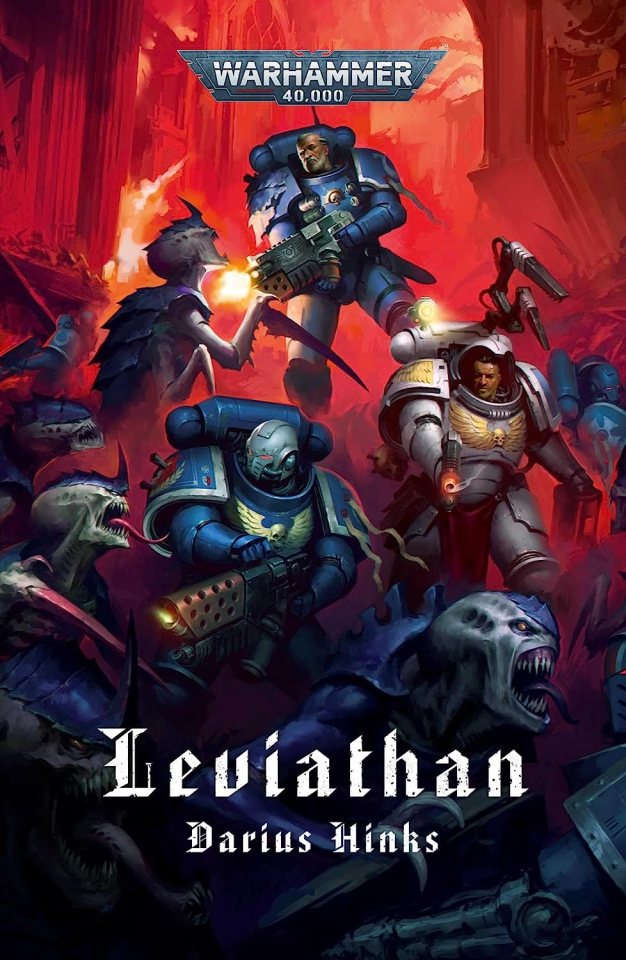
Publisher: Black Library (Audiobook – 24 June 2023)
Series: Warhammer 40,000
Length: 12 hours and 13 minutes
My Rating: 4.5 out of 5 stars
Prepare for all-out war as the righteous Ultramarines battle the insidious Tyranids in this epic new Warhammer 40,000 novel from Darius Hinks, Leviathan.
It has been a pretty good year for Warhammer 40,000 fiction already, with several fantastic novels coming out in 2023, including Warboss and The Lion: Son of the Forest by Mike Brooks (the latter being one of my favourite books from the first half of 2023), and Shadowsun: The Patient Hunter by Phil Kelly. However, the hits are far from over, especially as there are several fantastic new Warhammer 40,000 novels set to come out later this year. But before we get to those, I managed to jump onto another recent release with the outstanding novel Leviathan, written by established Warhammer author Darius Hinks. Hinks was a new author to me, but I soon grew to appreciate his latest book, especially as it showcased a dark and intense alien invasion that made for a great story.
In the far future of the 41st millennium, the besieged Imperium of Man faces many threats, but few are more deadly, unstoppable, or insidious as the unrelenting and seemingly endless hordes of the Tyranids, an alien race determined to devour everything it encounters. While several of the larger invading Tyranid fleets have been destroyed, a splinter tendril is making its way towards the galactic centre, threatening the very heart of the Imperium.
Standing in the way of this fleet is the fortress world of Regium, an ancient planet recently taken over by Imperial forces, it now serves as a bulwark against invasions heading towards the inner-Imperium. Many believe that Regium is secure from all threats, but when the people of the planet are haunted by parasites, strange cults, and mysterious dreams of terrifying monsters, it soon becomes clear that a Tyranid swarm is about to descend upon them.
It falls to the decorated hero, Lieutenant Castamon of the Ultramarines, to hold Regium against the foes and keep the rest of the Imperium safe. A veteran of many battles, Castamon believes that this new Tyranid fleet will be swiftly destroyed. However, these Tyranids are led by something far more sinister than the Ultramarines have encountered before, something cunning and ruthless that is able to disrupt minds and outthink even the cleverest of humans. With his forces split, Regium’s defences compromised, and his allies panicking, even the vaunted Lieutenant Castamon may be unable to save Regium from the Tyranid invasion. However, Castamon has one last trick up his sleeve, the brilliant Ultramarine Apothecary Biologis, Vultis, whose research into the Tyranid biology might be the only thing that can stop them. Unfortunately, the enemy knows all about the Ultramarines and their plans, and the deadly creature known as the Harbinger is coming for them.
Leviathan was a pretty awesome and intense Warhammer 40,000 novel that shines a real spotlight on one of the more insidious alien races in the canon. Featuring a strong and at times terrifying narrative, Leviathan was a great read, and I really got caught up in Hinks’s fantastic book.
Hinks pulls together an excellent story for Leviathan, and it is one that will appeal to a range of different readers, especially those fans of Warhammer 40,000 fiction. Set around the already troubled planet of Regium, Leviathan follows an intriguing range of different human/space marine characters as they attempt to make sense and prepare for a Tyranid invasion of their world. The early parts of the book are dedicated to introducing the key characters and the overall setting of the story, while also attempting to cast a more psychological edge to the main story as visions, doubts and other insanities haunt the populace. There are some great early action sequences, including a disastrous shipboard incursion, and a dark hunt in some interesting terrain, and Hinks works well to set up for the second half of the book, especially as several unique, character driven stories were introduced and given some early weight. While I enjoyed a lot of this set up, I did find the first half of the story to be a bit slow with its pacing and I was initially having trouble getting too invested in any of the characters or story elements. However, this changed when I got to the second half of the book.
This second half masterfully builds on all the setup and character development that occurred at the start of Leviathan and readers are in for a particularly intense and gruesome narrative from this point on. This entire second half is dedicated to the full-on invasion of Regium, as swarms of aliens, including some new creatures, emerge to decimate the populace and challenge the protagonists. Each of the character focused plot lines set up in the first part of the book, as well as a few additional story inclusions, are perfectly thrust into this overlying chaos, and you get to see them try to survive the oncoming horrors and monstrosities. Hinks really pulls no punches when it comes to this Tyranid invasion, and you get to witness all the devastation, the deadly transformation of the planet, and the subsequent epic battles, as the Tyranids fight against the human and Ultramarine defenders in some epic and well-crafted set pieces. Each storyline was really good in its own way, and together they formed a fantastic and at times over-the-top overarching narrative that successfully showcased just how overwhelming the Tyranids can be. I loved how dark Hinks made Leviathan at times, especially as he had no qualms about killing off key characters in some particularly brutal ways, which really raised the stakes for the reader. While I did think that a lot of the plot did rely a little on the narrative stupidity of certain characters (the Ultramarines kept forgetting everything they knew about the Tyranids), the second half of the book was extremely epic, and I had real trouble putting it down. All the separate storylines were concluded in entertaining and fitting ways, and I particularly appreciated the final plan that Hinks introduced for the main protagonists, which really fitted the outrageous feel of a lot of the plot. This brutal and continuously exciting second half really turned Leviathan into such a great read, and I really loved how the entire thing turned out.
Leviathan proved to be an interesting and compelling addition to the wider Warhammer canon, especially as Hinks took the opportunity to really dive into some of the factions and showcase how crazy they can be. However, I know that Leviathan has been copping a little flack in this department, mainly because some people see it as merely a promotional novel tied-in with some of the recently announced Ultramarines and Tyranid models. While I can definitely see that, especially as Hinks spends a lot of time highlighting some of the newer Tyranid creatures in his narrative, I still enjoyed Leviathan a lot. His depictions of the Tyranids were one of the major highlights of the book, and I loved how much he upped the horror aspect of them, showing them to be ravenous monsters who alter and devour everything they encounter. This might be one of the better portrayals of Tyranids that I have so far seen in Warhammer fiction, and they were certainly a lot less one-dimensional here than they are in other books. Part of this was because of the inclusion of several newer Tyranid creatures, such as the Neurotyrant and the Norn Emissary, with both being shown as unstoppable monsters with interesting abilities. This allowed the Tyranids to attack their prey in all new ways, and it was very fun to see the various intricate tactics they were able to come up with. Hinks tempers some of the more commercial aspects of these creatures’ inclusion by not actually using the names of the models in Leviathan, instead all you have is the protagonist’s descriptions of them when they encounter them in person. These personal and often deeply terrified accounts of the various Tyranid bioforms really help to showcase just how terrifying and alien they are, especially to the ordinary human, and it really added a great edge to the narrative. This darker edge is further exacerbated by the author’s powerful examination of how the planet of Regium is altered once the Tyranids arrive. The spores constantly raining down on the planet slowly poison the various humans as they breathe in, and the depictions of the protagonists dying from within as they inhale alien matter, while their skin starts to slowly melt is pretty damn memorable and terrifying, especially as this is the first step in turning all biological matter in the planet into edible goo. Frankly, I don’t think I’ve ever experienced the horror that is the Tyranid better than in Leviathan, and Hinks’ brilliant use of this faction enhanced the entire book.
On top of the Tyranids, Leviathan also features another intriguing major faction, the all-time classic Ultramarines chapter of Space Marines. I mostly liked how the various Ultramarine characters were featured in Leviathan, although I did think that Hinks could have perhaps done a little more to distinguish them from other general Space Marines. Still, Hinks goes out of his way to make the Ultramarines as badass as possible, and you really get a sense of their courage and battle prowess, especially as the severally outnumbered Ultramarines (I won’t go into the logistics of Regium’s defence here, but it did seem a tad low for such a vital planet), managed to put up quite a showing against the Tyranid swarm. Some of the fight sequences featuring the Ultramarines in combat were pretty damn epic, and while some Space Marines did die easily for plot effect (especially when going up against a Tyranid with a new model), I felt that Hinks did a good job highlighting just how dangerous a Space Marine can be. Hinks really tries to cover various aspects of the Space Marines throughout Leviathan, including the reverence and respect that most normal people have for them, and while this might not be the absolute best portrayal of an Ultramarine detachment ever, it was still pretty damn good, especially in those fantastic fight sequences.
I also must highlight some of the great characters featured within Leviathan as Hinks comes up with a diverse and compelling cast to tell the story with. Thanks to the way the story is set out, each of the key plotlines revolves around some excellent characters, each with their own motivations, missions, and big moments, as they try to weather or escape the oncoming Tyranid doom. Hinks crafts some great storylines for each of these major characters, and it proves easy to get invested in them, such as the tale of two ordinary farm workers who try to escape the monsters around them, the hapless Governor who finds himself out of his depth, or the proud Cadian leader who is drawn into war by the machinations of a delusional priest. However, some of the best characters in Leviathan are members of the Ultramarines, and much of the story focuses on the elites of this chapter on Regium. I really enjoyed these major Ultramarine characters, including the bold Lieutenant Castamon, the heroic leader who lives up to all the hype, the Apothecary Biologis, Vultis, whose analytical mind and desire for knowledge might hold the key to victory, and even the arrogant Sergeant Tanaro has his moments, especially in that powerful last scene. However, my favourite character in the book is probably the scarred Ultramarine Baraca. Baraca is a seemingly unkillable figure who has survived an insane amount of damage, but who has grown detached from even the rest of his battle brothers. Despite appearing to be a mindless brute, Baraca is a deep and complex figure whose friendship with Vultis provides some emotional power to their scenes together. Baraca honestly steals every scene he is in, especially his last, and Hinks writes a great storyline around him as he courts death, while trying to find his place in life. All these characters, and more are very well written, and the impact they have on the plot is pretty impressive.
Like most Warhammer 40,000 content that I absorb, I chose to listen to Leviathan’s audiobook format, which is such a fantastic way to enjoy these intense stories. I think that I made the right choice when it came to Leviathan, as this amazing audiobook really helped to throw me into the midst of the action. Narrator Theo Solomon did an excellent job of setting a fast pace with his narration, and his descriptions of the massive battles, compelling heroics, and gruesome aliens was very fun to listen to. While I wasn’t always the biggest fan of some of the character voices that he came up with, Solomon did produce some excellent tones for some of the main characters, particularly that of Lieutenant Castamon, who is made to sound very heroic and bold, which worked to showcase this intriguing protagonist. As such, I felt that this was an excellent way to enjoy Leviathan, and with a run time of just over 12 hours, this isn’t a massive audiobook to get through, especially once you get caught up in the impressive second half. I had an awesome time with Leviathan on audiobook, and I recently featured it on my favourite audiobooks from the first half of 2023 list.
Overall, I think that Leviathan was a pretty good Warhammer 40,000 novel and I was pretty impressed with my first book from Darius Hinks. While I did have some issues with the story, especially in the early goings, this ended up being a very memorable and captivating read, especially thanks to the use of the cool Tyranid faction. Loaded with carnage, brutal fights to the death, and complex characters dealing with an oncoming horde of clever aliens, Leviathan was an outstanding novel that deeply enjoyed.





 The Unseen Library