Throwback Thursday: Warhammer 40,000: Space Wolf by William King

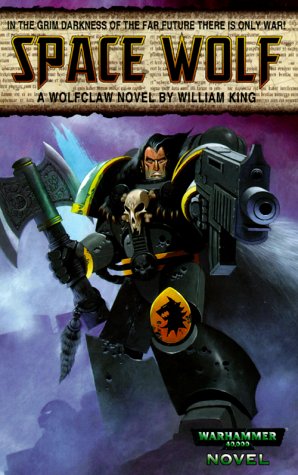
Space Wolf Original Cover

Publisher: Black Library (Paperback – 1999)

Series: Ragnar series – Book One

Length: 266 pages

My Rating: 4.5 out of 5 stars

Amazon

Welcome back to my Throwback Thursday series, where I republish old reviews, review books I have read before or review older books I have only just had a chance to read.  For this latest Throwback Thursday I dive into the world of the Space Wolves chapter of Space Marines with the classic Warhammer 40,000 novel, Space Wolf by William King.

The Warhammer 40,000 expanded universe is truly blessed with the sheer range of unique stories that it contains.  From pulse-pounding crime novels (Kal Jerico: Sinner’s Bounty), deeply fascinating novels about aliens (Ruin, Reign and Ghazghkull Thraka: Prophet of the Waaagh!), haunting horror tales (The Bookkeeper’s Skull), and even brutal war stories by common soldiers (Steel Tread and First and Only).  However, at the end of the day, most of the more intriguing stories focus on the iconic and awesome Space Marines.  These genetically enhanced and over-armoured warriors are often the true MVPs of the Warhammer canon, with some great series based on them (for example, the 50+ book Horus Heresy series).  There are a ton of great Warhammer 40,000 series around the Space Marines that I am exceedingly keen to get into, and I was recently lucky enough to find a copy of the first book of one of them which I immediately dived into.

That book was Space Wolf by William King, who I best know from his epic work in the Warhammer Fantasy franchise with his Gotrek and Felix series (check out my reviews for Trollslayer, Skavenslayer, Daemonslayer, Dragonslayer and Beastslayer).  Space Wolf is the first book in King’s six-part Ragnar series (also known as the Space Wolf and Wolfclaw series).  Focused on the character of Ragnar, a legendary member of the Space Wolves chapter, this series sounded really cool, especially as I have been really enjoying King’s writing lately.  I ended up having a great time with this novel which contains an awesome and very fun story.

In the far future, humanity is constantly at war with aliens, daemons, traitors, and heretics, all of whom wish to tear the massive and fragile Imperium of Man to shreds.  Humanities best and often last line of defence are the mighty Space Marines, the Emperor’s angels who fight the very worst xenos and spawns of the Chaos Gods.  Out of all the Space Marine chapters, one of the most respected, feared and honoured chapters are the Space Wolves.  Born from the genetic material of their legendary founder, Leman Russ, and bearing the touch of the wolf, the Space Wolves have stood tall time and time again.  But how does a mere man become a bestial and lethal Space Wolf?

On the planet of Fenris, Ragnar Thunderfist is a young warrior, content to work on his father’s ship and contend with the many dangers of his fierce and low-tech home world.  During a raid upon his village by a rival tribe, Ragnar is killed in a mightily duel after felling many enemies.  However, this is not the end of Ragnar’s journey; instead he finds himself waking up healed, resurrected by one of the mysterious Wolf Priests who watch over the planet.  Taken from the ruins of his village with other worthy aspirants, Ragnar learns that he has been chosen to become a member of the next generation of Space Wolves.

However, earning the right to join the Space Wolves is no easy task, and Ragnar soon embarks on a gruelling and lethal training regime that will test him to his very limit.  Working to hone himself into a living weapon, Ragnar will face trials, monsters and deadly rivalries as he attempts to prove himself.  But even if he is found worthy, the greatest trial involves the final transformation into a Space Marine.  The Canis Helix, which is implanted into all Space Wolves, bears a dangerous curse, which may turn even the strongest of wills into wild beasts.  Can Ragnar overcome the bestial rage that comes with this awesome gift, or will he lose his mind before he can serve the Emperor?  And what happens with the legions of Chaos arrive upon Fenris?

Space Wolf Cover 2

This was another exceptionally exciting and compelling read from William King, who perfectly starts another epic Warhammer series.  Space Wolf had a very different tone and structure to some of King’s other books that I have enjoyed, and I found myself getting really invested in this intriguing story of survival, self-discovery, and destiny.  Starting with an intriguing glance at the present, Space Wolf jumps back into the protagonist’s past, showing Ragnar’s formative years and the events that led to him being chosen by the Space Wolves.  Primarily told from the perspective of Ragnar, with a few sections told by an antagonistic alternate narrator, Space Wolf quickly turns into a fascinating examination of the intense training faced by potential Space Wolves recruits.  Most of the story follows the various stages of this intense military training and eventual genetic modification, and it was absolutely fascinating to see the changes the protagonist goes through.  While there is a lot of focus on expanding the lore and the character changes associated with it, King tells a concise and powerful story that really dives into the mind and personality of its protagonists.  This extended and brutal training sequence and initiations eventually leads up to the protagonist’s first mission as a Space Marine, which sees him and his team, many of whom you have also come to know, face off against an insidious foe on their own home world.  This last part of the book provides a ton of action, some intriguing horror aspects, and the introduction of a compelling antagonist who will likely show up in future entries in the series.  This final section really brings the entire narrative together extremely well, showcasing what the protagonist has been working towards, while also resolving some great character arcs.  I had a really fun time with this entire novel, and it has definitely made me keen to check out the rest of the series when I get a chance.

One of the most intriguing parts of Space Wolf was the way that it fits into the wider Warhammer 40,000 universe.  Specifically, this novel serves as a particularly good introduction to the legendary Space Wolves Space Marines chapter, who are one of the more popular factions in the extended universe.  King chooses to look at them from a rather unique direction, showing them purely from the perspective of the protagonist Ragnar, an inhabitant of a Norse-esque society with no concepts of space travel, advanced technology, or the wider universe outside of their lands, and whose understanding of the Emperor, the Chaos Gods, the Space Marines and more comes purely from myths and legends.  As such, for much of the novel Ragnar and his fellow initiates have no idea who the Space Wolves are, or what they have been chosen for.  The snippets they continue to get slowly inform them of the wider picture, and it was fascinating to see their blind faith that they were working towards something greater.  Their eventual initiation comes as a great shock to them, and seeing these previously simple warriors become elite Space Marines with knowledge of the wider universe results in some awesome and intriguing scenes.  I found it really fun to see the similarities and differences between the characters when they were normal and when they were Space Wolves, and it was fantastic to witness how their harsh roots results in Space Marines with some major Viking vibes to them (it’s one of the things that make them such a cool chapter).

However, King also ensures that the reader is given some intense insight into the dark side of the Space Wolves.  While their training is often harsh and lethal, and their treatment of the tribes of their home planet is very manipulative, there is something far more worrying lying beneath the surface.  The genetic manipulation that goes into creating them awakens a beast within them, with many losing their sanity or even their humanity entirely, reverting into beastlike creatures known as the Wulfen.  King does an awesome job highlighting the various ways in which the characters are changed, body and mind, throughout the course of Space Wolf, and there are some powerful scenes where they are forced to battle to control their new inner nature.  This really ends up being a particularly fascinating and well-balanced examination of the Space Wolves chapter, and I honestly could not think of a better introduction to this faction.  This cool lore, as well as the Norse-inspired aspects and Nordic-like wild settings, serve to beautifully enhance the entire narrative, and King’s choice to show all events from an uninitiated character’s perspective was just brilliant.  The use of Ragnar as a narrator also ensures that readers unfamiliar with the Warhammer franchise can also easily enjoy this novel, as they can learn about the wider universe at the same time as the protagonist.  Established fans, on the other hand, will get a lot of joy out of seeing the Space Wolves in this much detail, and they will no doubt have fun viewing the myths and unique interpretations that the various Fenris tribes place on the Space Marines and other elements of Warhammer lore.  As such, this is a novel that will really appeal to a lot of different readers, and anyone with interesting in fantasy, science fiction, or even historical fiction, will probably have a great time reading Space Wolf.

Finally, I must highlight how good Ragnar was as a point-of-view protagonist.  Not only do we get the great insights into Space Wolves initiatives that I mentioned above, but there are multiple intriguing personality and mental aspects to his character that come across extremely well in the narrative.  Ragnar starts the book as a young warrior whose life is changed in a single day as his tribe is destroyed by a rival clan, his family is killed, and he himself is killed and then resurrected by the Space Wolves.  Worse, he is resurrected alongside the man who killed him, Strybjorn Grimskull, and is forced to train and work with him, despite their hatred for each other.  This results in a great deal of inner struggle for Ragnar as he is constantly torn between his honour and new responsibilities to the Space Wolves and his desire for revenge against Strybjorn.  Watching these two constantly circle each other through the training parts of the novel is awesome, and their issues get even more intense once they undergo the genetic change and become Space Wolves with bestial urges.  These intense inner issues and rivalries proved to be an excellent central plotline for much of the novel, and I felt that they dramatically enhanced the entire narrative very well, adding in some much need drama, comradery, and character development.  I cannot wait to see more of Ragnar and his fellow Space Wolves in the future, especially after how his first mission turned out.

Overall, Space Wolf was just as impressive and awesome as I hoped it would be.  William King did an exceptional job writing a fantastic introductory Space Wolves tale, and he continues to remain one of my absolute favourite Warhammer authors, especially with the excellent range he showed here.  Readers will love this outstanding dive into the Space Wolves and the wider Warhammer 40,000 universe that this novel contains, and Space Wolf is a highly recommended novel to anyone looking for an action-packed and exciting read.

Space Wolf Cover

Amazon

The Final Girl Support Group by Grady Hendrix

The Final Girl Support Group Cover

Publisher: Penguin Random House Audio (Audiobook – 13 July 2021)

Series: Standalone

Length: 13 hours and 55 minutes

My rating: 4.25 out of 5 stars

Amazon     Book Depository

Bestselling author Grady Hendrix presents one of the most unique and intriguing novels of 2021, The Final Girl Support Group, a compelling thriller that brilliantly explores the slasher movie genre.

Hendrix is an interesting author and screenwriter whose name I have been hearing a lot in the last couple of years.  The author debuted in 2012 and has gone on to write several fun horror-based novels, including Horrorstör, We Sold Our Souls and The Southern Book Club’s Guide to Slaying Vampires.  Each of Hendrix’s previous novels had some fun concepts, and while I have not had the opportunity to check them out myself, I did read some very positive reviews for the previous two novels.  Hendrix’s latest book is The Final Girl Support Group, which caught my eye a few months ago.  What I found was a cool and clever novel that proved to be a compelling and addictive read.

We all know who the final girls are.  They are the only survivors of the vicious horror killers and slasher fiends in the movies, who manage to kill their monsters, avenge their friends, and walk off into a bloody sunset.  However, what happens to these final girls after they survive the worst days of their lives?  How do the final girls move on?

For Lynnette Tarkington, the horror of her defining moment never truly left her.  Twenty-two years since surviving terrible experiences, she is still barely able to leave her apartment, with paranoia and fear forcing her to see unimaginable danger around every corner.  Her only solace is the long-running support group she shares with five other final girls who have gone through their own traumatising events.  Together these women have slowly begun to put their lives back together one way or another, until the fateful day that one of their number fails to show up to group.

It soon becomes clear that their missing member has been murdered, a victim of one of the monsters they all fear.  As the remaining final girls go to ground, Lynnette finds herself under attack by someone who knows all about her and her escape plans.  Forced to improvise outside of her comfort zone, Lynnette discovers proof that other final girls are also being targeted.  When evidence suggests that Lynnette is responsible for some horrendous actions, she goes on the run to find out who is framing her.  Desperate, terrified, and still bearing the scars from all those years ago, Lynnette’s situation looks grim, but her latest monster is about to discover that you never count a final girl out.

As you can probably guess from the awesome plot of this book, The Final Girl Support Group is a very interesting novel that has some excellent elements to it.  Hendrix has come up with a clever narrative for this book, especially as it contains a very fun and compelling take on the classic slasher films.

The Final Girl Support Group has an excellent and deeply entertaining narrative which tells a very unique tale of a plot to kill the survivors of classic horror killers.  Hendrix does a really good job setting up each of the characters and the different world they lived in.  From there the story moves fast, as the protagonist experiences a variety of attacks on herself and her friends from all manner of directions.  The middle of the novel slows down a little and is extremely heavy, really examining the psychology of the protagonist and her friends, while also containing some excellent reveals and dark moments.  This all leads up to a very exciting conclusion, which was extremely intense and reminiscent of the films Hendrix is emulating and honouring.

Despite its roots, this novel was written more like a character-driven psychological thriller rather than a pure horror read, which I think worked extremely well.  The entire novel is loaded up with some cool twists, and the eventual reveal about who is behind the plot is pretty awesome and has some clever set-up behind it.  I loved the author’s inclusion of certain in-universe fictional articles and other inclusions, such as horror movie reviews, listicles and police transcripts, which helped to enrich the universe while also providing some interesting context to the various characters.  While I did have some issues with the middle section of the novel, mostly because of my feelings towards the main character, I felt that the entire narrative came together extremely well, and the outstanding conclusion really enhanced the entire overarching story.  An overall compelling and addictive read.

Easily the best part of this entire novel was the author’s examination of the horror/slasher genre as part of the plot.  Hendrix is obviously a massive fan of the horror genre, which is not too surprising considering he has actually written a couple of horror screenplays, such as the weird and disturbing sounding Satanic Panic, which I’m kind of keen to check out.  This love of horror is very clearly shown throughout The Final Girl Support Group, as this book acts as a major homage to some of the most famous slasher films of the last century.  The five other members of the support group are all strongly inspired by the final girls from Friday the 13th, A Nightmare on Elm Street, Halloween, The Texas Chainsaw Massacre and Scream.  Each of these characters has a very similar backstory to the characters from these movies, and Hendrix takes the time to describe the events that made them famous, which are near matches to the films, with similar characters, events and sequels.  Even Lynnette’s story, which is shown in the most detail, bears a very strong resemblance to the controversial 1980’s slasher film, Silent Night, Deadly Night and its sequel (a somewhat more obscure film that I had never heard of).

As a result, this novel is chock full of references to these various films, as well as some other horror/slasher entries (there was one that sounded a lot like Leprechaun).  I must admit that I am not the biggest fan of the horror genre, and my knowledge of slasher films is limited, however, even I was able to pick up and appreciate most of the references, which was really cool.  Hendrix does a wonderful job of deconstructing the various films, and it was extremely compelling and fascinating to see the author explore the aftermath of the event, the psychology of the killers, and the concept of crazy film fans.  I deeply appreciated the way that Hendrix structure this unique world where all these slasher movies occurred, and it was very interesting to see stuff like the final girls getting the film rights to their experiences, or the acceptance that a killer will come back in one form or another for a sequel.  The author also explores the negative sides of the slasher genre, such as the fact that they can be rather sexist and exploitative, and that author manages to cleverly tie some of the violence of the novels into the alt-right and men’s rights movements.  I did think that the underlying message that all men are evil was plastered on a little too thickly (having every single male character be an ass was a bit much), but I suppose that was a pretty significant theme of these slasher films.  This examination of the horror and slasher genre was pretty damn amazing, and fans of these movies are going to absolutely love seeing all the subtle references and compelling homages.

While I loved the story and all the amazing slasher film references in The Final Girl Support Group, I did feel that the novel was rather let down by the characters.  I was not the biggest fan of protagonist and point-of-view character, Lynnette, and I am in two minds about how much I liked her.  I did appreciate the author’s depiction of her as extremely paranoid and traumatised, which felt very realistic and deep.  I also enjoyed her survivalist mindset, which reminded me of Jamie Lee Curtis’s character in the 2018 Halloween film.  However, what annoyed me was at how incompetent the character was.  While I understood that the author was building towards the character having a breakthrough and becoming more dependable, I honestly think he really overdid the hopelessness.  Despite all her training and disaster planning, she manages to mess up every single action, interaction, or plan that she engages in, and is constantly outsmarted by the most obvious ploys or traps.  It was so frustrating to see her screw up again and again, and I found myself nearly yelling at the book every time she made a mistake.  Honestly, if Hendrix had dialled back these traits just a little, I probably would have enjoyed this novel a little more.  That being said, I did really appreciate the changes to the characters that did occur, and it was great to see her get some wins eventually.  I also enjoyed some of the twists that Hendrix set up around the character, which proved to be extremely compelling and place new light on her story.

Other members of the support group include Dani (whose story is like Halloween), Marilyn (Texas Chainsaw Massacre), Julia (Scream), Heather (Nightmare on Elm Street) and Adrienne (Friday the 13th).  Hendrix spends a bit of time exploring these characters, and it was cool to see the exploration of all these classic final girls and the aftermath of their horrors.  I really enjoyed seeing how each of them moved on with their lives after their experiences, with the characters running the gauntlet from inspirational to depressing.  It proved to be extremely captivating to learn more about these characters, and I grew to like several of them, although Heather was pretty annoying (her issues relate to her more psychological experiences, and the character does redeem herself by the end of the book).  I did find myself getting frustrated with each of these characters at times, as they also make some classic horror movie heroine mistakes, such as not performing a double tap (rule one in a horror situation), and being so quick to disbelieve Lynnette, even after all their experiences.  There were also some noticeable issues when it came to portraying the character’s ages.  Despite each of these characters having their traumatic event occur in the 1980’s when there were teenagers, none of them act like middle-aged women, which seemed really odd to me.  However, in the end I was able to overlook some of these flaws, and I ended up enjoying each of the characters’ stories and development.

While I was tempted to grab a copy of The Final Girl Support Group as an ebook for a quick read, I ended up getting the audiobook version, which has a runtime of just under 14 hours and which took me about a week to get through.  One of the more interesting things about this audiobook format is the narrator, Adrienne King, who horror/slasher fans will recognise as the final girl of the original Friday the 13th and who also had a subsequent appearance in Friday the 13th Part 2.  I felt that this was a pretty brilliant choice, not only because King portrayed a final girl but because her own real-life experiences with stalkers mirrors what happens to the characters in this novel.  However, while I did think it was a very fitting choice, I have to admit that I was not amazingly impressed with King’s narration.  She did a good job keeping the novel going at a quick pace and providing some emotion and feeling to the story, but I didn’t like the way she voiced the characters.  There is some variation between some of the final girls, but I honestly found that King’s voice work highlighted some of the character’s annoying tendencies and it never fully drew me in.  Still, this audiobook format is a fine way to enjoy this novel, and it is worth checking out.  I am also sure that Friday the 13th fans will enjoying hearing King’s take on the novel, especially when she describes the various homages to her own film, including the similarities in the deaths between one of the characters and King’s final girl in Friday the 13th Part 2.

The Final Girl Support Group was a fantastic read and is one of the more memorable and inventive novels of 2021.  Grady Hendrix does an outstanding examination of the final girl phenomenon in this novel and manages to craft quite an impressive and enjoyable thriller narrative around it.  While I wasn’t the biggest fan of every aspect of The Final Girl Support Group, it is still a great novel to check out, and horror fans will love the excellent examination of the genre.  I am very glad I decided to check this novel out and I will have to keep an eye out for whatever unusual book Hendrix writes next.

Amazon     Book Depository

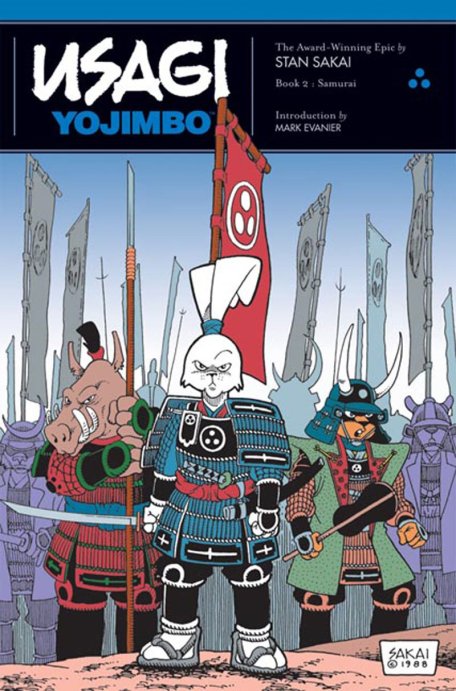
Throwback Thursday: Usagi Yojimbo: Volume 2: Samurai

Usagi Yojimbo Samurai Cover

Publisher: Fantagraphics Books (Paperback – 1989)

Series: Usagi Yojimbo – Book Two

Length: 141 pages

My Rating: 5 out of 5 stars

Amazon     Book Depository

After the fun that I had reviewing the first volume of the Usagi Yojimbo series, The Ronin, last week, I decided to follow it up with a review of the second volume in the series, Samurai. Samurai is an impressive second outing from author and artist Stan Sakai, which does an amazing job continuing his epic series after the introductory stories contained within the first volume.

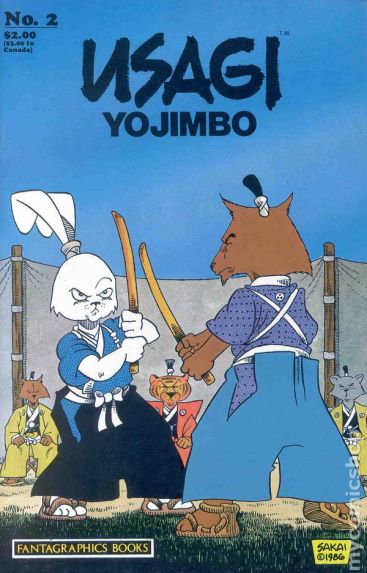
After his adventures in the first volume, the rabbit ronin Miyamoto Usagi has continued on his wandering ways. However, his latest journey quickly turns to violence when he encounters another ronin on the road. Without a word being spoken, both samurai engage in a swift and brutal duel to the death, in which Usagi is the winner. The only witness to the duel is the bounty hunter Gennosuke, who inquires into the origin of the apparent feud between Usagi and his recently deceased opponent. Usagi reveals that the dead samurai was named Gunichi and Usagi had much cause to kill him.

Usagi 1

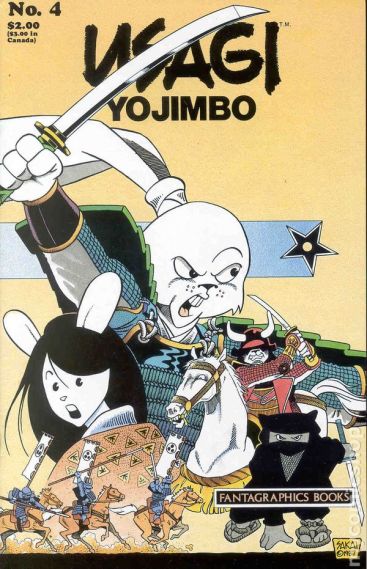
Regaling Gen with his tale as they travel together, Usagi reveals that the origins of this feud goes all the way back to his childhood and his tutorage under the unusual and skilled sword master Katsuichi. This tale follows Usagi as he becomes a young samurai in the services of his Lord Mifune, where he was comrade to Gunichi, and leads all the way to the fateful battle of Adachigahara Plain and the day that Usagi became a masterless samurai.

Back in the present, Usagi continues his adventures across the land, encountering many different people and unusual creatures. Watch him fight against a kappa, help defend a village of silk merchants against a roving group of bandits and witness his weird meeting with a mysterious and powerful little monster who is going to be a big somebody one day.

Usagi 2

Usagi Yojimbo: Volume 2: Samurai, is an amazing and fantastic volume of the Usagi Yojimbo series, which does an outstanding job continuing the story after the events portrayed in The Ronin. This second volume contains the first six issues of the actual Usagi Yojimbo series, and I really enjoyed the excellent adventures that are contained within these issues. The volume is broken down into four separate stories, the expanded story Samurai, as well as three stories which are significantly shorter. Each of these stories are really entertaining, and they all come together to create an impressive and incredible total volume of comics which I had a fantastic time reading.

The first story in this volume is also titled Samurai, and it is the major story contained within the Samurai volume. Running for 92 pages, this was one of Sakai’s first expanded Usagi Yojimbo stories, and I think it is one of his better ones. Samurai contains a captivating and exciting narrative that not only continues Usagi’s story in the present but which also goes back and explores much of the character’s past. This is shown through a lengthy flashback about Usagi’s childhood, his tutorage under the skilled samurai Katsuichi, his first meeting with Gunichi, their service under Lord Mifune, the events that led to Mifune’s war with the evil Lord Hikiji and the terrible final battle which cost Usagi his lord.

Usagi 3

Sakai comes up with an excellent background for Usagi in this story, and it was great to see how he expanded on some of the ideas and plot points that were featured within the first volume’s early stories. Even after all these years, the flashback contained with Samurai is still the definitive history of the character’s early days, although it has been expanded on several times in future volumes. This background is really intriguing, and I think that Sakai tells an amazing story, showing of Usagi’s unique training, his early triumphs including obtaining his swords, his service with Lord Mifune and then an expanded version of the battle of Adachigahara Plain, which has been briefly shown in the previous book. Woven into this is the tale of Usagi’s friendship with his fellow Mifune retainer, Gunichi, and the fateful day in their relationship that will cause Usagi to kill him the next time they meet. Sakai paces this entire extended story out well, and it turns into quite a complete and intriguing narrative. I like that it also added a lot more depth to the love triangle between Usagi, Mariko and Kenichi, and the scenes where Usagi and Kenichi put aside their differences for the first time for the sake of Mariko is great, and helps show that Kenichi is not a bad guy, he’s just occasionally blinded by his jealousy of Usagi.

I personally really enjoyed the scenes that featured Usagi and his sensei Katsuichi, the reclusive swords master. Their entire arc is really fun, and I love a good training sequence. Katsuichi is your typical wise and eccentric old hermit master who takes the young and eager student with potential under his wing to make him a superior student. Despite coming off as an aloof and hard man, Katsuichi is actually a kindly master who is impressed by Usagi’s determination and spirit (he gives a sly smile at the start of the training period). Katsuichi has some really interesting training techniques, and it is interesting to see how Usagi developed the skills that have kept him alive in the dangerous world he lives in. I loved the menial tasks montage, which is very reminiscent of The Karate Kid. It was also fun to see Usagi get randomly hit with a bamboo stick until he learns to anticipate surprise attacks, and I liked how it helped explain Usagi’s seemingly supernatural ability to sense when he is being watched or in danger. Overall, this proved to be an excellent inclusion to the story, and Katsuichi was easily the best new character introduced in this volume.

Usagi 4

Another major highlight of this first story is the part set in the present, which sees Usagi once again reunited with Gen. Gen was one of the better characters featured in the first volume, so it was really good to see him reintroduced in Samurai, especially as it helps set him up as a major recurring character in the Usagi Yojimbo series. Throughout the story, Usagi and Gen form quite an amusing partnership, with Usagi acting the honourable Zen warrior, while Gen is the unapologetic and uncultured mercenary. The two play off each other extremely well, with their great repartee and jabs at each other, and it is fun to see Usagi come out his shell a lot more around his companion. Gen also proves to be an entertaining audience for Usagi’s story, and it was fun to see his reactions to Usagi’s life tale. This was especially true when Gen started to get really into the story, despite his feigned indifference, and overreacted to several key moments. This entire story ends on a rather heartfelt moment between the two, with Gen indicating he completely understands how Usagi felt when he lost his lord “the saddest day of a samurai’s life is the day he becomes a ronin. Some day I’ll tell you how I became masterless…” and Usagi hinting that he really does see Gen as a friend. I really enjoyed seeing these two characters back together again, and this story definitely serves as a much better basis for their friendship than their backstabbing adventures in the previous volume. I also have to say, the silent dual at the front of the book between Usagi and Gunichi is the tops, and you could not ask for a better start to a story than an unexplained and sudden fight to the death.

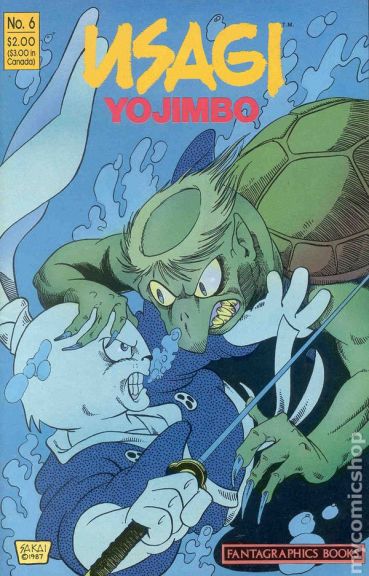
The next story featured in this volume is the short, horror-based story, Kappa. Wandering a desolate, swampy area, Usagi comes across a kappa, a Japanese water demon, who demands a toll to cross the marshes. While Usagi is able to pass, he must go back and try to save another traveller from the kappa, resulting in a desperate conflict. This is quite a good story, especially with the ghostly twist contained at the end. I really love that Sakai chooses to explore pieces of Japanese mythology like the kappa, and it was really interesting to see Usagi face off against one. There is also an extremely brutal and impressive fight sequence against the kappa featured within this comic, which was all manner of impressive.

Usagi 5

The third story in Samurai was called Zylla, and featured Usagi finding and befriending a mysterious creature hidden in the bushes, that he names Zylla, when he visits the hot springs. Zylla repays Usagi by saving him from some bandits using his fiery (one could even say atomic) breath and reveals itself as a large newborn bipedal lizard who Usagi speculates may be a god, “Are you a god, Zylla?”. This is a really fun short story in this volume, and it adds a fascinating new element to the world that Usagi Yojimbo is set in. It was also great to see Sakai continue to show off his love for Japanese culture by featuring baby Zylla, and he makes several humorous references to Zylla’s future work, such as how he should visit the big city at some point. All of this makes for an amusing entry in this volume and it had me smiling as I read it.

The final story was Silk Fair, which sees Usagi come to the aid of a silk worker, defending him from bandits. The worker takes him to his village, where Usagi eventually helps defend the village from a large bandit raid, after he deals with the silk works greedy administrator. This was a nice, short entry that showed a typical Usagi Yojimbo storyline of Usagi helping to defend the helpless again bandits. This was one of the first stories where Sakai explored a Japanese craft or industry, and while it does not go into as much detail as some of the later industry based stories (later volumes feature length depictions of things like sword crafting, seaweed farming, kite making and soy sauce production), it was still interesting to see. Silk Fair contained a good mixture of action and humour, and I especially enjoyed seeing the way Usagi managed to mess with the corrupt administrator and his cowardly bodyguard. There was also a rather unique battle sequence where Usagi and the silk workers are able to defeat the bandits with sewing needles and silk streamers. In the end, Silk Fair proved to be a strong and amazing story, and I felt that it was an extremely entertaining way to conclude this volume.

Usagi 6

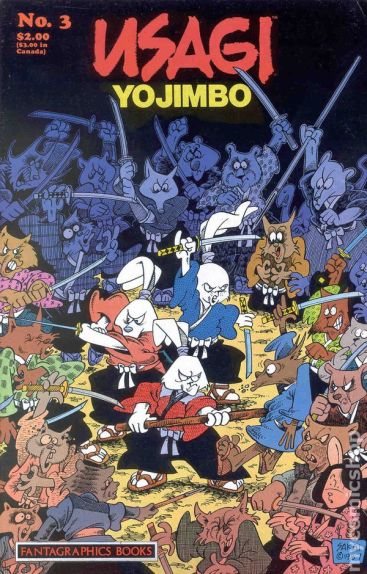
Like with every volume of the Usagi Yojimbo series, Stan Sakai’s artwork is once again a major and incredible highlight of Samurai. This second volume contains some fantastic examples of Sakai’s artistic talent, and it is clear that by the time he was working on the stories contained within Sakai had settled on his preferred designs for the various characters and landscapes featured, although further refinements did occur later down the track. This new character work is really impressive, and I liked how various new characters appeared, such as the warthog Gunichi and the lion based Katsuichi. I am also continually impressed with the way that Sakai can convey emotion and expression with his drawings, and you are constantly aware of what the various characters are thinking, just from seeing their faces. The various stories contained within Samurai featured some truly amazing and visually stunning landscape backgrounds, as Sakai continued his practice of showing off the beautiful scenery of Japan. Sakai also drew a number of impressive action sequences throughout the book, and he really got the hang of sketching out and showcasing the fast-paced and skilful fights that occurred between samurai. There are some impressive duel sequences throughout this volume, including the quick and sudden fight between Usagi and Gunichi at the start of the first story or the practice duel between Usagi and Kenichi which showed the ferocious fight between the two, which quickly ended with one strong strike from the obviously more skilled Usagi. Sakai also included several larger-scale battle sequences throughout the volume which really are something to behold. I particularly liked the major war sequence that showed the expanded battle of Adachigahara Plain. Sakai did an amazing job presenting the frenetic chaos of war and the explosive action that occurred with his art, and it was certainly a visual highlight of this volume.

Usagi Yojimbo: Volume 2: Samurai was an outstanding addition to the Usagi Yojimbo series, and it is one of my favourite volumes in this entire franchise. Stan Sakai presents a fantastic blend of character backstory, action, adventure, eye-catching art and clever humour in this volume, and the end result is a five-star comic which is really worth checking out. Thanks to the excellent background based main story, Samurai is a key volume in this series, making this book a must read. Samurai gets another five stars from me, and once again I have to strongly recommend this volume, and indeed the whole Usagi Yojimbo series, to anyone looking for an epic and enjoyable new series.

Amazon     Book Depository

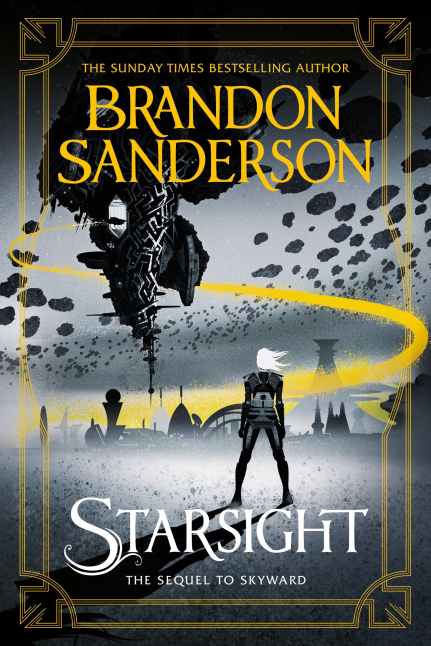
Starsight by Brandon Sanderson

Starsight Cover 2.jpg

Publisher: Gollancz (Trade Paperback – 26 November 2019)

Series: Skyward – Book 2

Length: 461 pages

My Rating: 5 out of 5 stars

Amazon

From one of the best authors of fantasy and science fiction in the world today, Brandon Sanderson, comes Starsight, an outstanding and addictive young adult science fiction read which continues the wildly entertaining adventures of a young starfighter years in the future.

Starsight is the second book in the Skyward series and follows on from the 2018 release of the same name. Skyward was a fantastic young adult science fiction book that told a compelling tale of bravery, determination and camaraderie in humanity’s distant future. Skyward was an amazing read, and it was easily one of my favourite books of 2018. As a result, I have been looking forward to Starsight for a while now, and it was one of my most anticipated releases for the second part of this year.

The Skyward series is set on the planet of Detritus, a desolate world that houses a population of humans in the caverns beneath the surface. The humans on Detritus are the remnants of a once great intergalactic human civilisation that has been destroyed in a war with a superior alien civilisation. Forced into hiding within the planet for hundreds of years, humanity eventually returned to the surface utilising scavenged starfighters to escape and build a military outpost to fight back against the alien ships who continue to harass the planet.

In Skyward, the reader is introduced to Spensa Nightshade, a young woman determined to become a pilot in the Defiant Defence Force (DDF), the military organisation that fights the alien invaders. While talented, Spensa faced opposition to being accepted into the military due to an apparent act of cowardice by her father years before. Despite the odds, Spensa was accepted in the DDF and was trained to become a skilled pilot, fighting in a number of actions against the enemy, while also trying to find out what actually happened to her father. Along the way, Spensa discovered an ancient but advanced human ship that had crash-landed on Detritus. Upon repairing the ship, Spensa discovered it had an AI installed in its computers, which she called M-Bot. After stopping an extremely destructive alien attack with the help of M-Bot, Spensa was compelled to fly through Detritus’s atmosphere, where she made several startling discoveries, the first of which was that Spensa and her family are powerful cytonics, beings with mental powers who are capable of traversing vast distances through space with their ability. The second discovery she made was that the aliens attacking Detritus were not simply mindless aggressors determined to wipe out humanity; instead they are members of an interstellar conglomeration called the Superiority, who are attempting to contain humanity within the planet. The Superiority hold a great fear of humans, who they see as an extremely dangerous and violent species, and Detritus is actually a prison planet/wildlife preserve where humans can live without disrupting the rest of the galaxy. Unfortunately, the actions of the DDF in reclaiming the surface and utilising spaceships have forced the Superiority to reconsider their approach, and they are now working to kill all the humans.

Usually this is the part of the review where I would give a brief plot synopsis of the new book and then go into an analysis of what I liked about it. However, this is going to prove a little hard to do without revealing some spoilers. While I don’t typically avoid talking about plot points that occur around 50-100 pages into book (I don’t particularly consider something happening that early to be a spoiler), I am a little more wary with Starsight. This is mainly because the plot of the book features some immediate substantial changes from the story that appeared in Skyward, none of which are really hinted at in any of the official online plot synopsis or book blurbs. As I am publishing this review a week before Starsight’s official release date, I think it is best that I put up a spoiler alert below, before I start going into the book in any real detail.

For those readers who do not want to risk any spoilers, I will say now that Starsight is an incredible book that I really, really enjoyed. Sanderson tells a wildly entertaining and highly addictive story that features some memorable characters, high-stakes events, some of the best science fiction action I have ever read and a ton of inventive world building. I honestly think that this is one of the best releases of 2019, and it easily gets a full five-star rating from me (if only I could go higher). I would highly recommend this book to anyone interested in an epic science fiction read, and if you loved Skyward, you are going to love this book.

Anyway, if you are not interested in learning any more details about this book’s plot or characters (which I do explore to a substantial degree), I would suggest you stop reading now, as everything below this paragraph has a spoiler alert in effect.

SPOILER ALERT:

Starsight is set a few months after the events of Skyward, and humanity has been busy. Thanks to Spensa and Skyward Flight, as well as the advanced technology contained with M-Bot, the DDF has managed to capture several of the planet’s ancient orbiting defensive platforms, which have allowed them to push the Superiority forces out of Detritus’s obit. However, despite these successes, humanity is still trapped on Detritus, and the eventual Superiority mass retaliation will likely wipe out everyone on the planet. Their only chance at survival is to flee from Detritus and find a new planet to make their home, somewhere the Superiority cannot find them. However, the only way to do this is with some form of hyperdrive, which humanity lacks access to, and Spensa’s cytonic teleportation abilities are too restrictive for mass use.

The crash-landing of an unknown alien spacecraft on Detritus may provide the solution that will ensure humanity’s survival. The pilot of this craft is a member of a non-Superiority species who has been invited for diplomatic reasons to enlist in a new Superiority fighter squadron, and she is able to pass on the cytonic coordinates to the squadron’s base to Spensa. Disguised with M-Bot’s holographic technology, Spensa travels to the Superiority space city, Starsight, in order to infiltrate the Superiority military and find and steal a working hyperdrive.

Joining the new Superiority squadron, Spensa discovers that she and her fellow recruits are being trained to fight the delvers, titanic inter-dimensional beings that dwell in the nowhere, who are capable of devastating planets if they are drawn into our dimension by an over-use of cytonic ability. But as Spensa attempts to complete her mission, she finds herself caught amidst the politics of the various Superiority races, many of whom wish for the complete and utter destruction of her people. Can Spensa navigate the strange new world she finds herself in, or will her actions result in the destruction of all she knows?

As you can see from the above synopsis, Starsight goes in some very interesting and unpredictable directions. I personally loved all of these new story elements, and the idea of Spensa having to infiltrate a mostly unknown alien society was a really clever and intriguing central plot idea that I think worked extremely well. The subsequent narrative is a fantastic blend of different story elements, which includes some great new characters, settings and plot directions, as well as some of the best parts of Skyward. For example, not only do you get to see a whole new take on the excellent space fighter training plot point that made the first book so amazing, but you also get a science fiction spy thriller story filled with all manner of political intrigue. This was a fantastic book to get into, and Sanderson has made sure that the plot is accessible to readers who did not get a chance to check out Skyward last year. However, I would strongly recommend reading Skyward first, not only because it will give you a better idea of the characters and certain plot elements, but because it is such an awesome book in its own right.

One of my favourite things about the first book in the Skyward series was the excellent group of characters that Sanderson focused on, including Spensa, M-Bot and the members of Skyward Flight. Throughout Skyward the reader got to know and care for these characters, and it was actually a little bit distressing when bad things happened to them. Skyward continues to look at several of the characters from the first book, although readers who grew attached to Skyward Flight might be a tad disappointed as Sanderson shifts the focus away from them and introduces the reader to a whole new group of alien characters.

Spensa is still the main point-of-view character for this second book and serves as a fantastic central protagonist. In many ways, Spensa is still the same impatient and reckless pilot that was such to see in the first book. However, it soon becomes obvious that the experiences, relationships and life lessons that she has faced since joining the DDF have tempered her in many ways, especially as she has to deal with the intense responsibility of being her people’s greatest hope for survival. I really enjoyed watching Spensa as she was forced to assimilate into the alien cultures on Starsight, and it was interesting to see how she reacted when she realised not everyone there is as evil as she believed. The opinions and support she gives to her alien friends result in some emotional moments, and it was really heart-warming to see how far she has progressed since the last book.

While Spensa is a great central protagonist, to my mind the best character in the entire book is still her sentient ship, M-Bot. M-Bot is the snarky and hilarious artificial intelligence that Spensa discovered crashed on Detritus, and together they form an efficient and enjoyable team. M-Bot honestly has all the best lines in the book, and nearly every interaction with Spensa results in some excellent jokes or banter. Despite the humour, M-Bot is a pretty complicated character, especially as in this book he is attempting to work out the full limits of his consciousness and code. He is continuously attempting to prove that he is actually alive, and these attempts result in safeguards in his system attempting to shut him down. I really enjoyed the way that Sanderson continues to utilise M-Bot. Even though he is a ship, he is still a fantastic and highly enjoyable character to focus on and we even get a reason for his mushroom obsession in this book.

Spensa’s new flight of Superiority comrades features an eclectic bunch of aliens, each with their own quirks and unique personalities. These include a figment called Vapour, who is essentially a sentient smell that can take control of ships and pilot them. Vapour is the ultimate spy and requires Spensa to be constantly on her toes. There is also the dione draft, Morriumur. Dione are a race of non-violent aliens high up in the Superiority hierarchy, who have a unique breeding system that combines the parents into one new being. This is a process that can take several goes, as the family of the newly bred dione may choose to reform a young dione so that they have an ideal personality. Morriumur is a draft, spending the first few months of their life testing out their personality to see if they are an ideal member of the species. Morriumur, who has slightly more violent tendencies than most of their species, is trying to prove that they belong as a starfighter, but the combined expectations of their family and the inner thoughts that they are not worthy, are a constant hindrance to them as a pilot.

While both of the above characters are pretty cool, and Sanderson spends a good amount of time exploring them, two members of Spensa’s new flight really stood out. The first of these is Brade, a human from another prison world who has been recruited as a cytonic enforcer by one of the book’s central antagonists. Brade, after being taken from her parents as a child, has essentially been brainwashed all her life to consider humans as evil and inferior, and this has a major damaging effect on her psyche. The interactions between her and Spensa throughout the book are quite fascinating, and she proved to be one of the most complex characters in this book. My favourite new character, however, had to be Hesho, who is totally not king of the kitsen. The kitsen are a race of tiny gerbil-like aliens who have recently converted from a monarchy to a democracy in an attempt to become a Superiority race. Hesho leads a group of around 50 kitsen who pilot one heavily armed fighter in Spensa’s squadron like it’s a capital ship. Hesho and the kitsen are really hilarious characters, mainly because Hesho is attempting to convince the Superiority that he is no longer ruling his people as a king, and instead the kitsen have embraced democracy. Unfortunately, despite Hesho insisting he is no longer a monarch in every interaction he has, his people continue to worship him, which kind of undercuts this message. I also found the similarities in the personalities between the kitsen and the Spensa we first encountered in Skyward to be very amusing, as the kitsen attempt to compensate for their size with extreme confidence and boasting like Spensa used to (for example, the first ship we see the kitsen flying is called Big Enough to Kill You).

All of the above characters are great, and I really loved the way that I was once again drawn into their various personalities and histories. It was a bit of a shame not to see too much of the characters I liked so much from the first book (although we do get an idea of what various members of Skyward Flight are up to), but I think the new characters that Sanderson introduced more than made up for it.

In addition to the fantastic character work, one of the other best features of Starsight is the epic and fast-paced action sequences that punctuate much of the book. Just like in Skyward, Sanderson presents a huge number of different scenes where Spensa is fighting or training in a fighter. The sheer amount of detail that goes into these various action sequences is pretty amazing, and I was able to picture all the flying and manoeuvres perfectly. The author comes up with a number of clever new scenarios in this book, including the fancy flying and combat required to fight a delver, or having Spensa fly in the type of craft she has been fighting against for her entire military career. All of the action in this book is first-rate, and I can guarantee that you will get lost in some of the incredible action sequences.

I have always been impressed by the elaborate worlds that Sanderson can create for his stories. Whether it is the vast fantasy world that he came up with for The Stormlight Archive, the supervillain dominated alternate version of Earth that appeared in The Reckoners trilogy, or the fantastic science fiction planet of Detritus that was the main setting for Skyward, Sanderson always delivers complex and intricate settings for his story, complete with huge amounts of backstory. In Starsight, Sanderson once again produces a huge and detailed new setting for his outstanding story. The alien civilisation that is living on Starsight is very impressive, and I love all the different alien races that he has come up with for this story. Many of the aliens have some very complex and fascinating history, a great deal of which featured in the story. I really look forward to seeing how Sanderson expands this universe even further in the final book in the trilogy, and I cannot wait to see what new aliens or civilisations he comes up with.

As you can see from this rather lengthy review, there is a lot to love about this book. Sanderson does an impressive job of combining the intriguing new story direction, the amazing characters, intense action and fascinating new setting into one concise narrative, and the end result is a perfect book. While Starsight is being marketed as a young adult book, and indeed it would prove appropriate for most young readers, it is really a novel that can be enjoyed by any reader of any age. I cannot recommend this book enough, and I am eagerly awaiting the next book in this series (which seems to be 2021 at this point, so far away!).

Amazon