
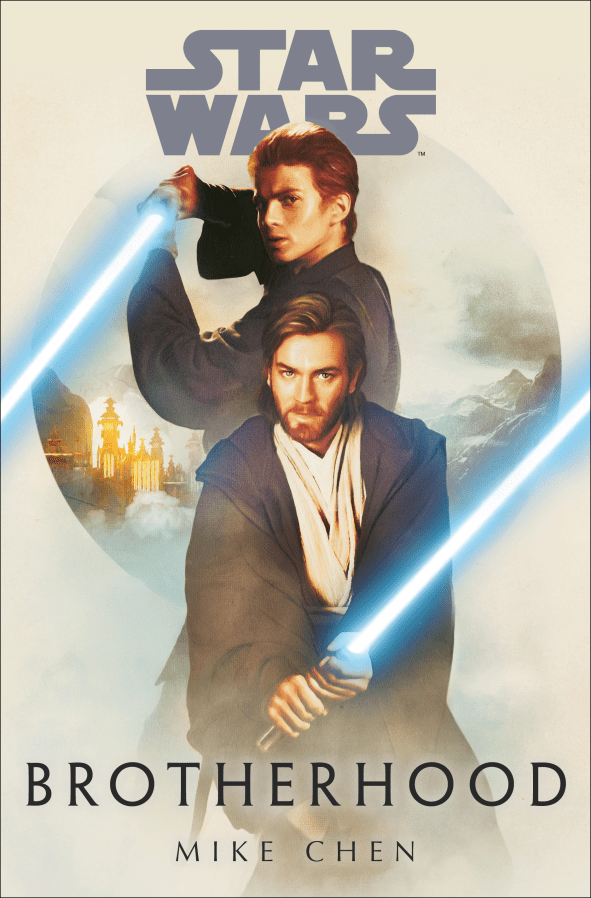
Publisher: Penguin Random House Audio (Audiobook – 10 May 2022)
Series: Star Wars
Length: 12 hours and 46 minutes
My Rating: 4.25 out of 5 stars
2022 is a great time to be a Star Wars fan as we are currently being bombarded with a string of awesome shows, cool comics, and fantastic novels (a movie also would be nice, but apparently there are issues there). Fans like me are currently having a great time with the Obi-Wan Kenobi live-action show that has been all manners of fun, especially as it brings Ewan McGregor and Hayden Christensen back to their iconic roles as Obi-Wan Kenobi and Anakin Skywalker. However, this is not the only recent Star Wars release that focuses on this iconic duo, as author Mike Chen presents Star Wars: Brotherhood. This is Chen’s first Star Wars novel and follows these two great characters as they embark on a dangerous political adventure right after the events of the film, Attack of the Clones.
It is dark days for the galaxy as the destructive Clone Wars between the Republic and the Separatists have just begun. As the galaxy splits down the middle and more and more systems join the war on opposing sides, the Jedi begin to take a new role as soldiers, the fragile peace they have long guarded slowly disappearing.
When an explosion devastates the neutral planet of Cato Neimoidia, home of the Trade Federation, the Republic is blamed by Count Dooku and the Separatists. Desperate to keep Cato Neimoidia from joining the Separatists, the Jedi dispatch Obi-Wan Kenobi to the planet to investigate the explosion and attempt to maintain the peace. However, Obi-Wan has his work cut out from him as he encounters a hostile planet, blinded by mourning and a long history of prejudice from the Republic. Worse, not everyone wants him to solve the crime, as Count Dooku’s sinister agent, Asajj Ventress, is also on Cato Neimoidia, attempting to turn the populace against the Republic.
At the same time, Anakin Skywalker has been promoted to the rank of Jedi Knight and works to balance his new responsibilities with his secret marriage. Despite orders not to intervene on Cato Neimoidia, when Obi-Wan finds himself in himself trouble, Anakin races to help him, dragging along a promising Jedi youngling. However, with their relationship forever changed by Anakin’s promotion, can the two Jedi brothers still work together as they attempt to grow beyond master and apprentice?
This was a fantastic new addition to the Star Wars canon that fans of the franchise are really going to enjoy. Containing an interesting character-driven story, Brotherhood was a great first outing from Chen, who successfully explored some of the best characters and settings of the Star Wars universe.
Brotherhood has a rather interesting multi-perspective narrative that I felt was pretty good. This cool Star Wars novel is set right at the start of the Clone Wars and seeks to not only highlight some early aspects of the conflict but also dive into the minds of the iconic protagonists, Obi-Wan Kenobi and Anakin Skywalker. The book has a strong start to it, with a devastating bombing going off on a neutral planet that forces Kenobi to investigate by himself. Arriving on a planet thick with emotion, undue influences and conspiracies, Kenobi finds himself in all manner of danger, while his former apprentice, Anakin, is forced into a far less interesting mission. Chen does a good job introducing the key elements of this book, and you soon get invested in the protagonists’s storylines, as well as the deeper emotions raging within them and other supporting characters about the bombing and wider events in the galaxy.
While I liked the start of the book, the centre of Brotherhood honestly dragged for me. Now part of this is because I had to have a break from audiobooks for a few weeks, but even when I started listening to Brotherhood again, I had a hard time making much progress. The slow investigation and Anakin’s slightly lumbering narrative, combined with the occasionally unnecessary plot around Mil Alibeth, just didn’t hold my attention as much as I had hoped, and it ended up being a bit of slog to get through it. Luckily, the pace really picks up towards the end as the various storylines start to coalesce into a more compelling and exciting read. I managed to get through the final third of the novel a heck of a lot quicker, and I was substantially invested in the characters, including a few supporting figures, and the narrative as a result. Everything comes together pretty well in the end and Chen delivers a mostly satisfying conclusion that hints at the wider threat to come. An overall entertaining, if slightly staggered narrative, I did have a lot of fun getting through it.
I mostly enjoyed how Brotherhood was written, as Chen did an outstanding job of blending compelling plot elements with deep character development and some fantastic universe-building. The main story itself features a mixture of investigation, conspiracy and personal conflicts, as Obi-Wan visits a hostile planet impacted by all manner of anger and mistrust. The author makes excellent use of multiple character perspectives to tell a complete and wide-ranging narrative. While a good portion of the plot focuses on the main two characters, Chen routinely throws in the perspective of several great supporting figures, including some antagonists, and it was fantastic to get some alternate views on the events occurring. As I mentioned above, I found the pacing was a bit off in the middle of the novel, and there were certain parts of the story that I had a harder time getting through. For the most part, though, the book flowed pretty well, and the switch between various characters helped facilitate that. While this is primarily a character-focused book, I did think that Chen did spend way too much time having his characters over-analyse everything in their heads, as the constant contemplation of their emotions or actions slowed the story down in places. However, I did think that the author was particularly good at capturing action, with some brilliant and intense scenes featured throughout the book. The ones that really shined to me where the sequences that showcased the Jedi character’s abilities in battle, as Chen made them come to life in a vibrant and powerful way. Overall, I thought that this was a mostly well written story, I loved how Chen’s distinctive style helped to enhance the narrative in places.
Brotherhood proves to be a particularly interesting piece of Star Wars fiction as Chen sought to not only expand on the main characters but also explore the wider universe during the early Clone Wars period. Written mostly as a standalone novel, Brotherhood has a lot of interesting canon elements that established fans of the franchise will deeply enjoy. The book is closely connected with both the events of the second prequel film, Attack of the Clones, and the following Clone Wars animated series. It was also apparently written somewhat in sync with another 2022 Star Wars novel, Queen’s Hope by E. K. Johnston, which I haven’t had a chance to read. However, despite this, most readers familiar with the films should easily be able to jump in and read Brotherhood without any issues as Chen does a great job of explaining all the key characters, concepts and other elements. There is also a ton of stuff for established fans of the franchise to enjoy as Chen spends a bit of time adding in some interesting elements and some great fan service.
One of the more interesting things featured within this novel is the examination of the early days of the Clone Wars. This hasn’t been greatly explored in the current canon too much, so it was cool to see the start of the war, with some of the earlier battles, conflicts and issues surrounding this galactic civil war. Chen spends a bit of time showcasing how the Clone Army was incorporated into the existing Republic structure, as well as the militarisation of the Jedi as they became commanders and generals. There is also an interesting examination of the rise of extremism during the Clone Wars, as various factions start to cause trouble outside the actions of the main armies. As a result, Brotherhood serves as an excellent bridging novel between Attack of the Clones and some of the preceding material, and I loved how Chen spent time setting up a few things for the Clones Wars animated series, although the sudden and unexplained appearance of a female clone was a bit odd. I also had a lot of fun seeing some of Palpatine’s machinations here as he subtly manipulates events to get the Jedi even more involved in the war and more integrated with the clones. There are also some key moments of the corruption of Anakin that occur here, and it was fascinating to see the moment that Anakin revealed his massacre of the Sand People to his future master.
While I deeply appreciated all the above, the most fascinating bit of Star Wars universe-building in Brotherhood had to revolve around the planet of Cato Neimoidia, the capital of the Trade Federation as Chen really went out of his way to explore this planet and its people, the Neimoidians. For years the Neimoidians have mostly been seen as the exploitive and evil villains from The Phantom Menace and were never really explored in that much detail. Chen spends a massive part of the book providing a deeper look at them and it soon becomes quite a compelling part of the novel. In particular, the Neimoidians and their Trade Federation are shown to be mostly neutral, trying to stay out of the war and disavowing the actions of Nute Gunray and his faction who are supporting the Separatists. When Obi-Wan arrives at Cato Neimoidia, he is introduced to their rich culture, unique society and a distinctive mindset that relies heavily on calculation and risk-assessment. However, Obi-Wan soon discovers that there is far more to being a Neimoidian than he ever realised, as the Neimoidians have a long history of being ignored, ridiculed and prejudiced against by the Republic. This long history of abuse, combined with the bombings on their planet, proves to be a deeply captivating and powerful part of the story. All these great Star Wars elements add a lot to the narrative of Brotherhood, and I had an outstanding time seeing all the clever new ways that Chen worked to expand and explore this iconic universe.
While the story and Star Wars universe are key parts of this book, Chen spends most of his time working on the characters. Brotherhood features a great cast of point-of-view protagonists who all have their own deep and unique journey through the book. However, the focus is on the pairing of Obi-Wan Kenobi and Anakin Skywalker, whose relationship lies at the core of the book. Both characters are featured very heavily throughout Brotherhood, and you are soon deeply invested in their individual narratives as well as their joint story. Chen paces out their appearances together very well, and you get to see them act as both a team and independently, although one of the main themes of the book is the examination of how well they work together as a team and how close they are. The author spends a lot of time exploring the unique relationship this master and apprentice duo have especially now that Anakin has become a full Jedi and they are now equals. This proves to be a fascinating element to focus on and I loved how powerful the character work around the pair and their relationship was.
On an individual level, Chen spares most of the focus to look at Anakin, who is going through a lot at this point in his life. Not only is he dealing with the sudden abilities of having to be a Jedi, but he is now secretly married to Padme, is trying to get used to his new robotic hand, and also bearing some anger and guilt at his actions of Tatooine. This presents many complications for Anakin, and he is constantly battling his emotions, desires and the feelings of disconnection that he feels to the rest of the Jedi. Chen does a great job of exploring the complex emotions and history surrounding Anakin, and you get a real sense of the inner conflict he feels all the time, especially when it is reflected in other characters. He does end up coming to grips with many of these issues as the book progresses, although some of them remain, leading to darker events in the future. The author’s focus on Obi-Wan is a little less intense, although there are still some very interesting elements there. Most of Obi-Wan’s concerns reflect his current mission as he finds himself dealing with a culture he doesn’t understand and whose emotions he has trouble responding to. At the same time, Obi-Wan is deeply concerned for Anakin, and his constant worries and examinations of their strained relationship deeply impact him. I found it fascinating to see Obi-Wan’s observations during this period, especially as he witnesses and chooses to ignore some warning signs around Anakin. Chen does a good job of trying to establish the more confident and wiser version of Obi-Wan that we see in The Clone Wars and Revenge of the Sith, and I it was very fun to see him negotiating and investigation on Cato Neimoidia.
Aside from these central characters, Brotherhood contains some other great characters whose storylines prove quite fascinating. The most prominent of these is Jedi youngling Mil Alibeth, whose unique connection to the Force makes her very sensitive to the pain people are feeling, so much so that she spends much of her earliest appearances trying to cut herself off from the Force. Mil finds an unlikely mentor in Anakin in this novel, and I appreciated the impromptu master-apprentice relationship they formed, especially as it benefits them both. Two Neimoidian characters, royal guards Ruug Quamom and Ketar Kor, also serve a significant role in the story, although in two different ways. The younger Ketar, whose family suffered greatly due to Republic prejudice, is extremely hostile to Obi-Wan and becomes a secondary antagonist, driven by his rage, anger and the manipulations of others. Ruug, on the other hand, is a veteran soldier and commando whose more cynical world view, a result of her long life of violence and black ops missions, allows her to see past her emotions and investigate the bombing properly. This results in Ruug becoming an ally to Obi-Wan as she tries to find the truth to save her people from more pain. Ketar and Ruug serve as interesting counterpoints to the Neimoidian emotional spectrum, and their separate impacts on the story are extremely fascinating. You really grow to like Ruug through the book, especially as she sticks to her principles, while Ketar, despite being an easily manipulated idiot, is one of the more understandable Star Wars antagonists you will encounter in, and his dive towards extremism is both powerful and understandable.
I also loved seeing fan favourite The Clone Wars’ character Asajj Ventress in this book, who serves as Brotherhood’s primary antagonist. The events of this book represent Ventress’s first canon interactions with Obi-Wan and Anakin, and it was fascinating to see them attempt to work out who or what Ventress is. Ventress ends up being very slippery and manipulative throughout Brotherhood, and she swiftly outmanoeuvres Obi-Wan by playing to the Neimoidian prejudices and emotions. I loved seeing this early Ventress appearance, and her conversations with Obi-Wan are really fun, especially as Ventress’s sarcasm, venom and contempt shine through in every sentence, only to be met by Obi-Wan’s politeness. This ended up being a great first major outing for Ventress, and I really enjoyed seeing how her rivalry with the Jedi began. The interactions, development and introductions of these great characters serve to really strengthen Brotherhood as a whole and I had a great time seeing Chen’s interpretations about all this amazing figures.
Naturally, I decided to check out the audiobook version of Brotherhood, which turned out to be an excellent decision. The Brotherhood audiobook was a fun experience that once again makes great use the classic and iconic Star Wars sound effects and music to enhance the story. At 12 hours and 46 minutes, this is a pretty standard length for a Star Wars audiobook, although it took me a little while to get through it. I had a lot of fun again with the sound effects which do a great job providing the ambient noise of the story that helps to bring the listener into the story. In addition, the always awesome Star Wars score is utilised to amazing effect during key parts of the book, and it is really impressive how much John Williams’s epic music can increase the impact of a scene.
In addition to the music and sound effects, the Brotherhood audiobook is greatly enhanced by its excellent narrator, Jonathan Davis. Davis is one of the best Star Wars narrators out there and his outstanding voice has been well utilised over the years. I have personally enjoyed Davis works in several fantastic audiobooks such as in Lords of the Sith, Kenobi, Maul: Lockdown, Master & Apprentice, Dooku: Jedi Lost, Doctor Aphra and Tempest Runner, and he is always great value for money. This was once again true for Brotherhood, as Davis does an outstanding job presenting the complex story to the listener while also bringing the various characters to life. Davis does a particularly good Obi-Wan Kenobi voice, which really helped here considering the character’s prominence in the plot. The rest of his voices are also very good, with multiple major and iconic characters come across in distinctive ways that fit how they have been portrayed in other media, particularly Yoda. In addition, the various new characters introduced in Brotherhood are also gifted fantastic and appropriate voices that allow the listener to distinguish who is talking. This excellent voice work, alongside the music and sound effects, really helps listeners to enjoy the compelling story and this is easily the best format to enjoy Brotherhood in.
This was another awesome addition to the rapidly expanding canon of the Star Wars universe. Mike Chen’s Brotherhood had an impressive and compelling narrative that not only explores some intriguing areas of Star Wars lore, but which also perfectly features two of its most iconic protagonists. A fantastic read that will appeal to anyone currently enjoying the Star Wars universe, Brotherhood is really worth checking out and I look forward to seeing what other awesome novels are added to this brilliant, expanded universe later this year.
 The Unseen Library