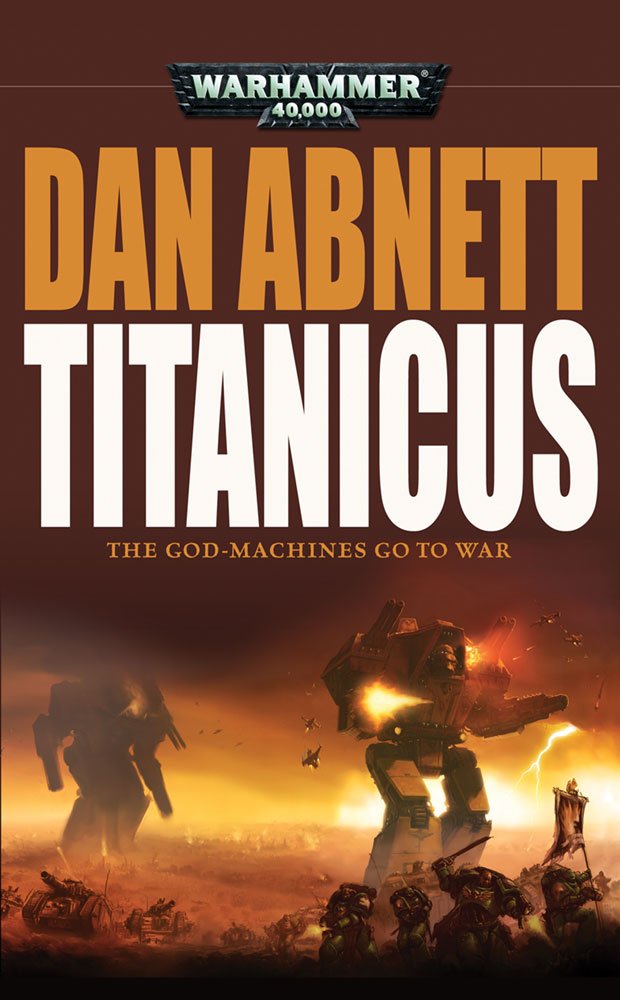
Warhammer 40,000: Titanicus by Dan Abnett

Publisher: Black Library (Audiobook – 1 September 2008)

Series: Warhammer 40,000/Sabbat Worlds Crusade

Length: 13 hours and 38 minutes

My Rating: 5 out of 5 stars

Amazon

The Titans walk to war in this brutal and captivating Warhammer 40,000 novel from the legendary Dan Abnett, Titanicus.

Of the many great Warhammer 40,000 authors out there, few are as impressive as Dan Abnett, who has envisioned an incredible number of awesome battlefields and unique character-focused war stories across the Warhammer universe.  Abnett has written a ton of exceptional and powerful books around the franchise, including several series considered to be the seminal texts of the extended universe.  This includes his brilliant Eisenhorn trilogy (XenosMalleus and Hereticus), and he has multiple entries in my favourite Warhammer 40,000 books list.  However, his best-known series is the Gaunt’s Ghosts books, which I am currently in the middle of reading.

The Gaunt’s Ghosts books are a key series of Warhammer 40,000 fiction that follows the frontline human soldier of this grimdark universe.  Set in an extended multi-planet campaign, known as the Sabbat Worlds Crusade, the Gaunt’s Ghosts books follow a ragged regiment of soldiers as they attempt to survive the dark servants of Chaos coming for them.  I am having an exceptional time reading the Gaunt’s Ghosts series, with books like First and Only, Ghostmaker, Necropolis, Honour Guard, The Guns of Tanith, Straight Silver and Sabbat Martyr, really impressing me with the complex stories and intense action.  While I need to read more of the Gaunt’s Ghosts books, I have taken a quick break to read some of the spin-off novels Abnett wrote around his main series.  Also set around the Sabbat Worlds Crusade, these spin-off novels follow other campaigns in this massive sector spanning war and provide Warhammer fans with a more in-depth view of these battles.  These spin-offs include the exceptional Double Eagle, which I had the great pleasure of reading last year, and which featured so many awesome duels between flyers.  Titanicus was another spectacular book shows a new and highly destructive battlefront of the crusade by focusing on the iconic Titan Legions of the Adeptus Mechanicus.

As war rage across the stars, the forces of Chaos constantly seek a way to disrupt the vital Sabbat World Crusade and destroy the human forces fighting to bring new worlds into the Imperium of Man.  To that end, the archenemy launches an ambitious and devastating surprise assault on the vital forge world of Orestes, whose under-strength defenders find themselves under mass attack from Chaos Titan war engines.  With both the citizens of the Imperium of Man and the forges of the Adeptus Mechanicus under threat, the planet appeals for help and soon finds its prayers answered from the stars in dramatic fashion.

Fresh from their own wars and heading out to join the crusade, the Titans of the Legio Invicta arrive on Orestes, determined to help their Mechanicus brethren.  Finding the forces of Orestes severely outwatched, the Invicta Titans stride to war, causing everything to tremble at the god-machines wrath.  Soon the world is engulfed in an engine war, with both sides wielding enough firepower to crack the planet and the entire population of Orestes caught in the conflict.

But as the war continues, a far more insidious threat arises that could impact far more than just the war on Orestes.  Deep secrets from within Orestes Forge soon begin to spill out, risking a schism between the Imperium of Man and the Adeptus Mechanicus.  With the planet trembling under the battling machines and enemy forces growing by the day, can Legio Invicta overcome the peril growing within their brotherhood before Orestes and the entire galaxy is put to the flame?

Dan Abnett presets another brilliant war story that is epic in every definition of the word.  Successfully presenting the awesome power of the Titans, Titanicus is a deeply compelling and impressive Warhammer 40,000 novel that I honestly could not get enough of.  Intense, exciting and so darn cool, Titanicus gets an easy five-star rating from me, as Abnett once again shows just how talented he is.

Titanicus had a particularly awesome and multi-layered standalone war narrative behind it that hooked me thanks to the author’s nuanced take on the destructive conflicts of the Warhammer 40,000 universe.  Starting off with some dark death to hammer home how grim the situation is, you are soon thrust into the main story as the planet of Orestes comes under attack and the defenders are pushed to the limit.  However, hope soon arrives with the landing of Legio Invicta, who back up Orestes’s existing Titans and defenders with their own engines and troops.  Abnett quickly and effectively sets up multiple character specific storylines as the book progresses that show various alternative viewpoints of the war.  The author works hard to showcase multiple levels of the conflict, from the top commanders all the way to the lowliest of soldiers, and I really enjoyed some of the intriguing storylines that emerged.  This includes desperate tales of survival by following human troops caught behind enemy lines and pursued by mechanical monsters, compelling dives into the minds of the Titan pilots, looks at the various political forces on Orestes, and even some fascinating storylines inside the Adeptus Mechanicus forge.  Abnett did an amazing job highlighting the desperate strife and the complex conflicts these figures endured, and you get a fantastic overarching look at the machine war that proves hard to look away from. 

As the plot of Titanicus continues, the various storylines go in some interesting directions, as you follow each of the characters or groups on their own unique journeys.  Abnett did a really good job of ensuring these unique storylines effectively played off each other as the book continues, and the way characters reacted to events from other plotlines was quite clever and helped to produce a cohesive and intense overarching narrative.  The introduction of a compelling storyline around intrigue and dissent amongst the Adeptus Mechanicus characters provides some extra drama and character conflicts, which added some interesting complexity to the plot, especially as it gave you an alternative group of antagonists which worked well alongside the menacing forces of Chaos, whose perspective you don’t see.  I appreciated how well Abnett set this storyline up in advance, and there are some clever hints to this, and other big events, earlier in the plot.

The final third of Titanicus is particularly impressive and intense, as the author brings together his various storylines extremely well.  I especially enjoyed some of the massive action sequences, while the resolution of the Adeptus Mechanicus storyline was powerful and full of drama as big personalities try to overcome mistrust and dissent.  While I would have liked to have seen the final battle in full, I think Abnett’s effective summary worked pretty well, and I understand that spending another few hours in combat would have watered down the author’s main message.  Each major character’s arc is resolved in a very satisfying manner, and there is an excellent blend of dramatic moments and intense action to keep the reader hooked.  I appreciated how a couple of these conclusions were more depressing, rather than being uniformly happy, which fits both the grimdark nature of Warhammer 40,000 as well as Abnett’s overarching themes that war has no true winners.  This story really came together well, and I deeply enjoyed the complex standalone narrative that Abnett came up with.

This was another insanely well written novel from Abnett, who excels at telling dark, deeply personal war stories from multiple perspectives.  The author provides the perfect balance of excitement, deep intrigue and fantastic character growth in Titanicus, all expertly set within the amazing Warhammer 40,000 universe, and it proves to be such an addictive read.  I personally became engrossed in the various character-driven storylines that emerged throughout the plot, especially the long-running storylines that lasted the entire book.  However, even the more minor character arcs, such as the occasional scene from a normal citizen living in the city to an extended look at the crew of a doomed machine, was hard hitting and Abnett really gets you invested in these personal tales.  As I mentioned above, these often-separate storylines worked extremely well in concert with each other, and Abnett did such a good job pulling them together into a brilliant, overarching narrative. 

Of course, you can’t talk about Titanicus’s writing without going into how incredible the action sequences are.  Abnett crafts together so many deeply intense and powerful battle scenes throughout Titanicus that constantly had the blood pumping as you watched your favourite characters brave the dark gauntlet of battle time and time again.  The author had a lot of fun envisioning war on multiple fronts, and I loved how we got to see infantry fights, tank battles and entertaining skirmishes between various augmented foes as the story continued.  However, easily the most awesome thing about Titanicus is the Titans themselves.  Insanely massive and powerful walking war machines, the Titans steal any scene they are in, and there are so many great reactions as the normal human characters see the Titans fight, especially when the despoiled enemy machines advance on them.  However, it is the sequences shown from the perspective of the Titan pilots themselves that are the best, as you become fully immersed into the battles in the scenes as the machines rain down destruction and depth.  You can honestly feel the insane powerful and destructive ability of the Titans as you move throughout Titanicus, and every single battle involving one of these massive walkers is epic on so many levels. 

As with the rest of Abnett’s books, Titanicus proved to be a particularly strong entry in the Warhammer 40,000 canon.  Serving as a companion piece to the Gaunt’s Ghosts books, Titanicus is a must-read to anyone who has enjoyed Abnett’s main series and the overarching campaign it is a part of.  However, as there are no overlapping characters or major storylines, Titanicus can also be easily read as a standalone novel, and indeed would be a great introduction to Abnett’s writing style and his ability to write awesome war stories.  Titanicus would also be the perfect entry novel to anyone interested in exploring Warhammer 40,000 fiction, especially science fiction readers who love the idea of giant piloted war machines.  The cool action, complex character arcs and fantastic standalone narrative ensures that anyone can really dive into Titanicus and have a brilliant time, and I honestly think this book would appeal to a wide range of different readers.

However, as with most books in the franchise, Titanicus will mostly appeal to those established Warhammer 40,000 fans who will love Abnett’s dive into some unique aspects of the universe.  Naturally, this is primarily going to be around the Titans, who are a very awesome part of the Warhammer 40,000 setting that are often underutilised in fiction due to being too overpowered (or getting badly nerfed when they do appear).  I think Abnett did these war machines perfect justice in Titanicus, and you really come away appreciating every aspect of them, including their raw power, their powerful spirit, and the love the crews have for them.  However, Abnett also dives into the dark side of the machine, and some of the sequences that show the pilots losing their humanity were particularly jarring.  Honestly, I thought Abnett’s portray of the Titans was just brilliant, and I have yet to see another Warhammer author do any better.  Abnett also takes a lot of time to dive into the lore surrounding the Adeptus Mechanics.  While these parts of the book might be slightly confusing for newer readers, established fans will love seeing Abnett explore these machine-worshipping figures, especially as a theological schism becomes a major plot issue.  Other cool lore aspects include examining the uneasy relationship between the Imperium and the Mechanicus on planets they share, the dark side of human life on a planet under siege, and even little fun moments, like a toy maker finally finding success as he makes models of the Titans battling across the world.  All these elements make Titanicus a particularly epic read for fans of the franchise, and I personally loved seeing Abnett’s take on all these cool universe inclusions.

While the writing, story and Warhammer 40,000 elements are all exceptional on their own, what really brings them together and makes Titanicus truly awesome are the multiple cool characters scattered throughout the plot.  Abnett introduces a huge range of fantastic and complex characters in Titanicus who you grow quite attached to as the plot continues.  All the characters, from major figures to minor one-scene characters, are fantastically written and cleverly influence the plot in their own cool ways.  Highlights for me included the desperate crew of a destroyed tank who try to escape on foot, only to find more danger in front of them.  A group of inexperienced conscripts who are completely unprepared for the horrors of war also prove to be really entertaining, and you grow invested in their struggles to survive and the tragedies that await them.  Abnett also examines several intriguing Adeptus Mechanicus figures within the Orestes Forge, whose frustrations, ambitions and struggles for power are far more human than they’d like to believe.  However, the best character arc for me was the one that revolved around the crew of a Legio Invicta’s Titan who are forced to accept an Orestes’ Princeps (the pilot plugged into the Titan’s mind) when their own dies without a successor.  The resulting conflicts between the inexperienced and arrogant outsider pilot and the veteran Legio Invicta crew, which includes the Titan’s moderati (second-in-command), who finds himself under a suspended death sentence, sets the scene perfectly, and you become really intrigued in seeing how the Titan will survive.  Watching these figures come together as a crew is a highlight of Titanicus, although Abnett does an excellent job twisting that around later when internal conflict splits the protagonists.  All these characters, and many more, gave Titanicus some real emotional heft, and I became so damn invested in seeing the final fate of so many of these outstanding protagonists.

I think that it’s kind of a given that I listened to Titanicus on audiobook rather than seeking out a physical copy of the book.  Warhammer audiobooks are so damn good, and frankly there is no better way to enjoy the franchise’s awesome narratives and compelling action.  This is particularly true for Titanicus, as the intricate details and impressive combat sequences really shine through even better when read out.  I especially loved how incredibly epic the various Titan-on-Titan battles came across in this audiobook format, and the fantastic voice of narrator Toby Longworth ensured that you were enrapt by every single second of carnage.  Longworth, who is one of my favourite audiobook narrators, always does an exceptional job bringing Abnett’s amazing stories to life, and he was once again exceptional here in Titanicus.  Longworth captures all the characters in Titanicus perfectly, and you get a real sense of their personalities, emotions and their reactions to the insane events of the book.  This includes the various Adeptus Mechanicus figures, which Longworth voices in all their mechanical glory, and you can just imagine these augmented figures, and indeed all the complex characters of Titanicus, as Longworth describes them.  This makes for such an exceptional experience, and I flew through the audiobook’s near 14-hour long runtime extremely quickly.  There is honestly no other way to enjoy Titanicus than on audiobook, and you are guaranteed to have an amazing time.

Dan Abnett continues to showcase why he is such a highly regarded author of Warhammer fiction with the brilliant and captivating Titanicus.  Perfectly showcasing a war between one of the franchise’s most epic components, the massive Titan war engines, Titanicus was an exceptional read from start to finish and one that I cannot recommend enough.  I had such a great time with Titanicus, and I look forward to reading even more Warhammer 40,000 books from Dan Abnett this year.
Amazon

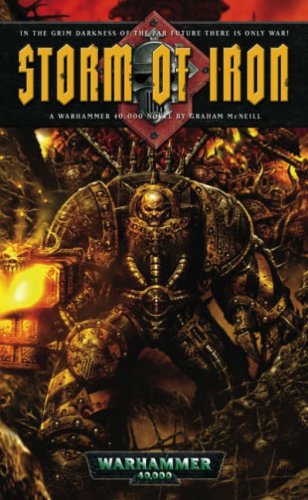
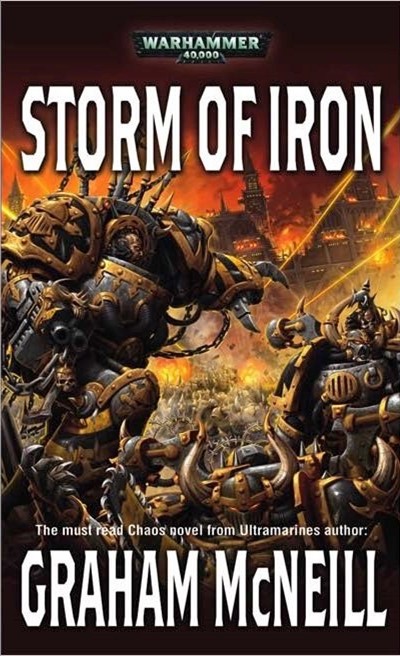
Throwback Thursday – Warhammer 40,000: Storm of Iron by Graham McNeill

Storm of Iron Cover 2

Publisher: Black Library (Audiobook – July 2002)

Series: Warhammer 40,000

Length: 11 hours and 3 minutes

My Rating: 4.5 out of 5 stars

Amazon

Welcome back to my Throwback Thursday series, where I republish old reviews, review books I have read before or review older books I have only just had a chance to read.  For this latest Throwback Thursday, I dive into some old-school Warhammer 40,000 fiction with the exceptional Storm of Iron by one of the most prolific Warhammer authors, Graham McNeill.

Readers of this blog will know that I have been really getting back into Warhammer fiction in the last few years, and I have had an outstanding time reading all the exciting and captivating reads the franchise’s extended universe contains.  I have been particularly impressed by the sheer number of talented authors who contribute to this extended universe, and I already have a few favourites due to how epic and complex their novels have turned out to be.  However, one of the main contributors to the current Warhammer canon I had not really explored yet is the superbly talented Graham McNeill.  McNeill has been writing Warhammer fiction for 20 years now, and he has produced multiple books for both the Warhammer 40,000 and Warhammer Fantasy sub-franchises.  Best known for The Ambassador Chronicles, Legend of Sigma, Ultramarines and Forges of Mars series, as well as his entries in the massive Horus Heresy series, McNeill has produced some outstanding sounding books throughout his career (including several books I really want to read) and had an incalculable impact on Warhammer fiction universe.  I however, have not had too much experience with his works, although I do have several of his novels sitting on my shelf.  I am hoping to read more of his stuff in the future, but I ended up starting with one of his earlier books, the standalone Warhammer 40,000 novel, Storm of Iron.

The Adeptus Mechanicus Forge World of Hydra Cordatus is a barren and desolate place, garrisoned by Imperial Guard of the 383rd Jouran Dragoons and members of Adeptus Mechanicus, who rule from one of the mightiest and seemingly impregnable fortresses in the galaxy.  No-one ever expected that the many wars that plague the universe would ever come to a planet as seemingly inhospitable as Hydra Cordatus, but hell has descended upon the planet in the form of Chaos Space Marines from the feared Iron Warriors legion.

Under the leadership of the dread Warsmith Barban Falk, the Iron Warriors have arrived on Hydra Cordatus in substantial numbers, determined to destroy all the Imperial defenders and take the planet’s main citadel.  After a blistering landing upon the surface of the planet that cuts off all hope of relief, the Iron Warriors deploy their full force of warriors, slaves, labourers and even several corrupt Titans to assault the enemy.  But they have not chosen an easy target, as the citadel of Hydra Cordatus is no ordinary fortress.  It is an ancient and mysterious stronghold, whose walls are designed to stymy any attack, and few foes would have a chance of defeating its defences.

However, the Iron Warriors have long been considered the greatest siege warfare specialists in all the universe.  Having honed their bloody craft for millennia since their betrayal of the Emperor, the corrupt Iron Warriors soon embark on an ambitious and fast campaign that soon threatens to completely destroy the Imperial forces.  Only the arrival of members of the Iron Warrior’s greatest enemies, the Space Marines of the Imperial Fists, gives any hope to the defenders.  But can even the legendary Imperial Fists stand against the ancient fury of the Iron Warriors?  And what secrets truly lay hidden in the depths of Hydra Cordatus’s citadel?

Well, this was a pretty damn awesome Warhammer book.  McNeill did a remarkable job with Storm of Iron, producing an intense and action-packed novel that might be one of the best siege novels I have ever had the pleasure of reading.  Loaded with impressive battle-sequence after impressive battle-sequence, as well as a ton of intriguing and fun characters, Storm of Iron was an outstanding read, and I had so much fun getting through it.

I will admit that one of the things that really drew me to Storm of Iron is that it showcases a massive siege in the gothic future of the Warhammer 40,000 universe.  I have always deeply enjoyed books with sieges in them, and the Warhammer universe is naturally filled with some good examples of this, although these mostly occurred in the fantasy focussed books.  As such, I was quite intrigued to see how a science fiction siege would occur, and McNeill really did not disappoint, painting a powerful and captivating picture and using the Iron Warriors and Imperial Fists, both of whom are known for their siege craft, as central figures in the narrative.

McNeill starts Storm of Iron off with a bang, showing the Iron Warrior’s initial move as they launch a lightning-fast raid and landing upon Hydra Cordatus in the opening chapters.  From there, the siege of the citadel starts in earnest as the Iron Warriors deploy their entire army towards it.  Told from multiple character perspectives of both the attackers and defenders, you swiftly get to know all the key players of the book and see their various personal and military struggles as the siege unfolds.  The author sets everything up perfectly, and you are soon engrossed in the novel-spanning siege, which McNeill explores in intricate detail, examining the various moves and countermoves that the two sides are doing.  You get some awesome scenes throughout Storm of Iron, and it really has everything you could want from a siege book, including artillery barrages, trench warfare, sapping, sallies, reinforcements, counterattacks and desperate fighting in breaches.  The entire story moves pretty quickly, and there are barely any pauses in between battle scenes.  Any delays that do occur serve an essential part of the plot, showing the various personal issues impacting the participants, introducing new characters, or exploring some of the hidden intrigue going on within the besieged citadel.

The story picks up even further around the middle, with the arrival of the Imperial Fists Space Marines who give the defenders more of a fighting chance.  As such, you are never quite certain how the book is going to unfold, and the battle really could go any way.  I liked how McNeill balanced the book between the Chaos and Imperial characters (or the attackers and defenders), and I deeply enjoyed seeing how each side conducted their war, especially as both had to deal with internal dissension and setbacks.  I think that the narrative had a great blend of cool story elements, and the combination of action, intrigue and character work fit the story very well.  Naturally, the best part of the book is the exceptional battle scenes, and thanks to author’s detailed depictions, it is extremely easy to envision all the intense fight sequences that unfold.  There are some outstanding scenes here, and there is a little bit of everything, included destructive ranged warfare, brutal close combat fights, desperate last stands and even some over-the-top battles between the massive Titans (essentially intense mecha warfare).  This entire story comes together pretty well, and I really liked the fantastic and dark notes that McNeill left it on.  While I wasn’t too shocked by one of the book’s main twists, there honestly wasn’t a moment where I wasn’t entertained by Storm of Iron’s story, and I had such a fantastic time seeing this entire epic siege unfold.  I managed to power through this book extremely quickly, and I had so much fun seeing how this protracted battle unfolded.  As such, this is a must-read for all those who love a good siege book, and I really appreciate the awesome story that McNeill featured here.

I love all the cool Warhammer 40,000 elements that McNeill was able to fit into this awesome book, and fans of the franchise will appreciate his attention to detail and fun depictions of the various factions and their iconic regiments/toys.  While the Imperial Guard, Adeptus Mechanicus and Imperial Fists are all featured here, this book is mainly about the Iron Warriors, and it was fascinating to see them in action.  These traitorous and corrupt siege specialists have a rich history of hatred, and while the author doesn’t go completely into their fall from grace, you get a good idea of why they turned and some of the terrors they have inflicted.  Indeed, all the depictions of the Chaos side are extremely powerful, and you get an impressive view of just how twisted and dangerous they and their dark gods are.  That being said, you get a much more nuanced viewpoint of the Chaos side here than most Warhammer books have, and it was utterly fascinating to see their views on the conflict.  That, combined with some of the secrets that the Adeptus Mechanicus are hiding, continues to reinforce one of the key concepts of the Warhammer 40,000 universe: that there really are no good guys here, just winners and dead people.  Thanks to author’s ability to highlight key universe and faction details, this is one of those Warhammer 40,000 books that could serve as a great introduction to Warhammer fiction, and if a massive and bloody siege doesn’t get your attention and make you interested in this franchise, nothing will.  As such, you don’t need to come into Storm of Iron with too much pre-knowledge of the Warhammer 40,000 universe to enjoy this book, although established fans will naturally get a lot more out of it.  I am personally glad that, of all of McNeill’s books, I chose to start with Storm of Iron, especially as it apparently sets up some of his future Warhammer entries.  In particular, it introduces one of the key antagonists of his Ultramarines series, which has long been on my to-read list, and I look forward to enjoying more of McNeill’s epic Warhammer books in the future.

I also deeply appreciated some of the excellent character work that was featured within Storm of Iron.  Due to how McNeill writes the story, the book features a huge range of different point-of-view characters, broken up between the Iron Warriors and the members of the 383rd Jouran Dragoons who are defending the citadel.  While the quick-paced story and multiple character perspectives cuts down on development a little, you do get to know all the key characters very quickly, and McNeill fits in some absolutely fascinating character arcs that I deeply enjoyed.  Three of the most interesting characters are the Iron Warriors captains who are leading the assault on Hydra Cordatus, Honsou, Forrix and Kroeger.  All three are pretty interesting in their own right, with Honsou the true believer ostracised by his comrades due to his heritage, Forrix the disillusioned veteran, and Kroeger the mad berserker who is slowly going insane serving the Blood God Khorne.  Their personal storylines are all amazing, but the real fun is seeing their interactions, especially as they all hate each other and are vying for their master’s favour.  McNeill spends a lot of time with these three villains, and you really get a sense of whole Iron Warrior’s legion through their disparate viewpoints.  I will say that I didn’t think any of the Imperial characters quite measured up to these Chaos characters, especially as McNeill really worked to make them as compelling as possible.  I did deeply enjoy the character of Guardsman Julius Hawke, a slacker who finds himself alone in the wilds and serves an interesting role in the battle.  I was also quite intrigued by Lieutenant Larana Ultorian, a defiant soldier who is captured by the Chaos forces and slowly driven insane by her forced service to them.  These characters, and more, all help to turn Storm of Iron into a much more complex and powerful read, and I had a great time explore all their unique stories and histories here.

I doubt anyone is going to be too surprised that I made sure to grab the recently released audiobook version, which in my opinion is one of the best ways to enjoy a cool Warhammer book.  The Storm of Iron audiobook was a pretty good example of this, as I quickly got drawn into it, especially as the awesome action sequences became even more epic when they are read out.  With a run time of just over 11 hours, this was a decent length Warhammer audiobook, although I managed to power through it in less than a week, mainly because of how much I got caught up in the story.  I was also pretty impressed by the narration from Michael Geary, who really dove into the various roles contained within Storm of Iron’s story.  Geary clearly had a lot of fun telling this dark tale, and I felt his fast-paced narration really added the intensity and excitement of the story.  I also felt that he did a great job bringing the various characters of Storm of Iron to life, and each of the main figures is given a unique voice or accent to help set them apart.  While I liked all the cool voices he did, Geary’s take on the various Chaos Space Marines was very memorable, especially as he really captures the cruelty, hatred and dark demonic influences that affect them.  An overall excellent Warhammer audiobook, I had such an exceptional time listening to this version of Storm of Iron, and this format comes highly recommended.

Overall, I am extremely happy that I chose to read this fantastic Warhammer 40,000 novel, and it was one of the more interesting older entries in the franchise I have so far read.  The extremely talented Graham McNeill did a wonderful job on Storm of Iron, and I had such an amazing time getting through its elaborate and action-packed narrative.  This book featured such an impressive depiction of a siege in the gothic far future, and readers are in for an intense and captivating time as they see this complex battle between besiegers and defenders unfold.  Clever, compelling, and filled with pulse-pounding fun, Siege of Iron was an excellent book and I look forward to reading more of McNeill’s Warhammer books in the future.

Storm of Iron Cover

Amazon

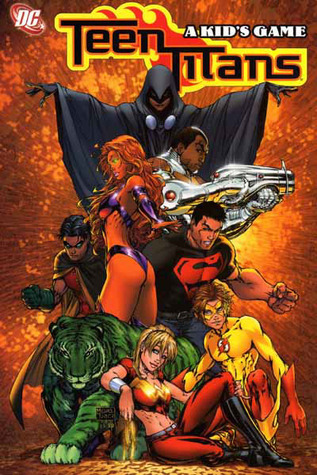
Throwback Thursday – Teen Titans Volume 1: A Kid’s Game

Teen Titans 1 Cover.jpg

Publisher: DC Comics (Paperback Edition – 1 April 2004)

Series: Teen Titans (2003)

My Rating: 5 out of 5 stars

Writer: Geoff Johns

 Artists:  Mike McKone

                Tom Grummett

                Marlo Alquiza

                Nelson

                Jeromy Cox

Amazon

Reviewed as part of my Throwback Thursday series, where I republish old reviews, review books I have read before or review older books I have only just had a chance to read.

Ever since I mentioned Geoff Johns’ 2003 Teen Titans series in one of my Top Ten lists last week, I have wanted to revisit the series.  I have always loved this run of Teen Titans the most.  Something about the combination of storylines, characters and this version of the artwork always spoke to me.  It was also one of the first comic series that I read and subsequently went out of my way to get every collected edition.  Even years later I still love dusting this series off, so I figured this would be a good time to go back and have a try at reviewing parts of this series.  That is why for this Throwback Thursday I will be looking at the first collected volume of the series, Teen Titans: A Kid’s Game.

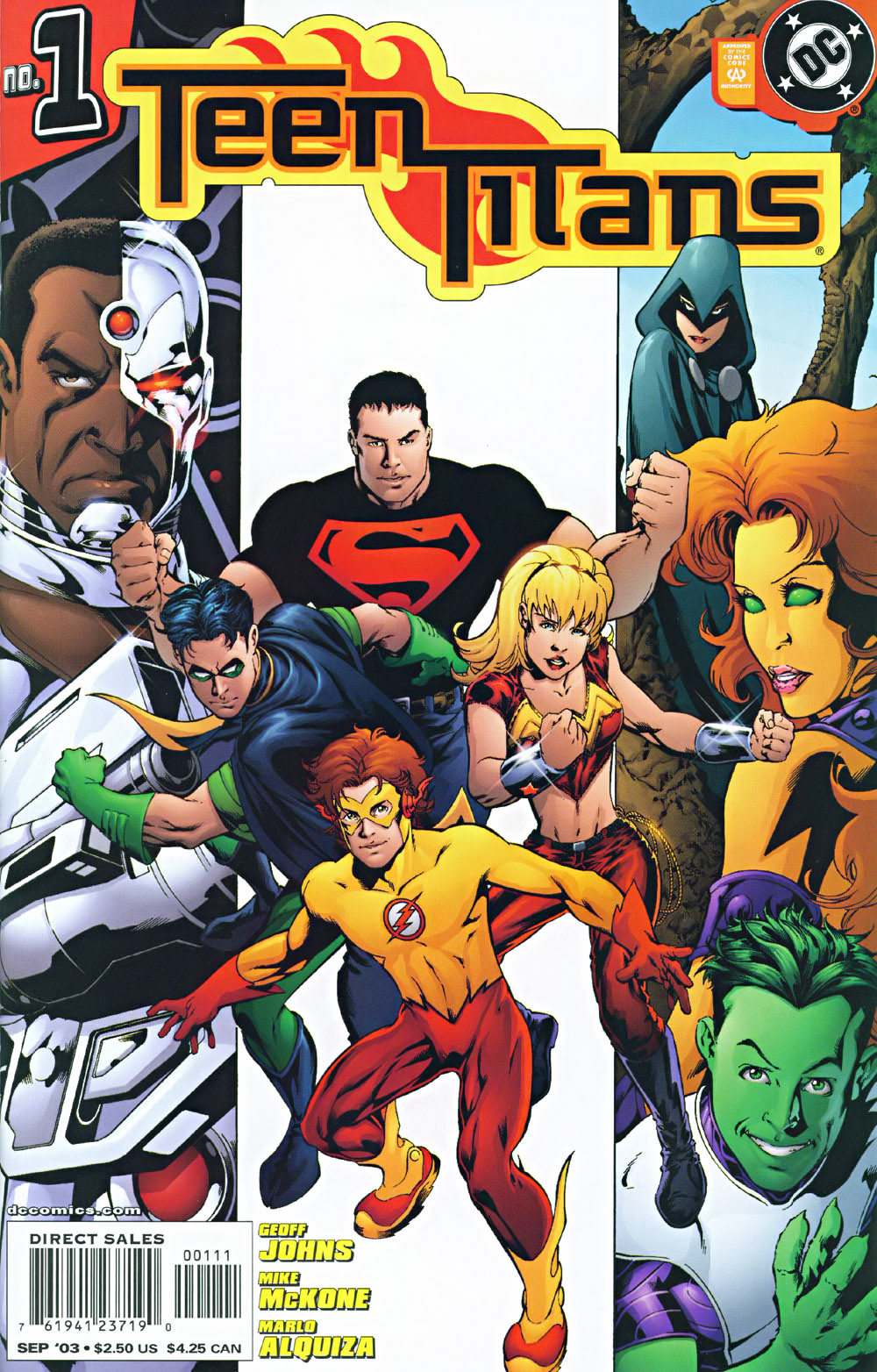
Teen_Titans_v.3_1.jpg

The Teen Titans are a team of teenaged heroes in the DC universe, usually the sidekicks of the universe’s adult heroes, but also featuring several characters without mentors.  The first formation of the Teen Titans occurred in 1964 and featured the original Kid Flash (Wally West), Robin (Dick Grayson) and Aqualad (Garth).  After a short while the original Wonder Girl (Donna Troy) joined their ranks and the team started calling itself the Teen Titans before it was given its own series.  Teen Titans was DC’s attempt to appeal to the younger generation of comic book fans, and it proved to be an extremely successful series, featuring a number of DC’s younger characters, including Green Arrow’s sidekick, the original Speedy (Roy Harper), who is considered a founding member of the team.  Teen Titans went through a number of different relaunches, with probably their most famous one occurring in 1980 with the launch of the New Teen Titans series, which brought back most of the original Titans, revamped Changeling to Beast Boy and introduced a number of iconic characters, including Cyborg, Starfire and Raven.  It also introduced several of the team’s most famous villains, including Deathstroke and Trigon.  The Teen Titans are one of DC’s most iconic superhero teams and have been featured in a number of media platforms, including the amazing Teen Titans animated show, Teen Titans Go (the less said the better), the dark and surprisingly good live action Titans and a number of key story and character elements have been included in the awesome Young Justice animated show.

Teen Titans went through a number of relaunches throughout the 1980s and 1990s, but the one most relevant to the 2003 Teen Titans comic series is the 1999 Titans comic series, which followed the adventures of adult versions of the original Teen Titans, most of whom had new superhero personas.  At the same time, DC launched the Young Justice comic book series (which I have talked about before) incorporating the younger generation of sidekicks (for example a new and younger Robin and Wonder Girl).  Both these series ended after the 2003 crossover limited series, Titans/Young Justice: Graduation DayGraduation Day featured a number of important events, including the sudden death of longstanding Titans member Omen; however, the most significant event was the death of the original Wonder Girl, Donna Troy.  The resultant despair and guilt following the death of this significant character led to both the Titans and Young Justice dissolving in what was to be conclusion of both these series.

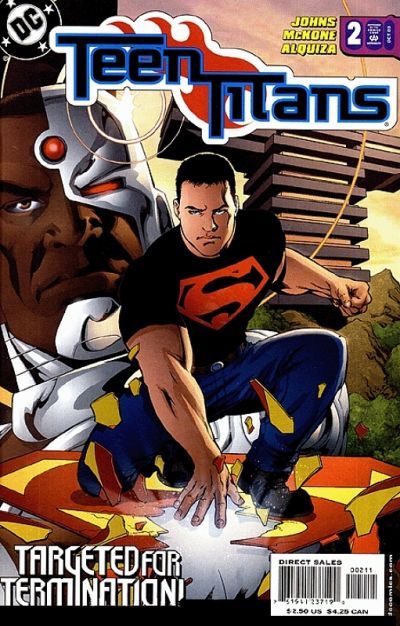
Teen_Titans_v.3_2

However, shortly after this, Geoff Johns started this specific run on Teen Titans, which combined elements of the cancelled Young Justice and Titans series, with the main four characters from Young Justice teaming up with some of the classic Teen Titans.  Another new series of Outsiders started around the same time and was heavily linked to this run of Teen Titans and featured Dick Grayson and Roy Harper.  This specific run of Teen Titans lasted until 2011, when DC initiated their New 52 relaunch (which I may or may not have some issues with).  Geoff Johns was the principle writer of this series until the 2005-06 Infinite Crisis limited series, which was a significant story point for all of DC’s titles at that point.  Due to the fact that Johns was the principle writer of the Infinite Crisis series, several of the younger Teen Titans (Superboy and Wonder Girl in particular) played a key part in this big crossover event, and several storylines from the 2003 Teen Titans turned out to be heavily linked to the crossover event.

Following the tragic events of Graduation Day, the young heroes that made up the superhero team Young Justice are lost.  Tim Drake (Robin), Conner Kent (Superboy) Bart Allen (Impulse) and Cassandra Sandermark (Wonder Girl) dissolved the team in their grief over losing the original Wonder Girl, Donna Troy, and have been avoiding each other since her funeral.  They may be the sidekicks of the greatest heroes in the world, but they are all missing their friends.  Despite their reluctance to team up again, each of them accepts an invitation from Victor Stone (Cyborg) to form a new version of the Teen Titans.  With a new base in San Francisco and other veteran Titans members Starfire and Beast Boy to help as mentors, Cyborg wants to bring these young heroes together again and forge an effective team.

Teen_Titans_v.3_3.jpg

However, before Cyborg can attempt to work with the four new Titans and convince them to stay on the team, a massive explosion rips through Alcatraz, endangering tourist lives.  As the Teen Titans mount a rescue, one of them is ambushed by the team’s oldest and most dangerous adversary, the world’s best assassin, Deathstroke the Terminator.  Deathstroke has long had a complicated relationship with the Teen Titans, but this time it looks like he wants to put the team down for good.  Claiming that kids should not wear costumes, he attempts to take out each member of the team, but what is the real reason behind his attack?  Can this new version of the Teen Titans survive the ruthless assassin?  What role will recently reborn Titan Raven play? Moreover, what will happen when the Justice League arrives to shut them down?

As I mentioned above, I am a huge fan in general of this entire run of Teen Titans, but this has to be one of the best instalments in the entire series.  Geoff Johns and his creative team came out of the gate swinging with this one and started the series off with a bang.  Not only does A Kid’s Game feature a fantastic storyline and contain some excellent character work, but it also serves as an outstanding first instalment of what turned out to be one of DC’s most consistent and captivating comic book series between 2003 and 2011.  The A Kids Games collected edition is made up of Teen Titans (2003) #1 – 7 and also features parts from Teen Titans/Outsiders Secret Files 2003, which can be useful for those readers unfamiliar with the characters, or at least that incarnation of them.

Teen_Titans_v.3_4.jpg

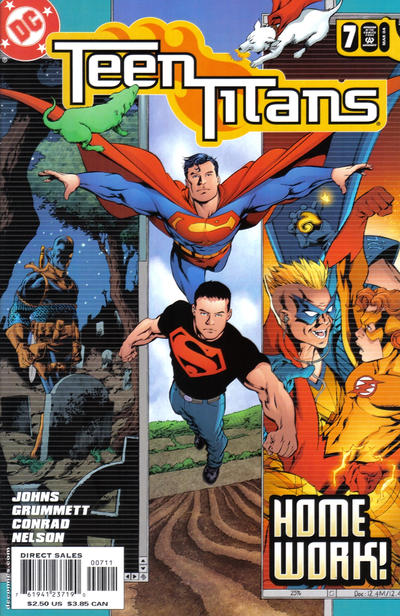
The storyline contained within A Kid’s Game has a lot of fantastic elements to enjoy within it.  The initial formation of the team is handled very well, as each of them is shown to be lonely or unsatisfied with their lives without their friends, and despite their misgivings decide to join up.  The follow-up battle between the team and Deathstroke is really good, and the team learning how to fight together while uncovering their antagonist’s motivations is very exciting.  Deathstroke has a hell of an entrance in this volume when he kneecaps Impulse at the end of the second issue in what is a pretty shocking and memorable moment.  I personally loved the storyline that occurred right after this in Teen Titans 2003 #6, when the Justice League, including the mentors of each of the younger Teen Titans’ members, show up and try to meddle with how the team is run.  This results in some chaotic action and a huge amount of amazing comic book drama, as the sidekicks fight and vent their well-justified frustrations to their mentors while also coming to terms with the guilt they feel over Donna Troy’s death.  I really cannot speak highly enough about this part of the volume, and I think this was what made me initially fall in love with the series.  The final storyline shows each of the characters during the school week, when it really helps to highlight the issues that being a part of the Teen Titans is helping them face.

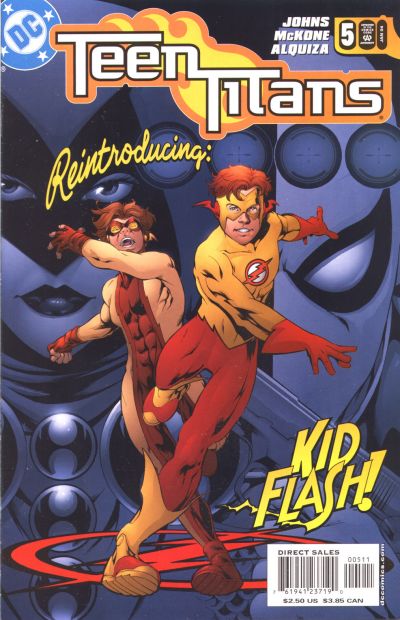
One of the things that I really like about this volume is that each issue contains a shocking reveal at the end.  I know that some comics overuse this, but I felt that Johns and his team were pretty justified in doing this, as they were trying to up the stakes during these first comics in their new series.  A lot of significant and surprising things are revealed during each of these issues, many of which would have ground-shaking impacts not just for the Teen Titan, but for the DC universe as a whole (Spoilers ahead).  This happens right in the first issue, with the reveal that half of Superboy’s DNA comes from Lex Luthor.  Other big events occurring at the end of each issue are the kneecapping of Impulse, the revelation that Jericho was still alive inside Deathstroke, Bart’s first appearance as Kid Flash, Wonder Woman showing up to start the brawl between the League and the team and the reveal that Lex Luthor is the person leaking information about Superboy’s genetics to Robin.  Even the quiet, final issue of this volume has a big reveal at the end, with the revelation that Rose Wilson is now working with her father Deathstroke.

Teen_Titans_v.3_5.jpg

The creative team behind this original run obviously had a great appreciation for some of the preceding Teen Titans series, as they utilise a number of key characters from these earlier series.  I personally thought that the issues contained with A Kid’s Game did a fantastic job of blending these old school Teen Titans storylines and character together with the former Young Justice characters, creating an excellent new dichotomy for the team.  This blend of the old and new helped create an excellent new series and was one of the best features of John’s run, and I also enjoyed the respect he showed towards the old Young Justice series.  I was also really impressed in hindsight with how well Johns and his team set up or hinted at a number of future storylines or character developments in these initial issues.  Many of these storylines (such as Superboy being a mixture of Superman and Lex Luthor’s DNA, Wonder Girl being related to Ares, Rose Wilson joining with Deathstroke, the resurrection of Raven and Jericho and the new Brother Blood) would have impacts for years to come and some are even utilised in comic series, television shows and animated movies to this day.  The creators of A Kid’s Game did an incredible job including them this early in the series, and they were really good introductions.

One of the best things about the entire 2003 run of Teen Titans is the focus on the characters and their development throughout the series.  While other volumes of this series feature some great character moments, nowhere is this more prevalent than within the issues that make up A Kid’s Game.  Most of the focus within this book is on the four characters, Robin, Superboy, Impulse and Wonder Girl, who are moving over from Young Justice to the Teen Titans.  The creators take a significant look at each of them and really work to develop each of them as substantial characters and develop them deeper than what they were within Young Justice.  With this impressive focus on developing and utilising these characters to their full potential, it is no wonder that they were utilised as such major characters during the Infinite Crisis storyline and beyond.  I also like how the older members of the team had to step up and assume a leadership role that readers had not seen before.  As a result, Cyborg and Starfire attempted to fill these leadership roles, while the slightly younger and less mature Beast Boy acts as the bridge between the two generations.  I thought that these new roles were really clever and added some new dynamics to the team.  I was also really impressed with how the creators focused on the trauma that all of the team members were feeling in the wake of Donna Troy’s death.  Each of them was racked with guilt after they were unable to help stop her death, and the anger and grief that each of them was feeling was extremely evident throughout the volume.

Teen_Titans_v.3_6.jpg

Another incredible part of this initial volume was the strong look at the relationship between the sidekicks and their mentors.  Despite the high regard each of their mentors holds in the superhero world, each of these sidekicks has issues that stem from how they perceive or are treated by their mentor.  The creative team really go out of their way to highlight these issues, and many are quite clever.  For example, Superboy, who is living as Conner Kent, appears to be frustrated at living a quiet life in Smallville, but as the story progresses it becomes clear that he is having trouble living up to the legacy of not only Superman but Clark Kent as well.  Robin is stuck wondering what his future holds and it soon becomes clear that he is reluctant to become like Batman, despite the fact that his is more like him than any of the Robins that came before him.  Wonder Girl is extremely angry and rebellious throughout this volume and is beginning to doubt her mentor Wonder Woman.  This is revealed to be a side effect of her trauma at the death of Donna Troy, and it soon becomes clear that she is one most impacted by the former Wonder Girl’s death.  Finally, Bart is sick of being considered not good enough to be part of the Flash legacy, as his own mentor does not think he is responsible enough to bear the Flash name (which is ironic, considering he is the only one of these young heroes whoever takes up their mentor’s mantle).  As a result, he acts like he does not care, while deep down he craves approval and Flash’s respect.  Bart easily shows the most growth within this volume, as he takes the Kid Flash mantle for himself, dedicates himself to learning all he needs to be a hero and vows to leave the Flash in his shadow.  All of these character issues come to a head perfectly when the Justice League arrives unannounced at Titan’s Tower and they try to meddle with their sidekicks lives and there are some amazing and cathartic moments between the younger heroes and their mentors.  His is comic book character work at its very best.

I have to note the great job the artistic team does throughout these first seven issues.  There are some great new character designs, such as Superboy’s iconic new look of jeans and a superman t-shirt, something that is still utilised within the Young Justice television show.  I also liked the way that Bart looked in the Kid Flash outfit.  The artwork on the action sequences is also pretty awesome, and there are a huge number of eyepopping scenes throughout this volume.  That shot of Kid Flash getting kneecapped is very impressive and really sticks with you.  Overall, there is some fantastic artwork, which works really well with the outstanding story and character work to create an excellent first volume.

Teen_Titans_v.3_7

Teen Titans: A Kid’s Game is an amazing first volume in the 2003 Teen Titans series.  I cannot speak highly enough about the storylines and the way that the creative team handle the complex young heroes.  A spectacular start to an incredible run one of DC’s most iconic series.  I fully intend to review some other volumes in this Teen Titans in the future so stay tuned for them.

Amazon