
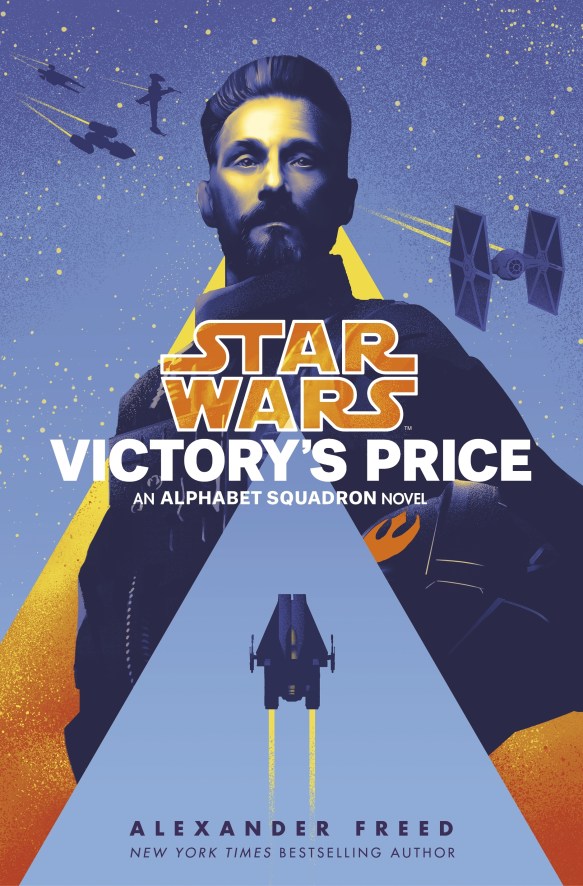
Publisher: Random House Audio (Audiobook – 2 March 2021)
Series: Star Wars: Alphabet Squadron – Book Three
Length: 16 hours and 19 minutes
My Rating: 5 out of 5 stars
One of the best Star Wars tie-in series comes to an epic and impressive end, as Alexander Freed presents Star Wars: Victory’s Price, the amazing third and final entry in the awesome Alphabet Squadron trilogy.
Since its inception in 2014, the current Star Wars extended universe has featured an amazing range of novels that tie into the various movies and television series. One of the best has been the Alphabet Squadron trilogy from acclaimed author Alexander Freed. Alphabet Squadron is a particularly compelling trilogy that follows a fantastic group of mismatched Rebel and Imperial pilots who continue to fight in the aftermath of Return of the Jedi. This series has so far featured two excellent entries: the great introductory novel Alphabet Squadron, and the outstanding second entry, Shadow Fall, both of which I have deeply enjoyed. As a result, I have been looking forward to seeing how the series ends and I think that Freed has left the best to last with this epic and powerful read.
The Emperor and Darth Vader may be dead, and the second Death Star destroyed, but the war is far from over. Nearly a year after the battle of Endor, conflict still reigns in the galaxy between the forces of the New Republic and the remnants of the Empire. In nearly every battlefield, the Empire’s forces are in retreat and disarray, apart from the notorious pilots of the 204th Imperial Fighter Wing, better known as Shadow Wing. Led by the dangerous Imperial TIE Fighter ace, Colonel Soran Keize, Shadow Wing continue to bring death and destruction to the Empire’s enemies, slipping away when their vile deeds are done.
However, despite their skills and strategies, Shadow Wing is in constant danger as New Republic forces, under the command of General Hera Syndulla, are pursuing them. Syndulla is determined to end the threat of Shadow Wing utilising the ragtag pilots of the unique unit known as Alphabet Squadron, each of whom has a score to settle with Shadow Wing, to lead the fight against them. However, the members of Alphabet Squadron, Wyl Lark, Chass na Chadic, Nath Tensent and Kairos, are still recovering from their last traumatic encounter with Shadow Wing on Cerberon, as well as the revelation that their former leader, Yrica Quell, was an active participant of Operation Cinder, the Emperor’s genocidal last order to destroy multiple disloyal planets.
As Hera and Alphabet Squadron attempt to find their prey, they begin to discover just how dangerous the cornered Shadow Wing has become, as their opponents begin to enact a new version of Operation Cinder. Worse, Alphabet Squadron are shocked to discover that Yrica Quell is still alive and has re-joined her old comrades in Shadow Wing. As the two forces engage in battle again, the loyalties of Alphabet Squadron will be tested like never before while Quell attempts to determine just whose side she is truly on. The conflict will finally end above the skies of Jakku, as the Imperial and New Republic fleets engage in their final battle. Can Alphabet Squadron finally put an end to the evils of Shadow Wing, or will Soran Keize’s master plan change the entire galaxy forever?
Now this is what all pieces of Star Wars fiction should be like. Victory’s Price is an exceptional and impressive novel that had me hooked from the very beginning. Not only does Freed do an amazing job of wrapping up the Alphabet Squadron trilogy but he also provides the reader with fantastic action sequences and some outstanding characters. This is easily one of the best Star Wars novels I have read in ages and it gets a full five-star rating from me.
For this final book, Freed has come up with a powerful story set within the iconic Star Wars universe. Starting right after the events of Shadow Fall, Victory’s Price sees the members of Alphabet Squadron separated and traumatised as their protracted and personal conflict with Shadow Wing begins. This leads into a series of exciting encounters and battles in space as Alphabet Squadron pursues Shadow Wing during their latest mission, while the leader of Shadow Wing hatches a plan to end the war on his terms. At the same time, each of the characters attempts to deal with issues or distress raised in the previous novels, whether it be Quell’s conflicted loyalties or Chass’s post-fight trauma. All of this leads to some epic and impressive final confrontations as the two sides meet for the very last time. This was an extremely good character-driven read, and I loved the very cool way that Freed finished off this amazing series.
While it is an amazing Star Wars novel, Freed focuses more on the war part of the book, turning this into a gritty story of survival, loyalty and conflict, which makes for a powerful piece of fiction. While obviously best enjoyed by those readers familiar with the rest of the series, Victory’s Price is a very accessible novel which new readers can follow without any trouble. Thanks to the awesome use of multiple character perspectives, Victory’s Price has an excellent flow to it, and the readers are supplied with clever twists, cool action sequences and impressive character moments as the protagonists come to terms with their place in the universe and the constant fighting. This ended up being quite an intense tale of war and life, which not only perfectly wrapped up the Alphabet Squadron series but which also had me engrossed from the very minute I started reading it.
One of the major things that I liked about this book was the way in which it added to the Star Wars expanded universe. This series has always done a cool job of exploring what happened after Return of the Jedi, and it is always interesting and somewhat more realistic to see that the war did not end as soon as the Emperor died. However Freed has painted this period as a particularly dark and deadly part of the war, and I love seeing how he envisioned what happened to members of the New Republic and Empire after Endor. Victory’s Price focuses on the very end of the civil war, showing another side of the events that lead up to the battle of Jakku and fitting its original characters into this conflict. This is a cool part of the book, and I loved seeing another version of the epic battle of Jakku, a major conflict that has been featured in several other novels and pieces of fiction. Freed also takes the time to explore and answer several other intriguing questions, such as the mystery behind the Emperor’s messengers, the creepy red-clad droids who project holograms of the Emperor’s face, which sought out various Imperial commanders after Endor and ordered the various genocides of Operation Cinder. The solution surrounding the messengers ends up being rather intriguing, and there are even some clever parallels to World War II in there. Due to the intriguing elements of Star Wars lore featured within, Victory’s Price, like the rest of the Alphabet Squadron series, will probably be enjoyed most by major fans of the franchise, but there are a lot of compelling elements that readers of all knowledge bases will appreciate. This was truly an exceptional piece of Star Wars fiction and I cannot wait to see what Freed adds to the canon next time.
I really must highlight the outstanding action scenes that Freed came up with for this book. I am a man who likes his Star War’s action, and I have to say that Victory’s Price has some of the best sequences that I have ever had the pleasure of enjoying. Due to the novel’s focus on fighter pilots, there are naturally a huge number of amazing combat scenes as the rival pilots engage in complex battles in space. Freed has saved the best for last in this final Alphabet Squadron novel, as the opposing pilots find themselves fighting in a range of unique situations. The battle scenes are extremely well crafted, filled with elaborate details and fantastic depictions of complex manoeuvres and clever tactics that are guaranteed to keep you on the edge of your seat with their intense action. They are also quite emotionally rich, as you witness your favourite characters constantly face near-death experiences in this final entry in the series. Highlights of these great battle sequences included two fantastic duels between the protagonists and the leader of Shadow Wing, which sees some fancy flying between some of the most skilled pilots in the series in some very distinctive landscapes. I also really loved the final, elaborate battle set above Jakku, which proved to be a major part of the second half of the book. Not only do you get the desperate and packed main conflict between the entire New Republic and Imperial fleets, which features destruction and death in every direction, but you also get a more private and quiet final battle between a group of Alphabet Squadron led New Republic fighters and Shadow Wing. This smaller pitched battle between the two sides fits perfectly into the midst of the wider conflict and is filled with personal turmoil and antagonism as these two rival squadrons meet for a final time. All these battles come out as being extremely epic and powerful, and I loved every second of the gritty and deadly fights they contained.
While I have a lot of love for Victory’s Price’s epic story, intense action, and clever Star Wars connections, easily the best thing about this book are the complex and well-written characters. Each of the major characters featured in Victory’s Price have been introduced in the previous Alphabet Squadron novels with some complex and powerful storylines. In Victory’s Price, all these great arcs reach a climax as the characters meet their final destiny and their stories comes to an end. I really enjoyed the satisfying conclusions that Freed came up with for his outstanding characters, although in many ways it was sad to see their stories finish. Still, I really appreciated all the great character arcs contained in this final novel, and Freed ensures they go through the emotional wringer before they go.
At the forefront of these outstanding characters are the five members of Alphabet Squadron who have served as the focal point for the entire series. The pilots in Alphabet Squadron, so named for their use of a different Rebel Alliance fighter (A-Wing, X-Wing, B-Wing, U-Wing and Y-Wing), are layered and complex individuals, each of whom has experienced their own trauma or betrayal throughout the course of the lengthy war. All five of these original characters have gone through significant development throughout the course of the previous two novels, and Freed does an exceptional job continuing their journeys in this final book.
The main protagonist of this series is Yrica Quell, a former member of Shadow Wing, who joined Alphabet Squadron in the first novel to help neutralise her former Imperial comrades. However, it was eventually revealed that Quell, despite claiming she defected from the Empire after refusing to participate in Operation Cinder, aided in the destruction of a planet. This revelation caused a massive rift in her relationship with the rest of Alphabet Squadron, and she ended up reuniting with Shadow Wing at the end of the second novel. In this final book, it is revealed that Quell has infiltrated Shadow Wing to bring them down from the inside. However, upon spending time with her Imperial comrades, she begins to experience doubts about her plan, especially as she sees that the Imperials are just as damaged by the war as she and the New Republic pilots are. Her plans are further complicated due to her relationship with the leader of Shadow Wing, Soran Keize, her former mentor and the person who initially convinced her to defect to the New Republic. Quell still has an immense amount of respect for Keize, and strongly believes in several of his plans. This re-remembered loyalty to Shadow Wing strongly conflicts with her friendships with Alphabet Squadron and the guilt she feels for her role in Operation Cinder, placing Quell in a major quandary for most of the book. This uncertainty and inner conflict is a really clever part of Quell’s story, and the reader is deeply impacted by her struggle and conflicted loyalties. This was easily one of the best and most powerful character arcs in Victory’s Price and I really appreciated the outstanding character story that Freed set around Quell.
Victory’s Price also spends a significant amount of time following Quell’s fellow Alphabet Squadron members, Wyl Lark and Chass na Chadic, both of whom have compelling arcs that highlight different aspects of warring soldiers. Wyl Lark is the young, optimistic member of the squadron who took over leadership at the end of the second novel. Lark has developed a significant amount throughout the course of this series, and it is great to see him come into his own as a leader and pilot. However, despite his apparent ease at the role, Lark is plagued by doubts and concerns about the morality of this fight, especially as it conflicts with some of the teachings of his race. He spends a great deal of this final book coming to terms with his morals, and even attempts to once again contact the members of Shadow Wing to try and find some common ground or a way to end the conflict. His actions go a long way to humanising the antagonists of the novel and his hope is a refreshing beacon of light in this darker Star Wars book. I deeply enjoyed seeing the way in which Lark attempts to change the outcome of the war his way, and it was a fascinating addition to the story.
Chass, on the other hand, is easily the most damaged character in the entire series. A music-loving veteran pilot who is more afraid of the end of the war and her inevitable slide into irrelevance and despair than her own death, Chass has always been on edge throughout the series. However, in Victory’s Price, Chass is even more traumatised, especially after learning of the betrayal of her love interest, Quell (which is an intriguing LGBT+ relationship for a Star Wars novel) and has since turned to the teachings of a cult to gain some clarity. Despite this, Chass is still driven by her anger and her rage and is constantly lashing out at everyone around her, with her death wish a constant anchor around her neck. Freed has written a complex and moving story around Chass and her suffering, and I deeply appreciate the portrayal of her as a troubled veteran. I think that Chass’s story comes to a fantastic end in this final novel, especially as she gets closure with several important people in her life. Both characters are incredibly well written and are fantastic examples of Freed’s exceptional writing ability.
Next up are the final two Alphabet Squadron pilots, Nath Tensent and Kairos. While both characters have been somewhat overshadowed throughout the series, Freed has developed some intriguing storylines around them which come full circle perfectly in this final novel. Nath Tensent, a pilot who served both the Empire and the Rebels during the war, has an enjoyable and likeable personality and is the sort of guy who quickly becomes everyone’s best friend. However, despite the easygoing façade he projects to the world, even Nath is feeling the effects of the war and the constant worry and responsibility is getting to him. This is particularly exacerbated in Victory’s Price when he becomes a decorated military hero with greater responsibilities and is forced to balance his own selfish goals with the lives of people who look up to him, as well as his very strong concerns for Wyl Lark. This results in a particularly clever and enjoyable arc, and it was great to see him finally take some responsibility in this war. I liked the way in which Freed ended Nath’s storyline, especially as it potentially opens another series in the future.
The final member of the squadron is the mysterious Kairos, an alien of unknown origin with a strong hatred for the Empire and terrifying combat skills. Despite her intriguing introduction in Alphabet Squadron, Kairos was somewhat left out of the second book after receiving an injury. However, this is more than rectified in Victory’s Price, as Kairos is featured more prominently and we finally get to see some of her backstory. Freed comes up with quite the intriguing, if tragic, story for Kairos, and it was fascinating to see her unique alien beliefs and culture, as well as a powerful story of renewal and redemption that accompanies her. Kairos becomes quite close to two characters in this book, especially after the closest people in her life died in the previous novel, and it was great to see her finally connect, even if only for a short while. Freed did a fantastic job setting up Kairos’ story in the previous two novels, and I personally loved finally getting some answers regarding this curious character’s identity.
Aside from the members of Alphabet Squadron, several other characters are also shown in great prominence throughout this book. The one I liked the most was Hera Syndulla, the New Republic general commanding Alphabet Squadron. Hera is one of the few characters in this novel who Freed did not come up with, as Hera originated in the Star Wars: Rebels animated series and serves as a bridging character to the larger franchise. Due to how much I love Star Wars: Rebels, I have really enjoyed seeing more of Hera in this series, not only because I am very curious about her post-Rebels life but because she also serves as a great mentor character to the members of Alphabet Squadron. Hera features a lot more prominently in this final novel and her perspectives are shown nearly as much as the members of Alphabet Squadron. This extra perspective really added a lot to the story as a whole and I personally really enjoyed seeing Hera take charge and attempt to hunt down Shadow Wing, while also attempting to determine the course of the entire war. I also really enjoyed the fact that this book shows Hera’s role in the battle of Jakku, which as the largest space battle in the entire civil war, you had to assume she would be a part of. Hera is naturally a bit of a badass in this battle, as you would expect, and I appreciated that Freed featured more of her in this novel.
The other major character featured within Victory’s Price is Colonel Soran Keize. Keize is a fantastically complex character who serves as the leader of Shadow Wing and Quell’s Imperial mentor. Despite nominally being the antagonist of this book, Keize is portrayed as a more of a tragic and misunderstood figure, one who is sick of war and who only has the best concerns of his men at heart. As a result, Keize is running his own game throughout Victory’s Price and works to get the best result for the members of Shadow Wing. His convictions, sense of honour and understandable motivations make him a hard character to dislike, and his role in mentoring Quell ensures that she is extremely conflicted when it comes to betraying him. Keize is also probably the best pilot in this entire series, as he is regarded as the Empire’s ace of aces, and Victory’s Price is where you get to see him soar as he engages in several great battles and duels. Thanks to this, and his curious character development, Keize is a great character to follow, and I really enjoyed the unique tale Freed told through him.
Freed also focuses on some of the other pilots on both the New Republic and Imperial sides. This results in a great combination of complex side or minor characters, each of whom have their own reasons for fighting in the war. Freed attempts to show that, despite fighting on different sides of the war, these characters really are not that different. Instead, all of them are soldiers, with several similarities, including their own trauma, PTSD and issues with the war that they are fighting in. I think it is a testament to Freed’s writing ability that he was able to get me to care about members of the Imperial navy, and it was pretty spectacular the way in which he attempted to show the humanity buried deep within them. It does mean that the action sequences more emotionally loaded and potentially devastating as you end up not wanting to see some of the pilots dying, but I really appreciated the way in which Freed took the time to explore these compelling side characters.
While I have previously enjoyed the first two Alphabet Squadron novels in their paperback format, circumstances required me to check out Victory’s Price as an audiobook instead, which was pretty damn awesome. Not only did Victory’s Price feature the usual blend of iconic sound effects and music that makes all Star Wars audiobooks such a treat to enjoy, but I found that the story flowed incredibly well in this format. With a lengthy runtime of 16 hours and 19 minutes, I absolutely blasted through this book as I became so engrossed in the awesome story and the way in which it was performed as an audiobook. I also thought that the use of the iconic Star Wars music in the Victory’s Price was particularly impressive, and not only did the music make several of the extended space battle sequences even more epic, but they also really highlighted some of the most emotional scenes in the book and made them strike my soul even more emphatically. I also really enjoyed the amazing narration from January LaVoy, who has previously provided her voice to the other Alphabet Squadron books. LaVoy is a particularly skilled narrator whose work on the Star Trek: Discovery tie-in novel, Die Standing, I really enjoyed. Not only does LaVoy present the awesome details of Victory’s Price in a quick and exciting manner, making each of the action scenes sound particularly cool, but she also provides some great voices for the various characters. Each of the main characters gets a unique voice which fits them perfectly and which really helps the listener get to grips with their personalities and inner thoughts. While all of the character’s voices were done extremely well, the best voice that LaVoy did was probably Hera Syndulla’s, which sounded extremely close to the character’s voice in the Star Wars Rebels animated series. All of this helps to make Victory’s Price’s audiobook an immensely enjoyable experience and I would highly recommend this format to anyone and everyone.
Star Wars: Victory’s Price is an exceptional and powerful novel from Alexander Freed that is one of the best books I have so far read in 2021. Featuring a dark and gritty war story set during a fascinating period of Star Wars history, Victory’s Price perfectly wraps up the impressive Alphabet Squadron trilogy while also providing some cathartic conclusions to outstanding character arcs that Freed has built up during the previous book. I absolutely loved this final novel (hence the massive review), and I think that this was probably the best entry in the entire series. A highly recommended read, especially if you have already enjoyed the rest of the trilogy, this was a truly epic Star Wars novel.
 The Unseen Library