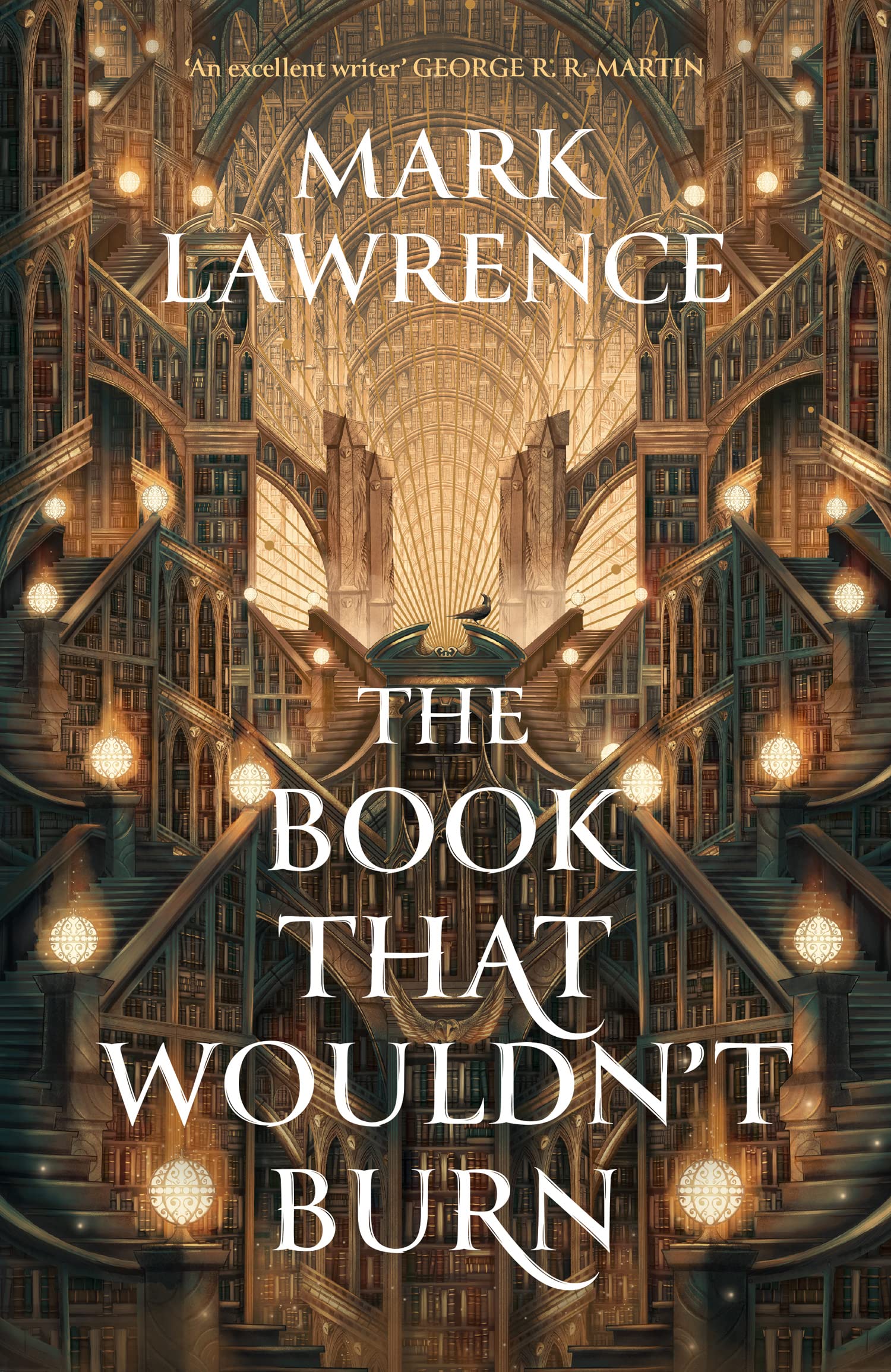
Publisher: Harper Voyager (Ebook – 1 May 2023)
Series: The Library trilogy – Book One
Length: 570 pages
My Rating: 5 out of 5 stars
Amazon
One of the world’s inventive and compelling fantasy authors returns with one of his best novels yet, the highly addictive and ambitious novel, The Book That Wouldn’t Burn, which sets off his new The Library trilogy.
Few authors have had the impact on the fantasy genre than Mark Lawrence has in the last few years, as the author has truly impressed readers throughout the world with his unique and captivating novels that routinely blend fantasy and science fiction elements. His series include The Broken Empire trilogy, The Red Queen’s War series, and The Book of the Ancestor series. I myself only started reading Lawrence’s work a couple of years ago with his compelling The Book of the Ice series, which followed several powered teens on a grim frozen planet. I had an outstanding time with this series, which included The Girl and the Stars and The Girl and the Mountains. While I still have to read the third book, The Girl and the Moon, I really enjoyed these books, and it was a pretty clever series. As such, I was very keen to check out Lawrence’s new novel, The Book That Wouldn’t Burn, especially as it had a very intriguing plot synopsis behind it.
Throughout the world, there is nothing more important, more significant, nor more permanent than the library. Built inside a mountain near the great city of Crath, the library contains an impossible number of books fitted within innumerable rooms that no one person can access. The sheer amount of knowledge contained within the library represents the greatest power in the world, allowing its keepers and the King of Crath to wield great control in the world. Into this vast and elaborate repository of knowledge and secrets, two young people are about to meet in unusual circumstances.
Livira is a young girl raised in the Dust, the desolate wasteland that surrounds Crath. Plucky, curious, and incapable of giving up, Livira is a rarity among her people as she seeks to know more about the world outside her home. But when the alien sabbers destroy her village and kill her people, Livira finds herself lost in the wilderness. Rescued and brought to Crath, Livira soon becomes certain that her future lies in the library. Overcoming prejudice and her own humble background, Livira learns to navigate the library and soon begins to find out some of its deeper secrets. However, the most mysterious of these might be another strange inhabitant of the library, Evar.
Evar and his small family have known nothing but the library their entire lives. Released after unknown eons frozen as children inside the library’s mysterious Mechanism, Evar and his siblings have grown up in a vast chamber of the library, learning from the books and becoming masters of specialised subjects. However, Evar has always desired more and has long tried to find a way to leave their book filled prison. His discovery of a portal within his home soon leads him to a place outside of time where he meets an exploring Livira. Together, the two attempt to find the true history of the library and the threats it has withstood over the years. But dark evils haunt the library, and soon the two explorers must find a way to uncover the truth behind the sabbers, their own history, and other deadly threats waiting for them in the future. Can these two children of the library survive the revelations in front of them, or will the truth tear them apart in ways they can’t even understand?
Well damn, now this was a seriously impressive and epic book. Lawrence has honestly outdone himself here with this incredible read, and this might be one of the best books he is ever written, which is saying something. The Book That Wouldn’t Burn features one of the most elaborate settings and narratives you are likely to see in fantasy fiction, and this results in a powerful and moving read that will keep you guessing time and time again. I had an exceptional time reading The Book That Wouldn’t Burn, and it would be impossible for me to give it anything less than a five-star rating.
The Book That Wouldn’t Burn is told from two separate perspectives, that of Livira and Evar, and covers their very different lives and experiences within the libraries. These two character-driven storylines are initially kept separate from each other as Lawrence spends a good chunk of the book introducing the protagonists, setting up their unique stories, and bringing together the elaborate setting that the story is based around. Both of these storylines are very interesting and fun off the bat, with Livira having her life torn apart, only to find purpose in the library, while Evar details his life lived purely within the library. While both storylines are really good, I initially got drawn into Livira’s the most, especially as her outsider perspective of the library allows you to really appreciate how alien and strange the massive house of books is. Livira’s storyline advances at an extended clip, covering years of her life as she learns, grows, and fully develops her adventurous personality as she seeks to fully understand the secrets of the library and everything within it. Evar’s storyline on the other hand is a little more sedate in its pacing, as it is set only along the course of a few days as he tries to finally understand the structure that has kept him prisoner for so many years.
The first half of the book that showcases these two characters’ initial introduction and growth are pretty damn entertaining, and it does a wonderful job of setting the scene for Lawrence’s elaborate story and background location. However, the story doesn’t find its true strength until the two protagonists meet and their storylines becomes a lot more intertwined. Due to the impossible physics and requirements of the library, there is a compelling time element to the meetings between the characters, which Lawrence captures masterfully, and which really alters their perspectives of each other. Once they are able to properly interact, the two characters grow close and spend an interesting chunk of the novel exploring their respective worlds, as well as the history of the library. Lawrence really lays the world building on thick during these parts of the book, and it serves to bring the two protagonists together, which just ensures the last act of the book is as tragic, moving and devastating as possible. The author drops some massive bombshell twists around two-thirds of the way through, which completely throws you and makes you rethink everything you have thought about the preceding narrative. I honestly was pretty damn shocked at this epic and devastating revelation, and while I had already been pretty damn addicted to the story by this point, this was the moment I realised what a masterpiece The Book That Wouldn’t Burn truly was.
The final third of the novel gets even better as certain background elements of Livira’s storyline finally come to fruition and her entire life begins burning around her. This causes her and many of the supporting characters from her part of the book to end up interacting with the characters from Evar’s storyline, which is a very interesting change of pace from the previous parts of the book. There are also some frenetic conflicts and some very dark moments as everything you have previously known about the settings, the characters and the history of the library is thrown around in some excellent and compelling ways. There are several great new twists in this final section of the book, and Lawrence gets very metaphysical with the reveals, relying on his setting’s unique temporal properties to mess with your mind and bring you surprise after surprise. I really loved just how cool and complicated this novel got towards the end, and Lawrence leaves an awesome and open conclusion for you to enjoy while drawing you in towards the next book in the series. I came away from this narrative desperately wanting more, especially after being blown away by all the twists within the book, and I cannot wait to see what happens next.
Those who are familiar with Lawrence will know that he is a very impressive and talented author, and I really liked how he developed his story and displayed all its outstanding elements to the reader. The Book That Wouldn’t Burn is a particularly complex read, loaded with damaged characters, elaborate storylines and an inventive major setting. Lawrence approaches his latest novel with his usual flair and imagination, expertly showcasing every clever detail of this world to the reader and keeping them enthralled the entire way through. Due to the complexity of the story, you really need to dive into every single word that Lawrence writes, and it honestly took me a little longer to get through this lengthy novel than I expected, mainly because of how much focus I needed to fully appreciate everything. That said, it has a very good pace to it and there is never really a dull moment as you are constantly drawn into what is happening or the elaborate depictions of the library.
I felt that the author’s use of two narrators was particularly effective, especially as they give very different views of what is happening around them and the setting they find themselves in. The extra expansiveness of the separate narration really helps to expand the scale of the book, and it takes some major temporal shifts for the two protagonist’s storylines to align. Once they do, the two separate character arcs intertwine extremely well, and I loved seeing their interactions through each other’s eyes, as well as the elaborate adventures they find themselves involved with.
Lawrence also was very skilled at setting up some of the book’s big twists, and while many of them surprised me when I read them, looking back you could see the subtle clues leading up to them, and you really appreciate just how clever the author was in the earlier stages of the book. The initial big twist is probably the best, and you really have to love how careful Lawrence was with some of the dialogue and character descriptions to pull that off. Some of the subsequent twists are a little less shocking, mainly because you are on guard at that point, but I did like how well some of the reveals based around the protagonist’s journey through time were utilised and hinted at in earlier scenes. The fact that there are completely different faces to some of the major early figures of the book was very cool, and it was clear that the author had a very impressive plan while writing the early stages of the book. These excellent writing elements, and more, served to enhance an already captivating story, and I cannot get past how well Lawrence set everything up.
There is no way I can move forward without talking about the elaborate library setting that was such an epic centrepiece of The Book That Wouldn’t Burn. I love how the author’s ultimate major setting is a library, which is something that all readers can really appreciate. While we can all imagine a pretty massive or full library, Lawrence amped that imagination up to an 11 in this book, describing a seemingly impossible structure, made up of innumerable rooms filled with massive climbable bookshelves and a seemingly infinite number of books and tomes. The sheer scale of this setting when described by Lawrence boggles the mind to a degree, and it really is an outstanding setting for this story as it is the perfect place for exploration, adventure, and even habitation. The library naturally features Lawrence’s trademark blend of fantasy and science fiction elements, and the structure has a transdimensional or alien feel to it, as the protagonists find different mechanisms within the structure, as well as strange and unique ways to travel through it. This blend of fantasy and science fiction elements worked particularly well, especially as you get to experience an intriguing contrast between ancient advanced technology and endless shelves of paper books.
The more unique elements of the library, including the portals, the robotic guardians, the locked doors, and more, are worked into the plot extremely well, and it was fascinating to see how they impacted the story, especially while the characters attempted to find out their origins. The time travel aspects of the library proved to be particularly awesome, and I loved how Lawrence used them, and other cool features, to twist the narrative in some powerful and unexpected directions, completely changing everything you thought you knew. It was also really effective how Lawrence explored the library through two very different sets of eyes, as Livira and Evar see it in different ways based on their respective history and cultures. These alternate views added even more depth to the epic setting, and you have to love the continued focus on exploration, especially when it resulted in some of the best scenes in the book. Honestly, I could go on and on for pages about just how impressive this outstanding setting is, so let me just be blunt and say: read The Book That Wouldn’t Burn, as you really won’t be disappointed when it comes to this elaborate library setting and the dark world it inhabits.
The final thing that I really need to highlight are the great characters contained within The Book That Wouldn’t Burn, which Lawrence did an outstanding job pulling together. There is a rich and compelling cast of characters featured within this novel, and their unique stories and experiences play a big role in how the story develops. However, most of the character work is saved for the point of view protagonists, Livira and Evar. Both characters have intriguing and tragic backgrounds brought about by encounters with sabbers, and they have found sanctuary within the library as a result. However, this is where their storylines differ as Livira seeks out the treasures of the library and works to get deeper within, while Evar looks to escape and find a whole new world to explore. This leads to some very conflicted character moments, and it was fascinating to see how these characters’ intriguing histories influences their understanding of the world and what they want. Both protagonists are well established and utilized by the author in The Book that Wouldn’t Burn, and their distinctive character arcs give the book a different flavour chapter to chapter as you explore both their lives.
I personally enjoyed Livira a little more as a protagonist, as her adventurous spirit, drive to be the best and sheer pluck were quite entertaining to see, especially as it allowed her to uncover so many cool secrets about the library. However, you also have to appreciate the darker background and narrative around Evar, a man trapped all his life in the library, and who has known only limited contact and love in his life. Evar’s entire life has been nothing but uncertainty, abandonment and a certain amount of inadequacy as he has only known a few other people, each of whom are the absolute experts in their fields. These two protagonists, when they meet, prove to be a powerful and interesting combination, and Lawrence was quite masterful and subtle when it came to weaving their chapters together. You really appreciate the pain, loss and sacrifices that both protagonists make throughout the book, and the bond they formed together, soon becomes such a key part of the story. While they do experience some major, mind-blowing setbacks, you grow really attached to both of them, and seeing them continue and dive even deeper into the unknowable heart of the library, makes for powerful reading.
Aside from Livira and Evar, The Book That Wouldn’t Burn features an extensive and compelling cast of supporting characters, whose interaction with the protagonists adds some intriguing elements to the plot, especially as many of them are filled with some great surprises. Both Livira and Evar’s storylines had some excellent supporting figures whose appearances are primarily limited to their respective narrator’s timeline. My favourite supporting character in the Livira chapters had to be Malar, a rough and tough solider who becomes Livira’s protector mostly against his will. His gruff attitude is a fun contrast to Livira’s bright and curious nature, and they have some entertaining scenes together, especially as he grows to care for her, and Lawrence works in some particularly compelling story elements around him in the later part of the book.
Evar’s chapters also feature a great range of supporting characters, and due to the more constricted nature of his story and setting, you get to know them a lot better than some of the cast associated with Livira. These characters include Evar’s adopted siblings, Starval, Kerrol and Clovis, who were also trapped in the Mechanism as children and grew up with him in the library. However, unlike Evar, who emerged relatively normal, each of Evar’s siblings were warped by the knowledge of the Mechanism and are now masters of a particular subject, including assassination and espionage, war and psychology. Each of these siblings is now fairly damaged as a result of their complex upbringings and childhood traumas, and it was fascinating to see their unique mindsets, especially through the eyes of Evar, who holds a special place in each of their hearts. These characters were all raised by the animatronic constructs, the Assistant and the Soldier, servants of the library who took charge of them, and I liked the fun interactions that resulted from them, especially once Lawrence worked his twisty magic on them. All of these characters and more are pretty damn interesting, and I loved how complex and emotionally charged their interactions became.
Frankly I could go on and on about this book, but I still do not think I would really be able to fully encapsulate just how much I enjoyed The Book That Wouldn’t Burn. This complex and clever fantasy novel is a true masterpiece from Mark Lawrence, who utilised all his impressive writing skills and imagination to create a unique and powerful read. The Book That Wouldn’t Burn’s elaborate narrative and massive library setting really grabbed my attention and I had such an epic time getting through this outstanding novel. Easily one of the best fantasy books of 2023, you need to check The Book That Wouldn’t Burn out, especially if you are already a fan of Mark Lawrence’s amazing works.
Amazon

 The Unseen Library