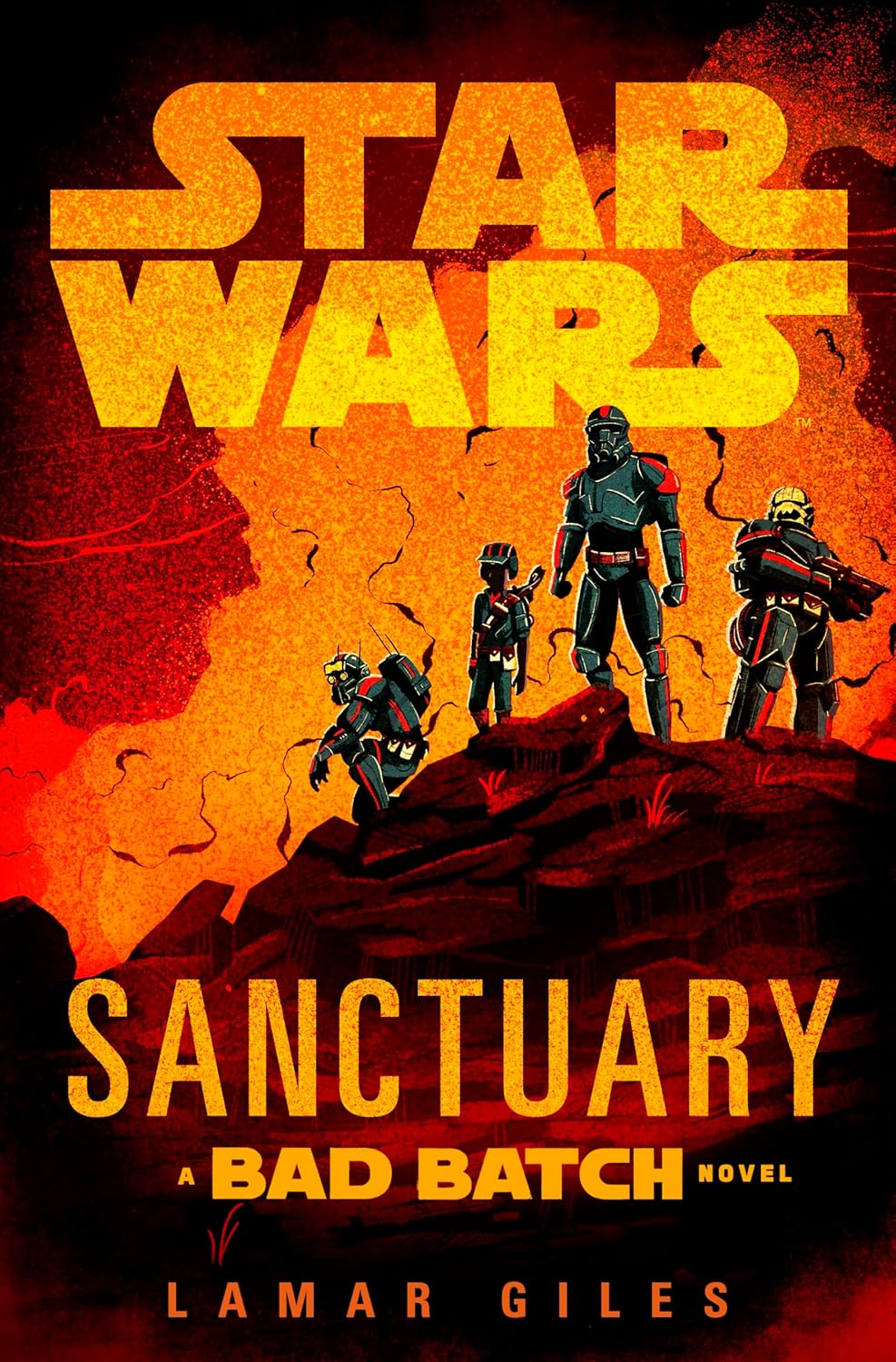
Star Wars: Sanctuary by Lamar Giles

Publisher: Random House Audio (Audiobook – 6 August 2025)

Series: Star Wars – The Bad Batch

Length: 11 hours and 46 minutes

My Rating: 4.75 out of 5 stars

Amazon

New Star Wars author Lamar Giles presents an epic and highly entertaining novel that follows everyone’s favourite group of rogue clones, with the Bad Batch focused novel, Sanctuary.

2025 has been an awesome year for Star Wars fiction.  Between the intense political novel, The Mask of Fear by Alexander Freed, and the upcoming Darth Vader-focused novel, Master of Evil by Adam Christopher, there are some interesting and heavy books coming out to further the lore of this iconic franchise.  However, there have also been some highly entertaining entries in this canon, including the fantastic novel Sanctuary.  Written by young adult fiction author Lamar Giles, Sanctuary is the author’s very first Star Wars novel, having previously written a short story in an anthology book.  A tie-in to The Bad Batch animated series, Sanctuary was an intriguing adult Star Wars novel that wasn’t originally on my reading radar.  However, in the mood for an audiobook from a familiar franchise, I decided to check it out, and boy was I glad that I did.

After turning on the Empire and deciding to live their own lives, the members of Experimental Clone Force 99, better known as the Bad Batch, are on the run, taking odd jobs and helping the innocents of the galaxy.  Made up of the grizzled Hunter, brilliant Tech, loveable powerhouse Wrecker and child prodigy Omega, the Bad Batch members have become an unlikely family.  However, after a series of dangerous missions, the members of the squad are tired, especially with their former comrades Echo and Crosshair on their own separate journeys. 

Needing a safe place to rest, the Bad Batch have found sanctuary on the planet of Pabu.  An idyllic settlement hidden from the eyes of the Empire, Pabu appears to be the perfect place for the clones to finally settle down and escape the constant battles.  However, before they can enjoy the peace of their new home, they’ll first have to help rebuild it.  With the settlement desperate for resources after a massive tidal wave, the members of the Bad Batch team up with pirate and self-proclaimed liberator of treasures, Phee Genoa, who promises an easy payday.

Hired to recover a valuable relic from an auction house, the crew’s ploy to steal it is quickly discovered, forcing them to revert to their usual fugitive ways.  However, their escape plan becomes complicated when Phee insists that they take on a second job, ferrying a mysterious couple to safe harbour.  Going against his better judgement, Hunter agrees to take on the passengers, but soon discovers that their new cargo has many secrets.  Forced to contend with an obsessive ISB agent and murderous tycoon with dangerous connections, the Bad Batch will risk it all for their new home.  But have they finally found an enemy too dangerous to defeat?

Sanctuary was an excellent and very entertaining Star Wars novel that proved a lot of fun to read.  Perfectly bringing the characters from The Bad Batch to life for an exciting new adventure, Sanctuary was an outstanding read that featured a compelling and action-packed story of love and life in the Star Wars universe.

Giles pulled together a captivating and very fitting narrative for Sanctuary, the serves as a great addition to The Bad Batch show, while also telling its own unique story.  Set towards the end of second season of the series, right after the events of the 13th episode, Pabu, Sanctuary is a fast-paced, character-driven story that takes the protagonists into the gritty underbelly of the Star Wars universe.  Starting with a very entertaining heist sequence, which goes about as well as any of the team’s plans, the titular Bad Batch and their pirate associate Phee Goena, escape with the loot, planning to sell it to a wealthy buyer.  At the same time, they take on two passengers, pregnant woman Keshiri Sohi and her masked partner Kuuto, who require smuggling across the galaxy.  Giles does a great job setting up all these initial story elements, and he quickly adds in some compelling complications that add some exciting drama to the narrative.  This includes a righteous ISB agent, Supervisor Sendril Crane, who is hunting their passengers, as well as the squad’s potential buyer, Cellia Moten, who would prefer to kill Phee Goena rather than pay her.

After an excellent shootout sequence halfway through the book where the protagonists are forced to simultaneously resist both Crane and Moten, the book slightly slows down as Giles works in some excellent story elements for both the protagonists and antagonists.  This includes growing drama between the Bad Batch and their passengers over their various secrets and lies, which also ties in nicely to internal conflicts amongst the team.  At the same time, Crane finds himself in the sinister orbit of the highly connected Cellia Moten, with the two trying to manipulate the other for their secrets and influence.  After a series of personal scenes for the protagonists that finally get them on the same page, Giles moves the story towards the end game, with the antagonists finding out where they are hiding.  This results in a series of awesome action sequences, with all the protagonists forced to fight to escape.  All the book’s characters, including its two villains, have their moment to shine here, and there are some powerful examinations of the relationship between new characters Crane and Sohi.  After some suitably climatic moments, the book ends on a high note that fans will really enjoy.  Giles also adds in an excellent cameo at the end that serves as a cathartic conclusion to another character’s story, and which I thought was a fitting and fun way to end the book.

I really enjoyed Giles’s writing style for Sanctuary, especially as he managed to achieve a lot in this novel.  Not only do we get a fantastic Bad Batch focused narrative loaded with action, adventure and other exciting Star Wars elements, but Giles also managed to include some powerful, personal moments, as various character dramas from both the show and this specific novel are played out.  The result was a slick and fast-paced novel that quickly draws the reader in with its easy humour and fun focus on The Bad Batch’s entertaining characters.  Thanks to some excellently timed shifts in character perspective, all the key members of Sanctuary’s cast have their moment to shine.  I particularly loved parts of the book that showcased the antagonist’s journey, which served as outstandingly entertaining contrast to some of the more character-driven chapters around the protagonists.  The combination of intrigue and Imperial politics in these scenes, as well as the mind games between to delightfully devious villains, was a true highlight of the book, and it allowed Giles to up the stakes of the plot, especially when it starts diving into some deeper Star Wars elements with some excellent references.

As a fan of The Bad Batch animated series I personally really enjoyed Sanctuary as Giles perfectly captured the tone and humour of the show.  Working as a great tie-in, Sanctuary fills in some interesting gaps between two of the show’s episodes, and the author does an excellent job of examining some of the issues the characters are facing during this period.  While naturally geared towards those familiar with The Bad Batch, Giles ensures that Sanctuary isn’t too show-lore dependent, and most general Star Wars fans will be able to read this book and have a great time.  Indeed, those unfamiliar with the animated series get a good glimpse at the humour and character dynamics in this novel, and it could serve as a good entry point to show.  Even if they don’t, the author also adds in a bunch of references that anyone familiar with Star Wars will be able to appreciate.  I felt that Giles did an excellent job exploring the period the novel is set in, the early days of the Empire a couple of years after the events of Revenge of the Sith, which is one of the more fascinating times in the franchise’s lore, and it was interesting to see how some of the new characters fit into this time.  As such, Sanctuary is going to appeal to a wide range of readers, and it’s a great read for fans of the Star Wars extended universe.

I have already mentioned a few times the excellent character work in Sanctuary as Giles features a great cast for this book.  Naturally for a Bad Batch book, the titular cast get much of the focus in Sanctuary, with excellent portrayals of Hunter, Tech, Wrecker and Omega.  Giles expertly captures their personalities from the show and reproduces them in Sanctuary.  As such, you are given some very interesting insights into the minds of each of these characters at this point in the series, with a particular focus on each clone’s glance towards the future and what they want out of life.  While there are some interesting alternating characters here amongst the cast, including Omega trying to become more independent, Tech’s unlikely romance with Phee, and Wrecker’s simple desire to blow things up, much of the character development for the main cast revolves around Hunter.  Giles spends a large amount of time diving into Hunter’s issues with losing control and no longer being a soldier, as well as some of the resentment he has from Crosshair’s abandonment of the squad.  This results in several fractious family moments, especially as Hunter’s caution tends to put him at odds with the rest of the team’s desires, and his distrust of Phee and their new passengers causes some noticeable friction.  These character dramas are a compelling part of the book’s overall plot, although Giles also does a good job of showcasing the more happy-family version of the Bad Batch, which fans of the show will appreciate, considering we all know what’s coming in a few episodes time.  That being said, I’m not sure I can forgive Giles for his line about Tech’s grapnel gun never failing him.

Aside from the titular Bad Batch, Giles features several additional outstanding characters, including returning show favourite Phee Genoa.  A free-spirited pirate and treasure hunter, Phee was a breath of fresh air amongst the stuffier clone soldier protagonists, and it was entertaining to see the unique interactions she had with the other characters.  Her antagonism of the rigid Hunter was particularly fun, especially as it brought up some much-needed drama, however, it was her relationship with Tech that was a true highlight of the book.  Giles did a good expanding on the feelings hinted at in the show, and they proved to be a very distinctive couple as a result.  I felt this gave some of the upcoming events of the animated series a little bit more of a tragic air, as you try to imagine what could be, and you end up liking them in a very bittersweet way.  The main cast of protagonists were well rounded out by new figures Keshiri Sohi and the masked Kuuto.  Mysterious passengers with secret pasts who cause all manner of trouble for the main cast, Sohi and Kuuto spend much of the book seemingly untrustworthy with their own agendas.  However, thanks to some excellent reveals, as well as a couple of good flashbacks, you grow to understand the complexity around their actions, and they proved to be a compelling addition to the cast as a result.

While I really enjoyed the protagonists, I felt they somewhat got overshadowed by the book’s impressive antagonists.  This includes ISB Supervisor Sendril Crane, a diligent and intense figure on the heels of Sohi and Kuuto.  Crane has a brilliant introduction in this book, which shows off his intelligence and ruthlessness, and he only gets better from there as you come to understand his background as a spy and his obsession with Sohi.  While Crane proves to be a ruthless adversary, he is well matched by Sanctuary’s other main antagonist, Cellia Morten.  An ultra-rich, politically connected tycoon with a penchant for murder, Morten is shown to be an outstandingly deranged figure early on, and she swifty amps up her evilness as the book continues.  Giles does an exceptional job sculpting Morten into the very worst rich villain he could, especially once her motivations for killing are revealed, and it was very fun for to eventual face reality on the real power structure in the galaxy.  While both serve as great antagonists to the main cast, the real beauty of these villainous characters occurs when they interact with each other, which results in a series of manipulative conversations which are thoroughly entertaining.  I particularly enjoyed how Morten continuously got the better of the normally unflappable Crane, especially in their first meeting when she gets out being arrested by asking if he had been sent by her good friend Sheev, with her use of namedropping and connections only getting better from there.  These two antagonists played off each other perfectly, and their battle of wits and cruelty, was even more entertaining than their hunt for the protagonists.  All these great characters added so much to my enjoyment of Sanctuary, and I loved the amazing arcs and interactions that emerged.

Naturally, I ended up listening to Sanctuary on audiobook, rather than seeking out a physical copy, as the audiobook format is the absolute best way to enjoy a Star Wars novel.  I love how incredible a Star Wars novel can sound when read out, and this was particularly true with Sanctuary, as all the awesome action and great characters were so much more impactful and fun in this format.  A lot of this is due to the narration of Marc Thompson, who does an exceptional job voicing all the characters and bringing the entire book to life.  Thompson, who is one of my favourite audiobook narrators, has long been one of the top narrators of Star Wars fiction thanks to his brilliant vocal talents and ability to impersonate various characters from the shows (see my previous reviews of Thrawn and Scoundrels by Timothy Zahn and Dark Disciple by Christie Golden).  His skill was on full display in Sanctuary, especially as he perfectly voiced Hunter, Tech and Wrecker throughout this novel, as well as several other characters from the show.  I was honestly so impressed by how he managed to accurately he was able to voice the three main clones from the show, with each of their distinctive but similar voices, coming across so damn close to their voice actor in the show, Dee Bradley Baker.  At the same time, he also does a good take on Wanda Sykes’s character Phee Genoa, and even does a passible voice for Omega, which includes the New Zealand accent of actress Michelle Ang. 

Thompson’s outstanding narration is further enhanced by the fantastic inclusion of Star Wars sound effects and music, which is an outstanding part of all Star Wars audiobooks.  The entire story really comes to life when you can hear crowd sounds and blaster fire amongst the dialogue, while the iconic Star Wars music makes several scenes just a little more epic, especially when they help remind you of moments from the films.  These extra audio inclusions pair perfectly with Thompson’s narration, and it honestly felt like you were listening to an episode of The Bad Batch with this audiobook.  I really enjoyed this full listening experience, and I ended up powering through Sanctuary’s near 12-hour long runtime in no time at all.  This was such a great listen, and this was honestly one of the better audiobooks I had the pleasure of listening to in 2025.

With a brilliant story, fun characters and a ton of action, Lamar Giles’ Star Wars novel, Sanctuary, was an outstanding hit.  An excellent tie-in novel that follows the entertaining characters from The Bad Batch animated series, Sanctuary was an impressive and exciting novel that had me hooked very early on.  A deeply compelling and addictive read, Sanctuary comes very highly recommended, especially on audiobook, and all Star Wars fans are going to have a great time with this awesome read.

Amazon

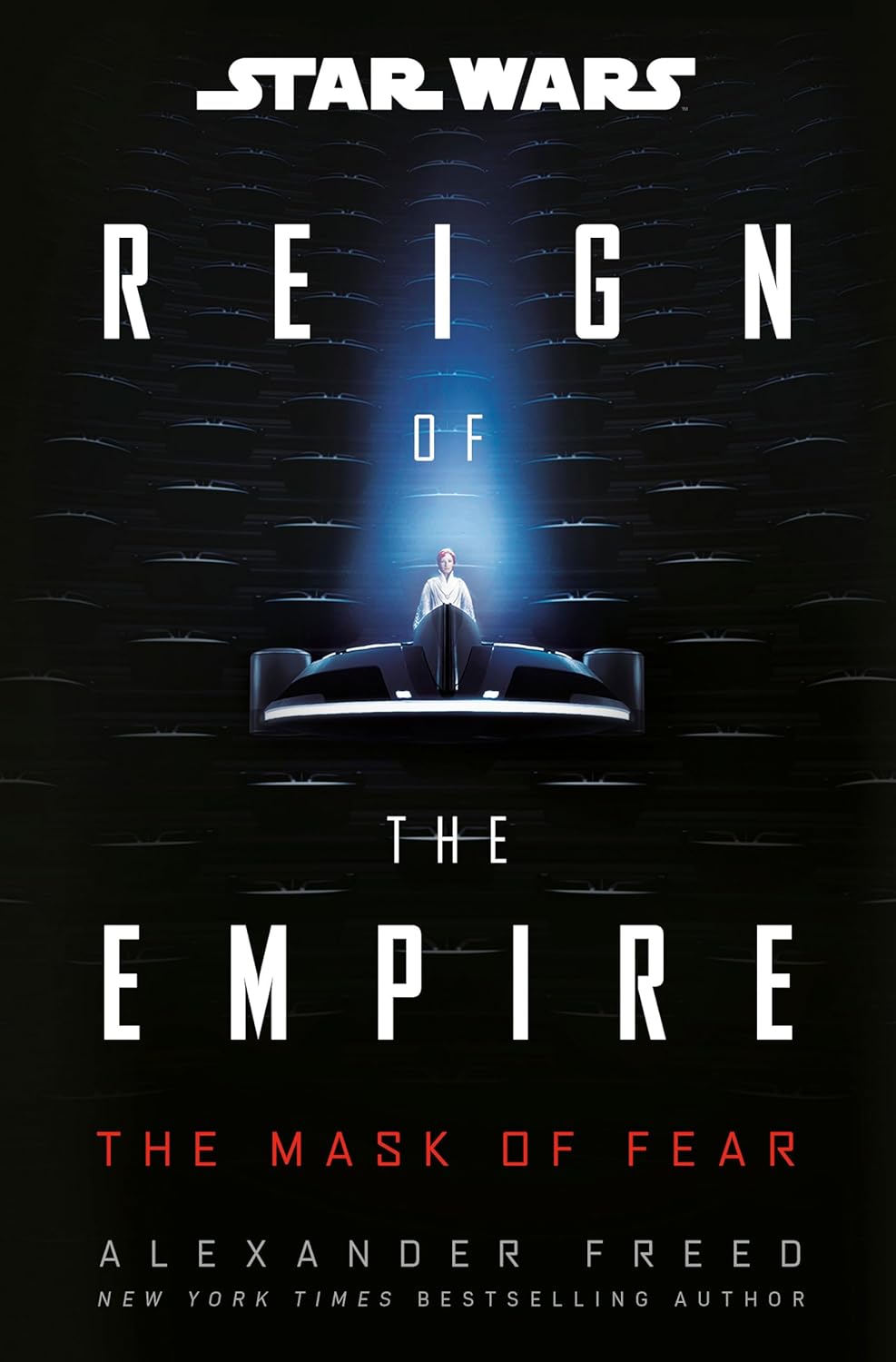
Star Wars: Reign of the Empire: The Mask of Fear by Alexander Freed

Publisher: Penguin Random House Audio (Audiobook – 25 February 2025)

Series: Reign of the Empire – Book One

Length: 16 hours and 51 minutes

My Rating: 4.5 out of 5 stars

Amazon

One of the top authors of Star Wars extended fiction, Alexander Freed, presents a compelling and complex inclusion to the franchise with The Mask of Fear, a powerful Star Wars novel that is a must-read before the upcoming second season of Andor.

There are some impressive authors writing Star Wars fiction at the moment, but one of my favourites is Alexander Freed, primarily because of his Alphabet Squadron trilogy.  An awesome series that followed a group of New Republic pilots in the immediate aftermath of Return of the Jedi, the Alphabet Squadron novels (Alphabet Squadron, Shadow Fall and Victory’s Price), are amongst some of my favourite Star Wars books, and I loved Freed’s dark take on the universe following the happy ending of the original trilogy.  As such, I was very intrigued when I heard that Freed was working on a new Star Wars trilogy set during one of my favourite periods of the franchise’s history, with the cool Reign of the Empire trilogy.

The Reign of the Empire trilogy is an ambitious series that seeks to chronicle the rise of the Empire and provides some cool new history in the current Disney canon.  Set immediately after Revenge of the Sith, the Reign of the Empire follow several key supporting characters from the films, as well as some new figures, as they attempt to navigate the galaxy following the formation of the Empire.  The first book in this series, The Mask of Fear, proved to be extremely fascinating, and I loved the compelling direction that Freed took the story.


Plot Synopsis:

Before the Rebellion, the Empire reigns, in book one of a trilogy told through the eyes of Mon Mothma, Bail Organa, and Saw Gerrera – for fans of Andor.

“In order to ensure the security and continuing stability, the Republic will be reorganized into the first Galactic Empire! For a safe and secure society!”

With one speech, and thunderous applause, Chancellor Palpatine brought the era of the Republic crashing down. In its place rose the Galactic Empire. Across the galaxy, people rejoiced and celebrated the end to war—and the promises of tomorrow. But that tomorrow was a lie. Instead the galaxy became twisted by the cruelty and fear of the Emperor’s rule.

During that terrifying first year of tyranny, Mon Mothma, Saw Gerrera, and Bail Organa face the encroaching darkness. One day, they will be three architects of the Rebel Alliance. But first, each must find purpose and direction in a changing galaxy, while harboring their own secrets, fears, and hopes for a future that may never come, unless they act.


The Mask of Fear
was another impressive and unique Star Wars novel from Freed, who sought to bring together a complex narrative of early rebellion and fear, as various people witness the rise of a tyrannical government.  Clever, intense and cleverly addressing some real-world parallels, The Mask of Fear was extremely good, and it served as a brilliant start to an excellent new Star Wars trilogy.

Freed produced a particularly intricate and complex narrative for The Mask of Fear that really sets the scene for the trilogy in a fantastic character-driven read.  I must warn potential readers that this is a very slow-burn narrative, with a focus on politics, character development, and Star Wars lore, and as such the book doesn’t have a ton of action in it at the start.  Instead, Freed follows the experiences of several different characters as they face the early days of the Empire’s rise and the end of the Clone Wars, with the narrative broken down across several character perspectives, including Mon Mothma, Bail Organa, a former Separatist operative who is forced to team up with Saw Guerra, and a couple of Imperial spies who find out the hard way that their Empire isn’t everything it’s cracked up to be.  This interesting combination of characters allows The Mask of Fear to go in a few compelling directions, including a political narrative around Mon Mothma, an adventure-laden investigation by Bail Organa, who tries to prove that the Jedi was set-up by the Emperor, a dark journey of revenge by the former Separatist, while the two spies find their stories interacting with the other characters as they try to investigate them.

As I mentioned above, the first half of The Mask of Fear is a little dry and slow-paced, but it nicely explores the universe after Revenge of the Sith and provides some dark context to how the Republic was changed into the Empire.  Mon Mothma’s story lies at the heart of the book, as she tries to bring about a legislative end to the Emperor’s reign, and this compelling political tale meshes well with the more action focused or espionage laden chapters of the other protagonists.  Things start to get a lot more interesting and intense once some of the characters start to interact with each other, including with a few action sequences, and Freed ensures that narrative gets realistically dark as you begin to understand the full evil of the Empire.

Everything leads up to the climatic final third of The Mask of Fear, where most of the major storylines of the book start to come together.  Thanks to the complicated story elements Freed set up in the earlier stages of the book, the reader finds themselves quite hooked at this point, especially as the characters find themselves in real peril.  I really enjoyed how Freed wrapped up a couple of the story arcs in The Mask of Fear, especially in one scene were a previously moral character finds the dark side of conflict.  Freed rewards the reader by providing a big moment of hope towards the end of the book, although this is swiftly taken away just to highlight what sort of Star Wars series this is going to be.  I really enjoyed this final section of the book, as the dark result of all the character’s plans galvanises them and leads them into a new direction.  I felt that this story came together extremely well, and while it was initially a little hard to get invested in it, Freed’s excellent establishment of the characters, narrative and overarching setting, ensured that it became a really gripping narrative.

The Mask of Fear was a very well-written novel from Freed, who expertly sets up a cool new Star Wars novel trilogy with some intriguing disparate elements to it.  The blend of politics, intrigue and action made for quite a compelling read, and I felt the author’s excellent use of multiple character perspectives led to a very rich and complex read that hit a lot of great boxes for me.  In addition, Freed does an amazing job placing this into the larger Star Wars canon, especially as he spends a lot of time exploring the very early days of Imperial rule, which is such a fascinating period in the franchise’s history.  The author perfectly blends compelling Star Wars lore about the fallout of the Clone Wars and the start of the Empire with his own story, and the resulting narrative is very fascinating.  While not every reader is going to love the complex political inclusions, I personally really enjoyed them, and this book helped to fill in some interesting gaps in how the Republic from the prequel films becomes the Empire.  As such, The Mask of Fear is a novel geared more towards hardcore Star Wars fans, although anyone who’s seen the original and prequel trilogies, or who wants to get a little more universe history before the second season of Andor comes out will probably have an amazing time with this book.

Speaking of politics, it’s hard not to notice some interesting real-life parallels that The Mask of Fear has with political realities of the world right now.  Freed would have written this book in 2024, and he paints a grim picture of the Empire’s new political and social reality within this book, which includes gross corruption, manipulation of the media, disinformation and other despicable practices, which will probably be quite familiar to readers now.  For example, the portrayal of a legislative body transferring most of its power to a popular-supported executive who then makes radical right-wing changes is jarringly close to how 2025 is turning out in some ways.  I found that these real-world parallels made the story that much more fascinating, and the reader ends up really feeling for the emotional turmoils of the protagonists.  One particular part of Freed’s portrayal of the Empire that I personally appreciated was the decision not to feature any of the franchise’s main villains, but instead focused on the people joining the administration purely for their own goals or benefit, who start revelling in the power they now have, or the lower level supporters who finally believe that they have a worthy leader.  In some ways this makes the Empire seem even eviler, as much like certain real-world governments, it’s obvious that the Empire was corrupt from top to bottom since the beginning.  As such, The Mask of Fear proved to be a masterful examination of how such fascist governments come into being and stay in power, and it was interesting, if a little scary, to see how the ultimate evil empire from fiction is being mirrored in the world today.

While the amazing story elements and intriguing examination of politics is a highlight of this book, for me, the best part of The Mask of Fear was the brilliant and damaged characters that Freed featured, especially his five major protagonists.  Each of these protagonists, which includes a compelling mixture of established characters and new figures written for this novel, has fascinating plot arcs behind them, as each of them tries to find their place in the new book.

Of these, I personally enjoyed the compelling storylines around future Rebel leaders Mon Mothma and Bail Organa the most.  Mon Mothma, who has been so well used in recent shows like Star Wars Rebels and Andor, had a compelling showing here in The Mask of Fear, and it was fascinating to see what happened to her in the immediate aftermath of the Empire’s takeover.  Portrayed as an ambitious politician already under attack by the new administration, Mon’s storyline around her attempts to curtail the Emperor’s power through political means and to keep power in the Senate is interesting, and I really enjoyed seeing the version of Mon who still believed in the institution she was apart of.  Freed weaves together an excellent combination of storylines around Mon, including her political troubles, personal issues, trauma from past arrests and her own growing disillusion with her political colleagues.  Mon’s storyline in The Mask of Fear starts her on the path to becoming the future Rebel leader, as she is forced to take deadly action in protection of her ideals, while also learning just how ruthless the new Emperor and his administration is.

The storyline surrounding Bail Organa on the other hand was a little more action and adventure focused, as he began his own journey towards rebellion.  Portrayed as the only person in the Empire who actually knows that the Emperor is a Sith Lord, Bail spends much of the book desperately trying to fight back by clearing the Jedi’s name.  You can really feel the despair in Bail as he tries to solve the situation in a manner he believes is right, only to hit roadblocks and disinterest from even his potential allies who disregard the Jedi who Bail knows are innocent.  This allows for some very intense scenes, especially as Bail crosses some major boundaries to chase his goals, and you really sympathised with everything Bail is going through.  Bail’s storyline was really well written, and I really enjoyed Freed’s realistic portrayal of what this character would be going through.  His storylines ended up melding nicely with the rest of the cast, especially Mon Mothma’s, and I loved how Freed showed them as having some noticeable political and personal friction.

The rest of the main point-of-view cast of The Mask of Fear includes three original characters, who provide intriguing alternate views about the Empire.  This included Soujen, a cybernetically enhanced Separatist infiltrator who awakens from hibernation to find that the government that made him was defeated, and he has to decide who or what he is going to fight for now.  A complex figure who believed in the Separatist cause, Soujen provides a compelling alternate view of events from the Clone Wars and the formation of the Empire.  Freed works an interesting and intense storyline around Soujen, as he is forced to confront the impact of his actions and the realisation that he might not have achieved anything with his fighting.  I loved how dark some of Soujen’s scenes got, as well as the realistic emotional outbursts as the character refuses to give up the war.  Soujen’s storyline is one of the most impactful in the entire story, as his more destructive approach forces the other characters to act against him.  There were some very complex interactions that occurred as Soujen tried to achieve his objectives, including a certain amount of tragedy which hits the reader hard.  The other key perspective characters are two imperial intelligence operatives, made up of an elderly spy who doesn’t fit in with the new regime and her young apprentice from the slums of Coruscant.  They both go on compelling journeys throughout the book, with the veteran tailing Bail, while the younger journeys into the morass of the extremist groups supporting the Emperor.  I really enjoyed seeing both coming to realise the problems with the Empire they’re solving in their own different ways, and both their perspective character arcs supported the other storylines extremely well.

This main cast is supported by an interesting array of figures, including supporting characters from the main shows, who have a big impact on the story.  The most prominent of these is Saw Gerrera, who, despite having a big role in the plot, doesn’t serve as a major perspective character.  Freed does an excellent job portraying Saw in this book, and it proves fascinating to see the character’s journey to become an extremist fighter begin in this book, as he initiates the first militant rebellion against the Empire.  This mostly rounds out the main cast, and as I mentioned above there is a distinct lack of major antagonists in this book, with neither the Emperor or Darth Vader appearing.  However, there is an array of self-serving middle management administrators and agents, pro-Imperial vigilantes and politicians supporting the new Empire, who prove to be quite dangerous and corrupt in their own way, especially as they oppose and attempt to remove the protagonist when they oppose the Emperor.  An overall excellent collection captivating character arcs in this book which really enhanced The Mask of Fear’s narrative in some impressive ways.

As with most Star Wars novels that I check out, I chose to enjoy The Mask of Fear on audiobook, which proved to be an outstanding way to enjoy this captivating read.  Star Wars audiobooks always do such a great job of capturing the atmosphere and excitement of the franchise’s extended universe, and I love how awesome they can make a story.  The Mask of Fear was a great example of this, and the complex narrative of politics, betrayal and damaged characters, really came to life when read out by the talented January LaVoy.  LaVoy, who specialises in reading female-led fiction, including extended universe books such as Star Trek: Die Standing and Freed’s Alphabet Squadron books, did an outstanding job narrating this awesome novel, and I loved how well she captured the key characters.  Her voice work for Mon Mothma was particularly good, and I liked the fun voices that accompanied some of the other intriguing female characters.  LaVoy also ensured that the story moved at a swift pace, and readers found themselves really drawn in, even with the book’s politically heavy content.  It helped that The Mask of Fear featured the typical array of iconic sound effects and music from the Star Wars films, which are put to great use throughout the production.  The sound effects in particular were cool, giving extra life to some scenes, especially those involving firefights, vehicles and crowds, while the music was used to add some outstanding gravity or excitement to key moments.  The combination of the amazing narration and the cool Star Wars sound inclusions helped to make The Mask of Fear something truly wonderful to listen to, and this is easily the best way to enjoy this fantastic novel.

Alexander Freed kicks off his Reign of the Empire trilogy in a big way with this captivating novel.  An outstanding addition to the Star Wars canon that dives into one of the franchise’s most intriguing periods, The Mask of Fear was an intriguing, character-driven novel that examines the fallout of war, political upheaval and the rise of evil.  Highly recommended, especially on audiobook, The Mask of Fear is a must-read for all Star Wars fans.

Amazon

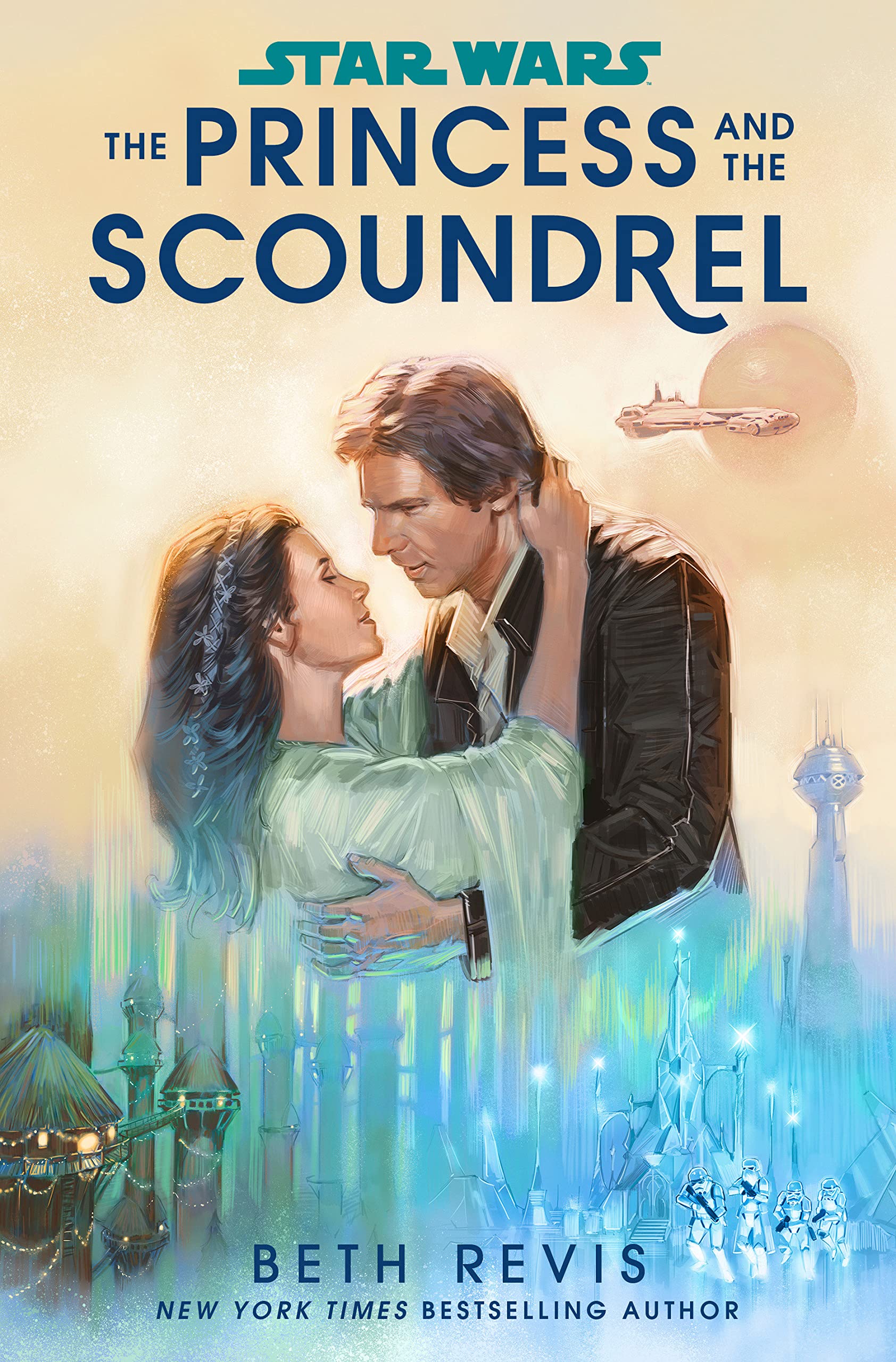
Star Wars: The Princess and the Scoundrel by Beth Revis

Star Wars - The Princess and the Scoundrel Cover

Publisher: Del Rey (Trade Paperback – 16 August 2022)

Series: Star Wars

Length: 348 pages

My Rating: 4 out of 5 stars

Amazon     Book Depository

Outstanding author Beth Revis presents an intriguing and enjoyable new entry in the extended Star Wars canon, with the fantastic tie-in novel, The Princess and the Scoundrel.

2022 has been a rather interesting year for Star Wars fiction.  While the focus has primarily been on the High Republic sub-series, several great authors have produced some awesome reads set around the various film trilogies (such as Star Wars: Brotherhood by Mike Chen).  However, one of the most exciting recent Star Wars tie-in novels is a character-driven read that focuses on the relationship between Han Solo and Princess Leia, The Princess and the Scoundrel, which was written by exciting author Beth Revis.  Revis, who already has some experience with the Star Wars canon, having written the 2017 novel, Rebel Rising, came up with an awesome story in The Princess and the Scoundrel that I had a wonderful time reading.  Not only does The Princess and the Scoundrel explore an interesting period of the complex and inspiring Star Wars canon, but it also contained a fantastic romantic heart that will appeal to a wider range of readers.

Goodreads Synopsis:

The Death Star is destroyed. Darth Vader is dead. The Empire is desolated. But on the forest moon of Endor, amongst the chaos of a changing galaxy, time stands still for a princess and her scoundrel.

After being frozen in carbonite, then risking everything for the Rebellion, Han is eager to stop living his life for other people. He and Leia have earned their future together, a thousand times over. And when he proposes to Leia, it’s the first time in a long time he’s had a good feeling about this. For Leia, a lifetime of fighting doesn’t truly seem over. There is work still to do, penance to pay for the dark secret she now knows runs through her veins. Her brother, Luke, is offering her that chance—one that comes with family and the promise of the Force. But when Han asks her to marry him, Leia finds her answer immediately on her lips . . . Yes.

But happily ever after doesn’t come easily. As soon as Han and Leia depart their idyllic ceremony on Endor for their honeymoon, they find themselves on the grandest and most glamorous stage of all: the Halcyon, a luxury vessel on a very public journey to the most wondrous worlds in the galaxy. Their marriage, and the peace and prosperity it represents, is a lightning rod for everyone in the galaxy—including Imperial remnants still clinging to power.

Facing their most desperate hour, the soldiers of the Empire have dispersed across the galaxy, retrenching on isolated worlds vulnerable to their influence. As the Halcyon travels from world to world, one thing becomes abundantly clear: The war is not over. But as danger draws closer, Han and Leia find that they fight their best battles not alone but as husband and wife.

I had a fantastic time getting through The Princess and the Scoundrel as Beth Revis wrote a pretty awesome and captivating Star Wars novel that covered a lot of bases.  Split between the alternating perspectives of Han and Leia, The Princess and the Scoundrel takes off right after Return of the Jedi.  While the victorious Rebellion plans their next moves, Han and Leia decide to make the most of their sudden freedom to get married after their traumatic year apart.  While both are still reeling from the events of the original trilogy, they come together in a fun wedding scene, before leaving on a glamorous trip that will be part honeymoon part propaganda show.  While initially trying to enjoy their honeymoon, both quickly fall into their old patterns, with Han chafing at the formality, while Leia continues to try and do her work as an ambassador and planner.  Arriving at an isolated ice planet, Han and Leia soon discover a destructive Imperial plot and must come together as a couple to thwart it.  This ended up being a really distinctive read, as Revis worked a more romantic plotline into the always entertaining Star Wars canon.  I loved seeing this fantastic tale of Han and Leia’s first adventure as husband and wife, and Revis ensured readers got an excellent blend of action, intrigue, and character development, as you witnessed these two amazing protagonists try to come together as a married couple.  There is a little something for everyone in this great read, and I found myself getting caught up in the action and the impressive focus on two of my favourite fictional characters.  An overall brilliant book that is really easy to enjoy and appreciate.

The Princess and the Scoundrel proved to be a very interesting addition to the current Star Wars canon.  While the romance between Han and Leia was strongly explored in the previous Legends canon, the current Disney canon has not featured it as much, and as such you see some fascinating events from their lives here for the first time.  Revis paints quite a fun picture of the sudden wedding these two have, which features entertaining interruptions from several key characters, some tricky manoeuvrings from Lando to get Han into a nice outfit, and, of course, a ton of Ewoks, while the honeymoon is as chaotic as you would expect from these two.  As such, this is a pretty key book for all fans of these two iconic characters, and I think that Revis hit an excellent tone when it came to some of these key events.  The author also fits in a lot of fantastic references and moments that a lot of Star Wars fans will appreciate, most of which are covered in a very fun way.  For example, the characters finally address that infamous kiss between Luke and Leia at the start of The Empire Strikes Back, with Han and Luke having a rather awkward conversation about it, before agreeing never to bring it up again.  Revis also makes quite good use of an interesting Han Solo villain from one of the previous canon books, and it was great to see some continuation from the previous intriguing storyline.  That, and several other amusing references, help to make this quite a key book for Star Wars fans, and I had a wonderful, nerdy time getting through it.

Aside from the direct references to the book, I was personally intrigued to see more about the period of Star Wars history that occurred in the immediate aftermath of the Death Star’s destruction in Return of the Jedi.  Despite the death of the Emperor, the war between the Empire and the Rebellion (now renamed as the New Republic), is still ongoing, and indeed some of the toughest fighting is still to come.  Several authors have covered this frenetic period in the current canon with some recent books, such as the Alphabet Squadron trilogy by Alexander Freed (made up of Alphabet Squadron, Shadow Fall and Victory’s Price).  However, I particularly enjoyed how The Princess and the Scoundrel covered this period, as it shows events literally hours after the end of the film.  Quite a bit is shown of the Rebellion’s initial strategies following the battle of Endor, as well as the Empire’s reactions to the death of the Emperor and the sudden shift in power.  While some of the wider campaigns aren’t shown, you get an interesting idea of what the military and political situation was at the time, which I deeply enjoyed.  Revis also spends time examining how members of the general public reacted to the news, and there is an interesting variation of responses.  Not only did some people straight out disbelieve that the events even occurred, with many assuming it was fake propaganda from the Rebellion, others who were associated with the Empire, or who had members of their family aboard the Death Star, acted quite hostile to the change in the established status quo.  These diverse reactions not only reflected some current real-world societal issues, but also provided a compelling insight into just how much influence the Empire had, even on the way to its downfall.  Throw in some hints and previews of the upcoming Operation Cinder, and this proved to be a very interesting addition the Star Wars canon that many established fans will really enjoy.

One of the strongest elements of The Princess and the Scoundrel is its impressive focus on the two main characters, Han Solo and Princess Leia.  While this book does contain a lot of action, intrigue and fantastic Star Wars elements, at its heart it is a romance novel between two well-established and complex characters, both of whom have experienced a lot of trauma and anguish in recent years.  Revis does a remarkable job of diving into both characters throughout the course of The Princess and the Scoundrel, and you really get a sense of their feelings, concerns and traumas following their victory.  However, there is also a great focus on their relationship, and you can really see the strong bond they have, even if they are still coming to terms with their feelings and their wildly different personalities.  I felt that Revis painted a realistic view of their relationship, which contains some difficulties early on, especially with their independent streaks.  However, the author also shows that the two characters are much stronger together, and they can work through any issues that come their way.  I think that this much better than just showing them having a fairy tale relationship, and I really appreciated the authors compelling take on one of the most iconic relationships in fiction.

Aside from their relationship, Revis also did a great job of diving into the complex emotional issues facing both central characters.  For example, Revis makes sure to explore the trauma surrounding Han after being trapped in carbonite for over a year.  Not only did he miss out on a lot of key events in his friends’ lives, but at this point of the book he has only been awake again for a few days, and some of his decisions are based on his concerns and fears about being trapped again.  Leia is also going through a lot after the discovery that Luke is her brother and, more importantly, that Darth Vader was her father.  As such, Leia spends much of the book attempting to reconcile the fact that her real father was a genocidal maniac who tortured her and is partially responsible for destroying her home planet.  This proves to be quite a deep and intriguing part of her character arc, especially since, unlike her newly discovered brother, she is unable to forgive Vader for everything he did.  There is also an interesting look at Leia’s early attempts to connect with the Force, after Luke reveals her Jedi potential.  Watching her attempts at using the Force is very fascinating, especially as she battles with her feelings about Vader while doing so and is reluctant to even try to use the abilities that he could do.  All these unique character examinations, and more, really help to showcase just how complex and traumatised Han and Leia were at this period, and how much their relationship helped them get past it.

Star Wars: The Princess and the Scoundrel by Beth Revis is an amazing read that provides Star Wars fans with something a little different to the typical tie-in novel.  Featuring a continuation of one of film’s most iconic romances, The Princess and the Scoundrels is at times touching and romantic, while also exploring the grim realities of the war-torn galaxy, all topped off with some classic Star Wars action and humour.  With an outstanding focus and understanding of its two main characters, The Princess and the Scoundrel was a fantastic novel that is well worth checking out.

Amazon     Book Depository

Throwback Thursday – Warhammer: Van Horstmann by Ben Counter

Van Horstmann Cover

Publisher: Black Library (Paperback – 1 February 2013)

Series: Warhammer Fantasy

Length: 415 pages

My Rating: 4.75 out of 5 stars

Amazon

Welcome back to my Throwback Thursday series, where I republish old reviews, review books I have read before or review older books I have only just had a chance to read.  For my latest Throwback Thursday I review another awesome Warhammer Fantasy novel, the compelling and unique Van Horstmann by Ben Counter.

Another week, another Warhammer tie-in novel that I must review.  I have been really diving into this franchise over the last year; to be fair, there are some incredible books there, including the two 2022 Warhammer 40,000 releases that got a full five-star rating from me, Ghazghkull Thraka: Prophet of the Waaagh! by Nate Crowley and Assassinorum: Kingmaker by Robert Rath.  Some of the best of these books are tie-ins to the now destroyed Warhammer Fantasy universe, including the novel from last week’s Throwback Thursday, Runefang by C. L. Werner.  Well, my current obsession with all things Warhammer continued again as I recently read the awesome Van Horstmann by Ben Counter.  Counter is a well-established author of Warhammer fiction, having made a ton of impressive contributions to the franchise, including his Grey Knights and Soul Drinkers series, as well as his entries in the massive Horus Heresy series.  I was really drawn to Van Horstmann when I picked it up, not only because it has a great cover (love a cover with a dragon on it), but because of its intriguing plot, which sounded extremely awesome.

In the human realm known as the Empire, magic has been feared and mistrusted through most of its history, with practitioners hunted down and burned at the stake.  However, following the Great War against Chaos, the elven mage Teclis was allowed to train various talented humans in the use of magic, establishing the eight Colleges of Magic that train scholars and battle mages to help the armies of the Empire.  Out of all the colleges that were formed, the most revered are the College of Light, whose powerful light magic can be used to push back the darkness of Chaos.

Years after its formation, a young wizard manages to find the College of Light, hidden behind a magical barrier in the Imperial capital, Altdorf.  This wandering wizard, Egrimm van Horstmann, is a talented young mage whose desire for knowledge and skill at manipulating the Wind of Hysh immediately impress his new teachers, and many believe that he will rise high in the order.  However, van Horstmann has a dark secret that burns deep within him, and knowledge, power and ambition aren’t the only reasons for his joining the Light Order.

As van Horstmann rises in the ranks of his order, it soon becomes apparent that he has a diabolical plan.  Working with dangerous forces, including daemons, cursed items and even the Chaos god Tzeentch, van Horstmann begins to manipulate his order, the other colleges, and even the emperor to get what he wants.  But the closer he gets to achieving the goal, the more enemies he makes, and soon factions within the Light Order and the greater Empire begin to move against him.  Can van Horstmann succeed in his mission before his dark purpose is discovered, or will his dastardly designs unleash the great and uncontrollable power hidden at the very heart of the College of Light?

This was an impressive and deeply captivating Warhammer Fantasy novel, and I absolutely loved the elaborate and clever narrative that Counter came up with.  Focusing on an intriguing villainous figure and crafting an addictive story around him that also explores key aspects of the franchise’s lore, Van Horstmann was an outstanding novel, and it was probably the best Warhammer fantasy novel I have read so far.

Counter has come up with an excellent and impressive narrative for Van Horstmann, which, as the name suggests, is completely focused on the character of Egrimm van Horstmann.  For those who don’t know, van Horstmann was a minor special character for the Chaos army in some of the earlier editions of the games, but he didn’t have that much background or lore surrounding him.  I personally knew him due to his name being associated with one of my favourite magical items available to Empire armies in the later editions, Van Horstmann’s Speculum, which is a very fun surprise for an unwary foe (I have fond memories of using Van Horstmann’s Speculum in a game to switch stats between my Master Engineer and my brother’s Manfred von Carstein in a duel.  The look on his face as his ultimate general was suddenly weaker than my minor hero was just hilarious).  However, Counter manages to take the short background summary of the character and uses it as the basis for this novel, expanding on the tale of van Horstmann and showing how and why he infiltrated the Light Order and ended up betraying them, which results in an epic story.

Van Horstmann has a bit of a slow start to it, as Counter takes the time to set up key parts of the story, including an intriguing prelude that examines the first wizards of the Empire and their darkest secret.  From there, the story introduces the main character, van Horstmann, and shows his entry into the Light Order and his start as a student.  The story gets quite interesting after this, especially as you see van Horstmann involved in a demonic exorcism, which quickly highlights just how ruthless and cunning he can be.  The story picks up pace from there as you begin to witness van Horstmann’s inevitable rise to power as the full scope of his desire and despicable nature become fully apparent.  Most of the middle of the book showcases the characters careful and evil manipulations, as he manages to fool everyone and become more and more powerful through deals with daemons and the Chaos gods.  There are some brilliant scenes here as you witness the full scope of his plans, from a great battle scene against the skaven, to organising several duels between the various magical factions, all in the name of gaining power.  Counter really does a good job of showcasing this viewpoint through multiple perspectives, and while much of the focus is on the gloating van Horstmann, you also see how his actions impact several supporting characters, many of whom start to get suspicious.  The entire narrative has a great dark fantasy edge to it, that occasionally borders on horror (especially when the character interacts with some of the daemons and their dark gods), and I found myself really getting drawn into this story once everything had been set up.

This leads up to the epic conclusion that sees van Horstmann’s master plan enter its final phase while his enemies begin to realise his evil nature.  This ended up being an extremely impressive conclusion, and it really becomes apparent just how much stuff Counter had set up in the first two-thirds of the book.  Everything comes together here, as compelling story elements such as van Horstmann’s long-term plans, his troubled past, all his terrible actions while part of the order, the revelations about the foundation of the Light Order, several great secondary character arcs, and the attempted investigation by van Horstmann’s enemies, all pay off.  I really appreciated the brilliant and dark way that these storylines worked out, and there are some great revelations, especially around van Horstmann’s motivations and the full scope of his careful actions.  I loved the deep and very personal reasons behind the events, especially as van Horstmann has some extremely fantastic revenge planned, which was pretty epic to behold.  The entire novel ends on a brilliant note that sets up the character for his future appearances as a special character in the tabletop game, while also stabbing home that van Horstmann isn’t the absolute master manipulator that he thought it was.  This clever conclusion was the perfect ending to this gripping plot about a conniving and dangerously intelligent villain, and it was so much fun to see how everything ended.  These final pages and the outstanding conclusion they contained, definitely increased the overall awesomeness of the entire narrative, and seeing just how well every great twist and turn was set up is incredibly awesome.

This ended up being an excellent addition to the overall Warhammer Fantasy canon, and Counter did a wonderful job of working this elaborate and impressive story into the wider universe.  As I mentioned above, Van Horstmann adapted basic character notes from an older game book, and I felt that Counter expanded on all these details extremely well, working them into the wider history of the Empire.  There are some great explorations of several key factions throughout this novel, particularly the Empire and some of the forces of Chaos, and the reader really gets an impressive view of the iconic setting of Altdorf, where much of the narrative takes place.  However, the most detailed and fascinating part of Counter’s dive into the Warhammer Fantasy world revolves around the exploration of the Colleges of Magic in the Empire.  Without a doubt, Van Horstmann contains some of the best explanations of how human wizards perceive magic that you are every likely to see in a Warhammer novel and Counter spends a ton of time examining this.  While some of the explorations surrounding magic do get a bit overly metaphysical for their own good, they are always pretty compelling to see, and I loved how there is a fun focus on the various different orders of magic, especially Light and Gold magic, as there are some awesome fights between these groups.  However, it is the Light Order that gets the most attention in this novel, as the main character is nominally a member of this group.  There is so much detail put into showcasing the Light Order’s elaborate, hidden headquarters, as well as how their particular brand of magic works, and you come away with a pretty intense understanding of this, which I deeply enjoyed.

Now, due to the sheer level of intriguing detail and Warhammer Fantasy lore contained within this novel, Van Horstmann is a book best enjoyed by those already a fan of the franchise.  Counter dives into some fantastic and occasionally obscure parts of the lore, and established Warhammer fans will really appreciate the clever touches and revelations featured within.  That being said, Counter also spends time ensuring that new readers will be able to follow the narrative rather easily, and a lot of the book’s exposition is spent establishing the history, magical elements, and some of the key factions for new readers.  As such, pretty much anyone who loves a good dark fantasy story can easily enjoy Van Horstmann as a novel, and I am sure that most people will have an excellent time with its very clever and intense narrative.  However, Warhammer fans are going to get the most out of it, and this probably isn’t the best first book for those readers interested in exploring the Warhammer Fantasy universe (the Gotrek and Felix novels, such as Trollslayer, would be my recommendation).  Nevertheless, this is an exceptional Warhammer Fantasy read that will appeal to a wide cadre of readers.

There is some great character work featured in Van Horstmann, which naturally focuses primarily on the titular character.  Counter really gets into the mind of van Horstmann in this book, and while most of the time you only see the supremely confident wizard who delights in manipulating men, wizards and daemons, there is a lot more under the surface.  This includes a tragic backstory that serves as the motivation that drives him to do all the terrible things he wants to do here.  While it would be rather easy to hate this character, especially with his inherent arrogance, I found myself getting drawn into his multiple plots and machinations, and you end up rooting for him just to see how all his plans unfold.  Despite that, it is also quite fun to see misfortune strike him, especially the fun twist at the very end of the book where his overconfidence comes back to bite him in a big way.  I had an outstanding time following van Horstmann in this fantastic novel and he proved to be a very fun central figure in this book.

Due to the massive focus on van Horstmann, Counter doesn’t spend a lot of time building up a lot of the side characters.  Despite that, there are a few interesting supporting characters and storylines that add a fair bit to the narrative and which have some compelling connections to the main plot.  Various members of the Light Order are featured throughout, and I liked the way that Counter portrayed them as mostly being quite full of themselves and unable to consider treachery from within their order.  Watching them get taken down a massive peg by van Horstmann is a little satisfying at times, especially when their fates are well deserved, although there are a few tragedies thrown in at the same time.  Other great characters include the manipulative Skull of Katam, a sentient magical skull who guides van Horstmann for its own reasons, and who served as an untrustworthy accomplice for a good part of the book.  Finally, there is also the interesting character of Witch Hunter Argenos, a rabid religious zealot who hunts agents of dark magic and the Chaos gods.  Argenos serves as a good counterpoint to many of the more magical characters, and his deep drive and desire for religious justice, helps to turn him into an excellent threat to van Horstmann.  These side characters, and more, have some interesting moments in the book, and I liked their excellent contributions that combined with Van Horstmann’s main tale in some fantastic ways.

Containing an addictive, powerful and brilliant story, Van Horstmann by Ben Counter is an incredible and awesome Warhammer Fantasy novel that follows a fantastic villain as he dives deep into the world of magic.  I loved the elaborate and captivating tale of revenge and dark power that Counter came up with here, and readers will swiftly get drawn into this amazing novel.  An excellent in the Warhammer Fantasy canon, Van Horstmann is an exceptional read that comes very highly recommended.

Amazon

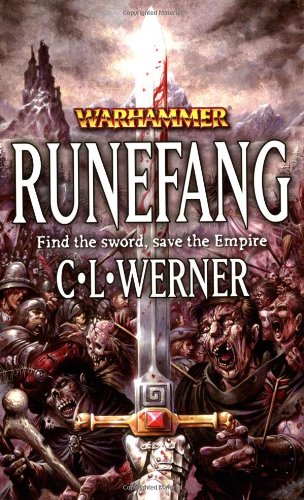
Throwback Thursday – Warhammer: Runefang by C. L. Werner

Runefang Cover

Publisher: Black Library (Paperback – 24 June 2008)

Series: Warhammer Fantasy

Length: 413 pages

My Rating: 4.5 out of 5 stars

Amazon

Welcome back to my Throwback Thursday series, where I republish old reviews, review books I have read before or review older books I have only just had a chance to read.  For this week’s Throwback Thursday I have a look at a classic Warhammer Fantasy adventure novel with the entertaining fantasy thrill ride, Runefang.

I have been reading an awful lot of Warhammer 40,000 novels lately, but deep down my heart will always belong to the Warhammer Fantasy franchise, as that was the game that I played back in the day.  Even though the Warhammer Fantasy game has ended (replaced by The Age of Sigmar), while it was going the Black Library invested a lot of time into creating some excellent novels in this setting, which I have also been enjoy recently.  This includes the awesome Broken Honour and some of the earlier entries in the iconic Gotrek and Felix series (including Trollslayer, Skavenslayer, Daemonslayer, Dragonslayer and Beastslayer).  Even after reading these, I am still in the mood for more fun Warhammer Fantasy adventures and so I just read Runefang by established Warhammer fiction author C. L. Werner.  Werner, whose other writing credits include the Witch Hunter, Thanquol & Boneripper and The Black Plague series, came up with a compelling idea for this novel which I had a lot of fun getting through.

As civil war, discord and political instability rock the human realms of the Empire, a far greater threat marches upon it from the south.  A massive horde of undead creatures has been raised from the grave and is  cutting its way through the heavily populated province of Wissenland.  As the forces of Wissenland gather to fight, they are disheartened to find that these are not the typical shambling herd of undead horrors, but a well-organised, highly disciplined force of relentless fighters with dangerous magic backing them up.  Worse, the leader of this force is a true monster, the wight lord Zahaak, an ancient general of the legendary dark necromancer, Nagash, who has risen from his last defeat to finally achieve the victory he promised centuries before.

After several devastating slaughters, it becomes apparent that the undead force before them is unstoppable and the only way to defeat it is to kill the unkillable undead general.  In desperate need of anything that will save his realm, the Count of Wissenland and his advisors come up with an unlikely plan: recovering the Solland Runefang.  Lost years before when an orc raid destroyed the former province of Solland, the stolen Runefang, one of the legendary 12 swords signifying rulership of the Empire’s provinces, is rumoured to be the only weapon capable of killing Zahaak.

The task of finding the Runefang falls to Baron von Rabwald, who pulls together a small expedition of soldiers, knights and adventurers and leads them to the Runefang’s purported hiding place in the Worlds Edge Mountains.  However, this is no easy quest, and the chances of success are low, especially as the Worlds Edge Mountains are a notorious haunt for monsters, orcs and innumerable other dangers.  Worse, they are not the only group seeking the lost Runefang, and the fell magic of Zahaak is never far behind.  Can the expedition recover the Runefang before it is too late, or will Wissenland fall at the hands of its greatest foe from the past?

This was an outstanding and extremely exciting Warhammer Fantasy novel that I had a wonderful time reading.  C. L. Werner did an excellent job providing readers with an amazing fantasy adventure, and Runefang has a lot of great elements that will appeal to a wide range of readers.

At the heart of Runefang lies a captivating and highly enjoyable fantasy narrative that quickly drags the reader in with its impressive action, enjoyable characters, intriguing examination of the Warhammer world, and exciting adventure narrative.   Starting off with a fantastic introduction that sees the Wissenland army’s first disastrous attack against the undead horde, you are swiftly brought into the middle of the conflict as you witness the aftermath of the defeat, which also introduces several of the main characters.  Following some compelling exposition about the enemy they are facing, the story splits into two parts, with Baron von Rabwald leading most of the supporting cast off to find the lost Runefang, while the rest of the story focuses on the Count of Wissenland’s attempts to delay the undead army to give the adventurers time.  This split works really well, and seeing the disasters unfolding in Wissenland heightens the stakes of the expedition’s adventures and ensures that the reader is even more invested in its outcome.  The expedition storyline encounters multiple obstacles throughout their adventure, including monsters, traps, and orcs and goblins.  They are also forced to deal with a rival force of humans who are also hoping to claim the Runefang, untrustworthy mercenaries, as well as a traitor within their ranks who is helping the enemy.

This all translates into a very good and action-packed adventure, and I loved seeing all the epic events unfold through the eyes of the varied characters.  The story chugs along at a quick and exciting pace, with a good combination of action, dark moments and some fun, if grim, humour that I quite enjoyed.  Werner also ensures readers are in for a wild ride by not being sentimental when it comes to character survivability.  This became really apparent around halfway through Runefang when several key characters, many of whom had been built up in a big way for most of the narrative, were very suddenly killed off, and one of the supporting cast took the reigns as lead protagonist.  While this was a little surprising, I think it worked rather well, and it added to the suspense and drama of the tale, as the new protagonist is forced to make some big choices and deals to keep the quest alive.  Following this, the story keeps advancing at a great pace, with new foes and dangers appearing the closer the protagonists got to their goal.  This leads up to the epic final sequences of the expedition narrative, and it was fantastic to see the surviving protagonists go up against all the villains that had been chasing them in a big, extended confrontation, and Werner kept continuously hitting the reader with twists, surprises and dangers.  The reveal about the traitor in the ranks was pretty good, especially as Werner threw in an excellent red herring character (although by the time it is revealed, there were limited potential characters who it could be).  Everything comes together extremely well, with all the storylines and character arcs reaching their natural end, and I felt that it was an excellent, if rather bittersweet, conclusion.

I have to say that this was a particularly good and accessible entry in the wider Warhammer Fantasy canon, which is very well suited to this sort of immense and powerful story.  While Werner could have just phoned in Runefang with a generic adventure story set in the universe, he does a great dive into the lore.  This novel is set well before the events of most Warhammer Fantasy novels and takes place during the Age of the Three Emperors, where the Empire was split by a raging civil war.  As such, the province of Wissenland is on its own throughout the novel and must also deal with the substantial machinations of its neighbours as it fights to survive, which gives it a great additional edge of intrigue.  The author also spends a great deal of time focusing on the ruined province of Solland and the importance of its lost Runefang.  It was fascinating to see the ruins of Solland in Runefang, as it was still badly scarred by the orc invasion that destroyed it, and the impact of Wissenland’s absorption of it was quite interesting.  I also really appreciated the fantastic portrayal of the notorious Worlds Edge Mountains, the former realm of the dwarfs that is now controlled by orcs, bandits, and monsters.  The author did a really good job showing this to be a desolate and dangerous place, and he really did not disappoint when it came to featuring the variety of cool creatures and threats it contains, forcing the protagonists up against dangerous odds again and again.

Finally, I must highlight the author’s excellent use of the undead army in this book.  Rather than using the armies of the Vampire Counts or the Tomb Kings (which were the two undead factions at the time of Runefang’s release), Werner features a historic army of undead creatures who have risen after their defeat during the early days of the Empire to have their vengeance.  As such, they are a unique force of undead creatures, and I loved seeing them in action, particularly as you get some awesome reactions of terror from the human characters observing them.  Overall, I really loved the cool use of Warhammer Fantasy elements, history and settings in Runefang, and I felt that this was the sort of Warhammer novel that any fantasy fan could pick up and enjoy.

I also need to highlight all the impressive action featured throughout Runefang, and Werner has a clear talent for making fight scenes come to life in a big way.  There are so many battles throughout this book, and each of them is showcased to the reader in exquisite detail.  Whether it be a small skirmish, a one-on-one fight, a brawl against a giant monster, or a large pitched battle between armies, the author ensures that the reader gets the full sense of everything that his happening.  It was extremely cool to see all these fights unfold, and I was able to mentally see every sword swing, desperate charge and epic moment.  I liked how some of these fights emulated the battles from the table-top Warhammer Fantasy game, and you could really envision how they would have looked being played out on the board.  These action scenes combined well with the awesome and exciting story, and I think that they strongly enhanced my enjoyment of Runefang.

The final thing I want to talk about is characters, as Runefang features an excellent and massive cast of distinctive protagonists and villains.  Now, I am not going to go into too much detail about character arcs or development here, as to do so might ruin which key characters are killed off early.  However, I have to say that I was really impressed with the awesome way that Werner introduced each of the major figures in the book.  As such, you quickly grow to like many of the figures in Runefang, especially as Werner goes out of his way to feature a unique and often damaged group of protagonists to fit the story around.  I will say that I deeply enjoyed the Baron’s notorious and scarred champion, Kessler, who has some great moments; the dwarf Skanir, who serves as cantankerous guide; and the fantastic duo of the halfling Theodo Hobshollow and his ogre sidekick, Ghrum, who were an excellent and entertaining comic relief team.  There are also some really good villains in this novel, including the bandits who are also after the Runefang (featuring a brilliantly despicable leader and an entertaining pair of cowards), and an extremely dangerous orc warlord, Uhrghul Skullcracker.  Uhrghul was a particularly fun character, and I liked both his philosophical insights about being an orc leader as well as his effective way of questioning human prisoners (eating my legs in front of me probably would get me to talk).  I did think that the main villain of Runefang Zahaak was a tad underdeveloped, even if he was shown to be an epic badass with major historical cred to his name.  However, this might have been a deliberate choice by Werner to highlight the uncomplicated nature and motivations of the undead compared to the more insidious, evil, or animalistic plots of the humans and orc villains.  I had an amazing time following these characters, just try not to get too attached to any of them.

Filled with fantastic action, a compelling adventure storyline, fun characters and great use of the Warhammer Fantasy setting, Runefang was an outstanding novel from C. L. Werner that I had an amazing time reading.  Werner really went out of his way to create the most impressive and exhilarating fantasy adventure he could, and the result is really worth checking out.  A highly recommended Warhammer fantasy novel that you are guaranteed to have fun with.

Amazon

Throwback Thursday – Warhammer: Broken Honour by Robert Earl

Warhammer - Broken Honour Cover

Publisher: Black Library (Paperback – 22 February 2011)

Series: Warhammer Fantasy

Length: 411 pages

My Rating: 4 out of 5 stars

Amazon

Welcome back to my Throwback Thursday series, where I republish old reviews, review books I have read before or review older books I have only just had a chance to read.  For my latest Throwback Thursday, I look at a cool standalone entry in the Warhammer Fantasy canon with the 2011 novel, Broken Honour by Robert Earl.

Damn it has been fun getting back into Warhammer fiction over the last couple of years, especially as there have been so many amazing and epic recent additions to the franchise.  I have really been having fun with the huge variety of stories associated with these iconic tabletop games, and while I have been mostly focused on the science-fiction based Warhammer 40,000 novels, I have also been dabbling with the Warhammer Fantasy subgenre.  Set in a chaotic and war-ridden world filled with all manner of creatures from classic fantasy, the Warhammer Fantasy novels contain fun and dark adventures, such as the Gotrek and Felix novels (check out my reviews for Trollslayer, Skavenslayer, Daemonslayer, Dragonslayer and Beastslayer).  I was lucky to recently find several cool Warhammer books in a second-hand shop, and I immediately dived into a particularly fun fantasy novel, Broken Honour, written by a new-to-me author, Robert Earl, who had written various other interesting Warhammer novels.  Set before the 2015 destruction of this setting and the start of the Age of Sigma, Broken Honour was a fantastic and entertaining read with a great story to it.

Chaos has once again invaded the realms of man, this time in the Imperial state of Hochland.  The ravenous beastman hordes are emerging from their deep forest lairs to begin their annual raids of the human settlements to destroy, despoil and feast on the people within.  As the armies of Hochland gather to repel them, they find themselves outmatched and outsmarted at every turn.  A powerful and dangerously intelligent beastman lord has risen to command the herd, and his unusual tactics may spell the end for every human living in Hochland.

As the Hochland baron and his advisors attempt to withstand the new threat advancing towards them, they desperately seek out any fighting men they can find.  Sensing opportunity, mercenary Captain Eriksson, a veteran fighter for sale currently only missing a regiment to command, arrives at the capital.  Keen to take advantage of the current chaos, Eriksson buys the freedom of a large group of prisoners to form a new free company.  Promised freedom and pardons for their crimes if they fight, the prisoners form a reluctant and ill-trained regiment, the Gentleman’s Free Company of Hergig, who hope to avoid the brunt of the battle in the back.

However, Eriksson and his troops soon find themselves in the very thick of the fighting, as those above them seek to use his unit to in the very worst ways.  Forced to contend with ravenous monsters, political intrigue, and a villainous lord with everything to lose, Eriksson and the Gentleman’s Free Company of Hergig will need to come together and hone their skills if they are to survive.  Can this band of rogues, thieves and criminals regain their lost honour and find redemption on the battlefield, or will they find only death and destruction as humanities most bestial enemies come to claim them?

Broken Honour was an awesome addition to the Warhammer Fantasy canon that I had an amazing time getting through.  Earl produced an exceedingly exciting and action-packed read that is essentially The Dirty Dozen in the Warhammer Fantasy universe (it is also comparable to the Last Chancers series from Warhammer 40,000).  Obviously, with a plot like that, I knew that I was going to have a lot of fun with this book, and Earl really did not disappoint.  While the narrative is a tad by the numbers, it is a pretty cool military fantasy narrative that is worked well into the Warhammer Fantasy setting.  The entire story flows really well, with the antagonists introduced up front and the protagonist, Eriksson, and his unwilling soldiers brought in quickly after that.  From there you follow the paroled Free Company as they are dragged from one conflict to the next and forced to contend with overwhelming odds.  As such, the book is loaded with a ton of outstanding action and brutal fight sequences that are guaranteed to keep you entertained.  Earl makes excellent use of multiple character perspectives to tell a deep and wide-ranging narrative, and you soon get dragged into several different character arcs, including several surrounding the antagonists.  Not only do you get to see into the heart of the beastman camp, but there are several brilliant sequences told from the perspective of a villainous Hochland noble who is trying to kill the protagonists.  This all ends up being a pretty exciting and fantastic story, and I found myself getting really caught up in the novel, powering through it very quickly.  Everything comes together really well into a great self-contained adventure, although a couple of character arcs didn’t get the conclusions that they deserved, and some storylines are never revisited, despite Earl leaving the story open for a sequel.  Despite that, Broken Honour was an excellent, easy novel to check out, and you are guaranteed to have a great time reading it.

I really liked how well Broken Honour slotted into the established Warhammer Fantasy setting, and this was a great addition to the overall canon.  Earl focuses his narrative around two particularly intriguing factions from the game here, the villainous beastmen and the human armies of the Empire, specifically from the state of Hochland.  I loved the insight into both, especially the beastmen, and the author really brings them to life in exquisite detail.  You can really feel the monstrous power, the Chaos infused evil and the beast-like mentalities contained within these creatures, and they prove to be excellent and brutal antagonists for the entire novel.  At the same time, there are some awesome insights into the soldiers of the Empire, and I loved the various depictions of their battle tactics and the various regiments.  While Earl does dive into these various Warhammer factions throughout Broken Honour, readers don’t need to know too much about them to enjoy the series, as the author does an amazing job introducing them and explaining what they are, and any fan of fantasy or dark fantasy would have a great time with this book.  Indeed, Broken Honour would serve as an excellent introduction to the Warhammer Fantasy canon for those readers unfamiliar with its details, as the story encapsulates the constant struggles and battles that occur within it, as well as the fun and larger-than-life characters it focuses on.  As such, this is a really good and entertaining Warhammer novel that will really appeal to both established fans and potential newcomers.

I really must highlight some of the great characters featured within Broken Honour, as Earl has come up with a wonderful and compelling group of figures to set the story around.  Most of the plot naturally revolves around the members of the Gentleman’s Free Company of Hergig, who are formed to face the threat within it.  Made up of over 120 former criminals, you don’t get to know all the members, but most of the ones who are featured are extremely fun and very memorable.  The leader, Captain Eriksson, proves to be a canny veteran who can manipulate events and his superiors in his favour to field a force in the war and get a lot of money.  Despite his mercenary attitude, Eriksson proves to have a conscious and builds up a fair bit of loyalty to his men, and this character growth really helps endear him to the reader.  Most of the other named Free Company members are a rather interesting and cool.  The drummer boy, Dolf, for example, proves to be an excellent human MacGuffin in the narrative as political plots revolve around his survival.  Other members of the Free Company that stood out to me include the tired veteran Sergeant Alter, the possibly mad former warrior priest Gunter, and the wily quartermaster Porter, whose moneymaking schemes and remarkable survival ability rounds out the character dynamics extremely well.

While I had fun with these protagonists, the best characters within Broken Honour are easily the baddies, with several great antagonist figures really coming together perfectly throughout the book.  The most prominent of these is Beastlord Gulkroth, who leads the beastman armies in the book.  Empowered by dark magics which have enhanced him even further than the rest of his kind, Gulkroth proves to be an intimidating and compelling figure in the novel, especially as his grasp of strategy, tactics and patience are highly unusual amongst his race.  Gulkroth spends the bulk of the novel balancing this newfound intelligence against his bestial nature, and it proves extremely interesting to see both sides of his personality come into conflict, especially as it impacts how his army attacks.  While Gulkroth is a fascinating figure, the best antagonist is Viksberg, a cowardly noble who was the sole human survivor of the first battle in the book thanks to his spinelessness behaviour.  Despite this, he manipulates the situation to make him appear as a hero and gets promoted as a result, killing anyone who knows the truth of his actions.  This eventually forces him to contend with Eriksson’s regiment, as one of them is a witness to his crimes, and he tries to get all of them killed on multiple occasions.  Viksberg’s continued attempts to kill the protagonists through indirect means really adds to the intrigue and enjoyment of the entire novel, and it was exceedingly entertaining to watch his various plots unfold.  Earl really goes out of his way to make Viksberg as despicable as possible, and you end up really disliking the entitled bugger, especially as he gets better characters killed.  You end up rooting against Viksberg in the hope that he’ll get his just deserts, only to be disappointed when he manages to survive to fight another day, which is both frustrating and extremely fun.  These brilliant antagonists, and all the other characters, add so much to the overall plot of Broken Honour, and I really appreciated the work that Earl put into his various characters.

Overall, Broken Honour by Robert Earl was an awesome and deeply entertaining Warhammer novel that I had a delightful time with.  The straightforward story is very exciting and contains some impressive character arcs that unfold to produce a riveting tale, while also providing all the action and bloodshed I could ever want in the iconic Warhammer Fantasy setting.  While I am a little disappointed that Earl didn’t write any additional novels featuring the characters in Broken Honour, I still had an awesome time with this book and it’s a great read for both Warhammer fans and those general fantasy readers.  Highly recommended!

Amazon

Throwback Thursday – Daemonslayer by William King

Daemonslayer Cover

Publisher: Black Library (Audiobook – October 2000)

Series: Gotrek and Felix – Book Three

Length: 9 hours and 38 minutes

My rating: 4.75 out of 5 stars

Amazon     Book Depository

Welcome back to my Throwback Thursday series, where I republish old reviews, review books I have read before or review older books I have only just had a chance to read.  For this Throwback Thursday, I am doing a bit of a double feature by reviewing two of the outstanding entries from the iconic Warhammer Fantasy franchise’s Gotrek and Felix series by the brilliant William King.  I have just published a review for the second book in the series, Skavenslayer, and, after some rapid audiobook listening, I have also pulled together a review for the third book, Daemonslayer.

After the epic conclusion of the battle of Nuln in Skavenslayer, Dwarf Slayer Gotrek Gurnisson receives a mysterious message and immediately sets out on the road, convinced that this missive may be the key to finding his much desired glorious death.  Accompanied as always by his companion, the former poet turned reluctant adventurer Felix Jaeger, Gotrek marches to the northern parts of the Empire to meet his destiny.

Arriving at their destination, Gotrek and Felix learn that a group of dwarfs are planning an expedition to find the lost dwarf stronghold of Karag Dum, and they want Gotrek to accompany them.  Destroyed in ages past, Karag Dum now lies in the middle of the Chaos Wastes, the most dangerous place in the entire world.  Wracked by the shifting winds of magic, marauding war bands, mutating warpstone and the foul essence of Chaos, no one can cross the Chaos Wastes and survive, and only death, madness or mutation awaits those who try.  However, expedition leader Borek Forkbeard has come up with an ambitious plan to fly over the Chaos Wastes in a giant, experimental airship, designed by an unstable engineer turned Slayer.

Determined to make up for previous failed attempt to reach Karag Dum, Gotrek agrees to accompany the expedition, with an inspired Felix accompanying him.  However, even with all the advantages that the airship provides, this will still be a perilous journey.  Many dangerous things lurk in the Chaos Wastes that will not hesitate to destroy the dwarven company for their dark gods.  At the same time, Gotrek and Felix’s old foe, Grey Seer Thanquol, plots from the shadows, determined to claim the airship for the Skaven cause.  But the very worst dangers will be found at Karag Dum.  A terrible foe lies within, waiting for revenge and determined to destroy all before him.  Can even the legendary Gotrek and Felix stand up to the wrath of a deadly Bloodthirster of Khorne, especially one who appears destined to kill Gotrek and destroy all who stand with him?

I am having so much fun getting through this cool series and I really wish I had checked it out many years ago.  Daemonslayer is another incredible read that continues the fantastic Gotrek and Felix adventures that started in Trollslayer and were continued in Skavenslayer.  William King has come up with a pretty intense story for this third entry in the series, and I loved the change in writing style featured within it.  An exciting and character-driven tale, this was easily the best entry in the series so far, and I deeply enjoyed the time I spent getting through it.

Daemonslayer contains an impressive and intense narrative that proves to be extremely addictive and a lot of fun to read.  Unlike the previous novels in the series, which featured a collection of short stories, Daemonslayer is actually a complete story with one continuous narrative.  This is an interesting change of pace, and one that I think works extremely well, especially as it cut down on some of the repetition that was an issue in Trollslayer and to a lesser extent in Skavenslayer.  King writes a fantastic story that quickly gets into the action and adventure as the protagonists embark on an epic and potentially lethal quest.  While not a collection of short stories, King does break the book up into several distinctive sections, each filled some unique plot points and antagonists.  These sections are pretty linear and flow into each other extremely well, resulting in a very cohesive and entertaining narrative.  Like the rest of the novels in the Gotrek and Felix series, readers do not need a lot of background knowledge about the Warhammer Fantasy world to enjoy this book.  While I would probably suggest reading Skavenslayer first, Daemonslayer can be read as a standalone book, and all readers are generally in for a good time with this novel.

The action and adventure flies pretty fast and thick throughout Daemonslayer, with highlights including a lengthy battle against an army of Skaven towards the start of the novel, exploration in the dark tunnels of Karag Dum and the final epic fight sequence against the hordes of Chaos.  King is particularly skilled at writing exciting and powerful battle sequences, and I loved how he managed to bring the uniqueness of a large-scale Warhammer battle to life.  Part of this is because the author makes great use of multiple character perspectives throughout Daemonslayer, which allows for a richer narrative as you get to see many different angles of the same story.  This works particularly well in the first battle against the Skaven, as you get to see Grey Seer Thanquol controlling his forces, as he desperately tries to kill Gotrek and Felix.  I did think that some of the Thanquol scenes in the second half of the novel were a bit weak, especially as they were more concerned with setting up his appearance in the next novel, Dragonslayer, than influencing the plot of Daemonslayer.  Still, these scenes were great, and you are always guaranteed a laugh when dealing with this ruthless Skaven.  While there is a noticeable focus on action and death, King also works in some fantastic comedy and humour, which makes this book an absolute treat to read.  I also appreciated how dark and emotional several scenes became, especially when the protagonists are faced with the grim realities of certain terrible situation.  All of this is worked into quite an impressive adventure story, which ends up being extremely addictive and enthralling to get through.

I loved the great use of setting throughout Daemonslayer, especially as King features some of the darkest and most dangerous locations in the entire Warhammer Fantasy canon.  The most notable of these is the notorious Chaos Wastes, a dark and dangerous wasteland, completely corrupted by the Chaos gods and filled with all manner of mutants, monsters, beastmen, worshipers of Chaos and Daemons, who gather and fight throughout the wastes.  While the Chaos Wastes are primarily shown from above, King makes sure to produce some gruesome and disturbing depictions of the landscape and its inhabitants, and it proves to be a pretty horrific backdrop for a good part of the story.  I do wish that a little more of the story had been spent on the ground within the Wastes, but it was probably a wise choice to avoid, as the story could easily become bogged down there.  I also really enjoyed the lost dwarf hold of Karag Dum, where the last third of the book takes place.  King was clearly drawing some inspirations from Tolkein’s Mines of Moria when he came up with this location (Moria is also known as Khazad-dûm), with hidden doors, ancient treasures, despoiling opponent, and a giant fiery demon boss.  The scenes set within this hold are pretty claustrophobic, and King makes sure to use the dark location to its full advantage during fight scenes.  You really get a sense of the decay and destruction that has occurred within this setting over the years, and it is pretty easy to feel the despair of the various dwarf characters.  Both these major settings are really impressive, and they prove to be an excellent and fitting backdrop to a very fun and intense story.

A major strength of this book is its characters, as King continues to produce a range of complex and distinctive figures to populate his tales.  This includes protagonists Gotrek and Felix, who find themselves on their most dangerous mission yet.  Felix continues to be used as the novel’s primary point-of-view character, and it is fascinating to see his continued evolution from cowardly fop to dangerous warrior.  Despite his continued caution and reluctance to engage in fights, Felix is now regarded by everyone as a heroic figure, and he accompanies Gotrek on this latest quest with only a minimum of forbearance, despite being given an out by his friend.  King has really hit his groove when it comes to portraying Felix, and the character reigns supreme as a sarcastic, but loyal friend.  I have really grown to like Felix, and readers will become pretty invested in his tale.

After being overlooked a bit in Skavenslayer, Gotrek has a lot more focus on him in Daemonslayer, as he re-visits one of his old failures and reunites with some of his dwarf kin.  For most of the novel, Gotrek is his usual gruff and battle-hardened self, still searching for his doom while managing to kill anything that he comes across.  While this is always a lot of fun, King makes sure to feature some deeper character elements in this novel, by highlighting some of his inner feelings and giving hints at his past.  There are several compelling mentions of Gotrek’s pre-Slayer life in this book, as well as some early hints at the character’s true destiny and the dark fate surrounding him.  King also shows a surprising amount of emotion in the character for this book, and Gotrek has some moving scenes with Felix as he contemplates the mistakes of his past and his many regrets.  I really enjoyed seeing how the character’s friendship with Felix has developed over the course of the last few books, and there is even a scene where Gotrek admits he is apprehensive about journeying to the Chaos Wastes and even lets Felix know he does not have to follow him.  While all this character development is great, King also makes sure to continue to portray Gotrek as an absolute badass in Daemonslayer, as he goes up against a ton of different enemies and opponents.  The various fight scenes with Gotrek are so much fun, although I do worry that King is perhaps making Gotrek a little too overpowered, especially as he manages to defeat a Bloodthirster, literally the most dangerous creature in the entire Warhammer canon (admittedly Felix helps a lot).  I still really love this great character and I cannot wait to see what other crazy adventures he goes on in the future.

Just like his previous books, King loads Daemonslayer up with a great range of supporting characters, and several of the characters introduced in this novel end up becoming major recurring figures in the Gotrek and Felix series.  Probably my favourite was Snorri Nosebiter, a fellow dwarf Slayer, who has had way too many blows to the head.  Snorri proves to be a fun companion to Gotrek and it was interesting to see a character who makes the titular protagonist seem sane in comparison.  There was also a fun character in Varek Varigsson, who is essentially the dwarf version of Felix, except with a range of explosive devices.  In addition, you cannot overlook the dwarf engineer turned Slayer, Malakai Makaisson, and I had a good chuckle when the characters discuss the fates of his previous, unfortunately named ships.  I also really liked that King reused two of his most entertaining characters from the previous novel, the Skavens Grey Seer Thanquol and Lurk Snitchtongue.  Both serve as secondary antagonists in the story, and prove to be excellent comic reliefs, especially as their schemes constantly go against them.  It looks like King has some fun plans for Snitchtonuge in the future, and I liked the fun changes he went through.

As I did for Skavenslayer, I really need to point out the extreme lack of female characters in this book.  Daemonslayer literally had only one named female character, Ulrika Magdova, who naturally falls in love with Felix the first time they lay eyes on each other.  While this is pretty lazy writing on King’s part, at least Ulrika is a much better written character than the females featured in Skavenslayer.  Ulrika is a badass Kislev fighter, who proves to be a dangerous fighter (of course, Felix has to be just a little bit better).  Still, I have a feeling she is going to be a bit of a damsel in distress in some of the future novels, and I hope that King balances it out with some additional female characters in the future.  Overall, there are some great characters featured throughout Daemonslayer and I look forward to seeing the ones who survive in some of the other Gotrek and Felix novels.

I ended up grabbing the audiobook format of Daemonslayer, narrated by Jonathan Keeble.  With a relatively short runtime of 9 hours and 38 minutes, the Daemonslayer audiobook is an easy audiobook to get through, and I managed to finish it off quickly.  The audiobook format proves to be a great way to enjoy this excellent book, especially as it allows the fantastic and chaotic landscape and characters to come to life in all their ghastly glory.  Keeble continues to impress as the narrator of this series, and I love the amazing array of voices he brings to the table.  Daemonslayer really highlights just how varied his voice can be as Keeble produces a substantial number of different accents and vocal tones to capture the rich and unique cast.  This includes Scottish-sounding dwarfs, Russian-esque Kislev lancers, humans with cultured British accents and the mad, loud voice of Snorri Nosebiter.  Keeble also has to voice the various inhuman monsters that the protagonists encounter, from the great Skaven characters, to the monstrous daemons and warriors of Chaos, all of which prove very fitting and amusing.  He also brings an immense amount of passion to his narration that deeply enhances the experience of anyone listening to the book.  The way in which he gets into the various fight sequences is amazing, and you can hear the sheer excitement in his voice as he reads.  This is especially true in the final epic fight scene, and the listener soon finds themselves on the edge of their seat as Keeble works his way up to the conclusion.  This is really an impressive and amazing format to enjoy Daemonslayer in, and I cannot recommend this audiobook enough.

Daemonslayer by William King is an exceptional and amazing entry in the fantastic Gotrek and Felix tie-in series.  This awesome novel contains an epic and intense story, as its two iconic protagonists continue to explore the dark and deadly Warhammer Fantasy world.  Filled with action, adventure, comedy and some dramatic character moments, Daemonslayer is an outstanding novel that comes highly recommended for all Warhammer fans.  I look forward to seeing how the rest of the series turns out and I am really enjoying my current jaunt into the world of Warhammer tie-in fiction.

Daemonslayer 2 Cover

Amazon     Book Depository

Throwback Thursday – Skavenslayer by William King

Skavenslayer Cover

Publisher: Black Library (Audiobook – December 1999)

Series: Gotrek and Felix – Book Two

Length: 10 hours and 30 minutes

My rating: 4.5 out of 5 stars

Amazon     Book Depository

Welcome back to my Throwback Thursday series, where I republish old reviews, review books I have read before or review older books I have only just had a chance to read.  The adventures of my two favourite Warhammer Fantasy protagonists, Gotrek and Felix, continues, with the second incredible and extremely fun entry in their series, Skavenslayer.

After their previous escapades throughout the Empire and beyond, wandering adventurer, outlaw, and writer Felix Jaeger is still reluctantly following the Dwarf Slayer Gotrek Gurnisson on his quest to find a glorious death.  After travelling to the Imperial city of Nuln, the two heroes attempt to make some money to support their travels.  However, danger is always around the corner, as the heroes find themselves thrust into the middle of a vast conspiracy when they take on a menial job.  The chittering and evil hordes of the Skaven are amassing beneath Nuln, determined to conquer the city by any means necessary.  Led by a dangerous and ambitious leader, the rat-men have several sinister plots to kill all the humans above and appropriate their city and technology for their own glorious purposes.  The only chance the city has to survive this chaos appears to be Gotrek and Felix, who are constantly dragged into the middle of the Skavens’ plots, thanks to fate, Skaven pettiness or terrible bad luck (both Felix’s and the Skaven’s).  Can the two heroes save Nuln from the Skaven hordes, or will Gotrek finally find the death he always seeks?

Wow, this is such a fun and entertaining series.  Skavenslayer is the second entry in the Gotrek and Felix series, which follows the two titular heroes as they journey throughout the Warhammer Fantasy world, battling all manner of monsters, demons and creatures.  After enjoying some of the excellent Warhammer 40,000 fiction out there (Deathwatch: Shadowbreaker and Kal Jerico: Sinner’s Bounty), I recently dove into the first Gotrek and Felix novel, Trollslayer, which contained several exciting and compelling short stories.  I loved the fantastic mixture of action, world-building and fun characters featured within Trollslayer, and within a couple of weeks I had started listening to SkavenslayerSkavenslayer proved to be another excellent novel, and I honestly think it was a slightly stronger novel than Trollslayer, thanks to its much more connected plot.  This was an outstanding read that has many amazing elements to it.

Skavenslayer contains an outstanding and deeply addictive narrative that follows Gotrek and Felix as they attempt to stop the Skaven plot to destroy the city of Nuln.  Skavenslayer is made up of several short stories linked together by Felix’s journal entries.  Unlike the previous novel, all six stories and the epilogue are linked, forming one continuous narrative and resulting in a tighter and more comprehensive read.

Skavenslayer’s first short story is Skaven’s Claw, which sees Gotrek and Felix employed as sewerjacks, guards who patrol the vast catacombs underneath Nuln.  On patrol, they chance upon a clandestine meeting between a Skaven and a human noble, placing Gotrek and Felix in the middle of a conspiracy involving the head of Nuln’s secret police.  Skaven’s Claw is an excellent first story that does a wonderful job establishing most of Skavenslayer’s plot details and introducing several key characters, including recurring antagonist Grey Seer Thanquol.  I loved the combination of action, world building and intrigue that was contained within Skaven’s Claw, and it results in an awesome, fast-paced story.  The Nuln sewers prove to be a claustrophobic and memorable setting for most of the battles.  I also enjoyed the use of secondary antagonist Fritz von Halstadt, a fanatical human who has been manipulated by the Skaven, as his story arc was very well established and quite compelling.  This is an awesome entry that gets Skavenslayer off to an impressive start.

Next up we have Gutter Runners, which sees the Clan Eshin assassin, Chang Squik, lead a group of Skaven Gutter Runners on a mission to kill Gotrek and Felix at the inn where they are working as bouncers.  This was a quick and action-packed story which proved to be a lot of compelling fun.  The action is swift and deadly, as the protagonists are attacked on multiple fronts, and there are several great battle scenes throughout.  This is a fun story that you can easily power through in one short sitting, and I felt that it did a great job keeping the reader’s attention after the fantastic introductory story.

The third entry is the fantastic and funny Night Raid, which focuses on the members of Clan Skyre, the insane Skaven engineers and weapon designers.  The leader of the Clan Skyre contingent, Heskit One-Eye, plans a raid on the Nuln College of Engineering to appropriate the latest human weapons and technology and obtain glory.  However, the jealous Grey Seer Thanquol organises a significant roadblock in the form of Gotrek and Felix.  This is another outstanding entry in the novel, and I consider it to be the most comedic and entertaining of the bunch.  Not only do you get to see amazing examples of Skaven backstabbing and betrayal but you also have an extremely funny and exciting sequence at the college, where all hell breaks loose when a Skaven gets stuck in a Steam Tank.  This story also serves as an excellent introduction to the various Skaven side-characters, and a lot of elements from Night Raid have major impacts on the rest of Skavenslayer’s story.

Up next, we have the disgusting and captivating story, Plague Monks of Pestilens.  In this story, a brewing plague strikes quick with deadly consequences.  However, this is no ordinary plague; it is a deadly concoction dreamt up by the demented plague monks of Clan Pestilens, led by the terrible Vilebroth Null.  Warned again by Thanquol, Gotrek and Felix attempt to stop the plague monks before it is too late.  Plague Monks of Pestilens is an amazing middle story that is pretty memorable.  Rather than the pure hack-and-slash narrative of the previous story, King works in an interesting mystery element, as Felix tries to work out where the plague monks are attacking from.  Once battle is joined, you are in for a dangerous and gruesome fight, especially as the author goes into full horror mode when describing the grotesque plague monks and their malformed, diseased bodies.  This is an extremely intense and disturbing story which really enhances Skavenslayer’s overall narrative and gives it the more serious edge it needed.

The penultimate story of Skavenslayer is Beasts of Moulder, which sees Gotrek and Felix attempt to stop the master mutators of Clan Moulder, led by Izak Grottle, try to unleash their latest creation.  This was a decent addition, although if I am being honest, it was probably the weakest entry in the entire book.  Not only are the stakes a little lower, but it repeats the pattern of the previous two entries.  I did quite enjoy the scene where Felix visits the palace, especially as everyone there assumes he is some sort of master monster hunter, but the rest of the story fell a little flat, especially the Elissa subplot.  Still, it fits into Skavenslayer’s narrative well and does a good job setting up the final story.

The last entry in Skavenslayer is the major concluding storyline, The Battle of Nuln.  In this story, both the citizens of Nuln and the Skaven army hiding beneath the streets have been afflicted by plague and famine.  In order to achieve victory, Thanquol leads a daring raid on the Countess’s palace during a ball, while the rest of the Skaven army attacks the city.  With Gotrek and Felix stuck in the middle of several Skaven plots, can they save the city before it is overwhelmed by rats, disease and vile Skaven magic?  The Battle of Nuln is an incredible and captivating entry that serves as the action-packed conclusion to the entire book.  King brings together all his fantastic storylines, and the readers are rewarded with an intense and extended war sequence, as the full wrath of the Skaven force is unleashed.  I deeply enjoyed this final story, and it did an outstanding job of providing satisfying, if occasionally lethal, conclusions to all the character arcs and storylines.  There is so much action going on in The Battle of Nuln, and I loved seeing the consequences of all the previous short stories finally come to the fore for both sides in the war.  An excellent and exciting conclusion that will put you in the mood for even more Gotrek and Felix.

I had an outstanding time getting through each of the short stories above, and not only are they fantastic reads on their own but together they form an impressive and intense overarching narrative.  King did a wonderful job crafting together all six stories, and I felt that the use of a single location and overarching antagonists worked extremely well, especially once you are introduced to the four iconic Skaven clans.  While some of the middle stories do suffer from plot repetition, this is still a great book which is extremely fun to read.  King ensures each story has a great combination of action, character development and humour, and each of the stories can easily be read on their own without a lot of context from the others.  This is also a very good Warhammer Fantasy novel, and readers only need minimal prior knowledge of the franchise, especially as King provides a great amount of detail and self-contained lore.  I felt that it came together perfectly, and readers are in for an exceptional time when they check this novel out.

One of the more entertaining and fun parts of this novel was King’s use of the Skaven as the villains of the story.  The giant rat-men known as Skaven are chaotic beings who, thanks to their spiteful nature, massive ambitions and weird array of abilities, weapons, magic and fighting techniques, are one of the most entertaining and recognisable races in the Warhammer Fantasy canon.  I think that King did a particularly good job bringing the Skaven to life in Skavenslayer, and they proved to be a very intriguing and memorable group of antagonists.  Not only does the author showcase several unique Skaven clans (each of them is covered in a short story), but he also captures the Skavens’ treacherous nature, speech pattern and insane pettiness.  While the Skaven have an elaborate plan, their own paranoia and self-serving mindset gets in the way of its success, and it is wonderful to see the various backstabbing, betrayals and plots that occur throughout the course of the book.  Despite this, they still prove to be a dangerous group of enemies, and they manage to hit the protagonists and the rest of the humans in Nuln in a big way.  I really enjoyed the way that King utilised the Skaven throughout this novel, especially as their duplicitous or cowardly actions are the catalyst for most of the book’s humour, and Skavenslayer is a fantastic and detailed introduction to this impressive Warhammer Fantasy faction.  That being said, there are only so many times you can hear a scared Skaven getting ready to “squirt the musk of fear”, and some different wording might have been better.

Another highlight of this book is its complex characters.  The most notable and prominent of these are titular protagonists, Gotrek and Felix, and it is still incredibly fun to see the unusual partnership of a doomed Dwarf Slayer and a former wealthy poet turned notorious adventurer.  Due to his position as the book’s main point of view character, much of Skavenslayer’s focus lies on Felix.  While there are still hints at his somewhat cowardly past, especially as he seems apprehensive before every single fight, Felix has become a much more fearless and dangerous being in this book, and he leads the way in several battles throughout Skavenslayer, proving himself a fantastic hero.  There are some interesting character moments for Felix throughout this book, especially as he encounters his brother, Otto, the first member of his family to reach out to him since his banishment.  There are some great comparisons between the wealthy Otto and the more adventurous Felix in Skavenslayer, and it was intriguing to see what Felix might have turned into if he was not bound to Gotrek.  I also liked how Felix developed more into his role as the sane straight man to Gotrek, and his dry humour really adds a lot of comedy to the books.  Overall, Skavenslayer is quite a strong outing for Felix, and he proves to be an outstanding central character.

Aside from Felix, the other main character is Gotrek, the mad, death-hungry Dwarf Slayer, who is constantly denied his desired doom in glorious combat due to his own unnatural skill.  Gotrek is his usual crude and disrespectful self throughout Skavenslayer, and it is an absolute joy to see him in battle, even if his portrayed as way too overpowered.  While he is a great character, Gotrek was underutilised in Skavenslayer, and he was mainly just a supporting player in the Felix-based stories, only appearing when there is a need for fighting.  Still, it was great to see him, and he does get a lot more attention in the next novel.

While Gotrek was a bit overlooked, King does a wonderful compromise by introducing an exceptional primary antagonist in the form of Grey Seer Thanquol, a powerful Skaven sorcerer who goes on to be a major recurring figure within the Gotrek and Felix novels and the wider Warhammer Fantasy universe.  Thanquol is an impressively entertaining character who represents the absolute best (or worst, depending on your point of view) of Skaven society.  He is insanely ambitious, arrogant, power-hungry and dangerous, and rose to power thanks to an unfortunate “accident” involving his predecessor, a loaded crossbow and an exploding donkey.  Due to his ambition and an unwillingness to share any glory, Thanquol spends just as much time plotting against his equally aspiring subordinates as he does attempting to conquer Nuln or kill Gotrek and Felix.  Indeed, several conflicts with the Skaven are due to Thanquol himself informing the protagonists about his rival’s plots, often through some hilarious letters which are clearly written by a Skaven (despite Thanquol’s own belief that they are masterful forgeries).  The sheer overconfidence, deluded self-belief and inability to take responsibility for his failings make Thanquol a particularly nasty antagonist, however, it is just so entertaining to see him strive and then fail, that you end up wanting him to live and succeed against his Skaven opponents.  Thanquol proves to be an excellent antagonist, and I really enjoyed seeing his alternative point-of-view which highlights the Skaven plans.  King really outdid himself coming up with this villainous rat-man, and he is one of the best things about Skavenslayer and the overall Gotrek and Felix series.

King has also filled Skavenslayer with an interesting collection of side characters who add a lot to the plot.  The author does a good job of introducing these major side characters throughout the various stories, and he manages to build them up and flesh out their personalities in a short amount of time.  There are great human supporting characters, such as Heinz and Doctor Drexler, and several fun and amusing Skaven.  The majority of these Skaven characters are leading members of the main clans who not only serve as secondary antagonists for the novel, but who are also cast as rivals to Thanquol’s rise to power.  I had a fantastic time seeing each of these Skaven characters in all their treacherous, self-serving glory, although my favourite had to be the aptly named Lurk Snitchtongue, who is a very fun and cowardly character.

If I had to make one major criticism, it would be about the complete lack of any decent female supporting characters.  While you can forgive some older fantasy books for their lack of gender diversity, it is a painfully obvious problem in Skavenslayer.  There are literally only two female characters of note within the novel, and both are badly written.  The first is Felix’s romantic partner, Elissa, who quickly becomes a major burden to the story by forming conflicts with Felix.  Their romance is thankfully over before the end of the book, and you cannot feel anything but relief as she leaves.  The other character is the ruler of Nuln, Countess Emmanuelle, who gets only a couple of lines at the end of the novel.  While her one scene does shine her in a good light, the rest of the novel hints that she is a vapid, lustful and incompetent ruler.  The underuse of female characters is probably going to be a major feature of Gotrek and Felix series in the future (for example, Daemonslayer only has one female character), however, I really hope that any who feature are written a lot better than the ones featured in Skavenslayer.

Just like I did with Trollslayer before it, I chose to listen to Skavenslayer on audiobook rather than grab a physical copy of the book.  I have a lot of love for the Warhammer Fantasy audiobooks, especially as they always perfectly capture the excitement, grim horror and elaborate fantasy of this franchise.  Skavenslayer was another great example of this, and I had a wonderful and thrilling time listening to this amazing novel in this format.  Much of the reason for this was the excellent narration by Jonathan Keeble, a brilliant narrator who has lent his voice to most of the Gotrek and Felix novels.  Keeble has an outstanding voice for dark fantasy stories such as this, and I loved the grim tone he gives to several of the characters, particularly Gotrek, as well as the sheer excitement that infects his tone whenever there is a fight sequence or dangerous scene.  Keeble also a lot of fun voicing the various Skaven characters, and he expertly mimics their high-pitched, whiney tones, which helps highlight their fickle and cowardly nature.  This excellent voice work helps turn the Skavenslayer audiobook into an absolute treat to listen to, and with a runtime of only 10 and a half hours, listeners will power through this in no time at all.

William King’s second Gotrek and Felix novel, Skavenslayer, was another outstanding and wildly enjoyable novel that I had an incredible time listening to.  Featuring a compelling connected narrative filled with intense action and fun villains, this is an amazing fantasy tale that is perfect for all Warhammer Fantasy fans.  I can think of no higher compliment for this book than to reveal that the moment I finished Skavenslayer, I immediately grabbed the next novel in the series, Daemonslayer, which proved to be just as much fun.

Skavenslayer 2

Amazon     Book Depository

Throwback Thursday – Trollslayer by William King

Trollslayer Cover 2

Publisher: Games Workshop (Audiobook – August 1999)

Series: Gotrek and Felix – Book One

Length: 9 hours and 55 minutes

My Rating: 4.5 out of 5

Amazon     Book Depository

Welcome back to my Throwback Thursday series, where I republish old reviews, review books I have read before or review older books I have only just had a chance to read.  In this latest Throwback Thursday article, I review a classic Warhammer Fantasy novel, the iconic Trollslayer by William King.

Over the last year or so, I have started to get back into the exciting and captivating extended universe that surrounds the Warhammer tabletop game franchise.  The Warhammer games are a lot of fun to play, but I have always deeply enjoyed the rich and extensive universe that has formed around it.  This is particularly true when it comes to the extensive literary world that has been created, with a huge collection of unique novels added every year.  I personally have barely scratched the surface of this franchise, having only recently read the exciting Space Marine novel Deathwatch: Shadowbreaker, and the fun crime novel Kal Jerico: Sinner’s Bounty.  For this review, however, I veer away from the science fiction based Warhammer 40,000, and instead look at a book in the Warhammer Fantasy universe.

The Warhammer Fantasy universe is set on a fantasy world where various races and factions fight for power, immortality, dark deities, and a general desire for bloodshed (Blood for the Blood God, Skulls for the Skull Throne!) in both large-scale battles and smaller skirmishes.  I love the fantastic and thrilling world of Warhammer Fantasy, especially as I used to play (my preferred factions were the Empire and the Lizardmen).  While there are many great novels set in this universe, the most recognisable and well-established series are the Gotrek and Felix books.

The Gotrek and Felix novels are some excellent dark fantasy books that follow the titular heroes, Gotrek Gurnisson and Felix Jaeger, as they traverse their world, facing every single monster, demon or villain they can find.  Created by William King, this long-running series has also been authored by fellow writers Nathan Long, Josh Reynolds and David Guymer, the last of whom has just released the latest entry, Gitslayer.  I have always heard good things about this series over the years, and I have previously enjoyed some of the short stories featured online or in the White Dwarf magazine.  As a result, when I had the brainwave to expand my knowledge of the Warhammer canon, this is one of the main series I wanted to check out, and to do so properly, I had to start with the original novel, TrollslayerTrollslayer, which was originally released in 1999, is an interesting novel that features seven original Gotrek and Felix short stories, including Geheimnisnacht, which was originally written as a one-off in 1988.  These seven stories have been bundled together into one continuous narrative, which proves to be an excellent and entertaining fantasy adventure.

Trollslayer Cover

Felix Jaeger, the son of a wealthy merchant and student in the Imperial capital Altdorf, used to live a blameless and dull life until he met the deranged Gotrek Gurnisson.  The son of a wealthy merchant and student in the Imperial capital Altdorf, Felix’s life was changed forever when Gotrek saved his life.  Gotrek is a Slayer, a dwarf who, after committing a terrible crime, has sworn to seek out a glorious death in battle, and who now wanders the world to find a foe worthy of killing him.  After a particularly damaging night of drinking, Felix drunkenly swears to follow him on his adventures to compose an epic ballad about Gotrek’s glorious death.

Bound by his oath, Felix now reluctantly accompanies Gotrek wherever he goes.  Their latest adventures will take them far and wide, as they venture throughout the Empire and beyond, travelling to the notorious holdings of the Border Princes, the mountainous realms of the dwarves and even under the halls of the conquered dwarf city of Karak Eight Peaks.  While they experience many unique discoveries and locations, one thing remains the same: enemies lurk around every corner, and Gotrek and Felix are forced to battle against some of the most dangerous creatures in existence, including orcs, goblins, trolls, the undead, mutants, beastman and more.

However, the most dangerous foe they face may be something far more insidious and unknowable.  The fell powers of Chaos are gathering throughout the land, and Gotrek and Felix seem to constantly become wrapped up in their plots and vile missions.  With danger and deadly foes all around, will Gotrek find the glorious death he seeks, and will Felix be able to survive whatever might foe eventually manages to kill his companion?

Wow, that was a cool novel I really should have read years ago.  Trollslayer was a fantastic and exciting novel that does a great job exploring some of the more dangerous settings in the Warhammer Fantasy world with two amazing characters.  Featuring seven dark and compelling short stories, Trollslayer is an outstanding book, and I had an incredibly fun and entertaining time getting through its audiobook format.  Banded together by some journal entries which bring the separate stories together, Trollslayer has a fantastic joint narrative that presents the reader with a collection of epic adventures.

TrollSlayer-john-gravato-Gotrek-and-Felix-1st-edition-cover

The book begins with the original Gotrek and Felix short story, Geheimnisnacht (Night of Secrets).  The two companions are stuck out in the dangerous forests of the Empire during Geheimnisnacht, an auspicious night of the year.  After nearly being run over by a dark carriage on the road, Gotrek and Felix investigate the actions of a dangerous Chaos coven out in the woods, and find more than they bargained for.  This is a rather entertaining and short entry in Trollslayers that serves as a fun introduction to the main protagonists and their quest.  King does a great job setting up both characters and you soon get a fantastic glimpse into their compelling personalities.  The author presents a very dark story within this first tale, as the heroes discover and fight the true horrors of chaos.  An excellent and intense opening story that will get you pumped up for the rest of the book.

The next entry contained within Trollslayer is called Wolf Riders, which sees Gotrek and Felix at the very edge of the Empire with plans to venture to the fallen dwarf stronghold of Karak Eight Peaks.  After encountering a beautiful young woman, Felix convinces Gotrek to join the doomed expedition of a cursed, banished noble family as they journey to the Border Lands to set up their own settlement.  Hired on as guards, the two heroes are forced to protect the caravan against a ravenous Greenskin horde, who are determined to destroy every one of them.  However, the true threat may lie within the convoy, as it soon becomes clear that someone has their own nefarious plans to kill everyone journeying with them.  Wolf Riders is an incredible second entry in the collection of stories, and it is easily one of the best tales in Trollslayer.  Not only does it reinforce the likeability of the two protagonists, but it also contains its own compelling and impressive narrative.  King manages to achieve a lot in Wolf Riders, introducing a cohort of great characters, showing several intense action sequences, and even presenting a clever and malicious mystery.  The entire narrative comes together extremely well, and readers are soon wrapped up in the compelling tale of redemption and bloodshed, which culminates in a tragic and memorable ending that forever changes one protagonist.

The third story is The Dark Beneath the World, which follows on immediately after Wolf RidersThe Dark Beneath the World sees Gotrek, Felix and some new companions journey into the dwarf stronghold of Karak Eight Peaks, which was infamously conquered by greenskins and Skaven in ages past.  Seeking treasure, holy relics and a glorious battle, the adventurers will face untold horrors in the halls beneath the city.  However, nothing will prepare them for the true dangers of Karak Eight Peaks, as the restless dead are stirring in response to a monstrous presence.  This was another great story that really highlights have exciting and action packed one of these stories can be.  I love how King takes his great characters right into the heart of one of the most iconic and dangerous settings in the entire Warhammer canon, and it proves to be an amazing backdrop to this compelling story.  A brutal hack and slash epic with some very intense moments, this is an excellent and fast-paced addition to Trollslayer that was an extremely thrilling read.

From powerful action to great humour, the next entry is the slightly shorter The Mark of Slaanesh.  This story sees Gotrek and Felix return to the Empire, where they encounter some malicious cultists of the Chaos god Slaanesh in a small town.  Unfortunately for Felix, Gotrek is suffering from amnesia after a blow to the head.  Forced to shepherd a docile Slayer through the town’s many dangers, Felix takes drastic action to bring his friend back to his senses.  The Mark of Slaanesh represents a very intriguing change of pace, with more of a focus on humour, as a weary Felix is forced to contend with a pacifist Dwarf Slayer, an eccentric doctor, and comedic mutants.  There are several extremely funny moments in this short story, which helped to turn The Mark of Slaanesh into one of the most entertaining entries in the entire novel.  I particularly appreciate how King was able to craft together such a despicable central antagonist in quite a short period of time, and it was great to see his implied comeuppance towards the end of the story.

King again rapidly switches gears with the next entry in the book, Blood and Darkness, a grim war story set in the darkest forest in the Empire.  This story sees Gotrek and Felix come across a ravished village within the Drakwald Forest, which has been utterly destroyed by beastmen.  Finding a young survivor, Kat, Gotrek and Felix escort her through the woods to the next village.  However, a vengeful and ambitious champion of Chaos is close behind them, with unholy plans for Kat and anyone else she comes across.  Blood and Darkness is another exceptional entry in the series, which is probably my overall favourite Trollslayer story.  Loaded with action, fantastic new characters and a particularly gruesome premise, Blood and Darkness really stands out from some of the other stories in this book, and I was blown away by how dark King made the narrative.  I really loved the story’s complex antagonist, and the entire plot surrounding Kat comes full circle in a great way.  While it is a tad creepy to see just how young Kat is in this story, especially as Felix apparently falls in love with her in a future novel (she gets aged up like 20 years before this happens, but it is still weird), this was an impressive and powerful story that really showed how complex, powerful and mature a Warhammer story can be.

The penultimate story in Trollslayer is The Mutant Master, which again switches pace and has a more humorous tilt to it.  After being attacked on the road by a swarm of mutants, the protagonists arrive at a struggling village and soon discover that the mutants are being controlled by a sorcerer in a nearby tower.  Betrayed by the villagers, Gotrek and Felix find themselves as prisoners and soon must deal with an insidious sorcerer who shares a history with Felix.  This was another great short story that places the protagonists into a uniquely dangerous position.  King includes some excellent humour in this novel, especially in the scene where Felix and the sorcerer have a very entertaining encounter, which proves that everyone, even dark sorcerers, fall to pieces when encountering former classmates.  While much of this story is dedicated to humour, the author fits in a particularly dark moment towards the end of the novel, which pushes one protagonist further than ever.  Another awesome and memorable story, I powered through this one extremely quickly.

The final entry in this book is the intense Ulric’s ChildrenUlric’s Children sees Felix trudging through a snowed-in forest, attempting to escape the cold and the wolves.  When they hear the sounds of a fight up ahead, Felix gets separated from Gotrek, and ends up getting captured by a dangerous group of soldiers.  The soldier’s leaders end up being revealed as cultists of the Chaos god Tzeentch, who are desperate to capture a mysterious family living nearby, who have strange powers and strengths.  Caught up in their conflict, Felix soon finds himself trapped in a manor house with two very different monsters and must try to overcome the powers of Chaos that threaten to consume him.  This was another fantastic story that serves as a great conclusion to the entire novel.  While I think that Ulric’s Children was one of the weaker stories in Trollslayer, it was still a compelling and thrilling tale which readers will enjoy.  I loved the inclusion of werewolves in this novel and it was fun to see Felix attempt to overcome a dangerous foe without Gotrek’s determined backup.  With some intriguing foes and an exciting story, this is a fun and fantastic entry in the book which will leave readers wanting more Gotrek and Felix in the future.

King really has loaded Trollslayer with an amazing range of different stories that highlight the gritty adventures of two memorable and loveable characters.  I had a great time getting through each of the short stories contained within this novel, and I think that the author did a good job combining seven shorter stories together into one cohesive tale.  I love how each of the stories has some impressive action set pieces, and readers are given an in-depth look at the true dangers and darkness that inhabits the Warhammer world.  King has also ensured that each tale contains a compelling blend of humour, dramatic character development and dark fantasy elements, all of which produce an outstanding overall narrative.  It was also very cool to see just how dark and gruesome King could make his narratives, and quite a few elements of this book closely bordered the horror genre.  Since the stories were originally published in instalments, readers are in for some repetition, especially as King rehashes Gotrek and Felix’s origin in every entry, and you also get quick summaries of their prior adventures.  While this and other pieces of repetition (for example, Gotrek runs his finger over his axe blade in every tale) can be a bit annoying at times, I personally thought it was a small price to pay for such an awesome and epic book.

One of the most impressive things about Trollslayer is the complex and distinctive characters.  Naturally, the main characters are series protagonists Gotrek Gurnisson and Felix Jaeger, both of whom prove to be really fantastic and exciting characters.  King has come up with an exceptional pairing in these two characters, and I absolutely love the combination of a doomed dwarf Slayer and a disgraced human with a penchant for poetry.

As the primary narrator of the separate stories in this book, Felix gets a great deal of attention, and you really get to grips with his superb character throughout the book.  I loved the depiction of a former arrogant dandy who finds himself in a situation well over his head, and Felix has a “fun” time facing off against all sorts of monsters in this book.  While most of the novel depicts him as a bit of a coward, Felix does manage to achieve some major heroics and you cannot help but sympathise with the terrible situations he finds himself in.  While the use of multiple short stories does tend to backslide Felix’s character at times (he reverts to a coward at the start of each story), I did enjoy seeing some of the excellent development that occurs around Felix.  Not only does he grow more confident in his own abilities, but he also becomes harder with each adventure, especially as he experiences tragedy and despair around every corner.  It was actually hard to see how some of the more tragic events of the book affected him, but I really appreciated the amazing character work that King worked around him.

The titular Trollslayer, Gotrek Gurnisson, is one of the most beloved figures in Warhammer Fantasy lore, and a magnificent character who I really enjoyed.  Much of Gotrek’s past is shrouded in mystery, and all you really know is that he is a mighty warrior who previously committed some great crime that still haunts him to this day.  Determined to find a glorious death, Gotrek willingly walks into the most dangerous of places, but always survives, much to his displeasure (even doomed dwarves are far too stubborn and proud to simply let an enemy kill them).  King mostly paints Gotrek as a crude, rude and bloodthirsty being, which is a lot of fun to see.  However, there is so much more to Gotrek than killing and fighting, and you see several glimpses of his true inner self in this book, especially when he thinks about the past.  I loved how King keeps Gotrek as a mostly enigmatic figure, mostly by not showing any of the story from his point of view, and the reader is never quite sure what he is thinking or planning.  All of this results in an excellent and memorable protagonist, and I am deeply intrigued to see what sort of adventures he has in the future, as well as any revelations about his past.

Aside from Gotrek and Felix, Trollslayer contains a range of interesting and compelling characters, several of whom act as point-of-view figures at various parts of the book.  King does a really good job of introducing and utilising so many unique figures throughout his various stories, and it is simply amazing how well he can develop and establish his character in such a short amount of time.  Even though you only see some characters for a few pages, you quickly become quite invested in their stories, which is the sign of a really good author.  However, readers are advised not to get too attached to anyone, as most of the side characters will come to a gruesome and tragic end.  Still, these supporting characters are really fun, and I look forward to seeing what unique figures are introduced in future Gotrek and Felix books.

Trollslayer also features the dark and well-established background setting of the Warhammer Fantasy world, with the protagonists adventuring through many iconic locations.  King makes excellent use of this fantastic background throughout his story, and I loved seeing all the cool locations, interesting factions and dangerous monsters contained within the story.  This actually serves as a really good introduction to the Warhammer Fantasy world, and readers unfamiliar with the various aspects of Warhammer will learn a lot here.  King can really craft together some dark and dangerous locations with his writing, and I love how spooking and claustrophobic some of his settings felt, especially the ancient dwarven catacombs and the haunted, monster infested forests.  I also loved the sheer range of different creatures and races featured within Trollslayer, as the author includes as many foes as possible.  It was extremely awesome to see Gotrek and Felix cut their way through various greenskins, monsters, and servants of Chaos, and there is something for all fantasy fans within this book.  I am extremely keen to see what other monsters and races are utilised in the future novels, and I am sure they will be pretty amazing.

I ended up listening to the Trollslayer audiobook format, which was an outstanding way to experience the awesome adventures contained within this book.  With a decent run time of just under 10 hours, I powered through this audiobook in a matter of days, especially once I got caught up in the fantastic depictions of intense action and dark creatures.  I was also really drawn in by the impressive narration of Jonathan Keeble, who has lent his voice to all the Gotrek and Felix audiobooks, as well as several other Warhammer projects and some of my favourite historical fiction novels, such as the Eagle of the Empire series.  Keeble has an epic voice, and the sheer passion that he brings to Trollslayer is immediately obvious, especially during the action scenes, where his excited voice captures the intensity and movement of the fights.  I also felt that Keeble did an exceptional job bringing all of the characters to life in an impressive way.  I particularly loved the gruff voice that he used for Gotrek, which fit the doomed dwarf warrior perfectly, and he also does a really good job voicing the often terrified Felix.  I also found some of the voices that he used for the supporting characters to be really fun and fitting, and I had a lot of love for a couple of the crazed sorcerers/alchemists they encounter, which were quite amusing.  All of this helps to turn the Trollslayer audiobook into an outstanding experience, and I think that this will be the format I check out the future Gotrek and Felix novels out in.  I might also have to consider listening to some historical fiction novels on audiobook in the future, especially as I know that Keeble will do a wonderful job narrating them.

Trollslayer by William King is an exceptional and clever Warhammer Fantasy novel that showcases the exciting and powerful adventures of the iconic Gotrek and Felix.  Serving as the main introduction to these two iconic heroes, Trollslayer contains seven outstanding and wildly entertaining short stories with some fantastic and wacky plots.  Readers who check out Trollslayer are in for a heck of a lot of fun and will swiftly become fans of this great duo and their outrageous adventures.  A highly recommended read, I suddenly have some major plans to check out more Gotrek and Felix novels in the future.

Amazon     Book Depository

Star Wars (2020): Volume One: The Destiny Path by Charles Soule and Jesús Saiz

Star Wars (2020) - Volume 1 Cover

Publisher: Marvel Comics (Paperback – 10 November 2020)

Series: Star Wars (2020) – Volume One

Writer: Charles Soule

Artist: Jesús Saiz

Colour Artists: Arif Prianto, Jesús Saiz, Rachelle Rosenberg and Dan Brown

Letterer: VC’s Clayton Cowles

Length: 136 pages

My Rating: 5 out of 5 stars

Amazon

The next stage of the Star Wars comic universe continues as Charles Soule, Jesús Saiz and their team of talented artists present the first volume of the Star Wars (2020) series, The Destiny Path.

Star Wars (2020) #1 Cover

Shortly after the Disney buyout of Star Wars and their subsequent creation of a whole new canon, Marvel Comics started to develop a new range of Star Wars comics.  While there were several great series, limited series and standalone comics set during various periods of Star War history, the main series were set between the events of A New Hope and The Empire Strikes Back.  These key comics, which included the Star Wars (2015), Darth Vader (2015) and Doctor Aphra (2016) series, did a fantastic job of filling in the gaps between these two films and presenting readers with some clever and unique adventures.  All these series came to an end in late 2019, with their plots coinciding with the start of events from The Empire Strikes Back.  In the wake of their cessation, Marvel announced four new Star Wars comic series that would take their place (after suffering some pandemic-related delays), set in the aftermath of The Empire Strikes Back.  While I have already looked at some of these comics, including the first entry of the Darth Vader (2020) series, I think it is time that I explored the flagship series of this new run of comics, the Star Wars (2020) series.

The Star Wars (2020) series will explore what happens to the main cast of protagonists after the events of The Empire Strikes Back and is set in the year or so between that film and Return of the Jedi.  This looks set to be a long-running series that will not only tell its own tale but will tie in to the events of the other current comics, probably resulting in some crossovers.  This first volume, The Destiny Path, contains issues #1-6 of the Star Wars (2020) series and serves as an excellent and compelling introduction to the rest of the series.

Star Wars (2020) #2 Cover

Following the battle of Hoth, the Rebel Alliance is in disarray.  With their fleet scattered around the galaxy and the might of the Empire reigning supreme, these are the darkest days the Rebellion has ever faced, especially as the Empire appears to have found a way to locate their ships and hiding places.  The hope of the entire Rebel Alliance may lie in the hands of its greatest leaders and heroes, but, after the events on Bespin, even these shining beacons of rebellion have been damaged beyond recognition.

With Han Solo captured by the Empire and handed over to the bounty hunter Boba Fett, those on the Millennium Falcon are dispirited and lost.  However, finding a Rebel cell under attack prompts them into action.  Despite missing the man she loves, Princess Leia is determined to rescue him and revive the Rebel Alliance by any means necessary.  At the same time, reluctant Rebel recruit Lando Calrissian attempts to make himself useful, despite mistrust from everyone around him.  Finally, Luke Skywalker, after losing a hand and finding out the horrible truth of his parentage is in shock.  Worse, his meeting with Vader appears to have damaged his connection to the Force, and neither of his masters will appear to talk to him.

Star Wars (2020) #2 Cover2

As the Rebel Alliance seeks a way to survive, each of these players, with the help of Chewbacca, C-3PO and R2-D2, begin the next stage of their journey.  As Luke seeks a lightsaber, Leia looks to find a way to save Han and Alliance, while Lando looks for redemption in all the wrong places.  All their journeys lead the back to the scene of one of the worst moments of their past, Bespin.  But how far will Luke, Leia and Lando go to achieve their goes, and will they be able to survive the dangerous enemies chasing them?

This is an outstanding and intense Star Wars comic that does a wonderful job of setting up a brand-new series of exciting adventures.  Charles Soule, who has written some of the best Star War comics out there, creates an exceptional and captivating tale that highlights the tragic consequences of The Empire Strikes Back.  Featuring some incredible artwork, amazing big moments, and a perfect portrayal of some of the iconic original trilogy cast, this is an outstanding and awesome comic.

Star Wars (2020) #3 Cover

For this cool first volume in the Star Wars (2020) series, the author has come up with an extremely compelling and clever multi-part narrative that I deeply enjoyed.  The Destiny Path has a strongly character-driven story, following Luke, Leia and Lando as they attempt to recover from the traumatic events of The Empire Strikes Back.  The narrative starts right after the heroes escape from the Cloud City at Bespin (technically before the closing scene of The Empire Strikes Back) and places the shell-shocked characters right in the middle of a firefight against an intriguing new foe.  The next stage of the story contains an intriguing couple of sequences aboard the Rebel medical frigate, showing off some new angles to the film’s final scenes, while also following Lando and Chewie as they head to Tatooine to scope out Jabba’s palace.  This part of the narrative is very clever and exciting, especially as it paints Lando as a bit of a wildcard, with unclear loyalties.  The next section of the comic takes Luke, Leia and Lando back to Bespin, each for a different reason.  There are some high octane and emotionally rich comic issues here, especially as all three of the characters are forced to face up to their recent mistakes and losses, while also taking on the Imperial garrison stationed there.  All of this leads up to the final part of the book, which is primarily focused on Luke, who journeys to several distant planets following a vision to find a new lightsaber.  There are some really cool sequences here as Luke continues to battle his own personal demons (and a real one, but we’ll get to that later), before eventually coming away with an unexpected prize.  All these disparate storylines work really well on their own, but their real strength lies in the way in which they tie together perfectly throughout The Destiny Path.  You end up getting a fantastic story as you follow one major event to the next, and I liked the unique tales contained within each section.  All of this serves as an awesome and powerful start to the Star Wars (2020) series, and there are plenty of hints of awesomeness to come as the Rebels bounce back while Luke continues to grow as a Jedi.  Epic Star Wars storytelling at its best!

Star Wars (2020) #3 Cover2

There is no way that I can talk about The Destiny Path without geeking out about some of the cool and memorable Star Wars elements and references featured within.  I deeply, deeply enjoyed seeing the intriguing and dramatic aftermath of The Empire Strikes Back that Soule envisions here, especially as he took the time to explore the various traumas and consequences of the events at Bespin.  This was a fantastic heart of the entire volume which is going to appeal to all fans of the Star Wars franchise.  Other cool Star Wars moments that fans will love include the mysterious events occurring around the Skywalker lightsaber.  This lightsaber, which disappears at the end of The Empire Strikes Back and reappears in The Force Awakens, is a major item throughout the Star Wars canon and I liked seeing Luke trying to find it in the bowels of Cloud City, only for it to slip into another mysterious person’s grip.  It will be interesting to see what happens to that in the future, and foresee it being a fascinating narrative thread throughout this entire series.

In addition to these elements from the films, Soule also fits in a lot of other cool references and call-backs to previous Star Wars comics, especially ones that he has had a hand in.  The most obvious of these was the appearance of Verla, who Luke encounters while trying to find a new lightsaber.  Verla is a Force-sensitive woman who first appeared in The Burning Seas volume of Soule’s Dark Lord of the Sith comic series.  It was great to see that Verla survived, and Soule does a good job working her into this story, portraying her as the damaged and cynical former Jedi student who is just trying to survive.  Verla’s inclusion allows Luke to learn more about Vader, both as a Jedi hunter and a Jedi named Anakin, and it was interesting to finally see him learn about the Jedi purges, Order 66, and the Inquisitors.  I also noticed a lot of mentions about the High Republic in this volume.  I really should not be too surprised about this, especially as Soule is one of the leading creative minds behind the High Republic range, having written the first novel in the series, Light of the Jedi.  It looks like Star Wars (2020) is going to rely on several events from the High Republic books, and I am intrigued about how Soule will work them into his cool story.  All of these Star Wars elements are extremely cool, and I think that they will deeply appeal to every fan of this franchise.  While mega fans are obviously going to love some of the more obscure references that Soule fit into this comic, this series is also very easy to enjoy if you have a more basic knowledge of Star Wars.

Star Wars (2020) #4 Cover

I do have to quickly highlight that one of my favourite parts of this entire comic is one of the final sequences in the volume.  In this sequence, Luke visits an abandoned Jedi temple which is filled with a mound of untouched treasures, including a lightsaber which he desperately needs.  However, it turns out that this entire building is a trap (Luke was warned, to be fair), as he is quickly attacked by the ghost of the Grand Inquisitor.  The Grand Inquisitor is an awesome character who served as the main antagonist of the first season of the Star Wars Rebels animated series.  Soule has previously utilised him in his Dark Lord of the Sith comic series, especially the first two volumes, Imperial Machine and Legacy’s End, but this current comic is set after his death in Rebels.  There are so many cool elements to the Grand Inquisitor’s return in this comic, including a fantastically drawn fight between him and Luke, where Luke encounters a double-bladed lightsaber for the first time, and I loved the Grand Inquisitor’s fiery, spiritual appearance.  However, the best part of this whole unique inclusion was the characters final interaction with Darth Vader.  Here it is revealed that Vader is the one trapping the Inquisitor’s spirit in this world, using him as a tool and a trap.  When the Inquisitor begs Vader for his release, Vader refuses, as the Inquisitor still has use to him.  The forlorn spirit starts to fade, but not before sadly uttering “there are worst things than death”.  This is an outstanding call-back to the character’s final words in Rebels, and it was so cool to see his morbid prediction come to pass.  This whole sequence really pushed The Destiny Path up a level for me, and I love how the creative team worked this into this fantastic and awesome comic.

Easily one of the best parts of this entire comic is the creative team’s portrayal of the iconic Star Wars characters who serve as the main protagonists of this amazing first volume.  Soule has done an incredible job writing a character-driven narrative around these protagonists, and I love his in-depth examination of their psyches and actions following The Empire Strikes Back.  The author pulls together some great storylines around these characters, and I loved seeing what amazing adventures they went on between these two films.

Star Wars (2020) #4 Cover2

One of the main characters explored during this book is the original Star Wars hero, Luke Skywalker.  Now, Luke is going through a lot at this point, having just had his hand chopped off and learned that his father is Darth Vader.  Luke spends most of the first part of the novel absolutely traumatised by these events and ends up doubting himself while also concealing this revelation from his friends.  To compound his issues, Luke finds his connection to the Force somehow damaged or fractured, as neither of his masters, Obi Wan Kenobi and Yoda, are reaching out to him.  This results in a more scattered Luke, and I loved the way that Soule dove into his damaged mindset.  There are some great and powerful moments throughout this comic that show off Luke’s trauma, as well some dramatic moments when he lashes out uncontrollably with the Force.  After receiving some visions and engaging in a hunt for a new lightsaber, Luke starts to come to terms with the events surrounding him, and it is great to see him recover somewhat, including by learning more about his father.  This slight reconciliation with his identity enables Luke to regain his control over the Force, and there are some very cool scenes where he uses his powerful and advanced abilities against the Empire.  Overall, this was a pretty spectacular look at Luke, and I really appreciated the cool story that Soule spun around him.  It will be interesting to see what is going to happen to Luke in the future entries of this comic, especially as he continues along his journey to become a full-fledged Jedi.  It will also be cool to see more of Luke’s new yellow lightsaber, which was an intriguing decision by Soule which I think is going to really pay off.

Star Wars (2020) #5 Cover

In addition to Luke, a lot of the story focuses on Leia.  Like the rest of the characters, Leia is pretty traumatised, as she discovered her love for Han only to lose him in seconds.  While at times she seems in control, especially as she works to salvage the Rebels fleet, she is clearly still impacted by this loss.  As a result, she desperately attempts to find a way to save him from Boba Fett, even if that means risking herself and her friends.  Her recklessness leads her back to Bespin with the others as she attempts to find more about the carbonite freezing process.  While Leia’s arc is possibly the least interesting (which isn’t a criticism; it’s just the other two main characters have some outstanding stories), she does have some great moments in this comic, and I especially loved the visual of her also trapped in carbonite.  It was also great to see more of badass Rebel leader Leia in this comic as she steps up and takes charge to protect those around her.  I imagine that the creative team have some great ideas for Leia in the future and I cannot wait to see what they are.

The other main character of this volume was the flashy and charismatic rogue, Lando Calrissian, who finds himself stuck with the other protagonists after helping them flee from Bespin.  Despite his attempts to do the right thing at the end of The Empire Strikes Back, Lando is still not trusted by anyone, as they blame him for his betrayal and the loss of Han.  As a result, Lando attempts to find some form of redemption with them, although he mostly comes across as a self-centred bastard.  Soule works a really intriguing storyline around Lando, and I loved seeing his meeting with Jabba the Hutt as he makes some initial inquiries into Han’s location.  Lando is able to talk his way out of a meeting with Jabba, although the reader is left wondering whether he plans to sell out the Rebels.  This nicely leads into his storyline on Bespin as he accompanies Luke and Leia back there.  It was great to see Lando returning to his city, especially as he manages to con his way through a range of different Imperial obstacles, and he was fully in his roguish element.  While Lando appears to return to Cloud City for selfish reasons, such as throwing a big middle-finger to the Empire, his jaunt does awaken his inner hero a little, and you get a glimpse of the person we eventually see in Return of the Jedi.  Lando is easily the most entertaining character in the entire comic and most of The Destiny Path’s humour is derived from his interactions with most of the other characters.  He is a very funny character, and it was great to see so much focus on him after barely featuring in the last stage of Star Wars comics.  I look forward to seeing what Soule and the creative team have for him in the future, and I think he is going to be the MVP character of the entire series.

Star Wars (2020) #5 Cover2

Aside from the three main characters above, The Destiny Path also includes a great range of other characters from various points in Star Wars history.  Like its precursor comic, Star Wars (2020) also follows Chewbacca, C-3PO and R2-D2, although I think these three great characters were a little overshadowed by Luke, Leia and Lando in this volume.  Chewie does have a bunch of fun moments throughout the comic, mostly in his interactions with Lando, and it is entertaining to see him be forced to deal with the cocky former friend.  R2-D2 does have a great sidekick time with Luke, and it was always fun to see him save the mighty Jedi’s life again and again.  There is also an interesting focus on a couple of new or lesser-known characters.  For example, it looks like Soule is going to spend a bit of time following Kes Dameron and Shara Bey, the parents of a certain Poe Dameron.  The Destiny Path also introduces an intriguing new antagonist in the form of Commander Zahra, a fanatical Imperial officer placed in charge of eliminating the remnants of the Rebel Alliance.  Zahra is tactical genius who I understand is going to have a major role in some upcoming comics.  This volume proves to be an excellent introduction to this cool new character, especially as it establishes her dangerous intelligence, murderous mentality and the insane grudge she bears against Leia, all while she commands the unique Star Destroyer, Tarkin’s Will, which still bears scars from being hit by wreckage of the original Death Star.  Zahra proves to be an outstanding antagonist, and I cannot wait to see what deviousness and insanity she brings to the rest of the series.

I definitely need to highlight the incredible and eye-catching artwork that was an outstanding and memorable feature of this awesome comic.  The artistic team behind this comic did an amazing job from start to finish, and every page was a visual treat for the eyes.  While all the art in this comic is great, there are a few things that really stood out to me, such as character design.  The artists do such an incredible job capturing the main characters throughout this comic, especially in the first issue where all their post-The Empire Strikes Back pain and emotion is on full display.  It was uncanny how similar these characters looked to their portrayal in the film, and it is a testament to the artists’ amazing ability.  There are also several awesome combat sequences scattered throughout the comic and I loved the way in which the art brought them to life.  A particularly good example of this was the opening space battle between the Empire and a small Rebel fleet.  The artists come up with an incredible background for this fight, which takes place between a sun and a concentrated barrage of green turbolaser bolts, which are being used to fence the Rebels in place.  This was so visually pretty, and it really enhanced the cool story and fighter combat that was taking place in front of it.  I also deeply enjoyed the way in which the artists have recreated several key scenes from The Empire Strikes Back.  These scenes, which include Luke losing his hand, finding out that Vader is his father and Han giving his iconic “I know” to Leia, are scattered throughout key parts of The Destiny Path.  Not only are these cool visually, but they are also clever from a writing point of view, dragging the readers back to the emotional impact of these events and driving how much they are still sticking in the mind of the protagonists.  I cannot overstate how awesome this art is and I had an absolute blast seeing every explosion, Force burst and clever flashback that they were able to fit in.

Star Wars (2020) #6 Cover

Well, if the above multi-page rant above didn’t give it away, then I’ll say it clearly here: this comic is incredible!  Soule, Saiz and the other talented artists have done an amazing job with this first volume of the Star Wars (2020) series, and The Destiny Path is an epic and awesome read.  I loved the in-depth examination of these key characters after The Empire Strikes Back and there are so many cool Star Wars elements worked into the story.  This is one of my favourite Star Wars comics and it gets a full five-star rating from me.  I cannot wait to see what extraordinary stories and powerful artform this fantastic creative team comes up with next and I need to order the next volume in now.

Amazon