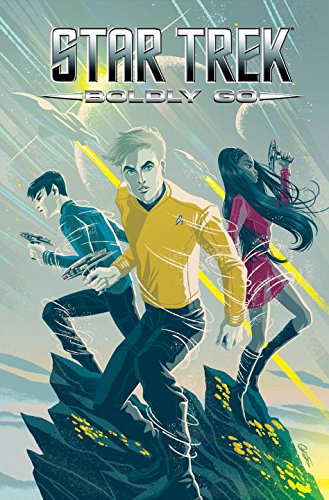
Throwback Thursday – Star Trek: Boldly Go, Volume 1 by Mike Johnson and Tony Shasteen

Boldly_Go_Vol._1.jpg

Publisher: IDW Publishing

Publication Date: 25 July 2017

Length: 136 pages

My Rating: 4.5 out of 5 stars

Amazon     Book Depository

Reviewed as part of my Throwback Thursday series, where I republish old reviews, review books I have read before or review older books I have only just had a chance to read.

In this Throwback Thursday, get ready to explore the first volume of an intriguing Star Trek comic book series, Boldly Go, which presents the reader with clever new story directions spinning off from the alternate timeline Star Trek movies.

I think it is time to admit to myself that I am starting to get rather hooked on Star Trek extended universe fiction. Like my obsession with everything from the Star Wars extended universe, all it took for me to dive into this new fandom was reading a few compelling Star Trek books. Amazing titles such as Available Light and The Captain’s Oath made me realise that there are some pretty interesting Star Trek books out there. I just started listening to another Star Trek audiobook today (The Antares Maelstrom by Greg Cox, which is pretty good so far). As a result, when I recently saw some other reviewers talking about a cool-sounding Star Trek comic book series that came out a couple of years ago, I immediately went and grabbed a copy of the first volume (I am very impressionable like that). What I found was an extremely compelling Star Trek adventure that had some truly intriguing and clever elements to it.
Star_Trek_Boldly_Go,_issue_1_RE.jpg

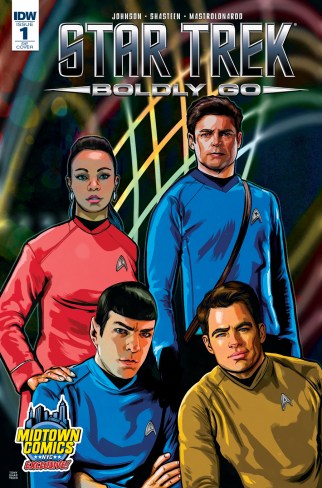
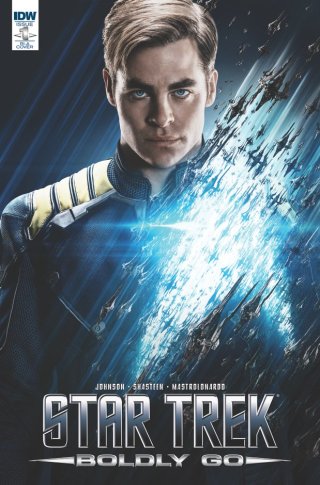
Star Trek: Boldly Go was an ongoing canon comic book series which started in 2016 and was set in the same continuity as the 2009 Star Trek film and its sequels. This continuity is an alternate timeline to the main Star Trek universe, which is known as the Kelvin Timeline due to the deviation that started with the time traveller Nero’s destruction of the U.S.S. Kelvin (Kirk’s father’s ship). This series was written by Mike Johnson, who has a lot of experience writing Star Trek comic book series, and featured contributions from several different artists. Boldly Go was the second ongoing series set in this timeline, following the 2011 Star Trek series which ran for 60 issues and was also written by Mike Johnson (which apparently had some really interesting-sounding storylines and which I might have to check out as well).
Star_Trek_Boldly_Go,_Issue_1_RI-A.jpg

Following the destruction of the U.S.S. Enterprise in Star Trek Beyond, the entire crew have been temporarily reassigned to new posts while they wait for their ship to be rebuilt. While Spock and Uhura are living on New Vulcan and Scotty is a lecturer at Starfleet Academy on Earth, Sulu, McCoy and Kirk are still serving out amongst the stars. Kirk has taken command of the U.S.S. Endeavour with McCoy begrudgingly at his side, and Sulu is serving a one-year exploration mission aboard the U.S.S. Concord.
Star_Trek_Boldly_Go,_issue_2.jpg

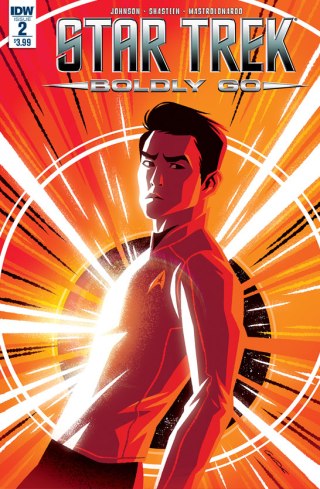
Events outside of their control will soon bring the former crew of the Enterprise back together, when the Concord encounters a ship of unknown design on the edge of Federation space. The ship is extremely powerful and technologically advanced and it attacks without warning, easily carving off pieces of the Concord with its destructive weapons. As alien boarders abduct members of the crew and devastate the ship, only one thing is certain: resistance is futile!

Star_Trek_Boldly_Go,_Issue_2_RI-A.jpg

The Borg Collective, one of the most dangerous races in the entire galaxy, have arrived in this version of Federation space nearly 100 years earlier than they were supposed to. Their motives are unclear, but as they attack several Federation vessels and settlements it is clear that they are en route to the capital of the Romulan Empire, Romulus. Answering the Concord’s distress call, Kirk and the Endeavour follow the Borg sphere after picking up Spock and Uhura. Forced to enter Romulan space, can Kirk and his crew save the abducted humans and defeat the Borg, or will actions provoke war with the Romulans? And what connection do the Borg have to the events that made this alternate timeline and formed this version of the Enterprise’s crew?

Star_Trek_Boldly_Go,_issue_3

This first volume of Boldly Go is a massive ball of fun that I had a great time reading. Not only does it feature a captivating and enjoyable story with some real cool twists; it also takes this Star Trek universe in some interesting directions. Featuring issues #1-6, this first volume starts a few months after the events of Star Trek Beyond and continues several of the fun storylines explored in the movies and the 2011 ongoing comic book series.
Star_Trek_Boldly_Go,_Issue_3_RI-A.jpg

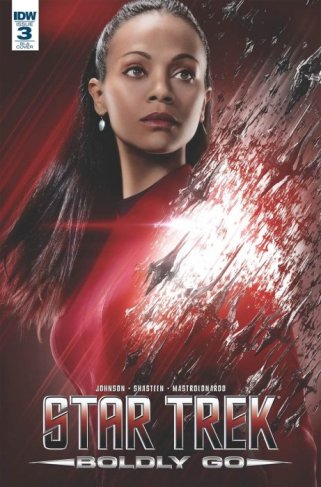
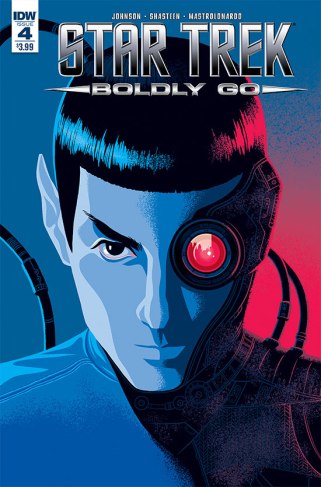
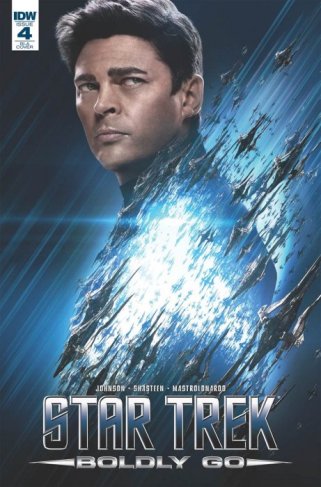
This first volume features a bunch of interesting storylines. Issues #1-4 contain the volume’s major storyline, the invasion of the Borg into Federation and Romulan space. This is an extremely action-packed storyline, and I really enjoyed seeing the Borg, who are probably the best Star Trek antagonists ever created, go up against the classic crew of the Enterprise. The entire Borg storyline is cleverly written, with high stakes and explosive action sequences, and it has some really cool moments. If you have ever wanted to see what would happen if the Borg tried to assimilate Spock (and let’s face it, who wouldn’t find that awesome) then this is the comic for you.
Star_Trek_Boldly_Go,_issue_4.jpg

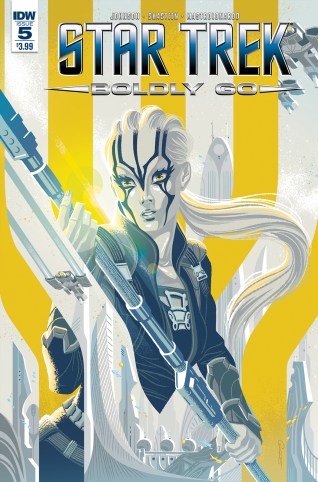
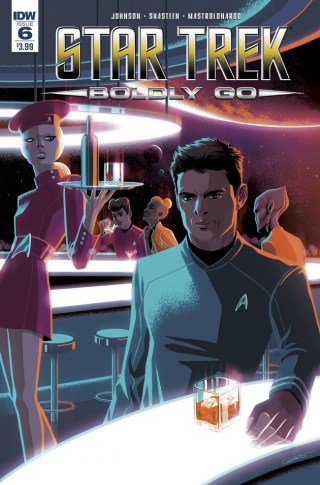
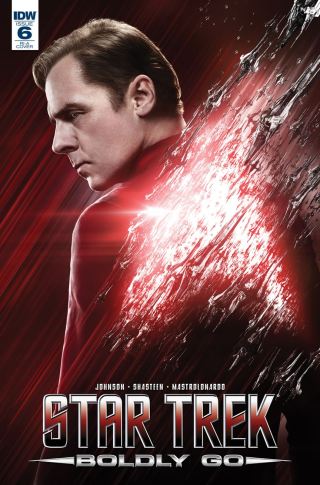
Issues #5 and #6 contain two different, intriguing storylines. Issue #5 contains a rather emotional story that examines the history of the fan-favourite character from Star Trek Beyond, Jaylah. Told chronologically backwards, this issue shows Jaylah’s tragic life trapped on the planet Altamid, and then goes further back to explore how she and her family were marooned there and the events of her past that would eventually lead her to Starfleet. The sixth and final issue in the volume continues some of the storylines from the first four issues of the series, reunites the always funny Scotty with the rest of the main characters and shows a rather curious story about an extremely advanced species of aliens interfering with the Endeavour in violation of their own version of the Prime Directive.
Star_Trek_Boldly_Go,_Issue_4_RI-A.jpg

While all of the storylines featured within this first volume are compelling and filled with emotional plot developments, it was also cool to see this version of the Enterprise crew once again. I really liked seeing how their adventures continued post-Star Trek Beyond, especially because, at the moment, it looks like Beyond is going to be the last film in this particular series of Star Trek films (which is a real shame, as some of the plans for the next instalment sounded particularly awesome). I did feel that the creative team of this comic did a fantastic job capturing the tone of the new movies and the personalities of these versions of the characters, and overall I found the story within this volume to be quite impressive.
Star_Trek_Boldly_Go,_issue_5.jpg

In addition to the great story, dedicated Star Trek fans will find some of plot inclusions to be extremely interesting, as they draw on some unique pieces of Star Trek lore. This volume features alternate timeline versions of characters from the original series, such as Captain Terrell, an older version of whom previously appeared in The Wrath of Khan, and there are intriguing hints at features of the Romulan Empire, such as the feared Tal Shiar. I also cannot get past how awesome it was to see the Borg in this timeline. Jackson has previously experimented with having this version of the original Enterprise crew interact with classic villains from other Star Trek shows. For example, they encountered Q in Jackson’s previous comic book series set in the Kelvin Timeline. However, it was particularly cool having the crew fight the Borg, and it resulted in a number of amazing scenes.
Star_Trek_Boldly_Go,_Issue_5_RI-A

I found the explanation for why the Borg were in Federation space during this time period to be extremely clever. In the main Star Trek universe, the Borg did not attack the Federation until the events of Star Trek: The Next Generation, set around 100 years after the start of The Original Series. However, in this comic, the Borg were attracted to the Federation much sooner than expected. The reason for this is eventually shown to be because Nero, the antagonist of the 2009 Star Trek film, constructed his massive ship, the Narada, out of Borg technology. This naturally drew the attention of the Borg, who travelled to Federation space at a much quicker rate than they did in their original appearance. While this explanation is pretty fascinating by itself, it actually results in some interesting connections with the main Star Trek universe. Technically, this alternate timeline is still considered to be within the canon of the main universe, as it was created when characters from this timeline, Nero and Spock from The Original Series, travelled back to the day Kirk was born. As a result, if the Narada contained Borg technology, then it is reasonable to assume that the Romulans are experimenting with captured Borg material in the main universe after The Next Generation ended. This has subsequently been somewhat confirmed, as the recent Comic Con trailer for the upcoming television series Picard showed images of Romulans dissecting Borg prisoners. As Picard is going to be set after the destruction of Romulus in the main Star Trek universe, it appears that this comic actually predicted events from the show before it was even in production (or else the creators of the show read this comic). This deep dive into Star Trek lore is really cool, and it is interesting to see ideas spawned in this comic have impacts in an upcoming show.
Star_Trek_Boldly_Go,_issue_6

This volume of Star Trek Beyond features some fantastic artwork from a variety of skilled artists. The main artist for the first five issues is Tony Shasteen, with Davide Mastrolonardo serving as colourist. Their combined artwork is pretty spectacular, and I really enjoyed it. Not only did they do a fantastic job of recreating the alternate timeline versions of the Enterprise crew, but the drawings of space, battles and the destruction of the Borg are amazing. I particularly liked the character designs of the Borg drones, especially when some of the Starfleet characters are converted into drones. I was also really impressed by an extended sequence that took place in Spock’s mind, where the Borg infiltrated his memories of several events of the 2009 film, and they made for a great scene. Issue #6 was drawn by Chris Mooneyham, with J. D. Mettler doing the colours. This naturally results in a noticeably different art style for this final issue, but this team does a great job of portraying some interesting scientific anomalies in space. Overall, the artwork featured within this volume is exciting and very well-done, and I had a great time seeing how the artists rolled out this adventure.
Star_Trek_Boldly_Go,_Issue_6_RI-A.jpg

Volume 1 of Star Trek Beyond is a fantastic comic book that is really worth checking out. The creative team have done a wonderful job portraying a new story that takes place in the aftermath of the last Star Trek movie. There are some really compelling story ideas taking place in this volume, and Johnson made sure to go big by bringing in a fantastic bunch of antagonists from The Next Generation. Best read by existing fans of the Star Trek franchise who will enjoy the creative team’s unique take on the characters and their adventures, this comic will also be appreciated by casual Star Trek fans who have only seen the more recent movies. I am extremely glad I decided to explore this Star Trek comic book series, and I will definitely be grabbing the next two volumes of this series when I next visit the comic book shop. This first volume gets four and a half stars from me and is an outstanding piece of Star Trek fiction.
Boldly_Go_Vol._1 (2).jpg

Amazon     Book Depository

Red Metal by Mark Greaney and Lt. Col. Hunter Ripley Rawlings IV. USMC

Red Metal Cover 2.jpg

Publisher: Audible Studios (Audiobook – 16 July 2019)

Series: Standalone/Book One

Length: 21 hours and 21 minutes

My Rating: 5 out of 5 stars

Amazon     Book Depository

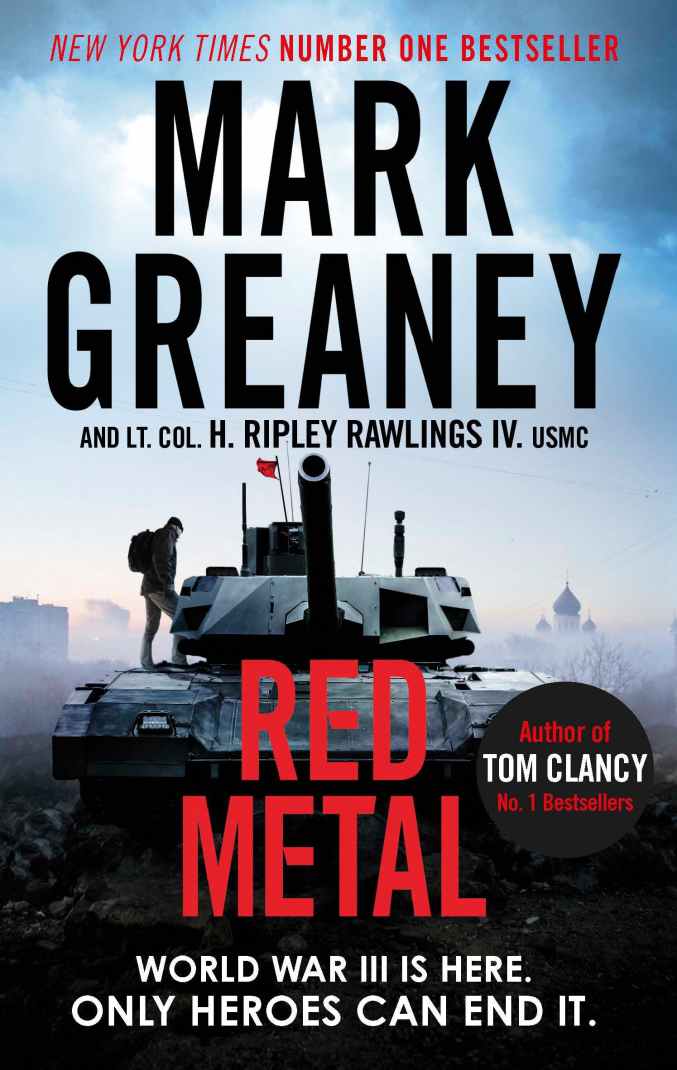
Get ready for World War III, because bestselling author Mark Greaney has teamed up with Lt. Col. Hunter Ripley Rawlings IV. USMC to create an absolutely incredible military thriller, Red Metal, which looks at how a potential invasion from Russia would unfold.

After years of war in the Middle East, the United States and their allies are preparing themselves for the next conflict. Many believe that this war will occur in the Pacific Ocean against China, especially after the Chinese begin to interfere in Taiwanese politics in an attempt to reunify the island nation with the mainland. As Chinese troops gather just outside of Taiwan and the United States military is rocked by a debilitating scandal, hardly anyone is expecting a move from Russia.

Since the end of the Cold War, Russia has been in an economic decline, and it desperately requires access to various advanced resources to remain a world power. An ambitious Russian colonel has come up with a complex plan to secure a vital Rare Earth mine that has the potential to secure the country’s future. Launching a high-speed and ruthlessly coordinated attack as Christmas falls, Russian forces stream across the border into Europe, crippling NATO and cutting the continent off from the United States. As America and NATO attempt to work out the extent of Russia’s plans in Europe and counter them, they are left distracted from Russia’s true goal as a second Russian army is secretly heading towards the African coast in order to reach the mine in Kenya.

As Russia continues its advance, the fate of the free world lies in the hands of several different individuals. In Washington, a veteran Marine Lieutenant Colonel and his colleagues attempt to decipher the Russian strategy before it is too late, while in Africa, a wily old French Intelligence agent and his Special Forces son must uncover why undercover Russian agents are abroad in Djibouti. In Europe, a mixture of unprepared NATO soldiers, including a young member of the Polish militia, an out-of-his-depth American tank commander and a high-flying US pilot must fight against the odds to push back against the invading Russian force. As epic battles erupt across several countries, one thing is clear: the world will never be the same again.

Wow, just wow. A few months ago, I predicted that along with The Kremlin Strike, Red Metal was going to be one of the top military thrillers of 2019. I am more than happy to report that I was 100 per cent right, as this was an outstanding read that I had an absolute blast listening to. The team of experienced thriller writer Mark Greaney, who is best known for his work on Tom Clancy’s Jack Ryan Universe and his own bestselling Gray Man series (make sure to check out my review for the latest book in this series, Mission Critical, here) and debuting author Lt. Col. Hunter Ripley Rawlings IV. USMC, have created a sensational book that I have no choice but to award a full five stars to.

Contemporary military thriller is a genre that I have only started getting into recently, although so far I have enjoyed some great examples, including The Moscow Offensive by Dale Brown, Treason by Rick Campbell and Red War by Kyle Mills. However, in my opinion Red Metal stands heads and shoulders above all of these books and it is probably the best pure military thriller that I have read. The authors of this book have come up with a truly fascinating military scenario that sees Russia sweep across two continents and influence conflict in a third. The Russians in this book have a really clever and effective military strategy that results in a massive, widespread conflict, and the reader gets to see every step of it unfold. This entire plan seems exceedingly realistic, and it is clear that Greaney and Rawlings have put some real thought into how war could break out and how the various participants would react. They really dive into the minutiae of the whole scenario and try to cover all the angles of an invasion of Europe and Africa, including cutting off communications, setting up an alternate navigation system, hacking the US and creating a number of plausible diversions. Never before has a discussion about the different sized rail tracks and rail switching stations in Europe been so fascinating. The scope of this conflict is really impressive, and the authors do a fantastic job showcasing the various types of battle that would occur in this sort of modern-day war between major superpowers. As a result, this book is filled with fighting on land, sea, air, underwater and even in cyber space, in an impressive thought exercise which translates into a compelling piece of fiction.

I really liked how the authors chose to tell this story from a variety of different perspectives, as Red Metal features a huge number of point-of-view characters. While the story is mostly focused on a few key characters, a number of minor characters often get one or two scenes, and the reader gets to see how the war unfolds from both sides of the conflict. As a result, the reader gets a much fuller understanding of how this potential scenario would unfold and how various countries or organisations such as NATO would react to war breaking out. The authors also make great use of the various perspectives to ratchet up tension throughout the book as the readers are privy to the full extent of the Russians plans. This results in the reader being fully aware of all the mistakes that the Americans and their allies are making in this war, and by the time they get their act together it seems like it is too little, too late.

The use of various perspectives also helps to create a number of different characters that the reader can really get invested in. While many of characters introduced only have small roles in the overall narrative, the authors do some detailed explorations of the backgrounds and story arcs of several key characters. Some of these characters have really well-written and have some enjoyable or intriguing storylines. I personally enjoyed the story of Paulina, a young recruit in Poland’s Territorial Defence Force (a volunteer military reserve) the most. Paulina finds herself thrust into the middle of the Russian invasion and is quickly transformed from an innocent girl to a hard-eyed killer in a few short days thanks to the horrors of war. Paulina’s story is extremely captivating, and it is potentially the character that most non-soldiers reading this book are going to identify with as they are left thinking how they would react in a similar situation. It was really quite interesting to see what role people in the various scenarios could potentially play, and I really liked seeing what sort of difference a small group of determined soldiers could make in a conflict such this.

One of the things that I really loved about this story was the realistic portrayal of the various armed forces involved in this book and the detailed examination of everything that needs to be considered in a war. This book is chocked full of military terminology, descriptions of various weapons and tactics, slang, military history and a variety of other complex features. You have to imagine the inclusion of all of these details is largely thanks to Rawlings and his extensive military experience, and I really enjoyed how the authors were able to seamlessly insert all of this knowledge into the story. Having all this information as the story progresses is extremely fascinating and I learnt a lot of cool facts. It also really amped up the realism of the whole story, in my opinion, and I found the story to be a whole lot more compelling as a result.

It is important to point out that Red Metal is not the male character dominated, exceedingly pro-American story that some military thrillers are; instead the writers went out of their way to produce a more balanced story. For example, the book features a number of great female characters, most of whom are involved in the war in some way or another, and it was cool to see how women are utilised in the modern military. The authors also take the time to show Russia’s side of the conflict and explain their motivations for engaging in this battle against the west. While a number or Russian characters are pretty villainous and/or murderous, they do tend to have some reasonable motivations for their actions, and indeed they see themselves as the good guys in this conflict. There are also a few more pragmatic Russian officers featured in the book who are a lot more likeable, especially as they come across as a bit more compassionate and less eager for war and destruction. The United States is also not heavily portrayed as the world’s most awesome country, as some military thrillers do. Instead the country is shown to be extremely unprepared for a Russian invasion, their military command is initially easily manipulated and a response to Russia’s actions is hampered by politics or pettiness from a superior officer. That being said, the book does feature a number of extremely pro-American scenes and sentiments, and there is even a sequence where an American pilot flies into combat shouting “die Commie die”, although to be fair, it is described as a historical military mantra developed in the Cold War to help pilots time their length of fire. The end result of the conflict between America and Russia is also what you’d pretty much expect, but it still makes for one hell of a read.

While the authors have added some interesting depth to this story, at its heart it is a military thriller, and that means that this book is chocked full of action. There are a huge number of fantastic and extended battle sequences throughout the entire book, some of which are truly epic in their size and content. Readers are really spoiled for action in Red Metal, as the authors have included all manner of different types of battles with a huge range of different vehicles and weapons. This book features battles in the air, at sea, underwater in submarines, on the ground with the grunts and in a variety of locations with Special Forces regiments. There are a number of impressive and memorable sequences, including a large amount of tank on tank combat, as two enemy armoured regiments face off against each other. I personally really enjoyed a particularly brutal ambush of Russian tanks in Poland, as Polish militia attempt to defeat a superior force in the middle of a city. The main set-piece has to be an extended battle between a variety of Russian units, and a force of United States Marines down in Africa. This battle down in Africa is particularly impressive, as the authors do an awesome job of bringing the fighting to life, and the sheer chaos of war and the ferocity of both sides as they try to win through any means necessary. All this action is pretty darn amazing, and the authors really outdid themselves with it.

I chose to listen to the audiobook format of Red Metal, which is narrated by experienced audiobook narrator Marc Vietor. I am really glad that I picked up the Red Metal audiobook as it was an amazing way to enjoy this fantastic book. Vietor did an excellent job narrating this book, and I felt that listening to the story brought all the intense action to life and helped place me in the centre of the story. Due to the book featuring a huge number of different nationalities, the story featured a range of character accents, all of which Vietor did extremely well, producing distinctive and memorable voices for each of his characters. The Red Metal audiobook runs for 21 hours and 21 minutes and it is an excellent format to consume this incredible novel.

Red Metal is a tour-de-force from Greaney and Rawlings, who have produced one hell of a military thriller. These two authors are a potent writing team, as Greaney’s experience as a thriller writer and Rawlings’s military knowledge helps create an epic read that just pumps the reader full of intense action, clever storylines and memorable characters. I really hope that these two authors continue to work together in the future, as Red Metal was a really impressive first collaboration. Five out of five stars all the way, you have to check out this book.

Amazon     Book Depository

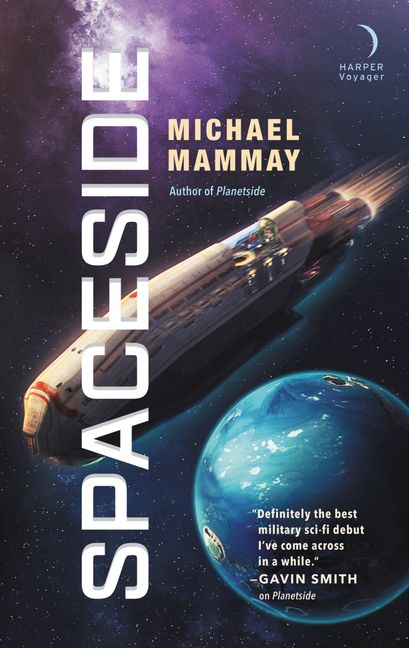
Spaceside by Michael Mammay

Spaceside Cover

Publisher: Harper Voyager (Ebook – 27 August 2019)

Series: Planetside – Book Two

Length: 336 pages

My Rating: 5 out of 5 stars

Amazon

Last year, Michael Mammay debuted an absolutely incredible book, Planetside, the outstanding science fiction thriller that absolutely blew me (and the planet of Cappa) away with its inventiveness, addictive story and explosive conclusion. Now Mammay attempts to follow up this amazing first novel with a second book in his Planetside series, Spaceside.

I mentioned several times already on my blog how much I loved Planetside last year. Mammay’s first book was a spectacular story that blended a science fiction story about an advanced human military occupying an alien planet with an intriguing thriller around a missing soldier. Planetside was easily one of the best books I read in 2018, and I still cannot get past that epic finale to the story.  As a result, when I found out that Mammay was following it up this year with Spaceside, I knew that I would have to read it, and featured it in both a Waiting on Wednesday post and my Top Ten Most Anticipated July-December 2019 Releases list. I was lucky enough to get an advanced electronic copy of Spaceside from Mammay and the publisher, and it did not take me long to dive in and read this book. I had pretty high expectations, considering how good the first entry in the series was.

In Planetside, veteran soldier Colonel Carl Butler is sent to the planet of Cappa to find a young officer who mysteriously disappeared following a mission against an insurgent group of the local aliens, the Cappans. Butler’s mission quickly revealed a massive conspiracy where elements of the occupying human military had been working with the Cappans to genetically modify humans with Cappan DNA, creating a dangerous hybrid species. After uncovering the existence of these hybrids and the full extent of the technology that had been traded to the Cappans, Butler is forced to make the terrible decision to initiate a major missile strike against Cappa to prevent a huge number of Cappans and hybrids from escaping into the wider galaxy. His actions stop the planned exodus and devastate the planet, killing a huge number of Cappans. Butler is subsequently arrested, frozen and sent back home for court martial, with his fate unrevealed in the last book.

Spaceside begins about two years after the events of Planetside, and reveals that Butler is now the most infamous man in the galaxy. While many view him as a hero, others consider him a genocidal monster. Forced out of the army, Butler now has an easy job as Deputy VP of Corporate Security for Varitech Production Company, a high-tech military company on the planet of Talca Four. In theory he helps protect the company against corporate threats, but in reality his job is to impress clients and utilise his substantial military connections for his bosses’ benefits.

As a result, he is surprised one day when he is called into the CEO’s office and given an actual security assignment. A rival tech company, Omicron Technology, has had a breach in their supposedly unhackable computer systems, and Varitech wants to know how it happened and whether their own systems are vulnerable. With no obvious leads and no-one claiming credit for the hack, Butler reaches out to one of his contacts working at the impacted company. However, shortly after their meeting, Butler’s contact is found dead and Butler is now the police’s prime suspect.

Determined once again to find out the truth no matter what, Butler starts to dig around at Omicron and discovers that they were working on a secret project with links to his time on Cappa. When information arrives from the most unlikely of places, Butler is once again drawn into a massive conspiracy that he is not meant to survive. Can he find a way out of this, or will he be forced to redo his greatest mistake?

Wow, just wow. This was another exceptional book from Mammay, who has once again produced a fantastic science fiction thriller hybrid with some amazing moments in it. I absolutely loved this follow-up to Planetside, which not only contains another addictive story with an amazing protagonist but also serves as an excellent sequel to the first book. I powered through Spaceside extremely quickly and loved every minute I spent glued to my screen. This gets another five out of five stars from me, and I reckon that I will once again be placing Mammay’s latest book on my top reads of the year list.

Just like the previous book in the series, Spaceside, is a compelling thriller set in a great science fiction environment and with some intriguing military thriller and science fiction elements thrown into it. However, in this book, the protagonist is no longer an official investigator for the military but a civilian involved in events that appear to be corporate espionage. This results in an intriguing change of pace from the first book that I quite enjoyed. Butler is much more of an outsider in this book, and his methods of investigating the potential crime and attempting to uncover the conspiracy are a lot more clandestine than before. Mammay takes this thriller based storyline to some interesting places and forces the protagonist to make some surprising alliances in order to survive and get to the bottom of the investigation. While the story is more focused on corporations than the army, there is still a strong military element to the book, as Butler is investigating military technology companies. There is also a strong amount of military action towards the end of the book as Butler once again sees combat against an enemy. Mammay writes some strong military action based sequences in his books, and the reader can almost see the detailed and well-written fight scenes. All of this results in an extremely strong main storyline that leaves open the potential for another intriguing entry into this series.

I was really happy that Mammay continued to follow the adventure of his protagonist from Planetside, Carl Butler. Butler, who serves as the story’s narrator and point-of-view character, is a fantastic protagonist who was one of my favourite parts of the first book. Butler is a blunt and honest old character, whose craggy, veteran solider outlook on life infects his narration of events and helps the reader connect with his story. Just like in Planetside, Butler is reluctantly dragged into the events of this book and goes up against a seemingly superior opponent, who thinks that they know how to manipulate the old soldier. However, Butler is a wily operator who is able to turn the situations to his advantage through his rough charm and experience of dealing with people, especially former military personnel, who assist him with his investigation and help keep him alive. I particularly liked the clever way that he was able to manipulate the situation towards the end of the book by playing on certain character’s weaknesses, military training and humanity, and while his final plan did not have the explosiveness of his actions at the conclusion of Planetside, it was still a great scene. I look forward to seeing what sort of trouble Butler gets up to in any future instalments of this series, as he is a truly enjoyable protagonist.

I felt that Spaceside also did a great job following on from the story established in the first book of the series. I really enjoyed seeing how the author followed through with several of the storylines left open at the end of Planetside, as well as how he explored a number of the consequences of the protagonist’s actions. The main way that this was achieved was by showing the reader how Butler’s life changed following his bombing of Cappa. Because the story is told from Butler’s point of view, we get to see how the guilt from his actions and the events that led up to them has affected his psyche. Despite the tough outer shell he shows most people, Butler is struggling with whether he did the right thing and must now deal with being the most infamous person in the galaxy, receiving glares or praise wherever he goes. These events and inner thoughts impact how he reacts to certain events later in the book, and it is a clever and natural progression for the character.

In addition to the focus on Butler, Mammay makes sure to include several characters from the first book so the reader gets to see how their storylines progressed. Not only does this help bring in a previously established sidekick for Butler, as well as a sassy reporter contact who gives him intel and clues, but it also brings back Butler’s old mentor and friend, General Serata, for a tense scene. Serata was the man who sent Butler to Cappa in the previous book, and in many ways he is responsible for the destruction on Cappa as he knew how his old friend would be forced to act in response to what was going on there. It was great seeing these two characters awkwardly try to discuss the events of the previous book and come to terms with Serata’s manipulation of Butler. All of this makes for a gripping follow-up to the first book, and I really enjoyed seeing how the author addressed some of the events from Planetside.

Spaceside is an incredible second outing from Michael Mammay, who has a truly bright future in the science fiction genre. I once again found myself drawn into the excellent story and fantastic central protagonist of this book, as Mammay does an outstanding job crafting together a clever and addictive narrative that does a spectacular job following on from the author’s amazing debut, Planetside. Spaceside gets a full five stars from me, and I am already looking forward to Mammay’s next enjoyable book.

Amazon

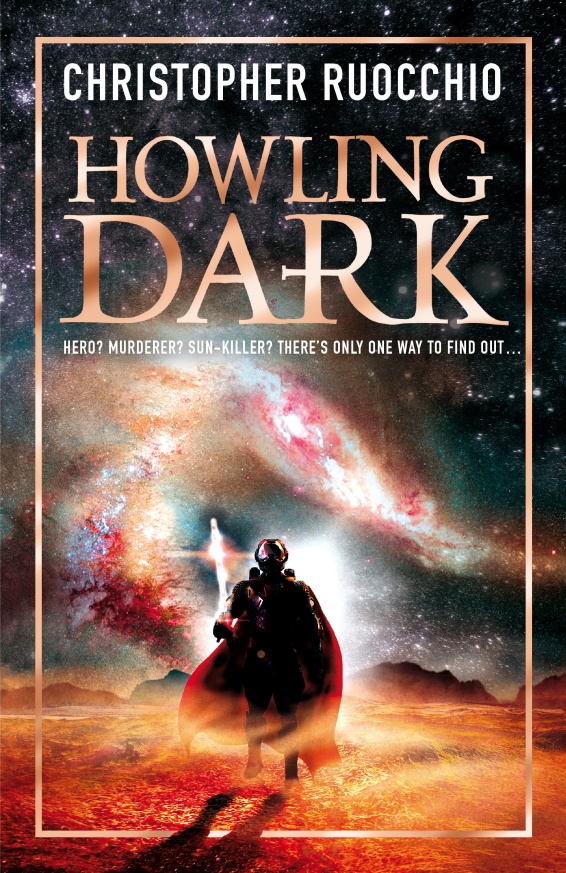
Howling Dark by Christopher Ruocchio

Howling Dark Cover

Publisher: Gollancz and Recorded Books (16 July 2019)

Series: Sun Eater – Book 2

Length: 679 pages or 28 hours and 3 minutes

My Rating: 5 out of 5 stars

Amazon

Outstanding new author Christopher Ruocchio, who blew me away last year with his debut novel, Empire of Silence, returns with the second book in his brilliant Sun Eater series, Howling Dark.

Empire of Silence was one of my favourite books from last year, easily making my Top Ten Reads for 2018 list, and I absolutely loved the author’s highly addictive story and its vast new science fiction universe. This was a fantastic first book from Ruocchio, and when I finished it, I really wanted to know what happened next. As a result, I have been waiting to read this sequel for a while, having done a Waiting on Wednesday article on it and including it on my Top Ten Most Anticipated July – December 2019 Releases list. I was pretty excited to receive a copy of this book a few weeks ago, especially as Ruocchio was nice enough to mention my blog in his acknowledgements (this has not affected my review or rating in any way). However, due to having a huge number of other books that were high priority reads, I ended up listening to the audiobook format of Howling Dark instead, which is narrated by Samuel Roukin. I had extremely high hopes when I started reading this book, and I was definitely not disappointed by the final result.

The Sun Eater series is set far in humanity’s future, where humans have left Earth and expanded out to thousands of worlds. While humanity, mostly in the form of the Roman-inspired Sollan Empire, has flourished, for the last four hundred years they have been fighting a brutal and destructive war with the Cielcin, a spacefaring race of aliens who have destroyed hundreds of colonies and billons of humans. Each of the books in the series is written as a part of the autobiographical chronicle of series’ protagonist, Hadrian “Halfmortal” Marlowe, otherwise knowns as the Sun Eater. Hadrian is the man who will one day destroy a sun in order to burn every Cielcin to a cinder, and in doing so become both history’s greatest hero and most infamous monster. However, these events are set to occur much further on in the future, and these earlier books focus on the events that formed Hadrian’s character, and show how he became the man to end it all.

In Howling Dark, the story is set some 50 years after the events of Empire of Silence. During this time Hadrian Marlowe has been wandering the outer fringes of the galaxy trying and failing to find a myth. Leading a band of mercenaries, former gladiators and disguised Imperial legionnaires, and carrying a cargo of frozen Cielcin prisoners, Hadrian hopes to travel the lost planet of Vorgossos. The planet’s mysterious master apparently has a way to contact the Cielcin, who Hadrian hopes to finally negotiate peace with, ending the brutal war that has ravaged both races.

However, finding Vorgossos has proven far more difficult than Hadrian initially anticipated. The legendary planet is well hidden, and the only way to uncover its location is to deal with the Extrasolarians, a group of humans who live outside of Imperial control and whose reliance on technology and enhancements borders on the heretical. As Hadrian and his companions locate a promising lead, they are suddenly ordered back to the fleet as the war against the Cielcin needs every soldier.

Determined to bring his plan for peace to fruition, Hadrian and his companions disobey these orders and go rogue. Entering the worlds of the Extrasolarians, the Exalted and other grim horrors at the edge of the known universe, they are able to obtain passage to Vorgossos. However, what they find at their destination may be even worse than the alien foes they are attempting to contact. Between facing technological monstrosities, a cruel, immortal king and the appearance of humanity’s oldest and most feared enemy, Hadrian has his work cut out for him. But the further along his path he travels, the more Hadrian begins to understand the grim destiny in front of him and the terrible cost he will have to pay.

This is another epic book from Ruocchio! Howling Dark is a dark, gothic science fiction masterpiece that was an absolute treat to read, and which really highlights the author’s creativity and ability to create a wide-ranging universe with some unique and captivating features.

This was another incredible and ambitious story from Ruocchio, who takes the reader on an extended and powerful adventure through his great universe. The Howling Dark contains a lengthy and compelling plot which goes in some very interesting directions. While this is a long book, Ruocchio does a great job of pacing the story out, and there is rarely a moment where the plot is not progressing in an intriguing way, or where the reader is left bored. I really enjoyed some of the dark places that the author took the story in this book, and there are a variety of cool new locations, antagonists and other monsters that the protagonist and his friends need to deal with in one way or another. Hadrian goes through some notable character development in this story as he takes more and more steps down the road to becoming the biggest legend in the universe. Howling Dark has a pretty epic conclusion to it, with some major plot developments occurring in the last 100 pages or so, and I really liked how Ruocchio wrapped up the storyline. Overall, this book has an intense and captivating storyline to it, and I am exceedingly glad I got a chance to read it.

I did find that the start of the book was a tad hard to get into. Due to the complex storylines (and possibly because I have read so many different books in the last year) it took me a little while to remember whom some of the characters were and where the plot was up to. It did not help that the story had jumped ahead by 50 years, and some of the events that occurred during this break are mentioned a few times at the start of the book. However, once I was able to get my bearings, it did not take me long to get hooked on the story and I had no problems following the enjoyable plot, especially as the author does a great job explaining these missing events and offering the reader several recaps of the events from the first book. Readers of the physical copy of Howling Dark will also be helped by the detailed dramatis personae, index of worlds and lexicon of terms that is included at the back of the novel, which can really help to clear up some confusion about the events that have occurred. I would say that readers would probably be best served checking out Empire of Silence first before trying to read Howling Dark, but I believe that new readers will be able to fully enjoy this story once they reach the recaps and get a sense of what happened in the previous books.

I really enjoyed how Ruocchio continued to write his story in the chronicle format that worked so well in the first book. Each of the books in the Sun Eater series are presented as part of a self-written chronicle of Hadrian’s life, penned some years in the future after he destroyed the sun. As a result, the story is told exclusively from Hadrian’s perspective and features his memories of the various events that formed his character. This is a great way to tell the story, mainly because the reader gets to see a contemplative version of the narrative. There is a real and palpable sense of regret in Hadrian’s narration, which really adds to the book’s grim tone, as the reader gets to hear the protagonist recount events that are not only traumatic for him, but which set him down the path to his defining moment. Due to Hadrian’s lifetime of self-reflection, you also get a far more in-depth examination of the character’s motivations for taking certain actions, as well as an analysis of why other characters acted the way did, which adds a great edge to the story. I also liked how the protagonist hinted at some of the key moments that occur later in the book or may occur in later books. This dramatic irony does a wonderful job of keeping a sense of tension in the air, as the reader knows that the worst is yet to come. Ruocchio’s use of the chronicle format for these novels is cleverly done, and I really enjoyed how it helped enhance the overall story.

Possibly Ruocchio’s biggest strength as a writer is his amazing ability to come up with a widespread and intriguing new universe to use as a setting for his fantastic story. This was one of my favourite things about Empire of Silence, as I loved the large, sprawling human empire that Hadrian lived in during the first book. This Sollan Empire was created after a major war with artificial intelligences thousands of years before, and therefore any technology that is too advanced or which thinks for itself is considered heretical by a controlling religious organisation. The massive empire is heavily inspired by the Roman Empire, with a similar government, military system, social castes and culture. This also affects the overall tone of the story, as the narrator, Hadrian, is a true son of this empire, and thus has a classical education that guides his overall view of life. As a result, the story is filled with the Hadrian quoting a number of historical verses and aphorisms to tell his tale, which really helps to give the overall story a more classic tone in the science fiction environment. I really liked this cool combination of science fiction elements with this antique mindset, and the general history of the Sollan Empire, with its veneration of other historical empires such as the Romans or the Victorians, is deeply interesting. This Sollan Empire actually reminded me a bit of the Imperium from Warhammer 40k, which also has a Roman inspiration and overarching gothic theme to them. As a fan of Warhammer 40k, it was cool see a universe built along similar ideas, and Ruocchio comes up with a number of clever and unique new elements to make his Sollan Empire stand out. Although most of the story in Howling Dark is spent outside of the main empire, the author still spends time expanding on elements of this massive organisation, and the reader gets more of a sense of them. I especially enjoyed seeing the Imperial legions in battle during this book, and it results in a number of incredible scenes that I really enjoyed.

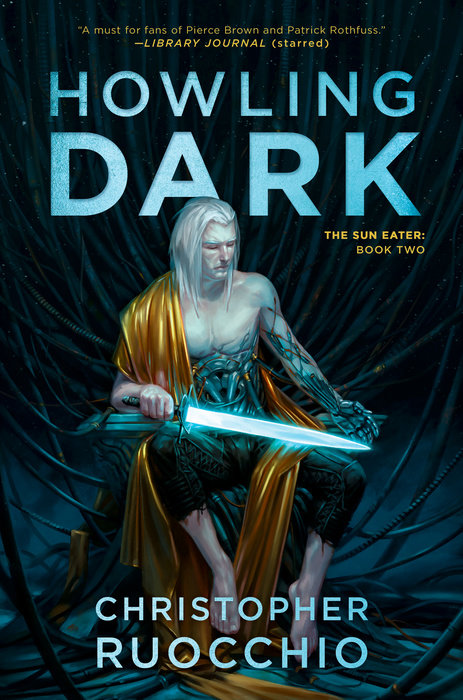
Ruocchio also does an outstanding job introducing a number of intriguing new universe elements to this book in the form of the Extrasolarians. I found the dive into the world of the Extrasolarians to be extremely fascinating, especially as Ruocchio let his creativity run wild during this part of the books, coming up with all manner of technological marvels, body augmentations, genetic modifications and other science fiction wonders. However, many of these technologies have a darker side to them, which the protagonist and his friends find out the hard way. Some of these modifications are downright creepy, and this really helped the author create a dark and distinctive expansion to his universe. I was especially impressed with one of the new antagonists of this story, Kharn Sagara, a sinister, technologically enhanced ancient with hidden motivations (check out the cover below to see how cool his character design is). The reader also gets a much more in-depth look at the Cielcin in this book, as the protagonist starts to understand more about them and how they think. Ruocchio does a fantastic job exploring the mindset of these creatures and showing them as truly alien beings with very little similarities to humanity, and the reader starts to get an understanding of why Hadrian will eventually be forced to destroy them. All of this is really cool, and I could honestly go on for pages about all the cool world building that Ruocchio does in this book, it was that impressive.

As I mentioned above, I ended up listening to Howling Dark’s audiobook format. The audiobook runs for 28 hours and 3 minutes and is narrated by Samuel Roukin, who does a fantastic job bringing this story and the characters to life. This is a lengthy audiobook, and readers will need to make a bit of room in their listening schedule to get through it. It is actually the longest science fiction audiobook that I have ever listened to (so far) and would easily make my Top Ten Longest Audiobooks That I Have Listened To list. I found that Howling Dark’s audiobook format was a great way to enjoy this epic novel. I always find that listening to a complex story helps me absorb a lot more of the story and universe details, making for a much fuller read. This was definitely true for Howling Dark, as I was able to really appreciate the huge amount of gothic science fiction detail that Ruocchio installed in his work. I also found that Roukin’s narration also did a wonderful job of capturing Hadrian’s inherent regret and despair, and this really helped me appreciate the entirety of the book’s story. Roukin also creates some terrific voices for the various characters and does a fantastic job bringing them to life through the audiobook. This was a fantastic format to enjoy Howling Dark with, and I will strongly consider listening to the audiobook of the next book in this series.

Overall, I think that Christopher Ruocchio does an excellent job following up on his spectacular debut, Empire of Silence. Howling Dark is an amazing read that I absolutely loved. Ruocchio has come up with a complex story for this book, which is massively enhanced by his clever writing style and impressive imagination. Clearly, Empire of Silence was no fluke, as Howling Dark gets a full five stars from me. I am really looking forward to checking out the next book in the series, especially as Ruocchio has left a huge number of intriguing storylines open, and I fully intend to stick with this series until Hadrian destroys that sun.

Howling Dark Cover 2

Amazon

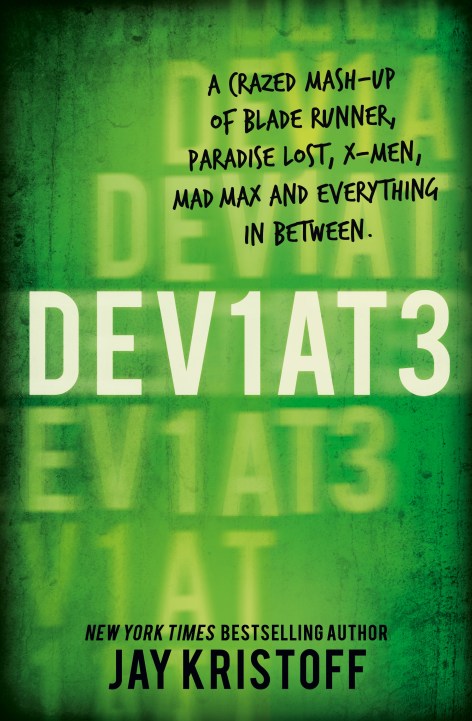
DEV1AT3 by Jay Kristoff

DEV1AT3 Cover.jpg

Publisher: Allen & Unwin (Trade Paperback – 17 June 2019)

Series: LIFEL1K3 – Book 2

Length: 423 pages

My Rating: 4.5 out of 5 stars

Amazon     Book Depository

From one of the most prolific young adult fiction authors, Jay Kristoff, comes the follow up to his electrifying 2018 smash-hit LIFEL1K3, DEV1AT3.

Over the last few years, Australian author Jay Kristoff has been one of the leading contributors to young adult fiction, writing several bestselling series. His works include The Lotus War series, the highly regarded The Nevernight Chronicles, and The Illuminae Files, which he co-wrote with fellow Australian Amie Kaufman. DEV1AT3 is actually the second of three Kristoff books being released this year, as he has already released the first book in his second collaborative series with Kaufman, Aurora Rising. Darkdawn, the third and final book in The Nevernight Chronicles, is set to be released in early September.

People who keep an eye on my blog may have noticed that I did a short review of DEV1AT3 a few weeks ago in a Canberra Weekly column. I have been meaning to write up an extended review of the book for a while now, as it was quite an enjoyable book with a lot of cool features. DEV1AT3 follows on from the incredibly popular first book, LIFEL1K3. The LIFEL1K3 series follows the adventures of four young friends in the dangerous post-apocalyptic remains of America, now controlled by rival mega-companies and gangs of religious fanatics.

DEV1AT3 is set in the immediate aftermath of the dramatic conclusion of LIFEL1K3, when the protagonist of the first book, Eve, found out the terrible truth of her origin: she is secretly a lifelike, an android who can ignore the Three Laws of Robotics. Worse, she is actually a replica of Ana Monrova, the daughter of the creator of the lifelikes, Nicholas Monrova, whose creations rebelled against him and killed his entire family. With the realisation that everything she has ever known is a lie, Eve begins to plot with the murderous Gabriel and the other lifelikes to find the comatose body of Ana. While Eve simply wants to kill the woman whose life she is imitating; the other lifelikes will use Ana’s body to unlock Monrova’s secrets in order to start a robot revolution.

Out in the post-apocalyptic wastelands surrounding Babel, Eve’s friends, Lemon Fresh, Ezekiel and Cricket, have seen better days. Not only were each of them forced to abandon Eve for different reasons but they must all face their individual consequence of the events that occurred within Babel. When unexpected events force them to separate, each of these friends find themselves in a whole world of trouble.

Lemon Fresh’s status as a deviate, a genetic mutant with the ability to manipulate electricity, has always landed her in trouble, but now she finds herself the ultimate pawn in a war between two of the major corporations that rule the land. Kidnapped by an agent of BioMaas Incorporated, Lemon eventually finds herself falling in with a band of fellow deviate teenagers, each with their own unique abilities, and whose leader, the Major, may hold the secrets to her past.

At the same time, the logika Cricket is stolen and sold to the Brotherhood, a group of religious fanatics determined to destroy every android, deviate and genetically modified being they can find. As the Brotherhood edges closer to a war with the Major’s deviates, Cricket is forced to fight as a robot gladiator while learning the dark secrets at the heart of the cult. Meanwhile, Ezekiel, the one lifelike with any love for humanity, teams up with an old enemy in order to track down Lemon Fresh and Cricket. However, when Ezekiel’s mission leads him into the path of Eve and his other lifelike brothers and sisters, he attempts to find a way to stop their destructive crusade and save his beloved Ana.

This was a fantastic piece of young adult fiction that does a wonderful job of following up the first book in the series. Kristoff tells an exciting story which not only continues the plot lines of the first book but which also takes the characters in some intriguing new directions. However, despite some differences in plot focus, the book continues to feature the cool allusions to other works of fiction that made the first book such a treat to read, and it continues to explore aspects of this intriguing post-apocalyptic setting. Readers who did not get the chance to read the first book, LIFEL1K3, last year will easily be able to start by reading DEV1AT3. Not only is the story quite accessible but it also starts off with an extremely detailed summary of the events and characters from the first book, which allows anyone to fully catch up with where the plot is.

One of the most interesting changes between this book and LIFEL1K3 is that the protagonist of the first book, Eve, is instead cast as an antagonist, and we end up seeing very little of the book’s plot from her point of view. Instead, the plot of DEV1AT3 is mostly split between the three perspectives of Lemon Fresh, Cricket and Ezekiel, who each have their own unique storylines. Each of these storylines is noticeably different, with all three of them making use of some unique features to help create an intriguing and emotionally strong story. The reader gets a real feel for all three of these point-of-view characters throughout the course of their individual plots, and several intriguing new side-characters are introduced. These separate storylines come together to form one amazing overall narrative, which ends with an amazing cliff-hanger for each of the main characters that will ensure readers will have to check out the final book in this series when it comes out.

One of the most intriguing aspects of the LIFEL1K3 series is that each of the books is marketed as a crazy mash-up of several different works of fiction. For example, the first book in the series had a real Alita Battle Angel crossed with Mad Max and Blade Runner vibe to it. Many of the references to the plots of various other media titles that were started in the first book are continued in DEV1AT3. For example, the whole Mad Max vibe of life in the wasteland is actually really enhanced in this book, as the vast majority of the story is spent out in the nuclear wastes and smaller outposts that make up the ruins of America, with a number of crazy car chases in souped-up doomsday vehicles featured throughout. We also get a deeper look at the whole Bladerunner aspect of the story, as Eve comes to terms with actually being a lifelike and attempts to get revenge for her creation.

In this second book, Kristoff’s plot also makes allusions to several other pieces of fiction in the three various storylines. For example, Lemon Fresh’s storyline is an interesting post-apocalyptic take on the X-Men, with the super-powered teen finding kinship with a group of similarly gifted individuals in a world that hates and fears them. The new deviates introduced in this storyline have a pretty cool range of powers, have all been attacked because of their abilities and even have a wise old mentor character in the Major. The various twists associated with this storyline are really clever, and it was interesting to see more deviates aside from Lemon. Ezekiel also has a great storyline within DEV1AT3. While much of his story is still tied up with his feelings for Eve, the lifelike copy of the woman he loves, and all the Bladerunner-esque emotions and thoughts he and his lifelike family experienced in the first book, Kristoff adds a fun new element to his storyline in this book. For much of his storyline, Ezekiel actually teams up with Preacher, the cyborg bounty hunter who was an antagonist of the first book. This is a very fun team-up, and it harkens back to a lot of classic odd-couple crime movies, with the two having a very rocky relationship that kind of improves as the story goes along.

I personally liked Cricket’s storyline the most. Cricket is a logika, a sentient robot who must obey the Three Laws of Robotics. Cricket, who was previously a small assistant robot, had his personality transferred into a massive combat robot in the last book. However, he is kidnapped by members of the Brotherhood, the insidious religious group fighting against Lemon Fresh’s new deviate brethren. Cricket, who has to obey all the orders given to him by the Brotherhood due to the Three Laws of Robotics, is forced to fight in a series of gladiatorial combats. This storyline gives the reader the best insight into the ranks of the Brotherhood, and Cricket uncovers certain secrets while working for them. With the whole Three Laws aspect, this storyline is obviously very reminiscent of the science fiction classic I, Robot; however, Kristoff comes up with some humorous takes on the Three Laws. Thanks to the assistance of the snarky logika Solomon (who I found to be one of the funniest characters in DEV1AT3), Cricket starts to learn how to utilise the loopholes in people’s statements, so he has a degree of freedom and he also makes use of a simple solution to counteract one of the laws, which was pretty funny. All of these references to these established pieces of fiction are great, and I really liked how the author adapted them to fit his compelling young adult story. I especially enjoyed seeing some complex science fiction ideas, such as Isaac Asimov’s Three Laws of Robotics, explained to a younger audience, with some cool tweaks to make a more entertaining and modern story.

In addition to fun story and clever references to other works, one of the most interesting things about the LIFEL1K3 series is the cool post-apocalyptic setting that the author has come up with. The nuclear ruins of America always makes for an intriguing setting for a story, and I really enjoyed the cool combination that Kristoff makes in this series with savage nuclear wasteland and high-tech cities. The sheer amount of creativity that Kristoff utilises for the setting is really impressive, as this book alone features wars between rival corporations, desert-dwelling religious nuts, mutants, rebelling androids, bandits and mutated monsters. All of these are utilised extremely well in the story, and I look forward to seeing what other cool aspects of this broken world become apparent in the next instalment of this series.

DEV1AT3 is another wild ride from Jay Kristoff that I had a lot of fun reading. Featuring an excellent story that makes great use of references to some classic pieces of science fiction and fantasy, DEV1AT3 is a fantastic read that refuses to slow down for everything. This is a highly recommended read for the older young adult market, and it will also appeal to older readers. I am extremely curious to see where Kristoff takes this story next and look forward to another electrifying adventure in this mad-cap world.

Amazon     Book Depository

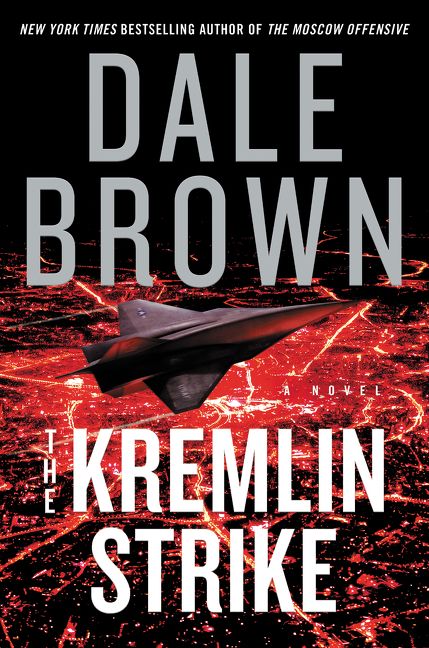
The Kremlin Strike by Dale Brown – Audiobook Review

The Kremlin Strike Cover

Publisher: HarperAudio (7 May 2019)

Series: Patrick McLanahan series – Book 23

Length: 13 hours and 18 minutes

My Rating: 4.5 out of 5 stars

Amazon     Book Depository

Bestselling author Dale Brown, perhaps one of the best current writers of military thrillers in the world today, returns with another exciting instalment of his Patrick McLanahan series, which takes America’s battle with Russia up into high orbit.

Following the recent defeat of his deadly combat robots in Texas, Russian President Geenadiy Gryzlov is desperate to strike back against the hated Americans. However, he no longer faces the inept US administration he enjoyed over the last couple of years. Instead, his failed attack on America has resulted in the election of a strong new president, John Dalton Farrell. With Farrell once again backing the innovative and resourceful private companies of former US President Kevin Martindale and former general Patrick McLanahan, Sky Masters and Scion Aviation International, America’s future looks bright. One of Farrell’s first priorities is the immediate resumption of America’s research into space flight and defence, resulting in Iron Wolf Squadron members Brad McLanahan and Nadia Roz being recruited by Sky Masters to head up their revamped space initiative.

However, the Americans are not the only ones with an eye to space. Knowing that Russia’s future world dominance depends on controlling the stars, Gryzlov has ordered the construction of a high-tech space station, Mars 1. Armed with devastating plasma weapons capable of shooting down every US satellite orbiting the planet as well as missile launchers that can rain down fire anywhere on the world, Mars 1 is an absolute game changer that will ensure Gryzlov finally achieves victory over the United States.

America’s only hope once again rests in the hands of the men of Sky Masters and Scion. As the Scion operatives attempt to determine a weakness in Mars 1’s defences, Sky Masters have created a number of advanced space planes and weapons that will allow Brad and Nadia to take the fight to the Russians in space. Will this new equipment be enough, or will Russia’s grip on high orbit propel them to a final, devastating victory?

Brown has been one of the best and most prolific authors of military fiction for over 30 years, having written 29 military thrillers in this period, as well as co-writing 18 books in the Dreamland series with Jim DeFelice. I only recently got into Brown’s books last year, when I read his 2018 release, The Moscow Offensive. After being drawn in by the promise of advanced military robots fighting it out in the American heartland, I fell in love with the awesome plot, intense action and analyses of real-world political strife, and as a result, The Kremlin Strike was one of the military thrillers I was looking forward to the most this year. The Kremlin Strike is the 23rd book in Brown’s Patrick McLanahan series, which follows the titular character and his allies as they attempt to keep America safe from a series of high-tech military threats. This book could also be considered to be sixth book in the Brad McLanahan series, as the overarching plot of the series started to focus more on Patrick’s son, Brad, in Tiger’s Claw, especially after Patrick McLanahan’s supposed death.

I absolutely loved the central concept of The Kremlin Strike, which looks at the potential of Earth’s high orbit to host the next major military conflicts that we see. This is not a new focus for Brown, as some of his previous books in this series, including Executive Intent and Starfire, have looked at the potential of space-born weapons. Before the story even starts, Brown makes it clear that he believes the United States needs to focus more on the possibility of a future war in space, and even includes some real-world news excerpts that look at recent advances in military technology that can be used to fight battles in space or destroy satellites orbiting the planet.

Based on this, Brown is able to come up with an incredibly intriguing military thriller that looks at the battles that could occur in the near future. I found it absolutely fascinating to see the author’s theories about how space warfare could be conducted, and the tactical advantages of having control of Earth’s orbit. While some of the technology in featured in the story, such as the Cybernetic Infantry Devices, are probably more advanced than what Russia or America can currently use (probably), Brown does examine a number of weapons and vehicles that are currently being tested in space. The various laser weapons, plasma launchers (OK, these are slightly less likely), missiles and other cool weapons or technology used in the battle in space make for some interesting reading. There were also some intriguing looks at the various limitations or downsides of the space technologies featured in this book, such as energy issues, fuel consumption or the gravitational backlash some weapons may experience. I especially liked how Brown was able to capture a more accurate view of space combat, with invisible laser beams rather than the colourful blasts you see in most science fiction movies.

All of the focus on combat in space is a superb basis for a story, and Brown backs that up with some first-rate storytelling to make this an outstanding read. The Kremlin Strike was an excellent blend of action, advanced technology and spy fiction that also has some intriguing mirrors to current world politics. The author tells the story from a range of different character perspectives, allowing for a widespread story that works incredibly well. I especially liked seeing the opposing views of the protagonists and antagonists, as it allowed the reader to see multiple sides of the overall conflict. For example, the reader gets to see the Russians plan their moves, and then you get to see the American countermoves. This view of the different sides of the conflict also works because neither the Americans nor the Russians have a solid idea of what the other side is planning. The reader is the only person who knows what is going on in both camps, and it is really fun to see the opponents slowly work out each other’s tactics during the course of the narrative, and then panic when they realise what their enemy is planning.

In addition to the combat in space, Brown also displays his detailed knowledge of modern warfare and military throughout the course of The Kremlin Strike. There are a huge number of scenes where modern military technology, techniques, strategies or standard operating procedures are featured, all topped off with a good helping of military terminology and acronyms. Brown utilises all of these extremely well, and there is nothing too overwhelming for readers who have a low understanding of the relevant jargon. All the action in this book is written incredibly well, and it was just plain thrilling to see some of the battles in the sky or in space take place. There were also some cool espionage sequences thrown in throughout the story as well, emphasising the benefit of human intelligence in current conflicts. All of these various aspects come together into a wonderful military thriller narrative, which proved extremely hard to stop listening to.

Another part of The Kremlin Strike that I enjoyed was the use of the fantastic prime antagonist, Russian President Geenadiy Gryzlov. Gryzlov has been a key villain in the last few books of the Patrick McLanahan series, and his angry, vindictive nature and his sheer inability to admit his own mistake makes him an amazingly easy character to dislike. I always find that a great antagonist can add so much to a story, and this is especially true in this book, where you can’t help but root for the protagonists and enjoy when the antagonist’s plots come to naught. You also cannot help but feel sorry at times for Gryzlov’s subordinates, who are forced to obey his wild orders, despite knowing that they will be punished when they fail. I really enjoyed a fun story development that occurs around this character in The Kremlin Strike, which I thought that Brown planned out very well, and which was one of my favourite highlights of this book.

While I absolutely loved The Kremlin Strike, the author has included a few right-wing political issues that might not be appealing to every reader. Right at the start of the book, Brown is very supportive about recent decision by the current US administration to form a specific armed force for space warfare, and this book examines the necessity of such a force. In addition, if you read between the lines a little, the US president in The Kremlin Strike, Farrell, could be a partial stand in for the current real-life United States president, while the previous incompetent president, Stacy Anne Barbeau, could be seen to represent this president’s real-life opponent at the 2016 election. Farrell is a political outsider, disliked by the media, whose tough talk and determination to cut through the bureaucracy of Washington (drain the swamp, if you will), won the support of the American people. The book’s apparent support of the current US president and some of his controversial decisions may be off-putting to some readers, although I do not believe that it harmed the entertainment value of the story. I personally found it interesting that in this scenario Brown once again painted Russia as America’s greatest enemy, which is something the current US president appears extremely reluctant to do, although perhaps I am reading into this too much.

I ended up listening to the audiobook version of The Kremlin Strike, which is narrated by William Dufris. The audiobook version of this book runs for a moderate 13 hours and 18 minutes, and I found it to be a great way to enjoy this exciting and detailed military thriller. Having only read Brown’s work before, I felt that having the audiobook book version playing in my ear helped ramp up the action sequences as well as increase the sense of urgency of the events occurring in the book. Dufris is also an excellent narrator, coming up with a huge number of great voices for the various characters that make up the cast of this book. The voices he attributed to these characters were really good and captured their personalities extremely well, such as, for example, the anger, ruthlessness and paranoia exhibited by Gryzlov. Dufris also did a good job with the character accents, continuing utilising a number of Russian accents throughout the book, as well as accents from other Eastern European countries such as Poland. I really enjoyed listening to the audiobook version of The Kremlin Strike and I think I will check out this format for any future books in the Patrick McLanahan series.

In this latest book in his long running Patrick McLanahan series, Dale Brown has once again created a first-class military thriller that is an absolute treat to read. The author’s focus on the future conflicts that may occur in our planet’s orbit were extremely fascinating, and the story created around it was a captivating and electrifying read. Easily accessible to those readers who have not previously had the pleasure of reading the Patrick McLanahan series before, The Kremlin Strike was a deeply enjoyable book, and a must for all fans of both the science fiction and military thriller genres.

Amazon     Book Depository

Quick Review – Rejoice, A Knife to the Heart by Steven Erikson

Rejoice, A Knife to the Heart Cover.jpg

Publisher: Orion Publishing (Audiobook Format – 18 October 2018)

Series: Standalone / Book 1

Length: 15 hours and 58 minutes

My Rating: 4 out of 5 stars

Amazon     Book Depository

Rejoice, A Knife to the Heart, is a complex piece of science fiction that I listened to on audiobook earlier in the year, and which I’ve been needing to review for a while. Rejoice is an enjoyable book which contains quite a fascinating story concept of aliens intervening on Earth to stop humanity’s destruction of the planet as a viable biome.

Hachette Australia Synopsis:

From the bestselling author of the epic Malazan Book of the Fallen, comes a story of mankind’s first contact and a warning about our future.

An alien AI has been sent to the solar system as representative of three advanced species. Its mission is to save the Earth’s ecosystem – and the biggest threat to that is humanity. But we are also part of the system, so the AI must make a choice. Should it save mankind or wipe it out? Are we worth it?

The AI is all-powerful, and might as well be a god. So it sets up some conditions. Violence is now impossible. Large-scale destruction of natural resources is impossible. Food and water will be provided for those who really, truly need them. You can’t even bully someone on the internet any more. The old way of doing things is gone. But a certain thin-skinned US president, among others, is still wedded to late-stage capitalism. Can we adapt? Can we prove ourselves worthy? And are we prepared to give up free will for a world without violence?

And above it all, on a hidden spaceship, one woman watches. A science fiction writer, she was abducted from the middle of the street in broad daylight. She is the only person the AI will talk to. And she must make a decision.

I had fun with Rejoice, which is a very high-concept science fiction novel and which dives deep into the heart of current world issues. The main plot focus of this book, the intervention by aliens, is a really interesting idea, which Erikson explores to its full potential. The various ways the aliens intervene in an attempt to make humanity better are really intriguing, ranging from force fields to stop violence and destruction of natural resources to providing humans with advanced technology and ending economics as we know it. It is also really cool to see the various ways Erikson imagines humanity would change if we were no longer able to commit violence or act on our hate. Obviously, there are some political undertones to this story which some readers may not be the biggest fans of, but I thought there were some quite salient points, and it was fascinating to view these current issues from a science fiction perspective.

One of the main reasons the focus on the alien intervention worked so well was because Erikon tells this story from a huge number of different perspectives. While the main character can probably considered to be Samantha August, the woman the aliens choose to be their main contact on Earth due in part to her status as a science fiction author (they are so intelligent, don’t you know), a ton of other perspectives are shown. Not only does the reader get to see the reactions of world leaders but they also get a view of events shown from the eyes of a huge range of other people directly or indirectly impacted by the alien intervention. This includes seeing the events through the eyes of farmers, tech companies, child soldiers in Africa, a family suffering domestic violence, astronauts, fighters in Israel and Palestine, an arms dealer, reporters and conspiracy theorists. In addition, there are facsimiles of several real-world people, including a certain media mogul and a rich pair of brothers, although neither of these portrayals are particularly flattering. There are also good representations of the current regimes in countries such as America, Russia or China, although I did think some of them were a tad less critical then they could have been. Overall, all these different perspectives allowed for an extremely powerful and compelling view of world events, and it was extremely fascinating to see how the author imagines these different sorts of people would react to an alien intervention.

I ended up listening to Rejoice in its audiobook format, which was narrated by Laurence Bouvard and runs for nearly 16 hours. I felt personally that the audiobook format was the best way to enjoy this novel, as it allowed me to absorb a lot more of the clever science fiction concepts featured in the story. Bouvard’s narration was also really good, especially considering she had to produce a huge number of accents from a range of different nations and peoples.

I found that Rejoice, A Knife to the Heart was an extremely clever and well-thought-out piece of science fiction that offered a unique and intriguing story. While the complex science fiction commentary on modern issues may not be for everyone, I really liked them and would recommend this book to those readers looking for a thought-provoking science fiction story.

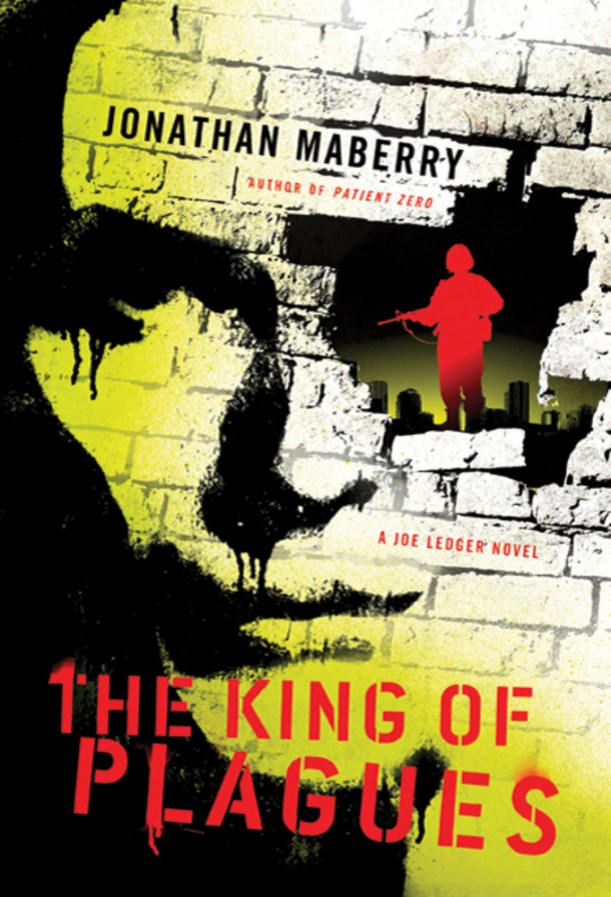
Throwback Thursday – The King of Plagues by Jonathan Maberry – Audiobook Review

The King of Plagues Cover.jpg

Publisher: Blackstone Audio (8 April 2011)

Series: Joe Ledger series – Book 3

Length: 16 hours and 10 minutes

My Rating: 5 out of 5 stars

Amazon     Book Depository

Reviewed as part of my Throwback Thursday series, where I republish old reviews, review books I have read before or review older books I have only just had a chance to read.

Over the last year or so, reading and reviewing all of the books in Jonathan Maberry’s Joe Ledger series has been something of a passion project for me. I absolutely loved the 10th and latest book in the series, Deep Silence, when I read it last year and found its superb blend of the horror, science fiction and thriller genres to be incredibly compelling and a whole lot of fun to read. Since then, I have gone back and read and reviewed the first two books in the series, Patient Zero and The Dragon Factory, and I found that I enjoyed them just as much as Deep Silence. As a result, when I got a gap in my reading schedule recently, I decided to check out the third book in the series, The King of Plagues, and once again found myself drawn into the world of Joe Ledger and the DMS.

Following the events of The Dragon Factory, which saw the death of the women he loved, Joe Ledger has left the chaotic world of the Department of Military Sciences (DMS) behind. Living in London, Ledger is suddenly thrust back into the field when an explosion levels a busy London hospital, killing everyone inside in one of the worst acts of terrorism the world has ever seen. Horrified by this callous attack, Ledger returns to active duty with the DMS and is immediately targeted by a hit team, before traveling to investigate a second attack at an Ebola research laboratory.

It does not take long to identify that the people behind these attacks are the group known as the Seven Kings. The Seven Kings are a mysterious secret society that Ledger and the DMS have dealt with before, as they influence and equip terrorist organisations around the world. Pledging fealty to a shadowy goddess and having a small army of highly trained mercenaries and the ability to influence highly placed people around the world, the Seven Kings are determined to change the world for their own benefit and are willing to kill anyone to achieve their goals.

As part of their plan to destabilise the world and benefit from the resulting economic chaos, the Seven Kings are planning to unleash weaponised versions of the Ten Plagues of Egypt that will not only kill untold masses but which will cripple the Seven Kings’ major opponents. If that was not bad enough, an old enemy from Joe Ledger’s past has resurfaced and is working with the Seven Kings to extract his revenge as the King of Plagues. Can Ledger and the DMS stop the devastating plans of the Seven Kings, or will the world once again bear witness to the devastation of the Ten Plagues?

The King of Plagues was another excellent addition to the Joe Ledger series that I had a fantastic time listening to. Maberry once again presents an exciting and addictive story that combines thriller action, a despicable evil scheme and a great group of characters, all told in Maberry’s distinctive writing style. This was an outstanding novel and yet another book in the Joe Ledger series that gets a five-star rating from me.

I always really enjoy the way that Maberry sets out the plots of his Joe Ledger books. The author utilises a huge range of different character perspectives across a number of different time periods to tell a full and complex overall story. By doing this the author is able to showcase a number of sides of the story. Not only does the reader get to see the protagonist’s story, but they also get to see how the antagonist’s evil scheme was planned and executed. Overall, this was a spectacular way to tell the story, and I always think that the reader gets so much more out of these books as a result. Maberry also did a fantastic job making this book accessible to readers unfamiliar with the series. While reading the Joe Ledger series out of order may result in some series spoilers for some of the earlier books, readers are easily able to start exploring this series with The King of Plagues and not have their enjoyment of the story suffer as a result.

The King of Plagues is filled with an amazing roster of characters, each of whom brings a lot of depth and emotion to the story. The main protagonist, Joe Ledger, has to be one of the biggest smartasses in fiction, and it is always a delight to watch him quip and make sarcastic comments across the world. However, despite that flippant exterior, Ledger is a complex emotional wreck who is still dealing with all manner of trauma and is barely containing his anger and bloodlust, especially when dealing with terrible events like the one in this book. I always find it fascinating when Maberry dives into the psyche of the series’ titular character, and it was especially poignant in The King of Plagues, as Ledger is still dealing with the loss of his love interest from the first two books, Grace Courtland. However, Ledger is not the only great character in this book. One of my favourites has to be Mr Church, the mysterious leader of the DMS, who everyone seems to be afraid of. Church once again shines in his role as the ultimate spymaster, but in this book he has some additional scenes that add to his character. In just one scene he shows the reader just why everyone is so afraid of him. There is also an attempt to humanise the character with some interesting reveals towards the end of the book, and I found those worked well and helped me like Church even more.

This book also featured the introduction of several other new characters. The main one of these, Circe O’Tree, is a brilliant young woman with a major chip on her shoulder who works as an analyst helping the DMS. I thought she was an intriguing character, especially due to her connections with the Seven Kings and several members of the DMS and her ability to analyse human behaviour. The King of Plagues also saw the introduction of the infamous Aunt Sallie, the second-in-command of the DMS, who is fearfully mentioned several times in the first two books. Aunt Sallie is a pretty fun character, and I am looking forward to seeing more of her scary, no-nonsense charm in the future. Funnily enough, one of my favourite characters was actually a dog, as The King of Plagues sees the inclusion of Ledger’s DMS attack dog, Ghost. Ghost was actually introduced in short story set between the second and third novels, Dog Days, but this is the first time readers of the main series get to see him in action. Despite being a ferocious and well-trained killing machine, Ghost is an absolutely adorable character who is responsible for some very funny moments in the story. Also, because he is such a good boy, you cannot help but get attached to him, and really get worried when he is in danger.

In addition to the great cast of protagonists, Maberry also utilises a great cast of antagonists in this novel in the form of The Seven Kings. The Seven Kings are an evil secret organisation who revel in deception and lies as they put their various plots and schemes into place. The identities of the various members of the Seven Kings is certainly interesting, and I really enjoyed this group and found them to be a fantastic group of antagonists. I absolutely loved the complex and devastating grand evil plan that they came up with in this story, and the full scope of their plot was pretty darn impressive. I was a little wary of this group at first, as they were introduced as some great threat that the DMS had apparently faced before, although there hadn’t been any mention of them in any of the previous books. However, in a number of interlude chapters set in the months before the current events of the plot, their lack of mention in the previous book is explained and they are presented as a force to be reckoned with. I quite liked this group of antagonists, and while certain revelations about them were not as surprising as in other Joe Ledger books, such as The Dragon Factory, for example, I did like certain developments that occurred within the Seven Kings, and I look forward to seeing how certain members show up again.

One of the things that makes the Seven Kings really sinister is their use of coercion and manipulation to achieve all their goals. At the most disturbing level, they target a number of people across the world with families and manage to terrify them so much that they will commit terrorist acts in order to save their loved ones. There are some quite chilling scenes in this book where the chief enforcer for the Seven Kings threatens these victims, and the lengths these innocent people will go to and the evils they will commit in the name of their families are horrifying at times. In addition, the Seven Kings use Twitter and other social media to fan the fires of hatred around the world, creating conspiracies and prejudice against certain ethnic groups that eventually result in violence. This examination of the evils of social media and how it can be used to spread hate is pretty fascinating, and it’s interesting to note that, as the book was written in 2011, it precedes a lot of the more recent and highly publicised incidents of Twitter being used to influence people. These inclusions really help set the Seven Kings apart from other villains in the Joe Ledger series and makes sure the reader is both disgusted and impressed by their methods.

The King of Plagues also saw the return of two antagonists from a previous book in the series, who join up with the Seven Kings to help them fulfil their master plan. I felt that both of these characters were used to their full potential within this book, and both had some truly intriguing and clever story arcs which contrasted quite impressively. For example, one starts on the long, hard road to redemption, while the other falls even further down the rabbit hole to pure evil. I won’t go into any more detail in order to avoid spoilers, but these two characters were extremely impressive, and were the main characters showing the inner workings of the Seven Kings.

Like the rest of the books in the Joe Ledger series, The King of Plagues is rich with action and firefights, as the protagonists engage in a number of battles with the minions of the Seven Kings. The action comes thick and fast throughout the book, and Maberry’s knowledge and research into various forms of armed and unarmed combat is extremely obvious. The way some of the firefights are paced out is pretty spectacular, and it is always impressive what a well-trained special operations team can do. Maberry really shines when it comes to the hand-to-hand combat sequences, though, as Ledger rips through his opponents with his martial arts prowess. The fight sequences in this book are straight up awesome, and those readers who love an action-packed book will be well catered to with The King of Plagues.

One of the things that I quite enjoyed about The King of Plagues was the author’s decision to include a number of celebrity cameos throughout the story. Not only does the protagonist encounter some famous singers and actors as part of the plot (including having a weird conversation at the end of the book with a famous rock star), but a number of celebrities are put into some interesting and deadly positions throughout the plot. I also had a good laugh at Maberry’s inclusion of a terrorist think tank made up of thriller writers coming up with the most outrageous situations they could think of, especially as that becomes a major plot point later in the book (and may have serious ramifications later in the series). The authors named dropped in these scenes are pretty impressive, and I thought it was a cute touch from Maberry to include his contemporaries like that. The use of the celebrities was an interesting choice from Maberry, but I think it fits into the wacky vibe of the Joe Ledger series quite well, and it was not too distracting from the main plot.

As with the previous books in the Joe Ledger series, I listened to The King of Plagues on audiobook. The audiobook is around 16 hours and 10 minutes long and is narrated by Ray Porter, who has to be my favourite audiobook narrator at the moment. Porter has an amazing vocal range, and I love the way that he portrays the main character of this book, Joe Ledger. Porter really brings Ledger to life in these audiobooks, not only amplifying the character’s sarcasm and smartass nature, giving real anger and sadness to Ledger when needed. The rest of the characters in this series are also really well done. I have mentioned before how much I love the voice he uses for Mr Church, and Porter really gets a lot of mileage out his Boston accent for some of the other characters. In addition to Porter’s awesome vocal work, I found that listening to The King of Plagues really helped bring me into the story. Not only does the action really pop in this format but listening to the antagonists come up with their evil plans and threats can be quite chilling at times. As a result, I would strongly recommend that readers check out the audiobook version of The King of Plagues. I know I will be checking out the rest of the books in the Joe Ledger series on audiobook as well.

Once again, I had an absolute blast listening to a book in Jonathan Maberry’s Joe Ledger series, as The King of Plagues was another outstanding addition to this fantastic series. Featuring a well-written and captivating story, some amazing characters, an evil and over-the-top plot, a number of intriguing plot points and some of the best action sequences in modern thriller fiction, this was an incredible read. I cannot wait to check out the fourth book in this series, and quite frankly all of the upcoming books sound like they have some truly outrageous stories.

Amazon     Book Depository

Star Trek: The Next Generation: Available Light by Dayton Ward – Audiobook Review

Star Trek - Available Light Cover

Publisher: Simon & Schuster Audio (9 April 2019)

Series: Star Trek

Length: 11 hours and 59 minutes

My Rating: 4 out of 5 stars

Amazon     Book Depository

For my latest review, I dive back into the massive universe of extended books that surround the Star Trek television and movie series, with the latest novel from legendary Star Trek fiction author Dayton Ward.

When I reviewed my first piece of Star Trek fiction, The Way to the Stars by Una McCormack, a couple of months ago, I mentioned how substantial the extended book universe around Star Trek was. With a huge number of series that cover various points of the Star Trek universe and over 840 novels to accompany the various movies and television shows, there are so many additional stories and characters out there for dedicated fans to enjoy. Star Trek tie-in novels and comics were not something that I had really gotten into before The Way to the Stars, but after enjoying it, I thought that Available Light would be a good opportunity to expand my knowledge of the Star Trek universe. I also decided that I would try my first Star Trek audiobook; I chose to listen to the audiobook format of Available Light, narrated by Robert Petkoff.

Quite a large amount of the extremely large Star Trek extended universe can be attributed to the author of this book, Dayton Ward. Ward is a prolific author who has been writing Star Trek fiction since 1998 with his inclusions in the long-running Strange New Words collections of Star Trek short stories, becoming the first author to contribute to three separate volumes of this series. Since then he has written more than 20 additional inclusions in the Star Trek universe, including last year’s Star Trek Discovery: Drastic Measures, which made my Top Ten list of Books I Wish I Read in 2018.

Available Light is the latest book in a series of novels which are set after the events of the last Star Trek: The Next Generation film, Nemesis. Available Light takes place in the year 2386, set seven years after the events of Nemesis and continues to follow the adventures of the USS Enterprise E, under the command of Captain Picard. Ward has written the last three books in this specific Star Trek series and Available Light continues several of the storylines established in these previous novels.

For over 200 years, covert organisation Section 31 has policed and protected the United Federation of Planets from the shadows. Following the designs of an artificial intelligence, Control, Section 31 has committed attacks, assassinations, political interference and all manner of illegal actions to preserve the security of the Federation, without any oversight. However, thanks to the actions of Star Trek: Deep Space Nine character, Dr Julian Bashir, all of Section 31’s secrets have been published and are now out in the open for everyone to see. With the entire Federation of Planets now aware of Section 31’s actions, the Federation government and Starfleet move to arrest and prosecute all known Section 31 agents for treason against the Federation.

While numerous crimes and atrocities have been revealed, perhaps none is more controversial than Section 31’s assassination of Federation President Min Zife following his secret deposition by a group of Starfleet officers. More shocking is the revelation that one of the Starfleet officers responsible for the illegal coup d’etat that unseated Min Zife was none other than Jean-Luc Picard, the captain of the USS Enterprise E.

While the politicians and remaining commanders of Starfleet argue about the future of Picard, the Enterprise continues its exploration of the distant and uncharted Odyssean Pass. The Enterprise has come across an incredibly large and ancient spaceship adrift in the middle of nowhere and apparently abandoned. When the Enterprise’s away team boards the ship, they discover that the ship might not be as abandoned as first believed. As Picard and the Enterprise attempt to help the mysterious beings who inhabit the ship, they find their plans complicated by the arrival of a band of salvagers with designs on the massive ship.

I really enjoyed Available Light, as Ward presents the reader with a compelling adventure in space that really reminded me of an episode of Star Trek: The Next Generation. Ward goes deep into the Star Trek lore to produce an intriguing story for the fans, and it was quite interesting to see how the events of Available Light help shape the wider Star Trek book universe. The book makes exceptional use of advanced science and a large amount of action to make the story even more interesting and fun. I especially enjoyed the various wonderful examples of ship-to-ship combat that occurred throughout much of the book, and I found them to be extremely entertaining and exciting. Overall, this is a pretty fun read, although there are some issues when it comes to its intended audience and the distribution of its two main storylines.

One of the things that I always try to cover when reviewing novels related to movies, television shows and video games is whether a book is suitable only for fans of the original media or whether readers with limited background knowledge of the franchise will be able to appreciate the book. Available Light falls into the category of books which is primarily aimed towards those readers with some knowledge and appreciation of the Star Trek franchise, especially those who are fans of the books, as Ward makes use of a number of storylines that originated in other books. For example, Available Light continues to showcase the Enterprise’s exploration of the region of space known as the Odyssean Pass, which has been covered in Ward’s last three novels, Armageddon’s Arrow, Headlong Flight and Hearts and Minds. It also dramatically follows storylines started in David Mack’s 2004 novel, A Time to Heal, which detailed the assassination of Min Zife, and his 2017 Star Trek: Section 31 novel, Control, which featured the publication of Section 31’s secrets. The book also contains a huge number of references to previous Star Trek adventures that happened in other books, the movies and the television shows. This does not just include those works associated with The Next Generation, as events from other shows, such as Deep Space Nine, are also heavily referenced. As a result, fans of these existing pieces of Star Trek fiction will have a much deeper appreciation for what is going on, and they may already be invested in the storylines that have been established in these previous books.

Dedicated fans of The Next Generation television series and movies will probably be surprised about the extensive storylines established in these books. Since the events of Nemesis, the books included in these series cover a huge range of adventures and character developments of the crew of the Enterprise. Those Star Trek television and movies fans coming into this book will be surprised at events like Picard and Beverly Crusher getting married and having a son. These fans should also be prepared for the fact that only a few of The Next Generation’s main characters are really featured in Available Light. While Picard, Worf, Geordi La Forge and Beverly Crusher are still aboard the Enterprise, major characters such as Deanna Troi, Data and Wesley Crusher do not appear at all, while the character of William Riker (now an Admiral) only appears in one chapter. In their place, several new, original characters have taken on their roles and become point-of-view characters for the Enterprise. While these characters are quite intriguing, fans of the original crew may be a little disappointed not to see how the missing characters are going. Ward has also included some characters that appeared in minor roles in both The Next Generation and Deep Space Nine. These include Admiral William Ross (who appeared in 13 episodes of Deep Space Nine), Worf’s brother Martok (who also appeared in Deep Space Nine) and Philippa Louvois (the Judge Advocate General from The Next Generation episode The Measure of a Man). Not only are these characters quite interesting in their own right, but there are some significant developments for some of these characters that fans of the franchise will be deeply intrigued to see.

That being said, while a large amount of the story is quite heavy on Star Trek lore, references and tie-ins to previous storylines, Ward does an exception job making this story accessible to a wide range of readers. I am not a particularly dedicated Star Trek fan and I only have an average knowledge of the lore and the various series and movies. However, I was able to follow the story quite closely, as Ward did a fantastic job explaining and describing the events that occurred in the previous storylines and episodes that Available Light’s story follows on from. While some readers whose knowledge of Star Trek is lesser than mine might struggle a little with the book, I feel that Ward has made this book extremely accessible to most readers. However, this book will really appeal to those readers who have a prior appreciation of the Star Trek franchise.

I should mention that that this book, like many licensed Star Trek novels, is not actually considered to be canon in relation to the television shows or movies. While some books, such as the recent Star Trek Discovery books, are considered to be canon (indeed, events in The Way to the Stars were mentioned in the show), Available Light and the books that it follows on from are not. That means that events that occur in this book are unlikely to affect what happens in upcoming movies or television shows, such as the upcoming show featuring the return of Captain Picard. While reading a non-canon book like this might not appeal to some fans of the franchise, I still quite enjoyed the story, and I am intrigued to see how this separate Star Trek universe will continue.

Available Light features two separate storylines that mostly remain separate from each other. The first storyline focuses on the fallout of the events of Control, including the revelation about Section 31’s actions and the attempts by the Federation to round up and prosecute all those who worked with or for the covert organisation. The second storyline focuses on the Enterprise as they encounter the new alien ship and the various inhabitants of this new region of space. Despite the huge amount of detail used to describe the Section 31 part of the book in both the official synopsis and the synopsis I wrote above, this storyline only really takes up around one-third of Available Light, with the remaining two thirds focusing on the Enterprise and her crew. I found both storylines to be extremely fascinating and a lot of fun. The Enterprise storyline felt like a classic episode of a Star Trek television series, with the crew working together to explore an intriguing phenomenon and overcome the odds to save an innocent party. The Section 31 storyline is also really cool, and I really enjoyed seeing what happens when the existence of this organisation becomes public knowledge.

While Ward does try to bring these two separate storylines together, such as by examining Picard’s guilt at the role he played in Min Zife’s ousting and assassination and having it affect his actions in the Enterprise storyline, I did at times feel like I was reading two unrelated books. I really think this would have been a better book if Ward had focused on only one storyline. I would have really loved a book completely dedicated to the aftermath of the Section 31 reveal, including having Picard stand trial for his crimes, and I am sure that the story of the Enterprise discovering the massive ship could have been even better with some additional storytelling. Instead, the story of Picard’s trail will occur later this year in David Mack’s upcoming novel, Collateral Damage. While it was slightly disappointing to find out that Available Light’s Section 31 storyline was mostly included to set up a future book, it was still really interesting and helped created a book that was a lot of fun to read.

Ever since Section 31 was first introduced, it has been a deeply intriguing plot point. The idea of a secret Federation security organisation that goes against nearly everything that Starfleet stands for is really clever, and it opens up a lot of possibilities. Section 31 is getting a lot of focus at the moment, as not only did they appear throughout the second season of Star Trek Discovery (which utilised the AI program Control, who appeared in several novels linked to Available Light as an antagonist) but there are apparently plans to do a Section 31 television series featuring Michelle Yeoh’s character from Discovery. As a result, it was really interesting to see this book universe version of Section 31 start to unravel in Available Light. The shock and outrage that results throughout the book are deeply intriguing, and I really liked seeing how the Federation and Starfleet reacted to the news. This really was a cool plot point, and I am extremely curious to see what happens to the organisation in future books.

As I mentioned before, I chose to listen to the audiobook version of Available Light. At just under 12 hours in length, it did not take me too long to get through this book, and I found it to be a great format to enjoy the intriguing, Star Trek based plot. I did find that listening to the story helped me pick up a lot more of the previous storylines and Star Trek references that Ward had littered throughout the book, which probably gave me a better base to enjoy the story. I found Robert Petkoff to be a really good narrator, and I really enjoyed the way that he told the story. Petkoff does a pretty good impersonation of the male characters from The Next Generation, including Picard, Worf and La Forge, and I found his Picard voice to be extremely convincing. Petkoff also did a great impersonation of Vulcan and Klingon characters throughout the book, and I thought the voices he attributed to these alien characters were quite excellent. As a result, I would strongly recommend the audiobook version of Available Light, and I am extremely glad it was the version of the book I chose to enjoy.

In the end, my second dive into the Star Trek universe was a little bit of a mixed bag. While there are some great and enjoyable story inclusions throughout Available Light, this is a book that is more aimed towards extremely dedicated Star Trek fans and features a split story that at times is more concerned with setting up future books rather than standing on its own. But I found the storylines explored within the books to be a lot fun, and I had an absolute blast listening to this captivating Star Trek tale. I am still really keen to check out additional Star Trek novels, and I hope to see where the various plots explored in this book go from here.

Amazon     Book Depository

Aurora Rising by Amie Kaufman and Jay Kristoff

Aurora Rising Cover

Publisher: Allen & Unwin (Trade Paperback – 6 May 2019)

Series: Aurora Cycle – Book 1

Length: 470 pages

My Rating: 5 out of 5 stars

Amazon

The superstar team of Australian young adult fiction authors Amie Kaufman and Jay Kristoff comes together once more to create an outstanding, heartfelt and deeply entertaining new novel that may prove to be one of the best young adult books of 2019.

Kaufman and Kristoff are two of the biggest and most creative authors currently writing young adult fiction.  Kaufman is probably best known for her work with Meagan Spooner, where they have co-authored the Starbound trilogy and Unearthed series of books, the second book of which, Undying, was released earlier this year.  She is also in the process of writing her own Elementals series, with the second book, Scorch Dragons, released a month ago.  Kristoff first came into prominence with The Lotus War series, which debuted in 2012.  Since then he has also written The Nevernight Chronicle, the final book of which is set to be released in September, while his latest book, Lifel1k3, was one of the most talked about young adult releases of 2018.  Kristoff’s sequel to Lifel1k3, Dev1at3, is set to be released in a month, and he is currently working on an epic fantasy series, Empire of the Vampire, with the eponymous first book set to be released in September next year.

Kaufman and Kristoff have previously collaborated on the bestselling and award winning The Illuminae Files, a space opera epistolary series made up of three books which ran between 2015 and 2018.  Their latest collaboration, Aurora Rising, is another epic piece of young adult science fiction and is the first book in their planned Aurora Cycle series, which is currently set to feature another two books, released in 2020 and 2021.

Aurora Rising is set in the year 2380 and follows a spacefaring team of young adventurers as they attempt to save the galaxy.  In the future, humans have expanded out deep into the Milky Way, with fast intergalactic travel made possible through the Fold, dangerous space found on the other side of literal folds in the universe.  The Aurora Legion are an independent peacekeeping force made up of humans and several friendly alien races.  In order to complete their various humanitarian, exploration and peacekeeping missions, the Aurora Legion sends teams of young legionnaires, who can better withstand the rigors of the Fold, into the field.  Each team is made up of six highly trained and skilled individuals, who together can solve any problem they encounter.

Tyler Jones is the star graduating cadet of the Aurora Academy, who, thanks to his dedication and ability, will be given first pick of his fellow graduating cadets to form an elite team.  However, when an unscheduled joyride forces him to perform a risky rescue in the Fold, he misses the cadet draft, leaving him with a team of the cadets none of the other graduating squad leaders wanted.  These include (the descriptions were copied from the blurb due to accuracy):

  • His sister, Scarlet – A cocky diplomat with a blackbelt in sarcasm;
  • His best friend, Cat – A tomboy pilot who’s totally not into her squad leader, in case you were wondering;
  • Zila – a sociopath scientist with a fondness for shooting her bunkmates;
  • Finian – a smart-ass tech-whiz with the galaxy’s biggest chip on his shoulder;
  • Kal – an alien warrior with anger management issues.

Forced to make the most of his bad luck, Tyler leads his team on a routine mission that quickly turns hairy when a hostile force of aliens seek to destroy them.  However, genocidal aliens are the least of their problems, when they discover that the girl Tyler saved in the Fold, Aurora O’Malley, has stowed away on their ship.  Aurora, the only survivor of a colony ship long thought lost, is 200 years out of time and desperate to figure out what happened to her colony and the family she left behind.  The squad discovers that she is far more significant than they could ever imagine when she displays strange abilities and impossible knowledge of both the past and future.  When shadowy government agents attempt to arrest Aurora, the squad are forced to go rogue to solve the mystery and end up in a race to save the galaxy.

Aurora Rising is a spectacular read, as these skilled authors take the reader through an intense young adult science fiction adventure in an intriguing new universe.  The book’s story as a whole is an outstanding mixture of intense action, enjoyable science fiction elements and excellent character work, all wrapped up with clever storytelling that is both compelling and humorous.  There are a number of great scenes and epic moments throughout this book that really highlight this book’s unique style and the writer’s ability to tell a story.  For example, I personally liked an extended sequence that followed the protagonists as they embarked on an elaborate and seemingly impossible heist on a massive space station ruled by a vicious crime lord.  The overall result is a near perfect read that I had an absolute blast checking out.  This is an amazing piece of young adult fiction, with enough action and relatable characters to appeal to all manner of potential teen readers.  Older science fiction readers will also have a great time with this book, especially as it sets up a captivating and ambitious new trilogy that will appeal to a huge and diverse audience.

This book is told from the first-person perspectives of the book’s seven protagonists, which includes Aurora and all six members of Tyler’s squad, each of whom gets a series of chapters throughout the book to tell the story.  Kaufman and Kristoff make good use of the chapters each of the characters narrate and the reader gets a good idea of each character’s individual personality, as well as important snippets into their individual backstory.  The authors also try to differentiate these chapters out a bit for some of the characters.  For example, Zila’s chapters are rather short, blunt and analytical in nature, matching her personality, while Scarlet’s chapters feature her listing off the humorous pros and cons of her ex-boyfriends, figuring out which ones to stay in contact with.  I really enjoyed how the authors told the story through these seven separate narrators, as not only did it bring me closer to the characters but it allowed the authors to showcase various perspectives of some of the more impressive sequences and events, allowing for a fuller and more intense story.

Aurora Rising features an outstanding complement of main characters, as each member of the squad, including Aurora, are looked at in some detail.  I was very impressed with how the authors where able to create such expansive and intriguing backstories for all seven main characters, as each of them has their own issues or concerns.  For example, Tyler and Scarlett are living in the shadow of their dead father’s heroics and trying to make him proud, Cat is deeply in love with Tyler and is having a hard time keeping her feelings in check, and Zila struggles with her disconnection with other people brought on by her tragic past.  Other examples include the team’s two alien members: Finian, who to hides his feelings of abandonment behind his brilliance and snark; and Kal, who is torn between guilt about what his race’s warrior caste, of which he is a member, has done to his home planet and his surprising feelings for one of the other members of his squad.  Aurora is perhaps one of the most complex characters, waking after 200 years to find that everything and everyone she knew is dead and parts of her past have been hidden for nefarious reasons.  Add into that her discovery of uncontrollable mental abilities and the feeling that something mysterious is guiding her and she has a lot to worry about.  One of the best things about this book is that whilst all seven characters are fairly complex individually, the book’s true strength revolves around the fact that when these characters come together they are an extremely dysfunctional crew.  The crew starts off as a rebellious and overly sarcastic mess unable to work together effectively, even with their individual abilities and strengths.  However, as the book continues, they do learn to cooperate to a degree, and the reader is made to really care for them, both individually and as a whole.  I loved how these character relationships expanded and strengthened throughout the book, and I had a lot of fun with this humorous and entertaining group of people.

I really enjoyed the universe that Kaufman and Kristoff crafted to fit around this enjoyable and intriguing story.  Visions of humanity’s future can always be a bit hit or miss, but I thought that the science fiction setting that the authors utilise in this book, which sees humanity expanding and interacting with other races while dark secrets and wars build up in the background, to be a fun and well-thought-out setting.  The characters visit an interesting and inventive number of locations through the book, all of which really add to Aurora Rising’s adventure and action.

I liked the author’s concept of the Aurora Legion, an intergalactic peacekeeping organisation that sends teenage operatives into action due to science fiction reasons.  One of the things I quite enjoyed about this was how these teams were designed to have six members whose joint abilities and specialities would allow them to anticipate and overcome any problem.  As a result the teams are made up of:

  • Alphas – leaders
  • Faces – diplomats
  • Aces – pilots
  • Gearheads – mechanics/inventors/technicians
  • Tanks – combat specialists
  • Brains – science officers/medics

This team breakdown proved to be quite an interesting concept, even if they do sound like party roles in a MMORPG (tank, healer, DPS etc).  I liked this idea and the various characters slid into the roles quite effectively.

I also had a lot of fun with the universe-expanding insertions that Kaufman and Kristoff placed before a number of the book’s chapters.  These insertions are written as information pages being read by Aurora on her uniglass, an AI tablet called Magellan, who has a playful sense of humour and who also provides some amusing commentary within the story.  These information pages provide the reader extra information about the universe, including about the Aurora Legions, the roles of the squads’ various members, the history of the universe, alien species, locations the protagonists visit and other relevant inclusions.  While each of these pages contains universe factual information, Magellan adds humorous twists to each of these pages which are very entertaining and really fit into the easy going and entertaining mood of most of the book.  However, these information pages do change and get more serious in the darker parts of the book, which also helps prepare the reader for the shift in mood.  I loved these inclusions, not only appreciating the inventive universe building they allowed, but also the fun take on the classic idea of in-universe media inclusions.

Aurora Rising is an absolutely fantastic book that blasts off with action, humour and amazing characters to create a deeply compelling and relentlessly entertaining story.  Australian authors Kaufman and Kristoff are an outstanding writing duo, and their latest collaboration is an amazing piece of young adult fiction that brilliantly establishes their new trilogy and ensures that future instalments of the Aurora Cycle will be some of the most sought after young adult books for 2020 and 2021.  Aurora Rising comes highly recommended from me, and it is one of my favourite new young adult books of 2019 so far.

Amazon