
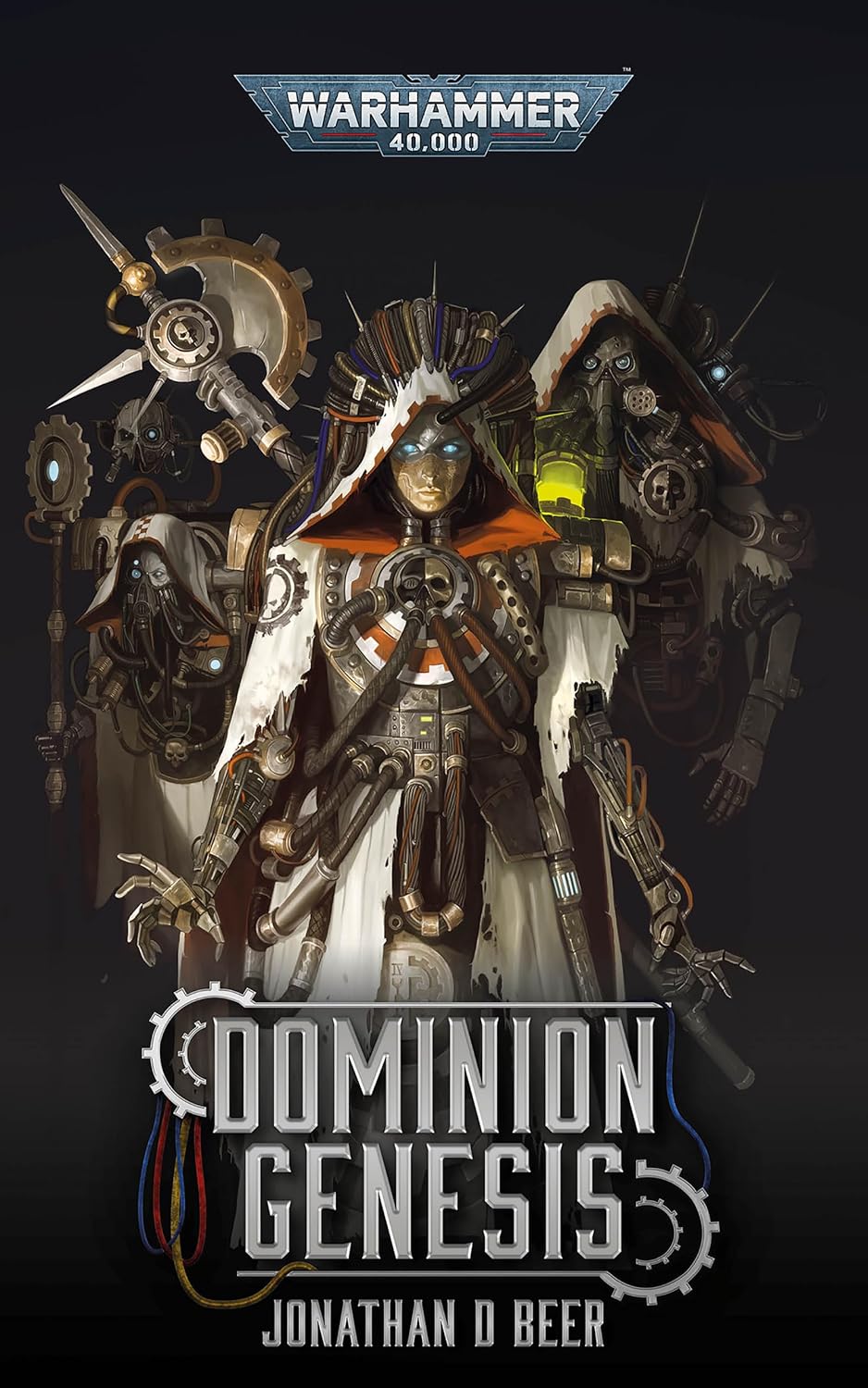
Warhammer 40,000: Dominion Genesis by Jonathan D. Beer

Publisher: Black Library (Audiobook – 21 September 2024)

Series: Warhammer 40,000

Length: 10 hours and 47 minutes

My Rating: 4.5 out of 5 stars

Amazon

Destitute tech-priests of the Adeptus Mechanicus embark on a massive quest for redemption in the excellent 2024 Warhammer 40,000 novel, Dominion Genesis by Jonathan D. Beer.

Beer is a talented rising author in the Warhammer 40,000 fiction space who has so far impressed with two interesting books covering unique spheres of the fandom’s canon.  I deeply enjoyed his first novel, The King of the Spoil, which was a particularly epic entry in the Warhammer Crime sub-series, and which ended up being one of my favourite debuts of 2023.  Beer followed up this debut last year with his second novel, Dominion Genesis, an intriguing read that takes place in a very different Warhammer 40,000 setting.  I had an excellent time with Dominion Genesis, although I spectacularly failed to write a review for it last year.  However, with Beer’s third Warhammer 40,000 novel just released, I felt that this was a good time to finally write something about Dominion Genesis, which honestly was an awesome read.

Plot Synopsis:

Gryphonne IV is dead – one of the mightiest forge worlds in the arsenal of the Adeptus Mechanicus, succumbed to the relentless hunger of Hive Fleet Leviathan. Devoured. Lost.

The few magi that survive drift in idleness, robbed of purpose and direction. But there is one who rejects that fate.

READ IT BECAUSE
It’s the gripping tale of an Explorator desperately seeking ancient technologies from humanity’s past as she races against time to restore one of the mightiest forge worlds in the Imperium.

THE STORY
Explorator Talin Sherax seeks ancient and miraculous technologies from humanity’s distant past. When she learns of a fabled relic that could restore all that has been lost, Sherax embarks on a journey, the outcome of which could change everything. Nothing will stand in her way… even if the quest brings her to the brink of heresy.

Dominion Genesis was a particularly intense and compelling entry in the Warhammer 40,000 canon that proves quite enthralling to read.  I like how Beer managed to achieve quite a few things with this book, as he produced an excellent quest narrative with a focus on obsession, trauma and survival, while also cleverly showcasing several different factions of the Warhammer 40,000 universe.

Beer came up with a very awesome story that hits a lot of highly emotional story notes early on.  The start of Dominion Genesis was one of the more striking sequences of Warhammer fiction I have read, as the protagonist, Explorator Talin Sherax, is forced to witness the destruction of their home world.  Moving quickly into a time skip, you see a very different version of Sherax several years in the future, as she still attempts to make sense of the destruction while searching for valuable lost technology.  After a great sequence aboard a derelict spacehulk, Sherax finds a clue about a potential artifact that could help to restore her planet.  Going against the orders of her superiors, Sherax leads a crew of human soldiers and Adeptus Mechanicus forces on a quest to several deadly and hidden locations in the galaxy.  Along the way, the protagonists examine their humanity in several different forms, while also being stalked by dangerous alien fighters determined to stop them achieving their goal.

There are some great sequences in the middle of this book, as the protagonist desperately follow the clues into a trap, which shakes all the characters to their core.  After a gruelling sequence of events that help to highlight and move along several, well-constructed character development arcs, the adventure moves to its destructive conclusion.  After another disaster, the protagonists are dropped in amongst a war between rival xenos forces and must journey into the fray to achieve their goal, resulting in a brutal series of battles and the intense conclusion to the narrative.  Beer wrote in some great tragic moments as the protagonists are outmatched at nearly every turn, although many of these sequences work well to provide closure to some of the book’s various character arcs.  The conclusion to Dominion Genesis was as bleak as you would hope for a novel in the grimdark Warhammer 40,000 universe, but it provides some great closure for the main character and will keep readers very satisfied.

I felt that Dominion Genesis was a particularly good addition to the Warhammer 40,000 canon, as Beer provides a thoughtful and complex novel loaded with unique action and damaged characters trying to survive the inherent darkness of the war-torn universe.  Beer ended up producing an intense character-driven story for Dominion Genesis, and I loved the great balance between action, exploration and interaction between certain unique Warhammer races, and the focus on character elements.  I personally really enjoyed the deep dive into the Adeptus Mechanicus, with various character perspectives diving into their culture and thought processes, even though certain sections of the plot need to be altered to emulate the machine nature of the tech-priests.  Beer tried to showcase a more emotional side to the Adeptus Mechanicus in this book, especially through his protagonist which, while different from other portrays of this faction, fits the trauma-rich narrative as all these characters struggle with the loss of their home.  The author also has fun fitting in several of the main alien races of the Warhammer 40,000 universe into the story, including orks, Tyranid, Aeldari and Necrons.  While not a lot of focus is given to understanding them, they serve as good foils to the obsessed protagonists, and it was interesting to see the Mechanicus takes on these different enemies.  In the end, Dominion Genesis proved to be a compelling, and impressive standalone novel that makes great use of its Warhammer 40,000 elements.  However, be warned that this novel is probably better read by more established fans of the franchise, rather than newer readers, as Beer covers a lot of complex lore in a short period of time.

One of the key things I liked about Dominion Genesis was the rich array of compelling characters featured throughout the plot.  Beer does an outstanding job introducing and following several very damaged figures, including the protagonist Explorator Talin Sherax, who finds herself in a depressed state following the opening sequence of book.  Cutting herself off from the technological hivemind used by the rest of Adeptus Mechanicus brethren, Sherax proves to be a brilliantly complex figure in Dominion Genesis, and Beer’s take of her as the depressed member of a group known for having no emotions was really fascinating.  The author also features an interesting array of other Adeptus Mechanicus members who provide great alternate viewpoints to that of Sherax.  I really enjoyed how Beer managed to include a lot of intriguing individualism in these machine-like Adeptus Mechanicus characters, and the range of different opinions and feelings around Sherax and her mission added some interesting drama to the story. 

Finally, I must highlight the human members of the Dominion Genesis cast, who provide intriguing alternate viewpoints to cybernetic protagonists. I particularly enjoyed the focus on a depressed former Imperial Knight pilot, who, after losing his ancient war machine, decides to join the crew of Sherax’s ship.  There are some fascinating focuses on his parallel grief to that of the Adeptus Mechanicus characters, as well as his own self-anger, especially while forced to pilot a seemingly lesser machine.  Beer writes some interesting side plots around this more human character, including his relationship with an Imperial Guard regiment also aboard the ship, and he must balance his need for human contact with his own grief and arrogance.  I felt this compelling collection of distinctive characters helped to make Dominion Genesis really stand out, and I enjoyed seeing their unique interactions.

As with most Warhammer 40,000 novels I review, I ended up listening to Dominion Genesis on audiobook, which is pretty much the best way to enjoy this series.  The Dominion Genesis audiobook ended up being a lot of fun to listen to, and I managed to get through it’s near 11-hour runtime quickly.  It helped that Dominion Genesis was narrated by the very talented Colleen Prendergast, who is becoming the go-to narrator for any Warhammer 40,000 audiobook that features a human female protagonist, such as Justin D. Hill’s Cadia series, or standalone books like Creed: Ashes of Cadia by Jude Reid or Longshot by Rob Young.  Prendergast did an outstanding job bringing the various complex cast members of Dominion Genesis to life, and I particularly appreciated the skill need to voice a variety of cybernetic humans with altered or robotic voices.  This great voice work turned Dominion Genesis into a fantastic listen, and it was very easy to enjoy Beer’s outstanding and lore-heavy story when it was being read out.

Overall, Dominion Genesis was an amazing second novel by Jonathan D. Beer, who did an outstanding job pivoting to a different area of Warhammer 40,000 fiction.  I loved the complex character-driven narrative contained within Dominion Genesis, and this was one of the more enjoyable Warhammer 40,000 novels that came out last year.  I cannot wait to see how Beer continues to develop as a writer in the future, and I currently have a copy of his latest book, Tomb World, in my audiobook queue to listen to.
Amazon

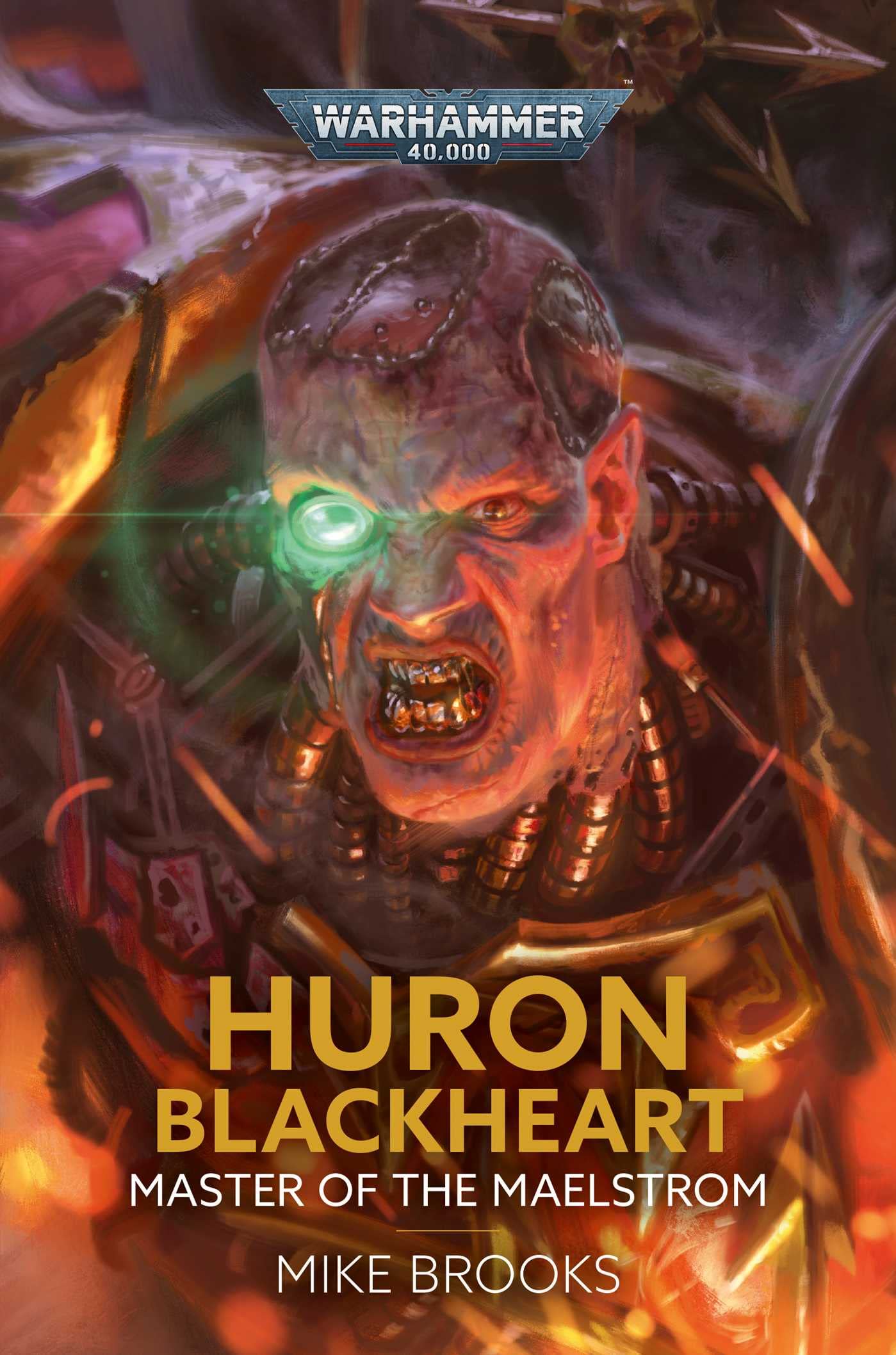
Quick Review – Warhammer 40,000: Huron Blackheart: Master of the Maelstrom by Mike Brooks

Huron Blackheart Cover

Publisher: Black Library (Audiobook – 7 May 2022)

Series: Warhammer 40,000

Length: 6 hours and 23 minutes

My Rating: 4.25 out of 5 stars

Amazon

I am really in love with the Warhammer 40,000 universe at the moment as they are producing some incredible books.  While many feature huge casts or examine vast conflicts, some of the very best Warhammer 40,000 novels provide greater context and insight into the game’s legendary characters.  These major character driven novels often result in some intriguing and powerful reads, and I love the complex stories that they tell.  One of the more interesting ones recently was the epic Huron Blackheart: Master of the Maelstrom by rising Warhammer 40,000 fiction author Mike Brooks.  This was a great and exciting read from last year, which I unfortunately never got the chance to properly review.  However, as I have just started listening to one of Brooks’s more recent novels, Warboss, I thought it would be beneficial to do a quick review of Huron Blackheart.

Plot Synopsis:

Huron Blackheart is the lord of the Red Corsairs, master of the lawless Maelstrom and its piratical denizens – but oathbreakers and renegades can seldom rely on the loyalty of their followers. With the galaxy thrown into turmoil by the return of Roboute Guilliman, the former Tyrant of Badab faces a renewed Imperium and fresh challengers emerging within his own ranks.

Huron must call on every trick he knows to stay in control – and alive. Yet even a warrior as ferocious and opportunistic as the Blood Reaver must be wary, for although there are many bargains he can strike, all power comes at a price…

Brooks has produced a very awesome and enjoyable read with Huron Blackheart which drags you in with its intense and entertaining story.  As the name suggests, the book primarily focuses on one of the more interesting characters from the wider Warhammer 40,000 canon, Huron Blackheart.  Huron Blackheart is a particularly cool character with a well-established background as a former loyal space marine who turned traitor and become a notorious pirate lord, haunting vast swathes of the Imperium.  Rather than diving into the full history of the character, Brooks instead tells a more contemporary narrative that shows the current actions of Huron Blackheart in the aftermath of the return of Roboute Guilliman.

The story sees Huron planning his next great offensive against the hated Imperium when one of his subordinates suddenly becomes a threat when he arrives with a mighty war prize, a legendary Ultramarines battle cruiser and Roboute Guilliman’s personal flagship, which the canny underling had managed to capture.  Now faced with a potential rival, Huron is further blindsided when several of his underlings ensure that a powerful daemonic relic falls out of his hands, further weakening his hold on his minions.  Forced into a corner, Huron soon finds himself caught between his murderous minions and the dark powers that surround him, and he’ll need to make a deadly decision that could change his existence and the remnants of his soul forever.

This is a pretty enjoyable and compelling overall narrative, and it is always quite a lot of fun to see events unfold from a villain’s perspective.  The author did a good job of balancing out some of the elements of the story, and the reader is treated to a great mix of Chaos politics, intense action, and a focus on the always awesome figure of Huron Blackheart.  Brooks makes good use of a multi-character perspective throughout Huron Blackheart, which is mostly effective in telling the fun and enjoyable narrative.  The main one of course is from Huron itself, which gives you some very interesting views into his mind, but several other characters are also well featured, including a captured Tech Priest who is forcibly recruited into Huron’s ranks at the start of the novel.  She provides a great outsider perspective to the entire story, and, when combined with Huron’s own cynical observances, you get a great view of the book’s events, especially all the backstabbing, politicking and carnage that emerges.  Not every character is given this great treatment however, as several of the supporting cast end up being a bit one-dimensional in places, which make their subsequent perspective shots a bit hard to care about.  Still, Brooks’s great use of perspective does capture the novel’s slightly darker and more bloody tone that some of the other Warhammer 40,000 novels out there as Brooks attempts to capture the villainous edge to every character.  I particularly enjoyed several of the scenes that showed the entire elaborate nature of Huron’s corsair organisation, and it was a lot of fun to see all the different factions, as well as several different groups of Chaos Space Marines, working together for piratical purposes.  I did think that the story itself was a little basic in places, especially when it came to its direction, and several of the twists or reveals were well telegraphed.  Still, I was pretty entertained the entire way through Huron Blackheart, and readers are guaranteed a pretty good time with the story.

Naturally for a book titled Huron Blackheart, a lot of the story is built around the exploration of who Huron is and what role he fills in the galaxy.  I must admit that this was one of those established Warhammer characters that I wasn’t particularly familiar with, so I was quite keen to see how the author would feature them.  Unsurprisingly, Brooks does a good job of setting Huron up as a particularly intense and ghastly central character for the novel, and you soon get a good idea of his motivations and the rage burning within him.  While Brooks was a little light on Huron’s full character history, readers fully understand his hatred, as well as other intriguing aspects of his character, such as his pragmatism, his deep-seated rage, and an actual understanding of the powers he has bound himself to.  I loved seeing the world through Huron’s eyes in parts of the book, especially as you see all his canny and cynical insights into the motivations of his minions and the key players of the Warhammer 40,000 universe.  Watching Huron attempt to manipulate every situation to his advantage is a ton of fun, and he cuts quite a distinctive figure in this book, even when on the losing end of a potential scheme.  Despite some of the setbacks he suffers in this novel, Huron comes away as a particularly strong and intelligent character, and it was fun to follow a Chaos leader that can control so many naturally treacherous beings.  Brooks also does a good job of tying Huron’s story into the wider current canon of the Warhammer 40,000 universe and it was fascinating to see what role Huron envisions his raiders having in the current wars of the galaxy.  There are some great references to other recent books and events, particularly when it comes the events around the captured Ultramarines ships, and I felt that this entire novel slid in nicely into this wider canon.

I ended up listening to Huron Blackheart on audiobook, which is always my preferred medium for Warhammer stories.  The Huron Blackheart audiobook ended up being a pretty awesome listen, especially with the impressive narration of Andrew Wincott.  Wincott captured every dark and bloody setting perfectly with his narration, and you got a real sense of the scale and menace of every scene, especially those focused on Huron himself.  Wincott made sure to also feature some great voices which really showed the full range of crazed figures that made up the supporting cast.  However, the best voice work was saved for Huron Blackheart himself, as Wincott wanted to inject some intensity into him.  Wincott gives him a deep, loud, and croaky voice, that perfectly captures his inhuman nature and helps readers to envision his mutilated flesh.  As such, the Huron Blackheart audiobook is an outstanding way to the enjoy the story, and with a run time of just under six and a half hours, it is one that you can power through pretty quickly.

Overall, Huron Blackheart: Master of the Maelstrom was a great Warhammer 40,000 book and I am glad that I got the chance to listen to it last year.  Mike Brooks had a lot of fun bringing the intriguing central protagonist to life in this new book, and his subsequent story of treachery and survival was interesting and easy to get through.  This was a particularly solid entry in the Warhammer canon, and all established fans of the franchise will have an excellent time with Huron Blackheart, especially in its audiobook format.

Amazon

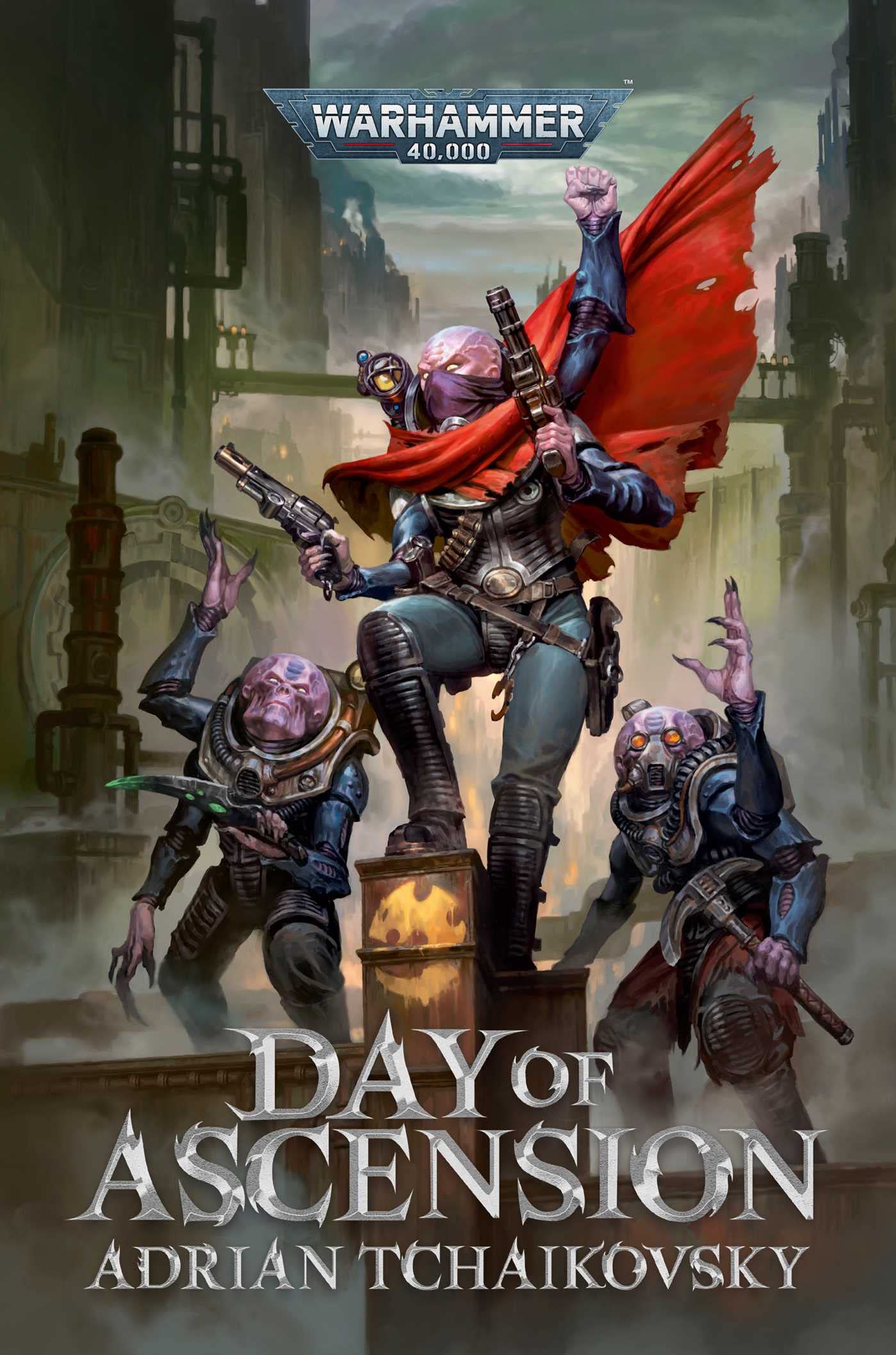
Warhammer 40,000: Day of Ascension by Adrian Tchaikovsky

Day of Ascension Cover

Publisher: Black Library (Audiobook – 29 January 2022)

Series: Warhammer 40,000

Length: 5 hours and 38 minutes

My Rating: 4.5 out of 5 stars

Amazon     Book Depository

Legendary science fiction and fantasy author Adrian Tchaikovsky has arrived in the Warhammer 40,000 universe with the awesome and clever novel, Day of Ascension, a deadly and wildly entertaining read that sets two brilliant factions against each other.

2022 has so far proven to be an amazing year for Warhammer fiction, with several impressive novels already released, including Steel Tread by Andy Clark and The Twice-Dead King: Reign by Nate Crowley.  However, the Warhammer 40,000 novel I have been most excited for is Day of Ascension, an awesome and unique read written by acclaimed author Adrian Tchaikovsky.  Tchaikovsky has been wowing science fiction and fantasy audiences for years, producing several impressive novels across various genres.  Not only has he written some fantastic standalone novels but he also produced highly regarded series, such as the Shadows of the Apt and Children of Time books.  I have really liked the sound of his cool novels, but I had not had a chance to read any of them yet.  Once I saw that Tchaikovsky was contributing to the extended Warhammer 40,000 universe, I knew that this would be the year I finally read something from him.  Day of Ascension is Tchaikovsky first full novel in the Warhammer universe (he previously wrote the short story Raised in Darkness), and I was deeply impressed by the brilliant and captivating story he came up with.

On the forge world of Morod, the life and soul of every human belongs to the Adeptus Mechanicus, the Imperial machine cult who provide the armies of mankind with their weaponry and war machines.  However, while the tech-priests of the Adeptus Mechanicus live in comfort and prosperity, constantly delving into the secrets of the machine, the common people of Morod have been worn down by millennia of servitude, exploitation and conscription, doomed to either die young in the mines and foundries or be turned into mindless mechanical soldiers.  In their grief and anger, the civilians of Morod have turned to a new faith that offers salvation from the harsh rule of the Mechanicus, although that devotion comes with a dark price.

In the hierarchy of Morod’s Adeptus Mechanicus, Genetor Gammat Triskellian is considered a joke due to his focus on improving the flesh rather than replacing it with machinery.  Constantly overlooked by his superiors and given the most menial of tasks, Triskellian looks to find a way to advance his research and end the corruption he sees holding the order back.  When he uncovers a particularly interesting genetic strain in the populace of Morod, he thinks it could be the answer to all his prayers, one that could enhance his science and revolutionise the advancements of his order.

Digging further, he finds evidence of an unusual and twisted religious congregation operating throughout the planet, preaching rebellion and the destruction of the tech-priests, while awaiting the return of long-gone angels who will turn the planet into a paradise.  Seeking to use this congregation to his own advantage, Triskellian captures young, idealistic infiltrator Davien to find out more about her mutated family.  But as his plans begin to come into effect, Triskellian is about to discover that not everyone is meant to rule, and that the forces he seeks to control are far more dangerous and hungrier than he could possibly know.

What an epic and impressive read!  Tchaikovsky has dived into this franchise with great relish, producing an exceptional and powerful piece of Warhammer 40,000 fiction that is not only exciting and action packed, but also extremely thought provoking as the author examines some of this universe’s most complex and intriguing factions.

I had a lot of fun with the incredible story contained within Day of Ascension, as Tchaikovsky takes the reader on an intense and dark journey.  The main premise of this book is a fun one: what if an ambitious Imperial tech-priest attempts to utilise the deadly power of a Genestealer Cult for his own machinations?  The answer: absolute chaos as an entire world implodes in the fires of revolution, destruction and religious zeal.  This was a great story that Tchaikovsky sets up brilliantly in the early stages, quickly introducing the corrupt world of Morod, the choking hierarchy of the Adeptus Mechanicus, and the malignant underlying Genestealer Cult attempting to manipulate events from the shadows.  After this great introduction, the remaining story happens at a very fast pace, especially as this overall novel is fairly short (193 pages, or just over five and a half hours on audiobook).  The political and scientific intrigue of point-of-view character Triskellian runs straight into the revolutionary aspirations of the Genestealer Cult’s Davien with the expected destructive results.  I loved the brilliant clash of styles that occur between these two groups, and all the betrayal, manipulation and alien influences melds perfectly with the non-stop action and revolution.  This quickly leads up to a destructive and powerful conclusion that I deeply enjoyed and will leave you reeling in multiple ways.  There were some absolutely amazing twists towards the end, and I loved the resultant terrifying consequences to the wider universe which were really cool and deliciously ironic.  Tchaikovsky ends everything on a captivating and dark note which will leave readers extremely satisfied after getting engrossed in the impressive story.  This is an epic narrative that drags you right into the very heart of the worst parts of the Warhammer 40,000 universe.

I really must commend Tchaikovsky’s first dive into the Warhammer 40,000 universe as the author has a noticeable appreciation for this franchise and canon.  I loved how he expertly focused the story on two particularly sinister factions within this universe, while also making excellent use of an Imperial Forge World as the main setting of this book.  The two main factions of this novel are the tech-priest of the Adeptus Mechanicus and an undercover Genestealer Cult, the dangerous human/alien hybrids who act as infiltrators and forerunners of the Tyranids.  Tchaikovsky ensures that the reader gets an exceptional and detailed look at both factions, and you are soon immersed in their lore, politics, and motivations, which is just so fascinating.  There are so many cool things about this, from the unique interactions of the cybernetic tech-priests and the mechanical soldiers to the slow infiltration and incorporation of the Genestealers who spark revolution throughout the planet.  However, the best thing about this is the way in which Tchaikovsky’s expertly showcases one of the most inescapable facts of the Warhammer 40,000 universe: there are no actual good guys here; just self-serving fanatics with their own terrible agendas formed from a universe constantly at war.  This is so brilliantly highlighted in the fact that halfway through the book you find yourself on the side of the alien infiltrators, who are taking advantage of the terrible conditions on Morod to spark a revolution.  However, no matter how beneficial and beatific they may appear, preaching about angels and the better days ahead, there is still an amazing sinister edge to them, especially if you know what horrors they are actually referring to.  I loved how brilliantly these two unique and corrupt Warhammer factions are played off each other, and it proves to be an excellent background to this awesome novel.

Like most Warhammer tie-in novels, Day of Ascension is probably best enjoyed by those fans of the franchise, especially as Tchaikovsky looks at some obscure and unique parts of the canon.  While maybe a little too-lore heavy to serve as the best introduction to the Warhammer 40,000 universe, I felt that this is an easy enough book for new fans to get into, especially if they are established science fiction fans.  Tchaikovsky ensures that the various story elements feature the right amount of detail and I the various factions are introduced extremely well especially to new readers.  I do feel that readers who don’t quite understand what the Genestealers and their Tyranid masters are might not get the true horror of this book and its conclusion, and I personally enjoyed the novel more because I knew what the true nature of the Genestealer’s plans were.  However, new readers probably will get the full benefit of this as it is made pretty clear from the context.  As such, I would probably recommend this to both established Warhammer fans and general science fiction readers, especially if they have enjoyed Tchaikovsky’s writings in the past, and I know a lot of people with have a great deal of fun with this.

I deeply enjoyed the cool and over-the-top characters featured throughout Day of Ascension, especially the main two characters, Triskellian and Davien, who act as the point-of-view characters for the novel.  Both are fantastic figures who are fully enveloped in the massive machines of their organisations, whether they like it or not, and who spend much of the book trying to battle what they see as their oppressors.  As such they form a brilliant tandem of opposing views, which perfectly shapes the morally grey nature of the narrative and makes it very unclear which one of these inherently terrible people you should be rooting for.  I particularly liked the character of Triskellian as the author envisions him as a thoroughly underappreciated middle management figure who is ignored and ridiculed by his superiors who fail to understand his work.  This constant mistreatment causes Triskellian to snap in this novel and he starts doing some darker deeds to gain what he believes is rightfully his.  I loved seeing this brilliantly portrayed figure, who will be clearly understood by anyone whose worked under an idiot boss, slowly slip off the deep end and attempt to use an evil alien cult to fulfil his objectives.  This character has some amazing moments, and it was so much fun seeing him try to manipulate events around him, only to be surprised that nothing goes to plan.  I also found his focus on genetics and biology to be quite fascinating, especially for a tech-priest, and his obsession with alterations on the flesh ended up having some intriguing parallels with the objectives of the Genestealer cult.

Davien, on the other hand, is an oppressed member of Morod’s population who acts as an infiltrator and spy for the Genestealer Cult she is a part of.  Frustrated by the slow pace of the promised revolution and the eventual appearance of their “saviours”, Davien has some outstanding scenes throughout Day of Ascension as she tries to save her loved ones from the machinations of the tech-priests.  Her rise in status and closeness to the powers that guide her family occur at the exact same time that she starts to have doubts about her organisations purpose, and the subsequent internal battle is extremely powerful and captivating, especially if you know just how right she is to be worried about the future.  Davien goes through a lot of growth, and it is fascinating to see what happens during her character arc, especially when it comes to her interactions with Triskellian and the influences of the beings guiding the cult.  Day of Ascension also has several great supporting characters who get their moments to shine throughout the book.  While most of them are a bit over-the-top in their appearance and personality, they prove to be very entertaining and I loved the outrageous and mechanically deformed highly ranked tech-priests who so badly enrage the protagonists.  There is a particularly good twist surrounding one of the minor support characters that I thought was extremely brilliant, especially as there is some subtle set up for it earlier on, and it results in an outstanding ending for the entire book.  An overall excellent cast of characters make this shorter Warhammer novel really shine.

Just like most of the Warhammer novels I have had the pleasure of reading, I chose to check out Day of Ascension in its audiobook format, which was an impressive and enjoyable experience.  As I mentioned above, this audiobook has a very short runtime and you can quickly power through it, especially once you get stuck into the intriguing and clever story.  I deeply enjoyed how this format enhanced this great narrative, and it was a lot of fun to hear all the chaos and destruction being read to you.  I must commend the narrator of Day of Ascension, actor Harry Myers, who did an exceptional job here.  I loved Myers’ great voice, which at times strongly reminded me of Stephen Fry, which is a definite plus.  Myers really dives into the various characters here, and I loved the brilliant edges he gives to them, especially the main character Triskellian.  You can really sense Triskellian’s frustration, ambition and internal outrage as the events of the novel proceeds, and this helps you to get into the mind of this entertaining figure.  An extremely cool way to enjoy Day of Ascension, I would strongly recommend this format to anyone interesting in checking out this great Warhammer 40,000 novel.

With this clever and exciting novel, Adrian Tchaikovsky has a brilliant debut in the Warhammer 40,000 universe.  Day of Ascension is an epic and intriguing novel that takes a fascinating look at two exceptional factions from the Warhammer canon and brings them together in a dark and entertaining battle of wills and manipulation.  Containing a tight, addictive story, some great characters, and a deep examination on some of the best parts of the Warhammer 40,000 universe, Day of Ascension is an outstanding read.  I really hope that Tchaikovsky writes more Warhammer fiction in the future as he absolutely killed it here.

Amazon     Book Depository