Warhammer 40,000: Longshot by Rob Young

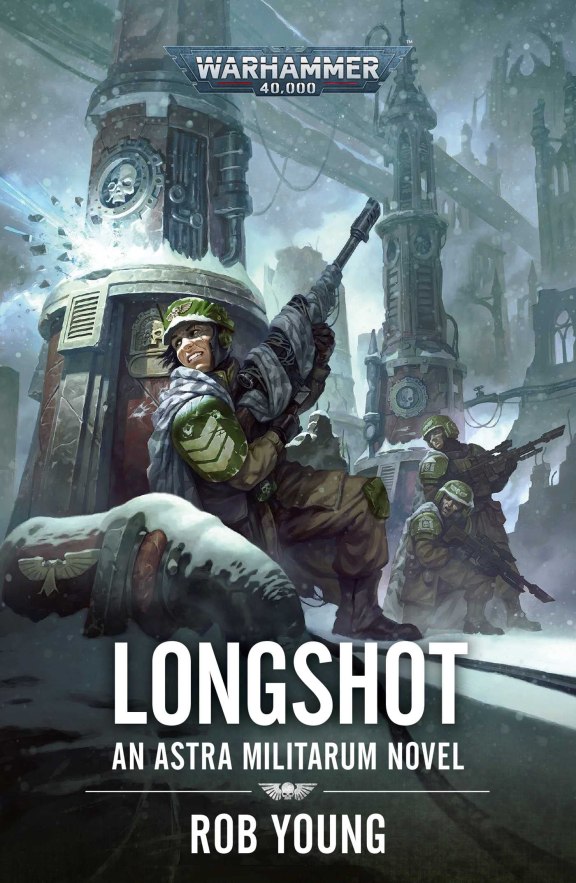
Longshot Cover

Publisher: Black Library (Audiobook – 12 August 2023)

Series: Warhammer 40,000

Length: 10 hours and 28 minutes

My Rating: 4.5 out of 5 stars

Amazon

Prepare to dive into one of the grittiest battles in Warhammer 40,000 fiction with the awesome and captivating novel, Longshot by Rob Young.

2023 has definitely been an outstanding year for Warhammer 40,000 fiction, and I have had a ton of fun reading several pretty amazing entries from this extended universe in recent months.  Examples of this include The Lion: Son of the Forest, Warboss, Shadowsun: The Patient Hunter, Leviathan and The King of the Spoil just to name a few.  However, the year is far from over and there are still several great-sounding Warhammer 40,000 novels coming out that I have my eyes on.  One of the more intriguing was the fantastic Longshot by new author Rob Young, which sounded extremely fun.  Longshot, which follows on from Young’s short stories, Transplants and Memories of Broken Glass, is the author’s debut Warhammer 40,000 novel, and it proved to be a very intense and action-packed novel with a great story.

Several years after the fall of Cadia, which saw the Imperium of Man split in two by a great rift in space, humanity is still attempting to recover as many lost planets and systems as possible.  The latest target of the relentless Indomitus Crusade sees the troops of the Cadian 217th arrive at the former manufactorium world of Attruso, whose people have fallen under the sway of the seeming beatific alien t’au.

As the initial assault begins in the battered city of Miracil, the Cadian forces struggle to make progress against the determined t’au defenders and their human auxiliaries.  As the fighting gets even more desperate, the tides of war soon place the keys to victory into the hands of Sergeant Darya Nevic and her squad of snipers.  Nevic is a legendary figure within the 217th, a transplant from a non-Cadian regiment renown for her abilities of infiltration, assassination and survival, Nevic excels at disrupting the enemy from the top down.  However, when the t’au unleash their own deadly sniper against the Cadians, Nevic is forced into a battle of wits with a killer just as skilled and ruthless as she is.  But has Nevic finally come across a foe even she can’t best, especially as she begins to doubt her mission in the face of her own infamy, the lies of her commanders and the t’au’s insidious promises?

Longshot is an awesome and fast-paced novel that perfectly showcases the horror of war in this grim universe through the lens of a skilled sniper.  Young did an outstanding job with his debut novel and I loved the intriguing and powerful narrative that placed great characters into a deadly setting.  I managed to knock this book off in a couple of days, and it is one of the most exciting and fun Warhammer 40,000 novels of 2023 so far.

I loved the complex and intense story that Young pulled together for Longshot, which perfectly presents a tale of the common soldier in the grim Warhammer 40,000 universe.  I have often said that some of the very best Warhammer 40,000 novels are those that focus on the common human soldier facing off against alien or inhuman forces (for example, Steel Tread, the Gaunt’s Ghosts books or Catachan Devil).  Longshot is a very good example of this as you follow a tired soldier as she faces internal and external threats on the frontline of a desperate conflict.  Thanks to its focus on snipers, city fighting, camaraderie and propaganda, Longshot is honestly the Warhammer 40,000 version of Enemy at the Gates, which I deeply enjoyed.  The reader really gets invested in the protagonist’s journey which follows her through some fantastic missions, battles and character growth in the first half of the novel.  This leads to a great second half, where Nevic becomes a victim of her own success and is forced to go up against a deadly enemy sniper.  Due to everything the protagonist experiences, there is some real tension leading into the final third of Longshot, especially after she experiences some terrible losses.  Thanks to the protagonists’ conflicted state, you honestly don’t know how the story is going to turn, and Young loads up some great twists and swerves.  While the ending was a tad predictable, I really enjoyed it and the author really pulled together a satisfying and exciting read that you can really power through.

This ended up being a pretty addictive standalone book, and it is one that would definitely serve as a great introductory novel to Warhammer 40,000 fiction for those readers unfamiliar with the franchise.  Young does a great job of expanding his previous short stories into his first full-length novel, and you really get to grips quickly with the situation, the characters, and the wider universe.  The sharp and intense character-driven story which primarily focuses on the protagonist, Darya Nevic, with a few chapters shown from other key character perspective, has a lot of great elements to it.  The focus on character motivation, the depravities of war, and the grim realities of the background universe really cut through the main story, and you understand the difficulties that many of the conflicted characters experience.  The subsequent focuses on morale in battle and the impacts of propaganda and manipulation also proves to be very fascinating and adds a great edge to Longshot.  I also deeply appreciated how well Young built up his main protagonist throughout the course of Longshot, diving into Nevic’s complex history and examining how she gained her legend.  You grow quite attached to Nevic as the book continues, especially she is forced to make several difficult decisions, and Young turns her into a relatable and understandable figure, especially when it comes to her conflicted feelings about her fame and leadership.  Nevic is well supported by other great characters, and Young was able to establish and utilise these figures in a short amount of time.

The real highlight of Longshot is the awesome and well-written action sequences that dominate the book and constantly keep the reader on their toes.  Young paints an effective and dark picture of brutal city fighting, and you can tell he was using the battle of Stalingrad as inspiration.  The gritty battles that take place are very exciting and powerful, and you can really feel the desperation and weariness of the combatants.  The author proves particularly adept at writing high-quality sniper scenes, and the focus on shooting, infiltration and calculated strikes makes Longshot stand out from other battle-heavy Warhammer 40,000 novels.  This ended up being a very slick and addictive read and Young proved quite skilled at getting his fantastic story across to the reader in the most effective way.

Well-established fans of Warhammer 40,000 canon will really appreciate Young’s compelling and insightful look into two distinctive factions who provide a very interesting contrast to each other.  This includes the members of the Cadians, one of the most iconic Imperial Guard factions in the game.  While the Cadians are already pretty heavily featured in Warhammer 40,000 fiction, I felt that Young provided a particularly effective dive into their current problems, namely the gradual deaths of the natural-born members of the regiment and their replacement by transplants from other regiments.  Thanks to the focus on Nevic, herself a transplant from another regiment, you see the dire internal conflict this causes as the strongly traditional Cadian regiment begin to lose their identity after the loss of their planet.  Young does a wonderful job of expressing this throughout the course of Longshot and the resultant impacts this has on the characters makes for some interesting story moments.  I also quite enjoyed seeing several outsider perspectives of the Cadians that Young worked into the story, which often contrasts well with what the Cadian protagonists feel, and it makes for some fantastic story moments. The author also examines other fascinating elements of the Imperial war machine, such as the exhausting Indomitus Crusade, the current crumbling state of the Imperium, the way other supporting regiments are treated, and the internal propaganda and planning of the regiment.

While the Cadians do get most of the story focus in Longshot, Young does take the time to also dive into the alien t’au who serve as the main antagonists of the plot.  Most Warhammer 40,000 novels that have the t’au as antagonists often nerf or underutilise them to a degree (for example Kill Team or Deathwatch: Shadowbreaker), which is frustrating for fans of the faction.  However, Young effectively showcases the t’au as skilled and deadly enemies who are able to weather the Imperial forces and overwhelm them in several key theatres.  Young has fun bringing several key t’au units to life throughout the course of Longshot and you really start to appreciate them as effective opponents to the Cadians.  There is also an interesting examination of t’au motivations, philosophies and manipulations, specifically around their recruitment of human auxiliaries.  This compelling dive into the t’au muddies the moral waters around the protagonists and the Cadians, and you soon start to question who has the best interest of the people of Attruso at heart.  This, and other intriguing similarities to the human soldiers, adds an awesome edge of consideration and concern to the story that I quite enjoyed.  I really think that Young had some of the better portrayals of the Cadians and the t’au I have so far seen in Warhammer 40,000 fiction, and fans of the franchise are going to have a wonderful time diving into that in this book.

Unsurprisingly, I chose to check out Longshot on audiobook, which in my opinion the best way to enjoy a Warhammer 40,000 novel.  Longshot is a particularly good example of this, as the audiobook format really helped to move the already exciting novel along at a fast clip, especially when the action scenes are brought to life by the narrator.  Coming in at around 10 and a half hours, this is very easy audiobook to get through quickly, and I made sure to power through it in only a few days.  It helped that this book was narrated by the very talented Colleen Prendergast, who already has a bit of experience narrating Warhammer novels featuring the Cadians.  Prendergast did a wonderful job bringing all the major characters to life, especially the main protagonist of Darya Nevic, and I loved the elaborate and fitting voices that she gifted the cast which really helped to draw you into the story.  However, the real benefit of Prendergast’s narration is the way that she walks the listener through all the elaborate battle sequences, especially those that show the snipers facing off against each other.  I felt that this narration expertly captured all the inherent intensity and danger of these scenes and I got really invested into the book as a result.  Thanks to this amazing narration and story enhancement, I would strongly recommend checking out Longshot on audiobook and I know I had a lot more fun thanks to this amazing format.

Overall, Longshot is an awesome and compelling addition to the Warhammer 40,000 canon and one that I had a ton of fun with.  Young produced a powerful and intriguing character driven war story that will appeal to a wide audience of readers, especially with its fantastic focus on sniping and some of the more fascinating elements of Warhammer lore.  I deeply enjoyed this fantastic novel and Longshot comes highly recommended.

Amazon

Throwback Thursday – Warhammer 40,000: Kill Team by Gav Thorpe

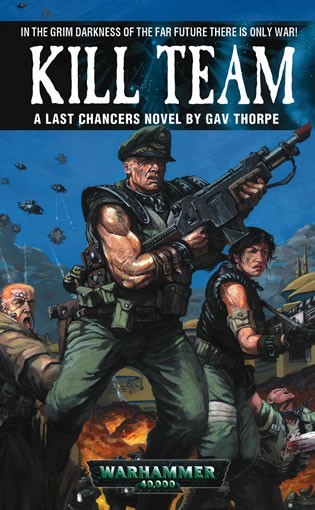
Kill Team Cover

Publisher: Black Library (Paperback – 1 November 2001)

Series: Last Chancers – Book Two

Length: 277 pages

My Rating: 4.5 out of 5 stars

Amazon

Welcome back to my Throwback Thursday series, where I republish old reviews, review books I have read before or review older books I have only just had a chance to read.  In my latest Throwback Thursday, I review the second epic entry in Gav Thorpe’s ultra-fun Last Chancers series with Kill Team.

I have been going through a real Warhammer phase in the last few months, especially as I have been lucky enough to find some awesome older paperbacks in second hand shops.  I was particularly happy to find a copy of was the first two books in Gav Thorpe’s Last Chancers series.  Following a rotating team of convict Imperial Guardsmen as they engage in suicide missions for their freedom, the Last Chancers books are essentially The Dirty Dozen in space, and I love the awesome and brutal stories that emerge.  The first book, 13th Legion, was one of the very best Warhammer 40,000 novels I have had the pleasure of reading, and I have been trying to fit the sequel, Kill Team, into my reading schedule for a while.  I finally got a chance last weekend, and boy was it worth making the time for as the second Last Chancers novel had another outstanding and action-packed story to it.

In the far future, the armies of the Imperium contain multitudes of scum and villains, all of whom are considered useful in the service of the Emperor.  However, after blowing his last chance at redemption after completing an impossible suicide mission, Lieutenant Kage has been cast aside, locked inside an Imperial detention centre away from the one thing he is good at, fighting the Emperor’s enemies.  When his former commander, the mysterious and ruthless Colonel Schaeffer, returns with another deadly assignment, Kage is swift to accept and become useful again, even if he no longer has a chance at freedom.

The Colonel has been tasked with leading a small, disposable team to assassinate a prominent Tau commander and he needs a new version of the 13th Penal Legion, the infamous Last Chancers, to pull the mission off.  Placed in command, Kage must recruit a ragtag group of the worst killers, deserters, and malcontents that the Imperial Guard have cast out.  Forcing them into a harsh training regime to bring them together into an effective squad, Kage soon finds himself leading a new squad of Last Chancers, many of whom are as desperate for freedom and the fight as he is.

However, their mission is another lethal suicide mission.  Working with an immoral Imperial Inquisitor, the team is covertly inserted into Tau space and must infiltrate the political and military circles surrounding their target.  But not everything is as it seems and soon the squad must content with treachery, personal enmity, and the superior technology of the Tau.  Can these new Last Chancers succeed when so many before them have perished, or will the only redemption they find be in death?

Thorpe continues to give me all the Warhammer 40,000 fun I can ever need with this amazing and intense read.  Serving as an outstanding sequel to 13th Legion, Kill Team proved to be a fun and compelling novel, loaded with action, adventure and some intriguing characters.

Readers are in for another intense and brutal story with Kill Team, as Thorpe once again utilises The Dirty Dozen format to successfully set the scene.  However, rather than having a massive regiment get whittled down until the toughest survivors are left, this time the protagonist and main narrator, Lieutenant Kage, is forced to choose his own team of criminals to lead on the Colonel’s new suicide mission.  I really enjoyed the starting scenes of Kill Team, especially as you see Kage go from cell to cell choosing the best individuals for his team, before engaging in an extended and deadly training montage, which mirrored the hell he went through in the first book.  As Kage is dealing with that, and his own substantial personal issues, the main mission of the book is set up as the Last Chancers are sent into Tau space to assassinate an ambitious, warmongering commander.  Initially infiltrating in as diplomats and mercenaries, the team travel to several Tau planets before beginning their attack.  The final third of the book is primarily focused on this deadly mission as the team find themselves in the middle of a bloody battle against the very worst the Tau can throw at them.  The subsequent fight is pretty intense and brutal, and the readers are treated to some great scenes of warfare in various unique scenarios.  The ending is well set up, with betrayals, fun reveals and some brilliant character focused moments as the team finally come together to succeed.  I do think that Thorpe might have gone one twist too many at the end, but the overall story was extremely satisfying, and I deeply enjoyed how the entire thing came together.

I had a lot of fun with this second Last Chancer’s novel, and I am really glad that The Dirty Dozen plot basis didn’t wear thin in the second entry.  Thorpe did a great job of following on from the story elements he introduced in 13th Legion, especially when it comes to the two main characters, who have a fantastic new dynamic in Kill Team.  Like the first book, Kill Team is very fast-paced, and I had a ton of fun at the start when the new characters are recruited, as well as all the awesomeness of the extended battle sequence at the end.  However, unlike the episodic storytelling Thorpe utilised in 13th Legion, Kill Team has a more straightforward plot line, which worked well to set it apart from the previous entry.  You really get dragged into the struggles of the new Last Chancers, as well as the eternally battered Kage, who serves as the book’s primary narrator.  While there are a lot of references to the first book, Kill Team can easily be read as a standalone read and it isn’t necessary to get through 13th Legion first.  However, I deeply enjoyed seeing the continued development of the protagonist and fans of the first book will probably get a lot more out of Kill Team as a result.  Unsurprisingly, a lot of the book’s focus is on the action and combat, and Thorpe really doesn’t disappoint when it comes to that.  The author does a wonderful job capturing every single firefight, brawl, and pitched battle that occurs within Kill Team, and you can see and feel every single shot, punch and stab that is thrown as a result.  The presence of a few too many characters guaranteed to survive did occasionally lessen the impact of some dramatic fight scenes, however, you still get caught up in the violence and I deeply enjoyed how well Thorpe supported his narrative with his great writing.

Kill Team also serves as an intriguing entry in the wider Warhammer 40,000 canon, especially as it is one of the stories that follows a common soldier as he experiences the alien perils of the wider galaxy.  Just like with 13th Legion, readers don’t need a lot of background knowledge of the wider Warhammer 40,000 universe to enjoy Kill Team, and the Last Chancers books are actually a pretty good introductory series for those unfamiliar with the franchise.  I loved some of the fun references and factions contained within Kill Team, not only because you get to see more of the dark side of the Imperial Guard, but you also get quite an in-depth look at the Tau.  The Tau are one of the more interesting factions in the Warhammer canon, and frankly there aren’t enough books focusing on them.  I had a lot of fun seeing them in Kill Team, mainly because you got to see the inexperienced human characters encountering them for the first time.  Their reactions at the Tau culture, politics, and weaponry, makes for a great part of the book’s middle plot, and it was really fun to see them comparing their own lives in the Imperium to what the Tau have (that scene when they’re exploring the Tau ship’s bathroom was just great).  While Thorpe did nerf the Tau when it comes to their battle prowess, as the Last Chancers mow down waves of Fire Warriors, you get a great idea of their military capability throughout Kill Team and I loved seeing the Battlesuits in action.  There are a lot of great elements that Warhammer fans will get a kick out of in Kill Team and I really enjoyed some of the stuff Thorpe added in.

For me, the real highlight of Kill Team was the exceptional character work, especially when it came to Lieutenant Kage.  Kage is a natural survivor who has gone through a lot in his life, especially since joining the Last Chancers.  The Kage we met in 13th Legion was a gritty survivor, just looking for his freedom at any cost.  However, after the success and trauma of his mission and his subsequent failure to stay out of trouble, Kage has come back a little broken and a little bit more unhinged, especially as he is now racked with guilt over the fate of his original Last Chancers.  After a lengthy, violent prison sentence, Kage is once again under the heel of Colonel Schaeffer in Kill Team.  Kage actually ends up becoming more like Schaeffer in this book, especially when he chooses, trains and controls his own team of rogues, and the realisation that he will be responsible for their deaths weighs very heavily on him.  This guilt, and his own mental trauma, plays a big part in how Kage interacts with many people in Kill Team, and there is something very wrong with Kage throughout this book.  Despite this, he is still the ruthless survivor that he was in 13th Legion, and, if anything, Thorpe possibly made him a little too unkillable and deadly for this sequel (he’s not really a common soldier anymore).  The best scenes involving Kage are still the ones when he faces off against Schaeffer, and the have some great interactions throughout the book, especially as Kage blames Schaeffer for everything that happened to him.  Kage honestly hates and fears the Colonel more than anyone else, and yet he still follows him, even though his own chance of freedom has already been spent.  This results in some brilliant encounters between the unhinged Kage and the taciturn Schaeffer, and I cannot wait to see how their relationship evolves in the other Last Chancers books.

Aside from Kage and Schaeffer, there is a good collection of supporting characters featured throughout Kill Team.  Most of the prominent ones are the new members of the Last Chancers who Kage recruits for the mission.  Thorpe features a great introduction for all these new characters at the start of Kill Team and you soon get drawn into their unique storylines.  Each brings something new to the book, even if it is only briefly, as you know well in advance that most, if not all, of these character are going to die.  I liked the more specialist focused characters featured in Kill Team, as it was an intriguing departure from the more generalised grunts in 13th Legion, although this did slightly pigeonhole these characters in certain ways.  Still, all the new Last Chancers characters formed an excellent base for the story, and it was fascinating to see how they interacted with Kage, who see him in the same way that Kage viewed Schaeffer in the first book.  Other awesome characters featured within Kill Team includes a wily Inquisitor, some alien diplomats and a mysterious passenger waiting in the wings.  All these, and more, add so much to the plot, and I had a great job seeing how they, and their seemingly inevitable deaths, played into this awesome book.

Overall, Kill Team was exactly the sort of fun read that I thought it would be, as Gav Thorpe did a wonderful job in this second Last Chancers book.  Loaded with action and highly damaged characters, Kill Team was another fantastic and electrifying romp through the chaotic and deadly Warhammer 40,000 universe with a crew of convicted soldiers.  Sharp, brutal, and highly addictive, I powered through Kill Team very quickly and had an awesome time doing so.  Hopefully I will be able to lay my hands on the next Last Chancers novels at some point in the future and I cannot wait to see what carnage they get up to next.

Amazon

Throwback Thursday – For the Emperor by Sandy Mitchell

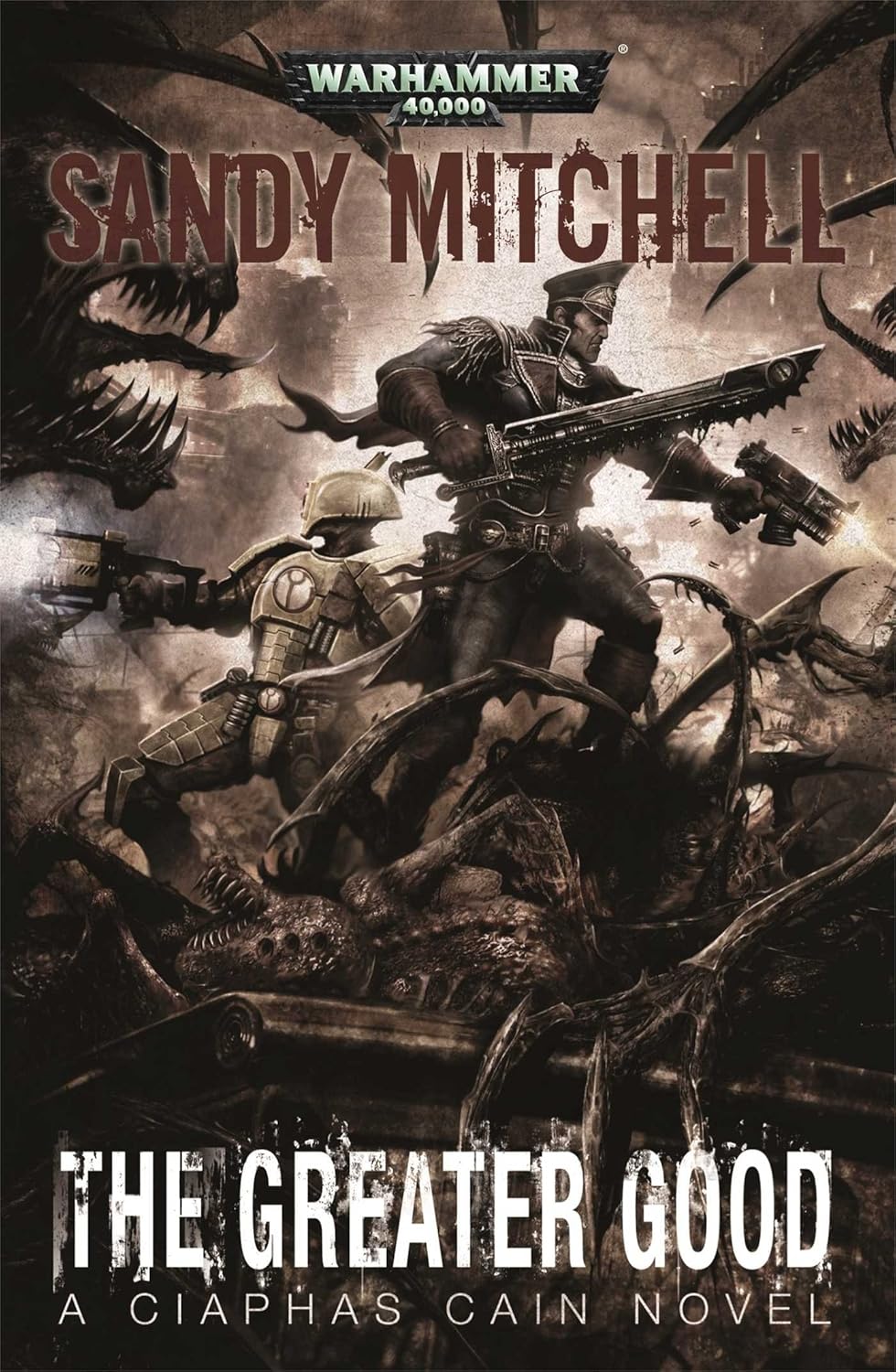
Warhammer 40,000 - For the Emperor Cover

Publisher: Black Library (Audiobook – 23 December 2003)

Series: Ciaphas Cain – Book One

Length: 8 hours and 57 minutes

My Rating: 4.75

Amazon

I’ve already put up one Throwback Thursday post today, for the cool Warhammer 40,000 novel, Kingsblade by Andy Clark, but the fun doesn’t end there as I am also going back to 2003 and reviewing the hilarious and deviously clever novel, For the Emperor by Sandy Mitchell, which is easily one of the funniest Warhammer books I have ever read.

Anyone who has paid the slightest bit of attention to my recent review habits would probably have noticed that I am quickly and doggedly powering through a ton of the top books in the Warhammer 40,000 range of fiction.  Not only did I recently finish off the epic Eisenhorn trilogy by Dan Abnett (featuring Xenos, Malleus and Hereticus), but I have also checked out several cool standalone novels, including Grim Repast by Marc Collins, Deus Encarmine by James Swallow and Sepulturum by Nick Kyme.  All these books are exceedingly impressive examples of Warhammer 40,000 fiction that featured their own unique elements, such as galaxy spanning conspiracies, intense horror elements, or a futurist homage to classic, gritty cop stories.  However, the one thing that they all tended to lack was a substantial and notable sense of comedy.  That is where my next entry comes in as I have finally had a chance to explore the first book in the iconic Ciaphas Cain series by Sandy Mitchell (a pseudonym for author Alex Stewart), For the Emperor, which had me laughing like crazy.

In the millennia when the forces of humanity fought to maintain the Imperium of Man, many heroes have risen from amongst the ranks of the Imperial Guard, gloriously leading mankind’s armies against the traitors, the heretics and the xenos.  Of these, few are spoken of with as much reverence and respect as the famed Commissar Ciaphas Cain, a living legend of duty, honour and courage.  Known throughout the Imperium for his daring exploits that have seen him survive the harshest of battlefields and continually lead his forces to victory, Commissar Cain is considered by many to be one of the greatest heroes of the age.

However, everything everyone knows about Cain is a lie.  In reality, he is a conniving coward who only seeks to avoid the horrors of the battlefield by any means necessary, in order to survive and make it to retirement.  Blessed with remarkable survival instincts, Cain has managed to stay alive against impossible odds many times, which has led many to believe he is a true hero capable of anything.  However, Cain’s ill-earned fame and reputation is a double-edged sword, as he is constantly chosen to journey to the worst battlefields in the Imperium, where his bad luck ensures he is in the thick of the fighting.

His latest mission sees him assigned to a newly formed Imperial Guard regiment suffering from horrific infighting and a lack of discipline.  Determined to install unity and respect amongst his new regiment, primarily so they don’t shoot him in the back, Cain is confident that he has found a relatively safe assignment.  However, his bad luck once again sees him in the thick of it, as his regiment is transferred to the backwater planet Gravalax, where a delicate situation is unfolding.  The inhabitants of Gravalax are attempting to defect to the alien Tau, who come with a message of peace and the Greater Good.  Not wishing to face the Tau and their superior technology, Cain works hard to avoid an upcoming war and ensure diplomacy will prevail.

However, after the Tau ambassador is assassinated and tensions are enflamed across the planet, Cain begins to suspect that there is more in play than he previously expected.  A shadowy conspiracy is hoping to start a war between the Tau and Imperium on Gravalax, and Cain is right in the middle of their plot.  To survive and avoid yet another war, Cain needs to work with a beautiful inquisitor to find out who is behind the attempted carnage before it is too late.  But his investigation reveals a far more dangerous enemy than expected, one that is determined to destroy all before it, starting with the terrified Cain.

Wow, oh wow, now that was a pretty damn fun book.  I had heard many times before how awesome and entertaining the Ciaphas Cain books were, and For the Emperor really did not disappoint.  Featuring a compelling story loaded with clever, dark humour, For the Emperor is a very easy book to fall in love with, and I ended up coming away really impressed with Sandy Mitchell’s amazing writing and comedic ability.

For the Emperor’s narrative itself is pretty interesting as it follows Cain through one of his most notable adventures.  Told in a chronicle perspective from Cain’s own memoirs (which may or may not be the most reliable source of information), you get to see the true Commissar Cain as he finds himself thrust into another adventure.  After a quick and very intriguing introduction, with notes from Cain’s associate, Inquisitor Amberly Vail, the story initially details Cain’s attempt to unify and control the Valhallan 296th-301st composite Imperial Guard regiment (eventually the Valhallan 597th).  These initial chapters showcase many aspects of the compelling protagonist, his deep cunning and determination to avoid damage, while also taking the time to introduce several of the major supporting characters.  The story changes after a few chapters as Cain and his new regiment arrive on Gravalax, where Cain must contend with the Tau, who are influencing parts of the local population.  Unlike most Warhammer 40,000 novels, the story doesn’t revolve around a war between the Imperial Guard and the Tau; indeed the focus on the plot is avoiding the conflict as two rival races attempt to find a diplomatic solution.  Unfortunately, some hidden force is attempting to start a war between the Tau and the humans, and Cain soon finds himself trying to maintain the peace, primarily for his own benefit.  After several intriguing and entertaining side missions, the plot eventually sees Cain and the new Inquisitor Vail lead a small, expendable force into the lair of their true enemy.  While I won’t go into detail about who they face, it results in a series of gruesome and deadly battles, where Cain’s survival skills are really put to the test.  Mitchell features a ton of action, intrigue, and odd-couple team-ups for this final major sequence, and you are really drawn into the intense storytelling, with even Cain’s sense of humour failing to cut through the brutal nature of the conflict.  Everything ends on a compelling, if slightly dark note, and you come away from the story pretty damn satisfied and ready for another intriguing adventure from this hilarious protagonist.

I really liked the fun way Mitchell wrote For the Emperor, as everything is set out to enhance the inherent comedy of the book.  While there is a ton of impressive action, adventure and intrigue, at their core all the Ciaphas Cain books are very light-hearted and add a more humorous spin to the grim Warhammer universe.  Indeed, I was getting some major Blackadder vibes from For the Emperor, as much of the plot sees the supposedly noble protagonist attempting to weasel his way out of actually getting into a fight.  Pretty much every interaction or thought in this book had me chuckling in some way, and I appreciated some of the clever jokes or references that Mitchell scattered throughout.  I also deeply enjoyed the cool chronicle format of the story, as Cain’s antics are made even funnier when you see it from his eyes.  At the same time, Mitchell includes a ton of extra notes and excerpts from other in-universe texts that not only provide intriguing context, but also add to the humour, especially as the intentionally over-the-top opinions and bad writing highlights just how crazy other members of the Warhammer 40,000 universe are.  There are also a series of notes, footnotes and quotes from supporting character Inquisitor Vail sprinkled throughout the plot to provide some additional insights, often in a humorous way.  I always deeply enjoy the use of a good footnote in fiction, especially due to my love of Terry Pratchett’s novels, and I felt that Mitchell utilised them perfectly throughout For the Emperor.  Not only do they provide additional information, but Vail’s footnotes often directly contradict Cain’s opinions and descriptions of events, and ensure a much more complex and complete overall story.

While the focus is often on the humour, Mitchell also does write a pretty compelling military thriller as the main story, which ties well into the wider Warhammer universe.  The focus on the intense conspiracy and the outbreaks of rebellion and war fit into the more humorous feel of the book extremely well, and you get quite an impressive story as a result.  There are also some rather dark moments scattered throughout the novel as well, and they provide a rather interesting contrast to the more comedic elements.  Having the character deal with some heavy moments, like being forced to kill an innocent man, provides some great balance to the story, and despite the lighter tone, you are always reminded just how grim the overlying universe truly is.

I deeply enjoyed Mitchell’s unique take on the Warhammer universe that was featured in For the Emperor, especially thanks to who is telling the story.  Most of the Warhammer 40,000 books you experience either follow a bold warrior or a common soldier, many of whom see the universe through lens of duty or ignorance.  However, the Ciaphas Cain books provide a much more down-to-earth view as the cynical Cain sees events as they truly are and he knows deep down just how deadly the universe and his own comrades are.  I really liked this alternate view of the franchise from a protagonist and it, and the inherent humour of the story, help to make this book really stand out from some other novels.  At the same time, Mitchell adds in some compelling and fascinating insights to the Tau, and other factions to the story, which really help to expand out the universe and ensure that there is plenty there for all Warhammer readers.  The examination of a more diplomatic route from the usually xenophobic Imperium of Man was also pretty damn fascinating, and it really helps to showcase how pragmatic some of Mitchell’s characters are.  This lighter tone, as well as the fun references to some other classic Warhammer 40,000 novels, ensures that all fans of the franchise are going to have an amazing time with this book, and I personally found it to be a welcome change of pace between a few heavier Warhammer novels I have recently read.  For the Emperor would also serve as a pretty good entry point into the Warhammer 40,000 universe, especially as you get a good idea of how crazy everything is, while also getting to have a laugh at it.  As such, this is an extremely good Warhammer novel, and I now fully understand why the Ciaphas Cain books are so beloved by the fandom.

I can’t mention For the Emperor without discussing the awesome and extremely entertaining collection of characters that Mitchell successfully introduces here.  For the Emperor features a substantial and compelling cast, each of whom brings something special to the story and helps to either enhance the humour or the more serious aspects of the book in their own special way.

The most important of these characters is of course Commissar Ciaphas Cain, through whose memoirs we see most of the plot unfold.  A legendary hero of the Imperium, Cain is one of the more unique figures in Warhammer 40,000 fiction, mainly because he doesn’t deserve his inflated reputation.  While he acts the great hero and everyone is in awe of his reputation, in reality he is a craven figure who is actively trying to avoid the universe’s various wars and stay alive.  Thanks to his narration throughout the book, you see him constantly manipulating the situation to his advantage.  Literally every single action he takes is done to benefit him and him alone, with an appropriate explanation or excuse to keep people from getting suspicious.  Even his more heroic actions in the book (stopping a riot, defending the Tau ambassadors, visiting the enemy stronghold) are only done because they serve him in some way or when he can’t get out of doing it without dying or losing his ill-gained fame.  I absolutely loved this unique character feature, as not only is it hilarious to see how he manages to weasel out or manipulate situations but it ensures that he is the complete opposite of the usual gruff and ultra-serious Commissar characters that are such a big part of franchise (Gaunt and Yarrick, for example).

While it would be easy to dislike such a selfish character, you really grow to enjoy Cain and his hilarious and cynical viewpoint of the universe, which is the source of much of the book’s comedy.  It also helps that nearly every one of his actions backfires on him in some way, as his attempts to stay out of the fighting usually see him put into an even worse situation.  His intriguing narration through his journals (which have been seized and classified for political reasons), adds to the comedic and emotional impact of the story, especially as you get to see him weigh his actions with the benefit of hindsight (although he is usually unrepentant).  Of course, Cain is also the textbook definition of an unreliable narrator, and you have to wonder at the truth of his words sometimes.  I did like how Mitchell tried to show that despite his desire to avoid combat, Cain is actually a pretty capable warrior and commander, and that he wouldn’t be as effective a leader if he weren’t trying to keep up his lies.  There are also some flashes of humanity and deeper emotions scattered throughout the book, and you can see that there is a good person in there somewhere, even if it is buried far beneath his instincts for self-preservation.  Honestly, Cain might be my most favourite Warhammer character since Kal Jerico, and I had such a fun time seeing his antics in For the Emperor.

Aside from Cain, I really need to highlight Inquisitor Amberly Vail, who finds herself investigating the same conspiracy Cain gets wrapped up in.  Vail is a very fun character in this book as she not only presents the fictional version of For the Emperor to the reader, but she has a big role in the actual plot.  Vail serves as Cain’s love interest, but she also is the only person in the book who sees right through Cain and knows what he truly is.  Watching her manipulate the seasoned conman is quite cathartic, and the two make an effective and interesting team throughout the book.  However, I felt that Vail’s best contribution to the novel comes in the form of her notes and footnotes throughout the account, especially as they constantly call out Cain for his actions and keep his narration mostly honest by filling in some crucial gaps.  It as also very fun to see the various different versions of Vail that appear throughout the book, as you see both how she presents herself to the reader, and the slightly altered version of her that Cain sees.  This really makes her stand out as a central character in this series and her funny notes and corrections deeply enhanced the already entertaining plot.

Another major character I need to mention is Cain’s aide-de-camp, Jurgen, the Baldrick to Cain’s Blackadder.  A stooped, smelly and scruffy being, Mitchell has made Jurgen as Baldrick-like as possible (including a scene in which he comes up with a cunning plan), and I loved every damn second of it.  Firmly believing that Cain truly is the hero he claims to be, Jurgen faithfully serves Cain, and it is a lot of fun to see the two play off each other, especially as Jurgen is honestly the most honest and likeable character in the entire book.  The rest of the cast, which include schemers, professional soldiers, and various Tau, also have their moments, and I really liked how they were portrayed in the book.  However, they all share one particularly defining feature: they all believe Cain is a hero and are led around by his manipulations.  Watching these generally smart people fall for Cain’s lies is a great part of the book’s plot, and I had so much fun seeing them act the fool in this one specific way.  Overall, though, For the Emperor has some outstanding characters to it, and it will be fun to see how they are utilised in the other Ciaphas Cain books.

Like most Warhammer novels I have the pleasure of enjoying, I chose to listen to For the Emperor’s audiobook format, which I maintain is one of the best ways to enjoy Warhammer 40,000 fiction.  All the best narrative and stylistic elements of For the Emperor comes through at an even higher quality when you listen to them, and you really find yourself getting drawn into the complex story while also laughing at the fun characters.  I felt that the production value behind For the Emperor was particularly impressive, as the audiobook features three separate narrators in experienced voice actors Stephen Perring, Penelope Rawlins and Emma Gregory.  Perring, who I enjoyed last year in the audiobook for Engines of Empire by R. S. Ford, serves as the primary narrator for most of the book as he voices all the characters and action in the chapters of For the Emperor told from Cain’s perspective.  Perring is an extremely awesome narrator and the range of epic voices he creates for the main cast are very impressive and really capture their personalities and unique physical characteristics.  I loved the cynical, tired and falsely noble voice that Perring utilises for the main character of Cain, and you have to mention the slimy and fun voicework for the character of Jurgen as it makes him sound even more like Baldrick.  Perring also narrates a couple of the in-text extracts (those written by a male author), and he ensures that they sound even more pompous and filled with misinformation, than you would get from a simple reading.

While Perring is the main narrator, the other two featured actors have amazing performances in For the Emperor’s audiobook which really add to the overall production.  Penelope Rawlins voices the character of Inquisitor Vail during the parts of the novel she writes, mainly her notes on the events going on and the various footnotes featured throughout the plot.  Rawlins’s take on Vail is slightly different to that of Perring, and you get a stronger sense of her intelligence and power through Rawlins voice, which I felt helps to emphasise that Cain’s perspective might not be the most reliable.  The change in narrator also ensures that the various notes from Vail really pop out in comparison to the main story so you always know when Vail is speaking to correct Cain’s memory of events.  The way that the footnotes are read out exactly where they fall in the text also works extremely well, and it ensures that Cain’s misinformation never gets a chance to sit properly.  The final voice actor, Emma Gregory, also provides a few interesting sections to the audiobook, particularly as she narrates one of the recurring in-universe texts that is quoted, written by an older version of one of the supporting characters (Guardswoman Sulla, who gets promoted to a general in the future). Gregory captures the pride and arrogance of Sulla, as well as her devotion to Cain, perfectly, and I felt that this additional performance was a great part of the production.  All this incredible voice work, as well as the amazing story that it brings to life, ensures that For the Emperor’s audiobook is particularly awesome and really worth listening to.  With a runtime of just under 9 hours, this is a really easy audiobook to get through, and I powered through it in only a couple of days, mainly because of how much fun I was having, and I cannot recommend this format enough.

Look, I think it is clear to see that I loved For the Emperor and had a fantastic time reading this awesome book.  Sandy Mitchell did something pretty special with this first entry in the epic Ciaphas Cain series, and I am now a massive fan of this series and the titular character.  Loaded with so much clever humour, fantastic Warhammer elements, and a strong and surprisingly intense narrative, For the Emperor is pretty much perfect, and there is so much for people to enjoy.  As a result, this book is particularly highly recommended, and I fully intend to get more Ciaphas Cain fun and manipulations in the future.

Amazon

Deathwatch: Shadowbreaker by Steve Parker

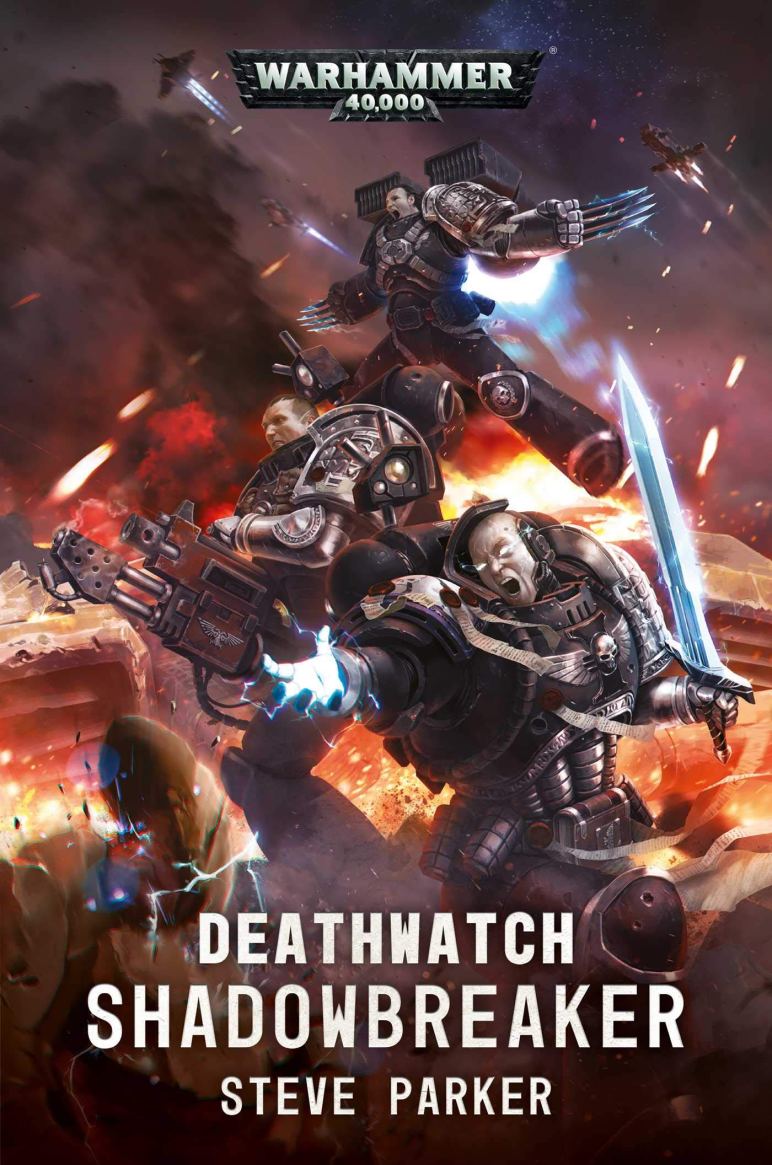
Deathwatch Shadowbreaker Cover

Publisher: Black Library (Audiobook – 25 April 2019)

Series: Warhammer 40,000/Deathwatch – Book Two

Length: 16 hours and 37 minutes

My Rating: 4.5 out of 5 stars

Amazon

Prepare to dive into the extended universe of Warhammer 40,000 (Warhammer 40K or 40K), as science fiction author Steve Parker presents Deathwatch: Shadowbreaker, an action-packed and exceedingly exciting sequel to his 2013 novel, Deathwatch, which pits the deadly Deathwatch Space Marines against an entire planet full of T’au.

Thousands of years in the future, the galaxy is constantly at war. Humankind has survived as the massive Imperium of Man, under the divine protection of their long-dead Emperor. However, this beacon of humanity is under constant threat from all sides. Destructive alien races, demons from the warp and the traitor forces of Chaos continuously assault its borders, whilst heretics, mutants and witches attempt to destroy it from within. Over the millennia, the Imperium has created many different forces to protect their worlds from these threats; however, none is more feared or revered than the Adeptus Astartes, the Space Marines. Space Marines are legendary warriors genetically modified to become significantly stronger, larger and faster than a normal man. Swathed in power armour and armed with the deadliest of weapons, the Space Marines are a force to be reckoned with on the battlefield, bringing the Emperor’s wrath down on all who oppose them.

But even amongst these deadliest of soldiers, there is one organisation of Space Marines who are respected above all others for their fighting ability and skill, Deathwatch. Deathwatch is an elite group made up of best Space Marines veterans from across the Chapters, trained to become the ultimate tools in one of the Imperium’s holiest missions, the extermination of the xenos, the alien. Utilising the most advanced technology in the Imperium and receiving specialist instruction in the strengths and weaknesses of their foes, Deathwatch work in small kill-teams under the Ordo Xenos of the Imperial Inquisition in order to hunt down and destroy the most dangerous xenos threats in the galaxy.

Lyandro Karras, Codicier of the Death Spectres, is a powerful Space Marine Librarian serving in the Deathwatch as the leader of the kill-team, Talon Squad. Barely recovered from the disastrous events of their last mission, Karros and Talon Squad once again find themselves under the command of the mysterious Inquisitor Sigma. Their new mission takes them to a former Imperial world that has been conquered by the alien T’au, who have indoctrinated the majority of the human population into their society and philosophy. An Imperial Inquisitor, Epsilon, has gone missing in T’au space, and Sigma believes that she is being kept prisoner on the planet. Desperate to free her before the T’au extract vital secrets about the Imperium from her, Talon Squad and a force of Ordo Xenos Storm Troopers are deployed to find her. Working with the local human resistance, Talon Squad identify the prison she is located in and must work to release her before the massive T’au garrison knows they are on planet. But what happens when Epsilon refuses to accompany Talon Squad back to the Imperium?

Deathwatch: Shadowbreaker is part of the massive extended universe which has formed up around the Warhammer 40K tabletop miniature game produced by Games Workshop. Warhammer 40K, which was first released in 1987 and pits armies of science fiction miniatures against each other, has always contained an interesting and grim science fiction narrative to serve as a background to the game. With every new edition of Warhammer 40K that was released, this background narrative got more and more detailed, resulting in an extremely deep, compelling and gothic-themed fictional history surrounding all of the different races, armies and characters featured within this tabletop game. Due to the popularity of the Warhammer 40K universe, a huge amount of expanded material has also been released over the years, including several videogames, comics, board game spinoffs, an animated movie (with a remarkably good cast of British actors) and there is currently a television series in production. However, the main medium that has been utilised as part of this expanded universe is books.

Over the years, there has been a tremendous amount of Warhammer 40K books produced, featuring the works of a number of skilled and talented science fiction authors. There are now hundreds of Warhammer 40K books currently published, covering the different periods and races featured in the tabletop game. In 2019 alone there were nearly 20 different novels, anthologies and audio dramas associated with Warhammer 40K. This is a very impressive amount of material, and I have not even mentioned the multiple book releases associated with the separate Warhammer Fantasy universe.

While I am a man of many, many different fandoms, the products of Game Workshops are among the earliest fantasy and science fiction products that I was a major enthusiast of. I was extremely into Warhammer Fantasy when I was a kid and I have many fond memories of painting and battling with the models, reading the company’s monthly White Dwarf publication and playing some of the Warhammer 40K computer games, such as Dawn of War. While I was solely playing with Warhammer Fantasy models, I did learn a lot about Warhammer 40K at the same time, especially as I really enjoyed reading all the lore and background of the various Games Workshop products. I have been meaning to read some Games Workshop fiction for a while now, and I have previously mentioned that I want to read the cool-sounding Gaunt’s Ghosts series. However, I ended up reading the recently released Deathwatch: Shadowbreaker instead, mainly because it featured two of my favourite groups from the Warhammer 40K lore, Deathwatch and the T’au, facing off. Shadowbreaker is the latest book from Steve Parker, a science fiction author, who has primarily written Warhammer 40K fiction. Shadowbreaker is his first release since 2016, and it is actually a sequel to his 2014 novel, Deathwatch, which featured the same group of primary characters.

I am actually really glad that I chose to read and review Shadowbreaker, as this excellent 40K novel contains an awesome and extremely entertaining story that features all manner of action, adventure and intrigue, while also diving deep into several fascinating parts of 40K’s lore. Shadowbreaker is an excellent sequel to the author’s previous book, Deathwatch, and Parker does an amazing job of continuing the story that was started in this prior book, while at the same time setting up some intriguing potential directions for the series to go next. Prior knowledge of the events of Deathwatch is not a necessity to enjoy this book, as Parker does a good job of re-introducing all the relevant events of the previous novel, and readers should be able to follow Shadowbreaker’s story without any real issues. Parker has created a rich narrative for this book that utilises a huge number of character viewpoints to not only examine the development within several characters but also explore a number of different angles and features of the harsh gothic universe in which this book is set. These multiple viewpoints work especially well during Shadowbreaker’s extended action sequences, as they allow Parker to show off every aspect and side of the brutal battles, resulting in some exciting and detailed combat set pieces. Shadowbreaker’s story ends up going in some rather intriguing directions, featuring some fun twists and reveals, and this was an overall fantastic and exciting story to check out.

While Shadowbreaker is an amazing novel, it might not be as appealing to those readers who are not familiar with the Warhammer 40K universe. This book is pretty lore heavy, containing a whole lot of references to history, technology, alien races and other unique aspects of this fictional universe. While I felt that Parker did a great job of explaining most of the Warhammer 40K elements that are relevant to the story, a certain amount of prior knowledge about this massive universe will really help readers understand what is going on. Do not get me wrong; readers unfamiliar with the franchise will easily be able to follow and enjoy Shadowbreaker’s story, but they may have trouble appreciating all the interesting lore references or depictions from the miniatures game. As a result, I would probably recommend this book more to established fans of the 40K universe, although casual science fiction readers are definitely going to have a good time reading this. That being said, I note that some other readers of this book who are more familiar with the actual tabletop game than me were put off by a couple of apparently incorrect depictions of weapons, armour and vehicles. While these apparent anomalies in no way impacted my enjoyment of the book (honestly, I am not knowledgeable enough about battle gear to have really picked up on this), I can imagine that this could annoy some hardcore 40K fans, so fair warning about that.

For me, one of the major appealing aspects of this book was its excellent examination of fascinating elements from the Warhammer 40K universe. As I mentioned above, the universe of the 40K games are filled with all manner of fantastic, complex and unique features which are all backed up with a ton of lore and fictional history. Parker does an awesome job of setting Shadowbreaker within this universe and he ends up utilising quite a lot of detail from the games in the story. There is actually quite a lot going on within this book. Not only do you have the primary storyline of Space Marines versus T’au but you also have storylines that relate to infighting and intrigue within the Ordo Xenos, examination of the constant threat that is the Tyranid, the machinations of the Eldar, and the long-term plots of a demon lord thrown in on top. All these various storylines actually come together really well into an outstanding story, and fans of the 40K franchise are almost guaranteed to have some mention or discussion about their preferred army or race in the game (with a couple of exceptions).

However, the thing that really excited me the most about this book was the central conflict between Deathwatch and the T’au. I am a major fan of both of those groups and have always been really intrigued by the cool lore and background that surrounds them. When I started reading this book, I was half-expecting the story to be shown purely from the perspective of the Deathwatch characters. If this had been the case, the author would have been forced to do a classic humans versus aliens storyline, where aliens are automatically the bad guys due to the Space Marines’ inherent hatred of all things alien. Therefore, I was pleasantly surprised when Parker presented a much more complex storyline which showed neither side as “good” or “evil”. Instead, thanks to the author’s excellent use of multiple perspectives, it is shown that both sides of this conflict are dominated by dangerous fanatics driven by their beliefs, either in the purity of destroying all things alien or the defining T’au philosophy of the “Greater Good”. This belief results in both sides doing some very questionable things in order to achieve their objectives, most of which result in large amounts of destruction and death. Interesting enough, it is Lyandro Karras and some of the members of Talon Squad who are the most reasonable characters in this book, and all of them have been heavily indoctrinated about the evils of the alien. This all makes for a much more intriguing and clever story, and I loved how it helped highlighted how complex this universe can get.

Shadowbreaker contains quite a bit of information about how the legendary Deathwatch operates, which is just downright fascinating, and I can imagine a lot of readers would be really interested to learn more about. While there was a lot more about the layout of the organisation and their training in the initial Deathwatch book, readers of Shadowbreaker learn a lot about them in this book. For example, Shadowbreaker contains information about Deathwatch’s unique relationship with the Inquisition, their skills in battle, their knowledge of the aliens they fight and the fact their ranks consist of Space Marines from various chapters. All of this is really cool, and there were a fantastic central organisation to centre the book on.

I also quite enjoyed the examination of the different Space Marines that make up the various Deathwatch kill-teams featured within this book. Thanks to the author’s use of multiple character perspectives, the reader gets to see through the eyes of a number of Space Marine characters. Parker cleverly utilises this to show off the varied personalities of the Space Marines, and it was interesting to see how diverse these genetically enhanced and indoctrinated killing machines can really be. A lot of this is due to the specific Chapters that they come from, as each character seems to reflect the traits of their Chapter and their founding father. I liked how the multiple perspectives helped highlight he different fighting styles of the various members of the Deathwatch kill-team, especially as each of them utilises different weapons and tactics to achieve their goals, reflecting the defining skills of their original Chapter. For example, the Raven Guard character continuously utilises a jump pack and lightning claws in his fights, while the Imperial Fist preferred to use heavy weapons. These different combat techniques add an extra layer of spice to the various fight sequences, and I really liked seeing the different characters in action. I was also really intrigued by the author’s deep dive into the history and peculiarities of two of the lesser-known Space Marine chapters, the Death Spectres and the Exorcists. Parker reveals some really interesting facts about these two Chapters, mostly when these respective characters think back on their past or their Chapter. I really didn’t know that much about these two Chapters before this book, and I really enjoyed learning more about them, especially as they have some very cool and unique traits (one summons and betrays demons for an initiation test; the other has a mysterious glass throne hidden on their home planet). As a result, fans of Space Marine history and lore are really going to love this book, and even non-fans will appreciate the world-building associated with them.

In addition to the intriguing examination of Deathwatch and other Space Marine Chapters, Parker also features an excellent look at one my favourite races in the Warhammer 40K universe, the T’au (or Tau). The T’au are probably the newest race in 40K canon (although that was quite a few years ago) and have been featured in a couple of books and have even had their own video game, Fire Warrior. T’au are a young race of aliens whose empire has quickly expanded in recent years thanks to their advanced technology and wiliness to incorporate alien races into their empire. Their sudden expansion has made them a real threat to the stagnant Imperium of Man. Parker does an amazing job incorporating the T’au into this book, and there are some fantastic depictions of their technology and unique physiology. The T’au serve as excellent primary antagonists for this book, and Parker takes an interesting view of them, diving into the darker side of their empire. Thanks to the various character perspectives contained within Shadowbreaker, the reader gets to see more than their typical depiction as a beatific race who merely wish to share their technology and their message of the “Greater Good” throughout the universe. Instead, you get to understand how slavishly devoted to their philosophy they really are, and the lengths that some of them will go to achieve their race’s goals. There are some really interesting discussions about how they control the populations they conquer, as well as some brief but curious mentions of T’au who do not follow the Greater Good and are persecuted or punished for this. I also really liked the detailed examination of a human world that is being ruled by the T’au, especially as you get to see all the various benefits and downfalls of this control. The fact that neither the T’au nor the Imperium actually care about the planet or its people is a bit of a dark spot in the novel, and some of the conclusions of the book reveal just how much better off this planet would have been on its own. If I had one complaint about Parker’s depiction of the T’au, it would be that they went down way too easily in a fight. While a couple of their units and commanders were able to hold their own for a bit, the rest of the T’au forces were pretty much slaughtered in one-sided battles throughout the book. While I appreciate that the author was probably trying to demonstrate Deathwatch’s skill at killing aliens, I think he could have perhaps added in a bit more of a fight from this popular race. Still, I really enjoyed this inclusion of the T’au, and I need to check out some other books that feature them.

I ended up listening to the audiobook format of Shadowbreaker, which was narrated by Andrew Wincott. Shadowbreaker clocks in at just over 16½ hours, so it is a fairly substantial audiobook which takes a little bit of effort to get through. I was very impressed by this format of the book, and I personally found it a great way to absorb all the amazing things occurring in the story. Wincott is a really good narrator, coming up with some distinctive and appropriate voices for the huge raft of characters that were featured in this book. I really liked how Wincott was able to capture the emotion and mood of the various characters, and I was especially impressed with the harsher tone that he took for many of the Imperial characters, which fitted perfectly into the gothic style of the Imperium. As a result, I would highly recommend the audiobook format of Shadowbreaker to anyone who is interested in checking this book out, and it is a wonderful way to enjoy this great piece of Warhammer 40K fiction.

Deathwatch: Shadowbreaker by Steve Parker was an incredible read which I found to be extremely entertaining and which proved to be a perfect reintroduction for me to the Warhammer 40,000 franchise. Parker presents an exciting and compelling story that dives deep into the universe’s lore while also exploring some of the complexities of the various featured races and armies. Overall, this is an outstanding novel and I am really glad that I checked it out. I fully intend to read more Warhammer 40K fiction in the future, especially after enjoying this book so much, and I hope that Parker continues his Deathwatch books in the future as well.

Amazon