
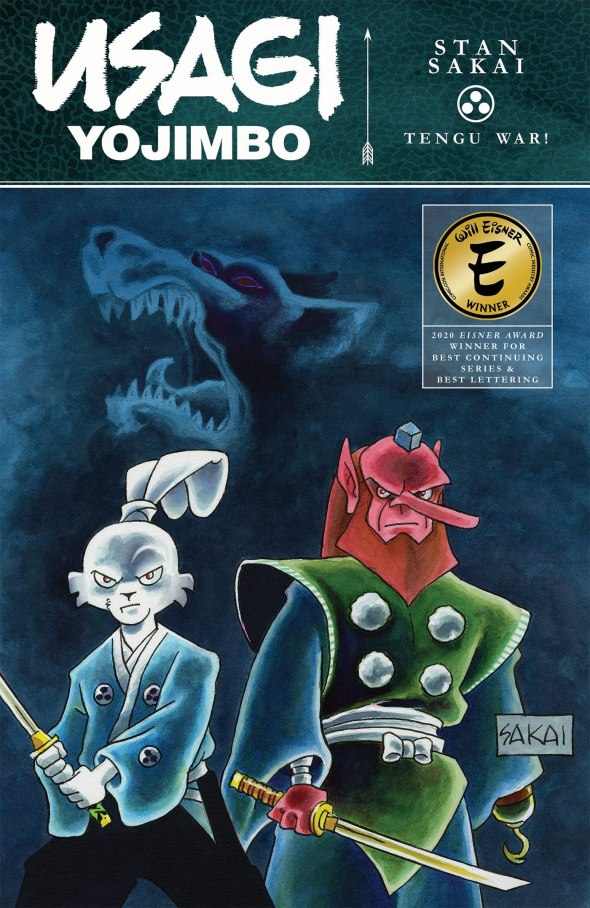
Usagi Yojimbo: Volume 36: Tengu War! by Stan Sakai

Usagi Yojimbo - Tengu War!

Publisher: IDW (Paperback – 22 March 2022)

Series: Usagi Yojimbo – Volume 36

Writer and Artist: Stan Sakai

Art Assist: Randy Clute (The Master of Hebishima)

Colourist: Hi-Fi Design

Length: 192 pages

My Rating: 5 out of 5 stars
Amazon

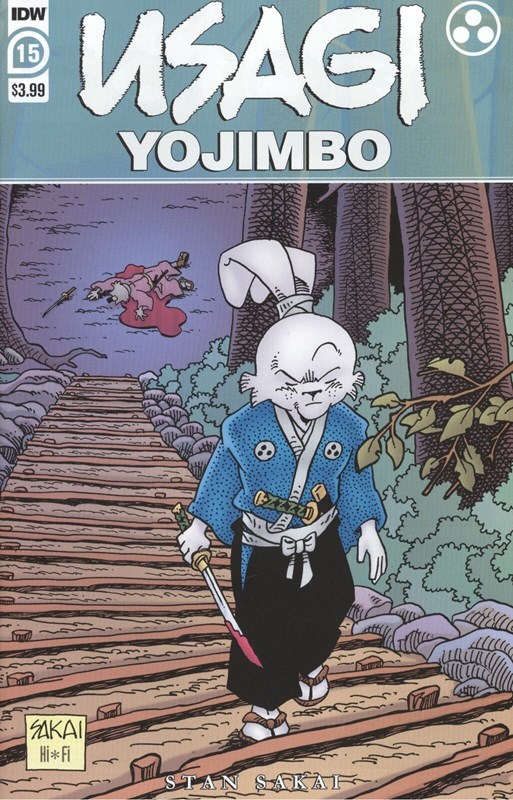
Usagi IDW #15

It is that amazing time of the year when I finally get my hands on the brand-new volume of the long-running Usagi Yojimbo comic series, written and drawn by the legendary Stan Sakai.  Fans of this blog will be well aware of my all-consuming love for this amazing series that follows a roaming rabbit ronin, Miyamoto Usagi, as he traverses an intriguing alternate version of feudal Japan inhabited by anthropomorphic animals.  Not only is this one of my favourite all-time comic book series but I have been steadily reviewing some of the older volumes as part of my Throwback Thursday series (see my recent reviews for Volume 12: Grasscutter, Volume 13: Grey Shadows and Volume 14: Demon Mask).  Unfortunately, Sakai only releases one volume of this epic series a year, so it is a very big deal when I finally get my hands on the latest volume (this latest volume has been one of my most anticipated releases for 2022 for a while now).

Usagi IDW #15b

This latest volume is Tengu War!, an intriguing and powerful comic that contains some awesome and clever new tales.  Tengu War! is the 36th overall volume in this series as well as the third volume printed by the publisher IDW (other IDW Usagi Yojimbo releases include Volume 34: Bunraku and Other Stories and Volume 35: Homecoming).  I have been rather enjoying these more recent Usagi Yojimbo volumes from IDW as not only do they contain Stan Sakai’s usual impressive storylines, characters and artistic work but they are also packaged into a fantastic new format of booklet, which is slim and more aesthetically pleasing.  In addition, the IDW volumes are also released in colour, which is an interesting change of pace from the previous volumes, which were initially released in black and white.

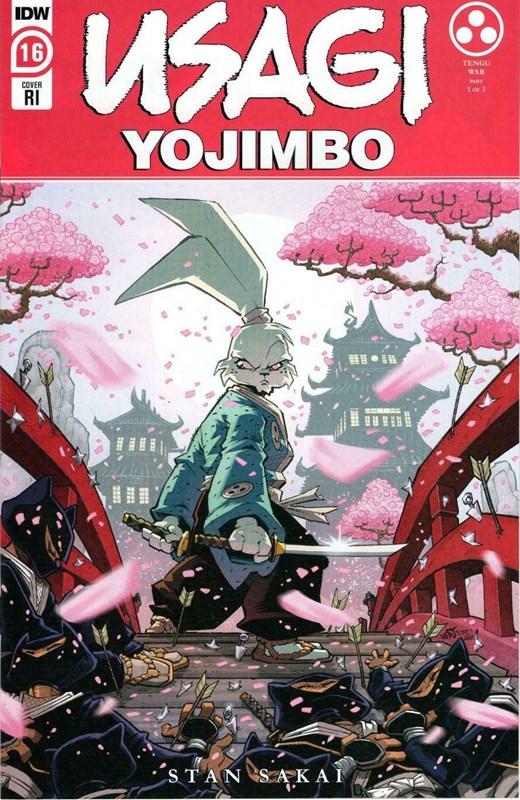
Usagi IDW #16

Tengu War! ended up being another great volume that makes use of Sakai’s skill and art to tell several complex and entertaining tales.  Set immediately after the final comic of the previous volume and continuing several overarching storylines and themes, Tengu War! contains four unique new stories which were set out in issues #15-21 of the IDW run on the Usagi Yojimbo series.  All four stories are fun and compelling new additions to the series that each present the reader with something different and distinctive.
Usagi IDW #16b

The first entry is the volume’s main multi-issue story that sees Usagi return to visit an old teacher only to find himself embroiled in a deadly supernatural war.  Made up of the first four issues of the volume, this entry actually consists of two stories, Sojobo and Tengu War!, which act together to tell one entire story, with Sojobo containing flashbacks to Usagi’s past, and Tengu War! featuring the current issue he and his friend are facing.  Due to how closely linked these two stories are, with Sojobo providing the background to the longer Tengu War! story, I decided to talk about them as a single entity in this article.

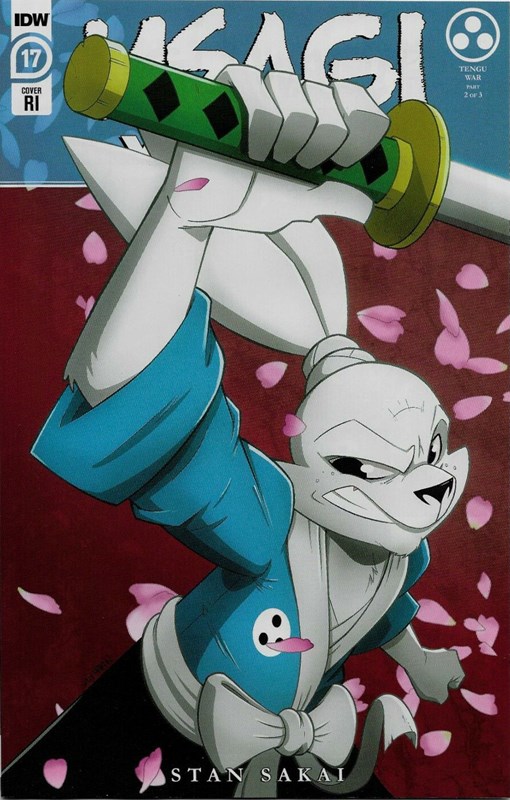
Usagi IDW #17

These stories are set right after the events of the last volume, and swiftly tell the story of Usagi and his mostly hidden second sword master, the tengu warrior Sojobo.  Years after his first meeting with Sojobo (see Volume 18: Travels with Jotaro) but before the events that would see him become a wandering ronin, a young Usagi returned to the tengu and convinced him to take him on as a pupil, enhancing his knowledge of the sword with Sojobo’s unique teachings.  Now, years later, Usagi returns to Sojobo’s clearing to pay his respects, only to discover his former master in grave danger.  A horde of guhin (lesser-tengu) are ravaging the mountainside, determined to claim the territory for themselves, and they have Sojobo and Usagi in their sights.  To survive, Sojobo is forced to return to from his self-exile and reclaim leadership of his clan.  But even with a tengu army at their back, can Sojobo and Usagi survive the onslaught of the guhin?
Usagi IDW #17b

These two stories were an excellent start to this volume, especially as they contain all the best elements of a great Usagi Yojimbo story, with great new characters, compelling Japanese supernatural elements, and another intriguing glance at Usagi’s complex past.  The first story, Sojobo, serves as a great introduction to the entire volume, perfectly continuing from the previous Sojobo story, and redefining the relationship between the two characters, showing their mentor-mentee bond.  This sets up the rest of the Tengu War! story extremely well, as you have a good basis for Sojobo’s and Usagi’s stakes in the narrative.  From there the story evolves into a classic Usagi Yojimbo tale, with Usagi getting involved in someone else’s fight, this time involving some unique and compelling supernatural foes.  This extended story continues some brilliant character moments as Sojobo becomes reacquainted with his wife and clan, while also showing off the intractability and intense honour of the tengu.  You also get to see the evolution of the bond between Sojobo and Usagi, and there are some great discussions as the wiser and battle-hardened Usagi discusses some recent changes in his life, such as the discovery of his son.  It was also quite fascinating to see the apparent impacts that Sojobo’s training had on Usagi’s skill as a warrior, and I found it fascinating that Usagi’s fighting style is described as a combination of mortal and tengu techniques.  The subsequent fights are pretty awesome and you get some fantastic and intense battle sequences that really highlight Sakai’s artistic skill.  This all leads up to the big conclusion which contains a great mixture of action, satisfaction, camaraderie and tragedy, as victory is achieved at great cost, and the reader is left extremely satisfied with how this story turned out.
Usagi IDW #18

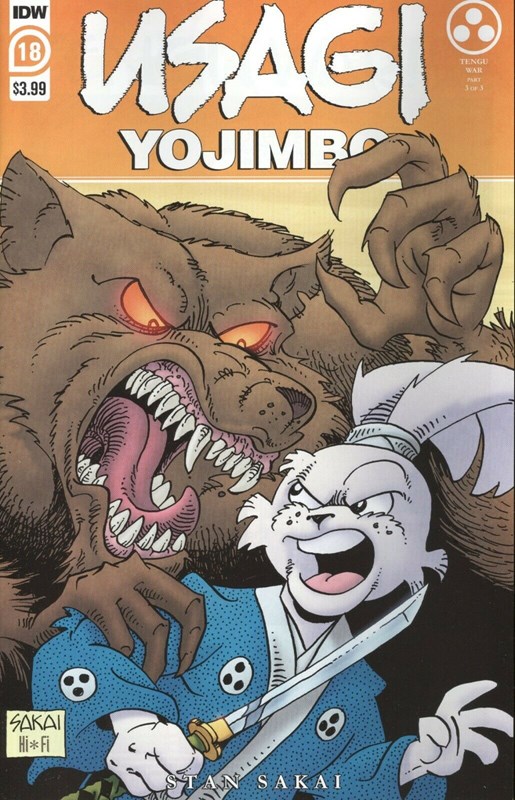
I have said many times before that some of the best Usagi Yojimbo stories are those where Sakai makes brilliant use of monsters, creatures or spirits from Japanese culture or mythology, and Tengu War! is a great example of this.  This cool story provides one of the best looks at the tengu, a fantastic and unique Japanese yokai (supernatural entity), in the entire Usagi Yojimbo series, and I really enjoyed the cool dive into the mythology surrounding them.  This story contains multiple different types of tengu who act as either allies or enemies, depending on their caste.  This includes the main supporting characters, Sojobo and his wife, Nozomi, who are dai-tengu, with the classic long-nosed, red-faced, humanoid-appearance that most people would associate with tengu, and who act as master warriors and wise sages.  These tengu are supported by their followers, the ko-tengu, bird-like creatures who act as samurai retainers in this comic, and I loved the cool combination of corvid features and samurai garb and mannerisms.  The final group of tengu featured within this comic are the guhin, a lesser form of tengu who act as mysterious spirits of the hills and lesser peaks.  Sakai depicts the guhin in this story in the more recent style of giant dogs (they are traditionally unseen spirits, but many modern depictions give them a canine physical form), and they come across as werewolf-like creatures, determined to take their rightful place at the top of the mountain.  These different form of tengu are explored in compelling detail, and I loved seeing the awesome scenes featuring all of them, especially as it results in some excellent fight scenes between classic tengu goblins, sentient samurai crows, and giant werewolves.  I loved this brilliant exploration of this unique part of Japanese culture (especially with the author’s comprehensive summary at the end), and it helps to enhance the outstanding overall story.
Usagi IDW #18b

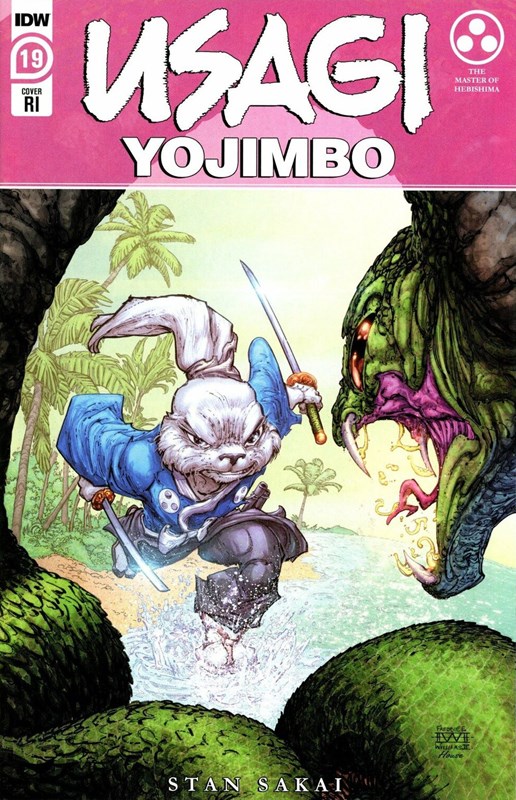
We next have the dark and captivating tale, The Master of Hebishima, which provides a chilling look at the evils of revenge, obsession and fear.  In The Master of Hebishima, the wandering Usagi chances across a couple of peasants who specialise in trapping and removing the local pests, the tokage lizards.  Upon meeting them, Usagi is intrigued to discover that the trappers sell most of their catch to a mysterious hermit on the island known as Hebishima (snake island), who lives amongst the local snakes.  When one of the trappers is injured, Usagi volunteers to transport the captured tokages to Hebishima for them.  However, what he finds there will shock and haunt him, as the hermit has a surprising history with Usagi, one that lies all the way back in the infamous battle of Adachi Plain.  Faced with this surprising threat from his past, Usagi is unprepared for just how dangerous his opponent is, or what they are truly capable of.

Usagi IDW #19

The Master of Hebishima is a tight and powerful one-issue comic that may be the best entry in the entirety of the Tengu War! volume.  Perfectly set up and executed, this tale is deeply interesting and powerful, especially with its unique and intense focus.  Sakai has come up with an excellent story for this entry that not only ties into one of the key moments of Usagi’s life but which also shows the full impact of someone’s obsession and desire for revenge.  The introduction of a mysterious stranger who has a connection to Usagi and the battle of Adachi Plain (which has been such a cool part of several volumes, including Volume 2: Samurai, Volume 11: Seasons and Volume 34: Bunraku and Other Stories), is handled perfectly, and I loved his unique backstory and the fact that you never actually find out his name.  This villain’s entire history is tied to Usagi’s, and I liked the interesting symmetry in their loyalty, sense of honour and desire to serve their respective lords.  The horror elements around this mysterious hermit are just great, especially with that snake reveal, and he proves to be an excellent opponent for Usagi, who could potentially come back in some future comics (I’d be keen for that).  I was slightly disappointed that this story had nothing to do with distinctive Usagi Yojimbo villain Lord Hebi, a giant snake who serves as the principal lackey to the series’ main antagonist, but Sakai more than made up for this with all the other inclusions.  This was an extremely well-paced story, and Sakai manages to do a lot with a single issue, producing one of his more memorable stories in recent years.
Usagi IDW #19b

One of the most notable things about The Master of Hebishima is its exquisite art, some of which bears a slight difference to Sakai’s usual work.  Parts of this issue are drawn sharper and in a slightly different style to the rest of the Tengu War! volume.  This is particularly clear in the earlier panels of this issue, with some noticeable and intriguing stylistic changes to the characters and landscapes, which I thought looked like a well-enhanced version of Sakai’s usual drawings.  I assume that this is because of the influence of artist Randy Clute, who is credited as giving “art assist” for this issue.  Whatever the reason, I quite liked how this comic looked very early on, and it was interesting to see it change back to Sakai’s more typical style as the comic continued.  The rest of the art in the comic also really needs to be highlighted though, as there are some extremely memorable and shocking moments drawn within.  Not only do you get a notably spooky island of snakes for the main story but The Master of Hebishima also features a detailed flashback sequence that looks awesome, especially some of the battle sequences.  I particularly liked how the antagonist’s face was constantly obscured by shadow during these flashbacks, as it helped to make them seem more sinister and mysterious while also ramping up anticipation for the final reveal, the best part of this story.  This extended panel reveal is pretty damn freaky as the artists present a gruesome visage, accompanied by a Medusa-esque twist.  This shot of the face is particularly well drawn in impressive detail and ends up being one of the most haunting panels I have ever seen in a Usagi Yojimbo comic.  All this beautiful, if somewhat creepy, art really works to enhance this brilliant story, and it ensures that The Master of Hebishima really sticks in the mind and is well worth checking out.

Usagi IDW #20

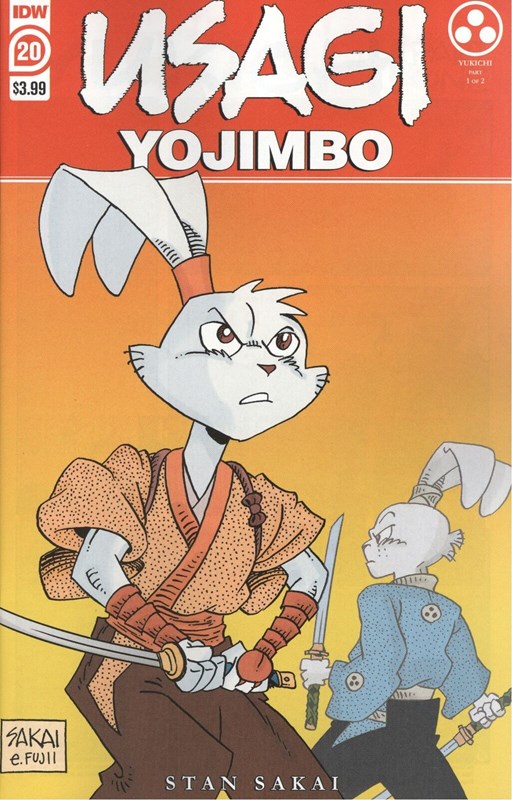
The final story in the volume is the two-issue long story, Yukichi, another excellent character-driven narrative that introduces a fantastic new supporting character for the series.  In this story Usagi encounters a fellow rabbit samurai, Yukichi Yamamoto, on the road.  It is quickly revealed that, years ago, Yukichi was a disrespectful student at a prestigious sword school who insulted Usagi when the ronin attempted to meet his master.  Now a more mature warrior, Yukichi is delivering the sword of his dead master to the school’s successor and, after he apologises to Usagi, the two decide to travel together.  However, a rival school is determined to stop them delivering the sword by any means necessary, and they will use Usagi’s recent misadventures to justify their actions.
Usagi IDW #20b

Yukichi is an amazing and fantastic story that serves as a great ending to the Tengu War! volume, especially as it combines an excellent Usagi Yojimbo story with some cool new character introductions.  This story is another one with an excellent pace to it, smartly bringing in Yukichi, revealing the history between him and Usagi, before revealing the story’s villains, the members of a dishonourable sword school.  From there the story intensifies as, after an initial confrontation, the students and instructors from the rival school attempt to kill Usagi and Yukichi, while also trying to claim a bounty on Usagi (a consequence of the main story in the previous volume, Homecoming).  This results in a brilliant climatic scene where the two protagonists take on a horde of underlings before Yukichi engages their leader in an intense duel.  This duel comes across as pretty awesome in the artwork, and you get the sense it is a real battle between master swordsmen.  The conclusion of the fight, which highlights Yukichi’s naivety compared to the more jaded Usagi, is very cool, and I liked the conclusion of the story, where Yukichi is forced to make a big decision and eventually decides to travel with Usagi.

Usagi IDW #20c

While the action, artwork, and story are great, the real highlight of this comic is the introduction of new character Yukichi, who Sakai is obviously setting up to be a big supporting figure in the overall series.  Yukichi gets an excellent and comprehensive introduction here, and you swiftly get a grasp on his personality, history and relationship with Usagi.  I mostly liked this character and his design, especially as he is a good foil to Usagi, given their divergent training history and life experiences, and his fighting style is awesome as well.  His strong sense of honour, especially when faced with the poor successor to his master, was a great inclusion, and it does bring in some similarities with Usagi.  I did think that the sudden realisation that they were cousins was a tad too coincidental, and wasn’t particularly necessary, but it does bring in a certain connection between the two which will bond them for the rest of the series.  I wasn’t the biggest fan of Yukichi’s facial design either, especially those overly large and expressive eyes.  It kind of made him look cartoonish and somewhat undercut the seriousness of some scenes.  Still, this was my only real complaint about this new character and I am very curious to see what happens with him in the future Usagi Yojimbo volumes.  I am predicting similarities to Usagi’s previous travels with Jotaro in volumes 18 and 19, and it will be interesting to see Yukichi interact with the other supporting cast members like Gen or Kitsune.  An overall excellent and impressive end to this amazing volume that wraps everything up nicely.

Usagi IDW #21

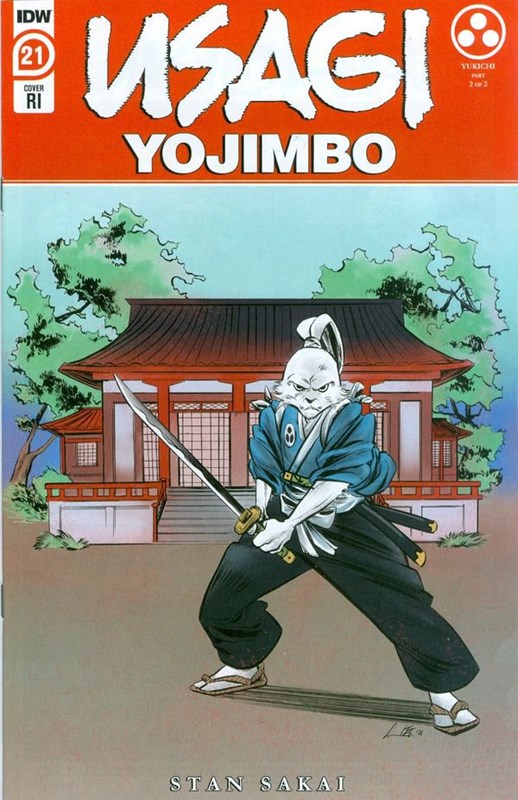
As always, I really need to highlight the fantastic and awesome artwork featured with this incredible volume as Sakai continues to enhance his excellent stories with some gripping and powerful scenes.  I have already discussed some of the best bits of art of each respective story, especially the amazing art of The Master of Hebishima, but every panel in this comic is drawn in exquisite detail.  Not only does Sakai present some great character designs, especially around the new supernatural creatures in the Tengu War! story, but you have his always impressive setting shots that perfectly highlight the beautiful Japanese natural landscape or the historical buildings.  You also must love the excellent battle sequences scattered throughout the stories.  Sakai has always excelled at conveying movement and combat with his minimalistic style, and this is brilliantly highlighted in the various comics of Tengu War!, including in elaborate group fights or one-on-one duels.  I am also really enjoying seeing these stories in colour from the get-go as part of the IDW release.  While I will always be extremely fond of Sakai’s usual black and white style, having these adventures appear in colour is also amazing, and I feel that the colour enhances some of the art, especially in The Master of Hebishima, which came up beautifully.  All this art brilliantly combines Japanese influences with western art styles and is such a joy to behold, especially as it always makes everything about the Usagi Yojimbo comics just a little bit better.
Usagi IDW #21b

Another year, another exceptional Usagi Yojimbo volume as Stan Sakai once again produces a masterful and impressive new comic.  Tengu War! is another awesome volume that presents the reader with three excellent stories that combine brilliant character work with unique narratives and outstanding artwork.  I had so much fun reading this excellent comic, and it gets another easy five-star rating from me and comes very highly recommended.

Amazon

Throwback Thursday: Usagi Yojimbo: Volume 11: Seasons by Stan Sakai

Usagi Yojimbo Seasons

Publisher: Dark Horse Books (Paperback – 1999)

Series: Usagi Yojimbo – Book 11

Length: 198 pages

My Rating: 5 out of 5 stars

Amazon

Reviewed as part of my Throwback Thursday series, where I republish old reviews, review books I have read before or review older books I have only just had a chance to read.

It has been a while since I have done a Usagi Yojimbo Throwback Thursday, but after doing a Waiting on Wednesday for the next upcoming volume in this epic series, Homecoming, I was in a Usagi mood and decided to write something extra.  As a result, I check out the 11th Usagi Yojimbo volume by the legendary Stan Sakai, Seasons.

Seasons is a fantastic and spectacular entry in the series that presents the reader with a series of great Usagi Yojimbo adventures that follow the rabbit ronin Miyamoto Usagi as he traverses his version of feudal Japan during the various seasons of the year.  This is a key entry in the series as it sets up a number of storylines for the next several volumes while also introducing some great new characters.  Needless to say, I had an incredible time reading this volume of the series and I have a lot of love for a number of the stories contained within it.  Seasons contains issues #7-12 of the Dark Horse Comics run on the Usagi Yojimbo series, as well as stories taken from the Usagi Yojimbo Colour Special.  This results in 11 separate stories throughout the volume, made up of single-issue entries and a couple of shorter tales, all of which contain an impressive and deeply enjoyable story with beautiful artwork.

USagi #7

The first story featured within Seasons is The Withered Field, an epic story of samurai honour and the warrior’s way.  In this story, Usagi is visiting a famed fencing school with the hope of challenging some of its instructors to test his skill.  However, before he can issue his challenge, all of the school’s instructors are beaten by another ronin, Nakamura Koji, a skilled swordsman who demands a fight with the school’s master.  As he waits for his challenge, Usagi befriends him and discovers that he was once a famed sword master himself, who began the warrior’s pilgrimage after suffering a humiliating defeat at the hands of a mysterious and unconventional swordsman.  Now determined to find this swordsman and rechallenge him, Nakamura Koji shows great interest in Usagi, especially when they must content with treachery from the fencing school.

The Withered Field is an outstanding story that serves as a compelling and powerful start to this volume.  I really enjoyed the amazing narrative that examined honour and martial prowess, with Usagi encountering a famed warrior who is even better than he is.  This great story does an excellent job of introducing the character of Nakamura Koji, who becomes a major figure in some of the future volumes in this series and who has an interesting connection to Usagi and his past.  The entire storyline around the two ronin facing off against the fencing school is extremely cool and action packed, and it appears to take a lot of influence from the second entry in the iconic 1950s Samurai film trilogy (which follows the adventures of Miyamoto Musashi, the historical samurai who serves as an inspiration for Usagi), Duel of Ichijoji Temple, with the students attempting to stop the wandering ronin from defeating their master.  There are amazing action sequences throughout this story, with Usagi and Nakamura Koji engaging in several awesome duels.  I particularly loved the opening sequence where Koji goes through the pre-fight forms before facing off in his sparring match against a fencing school instructor.  The eventual reveal that the samurai who defeated Koji when he was younger was Usagi’s mentor, Katsuichi, comes as little surprise, but it sets up an amazing story later in the series which makes this great story a must read for fans of Usagi Yojimbo.

Seasons’ second story is the thrilling but haunting A Promise in the Snow, which sees Usagi travelling through a snowy mountain pass during the height of winter.  As he trudges along, he comes across bandits attacking an innocent merchant and his servants.  Intervening, Usagi is able to slay all the bandits, but not before they severely wound the merchant.  Usagi finds the merchant’s young daughter and promises to save her father, carrying him back to his village.  However, the mountain passes are treacherous, and Usagi must contend with harsh weather, a pack of hungry wild tokage lizards and a dangerous avalanche.  But no matter what the mountain throws at him, nothing will prepare Usagi for the great shock awaiting him at the end of his journey. 

Usagi #8

This is a great entry in this volume that features a desperate struggle for survival in a dangerous location.  Sakai came up with an epic story for A Promise in the Snow, and I really love seeing Usagi power through great trials and tribulations to keep his promise to a young girl.  There are some beautifully drawn scenes throughout this story, and Sakai does a fantastic job bringing the snowy landscape to life in all its wondrous, deadly glory.  I also loved the way in which Sakai’s drawings highlighted Usagi’s struggles to get through the tough terrain; you can see him get more and more weary with each obstacle he encounters.  This story has a fantastic ending that is reminiscent of a lot of classic ghost tales, and looking back you see that Sakai set this twist up brilliantly, with tons of little clues.  Overall, this was an exceptional story which is a true highlight of this volume.

Next up with have the action-packed, intriguing story, The Conspiracy of Eight.  In this entry, Usagi is visiting the temple of his friend, priest Sanshobo, when an injured samurai wearing the crest of the notorious Lord Hikiji arrives at the gate.  The samurai bears a dangerous letter that names eight conspirators who are plotting against the Shogun.  As Usagi and Sanshobo debate what to do with the information, a large force of ronin arrives at the temple, determined to claim the injured samurai and kill all witnesses. 

This is another fantastic entry in Seasons that once again sees Usagi drawn into a major conspiracy impacting the realm.  There are a lot of cool elements to this story, such as Usagi and Sanshobo being forced to mount a defence of the temple from a dangerous siege.  This is a great, fast-paced story, and I really liked the unique battle scenes, especially the monks with staffs facing off against sword-wielding bandits.  Many of the plot elements contained within this tale come into play in several later Usagi Yojimbo stories, including one featured later in this volume, and I think Sakai did an exceptional job introducing them in The Conspiracy of Eight.  I also liked seeing the return of Sanshobo, the wise and noble priest and former samurai general.  Sanshobo serves as a good foil to Usagi’s more impulsive nature, cautioning him about acting in the affairs of great lords and counselling him that his proposed actions could lead to the death of many people.  While mainly a figure of wisdom, Sanshobo also serves as a great leader, utilising his experiences as a general to defend his temple and keep his monks alive.  The Conspiracy of Eight ends up being a very solid and enjoyable entry in this volume and I very much enjoyed seeing Sakai solidify a great new side character.

Usagi #9

Right after The Conspiracy of Eight comes another intriguing story that is primarily set within Sanshobo’s temple, Snakes and Blossoms.  In this entry, Usagi tells two short tales to Sanshobo: one that describes a crazy misadventure he had, and another that describes some important lessons from his past.  This two shorter tales work as sub-stories to Snakes and Blossoms and ensures that it is a distinctive entry in Seasons.  The first of the shorter tales is titled Hebi, which is set shortly after the events of the final story in Volume 7: Gen’s Story and sees Usagi and Gen once again lost following one of Gen’s shortcuts.  As the two ronin wander the unused paths, Gen saves Usagi from a wild snake that attempts to kill him.  However, Gen’s heroic actions has unexpected consequences when the two travellers are confronted by a mysterious nun at an abandoned temple later that night.  This was a rather cool horror story that exemplifies the sort of weird situations that Usagi can find himself in.  I loved the way in which Sakai plays Usagi and Gen off each other, and there are some very humorous interactions between this oddball pairing.  There is also some really insane artwork in this short story, and I loved the fantastic and scary sight of a giant snake emerging from its disguise to try and kill the protagonists. 

The other short story contained within Snakes and Blossoms is the cute tale, The Courage of the PlumThe Courage of the Plum takes place during Usagi’s childhood when he is training with his master, Katsuichi.  As the two walk through the snow, Katsuichi attempts to teach his student the various hidden aspects of nature around them, including the trees, each of which can represent human virtues.  The young Usagi is particularly intrigued by Katsuichi’s description of the humble plum tree as brave, and Katsuichi schools Usagi on how this smaller tree can be braver than the mightiest of oaks.  I always enjoy the depictions of Usagi’s unorthodox training under Katsuichi, as the student and teacher have a very amusing dynamic, and The Courage of the Plum turned out to be a delightful shorter entry with some intriguing philosophical discussion and some lovely drawings of the winter landscape.  Overall, Hebi and The Courage of Plum make for a fantastic combination of tales and I quite enjoyed seeing these two unique, short stories come together.

Up next in Seasons is an amazing shorter entry, Return to Adachi Plain, which sees Usagi journey back to the site of his greatest defeat, Adachi Plain, the battlefield where his lord Mifune (named after actor Toshiro Mifune, who starred in multiple classic samurai films that Sakai references in his works, including as Miyamoto Musashi in the Samurai trilogy), was killed in front of him.  Flashing back to tragic events that started his wandering lifestyle, Usagi remembers the battle in greater detail and the reader sees not only the role he played in saving the head of his lord from mutilation but also the first time he came directly in conflict with the villainous Lord Hikiji. 

Usagi #10

Return to Adachi Plain is a fantastic entry in this series as it is essentially one big war sequence, showing Usagi amid a violent battle from his past.  This story expands on the war sequence that was shown in Volume 2: Samurai, and it was really cool to see more of this battle, especially the combat scene between Usagi and Hikiji, which serves as the origin for Usagi’s distinctive forehead scar.  A fantastic shorter story that provides greater depth to Usagi’s role in this major defeat, this battle sequence was later reused in colour in Volume 34: Bunraku and Other Stories, and the events disclosed within is likely to come up in the upcoming Volume 35: Homecoming.

The next story in this volume is a relatively short entry called The CrossingThe Crossing is set aboard a small passenger ship where a group of rowdy peasants sing and dance to a fun folk song on deck.  However, during the climax of the performance, one of the peasants accidently bumps into an arrogant samurai who takes offence and moves to kill the transgressor, until a fellow passenger intervenes.  Unfortunately for everyone involved, the Good Samaritan isn’t Usagi; instead it is the demon spearman Jei. 

This is a captivating darker story that once again highlights just how dangerous and deranged Jei, one of the best antagonists in the entire Usagi Yojimbo series, is.  Sakai has written an extremely clever tale here that does a wonderful job showcasing Jei’s compelling nature as both a defender of the innocent and a raging psychopath who views nearly everyone as evil in form or another.  It’s fantastic watching the expressions on the peasants’ faces turn from relief to absolute terror as they slowly realise just how crazy Jei is, and you have to love that entertaining ending with the unsuspecting dock worker.  The Crossing serves as an excellent follow-up to several other shorter Jei stories that appeared in recent volumes, including The Nature of the Viper (which appeared in Volume 9: Daisho) and Black Soul (which appeared in Volume 10: The Brink of Life and Death), and this ends up being an impressive and compelling filler story in this volume.

Usagi #11

The shorter entries keep on coming! The Patience of the Spider introduces a new compelling character, General Ikeda.  Ikeda is a famed warrior and general who led a revolt against the Geishu Clan years ago (when the clan was ruled by the father of Usagi’s friend Lord Noriyuki).  When his revolt fails and his army is vanquished, Ikeda and two of his retainers flee to an abandoned farm and determine that their next course of action is to hide and wait.  Using a patient web-building spider as inspiration, Ikeda and his comrades show fortitude and restraint by disguising themselves as peasants and farming the land as they wait for the opportune moment.  However, as the years pass and Ikeda gains a family and faces the many harsh trials and dangers that await a peasant farmer, he begins to see the world differently, until the once notorious general is a completely new person, one with very different desires and dreams.

The Patience of the Spider is an outstanding example of how Sakai can quickly build up an intriguing and powerful character and ensure that the reader is utterly transfixed by their tale.  While this entry is relatively short, it is very impactful and may be one of the best stories in Seasons.  The tale of General Ikeda, as he faces the many different hardships of peasant life, including drought, bandits, floods and great personal loss, while also experiencing great joy and community, is extremely well written.  It proves to be extremely captivating to see this resolute man slowly change his nature as life overcomes him.  This also proves to be an excellent introduction to the character of Ikeda, who will go on to have a substantial role in the two big Grasscutter storylines, and his amazing character arc has an exceptional start here.  A very impressive and powerful tale, The Patience of the Spider is an amazing character-driven narrative from Sakai that is an absolute treat to read.

The next story featured in Seasons is the curious tale, The Lord of the Owls, which sees Usagi encounter a strange fellow traveller.  As Usagi stops at an inn, he witnesses a group of ruffians follow after a mysterious hooded samurai walking the road with the intention of robbing him.  Following them, Usagi witnesses the figure quickly kill the bandits after first startling him with his hypnotic and powerful gaze.  This man is eventually introduced as Oyama Tadanori, the mysterious Lord of the Owls, who reputedly can see the future and who claims that his destiny is intertwined with Usagi. 

Usagi #12

This was an interesting story that presents the reader with a lot of curious and unanswered questions.  While the main story is rather good, especially when it comes to the fate of the greedy bandits, the reader is left extremely mystified by the Lord of the Owls and his powers of prediction.  This entry opens up a rather fascinating storyline that is still not complete; despite an appearance in a later comic, Usagi is still waiting to uncover more about this figure and their combined destiny.  While I am hopeful that this story will pay off somewhere down the line, but in the meantime this particular entry has some great action sequences, a fun new character and some stunning landscape shots, which makes it really worth checking out. 

Up next with have a clever story, The First Tenet, which deals with the machination and inside politics of the Neko Ninja clan.  In this entry, Kagemaru, the second in command of the Neko Ninja, makes a move to betray his commander, Chizu, by reporting some of her recent personal missions to Lord Hebi, Lord Hikiji’s chief advisor.  Hebi, who is enraged by the news that Chizu is moving the Neko Ninja against the interests of Lord Hikiji, considers supporting Kagemura but is reluctant, especially as “deceit is the first tenet of the ninja”.  However, Kagemaru has subtle ways of getting what he wants, and soon Hebi finds himself in a dangerous situation that will change the future of the Neko Ninja forever. 

The First Tenet is a great story that masterfully shows of the duplicitous internal politics of the Neko Ninja and the supporters of Lord Hikiji.  The storyline started here will eventually have some interesting implications for major side character Chizu, and Sakai does a fantastic job setting it up.  I loved all the plotting and subterfuge that appears in this story, and it proves to be a fun and clever read.  I also love the massive battle scene that occurs in the middle of the tale, and it was particularly cool to see Lord Hebi, a massive snake, finally get into a fight.  Hebi is a terrifying figure to behold in combat, and it is worth reading this story just to see that.  An excellent and exciting addition to Seasons, I really enjoyed The First Tenet, especially as it leads to a lot of outstanding ninja storylines down the road.

Usagi Colour Special - Green Persimmon

Seasons’ penultimate story is The Obakeneko of the Geishu Clan, a chilling supernatural tale that sees Usagi and his companions face off against a malignant spirit.  As Usagi draws closer to the lands of his friends in the Geishu Clan, he stops outside a ruined mansion where he suddenly recalls the last time he was there.  Flashing back to shortly after the events of Volume 4: The Dragon Bellow Conspiracy, Usagi, Gen and Tomoe are travelling back to Geishu lands and attempt to seek shelter at a beautiful mansion.  The mansion belongs to the Lady Takagi, a mysterious woman who provides them with rooms and food and seems quite happy for the company.  However, as the night continues, Tomoe grows suspicious with their host and attempts to investigate, eventually revealing that Lady Takagi is a demon who is determined to kill and eat her guests. 

This was a very fast-paced and exciting tale that provides an awesome horror edge to the stories contained with Seasons.  I love it when Sakai features iconic Japanese supernatural monsters in his tale as they always prove to be outstanding and fearsome opponents for the protagonists.  The monster featured within The Obakeneko of the Geishu Clan is no exception, and I loved the freaky tale based around her and the desperate fight for survival that Usagi and his friends are forced to undertake.  While Sakai mostly focuses on the horror aspects of this story, I liked how he included a few humorous moments, such as including a great reference to Sakai’s prior comic, Groo the Wanderer: “did I err?”, as well as the funny concluding moment that sees Usagi fleeing in terror from a couple of woodcutters.  This was a really fantastic supernatural tale and it is always cool to see Sakai’s amazing depictions of these inventive Japanese monsters.

The final story in this excellent volume is the intense and action-packed Green Persimmon.  In this story Usagi, who is on his way to the Geishu lands, comes across a dying Geishu retainer who entrusts Usagi with delivering a mysterious package to his lord.  Opening the package reveals a simple and seemingly unremarkable ceramic green persimmon.  However, moments after receiving the persimmon, Usagi is attacked by a band of armed samurai who are desperate to reclaim it at all costs.  Managing to defeat his attackers, Usagi continues along the rough and windy coast road to the Geishu lands, but he encounters even more men determined to reclaim the persimmon and is soon forced to fight for his life as his attackers employ ruthless means to kill him.

Usagi-Yojimbo-Book-11-Seasons-Print-

Green Persimmon is an awesome and fantastic story that I deeply enjoyed, and which holds a great deal of significance for me.  This was actually the first Usagi Yojimbo story that I ever read, as a colour version of this story appeared in a magazine aimed at younger teens down here in Australia when I was a lot younger.  This story really stuck with me over the years due to the exciting story and cool action sequences, and it was one of the main reasons (along with Usagi’s appearances in the Teenage Mutant Ninja Turtles cartoons) that I decided to check out the Usagi Yojimbo comics in later life.  Needless to say, I am still very impressed with Green Persimmon years later; it is an enjoyable and memorable story to end this 11th volume.  I love the fluid combat sequences in this issue, including Usagi throwing the persimmon into the air and killing all his opponents before deftly catching it, and there are also some great banter scenes between Usagi and his attackers.  I also enjoyed the epic scene where Usagi finds himself trapped within a field of flame thanks to a flurry of fire arrows around him.  Not only is it cool that Usagi successfully survives by utilising the lessons of the legend of Prince Yamato Takeru and the Grass-Cutting Sword (the full events of which are drawn by Sakai in the next volume), but when he emerges from the ground covered in soot and dirt, he looks particularly demonic and enraged as he faces his opponents, making for an epic and amazing scene.  All of this is set to a fantastically drawn background of the rugged coastal landscape, which proves to be a fantastic setting for the various combat scenes.  If I had to offer any criticism about this story, it would be that the conclusion and reveal of the purpose of the ceramic persimmon did not really go anywhere and there were no mentions of this victory over series antagonist, Lord Hikiji, ever again.  However, I still really love this entry as Green Persimmon has so many cool and impressive elements to it and it is a great end note for this volume.

Seasons is another fantastic and incredible comic by Stan Sakai that sees Usagi engage in some captivating and intriguing adventures.  Featuring a cool mixture of different Usagi Yojimbo tales, Seasons is an amazing entry in the series.  I absolutely love a lot of the stories contained within this volume, which are once again anchored by outstanding character and breathtaking artwork.  This volume gets a full five-star rating from me and comes highly recommended.  On a side note, I am very glad that I decided to do another Usagi Yojimbo comic in a Throwback Thursday article as I have a lot of fun reviewing them.  I might have to skip ahead a volume for my next Throwback Thursday, as I cannot find my copy of Volume 12, Grasscutter.  However, I will either find it or get a new copy soon, as Grasscutter is too major a storyline to miss.  I hope you enjoy the review and make sure to check out some of the other reviews I have done of this epic and amazing series.

Amazon

Throwback Thursday: Usagi Yojimbo: Volume 10: The Brink of Life and Death by Stan Sakai

Usagi Yojimbo - The Brink of Life and Death

Publisher: Dark Horse Books (Paperback – 1998)

Series: Usagi Yojimbo – Book 10

Length: 215 pages

My Rating: 5 out of 5 stars

Amazon

Reviewed as part of my Throwback Thursday series, where I republish old reviews, review books I have read before or review older books I have only just had a chance to read.

Another week, another Throwback Thursday review of an early volume of one of my all-time favourite comic book series, Usagi Yojimbo, by legendary author and artist Stan Sakai.  This week I will look at the epic 10th volume in the series, The Brink of Life and Death, which proved to be another amazing and exciting five-star read.

Usagi Yojimbo Mirage 15

The Brink of Life and Death continues the adventures of the rabbit ronin, Miyamoto Usagi, as he travels throughout the lands encountering all manner people and dangers.  This 10th volume is a fantastic addition to the series, featuring a great mixture of stories, from the tragic to the supernatural, and utilising some iconic recurring characters.  This volume is the third that has been collected by Dark Horse Books, and it features a mixture of issues from two separate publishers.  This includes the final issues of the Mirage Comics run on the Usagi Yojimbo series, with Issues #15 and 16, as well a story taken from Issue #13 (the rest of Issue #13 was used in the last volume, Daisho).  It also contains the first six issues of the Dark Horse Books publication run of Usagi Yojimbo and serves as the starting point to Dark Horse’s lengthy connection to the series.  As a result, the volume starts off with a quick recap of the series (titled Origin Tale), containing some very broad strokes and ensuring that new readers could start on this volume if they wanted (although Sakai does make most of his comics fairly accessible to unfamiliar readers).  This volume also contains Dark Horse’s trademark story notes at the end of the volume, which proved to be a particularly intriguing companion to the excellent stories contained within The Brink of Life and Death.

The first story contained within this volume is the intriguing and exciting Kaiso.  In Kaiso, Usagi encounters a local peasant, Kichiro, while wandering on the coast, and travels with him to his village.  There, Usagi becomes familiar with Kichiro’s family and begins to learn more about the village’s main trade, seaweed (kaiso) farming.  While Usagi enjoys the seemingly simple life of the villagers, he soon finds himself involved in a feud with a neighbouring village, who Kichiro believes are poaching their seaweed fields.  However, not everything is as it seems, and Usagi manages to uncover a conspiracy that threatens to destroy his new friends.

Usagi Yojimbo Mirage - 16

Kaiso is a fantastic and compelling story that once again highlights a traditional Japanese industry, in this case, seaweed farming.  Sakai does a fantastic job exploring seaweed farming in this story, as he introduces and portrays a number of key tools, concepts and techniques involved with the production of edible seaweed, all the way from harvesting it from the ocean to turning it into its dried form, nori.  This examination of seaweed farming serves as a surprisingly good centre for this story, and it is a testament to Sakai’s skill as a writer that he was able to produce an exciting and intrigue filled narrative around this industry in just 20 pages.  There are some great action sequences throughout this story, and it was cool to see Usagi fighting off a bunch of attackers whilst on a small fishing boat, utilising traditional farming tools as weapons.  There are also several impressive drawings throughout this story, as Sakai seeks to capture the beauty of the Japanese coastline as well as the complexities of the seaweed trade.  Kaiso proved to be an awesome first entry in this volume, and its intriguing story content and premise really helps to draw the reader in right off the bat.

The next story within The Brink of Life and Death is a great entry titled A Meeting of Strangers.  While enjoying a quiet lunch at an inn, Usagi watches as a striking swordswoman, later revealed to be called Inazuma, enters the inn.  Wary of this mysterious woman, Usagi bears witness to her skill and ferocity in combat as she takes down a band of bounty hunters who attack her, before departing into the wilds.  However, Inazuma is not the only person being hunted, and soon Usagi finds himself under attack from a group of killers who have been hired to end him.

Usagi Yojimbo Dark Horse #1

This is a really good story that showcases Sakai’s ability to quickly introduce an intriguing new character.  Inazuma goes on to become a major figure in the Usagi Yojimbo series for the next 14 volumes, and she gets an amazing introduction in this story, instantly coming across as something new, due to her striking appearance and her tough mannerisms.  Sakai shows early in the story that she is pretty damn dangerous, as Usagi casually reaches for his sword the moment he sees her, a completely new action from the character, which clearly identifies Inazuma as a major threat.  She quickly backs this up with her impressive swordplay, including slicing up the clothes of a local creep, and then taking out a band of bounty hunters.  She has a brutal fighting style as shown in this comic, and I loved her trademark finishing manoeuvre of completely cleaning the blood off her blade with one deft swish through the air.  In addition to the introduction of this great character, other fun elements of the story include the return of the Snitch (who was introduced in the last volume), who facilitates the hit on Usagi.  The Snitch is such a fantastic minor antagonist, and it is really entertaining seeing him running around doing his thing: “money, money, money!”  There is also a particularly impressive fight sequence in the last half of the story between Usagi and the assassins in the woods.  This scene sees Usagi take on over 20 guys in quick succession and is a real showcase of his ability.  There is a particularly fun panel in this sequence which sees Usagi kill several people at the same time, with his defeated opponents arranged in a semi-circle, all of them dying in dramatic fashion while making a different death rattle (including one guy who goes: “Trout, Trout!” for some reason).  All of this was over-the-top and helped show off just how crazy and action-packed this series can be.

The third story in this volume is the short entry Black Soul, which continues to showcase the return of series antagonist, Jei.  During a stormy night, a young girl and her grandfather have their house invaded by three bandits who steal their food and kill the grandfather.  However, the bandits are far from the only predators out that night, as the mysterious and frightening Jei appears at the door.  This was a great story that added a lot of key elements to the character of Jei in only a few pages.  Jei’s sudden appearance is suitably dramatic, and it shows off how terrifying he can be.  I loved the way that Sakai portrayed Jei’s fight against the three bandits, as all you see is several drawings of the hut’s exterior while terrified screams run out.  The story then returns to the interior of the house, where the bandits’ corpses are strewn around the house, including one guy who is hanging upside-down from the rafters, dripping blood.  Not seeing what actually happened makes the reader imagine the very worst scenario, and it really amps up the dread that this antagonist emanates.  Sakai then continues to hint at Jei’s more supernatural abilities by having him ‘consecrate’ the spear of one of his fallen opponents, with the blade visibly turning black in his hands, matching the soul of the wielder.  Perhaps the most interesting part of the story is the young peasant girl, Keiko.  At first it appears that Jei is going to kill her; however, he stops after not sensing any evil in her.  This is the first time we have seen Jei show mercy, and it is a defining moment for the character, especially as Keiko starts following him as his companion.  Having Jei care for a young girl really adds to the complexity around Jei’s character, and in many ways it makes him seem even more evil, as he is corrupting this innocent with his dark crusade.  Overall, Dark Soul is a great and scary story which leaves the reader wanting to see more of this fantastic antagonist.

Usagi Yojimbo Dark Horse #2

Now we move on to Noodles, the only multi-issue entry in the volume which contains a powerful and impressive narrative that I really enjoyed.  In Noodles, Usagi enters a new town, only to be immediately accosted by the police, who are searching for a thief behind a recent crime wave.  Proving his innocence, Usagi swiftly finds out the source of the recent crimes is his friend Kitsune, who is up to her usual tricks.  Kitsune has a new companion, a soba noodle street vendor and mute giant known only as Noodles, who assists Kitsune to hide from the police.  However, Kitsune has underestimated the deviousness and corruption of the local police administrator who puts a deadly plan into place to save his own skin.

This was an incredible entry in this volume, and I have a lot of love for Noodles’s fantastic crime narrative.  Sakai crafts together a fantastic storyline that follows Usagi as he meets up once again with the entertaining side character Kitsune and intriguing new character Noodles.  Kitsune is her usual fun self, and the introduction of the mute gentle giant Noodle adds a lot of dimensions to her character.  Up to now, Kitsune has been shown to be a generally good person, although she is motivated by greed or a sense of mischief.  However, in this story, she is given someone to care for, and she is determined to protect him no matter what.  Unfortunately, this leads to some great tragedy for her, which I found to be extremely moving, and you cannot help but feel bad for her.  Luckily, this leads to a rather good revenge plot in the second part of the story, which gives Noodles a satisfying and enjoyable ending.  This entire story was extremely well written, combining together humour, intrigue, character interactions and some genuine tragedy to produce an epic and compelling read.  I also really enjoyed Sakai’s amazing depictions of life in a larger feudal Japanese town, and it is clear that he did a lot of research to show what day-to-day life would look like, as well as examining how the criminal justice system worked during this period.  There are some really impressive drawings throughout this story, from the multiple detailed street and crowd views filled with all manner of activities and people (there is a sneaky shot of Jei and Keiko walking through town at one point), to the amazing action sequences, including a great scene where the gigantic Noodles is attacked by the police.  However, I really must highlight a particularly gruesome execution sequence that was a key part of the story.  While this scene is sad and horrifying, it is extremely well drawn, very memorable and it does its job of producing a major emotional response from the reader.  Noodles is probably the best entry in this entire volume, and I cannot praise just how amazing its clever and captivating story is.

Usagi Yojimbo Dark Horse #3

The next story within this volume is the supernatural tale, Wrath of the Tangled Skein, which sees Usagi arrive at a local inn which is experiencing some trouble.  A rich merchant’s daughter has been taken mysteriously ill, and her entourage fear that it is the work of a demon or haunt, picked up from their travels through the dangerous forest known as The Tangled Skein.  Usagi, who has previously travelled through The Tangled Skein (back in Volume 7: Gen’s Story), offers his assistance and takes command of the merchant’s ronin while they wait for a priest to arrive.  It does not take long for events to come to a head, and Usagi finds himself facing off against dangerous and malicious terrors.

I really like it when Sakai does a supernatural tale in the Usagi Yojimbo series, and this one was particularly awesome as the author expertly utilises some fascinating creatures from Japanese mythology.  There are two separate monsters contained within this story.  First you have the nue, a terrifying chimeric creature with the head of a monkey, the body of a badger, the legs of a tiger and a snake for a tail.  Needless to say, this is a particularly weird creature, and Sakai does a fantastic job drawing it and then portraying a chaotic and dangerous fight around it as Usagi attempts to defeat it.  In addition to the nue there is also a tanuki, a shape-changing racoon dog, who manages to trick Usagi and almost costs him everything.  I really loved the designs of both these creatures within the comic, and it was extremely cool to see and learn more about these facets of Japanese culture and tradition.  This story is set up extremely well, and the author has a great blend of action, supernatural intrigue and fun character moments.  Wrath of the Tangled Skein also introduces the character of Sanshobo, a Bonze priest who goes onto become a key recurring character, helping to make this a significant and important entry in the Usagi Yojimbo series.

Up next we have another short character-driven tale, The Bonze’s Story.  In this entry, Usagi travels with the Bonze priest Sanshobo after the events of the previous story.  The two quickly find camaraderie with each other, especially when Usagi realises that his companion is a former samurai.  Sanshobo then relates the tragic tale of how he gave up his warrior ways, which occurred when the young son of his lord accidently died in his care.  This forced Sanshobo’s own son to take his own life to restore his family’s honour, an event that broke Sanshobo.  This was a rather fascinating tale that does a lot to cement interest in a new side character.  The origin tale for Sanshobo is really good, and the whole story of sacrificing a son to save honour is extremely captivating and memorable.  The entire background story is drawn amazingly, and the various expressions of horror, sorrow and pride on the face of participants as they attempt to survive in a storm are quite exceptional.  This was another amazing example of what sort of impressive story Sakai can tell in only a few short pages, and The Bonze’s Story definitely sticks in the mind.

Usagi Yojimbo Dark Horse #4

Following this shorter tale, we have the fun, action-packed Bats, the Cat and the Rabbit.  In this entry, Usagi seeks shelter in an old temple, but his quiet night is ruined when several Komori Ninja arrive, seeking a specific prey.  After they leave, Usagi discovers that the person they are hunting is an injured Chizu, the leader of the Neko Ninja.  Helping her, Usagi learns that she is carrying a valuable and dangerous scroll that the Komori Ninja are desperate to obtain.  Can Usagi and Chizu keep it out of their hands, or will a powerful new weapon be unleashed upon the lands?

Bats, the Cat and the Rabbit was an exciting and entertaining entry that sees Usagi reunited with one of his potential love interests Chizu, who we last saw back in Volume 8: Shades of Death.  This is a fast-paced story that focuses on the conflict between two rival ninja clans, Chizu’s Neko Ninja and the Komori Ninja.  The Komori Ninja, giant bats with blades on their wings who had an amazing introduction back in Volume 5: Lone Goat and Kid, are fantastic antagonists for this story, and it is always cool to see them in action, especially when Sakai draws them slicing through trees to get their prey.  The highlight of this story is the impressive ninja-on-ninja combat, as the more traditional ninja techniques of Chizu and the Neko Ninja go up against these flying opponents, all with Usagi in the middle.  This results in some epic fight sequences which end up being a lot of fun to see come to life.  I also really enjoyed the fantastic conclusion to this story, which not only has a great twist but which also adds a bit of tragedy to the life of Chizu, as she reflects on what constitutes duty for ninja.  An overall awesome and enjoyable story, this was another fantastic entry in this volume.

The penultimate entry in The Brink of Life and Death is the gripping story, The Chrysanthemum Pass.  After humiliating a group of thugs in a town, Usagi obtains a new travelling companion, Icho, a wandering medicine peddler.  The two become friendly as they wander around the mountains, but Icho is not what he seems.  Instead, he is secretly a member of the Koroshi, a notorious assassins’ guild, and is planning to take out a rich lord who is travelling through the Chrysanthemum Pass, and Usagi is also on his kill list.

Usagi Yojimbo Dark Horse #5

This was another outstanding story.  I loved the entire cleverly written narrative, which sees Usagi dragged into the middle of another devious plot.  Having his companion, Icho, turn out to be secretly evil was a fantastic choice by Sakai, and he sets it up perfectly, with only minor hints of his true intentions being revealed to the reader until about halfway through the story.  The rest of the story deals with Icho trying to subtly kill Usagi before his assassination mission and failing, allowing Usagi to be in the midst of the events in the pass.  This story then features a number of fantastic twists, including the fact that Usagi suspected that Icho was an assassin the entire time, implying that his reasons for travelling with him was to keep an eye on him and intervene if he was proven correct.  It was great to see the return of the Mogura Ninja, ninja moles with some really cool character designs who were introduced in the very first volume, The Ronin, and they once again proved to be surprisingly effective adversaries.  This story also serves to introduce a new group of antagonists for Usagi, with the first mention of the Koroshi assassins’ guild, whose various members tangle with Usagi multiple times throughout the rest of the series.  The Chrysanthemum Pass is therefore a fantastic and notable entry within this volume, and it ended up having quite an impressive story.

The final story in this volume is Lightning Strikes Twice, a powerful and captivating entry which provides new background for new character Inazuma.  In this story, Usagi once again runs into the mysterious Inazuma after finding several dead bodies on the road.  Encountering her within a temple, surrounded by other travellers, Usagi sits and listens to her tragic tale of love, loss and revenge as she recounts how she became so skilled with the sword, and the reasons why she is constantly being hunted throughout the lands.

Usagi Yojimbo Dark Horse #6

This was another epic story that really helps to build up Inazuma as an impressive and unique character within the series.  Her entire backstory as a girl who followed her heart and then lost everything is really emotional and humanising, adding layers of complexity to her rough exterior.  It was rather jarring to see such a strong woman stay with an abusive and uncaring partner, and it serves as an intriguing starting point for her road to exceptional warrior.  I enjoyed seeing her learning the way of the sword, and Sakai really builds her up as a natural prodigy with the blade.  Despite the humanising aspects of this story, Inazuma again comes across as a major badass within this story, thanks to the bloody fight sequence at the beginning, where she swiftly takes down a band of assassins with some very fancy moves, as well as the sequence at the end of the origin story, where she shows just how dangerous and cruel she can be.  I also absolutely loved the shocking reveal at the end of Lightning Strikes Twice where Usagi discovers that the people who have been quietly sitting through Inazuma’s story with him are all dead bounty hunters, which adds a real edge to Inazuma and her actions.  Lighting Strikes Twice proves to be a truly compelling and exciting tale, and I really liked learning more about this intriguing new character.  I also really appreciated how it tied into the previous Inazuma story and it ended up being a fantastic way to end the entire volume.

This 10th volume of the incredible Usagi Yojimbo series, The Brink of Life and Death, is another outstanding and addictive creation from Stan Sakai that features several impressive stories.  I loved this amazing combination of tales, and it was great seeing both standalone stories and entries that have deeper ties with the rest of the series.  Filled with awesome character moments, stunning artwork, and detailed depictions of feudal Japan, The Brink of Life and Death is a must read for fans of this series, and Sakai should be very proud of what he accomplished with this volume.

Amazon

Throwback Thursday: Usagi Yojimbo: Volume 9: Daisho by Stan Sakai

Usagi Yojimbo Daisho Cover

Publisher: Dark Horse Books (Paperback – 1998)

Series: Usagi Yojimbo – Book 9

Length: 215 pages

My Rating: 5 out of 5 stars

Amazon

Reviewed as part of my Throwback Thursday series, where I republish old reviews, review books I have read before or review older books I have only just had a chance to read.

Usagi Yojimbo Mirage - #7

It has been another good week of reading and reviewing for me, so I thought I would reward myself by doing a Throwback Thursday review of Daisho, the ninth volume in the outstanding, long-running Usagi Yojimbo series from one of my favourite authors, Stan Sakai.

Daisho is an impressive and exciting entry in the series, which unsurprisingly gets a five star rating out of me (full disclosure, every volume of this series is going to get five stars from me, it is just that damn good). This volume contains Issues #7-14 of the second run on the Usagi Yojimbo series, which was originally published by Mirage Comics (Issues #7 and #8 are only partially represented in Daisho as some stories from these issues were used in the prior volume, while a story from Issue #13 appears in the tenth volume that I will review next), and which has been collected into this volume by Dark Horse Books. This ninth Usagi Yojimbo volume is filled with several fantastic and creative stories that follow Usagi as he journeys across the land, getting into all manner of trouble and misadventures in this version of feudal Japan populated solely by anthropomorphic animals. Daisho serves as a significant inclusion in the overarching series, due to its connections to previous stories, and its introduction or resurrection of several key characters.

Usagi Yojimbo Mirage - 8

This volume starts off with an inspiring and tragic story, The Music of Heavens, which once again sees Usagi traversing the wilderness. His solitude is broken when he encounters the pack of Tokage lizards who he unwittingly befriended in a previous story, The Lizards’ Tale (which was featured in Volume 8: Shades of Death). While Usagi is less than thrilled to see the Tokages, they end up leading him towards another traveller who is making their camp in the woods. The traveller, Omori Kazan, is a mendicant Buddhist priest and skilled musician, who invites Usagi into his camp and talks to him about the various forms of music he studies. However, someone is stalking their camp, determined to get revenge and unafraid to kill an innocent bystander to get it.

I really liked The Music of Heavens and it proved to be a compelling first entry in this volume. The story is based on Usagi’s encounter with a new character, Omori Kazan. Kazan is an intriguing person due to his position as a komuso monk (the monks of emptiness) of a particular sect of Buddhism, which lends him a very distinctive look thanks to the woven basket hat (tengai) he wears on his head disguising his features. Kazan has an amazing arc that delivers a lot in a short while, as he introduces himself to Usagi and the reader, discusses music and religion, and then simultaneously meets his end while also experiencing the divine for the first time. This entire character arc is both beautiful and tragic at the same time, and it provides both Usagi and the reader with some significant emotional moments, especially when it comes to Usagi’s farewell to the Tokages. I also liked how Sakai utilises an antagonist from a previous story, and the fight between Usagi and this character was swift and well-drawn. This was an excellent introductory entry for this volume, and it is a story that I really enjoyed.

Usagi Yojimbo Mirage - 9

The second story in Daisho is the entertaining and clever entry, The Gambler, the Widow, and the Ronin. This story reintroduces the gambler from the previous story, The Duel (featured in Volume 6: Circles), who is up to his old tricks of organising deadly sword duels and cashing in on the bets of the local townsfolk. After the death of his previous samurai accomplice, Shubo, during a duel with Usagi, the gambler has been forced to find a new partner, the brutish and less skilled swordsman, Kedamono. However, Kedamono’s greed has convinced the gambler that it is time to end their partnership, and he quickly finds the ideal solution when Usagi arrives in town. However, as the gambler plots, he fails to realise that he is being stalked by Shubo’s widow, who is determined to get her revenge for the role he played in her husband’s death.

This was another amazing story that serves as a fantastic follow-up to a great prior Usagi Yojimbo story. I always get a real western vibe out of The Gambler, the Widow, and the Ronin, due to its title and the premise around a duel, it proves to be an excellent entry in this volume. Usagi is once again drawn into the plots of the gambler, and thanks to his humility, honour and good manners, which are mistaken as a weakness, both Kedamono and the local villagers are convinced that Usagi is a poor swordsman. However, the gambler, who has seen Usagi in action before, manipulates the odds so that he wins all the money when Usagi defeats his opponent, in a fun reversal of the events of The Duel. This was an incredibly entertaining scene as Usagi is again forced to deal with a bloodthirsty crowd, while the gambler feigns being saddened by the loss of his companion, despite being secretly delighted. However, the gambler ends up getting his comeuppance, and the widow, whose sad final scene was so memorable in The Duel, finally gets a small measure of justice. This was a very clever and enjoyable story, and I really loved how Sakai dived back to a prior standalone story to provide some closure and a fun continuation.

Usagi Yojimbo Mirage - 10

The next story is called Slavers, and it is a longer entry made up of two separate issues. In Slavers, Usagi encounters a young boy being pursued by bandits. Usagi defeats them and learns that the boy was attempting to get help for his village, which has been taken over by a gang of bandits who have enslaved the villagers as part of a destructive scam to steal their harvest and make a small fortune. Deciding to help the villagers, Usagi infiltrates the gang and attempts to rally the villagers to his cause. However, the gang’s leader, the villainous General Fujii, discovers the deception and captures Usagi, planning to kill all the villagers to make good his escape. Slavers is an amazing story that is not only intriguing in its own right but which also expertly sets up the series of follow-up stories that make up most of this volume. While the standalone narrative of Slavers gets a bit dark at times, due to an extended capture scene surrounding Usagi, it is a rather compelling story filled with action, deception and struggles against adversity.

Slavers is quickly followed up by three separate but distinct stories that can be combined together with Slavers into one large narrative that wraps up all the loose ends from the initial entry. The first one of these stories, Daisho Part One, sees Usagi in hot pursuit of General Fujii, who is in possession of Usagi’s precious swords. Due to the brutal actions of Fujii, Usagi loses his quarry and is forced into an extended hunt for him, eventually coming to a ransacked village. It turns out that the village had recently been raided by Fujii’s new gang, and Usagi must make a hard choice between recovering his soul or helping those in need.

Usagi Yojimbo Mirage - 11

I have a lot of love for Daisho Part One; it is probably one of my favourite entries in this entire volume. The story starts out with a magnificent and beautifully drawn sequence that shows the various elaborate processes by which a samurai’s swords are created. This impressive opening sequence is one of my favourite pieces of Usagi Yojimbo art from the entire series, and its creation highlights not only Sakai’s skill as an artist but his ability to research and portray intriguing parts of Japan’s unique culture and heritage. This sequence also shows the important a samurai’s swords to their wielder, as they are reflections of that warrior’s soul. This key concept is then brought to life in the main story, as it sees a somewhat unhinged Usagi risking everything to reclaim his swords from Fujii. Sakai does an outstanding job showing off how frustrated and enraged Usagi is at having his swords stolen from him, and he comes across as being quite frightening several times through the story. Usagi’s anger comes to a head when he reaches the village and his initial decision is to abandon the villagers and immediately follow Fujii and his men. However, a local village girl is able to shame him into thinking of others, and the old Usagi returns, providing aid to the villagers. This was an extremely compelling story that does a wonderful job combining a powerful, character driven narrative, with some exquisite artwork and some intriguing aspects of history, into an exceptional entry in this volume.

The next story in this volume is Mongrels, a quick story about a recurring Usagi Yojimbo side character, the bounty hunter Gen, which occurs around the same time as Daisho Part One. In this story, Gen enters a village and starts asking questions about his current bounty, General Fujii. However, he is not the only bounty hunter in town, as he soon encounters the notorious hunter Stray Dog, who is also hunting for Fujii. After a tense conversation, the two-part ways; however, both are determined to capture Fujii and outsmart their competition. This was a fun story that not only brings Gen into this multi-issue narrative but also introduces a couple of great recurring characters. Stray Dog is a fantastic character in the Usagi Yojimbo universe, and he often appears as a compelling rival (and sometime partner) to Gen (such as in the latest Usagi Yojimbo volume, Bunraku and Other Stories). This story serves as a swift and clever introduction to the character, and it was fun to see the rivalry between Gen and Stray Dog form so quickly. Mongrels also introduces the extremely entertaining side character, the Snitch (also called Toady), a sneaky, greedy character who provides information to the highest bidder. While the Snitch has only a short appearance in this story, he is going to start appearing in a lot of follow up volumes, and it is always fun to see where a character starts out. Overall, this was a great story that fits a lot of significant introductions and events into a few short pages.

Usagi Yojimbo Mirage - 12

The final story in this arc surrounding General Fujii is Daisho Part Two, in which Usagi and his guide meet up with Gen and Stray Dog right at the end of Mongrels. The three samurai decide to team up to raid General Fujii’s lair, and they engage in an all-out fight for money and honour. However, not everyone on the team is keen to work together, and betrayal is afoot. This was an excellent conclusion to the entire storyline, which I really enjoyed. This is a story chocked full of action, as the entire narrative sets up a massive fight between multiple combatants within an abandoned temple. There is some great character work within this story, not only from the protagonists, who bicker and fight amongst themselves, but also with the major antagonist, General Fujii. There some intriguing scenes that show Fujii’s efforts to lead and control a gang of bandits and cutthroats, and I also liked how Sakai shows him being haunted by thoughts of Usagi, whose swords he is holding onto. Usagi and Fujii finally get their showdown in this story, and it served as a fantastic end to this whole extended narrative. There are also some compelling moments surrounding Stray Dog, as he seeks to cheat the others out of the reward money for Fujii. While this initially paints him in a bad light, the source of his need for money is quickly shown, and it highlights just how complex and multifaceted this new side character is. I really liked how this entire story narrative ends, and Daisho Part Two is an excellent part of this volume.

The next story in this volume is the two-part entry, Runaways. In Runaways, Usagi journeys through a small town, when he finds himself in the path of a procession of the local noble lady. Hearing the lady’s name, Usagi is thrown back into the past as he remembers an adventure that occurred many years prior, when he was in the service of Lord Mifune. After finding out that the love of his life, Mariko, has married another man, Usagi is given a seemingly simple mission as a distraction. His task, to escort the young Princess Kinuko to the lands of her future husband, becomes infinitely more complicated, when their party is ambushed by a horde of Neko Ninja. Escaping with the princess, Usagi disguises Kinuko as a peasant in an attempt to hide her from their pursuers. However, the more time that Usagi and Kinuko spend together, the closer they become, until the lines of duty, honour and station become extremely blurred.

Usagi Yojimbo Mirage - 13

This was another exceptional story within the volume, and I liked how it flashed back to an adventure during his pre-ronin life. Set during the period when Usagi served Lord Mifune (as shown in Volume 2: Samurai), Runaways contains a powerful and emotional narrative that is actually based on Roman Holiday (Sakai is a massive Audrey Hepburn fan), which sees a princess run away with a strong male protagonist and grow close to him, despite her responsibilities and their differences in station. This proves to be a fun, if extremely loose adaption of the movie, and Sakai builds up a complex relationship between Usagi and Kinuko, as the two characters, both tragic victims of circumstances when it comes to love, grow closer to each other. However, despite their feelings, this relationship is fated to never be, and it ends in heartbreak, with the memories of it haunting both Usagi and Kinuko years later. I really liked how this story played out, and it was interesting to see aspects of samurai honour folded into the narrative from Roman Holiday. Other fantastic highlights of this story include the multitude of impressive fight scenes between Usagi and the Neko Ninja, starting with a major battle between two large groups of samurai and ninja. I also liked the exploration of the traditional Tanabata Matsuri festival that the two characters find themselves attending, especially as Kinuko has fun experiencing local customs, foods and activities that someone of her station will never get to enjoy. It was also cool to see an early adventure from Usagi, especially as this entry foreshadows events that have occurred in other volumes, including the return of several now-dead characters, such as Shingen (future leader of the Neko Ninja, who was introduced in Volume 3: The Wanderer’s Road, and died in Volume 4: The Dragon Bellow Conspiracy). An overall exciting and impressive story, Runaways is an amazing highlight of this volume.

The final entry is the short story, The Nature of the Viper. In this tale, a local fisherman finds the badly injured body of Usagi’s recurring foe, Jei, after he was thrown from a cliff during the climatic events of Circles. Bringing him back to his hut, the fisherman tends to Jei and manages to save his life. When Jei awakens, he shows his gratitude to the farmer be recounting a tale of viper and a peasant (a version of the classic fable, The Farmer and the Viper), before killing him and resuming his hunt for Usagi. This is a good, short entry that shows the fate of Jei after his last appearance. Jei comes across just as villainous and creepy as ever, and it was fun seeing the fisherman slowly realise just how much trouble he is in as the story progresses. While having a villain recount The Farmer and the Viper as justification for why they are killing a person is somewhat cliched at this point (although to be fair, this story was written back in the 90s), it was still a fantastic sequence. I think that this was an excellent way to end the volume, especially as the reader is left knowing that Jei has returned and that Usagi will be encountering him once again in the future.

Usagi Yojimbo Mirage - 14

Sakai has once again knocked it out of the park with the ninth volume in his series. Daisho contains several outstanding and memorable stories that are all wildly entertaining and contain some clever links to past and future entries in this series. I had an absolute blast reading this volume, and it is an extremely strong addition to the incredible Usagi Yojimbo series that comes highly recommend.

Amazon