
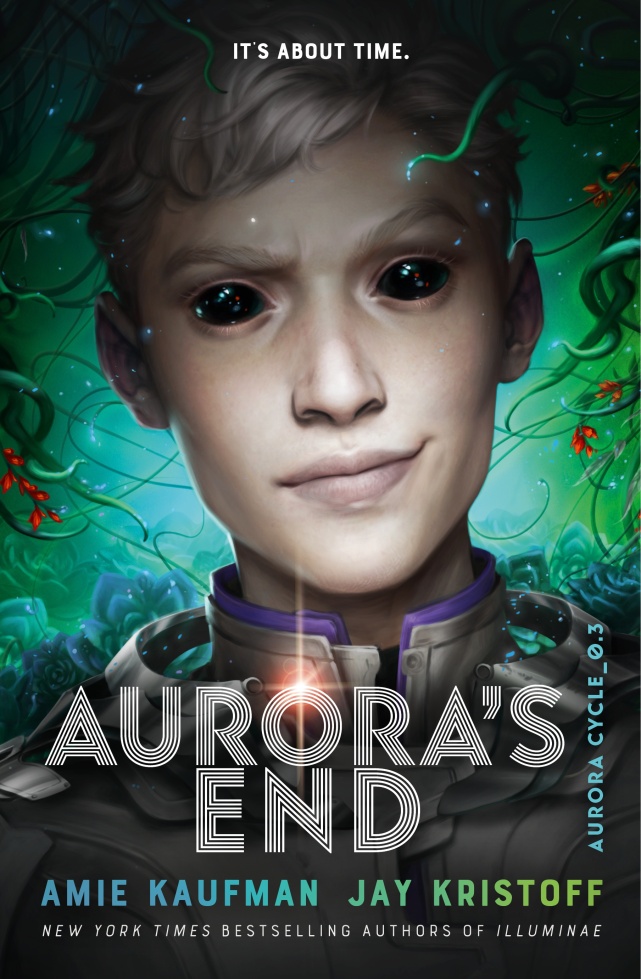
Aurora’s End by Amie Kaufman and Jay Kristoff

Aurora's End Cover

Publisher: Allen & Unwin Australia (Trade Paperback – 2 November 2021)

Series: Aurora Cycle – Book Three

Length: 493 pages

My Rating: 4.5 out of 5 stars

Amazon

The all-star team of Australian authors Amie Kaufman and Jay Kristoff present the third and final novel in their epic Aurora Cycle series, with the intense and clever young adult science fiction novel, Aurora’s End.

Over the last few years, I have been deeply enjoying the outstanding partnership of Amie Kaufman and Jay Kristoff.  Both Kaufman and Kristoff are accomplished authors, with several independent series to their name, such as Kristoff’s Lifel1k3 series (make sure to check out my review for the second book, Dev1at3).  However, I think that some of their strongest work has been together, as Kaufman and Kristoff have previously co-authored the acclaimed The Illuminae Files trilogy.  Their latest collaboration, The Aurora Cycle, has been a particularly amazing young adult science fiction series, and I have been really enjoying its cool story.

The Aurora Cycle novels are set in a far future when humans have expanded out into space and encountered a range of different alien species.  Peace between these species is kept by the Aurora Legion, an intergalactic collation of peacekeepers, made up of teenagers of various species (a slightly more hormonal Starfleet, slightly).  The series follows Squad 312, a group of misfits brought together thanks to the arrival of the mysterious Aurora O’Malley.  Auri is a girl out of time, who was awoken by the squad after centuries frozen in a colony ship and found herself gifted with dangerous psychic powers.  The first book in this series, Aurora Rising, introduced the squad and saw them thrust into the midst of a galactic conspiracy, as a race of plant-based aliens, the Ra’haam, who are plotting to assimilate all life, frame them as terrorists.  The second novel, Aurora Burning, expanded on the threats, the conspiracies, and the character drama, and ended with a massive cliffhanger, with all the surviving members of Squad 312 in great danger and the fate of the universe on the brink.

Following the terrible battle near Earth between the human and Syldrathi fleets, the planet-destroying superweapon was fired, but nothing turned out as expected.  Now, the various members of the galaxy’s last hope, Squad 312, have been flung throughout time.  Scarlett, Finian and Zila have been blasted back into the early days of Earth’s intergalactic travel, when there is no Aurora Legion, no friends, and a ticking clock of doom as the mysterious station they arrived at keeps blowing up.  Subsequently, Auri and Kal arrive years in the future, where the Ra’haam have won, and all hope seems lost.

Trapped in a time loop, Scarlet, Fin and Zila will initiate a desperate plan (again and again) with a new friend, but their mission may end up having unimaginable consequences.  While in the future, Auri and Kal are trapped with the only weapon that can end the Ra’haam threat, if they can get back to the present.  Forced to team up with the most dangerous being in existence, Kal’s genocidal father, Caersan, Auri and Kal embark on a dangerous mission through the Ra’haam controlled future with some unexpected help.

Back in the present, Squad 312’s leader, Tyler Jones, is also running out of time.  Still branded a fugitive by the entire galaxy, Tyler is the only person who knows that the Ra’haam are making their move to destabilise the various governments of the galaxy to start their invasion.  Forced to work alone and against the odds, Tyler needs to travel back to the one place he considers home, the highly secure Aurora Legion headquarters.  All three of these teams will need to survive impossible odds if they are to complete their missions and get back home.  But even if they succeed, can this ragtag team of teenagers really save the entire galaxy, or is the age of the plant-based parasite about to begin?

This was an outstanding novel from Kaufman and Kristoff that served as an excellent and captivating end to this impressive series.  Kaufman and Kristoff really went all out here with Aurora’s End, producing a complex and entertaining narrative that separates out the various characters and presents them with impossible temporal obstacles.  I deeply appreciate the clever narrative that the authors wove around these compelling characters, and it ended up being an exceptionally fun and enjoyable young adult science fiction book that I powered through in two days.

I absolutely loved the cool story of Aurora’s End, not only because it was really thrilling and fast-paced but because it was so ambitious.  I cannot think of another trilogy where, in the final entry, the authors decide to suddenly embark on massive time-travel adventure, with an intense narrative split across three vastly different time periods.  However, it works incredibly well, as Kaufman and Kristoff produced some epic and exciting storylines that remain mostly separate throughout the entirety of the book.  All three storylines are very distinctive, and all of them are pretty fun in their own unique way.  The storyline set hundreds of years in the past is an extremely entertaining event that sees three point-of-view characters trapped in a slowly devolving time-loop that ends every time one of them dies.  The characters are forced to work through an exploding, high-security station to find a way to travel back in time, with a substantial number of hilarious deaths and mistakes along the way.  The storyline in the present follows the Squad’s leader as he attempts to stop the entire alien invasion by infiltrating the most secure location in the entire galaxy without his squad.  Finally, you have the storyline in the future, which is an emotional and powerful post-apocalyptic narrative that sees Auri and Kal forced to contend not only with a hostile galaxy completely taken over by the Ra’haam but also with Kal’s insane and manipulative father.

I felt that all three of these storylines worked incredibly well, and each of them had their own appeal.  I honestly have a hard time faulting any of these distinct storylines, and it was one of those rare occasions in a split-storyline novel where there wasn’t a single character or timeline that I was a little less excited to read about.  If I had to choose a favourite, it would be the storyline set in the past, mainly because I loved the fun opportunities that only a time-loop story can present.  All three storylines were incredibly rich and compelling, and the authors did a good job of layering drama, excitement, character growth and humour through each of them.  While they were mostly separate from each other, the overlapping elements worked incredibly well, and the storylines ended up coming together perfectly towards the end.  The authors also do a good job wrapping up a lot of the unexplained story elements from the previous novels, with certain mysterious events and McGuffins finally revealed in their entirety.  This results in a big and epic finale where all the remaining characters are reunited to face the final threat of the Ra’haam.  It was extremely cool to see all the unique story threads finally come together.  I did think that the authors got a bit too meta-physical in the finale, especially when it came to dealing with the big-bad, but this didn’t really disrupt my overall enjoyment of the story.  I absolutely loved this wacky, clever, and well-planned out narrative, and I am still deeply impressed with how well the entire time-travel story worked.

I have really appreciated the cool and enjoyable writing style that Kaufman and Kristoff utilised throughout the Aurora Cycle, and it worked incredibly well once again in this final book.  Just like with the previous novels, Aurora’s End is told utilising six split perspectives, with each of the surviving squad members going into the final book getting multiple chapters.  Not only do these multiple perspectives help to present a rich and complex character driven narrative but it also helps the reader to really get into the heads of the main characters.  Each part of the book told by a different character has its own unique feel to it, and you really get the sense of each of the characters’ personalities and experiences.  I also love the way in which Kaufman and Kristoff layer in the action and humour throughout the entire novel, with various fun scenes featured throughout.  The action scenes are very intense, and the authors do a great job of highlighting the crazy battles that each of the characters get involved in, whether it be massive space battles, deadly close-combat fights, or sneaky attempts to move through an exploding space station.  The authors also have a great sense of humour, with many fun jokes and observations that made me laugh multiple times, especially around the fun time-loop storyline.  This made Aurora’s End a very easy novel to get through, as the natural narration and fast-paced scenes ensures that readers can power through it quickly, and with little hassle at all.  Due to this being the final entry in a series, readers are encouraged to check out the first two Aurora Cycle novels first before reading Aurora’s End.  However, those readers tempted to start and finish he series here should still be able to enjoy the story as the authors have a very inclusive writing style, and the book also features a highly detailed “stuff you should know” section at the front (very useful for both new readers and those who need a quick refresher).

Just like the previous novels in this series, Aurora’s End is marketed as a young adult read, and I would strongly recommend it to this audience.  Younger readers will deeply appreciate the use of multiple complex teenage characters kicking ass and saving the world, and I think that the authors did a good job of capturing the teenage mindset in their various protagonists.  This was also quite a mature and positive read, with multiple examples of romantic relationships, complex issues, and great portrayals of LGBT+ relationships that will be appealing to the younger audience, especially as the authors do not try to talk down to their chosen readers.  Due to some of these mature elements, I would suggest that this is a more appropriate read for older teens, and this is a series I would have really enjoyed when I was first getting into fantasy and science fiction.  Despite its marketing towards the young adult audience, this is a series easily enjoyed by older readers, and I think that most science fiction fans will have a great time with this series, if they don’t have any objections to following teenage protagonists.  Overall, I think this book will appeal to a wide range of readers and is a particularly good series for teenagers looking for a fun adventure with relatable heroes.

The last thing I want to highlight abut Aurora’s End is the excellent characters featured throughout, especially protagonists Aurora, Tyler, Kal, Scarlett, Finian and Zila.  Over the course of the Aurora Cycle, the reader has had a wonderful time getting to know all the protagonists, all of whom have grown throughout the series, while also experiencing loss, heartbreak, betrayal, and devastating revelations.  I have deeply appreciated the impressive and realistic character growth featured within, and the authors have continued this throughout Aurora’s End, with some major character moments that helped to define all of them and shown how they have grown.  Unlike the previous novels that have focused on a couple of the characters a little more, there was a much more even spread amongst the characters, with each getting their moment in the light.  Indeed, thanks to the cool time travel elements, you get to see multiple versions of one protagonist, with an older version of this character becoming a supporting figure in one of the other storylines.  I deeply appreciated the various character arcs featured throughout this novel, and Kaufman and Kristoff go out of their way to make you run the full emotional gauntlet here.  These arcs include a more comedic one surrounding the sarcastic Finian and the perhaps oversexualised Scarlett as they explore their new relationship while the world continuously explodes around them.  At the same time, the socially awkward Zila has a more serious experience in the time-loop, even as she embarks on a doomed relationship with someone who lived hundreds of years before she was born.

The other three characters also have some major and moving character arcs, especially Aurora and Kal, who are trapped in a future where the Ra’haam won, and everything has been infected by them.  This is a particularly dark storyline, and these two protagonists go through a lot, especially as they keep witnessing all manner of death and destruction around them.  Their arc is further complicated by Caersan, Kal’s father, who has similar powers to Auri and used them to destroy Kal’s home planet.  This results in some major emotional moments, as Auri and Kal are forced to work with an unrepentant Caersan, while also trying to work out their own complex emotions.  Finally, I must highlight the great development at occurred with Tyler, the team’s leader, who, after spending two novels turning Squad 312 into the ultimate team and family, ends up by himself, forced to face literal ghosts from his past with none of his established support.  Tyler really suffers in this book, and you must feel sorry for everything he goes through, even if he does start a passionate, if exceedingly violent relationship with a warrior alien princess.  All of these character arcs are really impressive, and you will be moved by everything these fantastic heroes go through, especially as not all of them will come out of it in one piece.

With this fantastic final book, the team of Amie Kaufman and Jay Kristoff have brought their amazing Aurora Cycle series to an epic and impressive conclusion.  Aurora’s End was an outstanding novel that perfectly wrapped up this excellent trilogy with fun, flair, and exceptional action.  Featuring some amazing characters and a very clever time-travel based storyline, Aurora’s End was an incredibly fun novel that comes highly recommended.  I deeply enjoyed this epic novel, and I really hope that these two brilliant Australian authors team up again in the future for another compelling series.

Amazon

Star Trek: Discovery: Die Standing by John Jackson Miller

Die Standing Cover

Publisher: Simon & Schuster Audio (Audiobook – 14 July 2020)

Series: Star Trek: Discovery

Length: 12 hours and 15 minutes

My Rating: 4.5 out of 5 stars

Amazon     Book Depository

One of the leading authors of media tie-in fiction, John Jackson Miller, returns with his second Star Trek: Discovery novel, Die Standing, an awesome and captivating read that follows the adventures of an excellent protagonist, the evil version of Michelle Yeoh’s Philippa Georgiou.

After the dramatic conclusion of the first season of Star Trek: Discovery, Emperor Philippa Georgiou, former ruler of the Terran Empire, a power-hungry and xenophobic human interstellar empire from a twisted alternate universe, has been stranded in the main Federation’s universe.  Biding her time while trapped on the Klingon home planet of Qo’noS, Georgiou is finally given a the opportunity she has been waiting for when Starfleet’s covert spy organisation, Section 31, offers her a chance to work as one of their agents.  However, Georgiou is far more interested in gaining her freedom and plotting to use Section 31’s resources to flee beyond Starfleet’s control.

Georgiou’s plans change when she receives news about a mysterious attack on one of Starfleet’s military vessels by a malicious and dangerous cosmic entity, one that her counterpart in this universe may have seen years before.  Intrigued by the description of the attack, Georgiou decides to remain with Section 31, especially as it bears a striking similarity to a powerful superweapon that was kept from her when she was Emperor.

Determined to use this weapon to regain her stolen power and take control of this weaker universe, Georgiou accepts Section 31’s proposal to travel to an isolated section of space where the creature was first witnessed.  Travelling with two mismatched minders who are already well out of their depth, Georgiou attempts to contact an old flame of this universe’s Georgiou, one who has a lot of influence in this quadrant of space.  Forced to conduct a subtle investigation amongst the secretive alien races of the sector, Georgiou and her companions follow the clues that will lead them to the entities they seek.  But what will happen when the former Terran Emperor has ultimate power within her grasp?  Will she ensure the safety of the Federation she despises, or will another universe bow before her might?

This was a fun and impressive new novel from bestselling author John Jackson Miller.  Miller is an interesting author who has a lot of experience writing tie-in stories, having previously written several pieces of Star Wars fiction as well as some notable Star Trek novels.  I have not previously read anything from Miller before, although I think that will have to change due to how much I enjoyed Die Standing.  Miller has written a couple of books that have been on my radar for a bit, including a previous Star Trek: Discovery novel, The Enterprise War, and the Star Wars: A New Dawn novel, which ties into the Star Wars: Rebels animated show.  This latest novel from Miller is an exceptional read, as he has come up with a wildly entertaining and clever novel based around the excellent character of Philippa Georgiou.  Backed up with an extremely compelling story, some interesting side characters and some wonderful universe-building, this is one of the better if not the best Star Trek novels of 2020, and ended up being an awesome read.

At the heart of this fantastic novel is a captivating and intense narrative that sees the protagonist and her companions venture into an unknown area of space in search of a creature with deadly potential.  This was an extremely clever and well-written character-driven story that features an excellent Star Trek narrative, filled with all manner of espionage, betrayal and war.  I really liked the way that the author blended together familiar Star Trek elements with a thrilling espionage narrative, especially one that was centred on a morally ambiguous protagonist who plans to betray everyone she encounters.  This makes for a number of great scenes, and I really liked the fascinating and clever places that the story went.  There are a number of particularly good twists featured throughout the book, and while I was able to predict where some parts of the story were going to go, I found myself pleasantly surprised and intrigued at some of the other reveals.  I also enjoyed the way in which Miller worked in some compelling comparisons between the two mirror universe, one mostly good and the other mostly evil, and it served as a clever and distinctive part of the book, especially as Miller does a lot with only one scene set in the Terran universe.  All of this makes for an exciting and powerful story that readers are going to have a wonderful time reading.  I really enjoyed the dark, thrilling and twist laden narrative and it honestly did not take me long to become hopeless addicted to this incredible Star Trek novel.

Die Standing is one of those tie-in novels that require some prior knowledge of its associated content to fully enjoy.  In this case, readers really do need to have a good understanding of the Star Trek: Discovery television show, as much of the story is derived from key events in the first and second seasons.  In particular, knowing the full tale around the character of Philippa Georgiou (both versions) is quite essential to fully appreciate the book’s story elements and character work.  At the very least, having some general knowledge of the Star Trek universe and the events of some of the shows would be useful, especially as the book is fairly dependent on some established story elements, such as the evil alternate universe.  That being said, Miller does do a really good job making this novel accessible to those readers whose knowledge of the genre might be lacking, and many of the key elements are explained in sufficient detail to follow the story and enjoy it.  However, this is definitely a novel most suitable for established Star Trek fans, especially as the author loads it up with a ton of fun or clever references to Star Trek: Discovery and some of the other television shows.  For example, this novel features the great inclusion of a younger version of the Dax symbiont (see more below), and I personally really liked how a major part of the book’s plot revolved around a key moment from Captain Kirk’s backstory (from The Original Series episode Obsession), not only showing the event from a different perspective, but also adding in some explanation for its origins and the reaction from Starfleet.  Die Standing also serves as a rather good bridge between the first and second seasons of Star Trek: Discovery, and it does an excellent job setting up the main character for her reintroduction to the show.

While this book did have an exceptionally captivating story and some cool Star Trek elements, the absolute highlight of this book has to be its wonderful protagonist (and occasional antagonist), the evil Terran version of Philippa Georgiou.  Die Standing features Georgiou in all her evil glory and she quickly makes an impression of the reader, especially after one particularly brutal and entertaining prison break sequence at the start of the book.  Pretty much every scene that features Georgiou is highly entertaining, and the snarky, arrogant personality she displays to anyone she meets proves to be spot on to how she is portrayed in the television show.  While I really enjoyed this character in Star Trek: Discovery (she is easily one of the best parts of the show) I personally felt that Miller actually helped to make Georgiou an even more compelling character throughout the course of this book.  The author really dives down into her personality and motives, showing just how twisted and self-serving she can be while also reflecting on all the things she has lost and the changes she is forced to deal with.  Georgiou goes through some fascinating self-examinations in Die Standing, especially when she is confronted with the legacy of her dead counterpart in this universe, and this serves as a fantastic emotional centre of the book.  The author’s impressive use of this fantastic character works extremely well, and it certainly helps Die Standing stand out from some of the other Star Trek novels of 2020.

Die Standing also features an excellent cast of side characters who add a lot to the story.  There are two characters who particularly stand out, Emony Dax and Sean Finnigan, who both serve as alternate protagonists, with significant parts of the book told from their perspective.  While Dax and Finnigan are nowhere near as dynamic as Georgiou, they are both distinctive in their own ways, and Miller does a good job at making them both likeable and compelling parts of Die Standing.  Emony is a young Trill gymnast who is the third host of the Dax symbiont.  This makes her an earlier incarnation of the Dax character who appeared in the Star Trek: Deep Space Nine television in two different guises (Jadzia Dax and Ezri Dax).  Thanks to her youth, both as a symbiont and a host, this version of Dax is a little more unsure and scared then her later counterparts, but is determined thanks to the terrible things she witnesses at the start of the book.  While she is initially extremely cowed by Georgiou’s overwhelming personality, Dax grows throughout the book and is eventually able to influence Georgiou.  Deep Space Nine fans will no doubt enjoy seeing this earlier version of Dax, and I rather appreciated the excellent character growth she experienced.  The other main character, Sean Finnigan, is definitely one of the more entertaining characters in this book.  Finnigan is an unashamedly Irish character who serves as the book’s comic relief.  A wild and unruly former Star Fleet officer, Finnigan is drafted into the mission due to an interesting connection he has to Georgiou, as a murderous, brainwashed version of himself served as the Emperor’s assassin in the mirror universe.  While Finnigan is a mostly entertaining character, joking, drinking and socialising with all everyone he meets, there are some deeper elements to his character, especially as he spends a good part of the book trying to balance his real personality with the more insane version of himself that Georgiou tries to bring out.  Dax and Finnigan form a compelling team with Georgiou, and they ended up being an extremely good trio the anchor the story around.

I also quite enjoyed the intriguing Star Trek universe-building that Miller featured throughout Die Standing.  A key part of this book’s story is set within an isolated section of space that is home to three distinctive alien races who are attempting to stay separate from the Federation.  All of these species are quite intriguing and inventive, and include a race of giant living spindles, an intensely warlike species of living tanks and a group of gaseous psychics.  Miller does an exceptional job exploring each of the three new alien species throughout the course of the book and giving them each unique characteristics, histories, and personalities.  Not only are these aliens quite fascinating in their own right but each of their specific traits plays into the overall story extremely well, with some fantastic twists tied into them.  In addition, Miller also spends time exploring some of the differences between the main Star Trek universe and the mirror universe that contained the Terran Empire.  Not only is there an excellent opening sequence set in this mirror universe that showcases the brutal nature of this alternate reality, but there are a number of fantastic discussions that examine how different these universes could be.  Miller ensures that the protagonist Georgiou spends a good amount of time recounting some of the horrifying details of her universe to her companions (mostly to unnerve them), and it proves quite entertaining to hear all of her various stories, especially as most are apparently not exaggerated.  I also loved the fun way that Miller altered famous historical quotes to show how different the universes could be, with a number of classic lines twisted into something far more brutal and cynical, such as “Let them eat field rations” from General Antoinette.  The book itself is also broken up into five separate sections, based upon the Terran stages of grief (for coping with a loss of status): defiance, murder, plundering, destruction and vengeance, with each sections starting up with a quote from the Terran universe that describe its history.  Needless to say that Star Trek fans are going to love the cool additions that Miller works into the expanded universe in this novel, and I personally had a wonderful time seeing all the inventive and entertaining things that the author could come up with.

Like most of the Star Trek books I have had read in the past, I chose to check out Die Standing’s audiobook format.  This was, as always, an excellent way to enjoy this clever Star Trek novel, and I had a wonderful time listening to the story unfold.  Die Standing has a run time of 12 hours and 15 minutes, which is actually the longest Star Trek audiobook that I have so far listened to, but I was still able to breeze through it in relatively short order once I got hooked on the story.  In order to tell this amazing book, Die Standing makes use of the vocal talents of narrator January LaVoy.  This is the first audiobook I have heard narrated by LaVoy, although she did voice a minor character in Star Wars: Dooku: Jedi Lost.  She has also served as narrator for several books I have physically read, such as Star Wars: Galaxy’s Edge: Black Spire, Star Wars: Last Shot and The Night Swim, and she has also narrated a couple of books I am hoping to checking out in the future, including Star Wars: Phasma.  I have to admit that I was initially a little thrown to have LaVoy as narrator, as this was the first Star Trek audiobook I have listened to that was not narrated by Robert Petkoff.  However, it makes a lot more sense to feature LaVoy as narrator due to the female lead, and I really enjoyed listening to her narration of this book.  LaVoy did an incredible job bringing the characters to life throughout Die Standing and she ascribed some very apt and distinctive voices to each of them.  I was particularly impressed with the fantastic voice she utilised for Philippa Georgiou, and I felt it was very similar to how the character was portrayed in the television show.  LaVoy makes sure to channel all of Georgiou’s scorn and sarcasm to the reader, and it was an absolute treat to listen to her villainous rants throughout the book.  I also quite enjoyed the voice that LaVoy utilised for Sean Finnigan, Irish accent included, and it helped to enhance him as a fun and entertaining character.  All of this leads to quite an exceptional Star Trek audiobook and I would strongly recommend this format to anyone interested in checking out Die Standing.

Star Trek: Discovery: Die Standing is an amazing and impressive Star Trek novel from John Jackson Miller that was an absolute joy to read.  Miller has crafted together a captivating and clever narrative for this book that follows several excellent protagonists on a high-stakes adventure through all manner of intrigue and betrayal.  Featuring some compelling story elements, fantastic world-building and an awesome evil protagonist, Die Standing was an exceptional novel and it ended up being one of my favourite Star Trek novels I have so far had the pleasure to read.  A highly recommend piece of tie-in fiction, fans of the Star Trek: Discovery television show really need to check this fantastic book as soon as possible.

Amazon     Book Depository