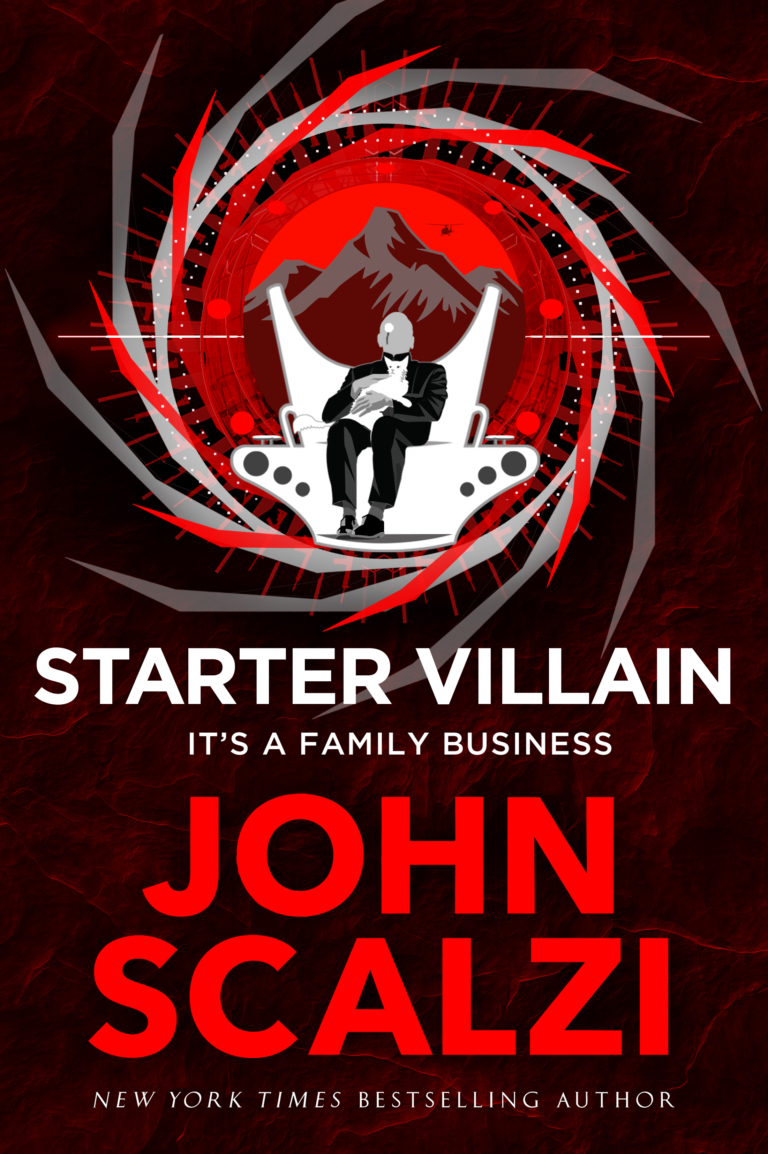
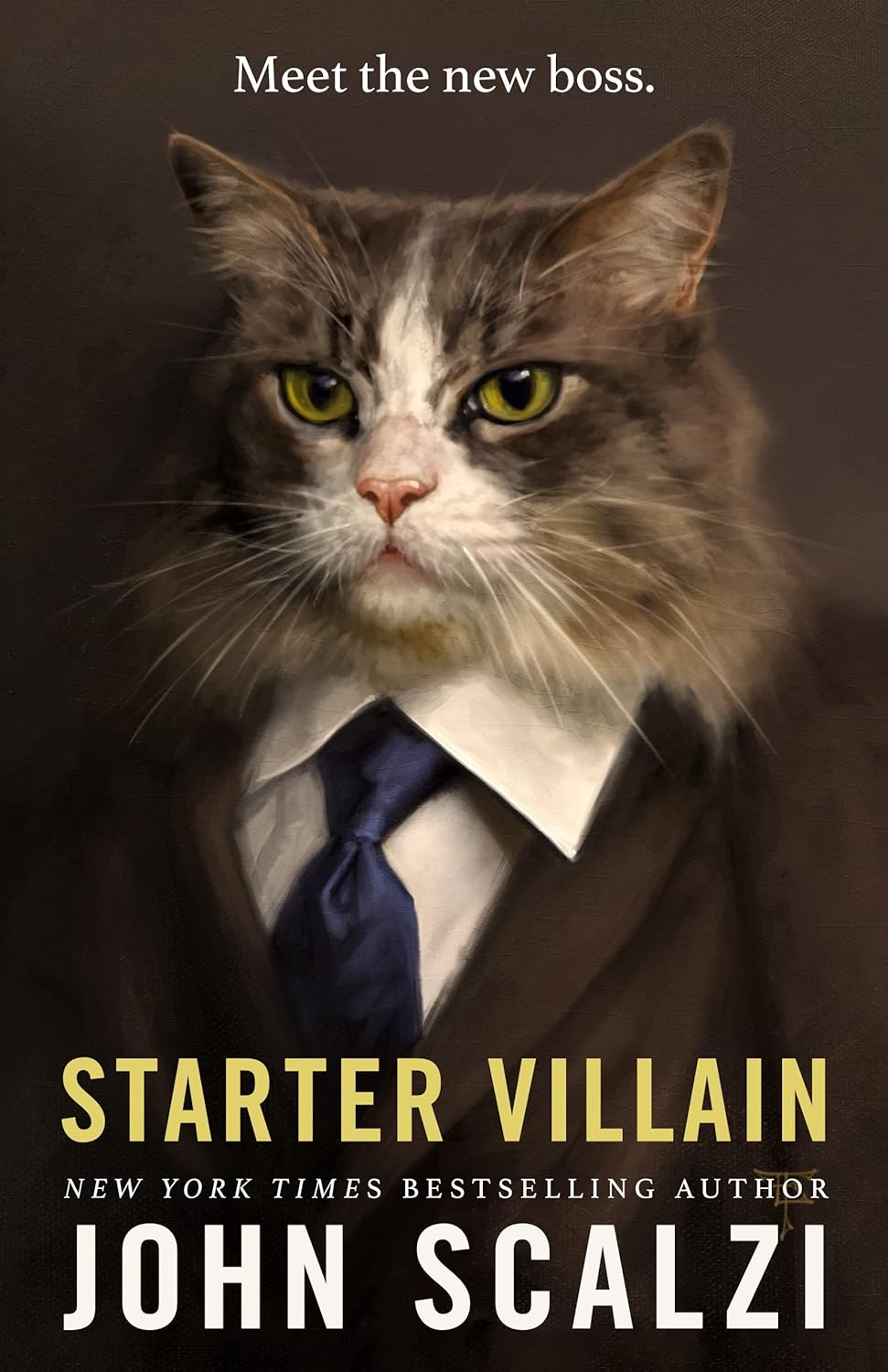
Quick Review – Starter Villain by John Scalzi

Publisher: Tor (ebook – 23 September 2023)

Series: Standalone

Length: 256 pages

My Rating: 4.5 out of 5 stars

Amazon

As we are getting towards the end of 2024, it’s probably about time I got around to writing something about one of the more hilarious and wildly entertaining books I checked out last year, the outstanding novel Starter Villain by John Scalzi.

John Scalzi is an outstanding science fiction author who has produced some intriguing and thoughtful books over the years.  Best known for his Old Man’s War series that followed the science fiction adventures of old human military volunteers whose minds are transferred to younger, genetically modified body, Scalzi is a highly inventive writer who creates some elaborate and powerful scenarios.  While he has written some very compelling science fiction series, I best know Scalzi from his standalone books where he and turns some outrageous ideas into wonderful tales of humanity.  My favourite is Redshirts, a fantastic and very clever Star Trek parody that imagines life aboard an Enterprise-esque ship from the point of view of the expendable lower-decks crew.  I also had a ton of fun with Scalzi’s 2022 novel, The Kaiju Preservation Society, which showcased the intriguing adventures of an organisation dedicated to preserving kaiju in a parallel universe.  All these books were very fun, which is why I made sure to grab a copy of the 2023 release, Starter Villian, which had a great plot behind it.


Plot Synopsis:

Inheriting your uncle’s supervillain business is more complicated than you might think. Particularly when you discover who’s running the place.

Charlie’s life is going nowhere fast. A divorced substitute teacher living with his cat in a house his siblings want to sell, all he wants is to open a pub downtown, if only the bank will approve his loan.

Then his long-lost uncle Jake dies and leaves his supervillain business (complete with island volcano lair) to Charlie.

But becoming a supervillain isn’t all giant laser death rays and lava pits. Jake had enemies, and now they’re coming after Charlie. His uncle might have been a stand-up, old-fashioned kind of villain, but these are the real thing: rich, soulless predators backed by multinational corporations and venture capital.

It’s up to Charlie to win the war his uncle started against a league of supervillains. But with unionized dolphins, hyperintelligent talking spy cats, and a terrifying henchperson at his side, going bad is starting to look pretty good.

In a dog-eat-dog world…be a cat.


This was a highly entertaining novel from Scalzi, who provides his own unique take on supervillains in all the best ways.  Starting off with a very comical funeral scene, Starter Villain only gets better from there as the protagonist, Charlie, finds his life unexpectantly changed when he inherits his uncle’s supervillain business and associated wealth.  Scalzi provides a fantastic introduction to the unique new world of super science and sinister business practices, and you are soon caught up in Charlie’s unlikely rise to the top.  The first half of the book is loaded with intriguing scenes as Scalzi lets his imagination run wild, and you have a fantastic time learning about sentient cats, crude talking dolphins constantly going on strike, and the other unlikely inventions and people that now make up Charlie’s life.  This compelling introduction to the world works well in setting up the second half of the story, as Charlie meets a cabal of similar uber-rich supervillains who all seek to exploit him.  When a series of events outside of his control force him into a battle of survival against these supervillains, Charlie needs all his new allies and his own unique ideas to win the day, even if victory isn’t quite what he imagined.

Starter Villain was such a lovely and impressive read, and I loved seeing Scalzi utilise his humour into something more terrestrial, yet still out of this world.  Featuring the author’s typical fast pace, Starter Villain hits the ground running and throws you right into the middle of Scalzi’s fantastic and memorable ideas.  The resulting story is clever, addictive, and features some amazing twists, all of which is very awesome to see unfold.  While there is a lot of mad science, Scalzi does try to ground the supervillain antics, and I loved the author’s thoughts on how such an organisation could exist in the modern world and what sort of nefarious actions they would participate in.  Naturally this means corporations and the uber-wealthy, which is depressingly accurate if you consider recent events, although this does mean that the antagonists are very easy to dislike and entirely unredeemable.  The author loads in so much clever humour around the general supervillain scenario, and I loved the fantastic jokes about the profession, the inventions that are being created, and the unusual ways they stay in power.  A lot of jokes about supervillains also provide some excellent commentary on current society, which cynical people like me will enjoy (a joke about a potential Australian recruit to the supervillain cabal hit close to home, which was just perfect).  This is a hilarious and well-put together read that expertly showcases the author’s inventive spirit.

I also want to mention the fantastic range of complex and eccentric characters featured throughout Starter Villain, who helped to make the story even more unique and funny.  Most of the book’s focus goes around the protagonist, Charlie, who finds himself thrust into a new world of dangerous rich elites and supervillain logic.  Charlie proves to be a great central figure for Starter Villain’s plot, mainly because he plays a great everyman character whose reaction to the narrative’s crazy events mirrors that of the reader.  While slightly bland compared to the other outrageous characters, Charlie does experience some excellent growth, especially as he learns to take responsibility and to appreciate the life he has.  I also enjoyed how Charlie, despite being new to the supervillain lifestyle, was able to work out solutions to his organisation’s big problems often by being his typical thoughtful self.  The rest of the characters in Starter Villain are all allowed to go wild due to having Charlie as the perspective protagonist, and I loved the array of talking dolphins, unusual scientists, murderous goons and rich manipulators that Charlie had to either work with or overcome.  My favourite figures were easily the highly intelligent sentient cats, who really run the company and who have been manipulating Charlie his whole life.  Scalzi has a lot of fun showcasing the cunning cats in charge, and I felt this whole awesome crew of characters helped to turn Starter Villain into an extremely fun read.

Overall, Starter Villain was an amazing read from John Scalzi that proves impossible not to love.  Featuring the author’s infectious humour and love for inventive scenarios, Starter Villain was such a great book, and I deeply enjoyed the author’s take on supervillain fiction.  Clever, unique and so much fun, Starter Villian is an exceptional read, and I really wish I had written a review for it sooner.  I will have to pick up my Scalzi game in the future, and not only have I got a copy of Old Man’s War to read at home, but I am eagerly awaiting his next book, When the Moon Hits Your Eye, which features a very, very interesting sounding story about the moon literally transforming into cheese, an idea I have so much love for and cannot wait to check out.

Amazon

Throwback Thursday – Identity Crisis by Brad Meltzer, Rags Morales and Michael Bair.

Identity Crisis Cover

Publisher: DC Comics (Paperback – 1 October 2005)

Series: Identity Crisis Limited Series

Writer: Brad Meltzer

Penciller: Rags Morales

Inker: Michael Bair

Letterer: Ken Lopez

Colorist: Alex Sinclair

Length: 288 pages

My Rating: 5 out 5 stars

Amazon     Book Depository

Welcome back to my Throwback Thursday series, where I republish old reviews, review books I have read before or review older books I have only just had a chance to read.  For this week’s Throwback Thursday I take a look at one of my absolute favourite comic book limited series, the epic 2004 DC Comics event, Identity Crisis.  (Quick warning, there are spoilers ahead).

Identity Crisis #1

It is fair to say that the early to mid-2000s was one of my favourite periods of comic books, with some truly cool and epic ongoing and limited series being released.  This was particularly true for DC Comics, who produced some of their best work during this time, many of which rank amongst my all-time favourite comic series.  This easily includes the exceptional and brilliant crossover event, Identity Crisis, which to my mind is one of the best limited series ever written.

Made of seven issues, Identity Crisis combines the unique writing talent of thriller author Brad Meltzer with the artistic stylings of veteran DC Comics collaborators Rags Morales and Michael Bair.  This ended up being a near perfect combination of talents and skill, and I have a lot of love for the exceptional story, which absolutely hooks me every time, and its outstanding associated artwork.  I particularly impressed with the addition of Meltzer, who, despite his more literary background has written some of the absolute best and most human comics I have ever had the pleasure of reading, including Green Arrow: The Archer’s Quest and the two Justice League of America storylines, The Tornado’s Path and The Lightning Saga.  However, his story in Identity Crisis is particularly powerful and thought-provoking, and it ends up being a comic that completely changes everything you knew about your favourite heroes.

For years the members of the Justice League of America have protected the world from all manner of evil and destruction, always prevailing no matter the odds.  But who can protect them when someone goes after those closest to them?  And what if they actually deserve the punishment being visited upon them?

On an unremarkable night, a mysterious attacker breaks into the home of long-serving Justice League associate, Ralph Dibny, the Elongated Man, and commits a terrible crime, the murder of Ralph’s beloved wife, Sue Dibny.  With no evidence about who the killer is and no idea how they breached the Dibnys’ impressive security, the superhero community rallies behind their bereaved friend and seeks to find the killer by any means necessary.

As the rest of the heroes seek answers at any potential suspect within the supervillain community, the Elongated Man and a small group his closest friends hunt for a minor villain, Dr Light, whose secret connection to the League’s darkest moment may hold the answers they seek.  However, when a second attack occurs on another publicly known relative of a superhero, Jean Loring, the former wife of the Atom, it soon becomes clear that someone else is targeting the heroes and their loved ones.

Identity Crisis #1b

As Batman, Superman, Green Arrow and others attempt to get to the bottom of the case, cryptic threats to one hero’s relative reveal that whoever is targeting them knows all of the League’s secrets, including their hidden identities.  As even more tragedies befall the superhero community, dark secrets from the League’s past are brought into the light and no-one will be prepared for the terrible truth behind these brutal murders.  Can the League weather this latest attack, or is this the beginning of the end for the world’s greatest heroes?

Damn, no matter how many times I read this comic, the tragic and powerful events of Identity Crisis still really get to me.  This exceptional comic contains one of the most impressive narratives I have ever seen in a limited series, taking the reader on a captivating and emotional dive into the world of your favourite heroes.  Perfectly combing a dark, mysterious narrative with incredible character work and some truly amazing artistic inclusions, this comic gets an extremely easy five-star rating from me.

For Identity Crisis, Brad Meltzer really went to the well, producing an insanely compelling and moving story that relentless drags you in and introduces you to a completely new side of your favourite heroes.  Utilising his experience as a crime thriller writer, he produces a powerful, character driven superhero narrative with detailed crime fiction elements to create an exceptional and unique story.  Identity Crisis has an amazing start to it, which not only carefully introduces several key figures but also installs some dark tragedy, as the wife of a superhero is killed off.  The subsequent investigation into her murder by the enraged superhero community is extremely compelling and intense, as the emotional heroes turn over every rock and stone, much to the horror of the villains.  However, it is soon revealed that several members of the Justice League are harbouring a devastating secret, one that could reveal the identity of the killer.  This secret becomes one of the most important parts of the first half of the series, and it leads to an epic, action-packed fight sequence against a particularly dangerous foe.

Identity Crisis #2

The story starts to go in a bit of a different direction at this point, with the above secret not really panning out regarding the investigation.  However, other superhero relatives, both public and secret, are targeted, resulting in pandemonium around the characters.  I loved the narrative’s move to a more classic investigation at this point, as the heroes start following every lead they can, while more character development and big moments are explored.  This all leads up to the defining moment when another superhero loses a loved one and the identity of the killer is seemingly revealed.  However, this turns out to be a bluff, as the real killer is still hidden.  The reveal of who did it and why are revealed pretty suddenly towards the end, with some curious and clever motivations exposed.  This leads to a tragic and heartbreaking conclusion, as more secrets are revealed, dangerous lies are uncovered, and several characters leave the story more broken and destroyed than ever before.  You will be thrown through the emotional wringer as you check this comic out.

I deeply enjoyed the way that Meltzer told Identity Crisis’s excellent story, especially as it quickly and effectively engrosses the reader and ensures their undivided attention.  The author utilises a mass-character narrative that follows a substantial collection of heroes and villains, many of whom have distinctive or semi-separate storylines.  This works to tell an intriguing, rich narrative that not only has some clever dramatic components but also allows for some intriguing and compelling retcons and expansions to the already elaborate DC universe.  It is very cool how the story developed into more of a murder mystery/thriller story as the comic progressed, and this really played to Meltzer’s strengths.  The investigation is handled very well, and I liked how the superhero elements altered and enhanced it in some clever ways.  The mystery itself is complex and clever, with Meltzer adding in some great twists, false leads and compelling surprises to keep the reader guessing.  The twist about the actual killer is pretty good, and Meltzer did a great job layering in hints and clues throughout the rest of the story while also introducing a few good alternative suspects.  While the motivations and complexities surrounding the killer’s actions are great, I did think that how the protagonists worked it out was a little abrupt, and it might have been a little better if they worked it out from some earlier clues.  The use of female characters wasn’t the best either, especially as most of them are there simply to be victims in one shape or another.  Having a long-established character getting both raped and murdered in a comic as a plot device is pretty unfortunate, and some stronger female figures might have helped balance this out.  Still, this ended up being an awesome read and I deeply enjoyed how it turned out.

One of the things that I really enjoy about Identity Crisis is the interesting examinations that were included as part of the plot.  Meltzer and the artistic team obviously had a lot of fun exploring or introducing some cool aspects of the DC Universe in this series, especially when it comes to the secret or hidden lives of superheroes and supervillains.  I particularly loved the in-depth examination about how both groups are officially or unofficially organised, and there are some very intriguing views of them socialising or working together.  The inclusion of a highly organised superhero death investigation squad, made up of a range of random heroes (the Ray, the Atom, Animal Man, Mister Miracle and two of the Metal Men) is particularly clever, as is the way the various heroes organise into a vengeful posse to question potential suspects.  The deep dive into the importance of a superhero secret identity also becomes an important part of the story, especially as the loss of the secret brings pandemonium thanks to the killer stalking them.  I also loved the counterbalance look at organised villainy, and there are some excellent scenes that see the villains gathering to socialise or talk shop.  Having an organising force like the Calculator, as well as a secret space station hangout, is pretty elaborate, and the deeper look at the villains of this universe, definitely gave Identity Crisis a compelling and intricate edge.

Identity Crisis #3

However, easily the most groundbreaking and compelling new inclusion to the universe is the reveal about the unofficial league within the Justice League who have some dark secrets.  Made up of heroes Green Arrow, Black Canary, Hawkman, Zatanna and Atom, as well as the Silver Age Green Lantern and Flash, this group of heroes apparently operated separately of the main Justice League during their classic Silver Age adventures, acting as their clean-up crew.  This retcon by Meltzer provides an interesting explanation for why villains never remember the secret identities of the heroes they switch minds with or whose dreams they invade, namely they have their mind erased by Zatanna’s magic after being captured by this inner-League.  While this is already a dark move by these established heroes, it gets even worse when they are forced to reveal that they intentionally destroyed Dr Light’s brain to make him less of a threat.  This and other revelations, acts to make many of your favourite heroes appear much more morally grey and fallible, and it was a particularly impressive and monumental inclusion, that will have grave consequences down the line for the entire universe.

Unsurprisingly for something written by Meltzer, Identity Crisis contains some insanely complex and impressive characters who form the heart of the tale.  Due to the way the story is told, Identity Crisis follows a massive cast of comic characters, including several obscure or underappreciated figures.  Meltzer does a brilliant job of utilising all these established characters throughout his story, with nearly every major cast member getting a moment to shine in some way or another, and multiple figures who were underutilised or unappreciated before this comic were given brilliant and defining second chances here.  While the use of multiple focus characters had the potential for a scattered narrative, Meltzer was able to direct the flow of the story around all these various protagonists and antagonists perfectly, and you still get a tight and concise story, which also takes the time to dive into each of these figures and showcase them to their greatest degree.  As I mentioned before, there is a real focus on highlighting the darker side of the superhero characters throughout Identity Crisis, and you end up really seeing these fantastic figures in a whole new scary light.

Let’s start with Ralph and Sue Dibny.  I must admit that the very first time I ever read Identity Crisis, many years ago, I honestly had no idea who Elongated Man and his wife were, as they were a little obscure.  However, Meltzer really goes out of his way to feature them in this story (even adding in a few retcons) and you are given a great introduction to them at the start.  In just a few panels, you understand who these characters are and what they mean to each other and the other superheroes, as well as some unique characteristics and relationship quirks.  This excellent introduction makes you start to care about them just as Meltzer brings the hammer down and kills Sue.  The subsequent grief, rage and despair from Elongated Man is just heartbreaking, and you go through the rest of the comic seeing him attempt to recover from these terrible events.  This amazing use of characters at the start of the comic has a great flow-on effect to the rest of the story, and you become exceedingly invested in finding the killer as a result.

Identity Crisis #4

From there, a lot of the superhero focus goes to the surviving members of the Justice League who formed the league within the League I mentioned above.  There is some exceptional character work around some of these team members, especially as they come to terms with the decisions they made in the past and how they are impacting them now.  I loved seeing them attempt to justify their actions to the other heroes, even their darkest decisions, especially as you can understand why they did what they did, while also feeling disappointed in them.  You really get a sense of determination and shame from them as the story continues, and you see all of them go through a lot in both the past in the present story.  Despite multiple differences, this team are still friends and comrades, and watching them come together to brawl with some of the most dangerous characters is pretty heartwarming, even if darker elements lie just beneath the surface.

While there is a focus on these inner-Leaguers, some of them are utilised a lot more frequently than others, particularly the original Green Arrow, Oliver Queen.  Green Arrow is an excellent figure in this comic and is probably the closest thing to a heroic narrator/central protagonist the story has.  His unique perspective on the events acts as a good foil to many of the other characters, such as Batman and Superman, and he proves to be a calm, if potentially vengeful figure for much of the story, organising many of the League actions and forensic investigations.  He also proves to be the voice of reason for the inner League, calmly justifying many of their actions and serving as a bridge between this existing group and the newer Flash and Green Lantern.  Despite his belief that they are doing the right thing, you can see some real emotion and regret in his face, especially when the further revelations about Dr Light and Batman come out.  I also appreciated the deeper look into his antagonistic relationship with Hawkman, which partially originated in the past events mentioned here, and it is interesting to see how the events of this comic impact future Green Arrow storylines.

Aside from Green Arrow, other members of this secret League who get an intriguing focus include the Atom, Ray Palmer, and his ex-wife, Jean Loring.  Due to his status as another public hero, Atom and Jean are also targeted throughout the story, and you end up getting a rather intense and fascinating look at both.  Watching their failed relationship rekindle is a nicer part of most of the comic, although eventual reveals and tragedies naturally ruin it and smash everything around.  Still, their complicated emotions and issues surrounding their fractured relationship make for some of the best parts of the comic.  I liked the interesting look at Zatanna throughout the comic, especially as she is largely responsible for some of the worst moments of this group of heroes, as she clearly feels guilty about her magic messing with the villain’s minds.  I also need to highlight the younger Flash, Wally West, who finds out about the actions of the other characters during the current events of the comic.  It is absolutely heartbreaking to see Wally learn that his mentor and predecessor, Barry Allen, was not as perfect as he imagined, and actually participated in some of the team’s worst events.  The distress he exhibits with every subsequent reveal is showcased through the comic’s art extremely well, and his subsequent guilt as he is forced to keep it secret from other Leaguers like Batman is quite noticeable.

Identity Crisis #5

As you can expect from any major DC Comics crossover event, members of DC’s Big Three are strongly featured throughout Identity Crisis.  While Wonder Woman only has a few intriguing scenes, in which you get to see both her ferocity and her kindness, there is much more of a focus on Superman and Batman.  Superman gets some great sequences throughout Identity Crisis, especially as the creative team sinisterly focus on his family and friends, all of whom are potential targets.  Watching Superman slowly get frustrated with the investigation, especially when Lois is threatened, helps to enhance the seriousness of the story, and he has some powerful moments here.  I did appreciate the way in which Meltzer attempted to paint the big blue Boy Scout in a darker light, as it is revealed that even the supposedly righteous Superman is not as innocent as you’d believe.  It is subtly implied that Superman always knew what the inner League was up to (yay for super hearing), and chose to ignore it for convenience.  This brilliant and dark suggestion that even Superman isn’t infallible is a pretty weighty one that  helps to enhance the weight and power of Identity Crisis’s narrative.

Batman is a lot more involved in the story and leads his own investigation into who is behind the killing.  Even though he does not actually appear until halfway through the comic, he is a heavy presence throughout Identity Crisis, both because of his brusque, loner ways of trying to solve the crime, but because of the dark shadows of the past.  There are multiple moments that revisit his childhood and the death of his parents, which parallels some of the other losses in Identity Crisis, and you get to see the human side of grief impacting this usually stoic character.  Batman’s storyline gets even more intense when it is revealed that part of his memory was erased by his fellow Leaguers to cover up their actions surrounding Dr Light, which is a very haunting inclusion.  Meltzer makes this even more intriguing by having Green Arrow suggest, mostly out of guilt, that Batman likely has done something similar in the past, while also acknowledging that he has likely already deduced that his memories were erased.  This really makes you consider Batman’s relationship with the rest of his heroes, and it certainly has a big impact on future Batman storylines.

The Batman impact on this story is also felt through the great focus on the current Robin, Tim Drake, who plays a surprisingly big role in the events of Identity Crisis.  At the start of the comic, Tim is one of the few members of the Bat-family who still has a father, which puts him at odds with Batman and the Robin predecessors.  As his father has only just discovered his dual identity as Robin, he becomes one of the more interesting protagonists, as the comic explores the stress of the superhero lifestyle on family.  Tim’s storyline ends up being extremely tragic when his father is murdered.  Watching Robin talk to his father over the phone as he’s about to die is just damn horrific, and your heart can’t help but break during that epically drawn-out scene where he and Batman arrive too late.  The subsequent parallel between him, Bruce Wayne and previous Robin Dick Grayson during this moment is particularly poignant, and it results in a whole new chapter of this amazing incarnation of Robin.

Identity Crisis #6

While there are a few other interestingly featured heroes in Identity Crisis, I’m going to start talking about the villains, as many of them have a brilliant role in this comic.  Thanks to Meltzer’s fantastic writing, Identity Crisis proves to be just as much about the villains as the heroes, as many of them are deeply impacted by the events disclosed here.  While I won’t reveal the identity of the killer here (I’m keeping some spoilers locked up), I will say that their motivations are pretty fascinating and provide a compelling insight into the super lifestyle.  The rest of the villains in Identity Crisis are fair game for discussion, though, and I deeply loved the creative team’s excellent examination of them.

Easily the villain I need to talk about the most is Dr Light, an old school Justice League villain who had not been really utilised in recent years.  Mostly known before this comic as the Teen Titans’ punching bag, Meltzer completely revitalised the character in Identity Crisis and, with a stroke, turned him onto one of the most deranged and dangerous figures in the entire universe.  It is revealed throughout the comic that Dr Light used to be an extremely powerful villain, but after invading an empty Watch Tower and raping Sue Dibny, the League brutally took him down, erased his memory of the event and then magically lobotomised him.  This resulted in him becoming the moronic and weakened villain who was routinely taken down by the teenage heroes and other embarrassing foes.  This entire reveal is pretty damn epic and horrifying at the same time.  Not only does Dr Light seem excessively evil and deranged in the flashback scenes, but the shocking revelations of his actions immediately make you hate him.  Meltzer’s explanation for why he turned into such as pathetic creature (aside from the real reason of capricious authors) really hits home hard, and even though Dr Light is a terrible person, you can’t believe that members of the Justice League went so far.  The subsequent scenes where Dr Light regains his memories and his powers feature some of the best artwork in the comic, and while he doesn’t do much here, the scenes with him brooding and plotting hit at his returned and future malevolence.  I deeply appreciated how much Meltzer was able to morph this villain, and while the reliance on rape for antagonist purposes is a bit low, he succeeded in making him a very hateful and despicable figure.

Aside from the killer and Dr Light, several other villains hold interesting and significant roles in Identity Crisis, and I deeply enjoyed how they were portrayed.  This includes Green Arrow villain Meryln, who serves as an interesting shadow to Oliver Queen throughout the comic (more so than usual).  While Green Arrow provides the superhero community’s viewpoint on events, Merlyn’s narration examines the supervillain community and their various reactions.  I loved his fun insights into his fellow villains, and he ends up being an interesting inclusion to the cast.  The same can be said for the Calculator, a formerly silly figure who has turned himself into a non-costumed villain who acts as an anti-Oracle, providing the villain community with tech support and intelligence by charging them $1,000 per question.  I loved this interesting revamp of this minor character, especially as this suave, behind-the-scenes information broker became his default look for years.  Calculator’s conversations and business dealings offer some compelling insights into the superhero community, and I loved the occasional jokes about his old costume.  Meltzer also makes exceptional use of one of my favourite villains, Deathstroke, who once again shows why he is the DC universe’s ultimate badass.  Hired by Dr Light to protect himself from the League, Deathstroke takes on an entire team of heroes single handily and essentially spanks them.  I love how the creative team not only showcase his insane physical abilities, but also his tactical knowhow, as he expertly takes down major heroes in brilliant ways (he takes down the Atom and Hawkman with a laser pointer, true story).  His scene in the centre of the comic is the best action sequence in Identity Crisis, and it perfectly showcased this awesome villain (seriously, give this man a movie), while also hinting at some future grudges.

Identity Crisis #7

The final character I want to talk about is the lecherous and always entertaining Captain Boomerang, who has a major role in the plot.  I absolutely loved the exceptional story that Meltzer wrote around this infamous villain, and it is easily one of his most defining depictions.  Captain Boomerang has always been shown as a bit of a joke, but this comic shows him as a fat, washed up has-been, who leaches off his fellow villains and is generally looked down upon by them.  However, he gets a very intense and emotional story in this comic, as he meets his long-lost son and starts to develop a relationship with him.  The father/son moments add a rather interesting and nice edge to the main story and seem slightly disconnected from the rest of the plot.  That is until the final killing, when it is revealed that Captain Boomerang has arrived to kill Robin’s father.  The implied suggestion that Captain Boomerang of all people might be behind the killings is pretty iconic, and I loved the split panels that contrast his phone call to his son with the phone conversation between Robin and his father.  The subsequent results of the attack, as well as the reveals in the aftermath are pretty awesome, and I really appreciated the fun second chance that Meltzer and the artistic team gave to this iconic, old-school villain.

While I have gone a lot about story elements and characters, I also really need to highlight the incredible artwork featured in Identity Crisis.  The artistic team of Rags Morales and Michael Bair did an outstanding job in this limited series, producing some of the absolute best artwork from this era of DC Comics which perfectly enhances Meltzer’s epic storytelling.  There are so many impressive and memorable artistic moments and sequences throughout Identity Crisis, and I loved the various ways in which the artists convey movement, action, and emotion in their detailed and captivating panels.  There are so many brilliant action sequences in this comic, with my favourite being the Deathstroke vs Justice League fight I mentioned above, although a few others are also very cool to see.  I also loved the character designs featured throughout Identity Crisis, especially as the creative team took the opportunity to seriously reinvent several heroes and villains.  The streamlined look of the Calculator is particularly fun, and I also loved the balding and fat version of Captain Boomerang.  While I didn’t love how a couple of characters looked (what was with the hair on Connor Hawke?), most of it was pretty exceptional, and I love how it was later reutilised by other artists.

There are multiple truly brilliant and eye-catching artistic highlights of Identity Crisis that I must highlight, including the massive and powerful funeral sequence that takes place in the early part of the series.  There is an incredibly elaborate double-page public funeral spread that shows every single emotional superhero in attendance, with the various heroes organised by team or connection to the grieving family.  The use of the multiple heroes and associates is pretty awesome, especially as there are a range of character-appropriate reactions, and I loved seeing the whole costume crowd surrounded by members of the press and public as they mourn.  You also get also some excellent and heartfelt sequences in the subsequent scenes which show the eulogies, especially when Elongated Man starts to literally deteriorate due to his grief, which is just so powerful.  Other great examples of the artist’s work include the fun flashback scenes that allowed them to draw events in various classic comic styles, that offer a little bit of simplicity compared to the darker modern spread.

I particularly loved some of the brilliant sequences that are set around Dr Light, as not only do you see him at his most dangerous in the past but you also have some outstanding scenes when he regains his memories and powers.  The excellent parallels between the Justice League’s takedown of Dr Light and their attack on Deathstroke are incredible, and the subsequent massive panel of blinding light around Dr Light’s face is perfection.  However, the absolute best-drawn sequence in Identity Crisis must be the panels leading up to the death of Robin’s father.  Watching the insane amount of emotion on Batman and Robin as they realise that Robin’s father is about to die is so damn moving, especially the anguish on Robin.  The most moving of these panels is the one that focuses on Batman’s face after Robin begs his mentor to save his father.  The look of pure dread, fear and despair on Batman’s face takes my breath away every single time I look at it, and it perfectly conveys all of Batman’s repressed feelings as he realises that history is once again going to repeat itself.  While there are some other great scenes, the above are easily the cream of the artistic crop and definitely make this comic stand out.  I have so much love for the artistic work of Morales and Bair here, and it markedly enhances the already exceptional story, turning Identity Crisis into a true epic classic.

Well, that’s pretty much everything I have to say about Identity Crisis here.  As you can no doubt guess from the excessive way I have waffled on, I have a lot of love for this exceptional comic and I’m not afraid to show it.  The brilliant creative team behind Identity Crisis did an incredible job with this comic and they really turned out something special.  Perfectly bringing together a deep and clever story with impressive artwork, amazing characters, and so much damn emotion, this comic has something for everyone and is so very highly recommended.  I deeply enjoy everything about Identity Crisis, especially how it leads to some other epic comic books (the continuation of the mindwipe stuff in Justice League of America, Green Arrow, Teen Titans and more is particularly good).  One of the most distinctive and amazing comics ever and a must read for all DC Comics fans.

Amazon     Book Depository

Throwback Thursday: Batman: Assault on Arkham

Assault on Arkham Poster

Studio: Warner Bros. Animation and DC Entertainment

Series: DC Universe Animated Original Movies – Film 20

Director: Jay Oliva and Ethan Spaulding

Writer: Heath Corson

Producer: James Tucker

My Rating: 5 out of 5 stars

Welcome back to my Throwback Thursday series, where I republish old reviews, review content I have enjoyed before or review older books I have only just had a chance to read.  For this week’s Throwback Thursday I go back and check out one of the more intriguing DC animated movies, with Batman: Assault on Arkham.

As I mentioned in a recent Top Ten Tuesday, I have been in a DC mood ever since I saw The Suicide Squad on the weekend, which was easily the best film focusing on the titular Suicide Squad.  While people only familiar with the live-action films might think that this is a low bar, those who know about the awesome catalogue of DC Comics animated films will know that there are several awesome and outstanding films that perfectly capture the feel and tone of the supervillain team and are pretty fun to watch.  Therefore, this week I will look at one of these great animated films, with Batman: Assault on Arkham.

Assault on Arkham is an amazing and fantastic film that came out in 2014 and is set in the same universe as the Arkham video game franchise (set between Arkham Origins and Arkham Asylum).  Directed by Jay Oliva and Ethan Spaulding, written by Heath Corson and produced by James Tucker, this was a memorable and fun DC Universe Animated Original Movie, which contains some of the best comic book based animated films out there.  Despite the name, Assault on Arkham is really a Suicide Squad movie, with Batman strongly featured but acting more as a side character.  This was an excellent and impressive film, which makes use of a darker tone and more adult animation to create a fitting Suicide Squad experience.  Heck, this was a much better Suicide Squad movie than the 2016 live-action film as it embraced the team’s darker side and their propensity for violence, while also featuring an impressive and clever story.

Two years before the Joker took over Arkham Asylum, the Clown Prince of Crime terrorises Gotham City, this time by threatening it with a dirty bomb.  With the Joker locked up in Arkham Asylum and refusing to talk, Batman stalks the streets of Gotham, searching for those who helped him.  His mission leads him to save the Riddler from a black-ops team of soldiers, sent by shadowy government agent Amanda Waller.  With Riddler now locked up in Arkham Asylum, Waller assembles the one force capable of breaching Arkham’s walls to find him and the information she desires, Task Force X.

Task Force X, also known as the Suicide Squad, is made up of some of the most deadly and skilled villains in the world, each of whom have been forcibly drafted onto the team and offered reduced sentences if they complete their mission.  Recruiting a team made up of Floyd Lawton (Deadshot), Harleen Quinzel (Harley Quinn), George Harkness (Captain Boomerang), Eric Needham (Black Spider), Nanaue (King Shark) and Louise Lincoln (Killer Frost), Waller sends them into Arkham with bombs implanted in their necks.

Forced to work together despite their innate distrust and dislike of each other, the Suicide Squad arrive in Gotham and make their plans to infiltrate the asylum.  However, it doesn’t take long for petty rivalries, massive manipulations, and dangerous outside influences to put all their schemes in disarray.  Working their way through the most dangerous place on the planet, the Squad soon learns a deadly secret that will change everything and set them on a bold new path.  But with Batman wise to their presence, can the Squad achieve their goals and make their escape, or will they find themselves locked up in Arkham instead.  Worse, someone far more dangerous is stalking the halls of the asylum, someone with an insane sense of humour and a desire to claim back what is his.  The Joker is loose, and he wants to play!

This is an awesome film that really does the chaotic and dangerous Suicide Squad justice.  Featuring an excellent story and serving as a clever adaption of the Suicide Squad comics and other pieces of media, this is an extremely fun movie.  Throw in an exceptional voice cast, some great interpretations of iconic characters, and some powerful animated sequences, and you have a great and impressive movie that I have long been a fan of.

At the heart of this great movie is a very compelling and exciting narrative that takes its various characters on a wild and dangerous ride to hell in back.  Assault on Arkham starts off with an excellent scene, which sees Riddler being attacked by Waller’s goons, only to be rescued by Batman in an intense and brutal fight sequence.  This then leads into an entertaining introductory sequence for the various members of the squad, with a fun reel of shots with no dialogue showing each member of the Squad showing off some of their skills before getting captured by various law enforcement groups.  These dark and sometimes gruesome introductory scenes really set the tone for the entire movie, while also providing great summaries of each of the main characters.  What follows is a fun and captivating character-driven tale as the members of the Squad arrive in Gotham and make their play to break into Arkham.  There are some fantastic clashes of personality and deep personal moments in this early part of the film, as the team initially comes together, despite their crazy differences.  This leads to an intriguing central part of the film, where the characters begin their assault on the asylum, performing a reverse prison break.  After some great scenes, the team are at large in the asylum, which leads to even more chaos, destruction, and big fight moments.  All of this leads to an explosive and dangerous final act, as the characters need to escape while being pursued by Batman and the Joker.  Caught between these extremely dangerous forces, the fractured Squad attempts to escape, facing some major defining obstacles which really bring the entire film together.  I loved the fantastic and darker story that this film featured, and the writing team did an excellent job combining brutality, humour, character development and pure craziness into one enthralling tale.  There are so many fun and thrilling moments to this outstanding film, and viewers will found themselves really getting drawn into the cool story.

The animation in Assault on Arkham is very impressive, and the creative team behind it did a great job bringing the various characters to life and placing them in some outstanding action sequences.  The movement and action in this film is pretty damn seamless, and you are in for some very fast-paced scenes that look pretty superb, especially as they feature a great mixture of lighting and multiple unique characters.  Highlights include the opening shadowy encounter between Batman and the special forces soldiers, the massive fight between Batman and the entire Suicide Squad, and the final two confrontations that occur after a big helicopter crash.  I loved the cool character designs of the various characters, especially as they mix some new looks with classic drawings.  I also felt that the creative team combined this cool animation with the excellent musical score well, and the various tunes really helped to set the scene.  There is something very dark, bloody, and adult about the designs in the film, and the end result is definitely not a kid’s cartoon.

Part of the design that I really enjoyed was the way in which the creative team attempted to emulate the style from the fantastic Batman: Arkham video games.  This film serves as a canon entry between Arkham Origins and Arkham Asylum, and the team did a great job capturing the cool style and themes that the games are famous for.  This is particularly seen in the various scenes featuring Batman, the playable character of the games, and you get to see him whip out the various gadgets and viewscreens that appeared in the games.  I particularly enjoyed the opening scene where Batman takes out a squad of soldiers in much the same way that a player would in the games, from the flips to the use of a batline.  There are also several references to the games throughout the film, from a character trying to hide in a vent, to the layout of Arkham Asylum, where you spend significant time in the first film.  Despite all these references, this film can easily be enjoyed by comic fans who have not played the video games.  Assault on Arkham is very much framed as a standalone film, and no matter your familiarity with Batman or the Arkham games, you will have a fun time watching this movie.

As I have mentioned above, this awesome film contained a really impressive and memorable take on the Suicide Squad, producing a truly great movie.  Part of this is the choice of team, as it features a compelling blend of characters that are inspired by the team first introduced in the New 52 range.  Anchored by team leader Deadshot and wildcard Harley Quinn, it also features long-time Suicide Squad member Captain Boomerang, as well as a fantastic combination of Black Spider, King Shark and Killer Frost.  While the team structure is similar to the team in the first live-action film, Assault on Arkham actually predates this film by a couple of years, and also utilises them a lot better, really showing off some more complex aspects of their personality, mainly thanks to the excellent voice cast.  This animated film also takes itself a lot less seriously than the first live-action film did, and is less afraid to show blood, sex and death.  While some of this is a tad over the top (some of the female characters are way too sexualised), I really wish that the subsequent live-action film had taken some cues from how successful this animated feature was, as that would have resulted in a much better experience.

Easily the best part of this film is the amazing characters and sensational voice cast, which really help to make it stand out.  While it does feature a lot of Batman and Joker, the main characters of this film are the Suicide Squad.  The most prominent is team leader an assassin extraordinaire, Deadshot.  Voiced by the talented Neal McDonough, a man who has voiced quite a few villains in his day, this version of Deadshot is near perfect, and contains a lot of elements from the comics that the live-action version was lacking.  While the overriding love for his daughter is still there, this version of Deadshot is a lot colder and a lot quicker on the trigger, happily massacring everyone who gets in his way.  McDonough really captures the character’s menace, killer instinct, and determination, and this Deadshot serves as the tough and often exasperated leader of the Squad.  I loved that they captured Deadshot’s crazier side (he has a massive death wish in the comics), especially as this leads to one of the best scenes in the entire film: “Mate, you just out-crazied the Joker”.  It was also cool that Deadshot had one of the most satisfying character arcs in the entire film, ending Assault on Arkham on a very entertaining and memorable note, that showed that the character was a man of his word: “Bang!”

This film also features an amazing version of iconic character Harley Quinn.  Before Margot Robbie and Kaley Cuoco put their spins on the character, veteran voice actor Hynden Walch provided her impressive voice to Harley, resulting in a fantastic and crazed female-lead.  Walch, who is probably best known for voicing Starfire in Teen Titans or Princess Bubblegum in Adventure Time, does an excellent job going a little darker with this character, producing some excellent scenes of madness and humour as Harley manages to annoy the other characters while cracking up the audience.  I loved the introduction that this character had, biting off an ear in a halfway house with Looney Tunes music playing (it’s weird, but it works).  Harley proves to be quite conflicted in this film as she finds herself stuck between her abusive ex, the Joker, and her new love interest, Deadshot (all I am going to say about the later relationship is “Yahtzee!”).  While this starts off with a very concerted attempt to kill the Joker, Harley is eventually drawn back to him, which is kind of heartbreaking.  There is some of the typical abusive relationship stuff that comes out with Harley, as she blames everyone but Joker for her problems.  This was a great portrayal of this fantastic and complex character, and I was very happy that Walch came back to portray Harley in other films such as Justice League Dark: Apokolips War.

Other great members of the Squad include Captain Boomerang, voiced by Greg Ellis.  Boomerang acts as the Squad’s comic relief, and I liked the uncaring and selfish attitude that is such a feature of the character in the original Suicide Squad comics.  Ellis really brings out the character’s smarmy and arrogant side, and I loved the amusing rivalry he formed with Deadshot, which results in a brilliant game of darts.  This movie also features the outstanding Gincarlo Esposito in the role of Black Spider, a murderous vigilante who is less than pleased at being lumped in with a group of supervillains.  Esposito brings some real gravitas to the character, and he proves to be a skilled and fun member of the team, and his inclusion results in a pretty major fake-out.  The hilarious John DiMaggio does a great King Shark in this film, and I loved the somewhat more human design of the monster and his funny dim-witted mentality.  Despite being a source of some humour, King Shark is a brutal killer, which is very much shown in his introduction where he emerges from a bathtub full of blood.  Finally, the brilliant Jennifer Hale portrays a fantastic Killer Frost (not surprising, considering she’s voiced the character in nearly every film or animated television appearance).  This version of Frost is pretty cold-blooded and proves to be a murderous addition to the team.  I liked the fun friendship that she forms with King Shark, and they prove to be a great duo.

While the Suicide Squad takes most of the film’s focus, Batman is featured pretty extensively in this film, which is really cool.  I personally was overjoyed that they got the iconic voice of Kevin Conroy for the character, and this amazing actor reprises his role from the various animated series and the Arkham games.  Batman is mostly on the outside of the story for the first half of the film, only becoming involved when the Squad enters the asylum, but once he gets involved, the results are pretty damn awesome.  This version of the character perfectly highlights the various aspects of Batman, as he kicks ass, intimates everyone he meets, outsmarts his foes, and utilises his amazing detective skills to make some big assumptions.  Featuring Batman as a side-character in his own film was an interesting choice, but it is one that really works, and it was great to see him attempt to work out the various ploys of the Squad, Waller, and the Joker.  Conroy’s voice work is of course, perfect, which isn’t surprisingly considering all the times he’s portrayed the character.  Another excellent inclusion of the legendary hero.

While most of the cast of Assault on Arkham are villains, the one that sticks out the most is the master of anarchy, the Joker.  Voiced by Troy Baker, who reprises his role from Arkham Origins, Joker really stands out as a character, which honestly isn’t that surprising.  Joker escapes his cell and starts causing chaos all over the asylum, coming into conflict with both the Squad and Batman.  This version of the Joker is the usual awesome mix of scary insanity and corny humour, and the character has several hilarious scenes throughout the film, including one of the best lines: “Denzel, what have they done to you?”  I also enjoyed the new rivalry he forms with Deadshot, as he shows some uncharacteristic jealousy over the fact that Harley has moved on.  This leads to a brutal brawl in the film’s conclusion, which is a major highlight.  Baker, who would go on to voice the Joker in several other animated features, does a pretty good job in Assault on Arkham, and does well at replicating Mark Hamill’s take on the character.  This results in an excellent villain, and I loved seeing the insane Arkham version of the character once more.

The final character I really want to highlight controls Task Force X, Amanda “the Wall” Waller.  Voiced by the incredible CCH Pounder, the definitive voice actor for the character (she is so good in Justice League Unlimited), this manipulative bureaucrat is in many ways the true villain of Assault on Arkham, turning everyone against each other to get what she wants.   She has an excellent introduction, where she manages to outsmart the Riddler, while also giving a fantastic line about riddles: “I have Google, like the rest of the world!”  From there, she proves to be a consistent badass, dragging the ruthless killers together into her Suicide Squad, bending them to her will, and then unleashing them upon the world.  Despite her plans not going as well as she hoped, Waller still manages to have a great run in Assault on Arkham, and Pounder really dives into the character’s manipulative nature and inner anger: “No one screws the Wall!”  She also has a pretty badass stare-down with Batman, actually managing to win their confrontation.  This character has a pretty amazing final moment in the film, especially as it wraps up her entire arc with Deadshot in one fantastic word.  Overall, Pounder rounds out the awesome central voice cast perfectly, and it was an absolute treat to see their performance come together.

Batman: Assault on Arkham is a fantastic and memorable animated film that is so much fun to watch.  Serving as the definitive and best film about the Suicide Squad for years, Assault on Arkham makes full use of its intense and exciting story, its brilliant design and exceptional cast and characters.  I deeply enjoy this amazing film and I have watched it multiple times ever since it was released.  A highly recommended watch, especially if, like me, you loved the latest Suicide Squad movie and want some more crazy, villain-led chaos and destruction.

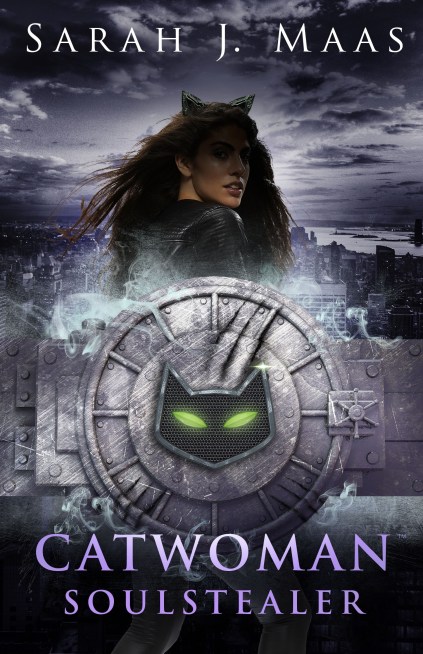
Catwoman: Soulstealer by Sarah J. Maas

Catwoman Soulstealer Cover.jpg

Publishers: Penguin Random House

                        Penguin Random House Audio

Publication Date – 7 August 2018

Amazon

One of DC Comics’ most iconic and badass female antiheroes is re-imagined in this bold new novel from young adult fiction bestseller Sarah J. Maas.

Selina Kyle is a rough street kid growing up in the slums of Gotham City.  She looks after her sister while scraping a living as a gang member and pit fighter.  When her luck finally runs out, her potential is seen by the mysterious Talia al Ghul who saves her and recruited into the League of Assassins.

Two years later, Selina has returned to Gotham City with a plan to turn the city on its head as Catwoman, the master thief and criminal mastermind.  Using the alias of the spoiled socialite Holly Vanderhees, Selina has returned at an ideal time; Batman is not in the city, away on a vital mission, and he has left his protégé Batwing behind to safeguard the city.  Initiating a series of high-profile thefts, Selina soon has the attention of Batwing and GCPD, especially when she starts teaming up with her new BFFs Poison Ivy and Harley Quinn to wreak havoc around the city.

While Batwing searches the city for this mysterious new villain, his alter ego, Luke Fox, encounters his mysterious new neighbour, Holly, and the two find themselves drawn to each other as their alter-egos battle in the night.  While Selina is able to outfox Batwing, a far more destructive force is about to be unleased upon Gotham.  Catwoman stole something from the League of Assassins and now a cadre of their most lethal assassins are descending on the city.  Will Selina be able to survive their deadly attentions, what is Catwoman’s plan, and who will be left standing in the aftermath?

This is the third book in the DC Icons series, a series of young adult books that provide re-imagined origin stories for younger versions of DC’s most iconic characters outside of the other established DC universes.  Featuring a range of different authors, the first book in the series, Wonder Woman: Warbringer, focused on Wonder Woman before she left Themyscira to become a hero, while the second book, Batman: Nightwalker, followed a teenage Bruce Wayne as he attempts to stop a series of murders in Gotham City.  A fourth book in the DC Icons series, Superman: Dawnbreaker, is currently set to be released in March 2019 and will follow a young Clark Kent as he investigates strange happenings in Smallville.

Soulstealer is the first of these DC Icons books that I have read, and I was quite impressed with the new and unique Catwoman story that it contained, as well as the cool new versions of several DC characters, including Poison Ivy, Harley Quinn and Batwing.  I listened to this book in its audiobook format, read by Julia Whelan.  I quite enjoyed having the story narrated to me, especially as it only took around 10 hours to get through.  While I initially had misgivings about whether I would like this series, after reading and loving Soulstealer I will definitely be getting a copy of Dawnbreaker when it is released next year, and Warbringer and Nightwalker will both be appearing future versions of my Throwback Thursdays reviews.

The author of Soulstealer, Sarah J. Maas, is one of the biggest names in modern young adult fiction, having written two best-selling young adult series in the last six years.  Her long-running Throne of Glass series finished earlier this year, and she has also created the A Court of Thorns and Roses series.  Soulstealer is the first Sarah J. Maas book that I have had the pleasure of reading, but after really enjoying the intricate story and fantastic characters within the novel I am keen to see what her fantasy books are like.  As a result, her Throne of Glass series is high on my list of books to check out in the future, especially after seeing just how awesome the artwork is on some of those covers and collected box sets.

Maas has installed a fantastic and clever story into her debut DC novel, and I really enjoyed how she re-imagined the origins of prominent comic book character.  Soulstealer contains a younger version of Catwoman, introducing her as a teenager gang member and focusing on her initial life of crime.  After the introductory paragraph, the story jumps ahead two years to Selina’s return to Gotham and her initial adventures as Catwoman, while also featuring several flashbacks to her training with the League of Assassins.  This main story is then told from two separate point-of-view characters, Selena and Batwing, and shows the characters in both their costumed adventures and as the people behind the masks in their civilian identities.  Soulstealer has a tight and intricate storyline that contains the perfect balance of comic book action, relationships, backstory, references and variations to comic lore, as well as a number of heists and intricate plots.  I loved Catwoman’s overall plan, as she engages in a play to take over Gotham while really nursing an ulterior motive that pits her against the League of Assassins.  I loved the slow reveal of this complex and insane plan, as well as the lengths she goes to bring her plan to pass, including making some dangerous partnerships.

One of the most interesting and significant changes that Maas makes to Catwoman’s origin story in this novel is the fact that she never meets or associates with Batman.  In nearly every previous iteration of Catwoman, her story has always been intertwined with Batman’s, as the two were usually each other’s main love interest, either as Batman and Catwoman or Bruce Wayne and Selina Kyle.  However, in Soulstealer, Catwoman is substantially younger than Batman, who starts his crusade years before she is trained by the League of Assassins.  In addition, Batman is not present in Gotham when she returns to the city and throughout the book the two characters have no interactions at all.  Instead, Catwoman’s main love interest is the Luke Fox version of Batwing, who has been defending Gotham in Batman’s absence.  This results in a similar romance plot to some of the classic Batman and Catwoman storylines, where the two characters meet and start to fall in love with each other in both of their personas, despite their apparently different personalities.  This is a fun little romance that does get serious at times, as the two characters are mirrored by their personal traumas and backstories, such as a Selina’s life on the streets and with the League, versus Luke’s PTSD as a result of his time as a marine.  There are also some great moments when the two characters face off against each other, and some of the book’s best laugh-out-loud moments came when Catwoman messes with either Batwing or Luke, sometimes at the same time.  To my mind, the funniest scene in the book had to be when Batwing, after getting injured and rescued by Catwoman, awakens half-naked in a darkened room, only to find out that he is actually in Commissioner Gordon’s spare bedroom.  The moment Luke walks out to find Gordon and his family staring at them was pretty darn funny, especially when Batwing attempted to play it off nonchalantly while silently cursing Catwoman.

One of the elements of Soulstealer that I really appreciated was the references and re-imagined versions of several DC comics characters that appeared throughout the novel.  A huge range of DC characters, many tied into the Batman comics, appear throughout the book in a number of different capacities.  The characters that appear range from the iconic to the obscure and are enough to delight both hardcore comic fans and those with a more casual knowledge of these comics.  Several major Batman characters appear throughout the story; I will refrain from mentioning the full roster of characters to cut down on spoilers, although there is one appearance that was particularly awesome.  While a number of these characters have key or interesting differences between their mainstream comic book counterparts, it is clear that Maas has a real understanding and appreciation for the lore behind these characters.  It is also incredibly fascinating to see how Maas changes these characters for the purposes of her story, and the subtle tweaks that are made to accommodate this different universe.

Of all these additional characters, two of the best and significant inclusions are fellow supervillains Poison Ivy and Harley Quinn, who team up with Catwoman to bring a little chaos to Gotham.  In the comic universe, these three supervillains occasionally form a team known as the Gotham City Sirens, and it was great to see them together in this book.  Like Catwoman, both Poison Ivy and Harley Quinn are quite young and have slightly altered origin stories which somewhat mirror the new origin story of Catwoman.  However, some of the key elements that made these characters so great in their comic book origins remain alive in these book adaptations of the characters and which work extremely well with Maas’s fantastic Soulstealer storyline.  For example, in this story, Harley is still obsessed with the Joker, no matter how much it impacts her relationship with the others, and there are a lot of discussions between Catwoman and Ivy about the roots of her obsession and insanity.  There is also a very clear and acknowledged romantic connection between Ivy and Harley that adds a really interesting element to the story, especially as Harley’s insanity stands in the way of the more serious relationship Ivy desires.  The inclusion of these characters adds in a defining friendship for a main character who has never had the option of friends before, and it’s also a lot of fun seeing these three characters work together, especially as they have such diverse skill sets and range of attitudes.  Overall, I really loved the fact that Maas included Poison Ivy and Harley Quinn as key characters in her novel, and it was a lot of fun to see her version of these young villains banding together for the first time and forming an outstanding partnership.

Rather than read a physical copy of this book, I grabbed the audiobook copy of Soulstealer and listened to that instead.  The audiobook is narrated by Julia Whelan, who does an amazing job capturing the essence of the book’s main character, Catwoman/Selina Kyle.  When focused on Catwoman’s point of view, the listener gets a real sense of the character’s emotions and attitude, and the voices that Whelan assigns to the other main female characters, Ivy, Harley and Talia, are fairly distinctive and fit well with the character.  I thought that the voice that the narrator used for the book’s other point-of-view character, Batwing/Luke Fox, was very serviceable and conveyed the character well enough.  However, I was a tad disappointed that the narrator did not do too much with several of the other iconic Batman characters in the story, such as Alfred, Batman or Commissioner Gordon, especially as these major characters have all been portrayed by amazing actors or voice actors in the past.  Still, the audiobook version is a great way to enjoy this story and it certainly helped me power through this novel quickly without forcing me to skip over any of its important elements.

Catwoman: Soulstealer is an excellent young adult superhero novel from acclaimed author Sarah J. Maas.  This book is a fantastic standalone novel that re-imagines an iconic DC comic book character.  No great previous insight into Catwoman or the DC universe is required, and those with even a glancing knowledge of the comic book characters will be able to enjoy this novel to its full potential.  This serves as a very good young adult novel that will hopefully draw in a younger generation of readers into this established universe, and I appreciated Maas’s casual inclusions of a number of LGBT+ elements.  Soulstealer comes highly recommended and it has certainly sparked my interest in checking out all the other books in the DC Icons range.

My Rating:

Four and a half stars

Amazon