
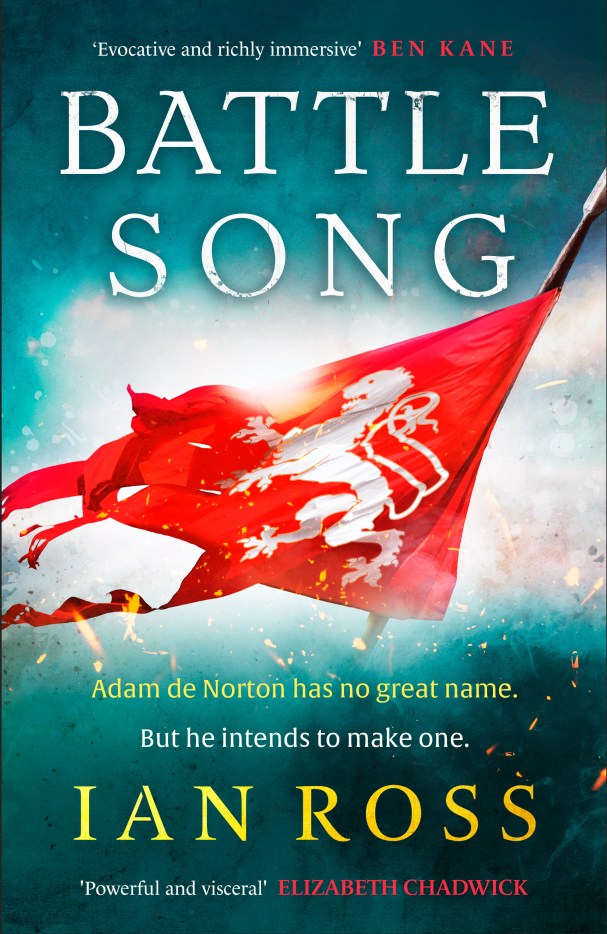
Publisher: Hodder & Stoughton (Trade Paperback – 28 March 2023)
Series: Standalone/Book One
Length: 405 pages
My Rating: 4.75 out of 5 stars
Impressive historical fiction author Ian Ross journeys away from his typical Roman history novels and instead dives into the chaos and glory of medieval England with the outstanding and highly addictive read, Battle Song.
England, 1262. Adam de Norton is a lowly squire with very few prospects to his name. Unable to claim his family’s rightful estates, Adam’s only hope is to be knighted by his lord, which will allow him to win the glory and respect his chivalrous heart believes in. However, his chances of even being noticed by his lord seem slim, and Adam looks set for a life of disappointment until a hunting accident leads him to his new master, the rogue knight Sir Robert de Dunstanville.
Robert de Dunstanville is a man infamous throughout England as a murderous heretic, and his anger, resentment and apparent lack of knightly virtue seem to match his devilish reputation. A keen member of the tournament scene, Robert leads Adam to Europe, where his underhanded strategies and desire for victory over honour, prove to be highly effective. While Adam chafes under the dishonour of his new master and the circumstances that lead them together, he soon discovers that Robert seems to have a far better idea of the realities of his world than he does.
Two years later, Robert leads Adam back to England, determined to take advantage of the chaotic political situation that emerges. The Earl of Leicester, Simon de Montfort, has declared war against his brother-in-law, King Henry III, and now leads the barons of the realm in a rebellion, aimed at bringing reform and redressing the balance of power in the country. As the country plunges into civil war, Robert and Adam must choose which side will give them the greatest advantage and keep them alive. Soon caught in the middle of a desperate battle for the fate of the kingdom, will this duo get everything they think they deserve, or wind up in a bloody grave?
Ian Ross has written an exceptional and captivating historical adventure in Battle Song that I had an absolutely wonderful time reading. Blending some great characters with an exciting story and intriguing historical detail, Battle Song is one the most thrilling and intense historical novels I have read in a while, and which is worth checking out.
Battle Song has an intense and captivating story that perfectly follows a young knight in training as he finds his destiny and gets embroiled in war. Blending emotional personal growth with an exciting narrative from a great part of history, Ross’s narrative for this book is really addictive, and I had a ton of fun powering through it in a few days. The story starts off great with a very strong introduction to protagonist Adam de Norton, a minor squire overlooked in life who still believes in the knightly virtues. After a violent brawl shows his true raging potential, Adam is drafted into the service of Robert de Dunstanville, a bastard knight with a severe grudge against the king, who drags Adam to Europe for a run at the knightly tournaments. The initial part of the book is really good as it sets up the story and the key politics of England, while also serving as an invaluable introduction to main characters. I loved the early friction between Adam and Robert, which really helps to showcase the differences between their world views and ensures that there is some intriguing personal conflict between them throughout the book.
Ross dedicates a good chunk of the plot to following Adam, Robert and their companions, on an extended romp through the European tournaments, which are so damn fun. The various scenes depicting the harshness of the tournaments, including the infamous melee, are some of my favourites in the book, and the author’s depiction of the chaotic violence and sheer unpredictability really appealed to me. At the same time, this book serves as a good learning experience for the protagonist as Adam learns the realities of being a knight as he experiences love, betrayal and begins a deadly rivalry. Ross also uses this part of the story to further dive into the start of the conflict between Simon de Montfort, as Robert meets and plots with the exiled Earl while in Europe and begins to weigh his options.
The second half of Battle Song is set back in England as Adam and Robert return home, determined to take part in the civil war to come, even if they don’t know which side to choose. This half of the novel is pretty damn intense as Ross really dives into the intriguing and dark history of the period in some great ways. The narrative drags the protagonists into some of the key events of the period, including riots, a dangerous siege, and several minor conflicts, as they watch the King and Simon de Montfort fight for control of the country. This part of the book is also well layered with the personal concerns of Adam and Robert, as Adam faces a hopeless romance while witnessing some of the most vicious elements of war, while Robert continues to battle his conscience, inner-hate and survival instincts to come out on top. There are some pretty epic scenes here and I deeply enjoyed how Ross balanced out the historical detail with the deeper part of his story. The characters all go through setbacks, growth, and dark moments as the plot proceeds, and the reader gets caught up in their personal tales. The battles themselves are really impressive, as Ross captures the sheer chaos of war and Adam learns what it is to kill. I really appreciated Ross’s use of Adam as the main point-of-view character for this second half of the battle, not only because his position allows a great view of all the key historical moments, but because you see a more impassioned take on events which gives the entire narrative some great heart. Everything leads up to the big final battle, which Ross covers perfectly, showcasing it as a metal meatgrinder of knight-on-knight combat. There are some outstanding moments in these final pages, especially as several character arcs and storylines are cleverly finished, and I was deeply intrigued to see how the entire conflict came together. Ross leaves everything on a satisfying conclusion and Battle Song ends up serving a particularly epic and brilliantly self-contained standalone read, which does have some potential to be continued in the future. I deeply enjoyed this exceptional story and it was so damn addictive in places.
One of the best highlights of Battle Song is the way that Ross expertly portrays the historical period in which the book is set. I loved the depictions of England and Europe in the 13th century featured throughout Battle Song, and Ross has a lot of fun showcasing the people, culture and politics of the people at the time. There is a particular focus on the lives and experiences of the knightly classes as the book as shown through the eyes of a lowly squire experiencing them for the first time. As such, you get a great idea of what it is to be both a knight and a squire as Adam grows into both roles while watching his master and peers in action. There are some great discussions about the how knights act in life, and I loved how Ross examined how the realities of this compared to the romanticized notions of chivalry and honour that Adam had been fed growing up. Naturally some of the best parts of the historical elements of Battle Song fall amongst the tournaments and battles that were such an amazing feature of the story. Ross really dives into the nitty gritty detail of the tournaments, and I loved seeing the tactics and practicalities of big events like the joust and the melee. It was also very interesting to see how these skills then translated across to the battlefield and the similarities and differences between the two proved to be deeply fascinating. Ross really went out of his way to highlight the gritty and brutal nature of both the tournament melee and the battlefield throughout Battle Song, and I loved the high-intensity action scenes that emerged as a result. Battle Song honestly some of the best historical battle sequences that I had seen for a while, and I found myself getting even further dragged into the story thanks to that.
In addition, I really enjoyed the compelling and impressive examination of the events of Simon de Montfort’s rebellion in 1264, one of England’s lesser-known civil wars. The entirety of Battle Song is set around this war, and Ross really good job of showcasing the politics and the events leading up to the rebellion as Adam and Robert witness his plotting during their tournament days. The second half of the book then examines the resulting war in high detail as the protagonists find themselves dragged into several key battles and incidents of this war, including the siege of Rochester and the decisive battle of Lewes. The author does an outstanding job showcasing these battles as he looks at how they came about, what happened during them, and the resulting impacts it had on the war. At the same time, Ross also tries to examine some of the key historical figures involved in this conflict, and it was very interesting to see the protagonists interact with them. Ross initially paints this war as a battle for rights against the king, with de Montfort trying to rally the nobles behind his leadership. However, rather than showing this as a purely noble affair, Ross also highlights some of the darker aspects of de Montfort’s campaign, including the infamous purge against the Jewish population of London at the start of the rebellion, which honestly was some of the darkest and most intense moments in the entire book. I deeply appreciated this complex examination of the history, especially the prejudice against the Jews, and it painted both sides in morally ambiguous tones that fit the two protagonists. Ross clearly has a real talent for portraying fascinating moments from history, and I had an outstanding time learning more about this unique and captivating period.
I was also quite impressed by the characters featured within Battle Song as Ross introduces the reader to an outstanding cast of both original characters and notable figures out of history. The main protagonists are the duo of Adam de Norton, a poor squire who serves as the book’s point of view character, and Robert de Dunstanville, a blackhearted knight with a low opinion of the world around him. Both characters are intriguing as they represent very different ends of the knightly spectrum. Adam starts the book as a naïve squire who believes in honour and duty, even after years of being overlooked by his lord. Robert, on the other hand, is a far more devious and jaded being. A bastard with no lands of his own, Robert is upset about royal rulings made against him and takes out his anger in the tournaments, where his cunning tactics allow him to achieve many victories. These two characters are polar opposites to begin with, however, they both start to influence the other in different ways. Adam starts to become a little more cynical, wiser, and learns how to survive in this harsh world, eventually becoming a competent and dangerous warrior. Robert on the other hand starts to soften as they grow closer, and the protagonist finds out that there is far more to Robert than he lets the rest of the world see. These two play off each other, and the rest of the extended cast, extremely well, and I loved the complex mentor-mentee relationship that emerged. These two are definitely the heart of the story, and I deeply enjoyed their compelling storylines, especially as they both experience hopeless romances, loss, disappointment, intense rivalries, betrayal and moments of glory as they journey towards the conclusion of the book. The rest of the cast supports the story nicely, and I loved some of the interactions that emerged, as well as the clever mixture of real people from history and original characters invented for the narrative. These great characters and their unique stories deeply enhance the quality of Battle Song and its powerful story and I was very impressed by how well Ross set them out.
With its outstanding blend of historical detail, amazing protagonists, and an intense and powerful narrative, Battle Song is a brilliant and epic read that I had such an incredible time reading. Ian Ross produced such a great read here and this was one of the more exciting and entertaining historical fiction novels I have read all year. Battle Song is a highly recommended historical fiction novel that is really worth checking out.
 The Unseen Library