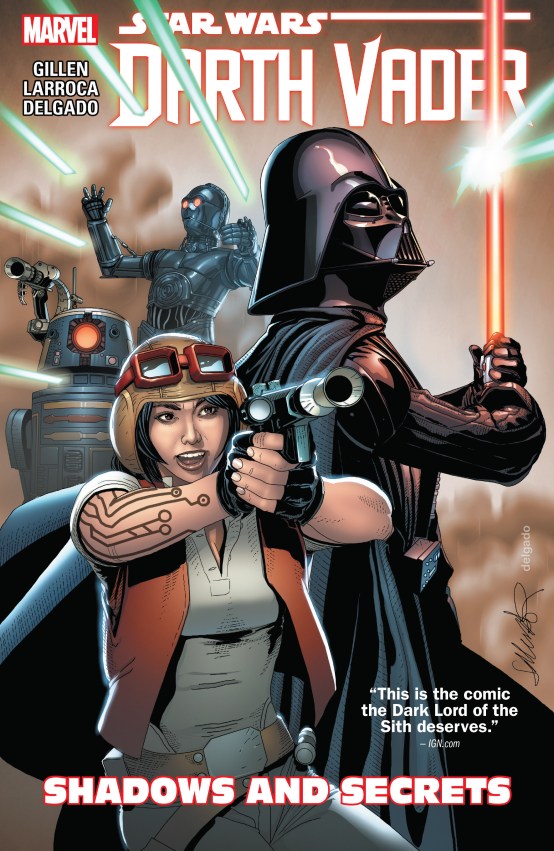
Throwback Thursday – Star Wars: Darth Vader (2015): Volume 2 – Shadows and Secrets

Darth Vader - Shadows and Secrets

Publisher: Marvel Comics

Writer: Kieron Gillen

Artist: Salvador Larroca

Colourist: Edgar Delgado

Publication Date: 5 January 2016

Length: 136 pages

My Rating: 5 out of 5 stars

Amazon

Reviewed as part of my Throwback Thursday series, where I republish old reviews, review books I have read before or review older books I have only just had a chance to read.
Darth Vader (2015) 7

For my latest Throwback Thursday, I take a look at the second volume of the 2015 Darth Vader series, Shadows and Secrets. This is a superb and fantastic addition to a series which I honestly consider to be one the best overall pieces of Star Wars fiction out there, as it continues to explore the complex character that is Darth Vader.

Following the events of the first volume of this series, Vader, Darth Vader now knows that the mysterious Rebel pilot who destroyed the Death Star is actually his son, Luke Skywalker, and that the Emperor has been lying to him for years. This revelation, combined with the fact that the Emperor is forcing him to compete for his favour with the scientific creations of the cybernetic genius Cylo, has crystallised Vader’s rage, and he is now determined to overthrow the Emperor and rule the Empire with his son. To that end, he has commanded his new agents, the rogue archaeologist Doctor Aphra and her two murderous droids, Triple Zero and BT-1, to gather the resources needed to pursue his agendas.
Darth Vader (2015) 9

Whilst Aphra and her criminal contacts do their work for him, Vader must appear to obey the commands of his new superior officer, Grand General Tagge. His latest mission from Tagge requires him to find out who stole a massive consignment of credits that the Empire recently seized from crime lords in the Outer Rim. There is just one problem: Aphra and a small group of bounty hunters stole the credits on his behalf. Vader attempts to cover up his involvement in the crime and lead the investigation away from Aphra. However, the arrival of his new aide, the brilliant Inspector Thanoth, may prove troublesome, as Thanoth’s investigation leads him in all the right directions.

However, despite the importance of Vader’s plans within the Empire, his main concern is the search for his son. Needing to locate and corrupt Luke before the Emperor finds out who he is, he tasks Aphra with not only finding his son’s location but to also find and silence the one person who knew that Luke was actually born. As Vader does all he can to keep Thanoth from finding Aphra and incriminating himself, he finds himself walking a fine line between victory and destruction. With new rivals and both the Empire and the Rebellions seemingly against him, can even Darth Vader get what he wants?
Darth Vader (2015) 9 alternate

Well this was another fantastic bit of Star Wars fiction! The first thing that I do have to admit is that Shadows and Secrets is probably my least favourite volume in the entire 2015 Darth Vader series. However, this is only because every other volume in this series is just so incredible that this one suffers a little in comparison. That being said, I absolutely loved this second volume as it contains an excellent story, some great moments, fantastic characters and some impressive artwork. Containing issues #7-12 of the Darth Vader series, Gillen and Larroca have done an incredible job with this second volume, and I still consider it to be a five-star read.

One of the best things about Shadows and Secrets is Gillen’s outstanding story, which continues some of the tantalising threads from the first volume while also introducing some great new elements. Gillen sets out a clever, well-paced story that is filled with all manner of action, adventure and intrigue, as Vader begins his duplicitous actions within the Empire, attempting to amass the resources he needs for his projects without drawing the suspicion of either his rivals in the Imperial hierarchy or his new superior. Most of the story contained within this volume is fairly self-contained, featuring a fantastic heist sequence and the subsequent fallout from this event. This fallout mostly revolves around Vader’s investigation into his own heist, which he attempts to cover up from his new aide, Inspector Thanoth. Thanoth is a genius detective of Sherlockian talents who was quickly able to get to the truth of the matter and find the culprit of the heist, despite Vader’s vest efforts. I really enjoyed this whole investigation element to the book, especially as it was fun watching Vader routinely sabotage his own investigation, often by killing any and all potential witnesses, only to have Thanoth easily breeze through these obstacles. Thanoth turned out to be an excellent new addition to this series, and I really enjoyed the intriguing partnership he formed with Vader, especially as he plays a dangerous game by continuously hinting that he knows Vader is behind the theft. This turned out to be quite an amazing and enjoyable storyline, and I really appreciated Gillen’s perfect blend of humour and serious storylines throughout the volume.
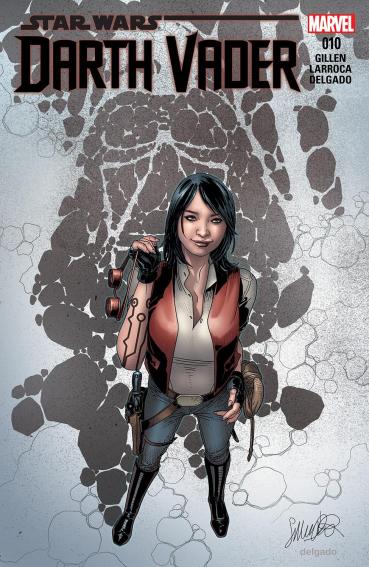
Darth Vader (2015) 10

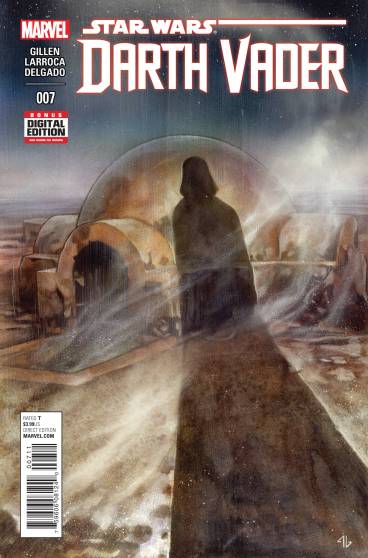
I also loved the continued focus on Vader’s obsessive hunt for Luke Skywalker, which has taken on a new edge now that he knows he is his son. While he was already searching for him in the first volume, now that he realises who he really is, Vader decides to protect his identity and the find out the whole truth behind his birth. This is shown in the first part of Issue #7, in which Vader and Aphra visit both the Lars Homestead and Ben Kenobi’s hovel on Tatooine, where he tries to gleam some knowledge from both houses about his son, before setting off a molecular bomb to erase all useful forensic evidence. Shortly after this, Vader than sets Aphra a task of finding and interrogating a former mortician from Naboo who prepared Padme Amidala’s body for her funeral, including setting up a hologram to make it appear that she was still pregnant. This tuned out to be an outstanding sequence, as the mortician, who has a huge amount of personal loyalty towards Amidala, at first refuses to provide any information about his work, before being tortured and confirming the existence of a child. While this admission is a betrayal of his beloved Queen that clearly costs the former mortician a lot, he is able to do one last act of service for her by not revealing any details about the second child, Leia. I thought that this scene was amazing, and I liked how it helped explain how Vader was aware of Luke’s existence and status as his child, but not that he also had a daughter. I also appreciated Gillen’s focus on the loyalty the inhabitants of Naboo had to Amidala, even in death, which was even able to move the cynical Aphra. Her subsequent mention to Vader of how Amidala must have really been something was a nice touch, as Vader’s subdued and hidden reaction hints at his continuing deep feelings towards his long-dead wife. I really liked this focus on the search for Luke, as not only does it makes sense in the context of the movies, but it also showcases the lengths Vader was willing to go to find and protect his son, and it leads to the best sequence in the entire volume.

I personally really enjoyed how the creative team continued to show off Vader as a dangerous and vicious powerhouse in this volume. While it does not contain the same level of carnage that he unleashed in the first volume of the 2015 Star Wars comic book series, Shadows and Secrets contains several amazing scenes depicting his destructive abilities and personality. Whether he is stuffing a crime lord into the mouth of his own exotic beast and then easily killing the distracted monster, or whether he is taking down and entire squadron of Rebel space fighters one at a time by throwing his lightsaber at them, he is shown to be pretty impressive.
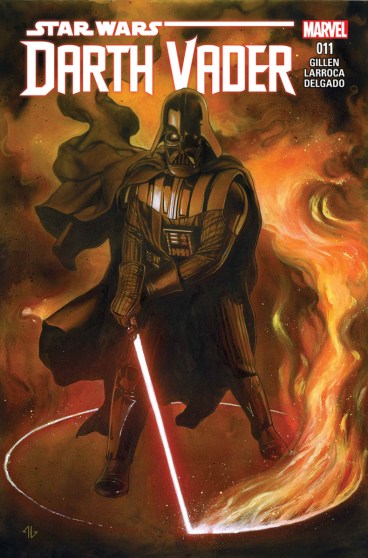
Darth Vader (2015) 11

Just like in the first volume, Doctor Aphra continues to shine as the series’s main supporting character, and her entire character arc within Shadows and Secrets is very intriguing. Throughout this volume, Aphra ends up undertaking several missions for Vader, such as trying to find the location of Luke Skywalker, and has become one of his main confidants. This puts her in a terrible position, as Vader is likely to kill her to protect his secrets, especially when Thanoth gets close to capturing her. Watching the various ways that this ultimate opportunist attempts to survive against the odds, including by brazenly withholding information from Vader in order to stop him killing her, is pretty impressive, and it makes for some great reading. Shadows and Secrets also contains one of the first deeper looks at Aphra’s internal character. During the sequence I mentioned above with the mortician, she gives a lengthy monologue about the death of her mother and how it has affected her. This was a heavy scene, and while she tries to play it off as not being very important, you can see that it has impacted her, turning her into a much more cynical and self-reliant person who has no room for idealism or blind belief. The significance of this scene is also quite crucial when you consider that much of what she said is later shown in the Doctor Aphra spinoff series and ends up becoming a defining part of her character. I also like how the noticeable changes that the creative team have inserted into Aphra’s personality when she deals with Vader. For most of the volume, Aphra comes across as an ultraconfident being who is able to manipulate and control bounty hunters, murderers and crime lords with ease. However, whenever Vader appears, there is a noticeable change in her bearing and personality, which isn’t too surprising as Aphra knows Vader is going to kill her one day.

I also have to point out how much fun the two murder droids Triple Zero and BT-1 continued to be in this novel. Essentially perverted versions of C-3PO and R2-D2, Triple Zero and BT-1 are remorseless killers who delight in murdering or torturing all organic life. These two add an insane element of humour to the entire series, and they have a number of great moments in Shadows and Secrets. Watching the two of them delight in all sorts of murder and mayhem is all sorts of fun, and you’ve got to love the weird and friendly relationship the two of them have formed with each other.
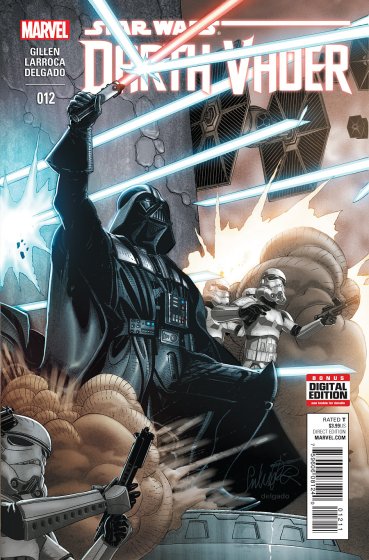
Darth Vader (2015) 12

One of the best highlights of this second volume is the amazing artwork. The artistic team, helmed by Salvador Larroca, did another fantastic job bringing the amazing story contained within Shadows and Secrets to life on the page. There are so many vibrant and imaginative panels in this volume, and the volume’s artistic team produce some amazing pieces of art that showcase the wider Star Wars universe. One of the things that continues to impressive me about this series is the way that the artistic team are able to convey so much emotion from the faceless main protagonist. Despite only ever seeing Vader’s expressionless and iconic mask, I found that I was constantly able to glean the true emotions that Vader was surely feeling at the time when I looked at him, ranging from cold menace, surprise, frustration to deeper emotions, such as sadness when Amidala is mentioned. There are some truly amazingly drawn scenes throughout this entire volume, although there are two that I would bring particular attention to. The first is the very first scene in Issue #7, which shows Vader standing out the front of the Lars Homestead, staring at Tatooine’s twin suns as they set. I absolutely loved how this drawing matched the iconic scene from A New Hope where Luke stared off in the same position, and I really appreciated the symmetry. The other piece of art that really stood out to me was a quick sequence that appeared a little later in the volume within Issue #8. In this scene, Aphra has just confidently dealt with one of the bounty hunters in her employ and is looking off in the distance speaking to someone. As she talks, Vader slowly materialises out the shadows behind her, responding to her comments. Despite the fact that Aphra’s expression does not change at all there is a notable shift in the tone of the panel when Vader appears, and you cannot help but feel the threat and menace that he exudes. This was some impressive artwork, which helped to really increase how much I loved this comic.

The second volume of the 2015 Darth Vader series, Shadows and Secrets, is a first-rate comic book that once again shows off how impressive Star Wars comics can really be. Gillen and Larroca did an incredible job following up the first volume of this epic series and I really enjoyed the complex and fun story that this second volume contained, especially when it was backed up by great characters and exceptional artwork. This is a superb addition to the series that is really worth checking out.
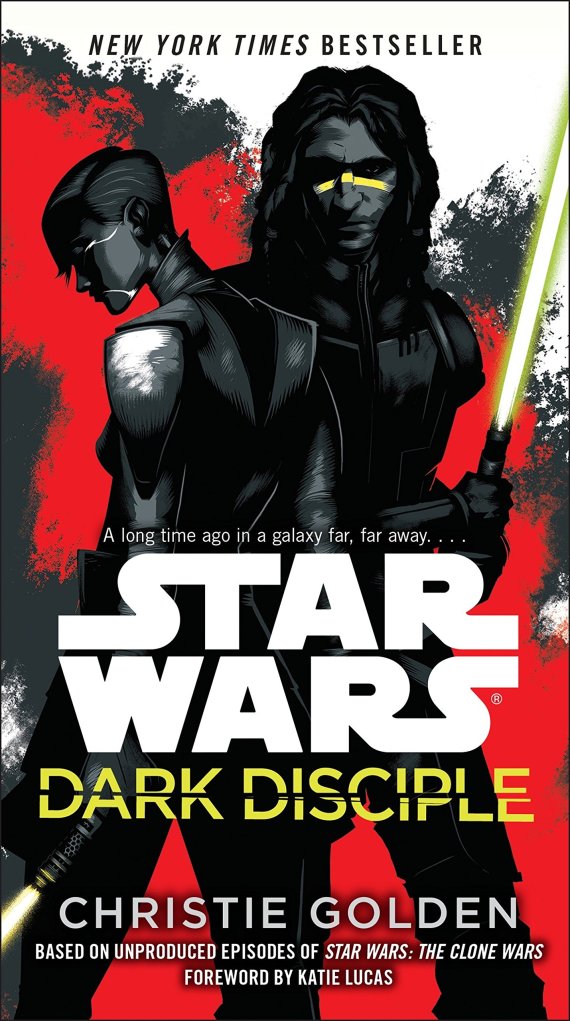
Amazon

Throwback Thursday: Star Wars: Dark Disciple by Christie Golden

Star Wars Dark Disciple Cover

Publisher: Penguin Random House Audio (Audiobook – 7 July 2015)

Series: Star Wars

Length: 11 hours and 11 minutes

My Rating: 4.5 out of 5 stars

Amazon

Reviewed as part of my Throwback Thursday series, where I republish old reviews, review books I have read before or review older books I have only just had a chance to read.

For this week’s Throwback Thursday, I go back and check out an amazing piece of Star Wars fiction with Star Wars: Dark Disciple by tie-in fiction extraordinaire Christie Golden. Dark Disciple is a compelling and intense Star Wars novel that features two fan-favourite characters from the extended universe in a fantastic adventure that is deeply connected with The Clone Wars animated series.

A Jedi shall not know anger. Nor hatred. Nor love!

For years, the galaxy has been locked in one of the most destructive struggles it has ever known, the Clone Wars. Led by the ruthless Sith Lord Count Dooku, the Separatists have engaged in a gruelling and bloody conflict with the Republic that has led to the death of countless innocents. While the guardians of the Republic, the Jedi, have tried in vain to capture Dooku and end the war, their methods appear inadequate to stop him. After a particularly brutal massacre, the Jedi Council do the unthinkable and sanction the assassination of Count Dooku, believing that only his death will bring peace to the galaxy.

To that end, the Council turns to maverick Jedi Master Quinlan Vos. Unpredictable, brash and experienced in undercover work, Vos is the perfect candidate for this dangerous mission. However, this is not a one-man job. In order to track down Dooku, infiltrate his defences and defeat him in battle, Vos is going to need a partner. At the suggestion of Master Yoda, Vos seeks out the one person who knows the Count better than anyone else, Dooku’s former apprentice and assassin, Asajj Ventress.

After losing everything she held dear at the hands of Dooku, Ventress is desperate to leave her past as a Sith behind. But her hatred for Dooku is all-consuming, and she jumps at the chance to finally kill him. However, Ventress believes that Dooku can only be defeated by someone empowered by their emotions and able to access the dark side of the Force. Tutoring Vos in the methods of her race, the Nightsisters, Ventress is able to make Vos stronger and more powerful as he sits on the knife’s edge between the light and the dark side. But this balance is fragile at best, and all it will take is a single push for Vos to fully embrace the darkness. Between the machinations of Dooku, terrible secrets from the past and his growing feelings for Ventress, can Vos remain true to his vows and complete his mission, or have the Jedi have unleashed a great new evil upon the galaxy?

Dark Disciple is an intriguing addition to the Star Wars canon which not only has some major connections to the popular Star Wars: The Clone Wars animated series but also contains a cool and at times dramatic story about love, darkness within and redemption. Dark Disciple was actually based on a script for eight unproduced episodes of The Clone Wars that were never made due to the Disney buyout of Star Wars and the subsequent cancellation of the animated show. These episodes were written by The Clone Wars screenwriter Katie Lucas (who provides a foreword for this book) and subsequently adapted into this book by acclaimed science fiction and fantasy author Christie Golden. Golden has authored many tie-in novels for various franchises, and I have previously enjoyed her World of Warcraft novels, including War Crimes (probably my favourite piece of Warcraft fiction) and Before the Storm. While Golden had written a few pieces of Star Wars fiction before this book, Dark Disciple ended up being her first novel in the current canon. In the end, this turned out to be an excellent read and I was really impressed in the way that Golden ended up turning this cool script into a deep and compelling novel.

Seeing as it is based off an unused script for the show, this book obviously has some strong connections to The Clone Wars television show. This book is set a little while after the events of the already aired episodes of The Clone Wars and continues their range of storylines a little further. Not only does Dark Disciple contain several characters whose main appearance was in the animated show, but it also refers to events from several episodes, including episodes that Katie Lucas wrote herself. As a result, Dark Disciple is probably best enjoyed by those readers who are familiar with the show, who will have a greater appreciation of the book’s various story elements. That being said, anyone who has seen the Star Wars prequel movies will be able to easily follow what is going on, and will no doubt enjoy the complex story it contains.

Fair warning to fans of The Clone Wars series, though: you are going to experience some sense of crushing disappointment after reading this. The book itself is pretty damn awesome, but it’s supremely disappointing that the story contained within this novel never featured as the amazing extended arc for the animated series it clearly would have been. While I really loved this novelisation, I cannot help but imagine how emotional and explosive it would have been acted out and animated as part of the show. As I review this book, it is actually less than a month until the release of the seventh and final series of The Clone Wars. While I am deeply excited for this final season, after reading this book I am a little sad as I know that the storyline contained within Dark Disciple is unlikely to be featured in it.

That being said, I really enjoyed the fact that this book focuses on two amazing characters from the animated series, Asajj Ventress and Quinlan Vos. Ventress and Vos are fan-favourite characters who have had significant appearances within the expanded Star Wars universe. Ventress is best known for her role within The Clone Wars universe (first appearing in the original 2003 Clone Wars show), where she first served as a major antagonist, before developing into more of an anti-hero. Ventress ended up being the focus of several major arcs within The Clone Wars series, some of which were written by Katie Lucas. Her success in the animated series saw her utilised in several books and comics set in the same period, although most of these are no longer canon. Vos also has an interesting origin as he was first seen as a background character in The Phantom Menace. Thanks to his cool look and some fan interest, the character was given a fleshed-out origin story as a Jedi and subsequently utilised in several works of expanded fiction. This included books and comics and an appearance in one episode of The Clone Wars. While Ventress and Vos had several interactions in the old Star Wars Legends canon, Dark Disciples is actually the first time that they meet in the current canon. Their whole relationship is a major part of the story, and I liked how it formed and developed throughout the course of the book.

I really enjoyed how Ventress was utilised in this book. Ventress is one of the best original characters in The Clone Wars, and I have always loved the gradual journey to redemption that occurred within her story arc. As a result, a book where she is one of the main characters is deeply intriguing to me and I was excited to see how she continued to evolve after her last appearance in the animated series. There are some major developments for Ventress in this book, and if you ever enjoyed this character in the animated series and wanted to know her ultimate fate than you need to read this book. Personally, I think that this was an amazing continuation to the character arcs that had been featured within the shows, and as I mentioned above, I am disappointed that it was never included as part of The Clone Wars. In adapting the script into this novel, Golden makes sure to really cover the background of this character, so those readers who are unfamiliar with the shows will be able to understand her complex and tragic backstory. I also think that Golden did an amazing job of capturing the complex character that was Ventress in this book, getting past her prickly outer layer to see the more complicated emotional person within. This was a near perfect examination of one of the best Star Wars characters who never appeared in a movie, and after reading this book it will be a shame not to see more of her in any of the planned animated shows.

Perhaps the most compelling part of this book is the complex and gripping central tale about Quinlan Vos’s fall to the dark side of the Force. This was an intrinsic part of the book’s overall plot, as Vos and Ventress both believed that having the easy power obtained by dark side users was the only way to defeat Dooku. This turn to the dark side is spurred on by lies, revelations and intense emotions, and it necessitates some deep dives into Vos and Ventress’s respective psyches, resulting in some dramatic and personal moments from both of these great characters. Watching Vos’s slow decline as he slips further and further away from the light side is painful at times, especially when you just know he is eventually going to turn. Even then, despite realizing it was coming, the point when he fully breaks bad for the first time (yellow eyes included) is pretty powerful, as he lashes out at the only person he has, and will ever, truly love. In many ways, Vos’s fall reflects Anakin’s later turn in Revenge of the Sith, in that he believes learning about the dark side is for the greater good, the Jedi Council pushes him to do something he has moral issues with and his emotional connections to a women push him over the edge. There are also some amazing scenes in the later part of the book where the reader is unsure whether Vos is actually evil or is just pretending to have fallen to fool his foes, which leads to a lot of uncertainty and hostility from the other Jedi and Ventress as they try to work out his plan. Overall, this was an outstanding centre for this book, and the complex web of deceit, deeper examination of how one falls to the dark side and all the drama surrounding this part of novel, was really cool to read.

One of the other parts of the story that I found to be interesting was the depiction of some of the other Jedi in this book. Throughout this story the Jedi, particularly the members of their ruling council, are shown to be walking a bit of a darker path thanks to the impacts of the Clone Wars. While not attempting to learn more about the dark side of the Force, members of the Council are beginning to propose action that they usually wouldn’t consider, such as the assassination of Dooku, or the execution of Vos and Ventress. This is a really intriguing take on their characterisation which plays in well with the future events of Revenge of the Sith, where their boldness in attempting to take over the Republic to protect it or Mace Windu’s attempt to kill Chancellor Palpatine backfires on them. Windu in particular comes across as a bit of an arse in this book, and the rest of the council (with the exception of Yoda and Kenobi) seem like meek followers going along with him. I thought that this aspect of the books was pretty interesting, and it liked seeing some hints of this once wise and noble Jedi Council beginning to act more rashly and dramatically.

Like most of the Star Wars books that I look at for my Throwback Thursday articles, I ended up listening to the audiobook version of Dark Disciple, which was narrated by Marc Thompson and ran for just over 11 hours. I have mentioned several times before about how I find Star Wars audiobooks to be a step above most other audiobook productions I listen to, and Dark Disciple was yet another awesome example of just how cool they can be. This audiobook in particular does an excellent job of utilising the huge range of iconic Star Wars sound effects to create an exciting or appropriate atmosphere for much of the story, and there is nothing cooler than hearing lightsaber or blaster sound effects during a battle sequence. In addition, this format also features some of the incredible and memorable music from the films. John Williams’s epic score from the prequels was on full display in this book, with some of his most awesome pieces being used throughout several scenes to great effect. Nothing amps up an action scene quite as much as having the pulse pumping Duel of the Fates playing in the background, while hearing the mournful composition known as Anakin’s Betrayal playing during the scenes where Vos is turning to the dark side of the Force is a real emotional gut punch that brings back memories of Vader and the Emperor killing all the Jedi. This was actually one of the best utilisations of Star Wars music in an audiobook that I have so far experienced, and I really loved how much it increased my enjoyment of this fantastic audiobook.

In addition to the cool sound effects and dramatic music, the audiobook also benefited from the talented voice work of Marc Thompson. Thompson is a veteran narrator of Star Wars audiobooks, having worked on a huge number of their tie-in books since 2007. I have previously listened to two Star Wars books narrated by Thompson, Thrawn and Scoundrels, and with both of these I was really impressed with the realistic and clever voices that he came up with for some of iconic Star Wars characters. Dark Disciple is another exceptional example of Thompson’s skill, as he was able to reproduce the voices of several of the book’s major characters. Not only does he do an amazing job replicating Ventress’s voice, but he also produced excellent examples of Yoda, Count Dooku and Obi-Wan Kenobi’s voices from The Clone Wars show. This is some first-rate voice work which, when combined with all the extra sound effect and musical inclusions, made Dark Disciples an absolute treat to listen to, and I cannot recommend this format highly enough.

Star Wars: Dark Disciple by Christie Goldie is an outstanding and highly enjoyable piece of Star Wars fiction that I had an amazing time listening to. Featuring a first-rate story that revolves around two amazing characters and their complicated relationship to the force (and each other), Dark Disciple is one of the better Star Wars novels that I have had the pleasure of reading. A perfect tie-in to the amazing The Clone Wars animated series, this book is a must read for all fans of that series, especially before the seventh and final season is released. Dark Disciple comes highly recommend and is a force to be reckoned with.

Amazon

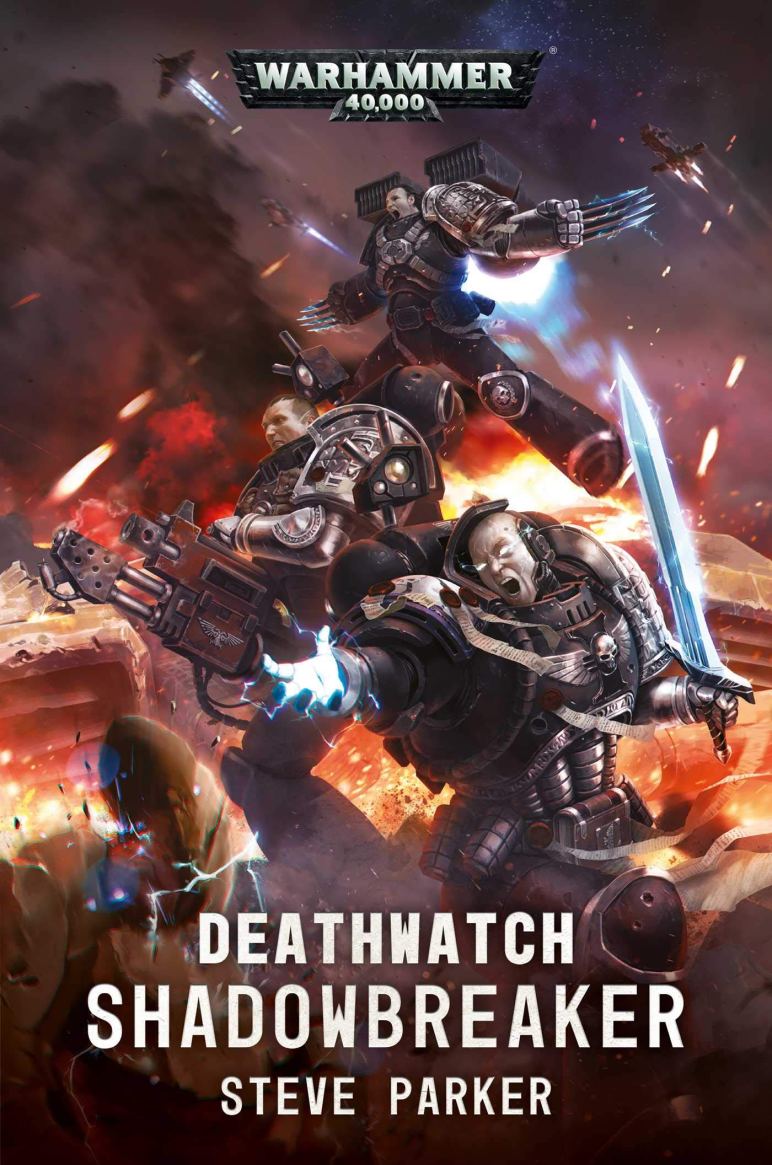
Deathwatch: Shadowbreaker by Steve Parker

Deathwatch Shadowbreaker Cover

Publisher: Black Library (Audiobook – 25 April 2019)

Series: Warhammer 40,000/Deathwatch – Book Two

Length: 16 hours and 37 minutes

My Rating: 4.5 out of 5 stars

Amazon

Prepare to dive into the extended universe of Warhammer 40,000 (Warhammer 40K or 40K), as science fiction author Steve Parker presents Deathwatch: Shadowbreaker, an action-packed and exceedingly exciting sequel to his 2013 novel, Deathwatch, which pits the deadly Deathwatch Space Marines against an entire planet full of T’au.

Thousands of years in the future, the galaxy is constantly at war. Humankind has survived as the massive Imperium of Man, under the divine protection of their long-dead Emperor. However, this beacon of humanity is under constant threat from all sides. Destructive alien races, demons from the warp and the traitor forces of Chaos continuously assault its borders, whilst heretics, mutants and witches attempt to destroy it from within. Over the millennia, the Imperium has created many different forces to protect their worlds from these threats; however, none is more feared or revered than the Adeptus Astartes, the Space Marines. Space Marines are legendary warriors genetically modified to become significantly stronger, larger and faster than a normal man. Swathed in power armour and armed with the deadliest of weapons, the Space Marines are a force to be reckoned with on the battlefield, bringing the Emperor’s wrath down on all who oppose them.

But even amongst these deadliest of soldiers, there is one organisation of Space Marines who are respected above all others for their fighting ability and skill, Deathwatch. Deathwatch is an elite group made up of best Space Marines veterans from across the Chapters, trained to become the ultimate tools in one of the Imperium’s holiest missions, the extermination of the xenos, the alien. Utilising the most advanced technology in the Imperium and receiving specialist instruction in the strengths and weaknesses of their foes, Deathwatch work in small kill-teams under the Ordo Xenos of the Imperial Inquisition in order to hunt down and destroy the most dangerous xenos threats in the galaxy.

Lyandro Karras, Codicier of the Death Spectres, is a powerful Space Marine Librarian serving in the Deathwatch as the leader of the kill-team, Talon Squad. Barely recovered from the disastrous events of their last mission, Karros and Talon Squad once again find themselves under the command of the mysterious Inquisitor Sigma. Their new mission takes them to a former Imperial world that has been conquered by the alien T’au, who have indoctrinated the majority of the human population into their society and philosophy. An Imperial Inquisitor, Epsilon, has gone missing in T’au space, and Sigma believes that she is being kept prisoner on the planet. Desperate to free her before the T’au extract vital secrets about the Imperium from her, Talon Squad and a force of Ordo Xenos Storm Troopers are deployed to find her. Working with the local human resistance, Talon Squad identify the prison she is located in and must work to release her before the massive T’au garrison knows they are on planet. But what happens when Epsilon refuses to accompany Talon Squad back to the Imperium?

Deathwatch: Shadowbreaker is part of the massive extended universe which has formed up around the Warhammer 40K tabletop miniature game produced by Games Workshop. Warhammer 40K, which was first released in 1987 and pits armies of science fiction miniatures against each other, has always contained an interesting and grim science fiction narrative to serve as a background to the game. With every new edition of Warhammer 40K that was released, this background narrative got more and more detailed, resulting in an extremely deep, compelling and gothic-themed fictional history surrounding all of the different races, armies and characters featured within this tabletop game. Due to the popularity of the Warhammer 40K universe, a huge amount of expanded material has also been released over the years, including several videogames, comics, board game spinoffs, an animated movie (with a remarkably good cast of British actors) and there is currently a television series in production. However, the main medium that has been utilised as part of this expanded universe is books.

Over the years, there has been a tremendous amount of Warhammer 40K books produced, featuring the works of a number of skilled and talented science fiction authors. There are now hundreds of Warhammer 40K books currently published, covering the different periods and races featured in the tabletop game. In 2019 alone there were nearly 20 different novels, anthologies and audio dramas associated with Warhammer 40K. This is a very impressive amount of material, and I have not even mentioned the multiple book releases associated with the separate Warhammer Fantasy universe.

While I am a man of many, many different fandoms, the products of Game Workshops are among the earliest fantasy and science fiction products that I was a major enthusiast of. I was extremely into Warhammer Fantasy when I was a kid and I have many fond memories of painting and battling with the models, reading the company’s monthly White Dwarf publication and playing some of the Warhammer 40K computer games, such as Dawn of War. While I was solely playing with Warhammer Fantasy models, I did learn a lot about Warhammer 40K at the same time, especially as I really enjoyed reading all the lore and background of the various Games Workshop products. I have been meaning to read some Games Workshop fiction for a while now, and I have previously mentioned that I want to read the cool-sounding Gaunt’s Ghosts series. However, I ended up reading the recently released Deathwatch: Shadowbreaker instead, mainly because it featured two of my favourite groups from the Warhammer 40K lore, Deathwatch and the T’au, facing off. Shadowbreaker is the latest book from Steve Parker, a science fiction author, who has primarily written Warhammer 40K fiction. Shadowbreaker is his first release since 2016, and it is actually a sequel to his 2014 novel, Deathwatch, which featured the same group of primary characters.

I am actually really glad that I chose to read and review Shadowbreaker, as this excellent 40K novel contains an awesome and extremely entertaining story that features all manner of action, adventure and intrigue, while also diving deep into several fascinating parts of 40K’s lore. Shadowbreaker is an excellent sequel to the author’s previous book, Deathwatch, and Parker does an amazing job of continuing the story that was started in this prior book, while at the same time setting up some intriguing potential directions for the series to go next. Prior knowledge of the events of Deathwatch is not a necessity to enjoy this book, as Parker does a good job of re-introducing all the relevant events of the previous novel, and readers should be able to follow Shadowbreaker’s story without any real issues. Parker has created a rich narrative for this book that utilises a huge number of character viewpoints to not only examine the development within several characters but also explore a number of different angles and features of the harsh gothic universe in which this book is set. These multiple viewpoints work especially well during Shadowbreaker’s extended action sequences, as they allow Parker to show off every aspect and side of the brutal battles, resulting in some exciting and detailed combat set pieces. Shadowbreaker’s story ends up going in some rather intriguing directions, featuring some fun twists and reveals, and this was an overall fantastic and exciting story to check out.

While Shadowbreaker is an amazing novel, it might not be as appealing to those readers who are not familiar with the Warhammer 40K universe. This book is pretty lore heavy, containing a whole lot of references to history, technology, alien races and other unique aspects of this fictional universe. While I felt that Parker did a great job of explaining most of the Warhammer 40K elements that are relevant to the story, a certain amount of prior knowledge about this massive universe will really help readers understand what is going on. Do not get me wrong; readers unfamiliar with the franchise will easily be able to follow and enjoy Shadowbreaker’s story, but they may have trouble appreciating all the interesting lore references or depictions from the miniatures game. As a result, I would probably recommend this book more to established fans of the 40K universe, although casual science fiction readers are definitely going to have a good time reading this. That being said, I note that some other readers of this book who are more familiar with the actual tabletop game than me were put off by a couple of apparently incorrect depictions of weapons, armour and vehicles. While these apparent anomalies in no way impacted my enjoyment of the book (honestly, I am not knowledgeable enough about battle gear to have really picked up on this), I can imagine that this could annoy some hardcore 40K fans, so fair warning about that.

For me, one of the major appealing aspects of this book was its excellent examination of fascinating elements from the Warhammer 40K universe. As I mentioned above, the universe of the 40K games are filled with all manner of fantastic, complex and unique features which are all backed up with a ton of lore and fictional history. Parker does an awesome job of setting Shadowbreaker within this universe and he ends up utilising quite a lot of detail from the games in the story. There is actually quite a lot going on within this book. Not only do you have the primary storyline of Space Marines versus T’au but you also have storylines that relate to infighting and intrigue within the Ordo Xenos, examination of the constant threat that is the Tyranid, the machinations of the Eldar, and the long-term plots of a demon lord thrown in on top. All these various storylines actually come together really well into an outstanding story, and fans of the 40K franchise are almost guaranteed to have some mention or discussion about their preferred army or race in the game (with a couple of exceptions).

However, the thing that really excited me the most about this book was the central conflict between Deathwatch and the T’au. I am a major fan of both of those groups and have always been really intrigued by the cool lore and background that surrounds them. When I started reading this book, I was half-expecting the story to be shown purely from the perspective of the Deathwatch characters. If this had been the case, the author would have been forced to do a classic humans versus aliens storyline, where aliens are automatically the bad guys due to the Space Marines’ inherent hatred of all things alien. Therefore, I was pleasantly surprised when Parker presented a much more complex storyline which showed neither side as “good” or “evil”. Instead, thanks to the author’s excellent use of multiple perspectives, it is shown that both sides of this conflict are dominated by dangerous fanatics driven by their beliefs, either in the purity of destroying all things alien or the defining T’au philosophy of the “Greater Good”. This belief results in both sides doing some very questionable things in order to achieve their objectives, most of which result in large amounts of destruction and death. Interesting enough, it is Lyandro Karras and some of the members of Talon Squad who are the most reasonable characters in this book, and all of them have been heavily indoctrinated about the evils of the alien. This all makes for a much more intriguing and clever story, and I loved how it helped highlighted how complex this universe can get.

Shadowbreaker contains quite a bit of information about how the legendary Deathwatch operates, which is just downright fascinating, and I can imagine a lot of readers would be really interested to learn more about. While there was a lot more about the layout of the organisation and their training in the initial Deathwatch book, readers of Shadowbreaker learn a lot about them in this book. For example, Shadowbreaker contains information about Deathwatch’s unique relationship with the Inquisition, their skills in battle, their knowledge of the aliens they fight and the fact their ranks consist of Space Marines from various chapters. All of this is really cool, and there were a fantastic central organisation to centre the book on.

I also quite enjoyed the examination of the different Space Marines that make up the various Deathwatch kill-teams featured within this book. Thanks to the author’s use of multiple character perspectives, the reader gets to see through the eyes of a number of Space Marine characters. Parker cleverly utilises this to show off the varied personalities of the Space Marines, and it was interesting to see how diverse these genetically enhanced and indoctrinated killing machines can really be. A lot of this is due to the specific Chapters that they come from, as each character seems to reflect the traits of their Chapter and their founding father. I liked how the multiple perspectives helped highlight he different fighting styles of the various members of the Deathwatch kill-team, especially as each of them utilises different weapons and tactics to achieve their goals, reflecting the defining skills of their original Chapter. For example, the Raven Guard character continuously utilises a jump pack and lightning claws in his fights, while the Imperial Fist preferred to use heavy weapons. These different combat techniques add an extra layer of spice to the various fight sequences, and I really liked seeing the different characters in action. I was also really intrigued by the author’s deep dive into the history and peculiarities of two of the lesser-known Space Marine chapters, the Death Spectres and the Exorcists. Parker reveals some really interesting facts about these two Chapters, mostly when these respective characters think back on their past or their Chapter. I really didn’t know that much about these two Chapters before this book, and I really enjoyed learning more about them, especially as they have some very cool and unique traits (one summons and betrays demons for an initiation test; the other has a mysterious glass throne hidden on their home planet). As a result, fans of Space Marine history and lore are really going to love this book, and even non-fans will appreciate the world-building associated with them.

In addition to the intriguing examination of Deathwatch and other Space Marine Chapters, Parker also features an excellent look at one my favourite races in the Warhammer 40K universe, the T’au (or Tau). The T’au are probably the newest race in 40K canon (although that was quite a few years ago) and have been featured in a couple of books and have even had their own video game, Fire Warrior. T’au are a young race of aliens whose empire has quickly expanded in recent years thanks to their advanced technology and wiliness to incorporate alien races into their empire. Their sudden expansion has made them a real threat to the stagnant Imperium of Man. Parker does an amazing job incorporating the T’au into this book, and there are some fantastic depictions of their technology and unique physiology. The T’au serve as excellent primary antagonists for this book, and Parker takes an interesting view of them, diving into the darker side of their empire. Thanks to the various character perspectives contained within Shadowbreaker, the reader gets to see more than their typical depiction as a beatific race who merely wish to share their technology and their message of the “Greater Good” throughout the universe. Instead, you get to understand how slavishly devoted to their philosophy they really are, and the lengths that some of them will go to achieve their race’s goals. There are some really interesting discussions about how they control the populations they conquer, as well as some brief but curious mentions of T’au who do not follow the Greater Good and are persecuted or punished for this. I also really liked the detailed examination of a human world that is being ruled by the T’au, especially as you get to see all the various benefits and downfalls of this control. The fact that neither the T’au nor the Imperium actually care about the planet or its people is a bit of a dark spot in the novel, and some of the conclusions of the book reveal just how much better off this planet would have been on its own. If I had one complaint about Parker’s depiction of the T’au, it would be that they went down way too easily in a fight. While a couple of their units and commanders were able to hold their own for a bit, the rest of the T’au forces were pretty much slaughtered in one-sided battles throughout the book. While I appreciate that the author was probably trying to demonstrate Deathwatch’s skill at killing aliens, I think he could have perhaps added in a bit more of a fight from this popular race. Still, I really enjoyed this inclusion of the T’au, and I need to check out some other books that feature them.

I ended up listening to the audiobook format of Shadowbreaker, which was narrated by Andrew Wincott. Shadowbreaker clocks in at just over 16½ hours, so it is a fairly substantial audiobook which takes a little bit of effort to get through. I was very impressed by this format of the book, and I personally found it a great way to absorb all the amazing things occurring in the story. Wincott is a really good narrator, coming up with some distinctive and appropriate voices for the huge raft of characters that were featured in this book. I really liked how Wincott was able to capture the emotion and mood of the various characters, and I was especially impressed with the harsher tone that he took for many of the Imperial characters, which fitted perfectly into the gothic style of the Imperium. As a result, I would highly recommend the audiobook format of Shadowbreaker to anyone who is interested in checking this book out, and it is a wonderful way to enjoy this great piece of Warhammer 40K fiction.

Deathwatch: Shadowbreaker by Steve Parker was an incredible read which I found to be extremely entertaining and which proved to be a perfect reintroduction for me to the Warhammer 40,000 franchise. Parker presents an exciting and compelling story that dives deep into the universe’s lore while also exploring some of the complexities of the various featured races and armies. Overall, this is an outstanding novel and I am really glad that I checked it out. I fully intend to read more Warhammer 40K fiction in the future, especially after enjoying this book so much, and I hope that Parker continues his Deathwatch books in the future as well.

Amazon

Throwback Thursday – Star Wars: Scoundrels by Timothy Zahn

Star Wars Scoundrels Cover

Publisher: Random House Audio (Audiobook – 1 January 2013)

Series: Star Wars Legends

Length: 13 hours and 57 minutes

My Rating: 4.5 out of 5 stars

Amazon

Reviewed as part of my Throwback Thursday series, where I republish old reviews, review books I have read before or review older books I have only just had a chance to read.

If you like the sound of a widely entertaining read that combines a clever heist-themed storyline with iconic Star Wars elements, then you need to check out Star Wars: Scoundrels by Timothy Zahn.

Scoundrels is set shortly after the events of A New Hope and follows Han and Chewie after they have temporarily left their friends in the Rebel Alliance to return to their old jobs as smugglers. The two are desperate to make some money in order to repay Han’s debt to Jabba the Hutt and have travelled to the planet of Wukkar to meet a contact. Instead of their contact, Han and Chewie are approached by a local businessman who wishes to recruit the pair to help him break into a local crime lord’s supposedly impenetrable vault to recover a vast fortune in stolen credits.

Lured in by the promise of a rich reward, Han sets about recruiting a team of highly skilled thieves, con artists and specialists, including their old friend Lando Calrissian, to help them pull off the heist. However, as they start to put together a master plan to enter the vault, they make a startling discovery: their target is a high-ranking member of the notorious Black Sun crime syndicate, who is currently hosting one of the organisation’s most powerful leaders. More importantly, in addition to the stolen credits, the vault now contains a collection of Black Sun’s blackmail files, which are a vital and closely guarded part of their operation.

Still determined to pull off the job, Han and his team need to work out a way to break into the unbreakable vault without painting a massive target on their backs. However, they are not the only group interested in the blackmail files, as an ambitious Imperial Intelligence agent is determined to capture them. Caught between two of the most powerful organisations in the entire galaxy, these scoundrels will need every trick up their sleeve to survive and raid the vaults. But when the stakes are this high, can any of them really be trusted?

Scoundrels is a fast-paced and well-written novel that does an outstanding job setting a compelling and entertaining heist story inside the Star Wars universe. This book was written by legendary Star Wars author Timothy Zahn, who I have mentioned several times before on my blog, especially for his recent Thrawn trilogy (Thrawn, Alliances and Treason). Scoundrels is a standalone novel that was released in 2013 and was the last Star Wars novel Zahn wrote before the Disney buyout of Lucasfilm. As a result, Scoundrels technically never happened in the current canon of the franchise and is instead part of the Star Wars Legends range.

At the heart of this novel is a complex and amazing heist storyline that sees the protagonists attempt to steal a vast fortune from a high-security vault. Scoundrels, or Solo’s Eleven, as I started to think of it, features a pretty classic heist set-up, with an impossible job offered and accepted, Solo building up a team of skilled criminals to help him pull off the job, recon, various complications, and then the attempt to break into the vault. I did find in some ways this part of the story was a bit typical and derivative of other examples of the heist genre, although I think a lot of the reason why I was having these thoughts is because I saw Rick and Morty’s excellent take-down of heist movies, One Crew over the Crewcoo’s Morty, immediately before I started reading this book (literally all I could think whenever a new crew member was recruited was “You son of a bitch, I’m in”).

However, this was still an incredibly entertaining novel and Zahn did create a storyline that was unique in a number of ways. In particular, Zahn makes excellent use of the technology (a combination of pre-introduced technology and stuff that Zahn made up himself) and the political turmoil in the Star Wars Legends universe to create a truly captivating piece of crime fiction. The story is loaded with all manner of twists, turns and doublecrosses, and I really enjoyed a number of the big reveals that were featured throughout the book (the character reveal at the very end of the book was pretty cool, for example). The entire plan for breaking into the vault and stealing its contents was also extremely clever and memorable, containing an excellent combination of subtly, manipulation, improvisation and number of massive explosive distractions. Also, the way they actually got out of the heavily armed compound was very cool, and definitely one of the best heist moves I’ve ever seen. All of this results in a first-rate heist thriller storyline which I deeply enjoyed and which has actually put me in the mood for more heist-centric books.

Another great part of Scoundrels is the fantastic group of characters that the story focuses on. Not only does the book showcase the classic partnership of Han and Chewie but we also get to see more of the suavest man in the galaxy, Lando Calrissian. Han is a great leader for the team, able to come up with a cool plan and improvise when they are faced with chaos, while Lando shines as the charismatic front man of the operation, able to charm or swindle everyone he comes in contact with. Quite a bit of time is spent exploring the turbulent relationship between Han and Lando at this point of their friendship, as several prior operations (some of which were featured in other novels and comics in the Star Wars Legends range) have fallen through, resulting in some bad blood between them. While both claim that they have forgiven the other for the sake of this operation, they both have a lot of doubts and are worried that the other is going to screw them over. This adds a whole bunch of extra drama to the story and ends in a rather entertaining and typical manner.

In addition to Han, Chewie and Lando, the rest of the heist crew is made up of some strong and distinctive characters who are a lot of fun. All of these characters bring a lot of team, and at no point did any of them feel unnecessary to the plot. Zahn also goes out of his way to establish each of these characters separate backstories and motivations, which adds a large amount of substance to their inclusion. As these different motivations mean that there is also a constant potential for betrayal and sabotage, which is another layer to the heist aspect of the book. There is also a great look at the Black Sun underboss and his main security chief as they attempt to understand the threat coming their way, while also trying to stay on the right side of the powerful Black Sun overlord, who is staying at the manor and playing mind games with them. There is a growing sense of desperation and irrationality from the two of them as the various manipulations push them closer to the edge, so much so that a deal with Darth Vader actually seems like a tempting offer. I also loved the inclusion of the Imperial Intelligence agent who attempts to utilise the planned heist for his own ends. His ambitious attempts to undermine Black Sun are interesting, and he brings a whole new edge to the overall story. All of these amazing characters add so many different things to the books plot and it was a lot of fun to see how their various character arcs progressed.

As I mentioned above, Scoundrels falls within the now non-canon Star Wars Legends expanded universe. While I have not read a lot of fiction from the Star Wars Legends range recently (with the exception of Death Troopers by Joe Schreiber), I have always been impressed with the wide range of different stories and plot lines that make it up, many of which are being utilised or referenced to in the current canon (the inclusion of Zahn’s character of Grand Admiral Thrawn in the Star Wars Rebels animated show is a prime example of this). However, there are some significant differences between the two canons, and some of these can be seen in Scoundrels.

One of the most noticeable differences between these two canons is the dominance of the Black Sun crime syndicate. While they only have a few minor appearances in the current canon (and they potentially would not have been included at all if they did not show up in a couple of episodes of The Clone Wars animated show, which remained canon after the buy-out), there were a major part of the original canon as one of the premier criminal organisations the protagonists would go up against. A lot of this comes out of the 1996 novel, Shadows of the Empire (which I actually read a long, long time ago), which showed the Black Sun leader, Prince Xizor, having nearly as much power and influence as the Emperor, and as a result, was a major rival for Darth Vader. Much of the book’s plot that involves the members of Black Sun or the Imperial Intelligence agent revolves around this rivalry, as the agent is hoping to damage Black Sun to gain favour with Vader. The protagonists, knowing this, also attempt to use this conflict to their advantage, and it becomes a major part of the book. The examination of the various criminal organisations available during this period is also pretty darn fascinating, and it serves as a wonderful, larger setting behind the main story.

In addition to this focus on the criminal underbelly that was featured in the old canon, Zahn made sure to fill his book with all manner of references to other books and comics in the Star Wars Legends canon, especially those that featured Han, Chewie and Lando. No specific knowledge of these events is needed to understand these references, as Zahn makes sure to explain the necessary parts, which mostly revolve around Han having terrible luck when it comes to prior jobs. Other examples of the history and unique storylines that existed in the old Star Wars canon are also pretty fascinating, but you do not need to be an expert on any of this to enjoy Scoundrels. Indeed, anyone who has seen the original trilogy will be fully able to appreciate the cool story contained within, although, as always, those Star Wars fans with a bit more background knowledge of the franchise will get a bit more enjoyment out of this book.

Like a great many of the Star Wars books I enjoy, I ended up listening to the audiobook format of Scoundrels. Narrated by Marc Thompson, it runs for just under 14 hours, which makes it slightly longer than most Star Wars audiobooks. Scoundrels contains all the fun features of a typical Star Wars audiobook format, with the narration permeated with all manner of iconic Star Wars music and sound effects. I love hearing the amazing Star Wars music as I have the story read to me, and in many places having the music played really enhances the emotion or the significance of a scene. Scoundrels also contains an impressive abundance of various sound effects which are utilised in nearly every scene. Having blaster fire sizzling past your ears in a fire fight or listening to the gentle susurration of the crowd in a big party sequence is just amazing, and it helps bring the story to life as you listen. I was also very impressed with the way that they showed how helmets and comm links could distort a character’s voice, and the use of sound effects for Chewbacca’s communications was a smart choice.

I also have to say how impressed I was with Marc Thompson’s narration of this book. Thompson is one of the premier narrators of the Star Wars audiobook, having lent his vocal talents to a number of novels in both the Star Wars Legends and Disney canons, including for the recently released Resistance Reborn. I have previously listened to Thompson’s narration for the first book in Zahn’s recent Thrawn trilogy, and I loved the work he did on that, especially when it came to the voice he produced for the trilogy’s titular character. He also does an extraordinary job with this format of Scoundrels, producing a huge number of unique and memorable voices for the various characters featured within it. His portrayals of Han and Lando were very accurate, especially Han’s voice, and that really helped me enjoy this novel so much more. Scoundrels was a first-rate audiobook, and I would strongly recommend this format to anyone who wishes to enjoy this book.

Star Wars: Scoundrels was an outstanding read, and I cannot praise the clever combination of a heist storyline with Star Wars elements enough. Zahn really is one of the best authors of Star Wars fiction out there, and I was never in any doubt that I would love this novel. He has a new book coming out in a few months, and I am very much looking forward to it. In the meantime, I will have to check out a few more of his earlier books, and I might also look up some other novels in the Star Wars Legends range.

Amazon

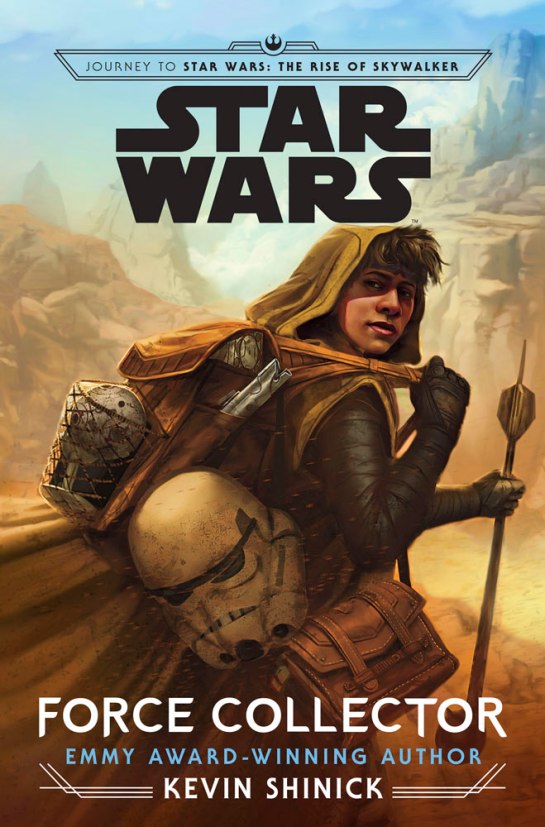
Star Wars: Force Collector by Kevin Shinick

ForceCollector-Cover

Publisher: Listening Library (Audiobook – 19 November 2019)

Series: Star Wars

Length: 8 hours and 13 minutes

My Rating: 4 out of 5 stars

Amazon     Book Depository

We are less than a week away from the final movie in the main Star Wars saga, The Rise of Skywalker, so it is about time that I got around to reviewing the final Star Wars novel of 2019, Star Wars: Force Collector by Kevin Shinick.

This is a book that I have been looking forward to for some time. Force Collector is a curious Star Wars young adult novel with an intriguing-sounding plot behind it, and it would have ordinarily been on my reading list anyway. However, as it is one of several books being released under the title of Journey to Star Wars: The Rise of Skywalker (other examples of which include Resistance Reborn), it was one I definitely needed to check out before the movie comes out in a few short days.

This book was written by Kevin Shinick, who is probably best known for his work writing and developing television shows such as Robot Chicken, the 2017 Spider-Man animated show, Mad and Disjointed. In addition, Shinick has also written several comics for DC and Marvel, including Avenging Spider-Man, Superior Carnage and Axis: Hobgoblin. Force Collector is actually Shinick’s debut novel and he has produced a great Star Wars book with a rather interesting concept that provides a clever new viewpoint into the events of the Star Wars films.

Set shortly before the events of The Force Awakens, Force Collector revolves around Karr, a teenage boy living on a backwater planet. Karr lives a difficult life; anytime he touches an item that has witnessed an important or traumatic event, he gets a searing headache and blacks out. However, these items also impart onto him a vision of the history associated with it, allowing him to glimpse into the past. While his parents search for a rational explanation for his episodes, Karr’s grandmother knows the real reason for strange visions: he is gifted with the Force.

Attempting to learn how to control his abilities, Karr struggles with his training and hopes to find someone who can teach him in the ways of the Force. However, all the Jedi are long dead, and no-one on his planet knows what happened to them. Determined to learn more, Karr begins to collect historical items which he hopes will allow him to have some vision of the Jedi and learn where to find them. However, the few meagre artefacts he can lay his hands on are unable to provide him with the knowledge he seeks.

When Karr’s grandmother dies and his parents attempt to send him away to a school on the other side of the planet, he finally has enough. Determined to find an actual Jedi to help him, Karr, his droid RZ-7, and his school’s new troublemaker, Maize, steal a First Order ship belonging to Maize’s father and set out on an adventure. Travelling from one planet to the next, Karr and his friends attempt to trace the history of the Jedi. Finding obscure item after obscure item, Karr is eventually able to piece together the events that led to the downfall of the Jedi order and the rise of the Empire. However, the greatest secrets may lay even closer to home than he imagined.

Force Collector is a fun and intriguing novel which provides a unique and clever examination of the events of the Skywalker Saga, and which I am very glad I decided to check out. Featuring a great group of central characters (Karr, Maize and RZ-7) who grow closer as they progress in their adventure, and a rather captivating story, this was an amazing Star Wars read. I particularly liked the idea of a character who could revisit the Star Wars past through the objects he touches, as it allows Shinick to take the reader on a journey through a number of events in the Star Wars canon. Some really interesting bits of Star Wars history are examined through the course of this book, and it features some compelling visits to a number of iconic locations. That being said, this is a rather low-stakes novel, as the protagonists’ great adventure comes across at times like an unusually eventful school excursion (indeed, that is the explanation they give to the people they encounter). As a result, this might not be the best book for people looking for an exciting or action-packed novel (Thrawn: Treason or Master and Apprentice might be a better 2019 Star Wars release for those readers), however, the examination of Star Wars history makes this book an outstanding read for major fans of the franchise.

In order to tell his story, Shinick has filled his novel with all manner of references to the wider Star Wars universe. Not only does the reader get to see a number of visions from the past as part of the protagonists’ quest to find out more about the Jedi, but they also visit a number of familiar locations. These include Jakku (where Rey was living), Utapau (where Obi-Wan killed General Grievous) and even Batuu (the planet where the Galaxy’s Edge theme park area is set, and which has also served as the setting for several books such as the recent release Black Spire), just to name a few. Our protagonists encounter a number of unique individuals or items which witnessed some of the most iconic moments out of the films. For example, at Utapau he discovers the walking stick of the planet’s leader, which reveals the conversation the leader had with Obi-Wan when he landed. On another planet he runs across a pilot who witnessed Obi-Wan cutting the hand off Ponda Baba in the Mos Eisley cantina on Tatooine. There are some really cool and, in some cases, obscure items that Karr touches throughout the story, and the events they showed were really interesting.

In addition, Shinick also focuses on exploring the Star Wars universe just prior to the events of Star Wars Episode VII: The Force Awakens. Force Collector appears to occur just before the start of The Force Awakens, and there are a number of references to the shape of the universe and the plans of the First Order. Shinick also uses this to allow the protagonists to visit and have some fascinating interactions with a couple of characters who appeared in the movie, such as Unkar Plutt or Maz Kanata. The meeting with Maz Kanata in particular was intriguing, and it was cool to see all these characters just before the events of the film rained down hellfire on their locations. In the end, this book contained all manner of references from across the films, the animated television shows and even some of the other books that make up the current Star Wars canon, making this a perfect read for dedicated fans of the franchise.

One of the most intriguing things that I liked about the story was its examination of how the characters in the wider Star Wars universe during this period perceived the Jedi and the events of the Skywalker Saga. Shinick makes it clear quite early on in the book that, during the period that novel was set, most of the galaxy saw the Jedi as a myth and barely anyone knows that much about them anymore. Even the protagonists, Karr and Maize, both of whom consider themselves somewhat more knowledgeable on the subject that most people, barely have any idea of what they were capable of or why they were destroyed. The various theories and histories of the Jedi that are postulated at the start of the novel are so obviously wrong to anyone who has seen the movies that it is quite a jarring experience. I found it deeply fascinating to see how it only took a generation or so for the legend of the Jedi to be degraded, and it explains why characters like Finn and Rey in The Force Awakens barely knew anything about them. The subsequent search for the truth is also interesting, and I liked how the characters attempted to piece together the events of the film. This search was hampered by the fact that the information they received was a random selection of events that were not in any chronological order. This ensures that they get a confused picture of all the events of the Skywalker saga, which they need to try and piece together to fully understand the lessons of the past. All of this was a really cool and unique take on the events of the films, and it was fun trip down memory lane.

While I really enjoyed all the cool references to the rest of the Star Wars franchise, I struggled to see how this book will actually tie into the events of the upcoming The Rise of Skywalker film, despite that being one of the major advertised features of the book. While this book did spend a bit of time expanding on the overall universe around the current trilogy of Star Wars films, there was nothing specific about The Rise of Skywalker in it. While this did not massively impact my enjoyment of the novel, I kept waiting for the story to kick off in another direction, perhaps after some of the galaxy-altering events that were shown in The Force Awakens took place, or feature a more major character from the films. It never did, and I very much doubt that the main character in this book is going to show up in the new movie (although I could be mistaken). The main connection I could find in this novel was the confirmation that a certain character is at the heart of all the major events of the Skywalker Saga, so much so that only touching an item of theirs was enough to make Karr understand all of the events of the films completely. This is something I believe that the Star Wars creative team wishes to reinforce, as the trailers and rumours indicate big things are happening to this character in the final movie, which will help signal the fact that the Skywalker Saga is truly over. There is also a mention of Karr holding onto a couple of certain Jedi items in case they will be needed in the future, but again I doubt this is going to feature in The Rise of Skywalker. As a result, while Force Collector serves more as an interesting recap for some of the prior Star Wars events, don’t expect any major revelations about the upcoming film.

Rather than grab a physical copy of this book, I ended up listening to the Force Collector audiobook, which was narrated by Euan Morton. Running at just over eight hours in length, this is a pretty short audiobook that most people should be able to get through rather quickly. As usual, I had a lot of fun listening to this Star Wars audiobook, as it featured all of the classic Star Wars music and sound effects, which really help to make the franchise’s audiobook formats so unique. Narrator Euan Morton is an old hand at narrating Star Wars audiobooks; I recently enjoyed his narration of Tarkin, for example. He does another fantastic job with the narration in Force Collector, coming up with a number of unique and distinctive voices for the characters who only appear in this novel, while also doing great impressions of characters who previously appeared in the film. I was particularly impressed with the realistically teenage voices he was able to come up with for Karr and Maize, and I also like how he did not really recycle any of the voices he used in the previous Star Wars audiobook of his I heard. All of this results in another outstanding audiobook adaption of a Star Wars novel, and it is easily one of my favourite franchises to check out in this format.

Star Wars: Force Collector by Kevin Shinick is a fantastic book that features a captivating and unique story, which is richly layered in references to the prior movies and other pieces of Star Wars fiction. While it does not contain an obvious connection to the upcoming The Rise of Skywalker film, it is still a really interesting and exciting novel that is worth checking out, especially as it provides a compelling recap of some of the previous films in the franchise. Aimed towards a younger audience, Force Collector will be easily enjoyed by all Star Wars fans, especially those who are familiar with the expanded fiction. However, even those readers who have seen the films will be able to appreciate the story in this book. An overall great read, this book is a lot of fun and is an excellent piece of Star Wars fiction.

Amazon     Book Depository

Throwback Thursday – Star Wars (2015) Volume 1: Skywalker Strikes by Jason Aaron and John Cassaday

Star Wars (2015) Volume 1 Cover.jpg

Publisher: Marvel Comics

Publication Date: 6 October 2015

Length: 160 pages

My Rating: 5 out of 5 stars

Amazon

Reviewed as part of my Throwback Thursday series, where I republish old reviews, review books I have read before or review older books I have only just had a chance to read.

I think it is fair to say that I have been in a real Star Wars mood lately. Maybe it is because of the imminent release of the final movie in the Skywalker Saga, Star Wars: The Rise of Skywalker, or perhaps it is because The Mandalorian is such an awesome TV show. Whatever the reason, I have been reading and reviewing quite a few Star Wars books and comics lately. For example, I am currently listening to Star Wars: Force Collector, I reviewed Tarkin last week and I recently read and reviewed Resistance Reborn and Vader: Dark Vision. As a result, I thought that this week would be a good time to do a Throwback Thursday on the first volume of the 2015 Star Wars comic book series, Skywalker Strikes, which did an outstanding job of introducing an extremely exciting ongoing comic series.

The Star Wars comic book series was started in 2015 and follows the adventures of the protagonists of the original Star Wars trilogy. Set shortly after the events of A New Hope, this series attempts to fill in the three years between the first film and The Empire Strikes Back. The Star Wars comics originally ran concurrently with the Darth Vader (2015) comic series until that series ended, and then proceeded to run alongside the Doctor Aphra comics. The Star Wars series ran for 75 issues and has only recently concluded. A sequel series with the same name is set to begin in early 2020, which will follow the events between The Empire Strikes Back and Return of the Jedi.

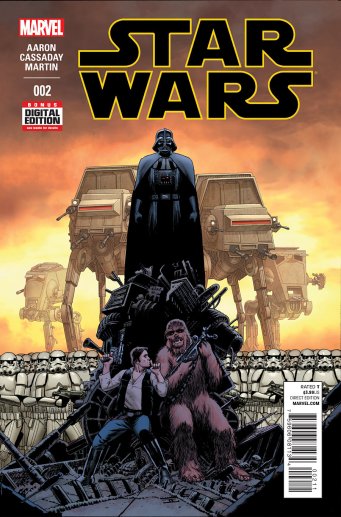
Star_Wars_Vol_2_2.jpg

Volume One of Star Wars begins shortly after the destruction of the Death Star. With the Empire in turmoil following the destruction of such a major weapon, Rebel Alliance members Luke Skywalker, Leia Organa, Han Solo, Chewbacca, C-3PO and R2-D2 use the chaos to infiltrate a key Imperial weapons factory. While they are able to destabilise the factory’s reactor core and free its slave labour force, the Rebels are unprepared for the unexpected arrival of Darth Vader.

Attempting to complete their mission while also trying to kill Vader, the Rebels find themselves hopelessly outmatched by the Dark Lord of the Sith, who is determined to capture the Rebel who blew up the Death Star. Not even Luke, with his newly discovered Jedi abilities, is able to stand up to Vader, and the Rebels barely manage to escape with their lives.

Frustrated by his failures against Vader, Luke decides to take a leave of absence from the Rebel Alliance and returns to Tatooine to contemplate his future. Travelling to the house where Obi-Wan Kenobi lived in exile for years, Luke hopes to find something that will guide him. Instead he finds himself walking into a trap, as the bounty hunter Boba Fett is lying in wait. At the same time, Leia talks Han into a scouting mission for the Rebels, but their simple mission soon attracts the wrong sort of attention. Who is the mysterious woman hunting Han, and why is claiming to be his wife?

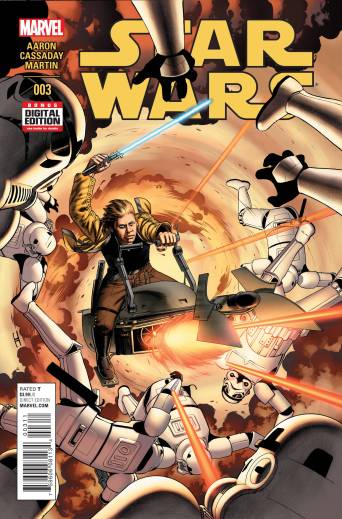
Star_Wars_3_Marvel.jpg

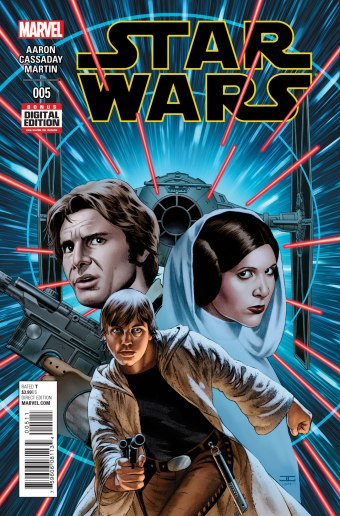
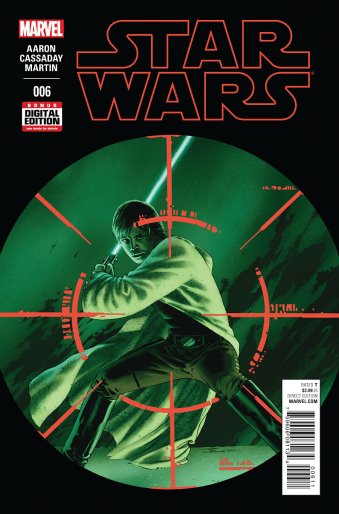
Skywalker Strikes, which is made up of Issues #1-6 of the Star Wars series, contains an outstanding story, fantastic artwork and some of the most insane Star Wars action sequences that you will ever see. The team of Jason Aaron and John Cassaday, have done an amazing job on this comic, and this first volume does a wonderful job starting off this long-running series. While all the issues in this volume are connected together pretty well, I would say that there is a distinctive break between Issues #1-3 and Issues #4-6. Issues #1-3 focuses solely on the protagonist’s attack on the weapon facility, while the last three issues feature some more independent adventures from some of the series’ various characters, as each of them is searching for something.

The sequence contained within Issues #1-3 is just incredible, and it is easily my favourite part of the entire series. What starts as a fun infiltration of an Imperial facility quickly devolves into utter chaos as Darth Vader enters the mix. What then follows is nearly three whole issues of action, explosions, fantastic first meetings and all manner of destruction as the Rebels desperately attempt to escape the factory. While all the characters involved in this part of the comic are really good, I have to say that Vader steals the show as the indestructible villain. This was actually one of the first pieces of fiction in the new Disney Star Wars canon that shows off how amazing Vader could truly be, and it is pretty darn awesome. Pretty much from the first instance he appears, he shows off the full extent of his powers by throwing stormtroopers in front of a sneak attack from Chewbacca, and then by starting to crush an AT-AT with the force. He then subsequently survives a full-on blast from the AT-AT’s cannons and hacks it to pieces with his lightsaber. He also cuts through a bunch of escaping slaves and shows his intense displeasure to his subordinates in a number of destructive ways, including twisting a stormtrooper’s head 180 degrees with the force (to be fair, he did catch sight of Vader without his helmet) and choking a Star Destroyer captain from an insane distance. I can also not be the only person who cracked up at Vader very quickly destroying an Imperial Officer moments after he said “Lord Vader will have my….” (spoilers, he was going to say head, and Vader really did). All of this destruction and action was essentially pure awesome, and I loved every second of it.

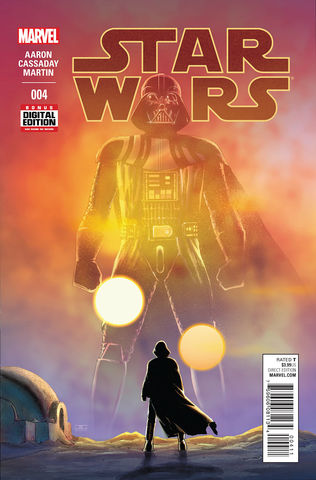
Star_Wars_Vol_2_4.jpg

In addition to all the action in this part of the book, there are also some major moments in Star Wars history that fans of the franchise are really going to enjoy. For the one thing, it actually has the first face-to-face confrontation between Luke and Darth Vader. This scene is handled extremely well. Luke, still believing that Vader is the one responsible for the death of his father, jumps at the chance to get revenge. However, as Luke runs towards Vader’s location full of confidence, he hears the disembodied voice of Obi-Wan Kenobi telling him to run. This is advice that Luke really should have taken; Vader, after berating Luke for his obvious lack of skill with the lightsaber, rather easily disarms him. While getting ready to kill Luke, Vader notices that the lightsaber he has taken off him is the very one he used to wield as Anakin Skywalker, which obviously raises some issues within him. As events at the factory spiral out of control, Luke is able to evade Vader, who starts to grow slightly more impressed by his skills. As Luke makes his escape, Vader realises that he is not only the pilot that destroyed the Death Star but also Kenobi’s last great hope. Still not fully realising the identity of the boy he just encountered, Vader rather vindictively promises to corrupt him to his purposes. All of these events are pretty incredible moments in Star Wars history, and I think that the creative team did an outstanding job introducing them in this new canon. The initial face-to-face showdown between the main protagonist and villain of the original Star Wars trilogy is a pretty significant moment, and I really loved how it was shown. The hints at the hidden history between the two are great, and the initial realisations from Vader that there is more to Luke than he realises are fantastic. I also liked how the creative team showed Luke as having no real skill with the lightsaber or the force. Considering that he only had about an hour of training with Kenobi, it really isn’t that surprising that he has no lightsaber abilities, so this is a pretty clever and realistic inclusion, especially as a good part of the following Star Wars comic series deals with some of the earliest days of his training. While these events are probably not the most significant to occur in this volume (more on that later), they are incredibly intriguing and any fan of the Star Wars franchise is going to love it.

The last three issues of Skywalker Strikes are also very entertaining, though less action-packed, since the creative team has opted instead for storytelling and showing off the state of the Empire and Rebel Alliance. While a despairing Luke sets off to find answers, Han and Leia set off to find potential locations for a new Rebel base, while Vader has a meeting with Jabba the Hut. There are some really interesting aspects to this part of the story, from the growing hopelessness in Luke as he begins to realise how far he is from becoming a Jedi, to Vader’s sudden obsession with capturing Luke, to the growing hints of romance between Han and Leia, disguised at this point as antagonism. However, I would say that it’s the newcomers to the comic series, Boba Fett and Sana Solo, that are some of the best parts of the last three issues of the volume. Fett, who has long been a fan favourite despite his complete underutilisation in the movies, shines as the badass bounty hunter as he scours Tatooine for Luke, eventually finding out all about him through some very violent means. This leads to a pretty fun showdown between Boba and Luke, as Boba ambushes him at Kenobi’s house and easily incapacitates him and R2-D2 with his cool array of weapons and tactics. It is only thanks to Luke’s first close-combat use of the force that he is able to escape, as he successfully blocks a blaster bolt while blinded (a nice homage to the training sequence from A New Hope) and moves an item with his mind. All of this was a pretty entertaining showdown, and I loved seeing Fett in action for once. We also have the mysterious Sana Solo, who has a pretty fantastic takedown of some Rodian thugs with a great piece of technology and a ruthless demeanour. She is later able to track down Han and Leia, absolutely terrifying Han before dropping one of the biggest bombshells of the book: that she is Han’s wife. While this is not explored in any great detail in this volume, it is an excellent introduction for this great character, who goes on to become a fairly major figure in the current Star Wars canon. As a result of all of this, the second half of the volume holds up pretty well to the action-packed first half, and there are plenty of major scenes, including the very big ending.

Star_Wars_Vol_2_5.jpg

While I did really like the second part of this volume, the best way to appreciate it fully is if you understand its connection to the Darth Vader (2015) series of comics. The Darth Vader series was launched right on the heels of the Star Wars comics and it is actually set in the aftermath of the first three issues of this volume. In the first issue of this concurrent comic, it is shown that Vader has actually started going rogue on the Emperor and is making his own deals with Jabba the Hutt, before the formal discussion he has with Jabba in Issue #4 of the Star Wars series. This actually clears up the somewhat cryptic discussion he has with Jabba later in the issue, where they talk about the bounty hunters he has hired, and also shows the point where he actually tasked Boba Fett with finding Luke. While none of this is absolutely vital when it comes to fully understanding the plot of Skywalker Strikes, it is interesting to see that some of the referenced events occurred in another series. However, the main reason why readers should try to understand the connection between this comic and the Darth Vader series is in the epic conclusion both of them share, where Vader learns the last name of the boy he has been hunting. Both Issue #6 of Star Wars and Darth Vader were actually released on the same day, so readers of both series were able to see this scene at the same time. The two scenes are shown in a slightly different light in each series. It is expanded a bit more in the Darth Vader series, as it plays into the feelings of resentment towards the Emperor that have been building in Vader through the series. However, I quite liked the simpler version in Issue #6 of Star Wars, as the slow-boiling rage and anger within Vader is pretty obvious, as he takes a whole page to fully react, cracking the glass on a Star Destroyer and simply whispering, “Skywalker”. As a result of this connection, the Star Wars and Darth Vader series complement each other extremely well, and I would strongly recommend reading both pretty close together. However, no matter which series you read, the sequence showing the moment where Vader realises that his son is still alive and a Jedi is pretty darn epic and really memorable.

It could be argued that splitting this volume into two separate storylines was an interesting choice from the book’s creative team. I imagine that six issues focused on the attack on the Imperial weapons factory would have been pretty epic (just imagine how much more destruction Vader could have wrought). However, I personally think they did the right thing by splitting the story and showcasing the aftermath of this action. This way you not only get the intense action of the first few stories but you also get to see the consequences of the mission, and all the implications this has for the wider Star Wars universe. In addition, there is also quite an intriguing set up for several key moments in the upcoming series as a whole, a whole new fight between Luke and another iconic Star Wars character in Boba Fett, and some amazing connections with a sister series. I really liked how the story of the entire volume came together, and I think it was an outstanding way to start this excellent series.

Star_Wars_Vol_2_6.jpg

I have to say that I was also really impressed with the awesome artwork that was featured in this first volume. The artwork was drawn by John Cassaday, and featured Laura Martin as the colourist. It is pretty amazing the way that Cassaday was able to capture the faces of the core original trilogy cast members with his artwork. Luke, Leia and Han all look really good to my eye in this volume, and the artist has also done some great renditions of other existing characters, such as Vader, Boba Fett and Jabba the Hutt. In addition, I really enjoyed all of the marvellous and exhilarating action sequences that they artistic team portrayed throughout the volume. These action scenes, especially the ones featuring Vader at the start of the book are just incredible, and I really loved seeing all the fantastic and creative violence. In addition to all the action, there are a number of scenes where the artwork helps to enhance the emotions and hidden meaning of a scene, and I will always love the way that they portrayed the closing moments of this volume. This was some first-rate Star Wars comic book art that is really worth checking out.
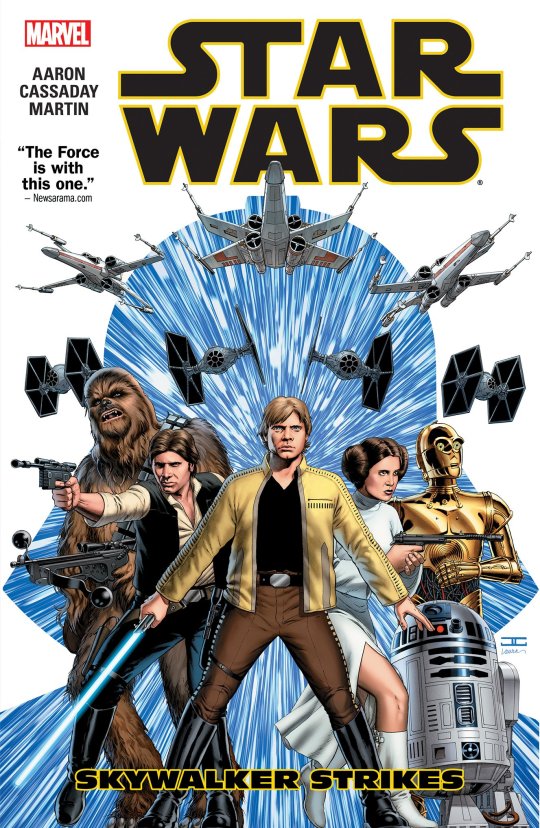
As you can see from the above review, I really loved this first volume of the Star Wars (2015) comic book series. The amazing creative team behind this first volume did a fantastic job with the first six issues that make up Skywalker Strikes, producing an extraordinary story which is complimented by a connection to another series and some exceptional artwork. This volume is a fantastic introduction to the flagship comic book series of the Star Wars franchise, and it comes highly recommended. No great knowledge of the expanded Star Wars canon is required to enjoy it, and indeed this may prove to be an effective gateway to the greater Star Wars universe. This gets a full five stars from me, and I am so very glad I decided to check out the Star Wars comic book series this year.

Amazon

Throwback Thursday – Star Wars: Tarkin by James Luceno

Star Wars Tarkin Cover.jpg

Publisher: Penguin Random House Audio (Audiobook – 4 November 2019)

Series: Star Wars

Length: 9 hour and 32 minutes

My Rating: 4.5 out of 5 stars

Amazon     Book Depository

Reviewed as part of my Throwback Thursday series, where I republish old reviews, review books I have read before or review older books I have only just had a chance to read.

In this week’s Throwback Thursday I check out an amazing and compelling Star Wars tie-in novel that focuses on a fascinating character from the franchise, with Star Wars: Tarkin, written by veteran tie-in author James Luceno.

Since early 2014, Disney has done an excellent job installing a new and distinctive expanded universe for the Star Wars franchise. This new expanded universe, which supplanted the existing expanded universe (which is now known as Star Wars Legends), has featured some amazing books which I have been really getting into in the last couple of years. I have read a lot of Star Wars books in 2019 and not only have I tried to stay abreast of the latest releases (for example, the latest Star Wars novel, Resistance Reborn) but I have also been checking out some of the older novels in the franchise (such as Thrawn and Death Troopers).

Tarkin was released in late 2014 and was one of the first non-movie novelisations or young reader Star Wars novels that were released in this new canon. Tarkin was written by James Luceno, an author with a huge number of Star Wars tie-in novels from the Legends canon already under his belt, such as the intriguing-sounding Darth Plagueis. I had heard good things about this book, and I was curious to see how Luceno would alter the character of Grand Moff Tarkin.

To those familiar with the Galactic Empire, Grand Moff Wilhuff Tarkin is a legendary figure. A former admiral, adjutant general, planetary governor and war hero of the Clone Wars, Tarkin was one of the Emperor’s most dedicated and capable servants. Determined to enforce the Empire’s authority throughout the galaxy by any means necessary, Tarkin was renowned for his merciless nature and his ability to out-think any opponent on the battlefield or in the political arena. But where did this nature come from: his past as a solider or as a politician, or are there powerful lessons in Tarkin’s upbringing that constantly drive him forward?

Five years after the end of the Clone Wars, Governor Tarkin holds the rank of Imperial Moff and is tasked with overseeing one of the Empire’s most sensitive and covert projects, the construction of a massive mobile battle station which the Emperor believes will become the ultimate symbol of Imperial power in the galaxy. Determined to bring order to the post Clone War chaos, Tarkin finds his plans for the construction of the station stalled when a mysterious ship launches an innovative attack against one of his bases. In the aftermath of this attack, Tarkin is ordered to work with Darth Vader to determine who orchestrated this incursion and deal with them.

Travelling to an isolated planet, Tarkin and Vader begin their investigation into the rebellious activity plaguing that area of the Empire. But when their opponents manage to out-manoeuvre them, Tarkin must call upon all of his experiences, including as a young hunter on his home planet of Eriadu, to stop them. However, even the lessons of his past may not be enough, as his new foes are as smart and determined as Tarkin and Vader and are willing to do anything to achieve their revenge on the Empire.

Tarkin was a smart and exciting Star Wars tie-in novel that did a fantastic job exploring the life of one of the franchise’s most complex characters. I had a great time listening to this book, and it is one of the better Star Wars novels that I have enjoyed this year. I really liked the deep dive into the history and mind of Tarkin, especially as the author wraps a compelling and multi-layered narrative around the character’s story. As a result, the novel gets four and a half stars from me and was a really good read.

This story is an interesting combination of an adventure that occurred five years after the events of Revenge of the Sith (roughly 14 years before the events of A New Hope), and a series of tales from various points in Tarkin’s earlier life. Grand Moff Tarkin has always been a fascinating Star Wars character to me; despite his lack of force abilities, he appeared to wield nearly as much power as the Emperor and was even able to command Darth Vader. This book does a wonderful job of not only showing how he was able to obtain so much power within the Empire but also exploring all of the formulative events of this character’s life that made him into the man capable of achieving so much. I personally think that this was a great combination of character narratives which come together extremely well, and I think that Luceno did a fantastic job getting to the root of Tarkin’s psyche and personality.

Despite it being the shorter part of the book, I personally enjoyed the various chapters that explore various moments of Tarkin’s past the most. In particular, I thought that the author’s examination of his training as a hunter to be a truly fascinating basis for the character’s tactical ability. The various scenes depicting him hunting the large beasts of his home planet are pretty cool, and it was really interesting to see the way that he utilised lessons from hunting creatures in his later careers. For example, he is trained to instil fear into all the beasts he encounters in order to establish dominance above them and to show them the consequences of acting in way he dislikes. A later scene in the book shows him using this training to successfully end a pirate menace in a very harsh and final manner, and it also explains why he considered blowing up a planet to be a viable fear tactic against rebels. In addition to its impact on future Star Wars stories, Tarkin’s early training and hunting background are utilised to great effect throughout the entirety of Tarkin, and it was great to see how it impacts on Tarkin’s thought process and planning. I also really liked how the focus on the hunt comes full circle, as the author works in a fun confrontation back at the Tarkin hunting grounds with the main antagonist of the book that I absolutely loved and which was a fantastic conclusion to the whole story. This hunting aspect was an exceptional addition to this canon’s depiction of Tarkin, and I like how other authors have expanded on it in other pieces of Star Wars expanded fiction. For example, the third volume of Darth Vader: Dark Lord of the Sith features Tarkin using his hunting abilities against Vader in a contest of wills.

In addition to this new origin for Tarkin’s tactical ability and mental acuity, I also enjoyed the various flashbacks to his history before and during the events of the Clone War. Luceno comes up with some great storylines that show off, for example, when Tarkin first gained the attention of the Emperor, or his thoughts on the various events that occurred during the course of the prequel movies. It was fun getting his theories on the causes of the Clone Wars or the formation of the Empire, especially as he is pretty close to the mark every time. I also liked that Luceno worked a confrontation between Tarkin and Count Dooku into one of the flashbacks, which shows why Tarkin remained loyal to the Republic during the course of the Clone Wars. All of these examinations of the character’s past, especially in the context of several key events in Star Wars history, was really fascinating and proved to be a fantastic part of the book.

While I did enjoy the examination of the character’s past, the main story itself is also compelling, as it shows the events that led to Tarkin becoming the very first Grand Moff. These parts of the book are a lot of fun and feature a unique and personal hunt for the protagonist which ties in well with the journeys to his past. I also quite enjoyed the fun team-up between Tarkin and Darth Vader, who assists him to complete his mission. Tarkin and Vader form a very effective team in this book, and it was interesting to examine the relationship between them and the mutual respect that grew between them. It was also cool to find out that Tarkin was one of the few people in the whole Empire who guessed that Anakin Skywalker and Darth Vader were the same person (the only other Imperial character who apparently guessed that was Grand Admiral Thrawn). This section of the book also features some intriguing looks at the early stages of the Empire, and I personally liked the examination of Imperial politics, the intelligence agencies and the ruling style of the Emperor. I also really liked the idealistic opponents that Tarkin faced off against, mainly because their leader becomes more and more aggressive the longer the fight against the Empire goes, until he starts to lack the moral high ground in this conflict.

While I really enjoyed the team-up between Tarkin and Vader, I do wonder if the author perhaps featured Vader and the Emperor a little more than he should have. Do not get me wrong, I absolutely love Darth Vader as a character and I have deeply enjoyed a number of extended universe comics or books that have featured him (such as the Darth Vader and Dark Lord of the Sith comic series, or the Dark Visions limited series). However, I think that a book called Tarkin should have focused a lot more on the exploits of the titular character and shown how he dealt with the unique problems presented in the plot on his own. Instead, he received a fair bit of help from Vader and the Emperor, which kind of undermined the book’s message that he was an unsurpassed strategist and hunter. The author might have been better off only featuring a small amount of the Emperor in this novel, and perhaps introducing Vader in a later Tarkin novel, much like Timothy Zahn did with Thrawn: Alliances. Still, it was a fantastic book, and I am never going to seriously complain about too much Darth Vader.

Tarkin proved to be a really interesting book in the current Star Wars canon, and one that fans of the franchise are really going to enjoy. That being said, I would say that no real knowledge of the Star Wars extended universe is required to understand the plot of the book. While it does reflect on some of the events of The Clone Wars animated series, particularly the handful of episodes that a young Tarkin appeared in, there is no urgent need to go out and watch these episodes first, as they are more passing references. It is also important to note that this book was released back in 2014, two years before the release of Rogue One. As a result, it lacks the inclusion of Director Krennic as a rival for Tarkin, which is something most of the tie-in media released after 2016 features.

Like many of the Star Wars novels I have enjoyed in the past, I chose to listen to the audiobook format of Tarkin rather than read a physical copy. The Tarkin audiobook was narrated by Euan Morton and runs for roughly 9½ hours in length. I found myself absolutely breezing through the Tarkin audiobook, and I was able to listen to all of it in a few short days, as I become enthralled in the awesome story. Star Wars audiobooks are always a fun production to check out thanks to their use of the iconic music and sound effects from the movies. Tarkin also makes great use of a number of the classic scores from the movies to enhance the various scenes, most notably The Imperial March, which is used a number of times when members of the Empire are being particularly ruthless or authoritarian. I also really liked the use of the various Star Wars sound effects, such as the sound of blaster fire, spaceship engines and even the iconic sounds of Darth Vader breathing, all of which are used to help set the appropriate atmosphere for the scene. While some of the Star Wars audiobooks greatly overused these sound effects and music scores, I think that the Tarkin audiobook had the just the right amount of these elements. At no point did the music or sounds overwhelm the narration nor distract the reader from the plot; instead they did a wonderful job of helping the reader stay glued to the story.

In addition to the excellent use of Star Wars music and sound effects, Tarkin also featured a fantastic narrator in the form of Euan Morton. Morton does a commendable job of imitating the voice of the titular character and helps bring the stern, intelligent and ruthless character to life with his voice work. In addition, Morton was also able to do good imitations of several other notable Star Wars characters, including the Emperor and Darth Vader. I felt that Morton produced a good replication of their voices, and the listener is instantly able to figure out who is talking. I also liked some of the voices that Morton came up with for the various supporting characters that featured in the book, and I was impressed with the voices he attributed to some of the different alien species that were encountered. I particularly enjoyed his Mon Calamari voice, for example, and felt that he was able to add some distinguishing vocals to each of these different species. Based on this strong narration, as well as the great musical and sound inclusions, I would strongly recommend the audiobook version of this Star Wars book, and I know that I intend to check out more of this franchise’s audiobooks.

Tarkin was an outstanding piece of Star Wars tie-in fiction that I personally really enjoyed. Not only did it contain a compelling and exciting story in the early days of the Empire but it also did a wonderful job exploring the background of one of the franchises most fascinating characters. I had an amazing time learning more about Grand Moff Tarkin, and I am slightly disappointed that there have not been any more Tarkin-centric novels released since 2014. As a result, I would highly recommend this book to anyone interested in a good Star Wars tie-in novel, and I would also recommend the excellent audiobook format.

While the next Star Wars novel I read is going to be Force Collector, I am always considering what older Star Wars book to listen to in the future. I am currently weighing up between this canon’s Lords of the Sith (the Emperor and Darth Vader trapped on a planet being hunted by rebels) or the Star Wars Legends book Scoundrels (a heist novel written by Timothy Zahn). Both sound like a lot of fun, and I will probably end up listening to them both in the very near future.

Amazon     Book Depository

Starsight by Brandon Sanderson

Starsight Cover 2.jpg

Publisher: Gollancz (Trade Paperback – 26 November 2019)

Series: Skyward – Book 2

Length: 461 pages

My Rating: 5 out of 5 stars

Amazon

From one of the best authors of fantasy and science fiction in the world today, Brandon Sanderson, comes Starsight, an outstanding and addictive young adult science fiction read which continues the wildly entertaining adventures of a young starfighter years in the future.

Starsight is the second book in the Skyward series and follows on from the 2018 release of the same name. Skyward was a fantastic young adult science fiction book that told a compelling tale of bravery, determination and camaraderie in humanity’s distant future. Skyward was an amazing read, and it was easily one of my favourite books of 2018. As a result, I have been looking forward to Starsight for a while now, and it was one of my most anticipated releases for the second part of this year.

The Skyward series is set on the planet of Detritus, a desolate world that houses a population of humans in the caverns beneath the surface. The humans on Detritus are the remnants of a once great intergalactic human civilisation that has been destroyed in a war with a superior alien civilisation. Forced into hiding within the planet for hundreds of years, humanity eventually returned to the surface utilising scavenged starfighters to escape and build a military outpost to fight back against the alien ships who continue to harass the planet.

In Skyward, the reader is introduced to Spensa Nightshade, a young woman determined to become a pilot in the Defiant Defence Force (DDF), the military organisation that fights the alien invaders. While talented, Spensa faced opposition to being accepted into the military due to an apparent act of cowardice by her father years before. Despite the odds, Spensa was accepted in the DDF and was trained to become a skilled pilot, fighting in a number of actions against the enemy, while also trying to find out what actually happened to her father. Along the way, Spensa discovered an ancient but advanced human ship that had crash-landed on Detritus. Upon repairing the ship, Spensa discovered it had an AI installed in its computers, which she called M-Bot. After stopping an extremely destructive alien attack with the help of M-Bot, Spensa was compelled to fly through Detritus’s atmosphere, where she made several startling discoveries, the first of which was that Spensa and her family are powerful cytonics, beings with mental powers who are capable of traversing vast distances through space with their ability. The second discovery she made was that the aliens attacking Detritus were not simply mindless aggressors determined to wipe out humanity; instead they are members of an interstellar conglomeration called the Superiority, who are attempting to contain humanity within the planet. The Superiority hold a great fear of humans, who they see as an extremely dangerous and violent species, and Detritus is actually a prison planet/wildlife preserve where humans can live without disrupting the rest of the galaxy. Unfortunately, the actions of the DDF in reclaiming the surface and utilising spaceships have forced the Superiority to reconsider their approach, and they are now working to kill all the humans.

Usually this is the part of the review where I would give a brief plot synopsis of the new book and then go into an analysis of what I liked about it. However, this is going to prove a little hard to do without revealing some spoilers. While I don’t typically avoid talking about plot points that occur around 50-100 pages into book (I don’t particularly consider something happening that early to be a spoiler), I am a little more wary with Starsight. This is mainly because the plot of the book features some immediate substantial changes from the story that appeared in Skyward, none of which are really hinted at in any of the official online plot synopsis or book blurbs. As I am publishing this review a week before Starsight’s official release date, I think it is best that I put up a spoiler alert below, before I start going into the book in any real detail.

For those readers who do not want to risk any spoilers, I will say now that Starsight is an incredible book that I really, really enjoyed. Sanderson tells a wildly entertaining and highly addictive story that features some memorable characters, high-stakes events, some of the best science fiction action I have ever read and a ton of inventive world building. I honestly think that this is one of the best releases of 2019, and it easily gets a full five-star rating from me (if only I could go higher). I would highly recommend this book to anyone interested in an epic science fiction read, and if you loved Skyward, you are going to love this book.

Anyway, if you are not interested in learning any more details about this book’s plot or characters (which I do explore to a substantial degree), I would suggest you stop reading now, as everything below this paragraph has a spoiler alert in effect.

SPOILER ALERT:

Starsight is set a few months after the events of Skyward, and humanity has been busy. Thanks to Spensa and Skyward Flight, as well as the advanced technology contained with M-Bot, the DDF has managed to capture several of the planet’s ancient orbiting defensive platforms, which have allowed them to push the Superiority forces out of Detritus’s obit. However, despite these successes, humanity is still trapped on Detritus, and the eventual Superiority mass retaliation will likely wipe out everyone on the planet. Their only chance at survival is to flee from Detritus and find a new planet to make their home, somewhere the Superiority cannot find them. However, the only way to do this is with some form of hyperdrive, which humanity lacks access to, and Spensa’s cytonic teleportation abilities are too restrictive for mass use.

The crash-landing of an unknown alien spacecraft on Detritus may provide the solution that will ensure humanity’s survival. The pilot of this craft is a member of a non-Superiority species who has been invited for diplomatic reasons to enlist in a new Superiority fighter squadron, and she is able to pass on the cytonic coordinates to the squadron’s base to Spensa. Disguised with M-Bot’s holographic technology, Spensa travels to the Superiority space city, Starsight, in order to infiltrate the Superiority military and find and steal a working hyperdrive.

Joining the new Superiority squadron, Spensa discovers that she and her fellow recruits are being trained to fight the delvers, titanic inter-dimensional beings that dwell in the nowhere, who are capable of devastating planets if they are drawn into our dimension by an over-use of cytonic ability. But as Spensa attempts to complete her mission, she finds herself caught amidst the politics of the various Superiority races, many of whom wish for the complete and utter destruction of her people. Can Spensa navigate the strange new world she finds herself in, or will her actions result in the destruction of all she knows?

As you can see from the above synopsis, Starsight goes in some very interesting and unpredictable directions. I personally loved all of these new story elements, and the idea of Spensa having to infiltrate a mostly unknown alien society was a really clever and intriguing central plot idea that I think worked extremely well. The subsequent narrative is a fantastic blend of different story elements, which includes some great new characters, settings and plot directions, as well as some of the best parts of Skyward. For example, not only do you get to see a whole new take on the excellent space fighter training plot point that made the first book so amazing, but you also get a science fiction spy thriller story filled with all manner of political intrigue. This was a fantastic book to get into, and Sanderson has made sure that the plot is accessible to readers who did not get a chance to check out Skyward last year. However, I would strongly recommend reading Skyward first, not only because it will give you a better idea of the characters and certain plot elements, but because it is such an awesome book in its own right.

One of my favourite things about the first book in the Skyward series was the excellent group of characters that Sanderson focused on, including Spensa, M-Bot and the members of Skyward Flight. Throughout Skyward the reader got to know and care for these characters, and it was actually a little bit distressing when bad things happened to them. Skyward continues to look at several of the characters from the first book, although readers who grew attached to Skyward Flight might be a tad disappointed as Sanderson shifts the focus away from them and introduces the reader to a whole new group of alien characters.

Spensa is still the main point-of-view character for this second book and serves as a fantastic central protagonist. In many ways, Spensa is still the same impatient and reckless pilot that was such to see in the first book. However, it soon becomes obvious that the experiences, relationships and life lessons that she has faced since joining the DDF have tempered her in many ways, especially as she has to deal with the intense responsibility of being her people’s greatest hope for survival. I really enjoyed watching Spensa as she was forced to assimilate into the alien cultures on Starsight, and it was interesting to see how she reacted when she realised not everyone there is as evil as she believed. The opinions and support she gives to her alien friends result in some emotional moments, and it was really heart-warming to see how far she has progressed since the last book.

While Spensa is a great central protagonist, to my mind the best character in the entire book is still her sentient ship, M-Bot. M-Bot is the snarky and hilarious artificial intelligence that Spensa discovered crashed on Detritus, and together they form an efficient and enjoyable team. M-Bot honestly has all the best lines in the book, and nearly every interaction with Spensa results in some excellent jokes or banter. Despite the humour, M-Bot is a pretty complicated character, especially as in this book he is attempting to work out the full limits of his consciousness and code. He is continuously attempting to prove that he is actually alive, and these attempts result in safeguards in his system attempting to shut him down. I really enjoyed the way that Sanderson continues to utilise M-Bot. Even though he is a ship, he is still a fantastic and highly enjoyable character to focus on and we even get a reason for his mushroom obsession in this book.

Spensa’s new flight of Superiority comrades features an eclectic bunch of aliens, each with their own quirks and unique personalities. These include a figment called Vapour, who is essentially a sentient smell that can take control of ships and pilot them. Vapour is the ultimate spy and requires Spensa to be constantly on her toes. There is also the dione draft, Morriumur. Dione are a race of non-violent aliens high up in the Superiority hierarchy, who have a unique breeding system that combines the parents into one new being. This is a process that can take several goes, as the family of the newly bred dione may choose to reform a young dione so that they have an ideal personality. Morriumur is a draft, spending the first few months of their life testing out their personality to see if they are an ideal member of the species. Morriumur, who has slightly more violent tendencies than most of their species, is trying to prove that they belong as a starfighter, but the combined expectations of their family and the inner thoughts that they are not worthy, are a constant hindrance to them as a pilot.

While both of the above characters are pretty cool, and Sanderson spends a good amount of time exploring them, two members of Spensa’s new flight really stood out. The first of these is Brade, a human from another prison world who has been recruited as a cytonic enforcer by one of the book’s central antagonists. Brade, after being taken from her parents as a child, has essentially been brainwashed all her life to consider humans as evil and inferior, and this has a major damaging effect on her psyche. The interactions between her and Spensa throughout the book are quite fascinating, and she proved to be one of the most complex characters in this book. My favourite new character, however, had to be Hesho, who is totally not king of the kitsen. The kitsen are a race of tiny gerbil-like aliens who have recently converted from a monarchy to a democracy in an attempt to become a Superiority race. Hesho leads a group of around 50 kitsen who pilot one heavily armed fighter in Spensa’s squadron like it’s a capital ship. Hesho and the kitsen are really hilarious characters, mainly because Hesho is attempting to convince the Superiority that he is no longer ruling his people as a king, and instead the kitsen have embraced democracy. Unfortunately, despite Hesho insisting he is no longer a monarch in every interaction he has, his people continue to worship him, which kind of undercuts this message. I also found the similarities in the personalities between the kitsen and the Spensa we first encountered in Skyward to be very amusing, as the kitsen attempt to compensate for their size with extreme confidence and boasting like Spensa used to (for example, the first ship we see the kitsen flying is called Big Enough to Kill You).

All of the above characters are great, and I really loved the way that I was once again drawn into their various personalities and histories. It was a bit of a shame not to see too much of the characters I liked so much from the first book (although we do get an idea of what various members of Skyward Flight are up to), but I think the new characters that Sanderson introduced more than made up for it.

In addition to the fantastic character work, one of the other best features of Starsight is the epic and fast-paced action sequences that punctuate much of the book. Just like in Skyward, Sanderson presents a huge number of different scenes where Spensa is fighting or training in a fighter. The sheer amount of detail that goes into these various action sequences is pretty amazing, and I was able to picture all the flying and manoeuvres perfectly. The author comes up with a number of clever new scenarios in this book, including the fancy flying and combat required to fight a delver, or having Spensa fly in the type of craft she has been fighting against for her entire military career. All of the action in this book is first-rate, and I can guarantee that you will get lost in some of the incredible action sequences.

I have always been impressed by the elaborate worlds that Sanderson can create for his stories. Whether it is the vast fantasy world that he came up with for The Stormlight Archive, the supervillain dominated alternate version of Earth that appeared in The Reckoners trilogy, or the fantastic science fiction planet of Detritus that was the main setting for Skyward, Sanderson always delivers complex and intricate settings for his story, complete with huge amounts of backstory. In Starsight, Sanderson once again produces a huge and detailed new setting for his outstanding story. The alien civilisation that is living on Starsight is very impressive, and I love all the different alien races that he has come up with for this story. Many of the aliens have some very complex and fascinating history, a great deal of which featured in the story. I really look forward to seeing how Sanderson expands this universe even further in the final book in the trilogy, and I cannot wait to see what new aliens or civilisations he comes up with.

As you can see from this rather lengthy review, there is a lot to love about this book. Sanderson does an impressive job of combining the intriguing new story direction, the amazing characters, intense action and fascinating new setting into one concise narrative, and the end result is a perfect book. While Starsight is being marketed as a young adult book, and indeed it would prove appropriate for most young readers, it is really a novel that can be enjoyed by any reader of any age. I cannot recommend this book enough, and I am eagerly awaiting the next book in this series (which seems to be 2021 at this point, so far away!).

Amazon

Star Wars: Resistance Reborn by Rebecca Roanhorse

Resistance Reborn Cover 2

Publisher: Century (Trade Paperback – 5 November 2019)

Series: Star Wars

Length: 298 pages

My Rating: 4.5 out of 5 stars

Amazon     Book Depository

The road to the final movie in the Skywalker Saga, Star Wars Episode IX: The Rise of Skywalker, begins here with this intriguing tie-in novel, Star Wars: Resistance Reborn, by recent fantasy phenomenon Rebecca Roanhorse. Resistance Reborn is a fantastic and action-packed book that attempts to bridge some of the gaps between The Last Jedi and the upcoming The Rise of Skywalker.

This latest book is a very interesting addition to the Star Wars tie-in media range, and it is one that all major Star Wars fans are going to be very keen to get their hands on. Resistance Reborn is the latest Star Wars tie-in novel and it is deeply connected with the upcoming ninth film in the main Star Wars storyline, The Rise of Skywalker, which is set for release in about a month. This book is one of several pieces of upcoming Star Wars tie-in fiction that attempt to fill in some gaps surrounding the plot of the upcoming film, other examples of which include the Force Collector young adult novel, the Star Wars: Allegiance comic book and even Black Spire, to a lesser degree. Resistance Reborn is probably the most exciting one on the list, as it is going to be the novel that is most closely connected with the events of the movies.

Following on shortly after the devastating events that occurred on the isolated planet of Crait at the end of The Last Jedi, the Resistance has been decimated by the tyrannical First Order. Seemingly abandoned by their friends and allies throughout the galaxy, only a few members of the Resistance have survived and are now in hiding. Those remaining Resistance members are as determined as ever to fight and are willing to risk it all the save the galaxy.

To that end, the leader of the Resistance, General Leia Organa, has sent her few remaining compatriots out into the galaxy in an attempt to find more volunteers, supplies, ships and, most importantly, leaders and strategists who can help guide the Resistance to victory. While her teams are able to find a few valuable recruits, including some old friends from the days of the Rebel Alliance, the situation is looking grim.

The First Order have started to establish their dominance throughout the entire galaxy, and few are willing to stand before them. Whatever allies or supporters the Resistance might have been able to count on have gone missing, apparently the victims of an oppressive roundup by the First Order. As Poe Dameron and the remains of his squadron attempt to recover a prisoner list that contains the details of the fate of these dissidents, it soon becomes apparent how far the reach of the First Order has grown. Can the Resistance survive, or will the shadow of the First Order overwhelm them all?

This was an outstanding read that not only tells a fantastic and enjoyable story that features several iconic characters, but it also does a great job of connecting The Last Jedi (which I have to admit was not my favourite Star Wars film) and The Rise of Skywalker. In addition to that, the author, Rebecca Roanhorse, who has gained a lot of positive attention in the last two years with her debut The Sixth World series, has also included quite a number of fun references to other works of Star Wars fiction, making this an entertaining read for fans of the franchise.

The first thing that I want to address about Resistance Reborn is how this book adds to the background of the upcoming Star Wars film. It shows the reader how the Resistance starts to rebuild itself before The Rise of Skywalker. The events of episodes VII and VIII saw the Resistance stripped of many of the resources and allies that they needed to fight the First Order. The Force Awakens featured the annihilation of the New Republic, the Resistance’s main supporters and one of the few galactic powers that could match the First Order, while The Last Jedi saw the destruction of most of the remaining Resistance forces, including pretty much all of their senior leadership. However, the recent trailer for The Rise of Skywalker shows quite a significant fleet of Resistance ships in a big climatic battle. A major question then arises: where did the Resistance get all of these people and ships after all their significant defeats? Resistance Reborn, which is set only a few days after the end of The Last Jedi, attempts to show how Leia and the Resistance were able to start gaining some initial recruits and materials. This is a rather intriguing storyline which shows how desperate the situation is for the Resistance and how powerful and widespread the First Order has become. I liked some of the explanations for why the Resistance was abandoned by their allies at the end of The Last Jedi, and Roanhorse comes up with a good explanation for how the protagonists found their initial batch of new recruits. The end of the book presents a rather interesting scenario for the entire Resistance, which does explain a few things that I noticed in the trailer for The Rise of Skywalker. Overall, based on what I can guess is going to occur in the upcoming film, I would say that this is an excellent bridge between the events of The Last Jedi and The Rise of Skywalker, although I am very curious to see how many aspects of this book do end up appearing in this new movie.

One of the cool things that I liked about Resistance Reborn was the cool way that Roanhorse split the story between an interesting mixture of characters. Rather than solely focusing on the central protagonists of the films, the author has instead included an intriguing choice of new point-of-view characters that fans of the extended Star Wars universe are likely to already be familiar with. That being said, there are a number of notable inclusions from some of the main characters in the book, and there are also a couple of new characters introduced in this book who get a few point-of-view sequences.

The main character of the book is Poe Dameron, who spearheads the Resistance’s attempts to gain new recruits. Poe was a good choice as the central character, as not only is he one of the central leaders of the Resistance and their main man of action but he is also still recovering emotionally from the events of The Last Jedi. The regrets he bears from his mutiny on the Raddus and the role he played in the devastation of the Resistance are still weighing heavily on his mind, and it results in some fantastic and emotional sequences from him and the people he interacts with. Roanhorse also spends a bit of time following General Leia as she recovers from all the traumatic events of the last two movies. In this book, Leia is showing quite a few hints of despair after all the losses she has recently experienced; however, it is heartening to witness her start to regain her drive and hope by watching the actions of the younger members of the Resistance.

It was very interesting to see that the rest of the main cast of the recent Star Wars films were not utilised as major characters in this book. You barely get to see anything of major characters like C-3PO and Chewbacca, and even Rey only gets a few minor scenes. Finn features a little bit towards the end of the book as he joins Poe on a mission. I really liked the interactions between Poe and Finn in this book, and I am curious to see whether this is a hint at some sort of romantic relationship occurring between them in the film (there are quite a few fan theories about that out there). Even if it doesn’t, I was very happy that this book actually contains a decisive end to that terrible romance that sprouted between Finn and Rose in the last film. Resistance Reborn did not feature any appearances from the major antagonists of the last two films; instead, the First Order as a whole were the book’s antagonists. While I would have liked to see some scenes of Kylo Ren or General Hux squabbling for dominance or expanding their influence, I did like the use of whole organisation as an opponent, and it was an effective way of showing off just how dangerous and malignant the First Order can be.

Quite a lot of time is also spent exploring some of the lesser-known members of the Resistance and some of their recent recruits. This includes members of Poe Dameron’s squadron of fighters, Black Squadron, who appeared in The Force Awakens; the protagonist of a previous trilogy of books, Norra Wexley; and the current version of Inferno Squadron from the Battlefront II video game, Shriv and Zay. These characters appear as fairly significant point-of-view characters throughout this book, and it was interesting to see the perspective of these lesser-known Star Wars characters as they fight as part of the Resistance. However, out of all the characters that appeared in this book, the one I was most happy to see was Wedge Antilles. Despite only being a minor character in the original trilogy of films, Wedge has long been a favourite of Star Wars fans due to his many appearances in a multitude of different extended universe formats, including books, comics, games and the Star Wars Rebels animated show, in both the previous canon and the current, Disney-operated canon. It was recently announced that Wedge would be appearing in The Rise of Skywalker, and this book reintroduces him in the current chronology of the films, showing him come out of retirement to once again fight the good fight. This was a really cool addition to the story, and I personally was so happy to see Wedge once again.

Probably one of the things that I liked the most about Resistance Reborn was the huge amount of Star Wars references that Roanhorse was able to fit in this book. Not only are there the obvious connections to the previous Star Wars movies but Roanhorse has made sure to tie the story into a number of other pieces of media from across the Star Wars expanded universe. Several of the characters that she has included in this book first appeared in other pieces of expanded universe fiction, such as the members of Inferno Squadron, who were the protagonists of Battlefront II. The characters of Norra and Snap Wexley were the protagonists of the Aftermath trilogy of Star Wars books, which ran between 2015 and 2017, while Snap and the rest of Black Squadron were also major characters in the Poe Dameron series of comic books. There are also a number of references to the 2016 novel Bloodline, and Resistance Reborn actually contains an interesting conclusion to one of the significant events from this prior book. Finally, there are a number of brief references to characters or events that occurred in a number of other books, comics or television shows, such as Wedge reminiscing about his recruitment to the Rebel Alliance during the third season of Star Wars Rebels, or a discussion of Ryloth’s history of oppression, which was shown in both the Rebels and The Clone Wars animated shows. Obviously, readers who are major fans of the Star Wars expanded universe are going to love all these fun inclusions, and I personally was really impressed with everything that Roanhorse was able to fit in. These inclusions did not overwhelm the overall plot of the book, so the story is very accessible to readers who are less familiar with the expanded Star Wars lore and who won’t get those references.

Resistance Reborn by Rebecca Roanhorse is an outstanding new entry in the Star Wars canon which I ended up enjoying quite a lot. Not only does this book offer some intriguing insights into the long-awaited The Rise of Skywalker, but it also features a ton of fantastic references and characters from across the Star Wars franchise, inclusions which are sure to please mega Star Wars fans like this reviewer. Required reading before The Rise of Skywalker comes out, this book comes highly recommended and was a lot of fun.

Amazon     Book Depository

Tiamat’s Wrath by James S. A. Corey

Tiamat's Wrath Cover

Publisher: Recorded Books (Audiobook – 26 May 2019)

Series: The Expanse – Book Eight

Length: 19 hours and 8 minutes

My Rating: 5 out of 5 stars

Amazon     Book Depository

With 2019 coming to an end, it is about time I got around to writing a review for one of the best science fiction books of the year, Tiamat’s Wrath by James S. A. Corey, the eighth book in the extremely popular The Expanse series. James S. A. Corey is the collaborative name of co-authors Daniel Abraham and Ty Franck, but for the purposes of this review it is simpler to treat Corey as an individual.

Tiamat’s Wrath is an outstanding piece of science fiction that I had an amazing time listening to earlier in the year. Despite being extremely keen for this book, I did not get around to reading it until a month or two after it came out, but when I did get a chance to listen to Tiamat’s Wrath, I absolutely loved it and it was one of my favourite books from earlier in the year. However, I completely failed to write a review immediately after finishing it, and it kind of got lost in the pile of books I needed to review as I read more and more stuff.

The Expanse books, which started in 2011 with Leviathan Wakes, are an extremely complex and outstandingly well-written science fiction series, which have also been turned into a very popular television show of the same name. It is important to note that while all the books in The Expanse are connected by the same universe, overarching plot and central characters, the story can be broken up into three separate trilogies of novels. After the success of the first eight books, the authors are starting to wrap up the series, with the upcoming ninth book (hopefully coming out sometime in 2020), being the last in the series. Not only is Tiamat’s Wrath the penultimate book in the series; it is also the second book in the last trilogy of the series, which started with 2017’s Persepolis Rising.

Tiamat’s Wrath is set a short time after the events of Persepolis Rising, when the Laconian Empire, under the command of High Consul Winston Duarte, successfully utilised advanced alien technology to take control of the entire gate network and destroy the navies of Earth and Mars. The Laconians now rule the entire galaxy, and the crew of the Rocinante (the central protagonists of The Expanse series), are wanted criminals as they fight a guerrilla war. This was another incredible addition to The Expanse series that not only contains a vast and captivating story in its own right but which sets up a fascinating scenario for the final book in the franchise.

Goodread’s Synopsis:

Thirteen hundred gates have opened to solar systems around the galaxy. But as humanity builds its interstellar empire in the alien ruins, the mysteries and threats grow deeper.

In the dead systems where gates lead to stranger things than alien planets, Elvi Okoye begins a desperate search to discover the nature of a genocide that happened before the first human beings existed, and to find weapons to fight a war against forces at the edge of the imaginable. But the price of that knowledge may be higher than she can pay.

At the heart of the empire, Teresa Duarte prepares to take on the burden of her father’s godlike ambition. The sociopathic scientist Paolo Cortázar and the Mephistophelian prisoner James Holden are only two of the dangers in a palace thick with intrigue, but Teresa has a mind of her own and secrets even her father the emperor doesn’t guess.

And throughout the wide human empire, the scattered crew of the Rocinante fights a brave rear-guard action against Duarte’s authoritarian regime. Memory of the old order falls away, and a future under Laconia’s eternal rule — and with it, a battle that humanity can only lose – seems more and more certain. Because against the terrors that lie between worlds, courage and ambition will not be enough…

For the plot of Tiamat’s Wrath, Corey tells the story from the perspective of several separate point-of-view characters, each of whom has a number of chapters throughout the book. This was a very interesting combination of character perspectives that helped explore various aspects of the galaxy following the rise to power of the Laconians. Three of the main point-of-view characters are former Rocinante crew members Naomi Nagata, Bobbie Draper and Alex Kamal, each of whom is involved in the war against the powerful Laconian Empire. Another point-of-view character is returning character Elvi Okoye, who, despite her loyalties to her friends upon the Rocinante, finds herself employed by High Consul Duarte as one of his primary scientists exploring the alien technology, and later finds herself drawn into the Laconian inner circle. The fifth main character is new protagonist Teresa Duarte, daughter of the High Consul, who provides insight into growing up in the Laconian Empire and the political intrigue of the capital. In addition to the five characters mentioned above, the book’s prologue, epilogue and interludes are narrated by former Rocinante captain James Holden, who is being held prisoner on Laconia and who is attempting to manipulate the system from within.

I really enjoyed the author’s use of these multiple viewpoints, especially as it allowed them to tell a complex and widespread story set across several different solar systems. Each of these various viewpoints provides the reader with different information and insight into the both the Laconian Empire and the unknown alien threat that has sprung up. While Elvi and Teresa’s story arcs are pretty fascinating and I quite enjoyed the combination of politics and alien science that filled their chapters, my favourite parts of the book are the chapters told from the perspectives of Naomi, Bobbie and Alex. This is mainly because these chapters focused on their fight against the Laconian Empire, and I really enjoyed the detailed and captivating accounts of a large-scale guerrilla conflict in a massive space location. Each of these three characters shows off a different aspect of this fight, including Naomi acting as the resistance’s master strategist while living in a supply crate, Bobbie’s work as a marine and drill sergeant on the frontline and Alex’s job piloting various combat craft into battle. Thanks to these three characters, you get an amazing idea of how this war is being fought, and the various issues involved with facing a seemingly invincible opponent. I also liked how all the various character arcs came together extremely well as the book progressed, creating a first-rate narrative that proved to be extremely addictive.

I am a man who loves his science fiction action, and I have to say that I had an absolute blast with the action sequences in this book. Corey has absolutely packed this book full of various battle sequences in space, as the protagonists go up against the various Laconian forces in both smaller skirmishes and one massive full-system assault. Not only are the battles pretty spectacular in their own right, but I love how realistic the author has tried to make them, with things like gravity, the lack of sound in space and communication delays across vast distances all taken into account. All this consideration really makes the combat in Tiamat’s Wrath stand out, and it added a lot to my overall enjoyment on this novel.

While this is an excellent piece of science fiction and an amazing read, due to its position as the eighth book in the series, and the middle book in the final trilogy, Tiamat’s Wrath is probably not the best book to start exploring The Expanse with. While Corey does a pretty good job of making this book accessible to new readers, I would strongly suggest that readers at least check out the previous book in the series, Persepolis Rising, first, as it will help readers understand more of the complex science fiction and story elements. There is no doubt in my mind that existing fans of The Expanse will love this fantastic book, especially as it takes the story in some interesting directions and sets up the series for a pretty epic conclusion. That being said, some of the developments that occur during the book are going to make dedicated The Expanse readers very sad, especially if they have grown attached to certain characters.

I ended up listening to the audiobook format of Tiamat’s Wrath, narrated by Jefferson Mays. This is a pretty substantial audiobook, running for just over 19 hours (indeed it would have just made the top 20 on my Longest Audiobook list), but I ended up getting through it rather quickly as I had a hard time turning it off. I found the audiobook to be a fantastic way to enjoy this book, and I think I absorbed a lot more of the detailed science fiction plot by listening to it. Mays has a great voice for narration, and I really enjoyed his take on the various characters in the book. All in all, listening to the audiobook version of Tiamat’s Wrath was a great experience, and I will probably end up doing the same for the final The Expanse book when it come out.

Tiamat’s Wrath is an exceptionally powerful novel that is easily one of the best books I have read so far this year. The Expanse’s authors have absolutely outdone themselves with this eighth book, which tells a complex and intriguing science fiction story. Featuring a first-rate story, a great group of core characters, some impressive action and the author’s typical attention to scientific detail, Tiamat’s Wrath comes highly recommended, and I am still kicking myself for taking so long to review this.

Amazon     Book Depository