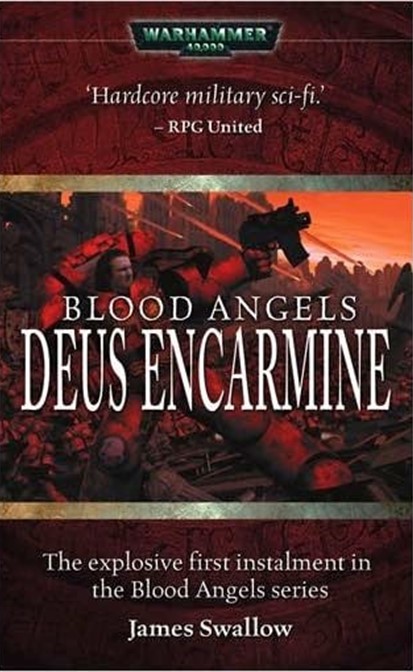
Throwback Thursday – Warhammer 40,000: Blood Angels: Deus Encarmine by James Swallow

Deus Encarmine

Publisher: Black Library (Paperback – 1 December 2004)

Series: Blood Angels – Book One

Length: 252 pages

My Rating: 4.5 out of 5 stars

Amazon

Welcome back to my Throwback Thursday series, where I republish old reviews, review books I have read before or review older books I have only just had a chance to read.  This is actually my second Throwback Thursday post today as I also put up a review for the Warhammer 40,000 novel Xenos by Dan Abnett.  However, I have been in an extreme Warhammer mood lately so I figured I would do a double feature and review the other Warhammer 40,000 book I finished this week, the first entry in James Swallow’s Blood Angels series, Deus Encarmine.

One of the main things that really draws me into the Warhammer extended universe is that it contains works from a ton of awesome authors who have experience across the writing spectrum.  For example, James Swallow is a highly regarded thriller author who also contributed his talents to several extended universes, including the elaborate Warhammer universe.  While many readers may be familiar with his entries in the Horus Heresy sub-series, Swallow’s other major contribution to the Warhammer canon is the Blood Angels books, which provide dark adventures for one of the most iconic Space Marines chapters, the Blood Angels.  I managed to grab the first two books in this series from a second hand shop a few months ago and I just finished off the first entry, Deus Encarmine, this week.  It proved to be a fantastic and dark read that showcases the Blood Angels in a whole new light.

Out of all the Space Marines chapters who faithfully defend the Imperium of Man, few are as revered, respected or feared as the legendary Blood Angels.  The genetic descendants of the angelic primarch Sanguinius, the Blood Angels are proud warriors whose martial prowess and resolve are known across the galaxy.  However, their strength comes at a great cost, as the traumatic death of Sanguinius millennia before during the Horus Heresy still lingers in their shared genes and has the potential to drive even the best of them mad.

As the Imperium once again finds itself invaded by the forces of Chaos, one of the Blood Angels’ greatest tests is about to begin on the planet of Cybele.  A grave world dedicated to the memory of fallen Imperial warriors, Cybele is brutally invaded by Chaos Space Marines of the traitor Word Bearers legion, who overwhelm the Blood Angels honour guard stationed there and a relief force from the Blood Angels battle barge Bellus.  Only an ambitious plan by a young Battle-Brother, Arkio, turns the tide against the forces of Chaos, a victory that is considered by many to be a miracle.

As the Blood Angels follow the Word Bearers back to their base of operations, the conquered planet of Shenlong, more miracles seem to surround Arkio, leading his fellow Space Marines to believe that he is the blessed reincarnation of Sanguinius himself.  The only Blood Angel who doubts is Arkio’s older brother, Rafen, who notices strange changes in his sibling that his fellows are too blinded to see.  Only Rafen can discover whether Arkio’s gifts are a Chaos plot or the divine will of Sannguinius, but will he find out the truth before humanity’s greatest protectors are torn apart from within?

This was an excellent and captivating Warhammer novel from Swallow that tells a bleak and compelling story of faith, betrayal and family.  Making full use of the grim Warhammer 40,000 universe and the focus on the iconic Blood Angels, Deus Encarmine set up this first part of this series perfectly and you come away from this book extremely satisfied.

I really enjoyed the complex and dark story that Swallow featured in Deus Encarmine, especially as there are multiple layers to the narrative that drag you in with clever twists and turns.  Starting quickly and effectively with an extended and bloody war sequence, you really get a sense of the Blood Angels’ determination and resolve, as well as some of the deeper elements that impact them.  However, the real story doesn’t begin until after the massive battle at the start, as the characters are drawn into a deadly plot based around the Blood Angels’ history and beliefs.  Thanks to the efforts of a manipulative Inquisitor, as well as their own arrogance and faith, the Blood Angels are led to believe that the young Battle-Brother Arkio is the reincarnation of their founder, and they decide to follow him on a doomed quest to a Chaos controlled planet.  The build up to the invasion is amazing, especially as you get to see the various enemy moves to confuse the Blood Angels, as well as the failed attempts by the protagonists to discover what exactly is going on with Arkio.  Everything comes to a head when they reach their target, and the massive and brutal battle that follows reveals some dark truths about the despicable plans to destroy the Blood Angels.

I really got drawn into this awesome and compelling narrative and I loved the many impressive layers that Swallow added to it.  While many readers will be drawn in by the detailed and bloody war sequences, the real joy is in the intense manipulations and deceits that the villains unleash as the protagonists find themselves confronted by their own beliefs in dark times.  Swallow makes perfect use of the grim setting and the interesting history of the Blood Angels to turn this into an intense read, and you really get drawn in as you attempt to discover the truth behind Arkio and the enemy plan.  The author features various character perspectives to really showcase the differing views of the Blood Angels, as wells as the moves of the antagonists, and I loved how everything unfolded.  Readers come away from Deus Encarmine very satisfied, although the bleak cliff-hanger ending makes you instantly want to get out and grab the sequel.  I also felt that this was a pretty good entry novel for those readers looking to get into Warhammer fiction, as Swallow expertly introduces key elements of the wider universe and showcasing just home grim and deadly the war between Chaos and humanity can be.

Unsurprisingly, this first book in the Blood Angels series spends quite a bit of time focused on the titular chapter of Space Marines, the Blood Angels, who proved to be as awesome as always.  The Blood Angels are one of the most iconic and beloved factions in the entire Warhammer universe.  While all Space Marines are compelling and contain great potential for exciting stories (see my reviews for Deathwatch: Shadowbreaker by Steven Parker and Space Wolf by William King), the Blood Angels are particularly complex and striking figures.  Deadly and honourable warriors, the Blood Angels have a religious obsession with blood which borders on the vampiric, as well as major psychic daddy issues from their dead progenitor that can potentially drive them mad.  All this has tugged at the imagination of generations of Warhammer fans and Swallow uses that to full effect in Deus Encarmine.  Not only do you see these deadly warriors in multiple battle sequences, but Swallow dives into the history, culture and spirit of the chapter, including all the factors that helped turn them into such efficient and unstoppable killers.  All the key aspects of the Blood Angels experience are artfully captured and utilised throughout Deus Encarmine and fans of this chapter will be particularly excited, especially as Swallow adds in a ton of references and homages to various parts of the lore and previous fictional releases (I spotted a couple from Bloodquest).  I particularly loved that Swallow featured a Death Company in one of the battles, which was so damn cool as you got to see Blood Angels inflicted with the Black Rage tear apart their enemies one last time.  I also really appreciated how Swallow utilised the past and trauma of the Chapter as a key story point, and their faith and dedication to their primarch is used against them by their enemy.  All these elements, and more, make Deus Encarmine a must-read for all Space Marines fans, especially those who love to field/read about the Blood Angels, and Swallow had a wonderful time showcasing this faction.

I had a great time with the characters featured in Deus Encarmine and Swallow perfectly set them up and then inserted them into the complex tale.  Nearly all the major characters are members of the Blood Angels, and they share a joint history of suffering and bloodshed that binds them together.  While their training and history ensures some similarities, Swallow ensures that the central cast had some key differences and personalities.  The main character of Rafen was particularly compelling, and Swallow puts an interesting history around him.  His constant battle between the needs of his chapter and his loyalty to his brother is a major part of the book’s drama, and it is hard not to feel for him when he is the only one able to see that something is going terribly wrong.  The character of Arkio was also a fantastic addition to the cast, and I loved his gradual change throughout Deus Encarmine from a humble warrior to a dangerous religious figure.  Other characters, including the arrogant Sanguinary Priest Sachiel, the grizzled and suspicious veteran Koris, and even the entertaining Word Bearers characters who acted in counterpart to the protagonists, were all well written and I loved the elaborate narrative threads that Swallow wove around them.  However, my favourite character in Deus Encarmine was probably Inquisitor Stele.  Initially shown as an effective, if arrogant, ally, it is slowly revealed that Stele is a manipulative and callous being who is leading the Blood Angels towards a darker objective.  Watching him carefully and effectively divide and control the various Blood Angels characters was really awesome and I loved watching his dark scheme unfold.  I deeply enjoyed how Swallow utilised his characters in Deus Encarmine, and it will be intriguing to see who survives the deadly events of the next book.

Overall, I felt that Deus Encarmine was a pretty epic read and a powerful addition to the Warhammer canon.  James Swallow has written an excellent and captivating read here that perfectly blended intrigue, betrayal and an intense war story with the complex history and culture of the iconic Blood Angels Space Marines chapter.  An intense and addictive read, I absolutely loved this first Blood Angels and I plan to check out the sequel, Deus Sanguinius next, especially as I want to see how Swallow ends this fantastic duology.
Blood Angels Cover

Amazon

Throwback Thursday: Warhammer 40,000: Space Wolf by William King

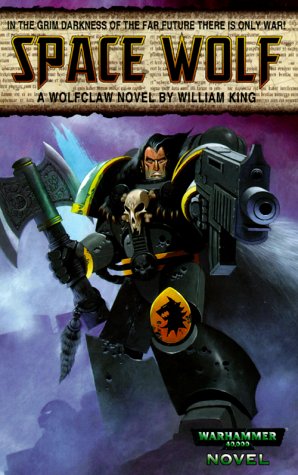
Space Wolf Original Cover

Publisher: Black Library (Paperback – 1999)

Series: Ragnar series – Book One

Length: 266 pages

My Rating: 4.5 out of 5 stars

Amazon

Welcome back to my Throwback Thursday series, where I republish old reviews, review books I have read before or review older books I have only just had a chance to read.  For this latest Throwback Thursday I dive into the world of the Space Wolves chapter of Space Marines with the classic Warhammer 40,000 novel, Space Wolf by William King.

The Warhammer 40,000 expanded universe is truly blessed with the sheer range of unique stories that it contains.  From pulse-pounding crime novels (Kal Jerico: Sinner’s Bounty), deeply fascinating novels about aliens (Ruin, Reign and Ghazghkull Thraka: Prophet of the Waaagh!), haunting horror tales (The Bookkeeper’s Skull), and even brutal war stories by common soldiers (Steel Tread and First and Only).  However, at the end of the day, most of the more intriguing stories focus on the iconic and awesome Space Marines.  These genetically enhanced and over-armoured warriors are often the true MVPs of the Warhammer canon, with some great series based on them (for example, the 50+ book Horus Heresy series).  There are a ton of great Warhammer 40,000 series around the Space Marines that I am exceedingly keen to get into, and I was recently lucky enough to find a copy of the first book of one of them which I immediately dived into.

That book was Space Wolf by William King, who I best know from his epic work in the Warhammer Fantasy franchise with his Gotrek and Felix series (check out my reviews for Trollslayer, Skavenslayer, Daemonslayer, Dragonslayer and Beastslayer).  Space Wolf is the first book in King’s six-part Ragnar series (also known as the Space Wolf and Wolfclaw series).  Focused on the character of Ragnar, a legendary member of the Space Wolves chapter, this series sounded really cool, especially as I have been really enjoying King’s writing lately.  I ended up having a great time with this novel which contains an awesome and very fun story.

In the far future, humanity is constantly at war with aliens, daemons, traitors, and heretics, all of whom wish to tear the massive and fragile Imperium of Man to shreds.  Humanities best and often last line of defence are the mighty Space Marines, the Emperor’s angels who fight the very worst xenos and spawns of the Chaos Gods.  Out of all the Space Marine chapters, one of the most respected, feared and honoured chapters are the Space Wolves.  Born from the genetic material of their legendary founder, Leman Russ, and bearing the touch of the wolf, the Space Wolves have stood tall time and time again.  But how does a mere man become a bestial and lethal Space Wolf?

On the planet of Fenris, Ragnar Thunderfist is a young warrior, content to work on his father’s ship and contend with the many dangers of his fierce and low-tech home world.  During a raid upon his village by a rival tribe, Ragnar is killed in a mightily duel after felling many enemies.  However, this is not the end of Ragnar’s journey; instead he finds himself waking up healed, resurrected by one of the mysterious Wolf Priests who watch over the planet.  Taken from the ruins of his village with other worthy aspirants, Ragnar learns that he has been chosen to become a member of the next generation of Space Wolves.

However, earning the right to join the Space Wolves is no easy task, and Ragnar soon embarks on a gruelling and lethal training regime that will test him to his very limit.  Working to hone himself into a living weapon, Ragnar will face trials, monsters and deadly rivalries as he attempts to prove himself.  But even if he is found worthy, the greatest trial involves the final transformation into a Space Marine.  The Canis Helix, which is implanted into all Space Wolves, bears a dangerous curse, which may turn even the strongest of wills into wild beasts.  Can Ragnar overcome the bestial rage that comes with this awesome gift, or will he lose his mind before he can serve the Emperor?  And what happens with the legions of Chaos arrive upon Fenris?

Space Wolf Cover 2

This was another exceptionally exciting and compelling read from William King, who perfectly starts another epic Warhammer series.  Space Wolf had a very different tone and structure to some of King’s other books that I have enjoyed, and I found myself getting really invested in this intriguing story of survival, self-discovery, and destiny.  Starting with an intriguing glance at the present, Space Wolf jumps back into the protagonist’s past, showing Ragnar’s formative years and the events that led to him being chosen by the Space Wolves.  Primarily told from the perspective of Ragnar, with a few sections told by an antagonistic alternate narrator, Space Wolf quickly turns into a fascinating examination of the intense training faced by potential Space Wolves recruits.  Most of the story follows the various stages of this intense military training and eventual genetic modification, and it was absolutely fascinating to see the changes the protagonist goes through.  While there is a lot of focus on expanding the lore and the character changes associated with it, King tells a concise and powerful story that really dives into the mind and personality of its protagonists.  This extended and brutal training sequence and initiations eventually leads up to the protagonist’s first mission as a Space Marine, which sees him and his team, many of whom you have also come to know, face off against an insidious foe on their own home world.  This last part of the book provides a ton of action, some intriguing horror aspects, and the introduction of a compelling antagonist who will likely show up in future entries in the series.  This final section really brings the entire narrative together extremely well, showcasing what the protagonist has been working towards, while also resolving some great character arcs.  I had a really fun time with this entire novel, and it has definitely made me keen to check out the rest of the series when I get a chance.

One of the most intriguing parts of Space Wolf was the way that it fits into the wider Warhammer 40,000 universe.  Specifically, this novel serves as a particularly good introduction to the legendary Space Wolves Space Marines chapter, who are one of the more popular factions in the extended universe.  King chooses to look at them from a rather unique direction, showing them purely from the perspective of the protagonist Ragnar, an inhabitant of a Norse-esque society with no concepts of space travel, advanced technology, or the wider universe outside of their lands, and whose understanding of the Emperor, the Chaos Gods, the Space Marines and more comes purely from myths and legends.  As such, for much of the novel Ragnar and his fellow initiates have no idea who the Space Wolves are, or what they have been chosen for.  The snippets they continue to get slowly inform them of the wider picture, and it was fascinating to see their blind faith that they were working towards something greater.  Their eventual initiation comes as a great shock to them, and seeing these previously simple warriors become elite Space Marines with knowledge of the wider universe results in some awesome and intriguing scenes.  I found it really fun to see the similarities and differences between the characters when they were normal and when they were Space Wolves, and it was fantastic to witness how their harsh roots results in Space Marines with some major Viking vibes to them (it’s one of the things that make them such a cool chapter).

However, King also ensures that the reader is given some intense insight into the dark side of the Space Wolves.  While their training is often harsh and lethal, and their treatment of the tribes of their home planet is very manipulative, there is something far more worrying lying beneath the surface.  The genetic manipulation that goes into creating them awakens a beast within them, with many losing their sanity or even their humanity entirely, reverting into beastlike creatures known as the Wulfen.  King does an awesome job highlighting the various ways in which the characters are changed, body and mind, throughout the course of Space Wolf, and there are some powerful scenes where they are forced to battle to control their new inner nature.  This really ends up being a particularly fascinating and well-balanced examination of the Space Wolves chapter, and I honestly could not think of a better introduction to this faction.  This cool lore, as well as the Norse-inspired aspects and Nordic-like wild settings, serve to beautifully enhance the entire narrative, and King’s choice to show all events from an uninitiated character’s perspective was just brilliant.  The use of Ragnar as a narrator also ensures that readers unfamiliar with the Warhammer franchise can also easily enjoy this novel, as they can learn about the wider universe at the same time as the protagonist.  Established fans, on the other hand, will get a lot of joy out of seeing the Space Wolves in this much detail, and they will no doubt have fun viewing the myths and unique interpretations that the various Fenris tribes place on the Space Marines and other elements of Warhammer lore.  As such, this is a novel that will really appeal to a lot of different readers, and anyone with interesting in fantasy, science fiction, or even historical fiction, will probably have a great time reading Space Wolf.

Finally, I must highlight how good Ragnar was as a point-of-view protagonist.  Not only do we get the great insights into Space Wolves initiatives that I mentioned above, but there are multiple intriguing personality and mental aspects to his character that come across extremely well in the narrative.  Ragnar starts the book as a young warrior whose life is changed in a single day as his tribe is destroyed by a rival clan, his family is killed, and he himself is killed and then resurrected by the Space Wolves.  Worse, he is resurrected alongside the man who killed him, Strybjorn Grimskull, and is forced to train and work with him, despite their hatred for each other.  This results in a great deal of inner struggle for Ragnar as he is constantly torn between his honour and new responsibilities to the Space Wolves and his desire for revenge against Strybjorn.  Watching these two constantly circle each other through the training parts of the novel is awesome, and their issues get even more intense once they undergo the genetic change and become Space Wolves with bestial urges.  These intense inner issues and rivalries proved to be an excellent central plotline for much of the novel, and I felt that they dramatically enhanced the entire narrative very well, adding in some much need drama, comradery, and character development.  I cannot wait to see more of Ragnar and his fellow Space Wolves in the future, especially after how his first mission turned out.

Overall, Space Wolf was just as impressive and awesome as I hoped it would be.  William King did an exceptional job writing a fantastic introductory Space Wolves tale, and he continues to remain one of my absolute favourite Warhammer authors, especially with the excellent range he showed here.  Readers will love this outstanding dive into the Space Wolves and the wider Warhammer 40,000 universe that this novel contains, and Space Wolf is a highly recommended novel to anyone looking for an action-packed and exciting read.

Space Wolf Cover

Amazon

Deathwatch: Shadowbreaker by Steve Parker

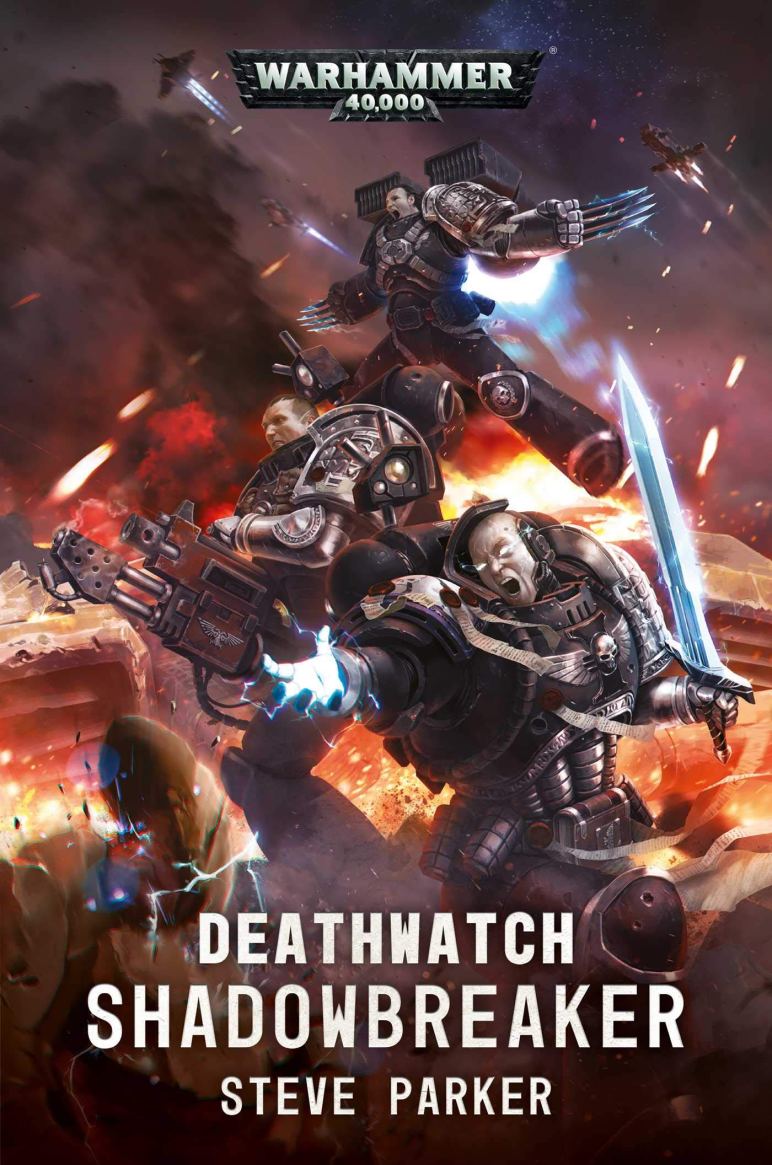
Deathwatch Shadowbreaker Cover

Publisher: Black Library (Audiobook – 25 April 2019)

Series: Warhammer 40,000/Deathwatch – Book Two

Length: 16 hours and 37 minutes

My Rating: 4.5 out of 5 stars

Amazon

Prepare to dive into the extended universe of Warhammer 40,000 (Warhammer 40K or 40K), as science fiction author Steve Parker presents Deathwatch: Shadowbreaker, an action-packed and exceedingly exciting sequel to his 2013 novel, Deathwatch, which pits the deadly Deathwatch Space Marines against an entire planet full of T’au.

Thousands of years in the future, the galaxy is constantly at war. Humankind has survived as the massive Imperium of Man, under the divine protection of their long-dead Emperor. However, this beacon of humanity is under constant threat from all sides. Destructive alien races, demons from the warp and the traitor forces of Chaos continuously assault its borders, whilst heretics, mutants and witches attempt to destroy it from within. Over the millennia, the Imperium has created many different forces to protect their worlds from these threats; however, none is more feared or revered than the Adeptus Astartes, the Space Marines. Space Marines are legendary warriors genetically modified to become significantly stronger, larger and faster than a normal man. Swathed in power armour and armed with the deadliest of weapons, the Space Marines are a force to be reckoned with on the battlefield, bringing the Emperor’s wrath down on all who oppose them.

But even amongst these deadliest of soldiers, there is one organisation of Space Marines who are respected above all others for their fighting ability and skill, Deathwatch. Deathwatch is an elite group made up of best Space Marines veterans from across the Chapters, trained to become the ultimate tools in one of the Imperium’s holiest missions, the extermination of the xenos, the alien. Utilising the most advanced technology in the Imperium and receiving specialist instruction in the strengths and weaknesses of their foes, Deathwatch work in small kill-teams under the Ordo Xenos of the Imperial Inquisition in order to hunt down and destroy the most dangerous xenos threats in the galaxy.

Lyandro Karras, Codicier of the Death Spectres, is a powerful Space Marine Librarian serving in the Deathwatch as the leader of the kill-team, Talon Squad. Barely recovered from the disastrous events of their last mission, Karros and Talon Squad once again find themselves under the command of the mysterious Inquisitor Sigma. Their new mission takes them to a former Imperial world that has been conquered by the alien T’au, who have indoctrinated the majority of the human population into their society and philosophy. An Imperial Inquisitor, Epsilon, has gone missing in T’au space, and Sigma believes that she is being kept prisoner on the planet. Desperate to free her before the T’au extract vital secrets about the Imperium from her, Talon Squad and a force of Ordo Xenos Storm Troopers are deployed to find her. Working with the local human resistance, Talon Squad identify the prison she is located in and must work to release her before the massive T’au garrison knows they are on planet. But what happens when Epsilon refuses to accompany Talon Squad back to the Imperium?

Deathwatch: Shadowbreaker is part of the massive extended universe which has formed up around the Warhammer 40K tabletop miniature game produced by Games Workshop. Warhammer 40K, which was first released in 1987 and pits armies of science fiction miniatures against each other, has always contained an interesting and grim science fiction narrative to serve as a background to the game. With every new edition of Warhammer 40K that was released, this background narrative got more and more detailed, resulting in an extremely deep, compelling and gothic-themed fictional history surrounding all of the different races, armies and characters featured within this tabletop game. Due to the popularity of the Warhammer 40K universe, a huge amount of expanded material has also been released over the years, including several videogames, comics, board game spinoffs, an animated movie (with a remarkably good cast of British actors) and there is currently a television series in production. However, the main medium that has been utilised as part of this expanded universe is books.

Over the years, there has been a tremendous amount of Warhammer 40K books produced, featuring the works of a number of skilled and talented science fiction authors. There are now hundreds of Warhammer 40K books currently published, covering the different periods and races featured in the tabletop game. In 2019 alone there were nearly 20 different novels, anthologies and audio dramas associated with Warhammer 40K. This is a very impressive amount of material, and I have not even mentioned the multiple book releases associated with the separate Warhammer Fantasy universe.

While I am a man of many, many different fandoms, the products of Game Workshops are among the earliest fantasy and science fiction products that I was a major enthusiast of. I was extremely into Warhammer Fantasy when I was a kid and I have many fond memories of painting and battling with the models, reading the company’s monthly White Dwarf publication and playing some of the Warhammer 40K computer games, such as Dawn of War. While I was solely playing with Warhammer Fantasy models, I did learn a lot about Warhammer 40K at the same time, especially as I really enjoyed reading all the lore and background of the various Games Workshop products. I have been meaning to read some Games Workshop fiction for a while now, and I have previously mentioned that I want to read the cool-sounding Gaunt’s Ghosts series. However, I ended up reading the recently released Deathwatch: Shadowbreaker instead, mainly because it featured two of my favourite groups from the Warhammer 40K lore, Deathwatch and the T’au, facing off. Shadowbreaker is the latest book from Steve Parker, a science fiction author, who has primarily written Warhammer 40K fiction. Shadowbreaker is his first release since 2016, and it is actually a sequel to his 2014 novel, Deathwatch, which featured the same group of primary characters.

I am actually really glad that I chose to read and review Shadowbreaker, as this excellent 40K novel contains an awesome and extremely entertaining story that features all manner of action, adventure and intrigue, while also diving deep into several fascinating parts of 40K’s lore. Shadowbreaker is an excellent sequel to the author’s previous book, Deathwatch, and Parker does an amazing job of continuing the story that was started in this prior book, while at the same time setting up some intriguing potential directions for the series to go next. Prior knowledge of the events of Deathwatch is not a necessity to enjoy this book, as Parker does a good job of re-introducing all the relevant events of the previous novel, and readers should be able to follow Shadowbreaker’s story without any real issues. Parker has created a rich narrative for this book that utilises a huge number of character viewpoints to not only examine the development within several characters but also explore a number of different angles and features of the harsh gothic universe in which this book is set. These multiple viewpoints work especially well during Shadowbreaker’s extended action sequences, as they allow Parker to show off every aspect and side of the brutal battles, resulting in some exciting and detailed combat set pieces. Shadowbreaker’s story ends up going in some rather intriguing directions, featuring some fun twists and reveals, and this was an overall fantastic and exciting story to check out.

While Shadowbreaker is an amazing novel, it might not be as appealing to those readers who are not familiar with the Warhammer 40K universe. This book is pretty lore heavy, containing a whole lot of references to history, technology, alien races and other unique aspects of this fictional universe. While I felt that Parker did a great job of explaining most of the Warhammer 40K elements that are relevant to the story, a certain amount of prior knowledge about this massive universe will really help readers understand what is going on. Do not get me wrong; readers unfamiliar with the franchise will easily be able to follow and enjoy Shadowbreaker’s story, but they may have trouble appreciating all the interesting lore references or depictions from the miniatures game. As a result, I would probably recommend this book more to established fans of the 40K universe, although casual science fiction readers are definitely going to have a good time reading this. That being said, I note that some other readers of this book who are more familiar with the actual tabletop game than me were put off by a couple of apparently incorrect depictions of weapons, armour and vehicles. While these apparent anomalies in no way impacted my enjoyment of the book (honestly, I am not knowledgeable enough about battle gear to have really picked up on this), I can imagine that this could annoy some hardcore 40K fans, so fair warning about that.

For me, one of the major appealing aspects of this book was its excellent examination of fascinating elements from the Warhammer 40K universe. As I mentioned above, the universe of the 40K games are filled with all manner of fantastic, complex and unique features which are all backed up with a ton of lore and fictional history. Parker does an awesome job of setting Shadowbreaker within this universe and he ends up utilising quite a lot of detail from the games in the story. There is actually quite a lot going on within this book. Not only do you have the primary storyline of Space Marines versus T’au but you also have storylines that relate to infighting and intrigue within the Ordo Xenos, examination of the constant threat that is the Tyranid, the machinations of the Eldar, and the long-term plots of a demon lord thrown in on top. All these various storylines actually come together really well into an outstanding story, and fans of the 40K franchise are almost guaranteed to have some mention or discussion about their preferred army or race in the game (with a couple of exceptions).

However, the thing that really excited me the most about this book was the central conflict between Deathwatch and the T’au. I am a major fan of both of those groups and have always been really intrigued by the cool lore and background that surrounds them. When I started reading this book, I was half-expecting the story to be shown purely from the perspective of the Deathwatch characters. If this had been the case, the author would have been forced to do a classic humans versus aliens storyline, where aliens are automatically the bad guys due to the Space Marines’ inherent hatred of all things alien. Therefore, I was pleasantly surprised when Parker presented a much more complex storyline which showed neither side as “good” or “evil”. Instead, thanks to the author’s excellent use of multiple perspectives, it is shown that both sides of this conflict are dominated by dangerous fanatics driven by their beliefs, either in the purity of destroying all things alien or the defining T’au philosophy of the “Greater Good”. This belief results in both sides doing some very questionable things in order to achieve their objectives, most of which result in large amounts of destruction and death. Interesting enough, it is Lyandro Karras and some of the members of Talon Squad who are the most reasonable characters in this book, and all of them have been heavily indoctrinated about the evils of the alien. This all makes for a much more intriguing and clever story, and I loved how it helped highlighted how complex this universe can get.

Shadowbreaker contains quite a bit of information about how the legendary Deathwatch operates, which is just downright fascinating, and I can imagine a lot of readers would be really interested to learn more about. While there was a lot more about the layout of the organisation and their training in the initial Deathwatch book, readers of Shadowbreaker learn a lot about them in this book. For example, Shadowbreaker contains information about Deathwatch’s unique relationship with the Inquisition, their skills in battle, their knowledge of the aliens they fight and the fact their ranks consist of Space Marines from various chapters. All of this is really cool, and there were a fantastic central organisation to centre the book on.

I also quite enjoyed the examination of the different Space Marines that make up the various Deathwatch kill-teams featured within this book. Thanks to the author’s use of multiple character perspectives, the reader gets to see through the eyes of a number of Space Marine characters. Parker cleverly utilises this to show off the varied personalities of the Space Marines, and it was interesting to see how diverse these genetically enhanced and indoctrinated killing machines can really be. A lot of this is due to the specific Chapters that they come from, as each character seems to reflect the traits of their Chapter and their founding father. I liked how the multiple perspectives helped highlight he different fighting styles of the various members of the Deathwatch kill-team, especially as each of them utilises different weapons and tactics to achieve their goals, reflecting the defining skills of their original Chapter. For example, the Raven Guard character continuously utilises a jump pack and lightning claws in his fights, while the Imperial Fist preferred to use heavy weapons. These different combat techniques add an extra layer of spice to the various fight sequences, and I really liked seeing the different characters in action. I was also really intrigued by the author’s deep dive into the history and peculiarities of two of the lesser-known Space Marine chapters, the Death Spectres and the Exorcists. Parker reveals some really interesting facts about these two Chapters, mostly when these respective characters think back on their past or their Chapter. I really didn’t know that much about these two Chapters before this book, and I really enjoyed learning more about them, especially as they have some very cool and unique traits (one summons and betrays demons for an initiation test; the other has a mysterious glass throne hidden on their home planet). As a result, fans of Space Marine history and lore are really going to love this book, and even non-fans will appreciate the world-building associated with them.

In addition to the intriguing examination of Deathwatch and other Space Marine Chapters, Parker also features an excellent look at one my favourite races in the Warhammer 40K universe, the T’au (or Tau). The T’au are probably the newest race in 40K canon (although that was quite a few years ago) and have been featured in a couple of books and have even had their own video game, Fire Warrior. T’au are a young race of aliens whose empire has quickly expanded in recent years thanks to their advanced technology and wiliness to incorporate alien races into their empire. Their sudden expansion has made them a real threat to the stagnant Imperium of Man. Parker does an amazing job incorporating the T’au into this book, and there are some fantastic depictions of their technology and unique physiology. The T’au serve as excellent primary antagonists for this book, and Parker takes an interesting view of them, diving into the darker side of their empire. Thanks to the various character perspectives contained within Shadowbreaker, the reader gets to see more than their typical depiction as a beatific race who merely wish to share their technology and their message of the “Greater Good” throughout the universe. Instead, you get to understand how slavishly devoted to their philosophy they really are, and the lengths that some of them will go to achieve their race’s goals. There are some really interesting discussions about how they control the populations they conquer, as well as some brief but curious mentions of T’au who do not follow the Greater Good and are persecuted or punished for this. I also really liked the detailed examination of a human world that is being ruled by the T’au, especially as you get to see all the various benefits and downfalls of this control. The fact that neither the T’au nor the Imperium actually care about the planet or its people is a bit of a dark spot in the novel, and some of the conclusions of the book reveal just how much better off this planet would have been on its own. If I had one complaint about Parker’s depiction of the T’au, it would be that they went down way too easily in a fight. While a couple of their units and commanders were able to hold their own for a bit, the rest of the T’au forces were pretty much slaughtered in one-sided battles throughout the book. While I appreciate that the author was probably trying to demonstrate Deathwatch’s skill at killing aliens, I think he could have perhaps added in a bit more of a fight from this popular race. Still, I really enjoyed this inclusion of the T’au, and I need to check out some other books that feature them.

I ended up listening to the audiobook format of Shadowbreaker, which was narrated by Andrew Wincott. Shadowbreaker clocks in at just over 16½ hours, so it is a fairly substantial audiobook which takes a little bit of effort to get through. I was very impressed by this format of the book, and I personally found it a great way to absorb all the amazing things occurring in the story. Wincott is a really good narrator, coming up with some distinctive and appropriate voices for the huge raft of characters that were featured in this book. I really liked how Wincott was able to capture the emotion and mood of the various characters, and I was especially impressed with the harsher tone that he took for many of the Imperial characters, which fitted perfectly into the gothic style of the Imperium. As a result, I would highly recommend the audiobook format of Shadowbreaker to anyone who is interested in checking this book out, and it is a wonderful way to enjoy this great piece of Warhammer 40K fiction.

Deathwatch: Shadowbreaker by Steve Parker was an incredible read which I found to be extremely entertaining and which proved to be a perfect reintroduction for me to the Warhammer 40,000 franchise. Parker presents an exciting and compelling story that dives deep into the universe’s lore while also exploring some of the complexities of the various featured races and armies. Overall, this is an outstanding novel and I am really glad that I checked it out. I fully intend to read more Warhammer 40K fiction in the future, especially after enjoying this book so much, and I hope that Parker continues his Deathwatch books in the future as well.

Amazon