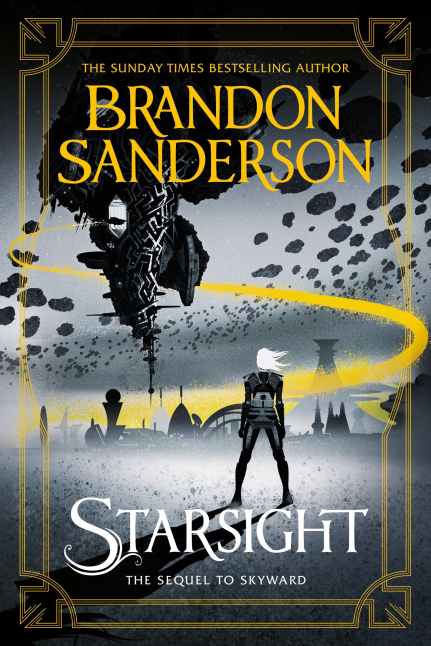
Starsight by Brandon Sanderson

Starsight Cover 2.jpg

Publisher: Gollancz (Trade Paperback – 26 November 2019)

Series: Skyward – Book 2

Length: 461 pages

My Rating: 5 out of 5 stars

Amazon

From one of the best authors of fantasy and science fiction in the world today, Brandon Sanderson, comes Starsight, an outstanding and addictive young adult science fiction read which continues the wildly entertaining adventures of a young starfighter years in the future.

Starsight is the second book in the Skyward series and follows on from the 2018 release of the same name. Skyward was a fantastic young adult science fiction book that told a compelling tale of bravery, determination and camaraderie in humanity’s distant future. Skyward was an amazing read, and it was easily one of my favourite books of 2018. As a result, I have been looking forward to Starsight for a while now, and it was one of my most anticipated releases for the second part of this year.

The Skyward series is set on the planet of Detritus, a desolate world that houses a population of humans in the caverns beneath the surface. The humans on Detritus are the remnants of a once great intergalactic human civilisation that has been destroyed in a war with a superior alien civilisation. Forced into hiding within the planet for hundreds of years, humanity eventually returned to the surface utilising scavenged starfighters to escape and build a military outpost to fight back against the alien ships who continue to harass the planet.

In Skyward, the reader is introduced to Spensa Nightshade, a young woman determined to become a pilot in the Defiant Defence Force (DDF), the military organisation that fights the alien invaders. While talented, Spensa faced opposition to being accepted into the military due to an apparent act of cowardice by her father years before. Despite the odds, Spensa was accepted in the DDF and was trained to become a skilled pilot, fighting in a number of actions against the enemy, while also trying to find out what actually happened to her father. Along the way, Spensa discovered an ancient but advanced human ship that had crash-landed on Detritus. Upon repairing the ship, Spensa discovered it had an AI installed in its computers, which she called M-Bot. After stopping an extremely destructive alien attack with the help of M-Bot, Spensa was compelled to fly through Detritus’s atmosphere, where she made several startling discoveries, the first of which was that Spensa and her family are powerful cytonics, beings with mental powers who are capable of traversing vast distances through space with their ability. The second discovery she made was that the aliens attacking Detritus were not simply mindless aggressors determined to wipe out humanity; instead they are members of an interstellar conglomeration called the Superiority, who are attempting to contain humanity within the planet. The Superiority hold a great fear of humans, who they see as an extremely dangerous and violent species, and Detritus is actually a prison planet/wildlife preserve where humans can live without disrupting the rest of the galaxy. Unfortunately, the actions of the DDF in reclaiming the surface and utilising spaceships have forced the Superiority to reconsider their approach, and they are now working to kill all the humans.

Usually this is the part of the review where I would give a brief plot synopsis of the new book and then go into an analysis of what I liked about it. However, this is going to prove a little hard to do without revealing some spoilers. While I don’t typically avoid talking about plot points that occur around 50-100 pages into book (I don’t particularly consider something happening that early to be a spoiler), I am a little more wary with Starsight. This is mainly because the plot of the book features some immediate substantial changes from the story that appeared in Skyward, none of which are really hinted at in any of the official online plot synopsis or book blurbs. As I am publishing this review a week before Starsight’s official release date, I think it is best that I put up a spoiler alert below, before I start going into the book in any real detail.

For those readers who do not want to risk any spoilers, I will say now that Starsight is an incredible book that I really, really enjoyed. Sanderson tells a wildly entertaining and highly addictive story that features some memorable characters, high-stakes events, some of the best science fiction action I have ever read and a ton of inventive world building. I honestly think that this is one of the best releases of 2019, and it easily gets a full five-star rating from me (if only I could go higher). I would highly recommend this book to anyone interested in an epic science fiction read, and if you loved Skyward, you are going to love this book.

Anyway, if you are not interested in learning any more details about this book’s plot or characters (which I do explore to a substantial degree), I would suggest you stop reading now, as everything below this paragraph has a spoiler alert in effect.

SPOILER ALERT:

Starsight is set a few months after the events of Skyward, and humanity has been busy. Thanks to Spensa and Skyward Flight, as well as the advanced technology contained with M-Bot, the DDF has managed to capture several of the planet’s ancient orbiting defensive platforms, which have allowed them to push the Superiority forces out of Detritus’s obit. However, despite these successes, humanity is still trapped on Detritus, and the eventual Superiority mass retaliation will likely wipe out everyone on the planet. Their only chance at survival is to flee from Detritus and find a new planet to make their home, somewhere the Superiority cannot find them. However, the only way to do this is with some form of hyperdrive, which humanity lacks access to, and Spensa’s cytonic teleportation abilities are too restrictive for mass use.

The crash-landing of an unknown alien spacecraft on Detritus may provide the solution that will ensure humanity’s survival. The pilot of this craft is a member of a non-Superiority species who has been invited for diplomatic reasons to enlist in a new Superiority fighter squadron, and she is able to pass on the cytonic coordinates to the squadron’s base to Spensa. Disguised with M-Bot’s holographic technology, Spensa travels to the Superiority space city, Starsight, in order to infiltrate the Superiority military and find and steal a working hyperdrive.

Joining the new Superiority squadron, Spensa discovers that she and her fellow recruits are being trained to fight the delvers, titanic inter-dimensional beings that dwell in the nowhere, who are capable of devastating planets if they are drawn into our dimension by an over-use of cytonic ability. But as Spensa attempts to complete her mission, she finds herself caught amidst the politics of the various Superiority races, many of whom wish for the complete and utter destruction of her people. Can Spensa navigate the strange new world she finds herself in, or will her actions result in the destruction of all she knows?

As you can see from the above synopsis, Starsight goes in some very interesting and unpredictable directions. I personally loved all of these new story elements, and the idea of Spensa having to infiltrate a mostly unknown alien society was a really clever and intriguing central plot idea that I think worked extremely well. The subsequent narrative is a fantastic blend of different story elements, which includes some great new characters, settings and plot directions, as well as some of the best parts of Skyward. For example, not only do you get to see a whole new take on the excellent space fighter training plot point that made the first book so amazing, but you also get a science fiction spy thriller story filled with all manner of political intrigue. This was a fantastic book to get into, and Sanderson has made sure that the plot is accessible to readers who did not get a chance to check out Skyward last year. However, I would strongly recommend reading Skyward first, not only because it will give you a better idea of the characters and certain plot elements, but because it is such an awesome book in its own right.

One of my favourite things about the first book in the Skyward series was the excellent group of characters that Sanderson focused on, including Spensa, M-Bot and the members of Skyward Flight. Throughout Skyward the reader got to know and care for these characters, and it was actually a little bit distressing when bad things happened to them. Skyward continues to look at several of the characters from the first book, although readers who grew attached to Skyward Flight might be a tad disappointed as Sanderson shifts the focus away from them and introduces the reader to a whole new group of alien characters.

Spensa is still the main point-of-view character for this second book and serves as a fantastic central protagonist. In many ways, Spensa is still the same impatient and reckless pilot that was such to see in the first book. However, it soon becomes obvious that the experiences, relationships and life lessons that she has faced since joining the DDF have tempered her in many ways, especially as she has to deal with the intense responsibility of being her people’s greatest hope for survival. I really enjoyed watching Spensa as she was forced to assimilate into the alien cultures on Starsight, and it was interesting to see how she reacted when she realised not everyone there is as evil as she believed. The opinions and support she gives to her alien friends result in some emotional moments, and it was really heart-warming to see how far she has progressed since the last book.

While Spensa is a great central protagonist, to my mind the best character in the entire book is still her sentient ship, M-Bot. M-Bot is the snarky and hilarious artificial intelligence that Spensa discovered crashed on Detritus, and together they form an efficient and enjoyable team. M-Bot honestly has all the best lines in the book, and nearly every interaction with Spensa results in some excellent jokes or banter. Despite the humour, M-Bot is a pretty complicated character, especially as in this book he is attempting to work out the full limits of his consciousness and code. He is continuously attempting to prove that he is actually alive, and these attempts result in safeguards in his system attempting to shut him down. I really enjoyed the way that Sanderson continues to utilise M-Bot. Even though he is a ship, he is still a fantastic and highly enjoyable character to focus on and we even get a reason for his mushroom obsession in this book.

Spensa’s new flight of Superiority comrades features an eclectic bunch of aliens, each with their own quirks and unique personalities. These include a figment called Vapour, who is essentially a sentient smell that can take control of ships and pilot them. Vapour is the ultimate spy and requires Spensa to be constantly on her toes. There is also the dione draft, Morriumur. Dione are a race of non-violent aliens high up in the Superiority hierarchy, who have a unique breeding system that combines the parents into one new being. This is a process that can take several goes, as the family of the newly bred dione may choose to reform a young dione so that they have an ideal personality. Morriumur is a draft, spending the first few months of their life testing out their personality to see if they are an ideal member of the species. Morriumur, who has slightly more violent tendencies than most of their species, is trying to prove that they belong as a starfighter, but the combined expectations of their family and the inner thoughts that they are not worthy, are a constant hindrance to them as a pilot.

While both of the above characters are pretty cool, and Sanderson spends a good amount of time exploring them, two members of Spensa’s new flight really stood out. The first of these is Brade, a human from another prison world who has been recruited as a cytonic enforcer by one of the book’s central antagonists. Brade, after being taken from her parents as a child, has essentially been brainwashed all her life to consider humans as evil and inferior, and this has a major damaging effect on her psyche. The interactions between her and Spensa throughout the book are quite fascinating, and she proved to be one of the most complex characters in this book. My favourite new character, however, had to be Hesho, who is totally not king of the kitsen. The kitsen are a race of tiny gerbil-like aliens who have recently converted from a monarchy to a democracy in an attempt to become a Superiority race. Hesho leads a group of around 50 kitsen who pilot one heavily armed fighter in Spensa’s squadron like it’s a capital ship. Hesho and the kitsen are really hilarious characters, mainly because Hesho is attempting to convince the Superiority that he is no longer ruling his people as a king, and instead the kitsen have embraced democracy. Unfortunately, despite Hesho insisting he is no longer a monarch in every interaction he has, his people continue to worship him, which kind of undercuts this message. I also found the similarities in the personalities between the kitsen and the Spensa we first encountered in Skyward to be very amusing, as the kitsen attempt to compensate for their size with extreme confidence and boasting like Spensa used to (for example, the first ship we see the kitsen flying is called Big Enough to Kill You).

All of the above characters are great, and I really loved the way that I was once again drawn into their various personalities and histories. It was a bit of a shame not to see too much of the characters I liked so much from the first book (although we do get an idea of what various members of Skyward Flight are up to), but I think the new characters that Sanderson introduced more than made up for it.

In addition to the fantastic character work, one of the other best features of Starsight is the epic and fast-paced action sequences that punctuate much of the book. Just like in Skyward, Sanderson presents a huge number of different scenes where Spensa is fighting or training in a fighter. The sheer amount of detail that goes into these various action sequences is pretty amazing, and I was able to picture all the flying and manoeuvres perfectly. The author comes up with a number of clever new scenarios in this book, including the fancy flying and combat required to fight a delver, or having Spensa fly in the type of craft she has been fighting against for her entire military career. All of the action in this book is first-rate, and I can guarantee that you will get lost in some of the incredible action sequences.

I have always been impressed by the elaborate worlds that Sanderson can create for his stories. Whether it is the vast fantasy world that he came up with for The Stormlight Archive, the supervillain dominated alternate version of Earth that appeared in The Reckoners trilogy, or the fantastic science fiction planet of Detritus that was the main setting for Skyward, Sanderson always delivers complex and intricate settings for his story, complete with huge amounts of backstory. In Starsight, Sanderson once again produces a huge and detailed new setting for his outstanding story. The alien civilisation that is living on Starsight is very impressive, and I love all the different alien races that he has come up with for this story. Many of the aliens have some very complex and fascinating history, a great deal of which featured in the story. I really look forward to seeing how Sanderson expands this universe even further in the final book in the trilogy, and I cannot wait to see what new aliens or civilisations he comes up with.

As you can see from this rather lengthy review, there is a lot to love about this book. Sanderson does an impressive job of combining the intriguing new story direction, the amazing characters, intense action and fascinating new setting into one concise narrative, and the end result is a perfect book. While Starsight is being marketed as a young adult book, and indeed it would prove appropriate for most young readers, it is really a novel that can be enjoyed by any reader of any age. I cannot recommend this book enough, and I am eagerly awaiting the next book in this series (which seems to be 2021 at this point, so far away!).

Amazon

Star Wars: Resistance Reborn by Rebecca Roanhorse

Resistance Reborn Cover 2

Publisher: Century (Trade Paperback – 5 November 2019)

Series: Star Wars

Length: 298 pages

My Rating: 4.5 out of 5 stars

Amazon     Book Depository

The road to the final movie in the Skywalker Saga, Star Wars Episode IX: The Rise of Skywalker, begins here with this intriguing tie-in novel, Star Wars: Resistance Reborn, by recent fantasy phenomenon Rebecca Roanhorse. Resistance Reborn is a fantastic and action-packed book that attempts to bridge some of the gaps between The Last Jedi and the upcoming The Rise of Skywalker.

This latest book is a very interesting addition to the Star Wars tie-in media range, and it is one that all major Star Wars fans are going to be very keen to get their hands on. Resistance Reborn is the latest Star Wars tie-in novel and it is deeply connected with the upcoming ninth film in the main Star Wars storyline, The Rise of Skywalker, which is set for release in about a month. This book is one of several pieces of upcoming Star Wars tie-in fiction that attempt to fill in some gaps surrounding the plot of the upcoming film, other examples of which include the Force Collector young adult novel, the Star Wars: Allegiance comic book and even Black Spire, to a lesser degree. Resistance Reborn is probably the most exciting one on the list, as it is going to be the novel that is most closely connected with the events of the movies.

Following on shortly after the devastating events that occurred on the isolated planet of Crait at the end of The Last Jedi, the Resistance has been decimated by the tyrannical First Order. Seemingly abandoned by their friends and allies throughout the galaxy, only a few members of the Resistance have survived and are now in hiding. Those remaining Resistance members are as determined as ever to fight and are willing to risk it all the save the galaxy.

To that end, the leader of the Resistance, General Leia Organa, has sent her few remaining compatriots out into the galaxy in an attempt to find more volunteers, supplies, ships and, most importantly, leaders and strategists who can help guide the Resistance to victory. While her teams are able to find a few valuable recruits, including some old friends from the days of the Rebel Alliance, the situation is looking grim.

The First Order have started to establish their dominance throughout the entire galaxy, and few are willing to stand before them. Whatever allies or supporters the Resistance might have been able to count on have gone missing, apparently the victims of an oppressive roundup by the First Order. As Poe Dameron and the remains of his squadron attempt to recover a prisoner list that contains the details of the fate of these dissidents, it soon becomes apparent how far the reach of the First Order has grown. Can the Resistance survive, or will the shadow of the First Order overwhelm them all?

This was an outstanding read that not only tells a fantastic and enjoyable story that features several iconic characters, but it also does a great job of connecting The Last Jedi (which I have to admit was not my favourite Star Wars film) and The Rise of Skywalker. In addition to that, the author, Rebecca Roanhorse, who has gained a lot of positive attention in the last two years with her debut The Sixth World series, has also included quite a number of fun references to other works of Star Wars fiction, making this an entertaining read for fans of the franchise.

The first thing that I want to address about Resistance Reborn is how this book adds to the background of the upcoming Star Wars film. It shows the reader how the Resistance starts to rebuild itself before The Rise of Skywalker. The events of episodes VII and VIII saw the Resistance stripped of many of the resources and allies that they needed to fight the First Order. The Force Awakens featured the annihilation of the New Republic, the Resistance’s main supporters and one of the few galactic powers that could match the First Order, while The Last Jedi saw the destruction of most of the remaining Resistance forces, including pretty much all of their senior leadership. However, the recent trailer for The Rise of Skywalker shows quite a significant fleet of Resistance ships in a big climatic battle. A major question then arises: where did the Resistance get all of these people and ships after all their significant defeats? Resistance Reborn, which is set only a few days after the end of The Last Jedi, attempts to show how Leia and the Resistance were able to start gaining some initial recruits and materials. This is a rather intriguing storyline which shows how desperate the situation is for the Resistance and how powerful and widespread the First Order has become. I liked some of the explanations for why the Resistance was abandoned by their allies at the end of The Last Jedi, and Roanhorse comes up with a good explanation for how the protagonists found their initial batch of new recruits. The end of the book presents a rather interesting scenario for the entire Resistance, which does explain a few things that I noticed in the trailer for The Rise of Skywalker. Overall, based on what I can guess is going to occur in the upcoming film, I would say that this is an excellent bridge between the events of The Last Jedi and The Rise of Skywalker, although I am very curious to see how many aspects of this book do end up appearing in this new movie.

One of the cool things that I liked about Resistance Reborn was the cool way that Roanhorse split the story between an interesting mixture of characters. Rather than solely focusing on the central protagonists of the films, the author has instead included an intriguing choice of new point-of-view characters that fans of the extended Star Wars universe are likely to already be familiar with. That being said, there are a number of notable inclusions from some of the main characters in the book, and there are also a couple of new characters introduced in this book who get a few point-of-view sequences.

The main character of the book is Poe Dameron, who spearheads the Resistance’s attempts to gain new recruits. Poe was a good choice as the central character, as not only is he one of the central leaders of the Resistance and their main man of action but he is also still recovering emotionally from the events of The Last Jedi. The regrets he bears from his mutiny on the Raddus and the role he played in the devastation of the Resistance are still weighing heavily on his mind, and it results in some fantastic and emotional sequences from him and the people he interacts with. Roanhorse also spends a bit of time following General Leia as she recovers from all the traumatic events of the last two movies. In this book, Leia is showing quite a few hints of despair after all the losses she has recently experienced; however, it is heartening to witness her start to regain her drive and hope by watching the actions of the younger members of the Resistance.

It was very interesting to see that the rest of the main cast of the recent Star Wars films were not utilised as major characters in this book. You barely get to see anything of major characters like C-3PO and Chewbacca, and even Rey only gets a few minor scenes. Finn features a little bit towards the end of the book as he joins Poe on a mission. I really liked the interactions between Poe and Finn in this book, and I am curious to see whether this is a hint at some sort of romantic relationship occurring between them in the film (there are quite a few fan theories about that out there). Even if it doesn’t, I was very happy that this book actually contains a decisive end to that terrible romance that sprouted between Finn and Rose in the last film. Resistance Reborn did not feature any appearances from the major antagonists of the last two films; instead, the First Order as a whole were the book’s antagonists. While I would have liked to see some scenes of Kylo Ren or General Hux squabbling for dominance or expanding their influence, I did like the use of whole organisation as an opponent, and it was an effective way of showing off just how dangerous and malignant the First Order can be.

Quite a lot of time is also spent exploring some of the lesser-known members of the Resistance and some of their recent recruits. This includes members of Poe Dameron’s squadron of fighters, Black Squadron, who appeared in The Force Awakens; the protagonist of a previous trilogy of books, Norra Wexley; and the current version of Inferno Squadron from the Battlefront II video game, Shriv and Zay. These characters appear as fairly significant point-of-view characters throughout this book, and it was interesting to see the perspective of these lesser-known Star Wars characters as they fight as part of the Resistance. However, out of all the characters that appeared in this book, the one I was most happy to see was Wedge Antilles. Despite only being a minor character in the original trilogy of films, Wedge has long been a favourite of Star Wars fans due to his many appearances in a multitude of different extended universe formats, including books, comics, games and the Star Wars Rebels animated show, in both the previous canon and the current, Disney-operated canon. It was recently announced that Wedge would be appearing in The Rise of Skywalker, and this book reintroduces him in the current chronology of the films, showing him come out of retirement to once again fight the good fight. This was a really cool addition to the story, and I personally was so happy to see Wedge once again.

Probably one of the things that I liked the most about Resistance Reborn was the huge amount of Star Wars references that Roanhorse was able to fit in this book. Not only are there the obvious connections to the previous Star Wars movies but Roanhorse has made sure to tie the story into a number of other pieces of media from across the Star Wars expanded universe. Several of the characters that she has included in this book first appeared in other pieces of expanded universe fiction, such as the members of Inferno Squadron, who were the protagonists of Battlefront II. The characters of Norra and Snap Wexley were the protagonists of the Aftermath trilogy of Star Wars books, which ran between 2015 and 2017, while Snap and the rest of Black Squadron were also major characters in the Poe Dameron series of comic books. There are also a number of references to the 2016 novel Bloodline, and Resistance Reborn actually contains an interesting conclusion to one of the significant events from this prior book. Finally, there are a number of brief references to characters or events that occurred in a number of other books, comics or television shows, such as Wedge reminiscing about his recruitment to the Rebel Alliance during the third season of Star Wars Rebels, or a discussion of Ryloth’s history of oppression, which was shown in both the Rebels and The Clone Wars animated shows. Obviously, readers who are major fans of the Star Wars expanded universe are going to love all these fun inclusions, and I personally was really impressed with everything that Roanhorse was able to fit in. These inclusions did not overwhelm the overall plot of the book, so the story is very accessible to readers who are less familiar with the expanded Star Wars lore and who won’t get those references.

Resistance Reborn by Rebecca Roanhorse is an outstanding new entry in the Star Wars canon which I ended up enjoying quite a lot. Not only does this book offer some intriguing insights into the long-awaited The Rise of Skywalker, but it also features a ton of fantastic references and characters from across the Star Wars franchise, inclusions which are sure to please mega Star Wars fans like this reviewer. Required reading before The Rise of Skywalker comes out, this book comes highly recommended and was a lot of fun.

Amazon     Book Depository

Tiamat’s Wrath by James S. A. Corey

Tiamat's Wrath Cover

Publisher: Recorded Books (Audiobook – 26 May 2019)

Series: The Expanse – Book Eight

Length: 19 hours and 8 minutes

My Rating: 5 out of 5 stars

Amazon     Book Depository

With 2019 coming to an end, it is about time I got around to writing a review for one of the best science fiction books of the year, Tiamat’s Wrath by James S. A. Corey, the eighth book in the extremely popular The Expanse series. James S. A. Corey is the collaborative name of co-authors Daniel Abraham and Ty Franck, but for the purposes of this review it is simpler to treat Corey as an individual.

Tiamat’s Wrath is an outstanding piece of science fiction that I had an amazing time listening to earlier in the year. Despite being extremely keen for this book, I did not get around to reading it until a month or two after it came out, but when I did get a chance to listen to Tiamat’s Wrath, I absolutely loved it and it was one of my favourite books from earlier in the year. However, I completely failed to write a review immediately after finishing it, and it kind of got lost in the pile of books I needed to review as I read more and more stuff.

The Expanse books, which started in 2011 with Leviathan Wakes, are an extremely complex and outstandingly well-written science fiction series, which have also been turned into a very popular television show of the same name. It is important to note that while all the books in The Expanse are connected by the same universe, overarching plot and central characters, the story can be broken up into three separate trilogies of novels. After the success of the first eight books, the authors are starting to wrap up the series, with the upcoming ninth book (hopefully coming out sometime in 2020), being the last in the series. Not only is Tiamat’s Wrath the penultimate book in the series; it is also the second book in the last trilogy of the series, which started with 2017’s Persepolis Rising.

Tiamat’s Wrath is set a short time after the events of Persepolis Rising, when the Laconian Empire, under the command of High Consul Winston Duarte, successfully utilised advanced alien technology to take control of the entire gate network and destroy the navies of Earth and Mars. The Laconians now rule the entire galaxy, and the crew of the Rocinante (the central protagonists of The Expanse series), are wanted criminals as they fight a guerrilla war. This was another incredible addition to The Expanse series that not only contains a vast and captivating story in its own right but which sets up a fascinating scenario for the final book in the franchise.

Goodread’s Synopsis:

Thirteen hundred gates have opened to solar systems around the galaxy. But as humanity builds its interstellar empire in the alien ruins, the mysteries and threats grow deeper.

In the dead systems where gates lead to stranger things than alien planets, Elvi Okoye begins a desperate search to discover the nature of a genocide that happened before the first human beings existed, and to find weapons to fight a war against forces at the edge of the imaginable. But the price of that knowledge may be higher than she can pay.

At the heart of the empire, Teresa Duarte prepares to take on the burden of her father’s godlike ambition. The sociopathic scientist Paolo Cortázar and the Mephistophelian prisoner James Holden are only two of the dangers in a palace thick with intrigue, but Teresa has a mind of her own and secrets even her father the emperor doesn’t guess.

And throughout the wide human empire, the scattered crew of the Rocinante fights a brave rear-guard action against Duarte’s authoritarian regime. Memory of the old order falls away, and a future under Laconia’s eternal rule — and with it, a battle that humanity can only lose – seems more and more certain. Because against the terrors that lie between worlds, courage and ambition will not be enough…

For the plot of Tiamat’s Wrath, Corey tells the story from the perspective of several separate point-of-view characters, each of whom has a number of chapters throughout the book. This was a very interesting combination of character perspectives that helped explore various aspects of the galaxy following the rise to power of the Laconians. Three of the main point-of-view characters are former Rocinante crew members Naomi Nagata, Bobbie Draper and Alex Kamal, each of whom is involved in the war against the powerful Laconian Empire. Another point-of-view character is returning character Elvi Okoye, who, despite her loyalties to her friends upon the Rocinante, finds herself employed by High Consul Duarte as one of his primary scientists exploring the alien technology, and later finds herself drawn into the Laconian inner circle. The fifth main character is new protagonist Teresa Duarte, daughter of the High Consul, who provides insight into growing up in the Laconian Empire and the political intrigue of the capital. In addition to the five characters mentioned above, the book’s prologue, epilogue and interludes are narrated by former Rocinante captain James Holden, who is being held prisoner on Laconia and who is attempting to manipulate the system from within.

I really enjoyed the author’s use of these multiple viewpoints, especially as it allowed them to tell a complex and widespread story set across several different solar systems. Each of these various viewpoints provides the reader with different information and insight into the both the Laconian Empire and the unknown alien threat that has sprung up. While Elvi and Teresa’s story arcs are pretty fascinating and I quite enjoyed the combination of politics and alien science that filled their chapters, my favourite parts of the book are the chapters told from the perspectives of Naomi, Bobbie and Alex. This is mainly because these chapters focused on their fight against the Laconian Empire, and I really enjoyed the detailed and captivating accounts of a large-scale guerrilla conflict in a massive space location. Each of these three characters shows off a different aspect of this fight, including Naomi acting as the resistance’s master strategist while living in a supply crate, Bobbie’s work as a marine and drill sergeant on the frontline and Alex’s job piloting various combat craft into battle. Thanks to these three characters, you get an amazing idea of how this war is being fought, and the various issues involved with facing a seemingly invincible opponent. I also liked how all the various character arcs came together extremely well as the book progressed, creating a first-rate narrative that proved to be extremely addictive.

I am a man who loves his science fiction action, and I have to say that I had an absolute blast with the action sequences in this book. Corey has absolutely packed this book full of various battle sequences in space, as the protagonists go up against the various Laconian forces in both smaller skirmishes and one massive full-system assault. Not only are the battles pretty spectacular in their own right, but I love how realistic the author has tried to make them, with things like gravity, the lack of sound in space and communication delays across vast distances all taken into account. All this consideration really makes the combat in Tiamat’s Wrath stand out, and it added a lot to my overall enjoyment on this novel.

While this is an excellent piece of science fiction and an amazing read, due to its position as the eighth book in the series, and the middle book in the final trilogy, Tiamat’s Wrath is probably not the best book to start exploring The Expanse with. While Corey does a pretty good job of making this book accessible to new readers, I would strongly suggest that readers at least check out the previous book in the series, Persepolis Rising, first, as it will help readers understand more of the complex science fiction and story elements. There is no doubt in my mind that existing fans of The Expanse will love this fantastic book, especially as it takes the story in some interesting directions and sets up the series for a pretty epic conclusion. That being said, some of the developments that occur during the book are going to make dedicated The Expanse readers very sad, especially if they have grown attached to certain characters.

I ended up listening to the audiobook format of Tiamat’s Wrath, narrated by Jefferson Mays. This is a pretty substantial audiobook, running for just over 19 hours (indeed it would have just made the top 20 on my Longest Audiobook list), but I ended up getting through it rather quickly as I had a hard time turning it off. I found the audiobook to be a fantastic way to enjoy this book, and I think I absorbed a lot more of the detailed science fiction plot by listening to it. Mays has a great voice for narration, and I really enjoyed his take on the various characters in the book. All in all, listening to the audiobook version of Tiamat’s Wrath was a great experience, and I will probably end up doing the same for the final The Expanse book when it come out.

Tiamat’s Wrath is an exceptionally powerful novel that is easily one of the best books I have read so far this year. The Expanse’s authors have absolutely outdone themselves with this eighth book, which tells a complex and intriguing science fiction story. Featuring a first-rate story, a great group of core characters, some impressive action and the author’s typical attention to scientific detail, Tiamat’s Wrath comes highly recommended, and I am still kicking myself for taking so long to review this.

Amazon     Book Depository

Star Wars: Vader: Dark Visions by Dennis “Hopeless” Hallum and Various

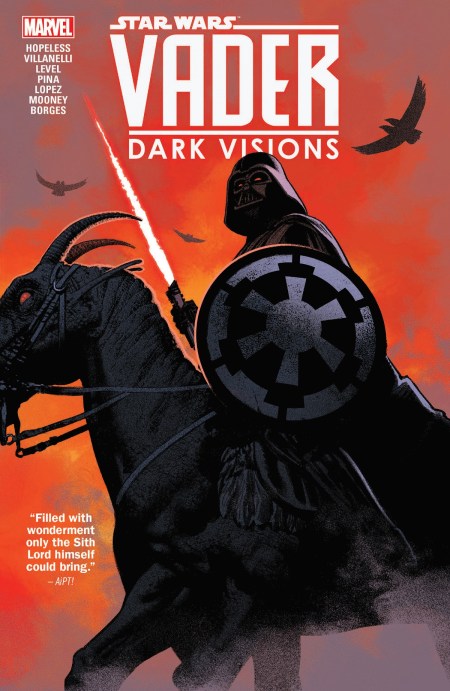
Vader-DarkVisions-TPB.jpg

Publisher: Marvel Comics

Publication Date: 27 August 2019

Length: 128 pages

My Rating: 4.5 out of 5 stars

Amazon

Prepare to see one of the most iconic and beloved villains in all of fiction, Darth Vader, in a whole new light as Dennis “Hopeless” Hallum and several talented artists present five new and clever stories of the Dark Lord of the Sith from across the galaxy.

To most of the universe, Darth Vader is the Empire’s ultimate symbol of power, authority and fear, delivering death and destruction upon all who incur his wrath. But to some he can be something even more potent and remarkable. On one planet he is a Black Knight, a beacon of hope that saved them from a terrible monster. To a certain Imperial Commander, Vader is a reminder that failure is unacceptable. To one Imperial nurse, Vader is her one true love. But no matter how people see him, the one universal truth is that those who encounter this Sith Lord are likely to end up dead.

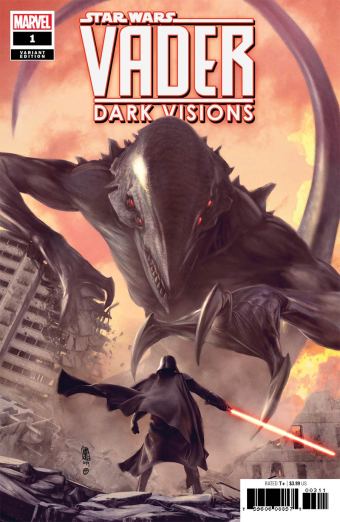
VaderDarkVisions1-Camuncoli.jpg

Vader: Dark Visions is a fun and uniquely intriguing Star Wars comic that I bought a few weeks ago while on holiday. Vader is easily one of my favourite Star Wars characters, especially as most recent pieces of Star Wars expanded universe fiction have gone out of their way to show him as the ultimate badass. For example, I have absolutely loved some of the recent Darth Vader comics that have been published, including the 2015 Darth Vader series, the Darth Vader: Dark Lord of the Sith series (check out my reviews for Volumes 2 and 3 here), and he has also been exceedingly impressive as a villain in recent volumes of the 2015 Star Wars comic series and the always entertaining Doctor Aphra comics. I also loved his appearance in the second season of Star Wars Rebels and in novels such as Thrawn: Alliances (which features a very cool scene of Vader flying a Tie Defender). As a result, I have been looking forward to Dark Visions for a while, as I found the cool concept of five new and different stories about Darth Vader very appealing.

This collected edition of Dark Visions contains five separate, standalone comic issues that have been written by Hopeless, each of which features the talents of a different artist. Each of these separate stories is really cool, featuring some very interesting story elements, eye-catching artwork and interactions that give the reader a real sense of how terrifying and complex the character of Darth Vader truly is. I also liked how different each of the stories was as Hopeless goes in some very interesting directions to showcase Vader.

VaderDarkVisions1-LFY

The first issue of Dark Visions is Savior and it features the artistic talents of Paolo Villanelli and colour artist Arif Prianto. Savior is the set piece of the entire book and is probably the one that shows off how powerful Vader truly is as he faces off against a gigantic civilisation-destroying monster by himself. Not only is this a pretty epic fight, but everything is shown from the perspective of a young boy whose people have been living in fear of the monster for generations. To him, Vader appears as a great hero, a Black knight, who has come to save their planet, and who even rides a black horse-like steed into battle. However, even after he saves his entire world, the young narrator gets a sense of what Vader really is and is quite rightly terrified. This was an awesome, action-packed first issue and it serves as a great introduction to the entire volume. You also have to give props to the cool cover art that this story produced. The main cover for Issue #1 was used as the cover for the Dark Visions collected edition, and the shot of Vader as an actual knight is one of the main reasons why I wanted to grab this comic. I have also included the two alternate covers that this issue inspired as well, as they are a lot of fun, and show the behemoth that Vader faces off against

SW_Vader_-_Dark_Visions_2.jpg

The second issue of this comic is easily the funniest of the whole Dark Visions volume. Issue #2, Unacceptable, features an absolutely hilarious Moby Dick inspired story drawn by Brian Level and coloured by Jordan Boyd. The story follows an Imperial Commander who, after seeing Vader brutally kill an entire room full of officers when he was younger, is absolutely terrified of any form of failure. As a result, when a single Rebel spy escapes his attack and he learns that Vader is on route, he abandons the fleet to take his Star Destroyer after this spy in order to capture him, as “failure is unacceptable”. What follows is a destructive rollercoaster ride through space, as the Rebel spy pilots his ship through a range of obstacles and the Imperial Commander obsessively follows him no matter the risk. This results in a fantastically amusing story filled with laughs, disbelief, some very impressive artistic set pieces and an ending that brings the entire story full circle. Thanks to excellent artwork, the commander’s fall to insanity is pretty clear throughout the issue, and I absolutely loved the crazy obstacles he went through. If you’ve ever wanted to see a Star Destroyer fly into an exogorth (the giant space slug in Empire Strikes Back) then this is the comic for you.

VaderDarkVisions-3.jpg

Next we come to the third issue of Dark Visions, Tall, Dark and Handsome, which has David Lopez and Javier Pina as the artists and Muntsa Vicente as the colour artist. Like Unacceptable, the story within Issue #3 is a tale of obsession; however, it goes in a very different direction. Tall, Dark and Handsome follows an Imperial nurse on the Death Star who, after treating Vader and feeling his power, starts to fall in love with him and begins to imagine an epic romance with him. This story pretty much ends the way you would imagine, but it is a very dark and emotional journey to the conclusion. While this story is pretty messed up, it is written and drawn extremely well, and you can’t help but feel sorry for the nurse who is slowly losing her mind. The artists did a fantastic job showcasing the various stages of the nurses obsession, from the initial stages of her infatuation, to the look she gives him after he knocks her down with the force (a look that can only be described as “thirsty”), to the scenes at the end where she finally cracks and goes into full-blown crazy stalker mode. I also loved the various sequences generated by the nurse’s imagination, which show her idealised versions of the romance, and they are a great portal into her shattered mind.

VaderDarkVisions-4.jpg

The fourth issue of Dark Visions is titled Hotshot and featured Stephen Mooney as the artist and Lee Loughridge as the colour artist. This is a rather interesting story that examines the impact Vader has on the psyche of the Rebel pilots he flies against. In this issue, Vader goes up against a group of skilled Rebel pilots, including a young hotshot flyer with boundless confidence. However, Vader’s superior skills and reputation as a pilot soon have a noted influence on his opponent’s minds, and Vader is able to defeat one solely through fear. I really liked seeing a story that focused on Vader’s ability as a pilot, as it is one of his more impressive abilities, and is pretty cool when focused on (his appearance in the season 2, episode 1 of Star Wars Rebels springs to mind). The various space battles that occur within this issue look fantastic, and you get a real sense of how skilled Vader is in the cockpit.

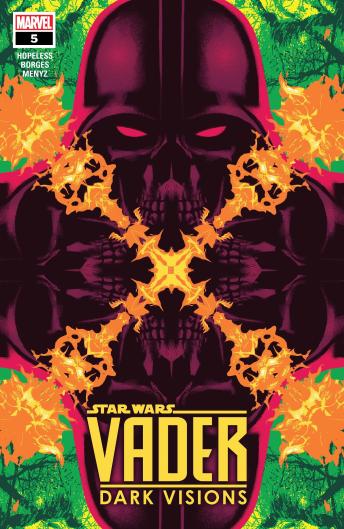
VaderDarkVisions-5.jpg

The fifth and final issue contained within this volume is called You Can Run…, and it was drawn by Geraldo Borges and coloured by Marcio Menyz. This final inclusion focuses on the general aura of fear that Vader exudes as he hunts down a person carrying valuable information on a hostile jungle world. Vader is already pretty terrifying on his own, but when his target gets dosed by a hallucinogenic compound and begins to see all sorts of horrors around him (like the Scarecrow’s fear toxin in Batman), Vader’s scariness gets amped up to 11. The artists come up with some pretty impressive fear-induced sequences throughout this issue, and the various exaggerated ways that Vader is shown are quite inventive (there is a hint of the Predator in one of them).

Overall, I think that this was a really varied and enjoyable combination of different stories that all examine a different aspect of this great character. All five of these issues are done extremely well and feature a fantastic combination of intriguing stories and amazing artwork. I absolutely loved each of the first three issues, and also quite enjoyed Hotshot and You Can Run… However, I actually found it really hard to pick out my favourite story, mainly because they were all enjoyable in such different ways. I do think that these various stories came together into a very satisfying overall volume that is extremely entertaining. As a result, I would strongly recommend Vader: Dark Visions, and it is an excellent read for all fans of the Star Wars franchise.

Amazon

Star Trek: The Antares Maelstrom by Greg Cox

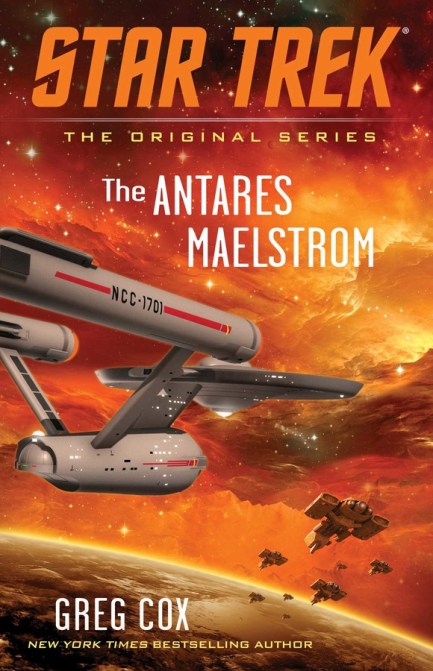
Star Trek - The Antares Maelstrom Cover.jpg

Publisher: Simon & Schuster Audio (Audiobook – 13 August 2019)

Series: Star Trek: The Original Series

Length: 11 hours and 34 minutes

My Rating: 4 out of 5 stars

Amazon     Book Depository

My bold new voyage down into the depths of Star Trek extended fiction continues as I review the latest exciting novel tied into Star Trek: The Original Series, The Antares Maelstrom by Greg Cox.

Get ready for a good old-fashioned “gold rush” on the outskirts of Federation space, as vast quantities of a rare and valuable mineral vital for energy production is found on the remote planet of Baldur-3. The sparsely populated planet is quickly overrun by a horde of opportunists from all over the galaxy, seeking to make their fortunes as miners and prospectors. Hailing from a variety of planets and made up of a number of different species, these determined but often under-prepared prospectors are pushing Baldur-3’s infrastructure to its limit. Despite not being part of the United Federation of Planets, Baldur-3 requests assistance from Starfleet, which dispatches Captain James T. Kirk and the crew of the U.S.S. Enterprise to help in any way they can. However, upon their arrival in the sector, Kirk discovers several major problems that require him to split his personnel.

While Kirk and the Enterprise remain above Baldur-3, Sulu and a small contingent of the ship’s crew are left behind at the local Deep Space Station S8 to help manage the prospectors in transit to the planet. While there, Sulu is forced to deal with a multitude of issues, including a malevolent saboteur, the return of an old romantic flame, and foolhardy adventurers attempting to cross the dangerous Antares Maelstrom to find a fabled shortcut to Baldur-3. At the same time, Spock and Chekov travel to a nearby planet, inhabited by a pre-spaceflight race of humanoids, where alien items have started appearing in the hands of the locals in what is clearly a severe violation of the Prime Directive. As Spock and Chekov investigate, they find themselves dragged into a sophisticated smuggling ring involving a rare tea that could prove disastrous for the planet’s future development. Each of these groups will experience mortal peril as they attempt to uphold the values of Starfleet and assist all those in need.

I have really been on a roll with Star Trek novels lately, having already read several fantastic pieces in the last few months, including The Captain’s Oath by Christopher L. Bennett, Available Light by Dayton Ward, The Way to the Stars by Una McCormack and the first volume of the Boldly Go comic book series. The Antares Maelstrom by Greg Cox is another fun and enjoyable Star Trek novel that I had a wonderful time listening to on audiobook. Cox is an experienced writer of tie-in fiction, having written novels related to a number of different media franchises, such as Buffy the Vampire Slayer, Alias, Underworld, The Librarians and titles from DC and Marvel comics. However, his most consistent body of work has been his Star Trek tie-in novels. Since 1995, Cox has written around 20 Star Trek books, set across the various television series. He has already written several books related to The Original Series, as well as three books that show the life and times of iconic franchise villain Khan.

This particular Star Trek adventure is set during the Enterprise’s five-year journey (2265 – 2270), meaning that this story occurred around the same time as the episodes of The Original Series. The Antares Maelstrom turned out to be an interesting change of pace from some of the other Star Trek books I have previously read, as it is a standalone novel that does not seek to explore character backgrounds or continue several ongoing storylines from previous novels. Instead, the episode reads a lot like an episode from The Original Series, with the crew of the Enterprise getting involved with a number of adventures in space and helping those in need.

Cox has populated his latest book with three separate storylines, each of which features various members of the Enterprise’s main crew. This includes Sulu’s stay aboard Deep Space Station S8 and Spock and Chekov’s investigation of the tea smugglers on the nearby planet. Both of these storylines branch off from Kirk’s storyline as he, Scotty, McCoy, Uhura and the Enterprise stay above Baldur-3 and provide assistance to the surface. Each of these storylines is quite interesting and has a number of great moments. While Spock and Chekov’s storyline is one extended adventure, the other two parts of the book feature a series of interconnected adventures and mysteries. This is a very interesting blend of stories, from the examination of a futuristic “gold rush” in space, to a covert investigation on an alien planet. I personally enjoyed Sulu’s storyline the most, as it featured a number of exciting moments between spaceships, a compelling investigation, several great new characters and a huge amount of action. The other two storylines are really good, and in my opinion the story benefited from having this great mixture of storylines, which did not dilute or overwhelm the overall quality of the book. Indeed, all of the storylines form a compelling overarching narrative which I found to be extremely fun and surprisingly addictive, and I was firmly glued to the story.

Like most tie-in novels, The Antares Maelstrom is intended for fans of the franchise it is based on, meaning that this is an ideal read for hardcore Trekkies. However, no great knowledge of the original series is required to enjoy this book. There are no real pre-existing storylines to follow, and anyone who has a basic knowledge of the show or who has seen the latest trilogy of movies will be able to follow along without any issues. Cox does pepper the story with a number of references to some of the past adventures of the Enterprise, and there is even a major connection to one of the more interesting episodes from the first season. The book does feature the first appearance of the titular Antares Maelstrom, which itself is a rather obscure reference to the second Star Trek movie, The Wrath of Khan, as the Antares Maelstrom is featured in one of Khan’s iconic monologues. While these many references and call-backs to previous episodes will prove to be enjoyable to fans of the franchise, most of them have no real bearing on the plot, and any that do are well explained.

I also felt that Cox did a fantastic job of capturing the original tone of the Star Trek television show in this novel. The focus on the prospectors arriving on Baldur-3 is used by the author to mirror the bold explorative and chance-taking stance that the crew of the Enterprise undertake, and there is a lot of discussion about new opportunities and venturing into the unknown. While these prospectors are initially viewed as greedy and reckless, they eventually come together as part of the book and show how, deep down, people are basically good. All this focus on unity, compassion and logic is classic Star Trek, and Kirk makes sure to accompany many of these examples with his trademark speeches, talking about the ideals of Starfleet and his crew. In addition to this, each of the major characters is strongly featured throughout the book, and the author makes sure that each of them gets a substantial amount of story time. Cox does an amazing job capturing the various personalities of the original series cast members, and it was great seeing them back in action in this new book.

As I mentioned above, I ended up listening to The Antares Maelstrom on audiobook, narrated by Robert Petkoff, which ran for 11 hours and 34 minutes. I absolutely flew through this audiobook, and I really enjoyed having this cool story narrated to me. Petkoff is still an impressive narrator, and I have previously mentioned how much I enjoyed his work narrating the voices of The Original Series cast members for The Captain’s Oath. In The Antares Maelstrom, Petkoff continues to amaze, coming up with a huge range of different voices for the various characters featured throughout the book. Just like in the previous book, his Kirk, Spock, Sulu and McCoy are darn near perfect, and I was really glad I got to hear a lot more of his Scotty, as he manages an awesome Scottish accent. I also got my first real experience of Petkoff’s Chekov in this book, and I have to say it was near perfect. The narrator expertly captures Chekov’s Russian accent, and there were a number of amazing instances where Petkoff had to imitate Chekov’s classic mispronunciations of English words. This is truly some first-class voice work and it really helps make the entire audiobook stand out. Petkoff seems to be one of the main Star Trek audiobook narrators at the moment, as several recent and upcoming books all feature his talents, and this makes me a lot more eager to check out these books in the future.

The Antares Maelstrom by Greg Cox proved to be another amazing piece of Star Trek fiction. It presents the reader with three fantastic adventures that come together to create an exciting and captivating book. While probably best read by established Star Trek fans, this book can be easily enjoyed by readers who have less Star Trek experience but who love sci-fi, intriguing mysteries, iconic characters and fast-paced action. Another great outing from Cox, The Antares Maelstrom is really worth checking out, especially in its audiobook format.

Amazon     Book Depository

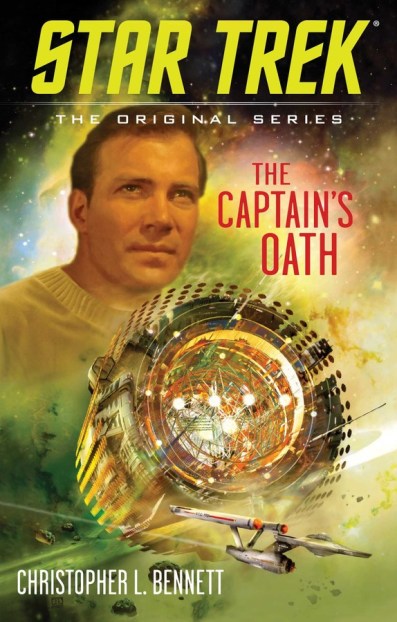
Star Trek: The Captain’s Oath by Christopher L. Bennett

Star Trek - The Captain's Oath Cover

Publisher: Simon & Schuster Audio (Audiobook – 28 May 2019)

Series: Star Trek

Length: 11 hours and 58 minutes

My Rating: 4.5 out of 5 stars

Amazon

Prepare to venture boldly into a new Star Trek: The Original Series tie-in novel which not only tells a deeply compelling story but also looks at several pivotal moments of Captain Kirk’s early Starfleet career that made him the captain we all know and love.

Captain James Tiberius Kirk is known throughout the galaxy as a great warrior, diplomat, explorer and hero. His story as the captain of the U.S.S. Enterprise is legendary, but how did a relatively young and inexperienced captain gain the right to take command of Starfleet’s most advanced and famous ship? What drives the young captain to be the best? And where did he get the tendency to bend Starfleet’s many rules in order to do the right thing?

Over three separate timelines set between 2261 and 2265, The Captain’s Oath follows Kirk’s early career as a captain. Looking at both his first command aboard the U.S.S. Sacagawea to his initial missions with the crew of the Enterprise, this book highlights several major conflicts and explorations that Kirk was involved in which shaped his personality and command style. From early conflicts with the Klingons, first contact missions that tested Kirk’s dedication to follow the Prime Directive to the letter, and diplomatic missions that had the potential to lead to war, these experiences will turn him into a captain worthy of the Enterprise.

I am fairly new to the world of Star Trek tie-in books, having only previously read two Star Trek novels that were released earlier this year, The Way to the Stars and Available Light. I was massively impressed by The Captain’s Oath, which was a spectacular and massively compelling read. Veteran Star Trek author Christopher L. Bennett, who has written a large number of Star Trek tie-in novels since 2004, crafted an excellent novel that not only showcases the past of an iconic character from the franchise but presents an exciting adventure at the same time.

The overarching narrative of The Captain’s Oath is told in three separate timelines. The first of these timelines starts in early 2261 and follows the early day of Kirk’s captaincy of the Sacagawea. The next timeline is set between 2262 and 2264, and also features Kirk as the Captain of the Sacagawea; however, this timeline starts after an undisclosed destructive event that crippled the ship and killed several of Kirk’s crew in the previous timeline, and follows Kirk’s adventures after this event. The final timeline is set in 2265 and starts the moment Kirk takes command of the Enterprise. It follows his first real mission as captain of his iconic ship, and ends just before the start of The Original Series television show. The book features lengthy chapters, with various adventures in different points of time spread throughout the course of the novel. These adventures are also usually shown from the perspectives of Kirk and some of the Starfleet personnel serving with him, although there are occasional scenes featuring characters aboard other Starfleet ships.

I did initially find it a little tricky to get my head around the use of multiple timelines, especially as I was listening to the audiobook format of The Captain’s Oath. However, once I got track of each of the three major timelines, I was able to appreciate what Bennett was doing with this writing style and how he wanted to tell the story. By using these multiple timelines, Bennett succeeds in telling a story that is much more complex and compelling than a linear story would have been. These multiple timelines allow the reader to get a much better sense of the main character and how he became the person he was in the first episode of The Original Series. By showing various stages of his time as a captain, Bennett is able to examine a number of key events that formed Kirk’s personality and command style. Through a series of intriguing missions and a ton of different scenarios, you get to see how Kirk reacts to both his success and his failures, and what lessons he takes with him. As the book progresses, you get to see how these earlier experiences affect his actions in the subsequent chronological missions. This was an extremely clever way to write the story, and I felt that the multiple timelines work extremely well together and helped create a powerful narrative that did a fantastic job showcasing the character of Captain Kirk.

I also really enjoyed the huge variety of Star Trek missions that Kirk and his crew went on throughout the course of the book. This book featured an amazing range of different missions that Starfleet are known for, including diplomatic undertakings, rescues, exploration, first contact and military missions in defence of the Federation. Some of these missions are quite complex in their individual content and in the way that most of them flow through and connect with later missions in the chronology. Bennett has come up with some truly unique and fantastic scenarios for this book, and through these various missions the reader is treated to some intriguing mysteries, intense battles and deep examinations of humanity and life. I really got into a number of these missions, including a fascinating mission where Kirk and his crew get trapped on a pre-spaceflight planet whose government is using propaganda to frighten the populace with non-existent invading aliens. However, the best scenario is a series of missions set during Kirk’s days as captain of the Sacagawea where he and his crew encounter an unusual group of aliens who are invading Federation space in some unique ships (the one on the cover). The various missions involving these new aliens not only result in some impressive space battles but also feature some intriguing diplomatic meetings and fascinating discussions about different forms of life, as the beings Kirk and his crew encounter are so alien that a number of key concepts such as territory and galactic borders are untranslatable to them. Each of the missions featured in this book were pretty amazing and are a testament to Bennett’s imagination and appreciation for the underlying material.

One of the things that I enjoyed about this book was the sheer amount of Star Trek references and lore that Bennett has managed to fit into this story. Fans of Kirk and The Original Series will be intrigued by this new look at Kirk’s early career as a captain and several of the pivotal adventures he undertook. The Captain’s Oath also features Kirk’s first meetings with several key characters from the series, including Spock, Sulu, Scotty and McCoy. Not only does the reader get an idea of the early relationship between Kirk and Spock, which only began when Kirk took command, but you also get to see Kirk befriend McCoy and then eventually talk him into becoming doctor for the Enterprise. In addition to the look at the major characters, there are also a number of great examinations of minor characters from the series. A great example of this is the inclusion of the Klingon character Captain Koloth, the villain of The Original Series episode The Trouble with Tribbles. While he was only in the book for a short period of time, it does answer a question about how Koloth and Kirk knew each other, as they recognise each other in the episode, and it shows why they disliked each other.

Perhaps the most interesting part of The Captain’s Oath was the inclusion of Gary Mitchell throughout the course of the book. In the show, Mitchell only appeared in one episode and was the original helmsman of the Enterprise before becoming the eventual antagonist of the episode Where No Man Has Gone Before. In this episode it is explained that Mitchell was one of Kirk’s oldest and closest friends, and Bennett spends a lot of time exploring this friendship in this book. Mitchell is shown to be a major influence on Kirk’s personality during the early days of him being a captain, helping him relax and become less beholden to Starfleet’s rules and regulations. Their friendship is an important part of the book, although it is a little tragic when you consider how it is destined to end. The book also features a few scenes with Lt. Kelso, who is killed by Mitchell in Where No Man Has Gone Before, and it is interesting to see some of his interactions with Mitchell and Kirk, considering his appearances in the show. It is curious to note that Bennett appears to have switched the roles of Mitchell and Kelso around, as Kelso is portrayed in the book as the helmsman, while Mitchell is the navigator. Nonetheless, the author uses the inclusion of Kelso to explain why Sulu was the ship’s physicist in this episode rather than helmsman, and why he was given the job in subsequent episodes.

Bennett has included some pretty deep Star Trek lore in this book, but do you need to be a major Star Trek fan to enjoy The Captain’s Oath? In my opinion, you do not. Obviously, hardcore Star Trek fans will get a lot more out of this book, no doubt appreciating all the references, minor characters and the backstory that Bennett has concocted. However, this book is easily enjoyable for people who only have a passing knowledge of the Star Trek shows or universe. Bennett makes the story extremely accessible, and many features from the franchise or history relevant to the story are explained in full detail, ensuring no one is left in the dark. Indeed, due to the awesome story, connection to The Original Series and the focus on such an iconic character, this is a great book to check out if you are curious about Star Trek books and want to see what they are like, and a lot of general science fiction readers will like some of the unique scenarios explored throughout the book. This would also be a really interesting book for those people whose only exposure to Star Trek has been the recent movies set in the alternate timeline, as this book shows a very different version of Kirk. Overall, I think that quite a wide audience can appreciate The Captain’s Oath, and it is a fantastic Star Trek tie-in book to check out.

While I did receive a physical copy of The Captain’s Oath, I decided to check out the audiobook version instead in order to fit it into my reading schedule. The audiobook format of this book is narrated by Robert Petkoff, who has a narrated a large number of previous Star Trek tie-in books, as well as several Star Trek novels coming out later this year. The Captain’s Oath audiobook runs for a pretty typical length of time for a Star Trek book, at just under 12 hours long, meaning that dedicated listeners should be able to get through this quite quickly. I really enjoyed listening to the audiobook format of this book, and I found that listening to the story helped enhance certain aspects of the plot, such as making the action sequences more exciting and providing the full impact of several of Kirks inspirational speeches. Petkoff is an excellent narrator whose work I have previously enjoyed when I listened to Available Light a couple of months ago. I noted back than that Petkoff did an amazing job imitating several key members of the Star Trek: The Next Generation cast, and I was very curious to see how he would go with characters from The Original Series. Petkoff’s voice work in The Captain’s Oath was pretty impressive, as he did an exceptional job bringing characters such as Spock, Scotty, Sulu and McCoy to life and making them sound very similar to their original portrayals in the show. Petkoff also did a pretty good Kirk, and I liked how he attempted to reproduce the captain’s iconic speech patterns from the show. Petkoff also had the opportunity to bring a huge range of different nationalities and alien species to life, and these were also very impressive, as he was able to produce some distinctive voice types from the show, including the specific vocal patterns of the Vulcans as well as several distinctive human accents. All of this made for an incredible listen, and I fully intend to check out the audiobook formats of any future Star Trek books narrated by Petkoff. Indeed, the next audiobook I am planning to listen to, The Antares Maelstrom, is narrated by Petkoff, and I look forward to listening to this latest book.

Star Trek: The Captain’s Oath is an exciting and captivating novel that does an outstanding job exploring the early life of Captain Kirk and examining some formative events that made him the character we all know and love. Author Christopher Bennett has created a compelling story that utilises multiple timelines and a series of intriguing missions to tell a complex tale that I had an amazing time reading. This is an excellent piece of Star Trek extended fiction that I would whole-heartily recommend for anyone who has ever been curious about learning more about Kirk’s story and the Star Trek universe prior to The Original Series.

Amazon

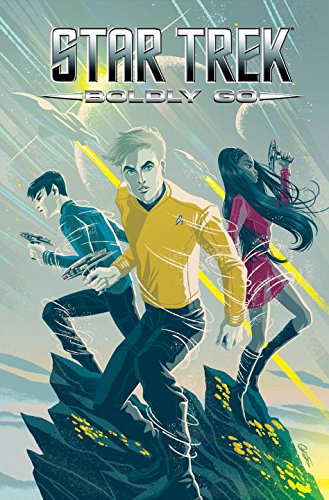
Throwback Thursday – Star Trek: Boldly Go, Volume 1 by Mike Johnson and Tony Shasteen

Boldly_Go_Vol._1.jpg

Publisher: IDW Publishing

Publication Date: 25 July 2017

Length: 136 pages

My Rating: 4.5 out of 5 stars

Amazon     Book Depository

Reviewed as part of my Throwback Thursday series, where I republish old reviews, review books I have read before or review older books I have only just had a chance to read.

In this Throwback Thursday, get ready to explore the first volume of an intriguing Star Trek comic book series, Boldly Go, which presents the reader with clever new story directions spinning off from the alternate timeline Star Trek movies.

I think it is time to admit to myself that I am starting to get rather hooked on Star Trek extended universe fiction. Like my obsession with everything from the Star Wars extended universe, all it took for me to dive into this new fandom was reading a few compelling Star Trek books. Amazing titles such as Available Light and The Captain’s Oath made me realise that there are some pretty interesting Star Trek books out there. I just started listening to another Star Trek audiobook today (The Antares Maelstrom by Greg Cox, which is pretty good so far). As a result, when I recently saw some other reviewers talking about a cool-sounding Star Trek comic book series that came out a couple of years ago, I immediately went and grabbed a copy of the first volume (I am very impressionable like that). What I found was an extremely compelling Star Trek adventure that had some truly intriguing and clever elements to it.

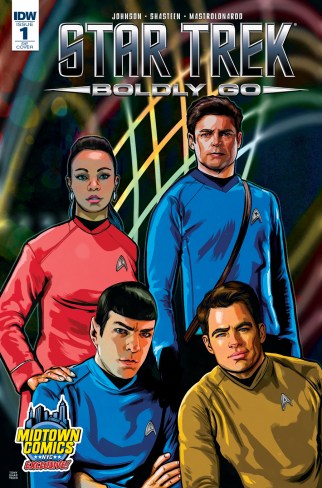
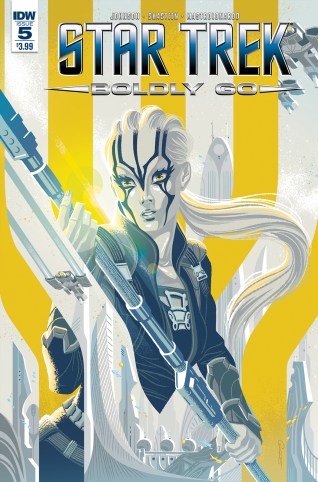
Star_Trek_Boldly_Go,_issue_1_RE.jpg

Star Trek: Boldly Go was an ongoing canon comic book series which started in 2016 and was set in the same continuity as the 2009 Star Trek film and its sequels. This continuity is an alternate timeline to the main Star Trek universe, which is known as the Kelvin Timeline due to the deviation that started with the time traveller Nero’s destruction of the U.S.S. Kelvin (Kirk’s father’s ship). This series was written by Mike Johnson, who has a lot of experience writing Star Trek comic book series, and featured contributions from several different artists. Boldly Go was the second ongoing series set in this timeline, following the 2011 Star Trek series which ran for 60 issues and was also written by Mike Johnson (which apparently had some really interesting-sounding storylines and which I might have to check out as well).

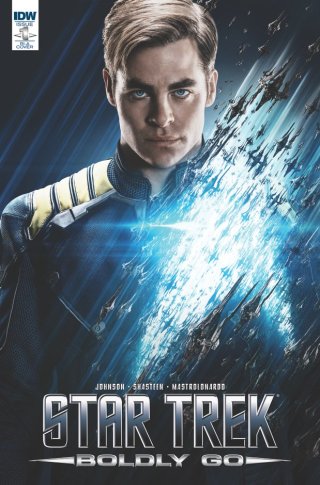
Star_Trek_Boldly_Go,_Issue_1_RI-A.jpg

Following the destruction of the U.S.S. Enterprise in Star Trek Beyond, the entire crew have been temporarily reassigned to new posts while they wait for their ship to be rebuilt. While Spock and Uhura are living on New Vulcan and Scotty is a lecturer at Starfleet Academy on Earth, Sulu, McCoy and Kirk are still serving out amongst the stars. Kirk has taken command of the U.S.S. Endeavour with McCoy begrudgingly at his side, and Sulu is serving a one-year exploration mission aboard the U.S.S. Concord.

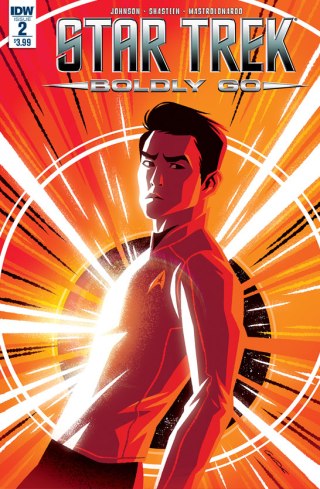
Star_Trek_Boldly_Go,_issue_2.jpg

Events outside of their control will soon bring the former crew of the Enterprise back together, when the Concord encounters a ship of unknown design on the edge of Federation space. The ship is extremely powerful and technologically advanced and it attacks without warning, easily carving off pieces of the Concord with its destructive weapons. As alien boarders abduct members of the crew and devastate the ship, only one thing is certain: resistance is futile!

Star_Trek_Boldly_Go,_Issue_2_RI-A.jpg

The Borg Collective, one of the most dangerous races in the entire galaxy, have arrived in this version of Federation space nearly 100 years earlier than they were supposed to. Their motives are unclear, but as they attack several Federation vessels and settlements it is clear that they are en route to the capital of the Romulan Empire, Romulus. Answering the Concord’s distress call, Kirk and the Endeavour follow the Borg sphere after picking up Spock and Uhura. Forced to enter Romulan space, can Kirk and his crew save the abducted humans and defeat the Borg, or will actions provoke war with the Romulans? And what connection do the Borg have to the events that made this alternate timeline and formed this version of the Enterprise’s crew?

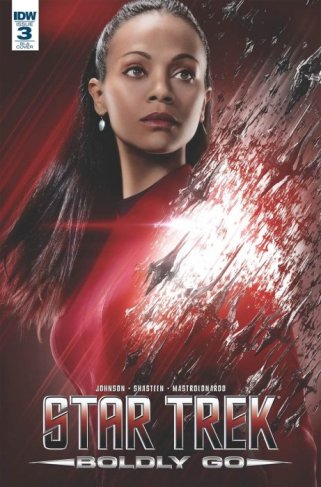
Star_Trek_Boldly_Go,_issue_3

This first volume of Boldly Go is a massive ball of fun that I had a great time reading. Not only does it feature a captivating and enjoyable story with some real cool twists; it also takes this Star Trek universe in some interesting directions. Featuring issues #1-6, this first volume starts a few months after the events of Star Trek Beyond and continues several of the fun storylines explored in the movies and the 2011 ongoing comic book series.

Star_Trek_Boldly_Go,_Issue_3_RI-A.jpg

This first volume features a bunch of interesting storylines. Issues #1-4 contain the volume’s major storyline, the invasion of the Borg into Federation and Romulan space. This is an extremely action-packed storyline, and I really enjoyed seeing the Borg, who are probably the best Star Trek antagonists ever created, go up against the classic crew of the Enterprise. The entire Borg storyline is cleverly written, with high stakes and explosive action sequences, and it has some really cool moments. If you have ever wanted to see what would happen if the Borg tried to assimilate Spock (and let’s face it, who wouldn’t find that awesome) then this is the comic for you.

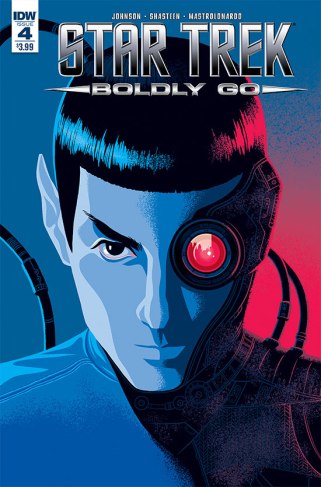
Star_Trek_Boldly_Go,_issue_4.jpg

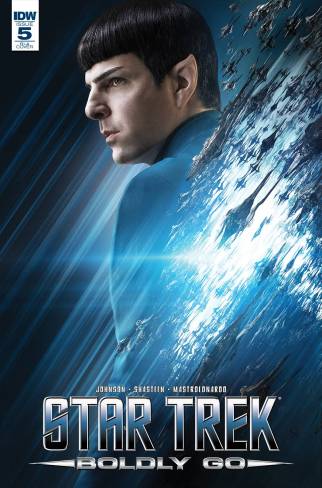
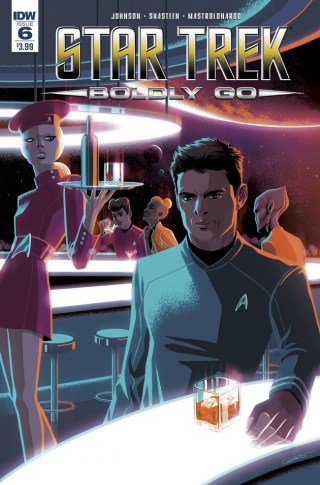
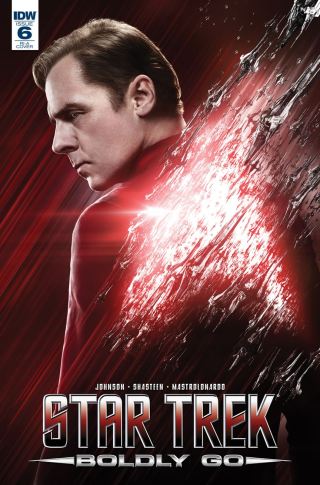
Issues #5 and #6 contain two different, intriguing storylines. Issue #5 contains a rather emotional story that examines the history of the fan-favourite character from Star Trek Beyond, Jaylah. Told chronologically backwards, this issue shows Jaylah’s tragic life trapped on the planet Altamid, and then goes further back to explore how she and her family were marooned there and the events of her past that would eventually lead her to Starfleet. The sixth and final issue in the volume continues some of the storylines from the first four issues of the series, reunites the always funny Scotty with the rest of the main characters and shows a rather curious story about an extremely advanced species of aliens interfering with the Endeavour in violation of their own version of the Prime Directive.

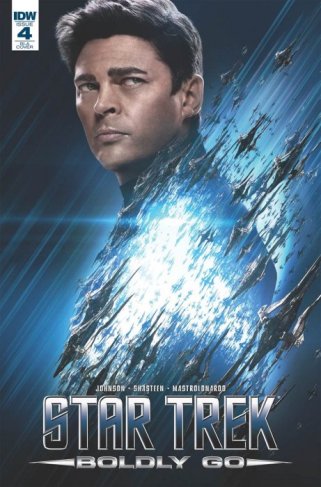
Star_Trek_Boldly_Go,_Issue_4_RI-A.jpg

While all of the storylines featured within this first volume are compelling and filled with emotional plot developments, it was also cool to see this version of the Enterprise crew once again. I really liked seeing how their adventures continued post-Star Trek Beyond, especially because, at the moment, it looks like Beyond is going to be the last film in this particular series of Star Trek films (which is a real shame, as some of the plans for the next instalment sounded particularly awesome). I did feel that the creative team of this comic did a fantastic job capturing the tone of the new movies and the personalities of these versions of the characters, and overall I found the story within this volume to be quite impressive.

Star_Trek_Boldly_Go,_issue_5.jpg

In addition to the great story, dedicated Star Trek fans will find some of plot inclusions to be extremely interesting, as they draw on some unique pieces of Star Trek lore. This volume features alternate timeline versions of characters from the original series, such as Captain Terrell, an older version of whom previously appeared in The Wrath of Khan, and there are intriguing hints at features of the Romulan Empire, such as the feared Tal Shiar. I also cannot get past how awesome it was to see the Borg in this timeline. Jackson has previously experimented with having this version of the original Enterprise crew interact with classic villains from other Star Trek shows. For example, they encountered Q in Jackson’s previous comic book series set in the Kelvin Timeline. However, it was particularly cool having the crew fight the Borg, and it resulted in a number of amazing scenes.

Star_Trek_Boldly_Go,_Issue_5_RI-A

I found the explanation for why the Borg were in Federation space during this time period to be extremely clever. In the main Star Trek universe, the Borg did not attack the Federation until the events of Star Trek: The Next Generation, set around 100 years after the start of The Original Series. However, in this comic, the Borg were attracted to the Federation much sooner than expected. The reason for this is eventually shown to be because Nero, the antagonist of the 2009 Star Trek film, constructed his massive ship, the Narada, out of Borg technology. This naturally drew the attention of the Borg, who travelled to Federation space at a much quicker rate than they did in their original appearance. While this explanation is pretty fascinating by itself, it actually results in some interesting connections with the main Star Trek universe. Technically, this alternate timeline is still considered to be within the canon of the main universe, as it was created when characters from this timeline, Nero and Spock from The Original Series, travelled back to the day Kirk was born. As a result, if the Narada contained Borg technology, then it is reasonable to assume that the Romulans are experimenting with captured Borg material in the main universe after The Next Generation ended. This has subsequently been somewhat confirmed, as the recent Comic Con trailer for the upcoming television series Picard showed images of Romulans dissecting Borg prisoners. As Picard is going to be set after the destruction of Romulus in the main Star Trek universe, it appears that this comic actually predicted events from the show before it was even in production (or else the creators of the show read this comic). This deep dive into Star Trek lore is really cool, and it is interesting to see ideas spawned in this comic have impacts in an upcoming show.

Star_Trek_Boldly_Go,_issue_6

This volume of Star Trek Beyond features some fantastic artwork from a variety of skilled artists. The main artist for the first five issues is Tony Shasteen, with Davide Mastrolonardo serving as colourist. Their combined artwork is pretty spectacular, and I really enjoyed it. Not only did they do a fantastic job of recreating the alternate timeline versions of the Enterprise crew, but the drawings of space, battles and the destruction of the Borg are amazing. I particularly liked the character designs of the Borg drones, especially when some of the Starfleet characters are converted into drones. I was also really impressed by an extended sequence that took place in Spock’s mind, where the Borg infiltrated his memories of several events of the 2009 film, and they made for a great scene. Issue #6 was drawn by Chris Mooneyham, with J. D. Mettler doing the colours. This naturally results in a noticeably different art style for this final issue, but this team does a great job of portraying some interesting scientific anomalies in space. Overall, the artwork featured within this volume is exciting and very well-done, and I had a great time seeing how the artists rolled out this adventure.

Star_Trek_Boldly_Go,_Issue_6_RI-A.jpg

Volume 1 of Star Trek Beyond is a fantastic comic book that is really worth checking out. The creative team have done a wonderful job portraying a new story that takes place in the aftermath of the last Star Trek movie. There are some really compelling story ideas taking place in this volume, and Johnson made sure to go big by bringing in a fantastic bunch of antagonists from The Next Generation. Best read by existing fans of the Star Trek franchise who will enjoy the creative team’s unique take on the characters and their adventures, this comic will also be appreciated by casual Star Trek fans who have only seen the more recent movies. I am extremely glad I decided to explore this Star Trek comic book series, and I will definitely be grabbing the next two volumes of this series when I next visit the comic book shop. This first volume gets four and a half stars from me and is an outstanding piece of Star Trek fiction.

Boldly_Go_Vol._1 (2).jpg

Amazon     Book Depository

Star Wars: Thrawn: Treason by Timothy Zahn

Thrawn Treason Cover

Publisher: Century (Trade Paperback – 25 July 2019)

Series: Thrawn – Book 3

Length: 333 pages

My Rating: 4.5 out of 5 stars

Amazon

The master of Star Wars extended universe novels, Timothy Zahn, returns with a third incredible book in his outstanding Thrawn series, Treason, which features the final adventure of his most iconic protagonist, Grand Admiral Thrawn, before his last appearance in Star Wars: Rebels.

While the new Disney Star Wars extended universe has produced some truly exceptional entries in the last couple years, the Thrawn series of books has been a real bright spot amongst them. Grand Admiral Thrawn was the antagonist of Zahn’s original Thrawn trilogy back in the 1990s, and quickly became a fan favourite character among the Star Wars fandom. After Thrawn was introduced into the new Star Wars canon as the primary antagonist of Star Wars Rebels in seasons 3 and 4, Zahn was brought back to write a series of novels that provided an updated history for this character.

The Thrawn series has so far consisted of two books, Thrawn and Alliances. In Thrawn, we are introduced to Mitth’raw’nuruodo, or Thrawn, a member of the Chiss Ascendancy, a race of aliens from outside the known galaxy, who was marooned within Imperial Space. Thanks to a secret connection to Anakin Skywalker and a clear demonstration of his tactical ability, the Emperor takes Thrawn into his service and employs him as an officer in the Imperial Navy. Accompanied by a young officer, Eli Vanto, who serves as his translator, aide and student, Thrawn rises through the ranks all the way to Grand Admiral by defeating a series of rebel and pirate forces. Towards the end of the book, it is revealed that Thrawn is still in service to the Chiss Ascendancy, and his loyalty to the Empire may be conditional on the Empire not threatening his people. In addition, he has sent Vanto to the Chiss, as he believes that his tactical abilities, honed under Thrawn’s tutorage, may be of benefit to their forces. Alliances, which is set after the events of the third season of Star Wars Rebels, reveals the history between Thrawn and Anakin Skywalker, and has Thrawn work with Darth Vader to investigate mysterious events in the Unknown Regions. There the reader is introduced to the Grysk, a dangerous alien species living in the Unknown Regions who are making aggressive moves against both the Empire and the Chiss Ascendancy. Together, Thrawn and Vader are able to foil the Grysk’s immediate plans, although they remain a dangerous force.

I really enjoyed both of the previous books in the Thrawn series. Thrawn is probably the best expanded Star Wars book I have had the pleasure to read so far, while Alliances did a great job continuing the series and featured a fantastic team-up between two of my favourite Star Wars characters. I personally enjoyed the first book a lot more than the second, although this may be because I did read the series out of order, starting with Alliances and then going back to Thrawn. I have been looking forward to the third book in the series for a while now. Not only did I look at it for one of my Waiting on Wednesday articles, but it also featured on my recent Top Ten Most Anticipated July-December 2019 Releases list.

In Treason, which is set in the midst of the fourth season of Star Wars Rebels, Thrawn is forced to postpone his campaign against the Rebels on Lothal when Grand Moth Tarkin informs him that funding for his Tie Defender Program is at risk of being reappropriated by Director Krennic’s secret program, Stardust. Placed in the middle of a political battle between Tarkin and Krennic, Thrawn must ensure the security of Stardust’s supply chains in order to retain his funding. What at first appears to be a routine mission against a dangerous form of alien space vermin quickly reveals that the supply lines are actually being targeted pirates who have knowledge about the materials being sent to Project Stardust.

The subsequent arrival of a Chiss ship with his former protégé Eli Vanto serving aboard raises further problems, when they reveal that a force of Grysk ships are active deep within Imperial Space. Now Thrawn must not only find out what the Grysk’s mission is but also foil a large-scale conspiracy from within the Empire. As Thrawn engages his opponents in space, the real danger comes when his loyalty to the Empire is called into question. Can Thrawn continue to serve both the Emperor and the Chiss Ascendancy, or will the Emperor finally tire of his treason?

Treason was another outstanding outing from Zahn, who once again produces an addictive and clever entry in the Star Wars expanded universe that does an exceptional job showing off his iconic protagonist. Treason was a real pleasure to read, and I found myself unable to put it down at times, as I was so engrossed by the excellent story and the fantastic examples of action in the Star Wars universe. The end result was amazing book which wraps up Thrawn’s current storyline and ties it into his appearances in the wider Star Wars universe.

Just like the previous books in the series, my favourite aspect of Treason is the focus on the titular character of Thrawn. Thrawn is one of the most tactically minded and analytical individuals in the entire Star Wars universe and is an unsurpassed military genius, able to defeat superior forces with his tactics and intelligence. Zahn has always done a spectacular job of portraying a character like this in his books, and Treason is no exception. Throughout the course of the book, Thrawn comes up with a series of tactical plans and deductions to confound his opponents and defeat their forces totally. The sheer range of different strategies and plans he comes up with are pretty ingenious, as are the ways that he is able to deduce how his opponents think, such as by analysing their artwork or their body language and movements. This results in some pretty amazing sequences throughout the book and included one extremely epic conclusion that sees Thrawn defeat a massively superior force without even being on the command deck of his ship. Instead, he leaves step-by-step instructions with his subordinate to perfectly counter and defeat his opponents. Honestly, I wish I could elaborate more because it was such an epic sequence, but that would require revealing some pretty big spoilers. I really love the focus on Thrawn and hope we get to see some more of his adventures and battles again in the future.

Despite the focus on Thrawn, much of the story is told from the perspective of some of his colleagues and subordinates, although many of these scenes also feature Thrawn’s observations on the other character’s body language and intentions. The use of all these point-of-view characters actually works really well, as it allows the reader to see Thrawn’s various tactical moves through the eyes of a normal character, thus requiring Thrawn or one of his protégés to explain in detail how he was able to come up with his actions, kind of like how Watson was used in the Sherlock Holmes novels. The characters of Eli Vanto and Commodore Faro have both served this purpose in the previous two books in the series, and it was good to see them both at it again in Treason. However, both have pretty major story arcs within this book, and it was interesting to see how their characters have evolved since first meeting Thrawn. This book also features several Chiss characters, such as Admiral Ar’alani, and it was intriguing to see their view on Thrawn’s actions and his role within the Empire. Zahn has also included a new character, Assistant Director Ronan, who has a major point-of-view role within the book. Ronan is a fairly annoying character most of the time, due to his arrogance and blind worship of his superior, Director Krennic. However, he does offer some pretty cool insights into Thrawn and the other character’s actions, and it was fun to see his respect for Thrawn reluctantly grow through the course of the book. These alternate point-of-view characters also allowed for some enjoyable speculation about Thrawn’s actual loyalties, and whether he currently serves the Emperor or the Chiss, and I felt that using all these side characters really added a whole lot to the overall story.

Like all of the other books in the Thrawn series, Zahn includes a huge number of action-packed sequences that are very exciting to read. Due to the focus on characters in the Imperial Navy, the vast majority of these battles are set within space and feature battles between the various spacecraft of the Star Wars universe. These space battle sequences are written extremely well, and they allow the reader to get an excellent idea of the cool fights that are occurring on the pages. Many of these sequences are enhanced by the various protagonists’ reliance on advanced tactics and stratagems, and as a result you get a much more complex and entertaining fight than some of the other space battles that occur in other examples of Star Wars fiction. I really enjoyed all the cool battles in this book, and the ones featured in Treason are a real highlight of the entire series.

Honestly, Treason is probably best explored by hardcore Star Wars fans. Not only does it deal with some quite obscure characters and aspects of the Star Wars universe but it is also the third book in a series with strong connections to Star Wars Rebels. I would therefore strongly recommend that readers check out the first two books in the Thrawn series first, as this will give them a more solid base to the story within Treason and provide them with some useful background into the Star Wars universe. However, for those readers who do not have any prior experience of the Thrawn books or some of the storylines explored in Star Wars Rebels, this is still an extremely accessible book, and Zahn does a good job of exploring key events of the previous stories featuring the character of Thrawn. I think that all readers, even those who only have knowledge of the franchise’s films, will also enjoy the deep dive into Star Wars lore that is featured within this book.

The entire Thrawn series so far has explored a number of aspects of the Empire before the events of the first Star Wars film, A New Hope, which I have found to be exceedingly fascinating. This is continued in Treason, where the author continues to examine the running of the Imperial Navy and also looks at the creation of the Death Star, namely the supply lines heading out to the construction zone. This book also features an intriguing look at the rivalries and politics that existed at the highest echelons of the Imperial power structure. In particular, Thrawn finds himself in the middle of the conflict between Grand Moth Tarkin and Director Krenic, which was shown in the Rogue One film. This was a particularly intriguing part of the book, and it is always interesting to see Thrawn engaged in political activities, as it very much outside his wheelhouse, although the results of this political battle were extremely fun. Treason also features more details on the species that inhabit the mysterious Unknown Regions of space, in particular the Chiss Ascendancy and the Grysk. Neither has been explored too much in the current canon, and Thrawn has been the only Chiss featured so far. All these explorations of the Star Wars lore are a really interesting part of the book that I loved reading and found extremely fascinating.

Treason is set in the fourth season of the Star Wars Rebels television show. In particular, the start of the book mirrors a scene in the 10th episode, Jedi Knight, and ends with the set–up of the final two episodes of the series. Unfortunately, this probably means that Treason will be the last Thrawn book for a little while as Star Wars Rebels ended (spoilers! although it’s been over a year since the finale) with Thrawn and the protagonist of Rebels, Ezra Bridger, being transported off into an unknown area of space. While the end of the episode hinted that Ezra was still alive (and therefore Thrawn would be as well), it may be some time before we find out his eventual fate. While there are no current plans for a continuation or sequel to Star Wars Rebels, I could see them trying to do something after the release of the seventh season of the related The Clone Wars show. Zahn has also stated that he is planning to write some additional Thrawn novels, although these are tied up until the ninth Star Wars film, The Rise of Skywalker, is finalised. Whether these Thrawn books will be tied into any future animated versions of Thrawn or be set before the end of Star Wars Rebels remains to be seen, although I personally would love to see what happens to Thrawn and some of the other supporting characters from these series.

Treason by Timothy Zahn is another exceptional entry in the Thrawn series, which once again explores one of the best characters in the Star Wars universe. Thrawn is a fantastic character, and Zahn does an exceptional job showing off his tactical prowess through a series of intense and complex battles in space. I really loved seeing how this part of Thrawn’s adventure unfolded, and Zahn has really produced a compelling story that proved exceedingly hard to stop reading. A first-rate Star Wars tie-in novel, Treason is really worth checking out. I honestly can’t think of any character I would love to see more of in the future than Grand Admiral Thrawn.

Amazon

The Kremlin Strike by Dale Brown – Audiobook Review

The Kremlin Strike Cover

Publisher: HarperAudio (7 May 2019)

Series: Patrick McLanahan series – Book 23

Length: 13 hours and 18 minutes

My Rating: 4.5 out of 5 stars

Amazon     Book Depository

Bestselling author Dale Brown, perhaps one of the best current writers of military thrillers in the world today, returns with another exciting instalment of his Patrick McLanahan series, which takes America’s battle with Russia up into high orbit.

Following the recent defeat of his deadly combat robots in Texas, Russian President Geenadiy Gryzlov is desperate to strike back against the hated Americans. However, he no longer faces the inept US administration he enjoyed over the last couple of years. Instead, his failed attack on America has resulted in the election of a strong new president, John Dalton Farrell. With Farrell once again backing the innovative and resourceful private companies of former US President Kevin Martindale and former general Patrick McLanahan, Sky Masters and Scion Aviation International, America’s future looks bright. One of Farrell’s first priorities is the immediate resumption of America’s research into space flight and defence, resulting in Iron Wolf Squadron members Brad McLanahan and Nadia Roz being recruited by Sky Masters to head up their revamped space initiative.

However, the Americans are not the only ones with an eye to space. Knowing that Russia’s future world dominance depends on controlling the stars, Gryzlov has ordered the construction of a high-tech space station, Mars 1. Armed with devastating plasma weapons capable of shooting down every US satellite orbiting the planet as well as missile launchers that can rain down fire anywhere on the world, Mars 1 is an absolute game changer that will ensure Gryzlov finally achieves victory over the United States.

America’s only hope once again rests in the hands of the men of Sky Masters and Scion. As the Scion operatives attempt to determine a weakness in Mars 1’s defences, Sky Masters have created a number of advanced space planes and weapons that will allow Brad and Nadia to take the fight to the Russians in space. Will this new equipment be enough, or will Russia’s grip on high orbit propel them to a final, devastating victory?

Brown has been one of the best and most prolific authors of military fiction for over 30 years, having written 29 military thrillers in this period, as well as co-writing 18 books in the Dreamland series with Jim DeFelice. I only recently got into Brown’s books last year, when I read his 2018 release, The Moscow Offensive. After being drawn in by the promise of advanced military robots fighting it out in the American heartland, I fell in love with the awesome plot, intense action and analyses of real-world political strife, and as a result, The Kremlin Strike was one of the military thrillers I was looking forward to the most this year. The Kremlin Strike is the 23rd book in Brown’s Patrick McLanahan series, which follows the titular character and his allies as they attempt to keep America safe from a series of high-tech military threats. This book could also be considered to be sixth book in the Brad McLanahan series, as the overarching plot of the series started to focus more on Patrick’s son, Brad, in Tiger’s Claw, especially after Patrick McLanahan’s supposed death.

I absolutely loved the central concept of The Kremlin Strike, which looks at the potential of Earth’s high orbit to host the next major military conflicts that we see. This is not a new focus for Brown, as some of his previous books in this series, including Executive Intent and Starfire, have looked at the potential of space-born weapons. Before the story even starts, Brown makes it clear that he believes the United States needs to focus more on the possibility of a future war in space, and even includes some real-world news excerpts that look at recent advances in military technology that can be used to fight battles in space or destroy satellites orbiting the planet.

Based on this, Brown is able to come up with an incredibly intriguing military thriller that looks at the battles that could occur in the near future. I found it absolutely fascinating to see the author’s theories about how space warfare could be conducted, and the tactical advantages of having control of Earth’s orbit. While some of the technology in featured in the story, such as the Cybernetic Infantry Devices, are probably more advanced than what Russia or America can currently use (probably), Brown does examine a number of weapons and vehicles that are currently being tested in space. The various laser weapons, plasma launchers (OK, these are slightly less likely), missiles and other cool weapons or technology used in the battle in space make for some interesting reading. There were also some intriguing looks at the various limitations or downsides of the space technologies featured in this book, such as energy issues, fuel consumption or the gravitational backlash some weapons may experience. I especially liked how Brown was able to capture a more accurate view of space combat, with invisible laser beams rather than the colourful blasts you see in most science fiction movies.

All of the focus on combat in space is a superb basis for a story, and Brown backs that up with some first-rate storytelling to make this an outstanding read. The Kremlin Strike was an excellent blend of action, advanced technology and spy fiction that also has some intriguing mirrors to current world politics. The author tells the story from a range of different character perspectives, allowing for a widespread story that works incredibly well. I especially liked seeing the opposing views of the protagonists and antagonists, as it allowed the reader to see multiple sides of the overall conflict. For example, the reader gets to see the Russians plan their moves, and then you get to see the American countermoves. This view of the different sides of the conflict also works because neither the Americans nor the Russians have a solid idea of what the other side is planning. The reader is the only person who knows what is going on in both camps, and it is really fun to see the opponents slowly work out each other’s tactics during the course of the narrative, and then panic when they realise what their enemy is planning.

In addition to the combat in space, Brown also displays his detailed knowledge of modern warfare and military throughout the course of The Kremlin Strike. There are a huge number of scenes where modern military technology, techniques, strategies or standard operating procedures are featured, all topped off with a good helping of military terminology and acronyms. Brown utilises all of these extremely well, and there is nothing too overwhelming for readers who have a low understanding of the relevant jargon. All the action in this book is written incredibly well, and it was just plain thrilling to see some of the battles in the sky or in space take place. There were also some cool espionage sequences thrown in throughout the story as well, emphasising the benefit of human intelligence in current conflicts. All of these various aspects come together into a wonderful military thriller narrative, which proved extremely hard to stop listening to.

Another part of The Kremlin Strike that I enjoyed was the use of the fantastic prime antagonist, Russian President Geenadiy Gryzlov. Gryzlov has been a key villain in the last few books of the Patrick McLanahan series, and his angry, vindictive nature and his sheer inability to admit his own mistake makes him an amazingly easy character to dislike. I always find that a great antagonist can add so much to a story, and this is especially true in this book, where you can’t help but root for the protagonists and enjoy when the antagonist’s plots come to naught. You also cannot help but feel sorry at times for Gryzlov’s subordinates, who are forced to obey his wild orders, despite knowing that they will be punished when they fail. I really enjoyed a fun story development that occurs around this character in The Kremlin Strike, which I thought that Brown planned out very well, and which was one of my favourite highlights of this book.

While I absolutely loved The Kremlin Strike, the author has included a few right-wing political issues that might not be appealing to every reader. Right at the start of the book, Brown is very supportive about recent decision by the current US administration to form a specific armed force for space warfare, and this book examines the necessity of such a force. In addition, if you read between the lines a little, the US president in The Kremlin Strike, Farrell, could be a partial stand in for the current real-life United States president, while the previous incompetent president, Stacy Anne Barbeau, could be seen to represent this president’s real-life opponent at the 2016 election. Farrell is a political outsider, disliked by the media, whose tough talk and determination to cut through the bureaucracy of Washington (drain the swamp, if you will), won the support of the American people. The book’s apparent support of the current US president and some of his controversial decisions may be off-putting to some readers, although I do not believe that it harmed the entertainment value of the story. I personally found it interesting that in this scenario Brown once again painted Russia as America’s greatest enemy, which is something the current US president appears extremely reluctant to do, although perhaps I am reading into this too much.

I ended up listening to the audiobook version of The Kremlin Strike, which is narrated by William Dufris. The audiobook version of this book runs for a moderate 13 hours and 18 minutes, and I found it to be a great way to enjoy this exciting and detailed military thriller. Having only read Brown’s work before, I felt that having the audiobook book version playing in my ear helped ramp up the action sequences as well as increase the sense of urgency of the events occurring in the book. Dufris is also an excellent narrator, coming up with a huge number of great voices for the various characters that make up the cast of this book. The voices he attributed to these characters were really good and captured their personalities extremely well, such as, for example, the anger, ruthlessness and paranoia exhibited by Gryzlov. Dufris also did a good job with the character accents, continuing utilising a number of Russian accents throughout the book, as well as accents from other Eastern European countries such as Poland. I really enjoyed listening to the audiobook version of The Kremlin Strike and I think I will check out this format for any future books in the Patrick McLanahan series.

In this latest book in his long running Patrick McLanahan series, Dale Brown has once again created a first-class military thriller that is an absolute treat to read. The author’s focus on the future conflicts that may occur in our planet’s orbit were extremely fascinating, and the story created around it was a captivating and electrifying read. Easily accessible to those readers who have not previously had the pleasure of reading the Patrick McLanahan series before, The Kremlin Strike was a deeply enjoyable book, and a must for all fans of both the science fiction and military thriller genres.

Amazon     Book Depository

Throwback Thursday – Star Wars: Thrawn by Timothy Zahn – Audiobook Review

Thrawn Cover

Publisher: Random House Audio (11 April 2017)

Series: Star Wars

Length: 16 hours and 56 minutes

My Rating: 5 out of 5 stars

Amazon

Reviewed as part of my Throwback Thursday series, where I republish old reviews, review books I have read before or review older books I have only just had a chance to read.

While Disney are currently releasing quite a large number of Star Wars tie-in novels and comics, none of them quite had the history behind them that Thrawn did. Timothy Zahn is probably one of the best authors of Star Wars fiction of all time, having written several books in the previous Star Wars expanded universe (now rebranded as Star Wars Legends) before Lucasfilm was bought out in 2012. Without a doubt, his most iconic contribution to the Star Wars universe was the character of Grand Admiral Thrawn, who was introduced in his 1991 book, Heir the Empire, the first book in Zahn’s original Thrawn trilogy. Grand Admiral Thrawn was the Empire’s greatest tactician and naval commander, who led the war against the protagonists of the original Star Wars trilogy following the events of Return of the Jedi and proved to be an effective major antagonist. Thrawn swiftly became a fan favourite, and Zahn revisited the character several times.

While Thrawn was an amazing character, many assumed that he was unlikely to be seen again after Disney shelved the original expanded universe to allow for their own stories and characters. However, Disney surprised many when they announced that Thrawn would be brought back to their extended universe in the Star Wars Rebels animated show. Thrawn was introduced as the show’s main antagonist for the third and fourth season and he shone as the villain of the show, bringing his tactical abilities and unique view of war to bear against the rebels. Brought to life with the voice work of the extremely talented Lars Mikkelsen, Thrawn is easily one of my favourite things about the show’s last two seasons and was a fantastic addition to the plot.

Disney also decided to include Thrawn in their slowly building collection of Star Wars novels, with a whole new Thrawn trilogy commissioned from Timothy Zahn. Given the unique opportunity to have a second go at introducing one of his most iconic creation, Zahn has so far written two books in this series, Thrawn and Alliances. I read and reviewed Alliances last year, but I unfortunately missed getting a copy of Thrawn when it first came out. With the third and final book, Treason, coming out at the end of July, I decided to finally go back and check out an audiobook copy of Thrawn.

In the Star Wars Legends canon, Thrawn was active for a long period of time, essentially from before the events of Attack of the Clones until several years after the events of Return of the Jedi, with a lengthy service in the Imperial Navy. In this book, however, Zahn has to reintroduce his character in a much earlier and compacted period of Star Wars history, as his character could only have come to prominence between Revenge of the Sith and the third season of Star Wars Rebels in the Disney canon. I was quite keen to see this new version of the character, especially as Zahn gets to once again show how an alien managed to rise to the highest of ranks in the xenophobic Imperial military.

Several years after the fall of the Galactic Republic and the Jedi, the Empire reigns supreme throughout the galaxy and is always looking to expand its control. A routine survey of an unexplored world in Wild Space uncovers a small, ramshackle settlement with items featuring writing in an unknown alien language. As the Imperial survey team investigates, they find themselves under attack from an unseen adversary who manages to inflict heavy causalities with minimal resources. Retreating back to their ship, the Imperials discover that their attacker, a blue-skinned, blue-haired alien, has stowed away on their transport. The alien identifies himself as Mitth’raw’nuruodo, a member of the Chiss Ascendency, a legendary race from the Unknown Regions. The Imperial commander takes Mitth’raw’nuruodo, or Thrawn, to Coruscant to be presented to the Emperor, who he impresses with his tactical ability and his mysterious connection to the Clone War General, Anakin Skywalker.

Taking Thrawn into his service, the Emperor makes him an officer in the Imperial Navy, along with his translator, cadet Eli Vanto. As Thrawn and Vanto are first enrolled in the Imperial Naval Academy and then assigned junior roles on a ship, they face opposition and resentment from other members of Navy. However, thanks to Thrawn’s unparalleled tactical and strategic mind, as well as his ability to understand and predict the actions of his opponents on the battlefield, the two are able to rise in the Imperial hierarchy.

As Thrawn is quickly promoted up the ranks, he starts to become obsessed with the enigmatic Nightswan, a brilliant rogue tactician who has been helping criminals and dissidents defy the Empire across the galaxy. At the same time, Thrawn’s inability to understand the political realities of the Imperial Navy proves to be a major threat. Luckily the politically ambitious Arihnda Pryce is willing to provide help, as long Thrawn assists with her plans to gain political power and become governor of her home planet of Lothal. As rebellion spreads through the galaxy, Thrawn leads the assault to cut it down as he heads towards his promotion as Grand Admiral.

This was a pretty outstanding novel. I absolutely loved Thrawn and it is probably the best canon Star Wars novel in that I have so far had the pleasure of reading. Zahn did an amazing job revamping his iconic character by presenting a fantastic new story that not only harkens back to the author’s original novels but also fits the character perfectly into the Disney timelines. Thrawn is an excellent balance of character work, action, political intrigue and exploration of the Star Wars universe, all of which adds up to an incredible novel that I was nearly unable to stop listening to and which results in an easy five-star rating from me.

The events of this book take place over the course of nine years, between the events of Revenge of the Sith and A New Hope. More specifically, it starts 11 years after Revenge of the Sith, and continues directly at the start of the third season of Star Wars Rebels, approximately two years before A New Hope. Thrawn is split into two separate storylines: one that follows the rise of Thrawn through the Imperial Navy and another that focuses on the machinations of Arihnda Pryce as she becomes governor of Lothal. The Thrawn storyline is mostly told from the perspective of Thrawn’s companion, Eli Vanto, although a few chapters are shown from Thrawn’s perspective alone. While the two storylines start off showing Thrawn and Pryce’s separate rises to power and are not initially connected, once the two characters start working together, their stories mesh together a lot more. While I had a stronger preference for the parts of the book focussing on Thrawn, I did quite enjoy the sections focusing on Pryce, as they had some compelling elements and showed a different side of the Empire. The two separate storylines mesh together quite well, and together they tell a complete and intriguing story that highlights how the characters obtained the relevant positions in the Imperial hierarchy that they had when introduced in Star Wars Rebels.

At the heart of this book is the focus on Thrawn, an absolutely amazing central protagonist, whose escapades and adventures are some of the best parts of the book. Zahn has done an amazing job reinventing Thrawn for this new era of Star Wars history, keeping all the character traits that made him such a hit in the original expanded universe, while fitting his character timeline into a much shorter period. Thrawn is still the same highly intelligent alien with an unmatched tactical mind and an appreciation for the culture and art of the various people he encounters. However, in this universe, he achieves his rank of Grand Admiral in a far shorter period of time. Starting with his rescue on a remote planet after ambushing Imperial forces (the entire scene is a rewrite of Zahn’s 1995 short story, Mist Encounter, although with a few necessary changes), this book shows him joining the Imperial Academy, and then climbing the ranks all the way up to Grand Admiral within a few short years. The entire story of Thrawn’s early career in the Imperial Navy is absolutely fascinating, and I really enjoyed this look at the character’s history, especially as his rapid promotions were due to the multiple intriguing military actions he oversaw. His entire storyline is extremely well paced out, and the reader gets a full story that is incredibly captivating. This was a really clever reimagining of the character’s history, and it is a great story to tell.

Zahn does a great job showcasing Thrawn as an utterly brilliant individual who is clearly smarter than everyone else he encounters. There are some great characteristics to Thrawn, like the way he is able to get into his opponents’ heads and anticipate their actions and intentions. His shear analytic ability is showcased so many times throughout the book, most notably in the way that he analyses the emotions and body language of all the people he encounters. For example, whenever Thrawn is talking with someone, the reader gets a short description of the facial reactions or emotions that the character talking to Thrawn is exhibiting. I’m unsure what this looks like in the hard copy of the book, but in the audiobook version the narrator uses his chilling Thrawn voice rather than his baseline narrator voices. From these short descriptions, the reader gets an idea of what Thrawn thinks the other character is thinking, and it is deeply fascinating to see how this affects Thrawn’s actions. I loved that the author continued to show how Thrawn gains insight into a people’s culture and personalities through their art. Throughout the book, Thrawn is shown appreciating a potential opponent’s art and culture, and then using the conclusions and observations he gleams from the items to alter his strategies or the way that he deals with them. This is a fantastic character trait that I am glad Zahn continued to use in his works.

Probably one of the best things about the character of Thrawn in this book is the inventive and brilliant strategies that he comes up with to defeat his enemies. Throughout the course of the book, Thrawn utilises some deeply inventive plans for both large-scale conflicts and smaller battles, and it is always very entertaining to watch these plans come to fruition. I loved some of the strategies that Thrawn used in this book; whether he is swamping a shielded fortress with artificial tidal waves or using Clone Wars era buzz droids to take out a pirate ship, the end result is just spectacular. In many ways, the Thrawn in this book is a bit like Sherlock Holmes, if Sherlock worked for an evil space empire. His opponent, Nightswan, is essentially Moriarty (a man nearly as smart as Thrawn, who sells his tactical abilities to members of the underworld), and the author uses this to make the battle scenes even more intense, as a brilliant attack from Nightswan is countered by an even more sophisticated move from Thrawn. In addition, Thrawn also has a loyal sidekick in Eli Vanto, who is essentially the Watson to Thrawn’s Sherlock. Not only are there certain similarities between the two within the story, such as the way that Thrawn takes Vanto and train him in his methods, turning Vanto into an extremely competent strategist, but Zahn also uses him in a similar literary way to Watson in the Sherlock Holmes novels. Vanto is used as a proxy for the audience, so when he questions Thrawn on how he came up with his plans or anticipated his opponents, the audience gets a full explanation within the scope of the story. Thrawn was an extremely awesome character in this book, and his presence helps turn this into an outstanding read.

In addition to the character of Thrawn, Zahn also looks at Governor Arihnda Pryce, another major antagonist from Star Wars Rebels. Zahn spends a good amount of time showing Pryce’s past and how she went from a nobody to a powerful planetary governor with major political connections and a history working with Grand Admiral Thrawn. I liked this look at Pryce; her story is pretty compelling and it offers a great look at the political side of the Empire. Pryce is already a pretty despicable character in Star Wars Rebels (she is responsible for the tragic death of one of the main characters), but this book does a masterful job of showing just how evil she is. While it starts off showing her experiencing early hardship and difficulties, she quickly stops being a character you can root for the moment she has any sort of power within her grasp. The way she turns on her friends and her extreme act of self-preservation towards the end of the book are pretty dark, and you cannot help but dislike the character even more after reading her full arc in this book. This was some really good character work, and Zahn does an amazing job showcasing Pryce’s motivations and despicable nature.

If you are a fan of massive and electrifying space battles, there is a lot for you to love in Thrawn. Zahn has packed this book with a huge number of large and impressive battles between Imperial ships and the various pirates and rebels that are encountered throughout the story. There are some really fun ship-to-ship battles throughout this book, and they are absolutely spectacular to watch unfold. Thanks to the brilliant adversary that Thrawn faces for most of the book, the characters face some unique opposition, such as Clone War era ships, like the vulture droids, and an impressive island base with massive guns. These result in some amazing sequences, especially when Thrawn comes up with a surprising strategy to defeat the opposition. I had a lot of fun listening to these battle sequences, and they are a real highlight I feel that many readers will enjoy.

Thrawn takes quite an interesting look at certain parts of the Star Wars universe, and fans of the series will enjoy the author’s canonical deep dive into the Empire at the height of its power. Quite a lot of time is spend showcasing the ins and outs of the Imperial Navy, and readers get a good idea of how it operates and its system of command as the main character rises through the ranks during the course of the book. In addition to the military side of the Empire, the storyline focusing on Governor Pryce highlights how brutal Imperial politics is during this period, as she attempts to gain power and influence. Zahn also includes a number of key characters from Star Wars lore and inserts them into his story. Characters such as Grand Moth Tarkin and Colonel Wullf Yularen (a background Imperial character in A New Hope who was given an expanded role in The Clone Wars animated show) are used quite successfully in this book and offer some interesting insights into additional aspects of the Empire. There are also the obligatory hints at the Death Star (seriously, nearly every piece of Star Wars fiction set in the period has some mention of a “secret Imperial project”) and other elements of the Star Wars movies. I quite enjoyed this intriguing look at the Empire between the events of the first two trilogies, and it helped with the story.

Like most Star Wars tie-in novels, Thrawn is intended more for dedicated fans of the franchise, although I felt that this book would be particularly accessible to those readers with only a basic knowledge of the Star Wars franchise. Zahn does an excellent job explaining key aspects of the Star Wars universe that fans who are only familiar with the movies might not understand, and the book features some really fun and exciting moments. As a result, this might be the perfect book to try if you are interested in exploring the Star Wars expanded universe for the first time, especially if you happened to enjoy Thrawn in Star Wars Rebels. There really is so much in here for dedicated Star Wars fans to enjoy, and those readers who grew up with Zahn’s original Thrawn trilogy will no doubt be extremely curious to see this new version of the character.

Like most of the Throwback Thursday books I review, I chose to listen to the audiobook version of Thrawn rather than read the physical copy. The Thrawn audiobook is narrated by veteran Star Wars audiobook narrator Marc Thompson and runs for 16 hours and 56 minutes. I have mentioned before that listening to a Star Wars audiobook is an intriguing experience, as the productions are filled with all manner sound effects, including a number of iconic sounds from the Star Wars franchise. Thrawn continues this tradition, featuring a huge number of sound effects in pretty much every scene. These sound effects are really effective at creating an ambiance and atmosphere, and the reader gets a whole other experience of the events occurring in the book. This includes a background susurration during parties and large gatherings or the sound of blaster fire during a battle sequence. While I really love how most of these sound effects work, I did have a slight issue with an effect used to alter the voices of a certain alien species. The producers added a high-pitched screeching echo to the voices of the aliens known as the Afe in order to simulate their unique vocal patters as described in the book. However, this sound effect is extremely distracting and unpleasant, and I found it hard to listen to the dialogue of the Afe characters. While these characters were only in the book for a short while, their voices were extremely memorable and it is hard to forget that screeching sound. On the plus side, the audiobook also featured several pieces of John Williams’s epic music from the Star Wars films at key parts of the book, which helped enhance several of the scenes and bring the audience into the story.

In addition to all the sound effects and music, the Thrawn audiobook also featured the vocal talents of narrator Marc Thompson. Thompson is an extremely talented voice actor, and his work in Thrawn was pretty amazing. He has an excellent voice for the character of Thrawn that not only sounds like Lars Mikkelsen from Star Wars Rebels but which also carries all of the character’s intelligence and charm. Thompson comes up with a great voice for Eli Vanto, utilising an accent that screams space yokel and which stands out from the voices of other Imperial characters in this book. I was also quite impressed with how Thompson was able to imitate key characters from the Star Wars universe. For example, Thompson does a great Emperor Palpatine voice and also comes up with passable imitation of Grand Moth Tarkin. I felt that Thompson really got the heart of many of the characters he narrated, whether by showcasing Thrawn’s cool intelligent manner or by replicating the arrogance that comes off many of the book’s Imperial characters. As a result, I would wholeheartedly recommend the audiobook version of Thrawn, as not only do the producers continue to make good use of sound effects and music, but they also use an amazing narrator to bring this story to life.

I had an absolute blast going back and listening to Thrawn for the first time. This is an exception piece of Star Wars fiction and Zahn does an outstanding job bringing his iconic character, Grand Admiral Thrawn, into the new Disney canon. Featuring a ton of amazingly entertaining moments and some excellent character work, Thrawn is an exceedingly fun book that will prove to be extremely appealing to both hardcore Star Wars fans and novice readers. This was a wonderful five-star read, and I cannot wait to see how Zahn wraps up this trilogy.

Amazon