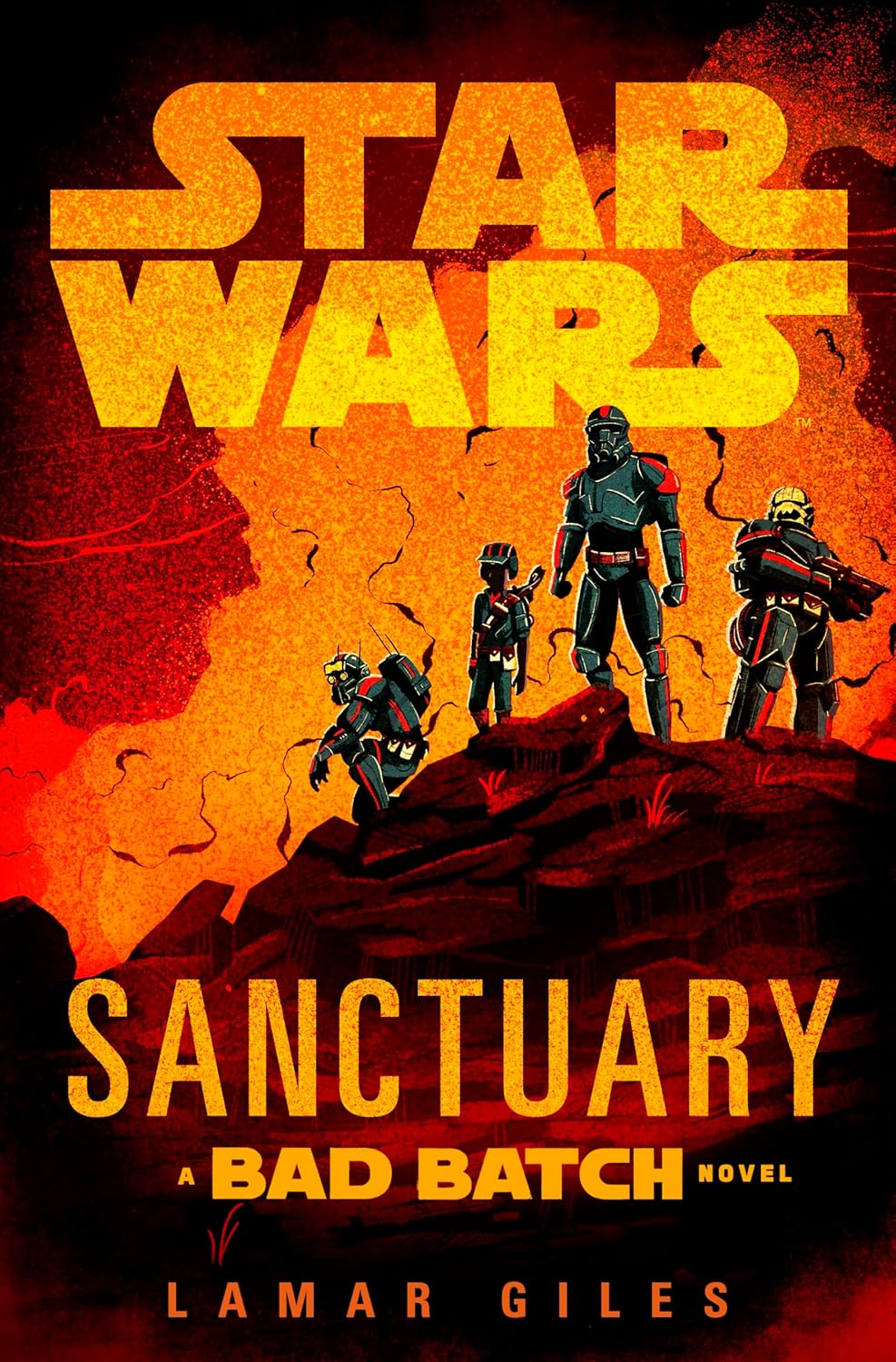
Star Wars: Sanctuary by Lamar Giles

Publisher: Random House Audio (Audiobook – 6 August 2025)

Series: Star Wars – The Bad Batch

Length: 11 hours and 46 minutes

My Rating: 4.75 out of 5 stars

Amazon

New Star Wars author Lamar Giles presents an epic and highly entertaining novel that follows everyone’s favourite group of rogue clones, with the Bad Batch focused novel, Sanctuary.

2025 has been an awesome year for Star Wars fiction.  Between the intense political novel, The Mask of Fear by Alexander Freed, and the upcoming Darth Vader-focused novel, Master of Evil by Adam Christopher, there are some interesting and heavy books coming out to further the lore of this iconic franchise.  However, there have also been some highly entertaining entries in this canon, including the fantastic novel Sanctuary.  Written by young adult fiction author Lamar Giles, Sanctuary is the author’s very first Star Wars novel, having previously written a short story in an anthology book.  A tie-in to The Bad Batch animated series, Sanctuary was an intriguing adult Star Wars novel that wasn’t originally on my reading radar.  However, in the mood for an audiobook from a familiar franchise, I decided to check it out, and boy was I glad that I did.

After turning on the Empire and deciding to live their own lives, the members of Experimental Clone Force 99, better known as the Bad Batch, are on the run, taking odd jobs and helping the innocents of the galaxy.  Made up of the grizzled Hunter, brilliant Tech, loveable powerhouse Wrecker and child prodigy Omega, the Bad Batch members have become an unlikely family.  However, after a series of dangerous missions, the members of the squad are tired, especially with their former comrades Echo and Crosshair on their own separate journeys. 

Needing a safe place to rest, the Bad Batch have found sanctuary on the planet of Pabu.  An idyllic settlement hidden from the eyes of the Empire, Pabu appears to be the perfect place for the clones to finally settle down and escape the constant battles.  However, before they can enjoy the peace of their new home, they’ll first have to help rebuild it.  With the settlement desperate for resources after a massive tidal wave, the members of the Bad Batch team up with pirate and self-proclaimed liberator of treasures, Phee Genoa, who promises an easy payday.

Hired to recover a valuable relic from an auction house, the crew’s ploy to steal it is quickly discovered, forcing them to revert to their usual fugitive ways.  However, their escape plan becomes complicated when Phee insists that they take on a second job, ferrying a mysterious couple to safe harbour.  Going against his better judgement, Hunter agrees to take on the passengers, but soon discovers that their new cargo has many secrets.  Forced to contend with an obsessive ISB agent and murderous tycoon with dangerous connections, the Bad Batch will risk it all for their new home.  But have they finally found an enemy too dangerous to defeat?

Sanctuary was an excellent and very entertaining Star Wars novel that proved a lot of fun to read.  Perfectly bringing the characters from The Bad Batch to life for an exciting new adventure, Sanctuary was an outstanding read that featured a compelling and action-packed story of love and life in the Star Wars universe.

Giles pulled together a captivating and very fitting narrative for Sanctuary, the serves as a great addition to The Bad Batch show, while also telling its own unique story.  Set towards the end of second season of the series, right after the events of the 13th episode, Pabu, Sanctuary is a fast-paced, character-driven story that takes the protagonists into the gritty underbelly of the Star Wars universe.  Starting with a very entertaining heist sequence, which goes about as well as any of the team’s plans, the titular Bad Batch and their pirate associate Phee Goena, escape with the loot, planning to sell it to a wealthy buyer.  At the same time, they take on two passengers, pregnant woman Keshiri Sohi and her masked partner Kuuto, who require smuggling across the galaxy.  Giles does a great job setting up all these initial story elements, and he quickly adds in some compelling complications that add some exciting drama to the narrative.  This includes a righteous ISB agent, Supervisor Sendril Crane, who is hunting their passengers, as well as the squad’s potential buyer, Cellia Moten, who would prefer to kill Phee Goena rather than pay her.

After an excellent shootout sequence halfway through the book where the protagonists are forced to simultaneously resist both Crane and Moten, the book slightly slows down as Giles works in some excellent story elements for both the protagonists and antagonists.  This includes growing drama between the Bad Batch and their passengers over their various secrets and lies, which also ties in nicely to internal conflicts amongst the team.  At the same time, Crane finds himself in the sinister orbit of the highly connected Cellia Moten, with the two trying to manipulate the other for their secrets and influence.  After a series of personal scenes for the protagonists that finally get them on the same page, Giles moves the story towards the end game, with the antagonists finding out where they are hiding.  This results in a series of awesome action sequences, with all the protagonists forced to fight to escape.  All the book’s characters, including its two villains, have their moment to shine here, and there are some powerful examinations of the relationship between new characters Crane and Sohi.  After some suitably climatic moments, the book ends on a high note that fans will really enjoy.  Giles also adds in an excellent cameo at the end that serves as a cathartic conclusion to another character’s story, and which I thought was a fitting and fun way to end the book.

I really enjoyed Giles’s writing style for Sanctuary, especially as he managed to achieve a lot in this novel.  Not only do we get a fantastic Bad Batch focused narrative loaded with action, adventure and other exciting Star Wars elements, but Giles also managed to include some powerful, personal moments, as various character dramas from both the show and this specific novel are played out.  The result was a slick and fast-paced novel that quickly draws the reader in with its easy humour and fun focus on The Bad Batch’s entertaining characters.  Thanks to some excellently timed shifts in character perspective, all the key members of Sanctuary’s cast have their moment to shine.  I particularly loved parts of the book that showcased the antagonist’s journey, which served as outstandingly entertaining contrast to some of the more character-driven chapters around the protagonists.  The combination of intrigue and Imperial politics in these scenes, as well as the mind games between to delightfully devious villains, was a true highlight of the book, and it allowed Giles to up the stakes of the plot, especially when it starts diving into some deeper Star Wars elements with some excellent references.

As a fan of The Bad Batch animated series I personally really enjoyed Sanctuary as Giles perfectly captured the tone and humour of the show.  Working as a great tie-in, Sanctuary fills in some interesting gaps between two of the show’s episodes, and the author does an excellent job of examining some of the issues the characters are facing during this period.  While naturally geared towards those familiar with The Bad Batch, Giles ensures that Sanctuary isn’t too show-lore dependent, and most general Star Wars fans will be able to read this book and have a great time.  Indeed, those unfamiliar with the animated series get a good glimpse at the humour and character dynamics in this novel, and it could serve as a good entry point to show.  Even if they don’t, the author also adds in a bunch of references that anyone familiar with Star Wars will be able to appreciate.  I felt that Giles did an excellent job exploring the period the novel is set in, the early days of the Empire a couple of years after the events of Revenge of the Sith, which is one of the more fascinating times in the franchise’s lore, and it was interesting to see how some of the new characters fit into this time.  As such, Sanctuary is going to appeal to a wide range of readers, and it’s a great read for fans of the Star Wars extended universe.

I have already mentioned a few times the excellent character work in Sanctuary as Giles features a great cast for this book.  Naturally for a Bad Batch book, the titular cast get much of the focus in Sanctuary, with excellent portrayals of Hunter, Tech, Wrecker and Omega.  Giles expertly captures their personalities from the show and reproduces them in Sanctuary.  As such, you are given some very interesting insights into the minds of each of these characters at this point in the series, with a particular focus on each clone’s glance towards the future and what they want out of life.  While there are some interesting alternating characters here amongst the cast, including Omega trying to become more independent, Tech’s unlikely romance with Phee, and Wrecker’s simple desire to blow things up, much of the character development for the main cast revolves around Hunter.  Giles spends a large amount of time diving into Hunter’s issues with losing control and no longer being a soldier, as well as some of the resentment he has from Crosshair’s abandonment of the squad.  This results in several fractious family moments, especially as Hunter’s caution tends to put him at odds with the rest of the team’s desires, and his distrust of Phee and their new passengers causes some noticeable friction.  These character dramas are a compelling part of the book’s overall plot, although Giles also does a good job of showcasing the more happy-family version of the Bad Batch, which fans of the show will appreciate, considering we all know what’s coming in a few episodes time.  That being said, I’m not sure I can forgive Giles for his line about Tech’s grapnel gun never failing him.

Aside from the titular Bad Batch, Giles features several additional outstanding characters, including returning show favourite Phee Genoa.  A free-spirited pirate and treasure hunter, Phee was a breath of fresh air amongst the stuffier clone soldier protagonists, and it was entertaining to see the unique interactions she had with the other characters.  Her antagonism of the rigid Hunter was particularly fun, especially as it brought up some much-needed drama, however, it was her relationship with Tech that was a true highlight of the book.  Giles did a good expanding on the feelings hinted at in the show, and they proved to be a very distinctive couple as a result.  I felt this gave some of the upcoming events of the animated series a little bit more of a tragic air, as you try to imagine what could be, and you end up liking them in a very bittersweet way.  The main cast of protagonists were well rounded out by new figures Keshiri Sohi and the masked Kuuto.  Mysterious passengers with secret pasts who cause all manner of trouble for the main cast, Sohi and Kuuto spend much of the book seemingly untrustworthy with their own agendas.  However, thanks to some excellent reveals, as well as a couple of good flashbacks, you grow to understand the complexity around their actions, and they proved to be a compelling addition to the cast as a result.

While I really enjoyed the protagonists, I felt they somewhat got overshadowed by the book’s impressive antagonists.  This includes ISB Supervisor Sendril Crane, a diligent and intense figure on the heels of Sohi and Kuuto.  Crane has a brilliant introduction in this book, which shows off his intelligence and ruthlessness, and he only gets better from there as you come to understand his background as a spy and his obsession with Sohi.  While Crane proves to be a ruthless adversary, he is well matched by Sanctuary’s other main antagonist, Cellia Morten.  An ultra-rich, politically connected tycoon with a penchant for murder, Morten is shown to be an outstandingly deranged figure early on, and she swifty amps up her evilness as the book continues.  Giles does an exceptional job sculpting Morten into the very worst rich villain he could, especially once her motivations for killing are revealed, and it was very fun for to eventual face reality on the real power structure in the galaxy.  While both serve as great antagonists to the main cast, the real beauty of these villainous characters occurs when they interact with each other, which results in a series of manipulative conversations which are thoroughly entertaining.  I particularly enjoyed how Morten continuously got the better of the normally unflappable Crane, especially in their first meeting when she gets out being arrested by asking if he had been sent by her good friend Sheev, with her use of namedropping and connections only getting better from there.  These two antagonists played off each other perfectly, and their battle of wits and cruelty, was even more entertaining than their hunt for the protagonists.  All these great characters added so much to my enjoyment of Sanctuary, and I loved the amazing arcs and interactions that emerged.

Naturally, I ended up listening to Sanctuary on audiobook, rather than seeking out a physical copy, as the audiobook format is the absolute best way to enjoy a Star Wars novel.  I love how incredible a Star Wars novel can sound when read out, and this was particularly true with Sanctuary, as all the awesome action and great characters were so much more impactful and fun in this format.  A lot of this is due to the narration of Marc Thompson, who does an exceptional job voicing all the characters and bringing the entire book to life.  Thompson, who is one of my favourite audiobook narrators, has long been one of the top narrators of Star Wars fiction thanks to his brilliant vocal talents and ability to impersonate various characters from the shows (see my previous reviews of Thrawn and Scoundrels by Timothy Zahn and Dark Disciple by Christie Golden).  His skill was on full display in Sanctuary, especially as he perfectly voiced Hunter, Tech and Wrecker throughout this novel, as well as several other characters from the show.  I was honestly so impressed by how he managed to accurately he was able to voice the three main clones from the show, with each of their distinctive but similar voices, coming across so damn close to their voice actor in the show, Dee Bradley Baker.  At the same time, he also does a good take on Wanda Sykes’s character Phee Genoa, and even does a passible voice for Omega, which includes the New Zealand accent of actress Michelle Ang. 

Thompson’s outstanding narration is further enhanced by the fantastic inclusion of Star Wars sound effects and music, which is an outstanding part of all Star Wars audiobooks.  The entire story really comes to life when you can hear crowd sounds and blaster fire amongst the dialogue, while the iconic Star Wars music makes several scenes just a little more epic, especially when they help remind you of moments from the films.  These extra audio inclusions pair perfectly with Thompson’s narration, and it honestly felt like you were listening to an episode of The Bad Batch with this audiobook.  I really enjoyed this full listening experience, and I ended up powering through Sanctuary’s near 12-hour long runtime in no time at all.  This was such a great listen, and this was honestly one of the better audiobooks I had the pleasure of listening to in 2025.

With a brilliant story, fun characters and a ton of action, Lamar Giles’ Star Wars novel, Sanctuary, was an outstanding hit.  An excellent tie-in novel that follows the entertaining characters from The Bad Batch animated series, Sanctuary was an impressive and exciting novel that had me hooked very early on.  A deeply compelling and addictive read, Sanctuary comes very highly recommended, especially on audiobook, and all Star Wars fans are going to have a great time with this awesome read.

Amazon

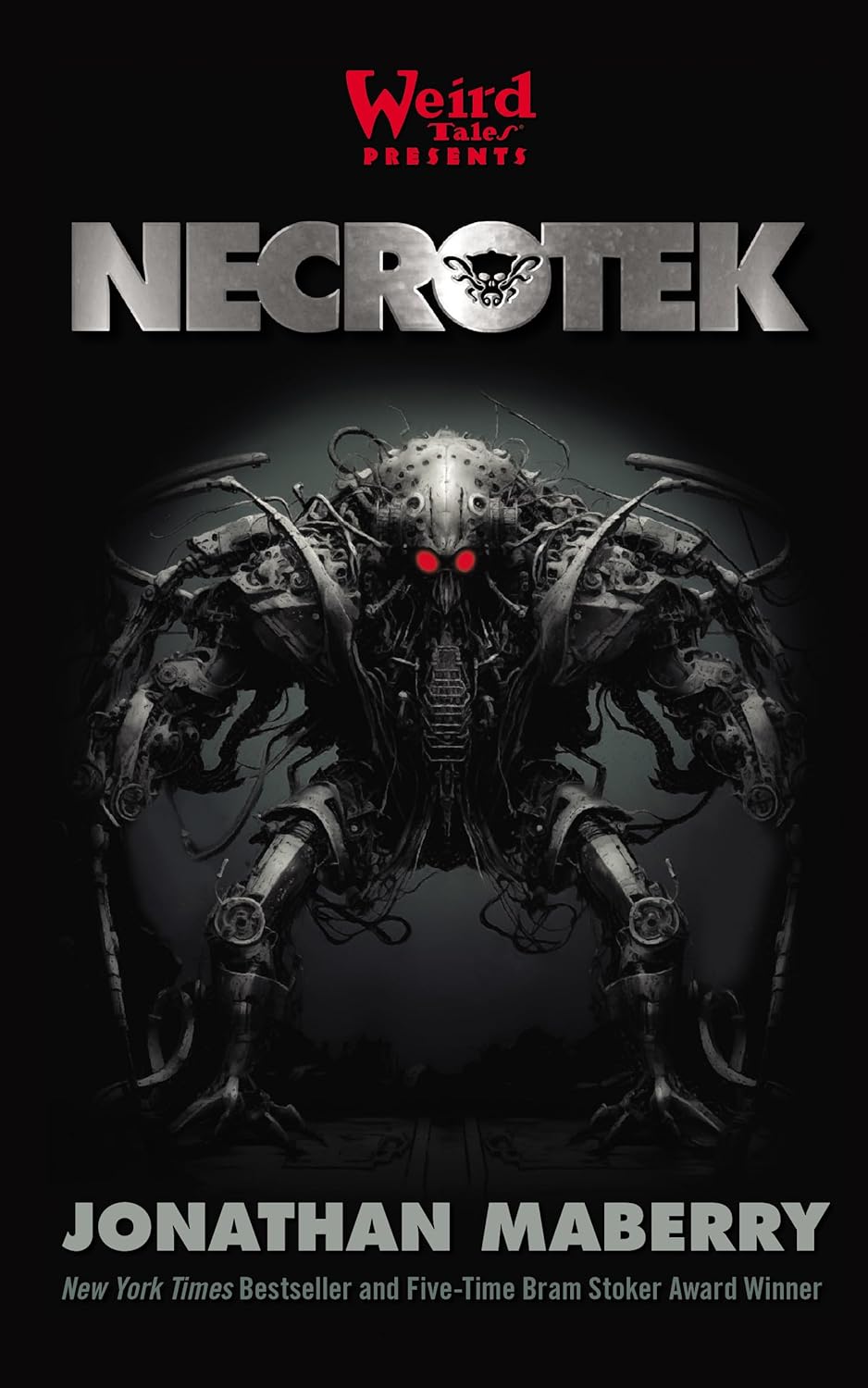
NecroTek by Jonathan Maberry

Publisher: Blackstone Audio (Audiobook – 28 May 2025)

Series: NecroTek – Book One

Length: 15 hours and 24 minutes

My Rating: 5 out of 5 stars

Amazon

One of the leading authors of action-packed fiction, Jonathan Maberry, dives headfirst into the science fiction genre with the unique read NecroTek, a remarkable Lovecraftian adventure in space that takes readers to some very dark places.

Readers of this blog will know that I have long been a fan of compelling author Jonathan Maberry, who has been impressing me with his elaborate, grim and varied book for years.  A long-time writer of horror-filled fiction across the genres, Maberry has multiple books and series under his belt, and I have had the great pleasure of reading a large portion of his existing works.  His main body of fiction is his Joe Ledger thriller series, which follows a tortured protagonist as he attempts to stop an array of dark technological threats assailing the modern world.  This series, which includes great books like Patient Zero, Assassin’s Code, Predator One and Dogs of War, as well as the Rogue Team International sequel series (Rage, Relentless and Cave 13), proved to be a great introduction to the author for me, and my appreciation for him grew after reading his Kagen the Damned dark fantasy series.  Made up of Kagen the Damned (one of my favourite books and audiobooks of 2022), Son of the Poison Rose (one of my favourite books and audiobooks of 2023), and The Dragon in Winter (which I am currently reading now), the Kagen the Damned books saw the author bring his distinctive style to the world of dark fantasy in a big way, and I loved the end result.

Due to how much I love Maberry’s captivating and enthralling novels, I always instantly grab anything new the author writes, and this includes his first release of 2024, NectroTek.  While his Joe Ledger books often feature strong science fiction elements in their thriller narratives, NecroTek was the first pure science fiction novel from the author, and I felt that he did an outstanding job applying his style and love for old-school horror into this new genre.  Released under the banner of the iconic Weird Tales horror magazine, NecroTek was one of my most anticipated releases of 2024, and it did not disappoint.


Plot Synopsis:

From New York Times bestselling author Jonathan Maberry, NecroTek is a gripping sci-fi thriller full of ghosts, gods, and a battle for the soul of humanity.

Neither cosmic philosopher Lars Soren, hotshot pilot Bianca Petrescu, nor the high priestess Jessica McHugh–Lady Death herself–can say quite where in the galaxy they are. But after an experiment gone horribly wrong, one thing is clear: Asphodel Station isn’t in orbit around Jupiter any longer. Worse, the monsters that live out here–ancient eldritch beings thought only to exist in stories and nightmares–have now been alerted to Earth’s existence.

Their army of Shoggoths is coming for us next.

Humanity’s only hope for survival lies on the surface of the alien world of Shadderal, where a ghost named Lost, the last of an ancient race, still haunts the vast plains of the Field of Dead Birds. But hope has a cost. Lost tells Soren about ancient derelict spacecraft awaiting on Shadderal, shapeshifting machines that blend ultra-advanced technology with the dark powers of necromancy. These ships might just be nimble enough to defend mankind against the coming invasion.

But there’s a catch: they can only be piloted by the dead.

As human starfighters fall in battle, their spirits can be called back from death to pilot these ghost ships of a fallen race. But will this new necromantic technology–NecroTek–allow humanity to stand against the vast armies of the Shoggoths? And even if it can, is the war to save the human race worth the cost of its pilots’ immortal souls?


What another brilliant read from Jonathan Maberry!  NecroTek was an outstanding and captivating novel that I unsurprisingly loved thanks to its elaborate and ambitious narrative, loaded with horror, carnage and a distinctive tale of survival against the odds.  Moving, powerful and highly emotional, NecroTek was such an epic and captivating novel, and I must give it a full five-star rating as a result.

Maberry produces another complex, detailed and powerfully dark narrative for NecroTek that is part science fiction, part horror, and all excitement.  Starting off just in advance of the events that will set the story in motion, Maberry does a great job of opening the book up and quickly setting the scene for the reader.  The start of a new series unconnected from his previous works (for now), this is one of the easier Maberry novels to break into, and you are soon invested in the tale of scientific exploration.  However, things change quickly once the teleportation experiment fails, and as this is Maberry, when things go wrong, they go wrong in a big and gruesome way.  The author really leans into his love of horror during these opening moments, and there are some shocking depictions of the side effects of the jump through space, as well as the terrifying things waiting for the survivors on the other side.  Maberry revels in featuring powerful depictions of terror and craziness here and it makes for a brilliant and often disturbing first part of the book.

After this horrifying start to the novel, NecroTek becomes more of a science fiction tale, although Maberry quickly infects it with his beloved Lovecraftian elements, as the protagonists soon discover that they have been discovered by Shoggoths above a mysterious planet.  This allows for some fantastic moments, as the humans attempt to defeat this new alien foe with their existing ships, while continuing to dive into the complex science and philosophy surrounding their circumstances.  This middle section of the book moves at a swift pace, and the readers are treated to some excellent battle sequences in space, as well as the character’s continued uncertainty as they try to understand the outrageous situation they have found themselves in.  Maberry does a great job setting down the required Lovecraftian lore and bringing key parts of the plot to light during this part of the book, and readers easily become absorbed in his compelling ideas, especially when they are coated in a combination of adventure, horror and intriguing characters.

Everything leads up perfectly to the final third of NecroTek, which sees the protagonists desperate to defend both the station, and the important planet they hover above.  Faced with attacks on multiple fronts and so many tragedies, the protagonists are forced to rely on a new ally and the titular NecroTek to face off against the Shoggoth fleet.  Maberry keeps the tension riding high for this final part of the book, and you are constantly on the edge of your seat as several simultaneous battles rage around the reader, often fought in some extremely epic ways.  There is some captivating tragedy, deeply moving moments of sacrifice, and elaborate dives into the human psyche as everything comes together, and you will be left dazed and moved by everything that unfolds.  An overall exceptional and unique story, NecroTek was so much fun, and I liked the potential for story continuation that exists at the end of the novel.

Maberry has a very distinctive writing style that he utilises in all his novels, no matter the genre, and which always results in an awesome and complex read.  Featuring a huge number of short and sharp perspective chapters that constantly jump between the key characters, as well as a few shots of the antagonists and other mysterious creatures, you get a layered story that shows so many complex actions at the same time.  This style works extremely well in this science fiction adventure, and I loved the elaborate ways he showcased the dark events occurring around the station, whether you get the experiences of the recurring characters, or one-off chapters that shows what happened to specific characters before they die.  These chapters deeply enhance the horror vibes in the book, which keep you on your toes and provides an overarching sense of threat and danger that really makes you concerned for the protagonists.  This cool horror vibe blends well with the extremely detailed science fiction setting and storyline, to create a particularly striking read that really stuck with me, especially as the author also dives into Lovecraftian elements which work nicely into Maberry’s distinctive tone.  As with most of Maberry’s work, NecroTek does get incredibly dark and disturbing at times, which may not appeal to every reader, especially when it comes to some of the more distressing occurrences.  However, Maberry channels this darkness extremely well into the plot and the various action sequences of the book, producing a rafter of ultra-exciting scenes that really stick in the mind.  I personally felt his various space-combat sequences were extremely good, and I loved how effectively he showcased the intricate nature of the battles, even when things get extreme with the inclusion of ghost-powered battle mechs. 

As with all Jonathan Maberry novels, the true power and heart of NecroTek lies in its many impressive and complex characters, who the author utilises to tell a particularly powerful and layered story.  Maberry has a real gift for producing compelling, damaged, and often highly over-the top characters for his various series, and NecroTek is no different as he introduces a range of figures whose unique perspectives shape and power the story.  While NecroTek lacks the full-on antagonist’s perspective that usually make his novels so effective (due to the enemies being unknowable aliens), you get a great spread of alternating perspectives and thoughts throughout NecroTek, as well as the powerful emotions behind them.  These emotions are greatly enhanced by the fact that all the human characters within NecroTek are disorientated or damaged by the earlier events of the plot, and watching them overcome their rage, fear or despair, really amps up the feeling of the unknown and the complex emotions that swirl around the plot.

While there are many characters featured within NecroTek, Maberry does focus the plot on a few key protagonists whose stories get a bit more attention.  This includes cosmic philosopher Lars Soren, who serves as one of the main explorers of the new world and the voice of calm reason amongst the protagonists.  I liked how effectively Maberry utilised a scholar protagonist for much of this novel, and it allowed for a much more thoughtful narrative at times.  Of course, as this is Maberry, there needs to be a militant main protagonist as well, and that role was filled ably by military pilot Bianca Petrescu.  A confident and skilled pilot, Bianca worked as a great partner to Soren throughout much of the adventure, and I liked the contrast in their styles and actions.  Bianca also works well as part of the fighter group, known as the Lost Souls, who work to defend the station from the Shoggoth fleet.  Acting like an extended family, the Lost Souls are a vital part of the book’s plot, especially as their eventual, many-layered sacrifice, results in some of the most emotionally charged scenes in the book, which is further enhanced by how much you have come to care for the whole group.  Throw in an actual necromancer and an ancient alien whose guilt-ridden ghost provides aid to the protagonists whilst also damning them, and the cast of NecroTek was extremely strong.  I really enjoyed the elaborate narrative threads that emerged around these figures, and it led to a very powerful and intense read.

As with most of the Jonathan Maberry novels, I chose to enjoy NecroTek on audiobook, which is easily the best way to enjoy one of the author’s elaborate and powerful novels.  Maberry’s distinctive writing style of constantly shifting characters, loaded action, and horrifying elements really comes across when read out and I honestly believe that this is the best way to enjoy one of author’s books.  A lot of this is due to the continued use of long-term Maberry collaborator Ray Porter, who has lent his voice to most of Maberry’s compelling audiobooks.  One of my favourite audiobook narrators, Ray Porter has an outstanding voice that expertly moves Maberry’s complex and addictive narrative around at a fast and effective pace.  Porter’s ability to instil emotion, intensity and often scary tones into his narration is extremely epic, and he can ensure that readers are always on the edge of their seats as they wait for more action or horror to emerge.  Porter also has a great range of different awesome voices that seem to always perfectly fit the character they are assigned to, and I love the fun and entertaining tones that convey so much of fear, feelings and deeper emotional state.  Coming in with an overall run time of 15 hours and 24 minutes, this is a long audiobook, although it proves easy to power through it quickly, especially in the action-heavy second half.  As such, the NecroTek audiobook version comes highly recommended, and you will not be disappointed when you listen to it.

Jonathan Maberry once again deeply impresses me with his elaborate and addictively dark science fiction read, NecroTek.  A very distinctive Maberry creation, NecroTek features a brilliant story that brings together cool new science fiction elements with the author’s love for all thing Lovecraftian into a brutal and captivating read.  Fast paced and loaded with complex characters, fantastic action, and some truly epic sequences, NecroTek was such a great read from Maberry and comes highly recommended.  I look forward to seeing how Maberry continues the series in the future, especially as a sequel, Cold War, is apparently set for release in 2025.

Amazon

Warhammer 40,000: The Fall of Cadia by Robert Rath

Warhammer 40,000 - The Fall of Cadia Cover

Publisher: Black Library (Audiobook – 5 August 2023)

Series: Warhammer 40,000

Length: 19 hours and 42 minutes

My Rating: 5 out of 5 stars

Amazon

Cadia Stands!  I ended 2023 on a very high note with one of the best Warhammer 40,000 novels of the year that follows one of the biggest events in the franchise’s recent lore, The Fall of Cadia by Robert Rath.

There were several amazing Warhammer 40,000 novels released in 2023, with some of my favourites including The Lion: Son of the Forest and Warboss by Mike Brooks, The King of the Spoil by Jonathan D. Beer and Cypher: Lord of the Fallen by John French, just to name a few.  However, in terms of sheer scale, epic battles, and larger-than-life characters, my favourite will have to be The Fall of Cadia.  As the name suggests, The Fall of Cadia follows the final battle for the planet of Cadia at the end of the 13th Black Crusade, which was a major campaign in the Warhammer 40,000 tabletop game.  The original 13th Black Crusade campaign happened back in 2003, with the official result being something of a draw.  However, in 2017, Games Workshop retconned the campaign to result in a much more substantial Chaos victory, which ended up having substantial impacts on the wider lore of the franchise, effectively reshaping the entire Warhammer 40,000 universe.

This change ended up being a pretty significant event, and Games Workshop provided some major write-ups about it that summarised the events and their explosive aftermath.  Indeed, the lore events initiated in this event have already been featured in several novels, and most of the current Warhammer 40,000 fiction examines the consequences of this campaign.  However, there has yet to be a novel solely dedicated to trying to capture the entirety of the action at the end, until now with The Fall of Cadia by Robert Rath.  Rath was a great choice of author to write this book as he is a truly amazing author of Warhammer 40,000 fiction.  His previous novels, Assassinorum: Kingmaker (one of my favourite books and audiobooks of 2022) and The Infinite and the Divine, have both been exceptional five-star reads, telling elaborate, character-driven stories that cleverly capture complex aspects of Warhammer 40,000 lore and turn them into impressive and addictive reads.  As such, he was the perfect choice to write The Fall of Cadia and he succeeded in creating a deeply moving and epic novel that perfectly brought the chaotic events that ended this infamous war to life.

In the far future of the 41st Millenium, few battlefields are more significant or more soaked in blood than that of Cadia.  A fortress world for the Imperium of Man, Cadia stands in the shadow of the Eye of Terror, a blazing rift that serves as a gateway into the Warp and the realm of the Chaos gods.  For any substantial invasion by the forces of Chaos into the Imperium to be successful, Cadia needs to be taken and destroyed, and for that task the Chaos Gods have chosen the Warmaster of the Black Legion, Abaddon the Despoiler.  Abaddon is a legendary warrior of hatred and spite who alone is capable of welding together the unruly and contentious forces of Chaos.  Over the millennia, Abaddon has launched 12 Black Crusades against Cadia, leading an unholy alliance of monsters, daemons, cultists and traitor Space Marines to battle.  However, each time Cadia has held, at great cost to the desperate Imperial defenders.  But now, as the forces of Chaos appear stronger than ever before, a 13th Black Crusade has been declared, one that looks set to destroy Cadia forever.

The Fall of Cadia starts well into the 13th Black Crusade, as, after weeks of heavy fighting, the forces of Cadia and humanity once again appear victorious, with the armies of Chaos retreating on all fronts.  However, despite the apparent victory over the heretics and the dark gods of Chaos, Lord Castellan Ursarkar Creed is uneasy, believing that the victory was too easy.  As the celebrations continue, Creed is soon proved right, as the Eye of Terror disgorges a new enemy force unmatched in size and deadly potential since the legendary Horus Heresy.

At its head flies a dread Blackstone Fortress, an alien superweapon capable of intense destruction and now crewed personally by Abaddon.  Faced with this threat, Creed attempts to bring together the various elements of humanities defenders, including legendary Space Marines, virtuous Sisters of Battle, the inhuman soldiers of the Adeptus Mechanicus, and the outmatched by steely rank-and-file troops of Cadia, determined to save their home.

As the final invasion of Cadia begins, Creed organises the defence the best he can to hold back the oncoming horde on land, in the sky, in space, and even far behind Cadian lines in their seemingly safe cities.  If Creed has any hope of succeeding, he will need to bring together the scattered armies of the Imperium on Cadia into a single cohesive force, but not all of the defenders are fighting for the same goals.  Even if these armies come together, can the legendary Creed hold off the fury of Abaddon and his dark gods?  Cadia’s last stand has begun, but who will be left alive at its end?

Robert Rath continues to showcase just how varied and impressive his talent for writing Warhammer 40,000 fiction is as he captures the incredible events of the last siege of Cadia.  The Fall of Cadia is epic in every way possible, as it presents the reader with a great coverage of these key lore events and the characters involved.  Elaborate, intense, and featuring so much damn carnage and war, The Fall of Cadia is an incredibly addictive read that got a very easy five-star rating from me.

I think it is important to point out that Robert Rath had a difficult task ahead of him when he was chosen to novelise the events surrounding the end of the 13th Black Crusade.  A lot of detailed lore has been written around this event, not only in the various guides, rulebooks and other material associated with the tabletop game but also in several years worth of novels and extended fiction that focused on the aftermath of the war.  Any novelisation about these events ran the risk of being a stale retelling of events that all Warhammer 40,000 fans already know about.  However, Rath rose to the challenge and presented a powerful, intense and memorable depiction of the events that really drags the readers in while showing just how incredible and epic a piece of Warhammer fiction can be.

To tell the events of The Fall of Cadia, Rath elected to cover everything in a massive, multilayered, character-driven narrative, told from every perspective imaginable.  Starting towards the final days of the battle, when Abaddon unleashes his true invasion of Cadia, the reader is soon engrossed a range of different storylines that cover many different angles of the battle.  Not only do we get to see the overall strategy of both sides but the reader is also thrust into personal wars and fights across the theatre.  So many amazing moments are covered, including a desperate last stand in the mountains, battles in the sky and space, Chaos infiltration in the cities, criminal enterprises, even internal dissension amongst the Chaos command.  These scenes are usually shown through the eyes of a complex characters, whose desperate fight for Cadia helps to define them and presents the reader with some impressive and captivating character arcs.  All these varied conflicts are expertly portrayed by Rath, who does a wonderful job capturing the intensity, brutality and lack of humanity involved in warfare, as his characters suffer on every battlefield imaginable.  The sheer epic and destructive nature of these conflicts really come across in Rath’s writing style, and I honestly visualised many of the scenes being described in cinematic detail in my head.

The first half of the book primarily focuses on these various scattered storylines, and it was a lot of fun to see the different theatres of war, especially as you start to get attached to the major characters.  All the battles featured are pretty awesome and intense in their own way, and I really have to emphasise just how skilled Rath is at bringing all the different elaborate bits of combat to life.  The complex story pieces start to come together in the second half, especially as each of the characters find themselves drawn to the same battlefields.  I really appreciated how the storylines tied together, and there are some brilliant moments featured here.  I also felt that the multiple deus ex machina moments towards the conclusion of a big battle sequence that Rath needed to include because they were part of the lore was handled about as well as they could be.  Rath did some good set-up for the most important of them earlier in the plot, and I liked how in many instances he tried to examine it from the perspective of the common soldier looking for miracles, so it often did not seem too ridiculous.

Everything leads up to the big final battle in the last third of the novel, and despite knowing how it was going to end, I still was extremely invested in the plot and eager to see how everything came about.  A lot of this was because I deeply enjoyed the compelling character arcs of the newer protagonists, but I was also very interested in seeing how Rath envisioned some of the more essential events.  The author really did not disappoint, as these epic and groundbreaking moments were expertly showcased to the reader in a powerful and captivating way.  The big deaths were pretty shocking and hurtful, especially if you did not know they were coming, and the major conflicts were so damn epic in their scope and impact.  The final devastating blows of the war really hit hard, especially as the climatic events featured some deeply personal moments alongside the mass devastation, which made everything that much more powerful.  I really loved how everything came together, and the poetic conclusion that highlighted the final fights of the surviving protagonists is going to stay with me for some time.  I am so damn impressed with how much passion and emotion that Rath was able to stick into this massive war story, and I honestly loved every single second spent reading The Fall of Cadia.

In addition to the amazing story, I really need to highlight the impressive array of characters featured throughout The Fall of Cadia.  Rath did a wonderful job of presenting the massive events of this book through a range of intriguing character perspectives on every side of the conflict, and there is a fantastic combination of new characters and established Warhammer 40,000 figures.  The author really tried to cover The Fall of Cadia’s narrative from every single angle he possibly could, and the resulting combination of generals, common soldiers, legendary warriors, ancient traitors and other interested onlookers, helped to make this Warhammer 40,000 story even more powerful and layered.  This includes several Chaos characters, whose tainted perspectives allow for a compelling view of both sides of the conflict.  The Fall of Cadia’s character arcs are mostly self-contained for the majority of the book, with their focus usually on that particular figure or theatre of the war.  However, there are some clever and moving interactions between the characters as the novel continues, and it is testament to Rath’s writing style and ability to create a massive web of overlaying character storylines that these interactions fit together so well into a cohesive and powerful narrative.  Rath really dove into the complex lives and personalities of every character he featured, even those that died quite quickly, and the resulting character arcs really added to the emotional impact of The Fall of Cadia.  You become heavily invested in these characters as a result, and waiting to see who survives the war is an important part of experiencing this novel.

So many big personalities were expertly featured throughout The Fall of Cadia and every reader is going to come away with their own favourites.  The better character arcs I personally loved included that of Major Marda Hellsker, who is forced to lead a desperate last stand for much of the book and grows into the leadership position thrust upon her.  Captain Hanna Keztral’s exploits in the sky also make for great reading, especially as she desperately tries to gain respect whilst flying an unarmed aircraft.  You also have to love the storylines surrounding Salvar Ghent, Cadia’s premier gangster, as he tries to exploit the war to his advantage before finding himself thrust into a much more prominent role.  I particularly loved how well Ghent interacted with some of the major figures in the book, and his entire storyline was one of the most entertaining.  The insatiable Necron collector Trazyn the Infinite was also a great inclusion in the plot, and Rath clearly had fun bringing back this hilarious character after featuring him so heavily in The Infinite and the Divine, and I got a good laugh at several of his pivotal scenes and petty moments.

However, the best characters in The Fall of Cadia had to be the opposing leaders of the war, Lord Castellan Ursarkar Creed and Abaddon the Despoiler.  Both are major figures in Warhammer 40,000 lore and Rath ensured that they were done justice in this novel.  Creed is shown to be a rough but brilliant commander, capable of inspiring an entire world while also suffering from the stresses of constantly being on the losing side.  I particularly enjoyed the subsequent inclusion of Colour Sergeant Jarran Kell alongside Creed as his long-suffering aide and best friend, and the two make for a very powerful character combination for many of the scenes shown from the defenders’ perspective.  Abaddon on the other hand is presented as the absolute beast that he is, and his obsessive desire to destroy Cadia is palpable.  I deeply appreciated that Rath showcased Abaddon as the ultimate villain in this universe, and his appearances were always exceedingly impactful.  Many of Abaddon’s appearances were cleverly shown through the eyes of his loyal servant, Dravura Morkath, whose rose-tinted opinions of her master barely covered the restrained evil within this figure.  I quite enjoyed Dravura as a character, especially as she has the most intriguing insights into the Chaos ranks, and the resolution of her storyline with Abaddon might be one of the most heartbreaking in the entire book.  These characters, and so much more, were such a brilliant part of The Fall of Cadia, and they helped turn what could have been a simple retelling of the lore into a particularly powerful and moving novel.

As with most Warhammer 40,000 novels, I feel that The Fall of Cadia is going to appeal to those fans of the franchise who already have a grip on the basics of the lore and main characters and can fully appreciate just how massive an event this book was.  Due to the material the book is based on, there were a lot of crazy events and characters featured here, some of which would be obscure even to casual fans of the game.  While Rath does an outstanding job of explaining and exploring the most important of these elements, some readers might occasionally be confused at what is going on or how certain characters came into being.  Still, I feel that most new readers can still have an exceptional time with this book, especially as the epic battles, impressive characters, and heartfelt military focused story, is so damn good.  The Fall of Cadia might even be a great gateway novel for those people trying to get into Warhammer 40,000 fiction, and it sure as hell encouraged me to read more Warhammer fiction.

One of the other things that I really appreciated about The Fall of Cadia was the way that Rath tried to paint a more nuanced picture of the planet of Cadia itself.  Cadia is usually portrayed as a bastion of military prowess and resistance without some of the issues other planets in the Imperium had, so it was quite interesting to see Rath’s different take on the subject, showing Cadia to be a planet with hidden issues and dissent.  In particular, Rath examines the problematic social structure of Cadia, where the active military are notably prioritized and those people who could not fight or be assigned other roles were considered a second-class citizen.  I loved how well Rath examined and focused on the issues surrounding this unique military class system, and it became a surprising key part of the book.  Indeed, the motivations of several characters are highly tied into these issues, with many seeking to prove themselves after being considered lesser for their contributions.  It also serves as an intriguing motivation for several antagonistic figures, and I loved just how well Rath was able to weave the structure of a planet into these intriguing character traits.  This, and more, really showcased Rath’s inventiveness and appreciation for the little details of the Warhammer 40,000 universe, and it is one of the reasons why I really enjoy his novels.

As with most Warhammer 40,000 novels, I chose to enjoy The Fall of Cadia on audiobook, which proved to be a very smart decision on my behalf as it was one of my favourite audiobooks of the year.  Coming in with a runtime of just under 20 hours, The Fall of Cadia is a bit longer than your typical Warhammer 40,000 audiobook, which reflects the massive story Rath came up with for this epic read.  I really loved how well this audiobook format brought the epic nature of this narrative to life and the many battles, wars, and unique characters felt even more impressive when read out.  I enjoyed the narration of Mark Elstob, who has previously lent his voice to other great Warhammer audiobooks, including Kal Jerico: Sinner’s Bounty by Josh Reynolds.  Elstob’s narration of The Fall of Cadia is extremely good, and I loved how passionately he presented every big event and piece of action.  I really enjoyed some of the great voices he came up with for the cast of The Fall of Cadia, and every larger-than-life character was gifted a fitting tone that perfectly captured their personalities and intensity.  His voices for the opposing leaders of the battle, Abaddon the Despoiler and Ursarkar Creed, are amazing examples of this, and you really get awesome impressions of both character’s opposing determination and charisma in some outstanding sequences.  I really cannot emphasise just how incredible this audiobook version of The Fall of Cadia is and it is definitely the best way to enjoy this world-shattering story.

Overall, The Fall of Cadia is a pretty exceptional piece of Warhammer 40,000 fiction that did such an impressive job of capturing this intriguing event from the game’s substantial lore.  Robert Rath is such an impressive author, and I am really glad he had the opportunity to cut loose and present this massive inclusion to the Warhammer 40,000 franchise.  The Fall of Cadia is easily one of my favourite books of 2023, and I loved how Rath told such an epic war tale in such a powerful and memorable way.  I honestly hope they make a movie based around this book in the future, because it would be so damn spectacular.  A highly recommended read that no Warhammer 40,000 fan should be without.

Amazon

Warhammer 40,000: Leviathan by Darius Hinks

Warhammer 40,000 - Leviathan Cover

Publisher: Black Library (Audiobook – 24 June 2023)

Series: Warhammer 40,000

Length: 12 hours and 13 minutes

My Rating: 4.5 out of 5 stars

Amazon

Prepare for all-out war as the righteous Ultramarines battle the insidious Tyranids in this epic new Warhammer 40,000 novel from Darius Hinks, Leviathan.

It has been a pretty good year for Warhammer 40,000 fiction already, with several fantastic novels coming out in 2023, including Warboss and The Lion: Son of the Forest by Mike Brooks (the latter being one of my favourite books from the first half of 2023), and Shadowsun: The Patient Hunter by Phil Kelly.  However, the hits are far from over, especially as there are several fantastic new Warhammer 40,000 novels set to come out later this year.  But before we get to those, I managed to jump onto another recent release with the outstanding novel Leviathan, written by established Warhammer author Darius Hinks.  Hinks was a new author to me, but I soon grew to appreciate his latest book, especially as it showcased a dark and intense alien invasion that made for a great story.

In the far future of the 41st millennium, the besieged Imperium of Man faces many threats, but few are more deadly, unstoppable, or insidious as the unrelenting and seemingly endless hordes of the Tyranids, an alien race determined to devour everything it encounters.  While several of the larger invading Tyranid fleets have been destroyed, a splinter tendril is making its way towards the galactic centre, threatening the very heart of the Imperium.

Standing in the way of this fleet is the fortress world of Regium, an ancient planet recently taken over by Imperial forces, it now serves as a bulwark against invasions heading towards the inner-Imperium.  Many believe that Regium is secure from all threats, but when the people of the planet are haunted by parasites, strange cults, and mysterious dreams of terrifying monsters, it soon becomes clear that a Tyranid swarm is about to descend upon them.

It falls to the decorated hero, Lieutenant Castamon of the Ultramarines, to hold Regium against the foes and keep the rest of the Imperium safe.  A veteran of many battles, Castamon believes that this new Tyranid fleet will be swiftly destroyed.  However, these Tyranids are led by something far more sinister than the Ultramarines have encountered before, something cunning and ruthless that is able to disrupt minds and outthink even the cleverest of humans.  With his forces split, Regium’s defences compromised, and his allies panicking, even the vaunted Lieutenant Castamon may be unable to save Regium from the Tyranid invasion.  However, Castamon has one last trick up his sleeve, the brilliant Ultramarine Apothecary Biologis, Vultis, whose research into the Tyranid biology might be the only thing that can stop them.  Unfortunately, the enemy knows all about the Ultramarines and their plans, and the deadly creature known as the Harbinger is coming for them.

Leviathan was a pretty awesome and intense Warhammer 40,000 novel that shines a real spotlight on one of the more insidious alien races in the canon.  Featuring a strong and at times terrifying narrative, Leviathan was a great read, and I really got caught up in Hinks’s fantastic book.

Hinks pulls together an excellent story for Leviathan, and it is one that will appeal to a range of different readers, especially those fans of Warhammer 40,000 fiction.  Set around the already troubled planet of Regium, Leviathan follows an intriguing range of different human/space marine characters as they attempt to make sense and prepare for a Tyranid invasion of their world.  The early parts of the book are dedicated to introducing the key characters and the overall setting of the story, while also attempting to cast a more psychological edge to the main story as visions, doubts and other insanities haunt the populace.  There are some great early action sequences, including a disastrous shipboard incursion, and a dark hunt in some interesting terrain, and Hinks works well to set up for the second half of the book, especially as several unique, character driven stories were introduced and given some early weight.  While I enjoyed a lot of this set up, I did find the first half of the story to be a bit slow with its pacing and I was initially having trouble getting too invested in any of the characters or story elements.  However, this changed when I got to the second half of the book.

This second half masterfully builds on all the setup and character development that occurred at the start of Leviathan and readers are in for a particularly intense and gruesome narrative from this point on.  This entire second half is dedicated to the full-on invasion of Regium, as swarms of aliens, including some new creatures, emerge to decimate the populace and challenge the protagonists.  Each of the character focused plot lines set up in the first part of the book, as well as a few additional story inclusions, are perfectly thrust into this overlying chaos, and you get to see them try to survive the oncoming horrors and monstrosities.  Hinks really pulls no punches when it comes to this Tyranid invasion, and you get to witness all the devastation, the deadly transformation of the planet, and the subsequent epic battles, as the Tyranids fight against the human and Ultramarine defenders in some epic and well-crafted set pieces.  Each storyline was really good in its own way, and together they formed a fantastic and at times over-the-top overarching narrative that successfully showcased just how overwhelming the Tyranids can be.  I loved how dark Hinks made Leviathan at times, especially as he had no qualms about killing off key characters in some particularly brutal ways, which really raised the stakes for the reader.  While I did think that a lot of the plot did rely a little on the narrative stupidity of certain characters (the Ultramarines kept forgetting everything they knew about the Tyranids), the second half of the book was extremely epic, and I had real trouble putting it down.  All the separate storylines were concluded in entertaining and fitting ways, and I particularly appreciated the final plan that Hinks introduced for the main protagonists, which really fitted the outrageous feel of a lot of the plot.  This brutal and continuously exciting second half really turned Leviathan into such a great read, and I really loved how the entire thing turned out.

Leviathan proved to be an interesting and compelling addition to the wider Warhammer canon, especially as Hinks took the opportunity to really dive into some of the factions and showcase how crazy they can be.  However, I know that Leviathan has been copping a little flack in this department, mainly because some people see it as merely a promotional novel tied-in with some of the recently announced Ultramarines and Tyranid models.  While I can definitely see that, especially as Hinks spends a lot of time highlighting some of the newer Tyranid creatures in his narrative, I still enjoyed Leviathan a lot.  His depictions of the Tyranids were one of the major highlights of the book, and I loved how much he upped the horror aspect of them, showing them to be ravenous monsters who alter and devour everything they encounter.  This might be one of the better portrayals of Tyranids that I have so far seen in Warhammer fiction, and they were certainly a lot less one-dimensional here than they are in other books.  Part of this was because of the inclusion of several newer Tyranid creatures, such as the Neurotyrant and the Norn Emissary, with both being shown as unstoppable monsters with interesting abilities.  This allowed the Tyranids to attack their prey in all new ways, and it was very fun to see the various intricate tactics they were able to come up with.  Hinks tempers some of the more commercial aspects of these creatures’ inclusion by not actually using the names of the models in Leviathan, instead all you have is the protagonist’s descriptions of them when they encounter them in person.  These personal and often deeply terrified accounts of the various Tyranid bioforms really help to showcase just how terrifying and alien they are, especially to the ordinary human, and it really added a great edge to the narrative.  This darker edge is further exacerbated by the author’s powerful examination of how the planet of Regium is altered once the Tyranids arrive.  The spores constantly raining down on the planet slowly poison the various humans as they breathe in, and the depictions of the protagonists dying from within as they inhale alien matter, while their skin starts to slowly melt is pretty damn memorable and terrifying, especially as this is the first step in turning all biological matter in the planet into edible goo.  Frankly, I don’t think I’ve ever experienced the horror that is the Tyranid better than in Leviathan, and Hinks’ brilliant use of this faction enhanced the entire book.

On top of the Tyranids, Leviathan also features another intriguing major faction, the all-time classic Ultramarines chapter of Space Marines.  I mostly liked how the various Ultramarine characters were featured in Leviathan, although I did think that Hinks could have perhaps done a little more to distinguish them from other general Space Marines.  Still, Hinks goes out of his way to make the Ultramarines as badass as possible, and you really get a sense of their courage and battle prowess, especially as the severally outnumbered Ultramarines (I won’t go into the logistics of Regium’s defence here, but it did seem a tad low for such a vital planet), managed to put up quite a showing against the Tyranid swarm.  Some of the fight sequences featuring the Ultramarines in combat were pretty damn epic, and while some Space Marines did die easily for plot effect (especially when going up against a Tyranid with a new model), I felt that Hinks did a good job highlighting just how dangerous a Space Marine can be.  Hinks really tries to cover various aspects of the Space Marines throughout Leviathan, including the reverence and respect that most normal people have for them, and while this might not be the absolute best portrayal of an Ultramarine detachment ever, it was still pretty damn good, especially in those fantastic fight sequences.

I also must highlight some of the great characters featured within Leviathan as Hinks comes up with a diverse and compelling cast to tell the story with.  Thanks to the way the story is set out, each of the key plotlines revolves around some excellent characters, each with their own motivations, missions, and big moments, as they try to weather or escape the oncoming Tyranid doom.  Hinks crafts some great storylines for each of these major characters, and it proves easy to get invested in them, such as the tale of two ordinary farm workers who try to escape the monsters around them, the hapless Governor who finds himself out of his depth, or the proud Cadian leader who is drawn into war by the machinations of a delusional priest.  However, some of the best characters in Leviathan are members of the Ultramarines, and much of the story focuses on the elites of this chapter on Regium.  I really enjoyed these major Ultramarine characters, including the bold Lieutenant Castamon, the heroic leader who lives up to all the hype, the Apothecary Biologis, Vultis, whose analytical mind and desire for knowledge might hold the key to victory, and even the arrogant Sergeant Tanaro has his moments, especially in that powerful last scene.  However, my favourite character in the book is probably the scarred Ultramarine Baraca.  Baraca is a seemingly unkillable figure who has survived an insane amount of damage, but who has grown detached from even the rest of his battle brothers.  Despite appearing to be a mindless brute, Baraca is a deep and complex figure whose friendship with Vultis provides some emotional power to their scenes together.  Baraca honestly steals every scene he is in, especially his last, and Hinks writes a great storyline around him as he courts death, while trying to find his place in life.  All these characters, and more are very well written, and the impact they have on the plot is pretty impressive.

Like most Warhammer 40,000 content that I absorb, I chose to listen to Leviathan’s audiobook format, which is such a fantastic way to enjoy these intense stories.  I think that I made the right choice when it came to Leviathan, as this amazing audiobook really helped to throw me into the midst of the action.  Narrator Theo Solomon did an excellent job of setting a fast pace with his narration, and his descriptions of the massive battles, compelling heroics, and gruesome aliens was very fun to listen to.  While I wasn’t always the biggest fan of some of the character voices that he came up with, Solomon did produce some excellent tones for some of the main characters, particularly that of Lieutenant Castamon, who is made to sound very heroic and bold, which worked to showcase this intriguing protagonist.  As such, I felt that this was an excellent way to enjoy Leviathan, and with a run time of just over 12 hours, this isn’t a massive audiobook to get through, especially once you get caught up in the impressive second half.  I had an awesome time with Leviathan on audiobook, and I recently featured it on my favourite audiobooks from the first half of 2023 list.

Overall, I think that Leviathan was a pretty good Warhammer 40,000 novel and I was pretty impressed with my first book from Darius Hinks.  While I did have some issues with the story, especially in the early goings, this ended up being a very memorable and captivating read, especially thanks to the use of the cool Tyranid faction.  Loaded with carnage, brutal fights to the death, and complex characters dealing with an oncoming horde of clever aliens, Leviathan was an outstanding novel that deeply enjoyed.

Amazon

Star Wars: The High Republic: Convergence by Zoraida Córdova

Star Wars - Convergence Cover

Publisher: Del Rey/Penguin Random House Audio (Audiobook – 15 November 2022)

Series: Star WarsThe High Republic

Length: 13 hours and 28 minutes

My Rating: 4.75 out of 5 stars

Amazon     Book Depository

The next phase of the High Republic is in excellent form as outstanding author Zoraida Córdova presents a particularly awesome new tie-in novel with Star Wars: Convergence.

For last couple of years, the focus of the Star Wars extended universe has been The High Republic, an intriguing prequel series of tie-in media that expands and explores the iconic Star Wars universe in the centuries before the Skywalker Saga.  Set hundreds of years before The Phantom Menace, the High Republic series examines the Republic and the Jedi at the height of their influence, as well as the many dangers they encountered during this time.  I have had an awesome time with the High Republic series, and there are some excellent stories contained within this elaborate prequel sub-series, written by a great collection of writers.  Highlights so far include the main novels Light of the Jedi, The Rising Storm and The Fallen Star, as well as great young adult novels such as Midnight Horizon, all of which come very highly recommended.

The latest batch of High Republic books are currently part of the second phase of the series, which acts as a prequel to the first and upcoming third High Republic phases.  Set even further back in the Star Wars timeline, the second phase provides intriguing context to the previous entries, including the origins of the main antagonists and the reason for their hatred of the Jedi.  I have so far read the preceding second phase novel, The Path of Deceit, a fantastic young adult read, and I have been excited for Convergence for some time.  Written by talented new Star Wars author Zoraida Córdova, Convergence was an amazing read that I had a wonderful time listening to.

It is a time of great expansion, exploration and diplomatic strides in the galaxy as the Republic seeks to expand its influence.  Led by the Jedi, Republic pathfinder teams are constantly journeying out into the furthest reaches of the galaxy, seeking out new civilizations and planets.  However, not everyone is excited to see the Republic or the Jedi, and chaos is always around the corner.

Nowhere is this clearer than the closely neighbouring planets of Eiram and E’ronoh, which have been at war for generations.  Bound to the fighting by hatred and years of conflict, the end of both planets looks to be near, as the war has resulted in nothing but drought, starvation and despair.  However, after an unexpected tragedy brings the two heirs of Eiram and E’ronoh together for the first time, a solution to the ongoing war comes clear and the mediating Republic are able to broker a marriage alliance between the two royal families.

But before wedding preparations can begin, an attempt is made on the lives of the young couple, which once again brings the planets close to war.  Determined to keep the peace, young Jedi Knight Gella Nattai is chosen to act as the couple’s bodyguard and journeys across both planets with them as they attempt to sell the peace to their people.  A serious and dedicated Jedi, Gella is unprepared for another companion for the journey as Republic Chancellor Kyong also sends her son, Axel Greylark, to represent the Republic.  A rogue and cad of the highest quality, Axel swiftly gets under the group’s skin, especially as his disdain for all Jedi, including Gella, is plainly evident.  However, the new companions need to work as a team, as they find themselves caught in a deadly conspiracy that can impact not only the warring planets but the entire Republic.  Can they get to the bottom of this plot before it is too late, and are they truly ready for the consequences if they do?

Damn, now this was a pretty awesome Star Wars novel from a very talented author.  Córdova came up with a remarkable and powerful narrative for Convergence that not only contained its own brilliant character-driven plot, but which also sets up some awesome narrative threads for the future.  I had an amazing time getting through Convergence, and it was one of the better Star Wars books I read in 2022.

Córdova brings out an impressive and complex story for Convergence that drags you in quickly and hits you with a ton of great elements from this new High Republic era.  Primarily set around the war-torn twin worlds of Eiram and E’ronoh, Convergence starts off with the two once again on the brink of war after an unfortunate space battle.  However, the battle leads to the intervention of the Jedi and the Republic, who attempt to force peace, as well as the chance meeting between the planet’s two royal heirs.  What follows is a compelling bout of political intrigue, as the two planets negotiate, while various elements with ulterior motives try to sabotage it.  This early part of the book is pretty damn compelling, as the author spends a good amount of time introducing the complex characters as well as the well-crafted background setting and war story arc.

Thanks to some mysterious murders and sabotages, the middle of Convergence evolves into an exciting road-trip narrative, as the two royals, their new Jedi bodyguard and the unrepentant party boy Axel Greylark, embark on a goodwill mission to both planets, which results in further action and adventure, while also taking the time to build up the four main characters and establish some intriguing relationships between them.  After some excellent and often heartbreaking sequences, the story enters a whole new phase as the deadly outside influences trying to disrupt the peace process are revealed.  There are series of great twists and turns around here, including one massive reveal that severely impacts a major character, and everything you think you know about the plot is changed as hidden motivations are revealed.  The last third of the book is easily the most exciting, as you wait for the various characters to explode when everything is brought to the light and the full scope of the various plots are revealed.  The author really amps up the action towards the end, including one of the most chaotic wedding sequences in Star Wars history, and there is no shortage of intense interactions as certain characters come face to face.  Everyone walks away from Convergence with their emotional and excitement buckets filled and I really appreciated the fantastic swings that Córdova took in this major High Republic book.

I deeply enjoyed how this excellent narrative came together, and Córdova has a great writing style that lends itself to an intense character-driven plot.  Told from multiple compelling character perspectives, Córdova has produced an excellent narrative that combines adventure, intrigue and character growth with the lore-heavy Star Wars universe.  While there is plenty of action and some great universe building featured here, most of the book is constructed around intense character emotions as the central protagonists attempt to overcome their pasts and the dangerous secrets they all hide.  The author keeps the pace of Convergence’s narrative pretty constant throughout, and there were no major areas that slowed down or got stuck, and I enjoyed the continued build-up of disasters and betrayals that occurred.  The various action scenes featured throughout a very well written and make sure to highlight both the emotion behind each battle, but the iconic Star Wars elements such as the Jedi.  There is also a great sense of mystery and betrayal throughout the book that gives it a powerful overarching tone, and you really get drawn in trying to see how the characters are going to implode with their own inner chaos.  It really proved quite impossible not to enjoy this captivating read, and I really think that Córdova showcased just how impressive her writing ability is with this outstanding read.

In addition to having an outstanding story, Convergence also serves as a great entry in the second phase of the High Republic and I loved how it continued certain awesome storylines as a key novel in this sub-series.  I have mentioned a couple of times previously on my blog that I was surprised they started off the second phase of this sub-series with the young adult book, Path of Deceit.  However, after getting through Convergence, I now completely understand why they did this, as the more subtle Path of Deceit really helped to set up certain key overarching plot elements, as well as the wilder aspect of this period of the Star Wars timeline.  Convergence had a narrower narrative focus which, which really benefited from not having to introduce a whole new batch of major antagonists in too much detail.  Córdova was able to expertly utilise and then expand some of the elements from Path of Deceit throughout Convergence’s narrative, which I think really enhanced the overall story, and made it a bit more gripping and connected with the wider series.  I do think that at this point in the High Republic, Convergence is a very hard novel for those non-Star Wars fans to easily jump in and fully appreciate.  A lot of the joy of Convergence and the other books in the prequel second phase is in seeing the origins of key characters, organisations or events that are featured or discussed in the first phase.  As such, you can only fully appreciate this book if you have read a few of the key novels from the first phase, and this makes Convergence a little less accessible as a result.  Luckily, Convergence really is geared towards established fans of the franchise, who are guaranteed to have a wonderful time with this book.

I really must highlight the outstanding settings that were such a key part of Convergence’s narrative and tone.  Part of this comes from the even earlier timeline that the book is set in, as this period of the High Republic is a lot wilder and less civilized in places, more resembling a space western than the golden age seen in the first phase.  While the story doesn’t spend a lot of time in the wider Star Wars universe, you get an idea of the different society and times in this new phase, and it really feels like a period of flux and new ideas.  However, the story primarily takes place on the twin worlds of Eiram and E’ronoh, both of which have been featured to a degree during the first phase (Into the Dark and The Fallen Star for example).  Both planets are shown in even more detail in Convergence, especially as the characters spend most of the book there.  Stuck in an endless cycle of war and destruction, both Eiram and E’ronoh are in very dire straits when Convergence begins, which adds a great layer of politics, strife, and desperate characters to the narrative.  The protagonists are forced to dive into the history and culture of both planets to resolve the war, which reveals some major emotional edges as the dark similarities and differences between them make peace seem impossible.  Córdova does a remarkable job highlighting both planets throughout the course of Convergence and I really cannot emphasise how impressive they were as a background setting, especially as there is a tangible tension and threat of violence permeating both.  I deeply enjoyed this cool setting and I look forward to seeing another author’s take on these planets, and the wider Star Wars universe at this time in the next High Republic books.

While I loved the epic story and impressive Star Wars elements, the best part about Convergence for me was the exceptional characters that Córdova introduced and strongly featured throughout the course of the narrative.  Each character is pretty intriguing in their own way, and many are clearly set to become central figures in this second phase and will no doubt be reutilised again by other authors in the future.  The plot of Convergence, however, primarily rests around four complex and well-written protagonists who tend to serve as the main point-of-view characters of the book.

The first two characters I need to talk about are Jedi Knight Gella Nattai and political scion Axel Greylark, who form an intriguing odd-couple pairing for much of the book.  Gella is naturally the more serious and stoic Jedi character, who is dealing with regrets and uncertainty after a failed mission that saw the order lose confidence in her.  Now forced to work under more experienced Jedi Masters, Gella is uncertain what her future holds, but her impulsive nature brings her into the middle of the conflict on the two warring planets.  She is eventually relegated to the role of bodyguard for the royal characters and is teamed up with Axel, who is easily the most entertaining and fun character in this entire book.  The son of one of the Supreme Chancellors, Axel is a pampered rogue and troublemaker who spends most of the book gambling, flirting and doing irresponsible things (think Lando dialled up to 11).  Introduced in a very entertaining early chapter which ends with him shooting up an illegal casino, Axel is sent by his mother to the twin planets as her envoy and is recruited as an extra bodyguard when things go bad.  He immediately goes to work annoying Gella, not just because of her uptight personality, but because he also has a great dislike of the Jedi in general after they failed his family as a child.  While it is easy to see Axel as a one-note character, he is one of the most complex figures in the entire novel and he has one of the best character arcs.  I loved the unique partnership he formed with Gella, which initially begins with great antagonism but eventually morphs into something else, that really changes both for the better.  Of course, there is a further great twist around Axel that changes the entirety of his story, and it will be fascinating to see how that evolves in some future books.

The other two major characters are the heirs to Eiram and E’ronoh, Princess Xiri A’lbaran of Eiram and Prince Phan-tu Zenn of E’ronoh, who suddenly find the fate of both worlds resting on their shoulders when they have a chance meeting.  Both are very different from each other as Xiri is a tough and practical warrior from a proud lineage, while Phan-tu is a kind and somewhat gentle former orphan who was adopted into the royal family.  Despite their differences, both are dedicated to their respective planets and initiate the peace process through an arranged marriage that will unite their houses.  While initially uncertain of each other, the two begin to grow closer as the book continues, not only because of their duty but because of their legitimate feelings as they prove themselves to their future spouse.  The author features a slow-burn romance between the two that builds throughout the course of the story and has a lot of roadblocks to it, including both characters’ families and pasts filled with tragedy.  Xiri and Phan-tu prove to be exceptional partners as the book proceeds, and I also really enjoyed the fantastic friendship group they formed with Gella and Axel during their travels, as the four stay to play off each other perfectly.  These four end up really carrying the book on their shoulders, and I really must compliment Córdova on how well they were crafted and the amazing stories woven around them.  Backed up by an amazing supporting cast of big personalities, this was an amazing character-focused book, and I cannot wait to see how some of these figures are featured in future High Republic works.

I doubt that anyone who is familiar with my blog and my love for Star Wars novels is going to be too surprised that I chose to check out Convergence on audiobook rather than reading the physical book I received.  I love, love, love all the Star Wars audiobooks, especially as the production team behind them always features iconic Star Wars sound effects and music throughout the runtime, which I find adds to the overall ambience and emotional impact of the plot.  Convergence was another exceptional example of this, and I especially enjoyed how the awesome music made every major scene feel that little more epic.  At the same time, Convergence also featured the outstanding voice work of Marc Thompson, who is easily one of the best Star Wars audiobook narrators of all time.  I always enjoy Thompson’s brilliant voice work in Star Wars fiction (such as in the audiobooks for Thrawn, Chaos Rising, Greater Good, Lesser Evil, Scoundrels, Dark Disciple and more), and he once again hit it out of the park in Convergence, giving each of the characters their own distinctive voice that really brought out their personalities and inner emotions.  I really loved some of the cool voices that Thompson brought out for Convergence, especially as they were well tailored for the relevant characters and their backgrounds, and this ended up being an epic performance from him that allowed listeners to power through the audiobook.  Coming in with a runtime of roughly 13 and a half hours, Convergence has a decent length, but dedicated listeners should have no trouble powering through it quickly.  I personally thought this was an outstanding way to enjoy this amazing book, and I even featured Convergence on my favourite audiobooks of 2022 list before I’d even finished it.

The brilliant High Republic series of Star Wars fiction continues to roll on at an unstoppable pace with the latest epic read, Convergence by Zoraida Córdova.  Featuring an exceptional plot, amazingly complex characters and serving as an intriguing prequel to the previous run of High Republic books, Convergence was an outstanding read that I cannot recommend enough.  One of the best Star Wars books of 2022, Convergence was extremely impressive and captivating and I am now very excited to check out all the High Republic entries of 2023.

Amazon     Book Depository

Throwback Thursday – Warhammer 40,000: Blood Angels: Deus Encarmine by James Swallow

Deus Encarmine

Publisher: Black Library (Paperback – 1 December 2004)

Series: Blood Angels – Book One

Length: 252 pages

My Rating: 4.5 out of 5 stars

Amazon

Welcome back to my Throwback Thursday series, where I republish old reviews, review books I have read before or review older books I have only just had a chance to read.  This is actually my second Throwback Thursday post today as I also put up a review for the Warhammer 40,000 novel Xenos by Dan Abnett.  However, I have been in an extreme Warhammer mood lately so I figured I would do a double feature and review the other Warhammer 40,000 book I finished this week, the first entry in James Swallow’s Blood Angels series, Deus Encarmine.

One of the main things that really draws me into the Warhammer extended universe is that it contains works from a ton of awesome authors who have experience across the writing spectrum.  For example, James Swallow is a highly regarded thriller author who also contributed his talents to several extended universes, including the elaborate Warhammer universe.  While many readers may be familiar with his entries in the Horus Heresy sub-series, Swallow’s other major contribution to the Warhammer canon is the Blood Angels books, which provide dark adventures for one of the most iconic Space Marines chapters, the Blood Angels.  I managed to grab the first two books in this series from a second hand shop a few months ago and I just finished off the first entry, Deus Encarmine, this week.  It proved to be a fantastic and dark read that showcases the Blood Angels in a whole new light.

Out of all the Space Marines chapters who faithfully defend the Imperium of Man, few are as revered, respected or feared as the legendary Blood Angels.  The genetic descendants of the angelic primarch Sanguinius, the Blood Angels are proud warriors whose martial prowess and resolve are known across the galaxy.  However, their strength comes at a great cost, as the traumatic death of Sanguinius millennia before during the Horus Heresy still lingers in their shared genes and has the potential to drive even the best of them mad.

As the Imperium once again finds itself invaded by the forces of Chaos, one of the Blood Angels’ greatest tests is about to begin on the planet of Cybele.  A grave world dedicated to the memory of fallen Imperial warriors, Cybele is brutally invaded by Chaos Space Marines of the traitor Word Bearers legion, who overwhelm the Blood Angels honour guard stationed there and a relief force from the Blood Angels battle barge Bellus.  Only an ambitious plan by a young Battle-Brother, Arkio, turns the tide against the forces of Chaos, a victory that is considered by many to be a miracle.

As the Blood Angels follow the Word Bearers back to their base of operations, the conquered planet of Shenlong, more miracles seem to surround Arkio, leading his fellow Space Marines to believe that he is the blessed reincarnation of Sanguinius himself.  The only Blood Angel who doubts is Arkio’s older brother, Rafen, who notices strange changes in his sibling that his fellows are too blinded to see.  Only Rafen can discover whether Arkio’s gifts are a Chaos plot or the divine will of Sannguinius, but will he find out the truth before humanity’s greatest protectors are torn apart from within?

This was an excellent and captivating Warhammer novel from Swallow that tells a bleak and compelling story of faith, betrayal and family.  Making full use of the grim Warhammer 40,000 universe and the focus on the iconic Blood Angels, Deus Encarmine set up this first part of this series perfectly and you come away from this book extremely satisfied.

I really enjoyed the complex and dark story that Swallow featured in Deus Encarmine, especially as there are multiple layers to the narrative that drag you in with clever twists and turns.  Starting quickly and effectively with an extended and bloody war sequence, you really get a sense of the Blood Angels’ determination and resolve, as well as some of the deeper elements that impact them.  However, the real story doesn’t begin until after the massive battle at the start, as the characters are drawn into a deadly plot based around the Blood Angels’ history and beliefs.  Thanks to the efforts of a manipulative Inquisitor, as well as their own arrogance and faith, the Blood Angels are led to believe that the young Battle-Brother Arkio is the reincarnation of their founder, and they decide to follow him on a doomed quest to a Chaos controlled planet.  The build up to the invasion is amazing, especially as you get to see the various enemy moves to confuse the Blood Angels, as well as the failed attempts by the protagonists to discover what exactly is going on with Arkio.  Everything comes to a head when they reach their target, and the massive and brutal battle that follows reveals some dark truths about the despicable plans to destroy the Blood Angels.

I really got drawn into this awesome and compelling narrative and I loved the many impressive layers that Swallow added to it.  While many readers will be drawn in by the detailed and bloody war sequences, the real joy is in the intense manipulations and deceits that the villains unleash as the protagonists find themselves confronted by their own beliefs in dark times.  Swallow makes perfect use of the grim setting and the interesting history of the Blood Angels to turn this into an intense read, and you really get drawn in as you attempt to discover the truth behind Arkio and the enemy plan.  The author features various character perspectives to really showcase the differing views of the Blood Angels, as wells as the moves of the antagonists, and I loved how everything unfolded.  Readers come away from Deus Encarmine very satisfied, although the bleak cliff-hanger ending makes you instantly want to get out and grab the sequel.  I also felt that this was a pretty good entry novel for those readers looking to get into Warhammer fiction, as Swallow expertly introduces key elements of the wider universe and showcasing just home grim and deadly the war between Chaos and humanity can be.

Unsurprisingly, this first book in the Blood Angels series spends quite a bit of time focused on the titular chapter of Space Marines, the Blood Angels, who proved to be as awesome as always.  The Blood Angels are one of the most iconic and beloved factions in the entire Warhammer universe.  While all Space Marines are compelling and contain great potential for exciting stories (see my reviews for Deathwatch: Shadowbreaker by Steven Parker and Space Wolf by William King), the Blood Angels are particularly complex and striking figures.  Deadly and honourable warriors, the Blood Angels have a religious obsession with blood which borders on the vampiric, as well as major psychic daddy issues from their dead progenitor that can potentially drive them mad.  All this has tugged at the imagination of generations of Warhammer fans and Swallow uses that to full effect in Deus Encarmine.  Not only do you see these deadly warriors in multiple battle sequences, but Swallow dives into the history, culture and spirit of the chapter, including all the factors that helped turn them into such efficient and unstoppable killers.  All the key aspects of the Blood Angels experience are artfully captured and utilised throughout Deus Encarmine and fans of this chapter will be particularly excited, especially as Swallow adds in a ton of references and homages to various parts of the lore and previous fictional releases (I spotted a couple from Bloodquest).  I particularly loved that Swallow featured a Death Company in one of the battles, which was so damn cool as you got to see Blood Angels inflicted with the Black Rage tear apart their enemies one last time.  I also really appreciated how Swallow utilised the past and trauma of the Chapter as a key story point, and their faith and dedication to their primarch is used against them by their enemy.  All these elements, and more, make Deus Encarmine a must-read for all Space Marines fans, especially those who love to field/read about the Blood Angels, and Swallow had a wonderful time showcasing this faction.

I had a great time with the characters featured in Deus Encarmine and Swallow perfectly set them up and then inserted them into the complex tale.  Nearly all the major characters are members of the Blood Angels, and they share a joint history of suffering and bloodshed that binds them together.  While their training and history ensures some similarities, Swallow ensures that the central cast had some key differences and personalities.  The main character of Rafen was particularly compelling, and Swallow puts an interesting history around him.  His constant battle between the needs of his chapter and his loyalty to his brother is a major part of the book’s drama, and it is hard not to feel for him when he is the only one able to see that something is going terribly wrong.  The character of Arkio was also a fantastic addition to the cast, and I loved his gradual change throughout Deus Encarmine from a humble warrior to a dangerous religious figure.  Other characters, including the arrogant Sanguinary Priest Sachiel, the grizzled and suspicious veteran Koris, and even the entertaining Word Bearers characters who acted in counterpart to the protagonists, were all well written and I loved the elaborate narrative threads that Swallow wove around them.  However, my favourite character in Deus Encarmine was probably Inquisitor Stele.  Initially shown as an effective, if arrogant, ally, it is slowly revealed that Stele is a manipulative and callous being who is leading the Blood Angels towards a darker objective.  Watching him carefully and effectively divide and control the various Blood Angels characters was really awesome and I loved watching his dark scheme unfold.  I deeply enjoyed how Swallow utilised his characters in Deus Encarmine, and it will be intriguing to see who survives the deadly events of the next book.

Overall, I felt that Deus Encarmine was a pretty epic read and a powerful addition to the Warhammer canon.  James Swallow has written an excellent and captivating read here that perfectly blended intrigue, betrayal and an intense war story with the complex history and culture of the iconic Blood Angels Space Marines chapter.  An intense and addictive read, I absolutely loved this first Blood Angels and I plan to check out the sequel, Deus Sanguinius next, especially as I want to see how Swallow ends this fantastic duology.

Blood Angels Cover

Amazon

Throwback Thursday – Warhammer 40,000: Xenos by Dan Abnett

Warhammer 40,000 - Xenos Cover

Publisher: Black Library (Audiobook – 1 May 2001)

Series: Eisenhorn – Book One

Length: 9 hours and 55 minutes

My Rating: 5 out of 5 stars

Amazon

Welcome back to my Throwback Thursday series, where I republish old reviews, review books I have read before or review older books I have only just had a chance to read.  In my latest Throwback Thursday I continue to review the awesome Warhammer 40,000 works of Dan Abnett with his impressive and dark space thriller, Xenos.

For my Throwback Thursday last week, I talked about legendary Warhammer fiction author Dan Abnett and his Gaunt’s Ghosts series, which is one of the pillars of Warhammer 40,000 fiction.  I have already had a lot of fun reading several of the Gaunt’s Ghosts novels (including First and Only, Ghostmaker and The Vincula Insurgency), so I thought I would take the opportunity to check out one of Abnett’s other major Warhammer entries, the Eisenhorn series, which I have heard some extremely good things about.  Set in a different area of the Warhammer 40,000 universe than the Gaunt’s Ghosts books, the Eisenhorn books are a darker and more intense series that follows a troubled Imperial Inquisitor hunting down a deadly conspiracy at the heart of humanity.

In the dark future, the Imperium of Man is under constant attack from aliens, monsters and daemons who seek to destroy or corrupt all within.  However, the greatest threat to the Imperium comes from within as diabolical heretics, witches and cultists work from the shadows to weaken the Imperium, worship the forces of Chaos, and bring humanity crashing down around them.  The only protection humanity has against these nefarious and hidden threats are the members of the Inquisition, deadly agents who wield great power and authority to pursue their investigations by any means necessary.

Gregor Eisenhorn is a talented and experienced Inquisitor who has long fought against the shadows constantly threatening stability and order.  When he finally corners and kills an old adversary amid a dark ritual, Eisenhorn hopes that his actions have permanently ended an ongoing source of Chaos and despair in the Imperium.  However, evidence he recovers from the crime scene hints at a greater conspiracy that threatens several local systems.

Travelling to a prosperous system hub, Eisenhorn restarts his investigation, determined to get to the bottom of this new danger.  However, he is unprepared for the full scope of the hidden forces of Chaos that wait for him, as a massive and hidden cabal rises in opposition against him.  As multiple planets within the system burn due to the action of the Chaos cultists, Eisenhorn works with a series of unique allies to bring this cult to heel before they cause irreparable damage to the Imperium.  However, the more sinister danger may come from the prize that his enemies are seeking, an ancient and dark tome of knowledge, known as the Necroteuch, which has the potential to burn the universe and turn the entire Inquisition against Eisenhorn.

Xenos was another exceptional novel from Abnett, and one that really showcases his ability to tell a varied and complex tale.  This is a dark, powerful, and impressive character-driven read, and I loved the switch to dark intrigue and heretical investigations, which made for such an incredible story.  I was an instant fan of Xenos’s clever and highly addictive plot, and I must give it a full five-star rating for how awesome it was.

I was deeply impressed with the outstanding and compelling story that Abnett featured in Xenos, especially as it was very different in style and substance to his previous works I have enjoyed.  While the Gaunt’s Ghosts novels are gritty war stories that focus on the common soldier, Xenos was a powerful and twisty space thriller that saw a determined Inquisitor attempt to root out the manipulations of Chaos far away from the battlefields.  The story itself is extremely clever and well-paced, and it swiftly draws you in with its dark events, especially its intense and action-packed introduction.  Despite killing his nemesis early in the story, Eisenhorn is forced to keep digging even further as he uncovers more conspiracies and plots.  Utilising undercover methods, interrogations, obscure evidence and a series of bloody fights, Eisenhorn and his unique comrades follow the trail across the sub-sector, attempting to discover the true plot of their enemies.  This leads to several large and memorable set pieces, and I loved the constant change of locations, especially as it allowed you to get a whole new idea of the scope of their foes plans and the desperate battles being fought to stop them.  I also enjoyed the quieter scenes that were laid out between them as they not only added some great intrigue, but also highlighted the personal nature of the protagonist’s quests and the bonds he forged along the way.  The plot is eventually resolved after several major battles, including some very trippy sequences, and I came away from this book very satisfied and wanting more, especially as Abnett laid some intriguing hints about deeper conspiracies towards the end.  I was absolutely hooked the entire way through this narrative and I had such an amazing time reading this exciting and compelling story.

Xenos was an extremely well written Warhammer novel, and I really appreciated how Abnett was able to seamlessly change writing style and tone for this darker read.  The author makes excellent use of a first-person perspective for Xenos, as the story is in a chronicle format being written by the central character of Inquisitor Eisenhorn.  This allows for a much more personal and protagonist-centric narrative which really draws you into the hunt as you see the protagonist’s obsession with capturing the heretics and ending the threat to the Imperium.  Abnett keeps the pace pretty fast and intense throughout the entirety of Xenos, even during the sequences between the main action-packed scenes, and you are constantly engaged with the hunt or the intriguing relationships between the characters.  I was personally very impressed with how Abnett was able to blend a lot of distinctive story elements together throughout Xenos to produce an excellent story.  The way that the author combines Warhammer, thriller, mystery, science fiction and even horror (the Chaos creatures can get pretty bad at times) elements together is just amazing, and it opens up the appeal of the book to a wide range of readers.  I loved the continued and powerful hunt throughout the Imperium, especially as all the protagonist’s actions and attempts to end the threat result in major consequences for those around him.  This was a deeply captivating and intense read, and I cannot empathise how addictive and fun I found it.

One of the main reasons I chose to check out Xenos and the Eisenhorn series, aside from generally loving Abnett’s writing, is it is generally considered to be one of the best series to start a dive into Warhammer fiction.  After powering through Xenos, I can confirm this as Abnett uses the lore and the darker side of the Warhammer universe to its full advantage throughout this fantastic thriller tale.  While some slight knowledge of the large Warhammer 40,000 universe might be helpful to understand parts of Xenos, new readers unfamiliar with the franchise can easily dive into this book and follow the story with no problem, and any science fiction fan can have an amazing time reading it.  Abnett patiently and competently explores key details of the Warhammer universe as the story continues, although never in a way that interferes with the captivating flow of the book.  As such, you get a good view of the overall state of humanity and the Imperium during this novel, with a particular focus on the Inquisitors and their mission.  The Inquisitors have always been a fascinating and complex part of Warhammer 40,000 lore, and this series really highlights just how dangerous their tasks are, as well as the fine line they walk in their hunt for justice and purity.  Naturally, this dive into the Inquisition will also make this book very appealing to experienced Warhammer readers as well, and Abnett is considered to be one of the best franchise authors for a reason.  I have a deep appreciation for all the cool lore elements that were featured here, and I particularly enjoyed how Xenos offers a very different story to many of the other Warhammer 40,000 books out there, and really highlights just how complex the universe can be.

I was also very impressed by the exceptional character work that Abnett featured with Xenos, as this compelling read features some great characters.  The primary figure of this book is naturally Inquisitor Gregor Eisenhorn, who serves as the main protagonist and narrator of the story.  I felt that Xenos served as a particularly good introduction to this iconic Warhammer figure, and I found myself getting quite attached to his journey.  A no-nonsense and extremely practical Inquisitor, Eisenhorn is seen by many as a cold and calculating man, although deep down he is a caring individual who feels great attachment to his friends and comrades.  Abnett portrays Eisenhorn as a pretty reasonable figure, preferring subtle investigations, which makes him appear a bit radical to some of his fellow Inquisitors whose preferred methods are to kill anyone with any potential for evil.  It was very interesting to see him as a pretty strait-laced guy in Xenos, especially as I have heard of how radical he gets in the future, and I think it was very smart of Abnett to showcase him in this way first to enhance the impact of his future actions.  However, Eisenhorn does go through a lot in Xenos, including mental, psychical and spiritual tortures, and you can really see the damage done to him and how his desire for vengeance and getting the job done by any means grows.  I cannot wait to see how his story advances in the next few books, as I know that Abnett has damaging days in store for him.

In addition to Eisenhorn, Abnett loads Xenos with a ton of interesting supporting characters, all of whom are seen through Eisenhorn’s eyes.  This includes Eisenhorn’s eccentric entourage of follows and agents, including a data-obsessed scholar, a skilled pilot, a grim justice operative and his newest associate, Bequin, a psychic blank who is drafted into the war against Chaos against her will.  This unusual team prove to be great backup to the dour Eisenhorn, and I liked the genuine connection that Eisenhorn forms with them, especially as it shows that he really isn’t the monster many people think he is.  Other characters of note include the varied and distinctive fellow inquisitors that either assist or oppose Eisenhorn, and the various deadly enemies he goes up against.  Rather than have one specific antagonist in Xenos, Abnett featured a cabal of Chaos worshipping foes, each of whom despises Eisenhorn for what he represents.  While there isn’t a massive focus on any specific villain, each of the major players in the cabal are pretty distinctive, and I liked the overall effect that Eisenhorn is fighting a multi-faced beast in Chaos, rather than a specific evil.  These outstanding characters really enhanced this epic and captivating narrative and I look forward to seeing what other insane figures show up in this series as it progresses.

Unsurprisingly, I chose to enjoy Xenos in its audiobook format, which is frankly the best way to experience any Warhammer novel.  With a run time of just under 10 hours, I absolutely powered through this audiobook and I found that it perfectly conveyed all of Abnett’s elaborate and compelling story elements.  This was partially due to the brilliant narration of veteran voice actor Toby Longworth, who has lent his fantastic vocal talents to most of Abnett’s Warhammer books.  Longworth did another remarkable job here with Xenos, and I loved his take on this slighter darker narrative.  I deeply appreciated all the voices he provided to the characters in Xenos, especially as he is not just recycling the voices he uses in the Gaunt’s Ghosts books.  Each of the voices here are pretty fitting to their respective character and there is some fantastic variation based on plot details such as the speaker’s planet of origin, species, inclination, and personality.  This excellent voice work really enhanced my enjoyment of this captivating read and I would strongly recommend this format to anyone interested in reading Xenos.

The first entry in Dan Abnett’s Eisenhorn series, Xenos, lives up to all the hype surrounding it as it proved to be an exceptional and highly addictive read.  Perfectly combining an elaborate thriller story with the dark Warhammer 40,000 universe, Xenos was a joy to read from start to finish.  I cannot recommend this novel enough and my plan is to listen to yet another book from Abnett in the next couple of days.

Amazon

Star Wars: The Princess and the Scoundrel by Beth Revis

Star Wars - The Princess and the Scoundrel Cover

Publisher: Del Rey (Trade Paperback – 16 August 2022)

Series: Star Wars

Length: 348 pages

My Rating: 4 out of 5 stars

Amazon     Book Depository

Outstanding author Beth Revis presents an intriguing and enjoyable new entry in the extended Star Wars canon, with the fantastic tie-in novel, The Princess and the Scoundrel.

2022 has been a rather interesting year for Star Wars fiction.  While the focus has primarily been on the High Republic sub-series, several great authors have produced some awesome reads set around the various film trilogies (such as Star Wars: Brotherhood by Mike Chen).  However, one of the most exciting recent Star Wars tie-in novels is a character-driven read that focuses on the relationship between Han Solo and Princess Leia, The Princess and the Scoundrel, which was written by exciting author Beth Revis.  Revis, who already has some experience with the Star Wars canon, having written the 2017 novel, Rebel Rising, came up with an awesome story in The Princess and the Scoundrel that I had a wonderful time reading.  Not only does The Princess and the Scoundrel explore an interesting period of the complex and inspiring Star Wars canon, but it also contained a fantastic romantic heart that will appeal to a wider range of readers.

Goodreads Synopsis:

The Death Star is destroyed. Darth Vader is dead. The Empire is desolated. But on the forest moon of Endor, amongst the chaos of a changing galaxy, time stands still for a princess and her scoundrel.

After being frozen in carbonite, then risking everything for the Rebellion, Han is eager to stop living his life for other people. He and Leia have earned their future together, a thousand times over. And when he proposes to Leia, it’s the first time in a long time he’s had a good feeling about this. For Leia, a lifetime of fighting doesn’t truly seem over. There is work still to do, penance to pay for the dark secret she now knows runs through her veins. Her brother, Luke, is offering her that chance—one that comes with family and the promise of the Force. But when Han asks her to marry him, Leia finds her answer immediately on her lips . . . Yes.

But happily ever after doesn’t come easily. As soon as Han and Leia depart their idyllic ceremony on Endor for their honeymoon, they find themselves on the grandest and most glamorous stage of all: the Halcyon, a luxury vessel on a very public journey to the most wondrous worlds in the galaxy. Their marriage, and the peace and prosperity it represents, is a lightning rod for everyone in the galaxy—including Imperial remnants still clinging to power.

Facing their most desperate hour, the soldiers of the Empire have dispersed across the galaxy, retrenching on isolated worlds vulnerable to their influence. As the Halcyon travels from world to world, one thing becomes abundantly clear: The war is not over. But as danger draws closer, Han and Leia find that they fight their best battles not alone but as husband and wife.

I had a fantastic time getting through The Princess and the Scoundrel as Beth Revis wrote a pretty awesome and captivating Star Wars novel that covered a lot of bases.  Split between the alternating perspectives of Han and Leia, The Princess and the Scoundrel takes off right after Return of the Jedi.  While the victorious Rebellion plans their next moves, Han and Leia decide to make the most of their sudden freedom to get married after their traumatic year apart.  While both are still reeling from the events of the original trilogy, they come together in a fun wedding scene, before leaving on a glamorous trip that will be part honeymoon part propaganda show.  While initially trying to enjoy their honeymoon, both quickly fall into their old patterns, with Han chafing at the formality, while Leia continues to try and do her work as an ambassador and planner.  Arriving at an isolated ice planet, Han and Leia soon discover a destructive Imperial plot and must come together as a couple to thwart it.  This ended up being a really distinctive read, as Revis worked a more romantic plotline into the always entertaining Star Wars canon.  I loved seeing this fantastic tale of Han and Leia’s first adventure as husband and wife, and Revis ensured readers got an excellent blend of action, intrigue, and character development, as you witnessed these two amazing protagonists try to come together as a married couple.  There is a little something for everyone in this great read, and I found myself getting caught up in the action and the impressive focus on two of my favourite fictional characters.  An overall brilliant book that is really easy to enjoy and appreciate.

The Princess and the Scoundrel proved to be a very interesting addition to the current Star Wars canon.  While the romance between Han and Leia was strongly explored in the previous Legends canon, the current Disney canon has not featured it as much, and as such you see some fascinating events from their lives here for the first time.  Revis paints quite a fun picture of the sudden wedding these two have, which features entertaining interruptions from several key characters, some tricky manoeuvrings from Lando to get Han into a nice outfit, and, of course, a ton of Ewoks, while the honeymoon is as chaotic as you would expect from these two.  As such, this is a pretty key book for all fans of these two iconic characters, and I think that Revis hit an excellent tone when it came to some of these key events.  The author also fits in a lot of fantastic references and moments that a lot of Star Wars fans will appreciate, most of which are covered in a very fun way.  For example, the characters finally address that infamous kiss between Luke and Leia at the start of The Empire Strikes Back, with Han and Luke having a rather awkward conversation about it, before agreeing never to bring it up again.  Revis also makes quite good use of an interesting Han Solo villain from one of the previous canon books, and it was great to see some continuation from the previous intriguing storyline.  That, and several other amusing references, help to make this quite a key book for Star Wars fans, and I had a wonderful, nerdy time getting through it.

Aside from the direct references to the book, I was personally intrigued to see more about the period of Star Wars history that occurred in the immediate aftermath of the Death Star’s destruction in Return of the Jedi.  Despite the death of the Emperor, the war between the Empire and the Rebellion (now renamed as the New Republic), is still ongoing, and indeed some of the toughest fighting is still to come.  Several authors have covered this frenetic period in the current canon with some recent books, such as the Alphabet Squadron trilogy by Alexander Freed (made up of Alphabet Squadron, Shadow Fall and Victory’s Price).  However, I particularly enjoyed how The Princess and the Scoundrel covered this period, as it shows events literally hours after the end of the film.  Quite a bit is shown of the Rebellion’s initial strategies following the battle of Endor, as well as the Empire’s reactions to the death of the Emperor and the sudden shift in power.  While some of the wider campaigns aren’t shown, you get an interesting idea of what the military and political situation was at the time, which I deeply enjoyed.  Revis also spends time examining how members of the general public reacted to the news, and there is an interesting variation of responses.  Not only did some people straight out disbelieve that the events even occurred, with many assuming it was fake propaganda from the Rebellion, others who were associated with the Empire, or who had members of their family aboard the Death Star, acted quite hostile to the change in the established status quo.  These diverse reactions not only reflected some current real-world societal issues, but also provided a compelling insight into just how much influence the Empire had, even on the way to its downfall.  Throw in some hints and previews of the upcoming Operation Cinder, and this proved to be a very interesting addition the Star Wars canon that many established fans will really enjoy.

One of the strongest elements of The Princess and the Scoundrel is its impressive focus on the two main characters, Han Solo and Princess Leia.  While this book does contain a lot of action, intrigue and fantastic Star Wars elements, at its heart it is a romance novel between two well-established and complex characters, both of whom have experienced a lot of trauma and anguish in recent years.  Revis does a remarkable job of diving into both characters throughout the course of The Princess and the Scoundrel, and you really get a sense of their feelings, concerns and traumas following their victory.  However, there is also a great focus on their relationship, and you can really see the strong bond they have, even if they are still coming to terms with their feelings and their wildly different personalities.  I felt that Revis painted a realistic view of their relationship, which contains some difficulties early on, especially with their independent streaks.  However, the author also shows that the two characters are much stronger together, and they can work through any issues that come their way.  I think that this much better than just showing them having a fairy tale relationship, and I really appreciated the authors compelling take on one of the most iconic relationships in fiction.

Aside from their relationship, Revis also did a great job of diving into the complex emotional issues facing both central characters.  For example, Revis makes sure to explore the trauma surrounding Han after being trapped in carbonite for over a year.  Not only did he miss out on a lot of key events in his friends’ lives, but at this point of the book he has only been awake again for a few days, and some of his decisions are based on his concerns and fears about being trapped again.  Leia is also going through a lot after the discovery that Luke is her brother and, more importantly, that Darth Vader was her father.  As such, Leia spends much of the book attempting to reconcile the fact that her real father was a genocidal maniac who tortured her and is partially responsible for destroying her home planet.  This proves to be quite a deep and intriguing part of her character arc, especially since, unlike her newly discovered brother, she is unable to forgive Vader for everything he did.  There is also an interesting look at Leia’s early attempts to connect with the Force, after Luke reveals her Jedi potential.  Watching her attempts at using the Force is very fascinating, especially as she battles with her feelings about Vader while doing so and is reluctant to even try to use the abilities that he could do.  All these unique character examinations, and more, really help to showcase just how complex and traumatised Han and Leia were at this period, and how much their relationship helped them get past it.

Star Wars: The Princess and the Scoundrel by Beth Revis is an amazing read that provides Star Wars fans with something a little different to the typical tie-in novel.  Featuring a continuation of one of film’s most iconic romances, The Princess and the Scoundrels is at times touching and romantic, while also exploring the grim realities of the war-torn galaxy, all topped off with some classic Star Wars action and humour.  With an outstanding focus and understanding of its two main characters, The Princess and the Scoundrel was a fantastic novel that is well worth checking out.

Amazon     Book Depository

The Twice-Dead King: Reign by Nate Crowley

The Twice-Dead King - Reign Cover

Publisher: Black Library (Audiobook – 15 January 2022)

Series: The Twice-Dead King – Book Two

Length: 12 hours and 3 minutes

My Rating: 4.5 out of 5 stars

Amazon     Book Depository

The fate of Oltyx and his necron dynasty is revealed in Reign, the epic and impressive second entry in The Twice-Dead King series of Warhammer 40,000 novels by Nate Crowley.

Last year I was lucky enough to listen to the fantastic and compelling Warhammer 40,000 novel, The Twice-Dead King: Ruin, which followed an exiled necron prince, Oltyx, one of the heirs to the Ithakas Dynasty.  After defending a barren rock in the far reaches of space for centuries, the immortal, metal-coated Oltyx soon encounters a grave threat of an invading alien fleet and is forced to break his exile and head back to his dynasty’s capital planet.  However, he soon discovers that his father, the king, and his court have been infected by a terrible madness and he must find a way to claim power and unite the remnants of his people before it is too late.  I had an outstanding time with Ruin and I was extremely excited when the planned second half of the series, Reign, came out a couple of weeks ago.

Reign takes place directly after the events of Ruin and sees Oltyx, now king of the Ithakas necrons, attempting to find a way to preserve his people after his capital planet was destroyed by the massed forces of the human Imperium.  With the remnants of his people crammed aboard his fleet, Oltyx searches for a safe planet to claim as their new home.  However, the forces of the Imperium are relentless in their mission to destroy all Xenos, and Oltyx’s fleet soon finds itself under pursuit from their massive crusade fleet.  At the same time, Oltyx is forced to deal with the vicious politics of the necron court, with the bickering and scheming nobles hoping to gain power at his expense.

However, the further the necrons run, the more apparent it becomes that the humans will never leave them alone.  Spurred on by his most loyal advisors, Oltyx embarks on a risky plan to find an ancient planet, said to be ruled over by a deadly king and his hordes.  Making use of long-lost technology, Oltyx and his people undertake a deadly trip towards their goal.  However, a far greater threat soon emerges in the very heart of his ship.  The flayer curse that has long infected his people and which drove Oltyx’s father mad has returned, and soon thousands are infected.  Forced to take drastic actions to save his people, Oltyx soon learns the full weight of responsibility and loneliness that all kings must bear.  But this king has a dark secret that will threaten the entire Ithakas Dynasty.  Can Oltyx control the dark urges that reside deep within his soul or will a new twice-dead king rise to reign over the Ithakas necrons?

Reign is an epic and exciting sequel to the first The Twice-Dead King novel, and I had a brilliant time getting through this compelling and fantastic novel.  This book has an excellent story that dives deep into the Warhammer 40,000 lore to explore one of the more mysterious races in the canon while focusing on a conflicted and damaged protagonist.

This latest The Twice-Dead King book had an intense and impressive narrative that I found myself incredibly drawn to.  Reign directly follows on from Ruin and continues several great storylines and character arcs established in the first book.  The book opens with the necrons on the run after the destruction of their crown world by the Imperium, and the recently crowned Oltyx desperately trying to produce a solution while also being assailed by doubts and regrets of his new position.  It really does not take long for the action to kick off, with the Imperium continuing their chase while Oltyx is assailed from within his own ship by treachery, dissention and doubt.  What follows is an intense chase storyline as the necron fleet tries to outrun their pursuers as Oltyx leads them to potential sanctuaries.  This eventually finds the necron travelling through a featureless void for the last half of the book, where they encounter greater internal problems as the terrifying flayer curse rears its head throughout the ships.  This results in some incredibly scary and powerful scenes that dives deeps into the protagonists’ insecurities and fears as he starts a brutal reign over his people.  All this leads up to epic conclusion, which not only features a brilliant fight scene between necrons and Space Marines, but then takes the protagonist on a deep journey to the heart of his enemies and himself.  There are some clever and powerful moments throughout the entire book, and I loved how several inclusions or continued throwaway lines really paid off.  I enjoyed how this book ended and Crowley leaves the narrative open for a follow-up, as there are a few questions left unanswered that I would really like to find out about.

Crowley has a great writing style that I felt really enhanced the intriguing and captivating Warhammer story contained within Reign.  The book’s narrative is well paced, with the plot jumping perfectly between great action sequences, touching character moments and freaky near-horror spots.  The author really lays in the detail during these scenes and the reader is swiftly drawn into the elaborate world of the necron, from the outrageous characters to the massive ships and artifacts.  This level of detail really brought the powerful narrative to life, and I was impressed with how epic and cool it made the various action sequences appear.  I particularly loved one elaborate fight sequence that saw the protagonist and his guards face off against the very best of the Angels Encarmine, including a full Death Company and a Chaplain.  This led to a destructive and intriguing duel, featuring some interesting similarities and a great clash of martial styles.  Reign is primarily a book for the dedicated Warhammer fan, especially as it focuses on an obscure race from deep within the lore.  You also really need to read the preceding book, Ruin, first, as all the key storylines follow through from there.  Some readers could probably get away with only reading the second book, especially as Crowley provide some detailed refreshing context and explanation, but I would strongly suggest going from the start to get the full experience of this fun and addictive read.

I deeply enjoyed how much Warhammer 40,000 lore that Reign features, especially as it dives into the heart of one of the most interesting factions, the necrons.  The necrons, ancient aliens with an ancient Egyptian motif who were made immortal by being encased in metal, are a fascinating race who are somewhat underutilised in Warhammer extended fiction.  However, throughout The Twice-Dead King novels, Crowley has done a wonderful job of examining everything important about the necrons and he soon expands your view of this mysterious and long-dead race, turning them into a very captivating and personable group.  Crowley really dives into the lore of the necrons, focusing on everything, such as their history, their emotions, technology, philosophies, physiology, strengths and their weaknesses.  There is a great focus on the many mental conditions impacting them thanks to their transition from flesh to metal, including the flayer curse which drives them insane and forces them to cut off the skin of their opponents and attempt to eat their flesh, despite their inability to consume anything.  The author brings each of these conditions to life, especially in Reign, and watching the various necron characters attempt to overcome the curses coming for them and impacting their friends is deeply fascinating and powerful.

I really enjoyed the intense sense of tragedy and decline that Crowley installs in the various necron characters, and you swiftly start rooting for them, despite the universe usually portraying humans as protagonists.  There are some major necron moments in this novel, and I loved the range of interesting characters, desolate settings and powerful technology that Crowley cleverly features.  You also must love seeing the rest of the universe through the necron’s ancient and somewhat arrogant eyes, as it makes for some amusing insights.  It was particularly fun to see their opinions about the human fleet coming after them, including the Space Marines of the Angels Encarmine, and their constant disbelief at their crudity and apparent success is a fun part of the book.  The Angels Encarmine are actually an interesting mirror to the necrons, as the Space Marines have also attempted to become better by enhancing their weak initial flesh.  The Angels Encarmine, a successor chapter of the Blood Angels, also share a similar bloodlust, insanity and desire for killing that the necron flayed ones have, and their appearance during the Black Rage is very similar to necrons suffering from flayers curse.  I deeply enjoyed this excellent and captivating examination of this part of the Warhammer 40,000 canon and Crowley has a brilliant understanding of this complex universe.

I also really enjoyed seeing the continued journey of the main character and sole point-of-view character, Oltyx, who is now the king of his dynasty.  Oltyx is a great, damaged character who went through substantial growth in the last novel as he attempted to become a worthy prince and regain his honour, only to discover that his father, the king, had gone insane with the flayer curse, which forced Oltyx to kill him.  Reeling from this and the death of his brother by the humans, Oltyx takes control as the new king and instantly finds himself overcome with responsibility as external and internal threats threaten to overwhelm him.  It is extremely captivating to watch Oltyx attempt to deal with the various dangers and concerns of a king, especially as he is wracked with guilt over his many mistakes and riven with indecision over the best course from his people.  Thanks to his own internal suffering, insidious visions from the past and his own brush with the flayer curse, Oltyx makes some terrible decisions throughout Reign, and his slow descent towards tyranny and insanity is brilliantly portrayed.  The subsequent and intriguing evolution of his character is set up extremely well, and it results in some major changes for Oltyx.  I really hope that Crowley will continue the story of Oltyx in the future as there is still a lot of development and story to follow there.

Like most Warhammer novels I have checked out, I chose to enjoy Reign in its audiobook format, which ended up being a great decision.  Having the complex and detail laden story read to me really helped to cement all the key detail of Reign in my head, and it really helped to paint an incredible picture of the various settings, events and battles.  It also was a pretty quick way to enjoy this great book, as, with a runtime of around 12 hours, most fans can power through Reign in no time at all.  I must highlight the impressive narration from Richard Reed, who also lent his voice to the first book in the series.  Reed has a brilliant voice that does an excellent job bringing all the ancient, proud and inhuman necron characters to life.  I loved the magnificent and powerful tones he gave to the main character and point of view character Oltyx, and the entire rest of the cast are given extremely cool and fitting voices that highlight their distinctive and mechanised personalities.  Reed ensures that the various mental diseases and age-related degradations that the necron characters are suffering really comes through in his voicing of them, and the occasional stutter or lengthy pause between words helps to highlight just how decrepit some of the ancient necrons is an excellent touch.  This was a brilliant and addictive way to enjoy this second The Twice-Dead King novel, and I would strongly recommend Reign’s audiobook to all Warhammer fans.

Nate Crowley continues to shine as a brilliant and talented author of Warhammer fiction, as his latest book, The Twice-Dead King: Reign, was such an awesome read.  Continuing the great narrative set up in Ruin, Reign was an amazing sequel that continued to dive down into the troubled mind of its cursed, necron protagonist.  I loved the amazing and captivating story that followed, especially as it showed the necron in all their bloody glory and revealed just how complex they can be.  A must read for all fans of Warhammer 40,000 fiction; Reign is an outstanding book that I just could not get enough of.

Amazon     Book Depository

Star Wars: The High Republic: Tempest Runner written by Cavan Scott and performed by a full cast

Star Wars - Tempest Runner Cover

Publisher: Random House Audio (Audio Drama – 31 August 2021)

Series: Star Wars – The High Republic

Script: Cavan Scott

Cast: Jessica Almasy, Dan Bittner, Orlagh Cassidy, Sullivan Jones, January LaVoy, Kathleen McInerney, Tara Sands, Vikas Adam, Jonathan Davis, Neil Hellegers, Saskia Maarleveld, Soneela Nankani, Marc Thompson and Shannon Tyo

Length: 6 hours and 5 minutes

My Rating: 4.5 out of 5 stars

Amazon

The epic High Republic era of Star Wars fiction continues in Tempest Runner, the brilliant and captivating full-cast audio drama written by impressive author Cavan Scott.

Ever since its beginnings in early 2021, I have been having a lot of fun with the cool new focus of the Star Wars extended universe known as The High Republic.  Set hundreds of years before the Skywalker Saga, The High Republic has featured several impressive novels, comics and other media releases that tell a grim story of destruction and strife in the golden age of the Republic and the Jedi.  One of more interesting pieces of this fiction from late 2021 was this fantastic full-cast audio drama, Tempest Runner, which focused on one of this era’s best villains, the Nihil Tempest Runner, Lourna Dee.  This awesome audio drama was authored by the exceedingly talented Cavan Scott, who not only wrote my favourite High Republic book so far, The Rising Storm, but also a great previous Star Wars audio drama, Dooku: Jedi Lost.

Synopsis:

The Nihil storm has raged through the galaxy, leaving chaos and grief in its wake. Few of its raiders are as vicious as the Tempest Runner Lourna Dee. She stays one step ahead of the Jedi Order at the helm of a vessel named after one of the deadliest monsters in the galaxy: the Lourna Dee. But no one can outrun the defenders of the High Republic forever.

After the defeat of her crew, Lourna falls into the hands of the Jedi – but not before she hides her identity, becoming just another Nihil convict. Her captors fail to understand the beast they have cornered. Just like every fool she’s ever buried, their first mistake was keeping her alive.

Lourna is determined to make underestimating her their last.

Locked onto a Republic correctional ship, she’s dragged across the galaxy to repair the very damage she and her fellow Tempest Runners inflicted on it. But as Lourna plans her glorious escape, she makes alliances that grow dangerously close to friendships. Outside the Nihil – separated from her infamous ship, her terrifying arsenal, and her feared name – Lourna must carve her own path. But will it lead to redemption? Or will she emerge as a deadlier threat than ever before?

Tempest Runner ended up being an entertaining and captivating piece of Star Wars fiction.  Featuring another excellent story from Scott that not only dives into the past of great character Lourna Dee but continues the story set up in several of the past High Republic novels.  Perfectly told using a full cast of narrators, this was an outstanding audio drama that I had a wonderful time listening to.

It was clear that Scott was on quite a roll last year when it came to fantastic storytelling.  Tempest Runner is set after the events of The Rising Storm and continues several interesting storylines from this novel, as well as other pieces of High Republic fiction such as Light of the Jedi and Out of the Shadows.  Starting off with Lourna’s capture by the Jedi, the story shows her successfully hide her identity and get imprisoned aboard a Republic prison ship doing hard labour as punishment.  Trapped with some of the worst criminals in the galaxy, as well as former Nihil members who utilise her identity for her own good, Lourna is forced to survive while also coming to terms with who she is, what drives her and what she wants from the future, especially when she connects with one of the prison guards.  However, an enemy from her past has found out where she is and is determined to kill her no matter what.  This leads to several intense and brutal confrontations as Lourna is forced to once again bring out her inner monster to save herself and defeat her opponents, while also setting her path for future endeavours in the High Republic universe.

Tempest Runner’s narrative ended up being pretty intense, and I loved the cool and intriguing plot, especially as there are several fun twists and reveals, including that great one towards the end.  While this is a mostly self-contained piece of Star Wars fiction, there are multiple intriguing connections to other High Republic novels and comics.  I particularly loved how several of the best villains from the main two novels were used here, and it also sets up Lourna’s storyline for the next book in the series.  Scott employs an interesting and roundabout way of telling Tempest Runner’s story, utilising a series of flashbacks and interludes to continue the main plot which occasionally helps compensate for the lack of descriptive words that is characteristic of the audio drama format.  I really need to highlight the book’s great opening section in which the capture of the protagonist is recounted in compelling detail to the novel’s main antagonist, with the storyteller and his audience providing questions and commentary during the dramatisation of the events being discussed to provide context.  The storyline has a great blend of elements, and I loved the fantastic prison story, the intrigue of the Nihil, the fantastic revenge plot surrounding the antagonist, as well as the massive amount of character development that occurs around the main character.

Scott really went out of his way to explore the character of Lourna Dee in Tempest Runner.  Despite being one of the most distinctive and entertaining villains in the High Republic canon, very little was known about Lourna Dee before now, except that she is an unassailable badass who is even capable of hanging with a Jedi in a fight.  Tempest Runner, however, dives deep into the heart of this cool character, and I liked the complex and intriguing development and history around her.  Most of the story is dedicated to the modern Lourna, who, after being captured, attempts to turn over a new leaf in the prison system to survive.  This provides some interesting insights into her mind and motivations, especially as she is not as mindless a killer as some of the previous books would lead you to believe.  Instead, she is quite a complex and tragic figure, something that is made clear when you see the various flashbacks to her past that Scott comes up with.  These flashbacks tell a captivating tale of betrayal and heartbreak, showcasing what led an innocent girl to a life of hardship and crime.  This backstory is extremely fascinating, with some powerful moments of love, loss, and revenge.  In addition, the story also dives into how she became a member of the Nihil and rose in its ranks.  This interesting background weaved into the main plot extremely well, and I think that Scott showcased the character’s past perfectly, ensuring that it explains her current mentality and motivations.  I am deeply happy that we finally got to see this character’s backstory, and it really did not disappoint.

While most of Tempest Runner’s focus was on Lourna Dee, a couple of other characters really stood out to me.  This included Tasia, the former Nihil member who blackmails Lourna to help her survive in prison.  Tasia is a fun secondary antagonist, and it was very entertaining to see her try and make a power play on Lourna once she was no longer in control.  I also loved seeing more of Pan Eyta, a former Nihil Tempest Runner who was betrayed by Lourna in The Rising Storm.  Pan, who is dying thanks Lourna, goes on a big revenge mission here and ends up being the major antagonist of this novel.  I personally thought this was an amazing conclusion to his compelling character arc established in the previous novels and it was great to see him and Lourna have several aggressive and deeply personal confrontations throughout Tempest Runner.  I also enjoyed seeing a young version of High Republic arch-antagonist Marchion Ro, before he took control of the Nihil, as well as a glimpse of his often-discussed father Asgar Ro.  Several other supporting characters in this novel were also pretty fun, and I had a great time seeing some of their storylines unfold.

While I had to highlight Tempest Runner’s cool narrative and great characters, you can’t talk about this amazing piece of Star Wars fiction without mentioning the awesome audio drama format.  I have a lot of love for Star Wars audiobooks and audio dramas (such as Doctor Aphra), and this was a particularly good one.  The team behind this epic audio drama did an amazing job of combining Scott’s great story with a team of brilliant voice actors, as well as the typical Star Wars sound effects and music.  With a run time of just over six hours, this is a very easy audio drama to quickly power through, and I think I managed it in just over a day myself.  While some people unfamiliar with the format might have some issues regarding the full reliance on descriptive dialogue and sound effects rather than expositional text to describe action, I thought that Tempest Runner was adapted extremely well and I had an absolute blast getting through it.

I must highlight the exceptional cast of voice actors that were featured in this awesome audio drama, as the team behind it pulled together a great group of narrators, including several actors well known for their work bringing Star Wars audiobooks to life.  The most prominent actor in this group is probably Jessica Almasy, who voiced main character Lourna Dee.  Almasy brings a great deal of complexity to the role and I loved the semi-French accent she utilised throughout Tempest Runner, which was reminiscent of how Twi’lek characters speak in shows like Star Wars: Rebels.  I thought that Almasy did a brilliant job of highlighting Lourna’s true feelings and personality in this audio drama, and it was great to see her transform the character in several intense, emotional scenes.  This was some brilliant voice work and it was an amazing highlight of this exceptional production.

I also deeply appreciated the great work that the other actors contributed to Tempest Runner and its characters.  While there were a few new narrators here whose work I enjoyed, the ones that impressed me the most were established narrators from other Star Wars audiobooks.  This includes January LaVoy, who voiced the character of Tasia, providing her with some much-needed depth and spite.  LaVoy, who I loved in works such as Star Wars: Victory’s Price (one of my favourite books and audiobooks of 2021) and Star Trek: Discovery: Die Standing, was just great here and I really appreciated the characterisation her voice added to Tasia.  Marc Thompson, who has previously narrated all the main High Republic novels, as well as the Thrawn Ascendancy books (Chaos Rising, Greater Good and Lesser Evil), was another standout narrator, especially as he voiced three characters, including antagonists Pan Eyta and Marchion Ro.  Having this cool continuation from Light of the Jedi and The Rising Storm for these great villains helped me enjoy their appearances in Tempest Runner a lot more, especially as Thompson has come up with some extremely sinister and fitting voices for them.  I also had a lot of fun with Jonathan Davis (who previously narrated Master & Apprentice, Lords of the Sith and Maul: Lockdown), who voiced two characters here.  I particularly enjoyed his work on the mysterious Asgar Ro, and the calm and wise tone he utilises for him (which is reminiscent of another major Star Wars character), works perfectly to give him some great depth.  An overall exceptional collection of narrators, I had an amazing time listening to this audio drama.

With a great cast, a brilliant story and a great focus on an incredible central character, Tempest Runner was an outstanding addition to the High Republic range of Star Wars fiction.  The always impressive Cavan Scott came up with an awesome narrative for Tempest Runner and I loved learning more about fun character Lourna Dee.  A must-listen for all fans of The High Republic, you really won’t regret checking out Tempest Runner.

Amazon