
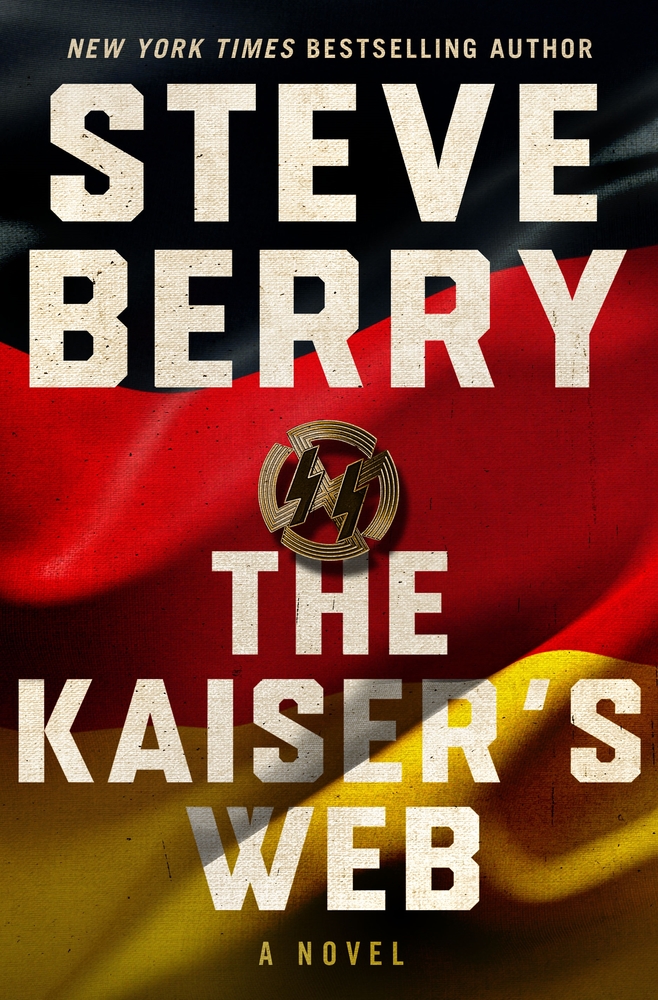
Publisher: Hodder & Stoughton/Macmillan Audio (Audiobook – 23 February 2021)
Series: Cotton Malone – Book 16
Length: 14 hours and 32 minutes
My Rating: 4.5 out of 5 stars
The always impressive Steve Berry returns with another amazing great historical conspiracy thriller, The Kaiser’s Web, which sees his long running protagonist Cotton Malone investigate secrets left over from World War II.
Germany is in the midst of a ferocious electoral battle as two very different candidates vie to become chancellor. One is the incumbent chancellor, a long-term public servant who believes in the goodness of her fellow Germans, while her opponent is a far-right populist, stoking the flames of nationalistic hatred and resentment to gain his power. Both have their own vision for the future, but the key to this election may lie in the past, specifically, to what really happened on 30 April 1945, the day that Hitler and Eva Braun supposedly died in their bunker underneath Berlin.
When a series of mysterious documents hinting at secrets from her opponent’s past are delivered to the German chancellor, she turns to her long-time friend, former United States President Danny Daniels for help. Determined to keep Germany from going to the far-right, Daniels calls on the services of former American intelligent agent, Cotton Malone, and his girlfriend, the resourceful Cassiopeia Vitt. Together, Malone and Vitt follow the trail left in the documents to Chile, where they uncover a dangerous web of deceit and hidden Nazi money, seemingly created by Hitler’s closest confidant and personal secretary, Martin Bormann.
When evidence suggests that Bormann, who everyone believes died in the last days of the war, may have actually survived and fled to South America with billions in stolen wealth, Malone and Vitt are shocked. However, they soon discover that not everything is as it seems, and that someone has woven a dangerous trap around them, one that could tip the election in the far-right’s favour. In order to save Germany from itself, Malone and Vitt must unravel the entire truth behind the conspiracy known as the Kaiser’s Web before it is too late. But what impact can secrets from over 70 years ago have on present day Germany, and how far are people willing to go to protect them? The truth about Hitler, Braun and Bormann will shock the world, and not even the legendary Cotton Malone will be prepared for the consequences.
Berry has been writing exciting and clever thrillers for nearly 20 years, ever since his 2003 debut, The Amber Room. While he has written several standalone novels, Berry is best known for his Cotton Malone books, which started in 2006 with The Templar Legacy, and The Kaiser’s Web is the 16th entry. I only started getting into the Cotton Malone series a few years ago when, on a whim, I decided to try the 14th book in the series, The Malta Exchange. I ended up really enjoying the amazing story contained within The Malta Exchange, which combined together historical tales of Malta, the Knights Hospitaller and the Vatican, to create an impressive and addictive read. I was also lucky enough to receive a copy of the 15th book in the series, The Warsaw Protocol, last year, which turned out to be another awesome read that dived deep into the heart of Poland’s history and politics. Both books were really intriguing reads and I am now quite determined to check out any and all new Cotton Malone novels that come out. I was particularly interested when I saw the synopsis for The Kaiser’s Web last year and I have been looking forward to reading it ever since. I am extremely glad that I did, as Berry has once again produced a fantastic and captivating thriller that not only weaves a unique fictional historical conspiracy into an excellent and highly enjoyable story, but which also allows new readers to dive in and readily enjoy.
For his latest novel, Berry has come up with another cool and impressive story that combines an investigation into historical secrets with an intense and dramatic thriller. Told from the perspective of all the various players in the book, The Kaiser’s Web’s narrative starts off quickly when a mystery with world-altering implications is presented to the protagonists, forcing them to explore the final days of the Nazi regime and travel all over the world to find the answers. While it initially seems like the protagonists are caught up in an elaborate and dangerous trap, the narrative quickly takes a turn when a third party intervenes, disrupting the entire plot and leaving everything, including the protagonist’s success or failure, up to chance. There are so many amazing elements to this story and I loved the way that the author works his altered historical details into a high takes, thrilling narrative, with the secrets of the past very much having an impact of key events from the future. Like several of Berry’s previous novels, The Kaiser’s Web has a lot less action in it than most thrillers do; instead most of the narrative is filled with talking, historical flashbacks and character building, which I personally really liked and which give this book a much more distinctive feel than some other examples of this genre. That being said, there are several great, fast-paced action scenes in this book, which, when combined with the clever historical elements and investigation, resulting a thrilling and powerful novel. I also liked how The Kaiser’s Web has much more a political thriller vibe to it than some of the previous Cotton Malone novels I have enjoyed, with the result of the protagonist’s investigation having severe impacts on the fate of Germany’s election, and indeed Berry works several different stages of the opponent’s campaign into the overarching story, showing how close the election is. All of this comes together into one big and captivating conclusion, and while I was able to predict a couple of the big twists, including a particularly major reveal, Berry still surprised me in places, and I had an outstanding time getting through this awesome story.
To really flesh out The Kaiser’s Web’s narrative, Berry dives deep into the heart and soul of the country of Germany and its people to set up the story’s central conspiracy and explain its significance. This includes a really intriguing examination of Germany’s history, both during the war and in the post-war period, and readers get a comprehensive understanding about what happened in Hitler’s bunker, and how history has recorded or, in many cases, failed to properly record these events. Berry also features a really in-depth examination of some key Nazi figures, including Martin Bormann and Eva Braun, showcasing their psyches and personalities, as well as exploring their role in the war, the major policies that Bormann enacted and their significance to people like Hitler. There is also an intriguing exploration around their recorded deaths, and the historical inaccuracies about them become a key part of the plot. There is also a compelling look at what happened to former Nazis post World War II, both in Germany and outside of it. In particular, the story traces the routes and hideouts that several former Nazis had in South American countries, and it was fascinating to see some of the real-life examples of fleeing Nazis that are repurposed for this narrative. All of these historical aspects are very interesting, and I love the unique and clever story that Berry was able to create using them.
In addition to Germany’s wartime history, Berry also examines the current political and social climate of Germany, which becomes a significant part of the book’s plot. Berry really attempts to explore a lot of the current attitudes that the modern German people have, especially as certain resentments, forced political concessions and other factors have seen a re-emergence of the far-right in Germany (and other European countries), and the election featured within the book becomes a real battle for the soul of the country. The author has obviously spent a lot of time researching current German moods and political preferences, and this proves to be a powerful and compelling heart to the novel, especially as he really does not have to exaggerate some of the problems that new hard-right organisations in Germany are causing. Berry does a fantastic job not only exploring the roots of a lot of these problems, many of which date back all the way to the war, but also working it into his clever thriller story, resulting in an amazingly powerful narrative that, thanks to these real-world issues, really drags you in.
One of the things that I always like about the Cotton Malone novels are the awesome depictions of the different countries and landscapes that form the backdrop for the impressive narrative. It is obvious that the author has a real passion for travel and new landscapes, and this really flows through into his writing as Berry spends a lot of time describing all the key features and locations his characters see, both man-made and natural, in exquisite detail. These depictions are so detailed and compelling that the reader can often believe they are standing next to the characters enjoying the view. The Kaiser’s Web is no exception to this as the author once again details several amazing places that form the backdrop to the complex story. As a result, the reader gets to experience some really cool locations, including several provinces of Germany, parts of Chile, brief looks at countries like Switzerland, Belarus and Austria, and an expanded exploration of the Free State in South Africa. In each of these locations, Berry provides the reader with fantastic details about the landscape, the people, local industries and politics, as well as some fun snippets of history, most of which relate to the post-war period. This becomes an extremely fascinating part of the book, especially as Berry’s enthusiasm for different horizons is quite infectious, and I had a great time exploring these new locations. I cannot wait to see where the next Cotton Malone novel is set, as the author is bound to feature some new and intriguing places.
I have to say that I also really enjoyed some of the new characters featured within The Kaiser’s Web. This was a pretty good book for characters, as Berry continues to not only showcase his long-running protagonist Cotton Malone but also reintroduces two characters who were somewhat underutilised in the previous book. Cotton, who is something of a nexus for historical conspiracies, has another great adventure in this novel, and I loved seeing this ageing former agent turned rare book dealer get into all manner of trouble as he attempts to find the truth. Despite being the nominal main character of this novel, I did think that Cotton was slightly pushed into the background of the story, mainly because several of the other characters were very heavily featured. Part of this is because Cotton spends the entire novel teaming up with his love interest Cassiopeia Vitt. Due to the fact that I have only read a couple of Cotton Malone novels, this was the first time I have seen the character of Cassiopeia in action, and I quite enjoyed her as a character. Cassiopeia, who is also the focus of several Berry’s short stories and novellas, is another great character to follow and it was interesting to see her counterpoint to Cotton’s perspectives. Cotton and Cassiopeia form a fantastic team in this book and I enjoyed seeing them work together and support each other in various ways. Aside from Cotton and Cassiopeia, it was also great to see more of former US President Danny Daniels, who becomes a key part of the story. I loved the idea of a popular former President running important international espionage missions after his retirement (could you imagine Obama doing something like that? That sounds pretty awesome), and he serves as a great supporting character getting Cotton and Cassiopeia involved in the story.
While the returning characters are good, my favourite point-of-view characters had to be Marie Eisenhuth, the current German chancellor who finds herself caught in the middle of dangerous events, and her main opponent in the upcoming election, Theodor Pohl, the book’s primary antagonist. These two characters represent the very different ends of the German political spectrum, with Eisenhuth a pro-immigration and anti-Nazi politician, while Pohl is a far-right figure who is attempting to utilise the conservative populations to introduce damaging nationalistic policies. Both Eisenhuth and Pohl get a substantial amount of focus in this book and it proved extremely fascinating to see them throughout the novel, especially as their electoral campaign plays out like a battle for the soul of Germany. It was also great to see Pohl’s perspectives, especially when he is manipulating people or reacting to the actions of Cotton and his friends and is forced to put more deadly plans into play. While The Kaiser’s Web initially focuses on their political differences, the novel soon examines various parts of both characters’ lives, pasts and families, which proves to be deeply compelling and interesting. I love the cool reveals behind these characters, and their storylines reveal a very intriguing case of nature versus nature. I think both characters had exceptional story arcs throughout this book and their storylines ended up being an outstanding part of The Kaiser’s Web.
I ended up listening to The Kaiser’s Web on audiobook, mainly because I have found that Berry’s awesome historically based conspiracies translate across to the audiobook format extremely well and I end up following all the cool detail and inclusions a lot more. With a run time of 14 hours and 32 minutes, this is a fairly decent sized audiobook, but listeners should generally be able to power through it rather easily, especially once the cool conspiracy really hits its height. I also really enjoyed the awesome narration of Scott Brick, who does an exceptional job with this latest Cotton Malone book. Brick is a well-established narrator who has contributed his voice to an amazing number of audiobooks, including all the previous entries in the Cotton Malone series, as well as the fantastic Orphan X series (for example, he did a great job narrating Into the Fire and Prodigal Son). I particularly enjoyed Brick’s amazing voice work in The Kaiser’s Web, mainly because he got an opportunity to show off the wide range of accents he could do. Not only does he pull off a range of German accents for the various German characters, but he also does some amazing South American accents and some extremely authentic South African accents. The South African accent, which is a really hard one to pull off (so many narrators and voice actors try and fail to do it properly, often coming off as Australian), was really good in this book, and I am really impressed by Brick’s skill. At the same time, Brick’s general narration voice fit the intense tone of The Kaiser’s Web extremely well, and I thought that he moved this dense and complex story along at a decent pace, ensuring that the listener’s attention was constantly drawn in. As a result, I had an exceptional time listening to this audiobook and this is easily my preferred format to enjoy Berry’s Cotton Malone novels with.
The Kaiser’s Web is another outstanding novel from Steve Berry, who has once again produced a captivating and clever historical conspiracy thriller. Featuring a unique tale, intriguing dives into several countries and some fantastic characters, The Kaiser’s Web is a must-read for thriller fans and comes highly recommended. I personally loved untangling all the threads in this cool thriller and I cannot wait to see what Berry comes up with next.







 The Unseen Library