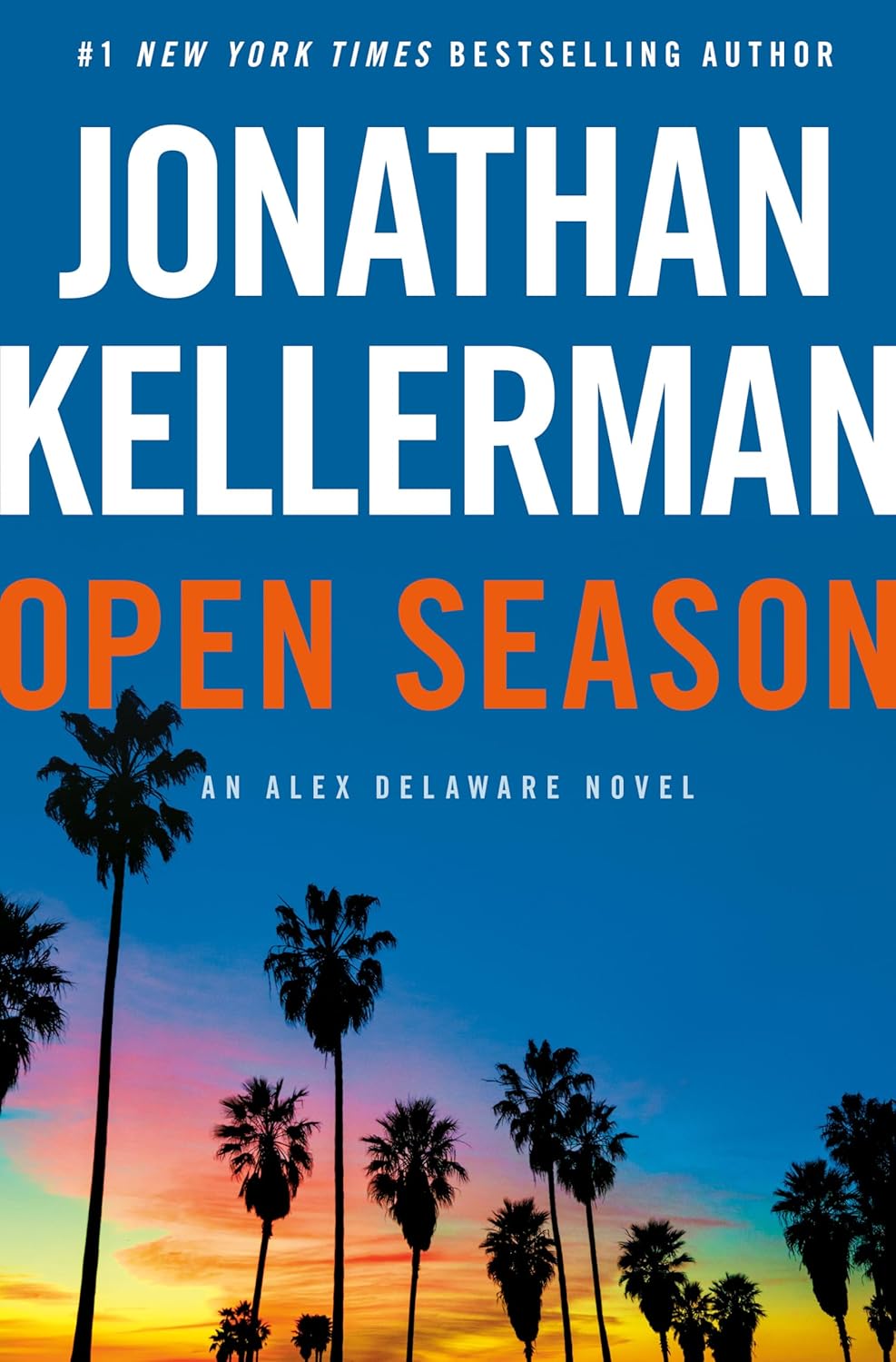
Open Season by Jonathan Kellerman

Publisher: Penguin Random House Audio (6 February 2025)

Series: Alex Delaware – Book 40

Length: 9 hours and 10 minutes

Rating: 4.5 out of 5 stars

Amazon

Still going strong after 40 Alex Delaware crime fiction novels, the always dependable Jonathan Kellerman presents another clever and captivating read with Open Season, an intense novel that proves very hard to put down.

Jonathan Kellerman is an excellent veteran author, whose massive body of work has been impressing crime fiction readers for decades.  While he has a couple of big series, Kellerman is best known for his long-running Alex Delaware series, which follows titular protagonist Alex Delaware, a child psychologist, and his best friend, LAPD Lieutenant Milo Sturgis as they investigate unusual or deranged murders around Los Angeles.  This is a really great series, and ever since I came across it, I’ve made a major effort to read each new entry, especially as they also provide some great mysteries and complex police investigation narratives.  Books like (The Wedding Guest, The Museum of DesireSerpentineCity of the DeadUnnatural History and The Ghost Orchid), have all been extremely amazing, and I eagerly await my new Alex Delaware hit at the start of each year.  The latest entry in the series, Open Season, is the 40th Alex Delaware novel, with Kellerman still going strong this far into the series.

Los Angeles is filled with all manner of dreamers and aspiring stars, but when one of them meets a tragic end, it falls to psychologist Alex Delaware and veteran homicide detective Milo Sturgis to find them justice.  Called in to investigate the dumping of an aspiring actress’s drugged body near a hospital emergency room, Alex and Milo soon set their sights on a known abuser as a likely culprit.  However, their hunt is prematurely ended when their suspect is found murdered, shot by a sniper.

Forced to switch to a new investigation, the two friends and their team are surprised to discover that the execution of the sexual predator is connected to two other unsolved homicides, with both additional victims shot from a distance using the same rifle.  Determined to figure out how the cases are linked, the team uncover a web of seemingly unconnected innocent victims, each of whom appeared to have been killed for very different reasons.

With additional bodies starting to pile up around the city, Alex and Milo find themselves in a race to solve the case before more victims can be cut down.  But are they facing a dangerous spree killer with no rhyme or reason to their actions, or a darker figure with their own complex rationales for murder?  To solve the case and stop the shooter, these two friends will need to use all their combined skills to decipher their strange motivation before even more people wind up dead.

Jonathan Kellerman continues to deeply impress with this new addictive and captivating crime fiction novel that I couldn’t get another off.  Featuring another brilliant and unique case, Open Season was an exceptional 40th entry in the Alex Delaware series that takes the reader down some dark and twisty paths.  This was a truly excellent read that I powered through in a very short amount of time.

Open Season was a particularly strong murder mystery from Kellerman, and I loved the compelling, multi-layered narrative that emerged.  Once again bringing together his two loveable main characters, Alex Delaware and Milo Sturgis, the two initially begin the book by investigating the murder of a young aspiring actress, drugged and dumped near a hospital.  Starting off with the typical look at the victim and anyone who knew her, the detectives are quick to narrow in on a suspect, only for the story to take an interesting turn when their potential killer ends up dead.  From there the story becomes a lot more complex, as the protagonists and a larger team begin to investigate the shooting of the first suspect, as well as several connected crimes.  This allows for a larger story with a ton of distinctive potential witnesses and suspects, and the protagonists investigate in several different directions, adding a lot of different pieces to the puzzle. 

Thanks to a series of varied clues, compelling research and additional discovered killings, the protagonists eventual narrow down on a potential suspect with interesting connections to each of the victims.  Without giving too much away, I felt that the overall solution for Open Season’s investigation was very clever, and it nicely tied into each of the victims/cases that make up the larger mystery.  The motivations for the killer were very unique and memorable, so it proved quite fascinating to see how the protagonists identified the antagonist and led to a great conclusion to the overall story.  I particularly enjoyed the final confrontation that the protagonists had with the killer towards the end of the book, and it wrapped the story up perfectly.  An overall excellent murder mystery narrative that will have you hooked all the way to the end.

I deeply enjoy Kellerman’s style for the Alex Delaware books and he really knows how to pull together a fascinating and intense police investigation narrative.  The author prefers a slow and methodical style of investigation as the protagonists pull together various clues and connections and work them into their various theories, which always adds a great touch of realism to proceedings.  There is a particular reliance on diving into the personal histories of the victims and suspects that Kellerman enjoys, which works to drag the reader further into the plot as they become even more invested in the investigations.  I felt that Kellerman’s typical style worked particularly well in Open Season, and I loved the complex investigation that emerged.  The multiple separate murders and the large array of connected people associated with each case allowed for a particularly elaborate story, and Kellerman carefully allowed his protagonists to explore these different elements allowing for compelling drive to the big conclusion around who was responsible.  I felt that Kellerman did an excellent job layering the more important clues around the case throughout the entire story, and it was very interesting to see what discussions or personal details came into play later.  I really got invested in Open Season’s complex case as a result, and this proved to be a particularly clever and well written mystery that deeply enhanced Kellerman’s already excellent story.

In addition to the very well-written story, Kellerman features some interesting characters and interactions in Open Season that help to create a unique feel that fans of the Alex Delaware series will be very familiar with.  Much of this lies with the two main characters, Alex Delaware and Milo Sturgis, who have an established and comfortable way of speaking with each other.  These two characters, both of whom are quirky in their own ways, are an excellent centre for the story, and I love how well the play off each other.  While their dialogue can be a little unique and occasionally flippant, Kellerman has spent a lot of time developing their patter, and you grow to appreciate the way these two characters work together.  In addition to their usual discussions, Open Season also had some more personal interactions between the two, especially when Alex is forced to keep some information from the team to protect the confidence of a medical professional.  I also liked how this was one of the Alex Delaware novels where the protagonist got to use his expertise as a psychologist to try to get to the root of the various suspects potential motivations.  This psychological work comes into play nicely, especially once they identify who the killer is, and it helped to give Open Season more of a distinctive edge away from other crime fiction reads.

While most of Open Season’s focus is on Alex and Milo, Kellerman also introduces an array of interesting supporting characters, each of whom are connected to the case in some specific way.  I really enjoyed the unique collection of characters that emerged, and there are some interesting storylines and connections that emerge thanks to the protagonists constant digging into the past.  The characters that get the most attention are some of the victims of the case, whose lives are explored in detail by the detectives.  Despite not interacting with the protagonists or readers while alive, you get to know all the victims thanks to interviews with their friends and families.  These many detailed interviews not only provide key information about who the victims are and potential motivations for their murders, but they also provide compelling and emotional testimony from those that loved them, which ensures that the reader becomes very invested in finding out who killed them.  You also meet a compelling group of people connected to the victims, who serve as witnesses, sources of information or suspects (sometimes all at once) in the case.  Due to the nature of Open Season’s story, you meet quite a few supporting characters, often for only a scene or two.  Kellerman makes these appearances count, though, and I liked some of the unique interactions that occurred, even if some of these characters were a little weird or had an unrealistic way of communicating.  The eventually revealed killer was particularly outrageous when eventually revealed, which I personally thought was very entertaining, although I could see some readers finding him to be too over-the-top.  Still, all these characters added something to the plot, and I enjoyed the effective way in which Kellerman introduced and utilised them throughout the book.

While I usually try to get physical copies of the Alex Delaware novels, for Open Season I ended up listening to the audiobook version, which I felt was an excellent way to enjoy this amazing book.  I personally find that the audiobook format does wonders for helping readers appreciate detailed and multilayered crime fiction narratives and Open Season was a great example of this, as I soon got drawn into every level of the author’s compelling mystery.  Part of the reason this worked so well was narrator John Rubinstein, who has lent his voice to a large chunk of the Alex Delaware series.  Rubinstein has a fun voice that lends itself to the occasionally zanier style of the Alex Delaware books and really brings the author’s complex narratives to life.  I especially enjoy how Rubinstein perfectly captures the characters featured in Open Season, including the main protagonists, Alex and Milo.  A great example of this is the very distinctive voice that Rubinstein utilises for Milo, which really captures the man’s complex and entertaining nature, and frankly I don’t know any other way how this character could be voiced.  The narrator also successfully captures the distinctive patter that the two main protagonists have between each other, and the way conversation flows between them in the audiobook is a ton of fun.  The various other characters featured with Open Season are also well represented, and I loved the colourful array of voices and accents that Rubinstein utilises for the supporting cast and various witnesses that protagonists encounter.  While a few of these voices are a little over-the-top, I personally liked them, and I felt it fit the long-running and distinctive series tone extremely well.  This exceptional narration allowed me to absolutely power through Open Season’s roughly nine-hour long run time, and I had such a blast picking up every single clue or compelling character interaction in this format.  As such, I would strongly recommend the audiobook version of Open Season to anyone interested in checking this mystery out, and I can personally guarantee it makes for great entertainment on a long trip.

Even after all these years, Jonathan Kellerman still shines as one of the masters of the crime fiction genre.  The 40th Alex Delaware novel, Open Season, was an outstanding addition to the series, and I love the compelling and awesome narrative that emerged.  Slick, addictive and featuring some interesting twists, Open Season was a truly impressive read, and I am still having so much fun with Jonathan Kellerman’s incredible books.

Amazon

Warhammer 40,000: Longshot by Rob Young

Longshot Cover

Publisher: Black Library (Audiobook – 12 August 2023)

Series: Warhammer 40,000

Length: 10 hours and 28 minutes

My Rating: 4.5 out of 5 stars

Amazon

Prepare to dive into one of the grittiest battles in Warhammer 40,000 fiction with the awesome and captivating novel, Longshot by Rob Young.

2023 has definitely been an outstanding year for Warhammer 40,000 fiction, and I have had a ton of fun reading several pretty amazing entries from this extended universe in recent months.  Examples of this include The Lion: Son of the Forest, Warboss, Shadowsun: The Patient Hunter, Leviathan and The King of the Spoil just to name a few.  However, the year is far from over and there are still several great-sounding Warhammer 40,000 novels coming out that I have my eyes on.  One of the more intriguing was the fantastic Longshot by new author Rob Young, which sounded extremely fun.  Longshot, which follows on from Young’s short stories, Transplants and Memories of Broken Glass, is the author’s debut Warhammer 40,000 novel, and it proved to be a very intense and action-packed novel with a great story.

Several years after the fall of Cadia, which saw the Imperium of Man split in two by a great rift in space, humanity is still attempting to recover as many lost planets and systems as possible.  The latest target of the relentless Indomitus Crusade sees the troops of the Cadian 217th arrive at the former manufactorium world of Attruso, whose people have fallen under the sway of the seeming beatific alien t’au.

As the initial assault begins in the battered city of Miracil, the Cadian forces struggle to make progress against the determined t’au defenders and their human auxiliaries.  As the fighting gets even more desperate, the tides of war soon place the keys to victory into the hands of Sergeant Darya Nevic and her squad of snipers.  Nevic is a legendary figure within the 217th, a transplant from a non-Cadian regiment renown for her abilities of infiltration, assassination and survival, Nevic excels at disrupting the enemy from the top down.  However, when the t’au unleash their own deadly sniper against the Cadians, Nevic is forced into a battle of wits with a killer just as skilled and ruthless as she is.  But has Nevic finally come across a foe even she can’t best, especially as she begins to doubt her mission in the face of her own infamy, the lies of her commanders and the t’au’s insidious promises?

Longshot is an awesome and fast-paced novel that perfectly showcases the horror of war in this grim universe through the lens of a skilled sniper.  Young did an outstanding job with his debut novel and I loved the intriguing and powerful narrative that placed great characters into a deadly setting.  I managed to knock this book off in a couple of days, and it is one of the most exciting and fun Warhammer 40,000 novels of 2023 so far.

I loved the complex and intense story that Young pulled together for Longshot, which perfectly presents a tale of the common soldier in the grim Warhammer 40,000 universe.  I have often said that some of the very best Warhammer 40,000 novels are those that focus on the common human soldier facing off against alien or inhuman forces (for example, Steel Tread, the Gaunt’s Ghosts books or Catachan Devil).  Longshot is a very good example of this as you follow a tired soldier as she faces internal and external threats on the frontline of a desperate conflict.  Thanks to its focus on snipers, city fighting, camaraderie and propaganda, Longshot is honestly the Warhammer 40,000 version of Enemy at the Gates, which I deeply enjoyed.  The reader really gets invested in the protagonist’s journey which follows her through some fantastic missions, battles and character growth in the first half of the novel.  This leads to a great second half, where Nevic becomes a victim of her own success and is forced to go up against a deadly enemy sniper.  Due to everything the protagonist experiences, there is some real tension leading into the final third of Longshot, especially after she experiences some terrible losses.  Thanks to the protagonists’ conflicted state, you honestly don’t know how the story is going to turn, and Young loads up some great twists and swerves.  While the ending was a tad predictable, I really enjoyed it and the author really pulled together a satisfying and exciting read that you can really power through.

This ended up being a pretty addictive standalone book, and it is one that would definitely serve as a great introductory novel to Warhammer 40,000 fiction for those readers unfamiliar with the franchise.  Young does a great job of expanding his previous short stories into his first full-length novel, and you really get to grips quickly with the situation, the characters, and the wider universe.  The sharp and intense character-driven story which primarily focuses on the protagonist, Darya Nevic, with a few chapters shown from other key character perspective, has a lot of great elements to it.  The focus on character motivation, the depravities of war, and the grim realities of the background universe really cut through the main story, and you understand the difficulties that many of the conflicted characters experience.  The subsequent focuses on morale in battle and the impacts of propaganda and manipulation also proves to be very fascinating and adds a great edge to Longshot.  I also deeply appreciated how well Young built up his main protagonist throughout the course of Longshot, diving into Nevic’s complex history and examining how she gained her legend.  You grow quite attached to Nevic as the book continues, especially she is forced to make several difficult decisions, and Young turns her into a relatable and understandable figure, especially when it comes to her conflicted feelings about her fame and leadership.  Nevic is well supported by other great characters, and Young was able to establish and utilise these figures in a short amount of time.

The real highlight of Longshot is the awesome and well-written action sequences that dominate the book and constantly keep the reader on their toes.  Young paints an effective and dark picture of brutal city fighting, and you can tell he was using the battle of Stalingrad as inspiration.  The gritty battles that take place are very exciting and powerful, and you can really feel the desperation and weariness of the combatants.  The author proves particularly adept at writing high-quality sniper scenes, and the focus on shooting, infiltration and calculated strikes makes Longshot stand out from other battle-heavy Warhammer 40,000 novels.  This ended up being a very slick and addictive read and Young proved quite skilled at getting his fantastic story across to the reader in the most effective way.

Well-established fans of Warhammer 40,000 canon will really appreciate Young’s compelling and insightful look into two distinctive factions who provide a very interesting contrast to each other.  This includes the members of the Cadians, one of the most iconic Imperial Guard factions in the game.  While the Cadians are already pretty heavily featured in Warhammer 40,000 fiction, I felt that Young provided a particularly effective dive into their current problems, namely the gradual deaths of the natural-born members of the regiment and their replacement by transplants from other regiments.  Thanks to the focus on Nevic, herself a transplant from another regiment, you see the dire internal conflict this causes as the strongly traditional Cadian regiment begin to lose their identity after the loss of their planet.  Young does a wonderful job of expressing this throughout the course of Longshot and the resultant impacts this has on the characters makes for some interesting story moments.  I also quite enjoyed seeing several outsider perspectives of the Cadians that Young worked into the story, which often contrasts well with what the Cadian protagonists feel, and it makes for some fantastic story moments. The author also examines other fascinating elements of the Imperial war machine, such as the exhausting Indomitus Crusade, the current crumbling state of the Imperium, the way other supporting regiments are treated, and the internal propaganda and planning of the regiment.

While the Cadians do get most of the story focus in Longshot, Young does take the time to also dive into the alien t’au who serve as the main antagonists of the plot.  Most Warhammer 40,000 novels that have the t’au as antagonists often nerf or underutilise them to a degree (for example Kill Team or Deathwatch: Shadowbreaker), which is frustrating for fans of the faction.  However, Young effectively showcases the t’au as skilled and deadly enemies who are able to weather the Imperial forces and overwhelm them in several key theatres.  Young has fun bringing several key t’au units to life throughout the course of Longshot and you really start to appreciate them as effective opponents to the Cadians.  There is also an interesting examination of t’au motivations, philosophies and manipulations, specifically around their recruitment of human auxiliaries.  This compelling dive into the t’au muddies the moral waters around the protagonists and the Cadians, and you soon start to question who has the best interest of the people of Attruso at heart.  This, and other intriguing similarities to the human soldiers, adds an awesome edge of consideration and concern to the story that I quite enjoyed.  I really think that Young had some of the better portrayals of the Cadians and the t’au I have so far seen in Warhammer 40,000 fiction, and fans of the franchise are going to have a wonderful time diving into that in this book.

Unsurprisingly, I chose to check out Longshot on audiobook, which in my opinion the best way to enjoy a Warhammer 40,000 novel.  Longshot is a particularly good example of this, as the audiobook format really helped to move the already exciting novel along at a fast clip, especially when the action scenes are brought to life by the narrator.  Coming in at around 10 and a half hours, this is very easy audiobook to get through quickly, and I made sure to power through it in only a few days.  It helped that this book was narrated by the very talented Colleen Prendergast, who already has a bit of experience narrating Warhammer novels featuring the Cadians.  Prendergast did a wonderful job bringing all the major characters to life, especially the main protagonist of Darya Nevic, and I loved the elaborate and fitting voices that she gifted the cast which really helped to draw you into the story.  However, the real benefit of Prendergast’s narration is the way that she walks the listener through all the elaborate battle sequences, especially those that show the snipers facing off against each other.  I felt that this narration expertly captured all the inherent intensity and danger of these scenes and I got really invested into the book as a result.  Thanks to this amazing narration and story enhancement, I would strongly recommend checking out Longshot on audiobook and I know I had a lot more fun thanks to this amazing format.

Overall, Longshot is an awesome and compelling addition to the Warhammer 40,000 canon and one that I had a ton of fun with.  Young produced a powerful and intriguing character driven war story that will appeal to a wide audience of readers, especially with its fantastic focus on sniping and some of the more fascinating elements of Warhammer lore.  I deeply enjoyed this fantastic novel and Longshot comes highly recommended.

Amazon

Billy Summers by Stephen King

Billy Summer Cover

Publisher: Hodder & Stoughton (Trade Paperback – 3 August 2021)

Series: Standalone

Length: 433 pages

My Rating: 5 out of 5 stars

Amazon

Stephen King returns with another exceptional read, Billy Summers, an awesome and memorable character driven thriller that has proved to be one of the best books of the year so far.

2021 has been quite an amazing year for Stephen King, who has released two outstanding and impressive novels in a short period of time.  His first book of 2021 was the interesting horror novel, Later, which followed a child who can see and talk to the recently deceased.  While I have not had a lot of experience reading Stephen King novels in the past, I really got into Later due to its likeable characters and thrilling narrative, and it ended up being one of the best audiobooks I listened to in the first part of 2021.  Due to how much I liked Later, I made sure to keep an eye out for any additional Stephen King releases, and I was extremely intrigued to see that he had a second book coming out with a great-sounding plot.  As a result, this second novel, Billy Summers, was one of my most anticipated reads for the second half of the year, and I was excited when I received my copy, especially as it contained a really cool story.

Billy Summers is an assassin and gun for hire.  A maestro with a sniper rifle and a master of elaborate escapes, there are few killers better than him.  However, for all his skills, Billy has one unusual quirk: he has a conscience and a moral code which limits him to only taking out contracts on targets he considers to be bad guys.  After a lifetime of killing, as both an assassin and a soldier, Billy wants out, and he is willing to take one final job to retire.  Luckily, his employer has a job that fits all his criteria.

Taken to the small city of Red Bluff on the East Coast of America, Billy is hired to kill a notorious gangster and killer who is currently locked up in Los Angeles but due to be extradited back to Red Bluff.  Billy’s boss wants the target dead the moment he arrives to stop him making a deal with the authorities ahead of his murder trial.  With a massive pay cheque on the line, Billy accepts the job, despite some odd stipulations.  As part of their plan to take out their target, Billy will need to take on the identity of an author working in the office complex overlooking the courthouse and maintain his cover for as long as it takes the extradition process to go through.

Despite misgivings about the job, Billy dives into the role as required and soon establishes himself as a regular figure in the office block.  As he waits for his target to arrive, Billy begins to get to know the people around him and takes the opportunity to write a memoir about his life and the decisions that led to him becoming a killer.  However, the closer he gets to the conclusion of the job, the more he suspects that nothing involved with this assassination is on the level, and that his bosses intend from him to die as well.  Making his own plans in case things go sideways, Billy prepares to end his career as an assassin on his own terms.  But then he meets Alice, and everything changes.

Well damn, how the hell does King do it?  After nearly 45 years of writing, you’d think the man would run out of unique and compelling ideas, but that apparently is not the case, as his latest book, Billy Summers, turned out to be quite an exceptional read.  King has produced an impressive and powerful story that follows a complex and well-established protagonist as he experiences life for the first time.  With some outstanding characters, a deeply thrilling storyline and some intriguing insights into the human condition, this was an outstanding read that was easily one of the best books I read in 2021 and which got a full five-star review from me.

Billy Summers contains a pretty addictive and powerful story that I found to be really cool.  The book is primarily told through the eyes of the titular Billy and shows him as he prepares to take on his final job.  King does a great job of introducing the character and the scenario, and you are soon placed into the midst of a very cool storyline as Billy moves into suburbia under an assumed identity to build his cover.  This results in some compelling character interactions, as Billy simultaneously prepares for his assassination mission with his employers while also getting close to some of the people he encounters and starts to see what a normal life feels like.  At the same time, he also builds up a third identity to use after the job is completed, which requires him to assume a different disguise and create some additional personal connections.  He also starts writing a personal memoir which tells a slightly altered version of his life story, including his rough childhood, his military career, and his early contract work.  This mixture of intriguing and fascinating story threads come together extremely well in the first half of the novel, and you get quite a unique and compelling narrative which perfectly blends thriller excitement with personal character growth.

After a big moment halfway through the novel, the entire storyline dramatically changes, especially as Billy is introduced to a key character, Alice.  While there is still a large amount of focus on the job from the first half of the novel and its consequences, the story noticeably morphs at this point, really diving into the relationship that develops between these two characters.  The storyline also moves away from some of the prior relationships that were introduced, and moves into a road trip, with Billy now accompanied by Alice.  There are some really good sequences in this second half of the novel, as well as a continued exploration of Billy’s past.  King does a fantastic job morphing the various story threads and plot ideas into a cohesive and captivating narrative, and I really enjoyed the powerful combinations.  The set pieces are a series of awesome action sequences, which help tie up several of the main story threads and lead up to the book’s epic conclusion.  While King is often criticised for his endings, I felt that Billy Summers had an exceptional and incredible conclusion that I deeply enjoyed.  This great conclusion is both tragic and memorable, and it ties together the entire novel extremely well, helping to turn Billy Summers into one of the best stories I have read all year.

I really enjoyed King’s writing style in this novel, especially as it focused a lot on character development and interactions between unique people.  The entire novel has a very philosophical bent to it, as King and his characters take time to explore the human experience, especially those aspects of life that people on the outside, such as BIlly, miss out on.  While you wouldn’t think that this would pair well with a thriller story about an assassin, it actually works extremely well, especially when combined with Billy’s journaling scenes, and readers are guaranteed to fall in love with this distinctive form of storytelling.  I also liked the author’s great use of various settings which help to show off the uniqueness of America’s landscapes.  King features several different locations, including suburbia, the inner city, the wide open road, the isolated Colorado mountains, and even some more famous locations, like fabulous Las Vegas.  Each location offers the reader and the characters something new to enjoy or appreciate, and King makes sure to capture both the beauty and the ugliness of these various settings.  While King does move away from some of his more extreme murder sprees in this novel, there are some dark moments in this book.  Not only are there some very graphic action sequences, but readers should also be warned about the sexual violence content, especially one scene where Billy enacts some justice.  I’m also slightly concerned that King might end up getting sued by Rupert Murdoch for a certain facsimile character who does some bad things.  Overall, though, I really enjoyed the way King told his latest unique story, and there is something for everyone in it.

As I mentioned above, I don’t have the most experience reading Stephen King novels, with only a few of his more recent reads under my belt.  Despite this, I was easily able to enjoy Billy Summers, especially as it is a standalone thriller with one-shot characters.  As a result, this is a book that any reader can easily pick up and get into, and I really liked how open the author made Billy Summers.  However, fans of King, as well as those people generally aware of his work, will probably have fun seeing the references to some of King’s previous books.  One of his more iconic works is referenced several times, especially as the protagonists end up spending time near a pivotal location.  While this is not particularly essential to the plot, it was a nice callback, and I think that most people will appreciate the fun self-homage.  I also found it interesting that both of King’s novels of 2021 had a compelling focus on writing, which becomes a key part of the plot.  While Later focused more on the publishing side of things, Billy Summers contains a fantastic examination of the difficulties of putting your ideas to paper as a writer, with the protagonist attempting to write his life story in his downtime.  While there are several fantastic advantages to the writing subplot, such as it being a great way to introduce the protagonist’s backstory in a compelling and episodic manner, I also quite enjoyed seeing the depiction of the writing process, and the various difficulties of telling a story.  It very much felt that King was pouring some of his own experiences with writing into these sections of the novel, and it was incredibly fun and insightful to see one of the world’s greatest authors depict the difficulties of writing in one of his novels.

Another area that Billy Summers excelled in is the fantastic central and supporting characters.  King does a remarkable job of introducing a diverse cast of characters, each of whom affect the character in various ways, either by showing him what his missing, or showing him what he is better than.  The most focused character is naturally the titular protagonist, Billy Summers, a brilliant contract killer who only kills bad people.  Billy is a remarkably complex figure, who builds several different personalities and personas around himself for professional reasons and protection.  I really enjoyed the intriguing portrayal of this character, mainly because you got to see at least four different versions of him in the first half of the book.  While the narrator is the calm and collected lover of classic novels who is basically a good guy, despite being an elite professional killer able to see every angle and work out the best way to kill someone and escape, that is a viewpoint that only the readers sees, at least at the start of the novel.  Billy hides this real side of himself from the rest of the world, effecting a less intellectual personality to his criminal associates, which he calls his “dumb self”, to fool them and think he’s less of a threat.

While his dumb self is usually enough to get by, his new assignment requires him to take up the identity of a struggling author who moves into a suburban neighbourhood and a local office block to focus on his upcoming bestseller.  Billy is forced to integrate into these social systems to keep his cover, and he soon makes friends amongst the people he meets, many of whom have an impact on him due to their honesty, innocence, and normality, all of which Billy has long given up.  He also builds up yet another identity to rent an additional house, which he plans to use as a safe house if the job goes wrong, which forces him to deal with additional normal people.  On top of that, he also takes the opportunity to write a memoir of his life, not only to maintain his cover but to satisfy his own curiosity about the writing process.  This proves to be a delicate balancing act, as he attempts to give an honest account of his past while also trying to keep up the charade of being dumb in case his employers read the story he writes.  This results in a unique, multifaceted character, and you get hints at the true nature of Billy, not just from the narration, but from seeing the similarities and differences between the various versions he presents to the world.

Billy’s life changes even further when he meets Alice, a woman who he meets at the very worst time of her life.  Saving her initially to maintain his cover, Billy soon finds himself drawn to protecting Alice, who has no-one and is having trouble getting over her trauma.  Billy soon works in a fantastic and touching relationship with Alice, as the two become close and help each other see the world in other ways.  Not only is Alice a great character in her own right, especially as King presents a very real and moving portrayal of a damaged and lost woman, but she also brings out the best in Billy.  While Alice does imprint on Billy due to her trauma, she also encourages him and gets him to continue writing his book.  This powerful bond they form soon becomes a central part of the book’s plot, and it is extremely fascinating and compelling to see what happens to them.  These exceptional characters and deep personalities really turn Billy Summers into an exceptional read, and I become severely invested in their story, even though I knew it was likely to end badly.

Stephen King has once again shows why he is the premier fiction author in the world today with another intense and exquisite read in Billy Summers.  Featuring a deep and captivating narrative about a complex character, Billy Summers was an absolute treat to read, and comes highly recommended.  Readers will swiftly fall in love with the unique narrative and compelling leading figures, and I guarantee that you will have trouble putting this excellent novel down.  Easily one of the best books of 2021, I cannot praise Billy Summers enough.

Billy Summers Cover 2

Amazon