
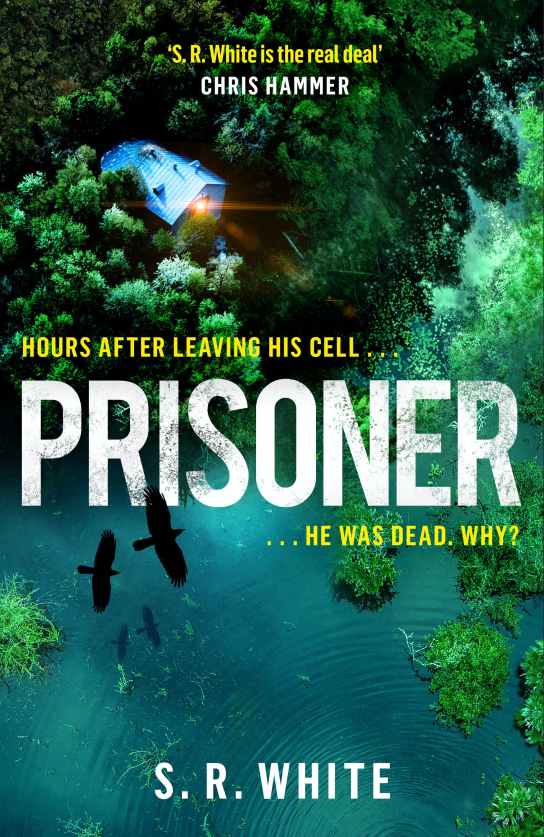
Publisher: Headline (Trade Paperback – 31 August 2021)
Series: Hermit – Book Two
Length: 421 pages
My Rating: 4.5 out 5 stars
Prepare for a twisty and dark Australian murder mystery novel as author S. R. White presents the compelling and powerful Prisoner.
Deep in rural Northern Australia, a dead body has been found in the middle of a dank and dangerous swamp. The corpse is staged to appear like a crucifixion, with the man’s arms and legs tied to poles, and his chest caved in with several blows. Called to the scene of the crime, Detective Dana Russo soon discovers that the victim was a convicted rapist who had only been released from prison a few hours earlier and whose crime occurred only a short walk away from his murder site.
Determined to get to the bottom of this unusual murder, Russo and her team swiftly begin tearing apart the victim’s life in prison and find that he had been in communication with two local sisters who offered him a place to stay once he was released. Investigating the sisters, they discover a unique pair of siblings who have been irreparably damaged by trauma and abuse and who live separate from the rest of society. Believing that the solution to the mystery may lay with them, Russo brings them both in for questioning, but finds them uncooperative and elusive.
Under pressure to solve the crime, the detectives slowly unwind an intriguing case, concerning corruption, drugs and prison gangs. However, the further they dig, the more apparent it becomes that the sisters are hiding some dark secrets about themselves and the victim. Forced to dig deep within herself, Russo uses the memories of her own traumatic childhood to analyse the suspects and find some common understanding with them. Can Russo break through these two unlikely suspects, or will the solution to this murder never be revealed?
This was a pretty cool and captivating novel from former British Police officer turned author S. R. White. Prisoner is White’s second novel and serves as a sequel to his 2020 debut, Hermit. This proved to be a fantastic read and I deeply enjoyed the intriguing and powerful narrative, especially as White loads his book with a complex mystery and some deeply damaged characters. I got pretty hooked on this book as it progressed and ended up finishing it in only a couple of days.
Prisoner contains a very impressive and compelling narrative that I really found myself getting drawn into. The novel mostly starts off focusing on the murder, with the discovery of the body in the first few pages, and then the protagonists immediately jump into the investigation, including the interrogation of one of the main suspects. As the story progresses, you get some other interesting elements thrown in, mostly around Dana Russo and one of her other colleagues as they deal with some dark personal history. There is also a captivating subplot regarding internal police politics that produces a real shakeup in the department and has some potential series-wide ramifications. However, most of the story remains on the mystery, and I really appreciated the creativity and darkness that the author fits into the case. Despite being a sequel to White’s first book, Prisoner can easily be read as a standalone novel, and no prior knowledge of the characters or the setting is needed. I felt that the entire narrative progressed along at a great pace, and there were no slow bits throughout the book, as the reader was either reading about the case or dealing with the intense personal demons of the various characters.
I must highlight the fantastic writing style that White featured throughout this novel. While most of the focus of Prisoner is on central character Russo, the author makes good use of multiple perspectives, mainly of the other detectives on the investigation team, to move the story along and provide some alternate points of view and different investigative threads. White utilises a very detailed writing style, which encourages a slower reading pace to make sure you don’t miss anything, and I felt that enriched the mystery and increased the realism of the plot. I also must highlight the incredibly detailed descriptions of the swampy landscape that surrounded the crime scene and the Northern Australian town where the plot is set. White paints a grim picture of small, isolated community on its last legs, where even the landscape has turned against it. You can really feel the stickiness and deadliness of the swamps, and it proves to be quite a haunting background to several scenes. I also must mention the really fun and unique take that several of the characters had on the film Signs. This film, which I personally rather enjoyed, is brought up several times and becomes a key plot point. While that does sound a little strange, its inclusion worked surprisingly well, and the subsequent discussions and insightful analysis of the film and its themes, ended up fitting into the overall narrative quite seamlessly, helping to create quite a unique tale.
I also deeply enjoyed the crime fiction/mystery elements of Prisoner, which really helped to turn this into quite a compelling and exciting story. White crafts together a really clever and psychologically intense mystery for this book, and I had a wonderful time seeing the protagonists unwind it. The author sets up a great methodical criminal investigation, with the characters slowly uncovering clues, backstory and various suspects throughout the story. While the police do achieve an impressive amount in just a couple of days, there is a gritty sense of realism to much of the story, and I really enjoyed seeing the police in action. The best part of the investigation is easily the focus on interrogations as the protagonist engages two uncooperative suspects in several separate interviews throughout the course of the book. These interrogation sequences are among some of the best parts of the entire book, as Russo really dives into the pasts and minds of her suspects, which also requires her to reach back and harness some of her own trauma to break through to them. This, combined with the rest of her team’s investigation, proved to be quite fascinating, and I really enjoyed seeing the cooperative work and professional skills involved. I also quite enjoyed the solution to the murder, especially as White comes up with quite a unique and dark motivation for the crime. There are several good suspects and motivations for the murder, which at times made me question who the killer might be. However, I thought the overall resolution of the mystery was extremely clever, and it really made great use of the dark psychology of some of the characters.
One of the biggest highlights of this book were the damaged and traumatised central characters, who White spent a substantial amount of time exploring throughout the course of the story. This includes a mixture of characters who previously appeared in Hermit and some new characters brought in for Prisoner. This includes central protagonist Dana Russo, the detective in charge of the investigation. Dana had a very traumatic childhood, brought on by an abusive mother who beat and emotionally tormented her following her father’s death. While this was revealed in the previous novel, it was recounted once again in Prisoner, especially as details of the case end up mimicking parts of Dana’s life. The protagonist is forced to dive deep into her prior experiences to help solve this case, and it was fascinating to see how she could instantly spot signs of abuse, as well as rationalise the various reasons behind it and the impacts it can have on a young person. The protagonist also uses her experiences to get into the minds of her two main suspects, resulting in some intense and extremely powerful interrogation scenes, where both suspect and interrogator are broken down at the same time. White also produces some more revelations about Dana’s terrible childhood, including a certain reveal on the last page that was pretty memorable, and I really liked the compelling picture he painted around this impressive leading character.
The other characters who proved to be extremely compelling were the main suspects of the murder case, Suzanne and Marika Doyle. The Doyle siblings are instantly identified as persons of interest in the case due to their house’s proximity to the crime scene and the fact that they wrote to the victim in prison and helped to organise his parole, despite having never met him. Upon examination of their history, as well as an insightful look at their house, it soon becomes apparent that both siblings had a hard childhood because of their controlling mother. Their life story becomes a key part of the overarching plot as Russo attempts to uncover their full history and personalities, as she believes it is important to solve the case. The eventual reveals about the siblings and their relationship, their past and their emotional states is extremely captivating, and White paints quite a dark and troubled narrative around them that was really fascinating. The way that this ties into the murder and their relationship with the victim is very clever, and White really outdid himself making these two sibling suspects.
I also must give a quick shout out to the character of Lucy Delaney, one of Dana’s co-workers and an invaluable resource in the case. Dana and Lucy got quite close to each other in the previous novel, with Dana revealing some of her childhood trauma to her, something she rarely does. In this novel, you get a much closer look at Lucy, who reveals some of her own personal issues, and the shared grief becomes a major part of her connection to Dana. Unfortunately for Lucy, she gets dragged into some internal police politics, which impact her and her secrets quite severely and will likely become a recurring issue in the series, especially if the relationship between Dana and Lucy progresses. Aside from Lucy, I felt that the police characters represented an interesting blend of personalities and skills, such as the wily veteran Mike or the similarly damaged officer Ali, who helped to give the film more personality. It will be interesting to see how these characters are featured in the future, and I look forward to learning more about them.
Prisoner by S. R. White is a clever and moving piece of Australian crime fiction that proved to be a real treat to read. White has produced a deep and compelling murder mystery narrative that focuses on a fantastic group of damaged protagonists and suspects, and who have some dark stories to tell. I really loved the more methodical and grounded police investigation angle of this book, especially the inclusion of some powerful interrogation sequences, and I was impressed with how the narrative unfolded. An excellent and captivating murder mystery, Prisoner comes highly recommended, and you will have a great time getting through the latest book from this fantastic Australian author.

 The Unseen Library