Star Wars: Shadow Fall by Alexander Freed

Star Wars - Shadow Fall Cover

Publisher: Del Rey (Trade Paperback – 23 June 2020)

Series: Star Wars: Alphabet Squadron – Book Two

Length: 393 pages

My Rating: 4.5 out of 5 stars

Amazon

Strap in and prepare yourself for some intense combat out in the black of space, as Alexander Freed returns with another exciting and compelling Star Wars novel, Star Wars: Shadow Fall.

In the wake of the death of the Emperor and the destruction of the second Death Star above Endor, the once mighty Galactic Empire is on its last legs as they face a determined and continuous assault from the forces of the New Republic.  Amongst the New Republic troops fighting to end the tyranny of the Empire are the ragtag fighter group known as Alphabet Squadron.  Formed by New Republic Intelligence and serving under legendary Rebel General Hera Syndulla, Alphabet Squadron’s mission is to hunt down and destroy the elite TIE fighter pilots of the 204th Imperial Fighter Wing, known as Shadow Wing, who have been terrorising the galaxy and are one of the greatest threats to the New Republic’s success.

Following their recent victory, which saw Shadow Wing’s base destroyed and their commanding officer killed, Alphabet Squadron are assisting with the lengthy siege of the Imperial system of Cerberon.  Led by former Imperial pilot Yrica Quell, herself a deserter from Shadow Wing, the five pilots of Alphabet Squadron are finally starting to work together as a team.  However, while they are happy to help Syndulla with her latest vital campaign, the squadron is still determined to finish off the remaining members of Shadow Wing before they cause more chaos and destruction.  Working with their New Republic Intelligence handler, Caern Adan, Quell believes she may have come up with a plan to trap her former Imperial comrades.  However, Quell has severely underestimated just how ruthless Shadow Wing has become.

Quell’s former mentor and commanding officer, Imperial fighter ace Soran Keize, has returned and taken control of Shadow Wing.  Determined to keep his people alive while inflicting as much damage as possible to the New Republic, he launches an attack against the Cerberon system that manages to bypass the trap laid for him.  Scattered, the members of Alphabet Squadron must each fight their own battles throughout Cerberon as they all attempt to survive and strike back.  However, as they face their greatest challenge to date Alphabet Squadron soon begins to realise that their most dangerous threat may not be the pilots of Shadow Wing, but the terrible secrets their own leader is keeping.

Star Wars: Shadow Fall is a fantastic and impressive Star Wars novel that examines the immediate aftermath of the original Star Wars trilogy while focusing a group of complex and damaged characters.  Shadow Fall is the fifth Star Wars novel from science fiction author Alexander Freed, and it serves as the second book in his Alphabet Squadron trilogy, which started last year with Star Wars: Alphabet SquadronAlphabet Squadron was an excellent first novel in this series, thanks to its exciting story which did an amazing job introducing the reader to each of the main characters of the titular Alphabet Squadron (so called because each member flies a different model of Rebel ship, i.e. one X-Wing, one Y-Wing and so on).  Freed’s latest novel is an outstanding sequel to Alphabet Squadron which continues the amazing character arcs and war-based narrative, while also adding in some excellent new elements.  While I really enjoyed the prior novel from Freed, I personally felt that Shadow Fall was a stronger book than Alphabet Squadron and I ended up really getting into this powerful and action-packed story.

This latest book from Freed contains an epic and enjoyable character-driven war story that follows the pilots of Alphabet Squadron as they attempt to subdue the Empire once and for all.  This proves to be a rather elaborate and multifaceted narrative as Freed utilises the key members of Alphabet Squadron as point-of-view characters.  While Shadow Fall initially has all the squadron members together, each of them goes on their own adventures throughout the book, breaking it up into several distinctive storylines.  Each of these storylines is rather intriguing and emotionally charged, especially as all the characters go through their own voyages of discovery.  These storylines are all confined to the same star system and each has its own take on the war occurring throughout Cerberon, especially as Freed also features a number of chapters from the point-of-view of the novel’s main antagonist, which allows the reader to see the plans and issues surrounding Shadow Wing.  All of this helps to create a compelling and exhilarating read, particularly as Shadow Fall contains a number of exciting and well written action sequences, including a series of amazing and impressive ship to ship combat scenes.  The characters get into some unique and deadly battles throughout the course of this book, and I really loved seeing all the intense fighting out in space.  Overall, this was a fantastic story and it ended up being quite a remarkable and addictive read.

One of the big things that I liked about Shadow Fall was the way that it continued to explore the turbulent period of Star Wars history that follows in the immediate aftermath of the death of the Emperor.  This period within the Star Wars universe has so much potential for great fiction and I feel that Freed does an outstanding job utilising it within his novels and showing off the battles that occurred.  There is a real gritty and dark feeling to this book, as both sides are involved in a lengthy and bitter conflict.  I really liked the darker and more desperate conflict that Freed portrays throughout this book, as both sides get pushed into some corners as they battle throughout the system.  This turned out to be an excellent setting and I really found it fascinating to see this vision of the post Return of the Jedi universe, especially as there was no instant victory for the Rebels as the movies suggest.  I look forward to seeing more of the war as the Alphabet Squadron series progresses and it will be interesting to see what battles and scenarios occur in the final book.

Readers interested in checking this series out do not need to have too much knowledge about the Star Wars extended universe; a general knowledge of the movie franchise should suffice.  However, like all pieces of tie-in fiction, those readers who are familiar with the more obscure bits of the fandom’s lore and history will get a lot more out of these books than casual readers.  I would also strongly suggest that people who want to read Shadow Fall should go back first and try Alphabet Squadron, as this will allow readers to get a better idea of the various characters and their histories and ensure that their actions have greater impact.  However, if you are determined to start here, I felt that Freed made Shadow Fall pretty accessible, summarising certain key events from the prior book and also providing some wider background information about the Star Wars universe during the period the novel is set.

One of the reasons that this story is so impactful and enjoyable is that Freed has anchored his narrative on the memorable and flawed characters that are Alphabet Squadron.  Thanks to the author’s use of multiple character viewpoints, the reader gets an in-depth understanding of all the key characters and their various story arcs and development.  A large amount of the book’s plot continues to focus on the leader of Alphabet Squadron and X-Wing pilot, Yrica Quell.  Quell is a former Imperial pilot and member of Shadow Wing, who defected after the end of the war, claiming that she attempted to stop her squadron from implementing Operation Cinder, a series of genocides ordered by the Emperor in the event of his death.  However, it was revealed at the end of Alphabet Squadron that she was actually a willing participant in Operation Cinder and only defected because her commanding officer, Soran Keize, ordered her to leave.  Quell is still haunted by her actions and is attempting to find redemption by working for the New Republic to hunt down her old squadron, while at the same time being blackmailed by her handler, Caern Adan, who is keeping the information about her crimes secret.  There are several great scenes throughout this book that deal with Quell’s guilt and fear of being found out as she attempts to come to terms with all she has done and tries to become the good person everyone believes she is.  However, chaotic events towards the middle of the book undo some of her progress and force her to really look deep into herself.  Quell easily has the best character arc entire book and her entire dramatic storyline is extremely well-written and emotionally rich.  It looks like Freed is taking this character in some interesting directions and it will get see what happens next.  I also enjoyed certain LGBT+ inclusions surrounding Quell (and some other characters), and it always great to see more of that added into the Star Wars universe.

Several other members of Alphabet Squadron get their own fascinating storylines and character arcs.  First up you have Wyl Lark, the team’s young A-wing fighter pilot, who is still shaken after his encounters with Shadow Wing during the first book.  Lark is a complicated character within this novel, as due to the past trauma he has started to experience some real weariness at all the fighting.  He also bears some inner conflict thanks to his past interaction with an unnamed member of Shadow Wing, who he knows only as Blink (due to the condition of their TIE fighter in the first book), which has made him believe that the Imperials are more human than most New Republic fighters believe.  This makes him act out in some odd ways, potentially endangering himself and others.  Regardless, Lark also takes on a big leadership role within this book as he finds himself in charge of a mixed force of New Republic soldiers and pilots who he must rally together to stop the machinations of Shadow Wing.  This forces him to make some tough decisions and results in some excellent character development, which is probably going to become a key part of the next entry in the series.

The book also focuses on Chass na Chadic, the pilot of the squadron’s B-Wing.  Chass is also an emotional mess throughout the book, which causes her to act out in an aggressive and reckless manner.  However, Chass’s difficulties are a result of her own addiction to combat and danger and her worries about what she is going to do after the war.  Chass also has a rather intriguing storyline that sees her forced to seek shelter with a growing cult after she is shot down.  This only adds to her emotional confusion as, while this organisation has some very valid points about the war, Chass has her own problematic history with cults which severely colours her opinions.  A fourth member of Alphabet Squadron who also gets a fair bit of attention is Y-Wing pilot Nath Tensent.  Nath gets a little less use than Quell, Lark and Chass in this book, and rather than getting his own individual storyline he ends up being more of a supporting character to the other members of Alphabet Squadron.  I liked how Nath, after getting the revenge he desired in the first book, started taking on more of a mentor role within the team and he ends up being the glue that keeps them somewhat together.  His experience, easygoing manner and ability to socialise with everyone really helps to balance out the team, and I think it was good decision from Freed to have at least one point-of-view protagonist not be an emotional wreck.  I have to admit that I really liked seeing all of these complex and damaged protagonists and their various storylines and development became a powerful part of the book’s story.

Aside from these main four members, Shadow Fall also features several other great New Republic characters.  This includes the fifth and final member of Alphabet Squadron, Kairos, the mysterious scarred alien pilot of the team’s U-Wing.  Kairos does not get a lot of use throughout this book and is barely seen or mentioned after the first 100 pages.  Despite this, there are a few minor reveals about her shrouded past, and I can only hope that we find out a lot more about her in the final book.  There is actually a lot more of a focus on the supporting character of Caern Adan, the New Republic Intelligence officer who has been leading the hunt for Shadow Wing, as well as his companion, IT-O, a former Imperial torture droid turned therapist.  I found Caern’s use within Shadow Fall to be rather compelling, especially after he was portrayed as such a despicable and self-serving character in the first novel.  Freed dives into this Caern’s background in this novel and shows how he became the harsh, calculating person you met in Alphabet Squadron, as well as exploring his history with IT-O and Kairos.  This examination into his past, as well as his present-day adventures with Quell, helps generate a bit of sympathy for him and he ends up becoming a bit of a tragic character as a result.  I was also really glad to see more of New Republic General Hera Syndulla, who fans would know as one of the main protagonists of the Star Wars Rebels animated television show.  Hera was a great character on the show and in recent years she has been featured as a key Rebel commander in the expanded fiction (with her ship, Ghost, having brief cameos in two separate live action Star Wars movies).  I am always happy to learn more about Hera’s story post-Star Wars Rebels, especially as she has a great role as the wise overall commander throughout this book, and Star Wars Rebels fans will get sad in one or two places, such as when she wistfully asks if anyone has a Jedi hidden away.  Overall, these were some great supporting characters and I enjoyed Freed’s focus on them.

In addition to all the members of the Alphabet Squadron and the various New Republic supporting characters, Shadow Fall is also a tale of Imperial pilot Soran Keize.  After spending most of the first book trying to forget his past and exploring the post Imperial galaxy, Soran returns to claim his place as leader of Shadow Wing.  Soran is another compelling character who ends up serving as an alternate point-of-view character for roughly a third of the book.  I always love it when authors show the story from the antagonist’s perspective, and this ended up working incredibly well in this novel.  Not only do we get to see Soran’s complex motivations for returning to his wing and restarting the fight with the New Republic, but through his eyes we also get a better idea of how the Imperial remnant is fighting and surviving at this point of the war.  Freed adds some real desperation to the Imperial characters as they start to deal with the fact that they are going to lose the war, and there are some interesting discussions about the Imperial pilots having to change tactics, as they no longer have access to the vast resources they were previously used to.  Despite his at times merciless tactics, Soran’s viewpoint really helps to humanise the Imperial antagonists and, in many ways, they are mirrors to the New Republic characters, as both teams are fighting for their ideals and beliefs.  That being said, none of the Imperial characters aside from Soran popped out to me, and I had a hard time really caring about them in any way or remembering who they were.  Still, it was great to get more of an Imperial viewpoint in this novel, and I look forward to seeing what happens to them in the final entry in the Alphabet Squadron series.

Star Wars: Shadow Fall by Alexander Freed is another outstanding and enjoyable Star Wars novel that serves as an exceptional sequel to last year’s Alphabet SquadronShadow Fall is an extremely captivating and addictive read, especially as Freed features an amazing action-packed story, fun Star Wars elements and some incredibly complex and compelling characters whose damaged personalities and scarred pasts really stick in the reader’s minds.  I had an awesome time reading Shadow Fall and I cannot wait to see how Freed finishes off this darker Star Wars series.
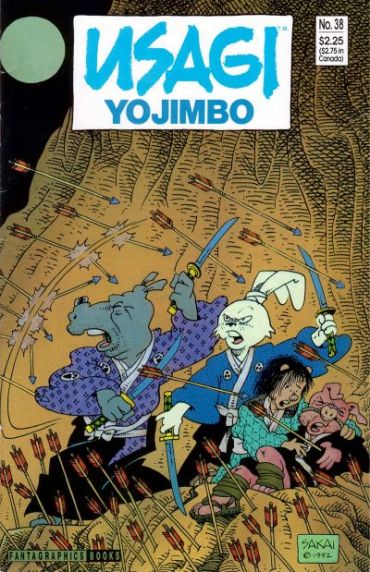
Amazon

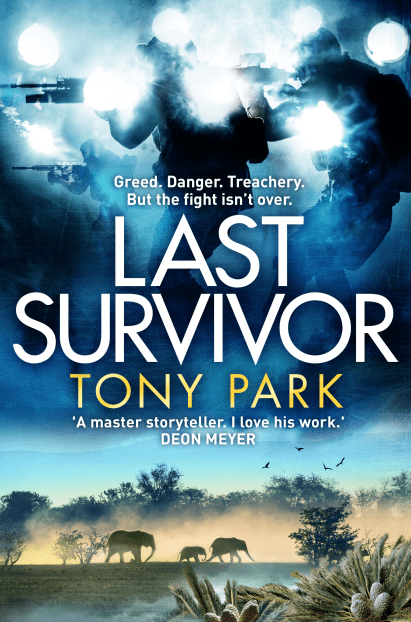
Last Survivor by Tony Park

Last Survivor Cover

Publisher: Macmillan Australia (Trade Paperback – 30 June 2020)

Series: Sonja Kurtz – Book Four

Length: 401 pages

My Rating: 4.5 out of 5 stars

Amazon     Book Depository

The master of the Australian thriller, Tony Park, is back with Last Survivor, another intense and action-packed novel that explores the turbulent and beautiful continent of Africa.

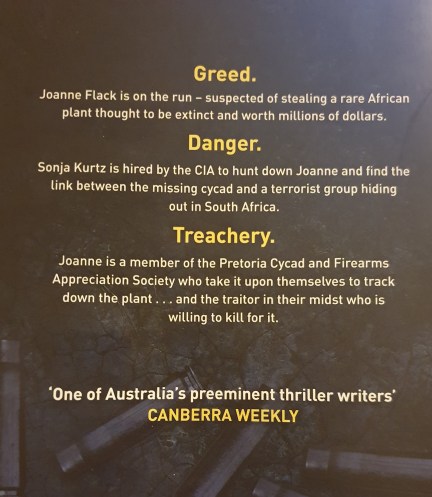
Tony Park is an awesome Australian author who has been writing some great thriller novels since his 2003 debut, Far Horizon.  I have been really getting into Park’s fantastic books over the last couple of years and I really appreciate their excellent adventure storylines, as well as the author’s outstanding use of Africa as a background setting for all his books.  I rather enjoyed his 2018 release, Scent of Fear, and I had an amazing time reading last year’s Ghosts of the Past which had some impressive historical fiction elements to it.  As a result, I was very excited when I received my copy of Last Survivor and not just because it quoted my Canberra Weekly review for Ghosts of the Past on the back (see below).  Last Survivor is the 18th novel written by Park and it also serves as the fourth book to feature his recurring protagonist, Sonja Kurtz.

In Last Survivor, freelance intelligence agent Sonja Kurtz is back and on the trail of a terrorist organisation who are financing themselves through the smuggling of rare cycads.  This story starts with Joanne Flack, treasurer of the Pretoria Cycad and Firearms Appreciation Society, on the run from her home in South Africa, accused of stealing an extremely valuable cycad worth millions of dollars.  However, when Joanne is attacked by a terrorist operative in the heart of London, she flees back to Africa, where she knows how to hide.

Following a dangerous operation in Mali, Sonja Kurtz is given a new mission by her contact in the CIA, who wants her help tracking down Joanne and finding out what she knows about the terrorists who attacked her.  Teaming up with former Fish and Wildlife Services investigator Rod Cavanagh, who has significant history with Joanne Flack, Sonja travels Africa to initiate contact.  However, the moment that Sonja finds her Joanne they are attacked by a team of heavily armed killers, determined to take her out.

With their CIA contact down and everyone now trying to kill them, Sonja, Joanne and Rod flee deeper into Africa seeking refuge where they can.  In order to protect Joanne, they need to work out who is funding their attackers and what their interest in the cycad is.  To that end, Sonja infiltrates the Pretoria Cycad and Firearms Appreciation Society in order to use them as a cover for her investigation.  However, it soon becomes clear that someone in the Society is working for the terrorists, and Sonja and her friends will have to tread carefully if they are to survive the forces coming for them.

Now, that was a fun read.  Park has once again produced another deeply exciting, high-octane thriller that drags the reader in and keeps them engaged until the bitter end.  I really loved this amazing read which combines a fantastic story with a captivating modern-day setting and a focus on a new and unique real-world issue.  Last Survivor is a very easy book to get into and it mostly serves as a great standalone novel.  Readers unfamiliar with Park’s work do not need to check out any of the author’s prior novels first, not even the previous books that featured Sonja Kurtz as a protagonist.  However, those long-term fans of Park will love seeing more of his unique style, as well as the return of one of his few reoccurring characters.

Park has come up with an outstanding and enjoyable thriller storyline for Last Survivor which was addictive, clever and very exciting.  The story revolves around the hunt for a rare cycad, and the protagonists’ attempts to stop the terrorist organisation attempting to obtain it to finance their operation.  This proves to be a fantastic narrative that combines a clever spy thriller story with great character development and impressive action sequences.  The author utilises a number of separate character perspectives to tell the story, allowing for an expansive and enjoyable narrative that splits into several separate plot lines.  I also liked all the fun characters that Park introduced throughout this book, from the troubled Joanne Fleck, whose significant past with Rod Cavanagh adds a lot of drama to the story, to the members of the Pretoria Cycad and Firearms Appreciation Society, heavily armed plant enthusiasts who have a traitor amongst their ranks.  It was also great seeing more of his recurring character, Sonja Kurtz, an aging spy with commitment and trust issues, whose burning love for Africa matches the author’s.  This story goes into some enjoyable directions, and there are several great twists and turns throughout it punctuated by a number of amazing action sequences to really drag in the reader’s attention.  I particularly liked the unique and extended battle sequence that served as the book’s conclusion and it was both intense and entertaining to watch Kurtz and her rag-tag team of elderly African gun-nuts go up against a group of terrorists and criminals.  All of this makes for a fantastic read and I found myself swiftly getting through the entire book in very quick fashion.

Another awesome element of this book is the way that Park once again sets the story throughout various parts of Africa.  Park has a clear and sustained love for Africa, as all his novels are based in or around the continent, which always proves to be an excellent literary setting.  This is once again true for Last Survivor, as the story jumps around various parts of multiple countries such as South Africa, Mali and Zimbabwe.  Each of these different countries prove to be great locations for this book and Park expertly examines several social and political realities of living in these countries, working them into the plot of the story in a compelling and enjoyable manner.  While it is great learning more about these African countries, the real magic occurs when Park takes the story out into the African wilds.  Not only does this prove to be an awesome location for the book’s intense action sequences but the author always provides such powerful and endearing descriptions of the wilderness and its animal inhabitants.  Park’s sheer love of the African countryside really shines through every time that a character considers their surroundings and he always manages to bring these locations to life.  I also like the way that Park uses his stories to examine parts of Africa that he is really passionate about, such as highlighting the damage and evils of illegal poaching, lauding various anti-poaching groups and patrols that are trying to oppose them, and also looking at the various national parks and nature preserves that exist across the various countries.  All of this really makes for a fantastic setting, and I cannot wait to see what new aspects of Africa that Park reveals in his next book.

As I mentioned above, Park routinely uses his thriller novels to throw a spotlight on the evils of poaching in Africa and the organisations and community groups who attempt to combat it.  While there is still a lot of that within this novel, the story mainly focuses on a fascinating new illegal operation that has taken root in Africa, the smuggling of rare cycads.  Cycads are ancient seed plants that have existed since the Jurassic, and while many species can be found around the world, several species are currently on the brink of extinction.  This apparently has led to a thriving smuggling market in Africa with many rare specimens illegally taken out of the country and sold off to rich collectors around the world.  Park really dives into this new illegal trade throughout the book with the story filled with a number of intense discussions about what cycads are, their various biological properties, why some of them are so rare and valuable, and how they are currently becoming a major source of financing for smugglers and terrorists.  This proves to be extremely fascinating, and I really appreciated the information I received learning more about cycads, a subject that I really did not too much about prior to this book.  The illegal cycad smuggling also plays really well into the book’s amazing thriller story, and I really enjoyed how an intense action story revolved around people smuggling plants and the lengths people will go to obtain them.

Last Survivor is another deeply impressive thriller novel from Tony Park, who has once again produced a clever, relevant, and intensely action packed read which you find extremely hard to put down.  I had an incredible time seeing another one of Park’s amazing adventures take place amongst the African wilds and I really love the unique elements he adds to the story.  This is a fantastic and compelling book and it comes highly recommended.

Last Survivor Back Cover

Amazon     Book Depository

Throwback Thursday: Usagi Yojimbo: Volume 10: The Brink of Life and Death by Stan Sakai

Usagi Yojimbo - The Brink of Life and Death

Publisher: Dark Horse Books (Paperback – 1998)

Series: Usagi Yojimbo – Book 10

Length: 215 pages

My Rating: 5 out of 5 stars

Amazon

Reviewed as part of my Throwback Thursday series, where I republish old reviews, review books I have read before or review older books I have only just had a chance to read.

Another week, another Throwback Thursday review of an early volume of one of my all-time favourite comic book series, Usagi Yojimbo, by legendary author and artist Stan Sakai.  This week I will look at the epic 10th volume in the series, The Brink of Life and Death, which proved to be another amazing and exciting five-star read.

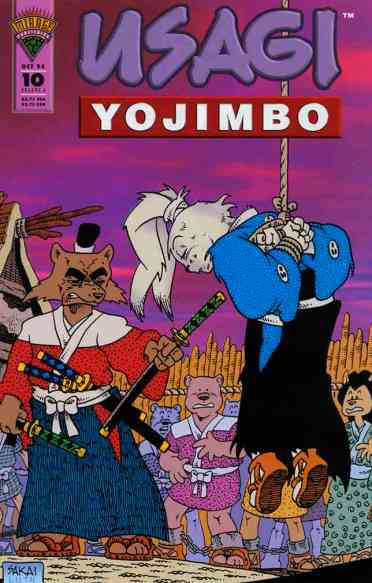
Usagi Yojimbo Mirage 15

The Brink of Life and Death continues the adventures of the rabbit ronin, Miyamoto Usagi, as he travels throughout the lands encountering all manner people and dangers.  This 10th volume is a fantastic addition to the series, featuring a great mixture of stories, from the tragic to the supernatural, and utilising some iconic recurring characters.  This volume is the third that has been collected by Dark Horse Books, and it features a mixture of issues from two separate publishers.  This includes the final issues of the Mirage Comics run on the Usagi Yojimbo series, with Issues #15 and 16, as well a story taken from Issue #13 (the rest of Issue #13 was used in the last volume, Daisho).  It also contains the first six issues of the Dark Horse Books publication run of Usagi Yojimbo and serves as the starting point to Dark Horse’s lengthy connection to the series.  As a result, the volume starts off with a quick recap of the series (titled Origin Tale), containing some very broad strokes and ensuring that new readers could start on this volume if they wanted (although Sakai does make most of his comics fairly accessible to unfamiliar readers).  This volume also contains Dark Horse’s trademark story notes at the end of the volume, which proved to be a particularly intriguing companion to the excellent stories contained within The Brink of Life and Death.

The first story contained within this volume is the intriguing and exciting Kaiso.  In Kaiso, Usagi encounters a local peasant, Kichiro, while wandering on the coast, and travels with him to his village.  There, Usagi becomes familiar with Kichiro’s family and begins to learn more about the village’s main trade, seaweed (kaiso) farming.  While Usagi enjoys the seemingly simple life of the villagers, he soon finds himself involved in a feud with a neighbouring village, who Kichiro believes are poaching their seaweed fields.  However, not everything is as it seems, and Usagi manages to uncover a conspiracy that threatens to destroy his new friends.

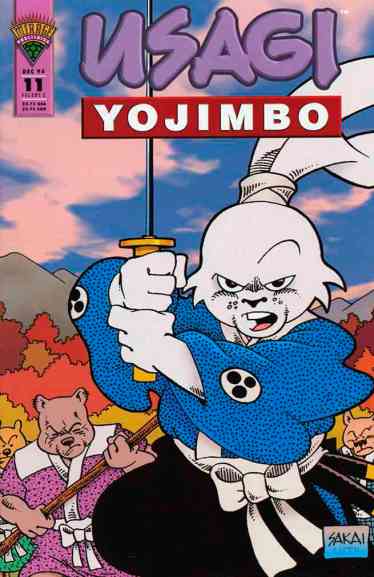
Usagi Yojimbo Mirage - 16

Kaiso is a fantastic and compelling story that once again highlights a traditional Japanese industry, in this case, seaweed farming.  Sakai does a fantastic job exploring seaweed farming in this story, as he introduces and portrays a number of key tools, concepts and techniques involved with the production of edible seaweed, all the way from harvesting it from the ocean to turning it into its dried form, nori.  This examination of seaweed farming serves as a surprisingly good centre for this story, and it is a testament to Sakai’s skill as a writer that he was able to produce an exciting and intrigue filled narrative around this industry in just 20 pages.  There are some great action sequences throughout this story, and it was cool to see Usagi fighting off a bunch of attackers whilst on a small fishing boat, utilising traditional farming tools as weapons.  There are also several impressive drawings throughout this story, as Sakai seeks to capture the beauty of the Japanese coastline as well as the complexities of the seaweed trade.  Kaiso proved to be an awesome first entry in this volume, and its intriguing story content and premise really helps to draw the reader in right off the bat.

The next story within The Brink of Life and Death is a great entry titled A Meeting of Strangers.  While enjoying a quiet lunch at an inn, Usagi watches as a striking swordswoman, later revealed to be called Inazuma, enters the inn.  Wary of this mysterious woman, Usagi bears witness to her skill and ferocity in combat as she takes down a band of bounty hunters who attack her, before departing into the wilds.  However, Inazuma is not the only person being hunted, and soon Usagi finds himself under attack from a group of killers who have been hired to end him.

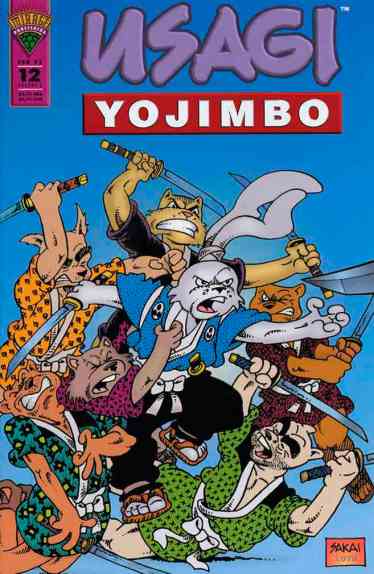
Usagi Yojimbo Dark Horse #1

This is a really good story that showcases Sakai’s ability to quickly introduce an intriguing new character.  Inazuma goes on to become a major figure in the Usagi Yojimbo series for the next 14 volumes, and she gets an amazing introduction in this story, instantly coming across as something new, due to her striking appearance and her tough mannerisms.  Sakai shows early in the story that she is pretty damn dangerous, as Usagi casually reaches for his sword the moment he sees her, a completely new action from the character, which clearly identifies Inazuma as a major threat.  She quickly backs this up with her impressive swordplay, including slicing up the clothes of a local creep, and then taking out a band of bounty hunters.  She has a brutal fighting style as shown in this comic, and I loved her trademark finishing manoeuvre of completely cleaning the blood off her blade with one deft swish through the air.  In addition to the introduction of this great character, other fun elements of the story include the return of the Snitch (who was introduced in the last volume), who facilitates the hit on Usagi.  The Snitch is such a fantastic minor antagonist, and it is really entertaining seeing him running around doing his thing: “money, money, money!”  There is also a particularly impressive fight sequence in the last half of the story between Usagi and the assassins in the woods.  This scene sees Usagi take on over 20 guys in quick succession and is a real showcase of his ability.  There is a particularly fun panel in this sequence which sees Usagi kill several people at the same time, with his defeated opponents arranged in a semi-circle, all of them dying in dramatic fashion while making a different death rattle (including one guy who goes: “Trout, Trout!” for some reason).  All of this was over-the-top and helped show off just how crazy and action-packed this series can be.

The third story in this volume is the short entry Black Soul, which continues to showcase the return of series antagonist, Jei.  During a stormy night, a young girl and her grandfather have their house invaded by three bandits who steal their food and kill the grandfather.  However, the bandits are far from the only predators out that night, as the mysterious and frightening Jei appears at the door.  This was a great story that added a lot of key elements to the character of Jei in only a few pages.  Jei’s sudden appearance is suitably dramatic, and it shows off how terrifying he can be.  I loved the way that Sakai portrayed Jei’s fight against the three bandits, as all you see is several drawings of the hut’s exterior while terrified screams run out.  The story then returns to the interior of the house, where the bandits’ corpses are strewn around the house, including one guy who is hanging upside-down from the rafters, dripping blood.  Not seeing what actually happened makes the reader imagine the very worst scenario, and it really amps up the dread that this antagonist emanates.  Sakai then continues to hint at Jei’s more supernatural abilities by having him ‘consecrate’ the spear of one of his fallen opponents, with the blade visibly turning black in his hands, matching the soul of the wielder.  Perhaps the most interesting part of the story is the young peasant girl, Keiko.  At first it appears that Jei is going to kill her; however, he stops after not sensing any evil in her.  This is the first time we have seen Jei show mercy, and it is a defining moment for the character, especially as Keiko starts following him as his companion.  Having Jei care for a young girl really adds to the complexity around Jei’s character, and in many ways it makes him seem even more evil, as he is corrupting this innocent with his dark crusade.  Overall, Dark Soul is a great and scary story which leaves the reader wanting to see more of this fantastic antagonist.

Usagi Yojimbo Dark Horse #2

Now we move on to Noodles, the only multi-issue entry in the volume which contains a powerful and impressive narrative that I really enjoyed.  In Noodles, Usagi enters a new town, only to be immediately accosted by the police, who are searching for a thief behind a recent crime wave.  Proving his innocence, Usagi swiftly finds out the source of the recent crimes is his friend Kitsune, who is up to her usual tricks.  Kitsune has a new companion, a soba noodle street vendor and mute giant known only as Noodles, who assists Kitsune to hide from the police.  However, Kitsune has underestimated the deviousness and corruption of the local police administrator who puts a deadly plan into place to save his own skin.

This was an incredible entry in this volume, and I have a lot of love for Noodles’s fantastic crime narrative.  Sakai crafts together a fantastic storyline that follows Usagi as he meets up once again with the entertaining side character Kitsune and intriguing new character Noodles.  Kitsune is her usual fun self, and the introduction of the mute gentle giant Noodle adds a lot of dimensions to her character.  Up to now, Kitsune has been shown to be a generally good person, although she is motivated by greed or a sense of mischief.  However, in this story, she is given someone to care for, and she is determined to protect him no matter what.  Unfortunately, this leads to some great tragedy for her, which I found to be extremely moving, and you cannot help but feel bad for her.  Luckily, this leads to a rather good revenge plot in the second part of the story, which gives Noodles a satisfying and enjoyable ending.  This entire story was extremely well written, combining together humour, intrigue, character interactions and some genuine tragedy to produce an epic and compelling read.  I also really enjoyed Sakai’s amazing depictions of life in a larger feudal Japanese town, and it is clear that he did a lot of research to show what day-to-day life would look like, as well as examining how the criminal justice system worked during this period.  There are some really impressive drawings throughout this story, from the multiple detailed street and crowd views filled with all manner of activities and people (there is a sneaky shot of Jei and Keiko walking through town at one point), to the amazing action sequences, including a great scene where the gigantic Noodles is attacked by the police.  However, I really must highlight a particularly gruesome execution sequence that was a key part of the story.  While this scene is sad and horrifying, it is extremely well drawn, very memorable and it does its job of producing a major emotional response from the reader.  Noodles is probably the best entry in this entire volume, and I cannot praise just how amazing its clever and captivating story is.

Usagi Yojimbo Dark Horse #3

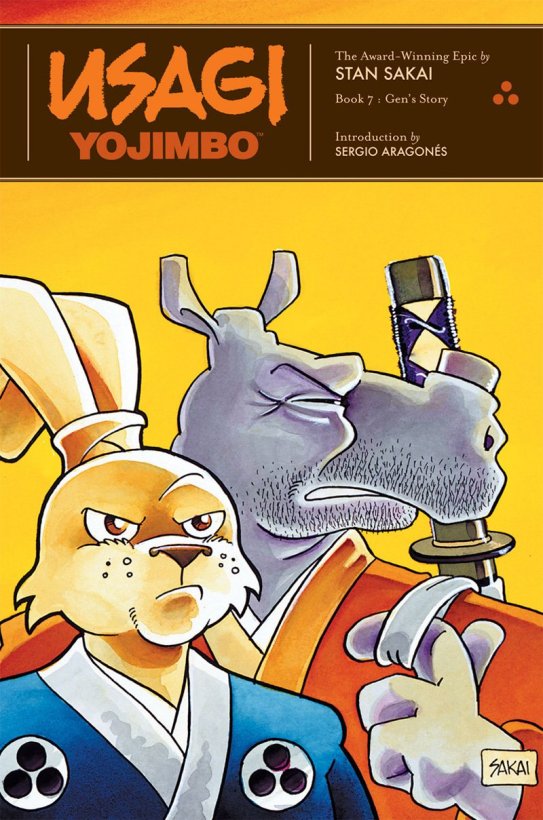
The next story within this volume is the supernatural tale, Wrath of the Tangled Skein, which sees Usagi arrive at a local inn which is experiencing some trouble.  A rich merchant’s daughter has been taken mysteriously ill, and her entourage fear that it is the work of a demon or haunt, picked up from their travels through the dangerous forest known as The Tangled Skein.  Usagi, who has previously travelled through The Tangled Skein (back in Volume 7: Gen’s Story), offers his assistance and takes command of the merchant’s ronin while they wait for a priest to arrive.  It does not take long for events to come to a head, and Usagi finds himself facing off against dangerous and malicious terrors.

I really like it when Sakai does a supernatural tale in the Usagi Yojimbo series, and this one was particularly awesome as the author expertly utilises some fascinating creatures from Japanese mythology.  There are two separate monsters contained within this story.  First you have the nue, a terrifying chimeric creature with the head of a monkey, the body of a badger, the legs of a tiger and a snake for a tail.  Needless to say, this is a particularly weird creature, and Sakai does a fantastic job drawing it and then portraying a chaotic and dangerous fight around it as Usagi attempts to defeat it.  In addition to the nue there is also a tanuki, a shape-changing racoon dog, who manages to trick Usagi and almost costs him everything.  I really loved the designs of both these creatures within the comic, and it was extremely cool to see and learn more about these facets of Japanese culture and tradition.  This story is set up extremely well, and the author has a great blend of action, supernatural intrigue and fun character moments.  Wrath of the Tangled Skein also introduces the character of Sanshobo, a Bonze priest who goes onto become a key recurring character, helping to make this a significant and important entry in the Usagi Yojimbo series.

Up next we have another short character-driven tale, The Bonze’s Story.  In this entry, Usagi travels with the Bonze priest Sanshobo after the events of the previous story.  The two quickly find camaraderie with each other, especially when Usagi realises that his companion is a former samurai.  Sanshobo then relates the tragic tale of how he gave up his warrior ways, which occurred when the young son of his lord accidently died in his care.  This forced Sanshobo’s own son to take his own life to restore his family’s honour, an event that broke Sanshobo.  This was a rather fascinating tale that does a lot to cement interest in a new side character.  The origin tale for Sanshobo is really good, and the whole story of sacrificing a son to save honour is extremely captivating and memorable.  The entire background story is drawn amazingly, and the various expressions of horror, sorrow and pride on the face of participants as they attempt to survive in a storm are quite exceptional.  This was another amazing example of what sort of impressive story Sakai can tell in only a few short pages, and The Bonze’s Story definitely sticks in the mind.

Usagi Yojimbo Dark Horse #4

Following this shorter tale, we have the fun, action-packed Bats, the Cat and the Rabbit.  In this entry, Usagi seeks shelter in an old temple, but his quiet night is ruined when several Komori Ninja arrive, seeking a specific prey.  After they leave, Usagi discovers that the person they are hunting is an injured Chizu, the leader of the Neko Ninja.  Helping her, Usagi learns that she is carrying a valuable and dangerous scroll that the Komori Ninja are desperate to obtain.  Can Usagi and Chizu keep it out of their hands, or will a powerful new weapon be unleashed upon the lands?

Bats, the Cat and the Rabbit was an exciting and entertaining entry that sees Usagi reunited with one of his potential love interests Chizu, who we last saw back in Volume 8: Shades of Death.  This is a fast-paced story that focuses on the conflict between two rival ninja clans, Chizu’s Neko Ninja and the Komori Ninja.  The Komori Ninja, giant bats with blades on their wings who had an amazing introduction back in Volume 5: Lone Goat and Kid, are fantastic antagonists for this story, and it is always cool to see them in action, especially when Sakai draws them slicing through trees to get their prey.  The highlight of this story is the impressive ninja-on-ninja combat, as the more traditional ninja techniques of Chizu and the Neko Ninja go up against these flying opponents, all with Usagi in the middle.  This results in some epic fight sequences which end up being a lot of fun to see come to life.  I also really enjoyed the fantastic conclusion to this story, which not only has a great twist but which also adds a bit of tragedy to the life of Chizu, as she reflects on what constitutes duty for ninja.  An overall awesome and enjoyable story, this was another fantastic entry in this volume.

The penultimate entry in The Brink of Life and Death is the gripping story, The Chrysanthemum Pass.  After humiliating a group of thugs in a town, Usagi obtains a new travelling companion, Icho, a wandering medicine peddler.  The two become friendly as they wander around the mountains, but Icho is not what he seems.  Instead, he is secretly a member of the Koroshi, a notorious assassins’ guild, and is planning to take out a rich lord who is travelling through the Chrysanthemum Pass, and Usagi is also on his kill list.

Usagi Yojimbo Dark Horse #5

This was another outstanding story.  I loved the entire cleverly written narrative, which sees Usagi dragged into the middle of another devious plot.  Having his companion, Icho, turn out to be secretly evil was a fantastic choice by Sakai, and he sets it up perfectly, with only minor hints of his true intentions being revealed to the reader until about halfway through the story.  The rest of the story deals with Icho trying to subtly kill Usagi before his assassination mission and failing, allowing Usagi to be in the midst of the events in the pass.  This story then features a number of fantastic twists, including the fact that Usagi suspected that Icho was an assassin the entire time, implying that his reasons for travelling with him was to keep an eye on him and intervene if he was proven correct.  It was great to see the return of the Mogura Ninja, ninja moles with some really cool character designs who were introduced in the very first volume, The Ronin, and they once again proved to be surprisingly effective adversaries.  This story also serves to introduce a new group of antagonists for Usagi, with the first mention of the Koroshi assassins’ guild, whose various members tangle with Usagi multiple times throughout the rest of the series.  The Chrysanthemum Pass is therefore a fantastic and notable entry within this volume, and it ended up having quite an impressive story.

The final story in this volume is Lightning Strikes Twice, a powerful and captivating entry which provides new background for new character Inazuma.  In this story, Usagi once again runs into the mysterious Inazuma after finding several dead bodies on the road.  Encountering her within a temple, surrounded by other travellers, Usagi sits and listens to her tragic tale of love, loss and revenge as she recounts how she became so skilled with the sword, and the reasons why she is constantly being hunted throughout the lands.

Usagi Yojimbo Dark Horse #6

This was another epic story that really helps to build up Inazuma as an impressive and unique character within the series.  Her entire backstory as a girl who followed her heart and then lost everything is really emotional and humanising, adding layers of complexity to her rough exterior.  It was rather jarring to see such a strong woman stay with an abusive and uncaring partner, and it serves as an intriguing starting point for her road to exceptional warrior.  I enjoyed seeing her learning the way of the sword, and Sakai really builds her up as a natural prodigy with the blade.  Despite the humanising aspects of this story, Inazuma again comes across as a major badass within this story, thanks to the bloody fight sequence at the beginning, where she swiftly takes down a band of assassins with some very fancy moves, as well as the sequence at the end of the origin story, where she shows just how dangerous and cruel she can be.  I also absolutely loved the shocking reveal at the end of Lightning Strikes Twice where Usagi discovers that the people who have been quietly sitting through Inazuma’s story with him are all dead bounty hunters, which adds a real edge to Inazuma and her actions.  Lighting Strikes Twice proves to be a truly compelling and exciting tale, and I really liked learning more about this intriguing new character.  I also really appreciated how it tied into the previous Inazuma story and it ended up being a fantastic way to end the entire volume.

This 10th volume of the incredible Usagi Yojimbo series, The Brink of Life and Death, is another outstanding and addictive creation from Stan Sakai that features several impressive stories.  I loved this amazing combination of tales, and it was great seeing both standalone stories and entries that have deeper ties with the rest of the series.  Filled with awesome character moments, stunning artwork, and detailed depictions of feudal Japan, The Brink of Life and Death is a must read for fans of this series, and Sakai should be very proud of what he accomplished with this volume.

Amazon

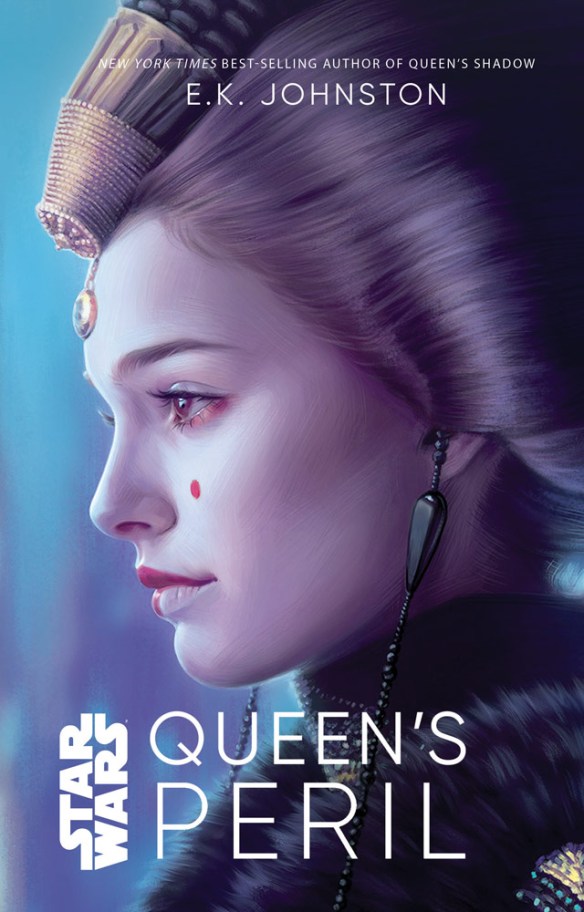
Star Wars: Queen’s Peril by E. K. Johnston

Queen's Peril Cover

Publisher: Random House Audio (Audiobook – 2 June 2020)

Series: Star Wars

Length: 6 hours and 10 minutes

My Rating: 3.75 out of 5 stars

Amazon

Prepare to dive back into a galaxy far, far away, as bestselling young adult author E. K. Johnston presents the very first Star Wars novel of 2020, Star Wars: Queen’s Peril.

Padmé Naberrie has always wanted to serve the people of her home planet of Naboo, and she knows that the best way to do that is to become Queen. Entering the competitive election, the 14-year-old politician is elected as ruler of Naboo. Casting aside her real identity for the protection of herself and her family, Padmé takes on a new name, Amidala, and moves into the royal palace, determined to bring change to Naboo. However, even a ruler as brilliant and diplomatic as Padmé is unable to do everything by herself, and she finds out that she is going to need help.

In order to keep her safe and to assist her with her needs, Padmé is introduced to a group of talented young women who will serve as her handmaidens. Acting as her assistants, confidantes, bodyguards and decoys, each of her handmaidens brings something different to the group, and it is up to Padmé to turn them into an effective team. Together, Padmé and her new friends seem capable of dealing with any challenge that may impact them.

However, there is a dark plot at work within the Republic, and its mastermind has Naboo in their sights. Soon Naboo is invaded by the armies of the Trade Federation, who seek to capture Queen Amidala and force her to sign away the planet. Forced to flee in disguise, Padmé sets out to reclaim her home and will do anything to free her planet. While Jedi, soldiers and a young chosen one may rally to their cause, the fate of Naboo ultimately rests on the shoulders of a young queen and her loyal handmaidens.

Queen’s Peril is an intriguing and enjoyable new addition to the Star Wars canon from bestselling author E. K. Johnston. I have been rather enjoying some of Johnston’s recent Star Wars releases, and I had a fun time reading her 2016 novel, Ahsoka, as well as last year’s fantastic release, Queen’s Shadow. Queen’s Peril is the first of several Star Wars books being released in 2020 (although some have been delayed), and I have been looking forward to seeing how this book turns out. This new novel acts as a prequel to Queen’s Shadow and is set both before and during the events of the first Star Wars prequel film, The Phantom Menace. This ended up being a fun and interesting read that explores some unique parts of Star Wars lore.

This latest Star Wars novel contains an intriguing tale that starts from the moment that Padmé is elected queen and takes on the Amidala persona. The first two thirds of this book follow the early days of Amidala’s reign, introducing Padmé and her handmaidens and showing how they became such a tight-knit team. There are a number of great moments during this first part of the story, and it was interesting to see the origin of a number of elements of the Amidala character that are shown in The Phantom Menace, such as her voice, the establishment of the decoy system, and a huge range of other compelling features. There are also several scenes that are dedicated to exploring why the Trade Federation decided to target Naboo and what the origins of their conflict were. I really enjoyed the first two thirds of this book, and I feel that the final third kind of let it down a little. The last part of the book focuses on the invasion of Naboo and follows the events of The Phantom Menace. While it was cool to see some different perspectives on the events of the film, this part of the book felt rather rushed, as the narrative jumped between a number of sequences from the movie in rather quick succession. Despite the problems with the ending, this was still a rather compelling story, and I did enjoy Johnston’s additions to the Star Wars universe.

While on the surface this book appears to be purely about Padmé, Queen’s Peril is actually about a number of different characters who made Padmé’s role as Queen Amidala possible. Padmé is naturally one of the main characters of the book, but all five of her handmaidens are just as important to the story. Johnston previously introduced each of these handmaidens in Queen’s Shadow, and briefly explored their unique skills and what they brought to the group. She does this again in Queen’s Peril, although this is done in greater detail, as this book shows each character’s history and how each of them became a handmaiden. Each of the handmaidens is given a distinctive personality, and all five get a number of scenes told from their point-of-view. I really enjoyed learning more about these characters, and it was great to see them come together as a group and work towards ensuring that Padmé was protected and an effective queen. While each of the characters are explored in some detailed, the biggest focus is on Sabé, Padmé’s first handmaiden and her main decoy (played by Keira Knightly in the film). The author spends time showing the unique relationship between Sabé and Padmé, and it was captivating to see the trust between them grow. Because she was so heavily focused on in the movie, Padmé does not get a lot of scenes in the last third of the book, so quite a bit this part of the story is told from the perspective of all the handmaidens. It was rather interesting to see how each of these characters went during the course of the film, and it was particularly cool to see some scenes with Sabé as she pretended to be the Queen.

In addition to Padmé and her handmaidens, Queen’s Peril also featured point-of-view chapters or scenes from pretty much all the key characters from The Phantom Menace film. The use of all these extra characters was an interesting choice from Johnston, and I liked how it expanded the story and showed some fresh perspectives and backstory for several major Star Wars protagonists. Most of these appearances are rather brief, with characters like Anakin, Obi-Wan Kenobi and Qui-Gon Jinn only getting a few minor scenes. However, other characters do get some extended sequences, especially Captain Panaka, the head of Amidala’s palace guards. Several chapters are told from Panaka’s perspective, and he becomes quite a key character within the book, mainly because he is the person who finds and recruits all of the handmaidens. Panaka is a major driving force of the plot, and it was interesting to see his role expanded from the films, especially as you get more insight into why he is so dedicated to the Queen. I also really liked how the book features several sequences told from the perspective of Senator Palpatine/Darth Sidious. These scenes were fun, as they showed a lot of Palpatine’s earliest manipulations, including how he was able to organise the invasion of Naboo. Overall, I rather appreciated how the author utilised all the characters within Queen’s Peril, and watching their development and interactions proved to be quite compelling.

Like the author’s other Star Wars novels, Queen’s Peril is intended for a young adult audience, and Johnston does a fantastic job tailoring it towards younger readers. This book has a lot of great young adult moments to it, especially as it focuses on a group of teen girls working together to outsmart a variety of adults and then eventually save their entire planet from an invasion. Queen’s Peril has some fantastic portrayals of these teen protagonists, and there are a number of sequences which show them stepping up or dealing with complicated issues that younger female readers will appreciate. While it is intended for younger readers, Queen’s Peril, like most young adult Star Wars novels, is also very accessible to all readers who are major fans of the franchise, and it is easy for older readers to get into and enjoy the plot of the book and its intriguing new additions to the Star Wars lore.

I did have a minor complaint about the release order of the books in Johnston’s series about Padmé. While I enjoyed both Queen’s Peril and Queen’s Shadow, I really do think that it was an odd decision to release Queen’s Shadow first, and then release a prequel novel a year later. It would have been better to release Queen’s Peril first to introduce the various handmaidens and help build up the emotional connection between them and Padmé, making their use and inclusion in Queen’s Shadow a bit more impactful. It might also have made a bit more sense to have Queen’s Peril only focus on events before The Phantom Menace, have another book focus exclusively on what was happening with the handmaidens and Padmé during the course of the film (which would have ensured that Queen’s Peril did not feel as rushed as it did towards the end), and then release Queen’s Shadow. While I am sure that there is some reason why the order for these books was a bit off, probably at the publisher level, I think they could have planned this out a little better.

I ended up grabbing the audiobook version of Queen’s Peril, and I had a great time listening to this book. Queen’s Peril has a short run time of just over six hours, so it is rather easy to get through this book quickly. Like all Star Wars audiobooks, this version of Queen’s Peril was a real auditory treat, due to the excellent use of the iconic Star Wars sound effects and scores from the movies, which are used to enhance each of the scenes. While it was great to once again hear all the fantastic music and intriguing background noises, Queen’s Peril’s greatest strength as an audiobook comes from its fantastic narrator, Catherine Taber. Taber is the actress who voiced Padmé in The Clones Wars animated television show, and, short of getting Natalie Portman in, is the perfect person to narrate a novel about the character. Taber also narrated the previous Johnston book about Padmé, Queen’s Shadow (indeed all of Johnston’s Star Wars books have featured the character’s voice actor as a narrator for their audiobook), and it was great to see her return. She naturally does a perfect voice for the character of Padmé, as well as for the handmaidens, who had similar speaking patterns due to their role as decoys. There are some great vocal scenes between these characters, especially when they are trying to perfect the Amidala voice, and they go through several variations throughout the book. In addition, because Queen’s Peril features nearly every major character from The Phantom Menace, Taber also had to voice several different people who were brought to life by some amazing actors in the original film. I felt that Taber did a fantastic job as imitating some of these voices, and it proved to be a real showcase for her skills as a voice actor. Overall, I had an amazing time listening to this audiobook, and I would strongly recommend this format to anyone interested in checking out Queen’s Peril.

Star Wars: Queen’s Peril is an intriguing and exciting new young adult Star Wars release from E. K. Johnson that acts as a sequel to her previous awesome novel, Queen’s Shadow. Johnston comes up with another compelling story that explores the early life of Padmé/Queen Amidala and her loyal handmaidens. While it does have some flaws, it is a very good book, and it should prove to be a fun read for established fans of the franchise and younger readers who are interested in breaking into the expanded universe. I had an amazing time listening to this book and I look forward to seeing what sort of Star Wars story Johnston produces next.

Amazon

Throwback Thursday: Usagi Yojimbo: Volume 9: Daisho by Stan Sakai

Usagi Yojimbo Daisho Cover

Publisher: Dark Horse Books (Paperback – 1998)

Series: Usagi Yojimbo – Book 9

Length: 215 pages

My Rating: 5 out of 5 stars

Amazon

Reviewed as part of my Throwback Thursday series, where I republish old reviews, review books I have read before or review older books I have only just had a chance to read.

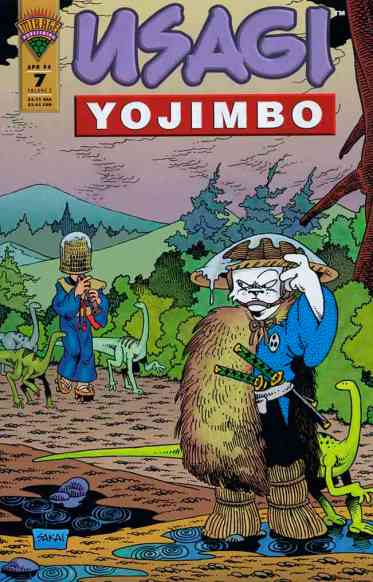
Usagi Yojimbo Mirage - #7

It has been another good week of reading and reviewing for me, so I thought I would reward myself by doing a Throwback Thursday review of Daisho, the ninth volume in the outstanding, long-running Usagi Yojimbo series from one of my favourite authors, Stan Sakai.

Daisho is an impressive and exciting entry in the series, which unsurprisingly gets a five star rating out of me (full disclosure, every volume of this series is going to get five stars from me, it is just that damn good). This volume contains Issues #7-14 of the second run on the Usagi Yojimbo series, which was originally published by Mirage Comics (Issues #7 and #8 are only partially represented in Daisho as some stories from these issues were used in the prior volume, while a story from Issue #13 appears in the tenth volume that I will review next), and which has been collected into this volume by Dark Horse Books. This ninth Usagi Yojimbo volume is filled with several fantastic and creative stories that follow Usagi as he journeys across the land, getting into all manner of trouble and misadventures in this version of feudal Japan populated solely by anthropomorphic animals. Daisho serves as a significant inclusion in the overarching series, due to its connections to previous stories, and its introduction or resurrection of several key characters.

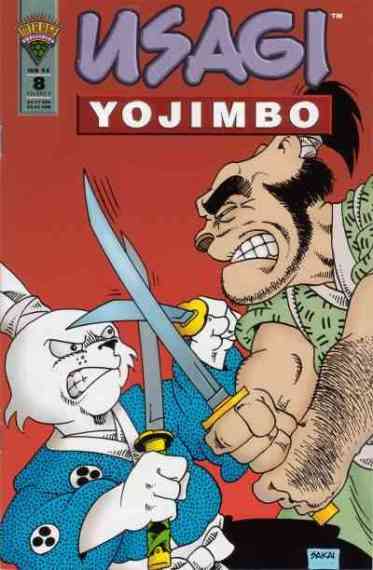
Usagi Yojimbo Mirage - 8

This volume starts off with an inspiring and tragic story, The Music of Heavens, which once again sees Usagi traversing the wilderness. His solitude is broken when he encounters the pack of Tokage lizards who he unwittingly befriended in a previous story, The Lizards’ Tale (which was featured in Volume 8: Shades of Death). While Usagi is less than thrilled to see the Tokages, they end up leading him towards another traveller who is making their camp in the woods. The traveller, Omori Kazan, is a mendicant Buddhist priest and skilled musician, who invites Usagi into his camp and talks to him about the various forms of music he studies. However, someone is stalking their camp, determined to get revenge and unafraid to kill an innocent bystander to get it.

I really liked The Music of Heavens and it proved to be a compelling first entry in this volume. The story is based on Usagi’s encounter with a new character, Omori Kazan. Kazan is an intriguing person due to his position as a komuso monk (the monks of emptiness) of a particular sect of Buddhism, which lends him a very distinctive look thanks to the woven basket hat (tengai) he wears on his head disguising his features. Kazan has an amazing arc that delivers a lot in a short while, as he introduces himself to Usagi and the reader, discusses music and religion, and then simultaneously meets his end while also experiencing the divine for the first time. This entire character arc is both beautiful and tragic at the same time, and it provides both Usagi and the reader with some significant emotional moments, especially when it comes to Usagi’s farewell to the Tokages. I also liked how Sakai utilises an antagonist from a previous story, and the fight between Usagi and this character was swift and well-drawn. This was an excellent introductory entry for this volume, and it is a story that I really enjoyed.

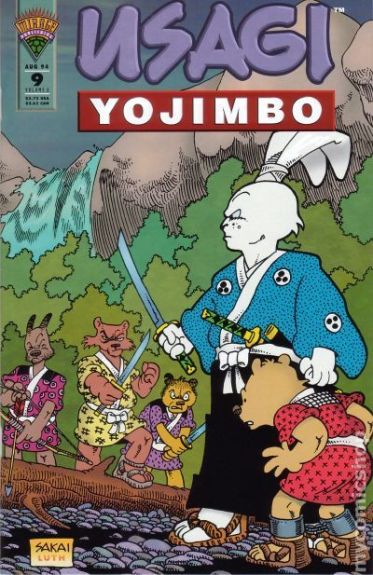
Usagi Yojimbo Mirage - 9

The second story in Daisho is the entertaining and clever entry, The Gambler, the Widow, and the Ronin. This story reintroduces the gambler from the previous story, The Duel (featured in Volume 6: Circles), who is up to his old tricks of organising deadly sword duels and cashing in on the bets of the local townsfolk. After the death of his previous samurai accomplice, Shubo, during a duel with Usagi, the gambler has been forced to find a new partner, the brutish and less skilled swordsman, Kedamono. However, Kedamono’s greed has convinced the gambler that it is time to end their partnership, and he quickly finds the ideal solution when Usagi arrives in town. However, as the gambler plots, he fails to realise that he is being stalked by Shubo’s widow, who is determined to get her revenge for the role he played in her husband’s death.

This was another amazing story that serves as a fantastic follow-up to a great prior Usagi Yojimbo story. I always get a real western vibe out of The Gambler, the Widow, and the Ronin, due to its title and the premise around a duel, it proves to be an excellent entry in this volume. Usagi is once again drawn into the plots of the gambler, and thanks to his humility, honour and good manners, which are mistaken as a weakness, both Kedamono and the local villagers are convinced that Usagi is a poor swordsman. However, the gambler, who has seen Usagi in action before, manipulates the odds so that he wins all the money when Usagi defeats his opponent, in a fun reversal of the events of The Duel. This was an incredibly entertaining scene as Usagi is again forced to deal with a bloodthirsty crowd, while the gambler feigns being saddened by the loss of his companion, despite being secretly delighted. However, the gambler ends up getting his comeuppance, and the widow, whose sad final scene was so memorable in The Duel, finally gets a small measure of justice. This was a very clever and enjoyable story, and I really loved how Sakai dived back to a prior standalone story to provide some closure and a fun continuation.

Usagi Yojimbo Mirage - 10

The next story is called Slavers, and it is a longer entry made up of two separate issues. In Slavers, Usagi encounters a young boy being pursued by bandits. Usagi defeats them and learns that the boy was attempting to get help for his village, which has been taken over by a gang of bandits who have enslaved the villagers as part of a destructive scam to steal their harvest and make a small fortune. Deciding to help the villagers, Usagi infiltrates the gang and attempts to rally the villagers to his cause. However, the gang’s leader, the villainous General Fujii, discovers the deception and captures Usagi, planning to kill all the villagers to make good his escape. Slavers is an amazing story that is not only intriguing in its own right but which also expertly sets up the series of follow-up stories that make up most of this volume. While the standalone narrative of Slavers gets a bit dark at times, due to an extended capture scene surrounding Usagi, it is a rather compelling story filled with action, deception and struggles against adversity.

Slavers is quickly followed up by three separate but distinct stories that can be combined together with Slavers into one large narrative that wraps up all the loose ends from the initial entry. The first one of these stories, Daisho Part One, sees Usagi in hot pursuit of General Fujii, who is in possession of Usagi’s precious swords. Due to the brutal actions of Fujii, Usagi loses his quarry and is forced into an extended hunt for him, eventually coming to a ransacked village. It turns out that the village had recently been raided by Fujii’s new gang, and Usagi must make a hard choice between recovering his soul or helping those in need.

Usagi Yojimbo Mirage - 11

I have a lot of love for Daisho Part One; it is probably one of my favourite entries in this entire volume. The story starts out with a magnificent and beautifully drawn sequence that shows the various elaborate processes by which a samurai’s swords are created. This impressive opening sequence is one of my favourite pieces of Usagi Yojimbo art from the entire series, and its creation highlights not only Sakai’s skill as an artist but his ability to research and portray intriguing parts of Japan’s unique culture and heritage. This sequence also shows the important a samurai’s swords to their wielder, as they are reflections of that warrior’s soul. This key concept is then brought to life in the main story, as it sees a somewhat unhinged Usagi risking everything to reclaim his swords from Fujii. Sakai does an outstanding job showing off how frustrated and enraged Usagi is at having his swords stolen from him, and he comes across as being quite frightening several times through the story. Usagi’s anger comes to a head when he reaches the village and his initial decision is to abandon the villagers and immediately follow Fujii and his men. However, a local village girl is able to shame him into thinking of others, and the old Usagi returns, providing aid to the villagers. This was an extremely compelling story that does a wonderful job combining a powerful, character driven narrative, with some exquisite artwork and some intriguing aspects of history, into an exceptional entry in this volume.

The next story in this volume is Mongrels, a quick story about a recurring Usagi Yojimbo side character, the bounty hunter Gen, which occurs around the same time as Daisho Part One. In this story, Gen enters a village and starts asking questions about his current bounty, General Fujii. However, he is not the only bounty hunter in town, as he soon encounters the notorious hunter Stray Dog, who is also hunting for Fujii. After a tense conversation, the two-part ways; however, both are determined to capture Fujii and outsmart their competition. This was a fun story that not only brings Gen into this multi-issue narrative but also introduces a couple of great recurring characters. Stray Dog is a fantastic character in the Usagi Yojimbo universe, and he often appears as a compelling rival (and sometime partner) to Gen (such as in the latest Usagi Yojimbo volume, Bunraku and Other Stories). This story serves as a swift and clever introduction to the character, and it was fun to see the rivalry between Gen and Stray Dog form so quickly. Mongrels also introduces the extremely entertaining side character, the Snitch (also called Toady), a sneaky, greedy character who provides information to the highest bidder. While the Snitch has only a short appearance in this story, he is going to start appearing in a lot of follow up volumes, and it is always fun to see where a character starts out. Overall, this was a great story that fits a lot of significant introductions and events into a few short pages.

Usagi Yojimbo Mirage - 12

The final story in this arc surrounding General Fujii is Daisho Part Two, in which Usagi and his guide meet up with Gen and Stray Dog right at the end of Mongrels. The three samurai decide to team up to raid General Fujii’s lair, and they engage in an all-out fight for money and honour. However, not everyone on the team is keen to work together, and betrayal is afoot. This was an excellent conclusion to the entire storyline, which I really enjoyed. This is a story chocked full of action, as the entire narrative sets up a massive fight between multiple combatants within an abandoned temple. There is some great character work within this story, not only from the protagonists, who bicker and fight amongst themselves, but also with the major antagonist, General Fujii. There some intriguing scenes that show Fujii’s efforts to lead and control a gang of bandits and cutthroats, and I also liked how Sakai shows him being haunted by thoughts of Usagi, whose swords he is holding onto. Usagi and Fujii finally get their showdown in this story, and it served as a fantastic end to this whole extended narrative. There are also some compelling moments surrounding Stray Dog, as he seeks to cheat the others out of the reward money for Fujii. While this initially paints him in a bad light, the source of his need for money is quickly shown, and it highlights just how complex and multifaceted this new side character is. I really liked how this entire story narrative ends, and Daisho Part Two is an excellent part of this volume.

The next story in this volume is the two-part entry, Runaways. In Runaways, Usagi journeys through a small town, when he finds himself in the path of a procession of the local noble lady. Hearing the lady’s name, Usagi is thrown back into the past as he remembers an adventure that occurred many years prior, when he was in the service of Lord Mifune. After finding out that the love of his life, Mariko, has married another man, Usagi is given a seemingly simple mission as a distraction. His task, to escort the young Princess Kinuko to the lands of her future husband, becomes infinitely more complicated, when their party is ambushed by a horde of Neko Ninja. Escaping with the princess, Usagi disguises Kinuko as a peasant in an attempt to hide her from their pursuers. However, the more time that Usagi and Kinuko spend together, the closer they become, until the lines of duty, honour and station become extremely blurred.

Usagi Yojimbo Mirage - 13

This was another exceptional story within the volume, and I liked how it flashed back to an adventure during his pre-ronin life. Set during the period when Usagi served Lord Mifune (as shown in Volume 2: Samurai), Runaways contains a powerful and emotional narrative that is actually based on Roman Holiday (Sakai is a massive Audrey Hepburn fan), which sees a princess run away with a strong male protagonist and grow close to him, despite her responsibilities and their differences in station. This proves to be a fun, if extremely loose adaption of the movie, and Sakai builds up a complex relationship between Usagi and Kinuko, as the two characters, both tragic victims of circumstances when it comes to love, grow closer to each other. However, despite their feelings, this relationship is fated to never be, and it ends in heartbreak, with the memories of it haunting both Usagi and Kinuko years later. I really liked how this story played out, and it was interesting to see aspects of samurai honour folded into the narrative from Roman Holiday. Other fantastic highlights of this story include the multitude of impressive fight scenes between Usagi and the Neko Ninja, starting with a major battle between two large groups of samurai and ninja. I also liked the exploration of the traditional Tanabata Matsuri festival that the two characters find themselves attending, especially as Kinuko has fun experiencing local customs, foods and activities that someone of her station will never get to enjoy. It was also cool to see an early adventure from Usagi, especially as this entry foreshadows events that have occurred in other volumes, including the return of several now-dead characters, such as Shingen (future leader of the Neko Ninja, who was introduced in Volume 3: The Wanderer’s Road, and died in Volume 4: The Dragon Bellow Conspiracy). An overall exciting and impressive story, Runaways is an amazing highlight of this volume.

The final entry is the short story, The Nature of the Viper. In this tale, a local fisherman finds the badly injured body of Usagi’s recurring foe, Jei, after he was thrown from a cliff during the climatic events of Circles. Bringing him back to his hut, the fisherman tends to Jei and manages to save his life. When Jei awakens, he shows his gratitude to the farmer be recounting a tale of viper and a peasant (a version of the classic fable, The Farmer and the Viper), before killing him and resuming his hunt for Usagi. This is a good, short entry that shows the fate of Jei after his last appearance. Jei comes across just as villainous and creepy as ever, and it was fun seeing the fisherman slowly realise just how much trouble he is in as the story progresses. While having a villain recount The Farmer and the Viper as justification for why they are killing a person is somewhat cliched at this point (although to be fair, this story was written back in the 90s), it was still a fantastic sequence. I think that this was an excellent way to end the volume, especially as the reader is left knowing that Jei has returned and that Usagi will be encountering him once again in the future.

Usagi Yojimbo Mirage - 14

Sakai has once again knocked it out of the park with the ninth volume in his series. Daisho contains several outstanding and memorable stories that are all wildly entertaining and contain some clever links to past and future entries in this series. I had an absolute blast reading this volume, and it is an extremely strong addition to the incredible Usagi Yojimbo series that comes highly recommend.
Amazon

We are the Dead by Mike Shackle

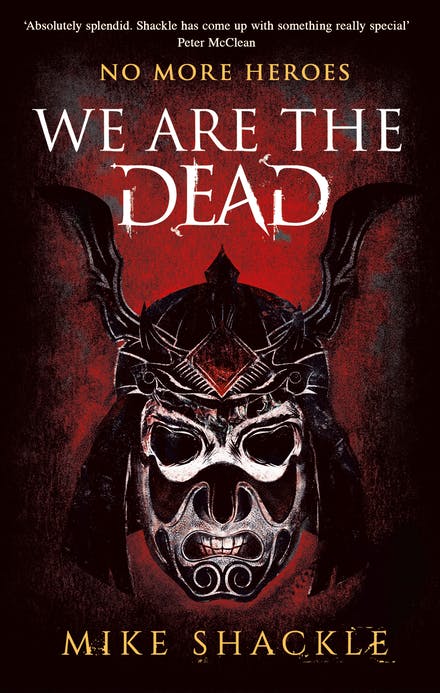
We are the Dead Cover

Publisher: Orion (Audiobook – 8 August 2019)

Series: The Last War – Book One

Length: 18 hours and 6 minutes

My Rating: 4.75 out of 5 stars

Amazon     Book Depository

Honour, loyalty, service and death! I finally get around to checking out one of last year’s hottest fantasy debuts with this review of We Are the Dead by Mike Shackle.

Generations ago, the nation of Jia was protected by powerful mages who wielded amazing magic that could shape the world around it. But when the magic faded, the people turned to the Shulka, their revered warrior caste, who held back the barbaric northern Egril tribes with their tactics, superior weapons and skills in combat. For hundreds of years the Shulka have successfully defeated the Egril raids, but their many victories have led to complacency.

During the latest raiding season, the Shulka are surprised when an organised and well-armed force marches upon them. Supported by demons and magic, the like of which has not been seen in an age, the Egril swiftly defeat the Shulka armies and conquer all of Jia in days. Their conquest is quick and brutal, and few are spared the bloody wrath of the Egril and their monsters. Those who do survive are forced in servitude and must worship the Egril’s terrible god or else suffer the consequences.

Now, six months after the invasion began, the country appears beaten, but there are always some heroes who are ready to fight back. In the capital city, Tinnstra, the disgraced, cowardly daughter of Jia’s greatest Shulka general finds herself drawn into a plot to save the royal family and soon finds the fate of the entire Kingdom resting in her hands. Elsewhere, a crippled Shulka warrior and his wheelchair-bound son attempts to lead an organised rebellion, but he soon finds that his greatest assets may be a young terrorist and a widowed mother who is trying to provide for her son. Can this unusual group of damaged heroes turn the tide against an all-powerful army or is it already too late to save their country from the control of a dark death god?

We Are the Dead is an intricate and impressive dark fantasy debut from talented new author Mike Shackle, which forms the first book in his The Last War series. This fantastic book came out last year, and it was one of the books I most regret not getting a chance to read in 2019, especially after I saw some of the very positive reviews being written about it. I really have been meaning to check this novel out for a while now, so I went out and grabbed the audiobook format of We Are the Dead a few weeks ago and started listening to it. I am extremely glad that I ended up reading this book, as I fell in love with this novel and its compelling character-driven story.
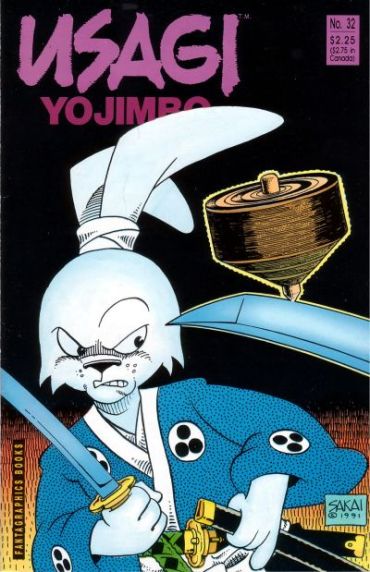
This novel contains an outstanding and exciting narrative that follows five unique and intriguing characters across eight days of rebellion and bloodshed in a conquered nation. We Are the Dead’s story starts off big; after a quick introduction to the world and a couple of the characters, everything soon blows apart as a destructive full-scale invasion occurs. The story than jumps forward six months and explores how the world has changed, and what has happened to the central group of characters. What follows is five intriguing and exciting separate storylines, each told from the perspective of a different character involved in various parts of the first major attempt from the Shulka resistance movement to strike back and restore their country. Each of these five storylines starts off by examining the unique adventures and experiences of that character and showing how they are brought into the latest round of fight. Each of the storylines starts off exclusively focusing on one point-of-view character, but they quickly start to connect as the plot of the book unfolds. All five separate storylines eventually come together exceedingly well into one extremely enjoyable and action-packed narrative that proves hard to put down. I really liked the way that all storylines all joined together, and it was fantastic to see the quicker narrative jumps between the various characters at the end of the book. I also enjoyed how the main story focused on eight days of conflict and adventure, with the various character arcs running concurrently with each other, as this allowed for a tight, powerful narrative. The various characters go through a lot of big and life-changing moments in the span of these eight days and there are some major cliff-hangers and surprising deaths that leave the reader in wild suspense. All of this makes for some great reading, and you will be on the edge of your seat for the entirety of this book.

Shackle chooses to tell his exciting story through the eyes of five separate point-of-view characters, all of whom have their own viewpoint and adventures within We are the Dead. Each of these characters have a fascinating character arcs, especially as most of the characters grow through adversity as they experience the horrors of war and learn the necessities of sacrifice, duty and loyalty.

The character who got the most focus within this novel was Tinnstra, the daughter of a legendary Shulka warrior who has a lot of high expectations weighing on her shoulders. Despite her heritage and her skill with a blade, Tinnstra starts the book dropping out of the Shulka academy, because she is a blatant and obvious coward. Managing to flee from the invasion, Tinnstra attempts to forge a new life for herself in the conquered capital, but eventually finds herself in the midst of the Shulka rebellion, with a particularly important package that could change the course of the war. At the start of this book, I really did not like Tinnstra, mainly because every second sentence in her chapters involved her pathetically doubting herself or calling herself a coward. Thankfully, this led to a rather good storyline about finding one’s courage and stepping up in a big way, and she eventually came across as a real badass with some fantastic and enjoyable chapters towards the end of the book.

Another great character is Jax, a former Shulka general who, after losing his arm during the initial invasion, becomes a determined resistance leader with his wheelchair-bound son. Jax is probably the most consistent protagonist throughout most of the book, serving as a steady and wise figure who is forced to face the reality of failing his country. Jax is an extremely likeable character, which makes it really hard for the reader when he goes through some incredibly dark moments that have the potential to break him.

Next up we have Dren, a teen terrorist who, after witnessing his family dying during the invasion, becomes a rabid killer, brutally attempting to take out any Egrils (or Skulls, as they are known, due to their distinctive helmets), not matter the collateral damage. Dren is a pretty unlikeable kid at the start of the book due to his overwhelming anger towards the Egrils, any Jian who associates with them and the Shulka resistance, who he hates just as much as the Egrils due to the way that they treated the peasants before the invasion and because of their failure in stopping the slaughter. However, as the book progresses, the reader gets more and more invested in Dren’s compelling story, especially when he starts spending time with Jax. Jax is a terrific mentor figure for Dren, who eventually learns the error of his ways and starts to take more responsibility for himself and the band of child terrorists he has recruited.

The final Jian character who the book focuses on is Yas, a single mother who attempts to earn a living working as a maid for the invaders. Yas is recruited as a spy by the Skulka resistance and ends up becoming more and more involved in their plots and schemes. Yas’s storyline is another fantastic arc, and there are some interesting similarities to Tinnstra’s arc, in that she finds her courage to fight back and do what is right. However, Yas’s story is more tied into the love of her family and her son, and how she wants a better world for her child to grow up in.

In addition to Jian characters, Shackle also tells a portion of the book from the perspective of Darus, an Egril Chosen, an officer who has been granted a magical ability by their powerful leader. Darus is a psychotic torturer with severe sister issues, who delights in causing pain and torment and who is determined to win glory and power. Darus’s powers are ironically that of healing, meaning that he is essentially an immortal antagonist who can also heal people that he comes into contact with. He uses this power throughout the book to heal his victims, bringing them back from the brink of death, so that he can torture them again and again in order to break their spirits. As you can probably guess, Darus is a rather reprehensible and unredeemable character, but one who offers an intriguing counterpoint to the protagonists. It is always cool to see something from the villain’s point of view, and I felt that Darus was a perfect antagonist for this dark and twisted novel.

All five of these characters proved to be extremely interesting to follow, and I really liked where all of their arcs went. Shackle does an impressive job making their portrayals and emotions seem realistic, and you can almost feel the fear, anger and hatred that several of the characters exude. I appreciated how none of the protagonists were perfect heroes, and most of them are victims or products of the war and the circumstances they find themselves in. I found it rather interesting to see how the various characters saw each other throughout the course of the story, such as when some of the characters viewed Tinnstra for the first time and mistake her expressions of terror and apprehension for looks of determination and impatience to get towards the enemy. I also have to highlight the raft of cool and likeable side characters featured throughout the course of the story, many of whom steal several scenes from the point-of-view characters. These are a fun collection of side characters, although readers really should not get too attached to them, as they tend to have a rather short lifespan within the course of the book. Overall, We are the Dead contains some excellent and enjoyable characters, and I really appreciated the complicated and captivating storylines that Shackle wove around them.

In addition to the impressive story and excellent characters, Shackle has come up with an awesome new fantasy world for We are the Dead. The entirety of the story is set within the nation of Jia, a cultured land with a proud warrior tradition, which is somewhat reminiscent of feudal Japan. Shackle does a fantastic job of setting up this landscape in the initial couple of chapters, before everything changes thanks to the invasion. The new Jia, six months after the brutal conquest, is a vastly different place, filled with hunger, fear and desperation as the survivors are forced to adapt to their new way of life. Shackle did an amazing job portraying a nation completely under enemy occupation, and I was put in mind of Nazi-occupied France, due to the round up of civilians, the inclusion of collaborators and snitches, retaliations against the populace and the careful resistance movements relying on help from a nation across the sea to survive. The Egrils also proved to be a great antagonistic nation for the plot of this book, and I loved how they were able to fool the conceited Shulka warriors by pretending to be tribal savages for years, before invading with an organised and advanced army, utilising magical and demonic assets to perfection. There were some distinctive Nazi elements to the Egrils, such as the way that they swiftly conquered all of Jia in a few days with Blitzkrieg-like tactics, their absolute devotion to their anointed leader (who is totally going to turn out to be the lost brother of the mage Aasgod, right?), their stormtrooper-like appearance and tactics, as well as the fact that the narrator of the audiobook format gave all the Egril characters a distinctive Germanic accent. All of this proved to be an excellent background for We are the Dead and I loved seeing the story unfold in this recently conquered fantasy nation.

Those readers who like some action in their stories will be extremely satisfied with We are the Dead, as Shackle has loaded his book with all manner of fights, battles and gratuitous violence (the best type of violence). This is an extremely action-packed novel, and I personally enjoyed all the cool fight sequences, from the small-scale battles between trained warriors, the brutal hit-and-run tactics of Dren’s fighters, and several larger fight sequences between opposing forces. Shackle proved to be very adapt at bringing these action sequences to life, and I found myself quite pumped up as a result of reading this book. Readers should be warned however that We are the Dead does feature a number of vivid and disturbing torture sequences, which are made even worse by the fact that the torturer, Darus, can heal his victim and keep inflicting pain, over and over again. As a result, if intense torture scenes make you uncomfortable, then you are probably better off avoiding this book.

As I mentioned above, I chose to listen to an audiobook version of We are the Dead, rather than grabbing a physical copy. The audiobook format has a run time of just over 18 hours, and it is narrated by Nicola Bryant. This is a lengthy audiobook and it took me a little while to get through it. Part of this is because the story is a tad slow at the start of the book, although I did end up absolutely powering through the last six hours extremely quickly in comparison to the first two thirds of the novel. I really enjoyed the audiobook version, and I found it to be an incredible way to absorb We are the Dead’s clever and detailed narrative. I was also impressed with Bryant’s narration, as she brought some real passion to the audiobook. You could hear the intense emotions in Bryant’s voice as she narrated the story, and you can tell that she was trying to emulate what the characters were feeling with her narration. Bryant also utilised a fantastic and distinctive set of voices for the various characters featured within the novel, and I think that she had an excellent grasp of their personalities and emotions. This proved to be an exception audiobook, and I would definitely suggest checking out this format of We are the Dead.

We are the Dead is an outstanding and deeply enjoyable fantasy novel from Mike Shackle, who really hit it out of the park with his debut novel. I had an amazing time listening to this book, and I loved the blend of compelling story, fantastic setting, complex characters and intense action sequences. This book comes very highly recommended, and I am regretting not picking up a copy of this book last year. I will not be making the same mistake later this year when Shackle’s sequel book, A Fool’s Hope, comes out in December, and I am looking forward to seeing where the story goes next.

Amazon     Book Depository

Film Review – Justice League Dark: Apokolips War

Justice League Dark - Apokolips War

Studio: Warner Bros. Animation and DC Entertainment

Series: DC Universe Animated Original Movies – Film 38, DC Animated Movie Universe – Film 15

Director: Matt Peters and Christina Sotta

Producer: James Tucker

Screenplay: Mairghread Scott

Writers: Christina Sotta and Ernie Altbacker

Length: 90 minutes

My Rating: 5 out of 5 stars

For this review I am going to go a little outside my wheelhouse by reviewing the latest animated comic book adaption from DC comics, Justice League Dark: Apokolips War. Fair warning: this is going to be a rather in-depth analysis, so those people who have not seen this film yet might be better served watching it first and then coming back. I will also have a spoiler alert for a key part of the movie towards the end of the review, so keep an eye out for that.

Over the last 13 years, DC Comics have been leading the way over Marvel Comics in the distinctive field of animated movie adaptations of their comic books. While Marvel have produced a couple of decent animated films, such as Planet Hulk and Hulk Vs., the DC adaptations have been leaps and bounds ahead of them. Most of these epic DC animated films have been part of the DC Universe Animated Original Movies project, which has produced 38 distinctive animated films since 2007. There have been some rather impressive and enjoyable releases as part of this project, and I have watched each one of them as soon as they have come out.

While a lot of the DC Universe Animated Original Movies stand alone, 15 films were set within a shared universe, with the same group of voice actors reprising their roles multiple times. This shared universe, known as the DC Animated Movie Universe, started in 2013 with Justice League: The Flashpoint Paradox, and examines an alternate universe inadvertently created by the Flash. This new universe is very heavily influenced by The New 52 continuity of comics (but don’t hold that against it), and features an interesting collection of films featuring a range of different DC characters, although there is a noticeable and understandable focus on Batman and the Justice League. Justice League Dark: Apokolips War is the 15th entry in the DC Animated Movie Universe and serves as the conclusion to most of the storylines that were featured within the preceding 14 movies. This film was directed by Matt Peters and Christina Sotta, and features a story written by Christina Sotta and Ernie Altbacker, with the screenplay written by Mairghread Scott.

Following two previous attempts to conquer Earth by intergalactic tyrant and New God Darkseid, the Justice League is determined to safeguard the planet no matter what. Led by a vengeful Superman, the League launches a pre-emptive attack against Darkseid’s fortress planet of Apokolips, when it becomes clear that he intends to invade Earth again. However, the League’s attack fails miserably as they fly into a trap set by Darkseid, who uses his new troops, the Paradooms, to swiftly defeating the entire Justice League, killing or capturing most of its members.

Now, two years later, Earth has been brutally conquered by Darkseid, who has devastated the planet, and intends to drain it of its magma in order to fuel his future designs of conquest. With nearly all of Earth’s heroes killed during Darkseid’s assault, only a scattered few remain to oppose his plans. At the fore is Clark Kent, the former Superman, who has been stripped of his powers by Darkseid, and who now leads a resistance movement with his wife, Lois Lane. Determined to save the Earth no matter the cost, Clark recruits the surviving members of the League and the Teen Titans: Raven, Damian Wayne and John Constantine for one final mission.

With the help of an odd and violent group of villains, including Lex Luthor, Etrigan the Demon and Harley Quinn’s Suicide Squad, Superman and small team attempt the impossible, a second assault on Apokolips. However, even if they succeed in reaching Apokolips, they will face terrible opposition. Former members of the Justice League, including Batman and Wonder Women, have been converted into loyal soldiers for Darkseid, and they will do everything in their power to defend him. Can Superman and his team defeat Darkseid once and for all, or are these Earth’s final days?

Well damn, now that was one hell of an animated film. As I mentioned above, I have watched a ton of animated comic book adaptations but Justice League Dark: Apokolips War might just be one of the finest and most impressive animated adaptations that DC comics has ever created. This outstanding, five-star film is just plain amazing, and I had an incredible time watching it (multiple times). Apokolips War contains an intense story, pulse-pounding action, an amazing voice cast and a superb connection to prior films and comics, which helps create an epic and powerful animated movie experience. The creative team behind this movie did an exceptional job on this film, turning it into an intense and addictive viewing treat that I absolutely loved. Viewers should be warned, this is not a film for kids, as it has a well-deserved R-rating (MA15+ in Australia), which it earns very quickly and very explicitly.

At the heart of the excellent movie is an exciting and clever story that pits the broken remainder of Earth’s heroes against the ultimate villain in the DC canon. Apokolips War has such a cool concept, starting off with the entire Justice League getting taken out in the first few minutes and then abruptly jumping two years into the future, showing a world devastated by an evil alien invasion. This perfectly sets the scene for a character-driven narrative that follows the last desperate attempt of a handful of mixed protagonists, as they attempt an all-or-nothing mission with extremely high stakes. This results in all manner of character development, tragedy, intense action, and a fantastic smattering of witty humour, which all comes together into a compelling and utterly memorable overall narrative. I was deeply impressed with where the writers took this fantastic story, and I really appreciated all the existing storylines and the substantial character arcs that they were able to explore, expand on and finalise within the movie’s hour and a half run time. This was such a great story, and it worked exceedingly well with the enjoyable characters, eye-catching animation and the awesome team of voice actors to create an amazing overall film.

One of the things that I think I should address first is about whether or not you need to see the other entries in the DC Animated Movie Universe before watching Apokolips War. Due to its cool action and well-written plot, this is a film that is rather easy for viewers unfamiliar with the franchise to follow and enjoy, although a lot of the story elements will make a lot more sense if you are familiar with the DC Comics universe and characters. While you can probably get away without watching any of the previous movies, this is the 15th and final entry in an interconnected universe, so there are obviously going to be some advantages to watching these other films first. For example, you get a much better understanding of the characters, their relationships and their personalities in this universe, and having this knowledge about the characters beforehand can really increase the dramatic punch that a bunch of their actions have. I also personally enjoyed the continued storylines of this film universe, and I liked seeing how this movie wraps up a lot of character arcs and answers some interesting questions. As a result, I would strongly recommend watching some of the other movies first: The Flashpoint Paradox, Justice League: War, Justice League vs. Teen Titans, Justice League Dark, Suicide Squad: Hell to Pay, The Death of Superman and Reign of the Supermen as a bare minimum (yes, I know that calling seven movies a minimum is a bit much, but that just goes to show how intricate this animated universe was).

The creators of this movie utilise an intriguing and unique cast of characters, continuing many of the character arcs established in the prior animated movies. Fair warning: quite a few major comic book characters, including some characters who have been key additions to this animated universe, die in the opening moments of the movie, while some others only get a few scenes, often without any dialogue, before they are also killed. While this movie has quite a huge death toll, I think most of the killings do serve a purpose by motivating the surviving characters, highlighting the brutal nature of the film and its antagonist, or providing a real emotional punch to the viewer. While a large number of characters from the DC universe only get small roles, Apokolips War does contain a rather intriguing and diverse group of central characters who are extremely interesting to follow.

The main character of Apokolips War is John Constantine, the rogue magician last seen in Justice League Dark. Ever since his live action television series a few years ago, Constantine has been popping up in all manner of DC Comic adaptions. Constantine is a fantastic central protagonist, constantly moving the plot along and providing entertaining commentary and witty remarks about the events occurring around him. He also has a rather tragic storyline, which sees him full of regret and shame after he let down his love interest, Zatanna. Not only does this result in a conflict with Superman, but it also serves as a driving force throughout the movie as he tries to redeem himself. Constantine also serves as the heart of the entire movie, acting as a confidant to several characters and providing inspiration during key moments, including one impressive speech at the very end. While he is an amazing character, he was a bit overused when it came to solving problems, as he seemed to have a magical solution for nearly every obstacle that the protagonists came up against. While it does show off his resourcefulness, and his jack-of-all-trades approach to magic, I thought that it was a bit of a crutch for the story at times. Still, I loved Constantine as a protagonist, and I cannot think of anyone better to be the main character for this film.

Another character that I really appreciated throughout this movie was Superman/Clark Kent. If the recent live-action DC movies have shown us one thing, it is that Superman is a very hard character to write or portray at times, due to his powerset, his iconic nature and his somewhat dated ideals. However, the DC Animated Movie Universe is one of the few projects which has covered the character perfectly and allowed the viewer to care about him. His use in The Death of Superman and its sequel Reign of the Supermen was particularly impressive, and the creative team have followed that up extremely well with Apokolips War. In the opening scenes, he is an angry and vengeful character, recklessly determined to take the fight to Darkseid and finish him off for good. However, following his defeat, he is cast back down to Earth without his powers and with a painful liquid Kryptonite tattoo to remind him of his failure and to demoralise those people he encounters. Despite this, Superman shows his usual spirit and determination, rallying the remaining heroes to Apokolips, and is a generally fun and inspirational character. The best thing about his character, however, is his relationship with Lois Lane throughout the film. Lois is a major badass in Apokolips War, reverting to the resistance leader persona that she had in The Flashpoint Paradox and leading the various heroes and villains (whom she brings to her side after a boxing match with Harley Quinn in a very fun scene). The relationship between Lois and Clark is one of the major emotional centres of Apokolips War, and it serves as a great continuation of their entire joint character arc from their previous movies. It also leads to the most powerful and emotionally charged scene of the entire movie, which was an extremely touching and memorable moment.

The other major protagonists are the two surviving Teen Titans, Robin and Raven, who both add a lot to the plot. The Robin in this movie is the Damian Wayne version of the character, who has been a focal protagonist of several films in the DC Animated Movie Universe. While Damian Wayne is not my favourite Robin (Tim Drake for the win), he has been a solid part of this shared universe, especially in the two Teen Titans movies. In Apokolips War, Damian is his usual arrogant self, although he has grown and matured since his introduction. However, the events at the start of the film turn him to a darker path, and he ends up leading the League of Shadows like his grandfather before him. While at first reluctant, he is convinced to help their mission by Raven, to whom he had grown close in Justice League vs. Teen Titans and Teen Titans: The Judas Contract. Damian’s major scene is the eventual encounter he has with a Darkseid controlled Batman, and their emotionally charged fight sequence is a great part of the movie. Raven is also a fantastic character as she spends most of the film fighting her literal inner demon, her father, Trigon, whom she has imprisoned in the gem in her forehead. The emotional turmoil of the film and the constant conflict against her father has drained Raven, and she is a shell of herself throughout Apokolips War. Raven has some rather dark moments in this film, and her continued inner conflict is an excellent part of the plot. I really liked that the writers chose to focus on Raven, and it turned out to be an exceedingly interesting continuation of her storyline from the excellent Justice League vs. Teen Titans film. I also really enjoyed seeing the extension of the relationship between Robin and Raven. There had been some hints of a connection between the two in their previous entries in the universe, but the writing team took the time to explore it in more detail in this film. There are some rather nice moments as a result, as well as some heartbreaking sequences (this is a pretty traumatic film after all), and overall, both of them proved to be a great addition to the movie.

While the above main characters are great, I really need to highlight the inclusion of the entertaining side characters, who add an incredible amount of fun and excitement to the movie. At the top of this list is Etrigan the Demon, last seen in Justice League Dark. Etrigan was easily the most amusing character in the entire film, mainly because he is comically depressed following the death of the human he was bonded to, Jason Blood, in his previous appearance. Because of this, he spends most of the film following Constantine, looking for something to break him out of his stupor, and being too apathetic to take anything seriously or even to rhyme (which is a big problem for a rhyming demon). His antics are very entertaining, and every appearance he has is designed to make you laugh, right up to the end. I also loved the fantastic use of the Suicide Squad characters in this film. Harley Quinn is her usual, exceedingly violent and over-the-top self in this film, and it was fun to see her lead the Suicide Squad: “Best boss ever”. Next up you have the always dependable Captain Boomerang, who is at his sleaziest right of the bat. Boomerang is another fun addition to the team, due to his funny jabs towards the other members of the Squad, and he has some great moments, including starting an Australian/British rivalry with Constantine. However, the best member of the Suicide Squad has to be King Shark, who stands out right from his start when Constantine hilariously identifies him as one of his exes (which is a great nod to Constantine’s bisexual orientation in the comics). Unlike the pacifist King Shark we see in the Harley Quinn animated show, this version of the character is a bloodthirsty killing machine who gleefully eats several people. He also appears to only be able to only able to say one phrase: “King Shark is a shark!” which I thought was a nice homage to Groot. Pretty much every scene with King Shark is just great, and you will surprised how much fun his constant declarations of “King Shark is a shark!” becomes, especially as it leads up to an amazing joke with Captain Boomerang. I loved all four of these characters, and their inclusion was a masterstroke from the creators, due to how much heart and humour they add to the film.

No superhero movie would be complete without a great antagonist, and Apokolips War features the biggest bad in the entire DC universe, Darkseid. Darkseid has been the major villain for the entire DC Animated Movie Universe, from his destructive introduction in the Justice League: War, to his manipulations in The Death of Superman and Reign of the Supermen. As a result, Darkseid is an amazing antagonist for this movie, as you get to wrap up his storyline and see how he has been building up to this battle for the entire length of the DC Animated Movie Universe. Darkseid is exceedingly ruthless and destructive in this movie, more than living up to his reputation by brutally taking out the Justice League and killing so many protagonists and heroes. I loved his portrayal as a cold uber-tyrant, and he has some awesome scenes, such as taking out the entire Green Lantern Corp by himself, or facing off against a raft of powerful opponents (including one massive brawl against another major DC antagonist). Of course, his most evil acts revolve around his treatment of the heroes that he captures in the opening acts of the film. I have already mentioned his depowering of Superman, but that is nothing compared to what he does to other members of the League, as he turns them into twisted cybernetic monstrosities, slaved to his will. I was particularly impressed with how he managed to twist Batman’s mind, turning him into his chief enforcer and strategist. Having the ultimate hero become as ruthless as the Batman in this film is a little jarring, and I felt that it was a rather intriguing character arc to explore. I also have to mention Darkseid’s new foot soldiers, the Paradooms. Paradooms are the traditional Apokolipian soldier’s, the Parademons, who have been enhanced with the DNA of Doomsday, making them more than a match for most of the heroes in the Justice League. While the name ‘Paradooms’ is a little uninspired, they do add an exciting new element to the story, especially after the thrashing that the Justice League gave the Parademons in Justice League: War. I did think that their power levels were a little inconsistent at times, as one minute they are killing the entire Justice League, the next they are getting taken out rather easily by the Suicide Squad, but overall they were a destructive addition to the universe. I really liked this collection of antagonists, and I think that having such impressive baddies, really amped up the stakes and my enjoyment of the film.

Apokolips War has a truly impressive voice cast, with most voice actors returning after prior appearances in the DC Animated Movie Universe. At the forefront is Matt Ryan, who once again voices Constantine to perfection in this film. Anyone who has seen any live action or animated feature where Ryan portrays Constantine will know how awesome his work is, and in Apokolips War he once again shines, bringing his brand of charm and roguish appeal to the character. I also must highlight Jerry O’Connell voicing Superman in this movie. O’Connell has been killing it as Superman throughout this shared universe, and Apokolips War is some of his best work. He brings a great deal of passion to the role, and I think that his voice expertly captures all of Superman’s attributes, from his inherent positivity, to his anger at Darkseid and everything that he has done. O’Connell’s Superman also has an amazing amount of chemistry with the film’s Lois Lane, although this is not surprising, considering that Lois is voiced by O’Connell’s real-life wife, Rebecca Romijn. Romijn also does a fantastic job with Lois, and I really like her take on the character, showing of Lois’s boundless confidence and deep love for Clark. Romijn also touches on Lois’s vulnerabilities and doubts in this film, and this helps her produce one of the best and most heartfelt sequences in the entire movie.

I am also a major fan of young voice actor Stuart Allan and his take on Damian Wayne. Allan has been voicing Damian since 2014, and he has always perfectly captured the character’s arrogance and reckless personality. I like how Allan has grown up in step with the character, and his portrayal of Damian in this film adds some more restraint, uncertainty and vulnerability to the character after the opening events. Another impressive young voice actor in this movie is Taissa Farmiga, who returns to voice Raven for the third time. Farmiga has a much younger and more vulnerable take on the character of Raven than Teen Titans fans would be used to, and I think it works extremely well, showing off how scared Raven is of herself and her inherent darkness.

There is also a fantastic group of voice actors voicing the many side characters and antagonists in this movie. Candyman himself, Tony Todd, voices Darkseid, and his deep and callous take on the character, really helps to make the antagonist seem even more menacing and evil. Jason O’Mara does another amazing job as Batman in this film, and I like his more calculating take on the character, especially when he is under Darkseid’s control. Rainn Wilson is also entertaining as Lex Luthor, and he brings a real cowardly, slimy air to his parts of the film. Rosario Dawson is once again cast perfectly as Wonder Woman, and I loved her strong and confident voice for this character. John DiMaggio, Hyden Walch and Liam McIntyre all return to voice members of the Suicide Squad they have portrayed before, and they are all rather entertaining. I have already mentioned how much I loved DiMaggio’s King Shark, and it was fun to see him provide a new voice to the character after portraying him in Assault of Arkham. Walch provides another excellent turn as Harley Quinn, bringing some great energy to the character, and I think I prefer her portrayal to that of her Teen Titans co-star Tara Strong. McIntyre also does an excellent Captain Boomerang, and I personally liked it when they cast an Australian in the role, even if the character is a bit of a silly Australian caricature. While there are a couple of actors who I haven’t discussed, I think I have done enough to show how this movie has an exceedingly strong voice cast, and there was not a single miscast in the entire film.

I also have to praise the amazing animation quality featured within this movie. The animators behind Apokolips War have helped produce an incredibly slick movie with some impressive backgrounds and some fantastic and eye-popping action sequences, some of which were quite brutal and over-the-top at times. Apokolips War also features some cool and unique character designs, as many of the character had new and distinctive looks as a result of the harsh plot of the movie. This includes the depowered Superman with the Kryptonite S on his chest, half-dead cybernetic Justice League members and a whole new evil costume motif for Batman. I also have a lot of love for how the musical elements of this movie fit in with the visuals, and some of the instrumental scores that were featured really helped some key events pop out and stick in the mind, especially when combined with some of the impressive animation. For example, there is a great scene about two-thirds in where the music helps really enhances a major moment around one of the key characters, there is also a bit right at the end of the movie where the score plays extremely well with a really visually impressive moment, creating a fantastic ending for the entire movie. This helps turn Apokolips War in a visual and audible treat, and I thought that the fantastic combination of these elements helped to create an excellent movie.


The next paragraph gets extremely plot heavy in its discussion, so I am issuing a SPOILER ALERT.

I need to discuss how the entire movie concludes, mainly because I am in two minds about it. The film essentially ends with the entire DC Animated Movie Universe being erased out of existence, when Constantine talks the Flash into creating another Flashpoint once it becomes clear that the Earth is doomed. While it was an amazing scene, especially with the monologue that Constantine gives to convince Flash to do it and the fade to white that heralded the end of the movie, I thought it was a controversial way to end the film. Not only was it a rather predictable move thanks to several discussions about the alternative Flashpoint universe made earlier in the film (and the fact that time travel was the only obvious way to fix everything), but it also seems to do the rest of the amazing film a disservice by instantly erasing it, and it reminded me of those television episodes where major events turned out to be dream sequences or simulations. That being said, I did think it was a great way to conclude the entire DC Animated Movie Universe, which was created as a result of a Flashpoint in the very first movie, and it keeps the entire plot of this shared universe rather contained. It will be interesting to see what happens next in the DC Universe Animated Original Movies range, and whether they create a new animated shared universe in the future. I also would love if they maybe set another movie in this universe post-Apokolips War, because seeing what happened in the crumbling ruins of Earth with a depleted Justice League has a lot of story potential

SPOILERS END


Justice League Dark: Apokolips War is an incredible and highly recommended animated comic book adaptation, which serves as an epic and memorable conclusion to the DC Animated Movie Universe. I had an exceptional time watching this movie, especially as it blended a dark and clever story with amazing characters, impressive animation and a top-notch team of voice actors. This was an overall great film, and it might be one of the best new movies of 2020 so far (which to be fair, might be due to most films getting pushed back this year). I had a great time reviewing this animated film, and I might spend a bit of time reviewing more animated comic book movies in the future. As most of them are adaptions of existing comic books, I think this is close enough to my current focus as a reviewer to fit on this blog, and I look forward to examining some of my favourite animated comic book movies in the future.

Throwback Thursday: Usagi Yojimbo: Volume 8: Shades of Death by Stan Sakai

Usagi Yojimbo Shades of Death

Publisher: Dark Horse Books (Paperback – 1997)

Series: Usagi Yojimbo – Book 8

Length: 200 pages

My Rating: 5 out of 5 stars

Amazon

Reviewed as part of my Throwback Thursday series, where I republish old reviews, review books I have read before or review older books I have only just had a chance to read.

It’s been a little while since I’ve done a Throwback Thursday article so I thought I would go back to the old faithful that is the incredible Usagi Yojimbo series and review the eighth volume, Shades of Death.

Usagi Vol 2 Issue 1

Shades of Death follows on right after the events of the seventh Usagi Yojimbo volume, Gen’s Story, and continues to follow the adventures of the rabbit samurai, Miyamoto Usagi, in this alternate version of feudal Japan populated by anthropomorphic animals. This eighth volume of the series is particularly significant as it is the first volume to be published by Dark Horse Comics, who printed the series for over 22 years, and who were only recently replaced by IDW for the latest volume, Bunraku and Other Stories.  However, the issues within this volume were originally printed by Mirage Comics, who did the entire second run of the Usagi Yojimbo series.  The Dark Horse Comics/Mirage Comics printing style is similar to the style used by the previous publisher, Fantagraphics Books. The only major difference is that the Dark Horse Comics volumes come with a story notes section at the back, as well as copies of all the covers for the various issues. I’m actually a big fan of the story notes that they started including in these volumes, as they contain some fascinating background information about some of the stories, including details about the various legends or elements of Japanese culture that Sakai focuses on in his story. Shades of Death contains issues #1-6 of the second run of the Usagi Yojimbo series, as well as containing stories from #7-8, and is made up of two major storylines and several shorter entries.
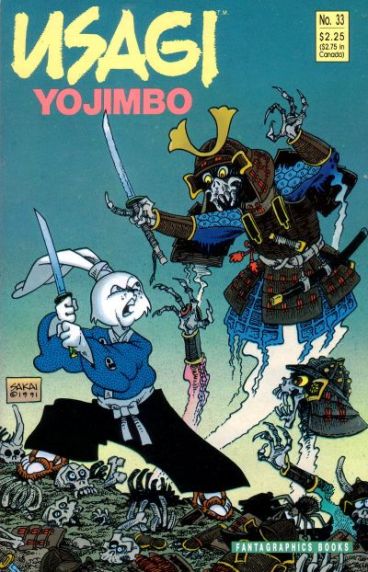
The first story is Shades of Green, and it is probably the most distinctive entry in this entire volume. The story starts with Usagi and his frequent travelling companion, Gen, being ambushed out on the road by a horde of Neko Ninja, forcing them to dive into a river to avoid being killed. Usagi and Gen eventually wash up near a remote village and encounter the mysterious rat mystic, Kakera, who asks Usagi and Gen for his help. Kakera reveals that the Neko Ninja are after him, as they hope to use his abilities to help rebuild their clan’s power after the events of The Dragon Bellow Conspiracy (volume 4). To that end, they have surrounded the village and intend to kill everyone in order to get Kakera, and even the skilled Usagi and Gen will be unable to stand up to their numbers. With no other help on the way, Kakera is forced to use his magic to summon four very special warriors to stand by their sides, the Teenage Mutant Ninja Turtles.

634715

Shades of Green is a fantastic and clever story that also serves as an excellent crossover between two iconic comic book series. Pretty much the big thing about this story is the way that is introduces all four members of the Teenage Mutant Ninja Turtles in the Usagi Yojimbo universe. Fans of either Usagi Yojimbo or the Teenage Mutant Ninja Turtles franchise will be aware that these two comics have had numerous crossovers throughout the years, with Usagi appearing in three of the Teenage Mutant Ninja Turtles animated television shows. The Turtles who appear in Shades of Green are the original Mirage Comics versions of these characters, who were created by Kevin Eastman and Peter Laird, and who had their own long-running series during the time this volume was published. Usagi has actually encountered Leonardo from this version of the Turtles several times before, including back in the third volume of Usagi Yojimbo, The Wanderer’s Road, so the two groups of characters were able to team up rather quickly. I thought that this was an incredible crossover, and I especially loved the dynamic between the Turtles and Usagi and Gen. Not only do you get the mutual respect that Usagi and Leonardo have for each-other but there is a rather fun dynamic between Gen and the other Turtles. I particularly liked one scene where Michelangelo questions the logic of the Usagi Yojimbo universe, including why the horses aren’t sentient but rabbits and rhinos are (something I have always wondered), and even asking Gen if he has a tail, which it turns out is a rather personal question. There are also some really fun battle sequences throughout this book, and it was great to see the two samurai team up with the Turtles to fight a whole bunch of ninjas. I really liked this crossover between them, and I also think that Sakai did an amazing job drawing and portraying these characters.
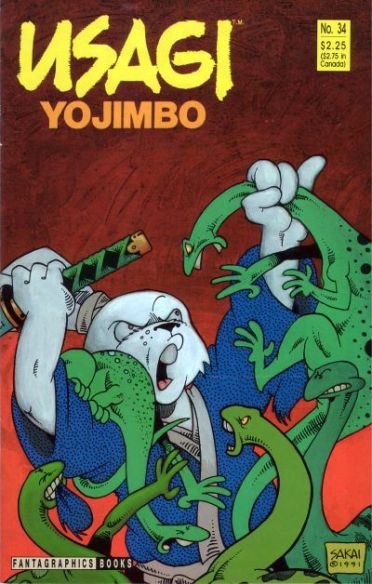
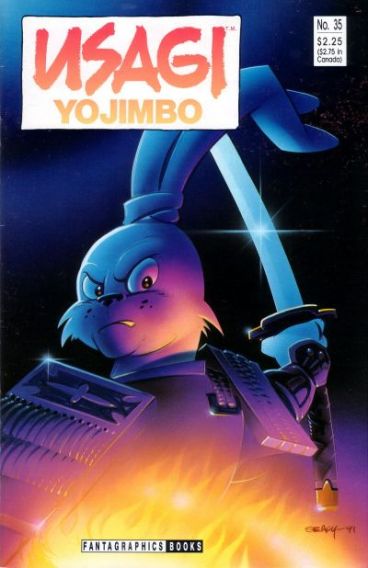
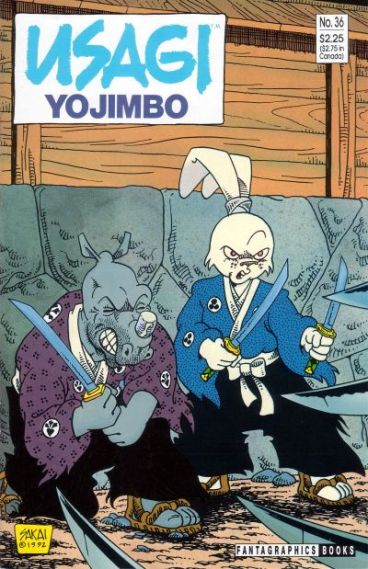
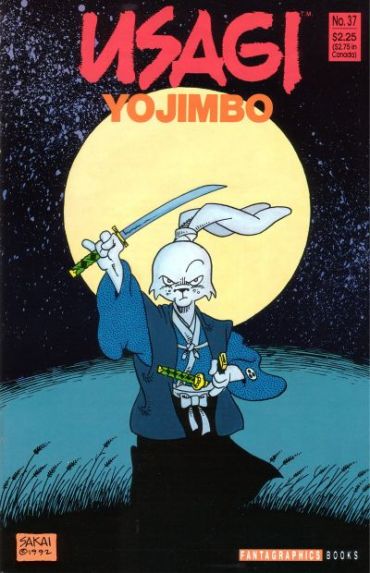
In addition to the crossover elements, Shades of Green also contains a rather intriguing overall narrative, especially the parts of it that examine the leadership of the Neko Ninja clan. The Neko Ninja clan has been in a bit of decline since the fourth volume, when a large number of their ninjas, including their leader, Shingen, died. Much of the plot of this storyline revolves around two high-ranking members of the Neko Ninja, the ambitious Gunji and Shingen’s sister Chizu, fighting for control of the clan, with their battle centred on the hunt for Kakera. This proved to be really exciting, and it was cool to see the internal ninja feud, while the clan is facing off against the protagonists. This book also contained the first meeting between Usagi and Chizu, who goes on to become a major recurring character in the series as well as a potential love interest for Usagi. I quite enjoyed Shades of Green, and it definitely serves as a memorable entry in the Usagi Yojimbo series that showcases how cool a crossover with this series can be.

559585

The next entry is a short story called Jizo, which only runs for a few pages. Despite its shorter length, this is a rather inventive and surprisingly powerful story that I have a lot of love for. Jizo is set on the side of a road, and features a mother placing a dosojin, a roadside icon, of Jizo-sama, in order to help the soul of her deceased young son who was recently killed by bandits. According to Buddhist beliefs, her son’s soul is attempting to make its way into paradise by piling rocks to cross a river. By leaving the statue to Jizo, the patron and protector of children, by the side of the road, the mother is hoping that passing travellers will place a stone near it, which will help her dead son’s soul in his eternal task. The story than continues without dialogue, as the statue of Jizo watches the road, noting the various travellers who walk across it. This includes Usagi, who runs into the same bandits who killed the child, and his actions seem to provide the statue with a measure of peace. This was a clever and beautifully rendered story, and I loved that Sakai redrew the same stretch of road for every single panel. This was such a fantastic concept, and I loved how he told such a powerful story with a minimum of dialogue, only utilising some exposition from the mother at the start and end of the story. The shots of the same stretch or road were done extremely well, and it was fun to see the various people who walked past the statue during the course of the day. Not only were there some familiar faces but there were several intriguing and distinctive-looking people going about all manner of different activities. It was also cool to learn a little bit about the statues to Jizo-sama, something I saw several times when I went to Japan, and the story notes I mentioned above proved to be really useful and interesting in regards to this. I was really impressed with this entry, and I loved the compelling story that Sakai told with his fantastic drawings.

The third story in this volume is Shi, an action-packed and exciting tale that I really enjoyed. Shi sees a wandering Usagi come to a crossroad, where he lets fate and the gods choose his route (a homage to the start of the film Yojimbo). His chosen path takes him to a market town where he witnesses a peasant being bullied by a group of thugs. Intervening, Usagi chases the thugs off and is invited to the peasant’s village for dinner. However, it soon becomes clear that something strange is happening at the village, as the thugs arrive soon after and appear determined to scare all the villagers away. Investigating, Usagi soon finds himself in the midst of a conspiracy involving the local magistrate and his brother, who are determined to kill Usagi and his new friends. To that end they hire a group of four assassins, who call themselves Shi (a reworking of the Japanese character for Shi turns it into a character for death).

559657

Shi proved to be an compelling entry that serves as one of the main two stories for this volume (indeed, if you combine the names of the first story, Shades of Green, with the title of this story, Shi, which in this case means death, you get the volume’s overall title, Shades of Death). There are some great elements to this action-packed story: the intriguing conspiracy, Usagi’s mixed encounters with the villagers that he is trying to save, and some funny moments as Usagi effortlessly deals with the initial group of thugs. However, the best part of the book has to be the extended fight sequence at the end as Usagi takes on the four members of Shi, each of whom is master of a different type of weapon (sword, spear, bow and the sickle-and-chain). This was a brutal and exhausting fight for Usagi, and it serves as an impressive main set piece for the entire story. It also results in a rather confronting and memorable sequence where, in the aftermath of the fight, Usagi is challenged by a local peasant who is jealous of the attention Usagi is receiving from his betrothed. The peasant gamely steps up to fight Usagi, claiming not to be afraid, only to be faced by an enraged samurai who is worked up into a blood rage after his battle. The look of anger and hate on Usagi’s face is surprisingly terrifying, and I love how demonic Sakai made him look, showing off a darker side to his complex protagonist. I also really enjoyed the entry’s two shady antagonists in the magistrate and his brother. These two duplicitous siblings make for a murderous team, especially when each of them attempts to betray the other in a fantastic conclusion that showcases the consequences of greed. Overall, Shi was an exceptional story that I had an awesome time reading.

The next story in Shades of Death is a fun entry titled The Lizards’ Tale, which focuses on a group of Tokages, the dinosaur-like lizard critters that infest the Usagi Yojimbo universe. In this story, a group of chilly Tokages attempt to warm themselves up one snowy night by snuggling together in the warmest place they can find, around the sleeping body of Usagi. Awakening the next morning, Usagi finds himself surrounded by the potentially vicious creatures, and only manages to flee by throwing them a bag of food and running for it. However, the Tokages are not that easily escaped, and they continue to follow Usagi hoping to get more food out of him. Despite his comical efforts to get rid of them, Usagi soon grows attached the Tokage pack, especially after they help him out of a sticky situation with some bandits. The Lizards’ Tale is a very fun and humorous story that provides some light-hearted moments in this volume after some of the preceding darker stories. I really liked how Sakai told the story without any dialogue whatsoever, relying on only the exaggerated movements and facial expressions of the various characters and the Tokage to tell the story. This was an incredibly entertaining entry, and I had a great laugh as I went through it.

637715

The final three stories are a bunch of shorter entries that focus on a younger Usagi as he trains with his sword master, Katsuichi. These three stories include Usagi’s Garden, Autumn and Battlefield, and feature some character-building moments for the protagonist. Each of these three stories is rather good, and it is always interesting to see a younger Usagi when he is a rash trainee, rather than the wiser, battle-hardened warrior that he is in the rest of the series. These three short stories contain a fun mix of narratives, including one about Usagi learning patience and honesty by attempting to grow plants, another where he frees the spirit of Autumn, Aki-Onna (Autumn Women) from a monster, and a final story where he sees his first battlefield and learns that there is rarely glory or honour in the midst of war. These were a great collection of stories, and I liked the moral based narratives that each of them contained. Reading these three shorter stories proved to be a good way to end the volume and it was nice to have some low-stakes entries to wrap everything up with.

As usual, Sakai’s artwork for this volume was deeply impressive for every story, and I loved every aspect of his drawings throughout Shades of Death. While I have already mentioned his fantastic fight sequences, the cool character designs and amazing use of facial expressions while talking about some of the stories above, I also have to highlight the detailed background sequences and depictions of the beautiful, multi-seasonal Japanese landscapes. Every panel of this book is loaded with incredible detail, and I loved examining all the different backgrounds, especially as I see something new and different in this volume every time I read it. Sakai did some outstanding artwork in this volume, and it was a real treat to see his drawings and characters come to life.

638013

Shades of Death is another incredible volume in the exception Usagi Yojimbo comic book series from the legendary Stan Sakai. Featuring some top-notch narratives, impressive character inclusions and some eye-popping artwork, Shades of Death was an exciting and captivating read. I loved every second that I spend reading this volume, and this eighth volume gets another five-star rating from me.

Amazon

To the Strongest by Robert Fabbri

To the Strongest Cover

Publisher: Corvus (Trade Paperback – 2 January 2020)

Series: Alexander’s Legacy – Book One

Length: 415 pages

My Rating: 4.5 out of 5 stars

Amazon     Book Depository

War and chaos are about to be unleashed following the death of history’s greatest conqueror in the new epic historical fiction novel from amazing author Robert Fabbri, To the Strongest, the first book in his new Alexander’s Legacy series.

This is a clever and compelling new novel from Robert Fabbri, who has successfully moved away from historical Rome to ancient Greece and Macedonia. I am a massive fan of Fabbri’s writing, and he is probably one of my favourite historical fiction authors at the moment due to his work on the incredibly entertaining Vespasian series. His last several novels have all been rather top notch (check out my reviews for the eighth and ninth book in the series, Rome’s Sacred Flame and Emperor of Rome, as well as the associated short story collection, Magnus and the Crossroads Brotherhood), and I have been really looking forward to reading To the Strongest for a while now. I actually read this book a few months ago, but I am only just getting around to writing a review for it now. This is not because I didn’t enjoy the book; on the contrary, I absolutely loved it, I just got a little distracted after reading this book and kept forgetting to come back to it (to be fair, it’s been a rather hectic year). Now that I have a little time, I thought I would go back and review this great book, contains a clever and intriguing story concept.

“I foresee great struggles at my funeral games.”

Babylon, 323 BC. After bringing together one of the largest and most expansive empires the world has ever seen, Alexander the Great lies dying at a young age, and no one is truly prepared for his passing. With no legitimate heir yet born, and no obvious frontrunner to succeed Alexander as ruler of the conquered lands that make up the Macedonian empire, his loyal followers assemble at his death bed and beg him to reveal who he will leave the empire to. Alexander’s answer is simple: “To the strongest.”

Now the entire empire is up for grabs, and it does not take long for the prediction laden within Alexander’s final words to come to pass. As the news of the king’s death travel throughout the land, many seek to take advantage, either to take control themselves, or to better their own personal situation. The empire soon dissolves into a ruthless battle for the throne, as the various parties scramble for power, with shifting alliances, devious betrayals and far-ranging schemes becoming the new norm.

But in the end, only one will emerge victorious. Will it be Perdikkas, the loyal bodyguard who Alexander seeming left this ring to (the Half-Chosen); Roxanna, Alexander’s wife who bears his unborn heir (the wildcat); Antipatros, the man left behind to govern Macedonia (the Regent); his most capable warriors Krateros (the General) or Antigonos (the One-Eyed); the devious Olympias (the Mother); the clever Ptolemy (the Bastard); or the sneaky Greek advisor Eumenes (the Sly). Which man or woman has the cunning or ruthlessness to outlast the others and survive? Let the struggles begin!

What a fun and fascinating piece of historical fiction. Fabbri has crafted together an epic and clever novel that tells the outrageous true story of the aftermath of Alexander the Great’s life. Told from the perspective of a number of major figures who fought or schemed throughout this period of history, Fabbri turns all these events into an outstanding and enjoyable story that proves extremely hard to put down at times. Containing a compelling writing style, several excellent battle sequences and numerous betrayals, manipulations and shifting loyalties, this is an impressive first entry in the Alexander’s Legacy series, which does an excellent job setting up all the initial conflicts that were caused in the initial aftermath of Alexander’s death while also leaving a lot of room for the series to advance into the future.

To the Strongest is a fantastic and entertaining novelisation of some rather intriguing events from ancient history that do not get a lot of coverage in modern fiction. I think the thing that I liked the most about this book is the fact that most of the crazy events that Fabbri features within it actually happened in one shape or form, or are recorded as such in the historical record. The period of history post-Alexander the Great is not one that I am massively familiar with, and so I did a bit of reading into it after I finished To the Strongest, mainly because I was rather curious to see how much of this actually happened. It turns out that nearly all of the craziest events that occurred, such as the brutal murder of several of Alexander’s wives, the theft of his corpse by one of the characters, and a particularly disastrous river crossing with a troupe of war elephants, really did occur, and required very little literary embellishment on Fabbri’s part to make this any more exciting and compelling. I really loved learning about all these cool moments from history, and I think that Fabbri did an amazing job converting these myriad events into a cohesive and enjoyable narrative. From what I understand, there are plenty more battles and betrayals to go, and I am rather looking forward to seeing the full scope of these events unfold in future books.

In order to tell his story, Fabbri utilises a number of different character perspectives from a large roster of unique historical figures. There are 11 point-of-view characters featured within this novel, each of whom narrate multiple chapters within the book. Fabbri has provided each of these characters with their own nickname and symbol, both of which help to distinguish the character and to highlight certain character elements or parts of their history. The use of these multiple character perspectives makes for quite an interesting novel, as it allows the reader to see a much wider viewpoint of the conflicts occurring around the entire empire, as well as the multiple sides involved in it. This mixture of character-specific chapters also allows the reader to get something different out of each chapter, as chapters that follow a warrior will feature more battle sequences, while other chapters are geared more towards political fights or intrigue. This mixture works really well, and it helps to produce a diverse novel with various compelling story elements to it. The chapters are not evenly distributed between the characters, with some getting multiple chapters throughout the course of the book, while others only get a few chapters here in there. Two characters in particular only appear in one half of the book each, with one getting killed off about halfway through, while another only appears a while after. Most of this is due to the fact that some characters were not as prominent in history until a later date, and I imagine that some of these characters will be utilised more significantly in later books.

I liked Fabbri’s take on all the characters contained within the novel, and he came up with a great group of historical people to centre this story on. I thought that he did a fantastic job portraying the sort of vicious and manipulative sort of people who would have tried to take advantage of the situation, and these are the sort the sort of characters that Fabbri excelled at creating in his previous Vespasian series. There are some truly enjoyable characters amongst the main 11 point-of-view historical figures, although I personally enjoyed the parts of the book that featured the Greek advisor Eumenes (the Sly). Eumenes is an exceedingly clever individual who is generally looked down upon within Alexander’s Macedonian empire due to his Greek heritage. Despite this, Eumenes is able to gain quite a bit of power and influence in the post-Alexander era by advising and working with some of the other characters, and is generally the most politically capable out of all of them. As a result, you see quite a bit of him, as not only does he has a large number of his own chapters but he also appears in a number of other characters’ point-of-view chapters, attempting to negotiate or advise these characters to a beneficial course of action. Watching him try and deal with all the other characters is pretty entertaining, especially as they are all rather dismissive of him at times, while he is clearly exasperated by their behaviours and desires, especially with one particular character who he sides with but who completely ignores some of his better suggestions.

Aside from the 11 point-of-view characters, Fabbri has also included a huge group of interesting side characters, most of whom were real-life historical figures. These side characters do a good job of bolstering the story set around the point-of-view characters, and it was intriguing to see how their arcs played out through the course of the story. Fair warning, there are a quite a few side characters utilised throughout the story, which can get a little confusing at times. Fabbri did however include a useful character list in the back of the novel which I did find myself occasionally referencing to keep track of who was who, and which proved to be rather helpful. Overall, I thought that this turned out to be a great group of diverse characters, and I am looking forward to seeing how the surviving members of the cast progress in future books.

I did have a slight criticism with how the book was set out, particularly relating to the spacing between paragraphs. Now, I would usually say that complaining about how a paragraph is formatted is rather nit-picky, but in this case, it was a bit of a legitimate problem. In the version of To the Strongest that I had, there were no breaks between any of the paragraphs, and usually this was not too much of a problem (even if it did make the pages a tad blocky). However, there was also a complete lack of spacing between two paragraphs that are parts of two separate scenes within the same chapter. This means that there are no obvious breaks between certain scenes within the novel, as the next paragraph could be the same scene or a whole new scene altogether, and this had a bit of an impact of how the story flowed throughout. For example, there are a number of places where you have some of the characters talking about one thing, and the next paragraph could either be a continuation of that same scene, or a completely new sequence set several days or weeks in the future. Several times throughout his book, I would get completely lost about what is happening when I started reading the next paragraph without realising that it had jumped to a whole new scene in the future. While it was fine, and I was able to get back into the flow of things once I realised what had happened, it did lead to several moments of confusion, which I think could have been avoided by placing a line break to indicate when a certain scene had ended. While this is a rather minor issue, it did keep recurring throughout the book, and I felt that it should have been avoided. Still, the epic story more than made up for it, and this formatting only had a minor impact on my overall enjoyment of To The Strongest.

To the Strongest by Robert Fabbri is an amazing and exciting historical fiction novel that I had a fantastic time reading. Fabbri has chosen an extremely intriguing historical period to explore within this novel, and his excellent portrayal of the chaos that followed the death of Alexander the Great makes for an outstanding story. I loved how the author used his vast array of historical characters to showcase all the potential battles and manipulation that occurred during this time, and it helped to create a fun and unique read. This is a first-rate read from Fabbri, and I cannot wait to read all the future books in this cool historical fiction series.

Amazon     Book Depository

Throwback Thursday: Usagi Yojimbo: Volume 7: Gen’s Story by Stan Sakai

Usagi Yojimbo Gen's Story

Publisher: Fantagraphics Books (Paperback – 1996)

Series: Usagi Yojimbo – Book Seven

Length: 187 pages

My Rating: 5 out of 5 stars

Amazon     Book Depository

Reviewed as part of my Throwback Thursday series, where I republish old reviews, review books I have read before or review older books I have only just had a chance to read.

For this week’s Throwback Thursday, I once again dive into the wonderful world of Usagi Yojimbo and review the seventh volume of this incredible ongoing comic series, Gen’s Story. I have been really enjoying going back and reviewing the older volumes of this fantastic comic by legendary writer and artist Stan Sakai, and this seventh volume is another excellent addition to the series that I always have a terrific time reading.

Usagi 32

Gen’s Story is an amazing example of a Usagi Yojimbo volume, which contains several short stories, each of which shows a unique tale set within the series’ clever version of feudal Japan populated with anthropomorphised animals. Each of the individual stories in this volume is rather good, and together they form a fantastic volume that not only introduces a recurring side-character but which also explores the backstory of another key character and serves as a perfect end note for one of the series’ best character arcs. This volume is made up of issues #32-38 of the Fantagraphics Books run on Usagi Yojimbo, as well as a story from Critters #38, which makes Gen’s Story a tad longer than a typical volume. All of these issues make for an awesome read, and Gen’s Story is another excellent addition to the Usagi Yojimbo series.

The first story contained within this volume is the fun and enjoyable tale, Kitsune. In this story Usagi encounters a talented street performer, Kitsune, who entertains the crowd with the tricks she can perform with her koma (spinning tops). However, Kitsune is much more than a simple entertainer; she is also an extremely skilled thief and pickpocket who manages to take Usagi’s purse without him realising it. This forces Usagi to stay late at an inn, washing dishes to pay for his meal, which results in him witnessing and intervening in an altercation between a notorious gambler and some local gangsters. Deciding to help the gambler under the mistaken belief that he is an innocent merchant, Usagi attempts to escort him out of town, where the two encounter Kitsune again just before the gangsters attack, leading to a fight in the streets.

Usagi 33

Kitsune is an entertaining story that works well as a suitably light-hearted start to the entire volume (get a fun story in before the feels start). The whole of this story is really amusing from the very start, and it contains some great comedy elements, from Usagi getting taken advantage of by Kitsune and the way he doesn’t initially realise that the person he is helping out is the same gambler who previously led a mob against him in A Kite Story, which was part of the fifth volume, Lone Goat and Kid. This leads to a great scenario where the gambler is forced to rely on Usagi for protection, while silently hoping that he will not remember who he is or what he previously did. Of course, Usagi eventually figures out who he is, thanks to the gambler’s boasting, and this results in a great end to the whole farcical tale. This issue also serves as an excellent introduction to the character of Kitsune, who goes on to become a major recurring figure within the Usagi Yojimbo stories. Sakai does a fantastic job showing off Kitsune’s personality and skills as a thief throughout this story, and I also love all the cool drawings he does of Kitsune’s various tricks with the spinning tops. Kitsune’s entire arc throughout this story is great, and I love how Usagi was able to get even with her at the very end, which is a fun prequel to all their future encounters. The combination of an entertaining plot, a great character introduction and an enjoyable call-back to a previous story helps to make Kitsune an excellent first entry in this volume, and I had an amazing time reading it.

The second story in this volume is the short entry Gaki. Gaki is quick and amusing story that follows a young Usagi back when he was a student under the tutelage of his sword master Katsuichi. After one of Katsuichi’s typical lessons, which sees Usagi receive a smack to the head, Usagi attempts to retaliate, striking a blow that seemingly kills his master and causes his ghost to start haunting Usagi. Of course, it ends up being a whole big misdirection, but it results in a fun sequence in which young Usagi is chased by a vengeful spirit, which all leads to a humorous conclusion. The highlight of this quick tale has to be the amazing drawings of the vengeful spirit and the pure terror that appears on the face of the young Usagi, all of which are way out of proportion to Gaki’s rather innocent story. All of this makes for an entertaining second inclusion in Gen’s Story, and it, together with the first story, provides readers with a fun start to this volume.

Critters 38

The third story is where we start getting to the heavier narratives of this volume, as the reader is treated to the supernatural tale, Broken Ritual. This story sees Usagi walking late at night through a small village filled with an unnatural amount of fear, especially after a loud and terrifying wail breaks the silence. Talking to the townsfolk, Usagi learns that the village, which is located close to the site of the battle of Adachi Plain, is haunted by one of Usagi’s old comrades, General Tadaoka, who died following the battle in the midst of an incomplete seppuku ritual. Now, due to the shame of having a dishonourable death at the hands of an unworthy and unnamed enemy, Tadaoka’s spectre appears in the spot where he died each full moon, letting out a wail of anguish. Upon hearing this tale, Usagi decided to try and help end the suffering of his former comrade and manages to help the spirt pass peacefully by successfully performing the seppuku ritual on the ghost.

Broken Ritual is an impressive and gripping story of honour and duty which is easily one of the best inclusions in this volume. This is one of those stories that really sticks in the reader’s mind, and the whole concept of samurai honour, even from beyond the grave, is a really fascinating central plot aspect. I loved the exploration of the seppuku ritual, and the supernatural elements of this story play into this really well, as it highlights just how important an honourable death is to a samurai like Tadaoka, so much so that he came back from the grave to ensure it was done properly. Sakai’s art is in top form for this volume, and his outstanding depiction of a wartime seppuku ritual is absolutely incredible. The intense facial expressions of Tadaoka during the seppuku scenes are particularly enthralling, and Sakai does a fantastic job of showing the pain and concentration that would have been on such a person’s face. All of this leads to a deeply captivating story, and it is amazing the sort of gripping tale Sakai can spin together in single issue.

Usagi 34

The fourth story in this volume is the shorter story, The Tangled Skein, which is the story that was originally featured in Critters #38. This is a creepy, quick story that follows Usagi in the immediate aftermath of the battle of Adachi Plain. Fleeing from the victorious troops of Lord Hikiji, Usagi attempts to hide in a dark forest known as The Tangled Skein, which is rumoured to be filled with all manner of haunts. Naturally, Usagi runs into one of these haunts, a demon disguised as a helpful old lady, and he must try to escape her clutches with help from the most unlikely of sources. This was an awesome supernatural storyline that I quite enjoyed, especially as the story once again highlights some of the philosophies surrounding samurai honour and what duties a samurai has to his lord, and vice versa. Fast-paced, exciting and with a surprisingly poignant moral to its story, The Tangled Skein is great entry to the volume, and I am glad that Sakai included it.

The next story in this volume is simply call Gen, and it is the major storyline contained within Gen’s Story. Made up of three Usagi Yojimbo issues, this is an excellent story of revenge and obsession that also continues the theme of the last few stories by looking at samurai honour and obligation. This story also reveals the full backstory of the always amusing and enjoyable recurring side character Gen and shows how he came to be a bounty hunter. The story is broken into three separate parts by issue, with the first part called Lady Asano’s Story, the second part called Sins of the Father and the third and final part titled Lady Asano’s Revenge.

Usagi 35

Naturally, Gen revolves around the character Gen, who Usagi once again meets out in the wilds, and helps him claim his latest bounty. Recovering from this fight in a nearby town, Usagi shares a meal with a destitute noblewoman and her retainer. The noblewomen, Lady Asano, is on the hunt for her husband’s murderer, a former advisor who betrayed him for great reward, and her exhaustive 20-year long quest has left her poor and on her own. The story is interrupted by the arrival of Gen, who is revealed to be the son of the great General Murakami, the most revered retainer of the Asano clan, and whose family owes allegiance to Lady Asano. Gen, bitter at the years his hard and disciplined father spent dragging him and his mother around the countryside hunting the murderer, an event that led to the death of Gen’s mother and Gen becoming a bounty hunter, refuses to help Lady Asano. However, once Lady Asano and Usagi are captured by the murderous advisor, revealed to be the town’s magistrate, Gen attempts to help, leading to an emotional and violent confrontation.

This was another excellent story that had a number of fantastic elements to it. It was great to finally get Gen’s backstory revealed, as Gen promised to tell his story all the way back in the second volume, Samurai. This was actually a rather tragic backstory for Gen, and I really liked seeing it, especially as it fits in really well with Gen’s character, not only explaining why he is so eager to fight for money but also why he is so dismissive and distrustful of honourable samurai, who must remind him of his father. Sakai makes sure to wrap up Gen’s personal history rather well within this story, as Gen gets some closure with his father towards the end of the story in one of the few instances that we see a really serious and emotionally wrought Gen. I also liked how Sakai continued to explore the concept of samurai honour within this story, especially the obsession and hurt that it can cause. We got to see the negative impacts that having an extremely loyal and honourable samurai as a father had on Gen, and Sakai also focused on the obsession for revenge and redemption that existed within Lady Asano, which not only drove her into poverty but also gave her the strength to finally get her revenge. The sequence where the dying Lady Asano slowly advanced towards the target of her wrath was pretty intense, and she almost appeared demonic as she slowly moved to get her revenge. Other cool highlights of the story include the huge pitched battle that occurred between the protagonists and their opponents’ retainers in the magistrate’s compound, and the continued fun banter between Usagi and Gen, which adds some much needed humour into this heavier story. Overall, this is an impressive and addictive expanded story, that achieves a lot of fantastic character development and which serves as an excellent focus of this entire volume.

Usagi 36

The next story contained within this volume is another lighter story, The Return of Kitsune. In this story, Usagi, who is accompanied by Gen, once again encounters Kitsune, who is up to her usual tricks of street performances and pickpocketing. This time, however, she accidently steals a valuable letter meant for a corrupt local merchant, and she is subsequently hunted through the streets until she runs into Usagi and Gen. Usagi and Gen was work together to save Kitsune from the merchant, even if they cannot agree on what the best course of action is.

The Return of Kitsune is probably one of the funniest inclusions in this volume. The highlight of this entry has to be the first meeting between the two fun side characters, Kitsune and Gen. These two characters play off each other extremely well, and you cannot help but chuckle at the exasperated expression on Usagi’s face as the Gen and Kitsune begin to flirt with each other. I also enjoyed seeing the opposing philosophies of Usagi and Gen clash throughout this story, as Usagi wants to intervene to save lives, while Gen wants to stay out of the whole thing and claims that Usagi is too nosey. This whole argument proves to be a rather entertaining part of the story, and it results in some excellent scenes towards the end of the story, especially when Usagi takes Gen’s advice about minding his own business and fails to tell his friend that Kitsune stole his purse.

Usagi 37

The final entry in this volume is the outstanding narrative, The Last Ino Story, which serves as the last appearance of one of the best recurring characters to appear in the earlier volumes of this series. In The Last Ino Story, Usagi and Gen are taking one of Gen’s infamous shortcuts late at night and find themselves ambushed by bandits while traversing a narrow path along the side of a cliff. Managing to outsmart their attackers, Usagi and Gen seek shelter in a nearby abandoned hut, where they find themselves confronted by a young woman who is attempting to defend her wounded husband. Able to make their way inside, they find that the woman’s husband is none other than the Zato Ino, who has settled down and abandoned his violent ways after his last encounter with Usagi and Gen. Gravely wounded by the same bandits Usagi and Gen encountered, Ino appears close to death and the two samurai must work quickly if they are to save him and ensure he gets to live the life he rightly deserves.

The Last Ino Story is an outstanding and emotionally rich story which is an amazing way to finish this entire volume off. This last entry in this volume contains a great story in its own right, especially as it serves as a fantastic conclusion to one of the best character arcs in the series, that of Zato Ino. Ino was introduced all the way back in the first volume, The Ronin, as a blind outlaw who was trying to find a quiet place to settle down and rid himself of his life of violence, but whose efforts were constantly disrupted by his large bounty and the hunters chasing him. However, as the series progressed and Usagi kept meeting him, he grew as a character, from him gaining his first true friend in the third volume, The Wanderer’s Road, to him finally finding a home and family after the events of the fourth volume, The Dragon Bellow Conspiracy. This final appearance from him (and it is indeed the last time that you see him), serves as a perfect send off to him, as Usagi and Gen, the only two people who knew his past and gave him a chance, find out that he ended up having a the peaceful life he always wanted and has even more happiness on the way. As a result, this is a perfect story for those readers who got attached to the character of Ino through the first volumes of the series, and it was great to see his story come to a satisfying end.

Usagi 38

I also liked Gen’s character arc throughout this story, especially once he finds out that Ino was the injured man in the barn. Gen and Ino have a complicated past, as Gen was initially trying to hunt Ino down for his bounty during their first encounter, and Ino ended up saving his life. In order to repay him, Gen dragged the injured Ino out of the castle before it exploded and told everyone, including Usagi, that Ino had died, in order to ensure that the blind pig would no longer be hunted and could settle down. In this story, Gen, upon seeing the man he saved once again dying, loses his cool and begins to take his rage out on an owl that has been stalking him throughout the course of the book, which he sees as an omen of death. Watching Gen constantly run out into the rain to chase away an owl is amusing on the surface, but it also reveals his deeper feelings that he usually keeps hidden: “The one decent thing I did was give him his peace, and you won’t take it away!” His determination to keep Ino alive because of this is a real change from his usual behaviour, and it helps underline that deep down Gen is a good character, even if he reverts to his usual gruff self the moment he knows Ino is fine. I also liked how the whole saga with the owl ended up, and it was a fun little turn around on the bird being an omen of death. Other highlights of this story include the cool battle sequence towards the front when Usagi and Gen manage to climb up the cliff and face the bandits trying to kill them. The five panels which show this fight are really cool, from the way that the grim faced Usagi and Gen are framed in the moonlight, the close-up of the bandits faces as they charge, the shot of Usagi’s bloody sword, and the way the fight is only alluded to by the sound effects that have been written in, makes for a great sequence that I really liked. All in all, The Last Ino Story is a first-rate inclusion, and it leaves the reader with a memorable and emotionally substantial ending to this volume.

The seventh Usagi Yojimbo volume, Gen’s Story, is another incredible addition to this awesome and deeply enjoyable series. Each of the entries within this excellent volume are outstanding reads, containing complex characters, fantastic narrative arcs and Sakai’s impressive artwork. Gen’s Story gets another five-star review from me, and Stan Sakai has once again shown why he is one of my favourite creative minds.

Amazon     Book Depository