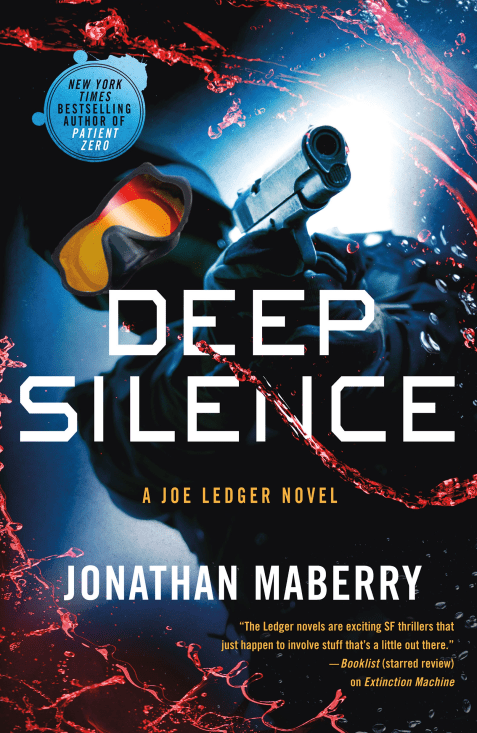
Deep Silence by Jonathan Maberry

Deep Silence Cover.png

Publishers: St. Martins Griffin

                        Macmillan Audio

Publication Date – 30 October 2018

Amazon     Book Depository

From horror legend Jonathan Maberry comes the 10th book in his weird-science based horror, thriller, science fiction Joe Ledger series, which takes the reader on a wild joyride through a world gone mad in this five-star adventure.

I have to admit that Maberry is not an author that I have had much experience with before.  The only work of his I have previously read was a fun short story that was featured in a volume of zombie short stories he jointly edited with George A. Romero in 2017 that I previously reviewed here.  However, I am extremely happy that I decided to check out this latest book as it exposed me to this incredible series, which I enjoyed immensely.  I can think of no greater praise for this novel then to say that upon finishing it, I immediately dropped everything and started reading the first book in the series, Patient Zero, which I will be reviewing in the next few weeks as part of my Throwback Thursday series.

I chose to listen to Deep Silence on audiobook rather than read a physical copy.  The audiobook format of this book is just under 16½ hours long and is narrated by Ray Porter, who has worked on several other books in the series.

In this latest book, a Russian splinter group have developed a powerful weapon with pieces of alien crystal seeded throughout the planet.  This new weapon can cause devastating earthquakes on a level never before seen and has the potential to destroy the entirety of the United States.  The weapon also has a chilling side effect: it causes people around the epicentre of the quake to engage in violent acts of madness, from suicide to ferocious attacks on others.  The first attack targets Washington, with mass violence erupting around the Capitol building.

America’s only hope may be the top-secret rapid response organisation, the Department of Military Sciences (DMS).  For years, the DMS has been the only line of defence against the insane science America’s enemies are utilising and developing in this new age of wonders.  From deadly diseases, ancient forbidden technologies, extreme acts of genetic manipulation, the latest forms of cyber and electronic attack, and even weaponised zombies, the DMS, led in the field by Captain Joe Ledger, has managed to stop all these threats and more.  Utilising the latest military and espionage equipment and the best and brightest soldiers and scientists America has to offer, the DMS operates just outside the government and can go further than any other agency can.

However, while the DMS attempts to combat this latest threat, they find themselves hindered by a megalomaniac President whose stupidity and paranoia make him more afraid of the DMS than the group unleashing earthquakes across his country.  As Joe and his team attempt to hunt down the origins of this attack they must contend not only with a dangerous Russian force but also with agents of their own Government and devices that can drive even the most dedicated DMS agent insane.  But as the Russians attempt to force the eruption of the Yellowstone caldera, the greatest threat may come from the creatures the technology was stolen from.

Deep Silence is the 10th book in Maberry’s Joe Ledger series, which started in 2009 with Patient Zero.  Maberry has been writing since 2006, with his debut book Ghost Road Blues forming the first book in the Pine Deep Trilogy.  Since then, Maberry has written a huge number of books, most of which have a horror theme or focus.  Apart from his Joe Ledger series, Maberry is probably best known for his Rot & Ruin series, a young adult zombie apocalypse series.  Aside from his fictional novels, Maberry has also written several comics for Marvel as well of a number of non-fiction books, which tend to focus on Maberry’s passions for martial arts and the supernatural.

Deep Silence is an exceptional book that combines together a number of genres, including science fiction, thriller, horror, military fiction and spy thrillers into one very captivating narrative.  The end result is a non-stop thrill ride that perfectly utilises the series’s bizarre nature and advanced science to create a devastating threat and a larger-than-life protagonist to face it.  There are so many amazing elements to this book, from its continuation of an enjoyable series, to the very weird elements that come into play, to the excellent writing style and enjoyable characters.  Once I started reading this book I just could not stop, and it is easily one of my favourite books of this year.

From what I understand, the Joe Ledger series started off mostly focusing on the mad sciences that humans are able to create and use against each other.  However, in recent books, the series has taken on a more Lovecraftian vibe, with unknown aliens, space demons and incredibly insane technology.  Deep Silence in particular seems to relate back to several of these previous alien technology based novels, as the devices, technology and motives that the book’s antagonists utilise are closely related to the adventures that occurred in previous books.  That being said, there is still the continuous use of more advanced human technologies utilised by many of the book’s characters, especially those working for the DMS.  All the crazy gadgets that they use are pretty impressive, but none (with one or two major exceptions) are outside the realm of possibility and reflect technologies that could potentially exist.  Indeed, in the introduction to Patient Zero, Maberry actually confirms that most of the technology he describes in his books is currently used or could soon be used by intelligence organisations around the world today.

One of the challenges of coming into a series late is the reader’s lack of knowledge about the universe’s background information, lore and the development of its main characters and the extent of their relationships.  Maberry does an incredible job bridging this gap throughout Deep Silence, providing the reader with descriptions of previous events, recaps of character descriptions and history and making use of a number of references to previous missions and adventures captured in the other books in the Joe Ledger series.  There are also a number of scenes that appeared to be callbacks to previous books, although the author was able to describe the pertinent details of these events.  As a result, I was never lost at any point and really appreciated the recaps and detailed descriptions the book’s various point-of-view characters provided throughout the novel.  It also made me very curious about some of the previous books in the franchise, and I am now very interested in checking out some of these insane and fun-sounding adventures.  As a result, Deep Silence is an excellent book if you want to get an idea of what the Joe Ledger series is all about.  At the same time, established fans of this long-running series will be interested to see the significant changes that occur to the book’s main characters, as well as the scenes detailing where the series will potentially be going in the future.

One of the things that I really enjoyed about Deep Silence was the way that Maberry presents the book’s narrative from multiple perspectives and across a range of different time periods.  Because of this, the reader is given a far wider view of the overall narrative.  Not only do they get to see the protagonists attempting to investigate and stop what is going on, but they get to see the antagonists coming up with their plans, discovering and researching their doomsday device over a period of years and then implementing their mission.  This also allows the reader to get a far deeper understanding of the antagonist’s objectives and mindscapes in committing these acts and what it costs them mentally and emotionally.  Nearly all the fun and eccentric characters working in the DMS get a few scenes told from their point of view.  This provides the reader with some high level, but easy to follow, scientific discussions, hacking sequences and the utilisation of incredibly exciting-sounding advanced espionage technology.  There is also a focus within Deep Silence of the politics around and behind the DMS, and how the organisation’s leader, the mysterious Mr Church (who is totally an alien, right?), deals with these situations.

While all of the other point-of-view characters are entertaining and it is intriguing to view their sides of the story, the best character has to be the series’s main protagonist, Joe Ledger.  Ledger is the extremely dangerous and slightly disturbed leader of the DMS field team, and has been at the forefront of all the adventures in this series.  It is interesting to note that Ledger is the only character in this book whose story is told from the first person perspective, which is fortunate because Ledger is one of the biggest smartasses in fiction, especially within the privacy of his head.  Nearly every single piece of the book told from Ledger’s point of view is filled with jokes, wisecracks, and exaggerated or sarcastic thoughts.  Ledger has some incredibly humorous observations about the world around him, especially the eccentric characters he encounters, and his thoughts are just as likely to be self-deprecating as they are to be insulting about the people he has to deal with.  He is also an eccentric being who does some incredibly funny things, from having fun with his opponents to humming the Mission Impossible theme as he breaks into a safe.  However, beneath this humorous exterior there is a deeply damaged character who is severely impacted by events that have occurred before and during this series.  Maberry spends significant time diving into this character’s history and psyche, which quickly gives the reader, even readers previously unfamiliar with the series, a good understanding of his life and the events that define him.  His deep and fractured mind becomes a key part of this story, especially when it encounters mind-altering alien crystal and events beyond the realm of human comprehension.  All of this helps create an amazing and incredibly relatable central character whom the reader becomes incredibly drawn to, and as a result, Ledger is one of the best things about this book.  Special mention should also be given to Ledger’s combat dog Ghost, who appears in nearly all the same scenes as Ledger and is just as much of an enjoyable character as his owner.

While the mad science elements and characters are great, Maberry has also ensured that this is the perfect book for those action junkies looking for fast-paced thrills.  Ledger is an absolute beast throughout this book and engages in a number of fantastic fights in a variety of different scenarios.  Maberry channels his love of martial arts through this character and includes a number of detailed and very quick fight scenes as Ledger dismantles his opponents with efficient skill.  The other characters are no slouches and there are number of great action sequences I enjoyed.  Two of my favourites have to be two separate and extended sequences which see Ledger and DMS’s Echo Team engage in massive fire fights with a range of opponents.  These scenes are absolutely incredible and make the reader feel like they are really in the middle of a gun battle.  The author takes pains to try and highlight how methodical and calm professional teams can be during battles while also highlighting the various strategies and combat advantages used.  The multiple perspectives come into play here perfectly, as the different members of Echo Team engage in various encounters around the main battle, really highlighting what an effective special ops team can accomplish in the field.  Maberry enhances the fun and the action to a crazy degree by also utilising the advanced technology available to the DMS agents.  This not only includes some insane and deadly weaponry, which is very cool in action, but also other pieces of advanced technology such as drones, body armour, goggles, and enhancements for Ghost that help turn the battles into massive and enjoyable set pieces.

Nothing, however, can top the sheer insanity that unfolds when the book’s antagonists unleash their super weapon against the world.  Maberry’s descriptive and skilled writing really brings these scenes to life.  The sheer devastation of the earthquakes that he describes is just incredible and very disturbing.  But nothing is more crazy or electrifying then the scenes where the people who are affected by the strange energy given off by the weapon go insane and start participating in a violent rampage against themselves or against each other.  Maberry pulls no punches here and all the violence is on full display, from terrible acts of violence against anyone around them to disturbing suicides or episodes of self-harm.  In many of these scenes the author attempts to get into the head of these characters and watch them slowly unfold from within.  This mostly prevalent with his protagonist, Joe Ledger, but other characters’ thoughts are shown.  Let’s just say you’ll never look at the Beatles song Revolution 9 the same again.  The biggest example of this insanity happens around the Capitol building in Washington DC, and quite frankly it reminded me of the church scene in Kingsman: The Secret Service, with the protagonists stuck in the middle of a crazy mob.

One of the more intriguing parts of Deep Silence is the side character of the President of the United States of America.  While this character is never explicitly named in the book, he is clearly supposed to be a Trump analogue.  The character is an easily manipulated, short-tempered, Twitter-obsessed moron who puts his own needs far above those of the country he is governing.  The resemblance to Trump is uncanny, and Maberry does an incredible job mirroring his arrogance and personality throughout the book.  While this character is a great addition by itself, Maberry spends a lot of time exploring how a character like this would deal with the advanced technology and extreme catastrophes that are a major part of this series.  The results are frustrating for the reader as they are forced to sit there and watch this character make all the wrong decisions and serve his own agenda or self-interest.  It was also very intriguing watching this President go up against the DMS as he routinely targets the department out of fear and ignorance.  The new political reality of Washington becomes a major factor throughout Deep Silence, and Maberry is understandably critical about how things are being run and the insanity currently gripping Washington.  It was very interesting to see Maberry incorporate the current unpredictable political reality of America into his new book, and readers will be very intrigued to see how this might impact the future of his long-running series.

I listened to the audiobook version of Deep Silence, narrated by Ray Porter.  The audiobook version does go for over 16 hours, so it’s one of the longer ones I have listened to lately.  That being said, due to its exceptional content, I found myself making a variety of excuses just to keep listening to this audiobook, and got through it very quickly.  The audiobook is an incredible way to experience this book, and I would highly recommend it, mainly because of Ray Porter’s narration.  Porter absolutely nails all of the characters and provides a number of amazing voices to fully capture the diverse accents and attitudes of this eccentric group of characters.  I was particularly enthralled with the calm, cool voice he gifted to the DMS Director, Mr Church, which really reminded me of Tom Hanks’s voice.  Special mention should also be given to his narration of the President.  The narrator created a fantastic Trump-like voice that fully conveyed the character’s high opinion of himself, as well as his dismissive and arrogant nature.  I actually had a visceral reaction when I heard that voice the first time, it was that good.  Porter’s narration for Joe Ledger was also perfect, as he does an incredible job portraying Ledger’s high-energy musings and the full tone of his personality.  Porter’s voice peaks and rises to meet the full intent of any of Ledger’s sentences, and he is a master at conveying Ledger’s innate sarcasm.  At the same time, he is also able to make his voice more serious and subdued during the darker scenes in which Ledger is deep within his head or his memories.  This is sterling work from Porter, and one of the best audiobook narrations I have ever listened to.  As a result, I highly recommend that the audiobook version of Deep Silence as the best way to experience this novel.

Bestselling author Jonathan Maberry once again takes his audience on a captivating thrill ride in the Joe Ledger Series.  Deep Silence provides the reader with an extraordinary and very engrossing story that proves extremely hard to put down.  Equally enjoyable for established fans of this long-running series and new readers who have yet to experience Maberry’s work, readers can and will have an incredible amount of fun with this book.  Best enjoyed in audiobook format, Deep Silence is guaranteed to make you a dedicated fan of the author and easily gets a five-star rating from me.

My Rating:

Five Stars

Amazon     Book Depository

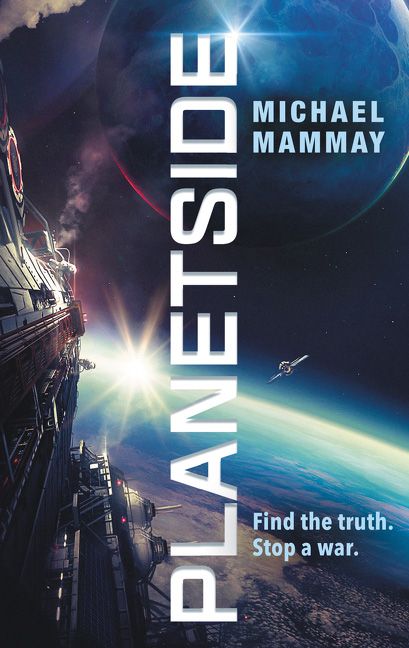
Planetside by Michael Mammay

Planetside Cover 2

Publishers: Harper Voyager

                        HarperAudio

Publication Date – 31 July 2018

Amazon

Well, that was an unexpectantly awesome book!  I am usually pretty good at predicting how good a book is going to be by its plot synopsis or my prior knowledge of the author.  When I first heard about Planetside I thought it sounded like an interesting concept from first-time author Michael Mammay.  While I had high hopes for the book, I did somewhat assume that it would just be another solid but enjoyable science fiction mystery.  What I was not expecting, however, was one of the best science fiction books of 2018 that easy achieves a five-star rating from me.

Set in the far future of Earth’s expansion, Planetside follows Colonel Carl Butler, a war hero living out a peaceful semi-retirement on a training base.  However, when his old friend General Serata calls him late at night and drags him all the way to headquarters, he obliges for old times’ sake.  Serata needs him to travel to the planet of Cappa, humanity’s current warzone, where members of a resilient and intelligent alien race known as the Cappans are fighting a gruelling insurgency against the humans attempting to exploit their planet.  Once there, he will head up an investigation into the disappearance of a young lieutenant who went missing after being wounded on the planet.  By all accounts, the wounded lieutenant was successfully evacuated from the surface, but the military hospital claims that he never arrived at their facility.  To makes matters worse, the lieutenant is the son of a high councillor, and the disappearance has become a highly publicised affair.  Despite knowing that there is more to the case than Serata is letting on, Butler agrees to find the missing officer.

Arriving at Cappa Base, the space station hovering over the planet, Butler soon finds that his investigation is going to be a lot harder than he anticipated.  All the soldiers he speaks to have the same rehearsed story, the head of the base’s military hospital flat out refuses to cooperate with him, the head of Special Ops is continuously unable to come off-planet to speak to him, and any witnesses or evidence that could point him in the right direction mysteriously disappears.  It is also damn suspicious that any time he takes a step in the right direction, somebody tries to have him killed.  Under pressure to wrap this investigation up, Butler decides to drop down onto the surface of Cappa, but what he finds down there will change everything.  Forced into an increasingly desperate situation, Butler must find the answers he needs before it is too late.

This is the first book from Michael Mammay, but it was more than enough to make me a dedicated fan of this author.  With a sequel already set to be released in 2019, Planetside is an extraordinary introduction to an amazing new series.  I chose to listen to this book in its audiobook format, read by R. C. Bray, and at 8 hours 38 minutes, this is a fairly quick way to enjoy this fantastic book.

Planetside’s story is based around the protagonist’s investigation into a missing human soldier on an alien planet that has been occupied by the human military.  As Butler arrives at the military base the solider was stationed out of, he begins to realise that there is something much more to the case than what was advertised.  Every single person he speaks to is hiding something, he seems only to uncover more lies, and some shadowy figures are actively trying to sabotage his investigation in any way they can.  Despite all these setbacks, the protagonist persists with his investigation throughout the course of the book and slowly begins to uncover the underlying conspiracy that the soldier’s disappearance is just one small part of.  There is so much about this mystery investigation to enjoy, as the author seamlessly combines the mystery and conspiracy part of this story with the science fiction element, creating a unique and captivating overall narrative.  The full scope of this conspiracy is very impressive, and Mammay’s slow burn reveal of the extent and implications of what Butler uncovers is well done to keep the reader in suspense.  I was intensely intrigued by this multilayered conspiracy, and was left constantly guessing at what the potential solution was.

The book is told from the point of view of its protagonist, Colonel Butler, and Mammay has created an excellent central character for this story that the reader is instantly drawn to and cannot help but like.  The author has done a fantastic job conveying the fact that Butler is a straight-shooting, no-bullshit, wily veteran soldier who has had enough of war and is just looking forward to retirement.  He is an amusing and intriguing choice to investigate the book’s intricate and potentially wide-reaching conspiracy, as he powers through the expected political niceties other investigators may have worried about without any concerns for his future or career.  His years of service also ensure that he has impeccable instincts when it comes to the people he is dealing with and is fully aware of when the other characters are bullshitting him, which occurs frequently throughout this book.  I had fun observing this rough and seemingly uncomplicated old-school soldier get to grips with this elaborate conspiracy and blow through all the careful plans of the book’s antagonists.  The colonel also has a sense of humour, something that the other characters encounter to various degrees of frustration, especially the people he is intentionally pissing off.  I also appreciated the self-deprecating and extremely honest reflections about the situation that Butler presents to the reader, as it made me like him even more.

The military aspects of this book are another amazing part of Planetside, as Mammay has perfectly captured elements of the modern day military and transplanted them into this science fiction storyline.  The majority of the story is set within Cappa Base, and the reader is made to feel like they are in a real military base.  The author also seeks to capture the full minutiae of military life throughout the book, and the reader is given insight into what tasks are undertaken on the base, the main characters experience and the respect he commands of the other soldiers in the story.  While most of the focus is on the investigation, there are a couple of action scenes throughout the book, including an extended battle sequence that see’s the protagonist and his allies engage in a protracted firefight with enemy forces on the planet’s surface.  The author’s use of the first-person perspective is perfect for these battle sequences and the reader is dragged right into the middle of these firefights, really experiencing the action through Mammay’s skilled and descriptive writing.  This battle sequences felt very realistic and had some noticeable similarities to real-life skirmishes in modern day battlefields.  The tactics the humans use during these conflicts on Cappa are highly reminiscent of American forces in the Middle East, although the inclusion of more science fiction appropriate weapons and technology allow for some interesting differences.

While the impressive investigation storyline does a fantastic job holding onto the reader’s interest, and the solution to the entire mystery arc is creative and clever, nothing compares to the book’s epic conclusion.  Without going into too much detail, I thought that the way that Mammay ended this book was just incredible, and is one of the main reasons why I am giving this book a five-star rating.  I also loved how, towards the end of the book, the protagonist becomes fully aware of how everything has to end, and at the same time he starts to understand that his oldest friend had sent him on this mission because he knew exactly how Butler would act upon uncovering the full extent of the conspiracy.  The final scene of the book was just perfect as the protagonist reflects on everything that has happened with one of the book’s side characters.  During this scene there is an excellent use of the end of a subtle countdown that has been occurring throughout the entire book, represented by a depleting number of whisky bottles, as well as an appropriate moment of happiness for Butler as he finally gets to have a whisky in a proper glass, which was just perfect.  As mentioned above, Mammay already has a sequel planned, and I am extremely curious to see where the story goes next.

The audiobook version of Planetside is a great way to enjoy this fantastic book, and I had a lot of fun listening to this format.  The audiobook’s narrator, R. C. Bray, manages to capture the gruff and grizzled personality of Butler perfectly, and for most of the book it really sounded like the old colonel was telling you his story.  Bray also does a good job producing distinctive voices for the rest of the characters in book, including several female characters, and the listener is able to distinguish between the various people without too much difficulty.  I also felt that listening to this story really helped bring me into the book’s awesome battle sequences as well as ensuring that I was fully invested in the success of the enjoyable main character.  Overall, I would recommend the audiobook format as an excellent way to enjoy this book, although readers will of course get a lot out of this book if they choose the paperback format.

Michael Mammay’s debut novel, Planetside, is an incredible piece of science fiction and is one of my favourite books of 2018.  Featuring a captivating mystery storyline that places the book’s likeable protagonist in the middle of a massive conspiracy, this book completely grabs the reader’s attention and refuses to let go until its powerful and memorable conclusion.  I cannot recommend this book enough and it is essential reading for all fans of the science fiction genre.  I am very much looking forward to Mammay’s sequel to Planetside, which is already at the top of my must-read list for 2019.

My Rating:

Five Stars

Amazon

The Anomaly by Michael Rutger

The Anomaly Cover

Publishers: Zaffre

                       Hachette Audio

Publication Date – 12 June 2018

Amazon

Prepare to have your fear of the dark reignited in this suspenseful and creative new novel from one of the best horror/thriller writers in the business, which takes the reader on one hell of an adventure.

The world is full of many secrets, cover-ups and mysteries, all of which have been hidden from the public by the academic elite.  At least, that’s what Nolan Moore would have you believe.  Nolan is an amateur archaeologist and former screenwriter whose web series, The Anomaly Files, attempts to uncover weird things from history.  Derided by the experts, The Anomaly Files has a devoted following of conspiracy theorists which Nolan hopes to turn into a television deal, and his latest episode might just be the break that he needs.

Following clues left by an explorer in 1909, Nolan and his production team travel to the Grand Canyon, hoping to find a hidden cave that may contain evidence of an ancient civilisation unrecorded in history.  For once, Nolan appears to be right, as the team manage to find the opening to a cave high up in a remote part of the canyon.  Exploring, they find a cave system filled with mysterious items and artefacts unlike anything ever discovered in this area before.  Their elation at this unique archaeological breakthrough is quickly quashed when they find themselves trapped within the cave, cut off from the outside world.

As their lights start to fade and their supplies begin to dwindle, Nolan and the team hold out hope for a rescue.  However, it soon becomes clear that something is very wrong.  Something alive is entombed with them and there is far more to this cave than they could have ever imagined.  As the team try to survive an increasingly desperate situation, Nolan must uncover the secrets of the structure they find themselves trapped in before they all die in darkness.

Michael Rutger is actually a pseudonym for bestselling author Michael Marshall, who has also written as Michael Marshall Smith.  Rutger has been writing since 1994 and is known for his intriguing science fiction novels, which often have a strong horror/thriller element to them.  The author is probably best known for his creepy 2002 release The Straw Men, which spawned two sequels, but his bibliography is littered with a number of other powerful and terrifying novels.  Fans of Rutger’s previous work will no doubt enjoy the quick reference to The Straw Men contained within The Anomaly, and it will be interesting to see if Rutger goes back to that series in the future.  I chose to listen to The Anomaly on audiobook.  The audiobook is narrated by Brandon Williams, and, at just under 10 hours in length, it doesn’t take too long to get to the heart of this great story.

One of the most enjoyable things about The Anomaly is the tense atmosphere that Rutger instils with his skilled writing and terrifying creative elements.  The reader really gets a sense of the desperation and despair slowly creeping up on the characters as the story progresses, even if they attempt to keep a brave face with each other.  With a limited and dwindling number of lights being held by the characters, Rutger is able to create quite a few opportunities for his protagonists to be forced to crawl around in the dark in this hostile environment.  The oppressive darkness takes a real shape during the book and at times has a near physical sense to it as the characters deal with it in different ways.  I felt that the story contained a well-balanced combination of action, exploration, archaeological and scientific exposition, despair-filled periods of rest, several gruesome and traumatic scenes and a surprising amount of humour from the characters.  However, even as the characters crack jokes at each other, you can feel the darkness surrounding them and you are constantly wondering what is going to happen next.

Special mention needs to go to Rutger’s creation of The Anomaly Files webcast show that was a major feature of the book’s early plot and the main plot reason that this group of characters are in this situation.  The author spends significant time describing the creation and filming process behind this show, and it’s intriguing how similar it sounds to some real-life conspiracy theory shows or broadcasts.  This accurate portrayal of a web show adds a lot of realism to the story, especially as it becomes clear that the characters are in over their heads and are different from the usual group of leading experts or military types you’d usually find in this type of novel.

I am not going to go into too much detail about the mystery of the cave as I don’t want to spoil this book for anyone who hasn’t read it yet.  Trying to figure out what exactly is behind the events affecting the protagonists is a big part of the experience, and too many details could potentially ruin the book’s impact.  Suffice to say, this central mystery is a very unique and creative idea from Rutger that is made up of a variety of different elements.  It was very intriguing to see the full extent of this central idea be revealed to the protagonists as the story progresses and readers will be astounded by what Rutger has come up with.  This mystery is made up of an interesting mixture of aspects from a number of different genres, and the author combines them together into one very intriguing conclusion with some massive implications.  I really enjoyed this exploration into the weird, and some of the things that harassed the protagonists as a result of the central mystery element worked very well with the tense nature of the story.

One of the defining features of The Anomaly is the strong focus on the characters entering the cave.  The readers grow to really care for these characters, and quite a lot of time is spent exploring their past and showing them as people who don’t deserve to be trapped in this terrible situation.  Most of the book’s focus is on the protagonist and narrator Nolan Moore, who is the cynical host of The Anomaly Files.  Nolan is a great central protagonist to have tell this story, as he is an observant character who has witty and at times piercing insights into his fellow characters while also providing the reader with his detailed examinations of the locations around him.  Despite coming off as a bit arrogant at the start of the book, the character’s brutal honesty about himself, as well as the exploration of certain parts of his past, does a lot to humanise him to the reader and make him into a character you can really care about.  This humanisation is furthered by his attempts to save his team and the extreme guilt that he feels for having brought his team into this place.

While Nolan is a great central character, Rutger also spends a significant amount of time focusing on the side characters, who in some ways are just as important as Nolan to the book’s overall story.  My absolute favourite of these characters had to be The Anomaly Files British producer, Ken, who spends the entire time quipping, swearing and generally making the most sarcastic comments he can, no matter how dire the situation gets.  Most of the book’s humour comes from Ken’s dialogue, as he makes it clear he’ll be joking and insulting the world right up till his death.  While this sort of character seems an odd choice for a thriller/horror novel, I felt his sarcastic attitude and comments fit the tense tone perfectly as he encapsulates a lot of feelings a normal person would have in that situation.  Ken is also one of those characters you can’t help but love and who you really, really hope will survive all the terrible stuff happening around them.

Molly the assistant producer and Pierre the cameraman also get a significant amount of focus in the book and are really good side characters.  Molly goes from being the most calm and collected character at the start of the book to the person most affected by the darkness and atmosphere of the cave.  Watching her try and work through her issues is quite inspiring, and there is even a descent exploration of the root of these deeper issues.  Not much of Pierre’s backstory is shown; however, the reader gets a good sense of his character throughout the book, and Nolan’s changing opinion and growing admiration for him mirrors the reader’s thoughts on him.  Other main characters include the ambitious reporter, Gemma, and Feather, the new age hippy who acts as a representative of the show’s sponsor.  Both of these characters get some decent exploration in the book, as well as some great scenes that make them stand out in their own ways.

I really enjoyed the audiobook version of The Anomaly.  I would definitely recommend it for anyone interested in finding out more about this compelling story.  I felt that having this book read out to me helped expand on the story’s tension and dark atmosphere, and it was a fantastic way to enjoy this amazing story.  Brandon Williams’s narration of the audiobook is excellent, and his voices for the characters are a highlight of this format.  Williams does a great job capturing the book’s point-of-view character, Nolan, very well, and the audience gets a real sense of the character’s cynical nature and inner thoughts through the terrific narration.  I absolutely loved the voice that Williams created for Ken, as he gives the character a very distinctive English accent that fits Ken’s sarcastic personality perfectly.  The accent is just wonderful and actually reminded me a lot of Matt Ryan’s voice for John Constantine in some of the modern television shows, especially when he swears (‘bollocks’, for example, is used multiple times).  The rest of the voices that Williams creates work well for the other characters and allow the readers to distinguish between them, although the less said about the ‘South African’ accent for minor character Dylan, the better.

With a powerfully intense atmosphere, The Anomaly is an exceptional horror/thriller from bestselling author Michael Rutger.  This is an amazing book, and readers will have a lot of fun trying to unravel the book’s central mystery, while desperately hoping their favourite characters survive this chilling adventure.  Addictive and terrifying in equal measures, this is an outstanding book that comes highly recommended for anyone looking for a weird, thrilling or horror based read.

My Rating:

Four and a half stars

Amazon

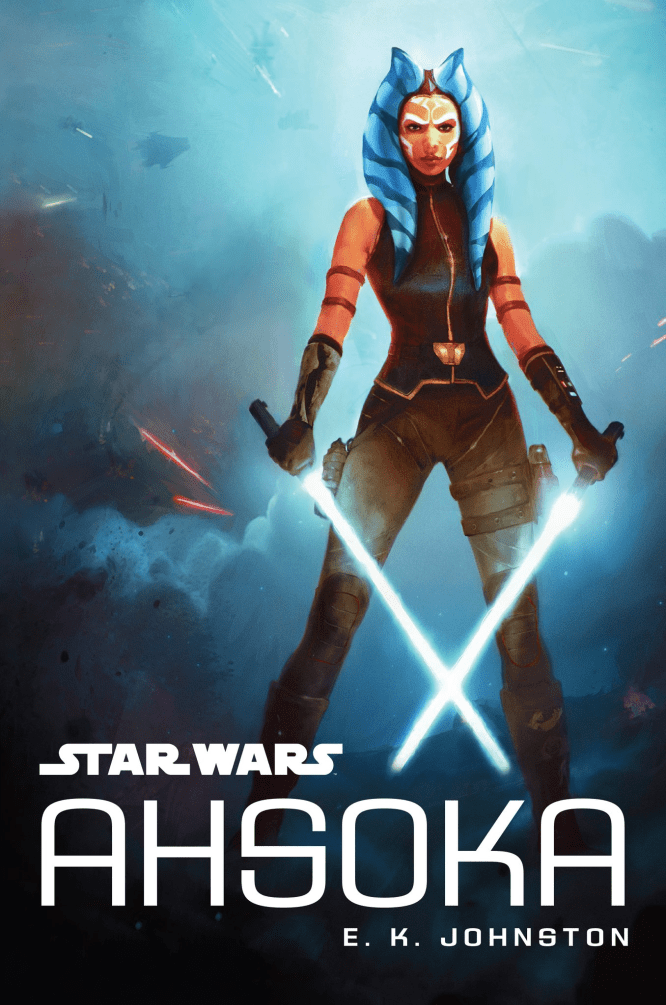
Throwback Thursday: Star Wars: Ahsoka by E. K. Johnston

Ahsoka_novel_cover

Publishers: Disney Lucasfilm Press

                        Penguin Random House Audio

Release Date – 11 October 2016

Amazon

Reviewed as part of my Throwback Thursday series, where I republish old reviews, review books I have read before or review older books I have only just had a chance to read.

The apprentice lives.  One of the best Star Wars characters that originated outside of the live-action movies returns in this action-packed, character-driven novel, which follows Ahsoka Tano’s adventures after the destruction of the Jedi Order.

Those people familiar with my previous reviews may have noticed that I am a bit of a Star Wars fan, having reviewed several pieces from the current Disney Star Wars extended universe in the last few months.  Therefore, it should not come as a surprise to anyone that I have watched and enjoyed the Star Wars: The Clone Wars and Star Wars Rebels animated television shows.  Both of these shows are very well done, can be appreciated by a varied audience and contain a large amount of the classic Star Wars heart and respect for the franchise’s lore and history that was missing in some of the more recent movies.  While many memorable characters were introduced in these shows, perhaps the most significant to the lore is the titular character of this book, Ahsoka Tano, Anakin Skywalker’s apprentice.

For those of you failing to remember Anakin having an apprentice in the live-action movies, you are not going crazy; Ahsoka has yet to appear in any live action movie.  She was instead introduced in The Clone Wars animated movie and served as one of the main characters of The Clone Wars television series, all of which take place in the years between Attack of the Clones and Revenge of the Sith.  Despite being one of the most popular characters on the show, Ahsoka would leave the Jedi Order at the end of the fifth season of The Clone Wars and only appear in the sixth season as part of a short vision sequence.  As a result, fans of the both the show and the character were frustrated and confused about what Ahsoka’s fate was and whether she had survived the events of the third prequel movie.  Fans didn’t get their answer until a couple of years later, at the end of the first season of Star Wars Rebels, where it was revealed that Ahsoka had survived the Jedi purge, becoming a member of the early Rebel Alliance.  Ahsoka, now wielding a pair of white lightsabers, became a key character in the second season of Star Wars Rebels, in which she was still an incredibly cool and powerful warrior.  She was utilised to perfection in this new show and had what is easily the best scene in the entire run of Star Wars Rebels: her long-awaited confrontation with Darth Vader.  The sheer emotion and intensity as Ahsoka finally came face-to-face with her old master and discovered that he was responsible for the fall of the Jedi was just amazing and is one of my favourite moments from all of television.

Following her appearance in Star Wars Rebels, Disney commissioned a young adult Ahsoka book, which was announced on 31 March 2016, one day after the Star Wars Rebels season 2 finale.  This book was released in late 2016 and was written by young adult author and Star Wars fan E. K. Johnston.  Ahsoka was Johnston’s first foray into Star Wars fiction, although she is currently working on Queen’s Shadow, a young adult novel focused on a post The Phantom Menace Padme Amidala, set to be released next year.  I have no doubt that a review for Queen’s Shadow will appear on this website in due time.  Now, with the recent announcement of a seventh season of The Clone Wars and the reveal that Ahsoka will be appearing in this new season, I decided to check out this book to see if it did the character any justice.  I chose to enjoy this as an audiobook, rather than read a physical copy.

During the Clone War, Ahsoka Tano was a fierce warrior and a commander of the Republic’s clone troopers.  However, after the devastation of Emperor Palpatine’s Order 66, which saw the clones turn on the Jedi, everything changed.  Fighting on Mandalore, far away from her master, Anakin Skywalker, Ahsoka is unaware of his fall to the dark side of the Force, and only just manages to escape the purge of the Jedi Order.

Now, one year after the fall of the Republic and the rise of the new Galactic Empire, the former Padawan is in hiding on the outskirts of the galaxy, trying to avoid any Imperial attention.  Living under an assumed name and with her trusty dual lightsabres gone, Ahsoka scrapes a living as a mechanic, intentionally distancing herself from the Force in order to hide her Jedi abilities.

Ahsoka journeys to a remote farming settlement on the Outer Rim moon of Raada.  Settling into her new life and making connections with its inhabitants, Ahsoka believes that she has finally found her sanctuary.  But her hopes of a peaceful life in her new home are quickly dashed when the Empire arrives, imposing their totalitarian rule on the people of Raada.  The agricultural potential of the moon is vital to the future of the Empire, and the workers are being forced to farm a new and mysterious plant.  Determined to help her new friends and wanting to make a difference, Ahsoka uses her wartime experience to help form a resistance in order to undermine Imperial control.

But when she is forced to reveal her full powers in order to save her friends, she once again finds herself on the run.  However, this time her actions have not gone unnoticed.  Her old ally, Senator Bail Organa wants her to join his fledgling rebellion, while the sinister Inquisitor, the Sixth Brother, arrives on Raada with plans to capture her, using Ahsoka’s friends as bait.

Because I am a fan of the titular character, I did go into Ahsoka with some rather high expectations.  Luckily I quite enjoyed Ahsoka, powering through this book quickly while appreciating how Ahsoka’s new adventure fit into the existing Star Wars chronology.  This story is very good, with an excellent blend of character development, Star Wars lore and some scintillating action and adventure.  The book contains a well-paced narrative that not only features Ahsoka’s personal story, but also examines the viewpoint of several side characters, in order to move the plot along, while also showing the impacts of Ahsoka’s actions from a different viewpoint.

This book is mainly focused on the adventures of Ahsoka, and fans of the animated show will appreciate seeing how she not only managed to survived the purge of the Jedi, but how she became the hardened rebel agent we encountered in Star Wars Rebels.  I feel that anyone who reads this book will appreciate the considerable amount of character development and insight that occurs with the titular character.  At the start of the book, Ahsoka is afraid, hiding who and what she is from the world while also denying herself access to the Force.  She is filled with regrets, concerns for her missing Jedi family and guilt not just about surviving but also about leaving the Jedi Order before its fall.  Throughout the book, her adventures, the new friendships she develops, the people she helps and the role she plays on Raada all help her to find a new purpose, as well as re-establishing her connection with the Force.

There are a number of great scenes featuring or concerning Ahsoka in this book.  These include her battle with the Sixth Brother, the forging of her new white lightsabres and the epic scene where she unleashes her Force abilities for the first time in a year.  It was also intriguing to see her advising the farmers in guerrilla tactics and helping them sabotage the Imperial occupation.  Fans of Ahsoka will appreciate the similarities this has to one of the character’s most significant arcs from The Clone Wars that featured her training a guerrilla army to combat a Separatist invasion, including a young Saw Gerrera (Forest Whitaker’s character in Rogue One).  I also enjoyed Johnston’s focus on the connection between Ahsoka and the female character Kaedan Larte.  It was great seeing this character help get Ahsoka out of her shell, and the subtle romantic feelings between the two of them was an interesting character direction for Ahsoka.  Overall, I thought Ahsoka contained an incredible take on its titular character, as Johnston not only provides the reader with a much clearer picture of Ahsoka’s fate following The Clone Wars, but also provides a powerful look at her thoughts and feelings following the destruction of the Jedi.

In addition to exploring the fates of one of their favourite characters, fans of the franchise are also treated to another intriguing look at events in the Star Wars universe not covered in the movies or television shows.  Ahsoka is set one year after the events of Revenge of the Sith, and shows the early days of Imperial control in the galaxy.  There is a palpable and well-utilised feeling of dread throughout the book as the various point-of-view characters encounter the steady increases in Imperial control as their military expands its influence.  It is fascinating to see the early Imperial military machine in action, especially when it comes to controlling and pacifying smaller planets and moons.  One of the most interesting aspects of this is the type of troops being utilised.  By this point in the Star Wars’ chronology, the Empire has started to phase out their clone troopers, replacing them with the human stormtroopers that appear in the original trilogy.  During her encounters with them, Ahsoka notes that these stormtroopers are still quite green and are nowhere near the clones’ level of competency when it comes to battle, controlling territory or dealing with Jedi.  This changeover in troop type for the Empire has not really been covered in too much detail before and is quite fascinating to see.

The exploration of the Empire’s methods of hunting down the remaining Jedi is also intriguing, as one of Vader’s Inquisitors serves as the book’s main antagonist.  The Sixth Brother is shown not only hunting fully trained Jedi like Ahsoka but also tracking down Force-sensitive children for his masters.  The extent of the Inquisitor’s power and influence is explored in some detail here, and I enjoyed seeing Ahsoka’s impression of these Inquisitors’ skills and actions, especially as the Inquisitors were also trained by Darth Vader.  Readers will also note the obligatory hints at the creation of the Death Star throughout the plot of the book, which is an important part of the overall Star Wars chronology.

These early days of the Imperial military is not the only thing covered in the book, as Johnston also explores the opening actions that would lead to the formation of the Rebel Alliance.  Johnston uses minor Star Wars character Bail Organa to great effect here, showing the work he beings immediately after his heroics in Revenge of the Sith to oppose the Emperor.  Ahsoka also features several cameos from other characters in the Star Wars cannon, and readers can look forward to seeing fan favourite characters Darth Maul, Obi-Wan Kenobi, R2D2, a young Princess Leia and the Grand Inquisitor.  This is a compelling and insightful addition to the Star Wars extended universe, and readers will be amazed by this new viewpoint into one of the franchise’s most volatile periods.

As I mentioned above, I chose to listen to the audiobook version of Ahsoka rather than track down a physical copy to read.  This was mainly because the creators of the Ahsoka audiobook managed to score Ashley Eckstein as the narrator.  Eckstein is the actor who voices Ahsoka in both The Clone Wars and Star Wars Rebels, and I loved the idea of having the definitive voice of the character narrate this crucial Ahsoka story to me.  As Ahsoka is the most prominent point-of-view character, this works out incredibly well, and the reader can enjoy hearing Ahsoka tell the story of what is around her.  Eckstein also provides excellent voice work for all the other speaking characters that feature in the book, as each of these characters were given a distinctive voice that does not feel out of place.

While I really enjoyed hearing Eckstein narrate the story, another benefit of listening to Ahsoka on audiobook is the use of the iconic Star Wars music, as well as the book’s cool use of sound effects.  The creators of the Ahsoka audiobook have inserted John Williams’s iconic score from the movies into a variety of the book’s scenes.  While this is slightly distracting in one or two places where the music did not quite fit properly, it works incredibly well for most of the book.  Several of the story’s big scenes, such as the pivotal battle sequence where Ahsoka reveals her Jedi powers for the first time since she went into hiding, are underscored by this music.  With this grand and powerful music playing in the background, these scenes are given a real epic quality that you just do not get from reading a psychical copy of the book.  It also serves to make Ahsoka feel a lot more connected to the movies, as the listeners are provided with a score that is instantly recognisable as belonging to this franchise.  In addition to the spectacular musical inclusions, the audiobook also features a range of relevant sound effects that really add to the book’s atmosphere and authenticity.  These sound effects range from droid noises and the sounds of ships starting up, to background music when the characters hang out in the cantina.  None of these sound effects distracts from the story and for some of the battle scenes, the lightsabers and blasters sounds really add to the reader’s excitement and involvement in the action.  Another thing I found fun while listening to Ahsoka on audiobook was the producer’s use of some sort of voice modulator for when Eckstein narrates the voices of stormtroopers or other characters wearing helmets.  This is a nice touch and really speaks to the producer’s attention to detail.  I am unsure how effective this would have been if Darth Vader had appeared in the book, but I’m sure I would found the end result amusing one way or another.

Clocking in at just over seven hours long, this is an easy book to get through and the inclusion of the classic Star Wars music, fun sounds effects and the definitive voice of the titular character make it an excellent way to experience this fantastic story.

Ahsoka has been written with a young adult audience in mind, and is definitely an enjoyable book for younger readers who are curious about the Star Wars universe, are fans of the animated shows, or are just looking for an exciting adventure in space.  That being said, the book does not pull any punches, and features an extended torture scene and quite a few deaths, including one particularly gruesome kill by the Sixth Brother.  While some of this can be a tad heavy, I personally feel that anyone mature enough to be familiar with the Star Wars franchise is probably going to be mature enough to not be affected by this violence.  Despite being intended for a young adult audience, Ahsoka, like many of the Star Wars young adult range, is definitely a series that can be appreciated by an older audience, especially those familiar with the franchise and the titular character.

Overall, I was very happy that I checked out Ahsoka, as it not only provided greater insight into the history of one of my favourite Star War’s characters but also painted a detailed and intriguing picture about the early days of the Empire.  Featuring a surprisingly deep and emotional story, this is a fantastic addition to the Star Wars extended universe that will appeal to fans of the amazing animated show, while also offering character based adventure to the more casual reader.  Definitely best to check out in the audiobook format, readers will love how this morphs this impressive Star Wars story into a memorable experience that becomes very difficult to turn off.

My Rating:

Four stars

Amazon

If you enjoy Star Wars fiction, check out some of my previous reviews:

https://unseenlibrary.com/2018/08/12/star-wars-thrawn-alliances-by-timothy-zahn/

https://unseenlibrary.com/2018/05/30/star-wars-last-shot-by-daniel-jose-older/

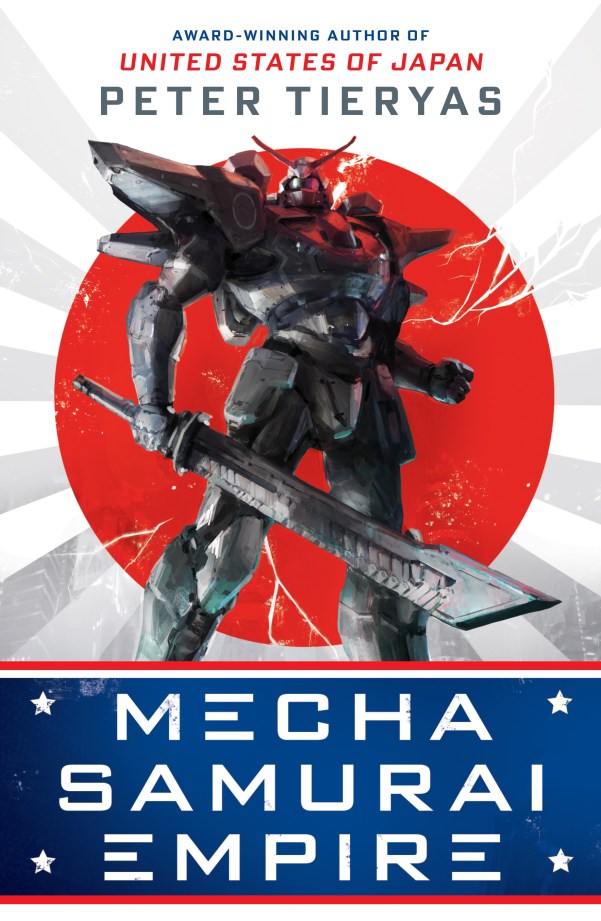
Mecha Samurai Empire by Peter Tieryas

Mecha Samurai Empire Cover

Publisher: Ace

Publication Date – 18 September 2018

Amazon     Book Depository

Prepare to experience one hell of an adventure in this follow-up to Peter Tieryas’s successful United States of Japan, in this incredibly exciting read that can best be described as The Man in the High Castle meets Pacific Rim.

Mecha Samurai Empire is set in an alternate version of our history, in which Japan and the Nazis won World War II.  This change to the outcome of the war was a result of the creation of the mecha, gigantic piloted military machines which gave the Japanese an unparallel advantage against the American forces.  In the aftermath of the war, America was split between Japan and Germany, who created distinct territories.  The western states, including California, became part of the United States of Japan, with its inhabitants swearing fealty to the Emperor.

In the 50 years that followed the end of the war, the United States of Japan entered an age of prosperity and technological advancement, and the development of more advanced mecha made them the most feared and effective military power in the world.  In addition to their military control, Japanese culture and custom has also been incorporated into American society, history has been rewritten and Japan’s wartime atrocities have been whitewashed.

In California, young student Makoto Fujimoto has only one dream: to become a mecha pilot and defend his country against the terrorists who killed his parents.  Unfortunately, Mac lacks the grades or political connections to achieve a placement in the mecha pilot training course at the elite Berkeley Military Academy, and his attempts to pass the special military exam end disastrously.  However, a chance encounter with rebel American forces allows him the opportunity to join up with a civilian mecha security company.  While his new role might not provide him much action, it might ensure his future placement at Berkeley.  But when Mac’s first mission goes horribly wrong, it might take all of his luck and skill just to survive.

Mecha Samurai Empire is an intriguing and exciting new novel from Tieryas and is the second book set in the United States of Japan universe.  Mecha Samurai Empire is not a direct sequel to the first book, United States of Japan, but it does contain a number of the story ideas that Tieryas did explore in his first book, and includes appearances from some of its characters.

As soon as I saw this book in the store and found out it featured mecha battles in an alternate timeline, I knew I was going to have to read it.  Because of the very enticing story concept, I did find myself going into this book with some very high expectations.  After reading it I am very pleased to say that I was not disappointed in the slightest, as I found Mecha Samurai Empire to be an incredibly entertaining book that makes full use of its unique elements and likeable characters to create an addictive story.  If you enjoyed the original United States of Japan, then you will definitely love this latest addition to the universe, that not only continues to highlight Tieryas’s marvellous alternate world, but which ramps the incredible mecha action.

The mecha are definitely the stars of this book, and the author spends a significant amount of time focusing on them and highlighting their importance in this new world.  Most readers of this book are going to be looking for some electrifying mecha combat, and Tieryas delivers this in abundance.  There is a huge amount of different types of mecha action, including training simulations, friendly competitions, small-scale battles between smaller mecha, larger battles between gigantic mechas and Nazi bimorphs (organic mechas), and there is even a large elimination tournament between various mecha pilots.  I’m a sucker for a good tournament, but this had to be one of my favourite extended sequences in the entire book.  Not only is there some incredible action during these tournament battles but the inclusion of multiple pilots allows the author to show off the various mecha battle techniques and fight styles as the competitors go at each other with a variety of close-combat weapons.  I also really enjoyed an earlier sequence when the protagonist finds himself piloting a small crab mecha by himself and must overcome several cannibalised mecha piloted by fanatical American rebels.  During these scenes Mac has to use all his training and skills, as well as the limited resources available to him in order to beat a larger force of opponents, and it is a very gripping scene to read.  Aside from the awesome action scenes, Tieryas has also chosen to present the reader with a much more in-depth view of the mecha in his universe.  The book contains the history of the mecha; the required training, simulations and the teamwork; discussion about famous mecha pilots; examinations of tactics and battle plans; mecha research; and even a look at the cultural impact of the mecha and the reverence shown to the pilots.  All of this additional information is deeply fascinating and really adds a lot to the book as the readers are shown they are more than just weapons.  If you’ve ever enjoyed the idea of mecha combat before, this is definitely the book for you.

While the mecha battles are one of this book’s best features, readers are also treated to an intriguing and memorable alternate history setting where the Axis powers won World War II and ended up taking control of the United States of America.  Tieryas has done an absolutely amazing job of creating a version of America that has been under Japanese control for 50 years, and it is fascinating to see how the author imagines this world would look.  In order to show the reader how the world came to be this way, Tieryas comes up with a clever alternate history of World War II and the years that followed it.  For example, Tieryas explores how a different strategy during the war could lead to a different outcome.  In this case, Japan joined the war by attacking Russia with the Nazis rather than America in the Pacific.  There is also some clever mirroring of real-life history, as the two main victorious world powers, Japan and Germany, end up in a cold war after splitting their conquered territory between them.

In addition to the changes in histories, Tieryas has also been quite inventive when it comes to the impact that a Japanese conquest would have on the culture of America.  While the Japanese influence on these territories in the book is quite noticeable, the author has come up with some captivating combinations between the two distinctive cultures.  I personally though that the way Tieryas continued to provide the reader with a ton of detailed descriptions of the food his characters were having was a very nice touch, as this showcased just how prominent Japanese food is in occupied America, while also featuring some curious examples of fusion cuisine.  It’s also interesting to see how much more advanced certain technology appears to be in this universe, a fact which can be attributed to the research into mecha technology and the fact that Japanese and Nazi scientists were able to operate with the world’s resources, including human test subjects, and a completely unchecked lack of morals.  There is also a dystopian element around this whole country, as there are a range of elements that show how controlling and despotic the United States of Japan government really is.  This is a continuation of the storyline from United States of Japan, and Tieryas continues to explore the nation’s hidden World War II war crimes, the rewriting of history, the use of propaganda, nationwide indoctrination, installed national pride and the fact that the characters are living in thinly disguised police state.  All of this serves to be an amazing background to this book that is both intriguing to explore and adds to the dramatic actions of the characters.

The story of Mecha Samurai Empire is strongly driven by the character development of the narrator and the other protagonists as they attempt to find their place in the world.  The main character and narrator, Mac, is an interesting focal character as the story is primarily set around his attempts to navigate this world and achieve his dream of becoming a mecha pilot.  Due to his past and the tragedy he experiences, Mac has a lot of self-doubt and other emotional baggage.  It is moving to see him getting through these barriers in order to become the hero his friends and country need.  I also got really attached to several of the supporting characters, especially Nori, Chieko, Kujira and Kazu, who we get to see develop in a similar manner to Mac.  Each of these characters has some distinctive character traits and motivations, and it’s cool to see how their personalities affect their mecha combat style.  It’s also intriguing to see the various levels of indoctrination and love for their country that these characters have, especially when they start to experience the darker side of the country and at times infuriating military commanders.  Another superb subplot is the relationship between Mac and Griselda, an exchange student from Nazi Germany.  Despite being old friends, their relationship is constantly criticised or forbidden by the other Japanese or German characters, and the constant us or them attitude is an accurate mirror of similar relationships throughout history.  It was a real treat to watch these characters develop throughout the course of the book, and the final fates of some these characters may leave readers reeling.

Award-winning author Peter Tieryas once again delivers another addictive and captivating story set in an alternate history version of the United States of America.  Making full use of this clever and creative setting, Tieryas packs his story full of pulse-pounding action as his characters pilot giant mecha in a variety of well-written and exciting battles.  With some real heart and emotional depth, Mecha Samurai Empire is so much more than its fun and memorable concept and comes highly recommended for all readers.

My Rating:

Four and a half stars

Amazon     Book Depository

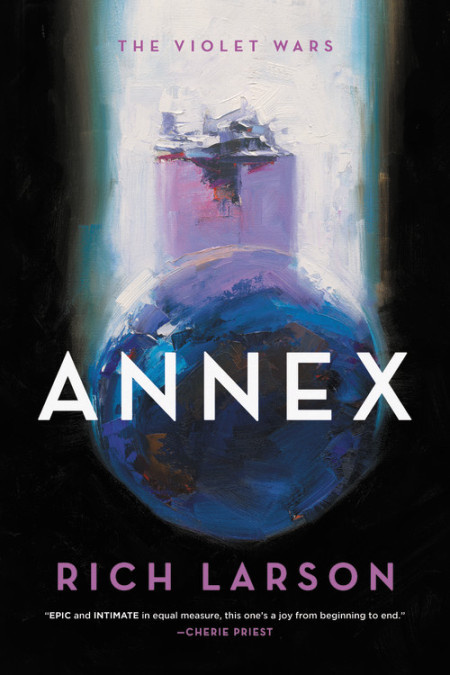
Annex by Rich Larson

Annex Cover.jpg

Publication Date: Orbit

Australian Publication Date – 25 September 2018

World Publication Date – 24 July 2018

Amazon     Book Depository

From exciting new author Rich Larson comes an absorbing young adult science fiction debut that makes use of creepy alien elements, excellent characters and fantastic LGBT inclusions to create a powerful and creative read.

When a gigantic alien ship arrives above Earth and isolates an entire city, all the children that are trapped with the aliens are kidnapped and infested with parasitic life forms, while the adults are clamped and inserted with mechanical devices that turn them into mindless drones.

For the small group of children that escape captivity, the disappearance of all the adults offers them a life of fun and adventure.  Falling under the leadership of the charismatic Wyatt, this group of survivors, the Lost Boys, are living the high life, with their newly attached parasites giving them the ability to vanish objects for brief periods of time.  While life is fun, they must continue to avoid the mechanical whirlybirds, the pod-like spaceships and the terrifying Othermothers hunting them in the streets.

For Violet, this new world allows her the opportunity to live the life she’s always wanted and to be the person she’s always wanted to be.  But Violet’s new life on of the city streets changes dramatically when she finds a new escapee, Bo, and takes him under her wing.  Bo has the most powerful parasite the group has ever seen and is capable of permanently vanishing larger objects.  It also appears the alien invaders want him back and are deploying hordes of their creatures to capture him.

Sensing an opportunity, the Lost Boys use Bo to fight back against the aliens while trying to uncover what plans they have for the rest of the planet.  Breaking into the massive hovering mother ship, Violet and Bo team up with the mysterious Mr Gloom to end this alien threat once and for all.  But these two young people will quickly find that the biggest threat to them may be far closer to home than they realise.

Annex is the first novel from Rich Larson and is the first book in The Violet Wars series, with the second book of this intriguing series, Cypher, already on its way.  This is a wonderful debut from Larson, which contains a surprisingly intense and at times dark story that will prove to be enjoyable to a wide range of readers.

There are a number of great features of Annex that readers will enjoy; however, one of the most noticeable features is the creepy and well-written descriptions of the aliens and events that the book’s main characters encounter.  There are a lot of inventive and twisted creatures, technology and even body modifications that can be found throughout this book, and Larson’s skilled writing helps brings them to life in the reader’s imagination.  I was particularly impressed, and a little freaked out, by Larson’s unique creation the Othermothers.  The Othermothers are unsettling clones of the escaped children’s mothers, perched upon long skeletal metal legs, who chirp out random phrases in the mothers’ voices in an attempt to lure the escaped children to them and then capture them.  Because of Larson’s descriptive writing, these creatures are horrifying and really stood out for me among the other alien antagonists the heroes encountered.  Special mention should also be made of the shadowy Mr Gloom, a strange adult they encounter whose appearance is not quite human and who has a range of powerful abilities.  I am not going to reveal too much about Mr Gloom because he appears about two-thirds into the book and I do not want to spoil too much about him.  I did find him to be quite a fun character.  Larson’s descriptions of Mr Gloom are fantastic, especially when it comes to exploring his shadow based abilities, which are a treat to read about.

In addition to the alien creatures and characters that are encountered through the book, readers should also keep an eye on the leader of the Lost Boys, Wyatt.  Wyatt is at first presented as a talented leader who has managed to bring the Lost Boys together and keep them alive.  However, there is much more to this character than he initially presents, and his real personality begins to be revealed to the heroes and the readers as the book progresses.  This is some incredible character work from Larson, and the revelation of Wyatt’s true motivations and persona is done perfectly, resulting in some excellent dramatic scenes and some really dark twists.  The author’s use of two separate point-of-view characters, Violet and Bo, works really well when it comes to viewing Wyatt, as the reader is able to observe his different manipulations, his moods and the cracks that appear in his outer façade.  This is a very intriguing character that dramatically changes the narrative of Annex in a number of ways, and the scenes exploring Wyatt are some of the best written in the entire book.

One of the key aspects of Annex that will prove to be an interesting addition for the reader is one of the main protagonists, Violet.  Violet is a tough–as-nails kicker of alien ass who is also a young transgender girl who has used the lack of adults following the invasion to finally live her life the way she always wanted to.  This is an amazing portrayal of a transgender character, as the author creates a stimulating backstory for Violet that examines her past and explores how she became her current self while also exploring the fears and people that stopped her from fully expressing her identity.  The book also explores how intrinsic this identity can be and how devastating attacks about identity can be, even during an alien apocalypse.  Violet is a well-rounded character, and Larson skilfully displays her other fears, her independence, her new friendship with Bo and her relationships with the other Lost Boys.  Violet helps to elevate this book to the next level and make it into a terrific piece of young adult fiction.

This book is an interesting addition to the young adult genre that definitely highlights the empowerment of young people.  The human characters of this book are all quite youthful and yet manage to thrive in a hostile alien landscape that has incapacitated all of the adults.  Watching these young people come together as a tight-knit group is an intriguing part of this book, and it is interesting to see the subtle techniques Wyatt uses to turn them into his own little army, such as with initiation rites, slogans and other forms of manipulation.  Overall, watching this group overcome without adult help the obstacles of being among the aliens oppressing them is a great part of the book.  This makes it an interesting read for the young adult audience, especially for those who love to see transgender characters in fiction.

Annex by Rich Larson is an excellent debut and is recommended for those younger readers looking for a science fiction adventure that they can relate to.  With some creepy aliens, intriguing characters and a deep look at transgender issues among today’s youth, this is an exhilarating read from a promising new author.

My Rating:

Four stars

Amazon     Book Depository

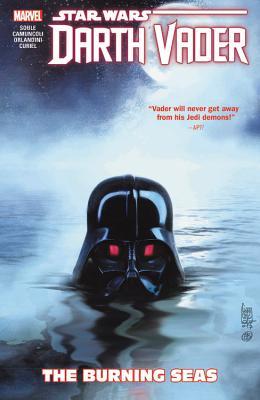
Star Wars: Darth Vader: Dark Lord of the Sith, Volume 3 – The Burning Seas

Darth Vader - The Burning Seas Cover

Publisher: Marvel Comics

Writer: Charles Soule

Artists: Giuseppe Camuncoli

              Daniele Orlandini

              David Curiel

              Java Tartaglia

Publication Date – 11 September 2018

Amazon

I have previously reviewed the second volume of this series here:

Star Wars: Darth Vader: Dark Lord of the Sith, Volume 2 – Legacy’s End

Darth_Vader_Dark_Lord_of_the_Sith_13.jpg

The creative team behind the amazing Darth Vader: Dark Lord of the Sith series return with their third volume, The Burning Seas, which continues to follow the early adventures of one of fiction’s greatest villains, Darth Vader.  This third volume contains issues #13-18 of what has to be one of my favourite current ongoing series.

This new volume is set one year after the formation of the Empire, and the Emperor is determined to show off the full military power he now commands.  To that end, he dispatches Vader to the aquatic planet of Mon Cala, which has been resisting attempts to be completely incorporated into the growing Empire, and whose King appears to be receiving advice from a Jedi.  However, this will not be Vader’s first journey to Mon Cala.  Years ago, during the Clone Wars, Anakin Skywalker and the Jedi saved the planet from a Separatist invasion and supported the young Mon Calamari king’s ascent to the throne.

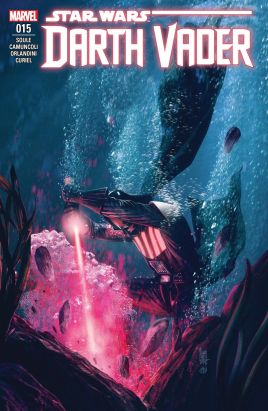
DarthVader-DLotS-14-no.jpg

Leading a force of his Inquisitors to Mon Cala, Vader attempts to investigate the potential Jedi influencer, but the situation quickly devolves into all-out war.  With Governor Wilhuff Tarkin leading the Imperial invasion, Vader and his forces attempt to locate the Jedi behind the unfolding events.  How will Vader’s return impact the planet of Mon Cala, and what events will the mysterious Jedi’s actions have for the future of the galaxy?

In additional adventures, Governor Tarkin finds himself in the unenviable position of owing Darth Vader a favour.  Vader’s request is a hunt with a twist: the hunter will be Tarkin, while the hunted will be Vader himself.  Bored by a lack of challenges, Vader has tasked Tarkin to provide him with some worthy competition.  Will Tarkin earn Vader’s respect, or will he and his team of mercenaries be the next victims of Vader’s rage?  In addition, Vader has been tasked to investigate sabotage around the construction of the Death Star on Geonosis.  As Vader encounters the creators of the Death Star, Commander Krenik and Galen Erso, he uncovers not only the saboteurs but also the full potential of the Death Star and the impact it could have on Vader’s position.

DarthVader-DLotS-15.jpg

Darth Vader: Dark Lord of the Sith returns with another fantastic and captivating volume that not only furthers the adventures of Darth Vader but also ties the series into the wider Star Wars universe while fleshing out backstories and lore not explored in the movies.  In this volume alone several minor characters’ pasts are shown, the history between Vader and Tarkin is explored and there is a particular focus on the events leading up to the Rogue One movie.  Dedicated Star Wars fans will love that the main story of this volume is set on the planet of Mon Cala and introduces several key Mon Calamari characters.  The readers are gifted with new origin stories for Admiral Raddus, who leads the Rebel fleet in Rogue One, and a young Commander Ackbar, famous for the line ‘It’s a trap’, which highlight their early abilities and show why they were so determined to fight the Empire.  Fans of the Clone Wars television show also get an intriguing conclusion to the three-part Water War arc of the show’s fourth season.  During this television arc, Anakin Skywalker and his allies helped save the planet from an invasion and helped the young Mon Calamari King Lee-Char ascend to the throne.  Now, in a reversal of this arc, Vader returns as an invader and his main target is the Mon Calamari king he once protected with his life.  It is a compelling switch that creates some terrific drama and emotion during this comic book arc.  Surprisingly enough, there is also a focus on the Mon Calamari cruisers, the large imposing ships that become a fixture of Rebel Alliance and the subsequent Resistance.  Several of the plans underway involve the future of these ships, and the twisted priorities of a Jedi regarding them are quite chilling to behold.  In addition to the main story of this volume, one of the issues is heavily involved in the construction of the Death Star.  As a result, Vader interacts with several characters who feature in the Rogue One movie, and the creative team are able to suggest he had a lot more to do with the events of Rogue One than shown in the movie.  This issue also sees Vader return to Geonosis, the main setting for the latter half of the Attack of the Clones movie, and it is very cool to see him return to this important location in his previous life.

On top of the above insertions into the Star Wars universe, the creative team also spend a significant amount of time in this volume exploring the relationship between Darth Vader and Grand Moff Tarkin.  When both characters are introduced in A New Hope, Tarkin always appeared to be in command of Vader and appeared to be someone that Vader respected.  It was an unusual relationship, considering Vader’s personality and his role as the Emperor’s apprentice.  This volume creates a fascinating new narrative that shows when Tarkin was put in charge and why Vader allowed it to happen.  This is first shown during the main story of this volume, when Governor Tarkin, who is leading the invasion of Mon Cala, requests Vader’s assistance to end the war quickly.  Vader is shown in these issues to independent from Tarkin, who still shows the ability to get what he wants from Vader, even if it may cost him down the line.  The creative team spend a good amount of time during the four issues that focus on the invasion of Mon Cala highlighting Tarkin’s tactical ability and ruthlessness, reminding the reader what a great villain Tarkin is in his own right.

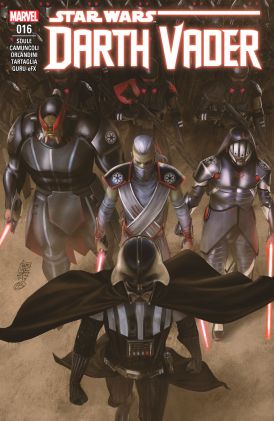
DVDLOTS-16

The rivalry between Vader and Tarkin comes to a head in the sixth issue of this volume, when the two of them hunt each other on a wild planet.  This is one of my favourite stories in the whole Darth Vader: Dark Lord of the Sith series so far, as the two Imperial heavyweights go head to head in a true battle of the villains.  This issue does an amazing job of highlighting the attributes of both characters.  Tarkin’s cunning, intelligence and determination to win are in full display, while Vader is shown to be not only a destructive force but also a creative opponent who is able to surprise even Tarkin.  The conclusion of this story is very clever and helps define the relationship these two characters have in the movie.  The final issue of this volume finds Vader officially under Tarkin’s command, but shows that Vader is not as subservient as Tarkin would wish.  The main focus of their rivalry in this volume is the Death Star, especially as Tarkin is convinced that his creation will make Vader obsolete.  Soule laces some suggestions during this final issue that many readers will find extremely intriguing and puts a whole new light on Vader and Tarkin’s relationship, especially in the final exchange between the two, where Vader presents a prediction to Tarkin: ‘If you invest too much of yourself in this battle station – – it may end up your tomb.’  The exploration of the relationship between these two dynamic and iconic Star Wars villains is an exceptional part of this new addition to the fantastic series and a really cool feature for Star Wars fans.

For the first time in this series, the creative team tackle a large-scale Star Wars battle as the forces of the Empire attempt to invade or subdue the entire planet of Mon Cala.  The battle sequences that are produced are breathtaking in their scope and execution, as the reader is treated to land battles, space fights, orbital bombardments, battles above, below and on the planet’s ocean surface and even a weaponised tidal wave which sweeps away masses of Imperial forces.  The artwork of these battle scenes is really exceptional; especially the sequences set underwater, which offers an unique scenery backdrop not typically seen in other Star Wars comics.  The creative team do a fantastic job showcasing the massive military capacities of the Empire and the pure devastation their newly created military machine can do.  I also loved the clever and very entertaining way that the rogue Jedi Ferren Barr manages to use certain Imperial forces against Vader’s Inquisitors, in what has to be one of best examples of karma in the entire history of Star Wars.

DarthVader2017-17.jpg

As they have in the previous volumes, the creative team behind the Darth Vader: Dark Lord of the Sith series go out of their way to showcase how much of a badass their titular character can be.  In addition to the issue in which he powers through all that Tarkin can throw at him, Vader spends the rest of this volume cutting through opponents like they are nothing, including hordes of Mon Calamari and Geonosians.  In addition to these fairly standard actions (standard, that is, for an all-powerful Sith Lord), Vader does some other extraordinary actions, whether it’s surviving explosive rock falls, attempting and nearly succeeding to push back a tidal wave, surviving at the bottom of the ocean and then subsequently taming and eventually killing a massive sea monster he encounters there using only the force, Vader appears like an absolute boss.  He also has a fun reaction when his Inquisitors abandon their mission and attempt to save him from the bottom of an ocean, instead of being grateful, he calls them fools and makes it very clear that ‘I never need…RESCUE’.  It is again captivating to watch how far Vader continues to move further and further away from the Jedi way, as even at the start of this series he had the potential to come back from the dark side.  However, his actions in this book, such as the utter destruction of something significant and good that he previously created, re-imagining his previous battle with Obi-Wan Kenobi with devastating new details, and his slaughter of a whole brood of Geonosians that he compares to animals just like he previously did with the Tusken Raiders in Attack of the Clones, once again show how far he has fallen.  I must also highlight the great artwork in this series when it comes to Vader.  Not only are his exploits shown in full and exquisite detail but the artwork presents him in such a sinister light in every single scene he is in.  This is another masterful portrayal of an exceptional fiction villain.

The third volume of the Darth Vader: Dark Lord of the Sith, The Burning Seas, is another outstanding addition to one of this year’s most consistent and entertaining comic book series.  This specific volume features massive and intense battles, an intense fight for supremacy between Vader and the ruthless Tarkin, and the continued outrageous and destructive adventures of one of the greatest villains of all time.  This entire run of Darth Vader: Dark Lord of the Sith is definitely worth getting into, and The Burning Seas is easily the best volume of this entire series so far.  A must read that comes highly recommended.

Darth_Vader_Dark_Lord_of_the_Sith_18.jpg

My Rating:

Five Stars.PNG

Amazon

If you enjoy Star Wars fiction, check out some of my previous reviews:

https://unseenlibrary.com/2018/08/12/star-wars-thrawn-alliances-by-timothy-zahn/

https://unseenlibrary.com/2018/05/30/star-wars-last-shot-by-daniel-jose-older/

Skyward, Volume 1: My Low G Life by Joe Henderson and Lee Garbett

Skyward Volume 1 Cover.png

Publisher: Image Comics

Publication Date – 25 September 2018

Amazon     Book Depository

Those looking for the next amazing comic book adventure they can get addicted to should look no further than Skyward, one of 2018’s breakout hits, which takes away a fundamental force and replaces it with a sensational story.

One day, around the planet, gravity all but disappeared, and the one thing that was previously holding everything to Earth’s surface all of a sudden became a fraction of what it previously was.  In the resultant chaos, huge swathes of the population simply floated away into the atmosphere.  Those that remained were forced to adjust to a new world with different rules.
Skyworld_01-1.png

Twenty years later, humanity has adapted to its new low-gravity reality.  For some, such as Willa Fowler, it’s the only way of life they have ever known, and Willa excels at navigating the skies above Chicago.  Living with her father, Nathan, a brilliant scientist traumatised by the events that sent his wife tumbling into the skies, Willa scrapes a living as a high-speed delivery girl with a number of risky and dangerous tricks up her sleeve.  But when her father reveals he has a way to bring gravity back, Willa doesn’t believe him and instead plans a meeting with Roger Barrow, her father’s rich former research partner, who has created much of the technology that allows the world to survive its new situation.  Descending to ‘The Streets’ of Chicago, the lowest level, inhabited by its richest citizens, Willa quickly discovers that Barrow is not the saviour she thought he would be.  Instead he is determined to keep gravity from returning, and will go to extreme lengths to stop Willa and her father.

Skyward_02-1.png

This is one of the first comic book works from Henderson, whose main claim to fame is as showrunner for the Lucifer television show.  The artist, Garbett, is probably best known for his work on the comic Loki: Agent of Asgard.  Together, this new team has created an incredible new comic book series that has already been picked up by Sony for a potential feature film, and it will be intriguing to see how this challenging and creative series will be adapted to the screen.  This first volume contains issues #1-5 of this new series.

Skyward contains an excellent story that examines life in a different and catastrophically affected version of Earth while also presenting an action-packed adventure with a wild protagonist.  The central idea of this series, the removal of gravity, is a crazy concept that allows for an exceptional overall package that combines great storytelling with incredible and unique artwork.  Throughout this first volume, there is a great combination of humour, action, character development and powerful emotional moments, all set within a fascinating new world shown in great artistic detail.

Skyward_03-1.png

It was quite intriguing to see the various ways in which a lack of gravity could affect the world that we live in.  Henderson and Garbett have come up with a range of different ways for the characters in this book to navigate around the skyline, and it is interesting to see the range of tools that are shown in the artwork.  The creative team has done an amazing job highlighting the various ways that the lack of gravity has affected the world, from food production to water gathering to human mobility.  One of the more intriguing aspects of the new world is the way in which guns have become obsolete due to the recoil pushing shooters back through the air, making it an ineffective weapon and more dangerous to the user than the target.  That said, the protagonist, Willa, has some more extreme and effective uses for the gun she carries around with her.  Perhaps the most intriguing idea presented in Skyward is the location known as The Streets, the lowest street level of Chicago, where the city’s richest inhabitants live in a state of denial at the changes that have happened and are trying to live like there is still gravity.  This includes wearing grav-boots to keep them stuck to the ground and forcing a man with no legs to sit in a wheelchair rather than floating in the air as he would prefer.  There are also some crazy inventions, like a magnetised hem to keep a dress from rising up.  These inhabitants of The Streets are absolutely terrified of the sky and have a very different lifestyle from the people living in Chicago’s skyline, who have embraced the new world.  One funny scene involves Willa traumatising an obnoxious bouncer by wrecking his grav-boots and making him float up into the sky a little.  Overall, this is a fun new world to set this great story in and has a lot of potential for future volumes of this series, where additional changes to day-to-day life are no doubt going to be revealed.

Skyward_04-1.png

The artwork in Skyward is just gorgeous and is definitely a key highlight of this incredible book.  The creative team have done an outstanding job showing off the low-gravity concept in art form, creating some fantastic scenes and drawings.  Most of the characters are shown floating around and navigating the air, which creates some amazing panoramas of the city from high above for the reader to enjoy.  All the characters, even those rich individuals trying to ignore the lack of gravity, are shown with their hair floating up in the sky, and multiple scenes have various liquids floating in the air around the characters attempting to have drinks.  It also means that fight scenes are constantly surrounded by droplets of blood that float around the characters and add a whole new sense of realism and brutality to the story.  The artistic highlight of this book has to be the incredible and exceptional drawings of the storm in low gravity that becomes such a massive part of the background in the later part of the volume.  Due to the effects of the low gravity, the storm manifests itself as a gigantic ball of water in the sky, surrounding several high-rise buildings.  The first drawing of this is amazing, and the following scenes which show the main characters navigating around this bubble and creating massive pockets of air are just fantastic, and represent some exceptional comic book art.  I was also suitably terrified by several of the drawings in this volume, from the opening scenes which show multiple people being lifted away by the low gravity, to the horrifying shot of the planet Earth and its new artificial ring, made up of planes, cars, ships, other debris and of course multiple dead animals and humans that have not decayed in their 20 years in orbit.  Lee Garbett and the creative team have outdone themselves in Skyward and I cannot speak highly enough of the artwork in this book.

Skyward Picture 1.jpg

The main character, Willa, is an excellent protagonist for this series.  As a character who has never known what it’s like to live in a world with gravity, Willa’s antics through the air are pretty crazy and she does some amazing and unpredictable things throughout the book.  Whether it’s using a gun to gain rapid altitude and to come down again, or blowing out a window underwater in a low-gravity storm of water after creating an air pocket with her oxygen tank.  The constant incredulity of the other characters as she does these things is very amusing and makes it quite clear that these actions are not the social norm in the new world.  My favourite quote of the books is when the antagonist, realising that Willa is about to blow open a window with her gun says ‘She wouldn’t…’ while Willa’s friend who is being held hostage responds with ‘Oh, she would.’ I must again return to the artwork of Skyward when it comes to showing off this main character.  The artists do a fantastic job highlighting the joy on Willa’s face as she flies around in the upper city; she looks like she was born to float.  I also loved the drawings that show off her crazy antics, from the early sequence which shows her using a gun to blast off away from people attacking her, to that fantastic scene where she blows open the underwater window.  The drawings themselves are incredible and really show off the action, while the looks of shock and amazement on the faces of onlookers tell a whole new story.  Henderson and Garbett have created a perfect main character and protagonist in Willa, and I can’t wait to see what she gets up to in future volumes of this series.
Skyward_05-1.png

Skyward is an incredible new series from the fantastic team of Henderson and Garbett.  I really enjoyed the central concept of a lack of gravity, as it allowed the creative team to present a bold and exceptional new setting for this exciting and powerful story.  I really cannot hype up the artwork of this series enough, and I love the various ways that the artists show off what impacts these gravitational changes would have to everyday life on the planet.  An outstanding five-star start to a series with incredible potential, this is the perfect read for current comic book readers and a great starting point for those trying to break into the medium.

My Rating:

Five Stars

Amazon     Book Depository

Salvation by Peter F. Hamilton

Salvation Cover.png

Publisher: Macmillan

Publication Date – 4 September 2018

Amazon     Book Depository

From one of the modern masters of the space opera comes a rich and ambitious piece of science fiction that that examines an exciting potential future for Earth and the intriguing adventures that could come as a result.

In 2204 AD, humanity has advanced by leaps and bounds and spread out among the stars.  Utilising advanced teleportation technology, next-gen computers and cutting-edge biotech, humanity has created a number of new and varied societies controlled by a handful of powerful corporations.  However, everything is about to change.  Out in the furthest reaches of human expansion, explorers have found a crashed alien craft.  While this is not humanity’s first contact with an alien species, the sinister cargo found onboard the crashed ship reveals a dangerous alien agenda.  Determined to ensure humanity’s survival, the Connexion Corporation assembles a task force to examine the craft and assess the potential threat that it could cause.  Led by Feriton Kayne, the task force is made up of Kandara Martinez, Yuri Alster, Callum Hepburn, Alik Monday and their assistants.  While on paper this group are the perfect people to investigate this potential threat, there is one significant problem: one member of the team is a hostile alien infiltrator.  As the team gets closer to the alien ship, secrets from their past are revealed and the future of the human race hangs in the balance.

Hundreds of years later, Dellian and his team of genetically enhanced soldiers are born and raised on a planet, far away from Earth.  An alien threat has forced humanity into hiding among the stars and pushed them to the edge of extinction.  As the young soldiers grow up, they encounter lessons from the past and discuss the legendary Five Saints who first encountered the invaders.

This is an absolutely spectacular piece of science fiction from bestselling author Peter Hamilton, who has once again created an elaborate and captivating space opera.  Hamilton has written a number of large-scale science fiction novels since his 1993 debut.  He first gained prominence with the Greg Mandel trilogy, which followed the adventures of a psychic detective in a dystopian future.  Hamilton followed this up with his first epic space opera series, The Night’s Dawn trilogy, which focused on souls of the dead coming back and possessing multiple human planets in the far future.  He continued with additional space operas, such as the Commonwealth Saga, the Void Trilogy, The Chronicle of the Fallers and the standalone novel Fallen Dragon, as well as the children’s fantasy series, The Queen of DreamsSalvation is the first book in Hamilton’s brand new trilogy, The Salvation Sequence, with the adventure continuing in the future releases, Salvation Lost and Saints of Salvation.

Salvation is an impressive and compelling read that combines a powerful and well-written story with a brand new, large-scale science fiction universe.  This story is told from of variety of different time periods set throughout Earth’s future.  The central story of this book is set in 2204 AD and features the exploration crew from the Connexion Corporation examining the crashed alien ship.  This storyline is narrated from Feriton Kayne’s point of view and is the only first-person narration in the entire book, except for a short flashback chapter examining Feriton’s infiltration of a different alien spacecraft.  Salvation also features five additional storylines that are set across various time periods.  Four of these storylines are presented as tales from the other four main characters in the 2204 AD timeline, Kandara Martinez, Yuri Alster, Callum Hepburn and Alik Monday.  Each of these flashback narratives is given its own significant chapter; for example the first of these flashback chapters lasts for 140 of the books 526 total pages.  The fifth storyline is set far in the future, and features a different group of characters who are living in the aftermath of these past adventures and is told across several shorter chapters.  The author makes spectacular use of these multiple time periods and combines them together into an excellent overarching narrative.  A significant amount of detail and a huge number of supporting characters are packed into this book, which falls just short of overwhelming the reader but creates the feeling of a massive universe with quite a lot going on.

Each of Salvation’s separate plotlines offers the reader a drastically different story to enjoy, and presents them with several unique adventures in one novel.  The storyline in 2204 AD is an intriguing first contact and exploration story that works incredibly well as the overall narrative that ties all the other storylines together.  The first flashback storyline is set in 2092 AD and features the story of how Callum Hepburn and Yuri Alster gained their antagonism towards each other.  It also shows the earlier days of Connexion and the darker side of their newly formed technology and world influence.  This first story is told from the point of view of Callum, Yuri and Callum’s wife, Savi, and features a thrilling spy tale that also reveals the unique and extreme form of criminal punishment that resulted from the new technology.  The second of these storylines is set in 2167 AD and focuses completely on Yuri as he searches for a missing person taken by the new and shadowy underworld that has taken shape amongst the stars.  This is the first of the flashback storylines to hint that an alien species may have nefarious plans for humanity, and also features some cool examinations of the power and tactics that Yuri and Connexion use.

The third storyline is a complex murder mystery storyline set in 2172 AD that focuses on the secretive FBI agent Alik Monday and presents another fantastic mystery with some unique science fiction elements.  The fourth storyline is set in 2194 AD and follows badass mercenary Kandara Martinez as she investigates corporate sabotage on the Utopial home planet.  This is a high-action thriller storyline that also examines the Utopials, a human society seeking to create a cultural utopia, while also going into genetic surgery in a big way.  The highlight of this storyline has to be the intense fight between Kandara and the mercenary Cancer, who had been a shadowy figure in some of the previous storylines.  The final prequel story follows the 2204 AD timeline narrator, Feriton Kayne, in 2199 as he infiltrates the large spaceship belonging to the Olyix, an alien race that humanity came in contact with some years before.  This is one of the shortest stories, but it contains the most detailed examination of the Olyix, who have appeared in several of the previous stories.

In addition to the stories set in and before 2204 AD there are also several chapters are set in the far future of humanity.  This timeline starts in 583 AA (After Arrival) and features the remnants of humanity as they prepare to fight back against the alien menace that pushed them away from Earth.  This is a rather intriguing storyline that examines children being turned into tight-knit teams of soldiers as they prepare for the war to come while also providing some hints about the events of the main storyline.  Each of the above stories are fairly self-contained and do an amazing job of showing off the sheer complexity of Hamilton’s new universe, while at the same time providing a series of unique and captivating tales across time.

Each of the prequel timelines has a storyline that could be considered either a murder mystery or thriller.  By themselves, each of these storylines is very well written and contains compelling mysteries and action packed sequences that are more than enough to keep the readers hooked to the book.  However, the real highlight of these prequel timelines is the way in which the play into Salvation’s larger mystery that is explored within the 2204 AD storyline, namely the identity of the alien race attacking humanity and which of the members of the research team is an infiltrator.  I really loved the way that these prequel stories hinted at the main mystery while also exploring the history of the main characters in an attempt to show their personality or a critical point in their lives.  The final twists in the 2204 AD storyline are very surprising and serve as a fantastic payoff for Salvation’s overall narrative.

The author has also included a significant amount of science fiction elements throughout the book that are presented in considerable detail.  It is fascinating to see Hamilton postulate how Earth may develop in the near future and the advanced technology that they would start to utilise.  The multiple timelines also come into play for this element of the book as they allow the reader to see the progression of technology over the years.  What is most interesting about this is that the main pieces of technology don’t change; instead the next generations of the same device are revealed throughout the book’s various stories before the technology eventually plateaus at its highest level.  The science fiction elements also come into play in several intriguing ways.  For example, they allow for some very creative mysteries, including a murder in a house containing teleportation gates that result in the victims being spread across multiple locations, including New York, the Moon, Mars and the Antarctic, creating a murder investigation with several unique complications.  The advent of space travel and other technology also allows the creation of some inventive new societies.  From futuristic utopias to desolate prison it is absolutely fascinating to watch these societies come together.  Overall the science fiction elements are a fantastic part of this book and add some intriguing elements to all of the book’s interconnected stories.

Peter Hamilton has produced another elaborate and powerful piece of science fiction space opera in Salvation.  With a new and unique universe that contains some fantastic and detailed new elements and multiple timelines that are combined together into an outstanding novel, this is an absolutely amazing read.  Epic science fiction at it’s very best, Salvation comes highly recommended and is a spectacular start to an exceptional new series.

My Rating:

Five Stars

Amazon     Book Depository