
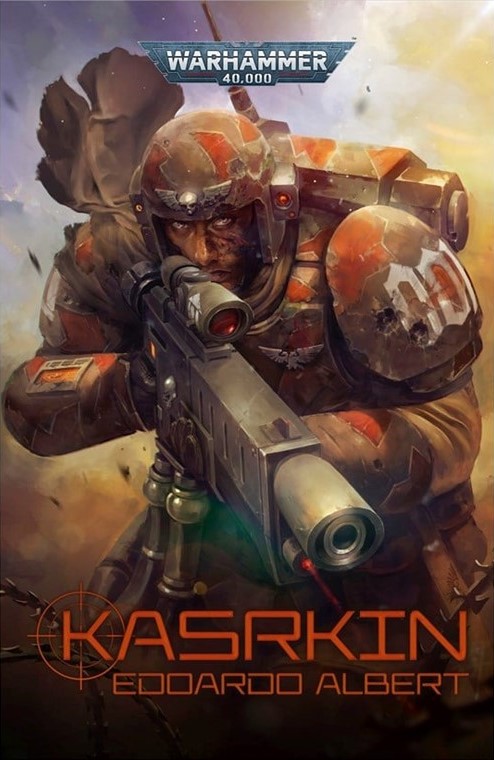
Publisher: Black Library (Audiobook – 22 October 2022)
Series: Warhammer 40,000
Length: 11 hours and 3 minutes
My Rating: 4.5 out of 5 stars
Get ready for some high-concept action in the latest awesome and exciting Warhammer 40,000 novel by Edoardo Albert, Kasrkin.
While I might be repeating myself a little, I must once again talk about the particularly amazing year I’m having when it comes to Warhammer 40,000 fiction. There have been some outstanding Warhammer 40,00 books out in 2022, and I have done my best to listen to as many of them as possible. Some of my personal highlights include The Wraithbone Phoenix, Outgunned, Assassinorum: Kingmaker, Ghazghkull Thraka: Prophet of the Waaagh! and Day of Ascension, just to name a few. All these have been a ton of fun, and so when I had an open slot in my reading schedule, I naturally chose another recent Warhammer 40,000 book, Kasrkin. Written by a new-to-me author, Edoardo Albert, who has previously created some interesting pieces of Warhammer fiction, Kasrkin is an action epic that pits a band of elite warriors on a deadly mission into the dark heart of a desert planet.
Welcome to the deadly desert world of Dasht i-Kevar, an Imperial planet currently under siege by the advanced xenos, the T’au, who have turned the usually baren planet into a bloody battlefield. But the war is about to get even more interesting as the T’au have succeeded in shooting down an Imperial Valkyrie containing an important Astra Militarum general, whose knowledge of the Imperial Guard strategy and disposition could cause the planet to fall.
Only one group of Imperial soldiers have a chance of journeying into the harsh desert of the planet, an elite squad of Cadian Kasrkin. Led by Captain Bharath Obeysekera, the Kasrkin are tasked to travel deep into the Great Sand Sea behind enemy lines to find the general and either recover him or kill him to keep him out of enemy hands. The best of the best, the Kasrkin are trained to operate in any terrain and face off against any enemy. But none of them have every encountered anything as endless, hot, or deadly as the deserts on Dasht i-Kevar.
Cut off by sandstorms and forced to journey over impossible obstacles, the Kasrkin are firmly on their own and can only rely on themselves. But the deeper they journey in the wastes, the more they begin to realise that they are not as alone as they thought. Other hunters are searching for the missing general, and the mysterious locals have their own games to play. However, none of them are prepared for an ancient evil lurking far beneath the desert sands, determined to kill everything it encounters.
Another week, another exceptional Warhammer 40,000 novel that I had so much damn fun listening to. Kasrkin was an excellent, fast-paced read that follows a compelling group of characters on an epic adventure tale. Loaded with action, compelling characters, and a story that makes perfect use of its setting and the fantastic lore of the Warhammer 40,000 universe, Kasrkin in an epic read from Edoardo Albert that I absolutely powered through.
The story itself starts off pretty simply, with Albert introducing the reader to the Kasrkin squad and quickly setting them on their mission to find the missing general. The early parts of the book are really focussed on allowing the reader to get their heads around the book’s premise, the characters, and the impressive desert setting, which honestly takes on a life of its own. Initially a little slow going to build up tension and camaraderie amongst the Kasrkin, the book starts to get interesting about a third of the way in, when Albert introduces some unique world elements which show how cool and weird the Warhammer 40,000 universe can be. From there, the story takes the protagonists closer to their objective, and I was initially a little surprised at how soon then managed to get where they were going. However, this proves to be a bit of a ruse from Albert, as he chooses this moment to really shake everything up.
About halfway through, the entire structure of the book changes with the appearance of a new group of point of view characters, a kindred of Kroot aliens, determined to capture the general for the T’au. This results in an awesome split in focus between the human and Kroot characters, and I loved the sudden introduction of an excellent rival group who appear equal to the Kasrkin in terms of combat ability. However, this is not the only surprise that Albert has in store, as both the Kasrkin and the Kroot find themselves facing off against an even more deadly enemy in a fantastic new setting. While I won’t go into too much detail about what happens next, it was a pretty epic move from Albert and one that I deeply appreciated. The rest of the story is particularly intense and dark, and there some real horror vibes going for part of it, which fit in perfectly with the powerful narrative and darker setting. Albert really layers on the action in the second half of the book, and I loved all the shocking and bloody places that he took his story, especially as there are several great twists and some truly engaging scenes featured throughout. Everything comes to an excellent end, and this proves to be a particularly powerful and gripping Warhammer 40,000 read that really stands on its own.
I felt that Albert’s strong writing style helped to enhance the compelling narrative of Kasrkin and I really appreciated how the author’s style brought everything to life. Like most Warhammer 40,000 novels, Kasrkin is a great standalone read that is very appealing for established fans of the franchise. However, this book can also be easily enjoyed by most general science fiction or military fiction fans, especially as the author covers all the relevant lore details that you need to understand the world you are diving into. Albert blends together some excellent storylines in this novel, and he keeps the pace steady, with a ton of brilliant action and dangerous occurrences. I liked how the narrative kept morphing as the book progressed as what started as a compelling, if slower, desert adventure eventually turned into a high-octane war novel, before finally transforming into a desperate survival novel in a horror setting. Albert manages these changes in style really well, and I think the constant alterations helped to keep the reader’s attention glued to all the craziness of the book.
At the same time, the book remains a soldier’s story at heart, which is something that Warhammer fiction always excels at showing (good recent examples include Steel Tread, The Vincula Insurgency and Catachan Devil). Watching these elite soldiers face impressive odds makes for an awesome read, especially as Albert also dives into their deeper concerns and features some deeper betrayals and intrigues. I also cannot highlight enough how outstanding the combat sequences were in Kasrkin as Albert features some pretty hairy action scenarios. I was particularly impressed with how well these combat scenes were enhanced by the book’s multiple character perspectives, especially once the Kroot were introduced. Having the perspectives changed between the opponent groups as the firefights was ongoing was just brilliant, and it was amazing to see both sides of the battle, as well as the reactions from the rival teams. All this, and more, really brought the best out of Kasrkin’s narrative and I deeply enjoyed how it was showcased.
Perhaps one of the most notable features of Kasrkin are the distinctive and memorable locations. The reader is dragged to several great settings throughout the course of the plot, and the author takes particular pleasure in presenting them in exquisite detail. The main location is the endless, featureless desert of Dasht i-Kevar, which the characters are forced to traverse for a good part of the book. I got some great Dune vibes from this setting, and Albert makes this desert out to be a soulless, crushing place of shifting sands, massive unstable dunes, and intense heat, with the ability to strip the resolve and strength from the strongest of men. Just listening to the characters traverse it made me thirsty, and you could really imagine the harsh journey they are going through. At the same time, Albert also introduces some very unique aspects to the desert, including impossibly smooth patches of sand that move like water and mysterious water that lives deep under the surface which gives the planet some unusual life. All these elements are very memorable, and you find yourself really feeling the intense desert surroundings as the characters push through it. I think that Albert did a remarkable job of introducing and then utilising this harsh setting and it definitely stood out as a landmark part of the book. A second, darker location becomes the key setting for much of the second half of Kasrkin and while I will again be brief to avoid spoilers, it was pretty damn epic. Serving as the lair of a notable enemy, this location was a haunting and deadly setting, and one that the characters all struggled to survive in. There are so many surprises and foes lurking in this location, and the strain of it really showed on the characters who find themselves with very little chance of survival. I had such a great time with this location, and it, as well as the outside desert, helped to turn Kasrkin into a particularly noteworthy book.
On top of the new setting, I was also really impressed with the outstanding Warhammer 40,000 elements contained within this great book. As I mentioned before, Kasrkin is a book a range of readers can enjoy, and part of the reason why is that Albert spends a lot of time exploring the unique lore elements of the Warhammer 40,000 universe that come into play during the plot. Not only does this help to introduce the universe to new readers but established fans will appreciate how deep Albert dives into the subject. As the name of this book suggests, quite a lot of the focus revolves around the Cadian Kasrkin, the most elite special forces group in the whole Imperial Guard. Albert showcases them perfectly throughout the book, and it was so damn epic to see them in action, especially as they live up to all the hype and work together as a particularly effective unit. The author dives into all their particularly quirks, training and operational preferences that sets them apart from the common Astra Militarum units, and you come away with a greater appreciation for who they are and what they can do. In addition, there is a great underlying look at how the Kasrkin are doing following the destruction of their home world of Cadia, and I loved the deeper grief that they are all suffering after their failure and the hardships they have faced.
On top of the Kasrkin, Albert also spends a substantial amount of time examining and featuring other Warhammer 40,000 factions throughout the story. The most prominent outside of the Kasrkin are the kindred of Kroot that become the protagonist’s opponents. During their multiple scenes, Albert dives deep into the biology, beliefs and society of the Kroot, and the reader is soon given a crash course in who they are and what they can do. There is a particular focus on their biological abilities, with Albert exploring their avian traits, their ability to communicate in different frequencies (giving off high-pitched whistles, which made several hunting scenes particularly cool) and more. The real focus is on the Kroot’s ability to absorb the genetic traits of anything they consume, which is a big part of their society, as they live to hunt and consume prey that can give them a greater edge in battle. Albert really examines this hunting and eating part of their culture, and it was fascinating to see how diverse the Kroot are after eating different creatures during their travels. This ability plays a big role in the plot, with horrific consequences, and I loved having the Kroot featured so heavily in this book, especially as I haven’t seen them in too many other pieces of Warhammer 40,000 fiction. I also loved how Albert did some fun contrasts between the Kroot and the Kasrkin and showed that they were very similar in their abilities and mentalities (and they both refer to their groups as kin). Watching the two sides face off against each other is a thing of beauty and it results in some complex and exciting battle scenes.
On top of the Kasrkin and the Kroot, a third major faction from the Warhammer 40,000 universe are also featured, and they become an exceptional part of the books plot in the second half of the book. Just like with the other groups featured within Kasrkin, Albert examines and features this group extremely well, and you get a good idea of who they are and what motivates them, even if they are a little more unusual then the general examples you see in Warhammer fiction. I was particularly impressed with how Albert used one distinctive unit from this third faction throughout the course of Kasrkin, and they prove to be brutal and terrifying hunters that haunt the point of view characters in some epic and dark ways. I cannot emphasise how well Albert featured all these different factions throughout Kasrkin, and fans of the franchise are going to have an outstanding time seeing them all in action and facing off against each other.
I had a lot of fun with the characters featured in Kasrkin as the author features some interesting interactions and character development in a short amount of time. Most of the book focuses on the members of the Kasrkin team, including their leader, Captain Bharath Obeysekera, a veteran officer with a lot of regrets behind him. Albert showcases this character a lot and Obeysekera proves to be a bit more of a radical thinker than your typical Imperial soldier, which I felt fit rather well in this unusual tale of survival, and it was heartbreaking to see him try and fail to keep his squad alive. Other great characters include Sergeant Shaan Malick, the squad’s veteran NCO, who serves as a rock for most of the book, while also playing his own selfish game. Watching him manipulate the other characters added a great edge to the plot, and I really appreciated his realistic and understandable motivations once they were revealed. I was also very impressed with the character of Roshant, a newly minted Commissar with family connections who joins the mission and proves to be a bit of a pain for most of it. Initially despised by the men and seen as a coward, Roshant goes through some real soul searching in this book, and it was fascinating to see this privileged character contrasted against the rough and tough Kasrkins, especially in some dangerous situations. The rest of Kasrkin’s cast are also pretty impressive, and Albert does a good job of balancing the narrative around a large group of characters. There is some excellent character work in this book, and I really appreciated seeing such a fun and damaged cast go to war against each other.
Like most Warhammer 40,000 books, I chose to enjoy Kasrkin in its audiobook format, which was an absolute ton of fun. Coming in at just over 11 hours, the Kasrkin audiobook was an excellent and quick way to experience this fantastic narrative, especially as all the many cool action sequences really seemed to pop in this format. The real highlight of this audiobook was narrator David Seddon, whose work I previously enjoyed in the short production Dredge Runners. Seddon did a remarkable job with the narration in Kasrkin, and I loved how he swiftly moved the book along and perfectly controlled the pacing of the audiobook. I was also deeply impressed with the huge range of voices that he brought to the production, and he effectively captured all the characters featured in this book and gave them all distinctive and fitting voices that showcased their personalities and emotions. Not only does he capture the various gruff and thoughtful human characters, but he also provides some great alternate voices for some of the alien characters contained within. The avian-inspired voices of the Kroot characters reminded me a little of the Skeksis from The Dark Crystal, which was really fitting considering the Kroot’s evolutionary origins. I also loved the deeper and more ancient voice that was used for another character, revealed later in the book, especially when combined with the various voices used for this character’s computer servant. This outstanding voice work really helped with my enjoyment of this book, and I had a wonderful time listening to the Kasrkin audiobook. This was easily the best way to enjoy this fantastic book, and I would strongly recommend this format to anyone interested.
The Warhammer 40,000 universe continues to enchant and amaze me with this latest tie-in book Kasrkin. Edoardo Albert wrote a powerful and deeply intense read that sees an iconic regiment from the game go up against all manner of trouble in some exceptional settings. Extremely addictive, relentlessly exciting, and very clever, Kasrkin was an outstanding read that I am really glad I decided to check it out. Highly recommended, especially for fans of Warhammer 40,000 fiction. You are guaranteed to have a great time with this excellent tie-in book.
 The Unseen Library