
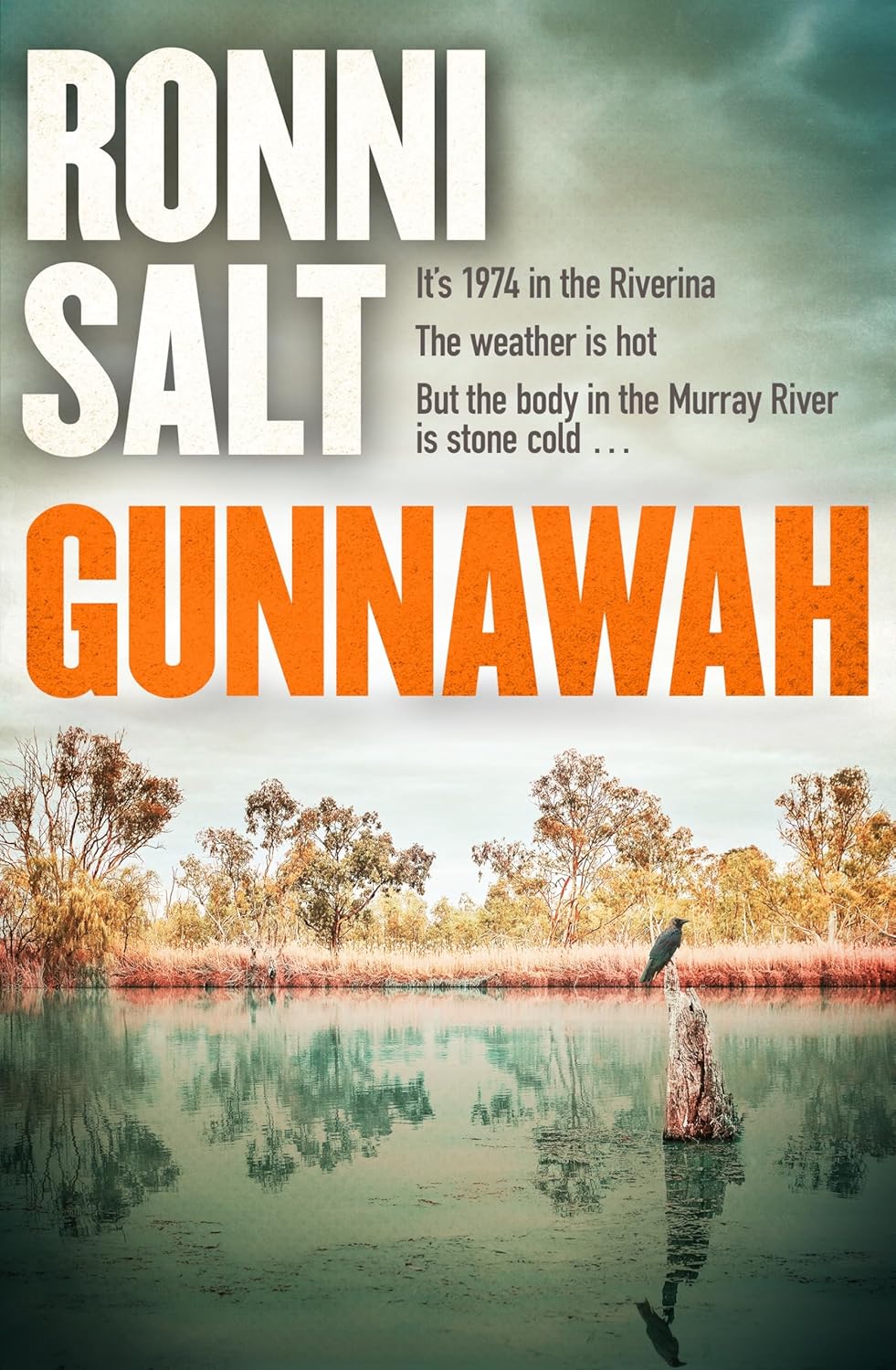
Publisher: Hachette Australia (Trade Paperback – 1 January 2025)
Series: Standalone/Book One
Length: 328 pages
My Rating: 4.5 out of 5 stars
New Australian author Ronni Salt presents a compelling new crime fiction debut with the fantastic novel Gunnawah, an intriguing and distinctive read that explores an intriguing period of rural Australian history.
Plot Synopsis:
It’s 1974 in the Riverina
The weather is hot
But the body in the Murray River is stone cold . . .
A captivating and compulsive crime thriller about guns, drugs and a young woman dead on the money
When nineteen-year-old farmgirl Adelaide Hoffman applies for a cadetship at the Gunnawah Gazette, she sees it as her ticket out of a life too small for her. The paper’s owner, Valdene Bullark, seeing something of the girl she once was in young Adelaide, puts her straight to work.
What starts as a routine assignment covering an irrigation project soon puts Adelaide on the trail of a much bigger story. Water is money in farming communities, and when Adelaide starts asking questions, it’s like she’s poked a bull ant’s nest. Someone will do whatever it takes to stop Adelaide and Val finding out how far the river of corruption and crime runs.
Shady deals. Vested interests. A labyrinth of lies. It seems everyone in Gunnawah has a secret to keep. And too many are already dead quiet.
Set deep in the heart of rural Australia during the era of Gough Whitlam, pub brawls and flared jeans, Gunnawah is a compulsive crime thriller of corruption, guns and drugs from Australian Noir’s most arresting new voice.
Gunnawah was an excellent first book from Ronni Salt that was an amazing and entertaining bit of Australian fiction to start 2025 on. Cleverly examining the unique landscape of Australia’s Riverina area in the 1970s and diving into its controversial history, Gunnawah was a fast-paced and surprisingly complex read that blended big characters with an addictive crime fiction narrative.
The book has an interesting, if slow, start to it, as the reader is introduced to the protagonist, Adelaide Hoffman, as well as the various other memorable inhabitants of the town. Much of the first third of Gunnawah is dedicated to building these figures up, while also hinting at the many secrets surrounding the town. While readers don’t get a lot of excitement off the bat in Gunnawah, I felt that this slow burn start was vital to the book’s later impact, especially as Salt loads up a ton of clues and hints about the later events of the book.
Things begin to heat up when the protagonists discover that there is a darker side to their small town, especially when it becomes clear a vital new irrigation project has ties to a local drug operation, while other crimes remain hidden in the shadows. There are some tense scenes as Adelaide, Val and their offsider Wayne begin to uncover what’s really going on around Gunnawah. However, it is the last third of the book that really ensures Gunnawah sticks in the mind. Starting off with a big event that is reminiscent of a particularly infamous Australian crime, the protagonists are soon thrust into greater danger and are forced to fight back like the battling Australian farmers they are. There are some awesome scenes here, especially as damaged protagonist Adelaide shows how badass she is, and I liked some of the satisfying conclusions that occur to the main story. Salt also cleverly ties up some other intriguing mysteries that have been running alongside the central plot, and I liked the solutions that emerged, especially as the resulting reveals were well built up in the earlier parts of the book. Readers come away very satisfied with how Salt concludes Gunnawah, and there is some potential to continue this book as a series if the author wants to.
Salt pulls together an intriguing book for her debut that blends a fantastic crime fiction read with some cool historical inclusions and a subtle web of humour that proves hard to get away from. Featuring a mass of interesting perspective characters, Gunnawah’s plot revolves around finding out all their relevant secrets and working together the storylines of the various big personalities in the town. These multiple perspectives help to create a complex and layered narrative, and they often backup the fantastic central characters of Adelaide and Val. The author builds up some excellent character development and human moments throughout Gunnawah, especially as there are some complex and damaged protagonists featured throughout. For example, Adelaide comes into the narrative traumatised by a previous incident that is expanded on as the book continues, and it was great to see her regain her confidence as Gunnawah continues.
The rest of the characters in the novel are an excellent combination of outrageous small-town folk, and a lot of Gunnawah’s humour is built from the fantastically funny interactions between these entertaining figures. For example, Val and Wayne, long-time friends who have history with the seedier side of Sydney before coming to small-town Gunnawah, prove to be a highly entertaining duo, and I enjoyed how they took events into their own hands, especially when it comes to protecting Adelaide. Other great humorous figures include the ambitious, if slightly hapless, mayor of Gunnawah and his social-climbing wife, whose antics in face of the serious crimes going on around town prove to be a lot of fun. These figures, as well as a range of other great exaggerated small-town folk in Gunnawah, add a lot to how entertaining Gunnawah proved to be, and I am curious to see if Salt will revisit them in any future books.
Another amazing aspect of Gunnawah that I really enjoyed was the fantastic historical background surrounding the main setting of the plot. Salt did a great job emulating a Riverina town for this book, and you really got the sense of a small Australian town in the 1970s, with the mixture of farmers, local politics and other country folk. Small towns always work well in Australian crime fiction, especially as readers love to see antics out in the bush, and Salt makes her story stand out by tying the narrative into real-life crime aspects of 1970s Australia. In particular, the narrative features representatives of a criminal organisation active during the period, and one of the major events of the books is highly reminiscent of the Donald Mackay incident. The author also includes a lot of references to larger events occurring around Australia during the period, especially rampant police corruption in New South Wales, as well as a focus on Australian politics. I personally enjoyed seeing the references to the Gough Whitlam era, and Salt actually includes a visit from Whitlam to Gunnawah as part of the plot, which proves to be quite a fun scene, especially when two of the book’s more entertaining personalities become involved. These intriguing historical inclusions give Gunnawah some real authenticity, especially if you are familiar with how bad things got in the Riverina area during the period, and I appreciated how Salt worked it into her narrative.
Ronni Salt comes out of the gate swinging with her first novel as Gunnawah proves to be an outstanding and compelling piece of Australian fiction. An amazing debut to start 2025 on, Gunnawah featured a great blend of crime fiction and historical inclusions to create a gripping and entertaining read. I had an awesome time reading Gunnawah, and I look forward to seeing what Salt writes next.
 The Unseen Library