
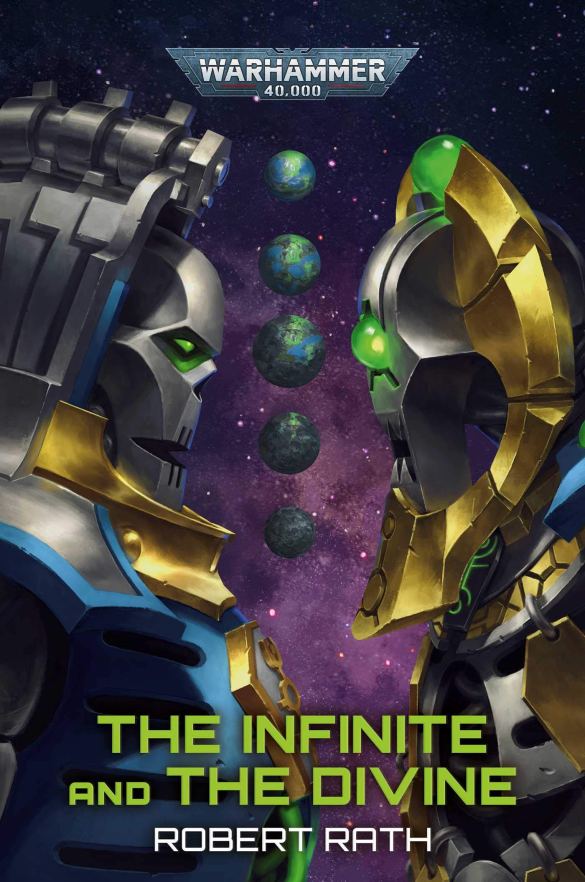
Warhammer 40,000: The Infinite and The Divine by Robert Rath

The Infinite and the Divine Cover

Publisher: Black Library (Audiobook – 10 October 2020)

Series: Warhammer 40,000

Length: 13 hours and 21 minutes

My Rating: 5 out of 5 stars

Amazon     Book Depository

Prepare to dive into one of the most entertaining and elaborate rivalries in Warhammer history with the outstanding and captivating read, The Infinite and The Divine, by the exceedingly talented Robert Rath.

Before I pause my current obsession with Warhammer fiction to pursue other recent books, I just had to read one more intriguing Warhammer 40,000 novel that I have been hearing a lot about in recent years, The Infinite and The Divine.  The debut Warhammer 40,000 novel of exceptional author Robert Rath, who previously wowed me with last year’s epic book, Assassinorum: Kingmaker (one of my favourite books and audiobooks of 2022) The Infinite and The Divine dives into one of the more unique factions in the Warhammer universe, the Necron.  This intriguing and fun novel follows two fantastic Necron characters as they engage in a bitter and lengthy feud across time and space.  Pretty much every review I’d read about The Infinite and The Divine was highly positive and I just had to try it out, and boy did it live up to all my expectations.

Long before the Imperium of Man and the Emperor existed, before the fall of the Aeldari and even before the Necrons traded their flesh away for immortal metal, there existed something far more deadly and permanent, an undying conflict between two arrogant scholars.  Even before they became immortal beings of metal, Trazyn the Infinite and Orikan The Divine were bitter rivals.  While Trazyn glorifies the past and seeks to capture and contain anything of rare or historical value, Orikan looks only to the future, divining events that are to come and hoping to find a way to become a being of energy.  But despite their differences, these two Necron are about to be drawn into the same obsession.

When Trazyn manages to obtain a rare Necron artefact, Orikan infiltrates Trazyn’s gallery to steal it, believing that it is the key to locating an ancient Necron tomb that could provide invaluable knowledge for the future of the Necrons.  However, Trazyn is unwilling to lose such a treasure, nor let Orikan’s trespass go unanswered, and swiftly snatches the artefact back, hoping to locate and plunder the tomb for himself.

So begins a battle of cat and mouse that will last millennia.  As both academics attempt to unlock the secrets of the artefact and gain the knowledge to find the tomb, they will engage in a series of deadly attacks and subterfuges to gain the advantage and destroy their opponent.  Their battles will destroy planets and shape the future of civilizations as they proceed, unheeding of the cost to those around them.  But the closer Trazyn and Orikan get to their goal, the more apparent it becomes that the treasure they seek is far beyond anything that the two rivals can ever imagine, and soon they and the entire Necron race sits on the precipice of destruction.

Wow, now that was an exceedingly epic and engaging Warhammer book.  Rath really pulled out all the stops for his debut here as The Infinite and The Divine is an incredibly clever and captivating read that I had an exceedingly hard time putting down.  Following two outstanding and petty protagonists, Rath hits the perfect blend of humour, intense action, and compelling lore expansions to elaborate Warhammer 40,000 lore, which turns The Infinite and The Divine into quite an elaborate and impressive read.

The Infinite and The Divine has a pretty epic and entertaining character driven story  that essentially boils down to two highly arrogant immortals going on an elaborate scavenger hunt across the galaxy for thousands of years, while also simultaneously engaging in a petty and deadly feud to ensure they win and their opponent fails.  This is an exceptional and highly amusing story concept which Rath utilises to his full ability, creating a captivating narrative that really drags you in and keeps you chuckling the entire way through.  The book starts with Trazyn facing off against an offshoot tribe of dinosaur-riding Aeldari, which does a lot to grab your attention while also perfectly introducing one of the main characters.  Rath keeps the momentum rolling after these initial fun fight scenes as Trazyn returns home to discover his rival, Orikan, invading his sanctum trying to steal one of his precious artefacts.  After a compelling fight that really highlights the differences between the two characters, Orikan escapes, and this sets off their bitter feud.

What follows is a series of fights and schemes across several different battlefields and locations as the two trade their advantage back and forth by claiming and then losing the artefact, all while attempting to kill each other.  There are some gloriously entertaining scraps throughout this book, especially as both Trazyn and Orikan have very different abilities and focuses, which Rath perfectly works into the story.  I have to highlight a particularly awesome and funny trial sequence near the start that played out in several different and amusing ways as Orikan uses his mastery of time to rewind events to try and get a result that favours him.  The two engage in some gloriously petty and hilarious methods to try and claim victory, and their reactions at being bested and the lengths they go to win really helps to turn this book into a fantastic and epic read.  Rath does a great job of switching attention between these two excellent characters as the book continues and I loved seeing the intriguing differences of opinions and the elaborate schemes that swirl within both their minds as they squabble.  The author adds in some great additional context of the wider universe throughout the story as well, and I loved the use of in-universe texts, such as the Necron epic The War in Heaven, at the start of each chapter, as they provide some subtle hints of what is to come.

The story gradually focuses on one specific planet which the Necron characters visit and fight across as they attempt to unlock the mysteries of the contested artefact and the treasure it unlocks.  This part of the book is particularly intriguing, as Rath adds in some compelling examinations of the evolution of this planet, and it is fascinating to see how their feud influences the people within, often to everyone’s detriment.  Trazyn and Orikan are eventually able to unlock the secrets of the artefact, which only intensifies their conflict, and I loved some of the very fun ways that they each try to knock off their opponents, especially as it often makes their own situation even worse.  I also felt that it was very clever how the author worked in the planet’s history and culture into the solution of the main mystery, and it was great when seemingly innocuous discussions about human society were actually hints about major events to come.  Everything leads up to the final opening of the tomb they have long been searching for, which of course only unleashes more problems.  Rath did a really good job of layering in hints and clever clues about the final twist, and I deeply enjoyed the massive reveal that emerged.  The protagonists are forced to work together in several spectacular scenes which did a wonderful job of highlighting the relationship the two formed throughout the conflict, while deeply upping the stakes and providing the reader with some memorable moments and entertaining battles.  Everything ends on an amazing note, especially with some final great betrayals by the protagonists, and you come away from The Infinite and The Divine pretty damn satisfied and extremely amused.

I was deeply impressed with how Rath brought The Infinite and The Divine’s complex and entertaining story together and considering the outstanding way in which he dove into the subject matter, it is pretty remarkable that this was his first Warhammer novel.  I was always going to be very interested in a book that focused on the Necrons, one of the more intriguing and distinctive factions in the Warhammer 40,000 canon, but I felt that Rath did a particularly exceptional job at capturing the essence of these immortal beings.  The great humour and comedy that he brought to the protagonists’ eternal feud really helped to make these ethereal beings very relatable and I loved their fun and arrogant opinions about the other races in the galaxy.  Rath manages to load a lot of snark into their observations about humans, orks and other species throughout their discussions, and it was quite fascinating to see their divergent opinions on the subject, as Orikan is determined to ignore and scorn all organics, while Trazyn is fascinated by culture and hopes to study or collect everything of value they have.  However, Rath also goes a lot deeper and you get an intense and powerful examination of the Necron self, including how they feel about their current state of being, the decline of their empire and the many sacrifices they have made over the years.  This, combined with an intriguing examination of their history, culture and personalities, gives readers a great understanding of the Necron race and any fan of this faction is absolutely going to love The Infinite and The Divine.  Rath’s excellent descriptions of the events, history, and the elaborate battles and technology really paints a beautiful picture around the Necrons and I felt that he did a remarkable job fitting the story around this background lore.  I especially loved the intriguing dive into Necron magic and other technology discussions, and it was really fun to see Orikan manipulate time throughout the book to make some very epic scenes.  While a few elements were extremely lore heavy, especially when it came to decoding the artefact, this was a very good use of the Necrons, and I really hope that Rath dives into additional unique factions in the future.

Despite Rath’s impressive and compelling descriptions of the Necrons and the wider universe, I don’t think I would recommend The Infinite and The Divine to those new to the Warhammer franchise, as the sheer amount of lore might break their reading flow.  However, for those a little more familiar with the history and background of the Warhammer 40,000 universe, this is a fantastic read which would serve as an exceptional transitional novel for those interested in checking out non-human stories in this canon.  I really cannot emphasise how great a book this was for Necron fans though and I deeply enjoyed Rath’s vision of these aliens and their unique culture.

I also really must highlight the excellent and compelling central characters of this book who take the form of ancient Necrons, Trazyn the Infinite and Orikan The Divine.  Ancient Necron lords who are the masters in their respective fields, Trazyn and Orikan are both particularly entertaining and fun in their own ways, as each of them believes themselves to be the smartest person in the room at all times.  Due to this, and many other reasons, the two hate each other with a passion and they enter into their eternal feud over several perceived grievances.  There is something delightfully entertaining about watching these supposedly highly evolved, ancient and wise beings engage in such petty actions against each other, and the way they bring out the worst in each other is so glorious, especially as it permeates the entire novel with some exceptional humour.  I personally loved how both were just as bad as the other in this feud, as this ensures that you don’t actually care which one of them wins and you can just get lost in the resulting chaos.  Ironically, the two protagonists actually have a lot in common, and when they are forced to work together they prove to be an effective team capable of so much more.  There are some great flashes of a deeper potential friendship at times, although this never lasts, although it is entertaining and moving to see what could have been had their rivalry not consumed their lives.  Throw in some very unique abilities, technology and artefacts between the two, which results in some particularly entertaining scenes and battles (watching Trazyn unleash his captured collections against his foes is always fun), and these two prove to be an outstanding central focus who really bring this exceptional story together.  I had so much fun with Trazyn and Orikan and I hope we see much more of them in the future, especially if the future of their private war is revealed.

I naturally listened to The Infinite and The Divine on audiobook, which was an epic experience as always.  The audiobook versions of all the Warhammer books are very effective at conveying the cool narratives, and I felt that The Infinite and The Divine’s audiobook really helped the reader to appreciate the elaborate story and the ton of lore that Rath fit into this book.  With a run time of nearly 13 and a half hours, this is a decent length Warhammer audiobook, although dedicated readers will power through it once you get caught up in the story.  I had a lot of fun listening to this audiobook, especially as they got the very talented Richard Reed to narrate the format.  Reed is an outstanding voice actor, who has a lot of experience narrating Warhammer novels, such as the Warhammer Crime novel Grim Repast by Marc Collins.  However, the main reason that I liked the use of Reed was because he also narrated the two The Twice-Dead King audiobooks, Ruin and Reign by Nate Crowley, which also focused on the Necrons.  Reed once again expertly captures the ancient and deadly nature of these metal alien creatures in his narration, and I felt that both main characters, Trazyn and Orikan, were perfectly portrayed by him.  Their intelligence and ancient emotions are shown to the listener, and I felt that Rath did a great job of showcasing their arrogance and pettiness through his voice work.  Throw in some additional great portrayals of the other eclectic characters and aliens contained in this book, and you have an outstanding performance which really helped The Infinite and The Divine’s audiobook format shine.  As such, this is absolutely the best way to enjoy this amazing novel and I cannot recommend it enough.

Robert Rath really cemented his Warhammer fiction legacy early with The Infinite and The Divine, which is one of the best and funniest Warhammer 40,000 novels I have read.  The exceptional book presents the reader with a unique and captivating narrative that perfectly utilises the iconic Necron faction while also telling a deep, personal and humorous story of betrayal, antagonism and treasure hunting.  I absolutely loved The Infinite and The Divine and I am really regretting not reading it earlier, especially as it lives up to all the hype.  A highly recommend book that is frankly one of the better Warhammer tie-in novels out there.

Amazon     Book Depository

Usagi Yojimbo: Volume 35: Homecoming by Stan Sakai

Usagi Yojimbo - Homecoming

Publisher: IDW Publishing (Paperback – 13 April 2021)

Writer, Artist and Letterer: Stan Sakai

Colourist: Tom Luth

Series: Usagi Yojimbo – Volume 35

Length: 192 pages

My Rating: 5 out of 5 stars

Amazon

It is that time of the year again when I absolutely gush about the latest volume of the epic and outstanding Usagi Yojimbo comic series by the infinity talented Stan Sakai.  This time I look at the 35th volume in this incredible long-running series, Homecoming, which presents the reader with a rich and emotional tale of regret and loyalty as Usagi returns home.

Anyone who has spent any amount of time reading my blog will already know of my deep love for the amazing Usagi Yojimbo series.  Following the adventures of the rabbit ronin Miyamoto Usagi, this series is set in an alternate version of Feudal Japan populated by anthropomorphic animals, and features incredible stories about samurais and honour.  Homecoming, which contains issues #8-14 of the IDW run on the Usagi Yojimbo series, is the second volume printed completely in colour, and features the work of colourist Tom Luth in addition to Sakai’s writing and drawing.  This latest volume follows on shortly after the events of previous volume, Bunraku and Other Stories, and continues three intense and powerful unique stories.

The first story in this volume is the two-issue entry TatamiTatami sees Usagi return to the lands of his former master, the late Lord Mifune, now ruled over by nefarious series villain, Lord Hikiji.  Journeying through a now hostile countryside, Usagi finds himself following an armed procession who are transporting high-quality tatami mats to the castle of one of Lord Hikiji’s rivals.  Usagi finds the caravan under attack by the Neko Ninja, who are determined to destroy the tatami.  When Usagi’s long-time ally and former Neko Ninja head, Chizu, appears, it soon becomes apparent that Hikiji has dispatched the ninja to destroy the tatami in order to damage his rival’s reputation.  Determined to defy Hikiji, Usagi and Chizu travel with the caravan to help guard the tatami from attack.  However, Chizu soon comes into conflict with her rival, Kagemaru, as they fight for leadership of their clan.  Can Usagi and Chizu disrupt the plans of Hikiji and Kagemaru, or will the dark lord continue to reign supreme?

Anyone who thinks it impossible to write a compelling story with death, politics and ninja around tatami mats has clearly never had the joy of reading one of Sakai’s stories before.  Throughout the Usagi Yojimbo series, Sakai has written some thrilling and intense stories around unique elements of Japanese culture, including seaweed farming, pottery making, sake brewing, and giant kite making, just to name a few.  This latest example, Tatami, is no exception to this, as Sakai crafts together a fascinating story that not only highlights the importance and prestige of tatami mats but which also perfectly ties into the wider Usagi Yojimbo universe.  Tatami starts strong, with a fantastic and exquisitely drawn sequence that shows the crafting process behind the tatami, from harvesting the reeds, to the lengthy weaving process.  The story then introduces Usagi to the narrative, also providing some key background for the main storyline in the Homecoming volume.  The action swiftly follows with the tatami caravan under attack from cunning ninja, and Usagi is convinced to help guard the tatami with the help of Chizu.  This all leads up to an epic night fight as Usagi and his allies face off against a horde of ninja.  This fight scene is particularly well drawn and features some great examples of sword play, a beautiful scene of fire and intensity as Usagi appears to stand alone in front of a swarm of ninja, and several massive explosions as the ninjas detonate black powder bombs.  This all leads up to a rather poignant finale, as Usagi suffers from a rare and moving defeat and people he respects are called upon to sacrifice everything for their samurai sense of honour.

In addition to the main story surrounding the tatami, there is also a rather interesting side-plot surrounding Chizu and her battle with Kagemaru for control of the Neko Ninja.  This has been a long-running conflict going back all the way to 11th volume, Seasons, and it was great to see some more progress on it, especially as it ties Tatami into some of the wider Usagi Yojimbo storylines.  This subplot proves to be pretty damn cool, as Chizu works to manipulate Kagemaru and her former followers, using the catspaw of Usagi and the other tatami guards.  This ends up in a fun ninja duel, as Chizu faces off against Kagemaru and another ninja, Kimi, above the plain where Usagi is fighting.  This is a fast-paced and deadly fight which makes use of several different ninja tricks and weapons, and which proves to be an exciting and cool addition to the plot.  There are a couple of intriguing, if slightly predictable, developments within this narrative, although it does hint that we are getting closer to a conclusion of this long-running Neko Ninja plot line.

The real highlight of the Chizu subplot, and indeed the entire story, is the outstanding epilogue where Kagemaru meets with Lord Hikiji’s main advisor, the giant serpent Lord Hebi.  While Kagemaru is initially expecting praise for his actions, it becomes apparent that Hebi and Hikiji are displeased that Chizu continues to disrupt their plans when Kagemaru is offered unique sake, brewed using poisonous serpents.  There is an incredible amount of menace in this entire sequence, especially once Hebi pours out the dead serpent from the sake, and then proceeds to eat in front of Kagemaru (nothing is more intimidating that some light cannibalism).  Hebi’s simple warning: “Do not ever fail us, Kagemaru,” is an amazing way to end this scene, and the mighty ninja leader is left absolutely shaken as he leaves Hebi’s presence.  This epilogue was perfectly written and drawn, and it proves to be an outstanding way to end this story arc, while also hinting that the Chizu-Kagemaru rivalry is about to heat up.  I absolutely loved this great first story, and Tatami proves to be an exceptional start to the entire volume.

The next story in this volume is the moving and intriguing Mon, which also follows Usagi’s travels through the land of his former lord, Mifune.  However, Usagi soon encounters much fear and resentment from the people he encounters, many of whom try to avoid his attention.  He soon discovers that they are shunning him because he still wears the mon (crest) of his former lord on his clothes, reminding people of the costly war that Mifune fought and lost against Lord Hikiji.  The tense situation gets even worse for Usagi when several Hikiji soldiers notice him and attempt to take their anger and resentment out on him, which does not go well for them.  Further, when a desperate innkeeper and former Mifune soldier works out who Usagi truly was, various ambitious Hikiji soldiers gather to claim the substantial bounty of Usagi’s head.

This was another fantastic entry, and one that proves to be rather touching and dramatic.  Sakai does a wonderful job setting up the main story around the Mifune mon and why it is currently feared and hated throughout his former lands.  The impeccably loyal Usagi is forced to deal with unexpected hatred and concern from those he encounters, which once again makes him think about the past with great regret and concern, especially as he continues to battle with his own conflicted loyalties about whether he should continue to serve a dead master.  There are several fantastic references to Usagi’s role in the war’s final battle, as shown in Volume 2: Samurai, and it was interesting that there is still fallout after all these years.  It was also great to learn more about mons and the importance that they can have to the people wearing them.  This is explored to a degree within the story itself, but Sakai also includes a detailed author note at the end of Mon which describes the history behind mons in general and their current role in Japanese society, while also discussing Usagi and the Sakai family mons.  I particularly liked the story surrounding the innkeeper, who, after years of desperation, finally loses his loyalty to the Mifune cause by informing on Usagi.  The final encounter between Usagi, the Hikiji troops and the bartender is also amazingly drawn, and the dramatic cliffhanger helps turn this into a pretty impressive story.

The final story in Homecoming is the powerful tale, The Return, which finds Usagi in the one place he has been trying to avoid the most, his old home village.  After the conclusion of Mon, Usagi washes up in his village and soon finds himself in the care of the love of his life, Mariko, and her husband, Kenichi.  As the usual feelings of regret, anger and resentment quickly grow between the childhood friends once more, Usagi finds himself forced into a far more serious conflict.  A cadre of former Mifune samurai have arrived in town and captured all the villagers.  Led by the fanatical Kato, these samurai seek vengeance for their lord and plan to destroy Hikiji’s influence and power by attacking an emissary of the Shogun as he travels through the village.  Torn between loyalty to his dead lord and the survival of his village, Usagi must work with Kenichi if there is any chance to save the people they love most in the world.

The Return is an exceptional and moving story which serves as the centrepiece and main entry of the Homecoming volume.  There is a lot going on in this final story, and Sakai manages to craft together an outstanding narrative that continues the dramatic and touching arc surrounding the failed love between Usagi and Mariko and the multiple complications accompanying it, and which also places Usagi and everyone he loves in great danger.  The Return continues immediately after the events of Mon, and Usagi is quickly engulfed in both the drama surrounding Mariko and Kenichi and the overall danger of the former Mifune samurai.  This soon results in a conflicted Usagi forced to bluff his way through the encounter in order to try and save his village from the samurai’s deadly revenge plot.  Working together with Mariko and Kenichi, Usagi’s plan eventually results in a bloody, extended battle against the invading samurai.  This proves to be a pretty epic and intense narrative, and Sakai really amped up the action and the stakes of the entire story by setting Usagi up against some of his former comrades.  There are so many great elements to this story, although you have to love the extended battle sequence at the end, especially once recurring characters Katsuichi and Jotaro make their appearance.  The final parts of this entire story are pretty touching, as the various characters say their goodbyes, and Sakai leaves this entire volume on an intriguing note, as for the first time it hints at another fencing master Usagi trained after, and which makes me eager for the next volume in this series.

The most intriguing elements of the entire story are the complex antagonists that are former comrades of Usagi who are willing to commit atrocities in the name of their dead lord.  For years, the former followers of the late Lord Mifune are seen in a bit of a tragic light, with most of them, especially Usagi, portrayed as extremely honourable men, much in the vein of their deceased lord.  As a result, it is extremely jarring to see former Mifune samurai engage in such vile actions, especially as they justify as part of their oaths to their lord: “A samurai cannot live under the same sky as the killer of his lord!”  There are some clear 47 Ronin inspirations here, with former samurai gathering after many years to achieve a final vengeance, even if this story is a little darker than the classic Japanese tale.  There are also some deep and compelling discussions about honour and loyalty throughout The Return, especially as Usagi is forced to balance his loyalty to his late lord against his own personal honour, feelings about his childhood village, and his own memories about Lord Mifune’s character.  The inevitable confrontation between Usagi and his former comrades is pretty harsh, and it was interesting to see a fight between two different groups of Mifune supporters who believe that their way is the right way.  I felt that the use of colour was particularly effective in The Return, as it made the final battle sequence really pop.  It was also very memorable to see Usagi face off against samurai dressed in the same Mifune clothes and colours that Usagi has worn in every comic.  Seeing a group of similarly coloured and clothed characters facing off against Usagi makes for a very different battle sequence, and it was really interesting to see.

Easily the thing I was most looking forward to in this volume was the emotional fireworks that would occur when Usagi eventually returned to his home village.  This has previously happened in two separate occasions, in Volume 1: The Ronin and Volume 6: Circles, both of which proved to be utterly heartbreaking.  Much of this revolves around the complicated love triangle between Usagi, who is still deeply in love with Mariko, who is married to his old rival, Kenichi.  While Mariko still has great feelings for Usagi, she is bound to Kenichi by her honour, and will not leave them, especially as it will shatter her whole family.  At the same time, Kenichi, who has always resented Usagi for his talent and luck, knows that Usagi and Mariko have feelings for each other, which breaks his heart, as he has also always loved Mariko.  All this is further complicated by the fact that Mariko and Kenichi’s son, Jotaro, is really Usagi’s child, who Kenichi willingly raised as his own son.  This has resulted in much conflict and despair amongst the three in the past, and it honestly does not take long for the anger and resentment to build up once more in The Return, especially as Kenichi is angry that Usagi encouraged Jotaro to seek out his old fencing master rather than go to the school Kenichi learned from.  While there are several great sequences where Usagi and Mariko once again display their unspoken love, much of the focus of The Return revolves around the intense rivalry between Usagi and Kenichi.  The story starts with their usual resentment and anger towards each other, but the two eventually start to work on their differences, especially as they prepare to save their villages.  There are several fun flashbacks to some of their adventures as children, which showed their early rivalries, as well as the two of them achieving great things together.  This comes to the fore as the story progresses, and the two are once again able to set aside their differences for the greater good.  This was an amazing thing to see, especially as they have been mostly antagonistic to each other throughout the entire series, and I liked how Sakai worked to resolve their conflict.  There were also several touching scenes between Jotaro and both of his fathers, which really represented one of the most important things the two former rivals have in common, and I loved that Sakai included Jotaro in this story.

There were some amazing moments in The Return, and I was deeply impressed with the incredible story that Sakai used as the centrepiece of this volume.  I really liked how Sakai successfully blended together so much action and intrigue with a powerful character-driven narrative, and I loved the cool examinations of honour and loyalty as a formerly bitter rivalry started to come to an end.  This final entry really delivered on all the potential of Homecoming and Sakai has done an exceptional job here crafting this story together.  I also really appreciated the way in which the other stories within Homecoming served as prequels to The Return, with key plot elements introduced in the earlier entries in the volume.  This was some extremely clever storytelling, and it really helps Homecoming to stand out as an exceptional and fantastic volume in this epic series.

As usual, the art of this Usagi Yojimbo comic was absolutely exquisite, and Sakai has worked his typical visual magic, creating several striking and powerful sequences throughout the entire volume.  In addition to some of the impressive action sequences and scenes I have mentioned above, Sakai produces some outstanding shots of the iconic Japanese landscape, with some incredible drawings of forests, mountains, towns and plains.  Each of these is pretty breathtaking, especially now that they are in colour, as the recently introduced colour work of Tom Luth really adds some new depth to the already awesome drawings.  I absolutely love the way in which Sakai matches his simple yet beautiful drawings with the complex storylines contained within Homecoming, and readers are in for a fantastic visual treat when they check this volume out.

Even after 35 outstanding volumes of the Usagi Yojimbo series, the amazing Stan Sakai continues to show why he is one of the best comic creators in the business with the incredible Homecoming.  Featuring several touching and powerful stories, which are backed up with some exceptional character work and stunning artwork, Homecoming is another superb collection of Usagi Yojimbo tales.  Fans of this long-running series are going to have an absolute blast reading this latest volume and it is very much worth checking out.

Amazon

Quick Review – Crusader by Ben Kane

Crusader Cover

Publisher: Orion (Trade Paperback – 27 April 2021)

Series: Lionheart – Book Two

Length: 393 pages

My Rating: 4.5 out of 5 stars

Amazon

Impressive historical fiction author Ben Kane returns with the second entry in his Lionheart series, Crusader, which does an amazing job of continuing the epic story of King Richard the Lionheart.

Synopsis:

KING. POLITICIAN. WARRIOR. CONQUEROR.

1189. Richard the Lionheart’s long-awaited goal comes true as he is crowned King of England. Setting his own kingdom in order, he prepares to embark on a gruelling crusade to reclaim Jerusalem.

With him on every step of the journey is Ferdia, his loyal Irish follower. Together they travel from southern France to Italy, to the kingdom of Sicily and beyond.

Finally poised to sail to the Holy Land, Richard finds a bitter two-year-long siege awaiting him. And with it, the iconic Saracen leader responsible for the loss of Jerusalem, Saladin.

No one can agree who should fill the empty throne of the Kingdom of Jerusalem and Saladin’s huge army shadows Richard’s every move. Conditions are brutal, the temperatures boiling, and on the dusty field of Arsuf, the Lionheart and his soldiers face their ultimate test…

Kane has produced another amazing novel in the Lionheart trilogy.  While Kane is best known for his incredible Roman historical novels, I have been particularly enjoying his compelling foray into medieval fiction with this outstanding series that examines the life of King Richard the Lionheart.  Told through the eyes of fictional character Ferdia, better known as Rufus, the first novel in this series, Lionheart, did a remarkable job of covering some of the most influential younger years of Richard’s life, which cumulated in him seizing the throne.  Crusader continues this epic retelling of Richard’s life by recounting the events that occurred as Richard led his forces on a bloody journey to the Holy Land.

Crusader contains a historically rich narrative that explores one of the most iconic periods of Richard’s life, the crusades.  Kane produces a very detailed story that focuses on the journey to the east as well as the battles in the Holy Land.  This includes the army’s stops in Sicily and Cyprus, where Richard was forced into conflict with other Christian rulers, before eventually arriving in the Holy Land and engaging in his legendary conflict with Saladin.  Kane attempts to cover every major battle of this Crusade, with several sieges, large-scale attacks, skirmishes and the infamous massacre at Acre.  At the same time, Rufus continues his deadly rivalry with the dishonourable knight Robert FitzAldelm, while also secretly engaging in a very risky romance.

This proves to be a very compelling story, and I very much enjoyed seeing this detailed portrayal of this legendary crusade.  Kane does a wonderful job of bringing all the dry historical facts to life throughout Crusader, and I found it fascinating to see his take on the entire journey and eventual battles with Saladin’s forces.  While the story does occasionally get a bit bogged down in medieval politics, royal disputes and petty squabbles, Kane keeps the novel going at decent pace, and the reader is treated to several epic and dangerous fight scenes.  The author can write a deeply impressive and thrilling battle sequence, and the reader is left on the edge of their seats multiple times, especially as the various characters you come to care about find themselves in utter peril.  I also enjoyed the bitter conflict that occurred between the non-fictional Rufus and his rival, FitzAldelm.  While not as prominent as in the first book, this rivalry is still a fantastic part of the book, especially as it adds an intrigue-laden edge to the main story.  While I really enjoyed this great novel, I do think that it suffered a little being the middle novel in the series, primarily because certain overarching conspiracies and plots are put on hold because of the crusade.  I also felt the first half of the novel was a little slow in places, especially when compared to the intense second part of Crusader.  Still, this was a pretty amazing story, and I loved how the author managed to ensure that his tale contained both excitement and fascinating historical fact.

Just like in the first novel in this series, Kane spends considerable time examining the complex historical figure of Richard the Lionheart.  In this book, Richard is portrayed as a multifaceted and intense being with a wide range of emotions and moods.  Most of the story focuses on the classic King Richard, the inspirational and personable figure that the protagonist Rufus eagerly vows to follow.  This includes multiple portrayals of Richard’s prowess in combat, especially in the Holy Land where he leads his troops to many great victories.  The author features several intense battles throughout the book where Richard either lead the charge or proved to be something more than human, such as fighting through a superior forces or chasing off an entire army by himself.  I initially assumed that Kane was taking a bit of artistic licence with some of these outrageous scenes, but it turns out that most were based on real historical accounts.  While I found these epic depictions of Richard to be cool, I also appreciated the way in which Kane tries to show the king’s darker side.  There are multiple scenes that portray Richard in a despondent mood, especially when faced with setbacks or betrayals, and this low mood could often transform into a dangerous anger at a drop of a hat.  This makes for a very complex and contrary portrayal, and I really appreciated the way in which Kane attempted to examine the true mind and thoughts of Richard, as seen by his closest friend.

It was also really interesting to see the continued growth of Rufus throughout Crusader, as he keeps moving away from the helpless Irish hostage he was at the start of the series, and is now a knight and close companion to the King.  Rufus goes through a lot in this novel, and it was fascinating to see how he deals with the horrors and dangers of the war around him.  I found his description and concern about the massacre of Acre to be particularly intense, and it was interesting to see him witness such an event while remaining loyal and dedicated to Richard.  Rufus’s rivalries and loves were a major focus of this novel, and it is clear that Kane is setting up something major with them for the final novel.  It was also intriguing to see the changes occurring with additional fictional character Rhys, Rufus’s squire and close confidant, who has accompanied the protagonist on all his adventures.  Rhys, after killing a vicious knight in the first book, has become a little bloodthirsty, and is constantly seeking to prove himself in combat, much to Rufus’s concern.  I really enjoyed the inclusion of these fictional characters amongst the more historically accurate tale of Richard’s campaigns, and it serves as a great narrative device, while also adding in some additional drama and conflict.  I am very curious about how Rufus and Rhys’s stories will end in the final book, although I am not expecting a happy ending.

Overall, Crusader was a pretty amazing historical novel that presented a detailed and captivating picture of King Richard’s crusades.  Loaded up with some excellent portrayals of historical events and a series of epic battles, Crusader will appeal to a wide range of historical fiction fans, and readers will have an outstanding time digging through Kane’s captivating text.  A clever and intriguing novel, I am very keen to read the final entry in this series next year, especially as we all know how dark the final chapters of King Richard’s story are.

Amazon