
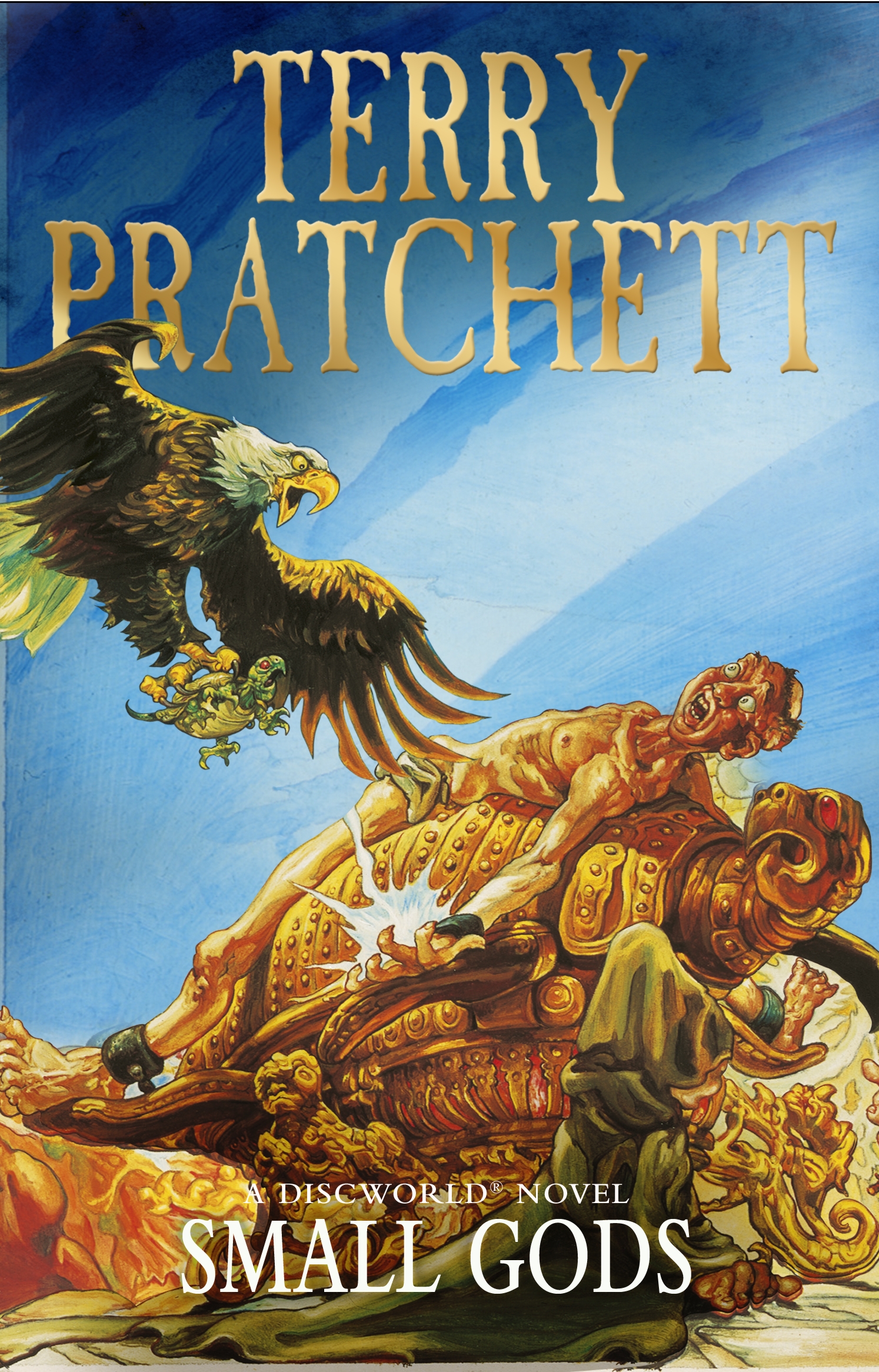
Publisher: Gollancz/Penguin Audio (Audiobook – 1993)
Series: Discworld – Book 13
Length: 9 hours and 55 minutes (Planer version)/11 hours and 38 minutes (Serkis version)
My Rating: 5 out of 5 stars
Thanks to an excellent road trip, I managed to revisit several awesome entries from the iconic Discworld series by the legendary Terry Pratchett, and it is time to highlight one of the very best books that Pratchett wrote, Small Gods.
I have never made any secret of the fact that I love all things Terry Pratchett, as the Discworld books were the formative series of my youth. A massively popular collection of loosely connected novels set on a flat world carried through space on the back of four elephants atop a giant turtle, the Discworld books present a range of unique fantasy adventures backed with exceptional comedy and satire. This series is so much fun, and I honestly love every single Discworld book, having read them all multiple times, usually while laughing myself silly. Indeed, I am such a big fan of this series that I named my blog after a location in the universe. Despite my overwhelming love for all things Discworld, I haven’t reviewed too many of the books on this blog, with Moving Pictures and The Last Continent previously being the only exception. However, thanks to some great road trips giving me opportunities for revisiting some classics, I have recently published reviews for Guards! Guards! and an additional review for Moving Pictures. I also recently re-listened to the impressive and thoughtful 13th entry in the series, Small Gods. An outstanding standalone novel that seeks to blend religious commentary with Pratchett’s strong humour and complex satire, Small Gods is one of the more thoughtful and moving Discworld books and is a must read for all fans of the franchise.
Floating through space on the back of a giant turtle, the Discworld is a place of magic, wonders, strange creatures and, unfortunately for the mortals just trying to live their lives, gods. Instead of the wise and beatific beings we hope them to be, the gods of the Disc are a capricious and vain lot, empowered by the belief of their human worshippers. But what happens when a mighty god loses his believers?
The militant nation of Omnia is an empire dedicated to the fervent worship of the Great God Om, an all-powerful being who knows all, sees all and is the only true god in the world. The problem is none of that is true. Instead, Om is a self-obsessed god among many, who barely pays attention to the people fighting in his name. More importantly, he is currently residing in the body of a tortoise, stripped of nearly all his divine power, and the only person who can hear him is a simple novice, Brutha, who isn’t fully convinced that the talking tortoise smiting him with tiny thunderbolts is his god.
Determined to get back on top and find out why he lost his power, Om recruits Brutha as his unlikely prophet. However, Brutha has his own problems as the sinister head of Omnia’s Quisition, Vorbis, has taken an interest in him. Forced to accompany Vorbis on a diplomatic mission, Brutha soon begins to understand that the world is a far bigger place than he realised, and that there is something very wrong at the heart of his nation.
As the tides of history take Brutha and Om into strange new places, the two find themselves encountering unexpected dangers, including dangerous ideas, sinister eagles, rebels determined to prove that the world isn’t round, deranged philosophers and the small gods that lurk in the dark places. To survive, Brutha will need to have faith in his god, but more importantly, Om will need to have faith in Brutha, especially when his own religion is turned against them.
After yet another re-read, Small Gods remains one of my favourite Discworld novels, and this is one of the very best examples of Terry Pratchett’s unique style and imagination. A hilarious, yet thought-provoking read that cleverly dissects religion, divinity and people’s beliefs, Small Gods quickly grabs your full attention and refuses to let go until it’s powerful, terminal end.
I have so much love for the outstanding narrative that Pratchett pulled together for Small Gods, which tells one of the more unique standalone tales in the Discworld series. I must admit, even after many reads, I am still very impressed that Pratchett decided to examine the nature of religion and belief through the lens of a hilarious odd-couple story that evolves into a road trip narrative. Starting off on a very entertaining note with the unsuspecting new prophet of Om, Brutha, encountering his god in the form of a small, battered tortoise, Pratchett does a good job of introducing the nation of Omnia and its place in the wider setting. This proves to be an effective start to the book, and a lot of the early themes and wider issues surrounding the nation of Omnia are well set-up. You also get a great examination of the book’s three main characters, and their compelling early interactions in Omnia sets up a lot of the book’s character-driven narratives. After this excellent introduction, Small Gods’ plot then moves to the bordering nation of Ephebe, which proves to be an intriguing centre of the novel, not only because it has some of the more entertaining sequences, but also because it begins to expand on some of the ideas from the front of Small Gods and you are given a good understanding of both Om’s situation and Brutha’s growth as a character.
The plot of Small Gods takes a powerful turn around halfway through, when Brutha helps further Vorbis’s schemes, only to then attempt to flee and do the right thing. However, thanks to the influence of a rival god and unexpected technology, Brutha and Om are inadvertently stranded in the desert with a helpless Vorbis. The following extensive scenes in the desert are probably the best parts of Small Gods, especially as Brutha begins to think for himself, and the philosophical clashes he has with Om set him up as the protagonist both the reader and the Omnians need. Pratchett really dives into what it is to be human and divine in this section of the book, and I deeply appreciate the rich character development featured within these sections of the plot. These desert scenes become even more impactful when Pratchett throws in a major obstacle for Brutha that threatens to push him over the edge into despair. You really feel for Brutha as he has his crisis of faith, only to maintain his humanity in the last confrontation with Vorbis. The subsequent scene on the metal turtle was very tense, and while I know some people dislike the end of Vorbis, I thought it was a very clever sequence, especially as Pratchett set up the hunting eagle perfectly. Pratchett continues to wrap up the rest of the narrative in a very satisfying way, and while the war sequence might have been a little unnecessary, it allowed some great character arcs to come together and showed how much Om had grown as a god. The final scene with Brutha once again showing his humanity no matter what, ended the book on satisfying and heart-felt note, I appreciated the hopeful tone Pratchett concluded his brilliant story on. An overall impactful and moving narrative that brought together a lot of complex plotlines and character moments and ensured you were hooked the entire way through.
I have always believed that Small Gods was one of Pratchett’s better written books, as he effortlessly blended a complex fantasy narrative that examined religion with his typically brilliant humour and some outstanding characters. Featuring one of his most complex and thought-provoking plots, Pratchett achieves so much with his intriguing inclusions, all without slowing down the speed of the book and keeping the tension and emotional charge of the book on high. Introducing a cool new setting, Small Gods works well as a standalone entry in the larger series that cleverly expands on some previously introduced features, such as the selfish and somewhat stupid gods of the Disc, as well as cool locations like Ephebe (which was previously featured in Pyramids). Due to its lack of major connections to the other entries in the Discworld series, Small Gods is a rather excellent introduction to Pratchett’s style and ability to dive into heavy topics with comedic content. Like all of Pratchett’s books, Small Gods is hilarious, and I love the many different levels of humour contained with the book, that range from obvious jokes at over-the-top situations, subtle witticisms often contain within well-placed footnotes, to clever word or name gags. Some of this humour is so subtle that it often goes over the reader’s head the first time, and you honestly need multiple readings to full appreciate every single joke or gag that Pratchett thought up (I still discover new jokes I previously missed every time I read a Pratchett novel).
However, the thing that ensures Small Gods stands out amongst the other brilliant Discworld novels is the author’s clever and insightful breakdown of religion and godhood on the Disc, which is both fascinating and entertaining. A lot of the book’s powerful messaging, complex themes and some of the best humour, comes out of the exploration of the divine and how it relates to both this crazy fantasy setting and the real world. While Pratchett does provide a lot of jokes about religion throughout the ages, he does it in a very intelligent and delicate way that makes the reader think. Rather than simply dunking on religions and focussing on the negatives, Pratchett instead subtly satirises the institutions, manipulative leaders and unthinking traditions that can often complicate or weaponise religion. A large amount of the plot revolves around Vorbis and the Omnian church violently trying the repress the idea that the world is flat and on the back of a giant turtle. While this is primarily a fun parody of the Catholic church’s suppression of Galileo’s claims about the Earth orbiting the sun (and which is now both funnier and sadder, thanks to flat earthers), it also examines how some people utilise religion as an excuse for violent action and manipulate faith for their own ends, which is a powerful recurring them throughout the book.
At the same time, Pratchett also focuses on a compelling central character with true faith who explores the meaning of religion and how it impacts his people. Seeing a likable character like Brutha recognise the problems in his nation allows readers to reflect and see the flaws in the organised religions Pratchett is parodying, while also appreciating the messages that these religions should strive for. The various complex discussions, personal revelations and jokes within Small Gods allow for a very insightful read that reportedly resonates with both atheists and pro-religious figures (Pratchett apparently received a lot of fan mail from both groups who thought Small Gods was written for them). I personally think that Pratchett’s thoughts and messages were extremely perceptive and layered with a great understand of humanity, and indeed many his compelling criticism or organised religion and how it is weaponised are more relevant now than when Small Gods was written, especially as it could also apply to other traditional institutions that are being abused.
Pratchett perfectly rounds out this incredible writing by featuring some of his very best characters, including several very complex figures who mature and evolve throughout the course of the book’s plot. This includes the main protagonist, Brutha, a simple novice who finds himself the only person left who can hear Om due to his genuine belief in the god rather than in the institutions that surround the religious practices. While initially portrayed as a somewhat dull and unthinking novice, you soon begin to realise that there is much greater complexity within Brutha, as well as the fact that he is a genuinely nice person held back by his simple ideas of life and faith. Thanks to his interactions with Om, who provides greater clarity to his religious beliefs, as well as his experiences outside his insular nation, Brutha begins to evolve quickly as a person, gaining a greater appreciation for the wider world, as well as beginning the understand that the world isn’t quite as black and white as he believed. It was fascinating to see Brutha develop as the book continues, especially as he begins to doubt his faith and rebel against the church and the god that had been his entire life. His interactions with Om were quite entertaining, as the two eventually become a fun duo of equals, although Brutha does get the upper hand over his god in quite an entertaining and refreshing manner. Brutha was also well defined by his relationship with the book’s antagonist, Vorbis, and their discussions about truth prove to be quite defining for Brutha as an inspiration for his rebellion. However, unlike the rest of the cast, Brutha resists becoming the monster that Vorbis wants him to be, and his subsequent demonstrations of faith, reason and humanity, really set him up as one of Pratchett’s best and most likeable central protagonists.
Brutha is well matched by his god, Om, who honestly is one of the best deities featured in the Discworld series. Formerly an all-powerful and arrogant god who didn’t care about his believers, Om finds himself suddenly trapped as a helpless tortoise who must desperately cling to Brutha to survive. Om proves to be quite a fascinating and entertaining figure in Small Gods, especially as Pratchett perfectly portrays him as formerly powerful being who must now rely on the mercy of others. His initial arrogance is very entertaining, and his subsequent wheedling manipulation of Brutha was a great follow-up that worked to keep him in the story. However, it was his eventual co-evolution with Brutha that turned Om into a particularly compelling protagonist. Despite his resistance, his bond to Brutha shapes him and forces him to see the world through human eyes, and the subsequent discourse on philosophy, life and how religion should be as they wander the dessert impacts Om just as much as Brutha. This eventually causes them to reach an interesting and heartfelt religious partnership, and it was fascinating to see the previously selfish Om risk it all to save Brutha, especially when he is confronted by other gods who act the same way he used to. I loved seeing this powerful and positive development in a divine figure, and Om really ended up being a compelling secondary protagonist with some of the best jokes.
While Brutha and Om are the heart and soul of Small Gods, this book would not be as impactful without its brilliant villain, Vorbis. A cruel and unflinching figure, Vorbis is probably Pratchett’s most ruthless antagonist, who utilises the mechanisms of the church to achieve his goals. However, rather than being a purely evil figure, Vorbis is shown to be simply someone who understands human nature and uses this knowledge to achieve his self-determined goals, which in some ways is worse than an obvious villain. Pratchett does an outstanding job showcasing Vorbis’s dark, insular nature, and you come to really appreciate just how sinister he is, especially as his actions inspire other people to do evil things to try and match him. He becomes even more immoral when compared to the very innocent Brutha, the only person that Vorbis occasionally sees as a real threat to his plans due to his legitimate belief, and their various interactions and discussion about the true nature of the world are quite powerful. Pratchett features Vorbis perfectly throughout the book, and his final appearances, where he finally understands his own nature, are very satisfying to behold.
The rest of the cast of Small Gods are also quite impactful in their own way. The blind philosopher, Didactylos, proves to be a fantastic voice of reason in the story, especially compared to the rest of the insane philosophers of Ephebe, and his very simple philosophy and viewpoint on life and truth give the characters, and the readers, much to think about amongst the discussions on religion. Didactylos’s nephew, Urn, came across perfectly as a machine-obsessed proto engineer, whose storylines go in some interesting philosophical directions, especially when he realises what his inventions will be used for. I had a very fun chuckle at the inclusion of Cut-Me-Own-Hand-Off Dhblah, a fun Omnian equivalent to the always entertaining Ankh-Morpork native, Cut-Me-Own-Throat Dibbler, while the Sweeper, Lu Tze, gets a great introduction as a secret history monk who occasionally changes events for the better. Finally, the zealous Sergeant Simony, who leads the internal Omnian revolution against Vorbis, proves to be a very impressive figure who, despite being a fervent misotheist (someone who hates one specific god), has a belief in freedom and the turtle that matches Brutha’s faith in Om. Simony serves as a very good example of just how far Vorbis can drive someone trying to do the wrong thing to achieve their goals, and I felt that he matched the fervour and faith of the other major characters in some fascinating ways. This cast of characters was overall superb, and I really appreciated how well they complimented each other’s story arcs, as well as the intelligent themes Pratchett was trying to get across.
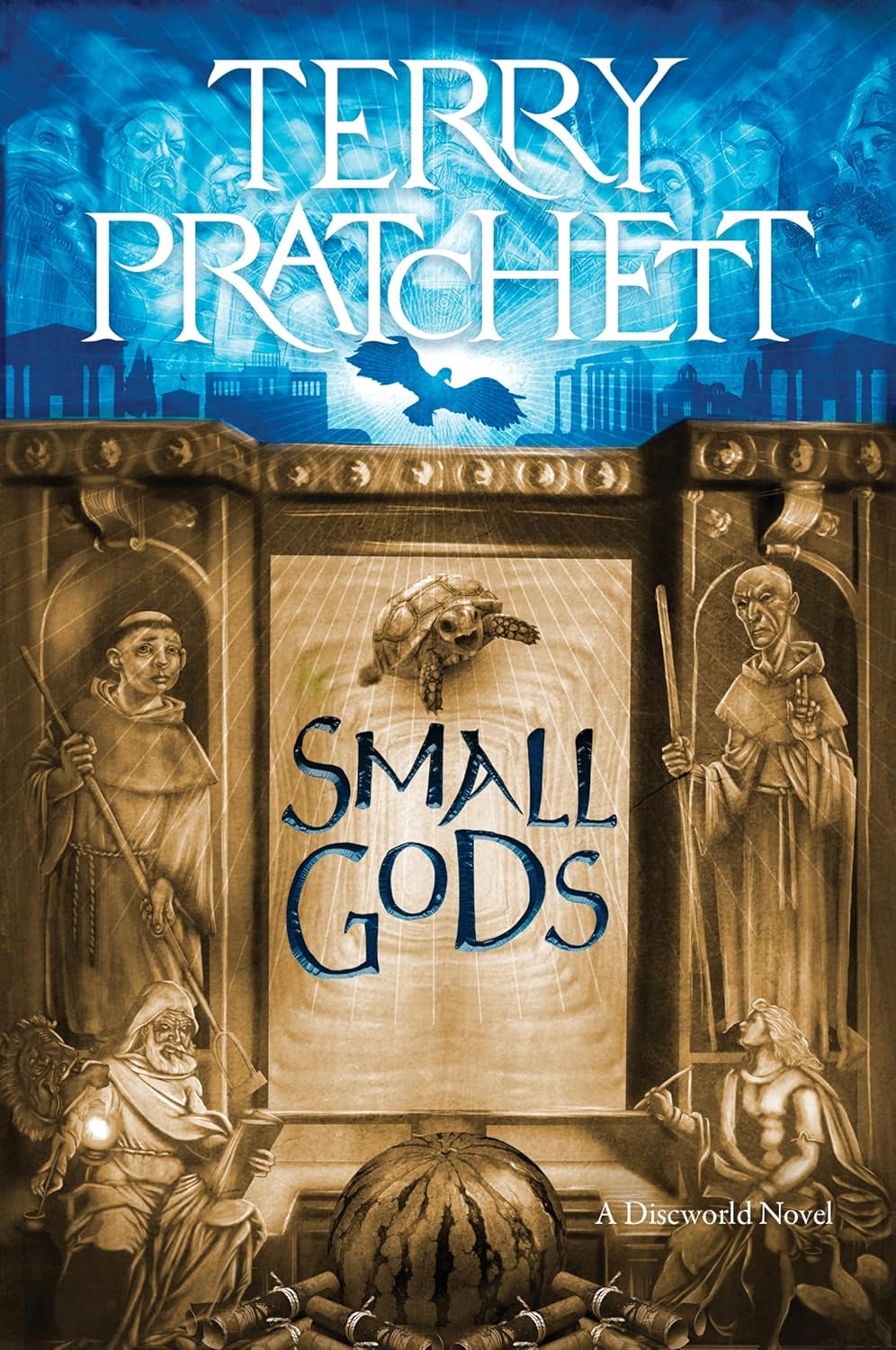
As with all the Discworld novels, I have enjoyed Small Gods as both a physical novel and an audiobook, and frankly this epic story comes across extremely well in all formats. However, I have a very special place in my heart for the Discworld audiobooks, and the outstanding stories, elaborate characters and impressive and clever humour always comes across extremely well in this format. I have had the great pleasure of listening to Small Gods multiple times over the years, and I want to highlight the two different unabridged version of Small Gods.
The first audiobook version of Small Gods is the original production narrated by Nigel Planer. Small Gods was a particularly impressive example of Planer’s voice work, as he had to come up with unique voices for a range of unusual characters. The Planer version of Small Gods is the one that I grew up with, and it is engrained in my mind as a result, especially as the narrator effortlessly moves through Pratchett’s many complex ideas and plots and brings them out in a fantastic and humours manner. Planer provides all the voices in his version of Small Gods, and he perfectly encapsulated all the key figures of the book with his exceptional narrations. You really get the full range of these character’s personalities and emotions through Planer’s voice work, and I loved his clever takes on Pratchett’s distinctive cast. As such, the Planer version of Small Gods is probably the gold standard for all Discworld fans, and it will always have a very special place in my heart.
There is also a recently released version of Small Gods that is narrated by three brilliant British talents, and which was the version I most recently enjoyed. This new Small Gods audiobook features a runtime of around 12 hours, which is a little longer than the roughly 10-hour long Planer version and provides an interesting new take on the novel. I really enjoyed the voice cast for this new audiobook, as not only do we once again get Peter Serafinowicz and Bill Nighy in their recurring roles, but it also features the primary narration of actor Andy Serkis.
Serkis, who has also narrated a recent version of The Lord of the Rings books that is worth checking out, does an exceptional job in Small Gods, ensuring a very fun experience for all listeners. While there are some tonal shifts in this audiobook that fans of the Planer version may find a little surprising or jarring, for the most part I think Serkis matches and even occasionally exceeds Nigel Planer’s performance, and I very much enjoyed his take on the book. His basic narration of Small Gods matches Pratchett’s style and humour extremely well, and I love how effectively he moves the story along, perfectly capturing the complex tone and energy of the plot. However, it is Serkis’s entertaining voices that were the highlight of this version of Small Gods, as the characters are each given unique tones that fit their personalities in some fantastic ways. His voice for Brutha, the central character, was extremely good, and I loved how well Serkis captured Brutha’s transformative journey and complex personality. Utilising a fitting rural voice for the protagonist, Serkis successfully showcases Brutha’s changing mentality and deep moral roots with his narration, and you can honestly imagine this intriguing figure every time the narrator voices him.
In comparison to Brutha, the voices for Vorbis and the Great God Om were a lot more elaborate by necessity, and I really appreciated the fantastic tones that Serkis choice for these entertaining figures. My favourite was probably the voice used for Vorbis, as the narrator gifted this antagonist a deep, rich and lingering voice that honestly put me in mind of Tony Jay or Alan Rickman with some added oily sinisterness. This impactful voice perfectly fit Vorbis’ menacing personality, and whenever the listener hears the voice, you know bad stuff is about to go down for the rest of the cast. As for Om, Serkis provides him with an unrefined and laddish voice with a Liverpool accent. This interesting voice choice matched Om’s uncaring and selfish personality extremely well, and I liked how well Serkis’s chosen tone for this divine figure played into the overarching theme that gods on the Discworld aren’t as sophisticated as everyone assumes they are. Most of the rest of the voices in Small Gods work extremely well, with Sergeant Simony and Cut-Me-Own-Hand-Off Dhblah having memorable voices as a result. However, I felt that the strong American accents that Serkis assigned to Didactylos and Urn really didn’t work, and failed to match the tone of the rest of the audiobook. While Serkis was probably trying to distinguish these two from the other Ephebian philosophers, their voices honestly grated on me, and I really wish he’d have tried something else. Still, the rest of Serkis’ voice work was amazing, and I cannot emphasise how incredible most of his narration of Small Gods turned out to be.
Serkis’s main narration was perfectly enhanced with the inclusion of Peter Serafinowicz and Bill Nighy in their recurring roles from the new Discworld audiobooks. Serafinowicz provides the voice of Death whenever he appears in this audiobook, which is a lot of fun as Serafinowicz has an extremely entertaining Death voice that captures the anthropomorphic personification in all his skeletal glory. His multiple appearances in Small Gods, leading key character towards the desert of judgement, were very awesome, and I loved hearing Serafinowicz converse with the other characters as Death. The audiobook production team does an excellent job sliding the Death voice into Serkis’s main narration seamlessly, and I love it when Serafinowicz’s voice suddenly appears during dangerous scenes, heralding that someone is about to die, and ensuring there is some great tension as you watch the other characters slowly realise something is very wrong. Nighy, on the other hand, narrates the various footnotes that Pratchett included in his text, providing an extra layer of humour. While there are relatively few footnotes in Small Gods, it is a key role that Nighy perfectly fulfils, and his calm, consistent tones, echoing Peter Jones’s similar role in The Hitchhiker’s Guide to the Galaxy radio and TV editions really highlighted the subtle comedy of these footnotes. These three exceptional actors come together perfectly and provide an outstanding overall performance that I could not get enough of. This was a truly exceptional audiobook that I think is on par with the previous Planer version, and I would strongly recommend both audiobooks as an amazing way to enjoy Small Gods, especially if you need to listen to something while travelling.
Well, as I am currently just getting to the end of page seven of my review for Small Gods by Terry Pratchett, I think it is a safe assumption to say that I love this amazing book. Easily one of my favourite Discworld novels, Small Gods perfectly blends a brilliant story and amazing characters with Pratchett’s amazing wit and his uncanny insights into compelling real-world issues. An incredible and addictive read from start to finish, Small Gods comes extremely highly recommended and can easily be enjoyed by anyone wanting a clever, funny and heartfelt read, especially on its two audiobook formats.


 The Unseen Library