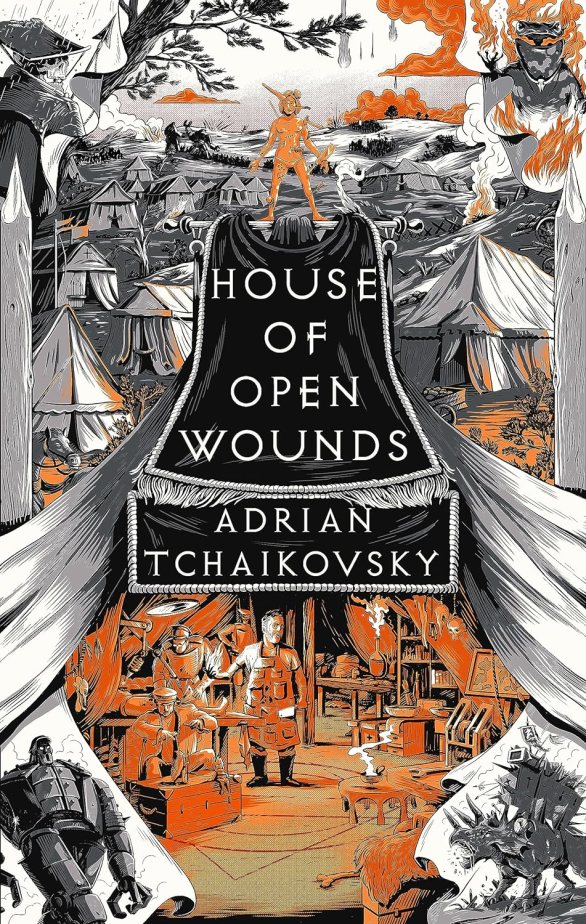
House of Open Wounds by Adrian Tchaikovsky

House of Open Wounds Cover

Publisher: Head of Zeus (Ebook – 7 December 2023)

Series: The Tyrant Philosophers – Book Two

Length: 636 pages

My Rating: 5 out 5 stars

Amazon

The always deeply impressive Adrian Tchaikovsky returns with an exceptional and remarkable piece of fantasy fiction, House of Open Wounds, which presents the reader with a particularly unique and ruthlessly entertaining story, chock full of brilliant characters.

Few fantasy authors have the range and style of Adrian Tchaikovsky, whose distinctive contributions to the science fiction and fantasy fields are quite remarkable.  While Tchaikovsky has written several highly regarded series, I have only just scratched the surface of his works, having read a few of his recent reads.  This includes his first foray into the Warhammer 40,000 universe, with the captivating standalone read, Day of Ascension, as well as the brilliant and elaborate novella, Ogres.  However, my favourite book from Tchaikovsky so far would have to be the outstanding City of Last Chances.

The first book in The Tyrant Philosophers series, City of Last Chances was an outstanding read that I had the pleasure of enjoying earlier this year.  Set around a conquered city with several unique magical inclusions, City of Last Chances introduced the reader to a cool new world and told a range of character driven stories about resistance, religion and sacrifice.  City of Last Chances got a very easy five-star rating from me, and it honestly was one of the best books and audiobooks I enjoyed in the first half of 2023.  I had such a brilliant time with City of Last Chances that when Tchaikovsky announced he was releasing a sequel in the second half of 2023, I was ecstatic.  This sequel, House of Open Wounds, continued some of the complex storylines Tchaikovsky started in City of Last Chances, and it was one of my most anticipated books for the second half of the year.

There are few nations more feared or relentless than the ever-expanding Palleseen.  A rising empire of zealots who are determined to bring Perfection and Correctness to an imperfect world, the Palleseen have advanced out of their homeland in an unstoppable wave, wiping out all religion and superstition as they go.  As cities and kingdoms fall before their military might, their armies leave behind mounds of dead and wounded soldiers who require tending in field hospital tents just behind the frontline.

Into this chaos is thrust the god smuggler Yasnic.  A former priest, miracle healer and occasional rebel, whose previous experiences with the Palleseen saw him hanged, attacked and banished from his city, Yasnic has experienced many upheavals throughout his life.  Saved from another execution by the army bureaucracy, Yasnic and his box of orphan gods arrive at the frontlines, where he has been assigned to work in an unorthodox medical unit.

Made up of a mixture of former priests, gods, magicians, alchemists, artificers, necromancers and led by a gigantic brute known as the Butcher, the experimental medical unit treats the soldiers no one else can save and recycles the rest into the war effort.  Entrusted to save the Palleseen soldiers, but doomed if anyone ever discovers the full extent of their abilities, the surgeons and orderlies of this unit ply their bloody trade as best they can while living as part of an unusual family, but the arrival of Yasnic could change everything.

As Yasnic works to fit into the unit and save lives, his unusual connections to the weakened and hidden gods of the world slowly begin to cause chaos throughout the army.  Not only is he aware of the divine forces that secretly hang around the hospital, but his own illegal and crotchety God is determined to bring miracles to the Palleseen, whether that want them or not.  As an outbreak of impossible healing and sudden pacifism spreads through the regiment, can Yasnic keep himself and his gods alive, or will the full force of the Palleseen zealots come crashing down upon him?

This was another epic and truly remarkable novel from Tchaikovsky that had me hooked the entire way through.  Featuring a dark, bloody and fun story, House of Open Wounds was a particularly distinctive read that told its own captivating story while continuing some of the best elements from City of Last Chances.  Funny, thoughtful and moving in equal measures, House of Open Wounds was an incredible and addictive novel that gets another very easy five-star rating.

I was very impressed with the exceptional and moving narrative that Tchaikovsky pulled together for House of Open Wounds, and I was hooked the second I got into it.  After the events of City of Last Chances, the reader is thrust into a new part of Tchaikovsky’s fantasy world as you find yourself imbedded in a Palleseen battalion following the members of an unusual but effective military hospital.  Like City of Last Chances, House of Open Wounds is strongly character driven, as you follow the personal stories surrounding each of these unusual outsider characters and learn about their complex pasts while watching their lives play out in the present.  Much of the plot revolves around returning protagonist Yasnic and his God, who are drafted into the unit, and you get to see his experiences of the other characters, the wars, and the internal Palleseen bureaucracy.  Most of the first half of House of Open Wounds is dedicated to exploring the new cast of characters and introducing their unique stories, as they find themselves closely following a bloody and dangerous war.  This part of the book is primarily focused on the healing and medical work of the protagonists, as well as diving into their reasons for being there and the unique skills they bring to the surgical table.  Apart from that, there isn’t an amazing amount of major plot progression here, except when Yasnic starts to mix things up around the battalion.  While this pace is a little slow, this first half of the book was really fun and enjoyable, as you find yourself getting really lost in the characters’ lives, unique struggles, desires, and experiences.  It also helps that many of these character details, as well as the mundane events of the hospital, eventually lead to bigger things later in the main plot, and Tchaikovsky does an outstanding amount of set up here.

The plot picks up a lot more in the second half, when the main battalion moves to a different warzone and find themselves involved in a substantial fight that really pushes the medical unit to its limits.  The new battles, as well as the intriguing location they find themselves in, move several of the character arcs in some big directions, and you find out more and more about each of the main characters as a result.  The constant chaos that surrounds Yasnic also starts to take its toll on the main story, as his strangeness and the double-edged miracles he occasionally brings cause him to make enemies and upset the delicate balance of the Palleseen army.  At the same time, the Palleseen war machine starts to alienate the members of the medical unit, who find their talents being stolen to create weapons.  Everything leads up to the big finale, where the protagonists attempt to free themselves with an elaborate and ambitious plan.  This plan makes great use of all their individual skills and histories, and so many little details and elements from the story are used to bring a fun and creative conclusion to the book.  Each of the fascinating character arcs conclude nicely and I loved how Tchaikovsky masterfully brought everything together in a satisfying and entertaining way.

Tchaikovsky utilises his typical excellent and distinctive writing style to convey this elaborate and entertaining narrative to the reader, and I had such a wonderful time seeing it unfold.  As with the previous novel in the series, Tchaikovsky relies very heavily on perspective changes to tell a multilayered, character-driven story.  Like the previous book, many of the major characters are initially showcased in their own chapter at the beginning, which often leads to additional cast introductions.  As the book progresses, the chapters feature perspective changes so you can see more interactions and a wider view of the entire story.  I loved the immediate deep background on several of these characters, and while you still often must wait a while to get their full story, you learn enough to like them in the opening parts of the novel.  Tchaikovsky makes full use of these characters to tell a fantastic story, and I loved how well he showcases some unique events through their eyes.  As with the previous book, House of Open Wounds has a range of tones as Tchaikovsky works hard to produce the right balance of humour, excitement, and moving and powerful character moments.  The multiple detailed and confronting scenes of the bloody battlefield hospitals are well balanced out by the fantastic and subtle humour, which often comes from the outrageous situations that occur throughout the book, as well as the various character’s unique outlooks on life.  This made for a particularly compelling book as you found yourself moving from comedic scene to a more dramatic or tragic moment with frequent regularity, as you find yourself stuck onboard a well-thought-out emotional roller coaster.

House of Open Wounds proves to be an intriguing and clever follow-up to City of Last Chances, especially as the author deepens the lore surrounding this fantasy world and brings back two fantastic protagonists.  Readers of City of Last Chances will have an absolute blast with this book, as you get some interesting follow up to Yasnic’s compelling storyline while also seeing a different side to the antagonistic nation from the first book.  This is a somewhat loose follow-up, and you really don’t need to have read City of Last Chances to enjoy House of Open Wounds.  In many ways this is a good standalone novel, especially as most of the focus is on a whole new group of protagonists, and even Yasnic is given a new name for much of the book.  Tchaikovsky does ensure that some of the key details and plot points from the first book are carried over when needed, although he does leave a bit of context out in places so as not to overwhelm new readers.  As such, House of Open Wounds is a very accessible read, although established fans of Tchaikovsky are going to particularly enjoy this, especially if they loved City of Last Chances.

One thing you can always rely on Tchaikovsky to do is to pull together an elaborate and deeply compelling world to set his stories around.  This is extremely true in this series as Tchaikovsky has come up with a war-torn landscape filled with magic, gods, demons and a new rising empire.  The author did some interesting set up for this world in the previous novel, although the plot there was primarily contained inside a single city.  In House of Open Wounds, the reader gets to see a bigger chunk of this world, even though much of the plot takes place either on the battlefield or in the camp behind the lines.  Despite this, you get a better idea of the politics, wars and conquests that have taken place in recent history, and you particularly learn more about the Palleseen.  The Palleseen are a group of ideological zealots dedicated to bringing their version of perfection to the world, which primarily involves breaking everything down into logic and reason, and doing away with superstitions and beliefs.  As such, their goal is to rid the world of gods, deities and other superstitions, usually by conquering the lands and bringing them under the control of their relentless bureaucracy.  Most of this book is dedicated to exploring the nature of their war machine, and you really get to see just how corrupt and ambitious some of their members are as a result.

I loved the focus on the military hospital and the war camp for most of the book, especially as seeing the various members of Palleseen camp allows the reader to fully understand the many problems, compromises and cruelties the Palleseen experience on their road to perfection.  Tchaikovsky throws in some great critiques of militarisation and empire building throughout the book as you see these perfect Palleseen become racked with pride, ambition and greed to prove themselves and advance up the ranks.  Their determination to win means they turn a blind eye to gods and superstitions when it suits them, and that results in the experimental medical unit that serves as the centre of the book.  However, while they appear to only want the assembled gods, alchemists, and other strange magics for healing, really they are working to corrupt them into terrible weapons to further their war capability.  There are several great storylines that see the Palleseen turning benevolent tools and creatures into highly inventive tools of war, and it serves as a major plot point and motivation for several characters, including a few Palleseen who have enough of their colleague’s lust for power.  Combine that with the returning minor gods, who end up having their own impact on several characters, and the reader comes away with a very cynical look at the Palleseen, and empires in general, which both ridicules them and shows just how malevolent and insidious they can be.

The real key that pulls together House of Open Wounds is the huge array of memorable and complex characters that are introduced throughout the course of the plot.  Tchaikovsky does a remarkable job of introducing and swiftly building up some truly amazing characters in this novel, and their compelling and often traumatic personal stories become so highly ingrained in the plot as a result.  There are so many great protagonists and supporting figures in this novel, and I was personally impressed with how all of them were original characters that were not built up in the prior novel.

The main exception to this rule is Yasnic and his god, both of whom were introduced in City of Last Chances and who are masterfully inserted into this sequel.  Yasnic was honestly one of Tchaikovsky’s best characters in City of Last Chances and I was so glad to see more of him here, especially as the author somehow manages to work in even more development after all the defining character moments that shaped him in the prior novel.  Since we last saw him, Yasnic has moved on from being the last priest of a forgotten god and has instead become a more generalised religious figure, offering shelter and assistance to fallen and orphaned gods who no longer have any power or believers by carrying them around in a box on his back.  After everything he has gone through, including his own crisis of faith, Yasnic now has a different view of the world, although he is still being haunted by his demanding and petty god.  Yasnic has some wonderful moments in this book as he tries to fit into his new role while also hanging onto the trappings of his old life.  Desperate to save everyone he can, Yasnic finds his views and pacifism really badly damaged by the constant war and the relentless and orderly Palleseen, and he is forced to make some haunting compromises.  You really get some very interesting insights into Yasnic’s mind in this book, especially as you see how the aftermath of him abandoning his position as a priest impacted him.  You cannot help but feel for the extremely likeable Yasnic at times, as he is thrust into tragic and heartbreaking positions against his will, and his quiet determination and general positivity pluck at your heartstrings.  Throw in some great new friends, an unusual but surprisingly wholesome love interest and a series of unfortunate misunderstandings that frustrate even this gentle soul, and Yasnic once again stands out as a particularly awesome and likeable protagonist.

The other side of Yasnic’s character resides in the body of his tiny, stumpy, and petty deity, God, a former major healing god who has lost all his worshippers apart from Yasnic, but still maintains his powerful healing abilities.  However, God refuses to heal anyone unless they swear a vow of pacifism, and if they cause harm to someone in any way, it will result in their wounds automatically returning, generally resulting in a sudden death.  Thanks to his stubbornness, pride, and his whiny focus on Yasnic’s soul, God was one of the most entertaining characters in City of Last Chances, and I am really glad that Tchaikovsky brought him back for House of Open Wounds.  While he is still a judgemental, mischievous and ugly angel on Yasnic’s shoulder in this sequel, you get to learn more about God and why he refuses to help save people.  There are some surprisingly emotional scenes where God expresses why he is so bitter and you really get a much better understanding of his angry mind, especially when Yasnic makes the same mistakes, adding to God’s sadness.  I also loved how well God played off Yasnic as he proves to be a surprising and entertaining counterpoint to the humble and nice former priest.  While most of their dialogue is quite contentious, with God trying to control his increasingly independent former priest, you can see deep down that God cares about Yasnic, and they form quite an interesting and fun duo.  Tchaikovsky took God’s character arc in some interesting directions towards the end of House of Open Wounds, and I have a feeling he is going to be a real nuisance to people in the next book.

House of Open Wounds also features quite a fun range of supporting characters, each of whom has their own compelling story to tell.  This primarily includes the crazy and unusual group of associated healers and hospital workers that work in the experimental hospital unit, as well as the competitive and dangerous Palleseen officers controlling their destinies.  I won’t go into too much detail here, as I could honestly go one for a paragraph about each, but I was really impressed with how well Tchaikovsky set each of them up and explored their histories and stories as the booked continued.  There are some brilliant and very well fleshed out character arcs everywhere in House of Open Wounds, and I loved just how compelling a story Tchaikovsky was able to make as a result.

Adrian Tchaikovsky once again shows why he is one of the absolute best authors of complex and intelligent fantasy fiction with this outstanding and epic read.  House of Open Wounds is a deeply clever, compelling and moving read that hooks the reader with its unique scenarios, fantastic humour, and memorable characters.  I loved every single second I spent reading this novel and I really appreciated the amazing way Tchaikovsky chose to continue the great story started in City of Last Chances.  I cannot wait to see what over elaborate fantasy stories Tchaikovsky creates in this universe in the future, and this epic novel is one of the best pieces of fantasy fiction I enjoyed in 2023.
Amazon

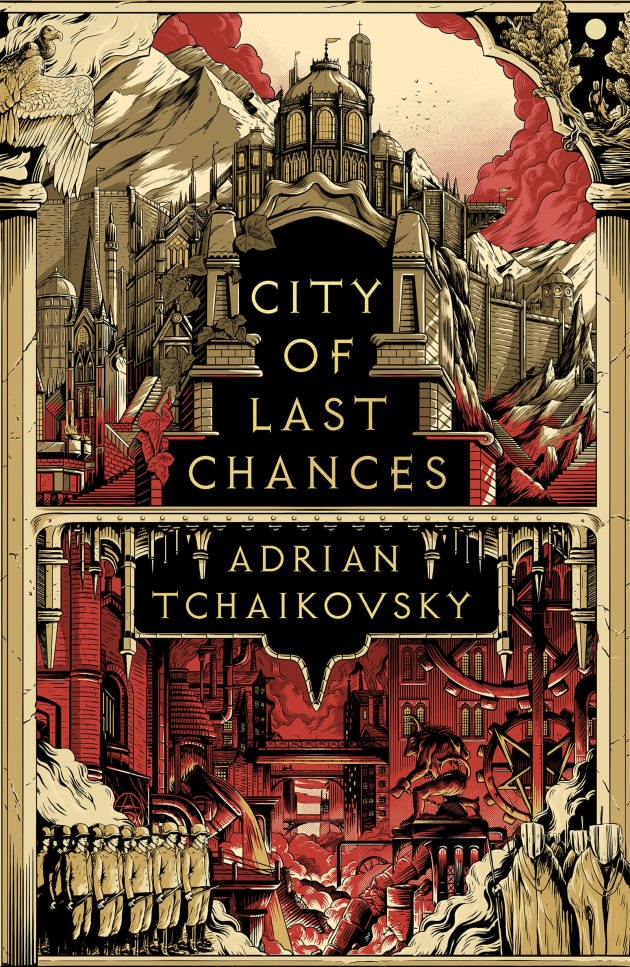
City of Last Chances by Adrian Tchaikovsky

City of Last Chances Cover

Publisher: W. F. Howes (Audiobook – 15 December 2022)

Series: Standalone/Book One

Length: 20 hours and 7 minutes

My Rating: 5 out of 5 stars

Amazon

Acclaimed fantasy and science fiction author Adrian Tchaikovsky delivers one of the best fantasy books of 2023 with the intricate and captivating City of Last Chances.

Over the last year I have been really getting into the works of Adrian Tchaikovsky, one of the most inventive and imaginative authors of fantasy and science fiction writing today.  Tchaikovsky is a skilled and prolific author who has been a major figure in genre since 2008.  Best known for his Shadows of the Apt, Children of Time, Echoes of the Fall and The Final Architecture series, as well as a compelling collection of standalone novels and novellas (I personally have my eye on his previous novel, Guns of the Dawn), Tchaikovsky has a great habit of creating elaborate new worlds filled with intriguing characters and scenarios.  I have only read a couple of his books so far, including Tchaikovsky’s first Warhammer 40,000 novel, Day of Ascension, and his outstanding 2022 novella, Ogres, but both were outstanding reads and I loved the epic stories both of them contained.  Because of this, Tchaikovsky’s latest standalone novel, City of Last Chances, has been on my radar for a while.  It was released last year, and I finally managed to get a copy on audiobook a short while ago and dove into it as soon as I could.  However, I was unprepared for just how captivating its story would be.

There has always been a darkness hanging over the ancient city of Ilmar.  Known colloquially as the City of Long Shadows, the City of Bad Decisions, and the City of Last Chances, Ilmar is home to many dangerous magical occurrences, including the mysterious Anchorwood at its centre, which serves as a gateway to other far-off worlds.  However, a far more sinister enemy has arrived at Ilmar, the soldiers of the Palleseen, a powerful empire seeking to bring its ideas of perfection and order to all it conquers, whether they like it or not.

After several years of occupation, Ilmar is at a tipping point.  Its citizens are fed up of the corrupt and brutal soldiers, and everyone in Ilmar, be they rebels, criminals, refugees, idealistic students or factory workers, is looking for an opportunity to strike back and make their lives better.  With these forces straining to be unleashed, all it takes is one spark to set the fire of anarchy.  That spark occurs when a powerful Palleseen official leads an ill-advised expedition into the Anchorwood, searching for additional power.  However, he is unaware that an opportunistic thief has stolen the necessary protective amulet in advance, and the expedition is massacred by the creatures that live within the wood.

As news of this crime spreads throughout the city, chaos begins to rear its head.  Everyone is searching for the valuable amulet that was stolen as it represents the greatest chance of freedom many will see, while the Palleseen soldiers are clamping down on the entire city, determined to find those responsible and make them pay.  In this chaos, a mixture of Ilmar’s citizens, including a desperate priest, a violent murderer, an unlucky thief, a duplicitous lecturer and several of the most lost people in the city, will seek to survive the oncoming storm, only to fan the flames further.  However, none are truly prepared for the full danger about to engulf Ilmar, or the heartbreak that follows with it.

Well damn, now that was a pretty damn epic book.  Tchaikovsky has delivered an exceptionally intriguing and addictive novel in City of Last Chances that got me hooked very early on.  I was honestly blown away with the captivating and unique narrative that City of Last Chances contained, and Tchaikovsky drew me in with every fantastic detail and distinctive character.  This book gets a very easy five-star rating from me as I am still thinking about every detail of this book.

City of Last Chances has an amazing fantasy narrative at its centre, which Tchaikovsky backs up with his impressive and distinctive writing style that results in an extremely entertaining, powerful, and intense read.  City of Last Chances follows a raft of different characters as they attempt to navigate a series of deadly events following a single theft.  Tchaikovsky sets out the story in a very interesting way, and the book initially feels more like a collection of short stories than one cohesive narrative; for most of the first half of the book, each chapter acts as a semi-independent story that introduces the reader to a new character and shows their place in Ilmar.  These new characters are often supporting or named figures from a previous character’s chapter, who have their own unique stories and lives.  These character-driven stories are all quite enjoyable and compelling in their own way, and Tchaikovsky cleverly alters the tone so that some come off as very serious, some are quite dark, and others can be a little more comedic and thought provoking.  Some of my initial favourites include the funny and philosophical first chapter around the priest Yasnic and his relationship with God (which reminded me a lot of Small Gods by Terry Pratchett), Langrice’s scene-setting chapter at the mysterious Anchorage inn, and the chapter that gave a proper and humorous introduction to the grim figure of Blackmane as he finds himself about to be executed by a very cheery hangman.  Not only are these chapters very entertaining in themselves, but they effectively set up a larger narrative within City of Last Chances, while also providing great character moments and more and more glimpses into the many aspects of Ilmar.

As the book continues, the character-driven chapters begin to flow on from the preceding storylines, with the catalytic theft of the Palleseen artefact leading to bigger events down the line.  Each chapter adds its own spin to these events by showing new factions, impacted characters, or horrors within the city, or by introducing a new series of spiralling events that begin to unwind the situation even further.  As the story continues, a main cast begins to develop as more of the chapters focus on certain characters.  This really starts to bring the overarching narrative together, and soon the best parts of each unique character and their arcs begin to mingle with the other fantastic figures.  The story soon develops into a great tale of revolution with some Les Misérables vibes to it, as students, refugees, resistance fighters and factory workers begin to revolt.  The substantial main cast is worked into these events extremely well, and the reader is soon wrapped up in their powerful character arcs as well as the overarching story of Ilmar as everything begins to unfold.  Most of this is captured in a series of great chapters focused on the main cast, although new characters are still introduced right up into the end, with some unique, if brief, storylines skilfully worked into the larger narrative.  The author really pushes everything up a notch as the book comes towards the end, and every danger, unusual occurrence and strange character is unleashed to some degree.  There are some outstanding reveals, big battles, and some deeply personal moments that really help to bring the entire fantastic story together.  I particularly loved how some great story elements that were hinted at earlier in the book are brought to the fore at the end, especially as this includes some outstanding twists (Hellgram’s wife was a fun one for me).  However, the true joy is in the way that every major character gets a resolution to their emotional and complex character arcs, leaving the reader breathless in multiple ways.  I felt that Tchaikovsky wrapped everything up perfectly, and this serves as a brilliant and captivating standalone fantasy narrative.

I cannot compliment the way that Tchaikovsky presented this outstanding story enough, as his distinctive writing style really helped to compliment the epic and complex plot.  I have already mentioned his great use of different character focused chapters above, and I must once again highlight how effectively they were used to tell a cohesive and distinctive narrative with so many entertaining facets.  While it did take me a little while to fully appreciate what Tchaikovsky was trying to achieve with these semi-independent chapters, once you notice how the story is coming together through character-focused sequences, you really grow to appreciate it.  The continued change of character focus ensures that Tchaikovsky keeps the pace of City of Last Chances pretty brisk, and it is easy to quickly move through the story, especially once you get caught up in the tale of Ilmar and its people that the author is developing.  Tchaikovsky also introduces some impactful changes in tone throughout the book, as City of Last Chances runs the gauntlet from being light-hearted to emotionally draining, as the protagonists go through hell and back while also trying to deal with their own personal problems.  The author puts in some pretty intense scenes throughout this powerful story, many of which leave the characters reeling in different ways, and there are also some quite terrifying or shocking sequences as the full horror of this city is revealed in gruesome fashion.  However, these darker scenes are often undercut with some fun and amusing humour that helps to diffuse the tension at some key parts of the plot and which I found to be very refreshing.  This humour is often a little black and cynical in context, which ensures that the reader is left amused, and sometimes laughing, without the story getting too light and drifting away from its harsher content.  I really think that Tchaikovsky found the right balance here, and I rather enjoyed how he mixed everything together.  I had so much fun seeing how Tchaikovsky wove his complex tale into this book and City of Last Chances really emphasises just how talented he is as an author.

One of the key things that made City of Last Chances such a hit for me was the outstanding setting of Ilmar.  Tchaikovsky has always been exceedingly good at effectively building up an inventive and complex new setting for his stories, and this is some of his best work yet.  The author shows Ilmar through the eyes of so many different characters in this book, each of whom adds a new aspect to its history, character, and energy, as the story progresses.  This proves to be quite an effective way to introduce the setting, and the reader soon gets an impressive picture of the entire chaotic glory of this oppressed city.  I love all the aspects of this place, including the magical dimension-hopping wood and the responsibilities surrounding it, the demon powered factories, the oppressed refugee areas, the idealistic student academy and the sinister Reproach, an abandoned part of the city filled with magically cursed wretches dancing to their death.  Each of these complex and compelling elements are explored to their fullest throughout City of Last Chances and I really appreciated how Tchaikovsky built them up and then effectively featured them again later in the story.

The author also explores various parts of the world outside of Ilmar, and it is interesting to see how that impacts on the main story.  I particularly liked the use of the Palleseen as the overarching antagonists of the story and Tchaikovsky paints them as an obsessed group of fanatics trying to bring their ideas of perfection to an unwilling world.  This plays into several of Tchaikovsky usual themes about oppression and revolution, and he sets the Palleseen up as a vindictive group, who are often hamstrung by the practices and bureaucracy they force on their enemy.  The entire focus on the city of Ilmar being unleashed to face the occupiers was an excellent part of the book, and Tchaikovsky built up all the factions and chaotic nature of the city really well.  As such, Ilmar is a brilliant background setting to this great story and I really appreciated how Tchaikovsky set his story into it.

While I loved so many of City of Last Chances elements, for me the most important and powerful part of the book is the characters, as Tchaikovsky introduces the reader to a massive and captivating cast of figures who travel through the story in their own fashion.  Due to the way the story is set out, there are quite a lot of characters in City of Last Chances, with new cast members being added in every chapter, either to support the current point-of-view protagonist or to set them up for their own chapter later.  As such, there is a real focus on quickly and effectively getting to the root of each character in their first chapter, and I think that Tchaikovsky did a great job on this score.  You get to know each of these figures really quickly and you really get drawn into their unique tales and arcs, many of which are perfectly developed over the course of the book.  While the cast is pretty massive, each of these characters is given plenty of time to develop and many prove to be particularly complex and relatable as a result.

While there are so many great characters, several definitely stood out to me, especially as Tchaikovsky kept going back to them.  This includes Yasnic, the last priest of a diminished and petty god who now haunts his one follower.  Yasnic is a fantastic and occasionally comedic character, which reminded me a little of the protagonist of Terry Pratchett’s Small Gods.  While I did think that Yasnic was a bit one-note at the start of the book, he develops as the story continues, and you really appreciate just how complex and damaging his life as a priest has been, thanks to his god’s arbitrary rules, many of which have actual good reasons behind them.  Watching him try to balance his faith and connection to his god against the terrible things being done to him and the city is a key part of the book, and it leads to some emotionally powerful scenes, especially when Yasnic thinks that his god is being taken away from him against his will.

Other great characters include Langrice, the shunned owner of the Anchorage, the inn that borders the Anchorwood, and Blackmane, an Allorwen refugee and former sorcerer, who serves as a criminal pawnbroker.  Both characters are older and wearier figures who are trying to survive the harsh circumstances of their lives the best way they can.  Both are shown to be outcasts to their own people in different ways, and this leads to a compelling relationship between the two, even if they do not actually trust each other.  I also quite liked the character of Maestro Ivarn Ostravar, a lecturer at Ilmar’s Gownhall university, who acts as a great patriot to his students while actually collaborating with the Palleseen.  Ivarn is a particularly arrogant figure who manages to manipulate people’s views of him, and it is really fun to see him thrown into situations outside of his control, especially when his own reputation works against him and forces him to become the figure head of resistance.  His student, Lemya, is also a great part of the book due to her fervent idealism brought on by Ivarn’s teachings.  Off course, her naivety comes back to bite her and the other characters repeatedly, and while her actions are often a little frustrating, it is great to see her slowly realise she is being manipulated and gain some common sense.

However, to my mind the best character in the book is Ruslav, which is frankly a shock as he initially shown as a simple thug with an obsession for women.  However, Tchaikovsky keeps coming back to him as the story develops and each new situation he finds himself in makes him more complex and likeable.  His first chapter shows how his entire perspective on life is changed when he falls in love with a beautiful painting, which starts a great character arc of self-discovery and confusion for him.  Tchaikovsky keeps developing Ruslav’s story as the book continues and he soon faces more and more challenges, including a mortal injury, a hanging, and forced religion.  The latter is the most damaging to him as he is forced to give up violence, the one thing in life he is good at, to stay alive, which results in quite the existential crisis.  Watching him try to fit all the unusual events occurring to him into his insights as a street thug proves to be entertaining and very relatable, as you understand just how much of a struggle each of his new experiences are for him.  His coarse humour fits into this arc very well, and watching him swear at his new, inadvertent god and all the people of different backgrounds he is forced to deal with, makes for some very fun scenes.  However, not all of Ruslav’s storyline is comedic, as Tchaikovsky loads in continued tragedy for him as well, that really shakes him, and the reader, to their core.  The author seems to both love and hate Ruslav, and the resulting damage and development he goes through result in some of the most emotionally rich parts of City of Last Chances.  I honestly am still surprised that Ruslav turned out to be such a great character, but he and the rest of the cast really make City of Last Chances an epic book, and I am really glad I got the opportunity to dive into their unique lives.

As with many of the larger fantasy books I tend to read, I chose to seek out the City of Last Chances audiobook format, which served as an outstanding way to enjoy this fantastic and elaborate book.  This new Tchaikovsky audiobook is pretty long with a run time of just over 20 hours, and it did take me a little while to get through it, although it was very much worth the time.  I always find that listening to an audiobook helps me to absorb more detail for some books, and this was particularly useful for City of Last Chances as Tchaikovsky has once again loaded his unique setting and captivating story with so many intricate elements.  As such, I was really able to full appreciate the full complexity of the dark city of Ilmar and its many, desperate residents.

I was also extremely impressed with the voice work of narrator David Thorpe, who ensured that the listeners could full enjoy every single aspect of City of Last Chances.  Thorpe, whose narration I have not had the pleasure of before, did a spectacular job here in City of Last Chances and I honestly enjoyed every second he spent telling this story.  Not only has he got a great base voice that tells the main story at a clipped and exciting pace but he also provides a ton of impressive tones for all the characters in this book.  Every one of City of Last Chances’ unique characters is given a particularly fitting voice that captures their personalities and really helps to convey to the reader some of their key points, such as Yasnic’s meekness, Ostravar’s arrogance, or Lemya’s unbridled idealism.  Thorpe also comes up with several great accents that he uses to differentiate some of the different races and nationalities contained within the city, and I felt that this really helped to emphasise the cultural elements contained within the story.  Overall, the City of Last Chances audiobooks is pretty damn spectacular, and I loved how the entire thing came together.  I had so much fun listening to Thorpe’s great take on the characters, and this is easily the best way to enjoy this epic read.

City of Last Chances is a brilliant and wonderful novel by Adrian Tchaikovsky that I cannot start raving about.  I quickly became enthralled the outstanding and compelling narrative that he pulled together throughout City of Last Chances, and his fantastic delivery, intriguing setting, and impressive characters all drew me in.  This is easily one of the best books I have read so far in 2023 and it comes very highly recommended by The Unseen Library.  I cannot wait to see what amazing book Tchaikovsky comes up with next, as if it is any where as good as City of Last Chances, I am going to love it.

Amazon

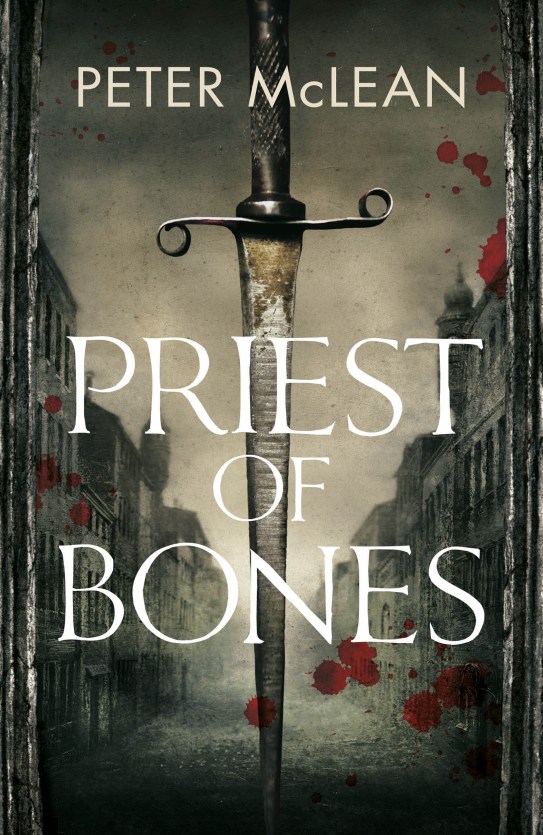
Priest of Bones by Peter McLean

Priest of Bones Cover.jpg

Publisher: Jo Fletcher Books

Publication Date – 2 October 2018

Amazon

For those looking for some down and dirty fantasy crime, look no further than Priest of Bones, the new release from fantasy author Peter McLean, which provides the reader with a dark, violent and downright entertaining story.

After achieving victory in a devastating war, thousands of soldiers begin the long and weary journey back home through a countryside ravished by war, plague and famine.  Among those soldiers returning to the industrial city of Ellinburg is Thomas Piety, priest of Our Lady of Eternal Sorrows and leader of a small and loyal band of killers.  Thomas has taken his duty as a soldier and a priest seriously, but now it is time for him to return to what he knows best: crime.

A successful crime lord before his conscription, Thomas believed he had left his territory in capable hands.  However, upon his return he discovers that his entire criminal empire has been taken over by a new gang that appears to have origins outside of Ellinburg.  With no choice but to reclaim what is his, Thomas and his soldiers, including his loyal sergeant, Bloody Anne, and his damaged brother, Jochan, do what they do best and go to war.

As Thomas and his gang, the Pious Men, reclaim territory and re-establish themselves in Ellinburg, they begin to realise that they are facing an opponent far more dangerous than the usual gangs and criminals of the city.  Their opponents are organised, have the best weapons money can buy and even have a couple of magic users.  To make matters worse, Thomas finds himself entrapped by one the deadly Queen’s Men, the feared order of spies and assassins loyal to queen, who have some special plans for the Pious Men.  Now, Thomas and his soldiers must embark on a dangerous and bloody crusade against the other gangs of Ellinburg.  Victory will mean control of the city’s crime, while defeat will spell doom for them all.

Priest of Bones is an excellent example of fantasy crime fiction done right as McLean has produced a story that is action-packed, incredibly intriguing and very enjoyable.  McLean has been writing fantasy for a few years and is probably best known for The Burned Man series, an urban fantasy crime series that focused on a magical hitman.  He also has a few short stories to his name, including some set in the Warhammer 40,000 universe.  Priest of Bones is the first book in his new War for the Rose Throne series, which will continue next year with the highly anticipated Priest of Lies.

The story contained within this first book is an amazing fantasy crime narrative which sees the protagonist work to reclaim his criminal holdings from a powerful new gang that has moved into the city while he was gone.  This starts out exactly as you would expect from this sort of story as the protagonists attempt to regain territory, one business at a time, while their opponents launch counterattacks and raids of their own.  The protagonists come up with some effective plans for taking territory and show what happens when a bunch of soldiers engage in some brutal urban combat.  There is a large amount of action throughout this book, which McLean records in bloody and enthralling detail.  This action mostly takes the form of small skirmishes and battles, although there are some magical battles which do result in some more gory and spectacular deaths.  All of this is incredibly fun, and it works very well with the intriguing side stories and character exploration to create a compelling overall narrative.  As the book progresses, an element of political intrigue takes hold as new players enter the game.  This represents an interesting but subtle change to the pace of the book and doesn’t result in any loss of action or excitement.  In many ways, it appears to be a setup for the next book in the series, which sounds like it’s going to have a much more political focus to it.  McLean wraps this all up with a memorable conclusion that I won’t elaborate on, but is the perfect ending for this outstanding and extremely enjoyable piece of fantasy crime.

The central gang that McLean looked at in the plot, the Pious Men, are a strong bunch of characters who serve as a fantastic focal point for this series.  All of the Pious Men are former soldiers who have recently survived the war and are still haunted by the horrors they experienced, especially at the devastating siege of Abingon.  Quite a few of the characters from this small band of soldiers are explored throughout the book, and while some of these characters only get minor mentions, a number do get expanded roles throughout the book and are shown to have some form of development or are slotted into a role that they make their own.  One of the most interesting features of this book is the way that McLean has focused on just how badly the war has messed up these characters, as pretty much all of them are suffering from PTSD in some way or another, referred to by the characters in the book as battle shock.  This is handled very well and allows for some fantastic scenes, as characters who initially come across as quite amiable for most of the book go berserk when attacked, while other characters who appear quite strong find themselves crippled by these memories.

The leader of this group of former soldiers turned criminals is Thomas Piety, who serves as the book’s main protagonist and only point-of-view character.  Thomas is a good central character to anchor this story, who for the most part comes across as a cold and calculating person who knows how to get what he wants.  As Priest of Bones continues, it is slowly revealed that there is a lot more to Thomas’s character than what is originally believed, as he is trying to hide not only the emotional damage from Abingon but the dark memories from his childhood that are still driving him to this day.  It is interesting to see Thomas try and reconcile his new role as a priest of Our Lady of Eternal Sorrows with his role as a soldier and crime lord.  It is also intriguing to see that one of his deeper motivations is based on his belief that his criminal enterprises not only will make his city a better place but may also save it from a similar fate to Abingon, something he is desperate to never see again.  As the story is completely shown through Thomas’s viewpoint, the reader gets the benefit of his cynical attitude as well as his humorous and accurate insights throughout the book.  This is a great focal character for this book, and I had fun exploring his full depths.

Quite a lot of time is also spent exploring the other members of the Pious Men that follow Thomas back from the war.  The best of these characters is easily Bloody Anne, the hard-as-nails sergeant who is Thomas’s most loyal soldier and friend.  There is detailed examination of Anne’s past which reveals a lot about her current character, including her distrust of magic users.  This turns into quite a nice side story, as Anne finally starts to overcome her past enough to start exploring a relationship with the prostitute Rosie.  Thomas’s brother, Jochan, is also an intriguing character who fits in well with this darker story.  Jochan is your standard unhinged killer, who has some of the funniest lines and can be found in the middle of all the big fight scenes.  His presence results in a lot of the book’s tension, as he and Thomas clash about everything.  McLean has also created a very traumatic backstory for Jochan that not only helps to humanise the character as the reader gets further into the book but also explains a lot about Thomas’s deeper motivation and the guilt he feels whenever he thinks of his brother.  Other great characters that the reader should keep an eye out for are the fake knight Sir Eland, the mysterious barmaid Ailsa and Billy the Boy, the Pious Men’s good luck charm who is clearly going to be a very important character throughout the rest of the series.

In Priest of Bones, Peter McLean has delivered a fast-paced and captivating piece of fantasy crime that is filled with a ton of graphic violence, a number of exhilarating fight scenes and some excellent character driven story work.  This new book is a wonderful introduction to the new War for the Rose Throne series, and I’m already looking forward to the follow-up book in 2019.  Clever, bloody and all sorts of fun, readers will have a blast checking this book out.

My Rating:

Four and a half stars

Amazon