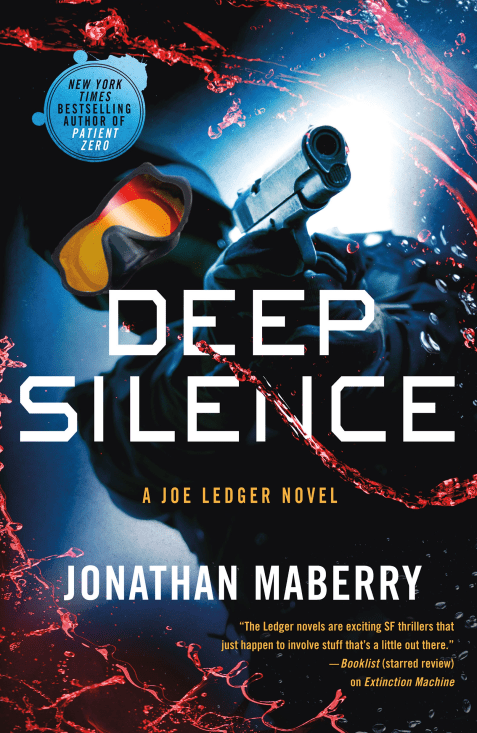
Deep Silence by Jonathan Maberry

Deep Silence Cover.png

Publishers: St. Martins Griffin

                        Macmillan Audio

Publication Date – 30 October 2018

Amazon     Book Depository

From horror legend Jonathan Maberry comes the 10th book in his weird-science based horror, thriller, science fiction Joe Ledger series, which takes the reader on a wild joyride through a world gone mad in this five-star adventure.

I have to admit that Maberry is not an author that I have had much experience with before.  The only work of his I have previously read was a fun short story that was featured in a volume of zombie short stories he jointly edited with George A. Romero in 2017 that I previously reviewed here.  However, I am extremely happy that I decided to check out this latest book as it exposed me to this incredible series, which I enjoyed immensely.  I can think of no greater praise for this novel then to say that upon finishing it, I immediately dropped everything and started reading the first book in the series, Patient Zero, which I will be reviewing in the next few weeks as part of my Throwback Thursday series.

I chose to listen to Deep Silence on audiobook rather than read a physical copy.  The audiobook format of this book is just under 16½ hours long and is narrated by Ray Porter, who has worked on several other books in the series.

In this latest book, a Russian splinter group have developed a powerful weapon with pieces of alien crystal seeded throughout the planet.  This new weapon can cause devastating earthquakes on a level never before seen and has the potential to destroy the entirety of the United States.  The weapon also has a chilling side effect: it causes people around the epicentre of the quake to engage in violent acts of madness, from suicide to ferocious attacks on others.  The first attack targets Washington, with mass violence erupting around the Capitol building.

America’s only hope may be the top-secret rapid response organisation, the Department of Military Sciences (DMS).  For years, the DMS has been the only line of defence against the insane science America’s enemies are utilising and developing in this new age of wonders.  From deadly diseases, ancient forbidden technologies, extreme acts of genetic manipulation, the latest forms of cyber and electronic attack, and even weaponised zombies, the DMS, led in the field by Captain Joe Ledger, has managed to stop all these threats and more.  Utilising the latest military and espionage equipment and the best and brightest soldiers and scientists America has to offer, the DMS operates just outside the government and can go further than any other agency can.

However, while the DMS attempts to combat this latest threat, they find themselves hindered by a megalomaniac President whose stupidity and paranoia make him more afraid of the DMS than the group unleashing earthquakes across his country.  As Joe and his team attempt to hunt down the origins of this attack they must contend not only with a dangerous Russian force but also with agents of their own Government and devices that can drive even the most dedicated DMS agent insane.  But as the Russians attempt to force the eruption of the Yellowstone caldera, the greatest threat may come from the creatures the technology was stolen from.

Deep Silence is the 10th book in Maberry’s Joe Ledger series, which started in 2009 with Patient Zero.  Maberry has been writing since 2006, with his debut book Ghost Road Blues forming the first book in the Pine Deep Trilogy.  Since then, Maberry has written a huge number of books, most of which have a horror theme or focus.  Apart from his Joe Ledger series, Maberry is probably best known for his Rot & Ruin series, a young adult zombie apocalypse series.  Aside from his fictional novels, Maberry has also written several comics for Marvel as well of a number of non-fiction books, which tend to focus on Maberry’s passions for martial arts and the supernatural.

Deep Silence is an exceptional book that combines together a number of genres, including science fiction, thriller, horror, military fiction and spy thrillers into one very captivating narrative.  The end result is a non-stop thrill ride that perfectly utilises the series’s bizarre nature and advanced science to create a devastating threat and a larger-than-life protagonist to face it.  There are so many amazing elements to this book, from its continuation of an enjoyable series, to the very weird elements that come into play, to the excellent writing style and enjoyable characters.  Once I started reading this book I just could not stop, and it is easily one of my favourite books of this year.

From what I understand, the Joe Ledger series started off mostly focusing on the mad sciences that humans are able to create and use against each other.  However, in recent books, the series has taken on a more Lovecraftian vibe, with unknown aliens, space demons and incredibly insane technology.  Deep Silence in particular seems to relate back to several of these previous alien technology based novels, as the devices, technology and motives that the book’s antagonists utilise are closely related to the adventures that occurred in previous books.  That being said, there is still the continuous use of more advanced human technologies utilised by many of the book’s characters, especially those working for the DMS.  All the crazy gadgets that they use are pretty impressive, but none (with one or two major exceptions) are outside the realm of possibility and reflect technologies that could potentially exist.  Indeed, in the introduction to Patient Zero, Maberry actually confirms that most of the technology he describes in his books is currently used or could soon be used by intelligence organisations around the world today.

One of the challenges of coming into a series late is the reader’s lack of knowledge about the universe’s background information, lore and the development of its main characters and the extent of their relationships.  Maberry does an incredible job bridging this gap throughout Deep Silence, providing the reader with descriptions of previous events, recaps of character descriptions and history and making use of a number of references to previous missions and adventures captured in the other books in the Joe Ledger series.  There are also a number of scenes that appeared to be callbacks to previous books, although the author was able to describe the pertinent details of these events.  As a result, I was never lost at any point and really appreciated the recaps and detailed descriptions the book’s various point-of-view characters provided throughout the novel.  It also made me very curious about some of the previous books in the franchise, and I am now very interested in checking out some of these insane and fun-sounding adventures.  As a result, Deep Silence is an excellent book if you want to get an idea of what the Joe Ledger series is all about.  At the same time, established fans of this long-running series will be interested to see the significant changes that occur to the book’s main characters, as well as the scenes detailing where the series will potentially be going in the future.

One of the things that I really enjoyed about Deep Silence was the way that Maberry presents the book’s narrative from multiple perspectives and across a range of different time periods.  Because of this, the reader is given a far wider view of the overall narrative.  Not only do they get to see the protagonists attempting to investigate and stop what is going on, but they get to see the antagonists coming up with their plans, discovering and researching their doomsday device over a period of years and then implementing their mission.  This also allows the reader to get a far deeper understanding of the antagonist’s objectives and mindscapes in committing these acts and what it costs them mentally and emotionally.  Nearly all the fun and eccentric characters working in the DMS get a few scenes told from their point of view.  This provides the reader with some high level, but easy to follow, scientific discussions, hacking sequences and the utilisation of incredibly exciting-sounding advanced espionage technology.  There is also a focus within Deep Silence of the politics around and behind the DMS, and how the organisation’s leader, the mysterious Mr Church (who is totally an alien, right?), deals with these situations.

While all of the other point-of-view characters are entertaining and it is intriguing to view their sides of the story, the best character has to be the series’s main protagonist, Joe Ledger.  Ledger is the extremely dangerous and slightly disturbed leader of the DMS field team, and has been at the forefront of all the adventures in this series.  It is interesting to note that Ledger is the only character in this book whose story is told from the first person perspective, which is fortunate because Ledger is one of the biggest smartasses in fiction, especially within the privacy of his head.  Nearly every single piece of the book told from Ledger’s point of view is filled with jokes, wisecracks, and exaggerated or sarcastic thoughts.  Ledger has some incredibly humorous observations about the world around him, especially the eccentric characters he encounters, and his thoughts are just as likely to be self-deprecating as they are to be insulting about the people he has to deal with.  He is also an eccentric being who does some incredibly funny things, from having fun with his opponents to humming the Mission Impossible theme as he breaks into a safe.  However, beneath this humorous exterior there is a deeply damaged character who is severely impacted by events that have occurred before and during this series.  Maberry spends significant time diving into this character’s history and psyche, which quickly gives the reader, even readers previously unfamiliar with the series, a good understanding of his life and the events that define him.  His deep and fractured mind becomes a key part of this story, especially when it encounters mind-altering alien crystal and events beyond the realm of human comprehension.  All of this helps create an amazing and incredibly relatable central character whom the reader becomes incredibly drawn to, and as a result, Ledger is one of the best things about this book.  Special mention should also be given to Ledger’s combat dog Ghost, who appears in nearly all the same scenes as Ledger and is just as much of an enjoyable character as his owner.

While the mad science elements and characters are great, Maberry has also ensured that this is the perfect book for those action junkies looking for fast-paced thrills.  Ledger is an absolute beast throughout this book and engages in a number of fantastic fights in a variety of different scenarios.  Maberry channels his love of martial arts through this character and includes a number of detailed and very quick fight scenes as Ledger dismantles his opponents with efficient skill.  The other characters are no slouches and there are number of great action sequences I enjoyed.  Two of my favourites have to be two separate and extended sequences which see Ledger and DMS’s Echo Team engage in massive fire fights with a range of opponents.  These scenes are absolutely incredible and make the reader feel like they are really in the middle of a gun battle.  The author takes pains to try and highlight how methodical and calm professional teams can be during battles while also highlighting the various strategies and combat advantages used.  The multiple perspectives come into play here perfectly, as the different members of Echo Team engage in various encounters around the main battle, really highlighting what an effective special ops team can accomplish in the field.  Maberry enhances the fun and the action to a crazy degree by also utilising the advanced technology available to the DMS agents.  This not only includes some insane and deadly weaponry, which is very cool in action, but also other pieces of advanced technology such as drones, body armour, goggles, and enhancements for Ghost that help turn the battles into massive and enjoyable set pieces.

Nothing, however, can top the sheer insanity that unfolds when the book’s antagonists unleash their super weapon against the world.  Maberry’s descriptive and skilled writing really brings these scenes to life.  The sheer devastation of the earthquakes that he describes is just incredible and very disturbing.  But nothing is more crazy or electrifying then the scenes where the people who are affected by the strange energy given off by the weapon go insane and start participating in a violent rampage against themselves or against each other.  Maberry pulls no punches here and all the violence is on full display, from terrible acts of violence against anyone around them to disturbing suicides or episodes of self-harm.  In many of these scenes the author attempts to get into the head of these characters and watch them slowly unfold from within.  This mostly prevalent with his protagonist, Joe Ledger, but other characters’ thoughts are shown.  Let’s just say you’ll never look at the Beatles song Revolution 9 the same again.  The biggest example of this insanity happens around the Capitol building in Washington DC, and quite frankly it reminded me of the church scene in Kingsman: The Secret Service, with the protagonists stuck in the middle of a crazy mob.

One of the more intriguing parts of Deep Silence is the side character of the President of the United States of America.  While this character is never explicitly named in the book, he is clearly supposed to be a Trump analogue.  The character is an easily manipulated, short-tempered, Twitter-obsessed moron who puts his own needs far above those of the country he is governing.  The resemblance to Trump is uncanny, and Maberry does an incredible job mirroring his arrogance and personality throughout the book.  While this character is a great addition by itself, Maberry spends a lot of time exploring how a character like this would deal with the advanced technology and extreme catastrophes that are a major part of this series.  The results are frustrating for the reader as they are forced to sit there and watch this character make all the wrong decisions and serve his own agenda or self-interest.  It was also very intriguing watching this President go up against the DMS as he routinely targets the department out of fear and ignorance.  The new political reality of Washington becomes a major factor throughout Deep Silence, and Maberry is understandably critical about how things are being run and the insanity currently gripping Washington.  It was very interesting to see Maberry incorporate the current unpredictable political reality of America into his new book, and readers will be very intrigued to see how this might impact the future of his long-running series.

I listened to the audiobook version of Deep Silence, narrated by Ray Porter.  The audiobook version does go for over 16 hours, so it’s one of the longer ones I have listened to lately.  That being said, due to its exceptional content, I found myself making a variety of excuses just to keep listening to this audiobook, and got through it very quickly.  The audiobook is an incredible way to experience this book, and I would highly recommend it, mainly because of Ray Porter’s narration.  Porter absolutely nails all of the characters and provides a number of amazing voices to fully capture the diverse accents and attitudes of this eccentric group of characters.  I was particularly enthralled with the calm, cool voice he gifted to the DMS Director, Mr Church, which really reminded me of Tom Hanks’s voice.  Special mention should also be given to his narration of the President.  The narrator created a fantastic Trump-like voice that fully conveyed the character’s high opinion of himself, as well as his dismissive and arrogant nature.  I actually had a visceral reaction when I heard that voice the first time, it was that good.  Porter’s narration for Joe Ledger was also perfect, as he does an incredible job portraying Ledger’s high-energy musings and the full tone of his personality.  Porter’s voice peaks and rises to meet the full intent of any of Ledger’s sentences, and he is a master at conveying Ledger’s innate sarcasm.  At the same time, he is also able to make his voice more serious and subdued during the darker scenes in which Ledger is deep within his head or his memories.  This is sterling work from Porter, and one of the best audiobook narrations I have ever listened to.  As a result, I highly recommend that the audiobook version of Deep Silence as the best way to experience this novel.

Bestselling author Jonathan Maberry once again takes his audience on a captivating thrill ride in the Joe Ledger Series.  Deep Silence provides the reader with an extraordinary and very engrossing story that proves extremely hard to put down.  Equally enjoyable for established fans of this long-running series and new readers who have yet to experience Maberry’s work, readers can and will have an incredible amount of fun with this book.  Best enjoyed in audiobook format, Deep Silence is guaranteed to make you a dedicated fan of the author and easily gets a five-star rating from me.

My Rating:

Five Stars

Amazon     Book Depository

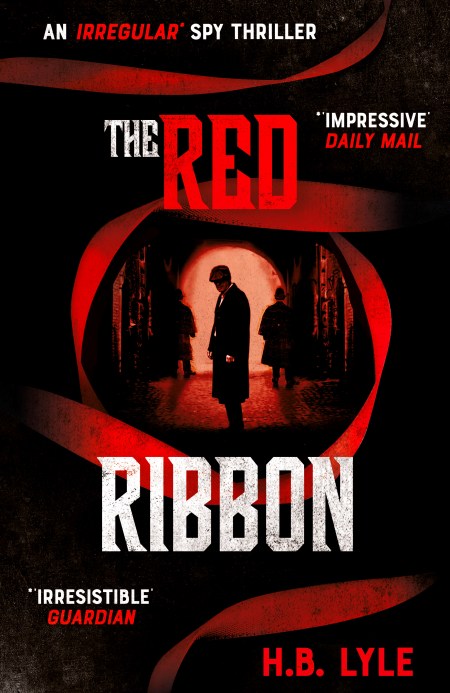
The Red Ribbon by H. B. Lyle

The Red Ribbon Cover.jpg

Publisher: Hodder & Stoughton

Publication Date – 23 August 2018

Amazon     Book Depository

Return to pre-World War I London for another compelling spy adventure in H. B. Lyle’s second book, The Red Ribbon, which is set in the same universe as Sherlock Holmes and features three exciting characters with an intriguing look at early 20th century British history and espionage.

In London, in 1910, Captain Vernon Kell is still attempting create a secret intelligence service capable of protecting England from foreign spies and infiltrators.  Despite the early success of the Secret Service Bureau, Kell’s organisation is constantly under pressure from the country’s politicians and is in danger of being absorbed into Special Branch of London’s police.

Unfortunately, Kell’s only agent, Wiggins, is distracted with his own cases and unwilling to play the political games needed to help the service survive.  Wiggins is the former leader of Sherlock Holmes’s street urchin surveillance organisation, the Baker Street Irregulars, and has picked up a few of his old master’s deductive tricks while retaining his lower-class charm and street smarts.  Wiggins is obsessed with finding the infamous anarchist, Peter the Painter, the man responsible for the death of one of Wiggins’s oldest friends, and is scouring the streets for him.

Looking for a missing girl on behalf of one of his contacts, Wiggins begins to investigate a mysterious embassy located in the affluent neighbourhood of Belgravia.  The embassy is actually a high-class brothel frequented by the rich and powerful of London.  When another girl associated with the embassy is found murdered, Wiggins attempts to find justice; however, the embassy is under the protection of someone Wiggins knows well: Tommy, a fellow former member of the Irregulars.

However, Wiggins’s personal investigations intersect with his work for Kell, as the two of them hunt for the source of a series of leaks at the highest level of government.  With the help of Kell’s wife, the suffragist Constance, Wiggins and Kell must find the connection between the events occurring around London in order to keep the country safe from sinister foreign influences.

The Red Ribbon is the follow-up to Lyle’s debut novel, The Irregular: A Different Class of Spy, and is the second book in the Irregular Spy Thriller series.  This is a great series that will appeal to a huge range of readers, as Lyle combines compelling historical fiction elements with a thrilling espionage story that has fictional links with one of the most iconic book series of all time, Sherlock Holmes.

The story within The Red Ribbon is split between the book’s three main protagonists and takes a look at each character’s different and exciting adventures.  Wiggins and Kell continue their missions from the first book, and while their investigations are ostensibly separate from each other, they eventually intersect in several clever ways.  The relationship between Wiggins and Kell is an important part of these two storylines, as Kell despairs of Wiggins’s personal investigations and wants Wiggins to solely work missions for the service.  The third focal character is Kell’s wife, Constance, who was a supporting character in the first book.  Constance becomes a much more significant character in The Red Ribbon, as the book focuses on her involvement with the suffragist and suffragette movements.  Both Wiggins and Kell become involved with Constance’s storyline in different capacities, while Constance provides significant assistance with her husband’s espionage work.  With three semi-connected stories, it does at times feel like there is too much going on for one cohesive narrative.  However, each of the stories comes together quite well in the end and provides the reader with an extremely captivating overarching narrative.

Having three separate storylines allows Lyle to highlight the differences in social classes during this historical period and highlights how different groups of people were treated.  Kell, as the influential gentleman, is forced to constantly deal with the upper-class politics and attitudes during his attempts to keep the service going.  Wiggins, who was raised on the street, deals more with the average Londoner and experiences the poverty and desperation many of them encounter.  He must also deal with the distain of the upper classes in the course of his espionage work.  While he is clearly the most competent agent in the entire British service, he is constantly looked down upon and ignored by his government superiors.  There are also several instances where Wiggins is assigned to infiltrate labour movements, something he is very reluctant to do due to his world views and background.  This divide often serves to create some significant tension with Kell, who, despite fully understanding Wiggins’s value, skills and point of view, is often exasperated by him.  The beefed-up storyline around Constance allows the reader a significant look at the suffragist movement and the early battles these women fought for equality.  In The Red Ribbon, Constance joins the much more militant suffragettes, and is constantly infuriated by the reactions of the male politicians and their oppressive policies.  The oppression of women also becomes a major point of conflict between Kell and Constance which results in a decline in their relationship, although the final payoff of this storyline is quite sweet.  I really enjoyed the way that Constance and Wiggins developed a fun comradery in this book, as their poor treatment by the upper-class men allow them to bond, with Wiggins even teaching Constance some anti-surveillance techniques.

Lyle cleverly incorporates several important historical events into this book, such as the funeral of Edward VII, the Black Friday suffragettes and suffragists protest outside Parliament and the Siege of Sidney Street.  These events are quite significant in their own right, and Lyle spends substantial time filling in their background and ensuring the reader is aware of why they are happening and why they are important.  However, they also serve as very compelling background events for the plot of The Red Ribbon and work well to enhance this already fascinating story.  In addition to these intriguing and important historical events, Lyle has also packed a number of historical figures into this story.  Quite a few prominent politicians and British civil servants have significant roles in the plot, including a young Winston Churchill, which makes the story feel a lot more authentic.  The author’s continued use of the enigmatic Peter the Painter as one of the book’s principal antagonists is another brilliant stroke, and the reader is provided with some intriguing theories about who he actually was and what his eventual fate was.  Lyle does slightly go overboard by adding in some other famous historical figures in small cameo roles, and the shoehorning in of people such as Charlie Chaplin and members of the 1910 British Antarctic Expedition seems a bit unnecessary.  That being said, it was amusing to watch Chaplin use his drunken tramp routine to help Wiggins escape a conflict in a theatre.

One of my favourite components of this book was the author’s detailed and unique look at British espionage and counter espionage in the early 20th century.  One of the book’s protagonists, Captain Kell, is an actual historical figure who is credited for creating Britain’s domestic spy service, which morphed into the modern MI5.  This fictionalised account of the early days of this organisation are quite fascinating, especially when the author looks at some of its early challenges, the political battles Kell might have had to face, and the sort of work this organisation was originally looking at.  In addition to the domestic espionage work, the protagonists of The Red Ribbon find themselves drawn into one of the most infamous espionage incidents of the era: the capture of British agents Captain Trench and Lieutenant Brandon in Germany in 1910.  This is a highly fictionalised account of the incident, as Lyle has inserted Kell and Mansfield Cummings, one of the founders of MI6, as being there.  It plays marvellously in Kell’s overall storyline, while also featuring some great scenes as the three protagonists’ attempt to evade arrest by the Germans.  Trench and Brandon are not portrayed in the best light, as Lyle has used them to further the class prejudices in Britain, portraying the two soldiers as quite incompetent spies who are captured as a result of wilfully ignoring Wiggins’s advice due to him not being a gentleman.

Another fun part of The Red Ribbon is the connection the book shares with the Sherlock Holmes novels.  The Irregular Spy Thriller series is set in the same universe as the Sherlock Holmes books.  Wiggins was mentioned several times in Arthur Conan Doyle’s original works as the leader of the Baker Street Irregulars.  As a result, Wiggins comes across as a rougher Sherlock Holmes, who uses the classic deductive method while also fighting, drinking and speaking in a lower-class manner.  As in the first book of this series, the great detective himself makes a brief appearance, providing Wiggins with a case-breaking suggestion, while casually enjoying his retirement.  The use of the Sherlock Holmes elements is definitely a defining element of the book, and while it is mostly used to draw interested readers into this historical spy thriller, Lyle successfully uses it to create a unique and enjoyable main protagonist.

B. Lyle has followed up his superb 2017 debut with another fun and exhilarating read. Continuing to use his Sherlock Holmes inspired character to great effect, Lyle weaves a full and captivating narrative that presents several unique stories chock full of adventure, mystery and interesting historical content. The Red Ribbon is an amazing second outing from Lyle which also sets up an exciting concept for a third book in the series.

My Rating:

Four and a half stars

Amazon     Book Depository

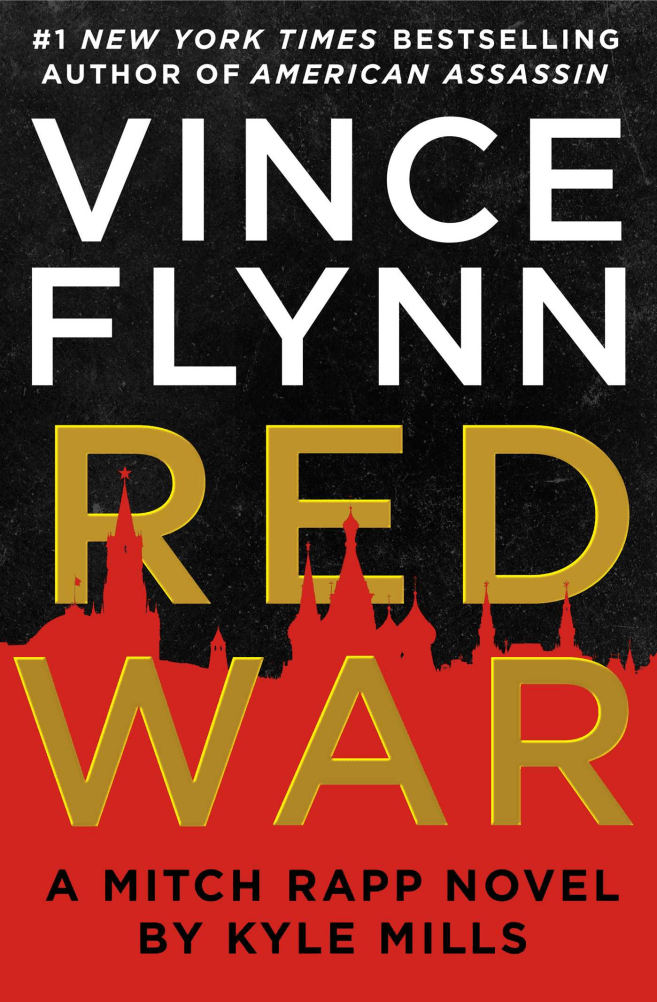
Red War by Kyle Mills (based on the series by Vince Flynn)

Red War Cover

Publisher: Simon & Schuster

Publication Date – 25 September 2018

Amazon     Book Depository

From the minds of two outstanding thriller writers comes Red War, the latest book in the iconic Mitch Rapp spy series.  This newest addition is an exhilarating and action-packed espionage novel that incorporates a captivating look at modern global politics into its exciting and enjoyable narrative.

For years, Russian president Maxim Krupin has ruled his country with an iron fist, and even recent setbacks to his ambitious plans in the Middle East have not lessened his power or influence.  However, Krupin is about to encounter an opponent even he may not be able to overcome: cancer.  With an inoperable brain tumour impacting his actions, the once calculating and selectively destructive strongman begins openly targeting all his enemies and opponents in order to retain his power and to distract attention away from his illness.

The Americans, especially the CIA, are alarmed and surprised by the Russian president’s sudden and unpredictable moves.  Uncertain of the motivations behind them, the CIA assign legendary covert operative Mitch Rapp to investigate and counter Krupin’s more aggressive moves, including the attempted assassination of Krupin’s former problem solver, Grisha Azarov.  When Rapp and the CIA uncover proof about Krupin’s medical condition, they begin to realise just how desperate and dangerous their opponent is.  With Russian troops massing on the border of Europe, it appears Krupin may even be willing to start a war with the West in order to maintain his position.  With World War III just around the corner, Rapp is given an impossible task: infiltrate Russia and assassinate the man many consider to be the most powerful person in the world.  Will Rapp and his allies succeed in this dangerous mission, or will their actions lead the world to the very brink of a nuclear war?

This is the 17th book in the Mitch Rapp series, which began in 1999 with the first book, Transfer of Power, which was written by Vince Flynn as a follow-up to his 1997 debut, Term Limit, which is set in the same universe as the Mitch Rapp books.  Following Flynn’s death in 2013, the series was continued by fellow thriller writer Kyle Mills, who has written 17 books since 1997, including the last three Mitch Rapp novels.  The Mitch Rapp books are a fast-paced and action-packed series that focuses on American espionage, and often features the titular character’s brutal war on Islamic terrorists.  Some who are unfamiliar with the books may have seen the film adaption of Flynn’s 2010 prequel novel, American Assassin, which was released in 2017, featuring Dylan O’Brien of Teen Wolf and The Maze Runner fame, as well as Batman himself, Michael Keaton.

In this latest book, Mills continues the series trend of providing the reader with eventful and compelling adventures.  Red War is chock full of action and combat as the protagonists attempt to counter the Russian president, the president’s personal assassin and the whole Russian army.  Readers will find plenty to keep them entertained, from small tactical skirmishes around the world between American and Russian covert forces, to large-scale battles and wars, with some devastating results.  While the main protagonist, Mitch Rapp, is starting to get a little old, he is still the same killing machine he has always been, and he powers through the vast majority of his opponents.  However, some of the other characters he encounters are the cream of the Russian army and have been enhanced by a combination of extreme training and performance-enhancing drugs.  This results in some very hectic shoot-outs and fight sequences, although there is very little doubt that Rapp will succeed.  A lot of these fights are tactical in nature as Rapp seeks to outsmart larger or more formidable forces he finds himself up against, resulting in some scenes with slower pacing that are used to create a more intense, but equally exciting, action sequence.  In addition, there are some fairly outrageous sequences throughout the book that readers will really enjoy.  For example, in a later part of the book Rapp suddenly finds himself leading an unusual army against his opponents, and a scene earlier in the book he decides to utilise a rocket-propelled grenade launcher in a fight after he starts “getting sick of these drugged-up, thirtysomething terminators whom Krupin was churning out”.

Mills has also made sure to include detailed examinations of the various intelligence-gathering and espionage techniques that his characters employ, as well as several scenes exploring the opposing nations planning and tactical sessions.  It is always fun to read about fictional tactical and intelligence meetings, especially in novels like Red War, when you see both these discussions from both sides of the conflict in order to focus on the various moves and countermoves each opposing side utilises.  In Red War, the motivation behind the Russian president’s actions is revealed to the reader within the first few pages of the book; however, all the American characters, and even some of the Russian characters, have no idea why he has escalated his campaign against his opponents.  It is very captivating to watch the various actions Krupin takes to not only stay in power, but also hide his illness from his own people.  As the book progresses and this becomes harder for him to manage, it is interesting to see the Americans begin to put the pieces together and see how well their theory fits into place.  Both the American and Russian characters do a lot of espionage and counterespionage moves throughout the novel as the Americans attempt to uncover the Russian leader’s unpredictable next move, while Krupin and his agents attempts to take out his various rivals while also frustrating the Americans.  The descriptions of these espionage moves and techniques feel very realistic, and there is enough going on to keep any lover of spy fiction very happy.

One of the most compelling and notable things about Red War is the way that it brushes on current politics and uses many recent real-world events in its story, by either referencing them or attributing them to the book’s fictional characters.  One of the main antagonists, the Russian president Krupin, is an athletic and powerful strongman that is clearly supposed to be a fictional version of Vladimir Putin, with several similar character attributes, including a propensity to use staged hunting propaganda shots out in the snow to promote his rugged, masculine image.  Many of Krupin’s actions and decisions throughout the book match those of Putin, down to the character revealing he utilises social media to influence international politics.  As a result, while the book focuses on a fictional antagonist, the reader is left thinking about what would happen if something similar were to happen to Putin or another world leader, and how other nations would respond.  The American and Russian characters discuss geopolitics throughout the book as they make their plots and plans, and many of the events they discuss have happened in the real world.  This allows the readers, especially those familiar with current world affairs, to enjoy a much more realistic read, especially when the characters look at real world events to justify their actions or responses.  These real-world inclusions help to turn Red War into a much more intriguing read for the readers that does an amazing job capturing its audience’s attention and interest.

Despite being the 17th book in the Mitch Rapp series, Red War is a very approachable book that is very easy for readers unfamiliar with the series to enjoy.  A perfect read for those who are intrigued by a fun and exciting plot concept, Red War delivers all the action and espionage you could possibly want, with some incredibly fascinating insights and references to modern global politics.  Mills has once again forged an incredible story from Vince Flynn’s original thriller universe, and fans of this series will not be disappointed by this latest offering.

My Rating:

Four and a half stars

Amazon     Book Depository

Star Wars: Darth Vader: Dark Lord of the Sith, Volume 2 – Legacy’s End

Darth Vader Legacy's End Cover.jpg

Publisher: Marvel Comics

Writer: Charles Soule

Artists: Giuseppe Camuncoli

               Daniele Orlandini

               David Curiel

Publication Date – 12 June 2018

Amazon

Darth Vader 7.jpg

Writer Charles Soule and artist Giuseppe Camuncoli return with an action-packed addition to the new and compelling series which follows the Dark Lord of the Sith in another sinister adventure in the newly formed Empire.

Legacy’s End is the second volume in the new Star Wars series, Darth Vader: Dark Lord of the Sith, which observes the shadowy journeys of fiction’s favourite villain immediately after he turned to the dark side of the force.  The first volume of this series, Imperial Machine, followed on directly after the events of the third prequel movie, Revenge of the Sith, and contained Vader’s initial mission for the Empire, acquiring the materials to forge his first red-bladed lightsabre.  It also featured the formation of the Emperor’s Inquisitors, the group of force users who, while not quite Sith, have fallen to the dark side of the force and are now being used to hunt down the remaining Jedi.

Darth Vader 8.jpg

Set immediately after the events of the first volume of this series, Legacy’s End continues to focus on Vader’s service to the Emperor and his multiple missions to obliterate all threats to the new Empire.  Vader has begun his training of the Emperor’s Inquisitors and is using his destructive teaching techniques to turn them into dangerous hunters.  Reviewing the list of Jedi whose destruction is a priority for the Emperor, Vader notes one name that stands out from the rest: Jocasta Nu, the former librarian of the Jedi Temple.  Despite her minor powers in the force, the Emperor views her as one of the most dangerous threats in the galaxy.  This is because Madam Jocasta has an unsurpassed knowledge of the hidden lessons of the force and the powerful secrets and weapons that the Jedi are protecting, which could be used by or against the Sith.

Teaming up with the Grand Inquisitor, Vader prepares to engage in the hunt for the elusive librarian.  There is just one problem: Jocasta Nu is already on Coruscant and has managed to infiltrate the Jedi Temple.  Perhaps the most important secret of the Jedi lies hidden in the archives, and Jocasta plans to ensure that the Sith will never have access to it.  But when Jocasta is discovered by Vader, the two force users must engage in a desperate fight, with the future of the Jedi in the balance.  While Vader has the pure power, Jocasta has plenty of tricks up her sleeve and her entire archive at her disposal.

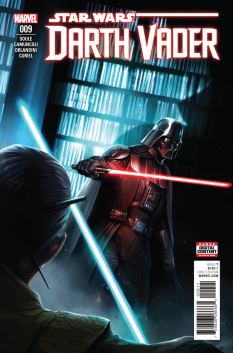
Darth Vader 9.jpg

In another adventure in this volume, Vader finds himself also being hunted by a mysterious foe.  Someone wants him dead, and the trail leads straight to the top of the Imperial Navy.  Who is trying to kill him, and how will Vader react when he finds the people responsible?

This is a fantastic second outing from the team of Soule and Camuncoli, who team up with new artists Orlandini and Curiel for Volume 2 of this fantastic series.  Soule is an experienced comic book writer, with significant work for both DC and Marvel under his belt, and is actually the man responsible for recently killing off Wolverine and Cyclops in two separate X-Men storylines.  Soule has also written several different Star Wars comics, including two limited series and the entire 31-issue run of Star Wars: Poe DameronLegacy’s End collects issues #7-#12 of the Darth Vader: Dark Lord of the Sith series, with a third collected edition currently set to be released in the next few days.

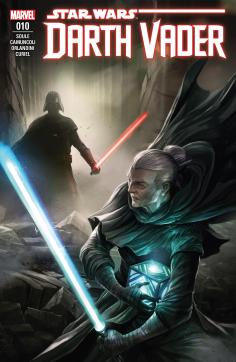
Darth Vader 10

This new Darth Vader series is an intriguing and entertaining series that takes place inside Disney’s new canon universe.  This book contains elements from the movies, while also being strongly associated with the Clone Wars and Star Wars Rebels animated shows.  As a result, it is a perfect series for dedicated fans of the Star Wars universe, although more casual fans of the movies will also enjoy this series, especially if the prospect of seeing Darth Vader kicking ass and taking names appeals to them.

This series primarily focuses on Vader and chronicles his early rise in power following his conversion to the dark side of the force.  Legacy’s End continues to examine his new role and position within the newly formed Empire.  Not only is he leading the fight against the remaining Jedi; he is also brutally training the Emperor’s Inquisitors and taking a commanding role in the imperial military complex.  Legacy’s End also does much to highlight Vader’s mindset in these days and to reveal the hateful creature that he has become.  For example, the first scene shows him chopping off the arms of several of the Inquisitors as a training exercise in order to teach them about loss, a lesson he claims they will never forget.  There are also several scenes where Vader is shown meditating, and the dark and twisted creature that appears as a representation of his inner self is an ugly and scary sight to behold.  The team behind this series do a fantastic job showing Vader’s sheer power and anger in several devastating battle sequences where he powers through his opponents with the maximum amount of brute force and zero concerns about collateral damage.  In these scenes his power is not limited to the destruction he causes with his lightsabre; it highlights the devastation he can unleash with the force and even with his fists.  For example, there is one memorable scene in which he punches a powerful droid to death when his lightsabre proves to be ineffective.  There are also several great interactions between Vader and the Emperor, and it is absolutely fascinating to see the twisted master-and-apprentice relationship that they have, especially as it is a major part of this series.  Overall, this volume continues to highlight Vader as a powerful badass, as well as showing him as a complex character, in order to create a powerful and addictive narrative.

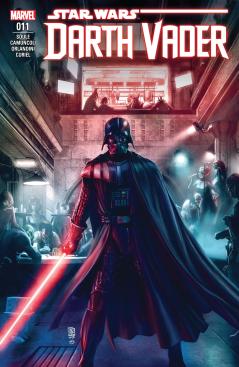
Darth Vader 11.jpg

This volume also contains some interesting connections to the rest of the Star Wars universe.  Not only are the early days of the Empire once again shown, but the series makes use of the Inquisitors, who were introduced in the Star Wars Rebel’s animated show as key antagonists.  It is great to see the formation of this group, as well as their early interactions with Vader, as none of this was really shown in the animated show.  However, the most intriguing part of this whole book was Jocasta Nu, the Jedi Temple’s librarian.  The character of Jocasta is fairly minor one that hasn’t been explored much before in the Star Wars canon.  She appeared briefly in the second prequel movie, Attack of the Clones, played by late Australian actress Alethea McGrath, and was a minor character in a few episodes of the Clone Wars animated show.  It is therefore very cool to see her in action in this series, and curious fans will be able to see what she is capable of for the first time.  The team behind this volume cleverly showcase her talents as a librarian and archivist rather than as a great Jedi warrior, and her methods of fighting against Vader are quite fun, involving several unusual Jedi weapons, such as a blaster powered by a lightsabre.  These scenes are pretty awesome, and interactions with Vader once she knowns he is Anakin Skywalker are very intense, especially when she realises that the terrifying figure hunting her was once one of her former comrades.  I also found the exchanges between Jocasta and the Grand Inquisitor to be quite intriguing, hinting at some more of the Grand Inquisitor’s past as a Jedi and Temple Guard, much of which has yet to be revealed in the extended Star Wars universe.

The overall story within this volume is fantastic and it is backed up with some spectacular artwork.  The second part of this volume, which focus on Vader being targeted by assassins is incredibly fun, especially the battle scene in which mercenaries who believed themselves capable of defeating a standard Jedi are completely overwhelmed by Vader’s insane battle tactics.  However, the main storyline with Jocasta is the most impressive part of the volume and contains some memorable scenes.  The conclusion of this storyline is the best part of the entire entry, and it will ensure all Star Wars fans will respect the courage of the Jedi librarian.

Darth Vader 12.jpg

Legacy’s Fall, the second volume of Darth Vader: Dark Lord of the Sith is an amazing continuation of this outstanding series.  Vader continues to shine as a sensational villain, and the creative team have done an excellent job showcasing this complex character as well as the sheer destruction and power that he possesses.  If you love to see the antics of a great villain, this is the series for you, as the early and most destructive battles of one of fiction’s most popular antagonists are shown here with some breathtaking artwork and fantastic storylines.  I have already ordered the third volume of this series and I cannot wait to see what happens next.

My Rating:

Five Stars

Amazon

If you enjoy Star Wars fiction, check out some of my previous reviews:

https://unseenlibrary.com/2018/08/12/star-wars-thrawn-alliances-by-timothy-zahn/

https://unseenlibrary.com/2018/05/30/star-wars-last-shot-by-daniel-jose-older/

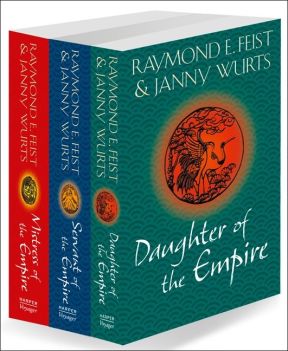
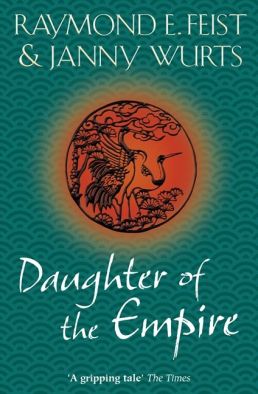
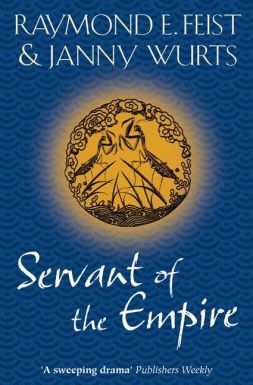
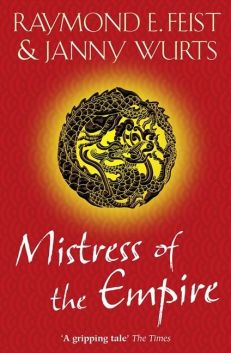
Throwback Thursday: The Empire Trilogy by Raymond E. Feist and Janny Wurts

The Empire Trilogy Cover.jpg

Publishers: Doubleday, HarperCollins

Publication Dates:

Daughter of the Empire – 1987    Amazon

Servant of the Empire – 1990       Amazon

Mistress of the Empire – 1992      Amazon

Collected Volume –                        Amazon

Reviewed as part of my Throwback Thursday series, where I republish old reviews, review books I have read before or review older books I have only just had a chance to read.

If you are a fan of Raymond E. Feist’s books, check out my review of his latest work, King of Asheshttps://unseenlibrary.com/2018/05/30/king-of-ashes-by-raymond-e-feist/

Set in the same universe as fantasy author Raymond E. Feist’s legendary Riftwar Cycle is The Empire Trilogy, which serves as a fantastic companion series to his main body of work.  This trilogy, made up of Daughter of the Empire, Servant of the Empire and Mistress of the Empire was written in collaboration with fellow fantasy author Janny Wurst and represents an intriguing piece of literature that shines not only as a side series to Feist’s first two books but also as a substantial and powerful standalone series.

I first came across this series during my school days, when I had to read Daughter of the Empire for a fantasy literature course (great book, terrible teacher).  I was already very familiar with Feist’s massive fantasy universe, having read all the other books available in the series at that point, though in a somewhat eclectic order.  I had not previously attempted to read The Empire Trilogy before this point, but I eagerly dived into Daughter of the Empire when I got my copy from the school library.  I was immediately entranced by the story and read it several times in that semester, especially during the more boring classes.  Upon completing the first book, I also sought out the second and third books in the series in order to see how the fantastic storylines continued.  In recent years, I was lucky enough to find audiobook copies of the entire trilogy, and have since re-listened to it several times.  These more recent perusals only confirmed my enjoyment of this series, as well as my love of Feist’s massive fantasy world.

The first book of The Empire Trilogy, Daughter of the Empire, was published in 1987, one year after the final book in The Riftwar Saga, the first trilogy in Feist’s massive Riftwar Cycle.  In many ways, Daughter of the Empire and the second book, Servant of the Empire, serve as accompaniments to Feist’s original series, as both plots are set at the same time and events that occur in Magician and Silverthorn have significant impacts within The Empire Trilogy.

Daughter of the Empire Cover.jpg

The Empire Trilogy follows Mara of the Acoma, a young woman who becomes the Ruling Lady of her house after the sudden death of her male relatives.  Through the course of this series, Mara must become a strong ruler to maintain the honour of her family and ensure the survival of all the people pledged to her house.  Mara must use all of her cunning to overcome powerful opponents while adapting new methods and viewpoints that are uncommon in her regimented culture in order to survive.

This series is set in the world of Kelewan, a vast planet inhabited by several strange alien species, and mainly focuses on the inhabitants of the massive Empire of Tsuranuanni.  The Tsurani were introduced in Feist’s first book, Magician, where they travel through a magical rift to the world of Midkemia and clash with the inhabitants of this new planet in an event known as the Rift War.  The Tsurani are a race of humans based on a combination of real world cultures, such as the Japanese, Koreans and the Aztecs.  For example, the overriding Tsurani ideal of honour, an exceedingly important concept in the books that strongly influences their culture and way of life, is very strongly based on feudal Japanese ideals of the samurai and bushido.  Kelewan is explored within Magician through the eyes of Feist’s main protagonist, Pug.  Midkemia is the main setting for the books in the Riftwar Cycle.  While Kelewan is visited in later books of the Riftwar Cycle, most notably in Silverthorn, it becomes a more underutilised setting as Feist’s overall series continues, before eventually being destroyed in Wrath of a Mad God.

Each of the books in this trilogy contains epic and captivating stories that not only highlight life in these alien planets but also show a tale of survival and victory against all odds as the protagonist, Mara, faces and overcomes the superior forces arrayed against her.  The first book in the trilogy is Daughter of the Empire, which introduces many of the series’ main characters and storylines.  The protagonist and main point-of-view character is Mara of the Acoma, who is dramatically pulled from her peaceful life as a novice priestess into the deadly and treacherous world of Tsurani politics.  Mara’s father and brother were killed during a battle on Midkemia because of treachery from the most powerful house in the Empire, the Minwanabi.  As a result, Mara is forced to take on the role of Ruling Lady to save her house from being destroyed and her retainers taken as slaves or forced to become honourless bandits.  With the vast majority of her soldiers killed in Midkemia, Mara must find creative ways to stop the Minwanabi and other rival houses from wiping her out.

Mara proves to be an effective leader, bending Tsurani traditions to her favour, recruiting talented followers and forming new alliances.  Her machinations result in a political marriage to a brutal husband whom Mara must endure until the moment is right to remove him.  Watching the protagonist rebuild her house through any means necessary is a fantastic focus of this book which really allows the reader to get a strong idea of Tsurani politics, ideals and culture, as well as Mara’s determination as the central protagonist.  The climax of the book is set within the Minwanabi stronghold, which Mara has been forced to visit in order to attend a celebration for the Warlord (the Tsurani equivalent of a feudal Japanese Shogun).  This final part of the book is filled with significant tension and fear, as everyone is well aware that the Minwanabi will murder Mara before she leaves the party.  Mara must find a way to use the Tsurani honour system to prevent her own assassination while also striking a blow against her opponent.  Daughter of the Empire is an exceptional introduction to this fantastic series, and is a spectacular novel in its own right.

Feist and Wurst followed up their first entry in this series with another sensational novel that doubles down on the action and intrigue and contains some of the best sequences in the entire series.  Servant of the Empire directly follows on from the events of the first book and sees Mara and her house still in great peril.  Mara may have overcome the previous ruling lord of the Minwanabi, but her enemies are still the most powerful house in the Empire.  While the new lord is nowhere near as competent as his father was, he has called up the family’s most devious and destructive member, Tasaio, the man who organised the death of Mara’s father and brother.  As the Minwanabi plot against the Acoma, Mara is distracted by her acquisition of a group of Midkemian slaves, especially the charismatic Kevin of Zūn.  As Mara and Kevin fall in love, the Acoma are drawn into a series of battles on many different fronts, but Kevin’s alien way of thinking offers Mara a distinct advantage.  But events completely outside Mara’s control may have the greatest impact on the future of her house.  Both the magician Pug and the chaotic event of the Riftwar bring significant change to the Empire, and Mara and her enemies must seek new ways to turn these events to their advantage.  While Mara’s relationship with Kevin provides her with strength, it also represents her greatest weakness.

Servant of the Empire Cover.jpg

There is a lot going on within this book, including a number of large-scale battle sequences, as well several scenes focusing on the Empire’s political intrigue.  The standout scenes for me have to be either the extended sequence in the arena which features a different point of view to the chaotic magic unleased by Pug in Magician, or the sequences where the biggest houses in the Empire stage a night-time battle of assassins in the halls of the Imperial Palace.  While this might be my favourite book in the series, I am not the biggest fan of the way the romance angle between Mara and Kevin is portrayed.  Kevin, however, is a fantastic addition for this book, and it is intriguing to have a character that has a similar viewpoint as the reader to observe and comment on Tsurani honour, politics and culture.

The third book in the series, Mistress of the Empire, is set some years after Servant of the Empire and sees Mara and the Acoma once again up against a superior enemy.  After their victories in the second book, the Acoma are now the most powerful house in the Empire, but Mara’s sins have come back to haunt her.  When the Hamoi Tong assassins initiate a devastating strike at the Acoma, the Assembly of Magicians forestalls Mara’s vengeance against the house she holds responsible.  The magicians, known throughout the Empire as “Great Ones” are determined to limit the Acoma’s influence, and Mara soon finds herself in a hidden war against the most destructive force in all of Kelewan.  At the same time, her former brother-in-law, Jiro of the Anasati, seeks retribution against Mara, while her loyal Spy Master Arakasi seeks to find a way to finally destroy the Hamoi Tong.  Travelling outside the Empire, Mara uncovers dark secrets about the Assembly, and her actions will have major impacts on the future of Tsurani life.

Mistress of the Empire is an excellent conclusion to this trilogy that not only provides a compelling story with exciting new additions but also neatly wraps up storylines from the previous two books.  While this book probably has the least connections to the events of Feist’s main series, it dives deeper into the history and hidden lore of Kelewan and the Empire, including the Assembly of Magicians, a sinister and powerful group in Feist’s universe.  Many of the main characters get satisfying endings to their storylines, and we get to see several chapters told from the point of view of the Spy Master Arakasi.  Arakasi is one of the series’ best characters; however, due to the nature of his work, the readers usually do not get to see him in action, instead only hearing second-hand accounts of his missions.  Readers get to enjoy scenes that focus on Arakasi’s investigations into both the Assembly of Magicians and the Hamoi Tong, which also serve to expand on Arakasi as a character.  Readers will also enjoy the fact that, after two books in which the antagonists need to keep up the appearance that they are obeying the Tsurani code of honour in their battles with the Acoma, Mara is now forced to go up against an opponent outside the typical laws and practices of the Empire.

One of the most interesting aspects of this series is how the authors have tied the books into the events of Feist’s original trilogy.  There are actually a few pre-emptive mentions of characters and events that become an important part The Empire Trilogy in Feist’s first book, Magician.  For example, the Shinzawai, a major house, whose members become key characters in The Empire Trilogy, are first introduced in this book as friends of Pug.  During Pug’s adventures in Kelewan, there is mention of a visit to the Lady of the Acoma, an event that subsequently occurs in Servant of the Empire.  The Minwanabi betrayal of the Acoma forces is also described to the Midkemian protagonists of Magician by a former Tsurani slave in an attempt to highlight the Tsurani system of honour and politics.  The first book in The Empire Trilogy, Daughter of the Empire is actually set in the time gap between the two halves of Magician, and takes a closer look at the impact that the Riftwar has had in Kelewan.

A more direct connection to the series is established in Servant of the Empire.  As mentioned above, long-running Riftwar Cycle protagonist, Pug, makes several appearances in this book, mirroring events that occur in second half of Magician.  Events that occur in Feist’s original trilogy have severe impacts on the plans of Mara and her enemies, such as the destruction of a huge number of Tsurani lords in the final battle of Magician and the death of the new Warlord in Silverthorn.  All of these become significant plot points in Servant of the Empire, and it is absolutely fascinating to see the impacts of events in other books.

Mistress of the Empire Cover.jpg

The most spectacular crossover event comes about halfway through Servant of the Empire, which shows some of the cataclysmic events from Magician from a whole new perspective.  In the second half of Magician, the powerful magician Pug unleashes his full fury on an arena full of Tsurani, sending wave after wave of magical attacks and disasters on the arena’s audience.  The scene is very intense when told from Pug’s point of view; however, readers of the second book in The Empire Trilogy are shown the absolute terror and destruction that a member of this crowd experienced during these events.  Mara, Kevin and a few Acoma retainers are present when the magical attack occurs and must flee through the panicking mob while also avoiding enemy assassins.  The sheer chaos and dread experienced by these characters and the surrounding crowd is astounding, and turns an incredible scene from Magician into one of the most intense and memorable sequences Feist has ever written.

Throughout the series, the Mara and her house are engaged in significant conflict with other factions in the Tsuranuanni Empire.  In the first two books, their opponents are primarily the most powerful house in the Empire, the Minwanabi, while the third book sees Mara in conflict with another influential house, as well as the Assembly of Magicians and the Hamoi Tong assassins.  As a result, the main focus of these books is usually the battles for supremacy between the Acoma and their opponents.  However, what sets these stories apart from other fantasy novels is the way that these battles are fought.  While an all-out war would probably ensure a quicker conclusion to this struggle, the Acoma and their enemies are forced to fight within their nation’s rules of conflict and honour.  As a result, the participants are forced to fight in a far more shadowy conflict.  While there are battles between armies, often with one side in disguise, the participants also fight using economics, espionage and politics.  Throughout the book, the protagonist makes alliances, build up her resources and use her influence to mould the politics of the realm to her advantage.  The reliance on honour is a fascinating part of this battle, and the reader will enjoy seeing the protagonist use this concept of honour to manipulate her opponents.  The real fun comes when the various participants are no longer bound by the rules and are able to unleash much more devastating and direct attacks on each other, such as the massive battle in the imperial palace that takes place in Servant of the Empire.  The battles for survival and control of the Tsuranuanni Empire represent an absolutely captivating and exciting part of this series, especially when the Acoma spymaster Arakasi gets involved.

Readers of The Empire Trilogy are also gifted with a deeper understanding and appreciation of the people, races and culture of Kelewan.  This world and some of its history was explored in Feist’s earlier books, including Magician, where an extended magical vision showed the reader key points in the planet’s history.  However, for those readers who wish to have a truly deep understanding of life in Kelewan, and the Tsuranuanni Empire in particular, the books in this trilogy are the best things to read.  Through the protagonist’s eyes the reader gets to explore the various pieces of land that make up the Empire, as well as the creatures that inhabit these lands.  Feist and Wurst also spend significant amount of time looking at the Cho’ja, the ant-like alien creatures who were first introduced in MagicianDaughter of the Empire takes a very interesting look at the Cho’ja, especially as an early part of the book focuses on the protagonist’s attempts to win a Cho’ja colony for her land.  In order to do this, she enters a hive and negotiates with a newly hatched queen in order to provide Mara with additional warriors and access to silk spinners.  In order to gain an edge on her competition, Mara attempts to understand the cultural differences between her race and the Cho’ja, and is able to come up with some intriguing conclusions as a result.  These initial and interesting observations of this race are then massively expanded upon in Mistress of the Empire when Mara, in an attempt to find out the secrets of the Assembly of Magicians, uncovers the true history of the Cho’ja and the ancient pacts they are bound to.  Readers will be absolutely fascinated by the lore of these creatures, and there are some great scenes featuring Cho’ja economy and their skills in battle.  In addition to the Cho’ja, Feist and Wurst also explore some of the human nations that exist in Kelewan, including the desert tribes of Dustari and the Thuril.  These explorations aren’t as detailed as the authors’ look at the Cho’ja and the Tsurani, but are intriguing in their own right, as the authors create some unique cultural features for them.

While the examination of the Cho’ja and the other human races of Tsurani is an intriguing and detailed part of the books in The Empire Trilogy, it pales in comparison to the massive amount of time spent exploring Kelewan’s main civilisation, the Tsuranuanni Empire.  The vast majority of the three books is spent within the Empire, with only a small portion of Mistress of the Empire spent outside.  Feist introduced a lot of the elements of the Tsurani in Magician, but this is expanded on substantially in this series.  Readers who read through these books will be left with an incredible amount of information about Tsurani politics, religion, culture, societal makeup and various other parts of day-to-day life in the Tsuranuanni Empire.  The use and examination of Tsurani politics at many different levels is an extremely compelling part of these books, and the various meetings and manipulations that occur represent a very enjoyable part of the book.  The concept of Tsurani honour is also explored in great detail.  Honour is a massive and defining part of Tsurani culture, and the various characters risk everything to maintain it.  Living or dying without honour is considered the worst thing imaginable as it will impact on the individual’s reincarnation in the next life.  The concept of honour is particularly skewed towards the Tsurani nobles, and it often takes an outside perspective, like that of Kevin, to identify how unfair the system is.  Mara becomes particularly adept at using this honour system to her own advantage.  While absolutely devoted to maintaining her family’s honour, her interactions with Kevin lead her to try and make some substantial changes in Tsurani society.  The books in the trilogy also reveal some deeper understandings about Tsurani history and the various secret organisations such as the Assembly of Magicians have been protecting.  While physically reading these books allows the reader to absorb a lot of this lore, I would also suggest that people check out the various audiobooks that have been produced, which can help listeners to absorb more of these amazing story elements.

I do have a few minor criticisms about this series, but nothing that is really going to change my high regard for it.  There are some unnecessary scenes where Mara is scolded and nagged by her nurse, Nacoya, who quickly becomes one of the series’ more annoying characters.  I felt that some of the scenes featuring Nacoya’s constant criticism took away from Mara’s image as a skilful and intelligent leader, and just made her seem like a foolish girl.  Luckily Nacoya is easily overshadowed by several of the other supporting characters, such as Keyoke, Arakasi and Lujan.  I also found parts of the relationship between Mara and Kevin in Servant of the Empire to be very frustrating, especially as they seemed to keep cycling through the same problems and issues.  Luckily, Kevin’s ‘barbarian’ insights and ideas more than make up for this, as he produces some excellent battle and political tactics throughout the book.  Overall, these are some fairly minor criticisms from me, and I really love all three of these books.

The Empire Trilogy from Raymond E. Feist and Janny Wurst is a spectacular fantasy series set in the same incredible universe as the Riftwar Cycle.  This trilogy of books is an amazing series in its own right; however, it’s real strength comes from it being a clever tie-in to Feist’s main series of books.  Featuring some incredible story elements, exceptional action-packed scenes and a detailed setting stuffed full of lore, The Empire Trilogy is some of these two talented authors’ best works, which still stand up to this day.  The series is required reading for anyone who has read Magician and other books in the Riftwar Cycle, but it also comes highly recommended for those readers looking for that next fantasy series to fall in love with.

My Rating (Series and Each Book):

Four and a half stars

City of Bastards by Andrew Shvarts

City of Bastards Cover

Publisher: Hyperion

Australian Publication Date – 31 July 2018

World Publication Date – 5 June 2018

Amazon     Book Depository

Young adult fantasy author Andrew Shvarts has a dramatic return with City of Bastards, an explosive and incredible follow-up to his electrifying 2017 debut.

After her father’s declaration of rebellion against the crown, Tilla, bastard daughter of Lord Kent, turned against him by rescuing the king’s daughter, Princess Lyriana, from his clutches.  Fleeing her father’s lands in the west of the Kingdom of Noveris, Tilla, Lyriana, and Tilla’s boyfriend, Zell, make the journey to the capital city of Lightspire, the opulent and magical city where Lyriana’s father reigns.

Attempting to put aside the horrors she experienced while fleeing from the west, Tilla settles down in a life of luxury as a student in the city’s prestigious university.  However, not everything is as shiny and golden as Tilla had hoped it would be.  She faces ostracism from the most of the city’s population as her father continues to wage war against the kingdom.  On top of that, Zell appears unsatisfied with city life and is growing distant from her.  Tilla and Lyriana are still mourning the death of Tilla’s brother, Jax, and not even their hard partying lifestyle is making them feel any better.

Their new lives are only destined to last for so long before disaster strikes.  When Tilla finds her roommate dead, she knows that a mysterious mage she encountered is behind the death.  But no-one seems willing to believe her, and the death is quickly ruled a suicide and pushed under the rug.  When she is then attacked by the rogue mage, something considered impossible, Tilla begins to realise that there is something very rotten in the heart of the Lightspire.  With her father apparently keeping the king’s invincible army of mages at bay, and shadowy cultists sowing chaos in the city, Tilla uncovers a terrible plot that could shake the entire foundation of the kingdom.  With the king’s inquisitor hunting her as a traitor and the whole word turned against her, can Tilla and her friends stop the evil unfolding in front of them before it’s too late?

City of Bastards is Shvarts’s second book, and is the sequel to last year’s release, Royal Bastards.  This is a fantastic new series of young adult fantasy books, with a third entry already planned for 2019.  These books are marketed towards a young adult audience, but this is a series that will also prove to be massively appealing to older readers as well.  Fair warning to parents: this is probably not the best series for younger readers, as the huge amounts of drugs, drinking, sex and teen angst make this books more appropriate for an mid to older teenage audience.

This novel contains a truly captivating story of intrigue and murder in the heart of a magnificent and magical city.  Shvarts combines some excellent thriller and fantasy elements together to create a superb overall narrative, which includes a large-scale conspiracy that proves to be particularly impressive.  There is a well-written and absorbing investigation angle getting towards the conclusion of this plot, and the full scope of this conspiracy is very elaborate and uses some intriguing magical elements.  There are a number of surprising twists, betrayals and dramatic reveals that will hook the readers, while the conclusion of the story is epic in its size and consequences.  Overall, this is an extremely compelling fantasy thriller story that has not been simplified for a younger audience.

Shvarts has also created an intricate and intriguing cityscape that serves as an excellent setting for the story.  There are some memorable locations visited throughout the course of the narrative, and the author does a fantastic job showing the differences between the richer areas of the Lightspire and the districts where the everyday citizens live.  Exploration through the city by the protagonist highlights this class difference and the corruption of the rich, all of which forms a significant story element later in the book.  The author also introduces some fascinating fantasy elements, such as large-scale magical messages, unique methods of transportation, rebellious anti-magic fanatics, the kingdom’s hidden magical heart and substantial catacombs under the city that hold dark and powerful secrets.  All of these elements play a significant role in City of Bastards’ story, and meld in perfectly with the protagonist’s investigation and the vast underlying conspiracy.

The entirety of City of Bastards is narrated by the book’s protagonist, Tilla.  Shvarts does an amazing job of capturing the essence of a modern teenager in the book’s narration, and the reader really feels that they are accompanying a rebellious young woman on her quest throughout the city.  As a result, the book is filled with sarcasm, funny jokes, humorous observations and a certain amount of complaining about the situation.  The story is also infected with a bit of teen angst, which is amusing to see amongst storylines dealing with the future of a civilisation and will no doubt prove to be relatable to many readers.  In addition to the humour, this narration also allows the reader to see the protagonist’s many vulnerabilities throughout the course of the story.  Overall, the protagonist’s narration adds a lot to this book, and is definitely one of its more appealing features.

A highlight of the book has to be the realistic focus on trauma and the powerful consequences of the first book.  Some of the very best young adult books are those which do not shy away from heavy topics, featuring gritty and realistic portrayals of trauma and PTSD as they try to highlight the often unseen or unconsidered costs of their character’s attempted heroism or battles for survival.  In City of Bastards, Tilla, Lyriana and Zell spend a significant amount of time dealing with the terrible things the encountered in the first book, including the death of Jax, Tilla’s brother and Lyriana’s love interest.  Lyriana’s transformation is the most dramatic, as is she suffering not only from Jax’s loss but also from the guilt and trauma following her decision to break her oath of pacifism and kill someone with her magic.  As a result, she turns from the sensible and respectful character she was in Royal Bastards to a hard-drinking wreck who acts out in a number of different ways and has a hard time dealing with her feelings.  Tilla is also traumatised by the death of Jax, and while at times she seems to be processing it better, her depression is compounded by the dramatic changes in her life and the outright disdain that many characters show her.  Overall, this realistic portrayal of trauma and vulnerability in the characters is very well written and adds a real emotional edge to the story.

City of Bastards is an amazing piece of young adult fantasy that makes substantial use of its new setting to create an epic, conspiracy-laden storyline that proves to be exceedingly captivating.  This is a powerful sequel to Andrew Shvarts’s first book, and fans of Royal Bastards will be entranced by the author’s focus on the first book’s devastating consequences.  This is one of the best pieces of young adult fiction of 2018.  I had a real hard time putting this book down, and it comes highly recommend.

My Rating:

Four and a half stars

Amazon     Book Depository

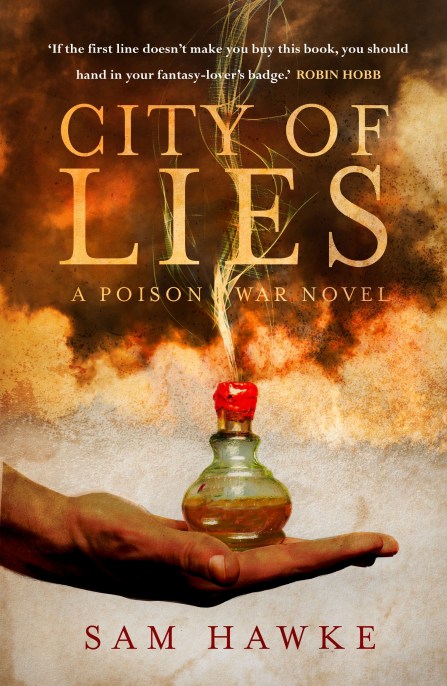
City of Lies by Sam Hawke

City of Lies Cover.jpg

Publisher: Bantam Press

Publication Date – 3 July 2018

Amazon     Book Depository

Poison, murder, conspiracy, and war are all on the way for readers of City of Lies, one of the best fantasy reads of the year from Canberra author Sam Hawke.

In the country of Sjona, the capital city of Silasta is a glittering beacon of culture and art.  Young nobleman Jovan and his family serve a special role, subtly protecting Sjona’s ruler, the Chancellor, and his heirs from being poisoned.  As a result of his training, Jovan is now capable of detecting and identifying poisons that could be slipped to his charges.  While his uncle and mentor directly protects the Chancellor, Jovan serves the Chancellor’s carefree young heir, Tain.

When Jovan and Tain return to the city following a diplomatic journey, they are soon placed in a terrible situation.  The impossible has happened: an unidentified poison has been slipped to the Chancellor, killing him and Jovan’s uncle.  Without their respective mentors’ guidance both young men are thrust into new roles: Tain as an untested Chancellor, and Jovan now responsible for the safety of his nation’s ruler.

However, things can always get worse.  A mysterious army has arrived undetected at the gates of Silasta, and the city, which has never known anything but peace, is soon besieged.  The army appears to be made up of Sjona’s peasants and contains powerful individuals in control of spirits.  With the majority of the military far away fighting in another conflict, few professional soldiers are left to defend Silasta, and Tain must lead a desperate defence against a superior force.

As the siege continues, it soon becomes apparent that not everything is as it seems.  Why is the city being attacked, and how did no one see this coming?  A deep conspiracy lies across the capital and no one can be trusted, not even Silasta’s ruling council.  It also appears that the person who killed the Chancellor is still at large within the city and is aiming to poison Tain as well.  As Jovan utilises all his skill to protect his friend, his sister Kalina searches for the traitors hiding inside their walls.

City of Lies is Australian author Sam Hawke’s debut novel and represents an outstanding first outing from a remarkable new talent.  This ambitious book contains a fantastic plot, with some unique story elements and an elaborate thriller narrative that combines perfectly with the book’s overarching fantasy narrative.  This is the first book in Hawke’s planned Poison War series, and is focused on two separate point-of-view characters, Jovan and Kalina, who each narrate around half the book.

This book contains an amazing and extremely compelling overarching thriller narrative that sees the protagonist attempt to unravel the conspiracies surrounding their city.  Hawke has put a lot of work into creating an elaborate and multilayered plot that draws the reader in with its significant intrigue.  The is so much for the reader to discover as the protagonists try to work out who the army attacking them is, what their motives are, and how the siege relates to the secrets of the ruling class.  This intrigue-driven storyline is amped up even more once it is revealed that the person who poisoned the chancellor might not be a member of the army camped outside the city.  Hawke presents the reader with a number of likely suspects, most of whom are on the city’s ruling council, as well as a range of interesting and plausible motives for the betrayal.  The full extent of the interwoven conspiracies is quite impressive, and Hawke presents an extremely captivating storyline of the protagonists unravelling the plot that is guaranteed to pull in the reader’s full attention.  This is definitely a high point of this fantastic book.

One of City of Lies’ standout features is Hawke’s substantial focus on poisons and role the main character plays in protecting the city’s ruler from harmful substances.  At the start of the story, the Chancellor and the protagonists’ uncle are both poisoned and killed by an unknown toxin.  Jovan, who already served Tain as his ‘proofer’, a combination food taster, poison master, and trusted personal chef, spends the rest of the book trying to defend Tain from a poisoner he knows is out there, who apparently has access to a poison he has no idea how to detect or cure.  The battle of wits between Jovan and the poisoner is an intense part of the book’s narrative, and the reader can feel the desperation that Jovan feels trying to keep his friend and, by extension, his city alive.  There are some great scenes throughout this book as Jovan attempts to work out how poison could be administered to Tain, as well as trying to work out potential cures and solutions to the poison’s victims.

In addition to examining the tension that the book’s poison elements elicit, Hawke also spends a significant amount of time exploring the various toxins of her universe and the techniques of the book’s poison ‘proofers’.  The descriptions of these skills in training is utterly fascinating, and the author has come up with some amazing ideas that prove to be enthralling for the reader.  In addition, Hawke has chosen to deepen the audience’s interest and knowledge of her universe’s poisons by including a page of the protagonist’s ‘proofer tome’ before each chapter in the book.  These pages contain a description of the poison, what effects it has when administrated and what clues the proofer can use to identify the poison in food, such as taste or texture.  This is a fun addition that also contains some information relevant to the book’s plot, and the readers will find themselves deeply exploring the lore being presented to them.  Another cool feature was the way in which Jovan uses his knowledge and cache of poisons in an offensive manner against his opponents to compensate for his lack of martial skill.  There are some fantastic scenes where Jovan uses a range of different substances in the middle of battles, as well as some excellent sequences where he doses potential opponents in advance of a confrontation.

Special mention should also be given to the wonderful fantasy setting that Hawke has created for City of Lies.  The vast majority of the plot is set within the capital of Silasta, a large city that has a reputation and preference for culture and the arts, whilst viewing violence and warfare as a distasteful profession.  The author does an amazing job describing this city’s many wonders, whilst at the same time creating a unique societal setup that plays brilliantly into the story’s intriguing elements.  While the focus of this book is solely within the nation of Sjona, expect the sequels to follow adventures in other countries mentioned.

The siege elements of this book are also very enjoyable and offer another interesting point to this fantastic book.  I’m always a fan of a good siege storyline, especially when it’s told from the point of view of the defenders.  The parts of the book that focus on the siege are extremely well written and provide the book with some substantial action sequences.  It is also fun to see how a city mostly made up of peace-loving artists and performers can defend itself without an army to help.  Hawke produces some great ideas for her defenders, which also ties into the fantastic poison elements above, when the protagonists use their knowledge to create some defences for their city.

Overall, City of Lies is an intrigue-studded masterpiece of a fantasy novel that combines together a range or magnificent story elements with an excellent setting and an addictive overarching thriller narrative.  Hawke’s use of poisons as a key plot point is just incredible and represents one of the most interesting parts of this book, and I am intrigued to see how she will continue to use poisons in future entries in this series.  This is a five-star debut from Hawke, and I would wholeheartedly recommend City of Lies to any fans of the fantasy genre.

My Rating:

Five Stars

Amazon     Book Depository

Deep Blue by Jane O’Reilly

Deep Blue Cover

Publisher: Piatkus

Publication date – 31 July 2018

Amazon     Book Depository

Following on from her 2017 release, Blue Shift, Jane O’Reilly returns to her electrifying science fiction universe for another exciting and action-packed adventure among the stars.

In the distant future of 2207, Earth is dying and humanity’s only hope for survival is a brand new planet on the other side of the galaxy.  Travel to this new sanctuary requires passage through the territory of several alien species who are unwilling to let a ragged human fleet anywhere near their areas of space.  In order to convince these aliens to allow humans access to a new planet, the government has initiated the Second Species programme to create the only resource the aliens want: human slaves genetically altered with alien DNA.

Former bounty hunter Jinnifer Blue, after failing to reveal the terrible truth about the Second Species programme, has been captured by its creator, her mother, Ferona Blue.  Now genetically altered with alien strength and pissed beyond all belief, Jinnifer escapes from the lab where she was held.  Having given up on warning humanity about the government’s sinister plans, Jinnifer’s only desire is to be reunited with her lover, the pirate Caspian Dax.

But Dax was also captured by Ferona and is now serving a brutal alien race as a mindless gladiator on the planet of Sittan.  Jinnifer has no choice but to travel to Sittan and attempt to rescue Dax, while at the same time organising the rescue of another friend, Eve, who has been captured by another dangerous alien species.  Gathering together allies and an old enemy into a ragtag team, Jinnifer initiates two desperate rescue missions to save her friends.  Can Jinnifer succeed, or has Dax fallen too far under the sway of the dangerous Sittan empress?

Deep Blue is the second book in the Second Species trilogy and a brilliant sequel to O’Reilly’s first science fiction book, Blue Shift.  This is a fun and fast-paced action series that makes use of an inventive and dangerous universe filled with unique aliens and desperate humans.  Deep Blue has a very busy plot told from a variety of viewpoints that are combined together in a clever fashion to create one thrilling narrative.  Each of the various exciting storylines also contain some flawed and damaged characters, most of whom are seeking some form of redemption.

Just like in Blue Shift, I found that the parts of the book that I enjoyed the most were the chapters that followed the machinations of the book’s central antagonist Ferona Blue.  Her despicable political manipulation on Earth was a highlight of the first book, and this continues to be the case in Deep Blue.  The added focus on Ferona’s negotiations with alien politicians, including the book’s other main antagonist, the Sittan empress, is a brief but fun addition to this equation.  Deep Blue’s other storylines are also very fascinating and contain some great sequences, including having four storylines featuring rescue missions and alien captivity running simultaneously within the book.

Readers who enjoyed the first book of the Second Species trilogy will also enjoy the significant development that the central character, Jinnifer, has undergone since the start of Blue Shift.  The character has evolved from an uncaring loner to the leader of her own small crew who harbours deep concerns for her friend’s wellbeing.  There is also a shift in the character dynamics between Jinnifer and Dax that is quite noticeable.  In the first book, Jinnifer was constantly being rescued by Dax, who ended up sacrificing everything to save her.  This is reversed in Deep Blue, as Dax is the one who is trapped and Jinnifer is the one attempting to save him by undertaking a dangerous rescue mission.  It is a fun change to the established character dynamic and readers of Blue Shift will appreciate the interesting change of pace O’Reilly takes in this second book.

O’Reilly has also created an excellent original universe to serve as the setting for her series.  There are a ton of intriguing science fiction elements, including an interesting prediction for the future of Earth and humanity and a number of unique alien species.  In Deep Blue, O’Reilly goes into greater detail of two of her alien races, the Sittan and the Shi Fai.  There is some exploration of both races’ history, culture, technology and way of life, as well as a visit to both home planets.  While there is a larger focus on the Sittan and their militaristic, female-dominated society, including using the Sittan empress as one of the book’s main antagonists, the scenes on the Shi Fai home planet are certainly memorable and more disturbing.  Other science fiction elements that readers are bound to find entertaining within Deep Blue include O’Reilly’s look at intergalactic politics, Earth’s political manipulation with advanced technology and the inclusion of human-alien hybrids.

This is a fairly action-packed book with some great combat sequences infused into the story to excite the readers.  The main character spends significant parts of the book utilising the swords she has implanted within her arms to great effect, and O’Reilly ensures that her two main characters spend significant time in gladiator-style death fights.  The author also is not too attached to some of her characters, so prepare for a few shocks and surprises.

O’Reilly once again sends the reader on an imaginative science fiction adventure through a dark and dangerous universe.  Deep Blue is a deeply fun and action-orientated story that will appeal to a wide audience and have readers hanging out for the final book in this exciting trilogy.

My Rating:

Four stars

Amazon     Book Depository

Deceit by Richard Evans

Deceit Cover

Publisher: Impact Press

Publication date – 18 June 2018

Amazon     Book Depository

From former politician Richard Evans comes one of the most incredible fictional examinations of the Australian political system with Deceit, an exciting and superb political thriller.

When corrupt Australian Prime Minster Andrew Gerrard makes a deal with his Indonesian counterpart, he embarks on a plan to build up a retirement nest egg by passing a controversial funding bill for overseas detention centres over a period of several years.  However, when key members of his party die in a tragic plane accident, Gerrard decides to process all of the funding in one go and receive the full amount of his payoff.

Outnumbered in the House of Representatives, and with only one week to pass the bill through both houses of parliament, the task looks impossible.  But the Prime Minister is a canny political operator with no conscience to speak of and with the Speaker deep in his pocket and with no conscience to speak off.  Equipped with a master plan, Gerrard starts to manipulate the bill through parliament.

The only person who may be able to stop him is the outgoing Clerk of the House of Representatives, Gordon O’Brien, who suspects that the Prime Minister’s mysterious last-minute bill is more sinister than it appears.  As one of the few people who believe in the sanctity of the parliament, O’Brien will risk everything to find out the truth and ensure no wrongdoing is done on his watch.  Utilising all the tools at his disposal, including the opposition and investigative journalist Anita Devlin, O’Brien prepares to move against the Prime Minister.  Let the political games begin!

Evans is a former Australian politician who served two terms as a federal member of parliament in the 1990s.  Evans has decided to utilise his political experience and expertise by creating a series of Australian politics based thrillers and dramas, with several books planned for release in 2019 and 2020.  Deceit is his debut novel and the first book of his planned Democracy trilogy, with the second book in this series, Duplicity, already set to be released in 2019.  Readers interested in fictional depictions of Australian politics should also keep an eye out for his upcoming Referendum and Jack Hudson series, both of which will start to be published in the next two years.

Deceit is a fabulous political thriller with a fantastic story that twists and turns through multiple layers of manipulation, deceptions, lies and double-crosses.  The book’s main antagonist, Australian Prime Minister Andrew Gerrard is a selfish, manipulative and sleazy character who serves as a perfect villain for this story and whose plots are a highlight of this book.  Evans has done a clever job of spreading the story out among multiple point-of-view characters, as this allows the reader to view the impact of Gerrard’s manoeuvrings and lets them see how they are received by members of the opposition, the media and O’Brien.  Evans is a very talented storywriter, and the entire plot of Deceit is extremely compelling and very well thought out.  Readers will fall in love with this amazing story and will find its overall conclusion very satisfying.

As someone who lives and works in the book’s main setting, Australia’s capital city, Canberra, I have received a lot of exposure to Australian politics.  As a result, I loved the author’s exceedingly realistic and accurate depictions of the Australian political system and how it was used within this story.  There is some great coverage of Australia’s parliamentary procedure and the creation and passage of bills and laws through both houses of parliament that are presented in a precise and well-described way.  There are also a number of characters who hold roles that are actually part of Australia’s political and civil service.  These positions and roles are explored in detail, and the reader is given significant insights into what work and requirements are needed by the people holding them.  Evan’s does a fantastic job of weaving these usually dry subjects into a very enthralling narrative, and readers will be intrigued to see how the fictional Prime Minister plans to get a dodgy bill past the entire country without anyone noticing what he is doing.

The standout scene of the book has to be an extended chapter that featured a session of question time in the House of Representatives.  Question time is a daily occurrence during the parliamentary sitting period during which government and non-government members of parliament ask ministers questions about their various portfolios.  As someone who has been exposed to many question times, I was struck by how genuine Evans’s description of this event was.  Evans perfectly encapsulates the entire process from start to finish and was able to recreate the snarky and sometimes petulant nature of the discourse that are the usual fare of question time.  The author expertly links the overarching storyline of political corruption into this scene, as one member of the opposition is suspicious and starts to ask the Prime Minister leading questions about the controversial bill he has put forward.  The political back-and-forth around these questions was amazing, and it was fascinating watching them being tied into the rest of the story.  Overall, this sequence was exceedingly compelling, and the entire time I was reading it I was physically incapable of putting the book down.

Deceit also contains some detailed and enjoyable depictions of Australia’s Parliament House and the capital city, Canberra.  Parliament House is a beautiful building, and Evans does a wonderful job describing Parliament House in detail and examining various parts of the building, from the Prime Minister’s office and courtyard, to the various gardens, media offices and even cafes.  Other little nuances of life within Parliament House are also captured within the text, no doubt because of Evans’s prior experiences working within the building.

I also really enjoyed seeing my home city of Canberra featured in this book.  Despite being the capital city, Canberra does not feature much in fiction, due to it being a smaller and newer city than Sydney or Melbourne.  Deceit, however, contains some great depictions of the areas of Canberra close to Parliament House.  There are several references to some real restaurants and cafes that politicians are known to frequent and where several big political discussions are known to have taken place.  There are also several scenes where the characters explore other parts of Canberra as part of the book’s plot.  I for one found it incredibly amusing and disconcerting to read a scene about a secretive handoff of documents set in a cinema that I’ve watched The Hunger Games and Doctor Who specials in.  Canberra locals will love seeing their city as a major fixture of this book, and other readers will get to explore Australia’s capital and see its potential as a setting in this exciting thriller.

Richard Evans’ first book, Deceit, is a five-star thriller that brings the Australian political process to life.  Former politician Evans brings all of his insight and expertise to this new book, and readers will be astounded by the realistic descriptions of Australian politics and the way it has been utilised in this exciting and first-rate story.  This is an outstanding debut from Evans, and this terrific read comes highly recommended.

My Rating:

Five Stars

Amazon     Book Depository