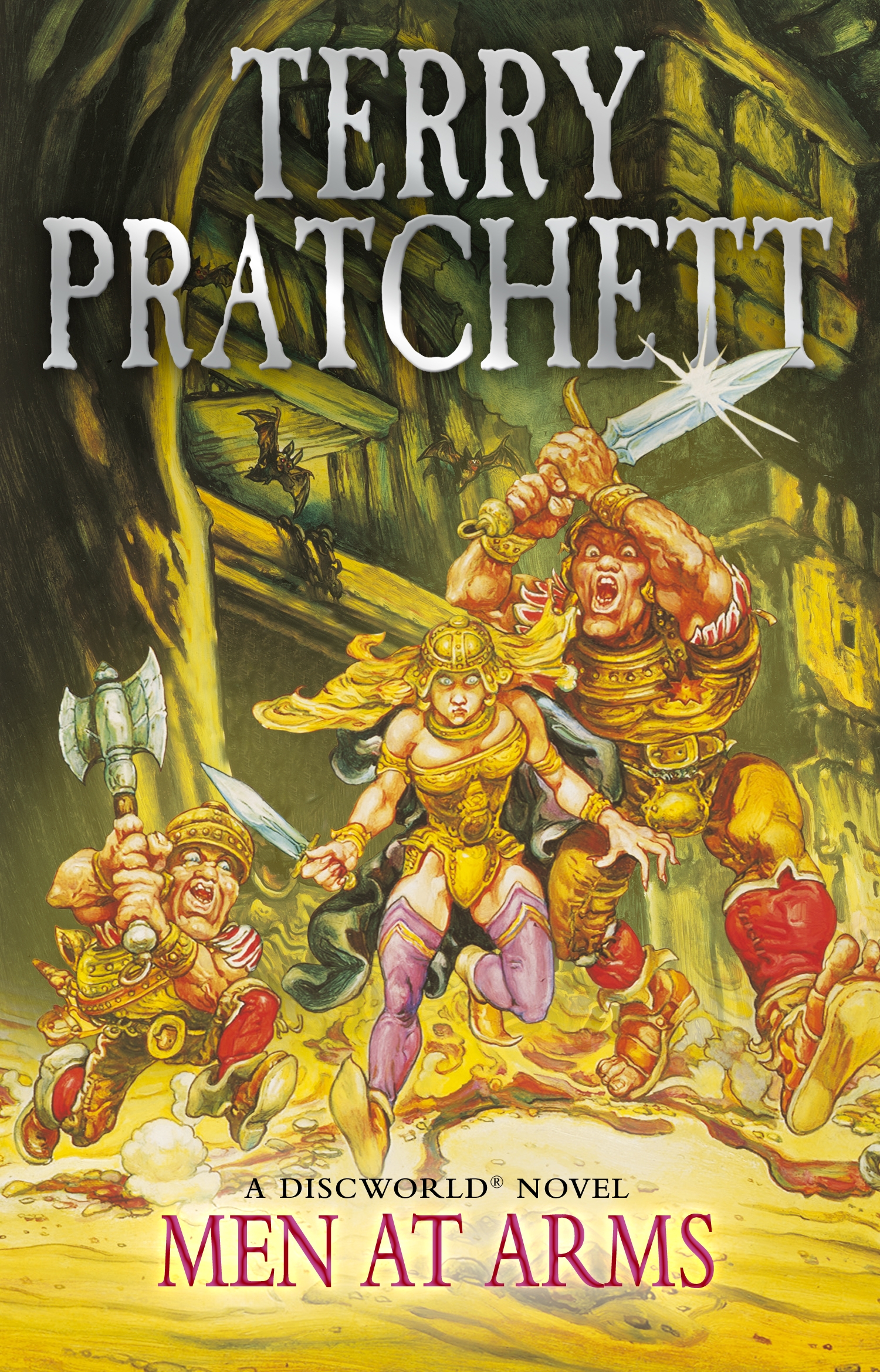
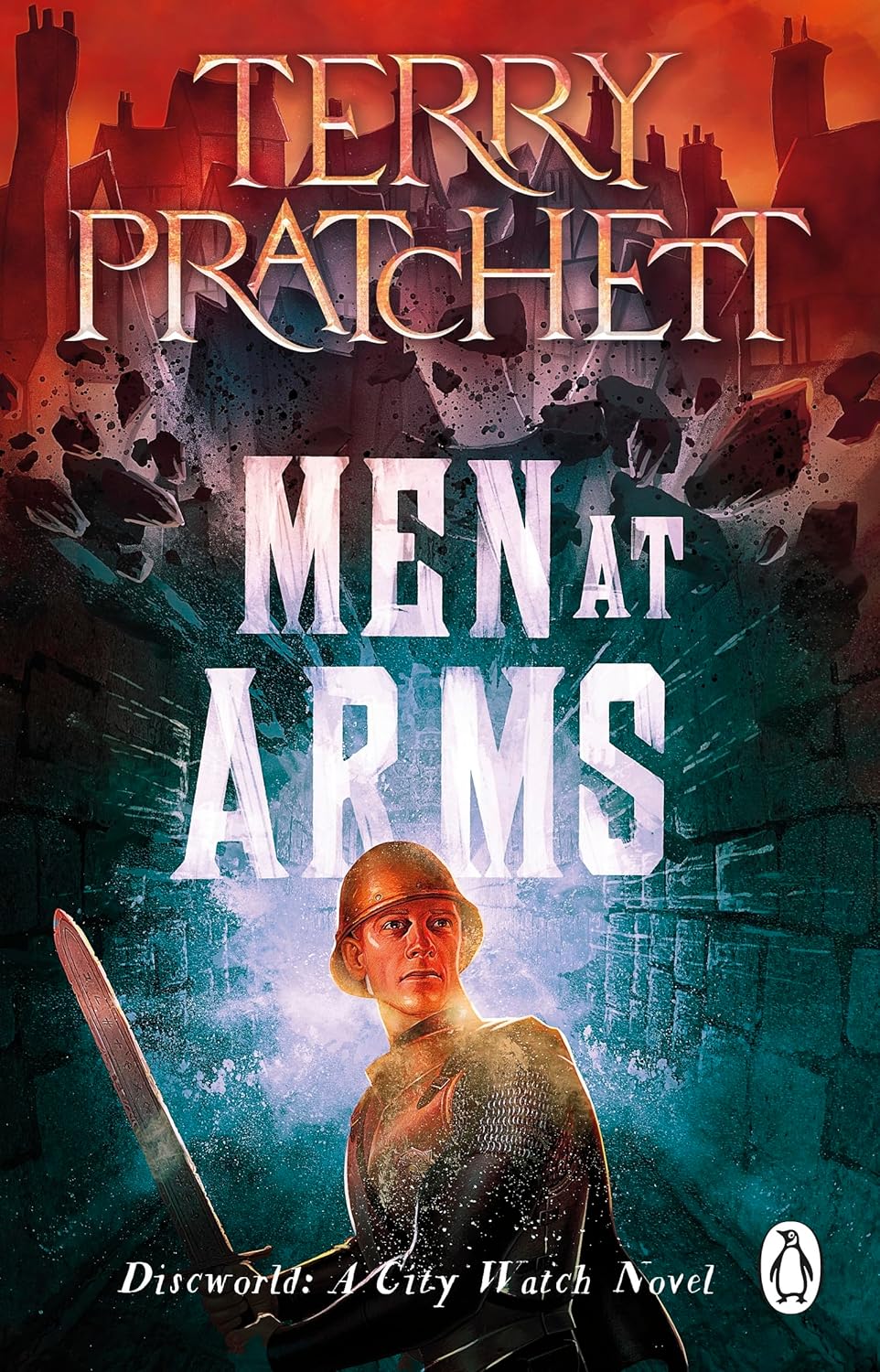
Men at Arms by Terry Pratchett

Publisher: Gollancz/Penguin Random (Audiobook – 1993)

Series: Discworld – Book 15/City Watch – Book Two

Length: 12 hours and 58 minutes

My Rating: 5 out of 5 stars

Amazon

After yet another re-read, the classic fantasy satire novel, Men at Arms remains as one of my favourite Discworld novels by the late, great Terry Pratchett, especially as its new audiobook version breaths fresh life into the always impressive novel.

Readers of this blog will have noticed that I have been on a real Discworld rampage lately, having re-read several books from my absolute favourite fantasy series.  Much of this is due to the recent release of a cool new audiobook version of all the Discworld books, featuring an awesome array of new narrators and vocal talents.  This new format has proven particularly awesome for books like Pyramids, Moving Pictures and Small Gods, and I have been eager to see how some of the books in my favourite Discworld sub-series, the City Watch books, come across with the new narrators.

While I have a lot of love for all the books in Terry Pratchett’s Discworld, my absolute favourites come from the City Watch sub-series.  Following the unlikely members of the Ankh-Morpork City Watch, a rag-tag team of guards generally looked down upon by the entire city, the City Watch books features an exceptional combination of fantasy and crime fiction elements, wrapped up in Pratchett’s usual satirical humour, as the protagonists investigate a series of dastardly crimes in the supernatural Discworld.  The series started perfectly with the awesome novel Guards! Guards!, which I reviewed last year, and Pratchett did an outstanding job following this up with the brilliant sequel, Men at Arms.

After saving the sprawling and eternally crime-ridden city of Ankh-Morpork from a fire-breathing dragon, the men of the Night Watch are still at work protecting the city, even though most of the city wishes they didn’t exist.  Despite their previous escapades, it’s a bad time to be a copper in Ankh-Morpork, with species tension between the dwarfs and the trolls at boiling point, while the powerful guilds disregard the Watch’s non-existent authority.  Worse, the Night Watch has been forced to accept three diversity hires, and must now contend with a mad dwarf, a thick troll and a woman (gasp) amongst their ranks.

Despite this, when an explosion at the Assassin’s Guild literally rocks the city, it falls to Captain Samuel Vimes and his small squad to investigate the heist hidden by the blast, despite the deliberate orders of the city’s tyrannical ruler to stop.  Determined to wrap up the case before his impending marriage and retirement, Vimes is soon forced to contend with a series of unusual, but seemingly linked murders, many of which have been caused by a lethal weapon never seen on the Disc.

With riots on the streets, and assassins and fools dodging their questions, all the members of the watch, including their contentious recruits, will need to work together to solve the murders before the city descends into chaos.  But how will they fare when going up against the most dangerous criminal mind the city has ever seen, one determined to bring back the Ankh-Morpork’s ancient kings, while wielding a dangerous new weapon that could change the entire Disc forever?

Even after many, many re-reads, Men at Arms continues to shine as one of Pratchett’s better books.  Featuring an epic crime fiction narrative, loaded with impressive characters, fantastic humour and great use of Pratchett’s iconic Discworld setting, Men at Arms is a complex, emotionally charged and deeply moving read that I could honestly read 100 times and still not get bored with.  A brilliant novel that unsurprisingly gets an instant five-star rating from me.

Pratchett wrote some exceptional narratives throughout his career, but few stand up to Men at Arms in terms of complexity, cleverness and emotional impact.  Expertly reintroducing the cast of Guards! Guards!, while also bringing in some impressive new support characters, Men at Arms starts off an excellent pace, as Pratchett cleverly examines the changes to the characters, sets up the new case, while also showcasing the motivations of the apparent main antagonist.  From there, it doesn’t take long for a dark series of crimes to take place, with Vimes and his squad investigating despite the apathy of the rest of the city.  Pratchett does a lot of excellent set up in the early part of the book, and the reader soon becomes invested in the investigation, especially as the book begins to follow a series of deaths, some of which were caused by a particularly deadly weapon that modern readers will be all-too familiar with.  Some great character arcs are also introduced here, as the extended cast all hit their own various problems they are forced to overcome, with Vimes dreading his eventual retirement, Carrot feeling the added responsibility, the fun buddy-cop arc between Detritus and Cuddy, and Angua dealing with her own problems.  The author sets up and expands on these arcs throughout the book perfectly, providing additional emotional impact, as well as some interesting side angles on the main storyline.

While the first half of the novel sets everything up perfectly, it is in its second half where Men at Arms truly shines.  Pratchett keeps raising the stakes of the story, with more victims, run-ins with the shadowy antagonist, and the Watch characters attempting to understand the nature of the weapon that has been turned against the city.  The author throws in some interesting wrinkles to the case, which shadow who the true villain is, while other events throw emotional shade across several of the characters.  The various connected character arcs start to come together perfectly as the book continues, and you go into the final stretch with a range of emotions around you.  While ostensibly a comedy, Pratchett chooses to hit the tragedy element of the plot really hard in the lead up to the finale, with some big moments that will leave you speechless.  The big end reveal and confrontation is exceptional, and I loved how well all the storylines and cleverly setup plot points came together.  Everything leads up to a very desperate struggle that helps to define some of the main characters in some very powerful ways.  Pratchett chooses to leave the book on a hopeful note that sets the expanded course for the future City Watch books, while also providing some interesting insights into one of the main characters and his role in the city.  An overall epic narrative that twists, turns and keeps you guessing, while constantly entertaining and emotionally charged.

As with his other books, Pratchett perfectly sets out Men at Arms with impeccable writing, and I loved how this complex novel came about.  Featuring his usual impressive blend of fantasy and humour elements at its base, Men at Arms is both intriguing and quite funny in equal measures, and I love the subtle comedy that runs through it.  Many of these scenarios involve classic fantasy scenarios being seen through the eyes of self-aware characters, allowing the situation to be taken up to an 11, with sarcastic commentary from the witnesses.  This humour is well enhanced by several of its best characters, including a fantastic new buddy cop routine, with members of two separate and historically antagonistic species forced to work together and eventually becoming friends.  Some of the other hilarious moments in the book include unlikely members of the city’s population being conscripted into the Watch, unfunny clowns, unconventional investigation methods, and other subtle humour.  You also have to love the brilliant footnotes that seek to enhance the story and showcase just how ridiculous the Discworld is by providing additional details about the universe and the people within it.  All this results in a brilliant and highly entertaining fantasy read, and that’s before you even get to the great crime fiction elements of the story.

As with Guards! Guards!, Men at Arms stands out from the rest of the Discworld series due to the way that Pratchett provides a complex and compelling crime fiction narrative.  Focused on an explosive heist that eventually results in a series of brutal murders, Men at Arms tries to envision how firearms would disrupt the Discworld.  This allows for quite a captivating crime fiction narrative, which I feel was a much better mystery than Guards! Guards!.  Advancing more into police procedural territory than its predecessor, the mystery of Men at Arms proves to be top rate, with the protagonists going after an already known villain for much of the book.  Much of the early story involves the protagonists trying to unfurl the antagonist’s plan and discover how he committed the crime, which allows for some great scenes as the Watch inexpertly investigate.  Pratchett cleverly twists the fact that think you know who the antagonist is towards the end of the book, and I love how well he switched this key story element, especially as the implied true villain of the story is far more sinister than just evil humans.  I really enjoyed how well Pratchett sets up this mystery in Men at Arms, and even after so many re-reads there are still additional subtle clues and foreshadowing that I’m only just picking up on.  The police procedural elements of the story are also extremely well handled, with a lot of humour focused around three very unlikely recruits joining the already scruffy outsiders who make up the Watch.  All these elements come together extremely perfectly and allow for readers of various genres to come into Men at Arms and have an incredible time.

Due to Pratchett’s excellent writing style, Men at Arms does work quite well as a standalone novel, and new readers can generally enjoy this book without any prior knowledge of the Discworld series, especially once they get caught up in the cool story and amazing humour.  However, I do feel that to get the best experience with Men at Arms, readers really do need to have checked out Guards! Guards! first.  The continuing storylines, history of the city and character arcs all come into play extremely well in Men at Arms, and you get a much more complete experience viewing all City Watch novels in order.  There is also a continuation of some character arcs from the standalone novel, Moving Pictures, especially as a few major characters from there get a recurring role in this new sub-series.  As such, I would say that Men at Arms is a novel more aimed towards Pratchett’s established fans, with those who loved Guards! Guards! guaranteed to enjoy its impressive sequel and the compelling direction Pratchett starts to take the City Watch books in.  It helps that the author continued to explore the crumbling and crime-ridden city that is Ankh-Morpork in this Men at Arms, providing even more details about its governance, mindset and people.  This includes really expanding on the species tension between the dwarfs and trolls and showcasing it as a major plot point while also paralleling real-life racial tensions.  This focus on dwarf and troll conflict becomes a major plot point of the Discworld going forward (especially in the later City Watch books), and its setup here was spectacular.  Combine that with the changes that happen to the Watch at the end of the book, and Men at Arms is an important entry in the wider Discworld context, especially as so many key City Watch storylines start here.

While there are so many amazing writing elements to Men at Arms, few things top the exceptional character work that ensured that this novel was far more than just a funny fantasy novel with crime fiction elements.  Instead, the complex and heartfelt dives into its extensive main cast ensured that Men at Arms was one of the more powerful and emotionally charged entries in the Discworld (a very impressive feat).  The combination of returning protagonists from previous books, as well as a few outstanding new characters, allows for a range of different plot perspectives and personal storylines, and Pratchett effortlessly works to make you invested in all these character arcs before hitting you with intense tragedy and powerful moments.

At the centre of the plot lies main character Captain Samuel Vimes, the cynical veteran leader of the Night Watch, who has finally found happiness and romance in his life.  Now on course to retire and become a man of leisure, Vimes must deal with the horror of becoming the thing he hates most: a rich civilian.  Dealing with it by diving into one last investigation, Vimes finds himself facing everything he hates about his job, including bureaucracy and the whims of powerful people, resulting in some brilliantly chaotic scenes.  While it does seem that Vimes’s role in this story is slightly diminished compared to in other City Watch books, especially in the centre, he is still a major part of the book, and Pratchett writes some excellent storylines around him being the dogged and worn-down investigator pushing against authority and trying to solve one more crime.  The focus on his identity as a copper, the sacrifices he makes for his fellow officers, as well as the horror at having to give up the job are major parts of his character arc, and there are some truly heartbreaking moments when he realises he must give it all up.  This is well balanced with his heartwarming romance with his unlikely partner, Lady Sybil Ramkin, whose well-meaning support and determination help to make Vimes a better person.  However, it is the major sequence when Vimes finally encounters the antagonist which really provides the best look at the character.  Forced to decide between being a good cop or a figure of vengeance (a battle that rears its ugly head for Vimes many times during the series), Vimes truly hits his mental and moral limit as he faces down his adversary, and it is one of the most powerful scenes in the entire Discworld series.

While Vimes is the main character of the City Watch series, the focus of Men at Arms is a little more skewed more towards Corporal Carrot Ironfoundersson, as Pratchett expands on his excellent introduction in Guards! Guards!.  Now firmly a part of Ankh-Morpork society, Carrot has evolved from naïve newcomer to a seasoned police officer who knows literally everyone in the city.  Fully utilising his natural charisma, Carrot proves to be a major force for law and order in the city.  I loved how much Pratchett enhanced Carrot in this sequel, as his personality evolves due to his role and responsibility, and despite still appearing quite naïve and obedient, Carrot showcases some impressive intelligence driving much of the investigation.  I especially appreciated the various scenes where Carrot managed to outfox many of the city’s more dangerous figures who fall for the dumb copper routine.  Despite his new confidence and ability to bring out loyalty in others, Pratchett makes sure to show that Carrot isn’t infallible, and you see some vulnerability at times. Carrot also serves as the moral centre of the book, bringing out the best in the other members of the Watch.  His interactions with Vimes in the final confrontation were very heartfelt, especially as he keeps the man he admires most from doing the wrong thing, while the way he handles the antagonists goes to show that he is truly a good man, who you better pray you never face.  I also think that his talk with Vetinari at the end of the book was one of the best scenes in Men at Arms, especially as he truly surprises the Patrician, while also dancing around the tricky subject of Carrot’s potential position as heir to the throne.  His decision to refuse power and ensure that Vimes will be there instead really helps you keep faith in the good of people, and this was frankly Carrot’s best book.

I also have to highlight the fantastic and fun duo that was the newly instated watchmen, Cuddy and Detritus, the later of whom previously appeared in Moving Pictures.  An unusual dwarf and the thickest of trolls, the two make for a particularly unlikely and chaotic duo, which Pratchett uses to full effect as the book continues.  Thanks to the enmity that exists between their respective species, Cuddy and Detritus spend much of the early part of Men at Arms bickering with each other, including in one scene in the middle of a riot.  However, after being forced to work together, the two form a grudging bond, especially when Cuddy stops seeing Detritus as a dumb troll.  I loved how well Pratchett took the classic odd-couple police partner trope and twisted it around the compelling species-rivalry theme of the book, and the fun dynamic that forms between the new friends is a major highlight of the book.  The various sequences that follow the big scene that defines these two partners are some of the most powerful in the entire Discworld.

Following on the heels of Cuddy and Detritus is Angua, the other new recruit to the Night Watch.  Angua is an interesting figure in the story, mainly because she’s one of the few people able to see how ridiculous the entire Night Watch is.  The subsequent storylines surrounding her potentially doomed romance with Carrot and her desire to keep her status as a werewolf secret from everyone, add some excellent alternate perspectives to the plot, and Pratchett did an outstanding job setting her up as a compelling figure for the rest of the series.  It helped that for this first book she worked as a bit of a double act with the small talking street dog, Gaspode, who also previously appeared in Moving Pictures.  Gaspode proves to be a fantastic wise-cracking counterpoint to Angua, and it was hilarious to watch him mess with the various human characters who refuse to believe he can talk.  Their resulting storylines about investigating the crime as canines, as well as the unlikely dog rebellion brewing within the city, works well with the other character focused arcs, and it was fun to get a little more closure on Gaspode’s story after his previous appearance.

Other great supporting characters in Men at Arms includes the returning members of the City Watch, Sergeant Colon and Corporal Nobbs.  While not as well utilised in this book as the rest of the City Watch series, they still prove to be a fantastic addition to the supporting cast.  Entertaining backers to the various other character-driven storylines, both show interesting depths in this book, whether it’s Colon acting as a put-upon drill sergeant, or Nobby’s use of his quartermaster past to obtain a collection of weapons.  Other members of the city also prove to extremely entertaining, with the tyrannical Lord Vetinari being the highlight.  The way in which Vetinari manipulates Vimes throughout the entire novel, while also understanding the true nature of most of the city’s residents is highly impressive, and I love that he stayed on as a major character after Guards! Guards!.  Throw in a complex arrangement of well-hidden antagonists, including an idea of violence that takes on a familiar form, and the cast of Men at Arms proves quite exceptional.  I really cannot emphasise just how much these carefully written character arcs and complex personal storylines increased the impact and emotional power of this novel, and you will come away loving everything about them.

I doubt anyone will be too surprised that I am about to write several paragraphs about Men at Arms’s epic audiobook formats, which I have long described as the very best way to enjoy Pratchett’s stories.  I honestly love all the Discworld audiobooks and luckily for connoisseurs, there are two outstanding versions of the Men at Arms audiobook that you can check out.

The first of these is the classic edition that was released back in 1996 and which is read by Nigel Planer.  Planer, who is one of my favourite audiobook narrators, lent his voice to most of the early Discworld novels, and is a key reason why I love Discworld books in this audio format.  Planer unsurprisingly does an amazing job with Men at Arms, especially as he perfectly captures Pratchett’s complex humour and intense story arcs with his brilliant narration, with every element of the book coming across in an exceptional and addictive manner.  This includes the brilliant characters, many of whom Planer previously voiced in other Discworld books.  Planner does an amazing job once again diving into these unique characters throughout Men at Arms, and the way he effortlessly portrays each character and shows their full personality and emotional range is just amazing.  He frankly provides the definitive portrayal for all the City Watch characters, and I honestly love the passion he brings to the Men at Arms audiobook. 

While the Nigel Planer audiobook version is always going to be a favourite of mine, I also have come to deeply appreciate the latest Men at Arms audiobook.  Part of a newly released collection of Disworld audiobooks that feature an interesting array of British talents bringing their vocal skills to Pratchett’s classic tales, this new Men at Arms audiobook is very impressive and is just as easy to get lost in at the classic Planer version.  Featuring the amazing cast of Jon Culshaw, Peter Serafinowicz and Bill Nighy, this Men at Arms audiobooks has a runtime just short of 13 hours, which is a few hours longer than Planer version.  However, the excellent array of narrators really makes it worth a listen.

The heart of this new Men at Arms’ audiobook is British radio and television personality Jon Culshaw, who dove into this role in a very impressive manner.  Culshaw really makes the story his own with his take on the novel and the characters, resulting in a very different feel that fans of the original Planer version will really appreciate.  Part of the reason why it was so good was that Culshaw brought back the excellent character voices and tones he previously used in Guards! Guards!, many of which provide great and often gritty new takes on some classic characters.  This includes a much rougher and despair filled Vimes, which fits the darker places Pratchett took the character in Men at Arms, especially when he goes up against the system.  His voice for Carrot captures the same keenness and naiveté that we saw in the previous book, however Culshaw’s vocal work also backed up Carrot’s excellent character development as the protagonist came into his own.  His voices for Lord Vetinari and Nobby Nobbs were also a ton of fun, with the dark and insister tones of Vetinari stealing every scene he is in, while Culshaw’s Nobby voices sounded appropriately similar to David Bradley or Jon Pertwee, which is just hilarious.  Culshaw also did an excellent job with several newly introduced City Watch characters, and I felt he got ever new additional cast members’ voice down perfectly.  My favourite was probably the troll Detritus, as Culshaw worked hard to showcase his massive and rocky troll nature, as well as his serious and slow personality.  This excellent vocal work from Culshaw ensured that the core of this Men at Arms audiobook was extremely impressive, and I really could listen to Culshaw’s take on these epic characters all day long.

As with all books in this new collection of Discworld audiobook’s, Culshaw’s main narration was perfectly backed up by recuring voices of Bill Nighy and Peter Serafinowicz. Both play key parts in this audiobook, with Nighy providing the narration for the footnotes, while Serafinowicz was the voice of Death whenever he appeared. These performances were once again perfect, and I especially loved Nighy’s excellent work with the vital, comedic footnotes.  Nighy really enhances the impact and value of these footnotes with his calm and impressive voices, and I especially loved his take on some of the more entertaining footnotes, including one where he partially sings a bad folk song.  Serafinowicz’s role in Men at Arms is also very fun, as he brings the fan-favourite character of Death to life.  Death has several great appearances in Men at Arms, and hearing Serafinowicz’s excellent voice suddenly appear amongst the general narration really increases the impact of the character.  Both Bill Nighy and Peter Serafinowicz’s inclusions were extremely fun, and I felt that they were combined with Culshaw’s main narration in a very impressive way.  These three brilliant British talents ensured that the new version of Men at Arms was particularly impressive, and while the original audiobook will always remain one of my favourite ways to enjoy Men at Arms, this new version is very much worth a listen and will likely inspire a new generation of Discworld fans.

Well, I think that my above excessive ramblings have probably made the point by now that I deeply enjoyed Men at Arms by Terry Pratchett.  One of the best Discworld and City Watch novels, Men at Arms was a glorious, captivating and moving read that perfectly blended crime fiction, fantasy and satire into one truly addictive and impactful book.  Clever, sharp and loaded with truly exceptional characters, Men at Arms was Pratchett at his very best, and I cannot recommend this book enough, especially on audiobook.  I can think of no higher praise for Men at Arms than to once again state that I will never get bored with this exceptional book, and it inspired me to continue the series and re-listen the next City Watch book, Feet of Clay.
Amazon

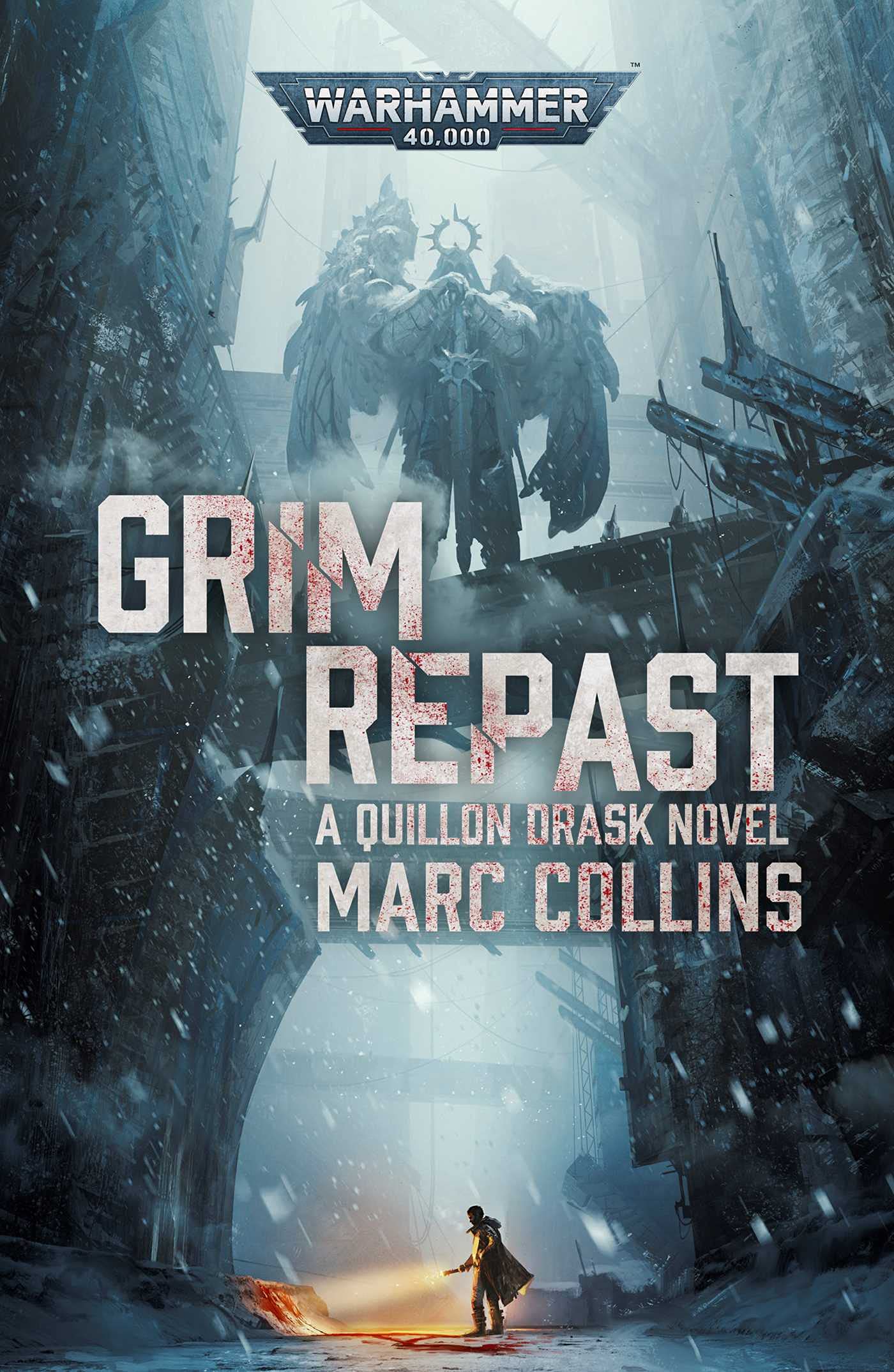
Warhammer 40,000: Grim Repast by Marc Collins

Warhammer 40,000 - Grim Repast Cover

Publisher: Black Library (Audiobook – 25 September 2021)

Series: Warhammer Crime

Length: 9 hours and 52 minutes

My Rating: 4.5 out of 5 stars

Amazon     Book Depository

Prepare for a gruesome and dark murder mystery novel in the gritty Warhammer 40,000 universe with the incredible and awesome Warhammer Crime novel, Grim Repast by Marc Collins.

I have made no secret of the fact that I am currently in the middle of a big Warhammer reading frenzy, having recently reviewed several awesome books, including two novels in my last Throwback Thursday posts (Xenos by Dan Abnett and Deus Encarmine by James Swallow).  However, I am still not done with the tie-in books in this very cool franchise as I have just finished another outstanding read, this time a book which is part of the Warhammer Crime sub-series.

The Warhammer Crime books are a fantastic and captivating series which, as the name suggests, blends crime fiction storylines with the epic Warhammer 40,000 universe.  All set within the tortured and sprawling human city of Varangantua, these great novels tell a range of entertaining and complex crime stories, including dark murder mysteries and elaborate thrillers, which make great use of the gothic futuristic setting.  I have so far enjoyed two Warhammer Crime entries, Dredge Runners and The Wraithbone Phoenix by Alec Worley, both of which were pretty epic reads.  These initial awesome reads really sold the Warhammer Crime series to me, and I have been interested in enjoying another entry.  I ended up choosing the great sounding read, Grim Repast, by rising Warhammer author Marc Collins.  One of Collins’s first full-length novels, Grim Repast is an exceptional read with one of the darkest crime narratives I have ever had the pleasure of reading.

“This city eats men….”

Veteran probator Quillon Drask thinks that he has seen all the dangers, depravities and villains that Varangantua has to offer, but he is about to discover a whole new level of horror.  Already traumatised and ostracised after his last lethal case and the betrayal that accompanied it, Drask’s first new investigation is not the simple job he was hoping for, as a body has been found in the dying district of Polaris.  The victim, a businessman on the wrong side of town, has been gruesomely mutilated, the implications of his injuries have frightening implications.

As more bodies are discovered, Drask finds himself chasing after a deadly killer who murders and dismembers without compunction and who has a sudden obsession with tormenting Drask.  Forced to play a deadly game that uncovers the corruption of his own organisation and sets him against the city’s elite, Drask finds himself alone and afraid against an enemy he doesn’t understand.  Only his twisted insights into the criminal mind, as well as the lessons of his career and devious dead mentor, offer the answers that he needs to solve the case and stop the killer.  However, not even Drask’s dark mind can comprehend the true horrors that lie beneath his city, one that connects to Varangantua’s past and a dangerous hunger that has always controlled people like him.

Wow, Marc Collins really came out swinging with this epic and outstanding Warhammer Crime entry.  Grim Repast is probably one of the best pure mystery novels set in the Warhammer universe that I have so far read, and I loved how seamlessly Collins was able to blend a dark, psychological crime fiction narrative with the grim and repressive atmosphere of a Warhammer 40,000 city.

Collins has cooked up a pretty wicked story for Grim Repast, which brings together multiple elements from across the genres to really highlight just how epic and complex a Warhammer story can be.  Following the compelling and damaged protagonist and narrator Probator Quillon Drask through the deadly streets of Varangantua as he chases after a lethal serial killer, Grim Repast is first and foremost a crime novel, and one that really grabs the reader’s attention.  Coming off as a dark psychological thriller with classic noir detective elements to it, the protagonist is forced to delve into the darkest heart of his massive, gothic city when he investigates several connected murders whose victims have been butchered in inventive and dark ways.

Collins sets up the case extremely well and then adds some intriguing complications to it where Drask is forced to investigate against the opposition of his bosses and their corporate controllers.  Bringing together a ton of character growth, disturbing developments in the murder case, as well as some fun action as Drask comes face-to-face with the killer in disguise, the plot moves quickly, and you are soon very hooked on finding the killer and the people pulling the strings behind them.  Forced to contend with the interference of a giant corporation, the protagonist finds himself in the middle of a dark conspiracy and, after the typical cop requirement of being suspended without his gun or badge, investigates on his own.  The mystery itself is well-set out and slowly unfolds, even if the overall culprit behind it isn’t too surprising.  However, the obvious suspect isn’t a narrative weakness, as the power of the story revolves around the protagonist fighting through the corruption and the insanity to confront his suspect, as well as the wider implications and horrors his investigation reveal.  The last third of the story is particularly brutal and grim as the protagonist uncovers some pretty horrendous crimes tied into the dark past of Varangantua, and is forced to face them by himself.  Everything ends in a pretty bloody manner, and I had a wonderful time seeing how this entire awesome crime narrative came together.  I loved the cool conclusion of this book, and the hints at some potential adventures for this character is something I would be extremely keen for.

This was a very well written book, and I really appreciated how Collins was able to tell such an effective and powerful story.  Featuring a quick pace and a brilliant focus on a very damaged protagonist, Grim Repast keeps you on your toes the entire time, and I loved how well it blended multiple crime fiction elements for the story while also making full use of the grim Warhammer setting.  The crime itself has some outstanding elements to it, and I was getting some major Jack the Ripper vibes from the plot as Drask receives several taunting notes from the killer.  Collins really brings about a dark and desperate tone around the characters and the city itself, and this lends itself perfectly to the complex crimes, especially as the murders have far deeper meaning and consequences than are initially seen.  The use of corruption and dangerous corporations helped to ensure that the character had even more mysteries and obstacles to overcome, which I thought was an outstanding bonus hook to the story.  The fantastic focus on murder and mystery rather than on wider universe elements ensures that Grim Repast also serves as a pretty good entry into Warhammer 40,000 fiction, especially for crime fiction lovers.  While some elements of the story hint or briefly discuss larger events or bits of the universe’s wider lore, you really don’t need to understand it to enjoy this book, and anybody who loves a complex and gloomy crime fiction can easily have their first taste of Warhammer fiction here without any issues.

Perhaps one of the best elements of Grim Repast that Collins featured was the setting of Varangantua itself.  While the continent-spanning city of Varangantua has appeared in the other Warhammer Crime books, I don’t think I fully appreciated just how good a setting it is until reading Grim Repast.  Collins sets out to make the city as dreary, deadly and dark as possible, and you find yourself getting lost amongst its constricting streets, compelling people and many hidden dangers.  The author honestly sets the city up as a character in itself, and it is quite powerful to see the protagonist move amongst its streets as Varangantua works to consume him, mind, body and soul.  To just make things a little grimmer, Collins chooses to set most of the story in the section of the city known as Polaris, an icy, desolate part of town that is slowly dying due to a lack of commerce.  I love how Polaris’s fortunes seem to match that of the protagonist himself, and Collins really amps up the noir vibes of Polaris with a ton of neon signs, dingy apartments and corrupt cops, making it feel that little bit more like a classic police story.

However, no matter how dingy and gothic Varangantua may be, it is still a futuristic city, so the universe’s advanced technology and other wider Warhammer elements are integrated into the city as well.  There are some great scenes where the city’s law enforcement utilises interesting investigation methods to solve the brutal murders, and I liked seeing the set up of a police force within the Warhammer 40,000 setting, especially as it is as corrupt or degraded as most things within the Imperium of Man.  I also really enjoyed how Collins was able to tie the mystery into the history of the city itself, with key parts of Varangantua’s past coming to the surface during the course of Grim Repast.  This gives the book a lot more substance when it is fully revealed, especially as it increases the overall stakes of the book, and I really appreciated and enjoyed how Collin’s utilised this brilliant setting throughout his book.

I also have to highlight the outstanding central protagonist and point-of-view character, Quillon Drask.  Collins created a wonderful character in Drask, a beaten down and emotionally damaged cop, reminiscent of classic pulp or noir detectives and investigators.  Still emotionally traumatised by the betrayal of his mentor during the last case, Drask attempts to find some normalcy in his work.  However, Drask is now isolated from the rest of his force, not just because of his propensity for finding the weirdest cases, but because of the taint surrounding his mentor.  Drask channels much of his anger and trauma into the new case, but he soon confronts forces that even he can’t fight through.  His obsession with this new case, his well-founded hatred of the aristocracy, and his desire for redemption, lead him to continue his investigation despite his boss’s orders, which leads him into all manner of trouble.  Collins did an outstanding job showcasing this character’s intense mental trauma throughout Grim Repast, and he really comes across as a complex and dark individual.  Despite being a troubled soul, you can’t help but like Drask, as his grim stubbornness just keeps forcing him towards the abyss, and nothing he does in the book, not even solving the murders, brings him any real comfort.  I loved how Collins also explored his penchant for getting into the darkest parts of the human mind and empathising with killers, and he reminded me a bit of Will Graham from the Hannibal Lector franchise, which isn’t too surprising considering that there are some major Thomas Harris influences in this book.  Drask gives a great running commentary on his dark observations of the city around him, and Collins really dives into the mind of his character throughout the course of the book.  This really adds to the book’s overall tone and quality, and I absolutely loved how Collins set out his central protagonist.

If I were to make one major complaint about Grim Repast, it would be that Collins relied a little too much on people reading his short story, Cold Cases, first.  Appearing in the Warhammer Crime anthology book, No Good Men, Cold Cases was the previous (and first) appearance of Quillon Drask, in which he hunted down another notorious killer.  Collins brought up Cold Cases multiple times throughout the course of Grim Repast, as the events helped form the protagonist and led to his mental/profession state in Grim Repast.  While I appreciate that Collins was trying to tie his new book back into this introductory story, I found it a bit confusing and irritating at times, mainly because I haven’t read Cold Cases.  I kind of got a little tired of the continued references to Cold Cases throughout Grim Repast, as it messed with the initial flow and enjoyment of this novel.  While you can pick up the events of Cold Cases through context as Grim Repast continues, I felt that Collins could have either eased up on the references a little or featured a better summary of this short story at the start, especially as it was such a big part of the protagonist’s motivations.  While this wasn’t a massive issue in my enjoyment of Grim Repast, it bugged me the entire way through, and it is something readers interested in Grim Repast should be aware of.  Overall, though, this was a pretty epic read, and I would recommend it, even with this issue.

To no-one’s surprise I ended up listening to the Grim Repast audiobook, which was pretty damn awesome.  I have so much love for Warhammer 40,000 audiobooks, especially as they are always so successful at capturing the dark tone of the settings as well as the complex stories.  I felt that Grim Repast was a particularly good example of this, as its audiobook really drew the reader into the cold surrounds of Varangantua and refused to let you leave.  It helped that Grim Repast was narrated by the highly talented Richard Reed, who previously impressed me with his narration of Nate Crowley’s The Twice-Dead King books, Ruin and Reign.  Reed has a naturally tough and rugged voice that does Grim Repast’s story a lot of justice, as his tones perfectly fit the noir-esque city of Varangantua.  I especially enjoyed how he portrayed Quillon Drask throughout the book, giving him a very gravelly tone that showcased his gruff exterior, while also expertly conveying the protagonist’s inner turmoil and pain.  You really get the full sense of who Drask is through Reed’s great voice work, and I really cannot emphasise how much value Reed’s narration added to this awesome audiobook.  With a runtime of just under 10 hours, Grim Repast is an easy audiobook to quickly power through, and you will really find yourself getting dragged into this elaborate and powerful tale in this format.

Fans of crime fiction, Warhammer fiction and everything in between should look no further than Grim Repast by Marc Collins for their next epic read.  Bringing together a complex and twisted murder mystery with the iconic setting of Varangantua in the Warhammer 40,000 universe, Grim Repast is an outstanding amalgamation of mystery, a dark psychological thriller, and the madness of the grim Warhammer 40,000 future, all of which makes for one hell of a dark and emotionally charged story.  I had an amazing time reading this powerful read, and it comes very highly recommended.

Amazon     Book Depository

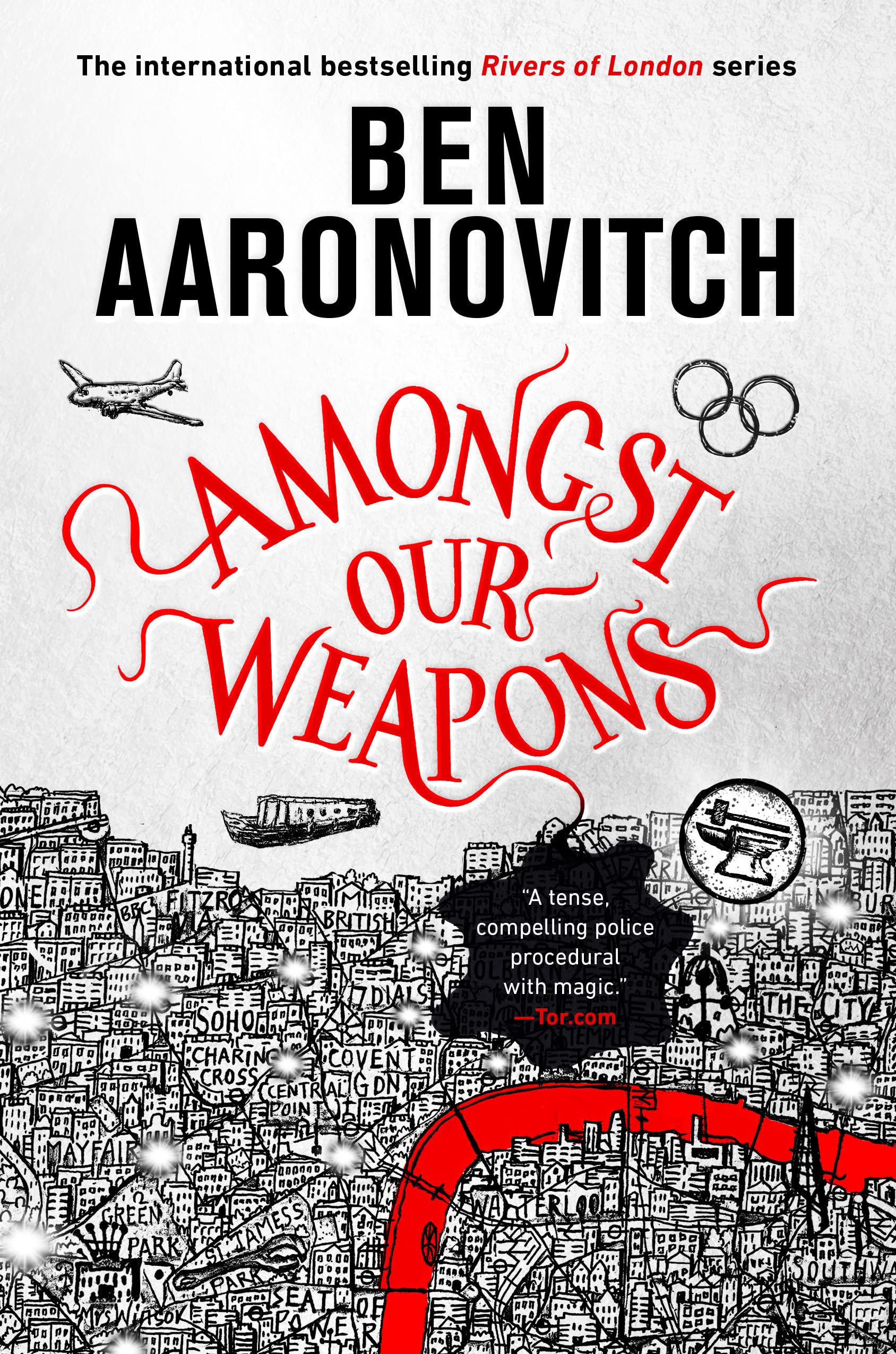
Amongst Our Weapons by Ben Aaronovitch

Amongst our Weapons Cover

Publisher: Orion (Trade Paperback – 12 April 2022)

Series: Rivers of London – Book Nine

Length: 406 pages

My Rating: 5 out of 5 stars

Amazon     Book Depository

One of the leading lights in the urban fantasy genre, the exceedingly talented Ben Aaronovitch, returns with the latest epic book in his brilliant Rivers of London series, Amongst our Weapons.

For the last 10 years, the fantasy world has been exceedingly impressed by the fantastic writings of Ben Aaronovitch, who came up with a real winner with his Rivers of London series (also known as the Peter Grant series).  Aaronovitch, who already had some major nerd cred as a writer of two Doctor Who serials, debuted the first book in this series, Rivers of London, back in 2011.  This book told the story of Peter Grant, a young Metropolitan Police officer who is assigned to a specialised branch of the Met that deals with magic and supernatural incidents.  This intriguing debut combined magical elements with a classic police procedural format to create an epic and captivating read.  The author has since expanded this series out to several novels, as well as a range of novellas, short stories, and even a graphic novel series, all of which continue the story of Peter Grant and Aaronovitch’s unique magical world.  I have had a lot of fun over the last few years with this series, and I have greatly enjoyed Aaronovitch’s last two entries, Lies Sleeping and False Value.  Aaronovitch is back with another exceptional read in his ninth Rivers of London novel, Amongst our Weapons, which continues the excellent format and presents the reader with an awesome new mystery.

The London Silver Vaults are a renowned underground market for silverware in the heart of London.  They are highly secured and constantly monitored, so getting away with any sort of crime in the vaults is impossible.  So when a crazed would-be robber is brutally killed in the middle of the vaults with no witnesses or cameras catching the act, the Met are forced to call in their secret weapon, Peter Grant and his fellow detectives from the Special Assessment Unit, better known as the Folly.

Specialising in investigating magical incidents, Peter and his team are quickly able to determine that the death and the murder’s subsequent escape were a result of powerful magic.  Taking the lead on the case, Peter hopes to catch the killer quickly, but are quick to discover that their investigation is about to get far too complicated.  Ancient magics and unknown powers are loose around London, and after discovering a second body, the Folly team begin to investigate the members of a mysterious college cult from Manchester that has been inactive for years.  As more attacks occur, it becomes apparent that members of the cult are being hunted down and that their killer appears to be a vengeful, spear-wielding angel.

Determined to get to the bottom of the killings, Peter dives into the history of the cult and the mysterious artefacts they uncovered.  His investigation will lead him all over England, from the colleges of Manchester all the way to the dismal North.  But even as he begins to uncover the truth behind the killings and the being responsible, does even the full might of the Folly have the power to stop an angel and the deadly magic gifted to her?  Worse, another party has involved themselves in the case, someone that Peter knows far too well.  Can Peter solve this case before it is too late, and how will he deal with the greatest challenge of his life, becoming a father to his two magical twins?

Wow, Aaronovitch continues to massively impress me, bringing together another brilliant and unique urban fantasy read.  Once again bringing together an outstanding story that features distinctive fantasy elements with a clever mystery, Amongst our Weapons was a fantastic read that I had an incredible time reading.  This book was pretty damn awesome and gets a full five-star rating from me.

I had an absolute blast with the story contained within Amongst our Weapons as Aaronovitch has once again cleverly combined complex fantasy elements with a compelling murder mystery investigation, resulting in a deeply entertaining and addictive story.  Aaronovitch starts this latest novel off strong, with the protagonist and his team immediately thrust into an investigation of a man with a mysterious magical hole blown into his chest and no witnesses who saw what happened.  This intriguing start quickly becomes even more enticing, as a second murder is soon discovered, as well as other unusual signs and discoveries at the various crime scenes.  However, the excitement does not end there, as Aaronovitch also fits in an early encounter with the powerful murder, who appears to be an exceedingly deadly angel of vengeance, as well as the sudden reappearance of recurring antagonist Lesley May, Peter’s former partner who now acts as a magical mercenary.  Throw in some great character driven storylines about the protagonist’s family, as his river goddess wife is about to give birth, and you have quite an exceptional start to the novel.  Indeed, once all these elements were set up, I was hopelessly hooked on the story, and it proved extremely hard to put this book down at all.

The rest of the narrative flows on from here extremely strongly, as the characters launch an exhaustive and intense investigation not only into the murders but into the origins of certain magical items and the history of the college cult who appear to be targeted.  This takes the protagonist on a bit of a fieldtrip outside London, exploring Manchester and the North, and introducing the characters to some intriguing new magical elements.  While parts of the story here did get a bit bogged down when it came to exploring some of the more complex new fantasy inclusions, I flew through the second part of the book, especially as it is laced with several brilliant and imaginative confrontations between the protagonist and the book’s various antagonists.  Everything comes together extremely well in the lead-up to the conclusion, which results in a fantastic battle that helps resolve everything perfectly.  I did think that it got a little too metaphysical in places, but I still deeply enjoyed this great conclusion, which should really satisfy every reader, while also setting up some interesting storylines for the future.

Aaronovitch has such a distinctive writing style for the Rivers of London series, which is put to great use throughout Amongst our Weapons.  Like most of the Rivers of London novels, Amongst our Weapons can be read as a standalone read, with Aaronovitch doing a great job of rehashing some of the relevant continued storylines when they become relevant to the ongoing story.  This book features the usual awesome blend of magic, crime fiction and character-led storylines, wrapped up with a great sense of fun and humour, which helps to produce quite an entertaining and captivating read.  I particularly loved how the author makes his novels feel like a police procedural with magic, and this is perfectly on display in Amongst our Weapons, as the protagonists engage in elaborate investigation into several unique deaths.  It is so much fun to watch these magic-wielding protagonists do research, official police investigations, paperwork, evidence collecting and various theorising as they examine both the magical and human sides of the case, and I always love how well these elements can be fit into a seemingly typical murder mystery storyline.  Everything flows extremely well through this novel, and while I think there are some minor pacing issues towards the middle, readers will power through this entire book once they get caught up in the mystery and the magic.

I have always been really impressed with the distinctive and captivating fantasy elements contained within the Rivers of London novels, which prove to be intrinsic and outstanding parts of the book.  Rather than use classic fantasy elements, the magic and unique creatures featured within this series are a lot more abstract with a focus on energy manipulation, creatures from alternate universes and godlike beings who get their powers by being embodiments of important locations.  This really gives the novels a great, unique feel that is brilliantly enhanced by the way that the various characters treat magic in an almost scientific way, especially from a policing perspective, as the protagonists are effectively investigating and monitoring it in London.  This fantastic way of examining magic proves to be quite effective in Amongst our Weapons, as you get to see all manner of theorising, analyses and scientific conclusions drawn up as the protagonists attempt to identify and quantify the new forms of magic they are dealing with, especially when they come face to face with an unknown being of immense power.  This cool magic is also quite stunningly described throughout the novel, and I loved seeing its unique and clever use throughout the various magical confrontation sequences, and there is nothing more awesome than reading about a couple of wizards face off against an apparent angel.  I find all the cool magical elements quite fascinating to explore, and I loved seeing some of the world building that occurred throughout Amongst our Weapons, with some new groups of magical users introduced or referenced throughout.  Aaronovitch actually sets up some intriguing new world-building elements throughout Amongst our Weapons, and I look forward to seeing how this expands in some of the future novels.

Finally, I really must highlight the outstanding characters featured within Amongst our Weapons, who really help to turn this awesome story into something truly special.  This cast is headlined by the book’s main protagonist and point-of-view character, Peter Grant, who I really have a lot of fun with.  Grant is a funny and bold protagonist, who has been really growing since the first novel, not only in personality and responsibility but also in magical talent.  He serves as a brilliant protagonist for Amongst our Weapons, and his dogged and clever investigation of the unusual events moved the story along at a swift and enjoyable pace.  While his police work is a major part of the character, this latest novel also focuses again on his personal life, showing his unique marriage to a river (well, the living embodiment of a river), and the upcoming birth of his likely magical children.  This puts some major responsibility on Peter’s head, which he struggles to deal with, still taking risks with his work.  Watching him obsessively chase after the culprit while also trying to balance the upcoming birth of his children was a great part of the novel, and it really helped to make the reader feel attached to him.  However, I personally loved his outstanding sense of humour throughout this novel, as much of the book’s comedic elements are thanks to this protagonist’s funny statements and clever observations about the outrageous events he is witnessing.

Aside from this excellent and relatable protagonist, Amongst our Weapons features a large and diverse cast of figures, including a combination of new people associated with the case and a huge batch of recurring characters who have been perfectly set up before.  Most of the recurring characters are re-introduced extremely well, and even new readers should be able to follow who is who amongst this unique cast of magic users and professional police officers who work together to solve crimes.  My favourite supporting character is Detective Chief Inspector Thomas Nightingale, head of the Folly and the last official wizard.  A gentlemanly figure who fought in World War II, Nightingale serves as a great mentor as well as a badass magician able to throw down with the worst creatures or dark magic users.  While not featured as heavily here as in previous novels, Nightingale has some great moments throughout Amongst our Weapons, and it was awesome to see him squaring off against the winged antagonist.  Aaronovitch also sets up some interesting storylines for him in this book, and it sounds like he will have a much more altered role in the future.  The other major character I should highlight is Lesley May, who serves as a secondary antagonist throughout this book.  Lesley, who spends most of the book as a mercenary character attempting to undermine the police’s investigation, is a great addition to the plot and I am extremely glad that Aaronovitch brought her back for this novel.  Not only do you get more of the regret-filled interactions with Peter but she serves as a great foil for the protagonists, and it was really fun to see her get involved and attempt to manipulate the situation to her advantage.  All these characters, and many more, are great additions to the fantastic and complex plot of the book, and I deeply enjoyed seeing the fantastic and powerful interactions between them.

The Rivers of London series continues to shine as one of the best and impressive urban fantasy series with Amongst our Weapons.  Ben Aaronovitch is such a talented author, and I deeply enjoyed distinctive and captivating stories he crafts, especially with its outstanding blend of unique fantasy and memorable murder mystery elements.  Amongst our Weapons is one of my favourite books from Aaronovitch I have read so far and it is a highly recommended for all fantasy fans.  If you aren’t exploring the Rivers of London, then you are really missing out!

Amazon     Book Depository

City of the Dead by Jonathan Kellerman

City of the Dead Cover 2

Publisher: Century (Trade Paperback – 15 February 2022)

Series: Alex Delaware – Book 37

Length: 319 pages

My Rating: 4.5 out of 5 stars

Amazon     Book Depository

Prepare to dive back into the excellent world of Jonathan Kellerman’s Alex Delaware series with the latest fantastic entry, City of the Dead.

There are some awesome crime fiction authors out there now who have some brilliant long-running series, but one I have been particularly drawn to is bestselling author Jonathan Kellerman.  Kellerman, who debuted in 1985, is an impressive murder mystery author who is best known for his Alex Delaware books.  This fantastic series follows titular protagonist psychologist Alex Delaware as he helps his police detective best friend solve some of the strangest or disturbing murders throughout Los Angeles.  I started reading this book a few years ago and have had an excellent time with the last three entries, The Wedding Guest, The Museum of Desire and Serpentine, all of which had an impressive and clever murder mystery narratives.  As such, I made a real effort to grab City of the Dead when it came out as I knew I was going to have a great time with it.  City of the Dead is the 37th Alex Delaware book and features another twisty and powerful mystery.

On a dark LA early morning, a moving truck runs over a naked body on the street.  As the police investigate this tragic accident, they discover a blood trail, which leads them to a nearby house, where the body of a murdered female is found.  Finding many of the details of this case to be unusual, LAPD homicide lieutenant Milo Sturgis once again brings in his friend, psychologist Dr Alex Delaware, to consult.  While the identity of the naked male out on the street is unknown, Alex is shocked to discover that he knows the female victim from one of his custody cases.

The victim, Cordelia “Cordi” Gannett, was a fraudulent mental health practitioner who specialised in manipulating the vulnerable for her own advantage.  Concerned that her deceptive practices may have led to her death, Alex and Milo examine her past to try and discover who killed her.  But as they dig into her intriguing life, Alex and Milo quickly discover that their victim had a troubled past, filled with mistakes, betrayals and bad influences.  But the more they uncover, the more they begin to question everything they think they knew about this terrible murder.  Was Cordi the dangerous manipulator everyone believes, or was she something far more vulnerable?  And what role, if any, did the dead man on the street play in her death?  A dangerous and disturbed murderer lies behind this crime, and their reasons for killing will shock even the hardened team of Alex and Milo.

Kellerman has done it again, producing an excellent and compelling murder investigation that will quickly hook you and take you to some dark places.  I loved the brilliant narrative of City of the Dead, which combines a complex mystery with interesting characters and the author’s unique style and perspective.  The author sets the start the story perfectly, with a couple of bodies discovered in unique positions that immediately grabs the reader’s attention.  This interest is intensified once the connection between Delaware and the victim are established, which also reveals the victim’s scandalous past.  From there the story continues at a slower pace, with Alex and Milo carefully building their case and their profile of the victim through intriguing interactions with various people with connections to the victim and her past.  This helps to set the scene for the rest of the novel, and the reader gets to see how all the details of this case are collected and pulled together.  The plot picks up a notch about halfway through when certain interesting developments to key suspects occur, producing extra complexity to the case, although I question the use of a couple of outrageous figures around this point.  From there the story reaches its zenith, as the protagonists get closer to their answers and a big reveal comes to light.  I really liked the twist towards the end, although it did kind of come out of nowhere and relied a little too much on coincidence.  However, I was very impressed by how Kellerman set up the big reveal from the very beginning of the book, especially as it helped to soften the randomness factor of the sudden reveal.  The entire motivation behind the killings was pretty bonkers (in a good way), and I loved how dark the story got, as well as the intriguing connections to the protagonist’s psychology background.  While I did think the story ended a tad too abruptly after this reveal, this was still a great story and I honestly could not put this down once I started.

Kellerman has a great writing style which I think complemented this fantastic narrative perfectly.  There is a really unique feel to each of his novels, especially as the characters have a distinctive way of interacting and talking, which I feel is a little more natural, even if they sometimes go off on some odd tangents.  I definitely liked Kellerman’s sense of pacing, and he strings this story our extremely well, with the slower, investigative side of the narrative perfectly balanced with the more intense and powerful moments.  The author hits all the right notes when it came to timing and fun reveals, with every great scene or unique character receiving a great introduction that brings the reader in.  Like all of Kellerman’s Alex Delaware novels, I found City of the Dead to be extremely inclusive to new readers, and the reader does an excellent job of re-introducing the recurring characters, plot threads and dynamics.  City of the Dead can easily be read as a standalone novel, and people with no pre-knowledge of the series can jump in here without any problems.  I had a great time getting through this impressive story and I ended up powering through the last 200 pages in less than a day, especially after I got really invested in the outstanding mystery.

One of the main things that I love about the Alex Delaware novels is the grounded and realistic approach that Kellerman takes to investigating a murder.  The characters investigate each case, including the one in City of the Dead, with a very methodical style, assessing the facts and slowly building up the case one fact at a time.  There is a particular focus on interviews and research, with the characters talking to multiple people who might know something to gain insight into the victims or potential suspects, while also diving into their past anyway they can.  This, combined with other real-life details such as delayed lab results or overworked cops and technicians, makes for a much more accurate portrayal of a murder investigation.  I personally love this style of mystery solving, and it helps to give City of the Dead a much more unique feel than some other murder mysteries out there.  I will say that some of the jumps were a bit over-the-top in places, and certain key revelations are only gained due to coincidental interactions outside of the main investigation.  Still, this is a great crime fiction story and I have a lot of fun with how a typical Kellerman investigation unfolds.

The final thing I need to discuss are the great characters of City of Dead, especially the two protagonists, Alex Delaware and Milo Sturgis.  By this point at the series, Kellerman has established an excellent dynamic between these two characters, and the brilliant psychologist and the seasoned police detective play off each other perfectly.  You can really sense the close friendship they have, and their excellent and distinctive back-and-forth banter is very entertaining.  Pretty much any story involving this partnership really works, and I have a lot of fun with this great team.  I also was quite impressed with the unique character of Cordi, the main victim of the story.  While we never see the character when she’s alive, Kellerman does a deep dive into her past and personality throughout the course of the novel as the two protagonists attempt to find out everything about her.  While you initially form a negative opinion of Cordi (even though she’s a murder victim), Kellerman successfully builds some nuance around her as the investigation continues.  The resultant picture, of a neglected and damaged person who is determined to never be poor or mistreated again, is very moving, especially as it speaks to some of her notable character choices and mistakes.  This makes for a very striking and compelling figure, and it is fascinating how much you become invested in finding her killer.  The killer was also an interesting choice from Kellerman, and while I won’t reveal too much here, I liked how they connected into the narrative, and I had a lot of fun when their motivations were revealed.  An excellent group of characters who enhance a compelling and exciting narrative.

With this latest amazing novel, City of the Dead, Jonathan Kellerman continues to shine as one of the more interesting crime fiction authors currently writing.  This fantastic novel brilliantly continues the long-running Alex Delaware series and presents the reader with an entertaining and thought-provoking murder mystery narrative.  Filled with a great story, some excellent investigation elements and a fantastic cast, City of the Dead was an impressive and addictive read that comes highly recommended, especially to fans of the iconic Jonathan Kellerman.

Amazon     Book Depository

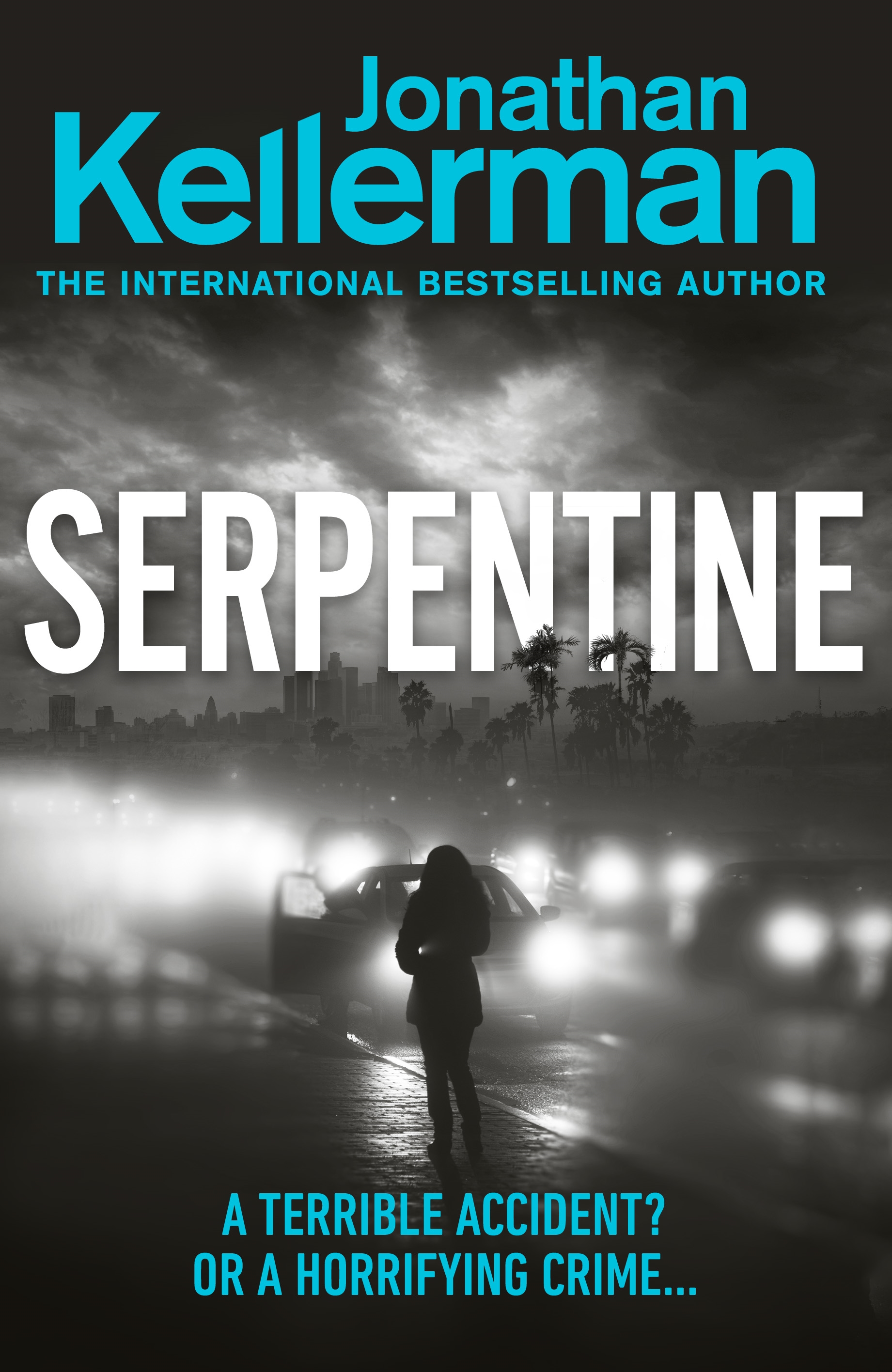
Serpentine by Jonathan Kellerman

Serpentine Cover

Publisher: Random House Audio (Audiobook – 2 February 2021)

Series: Alex Delaware – Book 36

Length: 12 hours and 10 minutes

My Rating: 4.5 out of 5 stars

Amazon     Book Depository

One of the leading stars of the murder mystery genre, Jonathan Kellerman, returns with the latest entry in his long-running Alex Delaware series, Serpentine.

For years LAPD detective Lieutenant Milo Sturgis has tended to do things his own way in the department.  Thanks to his impressive solve rate and his unique and successful partnership with his best friend, psychologist Alex Delaware, Milo has been able to crack some of the toughest murder cases that the department has come up across while managing to avoid the lows of office politics.  However, not even Milo is able to withstand pressure from the very top of the LAPD, so when an extremely wealthy businesswoman wants help from the department’s best, Milo is forced to work an impossible case.

The businesswoman, young entrepreneur Eleanor Barker, wants closure over the death of her mother, a mysterious woman who was found dead decades ago in a torched Cadillac with a bullet in her head.  Despite their reservations over the way the case was assigned to them, Milo is determined to do the best job possible, and with Alex’s help he begins his investigation.  However, with no evidence, no case file, no witnesses and no real idea about their victim’s past or origins, their chances of success seem slim.

Forced to look for answers in some unusual places, Milo and Alex are slowly able to pull together a picture of the events surrounding the death of Eleanor’s mother.  However, the more they dig, the more unusual coincidences begin to arise as what they discover deviates massively from the established facts.  It soon becomes apparent that there is far more to this case than was initially believed and that someone out there is determined to stop any investigation into this brutal murder.  Can Milo and Alex solve their most difficult case yet, or will a cunning killer continue to remain free?

Well, that was a pretty cool murder mystery!  Serpentine is the 36th entry in Jonathan Kellerman’s amazing Alex Delaware series, which has been running since 1985.  I am a relative newcomer to Kellerman’s work, having only stumbled onto series when I read his 34th book, The Wedding Guest, back in 2019.  I had an excellent time reading The Wedding Guest and the loved the authors distinctive writing style and ability to weave together a great mystery.  I enjoyed it so much I ended up checking out Kellerman’s next book, the 2020 release The Museum of Desire, which contained an impressive murder case and ended up being another amazing read.  As a result, I have been very keen to check out Kellerman’s latest book for a while now and I have to say that I was very pleased with how awesome Serpentine turned out to be.

I ended up absolutely powering through this latest Alex Delaware novel, especially once I got hooked on its exceptional and impressive murder mystery narrative.  Kellerman came up with an amazing narrative for this novel that proved to be particularly captivating right off the bat as his two established protagonists become embroiled in a seemingly impossible-to-solve case.  Forced to dig around in the past, the protagonists slowly determine the events surrounding the old murder via odd bits of evidence and a range of interesting witnesses.  While the investigative process is quite fun to see, Kellerman has also thrown a ton of fantastic twists into the story, ensuring that the reader has no idea how the mystery is going to unfold.  I love some of the unique directions that the author took this compelling case and I was impressed with some of the clever reveals that he chucked in, especially as they were set up beautifully and added some fantastic surprises to the plot.  While I did think that the book concluded rather rapidly and some storylines could have been wrapped up a little better, this was still an exceptional narrative which I deeply enjoyed.

Easily my favourite thing about the Alex Delaware novels is the great way that the author portrays the ongoing investigation.  Kellerman always ensures that his investigations extremely realistic and as a result his protagonists always engage in a methodical examination of the sources, slowly gaining the information they need and building up connections and discovering any inconsistencies.  A lot of their evidence is obtained through discussions with potential witnesses, colleagues and experts, and there may be multiple conversations with various persons of interest to find out different nuggets of information.  This then results in the main characters throwing out theories about what potentially happened and basing their future investigative directions on the most promising clues.  This manner of investigation proves to be very different to other crime fiction novels I have read, and I really enjoy this more realistic portrayal of how police could solve a difficult case, especially as the author works in time delays for evidence analysis, unreliable witnesses and colleagues, and lack of resources.  I particularly enjoyed the investigation featured within Serpentine as it forces the protagonists to solve a murder that occurred over 30 years previously.  As a result, the characters lack any sort of evidence, useful witnesses, or previous investigations to help them find the killer, and they are forced to utilise more creative methods to find information or track down anyone who has the slightest idea of who the victim was or what happened to them.  This extremely cold case was a fantastic part of Serpentine’s plot and it proved to be deeply fascinating to see how he envisioned detectives solving this sort of investigation.  I loved this realistic and methodical portrayal of a murder investigation and it really made Serpentine stand out as a fantastic crime fiction novel.

I also must highlight the outstanding two lead characters who form the heart of Serpentine, and indeed the entire series, titular protagonist Alex Delaware and LAPD detective Milo Sturgis.  Alex and Milo are a fantastic pair of crime-fighting protagonists who have taken on some extremely tricky murders during their partnership.  Both characters bring a lot to the novel.  Alex is the more serious of the two.  As a clinical child psychologist with a head for mysteries, Alex can provide some intriguing insights into the minds of the victims, witnesses, and potential suspects, which provide new insight into their cases.  Milo on the other hand is the food-loving, cynical veteran cop who works the hard grind of a LAPD detective.  While I enjoy both characters, Milo is easily my favourite due to his constant wise cracks, the author’s tasteful portrayal of the character as a homosexual LAPD lieutenant, and his somewhat maverick cop persona.  Alex is also quite fun, especially as his psychological insights have a basis in the author’s own training as a psychologist, and I liked his constant clever quips about the situations they encounter.  The real joy of these two characters, however, is the way they work together.  These two make an amazing team, especially as they have become close best friends who are able to work together perfectly in sync.  I loved the way these two were able to work together to solve crimes, and their innate teamwork and friendship is a fantastic centre of the book’s story.  I also enjoyed the way the two characters play off each other throughout the story, as their personalities and unique sense of humour really gel together well and produce a lot of fun jokes and moments.  Overall, I had an amazing time following Alex and Milo through another excellent book, and I cannot wait to see what crazy case they encounter next time.

To check out Serpentine I grabbed a copy of its audiobook format, which was narrated by John Rubinstein.  This audiobook, which has a run time of just over 12 hours, ended up being an amazing way to enjoy this fantastic book and I powered through it in no time at all, especially once I got caught up in the outstanding mystery.  Rubinstein, whose has previously lent his voice to a great collection of crime fiction novels, including previous Alex Delaware audiobooks, did an outstanding job narrating this novel, and I felt that he moved the story along at a fast and enjoyable pace which really captured the audience’s attention.  I also rather enjoyed the various voices that he utilised throughout Serpentine, as each character was given their own unique voice, which I felt fit their respective personality perfectly.  I really loved the voice that Rubinstein uses for Milo in particular, as it just screams veteran cop, and it really helped enhance how much I enjoyed this already awesome character.  As a result, I would strongly recommended Serpentine’s audiobook to anyone interested in checking out this book and listeners are in for a good time with this format.

Serpentine by Jonathan Kellerman is another impressive and clever addition to the great Alex Delaware series.  This latest book features a complex and captivating murder mystery investigation which forces Kellerman’s fantastic and lovable protagonists to dive back into the past and solve an intriguing cold case.  Full of several outstanding twists around Kellerman’s latest compelling case, Serpentine has an incredible story and readers are going to have an amazing time unwinding this great mystery.  I deeply enjoyed this fantastic novel, and this might be the best Alex Delaware novel I have read so far.  Highly recommended.

Amazon     Book Depository

Hidden in Plain Sight by Jeffrey Archer

Hidden in Plain Sight Cover

Publisher: Macmillan (Hardcover – 27 October 2020)

Series: William Warwick – Book Two

Length: 304 pages

My Rating: 4.25 out of 5

Amazon

Bestselling author Jeffrey Archer returns with the second book in his William Warwick historical crime fiction series, Hidden in Plain Sight.

London, 1986.  Following the failed attempt to put his nemesis, expert art thief Miles Faulkner, behind bars, William Warwick has been promoted to Detective Sergeant and now has a whole new focus: drugs.  William and his team have been assigned to take down a notorious drug kingpin, one who has all of South London in his pocket and who takes great pains to hide his identity and methods.  However, despite their focus on catching this mysterious drug lord, known only as the Viper, Warwick is still determined to take down Faulkner.

When William coincidently arrests an old acquaintance from his school days, Adrian Heath, it unexpectedly provides him with the opportunity that he has been looking for.  Not only does Adrian have information about the identity of the Viper, but he also has a connection to Faulkner that could be exploited to finally throw his adversary behind bars.  As William attempts to close the net around his targets, he must also counter the moves of his enemies, even when they attempt to ruin his life or his upcoming marriage to Beth.  However, it will take more than personal attacks and clever setbacks to discourage William, and he soon has Faulkner and the Viper exactly where he wants them.  But even in defeat, Miles Faulkner is a dangerous opponent, especially now that he has his vengeful eyes fully set on William and everyone he loves.

Hidden in Plain Sight was another exciting and clever novel from Jeffery Archer featuring a compelling historical crime drama set around the life of a fun fictional character.  The protagonist of this series, William Warwick, actually first came into existence in Archer’s iconic Clifton Chronicles series of historical fiction books, where he was introduced as the in-narrative fictional protagonist of a series of detective books written by the Clifton Chronicle’s main character, Harry Clifton.  After Archer concluded the Clifton Chronicles a couple of years ago, he decided to provide his fans with a more detailed exploration of this fictional detective, and this series is the result.  The William Warwick series looks set to be Archer’s next major long-running series and it will explore the entire career of Warwick, from eager young recruit to hardened and brilliant detective.  This is the second William Warwick novel following last year’s Nothing Ventured, and Archer has come up with an enjoyable new tale that proved really hard to put down.

This second entry in the William Warwick series contains another intriguing and exciting character driven narrative that sees the protagonists engage in a game of wits with some despicable criminals.  This proved to be an excellent historical crime fiction novel that not that not only continues the compelling narrative set up in the previous book in the series but which also sees the protagonist go after an entirely new foe.  Archer presents a great recreation of 1980s London and takes the story in an interesting new direction by having William attempt to combat the city’s crippling drug trade.  However, the story still has a fascinating focus on the world of art and antiquities and its associated criminal underbelly, thanks to the amazing returning antagonist from the first novel.  This story proved to be really exciting and fast-paced, and I enjoyed the variety of different crime fiction elements that Archer included in the plot, as the protagonists attempt to take down their quarry in a number of different manners.  Readers are treated to a range of great sequences, from pulse-pounding police raids, detailed investigations, cunning undercover operations and even a very entertaining courtroom sequence.  Archer has loaded Hidden in Plain Sight’s story with all manner of twists and turns, so much so that the reader is often left surprised at who ends up on top and where the story will go next.  This was a really enjoyable narrative that I found to be extremely addictive, resulting in me powering through the entirety of Hidden in Plain Sight in just over a day.  Fans of the previous entry in the series (as well as the Clifton Chronicles) will have a great time continuing the fun story started in Nothing Ventured, while new readers will also be able to quickly dive into this novel and become engrossed in the story.

Like all of Archer’s books, the narrative of Hidden in Plain Sight is strongly driven by the excellent characters that the plot follows.  Archer utilises a range of different character perspectives to tell his story, presenting a rich and multifaceted narrative that explores the lives of several intriguing protagonists, as well as a couple of great villains.  Most of the story focuses on the series’ titular character, William Warwick, the determined, ambitious and righteous police officer who has dedicated his life to fighting crime.  Warwick continues to grow as a detective throughout Hidden in Plain Sight, losing more of his “choir boy” personality and gradually becoming more addicted to the job and the danger.  Despite that he still maintains his strong moral code and proves to be a very likeable central character, especially as Archer spends a lot of time exploring his personal life and his various relationships.  In addition to Warwick, Archer also dedicates a large amount of the book to several key side characters including Warwick’s police colleagues, the major antagonists and members of Warwick’s family.  These various additional characters and perspectives really added a lot to the story’s flow, and it was a much more effective way to tell this narrative than through the eyes of Warwick alone.  Most of these characters are only featured for a small amount of time throughout the book, but I felt that Archer made the most of their appearances, showcasing their personalities and motivations in an excellent manner and making sure that the reader was concerned for their various story arcs.

While these books are mostly focused on the exploits of William and his crime fighting associates, the character I have the most love for is the villain, Miles Faulkner, who is a constant highlight of each book.  Faulkner is a debonair and brilliant criminal mastermind who specialises in elaborate art thefts and forgeries and who gained the attention of the protagonists in Nothing Ventured.  Faulkner serves as a brilliant foil to William and the other police, continually outsmarting them at every turn and thoroughly acting as the cocky master villain.  Faulkner pretty much steals every scene he appears in, and you cannot help but enjoy his antics, even when you are pulling for the protagonists to knock him off his pedestal.  Archer introduces a number of entertaining and clever twists around Faulkner throughout Hidden in Plain Sight, and it was extremely entertaining to see the various ways in which this antagonist manages to manipulate everyone around him and generally come up on top, even when it appears that he has lost.  I personally liked the more vindictive streak that appeared as part of Faulkner’s character in this book, following his various losing encounters with William and the other protagonists.  Not only does this result in a number of clever and elaborate revenge ploys but it also gives a harder edge to Faulkner as the overall antagonist of the series, and hints that he may have some diabolical plans for William in the future entries of this series.  I had a lot of fun with this excellent antagonist and I cannot wait to see what villainy he unleashes next.

Hidden in Plain Sight is another fun and clever novel from Jeffery Archer that comes highly recommended.  Archer has done an excellent job of continuing his William Warwick series, and readers are in for an exciting and enjoyable time with this book.  I really liked where Archer took the story in Hidden in Plain Sight and I am looking forward to seeing how the series will continue next year.

Amazon

Lies Sleeping by Ben Aaronovitch

Lies Sleeping Cover.jpg

Publishers: Gollancz and Orion Audio (Audiobook format – 15 November 2018)

Series: Rivers of London – Book 7

Length: 10 hours 25 minutes

My Rating: 5 out of 5 stars

Amazon     Book Depository

Prepare to dive headfirst into one of the best urban fantasy series in the world today, with the seventh book in Ben Aaronovitch’s Rivers of London series, Lies Sleeping.

London is a magical place, especially for Peter Grant, Detective Constable and apprentice wizard.  Peter is a member of an elite unit of the London Metropolitan Police, known as the Folly, which is tasked with investigating magical crimes and protecting the city from all sorts of magical threats.  The person at the top of the Folly’s most wanted list is Martin Chorley, also known as the Faceless Man, a magical criminal mastermind who is determined to do whatever it takes to gain power.  However, despite the Met and the Folly’s considerable resources, Chorley is always able to stay one step ahead of those chasing him.

During a routine attempt to subtly panic several of Chorley’s known associates, a magical creature attacks a potential witness.  Peter’s investigation soon reveals that the witness had ordered the forging of a large and mysterious bell, which Chorley is desperate to get his hands on.  As Peter and his team dig deeper in the bell’s construction, they quickly begin to realise that Chorley is the final stages of his master plan, a plan tied deeply into the heart of London’s dark and bloody history, and one which could cause untold disaster for the entire city.

As the clock ticks down, Peter needs to work out the connection between London’s past and the mysterious magical events occurring all over the city.  Can Peter and his team once again save the day, or will their adversary finally obtain the power he has always desired?  Moreover, what will Peter do when he comes face to face with the woman who betrayed him to Chorley, his old partner in the Met, Lesley May?

Ben Aaronovitch is a highly regarded author with an interesting writing history to his name.  His writing career began back in the late 1980s and early 1990s, when he wrote a couple of Doctor Who television serials, including the highly regarded serial Remembrance of the Daleks, as well as three entries in the Virgin New Adventures series of Doctor Who books.  The Virgin New Adventure series chronicled the adventures of the Doctor after the television show’s hiatus in 1989.  Aaronovitch’s three entries in this book series sound incredibly interesting, although they were considered to be somewhat controversial at the time due to their more adult content.  Aaronovitch did not get around to writing his fantasy work until 2011, when he wrote the urban fantasy Rivers of London.  This was the first book in the author’s Rivers of London series of books (alternatively known as the Peter Grant series or the PC Grant series), for which the author is best known for.  The Rivers of London series is very highly regarded, and Aaronovitch has worked hard to expand on the story and universe of this series, writing a number of novellas, short stories and graphic novels on top of the series’ main seven books.

Before Lies Sleeping, I had never got around to reading any of Aaronovitch’s books, despite hearing good things about his main series.  As a result, I was very happy that I finally managed to check out the series earlier this year.  I did receive a trade paperback edition from Hachette Australia, but in the end, I chose to listen to the audiobook version of this book, narrated by Kobna Holdbrook-Smith.  I have to say that I was extremely impressed with this brilliant book and found that I really enjoyed the excellent and captivating story.  Lies Sleeping easily gets a full five-star rating from me, and I fully intend to go back and check out the other books in this series.  This book is an excellent blend of the fantasy and crime fiction genres, both of which come together perfectly to create an extremely compelling and complex read.

Lies Sleeping will prove to be extremely appealing to huge range of people; not only pre-existing fans of the series but also those readers who have not read any of the Rivers of London books before.  As a first-time Aaronovitch reader, I found that it was incredibly easy to step in and enjoy this series, as the author did a fantastic job making Lies Sleeping accessible to everyone.  While Aaronovitch has created a huge amount of lore around his series, including in his novellas and comics, the reader does not need to have any knowledge of these or the previous six books in the series to fully understand the entirety of Lies Sleeping’s story.  However, those readers who do have experience with this series will love how the story continues to development, as well as the massive and surprising twists that occur throughout the book.

At the core of this book lies a series of intriguing mysteries that take place throughout London.  In order to achieve his villainous goals, the antagonist has embarked on a series of seemingly random and chaotic crimes and ventures, all of which apparently form part of his master plan.  These various mysteries or criminal events were really interesting, and I liked trying to work out how they would all come together.  I particularly liked how various parts of these mysteries were deeply tied into the history of London, and the protagonist needed to gain a historical understanding of some of various myths and legends surrounding London.  Watching the protagonist attempt to unwind the complex plan of the book’s villains was extremely compelling, and I had a great time trying to work out what was happening myself.  One or two threads of these mysteries did go unsolved in this book, and I will be curious to see if they are picked up in any of the future entries in this franchise.

Aaronovitch is clearly a very creative writer, as he utilises a huge range of different and fairly unique fantasy elements throughout this book.  While there are a large number of wizards, spells and elvish beings throughout the book, the main focus is on the titular rivers of the series.  The more common magical beings encountered in this series are the personifications of the various rivers and waterways (current and historical) that flow through and around London.  These beings are similar to gods, although the term genius loci may be more appropriate, and have a huge range of powers.  These are a really intriguing addition to the book, and it was interesting to see the protagonist attempt to deal and interact with the various river characters, including his girlfriend, Beverly Brooke (yes, the main character of this series is dating a river).  There is also a huge range of other genius loci, or similar beings, that are featured within the story, including the mysterious and insane Mr Punch.  The magic that the human characters utilise is complex and slightly less ostentatious than some classic pieces of fantasy, but when the master wizards get to work it can be quite impressive.

One of the things I liked best about this book is how the author could create a realistic British police narrative and ensure magic became part of the procedure.  The Folly may be a special branch of the Metropolitan Police, but it is still part of the police force, and as such the characters are forced to follow standard procedure when investigating magical crimes.  Having these elite magical characters fill out paperwork and other various elements of day-to-day police life was deeply amusing.  I did like seeing how regular law enforcement tactics, anti-crime strategies and police combat techniques could be utilised against magical opponents.  The overall fantasy elements of this book are really enjoyable, but I really liked to see them be blended with a classic British police story.

Aaronovitch has done a fantastic job creating a huge and intriguing group of characters for this series.  The protagonist of Lies Sleeping and the Rivers of London series is Peter Grant, police officer and official wizard’s apprentice.  Peter is the sort of protagonist I really enjoy (sarcastic, funny and determined) so I quite enjoyed having him narrate the story, making a number of great jokes throughout.  The other police characters make up a great supporting and diverse cast, with a range of different abilities and characteristics.  I especially liked the classy and wise Detective Chief Inspector Thomas Nightingale, the last officially sanctioned English wizard and Peter’s mentor.  He is an extremely charming and old-fashioned character who has a huge amount of magical power at his fingertips and who can be quite intimidating if he puts his mind to it.  I also quite enjoyed the other magical characters that appeared throughout the book, as Aaronovitch has created a bevy of river gods and associated genius loci characters.  I liked how many of these ancient characters portrayed modern characteristics and ways of speaking, even when talking in a historical context.  Long-time readers of the series will also enjoy the further exploration of several recurring characters, including finally revealing the backstory of the mysterious Mr Punch.

While the protagonists and supporting cast are great characters, I really liked the antagonists in this story.  The main villain of the story is Martin Chorley, also known as the Faceless Man.  He is an excellent antagonist who is built up as a master planner, master magician and crazy villain before you even see him in the book.  His master plan was fairly complex, and the character’s overall arc in this book featured some massive twists that I did not see coming.  Lesley May is another really complex character who is a great addition to the series.  Her relationship with Peter is one of the best parts of the book, as even after her betrayals earlier in the series, he is still trying to save her from herself.  The way this works out in the end is quite dramatic, and it will be interesting to see where it goes from there.

While a large part of this book is set out more as a slow and steady police procedural, there are some fantastic action sequences within Lies Sleeping.  These come about when the protagonist attempts to stop the plans of the Faceless Man, and all manner of chaos erupts.  Nothing highlights this better than an extended action sequence which involves Peter chasing after a van on a bicycle, throwing fireballs, while all manner of debris is magically flung at him and several pursuing police vehicles.  The magical duels between some of the participants, mainly Nightingale and Martin Chorley, can be particularly impressive, but I personally liked how many of the confrontations devolved into fist fights as both sides attempt to distract the other and disrupt their castings.  Plus, where else are you likely to see British police with truncheons attempt to fight evil wizards?  These amazing action sequences really added to the story, and it was great to see all this magic in action, rather than being theorised the entire time.

While I would have already been tempted to give Lies Sleeping a five-star review, the thing that definitely clinches it for me is the amazing audiobook adaption of the novel, narrated by actor Kobna Holdbrook-Smith.  At nearly 10 hours and 30 minutes, this is a moderately easy audiobook to get through, and I had an absolute blast listening to it.  Holdbrook-Smith has an amazing voice and his work narrating this audiobook was just incredible.  His voice for protagonist and story narrator Peter perfectly encapsulated the character and got the full force of his witty and enjoyable personality across to the reader.  I really liked all the voices that Holdbrook-Smith created for the various characters featured throughout Lies Sleeping, especially for some of the magical creatures, who had an air of ancient wisdom in their voices.  However, without a doubt my favourite voice was the one for Nightingale.  The voice chosen for Nightingale is full of all sorts of old British class, and I thought it fit the character perfectly and was one of my favourite parts of this whole audiobook.  Aside from the outstanding voice work, I also quite liked the jazzy music that was played at the start of each chapter.  It gave the book a real noir private investigator feel, and I like how it added to the tone of the book as a whole.  The audiobook version of this book also helped me understand the story a bit better as an outsider to the series, and that, combined with Holdbrook-Smith’s brilliant voice work, makes me completely happy to recommend the audiobook format of Lies Sleeping.

Aaronovitch once again delivers a spectacular read that expertly combines amazing fantasy and crime fiction elements into one widely outstanding narrative.  There are so many excellent elements to this book, and I had absolutely loved my first foray into the Rivers of London series.  I strongly recommend listening to the Lies Sleeping audiobook, narrated by the very talented Kobna Holdbrook-Smith, but those readers who prefer to read their books will also find much to enjoy about this fantastic book.  This is one of the best urban fantasy books I have ever had the pleasure of reading.  I fully intend to go back and check out all the preceding books in this series, and I can’t wait to see where the series goes next.  Five stars all the way.

Amazon     Book Depository