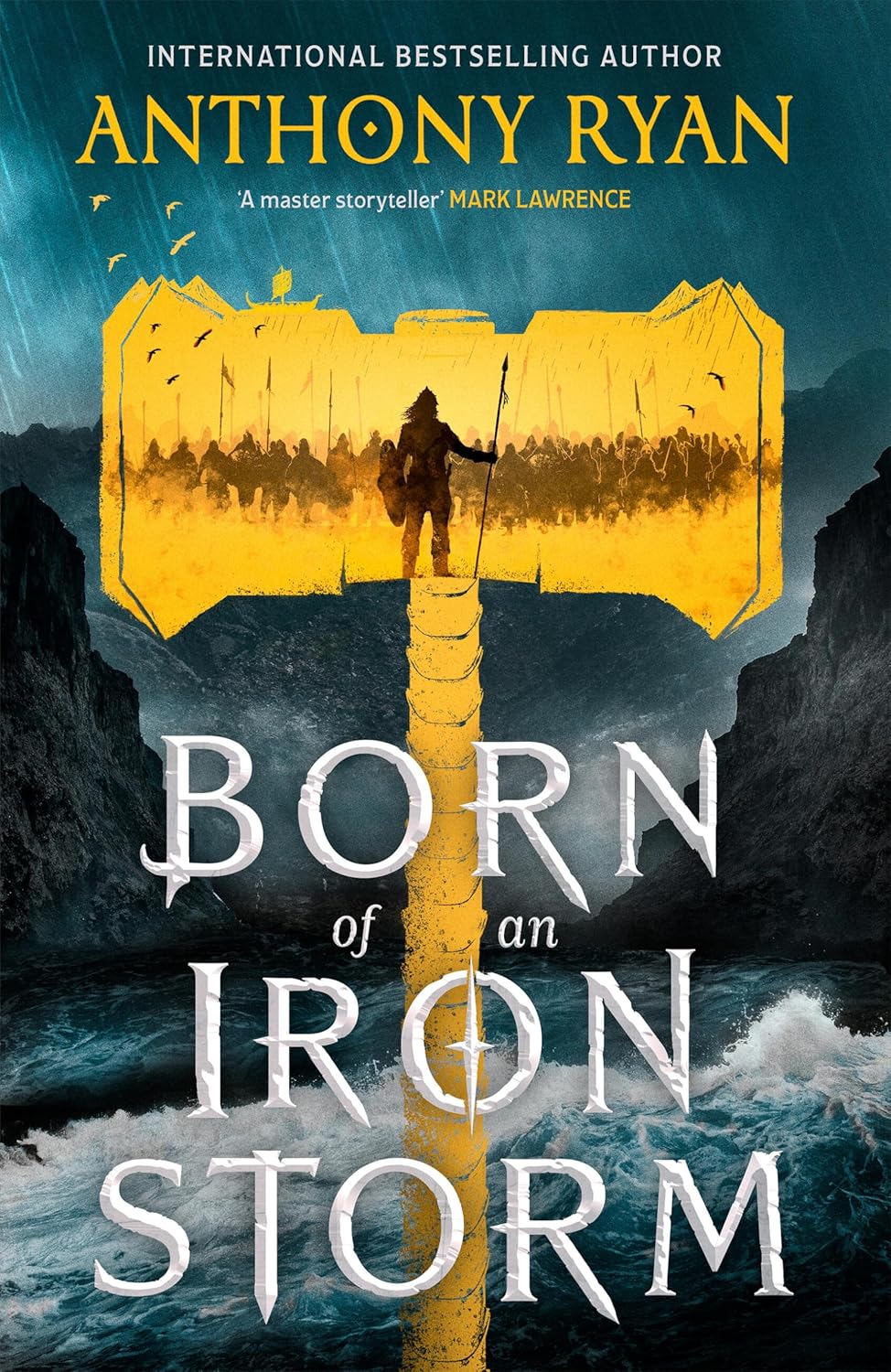
Born of an Iron Storm by Anthony Ryan

Publisher: Orbit/Little Brown Audio (Audiobook – 26 August 2025)

Series: Age of Wrath – Book Two

Length: 19 hours and 33 minutes

My Rating: 5 out of 5 stars

Amazon

Acclaimed fantasy author Anthony Ryan continues to explore an epic fantasy world of warriors, scholars and monsters with his outstanding new novel, Born of an Iron Storm, the impressive second entry in his Age of Wrath series.

In recent years, one of my favourite fantasy authors has been veteran writer Anthony Ryan.  Known for several intriguing and varied series, I become a fan of Ryan a few years ago when I started reading The Covenant of Steel series.  Following a young bandit turned scribe, who finds himself taking on many roles in his chronicled adventures, including that of knight, spy, rebel and heretical traitor, this amazing series was a really impressive example of fantasy fiction, and I had an incredible time with The Pariah (one of my favourite books and audiobooks of 2021), The Martyr (one of my favourite books and audiobooks of 2022), and The Traitor (one of my favourite books and audiobooks of 2023), all of which were five-star reads.

Due to how much I loved these amazing novels, I was very excited last year when Ryan released the first book in the Age of Wrath series, which served as a sequel to the Covenant of Steel books.  The first Age of Wrath novel, A Tide of Black Steel, is set a couple of decades after the events of The Traitor and builds on some of the events of the first series, while also featuring its own unique story.  I really enjoyed A Tide of Black Steel, which veered away from the chronicle style of the previous trilogy, and instead set out a Norse saga inspired tale of adventure and war.  Just like the Covenant of Steel novels, A Tide of Black Steel got a full five-star rating from me, and it was one of my favourite books and audiobooks of 2024.  As such, I have been very eager to get my hands on this sequel, which was one of my most anticipated books of 2025, and Ryan once again did not disappoint.

War and treachery have come to the sprawling island nation of Ascarlia, as the long-lost nation of Nihlvar begins an invasion centuries in the making.  The once powerful Sister Queens of Ascarlai lie dead at the hands of one of their own, the deranged Sister Lore, and their capital of Skar Magnol has been captured by Nihlvarian forces.  With their massive fleet in Skar Magnol’s harbour, and the forces of Ascarlia scattered, the Nihlvarian victory looks assured, and soon their eye turns to the wealthy port city of Olversahl and the lands of Albermaine beyond.

However, there are some who chose to resist the Nihlvarian threat.  In Skar Magnol, the young scholar Elvine finds herself trapped as an unwilling accomplice to Sister Lore.  To survive, she must play along with her queen’s twisted designs, while setting her own rebellious schemes into motion.  At the same time, loyal Ascarlian war leader Thera has survived the first skirmish against the Nihlvarian in the Outer Islands and finds herself leading a mismatched fleet against the invaders.  However, facing overwhelming odds, Thera must seek allies wherever she can, while the burdens of leadership lay heavy upon her, as if she fails, all Ascarlia falls.

As war rages in Ascarlia, other fights for survival occur across the sea.  Following his discovery of the Vaults of the Altvar, Thera’s brother Felnir has been promised a kingdom, and voyages to a hidden land filled with blood and suffering.  If he wishes to rule, Felnir will have to fight for the loyalty of his new people, while discovering the ancient secrets of those who came before him.  At the same time, in Nihlvar, the captured Ascarlian Ruhlin and his friends have escaped from captivity and are now fugitives from the Nihlvarian ruler, the Vortigurn.  If he wishes to keep himself and his comrades alive, Ruhlin needs to learn to control his inner monster and escape the bonds of prophecy, but dark secrets and beings have their eyes on him.

As war continues to spread like fire, Elvine, Thera, Felnir and Ruhlin must all fight their own desperate battles to survive and find their place in this new world.  But with treachery and hard choices all around, can these four unlikely heroes survive the wrath of the Vortigurn, or will their ambitions, fears and doubts tear them apart?

Anthony Ryan continues to showcase why he is one of the leading modern authors of fantasy fiction with this incredible and impressive novel.  Serving as an outstanding second entry in the Age of Wrath series, Born of an Iron Storm brilliantly continued Ryan’s complex, multilayered narrative, while taking the series in some exciting new adventures.  A classic fantasy tale filled with great characters, complex worldbuilding and intense, nautical action, Born of an Iron Storm was an epic read which gets a full five-star rating from me.

I felt that Born of an Iron Storm had an awesome overall narrative to it, as Ryan continued his elaborate series in strong fashion.  Once again split between the returning point-of-view characters from A Tide of Black Steel, you are essentially treated to four separate storylines, each with their own unique focus, setting and style.  This includes the intrigue laden storyline around Elvine as she attempts to survive the chaos surrounding the coup at Skar Magnol, which results in a compelling, espionage focused narrative.  Elvine’s story goes hand-in-hand with Thera’s storyline, which sees this protagonist attempt to raise an army to defend Ascarlia and retake the capital.  Thera’s chapters were some of the more action-heavy in the book, with a ton of great naval combat sequences, and it was fascinating to see this character grow into a leadership position.  Aside from Elvine and Thera, there was also the fantastic narrative around Felnir, who sets out to claim a new land as king by taking down a group of religious fanatics whose origins mirror that of the Nihlvarians.  Finally, escaped slave and occasional monster Ruhlin finds himself and his new comrades being hunted through Nihlvar and must seek an alliance with the land’s original inhabitants to survive.

Unlike the first book in the series, which saw several of the storylines cross over regularly, all four distinctive character plotlines remained mostly separate in Born of an Iron Storm, with only a few points of interaction in the Elvine and Thera narratives occurring.  This essentially meant that each of the narratives developed in a vacuum and were allowed to play out at their own pace.  Not only do these separate narratives stand out on their own merits but they come together nicely to form an intricate and addictive overarching narrative, as the alternating character-driven tales came to parallel each other extremely well.  All four of these distinctive narratives started off a lot quicker in Born of an Iron Storm than they did in the previous book, which allowed the reader to effectively get drawn into each character’s journeys as their storylines proceed.  Each storyline went in some intriguing directions, and the disparate adventures resulted in quite an exciting novel.  Ryan ensured that there were some exciting moments and compelling character interactions in each character’s respective chapters, and there was a great focus on action and war in this second Age of Wrath book.  Indeed, there were a few chapters that saw all four protagonists essentially fighting their own separate battles at the same time, with near simultaneous naval conflicts, sieges, pitched battles and forest ambushes.  Ryan ends each action and adventure laden narrative of Born of an Iron Storm on a very compelling note, with a few interesting twists and reveals hitting the two plotlines set outside of Ascarlia.  It also leaves the overall narrative of the series in a great place for the third, and presumably final, book, and I am extremely keen to see what happens to each protagonist in the next thrilling instalment.

I deeply enjoyed how Born of an Iron Storm came together, and it works well as the second entry in this epic series.  Ryan utilises many of the same style elements of A Tide of Black Steel, with the Viking-inspired setting and focus on multiple character adventures working particularly well to present an overall layered narrative with a lot of moving parts to it.  The author’s switch from the first-person chronicle style in the previous Covenant of Steel books to a third-person perspective told from four distinctive protagonists in this series allowed for a wider focus to the book, and Ryan makes sure to provide some intriguing expansions to his fantasy world.  Each chapter switches the narrative to another of the four perspective characters, and it was interesting to see how each switch would change the tone of the narrative depending on whichever protagonist was in focus.  I felt that Ryan did a great job of balancing the four distinctive storylines throughout the novel, and each plotline developed in some compelling ways.  I honestly found myself enjoying each of these separate storylines equally, with no noticeable weak links.  However, my favourite was the Elvine plotline, thanks to its inherent intrigue and focus on one of the book’s more fascinating protagonists, and Thera’s chapters, which had the most action and multiple cool scenes of long-ship on long-ship warfare.

Due to being the second book in a complex fantasy series, which is itself a sequel to a previous trilogy, Born of an Iron Storm is probably best enjoyed by those who have read the preceding novels from Ryan.  While there is a very intensive summary of the events of A Tide of Black Steel at the front of this novel, Born of an Iron Storm dives into the narrative very quickly, and reading the previous book really does help to increase enjoyment and understanding of the plot.  Ryan does a good job of recapping key plot points as he writes, and when combined with the comprehensive summary, new readers can probably drop into Born of an Iron Storm without too much effort.  However, this novel is going to appeal to those existing Ryan fans the most, especially those who previously enjoyed the Covenant of Steel novels.  While not too excessively vital to the plot, there are a lot of references to the events of the Covenant of Steel series, including the appearance of a couple of minor characters from these books, which was fun to see.  The events of these original books also play a big role in a couple of characters storylines and development, especially in the Elvine sections of the book (which features the two children of the Covenant of Steel’s protagonist), which lead to some compelling and intense moments.  I personally loved seeing Ryan continue to build on his already existing setting, and it was great to see what followed the chaotic events of the Covenant of Steel novels.

Ryan once again spent a lot of time developing his four central characters in Born of an Iron Storm, and their unique personalities, histories and continued changing perspectives, added some intriguing elements to the narrative.  Each of these characters have some fascinating moments and interactions in this novel, which cleverly builds on their storylines from the previous novel.  This includes Elvine, the young scholar revealed to be the long-lost daughter of Alwyn Scribe, who is forced to find her inner courage in this novel after being trapped in the captured Skar Magnol.  Caught up in the madness of Sister Lore, who develops a dark obsession with her, Elvine finds her inner rebel, while also trying to comprehend the sentient magical spear she recovered in the previous book.  Elvine’s storyline was really well written in Born of an Iron Storm, and Ryan had fun turning the previously mousy scholar into a dangerous warrior and leader, who gets into just as much trouble as her father.  Ryan’s other badass female protagonist in this novel was Thera, who finds herself the reluctant leader of the Ascarlian loyalist forces.  A skilled fighter, Thera spends much of Born of an Iron Storm learning to take on the mantel of leadership, while also dealing with her traumatic past, and her current emotional complexities.  Thera proved to be a very intriguing character to follow, especially with her chapter’s naval content, and it was fascinating to see her influence grow thanks to her actions.

On the other side we have the male protagonists, Felnir and Ruhlin, both of whom go through their own development and hell in this book.  Ruhlin’s character arc was a good continuation from A Tide of Black Steel, as he works to control his newly discovered inner monster and turn it into a force for good.  Like Thera, Ruhlin finds himself reluctantly leading a group of people who have placed their lives in his hands, and it was interesting to see him rise to the challenge, especially when even more figures put their hope in him.  Felnir, on the other hand, works to change fate by actively seeking leadership in a fun contrast to his sister and rival, Thera.  Finding himself in an unfamiliar land, Felnir works to inspire people unfamiliar with his past and soon finds the acclaim and respect he’s always wanted.  However, Ryan also writes a great storyline around his unchecked ambition and the consequences it has on those around him, and there is a great darkness to this character that is going to make him the wildcard of the series.

While the above four characters naturally get most of the focus in this series, Born of an Iron Storm also features a massive supporting cast, some of whom prove to be just as compelling and memorable as the main protagonists.  A lot of these figures are returning from A Tide of Black Steel, and I must admit that I was glad that Ryan put up his comprehensive summary at the front of this book, or I would have probably lost track of who they were.  Most of the best characters in this book were primarily in Elvine’s chapters, with the returning Colvyn (son of a certain scribe and a dark saint), being very fun, even if he got a little less focus here.  The ancient Ascarlian warrior and spymaster, Margnus Gruinskard, the Tieldwald was a great inclusion, first as a prisoner, then a reluctant ally to Elvine, and Ryan wrote a distinctive wearied element to him in this novel.  The author also did an amazing job of building off the big twist at the end of A Tide of Black Steel by featuring more of the traitor Sister Queen, Sister Lore.  Ryan made Lore into a particular twisted and dangerous antagonist, and her obsessive interactions with Elvine were some of the most compelling parts of the book.  Aside from these figures from the Elvine chapters, my favourite supporting figures were Lynnea, the innocent yet dangerous companion to Thera, and the mysterious Wohtin, who serves as Felnir’s guide to his new land.  Both were outstanding supporting characters in this novel, and I loved the intense, and very different, interactions they had with their respective protagonist.  I’m honestly barely scratching the surface of all the great supporting figures in Born of an Iron Storm, and I really appreciated the strong and varied cast that emerged in this novel.  All of them were very well written, and I really appreciate how Ryan utilised them to enhance his excellent narrative.

As I have tended to do with Ryan’s previous novels, I ended up enjoying Born of an Iron Storm on audiobook, which was an amazing experience.  I often find that compelling fantasy novels really come across well when read out by a talented narrator, and Born of an Iron Storm was an excellent example of this.  Thanks to the excellent narration of Steven Brand, who previously narrated the Covenant of Steel series, Born of an Iron Storm was a great treat to listen to, and I ended up powering through its near 20-hour long runtime.  Brand did an amazing job diving into the multilayered narrative and bringing out all the detail, action and compelling story elements through his narration, and I ended up absorbing a lot more detail thanks to having the story read out.  The narrator also brought back all his fantastic character voices from the previous audiobook, as well as a few new ones, to give the cast of Born of an Iron Storm life.  These characters came across amazingly, and I ended up having a blast listening to Born of an Iron Storm, especially the cool action sequences, which were so epic to listen to.  As such, I really recommend checking out this novel on audiobook, as you will be in for an amazing time.

Overall, Born of an Iron Storm was another exceptional novel from Anthony Ryan, who continues to expand on his cool fantasy world with another amazing, adventure-filled read.  Loaded with action, a fun story, and some excellent characters, Born of an Iron Storm was an impressive second outing in the author Age of Wrath series, and I loved how the story continued to evolve.  As such, this book comes highly recommended, and I cannot wait to see how Ryan continues his outstanding series next year.

Amazon

The Bone Raiders by Jackson Ford

Publisher: Orbit (Trade Paperback – 12 August 2025)

Series: The Rakada – Book One

Length: 470 pages

My Rating: 4.5 out of 5 stars

Amazon

Prepare for one of the most entertaining, thrilling and over-the-top fantasy novels of 2025 with the intensely fun novel, The Bone Raiders by Jackson Ford.

Jackson Ford is a compelling author who has written an interesting array of outrageous novels over the years.  Probably best known for The Frost Files series, which followed a telekinetic protagonist as she got in all manner of trouble, Ford has also released several fantastic science fiction novels under the name Rob Boffard.  I have been hoping to read some of Ford’s books for a while now, and I decided to finally take the plunge with his latest release, The Bone Raiders.  The first book in the author’s new The Rakada series, The Bone Raiders sounded extremely cool thanks to its entertaining plot and fun cover, and I couldn’t wait to dive into it.

In the grasslands of the Tapestry, raider bands used to run free as the supreme force of the wilds, pillaging towns and caravans at their leisure.  However, the glory days of the raiders are over, thanks to the rise of a new Great Khan with a vision to have all the people of his realm living under his thumb.  From his capital in Karkorum, the Great Khan has organised the slow destruction of anyone living in the Tapestry, with his mighty armies killing all who defy him.

Of the remaining raiders, none are as feared as the Rakada.  Better known as the Bone Raiders, the members of the Rakada are deadly fighters capable of fighting off most threats in the Tapestry.  However, their greatest weapon is their carefully cultivated reputation, gained by adorning their armour with the bones of the few people stupid enough to fight them.  But after the constant battles to escape the Khan’s armies, the Rakada only have a few raiders left.  With little food or viable targets to raid, the future of the Rakada looks grim, until a chance encounter with an araatan, a giant, fire-breathing lizard, gives young Rakada scout Sayana a bright idea.

After falling on the back of an araatan and accidently guiding its wild rampage to save the lives of her comrades, Sayana believes that these creatures are the future for her band.  Determined to find and train an araatan to be the ultimate combat mount, Sayana forcefully enlists the help of a legendary animal trainer from the capital.  However, coming up with the plan is one thing, but actually learning to ride the giant beasts without being burned alive is a very different proposition.  Worse, thanks to Sayana’s actions, the Rakada soon find themselves being hunted by the Great Khan’s ruthless right-hand, who wants her kidnapped sister returned to her.  To survive the vengeful onslaught coming their way and have any chance at a future, Sayana and her band will need to do the impossible and learn to ride the araatan or die trying.

Ford really did not disappoint with The Bone Raiders, as this awesome novel was everything I had hoped for.  Loaded with slick action, entertaining characters, and a particularly epic fantasy premise, The Bone Raiders was a fiery blast of fun from start to finish.  Working extremely well as the first book in the author’s new The Rakada series, The Bone Raiders was a great fantasy read with a lot of unique heart to it.

I have a lot of love for Ford’s ambitious and particularly awesome plot idea for The Bone Raiders, which saw a small band of badass, bone-covered female raiders attempt to change the status quo of their land by taming walking dragons, which frankly sounds a little out there, but which the author really makes work.  Starting off with a raid which goes bad very fast, Ford provides an excellent opening for The Bone Raiders, which features great character introductions amongst an unfortunate ambush and the sudden appearance of a giant fire breathing lizard, whom one of the protagonists, Sayana, inadvertently rides to save the day.  I really enjoyed how Ford quickly and effectively provided all the key details about this new fantasy universe, and some of the unique characters who inhabit it in this scene, and you get a great sense of the author’s style and humour here.  This opening sequence soon leads to Sayana coming up with the ambitious plan to train the araatan and ride them into battle against the Khan’s forces.  Forced to commit some light kidnapping of an additional supporting character, the protagonist is soon on her way to commit her plan, despite the worries of the Rakada’s leader.

While the protagonists attempt to gain the trust of a wounded araatan, Ford ups the stakes of The Bone Raiders’ plot through the sinister perspective of the book’s main antagonist Yesuntei.  Yesuntei proves to be an excellent complex villain for this first novel, and her deadly hunt for the Rakada leads to all manner of trouble.  Following some excellent sequences in the middle of the book, including a flooded raid and a brutal battle interrupted by sudden araatan attack, The Bone Raiders goes full throttle into its impressive final third, as Ford really amps up the action.  Thanks to a well-executed betrayal, the protagonists enter a particularly dark spiral which can only be resolved by a truly desperate plan.  As you can imagine in a book about first-time dragon tamers, things get crazy in this final section, including an all-out battle sequence with some true carnage.  I loved how all the key story elements of this book come together in this final scene, and it truly was the chaotic ending The Bone Raiders’ deserves.  Finishing off with a final foreshadowed reveal that sets up for some interesting continuation to the series, The Bone Raiders was so much fun to read, and I love its highly entertaining story.

I really enjoyed how this novel came together, and Ford clearly had a lot of fun writing The Bone Raiders, as the book featured a light-hearted style that expertly matched its over-the-top story.  Bringing together a great blend of high-octane action, chaotic characters and amusing humour, there is a lot to love and laugh about The Bone Raiders, as Ford tries to reach those readers who love a more comedic tilt to their epic fantasy.  However, there is far more to The Bone Raiders than that, as the author cleverly inserts inventive world building, subtle messaging, and some devastating emotional stakes around a particularly powerful cast.  All this captivating complexity is well showcased through three separate perspective characters, each of which provides a different take on the events of the book, including the main antagonist’s hunt for the protagonists.  Combine this with Ford’s excellent ability to pull together an over-the-top sequence of events, including several with araatan-riding shenanigans, and this was a very entertaining read that makes great use of the author’s complex and emotional writing.

One of the things that makes The Bone Raiders work so well is the varied and unique characters featured within the plot.  Ford does an amazing job of breaking the story up between three fantastic main figures, and there is some compelling character development which adds to the complex emotional intensity of this crazy novel.  Of these, the main protagonist is Sayana, a young scout of the Rakada, who ran away from a life of privilege to be free.  The idealistic and determined Sayana proves to be a great catalyst for many of the book’s main plot elements, and Ford provides some interesting character interactions amongst her plans, especially as she finds romance, rejection and the resentment of her chief in the same place.  The author writes an excellent arc around Sayana as she attempts to find herself, while also providing some hints at her past and who she truly is.  While I saw the big reveal about Sayana coming, it was still fun and should lead to some additional glorious carnage in the future.

While much of the focus of the plot is around Sayana, you also get some excellent chapters from the perspective of her fellow raider, Hogelun.  The Rakada’s muscle and brawler, Hogelun was an interesting choice for a secondary perspective figure, but it was one that worked well.  A straightforward figure, Hogelun provides some interesting alternate viewpoints to the plot, while also trying to deal with a complex romantic relationship.  Ford works in an excellent storyline about Hogelun finding her confidence and not letting others think for her, and I really enjoyed seeing her opinion on the chaotic events of the plot.  While Hogelun is fun, my favourite point-of-view character was the antagonist, Yesuntei.  A deadly figure who serves as the Great Khan’s right-hand, bringing about his vision, Yesuntei is resolutely determined to achieve her master’s goal.  However, when her sister is kidnapped by the Rakada, she risks everything to recover her, including returning to her war-crime roots.  Yesuntei ends up being a very worthy villain for this book, especially as Ford slowly strips away her veneer of control to showcase the deranged figure within.  Ford also increases the audiences dislike of this character by showing the layers to her manipulations, especially towards her sister, that are cleverly revealed as the book continues.  This helps turn Yesuntei into an excellent antagonist for this novel, and I was impressed with how Ford wrote her alternate perspective.

Of the remaining cast I need to highlight, one of the more significant is the eagle hunter, Tuya.  Yesuntei’s sister, Tuya’s affinity for training and controlling animals sees her kidnapped by Sayana and Hogelun to help in their wild plan.  Tuya proves to be one of the few truly selfless figures in the entire novel, and she proves to be a clever foil to both Sayana and Yesuntei, calling them out on their faults.  Ford writes a great storyline around Tuya getting her freedom, and her reactions and motivations are some of the more realistic in the entire book.  I also must highlight the other members of the Rakada, each of whom play a great role.  The Rakada chief, Chimeg, was a great pillar of wisdom for the book, even if her advice is ignored by the others, and Ford writes a great story around her weariness of the fight, especially after so many defeats and setbacks.  The archer Erhi was another great inclusion as the brains of the Rakada, as well as Hogelun love interest, and her complex narrative has some definite ups and downs.  Finally, there is the particularly awesome final member of the Rakada, Khun, a seemingly crazy raider who joined the Rakada and has been having fun ever since.  Khun is the book’s chaotic centre, and there were some hilarious scenes involving her.  However, as with the rest of the cast, Khun has a dark past that is cleverly revealed by Ford as the book progresses, and which helps to make the already entertaining Khun a favourite character.  All these great figures and their complicated development help to enhance the book’s amazing and epic plot, and I really appreciate how Ford uses them to make The Bone Raiders into something special.

With some brilliant chaotic energy, amazing action and a great sense of fun, Jackson Ford blazes into an awesome new series with The Bone Raiders.  An outstanding novel, The Bone Raiders was a highly addictive read that effortlessly keeps the reader’s attention.  I had an incredible time reading The Bone Raiders, and I cannot wait to see how The Rakada series progresses going forward.  The recently announced sequel, Sisters of the Lizard, is already a highly anticipated 2026 fantasy release for me, and if it’s as entertaining as The Bone Raiders, I already know I’m in for a good time.

Amazon

The Last Hour Between Worlds by Melissa Caruso

Publisher: Orbit (Trade Paperback – 26 November 2024)

Series: The Echo Archives – Book One

Length: 389 pages

My Rating: 4.5 out of 5 stars

Amazon

Take a bold leap through various time loops with one of the more exciting and clever fantasy novels of 2024, The Last Hour Between Worlds by Melissa Caruso.

Melissa Caruso is a very talented author who has been producing brilliant female-led fantasy fiction since her debut in 2017.  Starting with her outstanding Swords and Fire trilogy (The Tethered Mage, The Defiant Heir and The Unbound Empire) and continuing with her sequel Rooks and Ruins trilogy, Caruso made a big impact the first several years of career, and her writing has only gotten stronger since.  As such, I made it a big priority to get my hands on her 2024 novel, The Last Hour Between Worlds, which I had the pleasure of reading at the start of this year.  The first book in the author’s new The Echo Archives series, The Last Hour Between Worlds sets up a cool new fantasy series with a murder mystery twist behind it and some great story ideas.

Plot Synopsis:

A whip-smart adventure fantasy packed with rival guilds, reality-bending magic, and sapphic pining, The Last Hour Between Worlds is the brilliant launch of a new series from David Gemmell Award-nominated author, Melissa Caruso.

Kembral Thorne is spending a few hours away from her newborn, and she’s determined to enjoy herself at this party no matter what. But when the guests start dropping dead, Kem has no choice but to get to work. She is a Hound, after all, and she can’t help picking up the scent of trouble.

She’s not the only one. Her professional and personal nemesis, notorious burglar Rika Nonesuch, is on the prowl. They quickly identify what’s causing the a mysterious grandfather clock that sends them down an Echo every time it chimes. In each strange new layer of reality, time resets and a sinister figure appears to perform a blood-soaked ritual.

As Kem and Rika fall into increasingly macabre versions of their city, they’ll need to rely on their wits—and each other—to unravel the secret of the clock and save their home. 

The Last Hour Between Worlds was a particularly elaborate and compelling read that had me hooked from the start and kept dragging me along, much like its characters were dragged down through death and echoes.  Sharp, intense and featuring a ton of unique world-building, The Last Hour Between Worlds was a bold read that cleverly sets up a great new fantasy series.

I had a brilliant time with The Last Hour Between Worlds, as Caruso features a complex narrative with compelling stakes that proved hard to put down.  Starting off with a good introduction to the protagonist, Kembral Thorne, a nearly retired Hound and expert at travelling through the various arcane Echoes that exists under her city, and several other key characters as they are entertained at a party held by a prominent city politician.  It doesn’t take long for the action to kick off as several dark denizens from the Echoes arrive at the party, determined to kill certain guests and drag the entire gathering down into the reality below.  Dragged along with it, Kembral finds herself stuck in a dark time loop which only she remembers thanks to an interaction with a mysterious grandfather clock.  Forced to watch her friends and colleagues brutally murdered and dropped into a deeper Echo with each variation of the loop, Kembral seeks a way to stop the recurring murders and ensure that everyone comes out alive.

The plot goes in some interesting directions as The Last Hour Between Worlds continues, and it soon becomes apparent that Kembral and the rest of the humans are caught up in a deadly power struggle between the Empyrean, the masters of the Echoes, who are using this event as a key piece in their games.  Forced to team up with the only other person who can remember events, her nemesis and potential love interest, Rika Nonesuch, the two work through various iterations of the time loop, figuring out more clues about the event and trying knock all the competing Empyrean out of the time loop before the final chime of the clock.  This results in an entertaining, exciting and complex storyline, which Caruso sets up extremely well.  The blend of human and magical intrigues that the protagonists are forced to navigate allows for a very compelling story, and I loved all the cool twists that emerge, as well as the deeper personal struggles between Kembral and Rika.  It all leads up to the big conclusion at the final Echo, as the two desperately fight to ensure everyone survives.  I felt that Caruso set up an excellent ending for The Last Hour Between Worlds, especially as this story is wrapped up in a satisfying manner, while also hinting at some more dark adventures to come.

I really enjoyed how cleverly The Last Hour Between Worlds came together.  The slick blend of unique fantasy elements, a cool time-loop mechanism, and the layers of intrigue surrounding events was particularly impressive, and I really got hooked on the story because of how well these elements were utilised.  The time-loop part of the book was especially great, and the way in which Caruso kept reframing the story in each successive Echo ensured that you were constantly on your feet and you never quite knew what was going to happen next.  The underlying setting and magic of The Last Hour Between Worlds was also quite clever, as Caruso envisioned an elaborate array of alternating dimensions and dark creatures that mirror the humans above in twisted ways that the protagonists need to overcome and bargain with.  While I think that some of the elements of the setting could have perhaps been explored in a little more detail before the major events of the plot kicked off, for the most part readers can come in and completely follow what is happening in the plot without any issues.  The resulting action, well-hidden twists, and cool character interactions really enhance The Last Hour Between Worlds’ already compelling narrative, and you won’t be able to turn away from Caruso’s new fantasy adventure.

The final thing I want to talk about were the great characters featured within The Last Hour Between Worlds, with the focus primarily being around the heated pairing of Kembral Thorne and Rika Nonesuch.  A fun case of attracted opposites with lots of history, the law-abiding Kembral and the roguish thief Rika are the perfect foils for each other, and I love their heated interactions.  Despite their initial mistrust, the two soon begin to work together to survive and find their old feelings rekindling.  Caruso nicely slow burns their inevitable romantic attachment, , and they must work through a lot of mistrust, hidden secrets, and their own perceived slights to get there.  The rest of the cast is also interesting and entertaining, and you get quite attached to them as the time loops continue, even though some wind up temporarily dead.  Several are these characters are slated to have bigger roles in the upcoming sequel to The Last Hour Between Worlds, and I cannot wait to see what happens there.  Throw in some excellent dark mystical figures in the Empyrean, who act as either antagonists or shadowy figures on the sidelines, and this was a stacked set of characters that Caruso clearly has some intriguing plans for.

With a slick plot, a great mixture of fantasy adventure of murder mystery hijinks, and some entertaining characters, The Last Hour Between Worlds was an outstanding novel from Melissa Caruso, who continues to showcase why she is one of fantasy fictions most inventive rising stars.  Serving as a great starting point to a new series, The Last Hour Between Worlds comes highly recommended, and I loved its powerful and complex plot.  I honestly cannot wait to see where Caruso takes The Echo Archives series next, although the upcoming sequel, The Last Soul Among Wolves, sounds particularly awesome.

Amazon

A Tide of Black Steel by Anthony Ryan

Publisher: Orbit (Audiobook – 24 September 2024)

Series: Age of Wrath – Book One

Length: 19 hours and 20 minutes

My Rating: 5 out of 5 stars

Amazon

After finally getting something up for We Solve Murders, I continue trying to publish long-overdue reviews for some of the better books of 2024, including the highly captivating fantasy novel A Tide of Black Steel by Anthony Ryan.

Veteran fantasy author Anthony Ryan is an author I have been really learning to enjoy in recent years, especially as I fell in love with his epic The Covenant of Steel series.  Following a young rogue who takes on the mantle of a warrior, spy, strategist and most importantly a scribe throughout his complicated and danger-filled life, The Covenant of Steel novels were an impressive collection of books loaded with great characters, a compelling chronicle style and some brilliant twists.  All three books in the series, including The Pariah (one of my favourite books and audiobooks of 2021), The Martyr (one of my favourite books and audiobooks of 2022), and The Traitor (one of my favourite books and audiobooks of 2023), were instant five-star reads from me, and I had so much fun getting through them.  As such, I was very excited to find out about Ryan’s new novel, A Tide of Black Steel, especially as it serves as a sequel to The Covenant of Steel series.  The first book in the author’s new Age of Wrath series, A Tide of Black Steel sets up a mighty fantasy tale that I had a brilliant time with.

Plot Synopsis:

From the international bestselling author Anthony Ryan comes the spectacular first novel in a new epic new fantasy trilogy inspired by Norse mythology. A new age has dawned. An age of blood and steel. An age of wrath.

The land of Ascarlia, a fabled realm of bloodied steel and epic sagas, has been ruled by the Sister Queens for centuries. No one has dared question their rule. Until now.

Whispers speak of longships of mysterious tattooed warriors, sailing under the banners of a murderous cult of oath-breakers long thought extinct. A tide of black steel that threatens to vanquish all in its path.

Thera of the Blackspear, favoured servant of the Sister Queens, is ordered to uncover the truth. As Thera sails north, her reviled brother, Felnir, sets out on his own adventure. He hopes to find the Vault of the Altvar – the treasure room of the gods – and win the Sister Queens’ favour at his sister’s expense.

Both siblings – along with a brilliant young scribe and a prisoner with a terrifying, primal power – will play a part in the coming storm.

The Age of Wrath has begun.

A Tide of Black Steel was another outstanding novel by Anthony Ryan that provided readers with a cool and layered fantasy adventure.  Cleverly expanding the fantasy universe introduced in The Covenant of Steel books, A Tide of Black Steel brings together several interesting storylines into one exciting read with a very different tone to the author’s previous novels.  Powerful, action-packed, and featuring some interesting twists and turns, A Tide of Black Steel gets a full five-star rating from me, and it was one of my favourite books and audiobooks of 2024.

I really enjoyed how this cool novel turned out, especially as Ryan introduced an ambitious and powerful new narrative that combines bold, seafaring adventures with some complex world-building to create an outstanding read.  Serving as a loosely connected sequel to the author’s The Covenant of Steel books and told through the eyes of four compelling protagonists, the plot of A Tide of Black Steel breaks off into several divergent threads that each have their own charm while also individually exploring a dangerous new enemy threatening the world.  These perspective characters include Ruhlin, a young man who is captured for his mysterious magical abilities and must try to escape from dangerous new masters who want to use his gifts in the fighting ring.  At the same time, Thera of the Blackspear, an agent of the Sister Queens of Ascarlia, investigates a mysterious series of raids against Ascarlia’s borders, travelling to the most isolated islands of the nation.  Finally, Thera’s brother, Felnir, and the young scholar Elvine, are tasked with trying to find an ancient treasure horde and the dark secrets it contains.

Apart from Thera and Felnir’s perspective chapters, which are strongly linked for much of the book, these major storylines are kept mostly separate from each other, allowing for three separate adventures to occur simultaneously.  All these arcs were equally interesting and provided some cool alternate perspective and themes to the book, with Ruhlin’s being a dark coming-of-age plot, Thera’s being a brutal series of battles and investigation, while the combined plot of Felnir and Elvine was a great mixture of exploration, redemption and secrets.  While I was a little more drawn to Felnir and Elvine’s plotlines at times, primarily because of a couple of secretive supporting characters that hinted at a great connection between this book and The Covenant of Steel series, I honestly had a brilliant time with all the storylines, and they combined nicely into one compelling and cohesive overall plot.  All these storylines progress nicely, amping up the stakes and enhancing the adventure until they reach some thrilling conclusions where some big reveals come to pass.  While I saw a few of the twists coming, the impact of these arc conclusions was really impressive, and I came away from A Tide of Black Steel wanting more, especially as there was a cool and brutal cliff-hanger that is going to result in dark moments for the series going forward.

Ryan gave it a real classic adventure feel that worked in the context of the plot.  The author used a very different writing style here compared to The Covenant of Steel novels, as this latest book was a multi-character epic that lacked the chronicle style of the previous trilogy.  While this change in style while remaining the same universe could be potentially jarring, I think it worked quite well, and I enjoyed the complex and entertaining narrative that emerged.  Ryan proved adept at splitting the narrative between various protagonists, and the diverging perspective chapters blended well into a large and compelling story, with only occasional crossovers.  The reveal of key plot points in one perspective arc was well utilised in some of the other protagonist’s chapters, and I really enjoyed the tight, character-driven narrative that emerged.

As I have mentioned a few times, A Tide of Black Steel and the Age of Wrath series it is a part of are a sequel to Ryan’s The Covenant of Steel series, which the author uses to full effect to makes this novel even more enticing and fun.  Set years after the conclusion of The Traitor, A Tide of Black Steel takes place in a new setting, Ascarlia, a neighbouring realm to the lands featured in The Covenant of Steel books and features several characters with interesting connections to figures from the previous trilogy, including that series’ main protagonist.  Ryan has a wonderful time diving into this new setting, which has a distinctive Norse/Viking feel compared to the more traditional medieval Europe vibe of the previous novels.  This allows for an entirely new focus on naval combat, a boat and island focused culture and Norse-inspired military tactics, which really helps to set A Tide of Black Steel apart.  Ryan utilises all these elements to great effect in this new book, and the multiple longship-on-longship battles and clashes at the shield wall were impactful, as well as the well-researched and beautifully written depictions of maritime activity and nautical life.  I deeply enjoyed this expansion of Ryan’s universe, and the focus on a whole new realm within this world really opened the story options and allowed new protagonists and threats to shine.

While A Tide of Black Steel stands on its own extremely well, the events of The Covenant of Steel books are routinely referenced, and there are some very interesting connections between it and this new series.  As such, I feel that A Tide of Black Steel is a book that fans of Ryan’s previous series are going particularly enjoy, especially as they eagerly await any clues or hints about the open story threads from the end of The Covenant of Steel novels.  I know I was constantly curious to see whether some of the characters with more mysterious pasts were going to be revealed as figures we’d previously seen in the other series, and the result of that was pretty good.  I also liked how the use Ascarlia in this book finally provided a good follow-up to a key part of the first The Covenant of Steel novel, The Pariah, and I really enjoyed seeing Ryan expand on these events, including bringing back an antagonist from that book and making them a key supporting character here.  Despite all these references, those readers interested in checking out A Tide of Black Steel without reading The Covenant of Steel novels first are still guaranteed a good time, especially as Ryan provides all the relevant background and refreshes your mind about details relevant to the plot.  Still, for the full emotional attachment and background, I would recommend reading the other trilogy first, especially as they are excellent pieces of fantasy fiction.

I should also take the time to mention the excellent array of characters featured within A Tide of Black Steel, as Ryan introduces four outstanding central protagonists, as well as a great collection of supporting figures.  These characters are used to full effect throughout the course of the plot, and you grow attached to several, especially when you learn their background and motivations.  Each of the four perspective protagonists set an own excellent tone for their chapters, and I frankly enjoyed seeing all their separate adventures and differing mindsets.  Watching all of them overcome adversity, lies and issues from their past was quite impressive, and Ryan sets up some interesting, long-running character arcs that are going to be really interesting to see conclude in the future books.  The supporting cast was also quite impressive, and Ryan introduced a range of fantastic characters who were usually exclusive to a particular protagonist.  I personally enjoyed seeing a couple of Ascarlian-related characters previously featured in The Pariah return here, include Margnus Gruinskard, whose deadly duel in his previous appearance directly led to much of the carnage in the previous trilogy.  A couple of mysterious prisoners who find themselves tied to two of the protagonists also added a great deal of interest to the plot, and it was fascinating to see how they connected into the larger plot of the overall series, as well as their personal connection to a key character of this book.  I deeply enjoyed this fantastic cast, and their complex storylines added so much to the overall plot of A Tide of Black Steel.

While I was lucky enough to receive a copy of the A Tide of Black Steel paperback, I ended up listening to the audiobook version instead, primarily because I previously had such a great time with The Covenant of Steel audiobooks.  This proved to be an outstanding choice, especially as the audiobook version really helped to showcase the extended scope of Ryan’s fantasy world, while also enhancing the cool action sequences.  I personally really appreciated that they brought back narrator Steven Brand for A Tide of Black Steel, especially after he did such an awesome job voicing The Covenant of Steel audiobooks.  Brand really gets Ryan’s writing style, and he once again perfectly voiced all the key elements of the plot through his narration.  His take on the large cast of characters was particularly impressive, and each of the compelling figures featured in the plot was perfectly portrayed, with their complex personalities on full display.  I absolutely sped through A Tide of Black Steel’s nearly 20 hour long run time thanks to both the great story and the excellent narration, and this ended up being a particularly amazing audiobook that I deeply enjoyed.  A highly recommended listen and one of the best ways to experience Ryan’s cool new series.

Overall, A Tide of Black Steel was an outstanding fantasy novel, and one I really should have written something about earlier.  Cleverly expanding Ryan’s previously utilised fantasy world to create a compelling Norse-inspired fantasy adventure loaded with twists and hidden secrets, A Tide of Black Steel was a very worthy follow-up to The Covenant of Steel books and takes the reader on a very wild ride.  Exciting, intense and featuring some impressive characters, A Tide of Black Steel was extremely good, and there is a reason it was one of my favourite books from last year.  I cannot wait to see how Ryan continues the Age of Wrath series this year, and the upcoming sequel, Born of an Iron Storm, already sounds particularly awesome.

Amazon

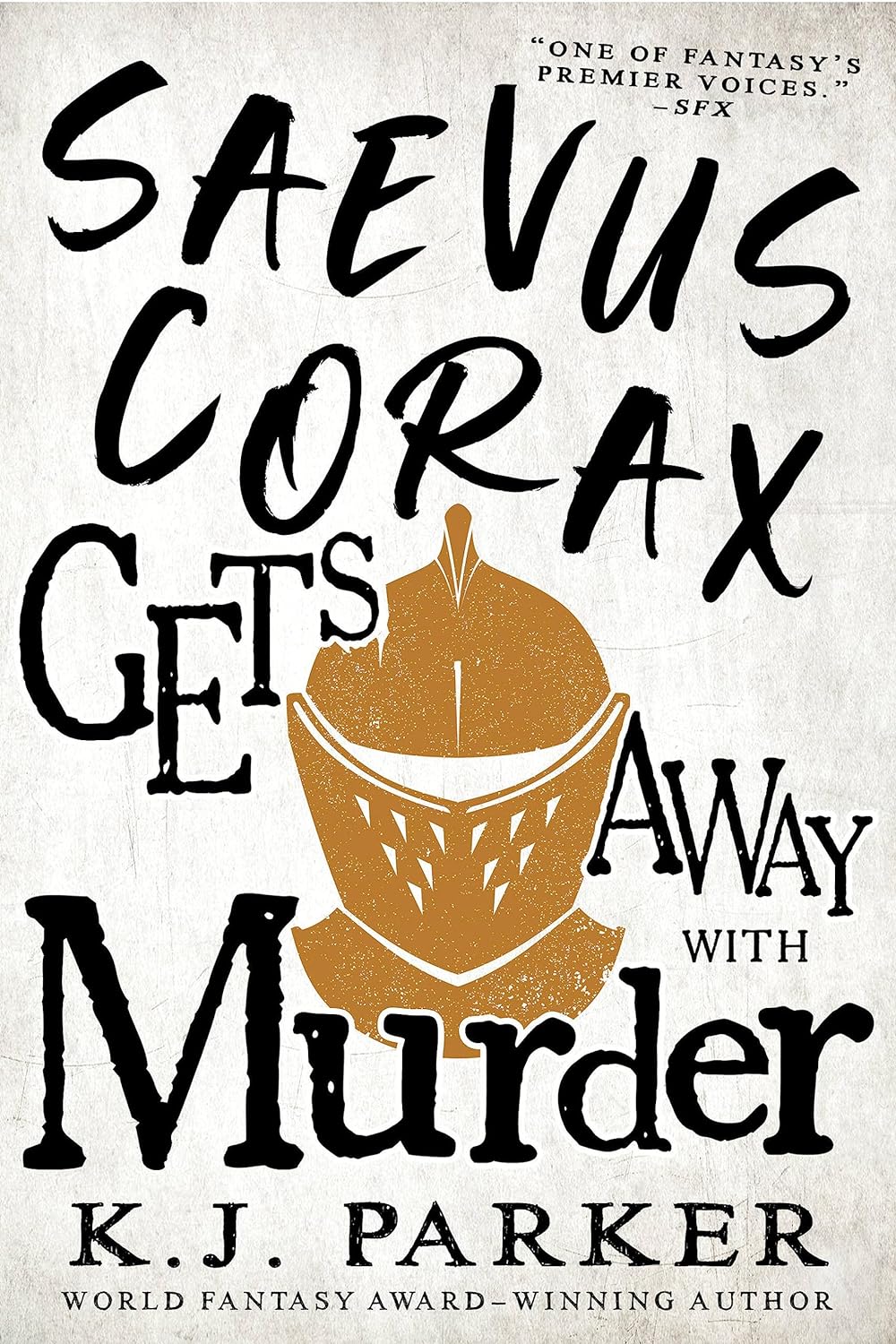
Saevus Corax Gets Away with Murder by K. J. Parker

Publisher: Orbit (Trade Paperback – 5 December 2023)

Series: Corax Trilogy – Book Three

Length: 323 pages

My Rating: 5 out of 5 stars

Amazon

One of the masters of comedic fantasy, K. J. Parker, ends his fantastic Corax trilogy on an outstanding note with Saevus Corax Gets Away with Murder.

As we get to the end of 2024, I’m desperately trying to finalise reviews for books I read earlier in the year.  This includes the third and final entry in the Corax trilogy by K. J. Parker, which I enjoyed a few months ago.  Parker, a pseudonym of author Tom Holt, released his entire Corax trilogy in 2023, which follows a resourceful and ill-fated rogue, Saevus Corax, as he finds himself in all manner of trouble.  Set in the same universe as the author’s The Siege series, which featured Sixteen Ways to Defend a Walled City (one of my favourite books of 2019), How to Rule an Empire and Get Away with It (one of my favourite books of 2020) and A Practical Guide to Conquering the World (one of my favourite books of 2022), this was a trilogy with a lot of potential, and I eagerly grabbed all three books the first chance I could.

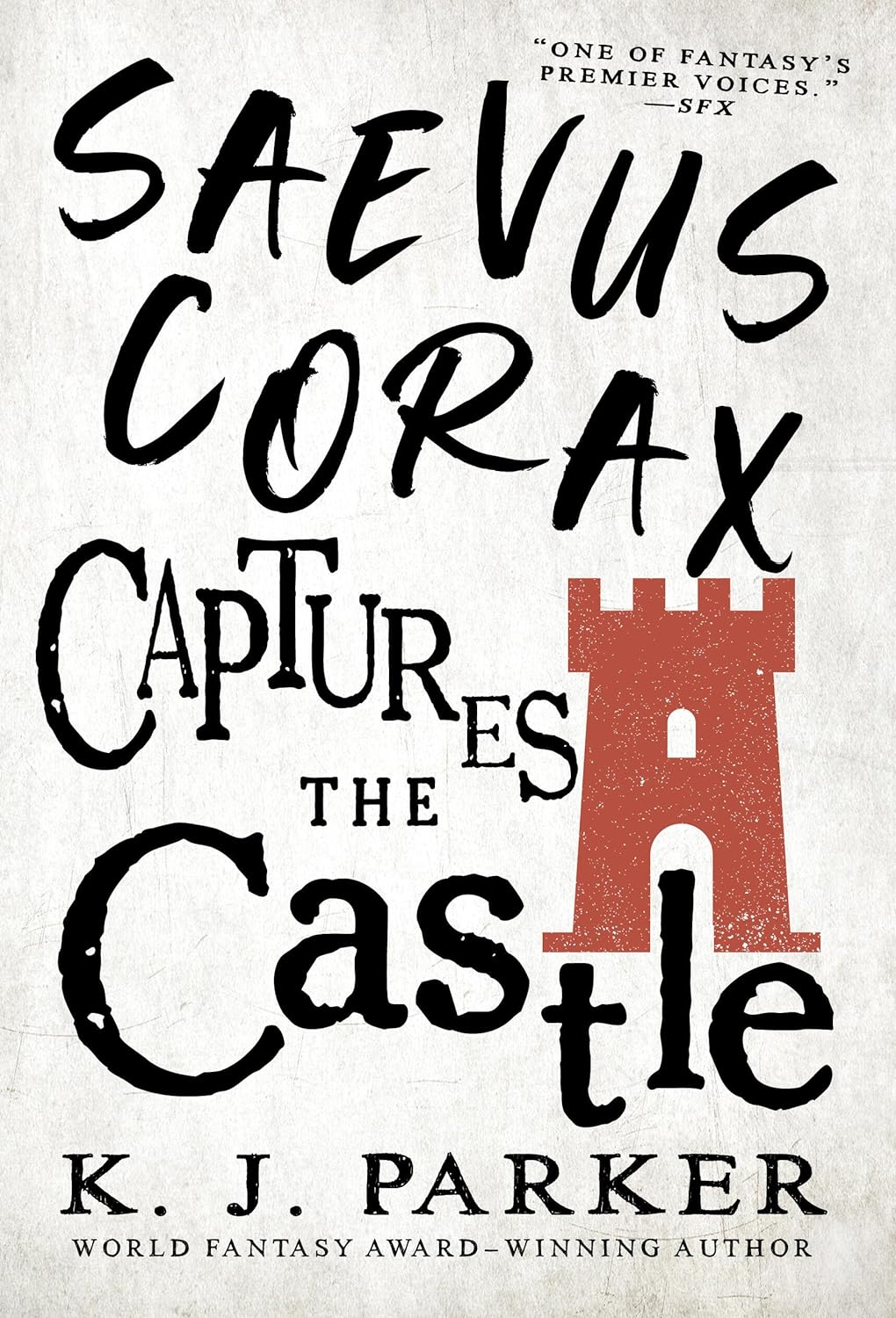
While I managed to get all three of the Corax novels last year, I only had the chance to read the first novel, Saevus Corax Deals with the Dead before 2023 ended.  This first entry in the trilogy was pretty damn incredible, and I loved the wonderful and highly entertaining story it contained, especially as it was masterfully layered with Parker’s trademark humour.  Saevus Corax Deals with the Dead got an easy five-star rating from me, and it ended up being one of my favourite books of 2023.  I quickly got onto the second book in the series, Saevus Corax Captures the Castle, earlier this year, and just like the first entry, it proved to be a remarkable read that I had a wonderful time with.  As such, I made sure to read the final book in the trilogy, Saevus Corax Gets Away with Murder, as quickly as I could, and it proved to be great reading whilst away on holiday.  I regret not writing something about Saevus Corax Gets Away with Murder sooner, as it was an outstanding and epic read that I could not put down, but hopefully I can make up for it now.

After years of schemes, daring cons, an unwilling coronation and other unfortunate adventures, Saevus Corax is still stuck doing the only job he’s good at, battlefield salvage.  Unglamourous and often disgusting work, it provides a basic living for his large crew of outcasts and rogues as they tour their world’s many scattered battlefields, rescuing and repurposing everything they can recover from the dead.  However, Corax’s band are about to encounter the only thing that can make their business unprofitable, a massive total war that threatens to burn the entire continent.

Seeing the signs of upcoming mass conflict, Corax and his crew attempt to flee to safer climates where they can still potentially make a living.  However, Corax finds his plan to escape thwarted by the family he has long tried to run away from.  His sister, Phantis, has finally caught up with him, but instead of the vengeance she always promised, she needs his help to survive a coup gone bad.  Despite his reluctance to get involved, Corax attempts to help, only to get dragged into even more danger.

Soon, with war coming closer and various factions seeking to kill him and claim the many bounties on his head, Corax is forced into one final scheme to get enough money to retire and escape from everything.  Reuniting with his old flame, the beautiful con artist Stauracia, Corax attempts to find a long-lost treasure that could solve all his problems.  But with betrayal coming from all sides, can Corax survive the chaos to come, or has he finally encountered a situation that even he cannot think his way out of?

Parker continues to showcase why he is the master of hilarious fantasy fiction, as Saevus Corax Gets Away with Murder was another amazing read with a captivating and unique plot behind it.  Masterfully wrapping up the Corax trilogy with a dark and entertaining story, Saevus Corax Gets Away with Murder had me hooked the entire way through and, just like all the other books in the series, it gets a full five-star rating from me.

This third Corax book proved to be an excellent read, with Parker taking his audience on a final wild ride of schemes, betrayal and family drama, as Saevus Corax comes face to face with all his demons.  While easily enjoyed as a standalone novel, Saevus Corax Gets Away with Murder is best read after the rest of the trilogy, especially as many of the ongoing storylines and character relationships come to an end here.  The plot of this book is epic and entertaining, as war, his ongoing conflict with his family and a desire to finally live a normal life drive Corax towards one final scheme while also trying to wipe away the sins of his past.  However, as this is Corax, nothing goes to plan, and he soon encounters multiple setbacks and conflicts that he is forced to overcome in his typical resourceful way.  However, this time Corax experiences some truly devastating betrayals and dark moments that destroy him in a way never seen before.  Parker really lays in the clever twists for this last book in the trilogy, and you will not be prepared for some of the dark routes he goes.  I felt that the big betrayal halfway through the novel was pretty impactful, although the final twist of the knife from his worst enemy at the end was the most heartbreaking.  Everything comes to an impressive end that, while satisfying, fits within the tragic narrative that is the protagonist’s life, and honestly could the author really have left this series on a true happy ending?

The author continues to utilise the writing style and intriguing setting that made the first two Corax books and the preceding Siege trilogy so successful.  While this similarity in style and substance does deal a certain dose of repetition to this third book, I still have a ton of fun reading them, and Parker makes it work so well in the context of his story.  Utilisng a chronicle format from the perspective of the protagonist, Saevus Corax Gets Away with Murder recounts the events of this final adventure, once again loaded with Corax’s distinctive and often satirical commentary and observations on events.  The author relies heavily on twists, betrayals and deep intrigues throughout the plot, all of which are carefully pulled together, explored and savagely roasted by the protagonist as he experiences them.  The continued cynicism and sarcastic take on the world that Corax witnesses and human nature in general brings in much of the book’s humour, and it is hard not to enjoy Corax’s unique thoughts.  This first-person perspective is such an effective storytelling method for the series, and I love how it enhances the humour of the story while also serving as a good tool for exploring the various aspects of the semi-fantasy/alternate history world that the author is setting so many of his books in.  Parker’s style really fits the complex narratives of deception, lies and betrayal that are the hallmark of the Corax series, and I am so glad that he set out this novel the way that he did.

The final Corax book was just as character focused as the previous entries, and I appreciated how Parker brought his various character arcs to a final close in Saevus Corax Gets Away with Murder.  Most of the focus remains on titular perspective protagonist, Saevus Corax, and it was great to see his unique story come to an end.  A typical Parker protagonist, in that he is clever, funny, unrepentantly cynical and just a little bit tragic, Corax has been a great figure to follow, especially due to the elaborate schemes and complicated history that define his life.  Constantly analysing the world and relying on the predictability of human nature, Corax is a dangerous person, especially when dealing with the various people trying to manipulate him as he tries to do the right thing.  While he is usually able to outsmart everyone, several betrayals in this book really get under his skin, and he ends up being particularly rash and devastated at times.  Despite this, he is still the clever, surprisingly honest, and often thoughtful figure that you have come to love in the previous novels, and I really appreciated seeing how his story concluded in this final Corax novel.

Aside from the protagonist, Saevus Corax Gets Away with Murder features an interesting range of supporting characters, many of whom have a complex relationship with the protagonist.  The most prominent of these is the manipulative force of nature, Stauracia, a con-artist who has a lot of history with Corax.  Corax and Stauracia play off each other perfectly, and I always enjoy seeing their unique form of courting involving cons, lies and deceit.  Saevus Corax Gets Away with Murder is the book that really defines their relationship, and it was awesome to see their chemistry on full display as they try to work together for the ultimate final score.  The rest of the cast is pretty fun as well, with the highlight being Corax’s sister Phantis.  Parker has spent the entire trilogy hyping up Corax’s family as dangerous antagonists, and the author didn’t disappoint when it came to finally featuring one.  Phantis is an incredibly selfish, vindictive and manipulative figure, and it was great to see the fantastic scenes between her and Corax, which amped up the family drama.  While I was slightly disappointed we didn’t get to meet another member of Corax’s family that has been talked about a lot, Phantis was more than enough for this book, especially as she hits Corax where it really hurts in some of the darkest scenes of the book.  Throw in the recurring background characters from the previous novels, including Corax’s band of scavengers, and this proves to be a great cast with a lot of fun features.  However, readers are warned not to get too attached to any of them, as Parker has final book killing fever and deals with several characters in intriguing ways, especially as many are tempted by betrayal and their own sinister schemes.

In the end, Saevus Corax Gets Away with Murder was yet another outstanding and deeply clever novel from K. J. Parker that I honestly cannot rave about enough.  Providing its own addictive and funny narrative, while also bringing the entire Corax trilogy to a fitting end, Saevus Corax Gets Away with Murder was an epic read that proves near impossible to turn away from.  Parker is such an impressive author, and I look forward to seeing what he produces next, especially as he appears to have a new series starting in mid-2025.

Amazon

The Fury of the Gods by John Gwynne

Publisher: Orbit/Little Brown Audio (Audiobook – 22 October 2024)

Series: The Bloodsworn Saga – Book Three

Length: 19 hours and 30 minutes

My Rating: 5 out of 5 stars

Amazon

John Gwynne brings his awesome Bloodsworn trilogy to a truly epic conclusion with the outstanding novel, The Fury of the Gods.

For the last few years one of the most compelling fantasy series has been the Bloodsworn Saga trilogy from acclaimed fantasy author John Gwynne.  This series is set in a Norse-inspired fantasy world shattered by warring gods and now filled with monsters, voyaging warriors and the human descendants of the gods whose power often see them collared and controlled as thralls.  The series started back in 2021 with the impressive read, The Shadow of the Gods, which introduced the main characters and set them on their quests.  I almost missed The Shadow of the Gods when it came out, but I was glad that I didn’t, as it turned out to be one of my favourite books and audiobooks of 2021.  Gwynne continued the series in a big way the next year with the excellent sequel, The Hunger of the Gods, which expertly continued the series and ended up also being a top book and audiobook of 2022.  Due to how amazing the first two entries in the trilogy proved to be, I have been eager for to the finale of the trilogy for a while, and I was so happy we got one in 2024.  One of my most anticipated books in the second half of 2024, The Fury of the Gods was everything I hoped it would be and more, and I listened to it the very first chance that I got.

The gods have returned, and all must pay the price!

After centuries of imprisonment following the last great war of the gods, the evil and crazed dragon-god Lik-Rifa has been released and now seeks to rule over the land of Vigrid.  With the cunning rat-god Rotta at her side, Lik-Rifa leads a vast army made up of her monstrous children, as well as ambitious mercenaries and Tainted warriors.  Determined to place the entire continent under her dark rule, Lik-Rifa turns her eyes to the stronghold of Snakavik and moves to destroy the last vestige of resistance against her.

However, not all is lost, as some seek to stand against Lik-Rifa.  Elvar, leader of the Battle-Grim, has killed her father and taken control of Snakavik.  Bound by fate and her oaths, Elvar must balance her new responsibilities as ruler while she plans for war against Lik-Rifa, a seemingly impossible task.  However, Elvar has done the impossible before by resurrecting Lik-Rifa’s hated brother, the wolf-god, Ulfrir, and binding him to her will.  Now her most potent weapon and the ultimate bait for Lik-Rifa, Elvar seeks to use Ulfrir to destroy the gods coming for her.  But even a giant wolf-god might not be enough to win the war, and Elvar needs even more allies to help her.

After scouring a bloody path across Vigrid, Orka Skullsplitter has rescued her son, but still seeks vengeance against Lik-Rifa’s forces.  To that end, Orka reunites with her old warband, the Bloodsworn, and sets them to join Elvar’s growing host.  Made up of deadly Tainted warriors, including their latest recruit, Varg No-Sense, the Bloodsworn have many reasons to fight against the dragon-god’s followers.  Together, the Bloodsworn, Battle-Grim and their various allies prepare to face Lik-Rifa’s army in the greatest battle the world has ever known.  But no-one is prepared for the chaos that is about to engulf Vigrid, as greater threats arise to devour all.

Gwynne continues to impress with this third and final Bloodsworn Saga novel.  The Fury of the Gods was another high-octane, character driven, dark fantasy novel, that takes the reader on a powerful adventure.  Loaded with fantastic moments and amazing action, The Fury of the Gods proved to be an outstanding conclusion to the Bloodsworn Saga, and I had such an awesome time getting through it.

The Fury of the Gods featured a spectacular and captivating narrative that starts off strong and refuses to slow down the entire way through.  Taking off immediately after The Hunger of the Gods, Gwynne effectively sets the stage for the oncoming battles as the various character arcs continue at breakneck pace.  Once again telling the story through the eyes of five distinctive protagonists (Orka, Elva, Varg, Biorr and Gudvarr), you get drawn into their intriguing personal tales as they recount the events they observe.  The first half of the book keeps these protagonists mostly separated, and their various storylines continued in similar directions to The Hunger of the Gods.  Orka is still set on her bloody revenge mission and must overcome her imprisonment by the rat-god Rotta.  Varg and the Bloodsworn journey back from their rescue mission in the neighbouring nation of Iskidan, encountering new threats along the way.  Elvar takes up the responsibility of ruling Snakavik after killing her father and finds herself leading the war against Lik-Rifa.  Finally, Biorr and Gudvarr provide intriguing insights into Lik-Rifa’s camp, as both the conflicted Biorr and the snivelling Gudvarr try to survive the rise of dragon-god in their own different ways.

Gwynne does a good amount of set-up in this first half of the book, and it was nice to see the various characters continue to breathe on their own for a bit, while also amping up the dangerous antagonists.  You once again get quickly drawn into each of the protagonists narratives, and I think that it is a testament to Gwynne’s writing that each of these storylines proved to be as entertaining and compelling as the rest.  Unlike other multiple-perspective novels I have read, I honestly loved every single character perspective in The Fury of the Gods, and I was excited to continue each of them.  Indeed, I find it hard to choose a favourite, as they were all fun while offering something a little different.  That being said, Elvar’s chapters moved the plot along the most, and Gwynne did his best character work with her in this book.

Everything leads up to a particularly epic final half, as Gwynne brings together all five point-of-view characters to the same location for the first time in the series.  With the protagonists spread out on each side of the conflict, you get a great view of the massive extended war as the god-led armies fight it out on several fronts, including in a brutal siege.  Gwynne kept the action going thick and fast here, and there are some great encounters and moments as the various characters meet on the battlefield.  Everything leads up to a massive confrontation nearly two-thirds of the way through, and there are some highly dramatic moments here, especially as the first big-death was a little unexpected.  This major fight ends in an interesting way, although details of it are spoiled a little by the awesome cover above.  This leads to some more fantastic moments, including the final battle between both sides.  The author chucks in a few more tragic moments in this final bit of the book, although I must admit that there weren’t a lot of surprises here, with many of the big reveals well telegraphed in advance.  I also thought that the various revenge arcs cluttered up the plot in a predictable manner, and I wish Gwynne had thrown a twist or two in here.  Still, everything ended on an extremely epic note, and readers who enjoyed the previous Bloodsworn Saga books will come away very satisfied and happy with the finalised character arcs.

As with the previous Bloodsworn Saga novels, Gwynne brings a distinctive style to The Fury of the Gods, which I felt greatly enhanced the story.  The blend of compelling Norse-inspired fantasy elements, great character work, and brutal action makes for awesome reading, and Gwynne presents it all in an accessible and enjoyable way.  I loved how the characters’ dialogue and inner thoughts fell in line with the book’s historical inspiration, and while this style might not be for everyone, elements of it, such as the repetition of certain thoughts and phrases, gives it a real saga feel.  As with the previous entries in the series, Gwynne makes excellent use of multiple character perspectives to tell his elaborate narrative, with his five point-of-view characters helming various chapters.  The split between these five characters worked extremely well, and you get some intriguing alternate perspectives of events that blend well as the book continues.  Gwynne makes excellent use of this split during some of the bigger combat scenes, and the use of shorter chapters when things get particularly exciting allows the reader to quickly switch amongst the action.  Talking of action, Gwynne ensures that the combat in The Fury of the Gods is as bloody and well-written as in the previous books, and his brilliant action scenes are so well described and bring you right into the midst of the fighting.

As The Fury of the Gods is the third and final book in an epic fantasy trilogy, it obviously isn’t the most ideal place for readers to dive into the overarching story, and you really should start at the beginning of the series for the full emotional impact.  However, for those who want to start with The Fury of the Gods, Gwynne does make this book somewhat accessible to new readers.  Between the detailed summary of the prior books, glossary of terms, character lists and the callbacks to the previous events during the plot, new readers can follow The Fury of the Gods easily enough and have fun.  This includes enjoying the full impact of the cool fantasy setting of Vigrid that Gwynne has lovingly set up during the three books.  The clever use of Norse-inspired elements really lends itself to the epic revenge driven narrative that Gwynne features, and the mixture of mythological, fantasy and historical elements proved to be a winning combination.  I still love seeing the various warbands using Viking war tactics against dark dangers and massive gods, and Gwynne really went all out making so many traditional Norse elements, such as weaponry, armour, ships and mentality, seem as realistic as possible.  At the same time, the book’s fantasy inclusions, such as the various monsters and Tainted, the human descendants of the gods, add so much to the story, through their vicious nature, intriguing descriptions, and underlying societal issues.  This was an overall pretty awesome setting, that Gwynne uses to full effect to tell his compelling tale.  I hope that Gwynne returns to this world at some point in the future, and it wouldn’t surprise me if some of the younger characters featured here get their own story.

In addition to The Fury of the Gods’ fantastic story and great writing, I also need to talk about the awesome characters.  Throughout the Bloodsworn Saga, Gwynne has put a lot of work into building up his various characters, and by this point in the trilogy you are highly invested in their respective stories.  As such, there aren’t a lot of new figures in this final book, and you generally know what to expect when one of the protagonists’ chapters begins.  However, it still proved awesome to see these figures in action again, and their compelling character arcs and differing personalities deeply increase the impact of the narrative.  Of the main cast, I would say that Elva steals the show the most in The Fury of the Gods.  While she has not always been the most exciting character in the series, this third and final book was where she really shined, primarily because she takes on the role of war leader against Lik-Rifa, and the increased responsibility changes her.  As such, it was outstanding to follow her storyline, and I appreciated seeing how conflicted she got at times, especially when it came to treating the Tainted in her domain.  Due to this, as well as some other badass scenes, Elva was one of the most compelling protagonists in The Fury of the Gods for me, and Gwynne provided an interesting conclusion to her narrative that I felt really worked.

The other four main characters all proved to be brilliant additions to the book, and their perspectives ensured quite an elaborate story.  The dangerous fighters, Orka and Varg, were both solid point-of-view characters in The Fury of the Gods, and I really enjoyed seeing how their respective arcs continued, especially as they were the main avenue to seeing the Bloodsworn warband.  Of all the protagonists, you were most likely to see action with Orka or Varg, and their various bloody sequences were a lot of fun.  That being said, Gwynne went a little light with the character development for these figures in this book, and while they have some moving moments (Orka comes out of her solitude to find people she cares about, while Varg finally cements his place in the Bloodsworn), I felt that Gwynne focused way too much on their respective hunts for revenge, which resulted in some of their stuff getting a little repetitive.

However, Gwynne more than overcomes any minor deficiencies with Orka and Varg through his use of the antagonistic perspective characters Biorr and Gudvarr, both of whom have joined Lik-Rifa’s cause.  Biorr proves to be a complex figure in The Fury of the Gods, and I loved how conflicted he become as his longstanding fanaticism slowly beings to wear away in the face of meeting his gods.  Gwynne did a really great job with Biorr, and his personal journey and attempted redemption made for some powerful moments.  On the other hand, we have the entertaining and despicable Gudvarr, whose chapters I always have fun with.  Gudvarr is an impressively annoying figure who has spent the last two books trying to avoid danger only to find himself getting stuck in progressively worse situations.  However, because he is naturally cowardly, weaselly and vindictive figure, you really don’t feel sorry for him, especially as every bad situation is the result of some failed ploy to gain influence or power.  While Gudvarr is a particularly contemptible figure, it honestly proves impossible not to enjoy his chapters, as they are generally the most amusing in the entire book thanks his snarky inner monologue, the deadly situations he barely escapes from, and the near certainty that he is going to come to a sticky end.  As such, I really enjoyed following Gudvarr and you can’t help but look forward to seeing what dangerous or manipulative situation he finds himself in next.

Finally, I must highlight all the awesome and impressive supporting characters that are featured in The Fury of the Gods.  Gwynne has built up an exceptional and massive cast of characters throughout the series, all of whom add something to book.  I loved seeing the many complex interactions that occurred between all these characters in The Fury of the Gods, and it was fun to see many of them meet for the first time in this final book, especially once all the perspective characters are together.  Highlights include the key members of the Battle-Grim and Bloodsworn warbands, all of whom have gone through so much throughout the trilogy.  Several of the best characters from both bands experience major tragedy in The Fury of the Gods, and it proves hard not the feel for them.  I also need to mention the main antagonists, Lik-Rifa and Rotta, two vengeful gods whose desire for revenge and control move much of the plot along.  I loved seeing the various human and Tainted characters interact with these dark gods, and Gywnne ensured they came across as a massive and dangerous threat.  Two entertaining giant ravens, a fun talking head, and so many other great characters ensured that The Fury of the Gods was a moving and deeply personal read, and I am so glad I got the opportunity to know them during the run of this trilogy.

As with the previous books in the Bloodsworn Saga, I chose to grab The Fury of the Gods on audiobook, which proved to be a particularly awesome way to enjoy this epic read.  Featuring a runtime just under 20 hours, The Fury of the Gods audiobook is a lengthy but highly exciting listening experience, and I found myself powering through this audiobook, namely because the format deeply enhances the intense story and intricate writing.  Narrator Colin Mace, who has lent his voice to the other Bloodsworn Saga books, did another brilliant job with The Fury of the Gods, and his impressive voicework leant some additional impact and gravitas to the book.  Mace perfectly portrays the Norse-inspired fantasy elements of the book, and I really loved how effectively he captured the various hard-nosed characters of the series.  I especially loved Mace’s take on the gigantic gods and other dark creatures haunting the lands, and I felt that the narrator was a key reason why I had so much fun with this audiobook.  Probably one of the best formats to enjoy The Fury of the Gods, listeners will have such an epic time with this audiobook.

With blood, fury and vengeance, the Bloodsworn Saga comes to a brilliant end that I could not get enough of.  The Fury of the Gods was another exceptional read from John Gwynne, and I was so very happy to see how this entire epic narrative concluded.  Loaded with action, excellent fantasy elements, and so many impressive characters, The Fury of the Gods was an outstanding book on its own, as well as an incredible conclusion to one of the most epic fantasy trilogies out there.  One of my favourite fantasy books of 2024, The Fury of the Gods was an excellent read that gets an easy five-star rating from me.

Amazon

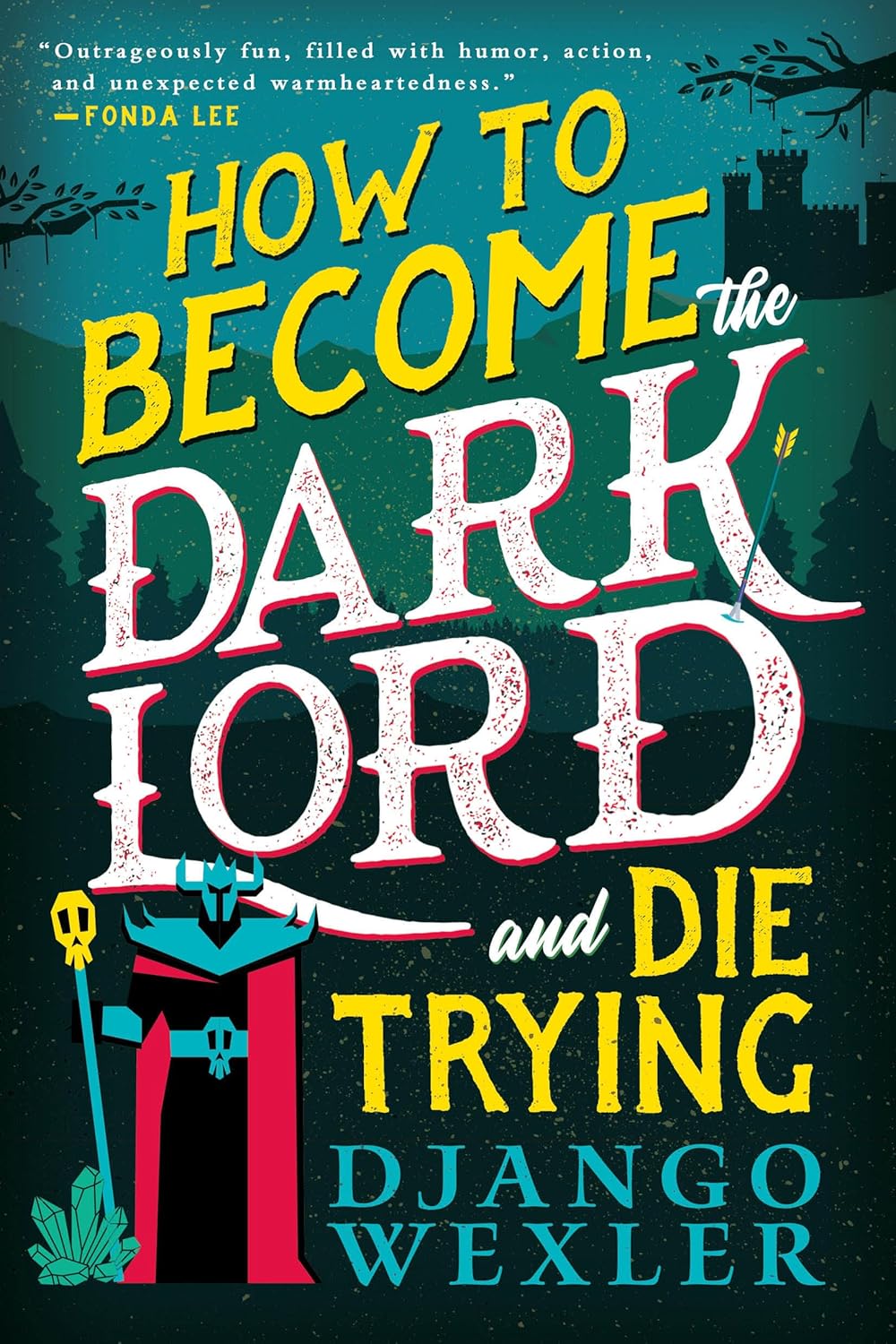
How to Become the Dark Lord and Die Trying by Django Wexler

Publisher: Orbit (Trade Paperback – 6 August 2024)

Series: Dark Lord Davi – Book One

Length: 395 pages

My Rating: 4.75 out of 5 stars

Amazon

Hilarious author Django Wexler presents one of the funniest and most memorable fantasy novels of 2024 with the deeply addictive How to Become the Dark Lord and Die Trying.  Serving as the first book in Wexler’s new Dark Lord Davi series, How to Become the Dark Lord and Die Trying was an extremely amusing book that has been on my radar for a while due to its amazing-sounding plot.

It’s a tale as old as time.  An ordinary human becomes trapped in a mythical fantasy realm and is subsequently lauded as the prophesied hero of legend, destined to rule the kingdom and defeat the conquering Dark Lord.  But what happens when the human protagonist gets sick of living and dying as the hero?

That’s the question that falls to Davi, a young woman who has become trapped in a bloody and predictable time loop.  Constantly forced to become the leader of the soon-to-be-destroyed humans of The Kingdom, Davi has tried time and time again to organise an army capable of defeating the oncoming and everchanging Dark Lord, only to fail and die in agony in over 200 inventive ways.  After nearly a thousand years of playing the hero and losing in brutal fashion, Davi has had enough and decides that if you can’t beat them, become them.

Determined to take control of her destiny, Davi sets out to do the direct opposite of every other loop.  If the Dark Lord always wins, then this time Davi will take her place at the top of the winning side and become the new Dark Lord herself.  But first she must pull together a band of followers from the various non-human races of the realm and bring her loyal minions to the Convocation where the new Dark Lord is chosen, far away in lands she’s never even seen.  Standing between Davi and her destiny lie multitudes of deadly landscapes, brutal enemies, and all manner of unique obstacles that a Dark Lord in training needs to overcome.  Armed with her wits, her accumulated knowledge of the world, the ability to use her own death to her advantage, and an insane amount of humorous confidence, Davi may be able to do the impossible and finally win.  But Davi will soon learn that becoming the Dark Lord isn’t everything it’s cracked up to be.

How to Become the Dark Lord and Die Trying was a highly entertaining and insanely captivating read that I honestly could not get enough off.  Featuring a brilliant scenario that Wexler plays to comedic perfection, combined with dark humour and a uniquely insane protagonist, How to Become the Dark Lord and Die Trying is an outstanding novel that I had so much fun reading.

I must admit that I instantly loved the very fun premise of this book which saw the protagonist decide to take on the role of the Dark Lord after hundreds of failed attempts to survive as the hero.  Wexler did an outstanding job setting this idea up in the first couple of chapters of How to Become the Dark Lord and Die Trying, and you are quickly intrigued by the combination of a bloody time loop, a despondent, if hyper, protagonist, and the entire change of plan said protagonist embarks upon.  As such, you are completely onboard as soon as Davi starts to implement her plan, and the resulting carnage proves to be highly entertaining and fun.  After multiple bloody failed attempts to start her new turn to darkness, Davi soon begins to get into her groove as the next Dark Lord, recruiting a small band of minions, and taking the first steps to proving she has what it takes to rule.

Davi’s subsequent quest to become the Dark Lord involves an intense adventure arc, as she leads her army through various fun fantasy locations.  Along the way to her destination, Davi engages in different schemes to recruit new followers, especially when she encounters some chaotic communities whose internal strife she is able to exploit.  The story devolves into an awesome combination of intrigue, humorous encounters, fantasy action and personal character growth, as the protagonist becomes more comfortable with the Dark Lord lifestyle.  After several extended sequences at key locations, the protagonist eventually reaches her goal and begins her trials to become the new Dark Lord.  However, nothing at the trials is what it seems, and Davi is forced to deal with multiple enemies from her various pasts to survive.  There are some great moments in this final part of the book, including tragic betrayals, heart-felt romance, intriguing revelations, and some big fights, all of which leads to an interesting open-ended conclusion that will ensure readers come back for the next book in the series.

I had an exceptional amount of fun with How to Become the Dark Lord and Die Trying, and Wexler had a fantastic style that really appealed to me.  Told exclusively from the slightly crazed first-person perspective of the protagonist, readers are treated to Davi’s highly excitable inner thoughts as she recounts her journey to becoming the Dark Lord.  This proved to be a great medium to explore the more complex elements of the plot, and I appreciated how Wexler was able to succinctly dive into time-loop and Davi’s place in it, while also moving the plot along.  The author also introduces a serviceable and intriguing fantasy world the plot of How to Become the Dark Lord and Die Trying, which proved interesting to explore.  While a little basic in places, Wexler does feature some excellent concepts here, and readers will enjoy watching Davi explore it with her own unique perspective, especially as she forms new ideas about the supposedly evil wilders (non-human creatures) as she works with them.  While some of these concepts are a little complex at times, everything honestly works extremely well for the entertaining plot, and I really appreciated how effectively the author was able to explore and utilise his fantastic ideas.

While all these great concepts help to craft a unique book, what holds everything together and keeps the reader’s attention is the relentless comedy that Wexler injects into nearly every page of How to Become the Dark Lord and Die Trying.  I really connected to Wexler’s humour in this book, and I found myself chuckling away for large chunks of it.  Thanks to the slightly cracked protagonist, the reader is bombarded with a constant array of jokes, hilarious commentary, and over-the-top moments, as Davi combats the horrors both in front and behind her with humour.  A lot of this humour was driven by the protagonist having a modern, nerdish perspective in a crazy fantasy world, and her reactions ranged from sarcastic to goofy.  Wexler also makes great use of an array of continuous footnotes to tell additional jokes outside the flow of the narrative, or to really expand on an interesting or funny point.  I am a big fan of the use of footnotes for comedic purposes (blame my Terry Pratchett upbringing), and Wexler made it work really well here.  The author also relies on quite a lot of highly adult humour throughout the book, which helped to give How to Become the Dark Lord and Die Trying an interesting flair.  While I could see some readers not liking how continuously risqué the book got, or how over-the-top the humour is in general, I personally felt that it worked and allowed for quite an amusing, if slightly randy, experience.

Talking of crazy humour, I must highlight the fantastic central protagonist of How to Become the Dark Lord and Die Trying, Davi.  A modern-day and highly nerdy woman who finds herself trapped in this recurring fantasy adventure without any idea of how she got there, Davi is an interesting figure, and you really connect with her as the plot continues, especially as a lot of hilarity is drawn from her outrageous behaviour and thoughts.  Davi is constantly cracking jokes, making sarcastic inner observations and meta commentary, often driven by her modern experiences, and it’s hard not to be amused by her antics.  She also has some great, often ridiculous interactions with the various fantasy creatures she encounters, and I liked seeing her unusual persona connect with these more serious creatures.

While it is easy to get lost in Davi’s comedic persona, the further you get into the book, the more apparent it is that her cracked behaviour has been brought on by the constant trauma from her hundreds of deaths and the accompanying thousand years of experience that she has lived through as part of her fantasy adventure.  The initial exposure to her early trauma and rage at the start of the book gives you enough of a glimpse of this that you appreciate her turn to the dark side, but you see even more of it as the story continues.  A lot of this is because, even after years of watching everyone die, she still cares about the people around her, and the impacts of her decisions start to wear on her.  While she maintains her zany persona for much of the book, a new romance and a dark change in her circumstances towards the end of the book nearly break her, and I felt that Wexler did an outstanding job of trying to humanise her there, especially as she sometimes gives off uncaring, immortal vibes.  Thanks to these deeper personality traits, as well as her comedic nature, I really grew to appreciate to Davi as main character, especially as she is a lot more capable and competent thanks to her experiences, although she still makes some interesting mistakes (never sleep with your minions, everyone knows that).  As such, I look forward to seeing how her story continues, especially as things are likely to get even more out of control for her.

Overall, How to Become the Dark Lord and Die Trying by Django Wexler was an awesome book that I honestly found to be quite addictive.  The fantastic central scenario is greatly enhanced by the author’s outrageous humour and clever storytelling, and it allows for quite an outstanding read.  Slick, unique and very, very funny, How to Become the Dark Lord and Die Trying was one of the more unique fantasy novels of 2024, and if you are in the mood for a great laugh, then this is the book for you.  I personally am very excited to see how the Dark Lord Davi series continues in the future, and the second novel, Everybody Wants to Rule the World Except Me, is set for release in May 2025.

Amazon

Saevus Corax Captures the Castle by K. J. Parker

Saevus Corax Captures the Castle Cover

Publisher: Orbit (Trade Paperback – 21 November 2023)

Series: Corax – Book Two

Length: 321 pages

My Rating: 5 out of 5 stars

Amazon

One of the funniest fantasy authors in the game presents a fantastic second entry in his closely released Corax trilogy with the hilarious and brutally brilliant Saevus Corax Captures the Castle.

In 2023, fantasy author K. J. Parker (a pseudonym of author Tom Holt), had an incredible blast of creativity as he managed to release an entire trilogy within the space of a month with the outstanding Corax series.  Set to follow an infamous battlefield salvager, the titular Saevus Corax, as he finds himself getting dragged into all manner of unusual scenarios, this series sounded so damn fun.  I was particularly intrigued, especially as these books were set in the same universe as his epic The Siege series, which featured Sixteen Ways to Defend a Walled City (one of my favourite books of 2019), How to Rule an Empire and Get Away with It (one of my favourite books of 2020) and A Practical Guide to Conquering the World (one of my favourite books of 2022).

While I managed to get all three of Parker’s Corax books last year, I only had the chance to read the first novel, Saevus Corax Deals with the Dead before 2023 ended.  This first entry in the trilogy was pretty damn incredible, and I loved the wonderful and highly entertaining story it contained, especially as it was masterfully layered with Parker’s trademark humour.  Saevus Corax Deals with the Dead got an easy five-star rating from me, and it ended up being one of my favourite books of 2023.  As such, I really want to get through the other two Corax books as soon as possible so I quickly powered through the second one, Saevus Corax Captures the Castle, last weekend.  Saeuvs Corax Captures the Castle was another outstanding read that I had such I wonderful time with.

Several years after his last outrageous adventure when he was crowned a king against his will, Saevus Corax is back to what he knows best, battlefield salvage.  While it is not the most glamorous work, it provides a living for his large crew of outcasts and rogues, as they tour their world’s many scattered battlefields, rescuing and repurposing everything they can recover from the dead.  However, a nemesis with a personal grudge will send Corax on a dangerous path he might have no escape from.

When several of his men are kidnapped, Corax’s only apparent chance to save them is to capture a delipidated castle in the middle of nowhere.  Utilising his unconventional tactics and knowledge of warfare, Corax begins his impromptu siege, only to discover that his old flame, the beautiful con artist Stauracia, is in charge of the castle’s defence, and she has no intention of losing to Corax again.

But why is Corax’s new unwelcomed employer so determined to capture the castle, and what are they hoping to achieve by using Corax’s motley crew?  The truth has the potential to plunge the whole world into war if Corax can’t keep it under wraps.  However, Corax soon finds himself distracted by revelations from his past, as he finds hope being dangled before his eyes.  Can Corax survive this latest misadventure and the dastardly rivals it brings, or has he finally met his match?

The second Corax book proved to be just as funny, addictive, and inventive as the first awesome entry, and I had such an outstanding time with Saevus Corax Captures the Castle.  Placing his wonderfully witty and world-weary protagonist on the course for more unusual conflict, Saevus Corax Captures the Castle had me fully hooked from the very first word and I just had to give it another full five-star rating.

Parker came up with a pretty clever and memorable narrative for Saevus Corax Capture the Castle, which proved to be a lot of fun to read.  Starting with another entertaining look at one of the group’s salvage jobs, the book soon places Corax’s entire group in a bad situation when members of the salvage band are kidnapped, and the only way to get them back is by capturing a castle.  So begins a battle of wits as Corax pits his innate knowledge of war and human nature against the manipulation of his old foe Stauracia, as they both try and work out why they have been charged with looking after an isolated castle.  This impromptu siege between two groups of people who do not actually want to be there proves to be quite entertaining, and it serves as a fun focus for the first half of the book.  This first half also features several flashbacks into Corax’s past, especially the events that have occurred since Saevus Corax Deals with the Dead, which provides some interesting motivations and looks at the connections between Corax and the book’s main antagonist.

Thanks to some deeply personal manipulations, there is an interesting and dramatic plot change in the second half of Saevus Corax Captures the Castle, as Corax finds himself motivated to journey alone to a forbidden nation.  This change from a siege to an independent journey actually works really well in the context of the story, and it builds on a lot of cleverly hidden elements and clues from the earlier plot.  You are really on the edge of your seat during this second part of the book, especially as Corax is in the direst of scenarios, and I loved seeing him use his understanding of people to get out of trouble.  The ending of this misguided quest proves to be very clever and a little heartbreaking, as Corax finds what he is looking for, but it’s not what he wants.  It does allow him a few bits of knowledge that let him destroy his opponents back home and get the payday, although nothing is every that simple for Corax.  I liked the intriguing tone that Parker left this second book on, especially as like the first book, the protagonist soon realises that he’s happiest when back doing what he does best.

Saevus Corax Captures the Castle features the exact same writing style as the first book in the series, which you tend to notice when you read these books in quick succession.  I personally liked this continuation of style, especially as it is what made me a fan of Parker in the first place, and it results in quite an entertaining story.  Told in a chronicle format from the perspective of main character Saevus Corax, the book is his account of events, filled with his commentary, observations and memories, to tell an intriguing tale.  Corax proves to be a very fun narrator, and his ultra-cynical take on the world has an entertaining influence on the story which is hard not to enjoy.  The resulting mixture of betrayals, manipulations and unconventional warfare really comes together into quite a comprehensive and fun story thanks to this great narration, and I was chuckling the entire way through.

The series continues to utilise the unique world that Parker came up with for both the Corax books and The Siege novels, and the fun references to some of the prior events are quite amusing.  As I mentioned in my review for Saevus Corax Deals with the Dead, this series is in some ways more of an alternate history novel rather than a fantasy book, as it does not feature any magic or unnatural elements.  Instead, we get a world of war, politics, and domineering nations, which acts as a satirical mirror of our own history.  I would still prefer some form of map up front to keep track of where the characters are going and where some of the nations being discussed are in relation to each other, but you can get by without one.  While there are a few mentions of the previous novel in the series, Saevus Corax Captures the Castle is for the most part a standalone novel, and anyone interested in a particularly fun tale can dive in here no problem.  However, I would personally suggest going from the start of the trilogy, if for no other reason than some of the jokes in this sequel are a little funnier after Saevus Corax Deals with the Dead, and you get the full understanding of the unique relationship between Corax and Stauracia.  It also solves one of the main mysteries from the first book, and it would not surprise me if a couple of story elements from this novel are featured in the third and final novel in the series.

As you would expect from a first-person perspective novel like this, most of the focus is on the titular Saevus Corax, whose unique adventures we are following.  Corax is a very typical Parker protagonist, in that he is an intelligent and cynical being who would rather live a simple life doing what he does best, but instead finds himself thrust into complex and dangerous events.  This proves to be a fun character dynamic, and I loved seeing the often-exasperated Corax forced to deal with people trying to outsmart and manipulate him while he is just trying to do the right thing.  Luckily his strong ability to understand how people think and then use that to outplay them often keeps him out of trouble, and it is quite entertaining to see him casually stop a clever enemy plan, just because they are doing exactly what he would.  His distrustful, intense, and often very honest outlook on life really impacts how the reader sees the world he lives in, and you really grow to appreciate his take on events, especially as he knows everyone is out to get him.  However, readers do get to see another side of Corax in this second book, especially as you get to see how his one previous attempt at romance worked out, and the impacts its tragic ending has on him cause him to act out in some big ways.  As such, this is a very intriguing book for this great character, and I had a wonderful time seeing him develop even further.

Aside from Corax, the cast of Saevus Corax Captures the Castle is pretty fun, as Parker comes up with an interesting group of self-centred, occasionally loyal, but mostly treacherous figures to partner up with our favourite rogue.  The most prominent of these is Stauracia, who was both a secondary antagonist of the first novel and the protagonist’s love interest.  Stauracia is a con-artist who has run afoul of Corax and his group before, and who finds herself forced to work both with and against them in this novel.  Smart, manipulative, and utterly lovely, Stauracia is the perfect foil for the more subdued Corax, and they have some amazing chemistry in this book.  I loved the unique relationship that bloomed between them that is often driven more by dislike or mistrust than anything else, but both of them come away a bit better from knowing the other.  Other major characters include the group of unlikely companions that make up Corax’s battlefield scavengers.  Their constant bickering makes for a fun background to many scenes, and I like how they are usually annoyed with Corax’s antics, although they keep following because no-one else could do the job better.  Throw in a great villain, whose prior connections to Corax result in some brutal plots against him, and the cast of Saevus Corax Capture the Castle are extremely entertaining, and I loved seeing the unique narrative that formed around them.

Overall, Saevus Corax Captures the Castle was a highly fun and utterly amazing novel from K. J. Parker that I cannot recommend enough.  Featuring all the humour, entertaining cynicism and clever characters that made the first Corax book so incredible, Saevus Corax Captures the Castle serves as an outstanding sequel that continues the series in an awesome way.  An outstanding and epic read, this was such a great book and I cannot wait to read the final Corax novel as soon as I can.

Amazon

Saevus Corax Deals with the Dead by K. J. Parker

Saevus Corax Deals With the Dead Cover

Publisher: Orbit (Trade Paperback – 10 October 2023)

Series: Corax – Book One

Length: 359 pages

My Rating: 5 out of 5 pages

Amazon

One of the most unique and funny authors of fantasy fiction, K. J. Parker, returns with an outstanding and hilarious read about a likeable protagonist caught up in the middle of so much drama, with Saevus Corax Deals with the Dead.

Few authors have the comedic chops and inventiveness of K. J. Parker, whose work I have been deeply enjoying over the last few years.  A pseudonym of established fantasy author Tom Holt, Parker has written a ton of unique and compelling reads over the years, including some outstanding novels that set outrageous and clever protagonists against the stupidity of their world in some impressive scenarios.  I particularly enjoyed Parker’s recent The Siege series, which saw three very different men take advantage of a major siege in very different ways.  All three Siege books were extremely epic, and they all got five-star ratings from me because of their clever stories, entertaining characters, and fantastic comedy.  This includes Sixteen Ways to Defend a Walled City (one of my favourite books of 2019), How to Rule an Empire and Get Away with It (one of my favourite books of 2020) and A Practical Guide to Conquering the World (one of my favourite books of 2022).

Due to how much I enjoyed Parker’s last series, I was very excited when I found out that he had a fun new trilogy coming out in 2023.  This series, the Corax trilogy, follows Saevus Corax, a professional battlefield looter who runs afoul of multiple groups, nations and people in his quest for survival and the big score.  Parker, who seems to be an unstoppable force when it comes to writing, released all three Corax books in the space of around a month, which is pretty damn impressive.  I have so far had the great pleasure of reading the first of these, Saevus Corax Deals with the Dead, which proved to be an exceptional novel and one of my favourite books of 2023.

Saevus Corax is a man with a twisted and hidden past, who seeks to make a new future for himself by looting the many, many battlefields that scatter his world.  Leading a professional band of scavengers, Corax makes his living by selling recovered and repaired gear from the dead to warring armies desperate or greedy enough to buy from him.  While not the most glamorous work, it’s a job Corax excels at, and it allows him to escape his complicated history.  But the past always has a habit of coming back when you least expect it, especially when there is a great deal of money on the line.

Finishing up a lucrative job, Corax and his men are shocked to discover that they are being accused of committing a brazen heist and now have a price on their heads.  Assuming that he is the true target of this bounty, Corax soon finds himself targeted by the two most powerful banking organisations on the continent.  Forced to flee, Corax finds himself the most wanted man alive, with several nefarious organisations, as well as vengeful members of his own family, placing a massive bounty on his head.  But who is Corax really, and why does everyone want him either alive or dead?

To understand that you’ll need to unwrap Corax’s complex history, and the events that turned him into the most important figure in world politics.  But Corax is sick of being a pawn in everyone else’s game, and he soon starts to make his own moves to ensure his independence.  Will Corax survive, or will his attempts at upsetting the board result in chaos and destruction across the world?

This was an absolutely amazing read from K. J. Parker that placed a very likeable and relatable protagonist into one heck of an elaborate bind.  Filled with a wry humour, outrageous scenarios and constant treachery, Saevus Corax Deals with the Dead was an outstanding read that gets a very easy five-star rating from me.

Saevus Corax Deals with the Dead has a great story that is told in a first-person chronicle format from the perspective of titular protagonist Saevus Corax.  This is the exact way that Parker wrote The Siege trilogy, and indeed this book is set in the same world several hundred years down the line.  This results in a different landscape for the story, with the bulk of the technology, culture, and certain story elements reminiscent of medieval times rather than the previously seen Romanesque setting, and Parker uses this to his full advantage, especially as the protagonist finds himself caught in a battle between this world’s equivalent of the historic banking giants, the Knights Templar and the Knights Hospitaller.  While nominally a fantasy novel, as it is set in a different world, this series often comes across more as an alternate history novel with comedic undertones, which is highly fun.

The author comes up with an awesome tale surrounding this scenario, as the compelling protagonist is thrust into this conflict against his will thanks to certain aspects of his birth.  Corax recounts this entire adventure in detail, as he first attempts to ascertain who is trying to capture him after framing him for a crime, before eventually going on the run.  Despite promising the reader to always tell the truth, Corax proves to be a somewhat unreliable narrator, mainly because he doesn’t have a desire to share his own personal history unless he must.  However, this hidden history comes into play quite a lot, as his past ensures he is immensely important for just being him.

Inevitably betrayed and captured, Corax is sent off to experience his destiny, which results in some substantial carnage as the protagonist attempts to either escape or turn the situation to his advantage.  This leads to several amusing battles, impractical wars, and other major confrontations, as Corax and the other characters lie, backstab and manipulate to try and get what they want.  Watching a highly practical man with a professional understanding of warfare and a capable imagination face off against various foes who constantly underestimate him makes for some great entertainment, and the various twists and turns that emerge are so much fun.  This entire story comes together extremely well, and the sheer number of betrayals, changing loyalties and attempts by people to use the protagonist for their own advantage ensure you’re never certain who’s going to come out on top of every brilliant scene.  The conclusion of Saevus Corax Deals with the Dead’s plot is very clever, and it brings together a lot of the unique world and compelling story elements that have been built up over the course of the story.  The way that the protagonist overturns everything just to maintain his life is so much fun, and the fitting rewards all the characters get is very fun.

I have so much love for how this story comes together, as the protagonist’s recounting of events really works to give you a personal and complex take.  Every moment of the story is told through Saevus Corax’s cynical and distrustful eye, which adds a certain slant to events, and the author does a great job of providing some fun, but detailed, context to the events unfolding.  Much of this book’s excellent humour is lifted from these outrageous situations that the protagonist finds himself in.  The protagonist does a great job of expressing the ridiculousness of many of these moments, as well as the funny ways he manages to oppose them, often by using simple human nature or flaws in various systems to his advantage.  I loved how well Parker introduced his protagonist is this novel, and Corax’s excellent narration of current events, as well as the compelling and often emotionally charged retelling of his personal history, comes together well to tell an impressive story.  I really cannot emphasise enough how well this first-person narration works, and the detailed recounting of events from a grounded, sensible and exasperated figure really makes for a unique tale.

As the first book in this new trilogy, Saevus Corax Deals with the Dead is a self-contained book, and readers don’t need to have read any of Parker’s previous novels to appreciate it.  As a fan of The Siege series, I enjoyed that the Corax books are set in the same world, especially as the author slips in some fun references and allusions to prior events.  However, no prior knowledge of The Siege books is needed, as the protagonist provides all the relevant world history in his narration, with a few fun and ironic points about the unreliability of prior narrators.  Parker does a good job of quickly building and exploring the various nations and powers in this world, especially if they relate to the plot, and I liked some of the fun parallels that exist between some of them and real historical entities.  The interplay of politics, the rivalries between powers, and the simple desire many of these groups have to betray each other is well set out as a result, and this works into the plot of the book very effectively, especially once you begin to understand just who Corax is.  I really enjoyed how all these elements are explored in the plot, although I did on multiple occasions wish that Parker had included some form of map just so I could have kept track of locations and nations.  I honestly had such a great time returning to this amazing world, especially as we got to follow yet another unlikely leader who was able to change the world just by applying their own unique brand of knowledge and an understanding of how fallible humans can be.

Saevus Corax Deals with the Dead was an incredible novel from K. J. Parker that continues to showcase his exceptional and comedic writing style.  Setting a great protagonist down a chaotic road, Saevus Corax Deals with the Dead had an amazing story which Parker showcases in his well-honed and enjoyable style.  Immensely clever and exceedingly funny, Saevus Corax Deals with the Dead comes highly recommended, and I loved every second I spent reading it.  I already have both sequels, Saevus Corax Captures the Castle and Saevus Corax Gets Away with Murder (both with very intriguing titles), and I am hoping to read them as soon as possible as I know I will love them too.

Amazon

The Traitor by Anthony Ryan

The Traitor Cover

Publisher: Orbit (Audiobook – 11 July 2023)

Series: Covenant of Steel – Book Three

Length: 19 hours and 15 minutes

My Rating: 5 out of 5 stars

Amazon

Acclaimed fantasy author Anthony Ryan brings his epic and exceptional Covenant of Steel trilogy to an end in a massive way with the impressive third and final book, The Traitor.

Over the last three years I have had an outstanding time getting my first taste of the works of leading fantasy author Anthony Ryan.  A veteran author who has been enthralling fantasy audiences for over a decade, Ryan has several highly regarded series under his belt, including his Raven’s Shadow books, the Slab City Blues series, the Seven Swords series and The Draconis Memoria trilogy.  However, I have so far only had the opportunity to read his latest body of works, The Covenant of Steel trilogy, which has been more than enough to make me a major fan of this author.

The Covenant of Steel books are an outstanding series that follows an intriguing and well-developed protagonist, the notorious Alwyn Scribe.  Told in a chronicle format written by Alwyn, the Covenant of Steel books follow the protagonist as he embarks upon a powerful and exciting character journey that sees him overcome his bandit past to take on several new roles, including that of a scribe, soldier and knight, all while serving the mysterious religious figure, Lady Evadine Courlain.  I have had an epic time with this series over the last few years, and the first two books, The Pariah (one of my favourite books and audiobooks of 2021) and The Martyr (one of my favourite books and audiobooks of 2022) have been exceptional five-star reads that proved near impossible to put down.  Loaded with action, intrigue, a fantastic new world, and some complex characters, this series is so damn good, and I have been eagerly awaiting the third and final book for a while.  This third book, The Traitor, was one of my most anticipated reads for 2023, and I was so excited when I finally got the chance to listen to it.

Alwyn Scribe is a man in real trouble.  Now a renowned knight, general, spymaster, and trusted advisor, the former outlaw has relentlessly championed the cause of his lady, the Risen Martyr Evadine Courlain, and ensured she is now the most beloved and influential religious figure in all of Albermaine.  But what if he made a terrible mistake?

Cryptic visions from the past have warned Alwyn that, despite her claims to be a servant of the divine Seraphile, Evadine actually serves the Malecite, the source of all evil in the land, who will use her to bring about a cataclysmic future.  Blinded by love, Alwyn is convinced that these visions are false, and he is determined to keep Evadine alive and ensure that her vision of a united Albermaine are brought to life, even if that means starting another destructive war.

However, the closer Evadine gets to achieving her goal, the more Alwyn begins to realise that she is no longer the same woman that he swore his life to.  Her messages of peace and tolerance have been replaced by the fires of puritanical fury, and Evadine soon launches a brutal crusade to rid the country of her enemies and place herself on the throne as an Ascendant Queen.  But is she truly corrupted by the Malecite or is her brutal work a necessity to keep Albermaine safe from a greater evil?  As a devastating civil war is unleashed upon the kingdom, Alwyn will be forced to choose whose side he is truly on and what he is willing to sacrifice to keep the world from burning.

Well damn, Ryan really didn’t disappoint with this fantastic and powerful conclusion to the fantastic Covenant of Steel trilogy.  Weaving together all the elaborate elements from his first two books and then lighting everything you love on fire, The Traitor was a complex and deeply enjoyable read that I honestly couldn’t stop listening to.  Powerful, thrilling, and oh so beautifully dark, The Traitor was a perfect ending to the Covenant of Steel trilogy that got an easy five-star rating from me.

The Traitor has a heck of a powerful narrative to it that takes the protagonist and the reader to the emotional limit.  After an effective and entertaining recap of the previous two books, The Traitor starts in the immediate aftermath of the previous novel, The Martyr, with Alwyn leading Evadine’s army to war against the dangerous Ascendant Arnabus and his forces, resulting in a major, religious war.  This initial conflict is the focus for a good part of the early story, and it serves as a great warm-up for the rest of the plot, allowing for some much-needed character reintroductions and development, while also providing some intriguing new context for the main story.  This initial fight only serves as a taste for the wars to come, as Evadine seeks to overthrow the current order and rule herself.  This incoming conflict ensures that the first half of The Traitor has a range of great story elements to it, with a mixture of intrigue, political manoeuvrings, espionage, and battles, ensuring that every second of The Traitor at this point is highly entertaining.  This also serves as an excellent prelim for the anticipated change in the middle of the book, where the protagonist is finally forced to confront the fact that Evadine is no longer the woman he fell in love with.

Due to the reveal at the end of The Martyr, you had to know that Evadine was going to have some sort of fall from grace in this final novel, and when it comes, boy does it come hard.  The betrayals, shocks and losses at this point are exceedingly impactful, and you soon realise that Ryan intends to go full scorched earth with his storytelling, forcing the reader to deal with some major tragedies.  I liked the dark turns that occurred at this point in The Traitor, especially as Ryan had been hinting at them since book one, and it was awesome to get some payoff for the previous dark predictions.  This forces Alwyn to make some tough choices, and there is a major and compelling change in the protagonist’s objectives and loyalties for the second half of the book.  Thanks to the great setup at the start, as well as the major events in the middle, the reader will be very strongly caught in the narrative at this point, and even though the final half of The Traitor slows down in places, you really cannot put it down.  Ryan really dives into the lore of his land in this second half, which provides some very unique scenes and moments, even if some of these story elements got a little away from the author.  Still, this part of the book has some pretty impactful moments, and you will not be prepared for some of the key touching events.

Everything leads up to a final confrontation, which releases three books worth of pent-up emotion and revelations in some spectacular scenes.  While part of this confrontation is a bit more metaphysical than it needed to be, you honestly will be blown away with how it all comes to an end, especially as there is layer upon layer of tragedy involved, and I deeply enjoyed the compelling and satisfying resolutions that followed.  This entire story was a fantastic read from start to finish, and I really loved how Ryan wrapped up so many of his ongoing storylines and arcs here.  While most plot points are finalised here, a couple do remain unresolved, and it wouldn’t surprise me if we get a sequel series at some point.  I personally would be very keen for that, as I had such an exceptional time seeing this elaborate trilogy and ongoing narrative come together in some excellent ways.

I have always really enjoyed how Ryan set out the previous Covenant of Steel books, and he did a fantastic job of continuing his awesome writing style in this third and final book.  The author sets out The Traitor using a chronicle style told from the protagonist’s perspective, which is such an effective writing tool.  This deeply personal vision of events, combined with the author’s regretful insights of the future, really helps to drag the reader into the story, and Ryan really makes the most of this story format the entire way through.  Like with the rest of the trilogy, Ryan keeps up a pretty steady pace in The Traitor, and there aren’t a lot of quiet moments in the book.  The author really hit the right blend of powerful character focus, fantasy world building, and storytelling loaded with intrigue and action, and there is generally something for everyone here.

I loved the darker, more tragic feel that The Traitor had, especially compared to the earlier books, and it was easy to tell that this is the final book in the series.  While the detailed plot recap and cast list at the front of the book is very helpful at reminding readers of prior events, readers unfamiliar with The Pariah and The Martyr probably won’t be able to jump into this final novel too easily as there are so many details from the first two books that reader’s need to be aware of to fully appreciate the impacts of this story. As such, people new to the series should really head back to the start, and I guarantee you will have a great time doing so.  I really enjoyed how this awesome book came together, and Ryan’s ability to weave together an intense read with so many layers to it is very impressive.

One of the great highlights of the Covenant of Steel series has been the exceptional and detailed fantasy realm that the book has been set in, shown through the eyes of the narrator as he explores it.  The reader has been given a very detailed look at these settings throughout the last two novels, and it has served as a great background to the plot.  Primarily a medieval landscape dominated by a quasi-Christian religion, this background setting initially didn’t have a lot of fantasy elements to it except for a couple of wandering beings with strange powers.  But Ryan slowly built up the fantasy elements throughout the book, with cumulation of magic occurring about halfway through The Martyr, which I think was an excellent choice, as it allowed him to instead focus on character growth, other world building elements, and the general politics and wars of the realm, in excellent detail.  A lot of these political and religious elements are strongly explored throughout The Traitor, especially in the first half, and Ryan had a lot of fun showcasing the land’s dark turn towards religious conflict as his character’s embark on a bitter holy war.  The dark and destructive changes to this well utilised setting are very notable, disturbing and compelling, and it was fascinating to see how much everything changed throughout the course of the series.

The Traitor does get a lot more fantasy heavy in the second half of the book, as the protagonist returns to a hidden realm and fully experiences the mysterious magic and powers that reside there to counter the dark visions of Evadine.  I do think that there might have been a few too many magical inclusions here, as the plot did get a tad convoluted in places.  Still, Ryan definitely had some fantastic and unique ideas here, and many of these fantasy elements have been utilised in the past to great effect.  One particular ability that emerges actually brings part of the story around full circle, and it allowed for some very compelling interactions with characters from the past that I quite enjoyed.  The fantasy revelations that emerge during the big concluding confrontation are very over the top, which some readers might have issues with.  However, I quite enjoyed it, and it lead to a particularly dark final meeting between protagonist and antagonist that had me hooked the entire time.  This really was an awesome fantasy series, loaded with cool settings and unique features, and I hope that we might get to revisit them in the future, especially as the events of this book will leave Albermaine a much darker and traumatised setting.

Easily my favourite element of The Traitor, and indeed the entire Covenant of Steel trilogy, has been the complex, damaged and memorable characters that the story has focussed on.  Ryan has come up with an exceptional group of protagonists and villains over the course of the trilogy, and there are some deeply elaborate character arcs ongoing throughout the last two books.  Many of these continue and conclude here in The Traitor, and Ryan really went out of his way to finalise the development of his characters in some powerful ways that will really strike the reader in the feels.

The main character of The Traitor is once again Alwyn Scribe, who serves as the primary narrator of the trilogy as he recounts his historical adventures.  Alwyn has been a particularly compelling character throughout the series, mainly because you get to see him grow from a common outlaw to key advisor of the Risen Martyr as she begins her campaign across the country.  Ryan has done such a great job telling Alwyn’s unique tale in the previous books, and the reader should already be highly invested in his story before The Traitor even starts.  Of course, this ensures that the reader is hit even harder by some of the big moments of the book, as Alwyn goes through a lot here.  Not only is he still involved in a series of deadly wars and political battles, but now he finds himself being torn between love and his sense of right and wrong, as Evadine becomes more and more unstable.  Watching Alwyn continue to justify Evadine’s actions, even though deep down he knows she’s in the wrong, is both frustrating and understandable, as you realise just how much he is devoted to her.  This sense of frustration is only enhanced by the constant recriminations Alwyn throws towards his past self as he narrates his own story, and you can feel the regret pouring of the pages there.  While I won’t give too much away here, Alwyn ends up going through quite a lot in The Traitor, and the emotional toil that inflicts is pretty terrible, especially as he has to make some bitter and ruthless choices.  It was very touching and intense to see Alwyn’s story come full circle in some ways, especially as there are some intriguing callbacks to his past, and all the major impactful moments that affect Alwyn are expertly portrayed by the author.  Despite everything he goes through, Alwyn still maintains much of his humour, wit, ingenuity, and disrespectful attitude that were such a great part of the Covenant of Steel trilogy.  It was so much fun to once again get his unique take on events, and he ended up being a pretty perfect narrator for this fantastic series.

The other major character that I have to talk about is Evadine Courlain, the Risen Martyr and Alwyn’s love interest, who has been such a significant figure in the last two books.  A religious leader who inspired people with her visions, Evadine has always been a fascinating character, especially as you are never quite sure if she is actually divinely chosen, a delusional madwoman, or something even worse.  After the reveal at the end of The Martyr that Evadine might be an avatar of evil, you come into The Traitor naturally highly suspicious of her, and Ryan caters to these expectations by ensuring that she quickly starts to descend into further darkness.  Despite Alwyn’s continual attempts to restrain her, and justify her actions to the reader, Evadine becomes more of a darker figure as she pursues her various wars, although initially never going quite far enough to alienate her friends.  Of course, that changes about halfway through the book, and when she goes dark, she goes dark in a big way, turning into quite a fantastic and sinister antagonistic figure.  I really loved how Ryan turned Evadine here, and it is such an outstanding cumulation of so many key story arcs from the first two books.  Despite everything she does, there is still a powerful bond between Alwyn and Evadine that deeply impacts both of them, and it was fascinating to see these great characters walk the thin line between love and hate again and again.  The complex interactions between these two characters at various different points of The Traitor are beautifully written, and you have to appreciate just how damaged and dangerous their bond got at times.  Evadine honestly was the perfect counterpoint to Alwyn in The Traitor, and I cannot emphasise how impressive her entire story arc ended up being.

In addition to Alwyn and Evadine, Ryan has loaded The Traitor with an exceptional cast of supporting characters who add a great deal to the impact of the story.  This supporting cast is mostly made up of figures from the first two books, as Ryan brings back many of the old favourites and seeks to wrap up many of the intriguing storylines that have been such a fantastic part of the series.  Highlights include Alwyn’s returning comrades, such as the unstable but very likeable Ayin, disgraced knight Wilhum, former outlaw Tiler, outlaw queen turned legitimate Duchess Lorine, and Juhlina, also known as the Widow.  These characters, and more end up having some interesting roles throughout The Traitor, and it was fascinating to see the various sides that many of them chose, especially as the plot continued.  I liked some of the surprising directions Ryan took a few of these returning characters, and there are some interesting choices, romances and entertaining fates that were wonderful to see.  Ryan also features several great new characters who got a good introduction and utilisation in The Traitor, even if it was only for a single book.  Quite a few of these characters were cast in antagonistic roles, which I think worked really well, and it was amazing how quickly Ryan was able to turn some of these characters into quite hateable figures.

While I did really enjoy the return of so many great characters featured within The Traitor, readers should be warned that Ryan does go on a bit of a murder spree here.  While I won’t give too much away here, several great characters meet an untimely end in The Traitor, and this honestly gets pretty heartbreaking.  While I usually don’t love it when authors kill off most of their characters in a finale, I think it worked quite well in The Traitor, especially as each death served an important narrative purpose.  It also helped that for many of these characters, Ryan worked to resolve their storylines in advance, so readers got some closure with them, even as they were taken away.  As such, The Traitor turns into quite a bloody and impactful read at times, and you will not be prepared for just how grim and tragic it gets when it comes to your favourite Covenant of Steel characters.  I really cannot emphasise just how good Ryan’s character work is though, and I hope we see some of the surviving figures again in the future.

I ended up grabbing a copy of the audiobook version of The Traitor, mainly because it has been the format that I have enjoyed the rest of the Covenant of Steel books in.  Coming in at a bit over 19 hours, this is a decently long audiobook, but I absolutely flew through it once I got caught up in the exceptional story.  This format really lent itself to Ryan’s writing style and epic storytelling, and I deeply appreciated how listening to The Traitor allowed me to absorb all the key character moments, action and world building a lot better.  My enjoyment of this book was enhanced even further by the return of narrator Steven Brand, who has given his voice to most of Ryan’s audiobooks.  Brand is a very talented narrator with a great voice that fits this darker fantasy novel extremely well, especially as he perfectly encapsulates the protagonist, Alwyn Scribe.  Brand really brings Ryan’s chronicle style to life in Alwyn’s voice, and I really loved his take on the protagonist and all the other characters.  The sheer despair, weariness and self-loathing that Brand envisions in Alwyn’s voice at times is really moving, and I deeply appreciated how expertly he dove into the role of the main character.  The rest of characters in The Traitor also receive some great, fitting voices, and the entire cast really came to life, if but briefly.  I honestly had such a great time listening to The Traitor on audiobook and this is easily my preferred way to enjoy this fantastic book.  As such, this format comes highly recommended, and it will probably end up being one of my top audiobooks of 2023.

Honestly, after how much fun I had with the first two books in this series, as well as my lengthy write-up above, it should come as no surprise that I deeply enjoyed The Traitor.  Anthony Ryan brought his epic Covenant of Steel trilogy to a near perfect end, and I cannot emphasise enough how great and impactful this exceptional novel was.  Featuring some excellent dark moments, powerful character development, and an outstanding war-focused narrative, The Traitor delivered everything I wanted and more.  Easily one of the best fantasy books of 2023 so far, The Traitor was a joy to read from start to finish, and I am so glad I got the experience this awesome and amazing fantasy trilogy.

Amazon