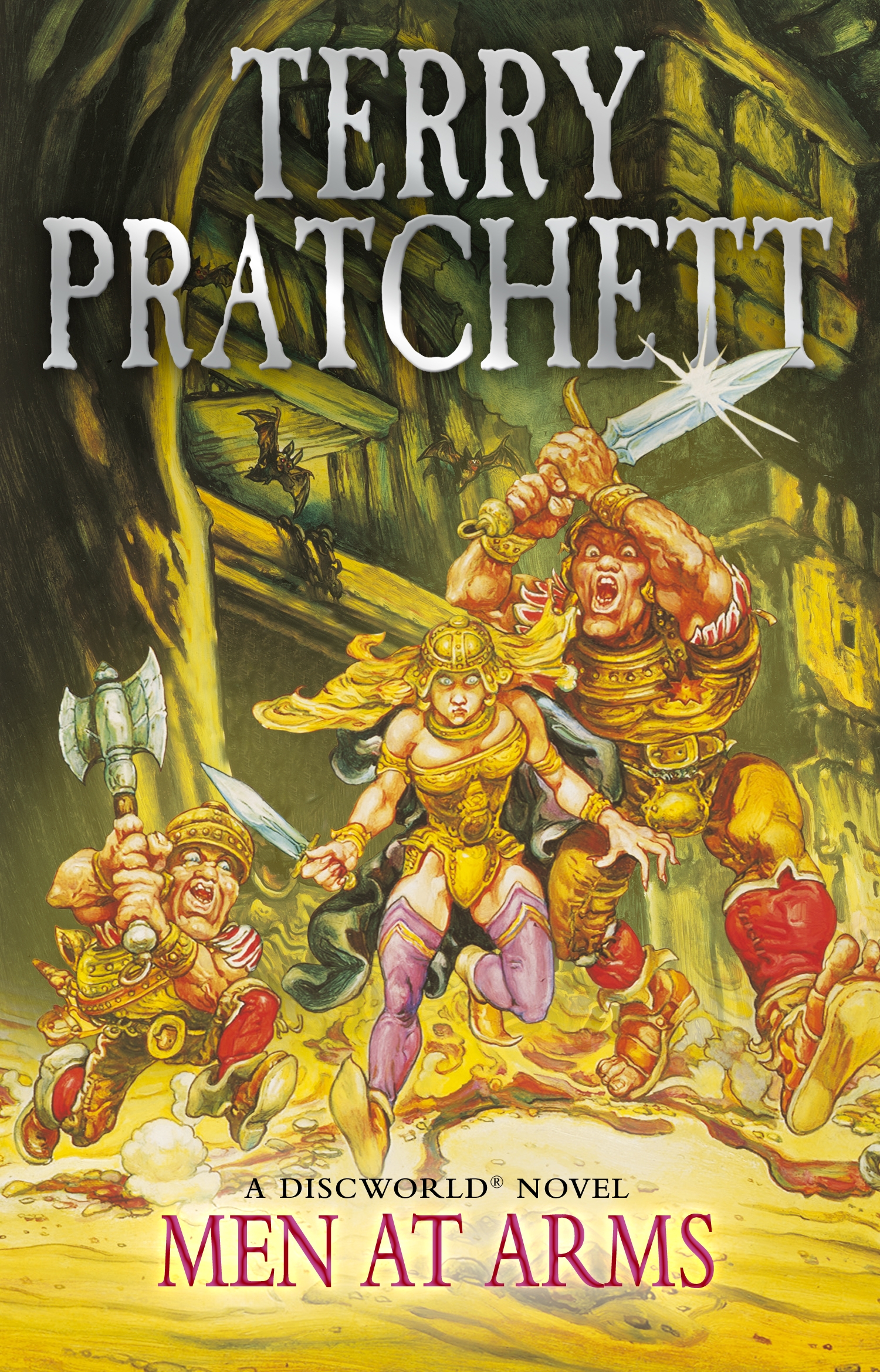
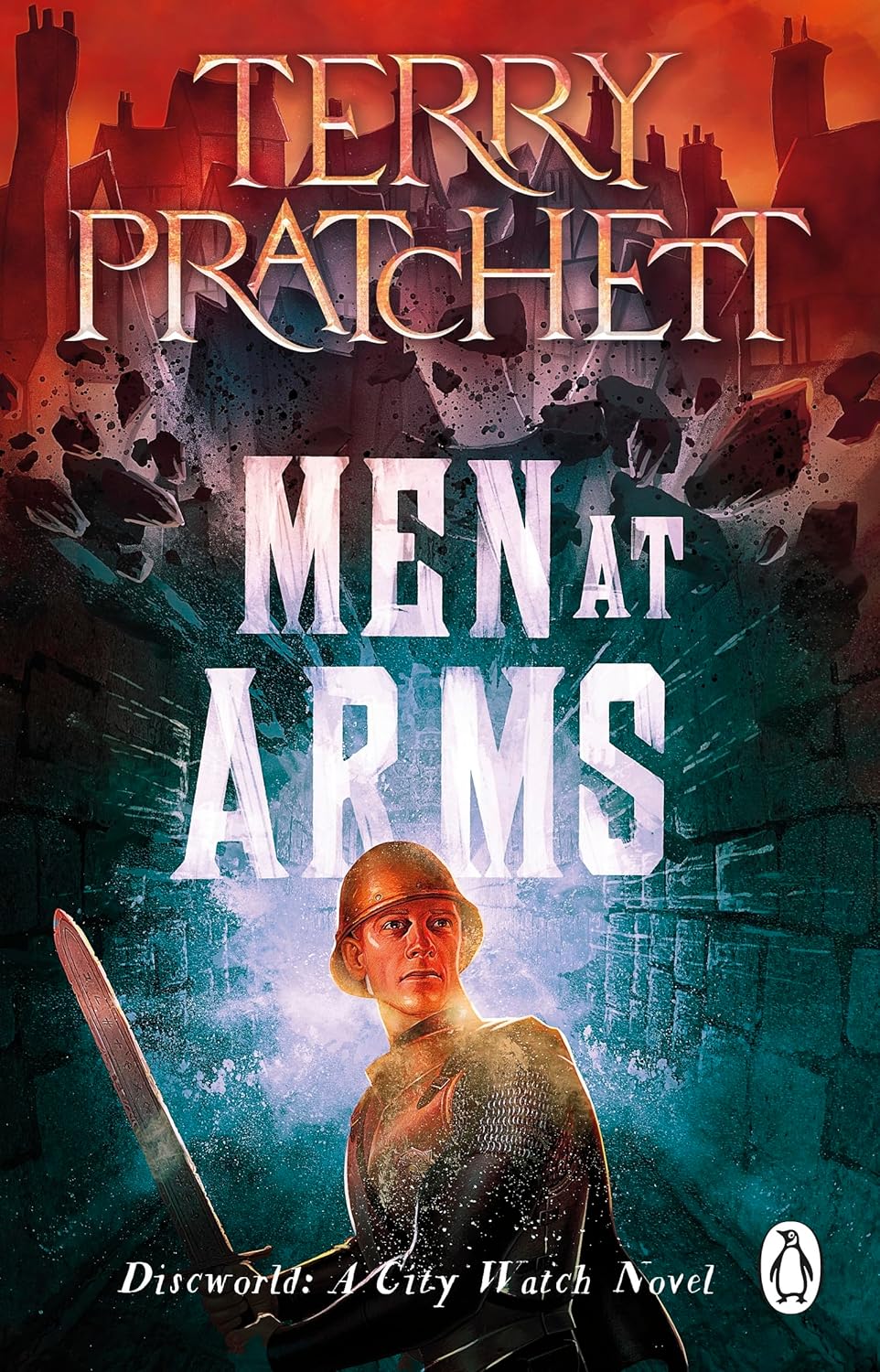
Men at Arms by Terry Pratchett

Publisher: Gollancz/Penguin Random (Audiobook – 1993)

Series: Discworld – Book 15/City Watch – Book Two

Length: 12 hours and 58 minutes

My Rating: 5 out of 5 stars

Amazon

After yet another re-read, the classic fantasy satire novel, Men at Arms remains as one of my favourite Discworld novels by the late, great Terry Pratchett, especially as its new audiobook version breaths fresh life into the always impressive novel.

Readers of this blog will have noticed that I have been on a real Discworld rampage lately, having re-read several books from my absolute favourite fantasy series.  Much of this is due to the recent release of a cool new audiobook version of all the Discworld books, featuring an awesome array of new narrators and vocal talents.  This new format has proven particularly awesome for books like Pyramids, Moving Pictures and Small Gods, and I have been eager to see how some of the books in my favourite Discworld sub-series, the City Watch books, come across with the new narrators.

While I have a lot of love for all the books in Terry Pratchett’s Discworld, my absolute favourites come from the City Watch sub-series.  Following the unlikely members of the Ankh-Morpork City Watch, a rag-tag team of guards generally looked down upon by the entire city, the City Watch books features an exceptional combination of fantasy and crime fiction elements, wrapped up in Pratchett’s usual satirical humour, as the protagonists investigate a series of dastardly crimes in the supernatural Discworld.  The series started perfectly with the awesome novel Guards! Guards!, which I reviewed last year, and Pratchett did an outstanding job following this up with the brilliant sequel, Men at Arms.

After saving the sprawling and eternally crime-ridden city of Ankh-Morpork from a fire-breathing dragon, the men of the Night Watch are still at work protecting the city, even though most of the city wishes they didn’t exist.  Despite their previous escapades, it’s a bad time to be a copper in Ankh-Morpork, with species tension between the dwarfs and the trolls at boiling point, while the powerful guilds disregard the Watch’s non-existent authority.  Worse, the Night Watch has been forced to accept three diversity hires, and must now contend with a mad dwarf, a thick troll and a woman (gasp) amongst their ranks.

Despite this, when an explosion at the Assassin’s Guild literally rocks the city, it falls to Captain Samuel Vimes and his small squad to investigate the heist hidden by the blast, despite the deliberate orders of the city’s tyrannical ruler to stop.  Determined to wrap up the case before his impending marriage and retirement, Vimes is soon forced to contend with a series of unusual, but seemingly linked murders, many of which have been caused by a lethal weapon never seen on the Disc.

With riots on the streets, and assassins and fools dodging their questions, all the members of the watch, including their contentious recruits, will need to work together to solve the murders before the city descends into chaos.  But how will they fare when going up against the most dangerous criminal mind the city has ever seen, one determined to bring back the Ankh-Morpork’s ancient kings, while wielding a dangerous new weapon that could change the entire Disc forever?

Even after many, many re-reads, Men at Arms continues to shine as one of Pratchett’s better books.  Featuring an epic crime fiction narrative, loaded with impressive characters, fantastic humour and great use of Pratchett’s iconic Discworld setting, Men at Arms is a complex, emotionally charged and deeply moving read that I could honestly read 100 times and still not get bored with.  A brilliant novel that unsurprisingly gets an instant five-star rating from me.

Pratchett wrote some exceptional narratives throughout his career, but few stand up to Men at Arms in terms of complexity, cleverness and emotional impact.  Expertly reintroducing the cast of Guards! Guards!, while also bringing in some impressive new support characters, Men at Arms starts off an excellent pace, as Pratchett cleverly examines the changes to the characters, sets up the new case, while also showcasing the motivations of the apparent main antagonist.  From there, it doesn’t take long for a dark series of crimes to take place, with Vimes and his squad investigating despite the apathy of the rest of the city.  Pratchett does a lot of excellent set up in the early part of the book, and the reader soon becomes invested in the investigation, especially as the book begins to follow a series of deaths, some of which were caused by a particularly deadly weapon that modern readers will be all-too familiar with.  Some great character arcs are also introduced here, as the extended cast all hit their own various problems they are forced to overcome, with Vimes dreading his eventual retirement, Carrot feeling the added responsibility, the fun buddy-cop arc between Detritus and Cuddy, and Angua dealing with her own problems.  The author sets up and expands on these arcs throughout the book perfectly, providing additional emotional impact, as well as some interesting side angles on the main storyline.

While the first half of the novel sets everything up perfectly, it is in its second half where Men at Arms truly shines.  Pratchett keeps raising the stakes of the story, with more victims, run-ins with the shadowy antagonist, and the Watch characters attempting to understand the nature of the weapon that has been turned against the city.  The author throws in some interesting wrinkles to the case, which shadow who the true villain is, while other events throw emotional shade across several of the characters.  The various connected character arcs start to come together perfectly as the book continues, and you go into the final stretch with a range of emotions around you.  While ostensibly a comedy, Pratchett chooses to hit the tragedy element of the plot really hard in the lead up to the finale, with some big moments that will leave you speechless.  The big end reveal and confrontation is exceptional, and I loved how well all the storylines and cleverly setup plot points came together.  Everything leads up to a very desperate struggle that helps to define some of the main characters in some very powerful ways.  Pratchett chooses to leave the book on a hopeful note that sets the expanded course for the future City Watch books, while also providing some interesting insights into one of the main characters and his role in the city.  An overall epic narrative that twists, turns and keeps you guessing, while constantly entertaining and emotionally charged.

As with his other books, Pratchett perfectly sets out Men at Arms with impeccable writing, and I loved how this complex novel came about.  Featuring his usual impressive blend of fantasy and humour elements at its base, Men at Arms is both intriguing and quite funny in equal measures, and I love the subtle comedy that runs through it.  Many of these scenarios involve classic fantasy scenarios being seen through the eyes of self-aware characters, allowing the situation to be taken up to an 11, with sarcastic commentary from the witnesses.  This humour is well enhanced by several of its best characters, including a fantastic new buddy cop routine, with members of two separate and historically antagonistic species forced to work together and eventually becoming friends.  Some of the other hilarious moments in the book include unlikely members of the city’s population being conscripted into the Watch, unfunny clowns, unconventional investigation methods, and other subtle humour.  You also have to love the brilliant footnotes that seek to enhance the story and showcase just how ridiculous the Discworld is by providing additional details about the universe and the people within it.  All this results in a brilliant and highly entertaining fantasy read, and that’s before you even get to the great crime fiction elements of the story.

As with Guards! Guards!, Men at Arms stands out from the rest of the Discworld series due to the way that Pratchett provides a complex and compelling crime fiction narrative.  Focused on an explosive heist that eventually results in a series of brutal murders, Men at Arms tries to envision how firearms would disrupt the Discworld.  This allows for quite a captivating crime fiction narrative, which I feel was a much better mystery than Guards! Guards!.  Advancing more into police procedural territory than its predecessor, the mystery of Men at Arms proves to be top rate, with the protagonists going after an already known villain for much of the book.  Much of the early story involves the protagonists trying to unfurl the antagonist’s plan and discover how he committed the crime, which allows for some great scenes as the Watch inexpertly investigate.  Pratchett cleverly twists the fact that think you know who the antagonist is towards the end of the book, and I love how well he switched this key story element, especially as the implied true villain of the story is far more sinister than just evil humans.  I really enjoyed how well Pratchett sets up this mystery in Men at Arms, and even after so many re-reads there are still additional subtle clues and foreshadowing that I’m only just picking up on.  The police procedural elements of the story are also extremely well handled, with a lot of humour focused around three very unlikely recruits joining the already scruffy outsiders who make up the Watch.  All these elements come together extremely perfectly and allow for readers of various genres to come into Men at Arms and have an incredible time.

Due to Pratchett’s excellent writing style, Men at Arms does work quite well as a standalone novel, and new readers can generally enjoy this book without any prior knowledge of the Discworld series, especially once they get caught up in the cool story and amazing humour.  However, I do feel that to get the best experience with Men at Arms, readers really do need to have checked out Guards! Guards! first.  The continuing storylines, history of the city and character arcs all come into play extremely well in Men at Arms, and you get a much more complete experience viewing all City Watch novels in order.  There is also a continuation of some character arcs from the standalone novel, Moving Pictures, especially as a few major characters from there get a recurring role in this new sub-series.  As such, I would say that Men at Arms is a novel more aimed towards Pratchett’s established fans, with those who loved Guards! Guards! guaranteed to enjoy its impressive sequel and the compelling direction Pratchett starts to take the City Watch books in.  It helps that the author continued to explore the crumbling and crime-ridden city that is Ankh-Morpork in this Men at Arms, providing even more details about its governance, mindset and people.  This includes really expanding on the species tension between the dwarfs and trolls and showcasing it as a major plot point while also paralleling real-life racial tensions.  This focus on dwarf and troll conflict becomes a major plot point of the Discworld going forward (especially in the later City Watch books), and its setup here was spectacular.  Combine that with the changes that happen to the Watch at the end of the book, and Men at Arms is an important entry in the wider Discworld context, especially as so many key City Watch storylines start here.

While there are so many amazing writing elements to Men at Arms, few things top the exceptional character work that ensured that this novel was far more than just a funny fantasy novel with crime fiction elements.  Instead, the complex and heartfelt dives into its extensive main cast ensured that Men at Arms was one of the more powerful and emotionally charged entries in the Discworld (a very impressive feat).  The combination of returning protagonists from previous books, as well as a few outstanding new characters, allows for a range of different plot perspectives and personal storylines, and Pratchett effortlessly works to make you invested in all these character arcs before hitting you with intense tragedy and powerful moments.

At the centre of the plot lies main character Captain Samuel Vimes, the cynical veteran leader of the Night Watch, who has finally found happiness and romance in his life.  Now on course to retire and become a man of leisure, Vimes must deal with the horror of becoming the thing he hates most: a rich civilian.  Dealing with it by diving into one last investigation, Vimes finds himself facing everything he hates about his job, including bureaucracy and the whims of powerful people, resulting in some brilliantly chaotic scenes.  While it does seem that Vimes’s role in this story is slightly diminished compared to in other City Watch books, especially in the centre, he is still a major part of the book, and Pratchett writes some excellent storylines around him being the dogged and worn-down investigator pushing against authority and trying to solve one more crime.  The focus on his identity as a copper, the sacrifices he makes for his fellow officers, as well as the horror at having to give up the job are major parts of his character arc, and there are some truly heartbreaking moments when he realises he must give it all up.  This is well balanced with his heartwarming romance with his unlikely partner, Lady Sybil Ramkin, whose well-meaning support and determination help to make Vimes a better person.  However, it is the major sequence when Vimes finally encounters the antagonist which really provides the best look at the character.  Forced to decide between being a good cop or a figure of vengeance (a battle that rears its ugly head for Vimes many times during the series), Vimes truly hits his mental and moral limit as he faces down his adversary, and it is one of the most powerful scenes in the entire Discworld series.

While Vimes is the main character of the City Watch series, the focus of Men at Arms is a little more skewed more towards Corporal Carrot Ironfoundersson, as Pratchett expands on his excellent introduction in Guards! Guards!.  Now firmly a part of Ankh-Morpork society, Carrot has evolved from naïve newcomer to a seasoned police officer who knows literally everyone in the city.  Fully utilising his natural charisma, Carrot proves to be a major force for law and order in the city.  I loved how much Pratchett enhanced Carrot in this sequel, as his personality evolves due to his role and responsibility, and despite still appearing quite naïve and obedient, Carrot showcases some impressive intelligence driving much of the investigation.  I especially appreciated the various scenes where Carrot managed to outfox many of the city’s more dangerous figures who fall for the dumb copper routine.  Despite his new confidence and ability to bring out loyalty in others, Pratchett makes sure to show that Carrot isn’t infallible, and you see some vulnerability at times. Carrot also serves as the moral centre of the book, bringing out the best in the other members of the Watch.  His interactions with Vimes in the final confrontation were very heartfelt, especially as he keeps the man he admires most from doing the wrong thing, while the way he handles the antagonists goes to show that he is truly a good man, who you better pray you never face.  I also think that his talk with Vetinari at the end of the book was one of the best scenes in Men at Arms, especially as he truly surprises the Patrician, while also dancing around the tricky subject of Carrot’s potential position as heir to the throne.  His decision to refuse power and ensure that Vimes will be there instead really helps you keep faith in the good of people, and this was frankly Carrot’s best book.

I also have to highlight the fantastic and fun duo that was the newly instated watchmen, Cuddy and Detritus, the later of whom previously appeared in Moving Pictures.  An unusual dwarf and the thickest of trolls, the two make for a particularly unlikely and chaotic duo, which Pratchett uses to full effect as the book continues.  Thanks to the enmity that exists between their respective species, Cuddy and Detritus spend much of the early part of Men at Arms bickering with each other, including in one scene in the middle of a riot.  However, after being forced to work together, the two form a grudging bond, especially when Cuddy stops seeing Detritus as a dumb troll.  I loved how well Pratchett took the classic odd-couple police partner trope and twisted it around the compelling species-rivalry theme of the book, and the fun dynamic that forms between the new friends is a major highlight of the book.  The various sequences that follow the big scene that defines these two partners are some of the most powerful in the entire Discworld.

Following on the heels of Cuddy and Detritus is Angua, the other new recruit to the Night Watch.  Angua is an interesting figure in the story, mainly because she’s one of the few people able to see how ridiculous the entire Night Watch is.  The subsequent storylines surrounding her potentially doomed romance with Carrot and her desire to keep her status as a werewolf secret from everyone, add some excellent alternate perspectives to the plot, and Pratchett did an outstanding job setting her up as a compelling figure for the rest of the series.  It helped that for this first book she worked as a bit of a double act with the small talking street dog, Gaspode, who also previously appeared in Moving Pictures.  Gaspode proves to be a fantastic wise-cracking counterpoint to Angua, and it was hilarious to watch him mess with the various human characters who refuse to believe he can talk.  Their resulting storylines about investigating the crime as canines, as well as the unlikely dog rebellion brewing within the city, works well with the other character focused arcs, and it was fun to get a little more closure on Gaspode’s story after his previous appearance.

Other great supporting characters in Men at Arms includes the returning members of the City Watch, Sergeant Colon and Corporal Nobbs.  While not as well utilised in this book as the rest of the City Watch series, they still prove to be a fantastic addition to the supporting cast.  Entertaining backers to the various other character-driven storylines, both show interesting depths in this book, whether it’s Colon acting as a put-upon drill sergeant, or Nobby’s use of his quartermaster past to obtain a collection of weapons.  Other members of the city also prove to extremely entertaining, with the tyrannical Lord Vetinari being the highlight.  The way in which Vetinari manipulates Vimes throughout the entire novel, while also understanding the true nature of most of the city’s residents is highly impressive, and I love that he stayed on as a major character after Guards! Guards!.  Throw in a complex arrangement of well-hidden antagonists, including an idea of violence that takes on a familiar form, and the cast of Men at Arms proves quite exceptional.  I really cannot emphasise just how much these carefully written character arcs and complex personal storylines increased the impact and emotional power of this novel, and you will come away loving everything about them.

I doubt anyone will be too surprised that I am about to write several paragraphs about Men at Arms’s epic audiobook formats, which I have long described as the very best way to enjoy Pratchett’s stories.  I honestly love all the Discworld audiobooks and luckily for connoisseurs, there are two outstanding versions of the Men at Arms audiobook that you can check out.

The first of these is the classic edition that was released back in 1996 and which is read by Nigel Planer.  Planer, who is one of my favourite audiobook narrators, lent his voice to most of the early Discworld novels, and is a key reason why I love Discworld books in this audio format.  Planer unsurprisingly does an amazing job with Men at Arms, especially as he perfectly captures Pratchett’s complex humour and intense story arcs with his brilliant narration, with every element of the book coming across in an exceptional and addictive manner.  This includes the brilliant characters, many of whom Planer previously voiced in other Discworld books.  Planner does an amazing job once again diving into these unique characters throughout Men at Arms, and the way he effortlessly portrays each character and shows their full personality and emotional range is just amazing.  He frankly provides the definitive portrayal for all the City Watch characters, and I honestly love the passion he brings to the Men at Arms audiobook. 

While the Nigel Planer audiobook version is always going to be a favourite of mine, I also have come to deeply appreciate the latest Men at Arms audiobook.  Part of a newly released collection of Disworld audiobooks that feature an interesting array of British talents bringing their vocal skills to Pratchett’s classic tales, this new Men at Arms audiobook is very impressive and is just as easy to get lost in at the classic Planer version.  Featuring the amazing cast of Jon Culshaw, Peter Serafinowicz and Bill Nighy, this Men at Arms audiobooks has a runtime just short of 13 hours, which is a few hours longer than Planer version.  However, the excellent array of narrators really makes it worth a listen.

The heart of this new Men at Arms’ audiobook is British radio and television personality Jon Culshaw, who dove into this role in a very impressive manner.  Culshaw really makes the story his own with his take on the novel and the characters, resulting in a very different feel that fans of the original Planer version will really appreciate.  Part of the reason why it was so good was that Culshaw brought back the excellent character voices and tones he previously used in Guards! Guards!, many of which provide great and often gritty new takes on some classic characters.  This includes a much rougher and despair filled Vimes, which fits the darker places Pratchett took the character in Men at Arms, especially when he goes up against the system.  His voice for Carrot captures the same keenness and naiveté that we saw in the previous book, however Culshaw’s vocal work also backed up Carrot’s excellent character development as the protagonist came into his own.  His voices for Lord Vetinari and Nobby Nobbs were also a ton of fun, with the dark and insister tones of Vetinari stealing every scene he is in, while Culshaw’s Nobby voices sounded appropriately similar to David Bradley or Jon Pertwee, which is just hilarious.  Culshaw also did an excellent job with several newly introduced City Watch characters, and I felt he got ever new additional cast members’ voice down perfectly.  My favourite was probably the troll Detritus, as Culshaw worked hard to showcase his massive and rocky troll nature, as well as his serious and slow personality.  This excellent vocal work from Culshaw ensured that the core of this Men at Arms audiobook was extremely impressive, and I really could listen to Culshaw’s take on these epic characters all day long.

As with all books in this new collection of Discworld audiobook’s, Culshaw’s main narration was perfectly backed up by recuring voices of Bill Nighy and Peter Serafinowicz. Both play key parts in this audiobook, with Nighy providing the narration for the footnotes, while Serafinowicz was the voice of Death whenever he appeared. These performances were once again perfect, and I especially loved Nighy’s excellent work with the vital, comedic footnotes.  Nighy really enhances the impact and value of these footnotes with his calm and impressive voices, and I especially loved his take on some of the more entertaining footnotes, including one where he partially sings a bad folk song.  Serafinowicz’s role in Men at Arms is also very fun, as he brings the fan-favourite character of Death to life.  Death has several great appearances in Men at Arms, and hearing Serafinowicz’s excellent voice suddenly appear amongst the general narration really increases the impact of the character.  Both Bill Nighy and Peter Serafinowicz’s inclusions were extremely fun, and I felt that they were combined with Culshaw’s main narration in a very impressive way.  These three brilliant British talents ensured that the new version of Men at Arms was particularly impressive, and while the original audiobook will always remain one of my favourite ways to enjoy Men at Arms, this new version is very much worth a listen and will likely inspire a new generation of Discworld fans.

Well, I think that my above excessive ramblings have probably made the point by now that I deeply enjoyed Men at Arms by Terry Pratchett.  One of the best Discworld and City Watch novels, Men at Arms was a glorious, captivating and moving read that perfectly blended crime fiction, fantasy and satire into one truly addictive and impactful book.  Clever, sharp and loaded with truly exceptional characters, Men at Arms was Pratchett at his very best, and I cannot recommend this book enough, especially on audiobook.  I can think of no higher praise for Men at Arms than to once again state that I will never get bored with this exceptional book, and it inspired me to continue the series and re-listen the next City Watch book, Feet of Clay.
Amazon

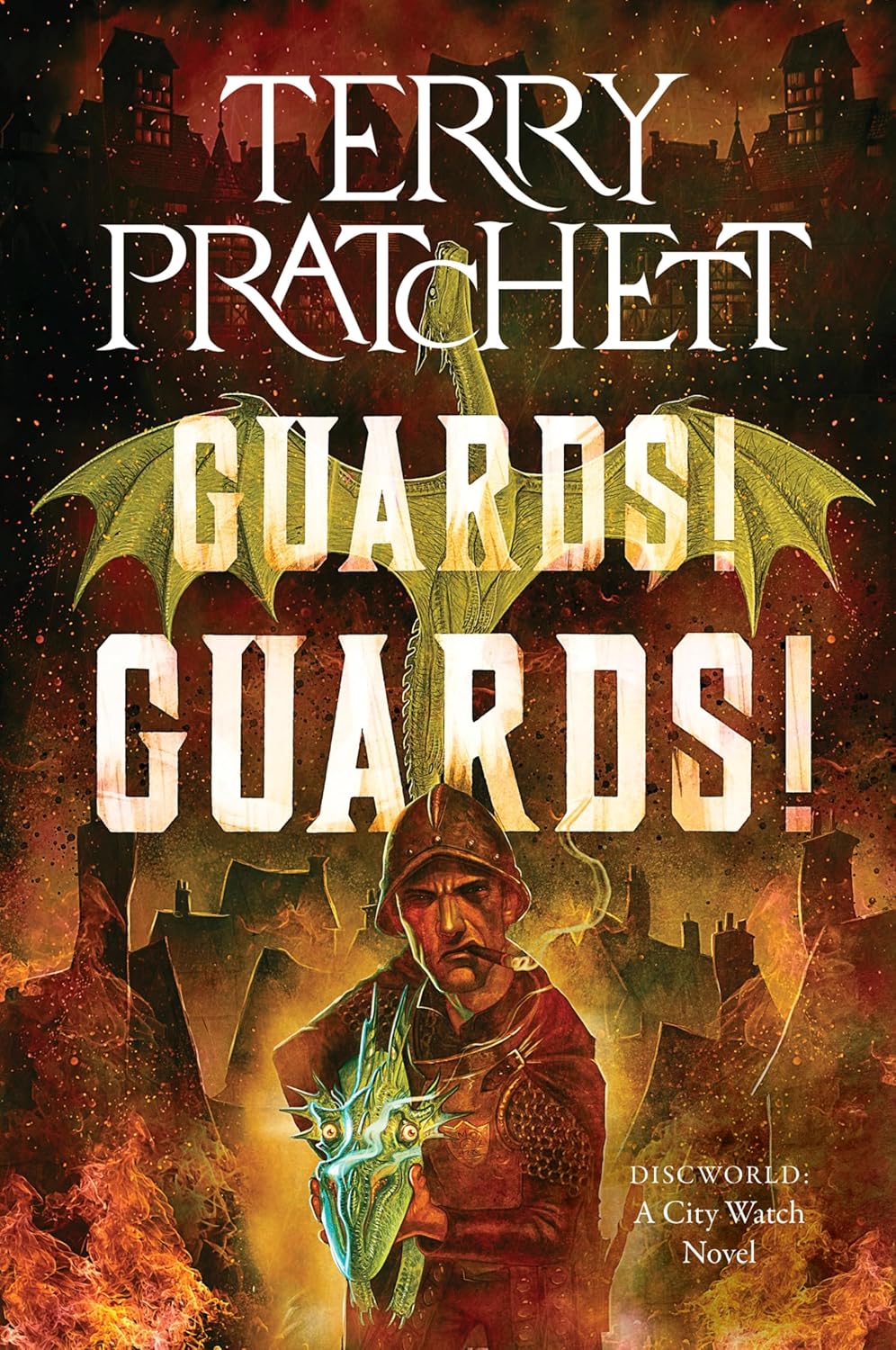
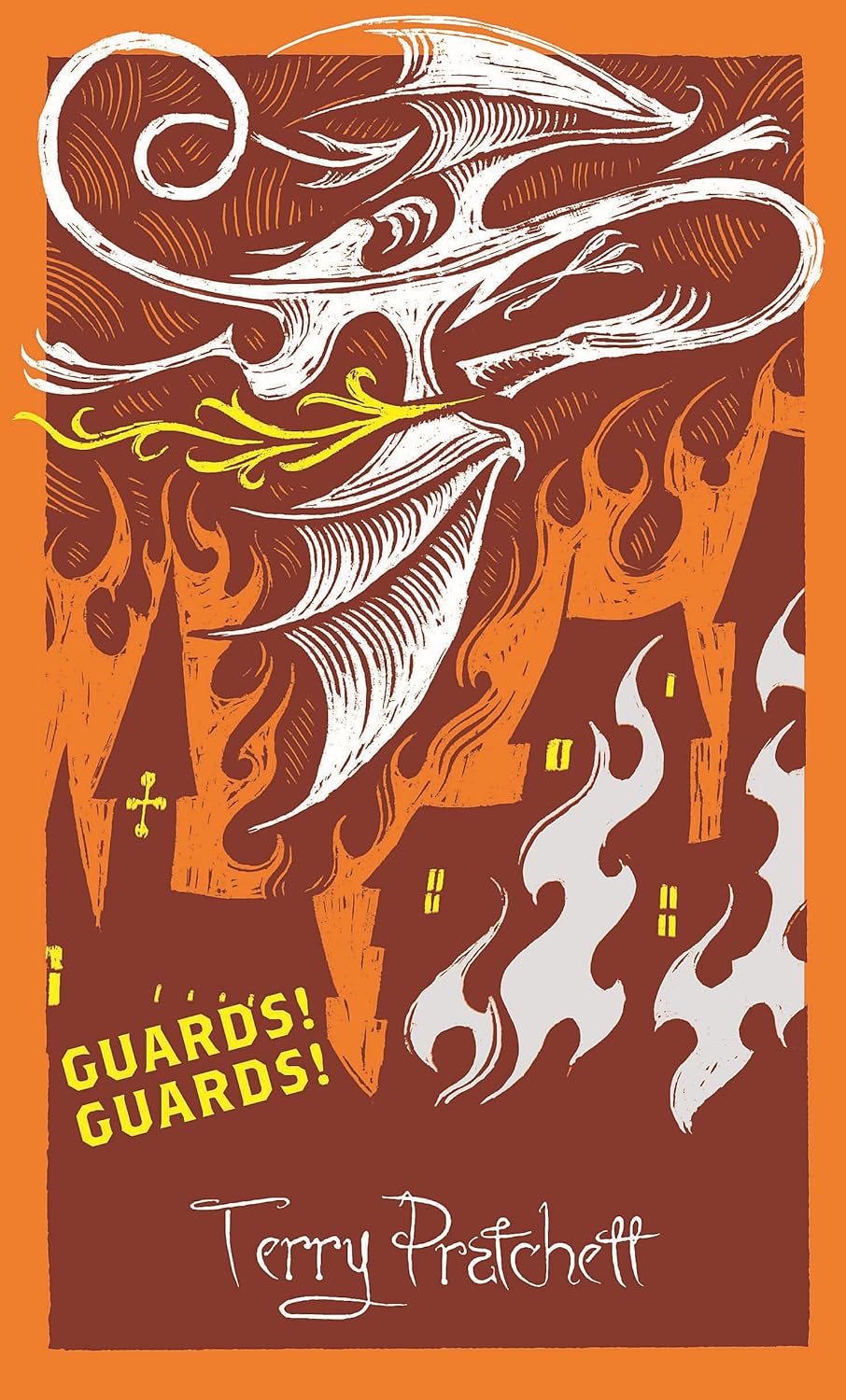
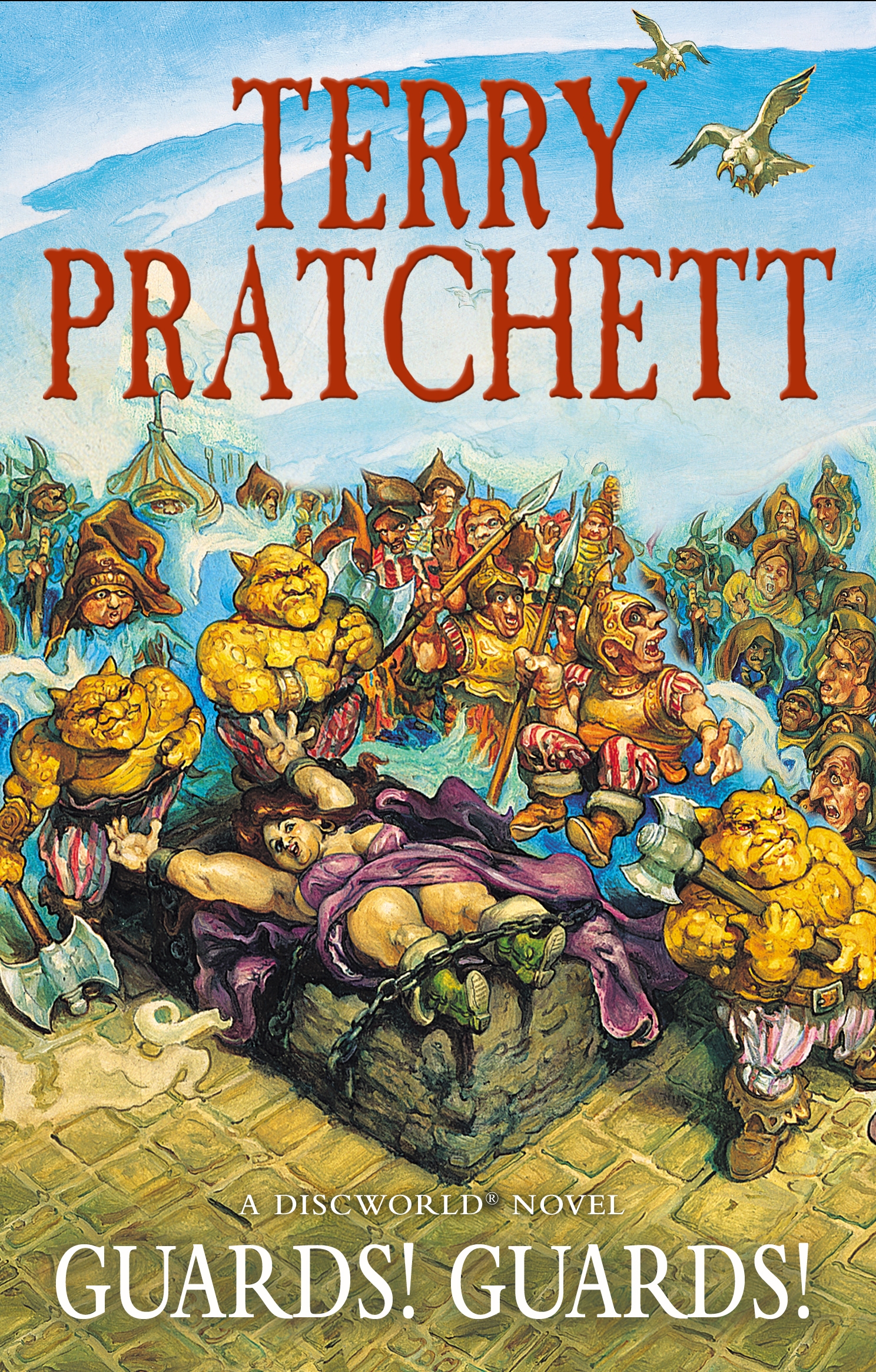
Guards! Guards! by Terry Pratchett

Publisher: Gollancz/Penguin Audio (Audiobook – 1989)

Series: Discworld – Book 8 / City Watch – Book One

Length: 13 hours and 29 minutes

My Rating: 5 out of 5 stars

Amazon

I recently revisited one of my favourite books in Terry Pratchett’s iconic Discworld series, Guards! Guards!, and I just had to review it to showcase how much fun this series can be.

I have never made any secret of the fact that I love all things Terry Pratchett as the Discworld books were one of the formative series of my youth.  A massively popular series set on a flat world carried through space on the back of a giant turtle and four elephants, the Discworld books present a range of unique fantasy adventures, backed with exceptional comedy and satire.  This series is so much fun, and I honestly love every single Discworld book, having read them all multiple times, usually while laughing myself silly.  Indeed, I am such a big fan of this series that I named my blog after a location in the universe.  Despite my overwhelming love for this series, I haven’t reviewed many Discworld books (the exception being Moving Pictures and The Last Continent).  That changes with my review of the outrageously funny Guards! Guards! which I recently enjoyed while on a road trip.

Guards! Guards! is a particularly entertaining addition to the Discworld series that I have a lot of love for.  Serving as the first book in the City Watch sub-series, Guards! Guards! sees Pratchett blend his typical fantasy and comedy elements with a complex murder mystery.  This book follows the ragtag city watch of this world’s main recurring city, Ankh-Morpork, as they try to solve a series of deaths caused by a monstrous murder weapon.  Due to its brilliant and hilarious story, as well as the fact that it perfectly sets up the rest of the awesome City Watch books, I generally consider Guards! Guards! to be one of my absolute favourite Discworld novels, and I have featured it in various Top Ten Tuesday lists over the years.

On the fantastical and impossible Discworld no place is more dangerous, corrupt or morally unhealthy as the legendary and stinking city of Ankh-Morpork.  The Disc’s largest city, Ankh-Morpork has many terrors haunting its urban depths, where life is cheap and death lurks around every corner.  However, not even the hardest criminals, deadliest wizards or most manipulative politicians are prepared for an ancient and malevolent creature that is about to be unleashed upon the city.

A shadowy secret brotherhood has engineered an elaborate plan to seize power in Ankh-Morpork through use of an unlikely weapon, a dragon.  Summoning a fully formed fire-breathing dragon to cause terror, the brotherhood hopes to use the resulting carnage to bring in their own puppet to control the city.  However, the dragon has its own ideas about what sort of terror it wants to bring down on humanity.

With the rest of the city powerless against the dragon, it falls to the ramshackle Ankh-Morpork Night Watch and its depressed captain, Sam Vimes, to try and stop it.  The only problem is the Watch are the biggest joke in the city, incapable of standing up to normal crime, never mind carnage caused by magical dragon.  But with an unnaturally keen new recruit guilting them into action, and a terrifying dragon fanatic with a crush on Vimes keeping them in line, the Watch is going to try and save the day, even if no-one wants them to.

Guards! Guards! still reigns supreme as one of my top Discworld novels from the always impressive Terry Pratchett.  Featuring a unique plot, loaded with an outstanding mix of mystery, humour and fun fantasy elements, Guards! Guards! brilliantly sets up one of Pratchett’s best sub-series while presenting its own epic and powerful story.  An exceptional read from start to finish, this book gets a very easy five-star rating from me, and I love it so damn much.

The plot of Guards! Guards! is so damn clever and is peak Pratchett in its inventiveness and impressive characters.  Presenting an entertaining and humourous noir murder investigation in a fantasy series, Guards! Guards! has a lot of moving parts to it, including some impressive character-driven story arcs, all of which come together beautifully for a particularly intense and insane story.  Starting off very strong with some great introductions to various key characters, including the young and keen Carrot Ironfoundersson, who journeys to the massive and corrupt city of Ankh-Morpork to join the Night Watch, providing fresh blood, irrepressible honesty and uncontrolled enthusiasm to the small squad of rejects and failures currently staffing it.  Carrot’s arrival corresponds with the start of a bold conspiracy, as a secretive mystic brotherhood plots to dethrone the Patrician and take over the city.  The initial scenes of this book are extremely good, and I love how Pratchett expertly sets up the entire narrative with some hilarious moments, including the opening sequence with the Elucidated Brethren of the Ebon Night, whose petty ideology shows you just what sort of criminal minds we are truly dealing with.

Things go in a chaotic direction as the Night Watch, led by the drunk and depressed Captain Vimes, witness a direct murder by dragon and begin their own investigation into the matter.  Pratchett expertly pivots the story around from its comedic fantasy start into a complex police procedural/noir murder investigation, as the protagonists try to find out why the dragon is terrifying the city and who benefits from the apparent crime.  At the same time, several great character arcs emerge, including a truly nice, if unconventional romance, new friendships, and a fun analysis of dragon mythology.  There is a great twist about halfway through the book as the down-and-out Night Watch witness an interesting change to the classic dragon fantasy tale that sees a unique king take over the city.

The final third of the book is some of Pratchett’s strongest writing, as Vimes identifies the true culprit and must work to undo the damage they caused.  There are some great moments in this last part of the book as Pratchett presents his own unique and hilarious take on classic fantasy tropes, including the famed million-to-one shot, the heroic rescue, and the successful defeat of a dragon.  I felt that the identity of the main villain of the story was very clever, and Pratchett sets it up well with subtle clues, although if you know Pratchett’s thoughts on certain government positions it’s not too surprising.  Still, the final confrontation between the protagonists and this villain is great, and being literal has never been so deadly.  Pratchett leaves Guards! Guards! on a hopeful note, and it’s impossible not to come away with a smile on your face.

Pratchett was really on-point when it came to writing Guards! Guards! and I loved how perfectly it came together.  As with all books in the Discworld series, Guards! Guards! features an exceptional mixture of fantasy and humour elements, as the unusual and cynical Discworld produces some unusual situations, layered in with a great plot and some fantastically complex characters.  A lot of the humour is derived from classic fantasy scenarios that are taken up to 11 and shown in outrageous manners, accompanied by sarcastic comments from the characters as they witness them.  For example, this book serves as an ode to the guards and watchmen from classic fantasy fiction, and there are some funny scenes when these self-aware guards realise how expendable they are in a fantasy story.  However, Guards! Guards! also features a brilliant third element as Pratchett also features a compelling crime fiction read, accompanied with an addictive murder mystery.

The blend of fantasy and crime fiction elements works incredibly well, and it is highly entertaining to watch a serious investigation consider magic, suddenly appearing dragons, and the unique background setting of Ankh-Morpork.  I also loved how many clever and subtle jokes Pratchett was able to weave in because of these crime fiction inclusions, and he ends up lovingly roasting so many classic tropes from police procedurals and noir detective novels.  Despite having read this book many times, I still laugh like crazy at all the humourous moments in Guards! Guards!, especially as you always discover a new joke or pun you previously missed.  I honestly don’t have time to list all the funny scenes in Guards! Guards!, but favourites include the various meetings of the petty and mostly incompetent Elucidated Brethren, Carrot’s naïve overreactions upon discovering crime in the city, and various musings on how to achieve a perfect, million-to-one chance.  Pratchett once again expertly backs up his humour in Guards! Guards! with a series of entertaining footnotes spread throughout the book, that prove to be nearly as much fun as the main story.  These brilliant footnotes contain additional jokes, sarcastic comments, or interesting expansions of the Discworld universe, and they always bounce off the main story perfectly, providing extra laughs and food for thought where necessary.  I really cannot emphasise just how well this blend of genres worked with Pratchett’s unique and endearing humour, and it proves impossible not to have an exceptional time while reading this book.

As with most Discworld books, Guards! Guards! works exceedingly well as a standalone novel, and I feel that anyone wanting a laugh could easily jump in and follow the story without any issues.  Due to its early position in the shared Discworld universe, you don’t have to know anything about the other entries in the overarching series to jump right in, as Pratchett goes a tad light on some of the more outrageous Discworld elements.  As such, I consider Guards! Guards! to be one of the very best entry novels to new Discworld readers.  It also proves to be a brilliant first book in one of Pratchett’s best sub-series, and so many key details of the subsequent City Watch books are introduced here.  This includes some excellent early looks at the chaotic city of Ankh-Morpork and key recurring characters in the larger universal plot.  Ankh-Morpork is a great background setting for Guards! Guards! and it was the first book completely set within the bounds of the city.  I loved seeing this crazy city in even more detail, and all the fun elements set up here help to make it an epic setting.  As such, this is a great book for any Discworld reader, new or old, and it’s one of my favourites for very good reason.

As with pretty much all of Pratchett’s works, the key things that made Guards! Guards! so impressive were the amazing and unique characters that were featured throughout the plot.  Pratchett had a real knack for producing complex, multi-layered figures who can be both comedic and tragic at the same time, and who you couldn’t help but love.  Guards! Guards! was a particularly good example of this, as Pratchett featured a range of brilliant and entertaining characters who would go on to be become major recurring figures in the Discworld canon.  Indeed, Guards! Guards! is one of the most significant books for new characters, and it is frankly amazing how many exceptional major and iconic figures were introduced here.  Each of these characters were so well written, and you have to love both their specific arcs in this book, as well as how they were expanded on in later works.

The most prominent character in Guards! Guards! is Captain Samuel Vimes.  A cynical and damaged man whose habit of calling out social inequities has seen him assigned to the joke position as head of the Night Watch, which he deals with by drinking vast amounts of alcohol.  A parody of every hard-drinking cop and private eye in classic noir fiction, Vimes starts the book with no prospects and too many dead friends.  Given new purpose when the dragon appears in the city, Vimes turns his innate rebellion to a purpose and tries policing and detecting.  Pratchett does an exceptional job setting up Vimes here in Guards! Guards!, and it is no wonder he goes on to be one of his top protagonists.  Vimes’s depressed investigative method proves quite successful, and it was entertaining to watch Vimes attempt to solve the case while sarcastically calling out his fellow citizens’ base stupidity and selfishness.  Pratchett also sets up an impressive redemption arc around Vimes, which comes about through a combination of trusted colleagues, romance, and a renewed determination to uphold the law.  While he ends the book still irritated with the world, the road forward to Vimes doing bigger and better things is well established, and you really get drawn into his arc as a result.

Another impressive character is naïve and innocent City Watch recruit, Carrot Ironfoundersson.  Due to his complex home situation and a late life revelation that he’s human rather than a dwarf (being six and a half feet tall wasn’t a clue to him), Carrot is sent to Anhk-Morpork with a desire to become a watchman, which he incorrectly believes is a noble calling.  Thanks to his literal personality and highly moral upbringing, Carrot proves to be an anathema to the lawless folks of Anhk-Morpork, as he comes to town bringing justice, enforcing obscure laws, and actually arresting thieves: “change your ways”.  A brilliant parody of ultra-righteous fantasy kings, Carrot serves as an outstanding comic relief for much of the book, especially when it comes to his wholesome interactions with the exceedingly criminal inhabitants of the city.  However, beneath his comedic cover, Carrot is written as a complex figure of change, and his ability to inspire the other characters, either through guilt or determination, leads to some big moments.  Pratchett did an amazing job with Carrot in Guards! Guards!, and it was fascinating to see how he evolves from his initial innocent personality, to a more clever, but still determined, character.

Aside from Vimes and Carrot, the other two watch characters are Sergeant Fred Colon and Corporal Nobby Nobbs, both of whom are excellent and solid comedic characters.  The stereotypical fat sergeant and dodgy corporal, Pratchett has fun setting them up as unassailable fixtures of the Night Watch as they do the jobs nature intended for them, and I love how they play off each other.  While Colon has some hilarious scenes, including his attempt at archery and his various ill-timed run-ins with the dragon, you can tell that Pratchett had a lot more fun writing Nobby.  While not all his over-the-top characteristics from the series are shown in Guards! Guards!, Nobby is still a particularly entertaining figure.  Between his coarse language, petty criminal mindset, and uncharacteristic foppish behaviours, every scene with Nobby is highly amusing, and I love how Pratchett expanded off clever stereotypes about lifetime corporals to create this wayward figure.

Outside the members of the City Watch, there are a fantastic array of figures who help to make Guards! Guards! a particularly enthralling story.  This includes one of the few female characters in the book, Sybil Rankin, a dragon-loving heiress who ends up being Vimes’s unlikely love interest.  Deliberately written as the direct opposite of a noir femme-fatale in both personality and appearance, Sybil is a force of nature, using her accumulated nobility to pull the Night Watch, especially Vimes, into her orbit.  It proves impossible not to like Sybil as you watch her confidently go after Vimes or try to put the dragon to heel, and she ends up being one of the most complicated female characters that Pratchett wrote (which is saying a lot when you think of some of his other great female characters).

The other major character that I want to separately highlight is the Patrician of Ankh-Morpork, Lord Havelock Vetinari.  While he has appeared in previous Discworld novels (notably Sourcery), this is the first book that showcases him as a full character.  Generally depicted as a Machiavellian mastermind and one of the few people capable of controlling the chaotic city, Vetinari has some great early scenes.  However, it’s not until the second half of the book when you realise just how fantastic a character he is.  Deposed by the false king, Vetinari initially appears to be completely powerless in the dungeons, until Vimes is thrown in with him and begins to realise that he is still in control, especially as he’s managed to cultivate a new intelligence network (procured by providing wartime strategy to magical rats), while also getting locked in a dungeon specifically designed to keep him safe.  His subsequent scenes tormenting the book’s real antagonist and talking about the nature of humanity with Vimes really cement him as an impressive figure, and the seeds for his many later inclusions as the Disc’s ultimate political mastermind are well sown here.

While I know I’ve been going on a bit about characters (blame Pratchett for being such a good writer), I just need to highlight a few more figures who have a great role in Guards! Guards!.  This includes the Librarian, one of Pratchett’s most iconic characters, who proves to be just as much fun outside of a wizard focused book, and it was entertaining seeing him interact with a separate group of friends.  You get a great introduction to the character of Cut-My-Own-Throat Dibbler, whose mercantile tendencies are on full display here.  The unusual swamp dragon Errol proves to be an unlikely pet, and his arc about finding love and his true form was particularly heartwarming.  Finally, I must mention the book’s great antagonist, who fully embraces the mad tendencies that his position demands.  While I won’t go into too much detail about who he is, I will say I loved seeing his various internal rants about the world, and the scenes with his incompetent henchmen were so damn funny.  All these characters, plus even more hilarious figures, are instrumental to so much of Guards! Guards! brilliant charm and humour, and after being introduced to them here, it’s impossible not to follow them on their full journey.

I have had the pleasure of reading Guards! Guards! in a couple of different formats over the years, but to my mind the best way to enjoy this book, and indeed any Discworld novel, is on audiobook.  The Discworld audiobooks are something very special, and I find that the unique stories, excellent humour and elaborate characters really come across when read out by a passionate narrator.  With the recent re-release of various Discworld audiobooks, there are now two different unabridged versions of Guards! Guards! fans can enjoy, and I want to highlight them both here.

The first Guards! Guards! audiobook is the original version with the talented Nigel Planer, who narrated 22 of the original 23 Discworld audiobooks.  Guards! Guards! is one of his best performances, and it set the scene nicely for many of his subsequent Discworld audiobooks, especially as he settled on a lot of key character voices and tones here.  While it has been a little while since I’ve listened to Planer’s version of Guards! Guards!, I have enjoyed it so many times it is permanently engrained in my head (I used to grab the tape cassette version out of my local library all the time).  Planer, who does all the voices himself, really captures the essence of Pratchett’s storytelling and excels at expressing the author’s unique humour through his vocal work.  I also felt that his portrayal of many of the key characters was second to none, and he really brought to life all the City Watch protagonists, as well as some other long-running figures, in some impressive ways.  He would revisit many of these voices in multiple subsequent performances, and it is a testament to his skill that the initial tones he came up with here, worked so well in the later books.  I frankly have so much love for Planer’s original take on Guards! Guards!, which definitely still stands the test of time, and his excellent and heartfelt voice work defines many of the City Watch characters for me.

While Nigel Planers original version is perfect, current Discworld fans may be more familiar with the latest audiobook production of Guards! Guards!, which was part of a recent re-recording of all the Discworld books.  These new audiobooks each feature a different famous British performer voicing the main plot, while acclaimed actors Peter Serafinowicz and Bill Nighy have key roles in every single production.  While these have been out for a little while, I only just listened to my first one .  Coming in at a runtime of 13 and a half hours, which is a tad longer than the roughly 10-hour long Planer version, this Guards! Guards! audiobook was extremely fun, and it served as excellent entertainment on a recent road trip.

The new version of the Guards! Guards! audiobook is primarily voiced by British radio and television personality Jon Culshaw.  Culshaw is amazing in the role, and I was deeply impressed with his take on the Guards! Guards! characters.  Each unique character comes across extremely well in Culshaw’s capable hands, and I enjoyed his take on their unique characteristics and eccentric personalities.  He perfectly showcased protagonist Samuel Vimes’s drunken despair and depression, while various other key members of the watch, such as the extremely keen Carrot and the more cautious Colon, are shown extremely well.  I also felt that Culshaw did an incredible job with several complicated figures from the story, such as the infamous watchman Nobby Nobbs, who Culshaw gifts a gruff and weaselly voice that sounded a lot like David Bradley or Jon Pertwee.  His Lord Vetinari is also amazing, and the deep and threatening tones really capture the character’s dangerous nature.  Finally, I felt that his take on the main female character, Sybil Ramkin, was just perfect, and you really got the full blast of her big personality and excessive aristocratic characteristics.  Many of the other side characters were also perfectly portrayed to my mind, and I must highlight the excellent way in which he disguised the voice of the main antagonist during some key secret society scenes.

Culshaw’s primary narration is well backed up by Peter Serafinowicz and Bill Nighy in their respective roles.  Serafinowicz provides the voice of Death whenever he appears in this audiobook, which works out extremely well even with Death’s relatively minor role in Guards! Guards!.  Serafinowicz has an exceptional Death voice, and hearing it suddenly appear throughout Guards! Guards! is so damn epic, especially during one scene where Death is hiding amongst the soon-to-be deceased.  Nighy, on the other hand, narrates the various footnotes.  Nighy was a perfect choice for this, and his calm, consistent tones, echoing Peter Jones’s similar role in The Hitchhiker’s Guide to the Galaxy radio and TV editions really highlighted the subtle comedy of these footnotes.  I felt that all three of these distinctive actors really vibed together in the Guards! Guards! audiobooks, and the switch between them was seamless, allowing for a particularly awesome listen.  Throw in an interesting short afterword about fantasy elements by acclaimed author Ben Aaronovitch, and this proved to be a remarkable and compelling audiobook I could not get enough of.  While Nigel Planer’s original narration of Guards! Guards! is always going to live in my head rent free, I felt that this new version more than lived up to the hype surrounding it, and I really appreciated the unique and powerful performances these new narrators brought to the table.  Frankly both of the audiobook versions comes highly recommended by me, and it is impossible to be dissatisfied by them at all.

Whew, well in case you could guess from this massive review (it got away from me), I love Guards! Guards! and I have some very strong feelings for it.  One of Terry Pratchett’s best Discworld novels, Guards! Guards! is the perfect blend of fantasy, crime fiction and humour that you could ever want, and I always get wrapped up in its elaborate story.  A wildly entertaining and comedic novel from start to finish, Pratchett added so much heart to this book, and you get drawn into the impressive characters and compelling, crime fiction plot.  A brilliant start to the City Watch subseries, Guards! Guards! is so damn good, and I know I will be reading it many more times in my life.  I can think of no better way to emphasise just how amazing Guards! Guards! is than to mention that I used it to introduce the Discworld to my wife, who is now powering through the series on her own.  So do yourself a favour and check this book out now!

Amazon

Top Ten Tuesday – My Favourite Discworld Novels by Terry Pratchett

Top Ten Tuesday is a weekly meme that currently resides at The Artsy Reader Girl and features bloggers sharing lists on various book topics.  The official topic for this week’s Top Ten Tuesday required participants to list the top upcoming books on their Fall (Spring down here in the Southern hemisphere) to be read list.  However, I addressed that a couple of weeks ago, so that leaves me with a bit of a free topic this week.  I decided to fill this extra list by looking at one of my absolute favourite series of all time, the Discworld books by Terry Pratchett.

I have long been a fan of Terry Pratchett’s Discworld series, which, in my opinion, is one of the absolute best series of all time.  Made up of 41 separate novels and running from 1983 to 2015, the Discworld novels are a fantasy institution from one of the most talented authors ever.  Set on a flat world shaped like a disc that travels through space on the back of four elephants, who themselves stand on the back of a giant turtle, this world is filled with all manner of crazy and over-the-top people, creatures, gods and monsters, and this results in an amazing number of stories.  All 41 books feature amazing and highly unique story that perfectly blends outrageous fantasy elements with clever and relentless humour and satire.  I have read every Discworld novel multiple times, and in my opinion, everyone is a masterpiece in their own way.  Heck, I am such a big fan of this series that I even named this blog after a location in the Discworld universe, that’s how much I love them.

While the Discworld novels are never that far from my mind, I have been thinking about them a lot more lately, mainly because I have been featuring some of them on my recent top ten lists.  My lists that highlighted my favourite Books with Magical Schools, Favourite Books Written More than Ten Years Ago and Hilarious Book Titles have all featured a few Discworld books, and it turns out I have a hard time not going on about Pratchett’s work on a weekly basis.  Naturally, this has gotten me thinking more and more about the Discworld books, and I will probably embark on a new re-read of them sooner or later.  However, before I get around to that, I thought I would have a go at listing my absolute favourite Discworld novels, as that will make an interesting list.

Now, why I deeply enjoy this entire series, not all Discworld novels are created equal.  Several shine above the rest in my opinion, whether because they have better jokes, a more compelling plot, or a more impressive and elaborate premise.  As such, I felt reasonably confident that I could choose the ten entries (with some honourable mentions) that I enjoy the most.  I have based this list on several factors, including humour, plot, world-building, characters and many other features.  This allowed me to determine my favourite Discworld books, although I had to make some hard choices to settle on a final top ten, as all of them are very good.  I was eventually able to whittle it down to my list, and I think the results match my overall preference rather well.  While most of them are from Pratchett’s golden years and are in the middle of the Discworld release back, I think there is a good variety here, and that the list below really showcases the outstanding and amazing depth that Pratchett always had.  So let us see what made the cut.

Honourable Mentions:

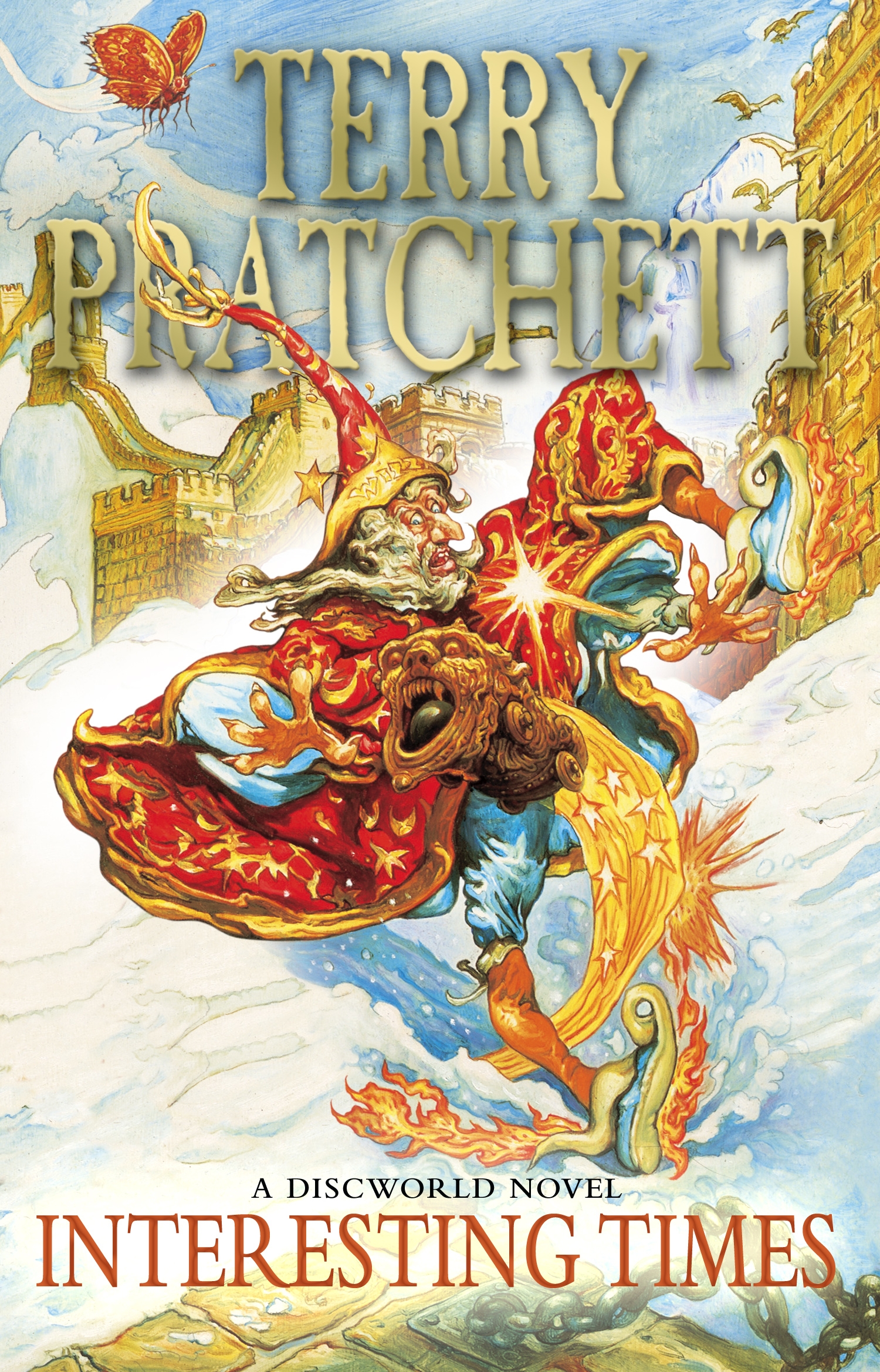
Interesting Times – 1994

Interesting Times Cover

A rambling good read that sees one of Pratchett’s most iconic protagonists visit this world’s version of Asia.  Loaded with some brilliant jokes (the multiple translations of a person’s scream), a ton of fun references to Asian culture, and some outrageous characters, Interesting Times is an excellent read that also offers a little closure for the first two Discworld books.

Amazon     Book Depository


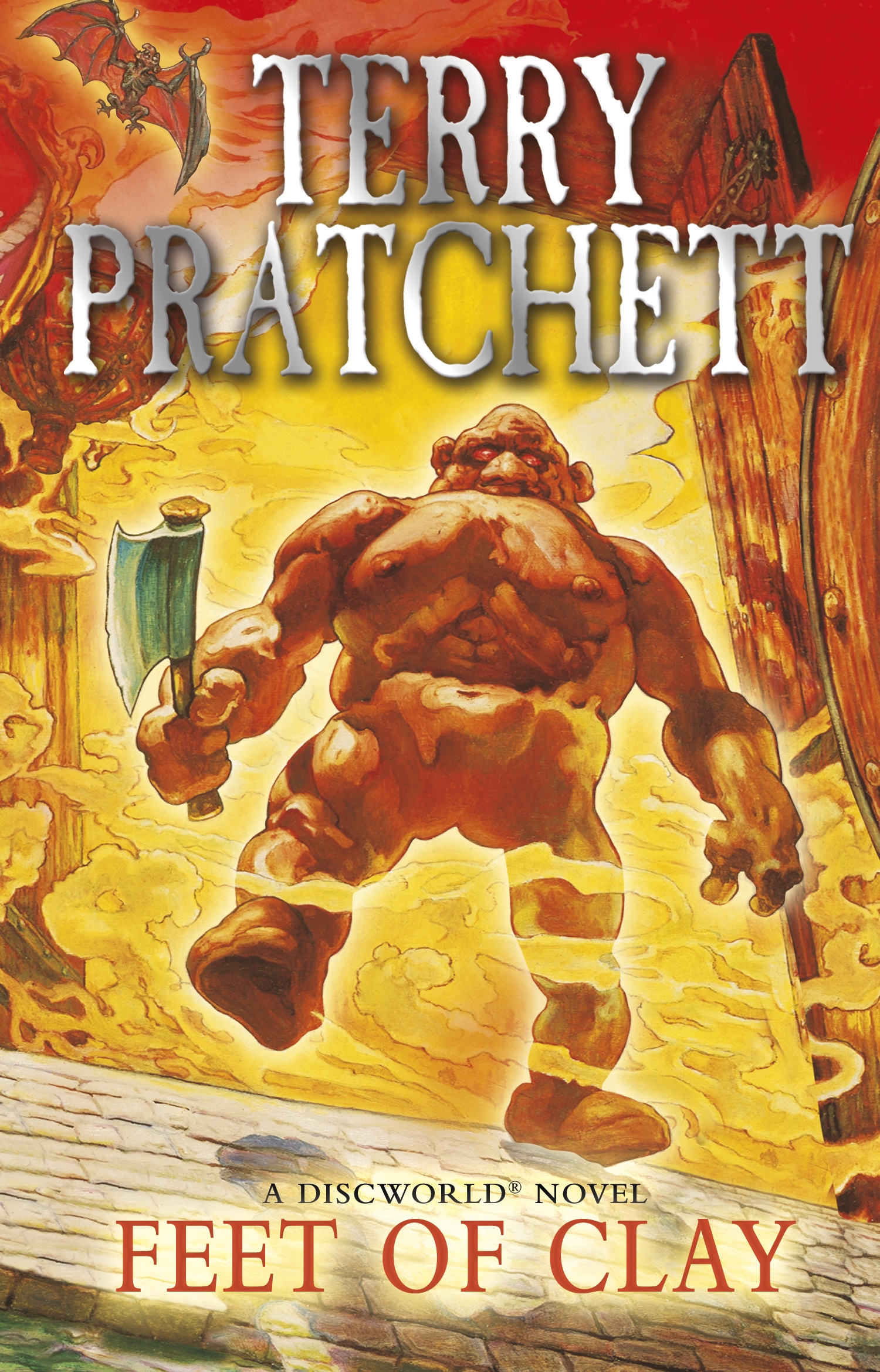
Feet of Clay – 1996

Feet of Clay Cover

The third City Watch novel, Feet of Clay is a brilliant murder mystery novel that makes full use of its fantasy and comedy to create an epic read.  Featuring several great mysteries, including a series of murders committed by a Golem and the poisoning of the city’s ruler, you really get dragged into the story while loving Pratchett’s excellent solutions and hilarious inclusions.

Amazon     Book Depository


The Truth – 2000

The Truth Cover

Pratchett introduces print journalism to the Discworld in this clever standalone entry.  Following an ambitious reporter who creates Ankh-Morpork’s first newspaper, only to get dragged into a big conspiracy, The Truth is an ambitious and very exciting entry that perfectly parodies everything about newspapers.  Loaded with jokes about everything from dodgy advertisers, stupid human interest pieces, and even featuring a trashy alternate paper, this is perfect for anyone familiar with the crazy newspapers of London.

Amazon     Book Depository


Night Watch – 2002

Night Watch Cover

Another exceptional City Watch book is the later entry, Night Watch, which sees Vimes, transported back into the past by magic with a dangerous serial killer.  Forced to relive his traumatic early days on the watch, Vimes must keep his younger self alive while also navigating a dangerous revolution he remembers all too well.  With a compelling narrative that mirrors Les Misérables and some great time-travel elements, Night Watch is one of the more distinctive reads in the series.  While it gets a lot darker than some of the other Discworld novels, it is still extremely addictive, and fits into the rest of the series perfectly

Amazon     Book Depository

Top Ten List:

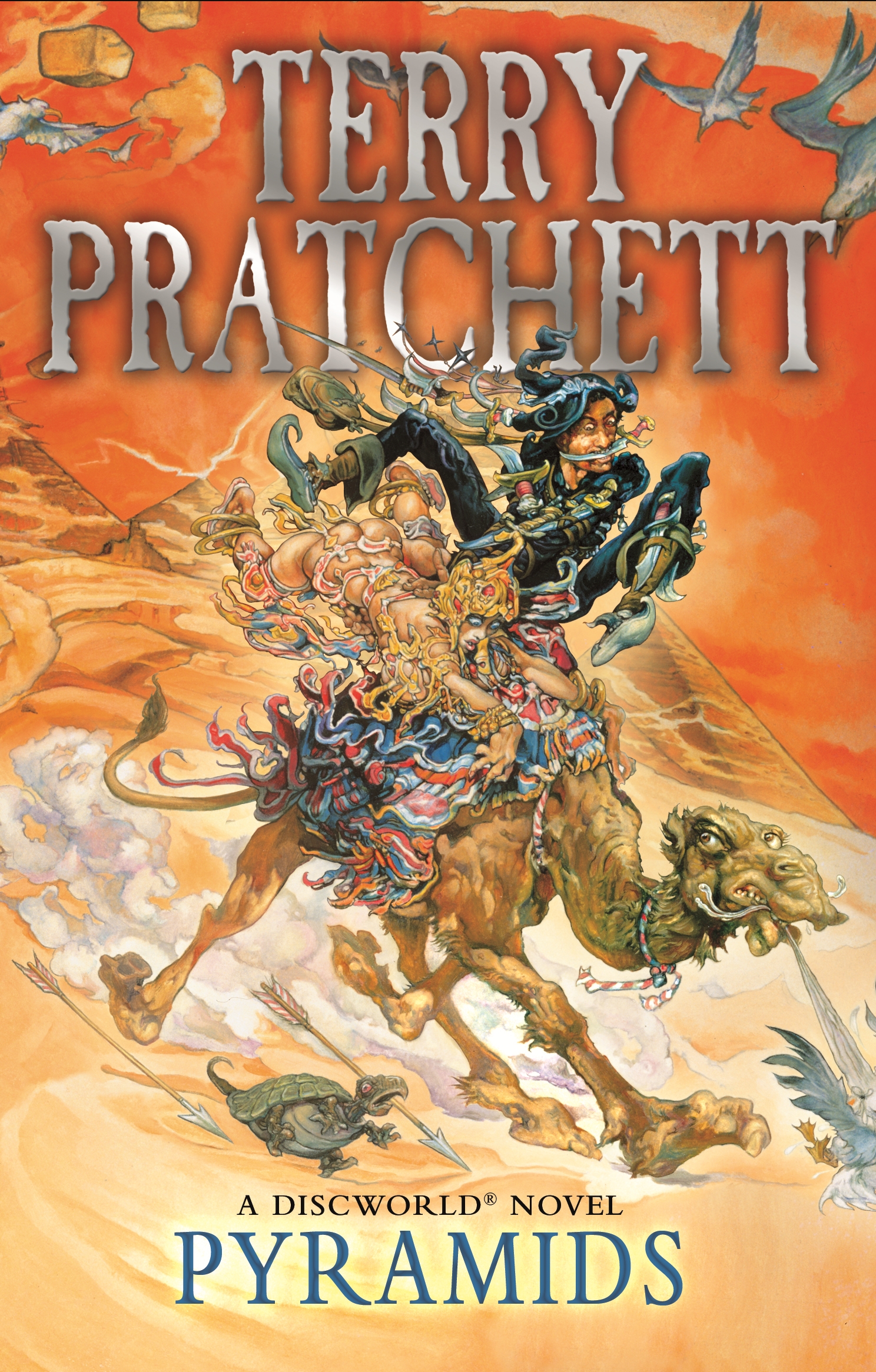
Pyramids – 1989

Pyramids Cover

The first entry on my top ten list is the classic Pratchett novel, Pyramids.  A standalone entry in the series, Pyramids tells the story of a young prince of a river valley kingdom, very similar to Egypt, who returns home after receiving training as an assassin in Ankh-Morpork (the biggest city on the Discworld and a major setting).  Upon claiming the throne, he tries to fight against the tradition of his kingdom, with limited effect, until the kingdom’s overuse of pyramids creates major temporal issues for the entire valley (its all down to bad geometry).  Loaded with so many jokes about ancient Egypt, this is a hilarious fish-out-of-water tale that is very hard to put down.  There are a ton of great moments in this novel, including the best look at the legendary Assassin’s Guild, an impromptu rugby game between the gods over the sun (with commentary from an overexcited priest), and an army of mummies pissed off at being buried without their organs.  I have probably read this Discworld novel the most out of any of them, and I get something new out of it every time I pick it up.  An exceptional, and extremely funny read.

Amazon     Book Depository


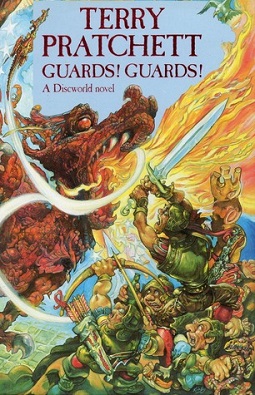
Guards! Guards! – 1989

Guards! Guards! Cover

One of the more interesting aspects of the Discworld series is the way that Pratchett featured several smaller sub-series which follow specific characters.  My favourite of these is easily the City Watch books, which follow the underpaid and constantly underestimated watchmen of the infamous, crime-ridden city of Ankh-Morpork.  Perfectly blending Pratchett’s typical humour and fantasy elements with hard-boiled detective narratives, the City Watch books are some of the best entries in this series, and I love the unique blend of characters and highly entertaining and enthralling narratives.  The first City Watch entry, Guards! Guards! is definitely one of Pratchett’s best novels, and I constantly rave about it when I do lists about funny books.  Not only does it do a great job introducing several iconic characters who Pratchett would reuse throughout the rest of the series, but it has an outstanding narrative to it.  Following the depleted and useless Night Watch, made up of a drunk captain, a hopeless sergeant and a criminally minded corporal as they attempt to solve a series of murders caused by a magically summoned dragon.  Joined by a new eager, if slightly oblivious new recruit, who definitely isn’t the city’s returning king, the Night Watch embark on an ambitious investigation against cultists, dragon hunters and city’s massive criminal class.  Guards! Guards! is fantastic on so many levels, and there is something for everyone in it.

Amazon     Book Depository


Moving Pictures – 1990

Moving Pictures Cover

One of the things that the Discworld novels excel at is parody and satire of certain social, historical or cultural elements, with everything from countries, ancient empires and entire trades lovingly mocked.  Perhaps one of the best examples of this is Moving Pictures, a mostly standalone read that sees the art of film appear on the Discworld, becoming an instant hit.  Soon an alternate version of Hollywood appears, and various characters jump at the chance to make over-the-top films, which are accompanied by a vast array of jokes and references about classic movies, film making tropes and actors.  Naturally for a Discworld book, nothing is what it seems, and the heroes are forced to face off against interdimensional monsters coming out of the screens.  In addition, the iconic Unseen University setting gets some stability as a new Arch-Chancellor arrives, shaking up the wizards.  I love this book on so many levels, especially as Pratchett has so much fun satirising the film industry here.  Everything is lampooned here, such as Gone with the Wind (accompanied with subliminal advertising), King Kong (except a giant woman kidnaps an ape), The Wizard of Oz (the dwarfs of the Discworld will never be the same again), and so much more.  I can’t even count the sheer number of movie references featured here, and I discover a new clever joke every time I read Moving Pictures.  Pratchett also manages to introduce or expand on several great secondary characters who will go on to have major roles in other books in the series, so it turns out to be a surprisingly key book.  Impressive and wonderful on so many levels, Moving Pictures was an easy inclusion for this list.

Amazon     Book Depository


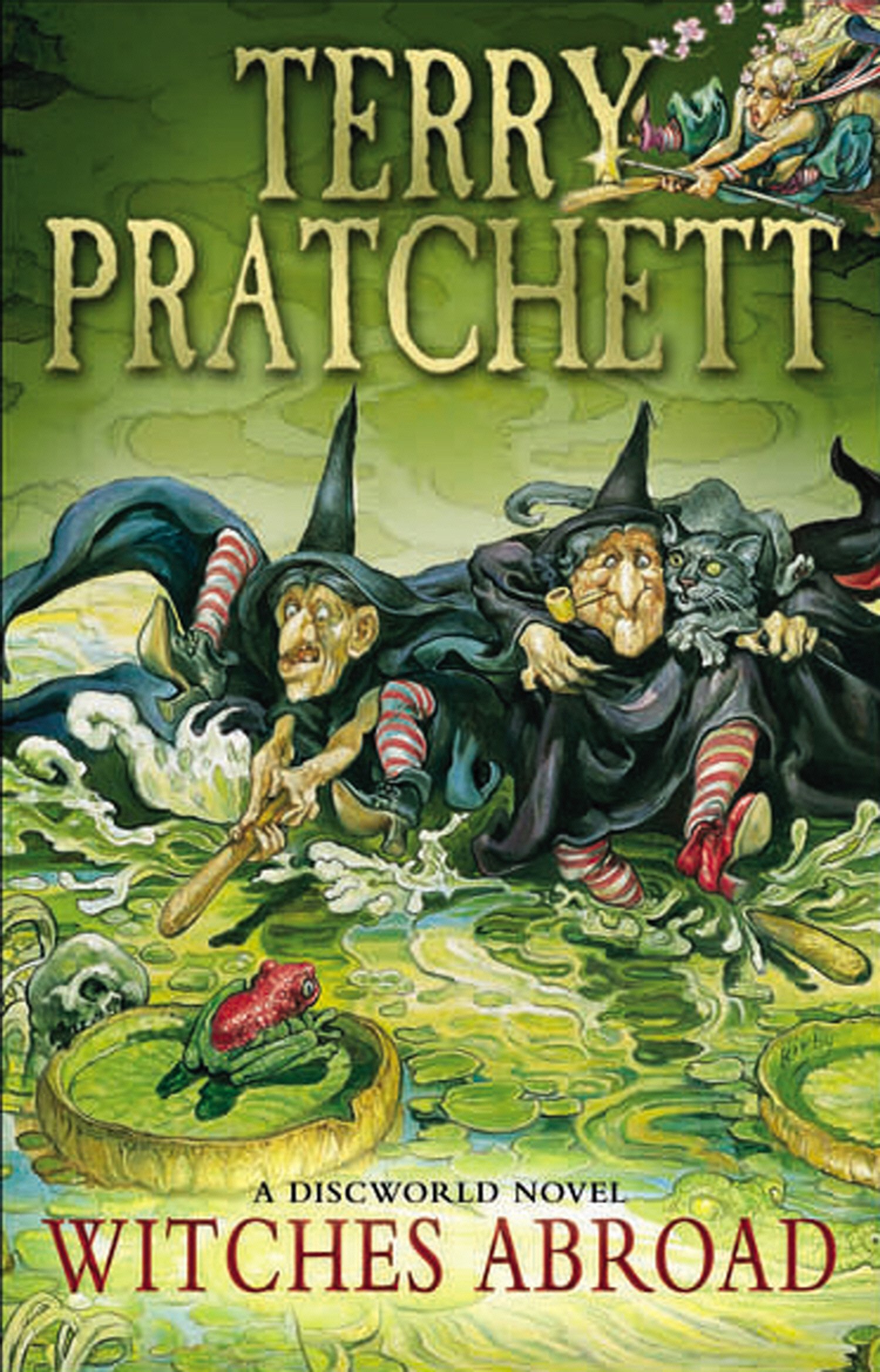
Witches Abroad – 1991

Witches Abroad Cover

Another one of the top Discworld sub-series is the Witches books, which unsurprisingly follows a group of witches (Granny Weatherwax, Nanny Ogg and Magrat Garlick), in several unique adventures.  Unlike the characters they are based on from Macbeth, the witches are a force for good and help the local villages primarily with headology (psychology and folk medicine parcelled up with mystical overtones) and the occasional magic.  The witches make for an excellent group of central characters, and Pratchett told some exceptional stories with them.  While Wyrd Sisters and Lords and Ladies are both pretty epic reads, my favourite Witches book is Witches Abroad.  As the name suggests, this book see the three protagonists embark on a holiday to a faraway kingdom (essentially New Orleans), to fulfil a fairy godmother’s last wish.  Along the way they are forced to confront a series of twisted fairy tale scenarios, their own internal bickering, and an evil fairy godmother from Granny Weatherwax’s past.  Armed only with a wand that is permanently set to pumpkin mode, the witches must deploy their usual trickery to save the day.  This entire novel is pretty epic, as it not only captures the protagonists in all their amazing glory, but it has a powerful story that expertly blends humour and drama.  A lot of the narrative focuses on the dark side of fairy tales, and Pratchett has fun satirising so many classic stories in very clever ways.  However, my favourite scene is the fantastic sequence where Granny Weatherwax uses headology to completely destroy a group of card sharks who had conned her friends.  Extremely inventive, memorable and oh so funny, I just had to feature Witches Abroad here.

Amazon     Book Depository


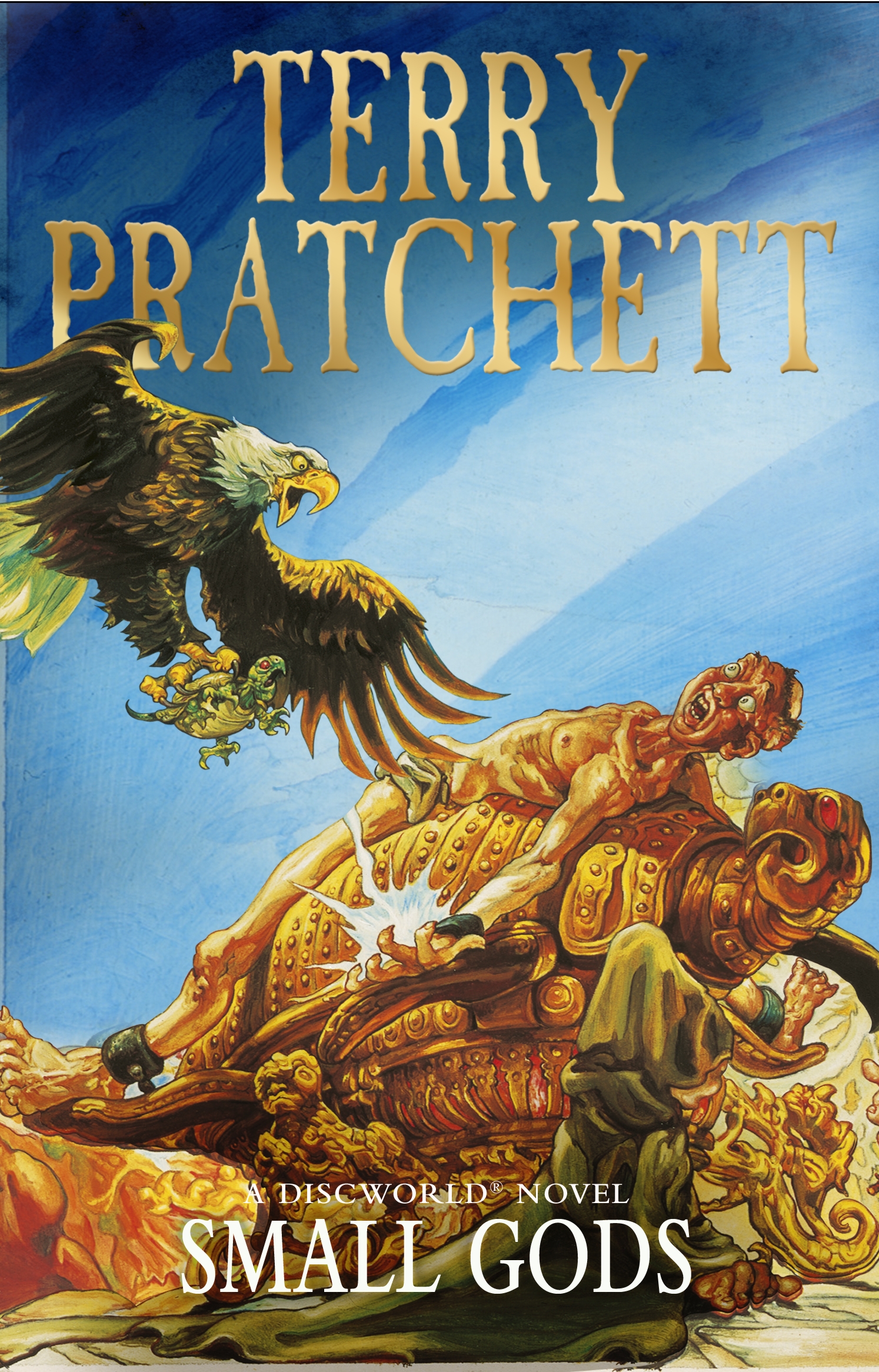
Small Gods – 1992

Small Gods Cover

The next entry on this list is in my opinion, some of Pratchett’s best work.  The 13th Discworld novel, Small Gods has a standalone narrative which sees Pratchett examine religion and belief.  The story follows Brutha, a somewhat simple lad who lives in a vast imperial theocracy that is centred around the worship of the Great God Om.  However, Brutha is shocked when he discovers a talking tortoise only he can understand who claims to be the actual Om.  Forced to take the tortoise along on a great adventure, Brutha discovers the corruption at the heart of his empire and must fight to save it, himself, and his god.  This is a particularly clever novel from Pratchett and a very worth addition to this list.  The author pulls together a very thoughtful and captivating read that examines the various pros and cons of religion, worship and gods in a very thoughtful, but still humorous way.  The mixture of theological debate, adventure, and the brilliant satire of religion, results in a very impressive read, and it is guaranteed to leave you both laughing and pensive at the same time.  The book’s main strength is the outstanding interactions of the two main characters, and the growing relationship between an arrogant put powerless god, and his simple but deeply wise believer, sets an impressive tone for the entire book.  I would say that Small Gods is one of the most intelligent and compelling books of the entire Discworld series and I cannot hype it up enough.

Amazon     Book Depository


Men at Arms – 1993

Men At Arms Cover

After wowing everyone with Guards! Guards! Pratchett mercifully brought back the City Watch characters and storylines again with a fantastic sequel, Men at Arms.  This book sees a retiring Captain Vimes and his team try and stop a madman who is running around the city killing people with the Disc’s first gun.  Featuring another exceptional mystery that involves assassins, clowns and a literal species war between dwarfs and trolls, Pratchett switches the tone of this book from the hardboiled detective story of Guards! Guards! to a more typical police narrative like Dirty Harry.  Loaded with fantastic cop humour and introducing several great new characters, Men at Arms is just as good as the first City Watch book, while also expertly setting up some story elements for the rest of the series.  Guaranteed to appeal to both fantasy fans and crime fiction buffs, Men at Arms is one hell of a read.

Amazon     Book Depository


Hogfather – 1996

Hogfather Cover

All Pratchett fans will know that one of the most surprising loveable recurring characters in the entire Discworld series is Death, the literal grim reaper, who appears in pretty much every book.  Initially shown to as a resolute soul taker, Death evolves into quite a personable and likeable figure who is obsessed with the humans he’s tasked with reaping.  This obsession eventually compels him to adopt a daughter and take on an apprentice, which leads to the first Death book, Mort.  Pratchett wrote several Death novels over his career, many of which dealt with Death’s growing love of humanity, while also involving attacks on reality by outside forces.  While I have a lot of love for Reaper Man and Soul Music, my favourite Death novel is probably Hogfather.  After the Hogfather (this universe’s version of Santa) is murdered, Death steps into the role for unknown reasons.  This forces his granddaughter, Susan, to investigate the disappearance and try to bring back the Hogfather.  This results in an extremely entertaining and silly book that satirises all things Christmas and festive in one fantastic outing.  Most of the humour revolves around Death pretending to be Santa, which leads to all manner of confusion and fear, that is so much fun to see.  Throw in a very memorable villain and a great secondary storyline around the crazy wizards at the Unseen University accidently inventing gods, and this is one of the funniest books in the series.  A very entertaining and compelling Discworld novel, you will never look at Christmas the same again after reading it.

Amazon     Book Depository


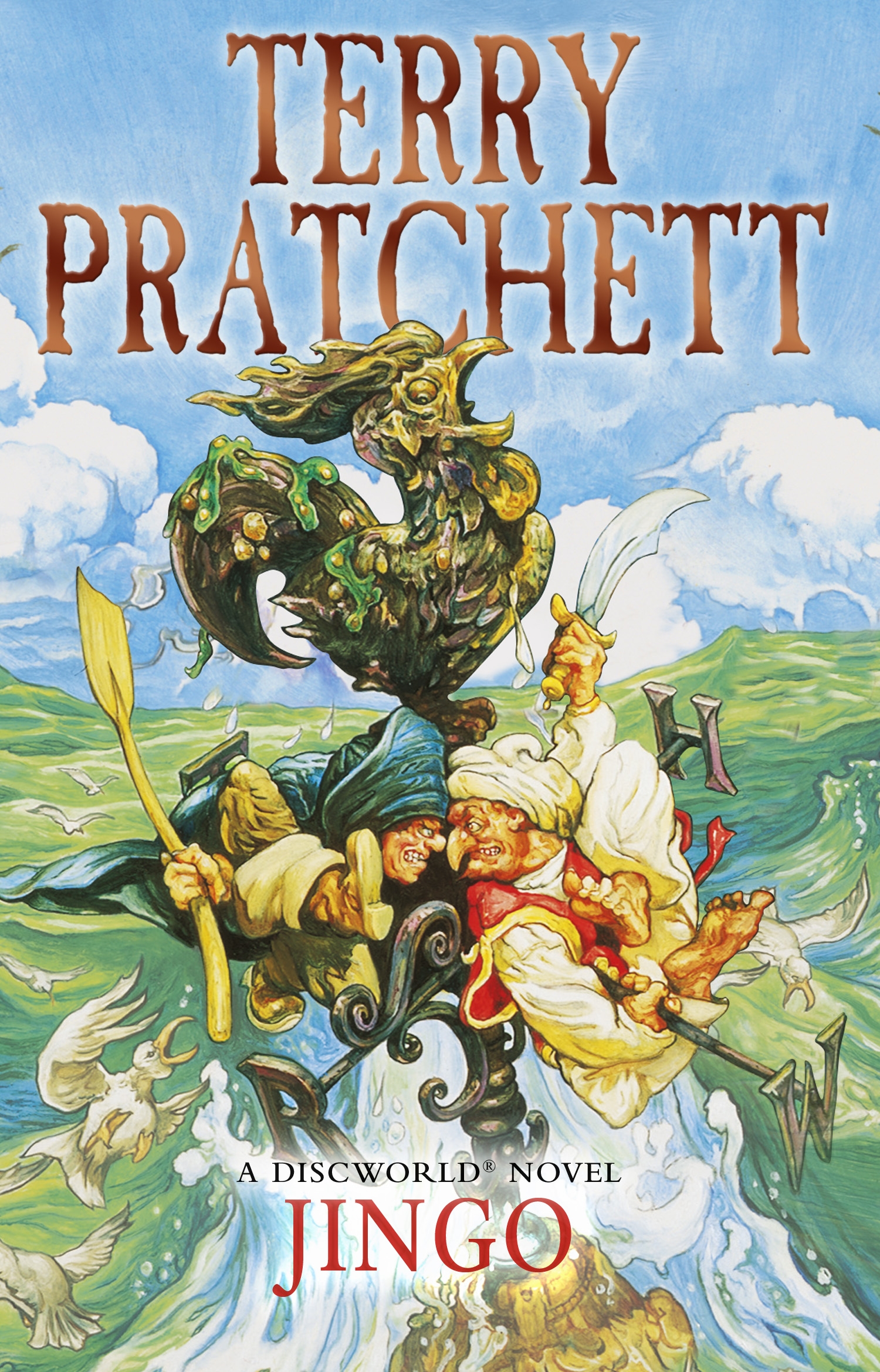
Jingo – 1997

Jingo Cover

For the next entry on this list, Jingo, I must admit that my choice to include it here might be for more personal reasons, rather than purely on the quality of the book.  That is because Jingo was the first Pratchett book I ever properly read, and it has led to my subsequent lifelong obsession with all things Discworld.  I still have my first copy of Jingo, and it is extra special for me because I managed to get Terry to sign it for me.  So yeah, I might be a little biased when it comes to Jingo, but I maintain it is a worthy addition to this list as it has a brilliant and hilarious story to it.  The fourth entry in the City Watch sub-series, Jingo sees Commander Vimes and his men caught up in a brewing war between Ankh-Morpork and the rival empire of Klatch when both claim a mysterious new island that rose in the ocean between them.  After an attempted assassination of a Klatchian prince occurs on Vimes’ watch, he leads the city watch in an impromptu invasion of Klatch to find the killer and stop the war.  I deeply enjoyed Jingo’s brilliant and very clever story and it was a very worthy addition to the City Watch series.  The humour in Jingo is a bit more subtle than some of Pratchett’s other novels, with most of the jokes satirising British imperialism, diplomacy, politics, and its view of foreigners, with a ton of references to historical wars and conflicts that Britain had against its neighbours.  While some of the jokes are a tad obscure, they are all extremely well set up, and they always get a chuckle out of me.  Throw in some brilliant references about a lone bowman assassin, an espionage mission with Sergeant Colon and a cross-dressing Corporal Nobbs that has mixed success, and the always charismatic Captain Carrot turning into Lawrence of Arabia and arresting two entire armies for breaches of the peace, and you have a really entertaining narrative.  Jingo is always a must read for me whenever I revisit the Discworld universe, as well as being an essential entry in the deeply impressive City Watch books that comes highly recommended.

Amazon     Book Depository


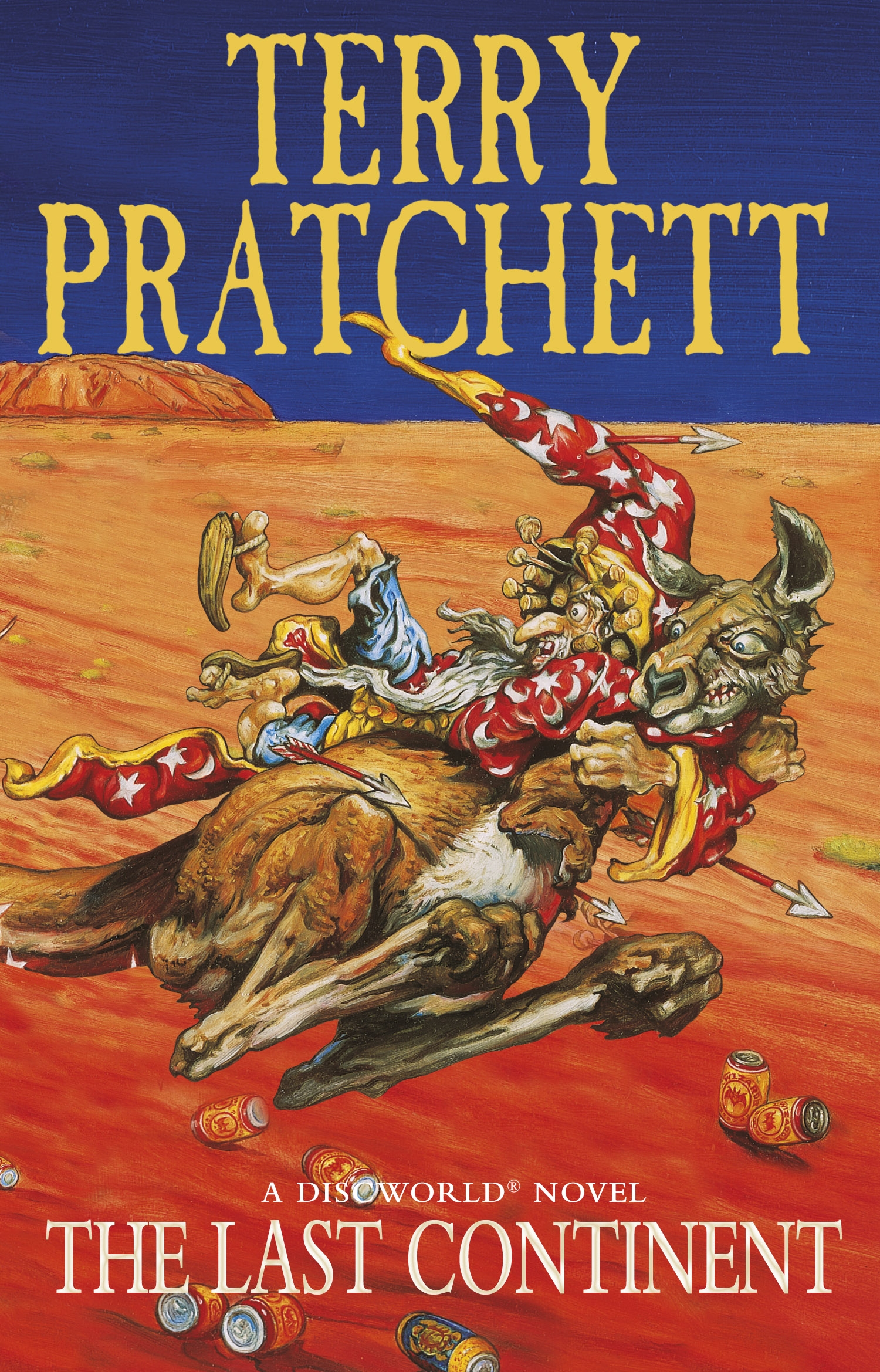
The Last Continent – 1998

The Last Continent Cover

Another Pratchett book that I have a little bias for is The Last Continent, which is probably one of my absolute favourite Discworld novels.  The sixth book to feature the cowardly wizzard (not a typo) Rincewind as its protagonist, The Last Continent takes place on the lost continent of XXXX, which is essentially the Discworld’s version of Australia (despite certain assurances from the author that any similarities to Australia are coincidental at best).  This book follows Rincewind after he is tricked into another heroic quest that sees him traverse the continent, often mimicking various Australian folk heroes or cultural icons.  At the same time, the wizards of Unseen University, in an attempt to find Rincewind, get themselves trapped back in time and must escape from an enthusiastic god of evolution with their usual chaotic shenanigans.  Pratchett has a lot of fun with The Last Continent, and there isn’t a single piece of Australian culture or history that he doesn’t make fun of here.  As an Australian myself, I can’t help but laugh at all his fun and well-written Australian jokes and it was interesting to see his British take on my country.  I also have a lot of love for the evolution centred jokes that occur during the secondary storyline, many of which I didn’t fully appreciate until after I studied biology at university.  This is probably one of the better Rincewind novels as well, especially as the character now full appreciates his role in the universe, and his resentment at being dragged into a heroic quest is quite hilarious.  Him, plus the fantastically written Unseen University wizards, make for a sensational cast, and their two storylines come together perfectly.  There is no way that I can exclude Pratchett’s love-letter to Australia from this list, and it will always have a very special place in my heart.

Amazon     Book Depository


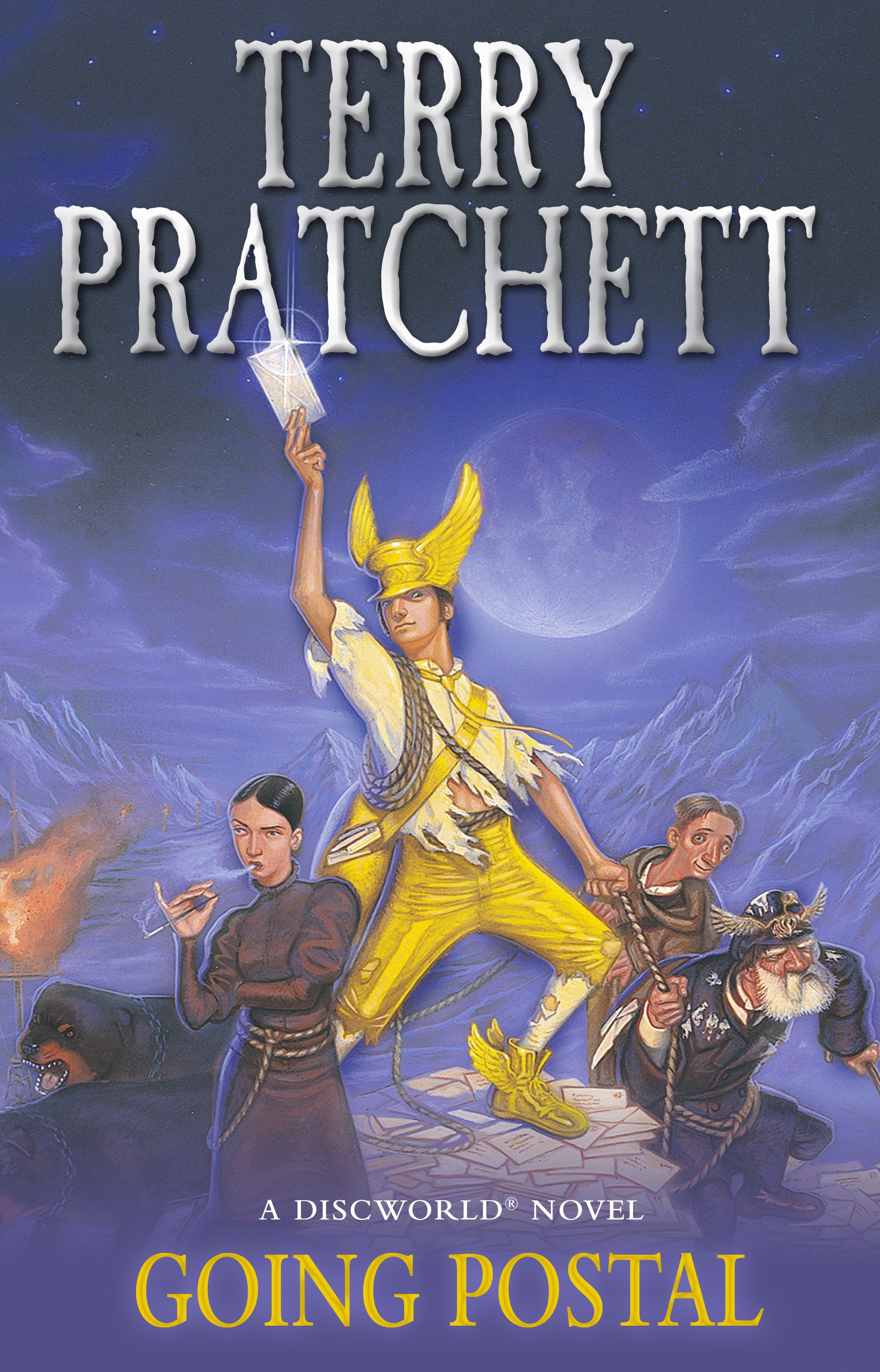
Going Postal – 2004

Going Postal Cover

The final entry on the list is Going Postal, which I feel is one of Pratchett’s best later books.  Featuring a very different tone from some of his previous books, Going Postal is a very distinctive read that is very hard not to enjoy.  Introducing a new protagonist in Moist von Lipwig, a notorious conman who is captured by Ankh-Morpork’s tyrannical leader, Lord Vetinari, and given two options: death or running the city’s post office.  Reluctantly choosing the later, Lipwig soon lives to regret his decision, as everyone and everything associated with the post office is absolutely crazy.  Forced to use all his talent, skill and instincts as a conman to save the post, Lipwig tries to rise to the occasion, only to contend with the ruthless chairman of a rival company who is determined to kill him.  It is a testament to Pratchett’s writing skill that he could make anything, even the post office, ruthlessly entertaining, as you swiftly fall in love with the hilarious over-the-top employees and associates of this crazy establishment.  Lipwig himself is the perfect protagonist for this book, and Pratchett wrote a brilliant redemptive storyline around him as he attempts to save his new friends with all his old tricks.  While this book is extremely funny, I also felt that Going Postal benefited from a somewhat darker tone than the preceding books, while  Pratchett also examines the benefits and costs of progress and new technology.  This darker tone would persist for the rest of Pratchett’s adult Discworld novels, and I have often thought that Pratchett included it in response to his growing health issues.  As such, I often look on Going Postal with a little sadness, especially as it was probably the best book he wrote towards the end of his career.  However, despite that, Going Postal is probably one of the Discworld books I have read the most and I would strongly recommend it to anyone and everyone interested in this outstanding series.

Amazon     Book Depository


So, as you can see from this exceptionally long list, I have a lot of love for the Discworld series and can write a ton about all the books.  While I deeply enjoy all the Discworld novels, the ten featured above are my absolute favourite now, and I cannot recommend them enough, especially if you want a laugh or an uplifting tale to brighten your day.  This is a list I might come back to in the future, especially if I do another reread and re-evaluate my positions.  I have been thinking about trying to read all of them again soon, especially as I recently found out that the Discworld audiobooks have all been re-released, this time with an amazing voice cast, including Colin Morgan, Peter Serafinowicz, Billy Nighy, Andy Serkis and Indira Varma.  As such, stay tuned for more reviews of the Discworld books soon, and I look forward to returning to my ultimate comfort book series.  In the meantime, let me know what your favourite Discworld book is in the comments below.