

Publisher: Black Library (Audiobook – August 2021)
Series: Gotrek and Felix – Book Six
Length: 11 hours and 13 minutes
My Rating: 4.75 out of 5 stars
Welcome back to my Throwback Thursday series, where I republish old reviews, review books I have read before or review older books I have only just had a chance to read. For my latest Throwback Thursday I continue my recent obsession with Warhammer Fantasy fiction by checking out another entry in the iconic Gotrek and Felix series by William King, Vampireslayer.
I have been on a real roll with looking at the cool fiction associated with the now defunct Warhammer Fantasy tabletop game over the last few weeks, including the fantastic novels Runefang and Van Horstman. However, few Warhammer Fantasy books have grabbed my attention or interest more than the Gotrek and Felix series, which serves as one of the central pillars of Warhammer fiction. The Gotrek and Felix books, which were originally written by William King, follow the titular characters, dwarf slayer Gotrek Gurnisson and his sworn human companion Felix Jaeger, as they journey around the Warhammer Fantasy realm, finding monsters to fight and kill, all in the hope of finding a worthy death for Gotrek. This is an awesome and unbelievably exciting fantasy series that take the reader to some of the darkest parts of the Warhammer Fantasy world and sees them face off against all manner of crazy foes.
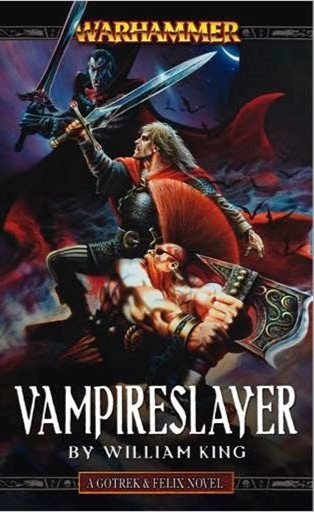
I have had an absolute blast getting through the Gotrek and Felix books over the last year, as there have been some cracking reads in there. The previous books, Trollslayer, Skavenslayer, Daemonslayer, Dragonslayer and Beastslayer, have all had their own unique charm, and all of them have been well written and compelling reads. Vampireslayer is the sixth book in the series, and as the name suggests, it pits Gotrek, Felix and their allies against one of the most dangerous creatures in the Warhammer canon, an ancient and deadly vampire count.
Following their victory at the siege of Praag, Gotrek, Felix and their surviving allies, have finally been able to relax after a never-ending series of battles. However, the ever-restless Gotrek is still determined to find a worthy death to fulfil his suicidal oath, and Felix knows it is only a matter of time before they journey out to face the rising hordes of Chaos that are building around the realms of man. But before Gotrek and Felix can head out, a new evil rears its head; one that is far more cunning and ancient than anything they have faced before.
After accepting a job from a wealthy Praag nobleman, Gotrek and Felix find themselves investigating a mysterious man who is attempting to steal one of their client’s treasured artifacts. But the closer they look, the more apparent it becomes that their target is no ordinary man, but a powerful ancient vampire named Adolophus Krieger, who has been stalking the streets of Praag, feasting on the innocent. Determined to slay this beast, Gotrek and Felix’s confrontation goes poorly, when the vampire outsmarts them, steals the artifact and takes their companion, Ulrika Magdova, hostage.
Determined to save Ulrika and get their revenge on their foe, Gotrek and Felix, as well as their allies, Snorri Nosebiter, Max Schreiber and Ulrika’s father, Ivan Straghov, pursue the vampire lord. To kill Krieger, they will have to travel to one of the most dangerous places in the Old World, the haunted lands of Sylvania. Controlled by the Vampire Counts for generations, Sylvania is a wicked place where the dead never rest, and dark creatures lurk around every corner. Worse, their foe is powered by an ancient artefact forged by Nagash and has designs on becoming the supreme vampire ruler, leading them in a new war against the living. With the odds stacked against them, Gotrek, Felix and their companions must dig deep if they are to kill Krieger, rescue Ulrika and save the world. But after spending time trapped with the vampire, can Ulrika truly be saved?
King once again shows why his Gotrek and Felix books were the defining Warhammer Fantasy series with this epic and fast-paced read. Vampireslayer is easily one of the stronger entries in the series and takes its distinctive protagonists on an intense and captivating adventure that I deeply enjoyed.
Vampireslayer had an amazing fantasy narrative, and I think this was one of King’s more impressive and enjoyable stories. Taking off right after Beastslayer, the initial story sees Gotrek, Felix and their allies still at the city of Praag, planning out their next adventures. They quickly find themselves dragged into another adventure when a distant relative of Ulrika reaches out to them for help with a mysterious threat. This initial part of the book was rather interesting, and not only does it have some great follow-ups from the previous entry in the series but it also sets up the narrative and the current characters really well. There is a fantastic cat-and-mouse game going on in the early stages of the novel, as the protagonists attempt to discern the new evil they are going up against, while their vampiric assailant, Adolophus Krieger, puts his plans into motion. Following the first encounter between the heroes and the vampire, which is set up and executed to drive up anticipation for later interactions, Krieger escapes and the protagonists are forced into a deadly chase across the world.
The rest of the novel is primarily set in the dread realm of Sylvania, and sees the protagonists chase after the vampire and his kidnapped victim. This second part of the book is filled with some fun and exciting classic horror elements as the protagonists go up against a variety of foes from the vampire count’s army. There is a lot of great action, fantastic chases, and some substantial character development occurring during this part of the novel, as the author brings together many of the threads from earlier in Vampireslayer, while also introducing some intriguing new supporting characters. King makes particularly good use of multiple character perspectives throughout this part of the book, and I loved seeing the conflicted thoughts of the main protagonists (minus Gotrek as usual), as well as the many plots of the villain and his new minion. This all leads up to the big confrontation between the protagonists and their foe at the legendary Drakenhof Castle, as the heroes face off against an army of the undead and the vampire himself. The action flows thick and fast here, and King pulls no punches, showing the brutal and dark nature of the Warhammer Fantasy universe. I did think that the final confrontation was a bit rushed, with the anticipated battle against Krieger lasting only a short while, but it was pretty fun to see. There are a couple of good tragic moments in this conclusion, as well as some interesting developments for some long-running supporting characters, and King brings everything to a good close as a result.
I think that one of the things that made this story particularly enjoyable was that it was a lot more focused than some of the other books in the series. This was mainly because it was the first book since Skavenslayer not to feature a sub-story that focused on recurring villain, Grey Seer Thanquol. While Thanquol’s perspective was good for Skavenslayer, its use in the following novels, while usually very fun and entertaining, seemed a bit unnecessary and often affected the pacing or stole the impact away from the book’s actually antagonists. This became more and more apparent in Dragonslayer and Beastslayer, especially when Thanquol’s actions rarely had any impact on the main plot. As such, not having a Thanquol focused side story in Vampireslayer was a bit of a blessing, and it really increased the impact of the remaining storylines. It also ensured that the parts of the book told from Krieger’s perspective really pop, as he was the only villain you could focus on. I had a brilliant time with this impressive story and it ended up being an excellent adventure to follow.
Vampireslayer proved to be a pretty awesome entry to the wider Warhammer Fantasy universe, and I loved the cool details and references that King added in. Like most of the books in the Gotrek and Felix saga, Vampireslayer can be read as a standalone novel (probably more so than the last three books in the series), and very little pre-knowledge about the Warhammer Fantasy or the previous books in the series is required to enjoy this excellent book. King does a great job of once again introducing the key elements, recurring characters, and wider evils of this universe, ensuring that new readers get the information they need without making it too repetitive or boring for established fans.
One of the things that makes Vampireslayer standout a little more from some of the recent entries in the series is the move away from Chaos focused opponents and instead brings in a new faction from the universe in the form of a vampire and his undead hordes. This is a fantastic change of pace, and I rather enjoyed seeing one of the more compelling factions from the game, even though I have bad memories of facing my brother’s Vampire Counts army. King does a brilliant job diving into the lore and history of vampires and the general undead in the Warhammer universe, and the protagonists get a good crash course on them, which new readers will deeply appreciate. I loved seeing a vampire antagonist in this novel, especially as it is one of the classic Vampire Counts types (a Von Carstein vampire). This vampire has a lot of the classic European elements associated with Dracula, and it was fun to see the protagonist deal with this sort of creature, especially as Krieger takes the time to taunt them in a way they’ve never dealt with before. King also adds in several of cool units from the Vampire Counts book, and it was pretty fun to see them in action in some brilliant fight scenes. I also deeply enjoyed the dark setting of Sylvania, where much of the story takes place. Sylvania, a Warhammer realm based deeply on Transylvania and ruled over by vampires, has always captured my imagination and it was fun to see it used in Vampireslayer. You really get the sense of fear and despair surrounding the countryside, and all the locals, many of whom are just a step away from becoming some form of creature, are a depressing and scared group. Watching the characters attempt to traverse this land was really entertaining, and I think all these awesome Warhammer Fantasy elements helped to make this great story even more impressive.
I also found some of the character work in Vampireslayer to be pretty intriguing, as King examines several great characters in this book. The central two characters are naturally Gotrex and Felix, although not a great deal of character development went towards them in this book. Gotrex is his usual gruff, murderous and unreadable self, who is essentially shown as an unkillable beast at this point, and you really don’t get much more from him, especially as Gotrex’s perspective is deliberately not shown. Felix also doesn’t get much growth in this book, although he does serve as a primary narrator, recording and observing the events of the book. Despite this lack of growth, Felix is a great everyman character to follow and it is really entertaining to see his quite reasonable reaction to facing off against the evils that gravitate towards Gotrek.
A large amount of focus went to the supporting characters of Max Schreiber and Ulrika Magdova, who have been major parts of the series since Daemonslayer. The attention on both has been growing substantially through the last couple of books, especially in Beastslayer, and they had a massive presence in Vampireslayer. Max, the team’s wizard, is pushed to the brink in this book after investigating a dangerous magical artefact and having his companion Ulrika kidnapped. Max, who has always had a crush on Ulrika (it was pretty creepy at first, but better now), becomes obsessed with saving her before its too late, and this drives him to some extremes in this book. Ulrika, on the other hand, must survive the evil attentions of the book’s villain, especially once the vampire takes an unhealthy obsession with her. I must admit that I have always found Ulrika to be a fairly annoying character (which isn’t great when she’s usually the only female figure in the books), however, this was one of her best appearances as she goes through a physical, mental and magical wringer. Her attempts to resist the vampire are extremely powerful and her eventual fall to darkness is one of the more compelling and best written parts of the book. This was an excellent outing for both these supporting characters, and it actually serves as a wonderful final hurrah, as I know they don’t appear in many books in the future.
The final character from Vampireslayer that I need to talk about is the book’s primary antagonist, the titular vampire Adolophus Krieger. Krieger, a centuries-old creature with connections to Vlad von Carstein, serves as a brilliant villain for this adventure novel, especially as King takes a substantial amount of time to dive into his history, personality and motivations. Rebelling against his sire and attempting to become the next vampiric master of the Old World, Krieger is shown as a complex and intense being with some major issues. Not only does he have to temper his intense ambition, but he also finds himself mentally deteriorating towards savagery and must constantly fight for control as his afterlife’s goals comes to fruition. King does a great job capturing this compelling figure throughout the book, and I particularly enjoyed his introductory chapters where his temper and inability to suffer fools is shown with gruesome results. Krieger has a brilliant presence throughout the novel, and he was a great villain opposite Gotrek and Felix with his gentlemanly airs (he has a great comeback to a line from Snorri Nosebiter). I deeply enjoyed all the outstanding characters in Vampireslayer, and King did some superb work with them throughout this novel.
After reading paperback versions of Dragonslayer and Beastslayer, I’ve finally gotten back onto the Gotrek and Felix audiobooks with Vampireslayer, which was a lot of fun to listen to. The audiobook format did an amazing job of capturing the dark tone and fast-paced action of this intense novel, and I felt that listening to Vampireslayer on audiobook really helped me appreciate a lot of the book’s more interesting details. With a runtime of just over 11 hours, this is an easy audiobook to power through, and I personally managed to get through it in a few days. This great audiobook was further enhanced by the excellent narration of Jonathan Keeble, who has narrated most of the other Gotrek and Felix audiobooks. Keeble has an amazing voice for this sort of novel, and I loved the fantastic way he was able to move the story along at a brilliant pace while also enhancing the book’s horror and action elements. I particularly loved the range of excellent voices he attributes to the various characters, many of which are carried over from his previous audiobook experiences. All the characters get some distinctive and very fitting tones here, which I think worked extremely well. Examples of some of the best voices include Felix, whose calm voice of reason, serves as the narrator’s base tone for most of the story; Gotrek, who is given a gruff and menacing voice that contains all the character’s barely restrained anger and regret; and even the new vampire character, Adolophus Krieger, who is gifted a French/European accent to match the classic vampire vibe that goes with the Vampire Counts characters in Warhammer, and the character’s likely origins as a Bretonnian Knight. This expert voice work was extremely good and I had a brilliant time listening to this version of Vampireslayer. As such, this format comes highly recommended and it is usually one of the best ways to enjoy a cool Warhammer novel.
Vampireslayer was another epic entry in the fantastic and ultra-fun Gotrek and Felix series by William King. Bringing in a great new opponent who pushes the protagonists to new lows, this was an excellent adventure novel that shows some of the best parts of the Warhammer Fantasy world. With a captivating and fast-paced narrative, this was one of the better entries in the series and I had an outstanding time getting through Vampireslayer. An awesome read for all Warhammer and general fantasy fans, especially on audiobook. I love this series so much!

 The Unseen Library