Destroying Angel by S. G. MacLean

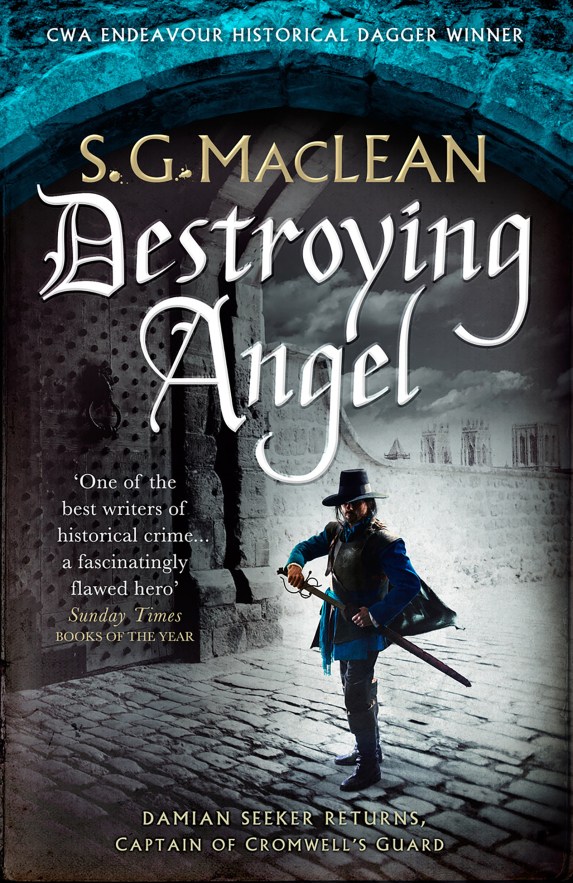
Destroying Angel Cover.jpg

Publisher: Quercus

Publication date – 12 July 2018

Amazon

Prepare to experience an excellent multi-mystery story set deep in the heart of Cromwell’s Puritan England in Destroying Angel, the new book from historical thriller sensation S. G. MacLean.

It is 1655, a time of great change for England.  Oliver Crowell’s forces have cleared the Royalist armies from England, and exiled the King and his court to the continent.  The country is now in the grip of Puritan morals and the rule of Cromwell’s major-generals.

In York, Captain Damian Seeker of Cromwell’s army is responsible for hunting down Royalist elements hiding within the country and quelling dissent against the new regime.  His latest mission requires him to journey to the small village of Faithly on the Yorkshire moors to deliver the government’s new laws and ordinances and inspect the area for traitors.  In addition, a fugitive member of the King’s exiled court may have returned to his family estates near Faithly, and Seeker is charged with searching the village and the surrounding countryside.

But upon arriving in Faithly, Seeker bears witness to the tragic death of the young ward of the town’s commissioner.  Her death appears to be the result of poisoned mushrooms, slipped to her at a formal dinner attended by Seeker and several of the village’s notable citizens.  Was she the intended target or just a causality of a far larger game?  As Seeker begins to investigate, he soon finds that Faithly is a seething hotbed of resentment and fear.  Plots, secrets, lies and petty jealousies lie just beneath the surface, and many of the village’s inhabitants seek to use the dramatic changes in England’s rule for their own gain.  As Seeker attempts to navigate the chaos he finds in Faithly, a chance encounter from his past will change everything for the captain.

MacLean has once again delivered a fantastic and intensely thrilling piece of historical fiction.  Destroying Angel is the third book in the Captain Seeker series, and the seventh overall book from MacLean, who has also published four historical thrillers in his Alexander Seaton series.  In his latest book, Maclean has created several compelling mysteries that are expertly combined with the book’s fascinating historical background.

The main storyline of Destroying Angel is a fantastic investigation into the secrets and mysteries surrounding a small village.  When the book’s protagonist arrives at Faithly, the central location of the plot, he encounters a village that is brimming with hidden secrets and lies.  While the core mysteries revolve around the poisoned girl and the location of the fugitive Royalist lord, the protagonist is forced to uncover all of the village’s many secrets in order to find the solutions to the murder and treachery that he encounters.  The reader is presented with a massive stream of information about many of the characters in the book, all of which is cleverly woven into a series of intriguing solutions.  For example, the eventual motives for the poisoning of the commissioner’s ward are particularly captivating, and fairly tragic.  MacLean ensures that every single secret and hidden past is tied into the overall story and has created an outstanding narrative that highlights his substantial skill at historical mysteries.

In addition to the huge range of mysteries that MacLean has inserted into his book, there is also a significant storyline that will prove to be extremely interesting to fans of the previous books in the Captain Seeker series.  While performing his other investigations, the protagonist is thrust into an emotive storyline when he suddenly encounters ghosts from his past.  This new storyline is particularly intriguing as it goes deep into the protagonist’s past, uncovering old wounds and substantially increasing his emotional stake in the story.  Previous readers of this series will find it intriguing to see the usually implacable character of Seeker so rattled and unbalanced in this story.  The sudden and violent introduction into this storyline is particularly memorable and represents a noticeable change in the book’s tone, and is an excellent inclusion in an already fantastic read.

One of the most impressive and enjoyable elements of this book is the author’s spectacular use of an absorbing historical setting.  During this period, England is experiencing significant change, as the King and his followers have all been expelled from the country and a new group of people have risen in power.  Despite it being a significant part of England’s history, not too many historical fiction authors have chosen to set their books during this period.  MacLean does an amazing job of exploring the various aspects of this new regime and tying them into the overall plot of Destroying Angel.  This includes the new laws that have been put in place, the changes to local governance and the effect of military rule on the people.  However, one of the most fascinating aspects of the entire plot is MacLean’s examination of the Puritan moralities that were imposed on the people of England.  Destroying Angel focuses on how this affected day to day life, what role the new church had in England and how they treated priests who didn’t meet Puritan expectations.  One of the best parts of the book is the blatantly biased trial of the priest of Faithly village, as members of the populace and a special state examiner, known as ‘the Trier’, attempt to remove him from his parish.  The author has chosen a great location to showcase these examples of life under Cromwell, as the small village setting allows the reader to see how it affected normal, everyday people.  It also allows the reader to get an idea about some of the discontent and petty power plays that could have possibly resulted from the changes to the system.  Overall, MacLean has set his series with a deeply interesting time period that serves as the perfect background for a murder and conflict ridden story.

Destroying Angel is a fantastic and incredibly enjoyable novel that serves as an outstanding and powerful new addition to MacLean’s Captain Seeker series, combining several captivating mysteries with an outstanding and rarely utilised historical setting.  Readers will find so much to love about this book, which is historical murder mystery at its very best.

My Rating:

Five Stars

Amazon

The Traitor God by Cameron Johnston

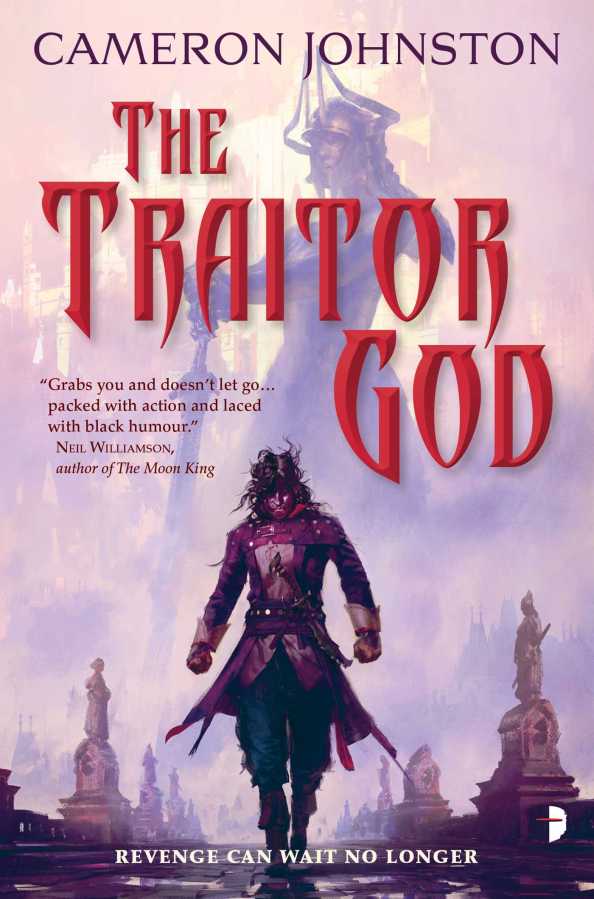
The Traitor God Cover

Publisher: Angry Robot

Publication date – 5 June 2018

Amazon

Prepare yourself for dark magic and a powerfully inventive adventure in The Traitor God, one of 2018’s best fantasy debuts from exciting new author Cameron Johnston.

Ten years ago, reviled mind-bending magician Edrin Walker fled his home city of Setharis with demons biting at his heels.  On that night, a god died, his mentor disappeared and Edrin’s memories of the events surrounding his exile were erased from his mind.  All Edrin remembers is that he made a deal with somebody extremely powerful.  In exchange for him leaving the city, this mysterious figure guaranteed the safety and long life of his closest friends.

Edrin has spent the last 10 years wandering the wilderness, living day to day and evading the creatures hunting him.  Content with his decision and new life, his exile ends the moment he witnesses the death of his best friend, Lynas.  In one terrible night, Lynas was brutally murdered and skinned alive, and Edrin saw every minute of it through their powerful mental link.  Now, with nothing left to lose, Edrin will return home, his only intention to burn everyone and everything until he finds the person responsible for his friend’s death.

However, returning to Setharis is a dangerous proposition.  Not only is he still being hunted by demons, but the Arcanum, Setharis’s governing body of magicians, will kill him the moment they find out he is still alive.  Beyond caring, Edrin will risk everything to get revenge, and woe betide any man, magician, demon or god who gets in his way.

This is an extraordinary first novel from Johnston, who has produced a stylish and highly addictive sword and sorcery fantasy adventure with a morally corrupt protagonist, a great new fantasy setting and a huge number of magical battle sequences.

The Traitor God contains an impressive dark fantasy action story that effortlessly captures the reader’s imagination and attention and drags them through every page of the book.  What starts as a revenge investigation and rampage turns into a fight for the future of an entire city, as mysterious forces are unleashed.  The story is told solely from the perspective of the protagonist, Edrin, and as a result it has been noticeably infected with his dark humour and well-developed scepticism.  The familiar storyline of a hero returning home and finding that everything has changed works well within The Traitor God.  Readers will enjoy watching the powerful magician manipulate the new generation of criminals and bystanders who are unfamiliar with what he can do.  While the eventual revelation of who is responsible for the murder is a tad predictable, the investigation getting there is amazing, and fans will enjoy seeing the protagonist confront his enemies.  The scope of the villain’s evil plot is quite impressive and results in some massive scenes towards the end of the book.  I really enjoyed the cunningness and ingenuity of the protagonist and had fun watching him come up with clever solutions to the difficult and unique problems he encounters.  There is one amazing scene towards the end of the book when his plan to finish off a powerful antagonist is slowly revealed to the reader.  The reveal of the protagonist’s master plan, which is kept hidden from the reader due to magical plot elements, is done perfectly within this scene, and the audience will enjoy the clever ideas and dark humour used within.

The vast majority of the plot of Johnston’s book is set within the city of Setharis, which is controlled by an army of powerful magicians.  The city is a great setting for this dark fantasy novel as the protagonist is forced to conduct his investigation through its corrupt and crime-ridden streets.  It is clear that Johnston has spent significant time creating Setharis, and Edrin explores vast swathes of it during his adventures.  The exploration of the Arcanum is particularly intriguing, and readers will be shown the noticeable differences between the sanctuary of magicians and the dwellings where the city’s poor live.  Edrin’s observations about the inequalities and corruption of the Arcanum are unique among the book’s magicians.  This allows Johnston to show off the arrogance of the other magicians, which plays into the plot while at the same time endearing Edrin to the reader.  The setting of Setharis is an amazing part of this novel, and readers will look forward to returning to it in Johnston’s future works.

One of the best parts of The Traitor God is the sheer amount of exceptional magical and fantasy elements that have been packed into it by the author.  Edrin has unique magical mind powers that allow him to control people he encounters, and these are surprisingly dark powers for a fantasy protagonist to have.  These powers are intriguing, as they are known and feared throughout Johnston’s fantasy world, and Edrin suffers significant discrimination as a result.  The scenes where Edrin uses his mind-bending abilities are well presented by Johnston, as he successfully endeavours to show the effect Edrin’s power has on the other character’s minds.

The other magicians that feature in The Traitor God also have magical powers that catch the reader’s imagination when they are presented in the book.  The book features magicians with powers to nullify the magic of other magicians, sniffers who can smell and identify magicians from a distance, magicians who use body enhancement magic to become epic soldiers, and one extremely skilled hydromancer.  Johnston has also created some fascinating rules and abilities that affect all of the magicians within the book, including Edrin, and result in some wonderful story elements.  A great example of this revolves around the rule that magic permeates every cell of a magician’s body and leaks out of them into items like their clothing or bedding.  Johnston uses this fact to great effect throughout the story, as his protagonist is constantly forced to find constructive ways to avoid enemies who can detect his magic.  The author has also created memorable descriptions of the way that magicians are forced to access their magical power.  Johnston establishes that magicians within The Traitor God have to be careful about the magic they draw into themselves, lest they burn themselves out or go mad with power.  There are several scenes where Edrin is forced to draw large amounts of magic into himself to face powerful opponents or save the lives of his friends, and the resultant internal battles to retain control and his sanity are a fantastic part of the narrative.

While Johnston goes into incredible detail about the rules and roles of the magicians of Setharis, he has also included some alternative magical users who do not follow the same rules.  The comparison between these two different groups of magic users is quite distinctive, and scenes where they come into conflict with each other are quite destructive and highly enjoyable.  Johnston has made sure to include a number of unique demonic creatures the hunt and harry the protagonist.  These creatures are quite distinctive, and Johnston cleverly ties their hunting ability into his rules about magical scents and detection.  The most memorable magical creature within the book is also the largest, and results in some significant, fast-paced and explosive scenes throughout the book.  Overall, the electrifying and distinctive magical and fantasy elements within The Traitor God are one of the book’s most intriguing characteristics and highlight just how imaginative and creative Johnston is.

There are a tremendous number of action-filled sequences throughout the book as the main character and his allies fight criminals, demons, magicians and gods.  As a result, The Traitor God will appeal to wide range of readers eager to get their latest dose of intense fantasy action.  There are brawls, chases, complex magical duels, fights with monstrous foes, large-scale magical warfare within a city, and even a fight between two gigantic magical constructs.  Various elements that Johnston sets up when describing the city of Setharis or the magical abilities and rules of his magician characters often come into play during these scenes, and the author does a great job of winding his own lore into these fantastic sequences.  Those drawn to magical and fantasy action and battles will find all their needs and more are met within this book.

In his debut book, Cameron Johnston has shown that he is author with an immense and powerful imagination and the ability to skilfully transcribe his ideas into a powerful narrative.  The Traitor God is a fantastic piece of dark fantasy, with some incredibly thrilling action and adventure subplots.  This book is a highly recommended read, and Johnston is an author that fantasy fans will need to keep an eye on.

My Rating:

Four and a half stars

Amazon

The Fire Court by Andrew Taylor

The Fire Court Cover

Publisher: Harper Collins

Australian Publication Date – 19 March 2018

World Publication Date – 5 April 2018

Amazon     Book Depository

Bestselling author Andrew Taylor returns to the 1660’s and the scorched city of London with the thrilling murder mystery, The Fire Court.

It has only been a few short months since the Great Fire of London ravaged the city, killing many and destroying a large number of houses and buildings.  The city is now finally rebuilding itself, aided by the Fire Court, an incorruptible institution that examines legal cases around the rebuilding and ensures the best result for the city.  While the Fire Court is supposed to be neutral in all cases, there are some who seek to use it their advantage.

James Marwood, a low-level government official, is one of the few people in London doing better now than before the fire.  However, James is still caring for his ailing father, a convicted traitor whose mind has been affected by his time as a prisoner.  When his father claims to have found a murdered woman at the site of the Fire Court, James initially assumes that his father imagined the situation.  But when his father is run down in the street and killed, James begins to suspect he may have actually witnessed a murder.

As James begins to look into this possibility, he soon finds evidence that connects his suspicions to an upcoming Fire Court case that will decide who will rebuild a number of profitable properties.  His investigation once again leads him to an old acquaintance of his, Cat Lovett, the daughter of a regicide.  James previously helped Cat escape retribution for her father’s crimes, and he now turns to Cat and her new employer to gather information on the upcoming case.

When more people connected to the case turn up dead and their investigation is hampered by influential members of the court, James and Cat begin to suspect that the Fire Court may not be as incorruptible as they thought.  It soon becomes clear that death is once again stalking the streets of London and this time they will not escape unscathed.

The Fire Court is the follow-up to Taylor’s 2016 hit, The Ashes of London.  Taylor is a veteran author and has significant experience writing a range of different genres and novel types.  He has produced over 40 novels since 1982, mainly focusing on crime fiction, with some of his more recent books featuring captivating historical elements.

Taylor’s last book, The Ashes of London, was a fantastic piece of historical crime fiction that made full use of its distinctive setting of the Great Fire of London.  Having the characters solve a crime and explore the city during the immediate aftermath of such a devastating historical event was masterstroke from Taylor which has resulted in a superb and memorable piece of literature.  In The Fire Court, Taylor returns to this fascinating period to show how much rebuilding happened in the six months after the destructive fire.  The focus on the historical Fire Court that was instituted in the aftermath of this event is the most intriguing part of Taylor’s new book, and readers will be extremely interested in learning more about this unique bit of history.  Taylor does a tremendous job of introducing the role that the Fire Court played in the rebuilding of the city and how it worked.  The reader is treated to several scenes that feature cases before the court, showing how the verdicts were reached.  Several of the Fire Court’s actual judges are included as characters, which is a nice touch of historical realism.  Overall, the examination and inclusion of the historical Fire Court is a notable piece of this novel and readers will appreciate how Taylor has interlaced his complex murder mystery with this interesting historical setting.

In addition to the fire-related historical elements, Taylor has also done an outstanding job of displaying what the city of London would have looked like in the 1660s.  During their investigation of the crime the protagonists visit large and varied swathes of the city which are vividly described, which brings readers right in to the middle of this vibrant and bustling city.  This base historical setting is well written, and readers will enjoy this incredible romp back in time.

The central plot of this novel revolves around a powerful murder mystery storyline and investigation.  The Fire Court is told from the perspective of three separate narrators – James, Cat and Jemima – each of whom tries to find answers in their own way.  The investigation into the murder is very intense, and what initially starts as a single potential murder spirals into a series of killings as the culprits attempt to cover up their crimes.  This overall storyline is well written, filled with suspense, and very compelling.  Readers will be captivated by the way fire is used by both the protagonists and the antagonists throughout the book.  The use of such a tool is significant, as all the London-based characters know the power of fire and its destructive potential.  It is a potent symbol of criminal wrongdoing in this series, and the audience will be shocked by how it affects the lives of the protagonists in this book.  In addition to the symbolic use of fire, Taylor also includes a significant twist at the conclusion of the investigation that will leave the reader reeling and thinking for a very long time.

Taylor has produced a remarkable and enjoyable murder mystery that makes full use of its unique setting.  Readers will love the detailed examination of the aftermath of London’s most destructive fire and will find themselves enthralled by an excellent mystery with one hell of an ending.  This is a highly recommended read from an exceptional author.

My Rating:

Four stars

Amazon     Book Depository

The Greater Good by Tim Ayliffe

The Greater Good Cover

Publisher: Simon & Schuster

Publication Date – 23 April 2018

Amazon

Australian author Tim Ayliffe presents a fantastic debut thriller set in iconic Sydney that delves into the heart of politics and the role of the media in the modern world.

John Bailey was a brilliant war correspondent for the Australian paper, The Journal.  However, his life took a downward turn when he was kidnapped in Iraq and tortured for several months.  Now, years later, Bailey is living a life of alcoholism and self-destruction, only occasionally contributing articles to The Journal.

However, when a prostitute is found murdered in her high-end Sydney apartment, his editor and old friend, Gerald Summers, sends him to investigate the crime, claiming that Bailey is the only person he trusts to report the story.  The prime suspect in the case is an influential political advisor who had a close relationship with the victim.  When Bailey encounters the advisor, he claims to have information that will clear his name, while at the same time implicating his boss, the defence minister.

After a run-in with an old friend in the CIA, Bailey soon realises that there is much more to this story than a simple murder.  Investigating further, he soon discovers that the murder was committed to cover up a massive conspiracy that the defence minister is linked to.  When witnesses to the crime start turning up dead and the police are pressured to drop their investigation, Bailey is determined to uncover the truth and publish the full story.  But powerful people are invested in keeping this case quiet, and Bailey soon finds himself in their crosshairs.

This is an exciting and high-energy first book from Ayliffe, who makes full use of his journalistic experience and political insights to create a smashing thriller with a tangible Australian presence.  The investigation into the conspiracy and its associated murders works well as the heart of this story, and readers are invited along on a wild thrill ride as the protagonists rush through this murky world of Australian politics and espionage in a quest to find the truth.

The character of Bailey serves as a great central narrator for this frenetic story, and readers will love the maverick approach he has to investigating the case and the lack of restraint of manners he has when it comes to dealing with Sydney’s political and financial elite.  Ayliffe also spends a significant amount of time attempting to humanise his main character by examining his past as a prisoner and the effects his PTSD has had on his life and career.  There are some great, emotional scenes as Bailey attempts to get over his problems with the help of other characters, and Bailey comes across as a much more grounded and damaged protagonist as a result.  The other main narrator in The Greater Good is Sharon Dexter, who serves as the official police investigator and Bailey’s main love interest.  Her investigation focuses more on cover-ups, sexism, and corruption in the police force, and these parts of the book serve as a great counterpoint to the sections featuring Bailey.

Ayliffe has made full use of his political knowledge and insight throughout this book.  A large amount of the plot revolves around both Australian and international politics, and readers will be amazed at the potential conspiracy he is able to create.  Various Australian political elements are dragged into the story and play a key part of the plot.  These include discussions about pre-selections of federal seats, government spending and the role of several federal government agencies.  World politics and the current status of Australia on the world stage are also examined within the story.  There is a large focus on the expanding role of China, and the discussion about whether Australia should strengthen its relationship with this new world power or whether it should maintain its current relationship with the United States.  This discussion is a key part of understanding the plot, and plays out in the book in a similar manner to current debates on the subject within Australia.  This adds a real sense of realism to the story and makes readers, especially those familiar with current Australian news and politics, very thoughtful.

Throughout The Greater Good, the main characters are attempting to obtain evidence of a conspiracy so that they can print it in their newspaper, The Journal.  As a result, the role of print media in keeping government’s honest and uncovering political corruption is examined in some detail.  It is clear that Ayliffe, a career Australian journalist, is very supportive of the media remaining in this role, and many of his characters are quite critical of attempts to stall the publication of these stories.  This allegorical analysis of the current role of media in politics and society is an intriguing part of the book and many readers will find this exceedingly relevant in light of recent world events.

Readers also need to keep an eye out for Ayliffe’s clever and entertaining inclusion of characters that are clearly based on real life Australian personalities.  For example, the fictional Australian Prime Minister is described as an athletic man who is known for his fun runs and surfing, in a way reminiscent of former Prime Minister Tony Abbott.  In addition, certain plot twists towards the end of the book will also remind the audience of another previous Prime Minster.  Another example is a minor character who is introduced as a prominent talk show radio host.  This character appears to be a composite creation of several of Australia’s right-wing radio commentators and comes across in a very similar manner to these real life presenters.  These cheeky additions are a fun inclusion that will amuse readers with even a passing knowledge of these Australian personalities.

In many ways The Greater Good can be considered a love letter to the author’s home city of Sydney, as it contains a number of different locations and references that will be quite familiar to Sydneysiders.  The narrator visits a number of different suburbs within Sydney, including Palm Beach, King Street, Finger Wharf at Woolloomooloo, Bondi and Chinatown, and also frequents some real life Sydney venues, such as Harry’s Café de Wheels.  Not only is the food, geographical location and description of this Sydney café described in the text, but the author has also included a write-up of the restaurant’s owners and its history.  In addition to furnishing the story with real life Sydney locations, Ayliffe also includes brief references to events and occurrences that Australians would recognise the significance of, such as Australian rugby, lockout laws and the current ice epidemic.  While none of these locations or occurrences is essential to the plot, they do add a certain sense of reality to the entire novel, and Australian readers will enjoy seeing locations and scenarios that they recognise and understand.

Tim Ayliffe’s debut novel, The Greater Good, is a fun and exhilarating political crime thriller that is guaranteed to electrify and entertain in good measure.  Making full use of Ayliffe’s extensive knowledge of Australian politics, culture and media, this very topical book is an excellent read for Australian audiences and those international readers keen to explore Australia’s potential for thrillers.

My Rating:

Four stars

Amazon

The House on Half Moon Street by Alex Reeve

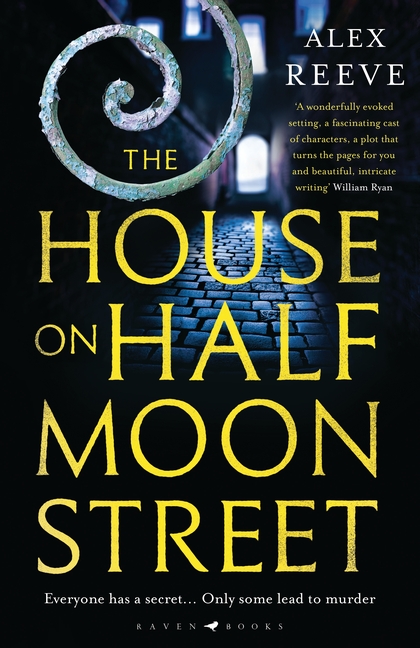
The House on Half Moon Street Cover

Publisher: Raven Books

Publication Date – 3 May 2018

Amazon     Book Depository

Prepare yourself for an extraordinary tale of love, life and murder in Victorian London, all with a unique twist that will make this book one of the most talked-about pieces of historical fiction this year.

In London, in 1880, Leo Stanhope is a bright young man living the city life.  He is employed as an assistant to a London coroner and is in love with Maria, a high-class prostitute.  However, Leo also has a big secret: he was actually born Charlotte.  Born a woman, but knowing deep inside that he was a man, he ran away as a teenager and has been living as Leo ever since.  Only a few trusted people know this, and Leo fears the day he’ll be discovered.

When Maria is found dead, Leo finds himself accused of her murder.  With his life falling down around him, Leo starts his own investigation into the case.  But what does Maria’s death have to do with another corpse found drowned in the river, and how do Maria’s rich employers and an infamous London abortionist fit into the case?  Leo will risk everything to find Maria’s killers, even if that means revealing his biggest secret.

This is an outstanding debut from author Alex Reeve, who has created a fabulous addition to the historical crime genre.  The House on Half Moon Street has massive potential to expand out into a fantastic and iconic new series.

Without a doubt, the most distinctive and memorable part of The House on Half Moon Street is the main character, Leo Stanhope, who is a transgender man.  The first thing that needs to be mentioned is that Reeve has done a great job of writing this character and has produced an appropriate and non-controversial description of a transgender person.  There is a lengthy examination of the protagonist’s views about his identity, which includes descriptions of his childhood, memories of how he has always felt this way and internal monologues on how uncomfortable he felt behaving as a woman.  Reeve also does a fantastic job of portraying Leo’s fears and frustrations at the way he has to live and the way some characters, such as members of his family, treat him.  Overall, this is an emotional and insightful examination of a transgender character in a historical setting, and Reeve has chosen an excellent protagonist for his novel.

The focus on a transgender main character and gender issues works well with Reeve’s great use of the Victorian setting, as he explores how transgender people lived in historical times.  As described in the book, transgender individuals were not treated well within Victorian England.  In one scene Leo describes how someone who was living in a similar situation to himself had recently been discovered by the authorities and institutionalised as a result.  The views and responses of the people who discover his secret also reflect the attitudes of the time, although there are some obvious parallels with some modern opinions, resulting in thought-provoking social commentary.  There are also some interesting descriptions of the techniques, tools and clothing that the protagonist uses to hide his female characteristics and make himself appear more masculine.  Due to differences in technology and social expectations, these techniques are obviously different from modern alternatives and represent some interesting hypotheses from Reeve.

There are also some amazing descriptions of Victorian London, which serves as a great backdrop for this story.  Not only does the dingy Victorian setting help to highlight Leo’s dark emotional state throughout the book; it is also the perfect background for a murder mystery that revolves around the murky criminal underworld.

On top of the compelling protagonist and the wonderful use of setting, those who read The House on Half Moon Street will also be treated to a top-notch murder mystery that also delves into the criminal and policing elements of 1880s London.  The investigation into the deaths is an intense experience that takes the protagonist through a series of different suspects and clues, creating an intriguing and complex case.  The emotional impact of the case on Leo is plainly obvious due to superb story narration, and this proves to be engaging to the reader, who becomes invested in solving the case.  The final solution to the book’s mystery is very clever, and the readers will love how the case comes to its conclusion.

Historical fiction buffs will also enjoy the examination of law and order during the era, as Reeve examines several police institutions, including the work of the coroner during the time.  The protagonist also encounters some of the city’s criminal elements, and there are some surprising crimes that are covered within the book.  Reeve’s use of a transgender protagonist once again comes into play during the character’s investigations, and the reader will be drawn into the scenes where Leo attempts to hide his previous life from the police and criminals.

The House on Half Moon Street is a phenomenal new book that takes a deep and sensitive look at transgender issues in Victorian London whilst also making use of a dark and detailed historical setting and a first-rate overarching murder mystery.

My Rating:

Four stars

Amazon     Book Depository

Pandora’s Boy by Lindsey Davis

Pandora's Boy Cover.jpg

Publisher: Hodder & Stoughton

Publication Date – 5 April 2018

Amazon

Ancient Rome’s premier female detective returns in the latest Flavia Albia mystery from veteran historical crime author Lindsey Davis.

Rome, 89 AD.  Flavia Albia, the daughter of the legendary investigator Falco, is now a proficient private investigator and informant in her own right.  When the ex-wife of her husband, Tiberius, brings a case of family drama to her, Flavia is tempted to refuse, but when Tiberius disappears she needs a distraction.

The case revolves around a teenaged girl found dead in the prosperous Quirinal Hill district of Rome.  The girl, Clodia, was the apparent victim of a poisoned love potion, and her parents and grandparents are blaming each other for her death.  What begins as a simple investigation quickly becomes complicated when the witch accused of supplying the potion turns out to be the sister of the city’s biggest crime boss.  No-one is talking, and everyone in the Quirinal Hill has a secret.

Flavia is forced to seek the truth from a variety of people, including warring grannies, concerned parents, criminal lawyers, secretive slaves, a lettuce salesman with an interesting religious statue and, worst of all, the overprivileged offspring of Rome’s elite.  However, as Flavia’s investigation continues and a friend of hers dies, it soon becomes apparent that a vicious gang war is imminent.  Can Flavia solve the crime without getting caught in the crossfire, especially when she has a terrible history with one of the gangs?

Pandora’s Boy is the sixth book in the Flavia Albia series, which acts as a direct sequel series to Davis’ Marcus Didius Falco series.  Davis is one of the most prolific authors of historical whodunits and has a particular focus on novels set in ancient Rome.  For example, her Marcus Didius Falco series contains 20 books, and she has produced some stand-alone books set in the same period.

Like the previous books in the Flavia Albia series, Pandora’s Boy takes a contemporary look at Roman culture and lifestyles.  The inhabitants of Davis’ books act in a very modern way despite their ancient surroundings, and this results in a very humorous interpretation of the ancient Roman characters.  Davis also uses this book to parody a specific group in modern society: the millennials.  Throughout the story, Flavia is forced to follow, interview and generally endure the victim’s friends, who are the offspring of the city’s rich and powerful.  These friends are exceedingly selfish, have sordid love lives and get into all sorts of mischief.  In other words, they act in a very similar way to how modern day millennials are often perceived and portrayed.  Their appearance is quite jarring in the ancient Roman setting and leads to a lot of the books humour.  In all, it is a fun, quirky addition, and an amusing examination of modern society through very ancient eyes.

The core of the book is the death of a young woman and its investigation by the main character.  This is a well-done mystery that takes many twists and turns to keep the attention of the reader.  Flavia’s investigation is done through interviews, trickery, observations and undercover work, and, like many other parts of the book, is infused with Davis’ trademark humour.  The investigation is wrapped up in a final scene that is a throwback to classic murder mystery dénouements.  All the interested parties are gathered together in one place and the investigator reveals their conclusions, eventually leading to their solution to the crime.  Davis provides a perfect parody of this, infused with her own unique touch.  As a result, there are several jokes about this well-used literary device, including discussions around the necessary prep work and tricks to keep the gathered parties’ concentration of the speaker that will greatly amuse many murder mystery buffs.

One of the more diverting and memorable aspects of the Flavia Albia series is Davis’ tendency to include big action sequences that devolve into near absurdity and provide some of the best laughs in the entire book.  For example, in Davis’ previous book, The Third Nero, the climactic scene was a battle in the heart of Rome that featured, among other things, a war elephant, Parthian cataphracts and one of the most improbable chase sequences in all of fiction.  While nothing will quite top this, Davis has striven to include one such scene in Pandora’s Boy, featuring an interrupted séance, an all-out brawl between legionnaires and Vigiles at a collapsing temple, all of which serves as a backdrop to a fight between two warring grannies.  This is an extremely entertaining scene and definitely a highlight to watch out for.

Another notable feature of the books in the Falco universe is the deeper examination of the Roman criminal justice system.  The investigators in these books often deal with the Vigiles and the Aediles, the ancient Roman equivalent of the police and magistrates, many of whom turn into key characters.  This is a unique feature, as most Roman historical fiction books neglect to focus on these institutions, only mentioning them if in the context of political gain.  Pandora’s Boy includes a detailed look at the Vigiles who patrol the Quirinal Hill district and their investigation into the death and other serious crimes.  Loaded up with a suitable modern twist, the inclusion of these characters is an intriguing addition that highlights an often-neglected side of ancient Roman life.

Pandora’s Boy is a wonderful addition to one of the best ancient crime series currently on the market.  Davis once again creates a fantastic murder mystery and infuses it with outrageous humour and a modernistic take on ancient Roman life.  This is an exceedingly fun and deeply absorbing novel that will appeal to a very wide audience of readers.

My Rating:

Five Stars

Amazon

The Seven Deaths of Evelyn Hardcastle by Stuart Turton

The Seven Deaths of Evelyn Hardcastle Cover

Publisher: Raven Books

Publication Date – 8 February 2018

Amazon     Book Depository

A classic and complex murder mystery in an English manor combines with ingenious elements from fantastic genres to create one of the best new releases of 2018.  Reading like the outrageous combination of Groundhog Day, Inception, Downton Abby and Sherlock Holmes written by Agatha Christie, The Seven Deaths of Eveyln Hardcastle is the triumph debut from outstanding new author Stuart Turton.

In a turn-of-the-century country manor, Blackheath, a group of distinguished family guests have gathered for the first time since a terrible incident many years ago.  Before the end of the weekend’s masquerade, a terrible crime will be committed.  A young woman will be killed, and no one will realise that her death was the result of murder.

Inserted into the middle of all this chaos is Aiden Charles, who awakens with no memory of who he really is.  Aiden thinks at first that he is a cowardly doctor with amnesia until a man wearing a plague mask reveals that nothing is as it seems.  Aiden is an outsider, inhabiting and controlling the body of the doctor through unknown means.  The plague doctor reveals that Aiden has been trapped within the manor and is being forced to repeatedly relive the same day again and again, awakening each morning in a different host and living the entire day in their body.

There is only one way Aiden can earn his freedom: solve the murder of Evelyn Hardcastle, the estranged daughter of the manor’s owners.  If Aiden can solve the murder by the end of his eighth day, he will be able to leave.  If he fails to solve the murder his memory will be erased and the cycle will start again.

Using the abilities and connections of his eight very different hosts, Aiden must navigate the halls of Blackheath and the various guests who have arrived for the party.  However, Blackheath has a dark history of murder and betrayal that still casts a shadow to this day.  Every one of its inhabitants has a secret, and many of the guests would willingly kill to protect theirs.

Aiden is also forced to overcome several unnatural problems associated with his circumstances.  While the bodies he inhabits all hold the means to solving the crime, he is forced to balance the varied personalities of his hosts, each of which causes him to act or think in a very different way.  The longer he remains trapped in Blackheath, the more powerful the personalities are.

It also soon becomes apparent that Aiden is not as alone as he thought.  Two other people like him have also been trapped in Blackheath, but only one of them can solve the murder and earn their freedom.  One of his competitors appears to be trying to help him, but Aiden may not be able to trust the mysterious Anna, even though her name is the only thing from his past life that he can remember.  The third competitor has taken on the persona of a murderous footman and has no qualms about killing all of Aiden’s hosts to remove him from the competition.  Can Aiden solve an unsolvable crime before all his hosts are killed, or will he be trapped forever within Blackheath?

The Seven Deaths of Evelyn Hardcastle is a fantastic read that features a unique and imaginative combination of genres.  The basis of the story is a complicated murder mystery placed within the setting of a British manor house.  However, there is a certain and mysterious fantastic element that makes the narrator relive the day over and over again within a new host.  The murder mystery, the manor house setting and the time travelling body swapping, combine together perfectly into a tremendously addictive narrative.

At the heart of the story is an intense and compelling mystery that quickly becomes the main draw for the reader.  Solving the murder of Evelyn Hardcastle requires the protagonist to discover and expose every single secret and lie within the manor.  The sheer amount of details and enigmas that Turton has included with the book are so immense that it takes nearly eight different perspectives of the same sequence of events to get them all together.  Even then, the reader will be amazed by every single twist and turn that it takes to get to the final reveals.  The time travel and body  switching elements of the plot cleverly tie in and enhance the book’s mystery elements.  These elements allow the reader to see multiple versions of the same event, provide a wide variety of different perspectives on the clues, and pull together different testimonies from the same characters as they are questioned by the various hosts.

In addition to enhancing the murder mystery elements, the time travel and body switching aspects of the novel also help to increase the pacing and suspense throughout the book.  The transition between the main character’s various hosts is not as linear as it first appears.  Not only does the narrator switch to his next host once a day is over, he can also switch back to a previous host when he one of his hosts is knocked out, falls asleep or is killed.  This allows the reader to flip through these hosts when a lot of action is occurring, especially when the narrator’s various hosts are targeted in quick succession.  Additional suspense is also introduced due to many of the incidents within the story being out of sync with the narrator.  Various events have been put into place by either future hosts of the narrator or by characters from different points of the book’s timeline.  As a result, the reader has no idea why some events are happening, especially at the start of the book, and it is cool when the various causes of these events are revealed throughout the later parts of the book.

An appealing part of The Seven Deaths of Evelyn Hardcastle is the eight unique hosts for the main character to possess.  Each of these hosts has their own strengths and weaknesses, and it is intriguing watching the main character try and work out what they are.  They also have their own distinctive personalities that affect the main character in different and subtle ways.  The hosts also have their own way of dealing with people or situations, and this affects how the main character reacts and goes about his investigation.  It is intriguing to see how he changes from host to host.  In addition, there is no certainty about who the main character’s future hosts are going to be.  While there are hints, the reader doesn’t know until the narrator wakes up in the body, so the reader can’t help but examine the other characters with whom the narrator interacts in case they are a future host.  There are also some interesting scenes in which the narrator attempts to find and interact with a future version of himself.  Turton’s use of multiple hosts for his narrator is an important and distinctive part of this book that cleverly adds additional mystery to the narrative while also providing suspense and a changing array of personalities and challenges for the protagonist.

Representing a masterful combination of crime fiction and otherworldly attributes, The Seven Deaths of Evelyn Hardcastle is pure enthrallment that is guaranteed to transfix all eyes to its pages.  As one of the best releases of 2018, I cannot recommend this book enough.

My Rating:

Five Stars

Amazon     Book Depository

The Throne of Caesar by Steven Saylor

The Throne of Caesars Cover

Publisher: Constable

Australian Publication Date – 6 March 2018

World Publication Date – 20 February 2018

Amazon

Steven Saylor’s long-running ancient Roman detective series returns as Gordianus the Finder deals with the most infamous murder in Roman history: the assassination of Julius Caesar.

For decades, Gordianus the Finder has been the most respected investigator in all of ancient Rome.  After a lifetime of solving crimes and murders for the city’s rich and powerful, Gordianus is determined to retire from the investigative game and enjoy a life of luxury.  However, one last surprise has been thrust upon him: Gordianus’ adopted son Meto has spent years in the service of Caesar as his trusted aid and ghost-writer, and Caesar now seeks to reward Meto by making his father a senator.  Reluctantly accepting this rise in station, Gordianus’ ascension will take place in five days’ time, on the Ides of March.

Caesar has an ulterior motive for meeting with Gordianus.  Warned by visions and prophets, Caesar believes that his life may be in danger, and that disaster may strike before the conclusion of the Ides.  He requests that Gordianus keep his ears to the ground and quietly question leading members of the Roman nobility to see if there is any basis to his concerns.  While initially sceptical of any attempts on the dictator’s life, Gordianus’ suspicions are aroused when one of Caesar’s old rivals, Senator Cicero, also asks him to watch out for potential conspiracies.  As Gordianus begins his investigation, he finds himself in the middle of dangerous historical events, and even the legendary Finder may be unable to stop what is to come.  The Ides of March are approaching, and Caesar’s life isn’t the only one at risk.

The Throne of Caesar is the 16th book in the Roma Sub Rosa series, a series that also includes three prequel novels and two collections of short stories.  Saylor began in 1991 with Roman Blood, set in 80 B.C. some 36 years before the events of this book, and he has slowly been working towards the assassination of Julius Caesar.  Indeed, the last three instalments of the series were prequels produced while Saylor perfected his account of this famous murder.  It was definitely worth the wait, as Saylor has produced an extremely detailed and well-researched account of the infamous killing.

Gordianus’ investigation and social interactions are used to introduce the reader to many of the key people involved with the plot, as well as to discuss the political atmosphere that lead up to the assassination.  The Ides of March is the centrepiece of the novel.  It is clear that Saylor has consulted the key historical records of the killings, as he has made sure to include several of the lesser-known events that happened on the day.  For example, Saylor includes descriptions of the supposed visions Caesar’s wife, Calpurnia, had the night before, and Decimus Brutus’ intervention at Caesar’s residence the morning of the Ides.  Saylor also dedicates a good part of the book to examining the aftermath of Caesar’s death, including the political manoeuvrings that immediately followed, as well as the violent funeral.  As a result, the description of the killings and the surrounding circumstances are first rate, and this aspect of the book will appeal to Roman history buffs.

As Saylor discusses in the author’s notes, writing a murder mystery around the assassination of Julius Caesar is particularly hard, as his death is one of the most well-known events in Roman history, with all the conspirators condemned to historical infamy.  Saylor, however uses this to his advantage and manages to create a large amount of suspense by counting down the days until the 15th of March and hinting at the events that are to come.  All the reader can do is keep going through the novel, knowing that Gordianus will be unable to stop the murder, even as he gets closer and closer to the truth.

Saylor also compensates for the lack of mystery around the death of Caesar by including a second murder subplot.  Elements of this additional murder mystery are hidden in the background of most of the book, as the reader’s attention is directed towards the upcoming assassination, and the investigation into the second murder comes to the fore after Caesar’s death.  The actual events of the second murder are unique and will be of particular interest to fans of a certain Shakespearean play.

One of the best features of The Throne of Caesar is the significant incorporation of Greek mythology throughout the book.  Several Greek myths are discussed, and parts of the plot mirror elements of these myths.  Many of these myths are also included as centrepieces of two Roman epic poems written by Gaius Helvius Cinna, a famous historical poet, which are a major part of the plot.  While one of the plays featured is completely fictional and with no historical basis, the other play is Zmyrna, considered by Cinna to be his greatest achievement, the text of which is unfortunately lost to history.  Saylor provides an interesting possible narrative for the lost play, which flows into the plot of his mystery with great effect.  The overall effect of Saylor including these myths and legends is very striking, and it provides the reader another viewpoint into the lives of the ancient Roman characters who put great stock in these old and religious stories.

The latest addition to the Roma Sub Rosa series is a meticulously detailed and well-crafted book that acts as a unique and powerful chronicle of an important historical crime.  A suspenseful and compelling read, The Throne of Caesar serves as a great continuation of the story of Gordianus the Finder, and it will be interesting to see where Saylor takes the series next.

My Rating:

Four and a half stars

Amazon

Blood of Assassins by R. J. Barker

Blood of Assassins Cover

Publisher: Orbit

Publication Date – 13 February 2018

Amazon     Book Depository

War, murder and magic return with R. J. Barker’s assassins in the sequel to his impressive debut, Age of Assassins.

It has been five years since assassins Girton Club-Foot and his master, Merela Karn, started a bloody civil war in the nation of Maniyadoc.  Since then, they have been in hiding, fighting in the borderlands as soldiers for hire to avoid the price on their heads.  However, when Merela is gravely injured, they have no choice but to return to Maniyadoc and seek shelter there.  Girton finds a far different land to the one he visited five years before.  War has turned much of the kingdom into a brutal hellscape, ruled over by war crazed marauders known as Nonmen, while giant flesh-eating pigs roam the wilds.

Amongst this chaos, three kings fight for power, their armies controlling what small tracts of inhabitable land remain.  Girton knows all three of the opposing kings, having spent time among them five years ago.  Two of them hate Girton and his master, falsely blaming them for the deaths of their relatives, the events which started the war.  However, the other of the warring kings, Rufra, owes Girton his life, and may be the only friend the young assassin has.  Since their last meeting, Rufra has turned into a noble king, weighed down by the responsibility of his office and personal grief.

Pledging his loyalty to Rufra, Girton immediately sets about trying to find a spy hidden among the king’s closest followers, navigating camp politics and the fragile alliances that hold the army together.  At the same time, Girton must also solve the murder of a fanatical religious leader whose dangerous followers demand retribution.  Rufra is the fractured nation’s best option for peace, but far too many people want him dead.  Each day the spy is active hastens Rufra’s defeat, and Girton must use every bit of his wit and skill to save his friend.

But the greatest threat to Rufra’s reign may be Girton himself.  Like all assassins, Girton uses forbidden magic to grant himself subtle advantages to aid him in his kills.  However, Girton’s magic has become far too powerful, and he can no longer control the terrible energies within him.  In a world were all magic is outlawed and feared, any evidence of Girton’s abilities would condemn him and everyone he loves to a bloody end.  The last uncontrolled sorcerer turned the kingdom of Maniyadoc into a barren wasteland, and Girton’s power may soon compel him to do the same.

This is the second book in Barker’s The Wounded Kingdom series and is the follow-up to last year’s successful and highly compelling debut, Age of AssassinsBlood of Assassins is a great addition to the series which builds up the anticipation for the upcoming King of Assassins, which is set to come out in Australia in August 2018.

The fantasy world that Barker has created is an interesting one with several unique features.  While most of the first book’s story was limited to the goings-on within one specific castle, Barker completely changes the script in this sequel by expanding the narrative to the whole realm of Maniyadoc and the fighting going on around it.  Readers of Age of Assassins will enjoy seeing how the devastation of the civil war has changed the kingdom.  The nation of Maniyadoc, which was already described as a fairly dismal place, is now haunted by a new range of monstrous creatures and humans created by neglect and the brutal fighting.  This noticeable change to the scenery of the story helps to affect the overall mood of the book and also acts as a mirror to Girton’s more depressed and hopeless mental viewpoint in the second book.

I often enjoy authors blending different genre types within fantasy books, and Blood of Assassins is a great example of this, as Barker has incorporated elements of political thrillers and murder mysteries.  The hunt for the murderers and traitors at the heart of Rufra’s camp is a well done and produces a compelling mystery that combines well with the book’s action, politics and magic.

Fans of action and battle will not be disappointed, as Barker makes full use of a range of fight scenes.  Action junkies will enjoy the numerous duels, clashes between assassins, larger pitched battles and one notable siege that sees that protagonist fighting to defend a village from a horde of crazed Nonmen while also attempting to hold his destructive magic at bay.  It is also interesting to see how Barker forgoes the enormous pitched battles that are a usual fantasy staple.  Instead this conflict is fought by small, desperate armies over limited amounts of land, which comes across as more realistic, considering the landscape.

Finally, Barker has also done a great job of showing how his main characters have developed since the last novel, particularly taking the time to illustrate how their relationships move and change throughout the book.  Girton has gone from a young and optimistic boy seeking the approval of his master to a taciturn and depressed man, actively resenting his master for the changes and problems in his life.  At the same time, Rufra has gone from a lowly squire seeking a friend and trying to avoid trouble to a man consumed by his responsibilities and personal grief.  These changes lie at the heart of the book and add emotional depth to the story.  It is also warming to see how the friendship between Girton and Rufra lightens both characters and helps heal their emotional wounds.

As a result, Blood of Assassins is a fantastic character-driven story that weaves together action and mystery in Baker’s excellent fantasy world to create a scintillating and addictive read.  This is a marvellous second outing from a bright new star in fantasy fiction.

My Rating:

Four stars

Amazon     Book Depository

Gunpowder Moon by David Pedreira

Gunpowder Moon Cover

Publisher: Harper Voyager

Publication Date – 13 February 2018

Amazon     Book Depository

Murder has just been committed on the Moon, and all hell is about to break loose.

By 2072 the world has dramatically changed.  A devastating natural disaster shook the planet and altered the balance of power between nations.  The only hope for the future lies in a new energy source, helium-3, which can power Earth’s fusion reactors and provide unlimited clean energy.

Earth’s main source of helium-3 is on the Moon.  Desperate to have as much of this valuable material as possible, the world’s leading nations each have their own mining expeditions in play.  Life is tough for the miners, death lies around every corner and Moon dust can quickly destroy the hardiest of equipment.

For Caden Dechert, the Moon is the perfect place for a man trying to escape his past, even if it does strongly smell of gunpowder.  Trying to forget the long wars he fought back on Earth as a marine, Caden has forged a new life as the chief of the U.S. mining station Sea of Serenity 1, a vital station for a country only just coming back into world prominence.

However, Caden’s small slice of peace is broken when a member of his mining team is murdered in a deliberate explosion.  Evidence quickly points to the United States’ most prominent rival, China, whose bases are located a short distance from Caden’s station.  Tensions are quick to rise, and a series of escalating incidents sees the two nations draw closer to the brink of war.

Despite the evidence supplied by his own country, Caden is not convinced that the Chinese are behind the explosion.  Years spent working near the Chinese mining team has built up a certain respect, and Caden’s suspicions of a conspiracy begin to grow after noticing other unusual activities around his base.  With his team trapped at Sea of Serenity 1, and with both nations ready to fire the first shot, Caden is forced to investigate the murder himself in order to stop a destructive war that could tear his beloved Moon apart.

From first time author David Pedreira comes Gunpowder Moon, a spectacular piece of crime fiction set on the harsh and unforgiving surface of the Moon.  Pedreira has created an interesting murder mystery that combines with a high-stakes plot, science fiction elements and exotic location in order to produce a great story.

Without a doubt, the most memorable feature of this book is its setting of the Moon.  Pedreira has done a remarkable job of highlighting and describing his story’s brutal backdrop.  Significant time is also spent describing the narrator’s emotional attachment to the Moon and how it represents a new beginning for his crew of outcasts.  By the end of the book, the Moon is nearly an additional character as it acts as an excellent emotive setting for the reader.

The Moon also serves as an important plot device, as various features of life on the Moon, such as the required technology, gravity, the isolation and the devastating effects of Moon dust, all play a key part in the overall story.  In addition, Pedreira’s observations about the requirements for living on the Moon and his descriptions of the technology and mining work will appeal to the interests of many curious readers.

While the Moon is the main location for this book, Pedreira has also created an interesting potential future for humanity that serves as a backdrop for the story.  Pedreira postulates an interesting build-up to a war between America and China made up of ecological problems on Earth, expansion outside the planet and a fight for a new energy source.  Views of the near future of Earth are always fascinating, and the predicted future presented in Gunpowder Moon is a particularly intriguing story element that combines well with the books overarching mystery.

The plot of Gunpowder Moon focuses on a riveting murder mystery that is made unique by its location and the limited options for an investigation.  The investigators do not have any traditional evidence or witnesses.  They have limited information due to their isolation and they are unable to discuss the case with many of their suspects, who may be on Earth.  The background plot of the United States and China going to war combines well with the murder elements, as there is a real sense of urgency and import to the investigation as the main characters are trying to stop an upcoming war.

Gunpowder Moon is an excellent science fiction murder mystery that contains a fast-paced, action-packed story.  The author makes great use of his futuristic setting and unique location, providing the reader with impassioned descriptions of the Moon’s surface.  David Pedreira’s debut novel is a captivating and intriguing new read that spectacularly captures humanity’s imagination with the Moon.

My Rating:

Four stars

Amazon     Book Depository