
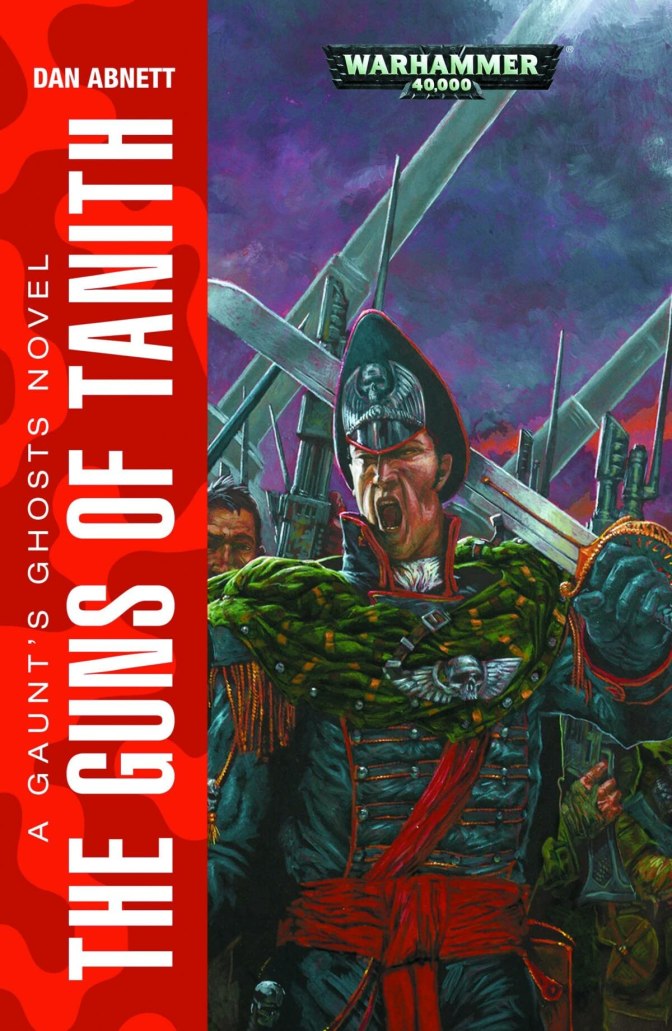
Publisher: Black Library (Audiobook – 25 April 2002)
Series: Gaunt’s Ghosts – Book Five
Length: 10 hours and 10 minutes
My Rating: 4.5 out of 5 stars
Welcome back to my Throwback Thursday series, where I republish old reviews, review books I have read before or review older books I have only just had a chance to read. After having such a great time reviewing the previous Gaunt’s Ghosts novel, Honour Guard, in my last Throwback Thursday, I immediately read the fifth fantastic entry in the series, The Guns of Tanith, which proved to be just as awesome and exciting.
As I mentioned last week, I have been really getting into the works of Dan Abnett over the last year, and I now consider several of his books to be amongst the best Warhammer 40,000 novels I have had the pleasure of reading. Not only did I deeply enjoy his epic Eisenhorn trilogy (made up of Xenos, Malleus and Hereticus) but I have also been powering through his Gaunt’s Ghosts books. The Gaunt’s Ghosts books are some of the more iconic novels in the Warhammer 40,000 franchise and are often considered essential reading by fans of the franchise due to the captivating way they capture the gruelling experiences of ordinary human soldiers in this grim, futuristic setting. The first four novels in the series, First and Only, Ghostmaker, Necropolis and Honour Guard, as well as the prequel novel The Vincula Insurgency, are all excellent and exciting in their own way, and I have had a ton of fun seeing the impressive war narratives set around the men of the Tanith First-and-Only, informally known as Gaunt’s Ghosts. As I was still in the mood for some awesome action at the end of last week, I just had to keep going with these books and I quickly picked up the fifth entry, The Guns of Tanith.
As the massive Sabbat Worlds Crusade continues to pit the forces of the Imperium of Man against the foul forces of Chaos, the battlelines extend across multiple planets and systems, drawing in millions of soldiers. The latest phase of the crusade has severely stretched the supply lines of the Imperial assault and the Chaos foes are quick to take advantage, threatening to cut off and surround the main Imperial force. To stave off disaster, Warmaster Macaroth, needs the Tanith First-and-Only to recapture the vital promethium producing planet of Phantine so the crusade can be resupplied and continue.
Led by the heroic Colonel-Commissar Ibram Gaunt, the Tanith First-and-Only engage in a deadly airborne assault on several of the planet’s domed cities. Relying on their unique skills of navigation and infiltration, the Ghosts prove to be vital to the operation and soon take the key city of Cirenholm. However, holding the city proves to be harder than expected. While preparing for the next assault, the vile murder of a freed Cirenholm civilian places a Ghost on trial and opens up the festering cultural divides within the regiment.
As Gaunt attempts to get to the bottom of the crime and ensure that the innocent are left alive, the Ghosts are given a vital mission to undertake. A dangerous Chaos warlord has taken command of the final occupied city, Ouranberg, and his lethal command threatens to devastate an attack by the Imperials. To ensure a successful invasion of this Chaos stronghold, a specialised team of Ghosts is tasked with infiltrating the city and assassinating the enemy leader in advance of the main assault force. Featuring some of the best the Ghosts have to offer, the assassination squad will be forced to walk through hell to achieve their objective and not everyone will be coming back.
In this fifth entry in this amazing series, Abnett continues to impress with another powerful and captivating character-driven read that takes the Ghosts through a gruelling round of battles, tragedy and growth that proves near impossible to put down. The Guns of Tanith was a pretty strong entry in the series, expanding on some of the interesting storylines from the first novel while also introducing a new dark scenario for the characters to deal with.
The Guns of Tanith features a fantastic narrative from Abnett that contains his usual blend of high-intensity action, character growth, and intriguing examinations of the Warhammer 40,000 universe, that make all the Gaunt’s Ghosts novels such a treat to read. Following on from the events of the previous books in the series The Guns of Tanith is told in Abnett’s typical style, with a ton of unique character perspectives, mostly those of the Ghosts, which presents the reader with a rich and vibrant view of the events, as well as the unique, character-driven storylines that emerge. While this fifth Gaunt’s Ghosts novel can be read as a standalone book, The Guns of Tanith does see several ongoing, character focused storylines come to a head or get even more complicated. As such, readers should really consider checking out the previous novels first so they can get the full emotional weight of the revelations and twists that emerge.
The main narrative of The Guns of Tanith is bookended by major extended battle sequences that see the Ghosts and their allies engage in elaborate fights across two separate cities. The first of these battles, in Cirenhom, sees all the Ghosts forced to engage in a particularly bloody battle with limited ammunition against a dangerous and determined foe that has set up some elaborate traps. This extended sequence is both epic and useful as it provides the reader with a ton of intense action to draw them into the novel while Abnett introduces the characters and storylines that this latest novel is focused on. You also get a good overview to the new setting of Phantine, a polluted planet with a toxic atmosphere that requires multiple forms of airship to traverse. This unique location adds some great spice to the overall story, especially as it requires the characters to learn some unique aerial skills, while also allowing Abnett to have fun featuring several impressive dogfights. There are some great moments during this first extended battle sequence, and it sets the rest of the book up nicely.
The middle of the book is where the reader gets into the real meat of the story, especially as it lowers the intensity levels down from the action-packed introduction and allows the reader to breathe and absorb all the intriguing story elements to come. At first, I wasn’t too keen on a quieter middle section to this novel, especially as I thought it would make The Guns of Tanith more of a bridging novel in the series, rather than a book that could stand on its own. However, Abnett soon proved me wrong as this intriguing central storyline contained a lot of major character moments and intriguing plot lines, while also expertly setting up the final third of the book. The main storyline explored in the centre involves a murder investigation when one of the Ghosts is accused of killing an innocent civilian. Abnett does a great job with this murder storyline, especially as it brings in compelling mystery and legal thriller elements to it, while also driving the characters in some excellent directions. However, the real joy of this part of the book is the focus on the camaraderie and factions within the Ghosts, and the fracturing coherence in places leads to some memorable moments later on.
The final section of the book focuses on the assault of the Phantine city, Ouranberg, and the special Ghosts mission to assassinate the Chaos warlord. Following several supporting members of the cast, this final third of The Guns of Tanith takes these characters on a particularly dark mission through a Chaos stronghold, and Abnett throttles up the tension and brutality to the maximum, ensuring that the readers are strongly hooked on everything unfolding. Watching the separated teams attempt to navigate through enemy territory leads to some dark and bloody sequences, and everything comes together in a brutal confrontation where all the characters get a moment to shine. The invasion in the aftermath of this assault brings the entirety of The Guns of Tanith together in an outstanding way, as several major storylines are expertly and impressively resolved, often in ways that leave the characters even more damaged than when they started. This is also a particularly shocking death of a major character that is guaranteed to move long-term readers of the series. Abnett does a masterful job of setting this death up, including by showcasing several misleading near-misses, so you really don’t know who is going to live or die right up to the end. His eventual choice is one designed to wound his readers, and you will have to come back to see how it impacts the rest of this series. Overall, this was an extremely solid and impressive Gaunt’s Ghosts narrative, and I deeply enjoyed how Abnett continued and finalised some of the great character storylines from the previous books, while also providing the reader with more action and intrigue than they can handle.
As with most of the Gaunt’s Ghosts books, The Guns of Tanith is an open read to all those unfamiliar with the wider Warhammer 40,000 canon. Abnett goes out of his way to make his books accessible for new readers, and he always provides enough detail and background so that anyone can catch up and enjoy the subsequent story. However, for those fans more familiar with the Warhammer universe, there are always a ton of great elements or unique world building details that they will find particularly fascinating. The new locations in The Guns of Tanith are pretty damn spiffing, and I had a lot of fun with the polluted planet, especially as it requires multiple arial sequences. This is turn leads to the introduction of the Phantine XX Fighter Corps, who Abnett will go on to feature in his spin-off novel, Double Eagle, and it was fun to see how they get their start here. For me, though, the best part of the universe expansion was Abnett’s in-depth look at the day-to-day life of the common soldier in the Imperial Guard. While Abnett has always done a masterful job of capturing the footslogger experience in his novels, I felt that The Guns of Tanith was one of his best attempts to dive into the core of his beloved regiment. Not only is there are lot of story focus on the various members and factions of the regiment, but Abnett also spent some time trying to explore the downtime and personal lives of the characters, and it was pretty intriguing to see the accompanying civilian baggage train of the regiment, which includes their families and other vital services. I also personally loved the scenes that examined the problems associated with the Imperial bureaucracy as the Ghosts come up against their greatest enemy: bad paperwork. Certain mistakes ensure that the Ghosts are left with minimal ammunition as the Departmento Munitorum orders the wrong power packs for their lasguns. The following extended sequence which saw the regiment unable to fight effectively because their ammunition couldn’t fit their guns was an impressive part of the book and it definitely raised the stakes during the book’s introduction.
As usual, one of the major highlights of The Guns of Tanith is the amazing characters that the story focuses on, as Abnett once again fits a huge number of character-driven storylines into the book. At this point in the series, Abnett has introduced a pretty substantial cast of characters, many of whom have ongoing storylines, and it is intriguing to see them unfold even further in The Guns of Tanith, especially as Abnett does a great job featuring most of them equally and then combining them into the larger narrative. Many of the more intriguing character arcs in this book carry over from the previous novels and there are some great conclusions and expansions to them here that helps to improve the already great narrative of The Guns of Tanith. At the same time, several new characters are introduced here or finally given prominence, and it was interesting to see how they fit into the already established character dynamics that Abnett has been building up. The cohesiveness of the Ghosts as a regiment ends up becoming a huge fixture of this book as the Tanith-Verghastite divide is explored in greater detail by many of the characters. It was fascinating to see how Abnett handled these character storylines in The Guns of Tanith, and several of them ended up being some of the best parts of the book.
As with most of the novels in the series, quite a lot of character focus goes towards the main protagonist, Colonel-Commissar Ibram Gaunt, whose experiences as the commander of this unique regiment continue to trouble him in various ways. In The Guns of Tanith, this takes the form of his apparent unconscious bias towards the Tanith elements of his regiment over the Verghastite recruits, which is showcased by his differing reactions during two court cases. This results in several intense interactions between Gaunt and members of his team, which helped to showcase the protagonist’s idealism and a certain degree of naiveté when it comes to Imperial politics, both of which will cause him trouble in the future. This is also an intriguing look at the issues caused by Gaunt holding the dual rank of Colonel and Commissar, which make him simultaneously a command officer and a political officer in charge of discipline. This is the first time the duality of his roles has caused some major problems for him, and it was interesting to see several characters question him about it. Watching Gaunt try to balance his various hats while also maintaining the respect of his men and his superiors makes this a rather compelling novel for Gaunt and I will be intrigued to see how this affects the character in the future.
While there is always a lot of focus on Gaunt, many of the other characters have big moments here, and it is always interesting to see which characters Abnett will focus on in each particular novel. Firstly, this is one of the Gaunt’s Ghosts books where the major characters of Colm Corbec and Elim Rawne do not get a lot of focus, as Abnett sets them aside to make room for others. Corbec is once again wounded early on in the plot to keeps him out of the action, while Rawne, after getting a good needling into Gaunt, is showcased as the senior commander, but that’s about it. Instead, a lot of the focus goes towards some of the newer members of the cast, such as Gol Kolea, whose attempts to balance his complex family concerns leads only to tragedy and despair for him and the reader. Cuu continues to be a menace, while surgeon Ana Curth acts as several character’s consciences throughout the book. The previously overlooked but surprisingly lucky Bonin finally got some prominence in this novel, and I loved finding out how he survived Necropolis. The newer characters of Commissar Hark and Captain Ban Daur also proved to be essential parts of the plot, and I am really glad that Abnett continued to utilise them, as they helped Gaunt see the errors of several decisions while simultaneously taking on some of Gaunt’s more unorthodox methods. Members of the original Ghosts, such as Brin Milo, Larkin, Bragg and Mkoll all had good roles in The Guns of Tanith as well, and their balanced scenes showcased different triumphs and tragedies. Finally, I was glad that Abnett decided to keep featuring the mysterious preacher, Ayatani Zweil, after his fun introduction in Honour Guard. Zweil is an always entertaining yet serious figure, and it was great to see him knock some sense into several characters when they needed it. I’m honestly only scratching the surface here, as a ton of other characters were well featured throughout The Guns of Tanith as Abnett continues to build and bring together his final cast of major characters. Each of these amazing protagonists had some superb impacts on narrative of this novel, and I cannot wait to see how Abnett continues to develop them in the later books of the series. I am assuming it is only a matter of time until more of the characters start to die, and I am sure that will break my heart just as much as the big death in The Guns of Tanith did.
Due to my love of the format, I of course listened to The Guns of Tanith on audiobook, which is easily the best way to enjoy any Warhammer book. I have gone on a lot about the fantastic Gaunt’s Ghosts audiobooks in recent reviews, and The Guns of Tanith has all the same advantages, as one of my favourite audiobook narrators, Toby Longworth, brings the reader right into the heart of the action with his great voice work. Every scene is masterfully showcased by his narration, and all the characters are brought to life thanks to the great voices he utilises for them. Longworth really stretched himself when it came to accents in this latest novel, and he features a ton of great new voices, as well as the existing tones from the previous audiobooks, to bring this entire audiobook together. With the standard runtime of just over 10 hours, The Guns of Tanith audiobook is a real snap to power through, and I honestly finished it off in only a few days.
Unsurprisingly, I absolutely loved the fifth entry in Dan Abnett’s exceptional Gaunt’s Ghosts books, The Guns of Tanith, which proved to be another powerful and enjoyable Warhammer 40,000 novel. Filled with Abnett’s usual impressive battles, The Guns of Tanith also had a brilliant focus on characters-driven storylines that dominated most of the plot and kept the readers hooked the entire time. An intense, addictive, and deeply personal Gaunt’s Ghosts books, The Guns of Tanith was pretty damn outstanding and I loved every second of it.
 The Unseen Library