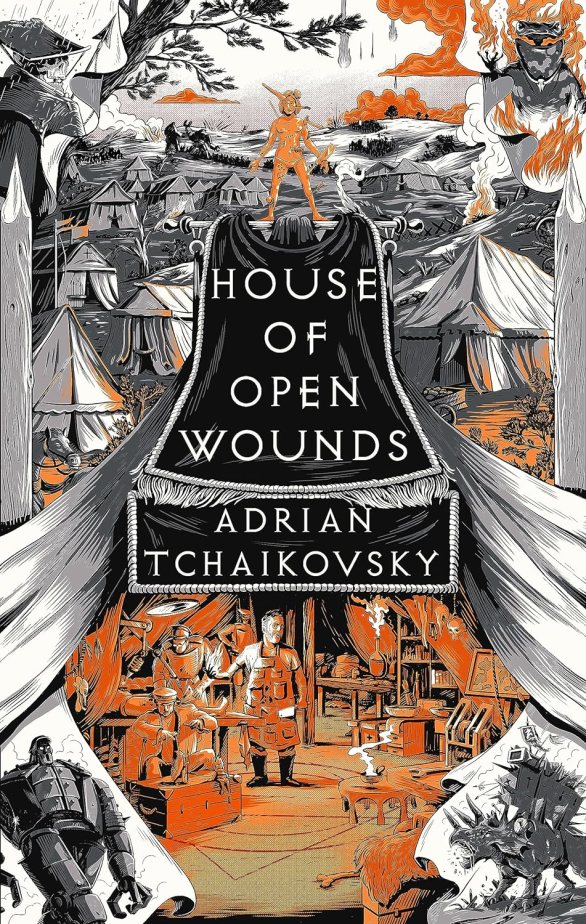
House of Open Wounds by Adrian Tchaikovsky

House of Open Wounds Cover

Publisher: Head of Zeus (Ebook – 7 December 2023)

Series: The Tyrant Philosophers – Book Two

Length: 636 pages

My Rating: 5 out 5 stars

Amazon

The always deeply impressive Adrian Tchaikovsky returns with an exceptional and remarkable piece of fantasy fiction, House of Open Wounds, which presents the reader with a particularly unique and ruthlessly entertaining story, chock full of brilliant characters.

Few fantasy authors have the range and style of Adrian Tchaikovsky, whose distinctive contributions to the science fiction and fantasy fields are quite remarkable.  While Tchaikovsky has written several highly regarded series, I have only just scratched the surface of his works, having read a few of his recent reads.  This includes his first foray into the Warhammer 40,000 universe, with the captivating standalone read, Day of Ascension, as well as the brilliant and elaborate novella, Ogres.  However, my favourite book from Tchaikovsky so far would have to be the outstanding City of Last Chances.

The first book in The Tyrant Philosophers series, City of Last Chances was an outstanding read that I had the pleasure of enjoying earlier this year.  Set around a conquered city with several unique magical inclusions, City of Last Chances introduced the reader to a cool new world and told a range of character driven stories about resistance, religion and sacrifice.  City of Last Chances got a very easy five-star rating from me, and it honestly was one of the best books and audiobooks I enjoyed in the first half of 2023.  I had such a brilliant time with City of Last Chances that when Tchaikovsky announced he was releasing a sequel in the second half of 2023, I was ecstatic.  This sequel, House of Open Wounds, continued some of the complex storylines Tchaikovsky started in City of Last Chances, and it was one of my most anticipated books for the second half of the year.

There are few nations more feared or relentless than the ever-expanding Palleseen.  A rising empire of zealots who are determined to bring Perfection and Correctness to an imperfect world, the Palleseen have advanced out of their homeland in an unstoppable wave, wiping out all religion and superstition as they go.  As cities and kingdoms fall before their military might, their armies leave behind mounds of dead and wounded soldiers who require tending in field hospital tents just behind the frontline.

Into this chaos is thrust the god smuggler Yasnic.  A former priest, miracle healer and occasional rebel, whose previous experiences with the Palleseen saw him hanged, attacked and banished from his city, Yasnic has experienced many upheavals throughout his life.  Saved from another execution by the army bureaucracy, Yasnic and his box of orphan gods arrive at the frontlines, where he has been assigned to work in an unorthodox medical unit.

Made up of a mixture of former priests, gods, magicians, alchemists, artificers, necromancers and led by a gigantic brute known as the Butcher, the experimental medical unit treats the soldiers no one else can save and recycles the rest into the war effort.  Entrusted to save the Palleseen soldiers, but doomed if anyone ever discovers the full extent of their abilities, the surgeons and orderlies of this unit ply their bloody trade as best they can while living as part of an unusual family, but the arrival of Yasnic could change everything.

As Yasnic works to fit into the unit and save lives, his unusual connections to the weakened and hidden gods of the world slowly begin to cause chaos throughout the army.  Not only is he aware of the divine forces that secretly hang around the hospital, but his own illegal and crotchety God is determined to bring miracles to the Palleseen, whether that want them or not.  As an outbreak of impossible healing and sudden pacifism spreads through the regiment, can Yasnic keep himself and his gods alive, or will the full force of the Palleseen zealots come crashing down upon him?

This was another epic and truly remarkable novel from Tchaikovsky that had me hooked the entire way through.  Featuring a dark, bloody and fun story, House of Open Wounds was a particularly distinctive read that told its own captivating story while continuing some of the best elements from City of Last Chances.  Funny, thoughtful and moving in equal measures, House of Open Wounds was an incredible and addictive novel that gets another very easy five-star rating.

I was very impressed with the exceptional and moving narrative that Tchaikovsky pulled together for House of Open Wounds, and I was hooked the second I got into it.  After the events of City of Last Chances, the reader is thrust into a new part of Tchaikovsky’s fantasy world as you find yourself imbedded in a Palleseen battalion following the members of an unusual but effective military hospital.  Like City of Last Chances, House of Open Wounds is strongly character driven, as you follow the personal stories surrounding each of these unusual outsider characters and learn about their complex pasts while watching their lives play out in the present.  Much of the plot revolves around returning protagonist Yasnic and his God, who are drafted into the unit, and you get to see his experiences of the other characters, the wars, and the internal Palleseen bureaucracy.  Most of the first half of House of Open Wounds is dedicated to exploring the new cast of characters and introducing their unique stories, as they find themselves closely following a bloody and dangerous war.  This part of the book is primarily focused on the healing and medical work of the protagonists, as well as diving into their reasons for being there and the unique skills they bring to the surgical table.  Apart from that, there isn’t an amazing amount of major plot progression here, except when Yasnic starts to mix things up around the battalion.  While this pace is a little slow, this first half of the book was really fun and enjoyable, as you find yourself getting really lost in the characters’ lives, unique struggles, desires, and experiences.  It also helps that many of these character details, as well as the mundane events of the hospital, eventually lead to bigger things later in the main plot, and Tchaikovsky does an outstanding amount of set up here.

The plot picks up a lot more in the second half, when the main battalion moves to a different warzone and find themselves involved in a substantial fight that really pushes the medical unit to its limits.  The new battles, as well as the intriguing location they find themselves in, move several of the character arcs in some big directions, and you find out more and more about each of the main characters as a result.  The constant chaos that surrounds Yasnic also starts to take its toll on the main story, as his strangeness and the double-edged miracles he occasionally brings cause him to make enemies and upset the delicate balance of the Palleseen army.  At the same time, the Palleseen war machine starts to alienate the members of the medical unit, who find their talents being stolen to create weapons.  Everything leads up to the big finale, where the protagonists attempt to free themselves with an elaborate and ambitious plan.  This plan makes great use of all their individual skills and histories, and so many little details and elements from the story are used to bring a fun and creative conclusion to the book.  Each of the fascinating character arcs conclude nicely and I loved how Tchaikovsky masterfully brought everything together in a satisfying and entertaining way.

Tchaikovsky utilises his typical excellent and distinctive writing style to convey this elaborate and entertaining narrative to the reader, and I had such a wonderful time seeing it unfold.  As with the previous novel in the series, Tchaikovsky relies very heavily on perspective changes to tell a multilayered, character-driven story.  Like the previous book, many of the major characters are initially showcased in their own chapter at the beginning, which often leads to additional cast introductions.  As the book progresses, the chapters feature perspective changes so you can see more interactions and a wider view of the entire story.  I loved the immediate deep background on several of these characters, and while you still often must wait a while to get their full story, you learn enough to like them in the opening parts of the novel.  Tchaikovsky makes full use of these characters to tell a fantastic story, and I loved how well he showcases some unique events through their eyes.  As with the previous book, House of Open Wounds has a range of tones as Tchaikovsky works hard to produce the right balance of humour, excitement, and moving and powerful character moments.  The multiple detailed and confronting scenes of the bloody battlefield hospitals are well balanced out by the fantastic and subtle humour, which often comes from the outrageous situations that occur throughout the book, as well as the various character’s unique outlooks on life.  This made for a particularly compelling book as you found yourself moving from comedic scene to a more dramatic or tragic moment with frequent regularity, as you find yourself stuck onboard a well-thought-out emotional roller coaster.

House of Open Wounds proves to be an intriguing and clever follow-up to City of Last Chances, especially as the author deepens the lore surrounding this fantasy world and brings back two fantastic protagonists.  Readers of City of Last Chances will have an absolute blast with this book, as you get some interesting follow up to Yasnic’s compelling storyline while also seeing a different side to the antagonistic nation from the first book.  This is a somewhat loose follow-up, and you really don’t need to have read City of Last Chances to enjoy House of Open Wounds.  In many ways this is a good standalone novel, especially as most of the focus is on a whole new group of protagonists, and even Yasnic is given a new name for much of the book.  Tchaikovsky does ensure that some of the key details and plot points from the first book are carried over when needed, although he does leave a bit of context out in places so as not to overwhelm new readers.  As such, House of Open Wounds is a very accessible read, although established fans of Tchaikovsky are going to particularly enjoy this, especially if they loved City of Last Chances.

One thing you can always rely on Tchaikovsky to do is to pull together an elaborate and deeply compelling world to set his stories around.  This is extremely true in this series as Tchaikovsky has come up with a war-torn landscape filled with magic, gods, demons and a new rising empire.  The author did some interesting set up for this world in the previous novel, although the plot there was primarily contained inside a single city.  In House of Open Wounds, the reader gets to see a bigger chunk of this world, even though much of the plot takes place either on the battlefield or in the camp behind the lines.  Despite this, you get a better idea of the politics, wars and conquests that have taken place in recent history, and you particularly learn more about the Palleseen.  The Palleseen are a group of ideological zealots dedicated to bringing their version of perfection to the world, which primarily involves breaking everything down into logic and reason, and doing away with superstitions and beliefs.  As such, their goal is to rid the world of gods, deities and other superstitions, usually by conquering the lands and bringing them under the control of their relentless bureaucracy.  Most of this book is dedicated to exploring the nature of their war machine, and you really get to see just how corrupt and ambitious some of their members are as a result.

I loved the focus on the military hospital and the war camp for most of the book, especially as seeing the various members of Palleseen camp allows the reader to fully understand the many problems, compromises and cruelties the Palleseen experience on their road to perfection.  Tchaikovsky throws in some great critiques of militarisation and empire building throughout the book as you see these perfect Palleseen become racked with pride, ambition and greed to prove themselves and advance up the ranks.  Their determination to win means they turn a blind eye to gods and superstitions when it suits them, and that results in the experimental medical unit that serves as the centre of the book.  However, while they appear to only want the assembled gods, alchemists, and other strange magics for healing, really they are working to corrupt them into terrible weapons to further their war capability.  There are several great storylines that see the Palleseen turning benevolent tools and creatures into highly inventive tools of war, and it serves as a major plot point and motivation for several characters, including a few Palleseen who have enough of their colleague’s lust for power.  Combine that with the returning minor gods, who end up having their own impact on several characters, and the reader comes away with a very cynical look at the Palleseen, and empires in general, which both ridicules them and shows just how malevolent and insidious they can be.

The real key that pulls together House of Open Wounds is the huge array of memorable and complex characters that are introduced throughout the course of the plot.  Tchaikovsky does a remarkable job of introducing and swiftly building up some truly amazing characters in this novel, and their compelling and often traumatic personal stories become so highly ingrained in the plot as a result.  There are so many great protagonists and supporting figures in this novel, and I was personally impressed with how all of them were original characters that were not built up in the prior novel.

The main exception to this rule is Yasnic and his god, both of whom were introduced in City of Last Chances and who are masterfully inserted into this sequel.  Yasnic was honestly one of Tchaikovsky’s best characters in City of Last Chances and I was so glad to see more of him here, especially as the author somehow manages to work in even more development after all the defining character moments that shaped him in the prior novel.  Since we last saw him, Yasnic has moved on from being the last priest of a forgotten god and has instead become a more generalised religious figure, offering shelter and assistance to fallen and orphaned gods who no longer have any power or believers by carrying them around in a box on his back.  After everything he has gone through, including his own crisis of faith, Yasnic now has a different view of the world, although he is still being haunted by his demanding and petty god.  Yasnic has some wonderful moments in this book as he tries to fit into his new role while also hanging onto the trappings of his old life.  Desperate to save everyone he can, Yasnic finds his views and pacifism really badly damaged by the constant war and the relentless and orderly Palleseen, and he is forced to make some haunting compromises.  You really get some very interesting insights into Yasnic’s mind in this book, especially as you see how the aftermath of him abandoning his position as a priest impacted him.  You cannot help but feel for the extremely likeable Yasnic at times, as he is thrust into tragic and heartbreaking positions against his will, and his quiet determination and general positivity pluck at your heartstrings.  Throw in some great new friends, an unusual but surprisingly wholesome love interest and a series of unfortunate misunderstandings that frustrate even this gentle soul, and Yasnic once again stands out as a particularly awesome and likeable protagonist.

The other side of Yasnic’s character resides in the body of his tiny, stumpy, and petty deity, God, a former major healing god who has lost all his worshippers apart from Yasnic, but still maintains his powerful healing abilities.  However, God refuses to heal anyone unless they swear a vow of pacifism, and if they cause harm to someone in any way, it will result in their wounds automatically returning, generally resulting in a sudden death.  Thanks to his stubbornness, pride, and his whiny focus on Yasnic’s soul, God was one of the most entertaining characters in City of Last Chances, and I am really glad that Tchaikovsky brought him back for House of Open Wounds.  While he is still a judgemental, mischievous and ugly angel on Yasnic’s shoulder in this sequel, you get to learn more about God and why he refuses to help save people.  There are some surprisingly emotional scenes where God expresses why he is so bitter and you really get a much better understanding of his angry mind, especially when Yasnic makes the same mistakes, adding to God’s sadness.  I also loved how well God played off Yasnic as he proves to be a surprising and entertaining counterpoint to the humble and nice former priest.  While most of their dialogue is quite contentious, with God trying to control his increasingly independent former priest, you can see deep down that God cares about Yasnic, and they form quite an interesting and fun duo.  Tchaikovsky took God’s character arc in some interesting directions towards the end of House of Open Wounds, and I have a feeling he is going to be a real nuisance to people in the next book.

House of Open Wounds also features quite a fun range of supporting characters, each of whom has their own compelling story to tell.  This primarily includes the crazy and unusual group of associated healers and hospital workers that work in the experimental hospital unit, as well as the competitive and dangerous Palleseen officers controlling their destinies.  I won’t go into too much detail here, as I could honestly go one for a paragraph about each, but I was really impressed with how well Tchaikovsky set each of them up and explored their histories and stories as the booked continued.  There are some brilliant and very well fleshed out character arcs everywhere in House of Open Wounds, and I loved just how compelling a story Tchaikovsky was able to make as a result.

Adrian Tchaikovsky once again shows why he is one of the absolute best authors of complex and intelligent fantasy fiction with this outstanding and epic read.  House of Open Wounds is a deeply clever, compelling and moving read that hooks the reader with its unique scenarios, fantastic humour, and memorable characters.  I loved every single second I spent reading this novel and I really appreciated the amazing way Tchaikovsky chose to continue the great story started in City of Last Chances.  I cannot wait to see what over elaborate fantasy stories Tchaikovsky creates in this universe in the future, and this epic novel is one of the best pieces of fantasy fiction I enjoyed in 2023.
Amazon

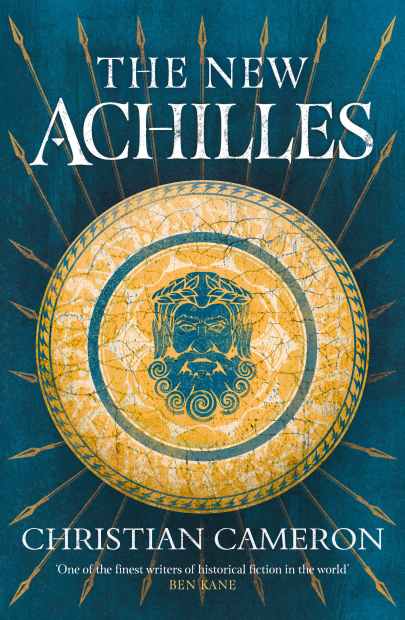
The New Achilles by Christian Cameron

The New Achilles Cover

Publisher: Orion (Hardcover – 18 April 2019)

Series: The Commander series – Book 1

Length: 399 pages

My Rating: 4 out of 5 stars

Amazon     Book Depository

Acclaimed historical fiction author Christian Cameron once again returns to his favourite setting of ancient Greece with his latest novel, The New Achilles.

Greece, 223 BCE. War has come to Greece, as the various Mediterranean powers, including Egypt, Rome and Macedon, engage in a proxy battle on Greek soil. In a sacred sanctuary near the city of Epidauros, Alexanor, a former marine from Rhodes, has spent several years training to become a healer, seeking to escape his violent past. However, war will find Alexanor once again when the Spartans invade the nearby city of Megalopolis, forcing the surviving defenders to bring their wounded to Alexanor’s sanctuary.

Among the wounded is the leader of the men who attempted to fight against the Spartans at Megalopolis, a young man called Philopoemen. After saving his life, Alexanor finds his future tied into that of Philopoemen, who is destined to become one of ancient Greece’s greatest military leaders. Allied with the armies of Macedon against the Spartans and their Egyptian paymasters, Philopoemen proves to be a capable military commander. More importantly, his bravery and skill in battle earn the respect of his fellow Greeks, many of whom consider him to be Achilles reborn.

When prevailing political and military currents require Philopoemen to help with a civil war on Crete, Alexanor travels with him. There they will attempt to take on the powerful city-state of Knossos with an eclectic mix of troops and minimal support from Macedon and the Achaean League. Can Philopoemen and Alexanor succeed, or will the new Achilles fall short of his destiny?

Christian Cameron is a skilled author who has written a number of books throughout his career. While the author is probably best known for his historical fiction work, he has also branched off into fantasy under his pseudonym of Miles Cameron, including his Masters & Mages series, the first book of which, Cold Iron, I previously reviewed here. His latest book, The New Achilles, is the first book in his The Commander series, which will follow the life of the historical figure Philopoemen. This is the third of Cameron’s series which focuses on ancient Greece, with his Tyrant and Long War series both focusing on different periods of ancient Greek history. I have always found that Cameron has a very thorough writing style, and he tends to throw himself into the historical details of his books. This is continued with The New Achilles, as the reader is presented with a very complex tale that may prove a little harder to connect with. However, this book is well worth sticking with, as the author has created an outstanding historical tale that focuses on quite a remarkable character from history.

While The New Achilles does contain some other story elements, at its core it is an intriguing story about the life of Philopoemen. Philopoemen was a skilled general and political leader who was responsible for turning the Achaean League into a viable military power in Greece. He is sometimes known as “the last of the Greeks” (I believe that the next book in this series will be called The Last Greek) due to being one of the last great Greek generals before the Roman era. I have to admit that this was a historical character I had no real experience with, so I was extremely curious to see the author’s vision of his life and deeds. Cameron tackled the story with his usual highly detailed writing style, presenting a comprehensive novelisation of several key events of Philopoemen’s life, his earliest successes and his campaign on Crete. However, there is apparently a large amount of this man’s story left to tell, as he accomplished a great many deeds during his long life. I felt that the author did a fantastic job of capturing the personality of this larger-than-life figure, and I really enjoyed the well-paced story that showed his early rise to prominence.

The story is told from the perspective of the fictional character Alexanor, who, after healing Philopoemen, continues to encounter him and eventually becomes his friend and confidant, accompanying him on several adventures. I liked the use of an outside narrator to tell Philopoemen’s story, and Alexanor is an excellent character in his own right, as he constantly has to balance his duties as a medically trained priest with his desire to help Philopoemen win his battles and his wars. There are issues from his past that he has to deal with, including trauma from a previous war, a lost love and family strife, all of which make for an intriguing character. Another benefit of having a priest as a narrator is that it allows the author to spend time exploring ancient Greek medicine. This was a particularly fascinating element of the book’s story and it was extremely intriguing to see how ancient medicine compares to more modern techniques, and the differences and similarities in knowledge are quite interesting. It also results in some compelling ethical deliberations from the narrator about the dissection of human corpses, which, while strictly forbidden, could result in greater medical knowledge. Overall, I quite enjoyed the author’s use of Alexanor as a narrator, and his focus on his life was an intriguing and enjoyable addition to the story.

This book is set during quite a chaotic period of Mediterranean history, with a huge number of different ancient empires and city-states engaging in various wars and conflicts, many of which have an impact on The New Achilles’s story. Cameron makes sure to examine the various political implications of many of the conflicts occurring around the same time as the events Philopoemen was involved with, and it is quite fascinating to see what effect something like the war between Carthage and Rome could have on the inhabitants of Greece. In addition to the consequences of these distant wars or events, Cameron also looks at the political and national makeup of the various forces arrayed in the conflicts that Philopoemen and Alexanor are involved with. These could get quite complex at times, with a range of alliances, competing city-states and mercenary forces involved or attempting to intervene in a conflict. An example of how complex things could get could be seen in the protagonists extended conflict on Crete, where Philopoemen led a force of Achaean League troops to support one Cretan city state against the on the behest of Macedon. The opposing Cretan city-state was supported by the Ptolemaic dynasty of Egypt, whose Spartan allies joined in and led the fight against Philopoemen. Various other mercenary groups of different nationalities such as the Thracians and the Illyrians were also employed in this conflict and had various roles in the battles and politics. While the sheer number of different historical groups can get a bit overwhelming at times, Cameron does a great job explaining their history and their allegiances, and it is quite fascinating to see the roles they played in various conflicts.

Like many of Cameron’s previous books, the author’s dedication to historical detail and accuracy in The New Achilles is extremely impressive. Each page is full of intriguing elements from history, and it is easy for the reader to find themselves transported to this classical historical landscape. The author not only looks at the military and political aspects of this historical setting; he also examines day-to-day life for the various Greek civilisations. Cameron also makes use of a whole glossary of historical Greek terms and names throughout The New Achilles, all of which gave his story a greater sense of authenticity.

The New Achilles features a huge number of battle scenes and sequences, as the author captures a number of the historical fights Philopoemen was involved with. These battle sequences were extremely exciting, as the author presents some gritty and blood battle scenes. These were quite spectacular, and I loved the realism contained within the story as even the victors find themselves covered in all manner of wounds, and rarely is there a battle where the main characters come out unscathed. This is particularly true for Philopoemen, who tends to suffer injuries in nearly every battle he gets involved with, due to throwing himself into the heart of the fight. I thought this was a clever inclusion from the author, as not only does this reflect some historical accounts of the relevant battles but it is incredibly refreshing to see a hero that does not emerge from a battle unscathed. I quite enjoyed the examination of Greek battle tactics and weaponry, and the battle sequences in this book are fairly spectacular and well worth checking out.

Christian Cameron’s latest book, The New Achilles is a detailed and compelling examination of a truly remarkable, if overlooked, historical figure. The story of Philopoemen’s life proves to be an amazing focus for the plot, and Cameron brings a number of intriguing aspects of the ancient Greek period to life with his trademark detail orientated writing style. This was an incredibly interesting and captivating read, and I am looking forward to seeing how Philopoemen’s life progresses from here in future instalments of The Commander series.

Amazon     Book Depository

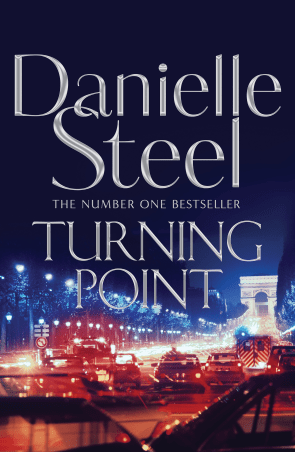
Turning Point by Danielle Steel

Turning Point Cover.png

Publisher: Macmillan

Publication Date – 8 January 2019

Amazon     Book Depository

From world-renowned, best-selling author Danielle Steel comes this powerful dramatic novel that examines the highs and lows of being a top surgeon in the modern world.

Bill Browning, Stephanie Lawrence, Wendy Jones and Tom Wylie are four of the world’s leading trauma surgeons, all living in San Francisco.  Each of these surgeons’ professional lives is near perfect, however their personal lives are a mess.  Bill is all by himself, since his ex-wife and daughters are living in London, and he immerses himself in his work while desperately missing his children.  Stephanie constantly puts her work above her family, barely seeing her young children and frustrating her stay-at-home husband.  Wendy’s life outside work is defined by her relationship with her married colleague, and is constantly frustrated by his indifference to their relationship and his reluctance to end his marriage.  Tom, an over-the-top womaniser, is the only one satisfied with his life, but deep down he knows his life lacks connections as he refuses to let anyone to get close to him.

Tragic circumstances in two separate cities will have unexpected impacts on the lives of all four of these surgeons.  Following a terrorist attack in Paris and a devastating fire in San Francisco, both cities’ respective governments organise a multi-week exchange of trauma surgeons in order to help both cities learn from each other’s experiences.  Bill, Stephanie, Wendy and Tom are each chosen by their respective hospitals to represent the San Francisco delegation and travel to Paris, leaving their lives at home behind.

Once in Paris the American surgeons find a deep friendship and camaraderie with each other and the French team, as they have the chance to socialise with those rare people who understand the personal challenges their medical careers can cause.  As the San Francisco teams learn about the French medical and emergency response system, another terrible act of violence hits the people of Paris.  As both the American and French teams deal with the consequences of these horrific actions, these surgeons find their lives impacted in unexpected ways.  How will these events change them, and how will they impact those around them?

Danielle Steel is one of those authors that really does not need an introduction.  With over 150 books to her name since her 1973 debut, Steel is the undisputed master of the romance and drama novel.  Interesting fact for the day: Steel is actually the fourth best-selling fiction author of all time, coming in only behind William Shakespeare, Agatha Christie and Barbara Cartland, making her the top best-selling author alive today.  Turning Point is Steel’s first release of 2019, and she has an additional five books planned for the rest of the year.

I have to admit that this is not the usual sort of book I would check out, and Danielle Steel is not an author I would usually go for.  I much prefer novels with a lot more action, violence or comedy than romance or intense drama.  However, I have always had a bit of a soft spot for medical fiction, and I thought that the summary of Turning Point sounded fairly compelling.  I also thought that looking into Turning Point would be an interesting change of pace for me, so in the name of broadening my horizons and mixing up my reviews, I decided to check it out.  I have to say I did get into this amazing story, and enjoyed the dramatic narrative that unfolded within it.

There was a little less medical stuff in this book than I would have liked, but there was more than enough to get me into Turning Point’s story.  There are no in-depth surgical scenes, but the author does a fantastic job of describing the aftermath of catastrophic events and how hospitals and medical professionals deal with triaging patients.  What I enjoyed most about the medical parts of this book are the author’s examination of the personal difficulties that surgeons experience as a result of their work.  All of the characters have stunted or damaged social and family lives because of the huge strain their chosen profession takes and the long hours they have to work.  This is particularly true for the characters of Bill and Stephanie, who have children and families, and are forced to deal with having to choose between their dream careers that they have spent their entire life working towards and their families.  Steel mainly focuses on Stephanie for this, as Bill’s wife left him years before the events of Turning Point.  Throughout the book, Stephanie’s husband is constantly making her feel guilty for working while he is left at home with the children, and this puts significant strain on their relationship.  The sexism angle of this was also explored, as Stephanie’s husband, parents and mother-in-law are all very unsupportive of her role and seemed to think she should be with her children, despite Stephanie providing a very reasonable argument that her mother never complained about her father’s similar medical career.  While the examination of the familiar strains of these characters’ surgical careers is a particular focus, the other social impacts of their work is also explored, and I found it fascinating how most of them could only open up to people in a similar line of work and who could understand what they were going through.

The plot of this book is split between San Francisco and Paris, and Steel fills the book with fantastic descriptions of both cities.  Her characters explore and tour through both locations, and the book comes across as a love letter to both cities from the author, who has spent significant periods of time there.  While I enjoyed both of these descriptions, I found the comparison of both cities’ emergency response protocols and the roles of their doctors and emergency services to be the most interesting parts of these settings.  The differences between how these two major cities deal with devastating events is extremely fascinating, and I liked the time that Steel spent exploring them.  During the course of the book, Paris is hit with both a terrorist attack and a school shooting, both of which are emblematic of the main catastrophes hitting America and France.  It was quite shocking to see the aftermath of one of these events in some detail, but it I appreciated why Steel included them.

While filled with other great elements, at its heart Turning Point is a dramatic story with a number of romances.  A large amount of the drama is generated by the elements discussed above, such as the stresses associated with a medical career or the destructive events the characters witness.  Relationships break down, people are in conflict with each other and personal revelations lead to life changing decision for all the characters featured in the book.  Each of the main characters also gets their own romantic subplots, and I liked how each of them turned out.  I was a bit surprised about how much I began to care about each character, but as the reader dives deeper into the book they become more and more involved in their lives.  While I did think the all-round happy endings for everyone was a bit predictable, I liked how the drama and romance elements of these books tied into the other parts of the story to create an amazing overall narrative.

While this was not a book I was expecting to get into, I did find myself enjoying Turning Point and the intriguing story contained within it.  With some excellent medical inclusions and a deep examination of the high pressure lives of surgeons, this is a fantastic read and one that exceeded my genre expectations.

My Rating:

Four and a half stars

Amazon     Book Depository

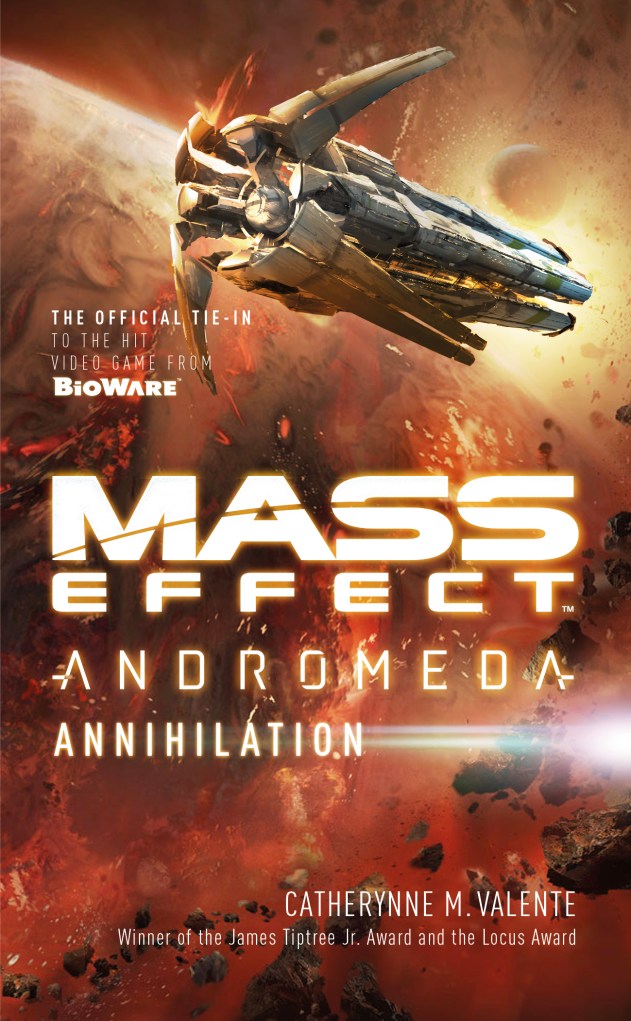
Mass Effect: Annihilation by Catherynne M. Valente

Mass Effect Annihilation Cover

Publishers: Titan Books

                        Blackstone Audio

Publication Date – 6 November 2018

Amazon     Book Depository

A new galaxy, a ship full of disparate alien species, what could possibly go wrong?  Veteran author Catherynne M. Valente brings to life a new adventure in the Mass Effect universe with Mass Effect: Annihilation, the third official tie-in novel to the 2017 video game, Mass Effect: Andromeda.

This was a really good piece of science fiction that expertly built on the intricate extended universe that has been created around the Mass Effect video game franchise.  I should preface this review by mentioning that I am a huge fan of this video game series, and one of the best things about it is the great universe and intriguing storylines that have been produced as a result.  While I know that many people had some valid criticisms about the latest game in the series, Andromeda, I actually really enjoyed the new addition to the series’ story and lore and had a lot of fun playing it and exploring all the additional plot that is hidden outside of the main missions.  One of the many mysteries that I hoped to get an answer about was the fate of Quarian ark, so I was very eager to read this book when I first heard about what it was going to focus on.

For those unfamiliar with the Mass Effect franchise, the first game was released in 2007 and is set in a universe where humanity has gained spaceflight and by 2183 has expanded throughout the Milky Way galaxy.  Once they were outside of our solar systems, humans met with several alien races which governed large portions of the galaxy.  The three main species, the Asari, the Salarians and the Turians, formed a ruling council on the ancient alien space station, the Citadel, which served as a capital city for these races and several other allied species.  The game series followed the human protagonist, Commander Shepard, as he (or she, depending on your settings), investigates the resurgence of the Reapers: ancient, sentient space ships who appear every 50,000 years to destroy all sentient organic life.  While Shepard is able to delay the appearance of the Reapers in the first two games, they launch a full-scale attack in Mass Effect 3, leading to significant, galaxy-changing events.

The game Mass Effect: Annihilation is based on, Mass Effect Andromeda, is the fourth Mass Effect game released and a loose sequel to the original series.  Andromeda is set over 600 years after the events of Mass Effect 3, and follows a group of explorers and colonists from the Milky Way galaxy as they travel to the Andromeda galaxy in an epic one-way trip to find new planets to settle on.  This was a result of the Andromeda Initiative, a joint exercise from a number of Citadel species in order to settle in the new galaxy.  The Initiative launched their ships to Andromeda in the period between Mass Effect 2 and 3.  Each of the main Citadel races, humans, Asari, Salarians and Turians sent an ark ship to Andromeda, each filled with 20,000 cryogenically frozen members of their respective species.  These four arks were launched at the same time, and the plan was for them to dock in the Nexus, a miniature version of the Milky Way Citadel sent in advance of the arks, which was to be used as a staging ground while the Pathfinders found and explored new planets for their races to settle on.  During the events of Mass Effect: Andromeda, mention was made of a fifth ark, built by the Quarians and filled with several other alien races, that was supposed to launch soon after the initial four arks.  However, this fifth ark made no appearance during Andromeda, and was one of the game’s unsolved mysteries, perhaps destined to never be solved, as there is currently no plans to continue the Mass Effect game franchise (although it is too big a franchise for them not to do something else with it in the future).

The Mass Effect games have inspired a number of additional media releases over the years.  Four Mass Effect books were written between 2007 and 2012 to correspond with the original game trilogy, as well as a number of comic book series.  Following the release of Mass Effect: Andromeda in 2017, a new trilogy of books was commissioned which further explored key events or characters mentioned in the fourth game.  Annihilation is the third and final book in the Mass Effect: Andromeda book trilogy.

As the Reaper fleet begins to appear in the Milky Way galaxy, a fifth ark is launched by the Andromeda Initiative to bring another 20,000 settlers to the Andromeda galaxy.  Built by the planetless Quarians, the ark Keelah Si’yah is the only ark to hold colonists from a number of different races, including Quarians, Drell, Elcor, Batarians, Volus and Hanar.  Despite having different outlooks, opinions, biological requirements and reasons to leave the Milky Way, these races are united in their decision to reach the new galaxy and find new planets to settle on.

As the ship reaches the end of its 600-year long journey, problems are soon identified aboard the ship.  One of the ark’s Sleepwalker teams, a small team of individuals tasked with checking on the status of the ark as it flies through space, is suddenly awoken years before the Keelah Si’yah is scheduled to dock with the Nexus.  The ship’s virtual intelligence has identified certain discrepancies in the readings of several Drell cryopods.  Investigating the pods, the Sleepwalker team find that their inhabitants have died from a disease, something that is supposed to be impossible while frozen.  Even worse, the ships systems are all reporting that everything is fine, and that the inhabitants of the pods are still alive.

The Sleepwalker team quickly discover that the dead colonists have all been infected by a virulent disease, one that seems capable of jumping across to the vastly different alien species.  The team are desperate to find out the cause of the disease, but their investigation is severely hampered by a number of system failures across the ark, while the ship’s computers continue to insist that everything is all right.  As the failing systems start to randomly unfreeze more and more colonists, the disease quickly spreads across the ark.  It soon becomes apparent that the disease has been artificially created, and that someone is launching a deliberate attack against the Keelah Si’yah and its crew.  As the various colonists turn on each other in fear and confusion, can the Sleepwalker team find a cure and uncover who is behind the attack, or will everyone on the ark die before reaching Andromeda?

The author of this book, Catherynne M. Valente is not an author I was very familiar with before listening to Annihilation, but she appears to have produced a wide range of different novels, some of which are quite quirky in content.  I do remember seeing and trying to get a copy of her 2018 release, Space Opera, earlier this year, mainly because it sounded like such a fun read, what with it essentially being Eurovision in space.  Luckily, I was able to obtain a copy of Annihilation a week ago and powered through its audiobook format, narrated by Tom Taylorson.

Mass Effect: Annihilation has an exciting and intriguing story that expands on the established lore of the Mass Effect universe while also providing the reader with a compelling science fiction mystery.  The story is broken up into three main parts: the characters attempting to identify and cure the disease, the attempts to fix the ship’s broken system and an investigation into who or what initiated the attack on the ark and its inhabitants.  As a result, there is a good combination of medical, technical and investigative scenes that come together into a rather intriguing overall narrative.  There is not a lot of action, but the focus on the various problems around the ship is very interesting.  The link between the various parts of the book and the final solution to who is behind them was also quite clever and the reasons behind it were quite interesting.  There are some certain dark moments, especially when it comes to the reveal of who was behind it.  Annihilation is obviously going to appeal a lot more to readers who are familiar with the games and who enjoy the backstory of this series, but this is a great story with plenty for other readers to enjoy, and I felt that Valente makes this story accessible for outside readers.

One of the most interesting parts about Annihilation is the fact that the book focuses on the less prominent alien races in the Mass Effect universe.  Aside from one prologue that follows a human, every single character is a member of six less common races in the lore and games, the Quarians, Drell, Volus, Batarians, Hana and Elcor.  This is unique, as the games and the previous novels tend to mostly focus on human characters, or feature a significant number of characters from the games more prominent races, such as the token sexy alien species, the Asari, or the gigantic and war loving Krogan.  The other main council races, the Turians and the Salarians, are also extremely prominent compared to the six races featured within this book, with great Turian and Salarian characters appearing frequently in the games or the books (I am the very model of a scientist Salarian).  In pretty much all of the games, the protagonist can choose members of the above aliens to be a part of the team.  However, Annihilation completely changes this around, as four of the six races that the book focuses on have never had usable characters in any of the games and are mostly minor side characters.  Of the other two races, the Quarians do get a good examination within the games, with one of their members quite a key character.  The Drell are explored to a much lesser degree, although badass Drell assassin Thane Krios as a useable teammate in the second game.

I was pleasantly surprised to read a book where these six less commonly featured races were so prominent.  Valente has a great understanding of these races and spends a significant part of the book exploring each race’s various quirks, important parts of their biology, culture, society or lifestyle, as well as certain parts of their history.  The author does a fantastic job expressing all these racial traits throughout the book, and even new readers to the franchise can quickly gain an understanding of what these species are and what is key to all of them.  For example, Valente is able to expertly capture the various speech characteristics of each of the races featured in Annihilation.  This includes the heavy breathing of the Volus, the lack of personal pronouns in the Hanar’s dialogue, the rolling stream of Drell memories that they say aloud when flashing back to important memories, and even the Elcor habit of prefacing their sentences with their emotional state.  These are all done incredibly consistently throughout the book and really add a lot of authenticity to the story.  These vocal patterns can also be particularly entertaining, especially when it comes to the Elcors, as nothing is more amusing than having an angry Elcor calmly telling everyone how enraged he is.  The various alien species did have the potential to make the investigation into the virus hard to understand, but the author cleverly got around this by having the characters compare the disease, cures and other relevant aspects to common and recognisable human disease.  Overall, these alien inclusions are fantastic, and it was great to see these more obscure fictional species finally get the limelight in a Mass Effect story.

While the alien races as a whole are great inclusions in Annihilation, Valente has also created some amazing characters to make up the Sleepwalker team investigating the issues plaguing the ark.  These characters include the team’s leader, Quarian Senna’Nir vas Keelah Si’yah, Drell detective Anax Therion, Elcor doctor Yorrik, former Batarian crime lord Borbala Ferank, Volus tailor Irit Non and a religiously fanatic Hanar apothecary.  Each of these characters is pretty fun, and all of them have demons in their past that are explored throughout the book.  For example, Senna’Nir is obsessed by computer intelligences, something that is forbidden by the other Quarians following a terrible event in their history.  As a result, Senna’Nir spends large portions of the book coming to terms with his secret obsession, and it is quite an interesting subplot which also allows the introduction of one of the best side characters, a sassy Quarian grandmother virtual intelligence.  Each of the characters’ backstories is fairly compelling and each add a lot to the story.  Borbal Ferank’s crime lord persona is also a lot of fun throughout the book, as she casually mentions her previous crimes and familiar betrayals that are quite common for Batarians.  There are also the mysteries around Anax, as the ultimate infiltrator gives several versions of her past throughout the book to various characters to get the answers and stories she requires.

Easily the best character in Annihilation is Yorrik, the Shakespeare-obsessed Elcor doctor who spends the entire book trying to cure the virus infecting the ark.  He was extremely amusing throughout the entire book, as he spend significant parts of the book dropping jokes in his emotionless tone, or attempting to engage his companions in discussion about his extremely long Elcor adaptions of Hamlet or Macbeth.  Yorrik is a fantastic character throughout the entire book, and he is definitely the person the reader gets the most attached to.  Never have Shakespearian quotes been more appropriate for the fate of an alien.  I also really loved the unique partnership between Anax and Borbala.  The detective and criminal make a great team, and the two have a lot of fun investigating the attack on the ship, and it was great seeing the two of them get closer to each other through the course of the book.  Valente has done an incredible job with the characters in this book, and their histories, relationships and unique viewpoints really make this novel awesome.

I listened to the audiobook version of Annihilation, which I found to be an amazing way to enjoy this book.  At just under nine hours long, this is an easy audiobook to get through, but it is one I had a lot of fun with.  One of the best things about the audiobook version was the fact that they got Tom Taylorson, the voice of the male protagonist in Mass Effect: Andromeda, to narrate this audiobook, which is just awesome for those people who have played the game.  Taylorson does an excellent job portraying each of the characters in this book and I loved all the voices he came up with.  He also managed to get all of the unique voice patterns and vocal particularities of the various alien species down perfectly, and each alien species sounded exactly as they did in the games.  This is an outstanding piece of audiobook narration, which really added a lot to how much I enjoyed this book.

Overall, I am going to give Mass Effect: Annihilation a rating of four and a half stars.  I will admit that one of the main reasons I am giving it such a high rating is because of my love of all things Mass Effect and because of how much I love the franchises lore and expanded fictional history.  I am aware that people who are not as familiar with Mass Effect may not enjoy it as much, but I hope that most readers will appreciate the great characters, interesting story and excellent audiobook adaption.  This is great piece of science fiction and an excellent tie-in novel that is a perfect read for fans of the Mass Effect franchise.

My Rating:

Four and a half stars

Amazon     Book Depository

Dreadful Company by Vivian Shaw

Dreadful Company Cover.jpg

Publisher: Orbit

Publication Date – 24 July 2018

Amazon     Book Depository

Those looking for an entertaining, intriguing and different take on the horror genre should investigate Dreadful Company, the latest book from author Vivian Shaw, which contains a thrilling story based around the doctor to your favourite fictional monsters.

Greta Helsing is London’s medical practitioner for the undead, providing specialised treatment to the city’s hidden community of ghouls, vampires, mummies and zombies.  After being called to Paris to attend a supernatural medical conference, Greta’s plans to enjoy a stimulating discourse and debate on monster medicine is ruined when she is suddenly kidnapped off the street.  Her abductors turn out to be a coven of young and murderous vampires led by the unhinged Corvin, who bears a particular grudge against Greta’s vampire friend Ruthven.  Even more concerning, a member of Corvin’s coven is using magic to summon small and friendly magical creatures.  While the creatures may be harmless, the ripples they are causing in reality are not, and represent a significant threat to our world.

While Greta is trapped in the tunnels and catacombs below Paris, her friends arrive in the city to save her.  Legendary elder vampire Ruthven and Greta’s vampyre boyfriend, Sir Francis Varney, team up with Paris’s guardian werewolf, two immortal paranormal investigators and the city’s resident demon to free Greta and put an end to the dimensional instability.  But Greta and her companions are about to find out that there are weirder and more dangerous things than a collection of bloodthirsty vampires in the tunnels underneath Paris.

Dreadful Company is Shaw’s follow-up to her 2017 debut novel, Strange Practice, and is the second book in her Dr Greta Helsing series.  Dreadful Company returns several of the protagonists from the first book while also adding in a healthy number of new and exciting characters.  A third book in the series is already planned; I will definitely be keeping an eye out for Grave Importance next year.

Shaw’s latest book contains a fun and electrifying adventure that pits several ancient beings and their doctor against a coven of vampires and the magical catastrophe they have created.  The author tells her story through a range of characters to show many different perspectives of the adventure taking place.  Not only is every single protagonist – including returning characters Greta, Ruthven and Varney, as well as new characters the werewolf St Germain, the remedial psychopomps Brightside and Dammerung and the demon Irazek – a point of view character, but so are several of the young vampires who serve as the book’s antagonists.  This allows Shaw to tell a much wider story.  Not only is the central adventure explored in greater detail from a several angles, but the motivations, shared histories and the underlying thought processes of the story’s key players are presented to the reader.

Shaw has made a smart decision to change the book’s main setting from London to Paris.  Many writers can get bogged down in one location during their series, but Shaw did a fantastic job adapting her story to a completely new and unique cityscape, a trend that she will apparently continue to follow in her 2019 addition to the series.  Shaw makes full use of several iconic Paris locations, particularly the catacombs and tunnels underneath the streets, which are the perfect setting for a horror story.  Overall, Dreadful Company contains a rather exciting adventure story that makes spectacular use of its horror and fantasy elements, while also making use of the humour and history of its many point-of-view characters to lighten the darker tone of the book and create a unique and entertaining read.

I was extremely happy that Shaw included more examples of monster medicine within Dreadful Company.  The examination of the medical techniques used on supernatural characters was one of the best features of Strange Practice, and was a very unique and compelling element of this first book.  There are a number of wonderful general monster medicine scenes throughout the book, including a supernatural medicine conference where topics include ‘An overview of the various treatment modalities for tissue degeneration in Class A revenants’ (how to stop bits falling off zombies).  Readers will really enjoy Dreadful Company’s interesting focus on the medicine of vampires.  Shaw did spend a little time exploring the biology and treatment of vampires in the first book, which is expanded upon in Dreadful Company.  There are several discussions about vampire anatomy and physiology, including some of the features of the different vampire subspecies.  There is also a detailed look at the effect of certain substances on vampiric characters, including drugs and garlic, as well as the surprisingly devastating absinthe.  The protagonist is also forced to treat a number of different vampire characters for a variety of different conditions, including an overdose, stab wounds and an infection caused by a ghoul bite.  Once again, Shaw’s inclusion of monster medicine was an amazing part of this book, and I am looking forward to the third novel in the series, Grave Importance, which will focus on the care of mummies.

Aside from the examination of vampire biology, Shaw has also included a fascinating look into the different vampire mentalities, particularly when it comes to the old school versus the young bloods.  The two elder vampire characters, Ruthven and Varney, are reformed from their violent past and are instead trying to live normal and peaceful lives alongside humans.  The younger vampires, on the other hand, are bloodthirsty creatures who don’t follow any rules, kill indiscriminately and indulge in drugs and wanton behaviour.  The differences between the behaviours of these two different types of vampires are quite noticeable, especially when the younger vampires try to live up to all of the vampire stereotypes, such as sleeping in coffins, wearing elaborate clothes and makeup, making up dumb names for themselves, developing a superiority complex and trying out various ways to make themselves glitter.  While these inclusions are extremely fun, the readers will really experience chills when they see how angry the usually calm characters Ruthven and Varney get when they encounter these younger vampires and realise what taboos they have broken.

In addition to the creative and captivating use of vampire characters throughout the book, Shaw has referenced several other classic horror creatures and villains.  There are several allusions to Frankenstein and The Phantom of the Opera, with the protagonists actually visiting the Phantom’s underground lair at one point.  There are also other creatures, such as magically summoned hair monsters, well monsters and a whistle-summoned spirit, all of which play an interesting role in the plot.  Some great humour also comes from the inclusion of several ghosts, many of whom can be found having a lively party in Paris’ iconic Père Lachaise cemetery.  Highlights of this scene include a snarky Oscar Wilde and a musical Jim Morrison, both of whom have some great interactions with the new characters, Brightside and Dammerung.

Dreadful Company sees new author Vivian Shaw return with another fun and thrilling horror novel that contains a fast-paced adventure and a light comedy enhance tone.  Shaw has invested in a range of new characters, a fresh setting and some appealing fantasy and horror elements.  The author’s clever and memorable inclusion of monster medicine once again shines through as the book’s best feature, as well as the detailed examination of the vampire psyche.  An absolutely amazing second outing from Shaw, Dreadful Company is a fantastic read that will prove to be both unique and captivating to a huge range of readers.

My Rating:

Four and a half stars

Amazon     Book Depository