
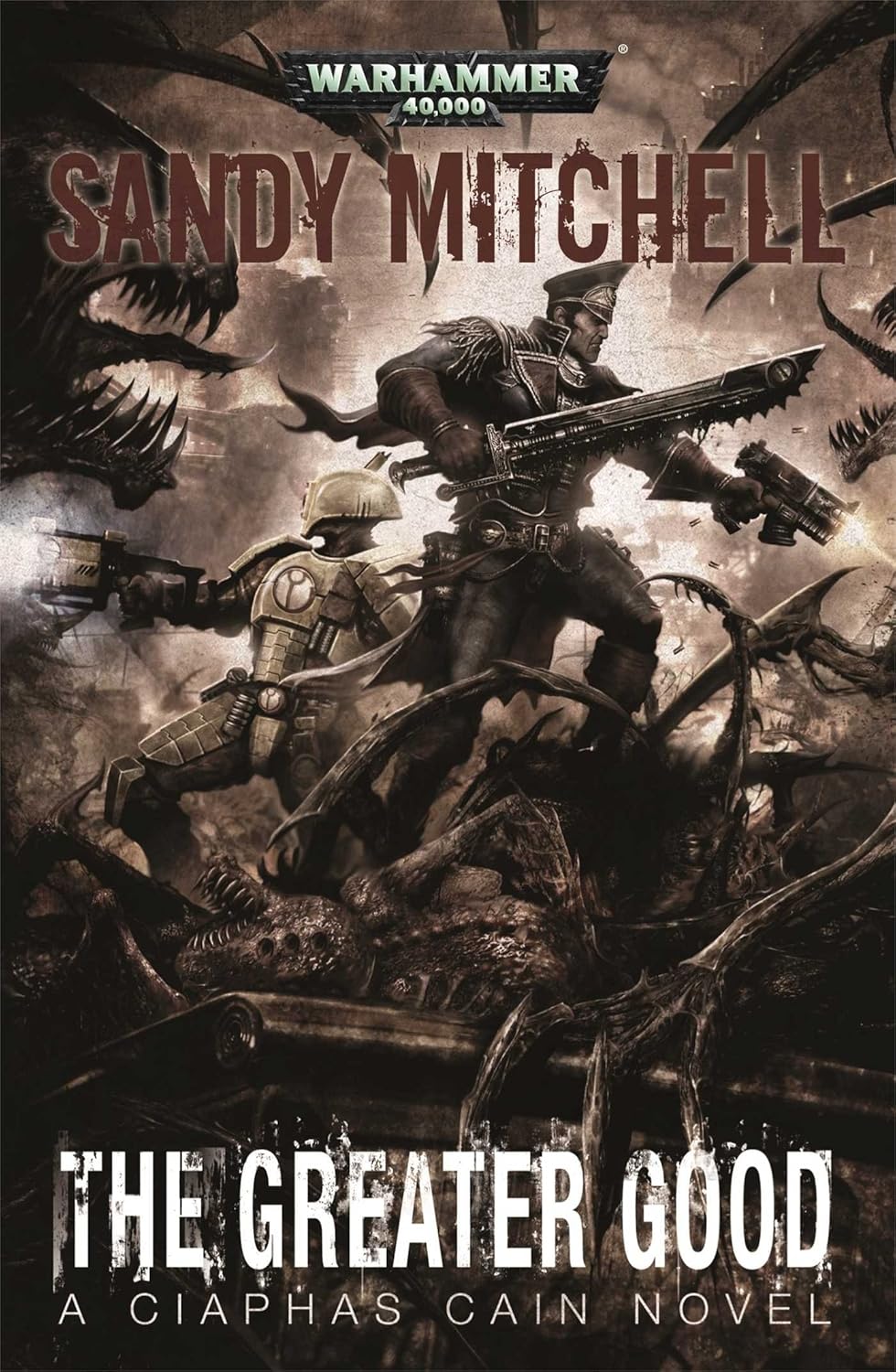
Warhammer 40,000: The Greater Good by Sandy Mitchell

Publisher: Black Library (Audiobook – 1 January 2013)

Series: Ciaphas Cain – Book Nine

Length: 9 hours and 50 minutes

My Rating: 4.5 out of 5 stars

Amazon

Continue to follow the legendary and complex Commissar Ciaphas Cain into death and danger, with another amazing book in Sandy Mitchell’s awesome Warhammer 40,000 series, The Greater Good.

After recently reviewing the eighth book in Sandy Mitchell’s iconic Ciaphas Cain series, The Last Ditch, I just had to continue following the fun adventures of the Imperium’s most charismatic yet cowardly commissar, Ciaphas Cain.  As such, the moment I finished The Last Ditch, I immediately read the ninth book in the series, The Greater Good, which had a very interesting scenario behind it that builds on several previous storylines from the series.

Commissar Ciaphas Cain, legendary hero of the Imperium of Man and self-declared fraud, is once again thrust into mortal danger when he is assigned to bolster the defences of the human planet of Quadravidia, against the high-tech attacks of the Tau.  Amid the expected brutal fighting against the advanced aliens, Cain is surprised when the Tau not only recognise him amongst the fighting but also single him out to request an unexpected ceasefire right on the cusp of a Tau victory.

Expecting the worst from this unlikely turn of events, Cain is unsurprised when the Tau reveal that an even greater threat is moving towards the sector, a hive fleet of Tyranids.  With neither side capable of fighting both each other and the ravenous Tyranids, the Imperium and the Tau agree to an uneasy truce, with both sides agreeing to coordinate their offensive against the incoming hive fleet.

Accompanied by a Tau ambassador, Cain, his trusty aid Jurgen, and the Imperial fleet journey to the vital Forge World of Fecundia, a potential target for the incoming Tyranids.  Using Fecundia as a base of operations, the Imperium are hopeful the Tyrands will focus their attack on the Tau controlled planets.  However, the chances of Cain remaining out of the fight are always slim, and the commissar soon discovers the existence of a secret facility hidden on the planet, one guaranteed to draw the Tyranids to Fecundia.

Caught between an invading fleet of ravening aliens, and the troubled politics of Fecundia, Cain must rally the defenders for another deadly battle.  However, the secrets lurking within the hidden facility look set to doom them all, and Cain must discover just how far the rot goes in Fecundia, before the entire world is devoured.

The Greater Good was another excellent and highly entertaining Warhammer 40,000 novel from Sandy Mitchell that combines excellent and action-packed storytelling, with a fantastic and humorous protagonist.  Featuring an outstanding story, The Greater Good was a ton of fun from start to finish, and it served as an amazing continuation of one of the best Warhammer 40,000 series out there.

I quite enjoyed the plot of The Greater Good, although it did go in some different directions to what I was expecting.  From the cover and the official plot synopsis, I assumed this novel was going to feature humans and Tau fighting side by side on the initial planet the book is set, after temporarily setting aside their differences.  Instead, the plot is primarily set on a secondary planet of Fecundia, with the only Tau being a controversial ambassador providing some interesting alternative insights.  While this was still a fun and exciting narrative, it did run the risk of being a bit too similar to some of the previous Ciaphas Cain novels that focused on Tyranid invasions.

I felt that Mitchell compensated well for this change in direction, by drawing together an interesting read about infiltration, isolated battles and the Imperium’s research in the Tyranids as they attempt to find ways to defeat them.  Revisiting key story elements from the previous two Ciaphas Cain novels, the protagonist soon finds himself trapped amid a series of controversial and dangerous experiments that begin to attract the Tyranid hive fleet.  After a series of exciting set pieces, including a great extended sequence with the protagonist trapped in an alien filled desert, you reach the final third of the book which primarily takes place in the secret research centre.  Unsurprisingly, things go wrong, and Cain and Jurgen are forced into a seemingly hopeless situation as they fight enemies on all sides.  There were some good twists here, especially around potential betrayals, and while the culprit is easy to predict, there is an excellent amount of uncertainty and red herrings to keep you guessing.  The entire story comes together in an awesome way, filled with Mitchell’s usual excellent fight sequences and humour, and this proved to be a compelling and satisfying addition to the larger series.

Long-term fans of this Warhammer 40,000 series will know that Mitchell has a set format for the Ciaphas Cain books that blends clever character-driven humour with the usual grim action and lore of the universe.  This was also the case for The Greater Good, which features the usual chronicle style told from the protagonist’s perspective, bolstered by funny external commentary from a fictional editor, who also adds in some entertaining in-universe texts for some additional context.  While this style and certain narrative elements are very familiar, especially if you read a few of these books in a row, The Greater Good was still an awesome novel, and Mitchell did make it stand out by adding in some intrigue with Tyranid infiltrators, as well as some curious looks at diplomacy between the Imperium and the Tau.  I quite enjoyed seeing the conflicts that emerged between the various factions of this impromptu alliance, especially as Cain and the Imperial Guard had more issues with their Adeptus Mechanicus and Space Marine allies than the Tau.  Add to that Mitchell’s usually impressive humour and wonderful action set pieces, and The Greater Good was an overall outstanding novel that I quickly powered through.

While most of the Ciaphas Cain books work well as standalone reads that are very accessible to new readers, The Greater Good stood out as it had more of a connection to the previous entries in the series.  There were a lot of heavy references to the events of For the Emperor, The Emperor’s Finest and The Last Ditch, with key plot elements and some returning characters coming into the play during The Greater Good’s narrative.  As someone who enjoyed all the previous books, it was nice to see the consequences and aftermath of these prior adventures be utilised in this entry’s plot, and I think that long-term fans will really appreciate it.  These references also helped to dispel some of the usual issues this series has with reusing descriptions and thoughts from the previous books.  While much of the plot is geared towards established fans, new readers can still easily follow The Greater Good’s plot without too much issue, as Mitchell does an excellent job of recapping these previous adventures.  As such, The Greater Good proves to be an amazing overall entry in the Ciaphas Cain series, especially as it remains accessible and enjoyable to readers of varying experiences.

As always, I must give a shoutout to the outstanding cast of this novel, especially as there is an interesting array of unique characters contained within.  This includes a great mix of familiar and new characters, with much of the action focused on the titular Commissar Ciaphas Cain, who remains the usual complex rogue we’re so familiar with.  It is always fun to see Cain struggle with his imposter syndrome and supposed cowardice, and Mitchell ensures that the protagonist is the main source of the book’s humour thanks to his self-centred narration and hilarious insights into the usual grimdark universe.  Cain’s aide Jurgen remains an excellent source of additional entertainment, while Inquisitor Amberly Vail is once again perfect as the overarching editor of the story, providing her sarcastic insights and corrections to Cain’s actions and conclusions.  Throw in a captivating combination of new or minor characters, including a frustrated general, a calculating Tau ambassador, some returning Space Marines and a cunning Tech Priest with her own agenda, and the cast of The Greater Good is exceptional and drives the story into some fascinating places.

After hyping up the audiobook versions of all the previous Ciaphas Cain entries, I doubt anyone will be too surprised that I decided to check out The Greater Good on this format.  All Warhammer 40,000 novels are damn awesome on audiobook, and The Greater Good is a particularly epic example of this.  Coming in with a runtime just short of 10 hours, The Greater Good audiobook is an amazing listen that is easy to get addicted to, especially as the excellent use of several outstanding narrators really helps to enhance and highlight Mitchell’s unique writing style.

The Greater Good audiobook features an impressive six separate narrators, all of whom will be quite well known by Warhammer audiobook enthusiasts.  As with the rest of the series, most of the work is done by returning narrators Stephen Perring and Penelope Rawlins, both of whom have a key role in this production.  Perring serves as the entertaining and flippant voice of Cain as he recounts this adventure in his own words, while Rawlins is the voice of Inquisitor Vail as she provides her editorial notes throughout the plot and introduces other intermissions.  These two have long proven themselves to be perfect main narrators for the Ciaphas Cain books, and they fulfilled their roles in The Greater Good extremely well, full grasping the complexity of their respective characters.  The other four narrators for this audiobook, Matthew Hunt, Andrew James Spooner, John Banks and Tara Rawson, have minor but entertaining roles in this audiobook, providing voices for the various in-universe history texts and other books/messages that appear at various parts of the book, which allows for some additional comedy.  This mixed narration comes together extremely well throughout the entirety of The Greater Good, resulting in a particularly epic listen.  As such, I would once again recommend that potential readers of this Ciaphas Cain novel check out the audiobook version, as there is frankly no better way to enjoy The Greater Good.

With yet another clever, exciting and hilarious take on the epic Warhammer 40,000 universe, the ninth Ciaphas Cain novel, The Greater Good, was an outstanding addition to the series that I had a wonderful time listening to.  Utilising his tried and tested writing style, Sandy Mitchell produces another compelling and entertaining read that proves to be highly addictive and a lot of fun to get through.  I really enjoyed this excellent entry in the Ciaphas Cain series, and I am hoping to finish off this series by the end of the year.

Amazon

Warhammer 40,000: The Bookkeeper’s Skull by Justin D. Hill

The Bookkeeper's Skull Cover

Publisher: Black Library (Audiobook – 18 January 2022)

Series: Warhammer 40,000/Warhammer Horror

Length: 4 hours and 32 minutes

My Rating: 4.5 out of 5 stars

Amazon     Book Depository

Get ready to dive back into the crazy and terrifying Warhammer 40,000 universe with the clever and exciting read, The Bookkeeper’s Skull by acclaimed author Justin D. Hill, which serves as a great entry in the Warhammer Horror sub-series.

Despite not being even halfway done yet, 2022 has already produced some epic new entries in the Warhammer 40,000 universe, including Steel Tread by Andy Clark, Reign by Nate Crowley, Day of Ascension by Adrian Tchaikovsky and Krieg by Steve Lyons, just to name a few.  After these awesome reads, there was no way I wasn’t going to check out The Bookkeeper’s Skull, especially when it had such an intriguing name.  The Bookkeeper’s Skull is an awesome book that forms part of a sub-series of Warhammer tie-in fiction known as Warhammer Horror.  This series unsurprisingly presents the reader with horror-based stories in its various universes and has already produced some very cool sounding reads.  The Bookkeeper’s Skull is my first brush with this horror series, and I was very excited to read one, especially as it was written by Justin D. Hill, a fantastic author who has been impressing recently with several great novels, including his Cadia series.  I loved the unique and clever story that Hill came up with for The Bookkeeper’s Skull.

Throughout the Imperium of Man, many planets serve the God Emperor in different ways.  For the agri-world of Potence, its only duty is to meet the iron-firm food quotas levied upon it by Imperial hierarchy, ensuring that the armies of the Imperium are supplied with all the food they need to fight the aliens and the heretics.  The enforcers, implacable lawmen with the ability to deal out death on an arbitrary basis, roam the planet and the farms of Potence, ensuring that the populace and serfs do all there is to produce the appropriate amounts.

Rudgard Howe is a new enforcer recruit who has just reported to duty.  The son of the planet’s chief enforcer, Rudgard faces a deadly future which will eventually force him to kill his older brothers to claim his dying father’s position.  But before he faces his family, he must learn the ropes by journeying out to the farmsteads of the planet and ensuring they can meet their quotas.  Travelling with a veteran enforcer, Rudgard learns the hard truths about life in the Imperium and the necessities of justice in keeping the planet running.  However, no lessons will prepare Rudgard for the horrors awaiting the enforcers at their final destination, the far-flung farmstead of Thorsarbour.

Located out in an ancient and unknown region of the planet, Thorsarbour is a cursed settlement, with its overseers poorly led and its serfs living in terror of the strange presences they claim to feel.  Finding the settlement far behind its quotas, the enforcers attempt to whip the farm into shape, but between the unnatural feeling of the land surrounding Thorsarbour and the dangerous presence of a bloody sanguinary cult amongst the serfs, they have their work cut out for them.  Worse, a series of unexplained and brutal murders are occurring around Thorsarbour, each one accompanied by mysterious strawman placed near the body.  As Rudgard tries to uncover the cause of these mysterious deaths before they destabilise their work, the enforcers begin to discover something unnatural behind them.  Can they discover the culprit before it is too late, or will the horrors of Thorsarbour consume them all?

This was a really interesting first dive into the Warhammer Horror series for me and it is one that I am very glad that I undertook.  The Bookkeeper’s Skull is an excellent novel that very quickly grabbed my attention with its clever storytelling and fantastic, fast-paced plot.  Hill manages to do a lot with this story in a very short amount of time as The Bookkeeper’s Skull has a pretty short run time.  Despite this, the reader is quickly and succinctly introduced to the main character and narrator, Rudgard, and the world of Potence, in a great couple of opening chapters, before dropping them right into the horror of Thorsarbour.  Once the narrator arrives then you are quickly struck by the unnatural and freaky nature of the location, as they encounter several of the unusual issues surrounding the farmstead.  Following the initial discovery of a multitude of bodies and death, the protagonists encounter one dangerous situation after another, as they contend with religious fanatics, terrified serfs and overseers, monstrous farm animals, mysterious strawmen, a strange and prophetic girl, and a mysterious force brutally killing off everyone in the compound.  Even with so much happening, the pace of this novel never slackens, and there is a very high death count as everything goes wrong in some very brutal way.  I was pretty hooked on this novel from the very start, and I loved where the story went, even if it did get a little predictable towards the end.  I had a fairly good idea of who was going to live and die from the start, as well as who the killer was likely to be (the title is very suggestive).  I do think that the novel slightly fell apart at the very end, as Hill chooses to leave a little too much mystery behind what sort of force might be ultimately responsible for the events of the book, but this was still an amazing story that I had a lot of fun with.

The Bookkeeper’s Skull turned out to be a pretty good Warhammer 40,000 novel, and I liked how it fit into the wider universe.  This novel is closely related to one of Hill’s other novels, Cadian Honour, which is also set on the world of Potence and features an older version of the protagonist.  I love it when a novel provides an interesting connection to an author’s previous work, especially one that provides some exciting context and personal history, and this was a great example of that.  Despite this, people interested in checking out The Bookkeeper’s Skull don’t need to have any pre-knowledge of Hill’s writing or any other Warhammer 40,000 novels to enjoy this excellent book.  Indeed, this is a fantastic introduction to both Hill’s writing and the wider Warhammer universe and could be an interesting first book to readers curious about either.

I was very impressed with how the author was able to meld horror elements into this Warhammer 40,000 novel to create a unique and impressive story.  Hill did a beautiful job of creating a powerful and creepy atmosphere for this novel right off the bat, especially as the opening chapter features a sinister and freaky toy/companion that the protagonist had as a child (seriously, WTF).  This dark atmosphere only increases as the book continues, especially once the characters arrive at Thorsarbour.  Between the brutal conditions imposed upon the serfs, the unsettling atmosphere, the undercurrent of fear, the crazed religious cult of self-mutilating fanatics, the graphic murders and the haunting presence of several otherworldly characters, you have all the elements you need for a truly impressive and memorable horror tale.  The pacing of the killings is excellent, and the reader finds themselves drawn in by their cruel and bloody nature as the bodies keep dropping in even more elaborate ways.  These killings also work well with the presence of the cult and the appearance of all the strawmen and other agricultural elements, and the book ends up with vibes reminiscent of films like The Wicker Man or Children of the Corn, especially with a pale and potentially psychic child talking about a supernatural figure responsible for the killings.  This ended up being an awesome horror read, and I find myself getting really drawn into the creepy story thanks to some of the freaky elements it contained.

This proved to be a particularly good Warhammer 40,000 novel due to the distinctive setting.  The Bookkeeper’s Skull takes place on a seemingly peaceful agri-world, which gives the reader some intriguing insights into this wider universe.  I loved the cool look at the various archaic ways that this spacefaring civilisation gets food and other resources.  The entire agri-world acts in a mostly feudalistic manner, with practically enslaved serfs doing much of the work on farmsteads.  The blend of gothic science fiction with modern and ancient agriculture elements works really well and it serves as a brilliant background for this darker tale.  Indeed, many of the book’s horror elements are derived from just how bleak and harsh the Imperium of Man truly is and just how badly they treat their own citizens (and they’re the good guys, apparently).  Hill paints some truly shocking pictures of the conditions on this world, including some very gruesome depictions of a rabid self-mutilating cult and some brutal scenes of violence that the enforcers inflict upon the people.  However, the most disturbing part of this world is Gambol, a being who is revealed to be a former criminal who had their arms and legs amputated, his mind modified by technology, and then dressed as a clown to become the protagonist’s childhood toy.  This disturbing figure, equipped with his festering flesh-plugs (shudder!), is sprung on you in the first few pages of the book and really helps to set the horror mood for the reader, as well as just how dark and horrific the Imperium can get (they do this sort of thing to a lot of people).  I loved how grim and dark Hill made this Warhammer story and you really get a sense of just how messed up everything is.

I quite enjoyed the character of Rudgard, who serves as the central protagonist and narrator.  The Bookkeeper’s Skull is told from Rudgard’s point of view in a chronicle format, so you get a real sense of this excellent character both as an experienced enforcer and the young rookie he is in this novel.  This version of Rudgard is a young and inexperienced man who is trying to live up to his family’s legacy, which includes a cruel father, two murderous brothers and an insane mother.  Sent out on routine mission with veteran enforcer Tarrini, Rudgard quickly learns all the terrible truths about his job as he essentially becomes an executioner.  Because of his past and the terrible events of this book, you get to see Rudgard turn into the no-nonsense figure from Hill’s previous novels, and I liked the continued change in his character.  I enjoyed the excellent mentor/mentee relationship he forms with Tarrini, as well as the narrators continued comments attempting or excusing some of his actions.  These considered and compelling notations from the older Rudgard give some interesting context to both the younger and older versions of the character, and it is interesting to see how much he has changed and developed over the years.  While I did think that parts of his backstory were wrapped up a little too quickly, this was still a fantastic examination of a great character and I look forward to seeing more of him in some of Hill’s other works.

I made sure to grab the audiobook version of The Bookkeeper’s Skull, which proved to be an incredible way to enjoy this brilliant novel.  Due to the shorter length of the story, this is a relatively quick audiobook with a rough run time of four and a half hours, which can be powered through extremely quickly.  I found that the audiobook format was highly conducive to the powerful horror mood of the novel and I personally felt that it really enhanced the tension and fear that the story produced.  A lot of the reason why I enjoyed this audiobook was the excellent voice work from narrator Matthew Hunt.  Hunt, who has lent his voice to several Warhammer audio productions in the past, had an excellent voice for this audiobook, and I felt that he captured both the main character and the overall tension of this novel extremely well.  Hunt moved this audiobook along at a swift and compelling pace that really grabs the attention and ensures that you keep listening as events get darker and darker.  Throw in some fantastic and fitting voices (Gambol’s near childlike voice is pretty damn freaky, and I loved the sly and manipulative voice given to the cult leader), and you have an outstanding audiobook that is really worth checking out.

Overall, The Bookkeeper’s Skull by Justin D. Hill is an outstanding and epic Warhammer Horror novel that I had a brilliant time reading.  Hill came up with a clever and captivating story that does an excellent job combining freaky horror elements with the expansive and fun Warhammer 40,000 universe.  I loved my first taste of the Warhammer Horror brand and I look forward to checking out more of it in the future, as well as some more exceptional writing from Hill.

Amazon     Book Depository