

Publisher: Harper Voyager (ebook – 1 August 2024)
Series: Dragonwar Saga – Book One
Length: 480 pages
My Rating: 4.5 out of 5 Stars
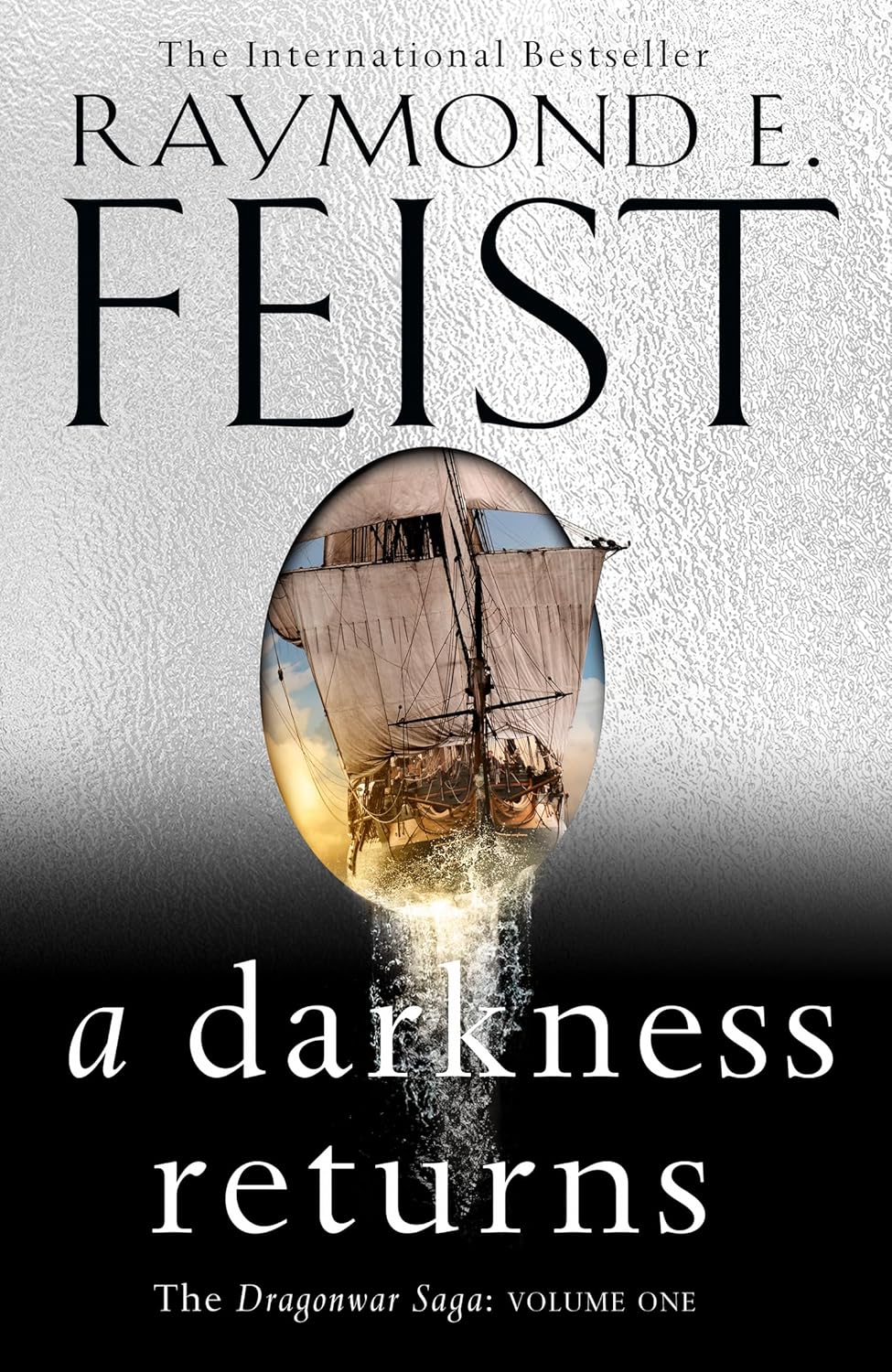
Prepare to return to one of the most iconic realms of fantasy as acclaimed author Raymond E. Feist presents the reader with another high fantasy adventure set across multiple worlds with A Darkness Returns.
Raymond E. Feist is one of the most impressive and long-running authors of fantasy fiction in the world today, who has been writing intriguing reads for over 40 years. Feist is best known for his extensive Riftwar Cycle, a connected series of books that follow a variety of threats and conflicts on several fantasy words created by Feist. Starting with Magician in 1982, The Riftwar Cycle initially focused on a war between two different fantasy worlds joined together by a magical rift in space, with the realm of Midkemia, which had a more classic European fantasy vibe, being invaded by armies from the Asian inspired world of Kelewan. Feist would write an interesting array of different storylines as he continued to expand his fantasy series across many years of internal plot, and there ended up being nearly 30 books in the Riftwar Cycle, which ended back in 2013. I have been a huge fan of this series for years, as it was one of the first fantasy series I ever really got into, thanks to various unique sub-series that moved the history of Midkemia and its associated realms along at an intriguing pace. Key highlights for me include the associated Empire trilogy, that Feist co-wrote with fellow fantasy author Janny Wurts, and Talon of the Silver Hawk, which was one of the first big fantasy novels I read as a young teenager.
While Feist apparently ended his Riftwar Cycle books some years ago, it turns out that he couldn’t leave his original world alone for too long. His next trilogy, the Firemane Saga, which started back in 2018 with King of Ashes, initially showed a captivating adventure on the new fantasy world of Garn, following a whole new group of protagonists. However, as the series continued with Queen of Storms and Master of Furies, it became apparent that the Firemane Saga existed in the same dimension as the Riftwar Cycle, with several characters from Feist’s original novels having cameo appearances. The final book, Master of Furies, identified a major threat lying dormant beneath Garn, and the novel ends with the protagonists of the Firemane Saga travelling through a rift to Midkemia to learn how to defeat it. This new novel, A Darkness Returns, is set immediately after the events of Master of Furies and seeks to bring together the worlds of the Riftwar Cycle and the Firemane Saga for one epic adventure, while also introducing Feist’s new The Dragonwar Saga series. Naturally, as a fan of both prior series and Feist’s writing in general, I was very excited, and A Darkness Returns has been one of my most anticipated books of 2024.
A new darkness is rising, one that could destroy two worlds and everything in them.
After finally defeating the nefarious Pride Lords on their home planet of Garn, Hatushaly, last scion of the Firemane dynasty, has agreed to travel to the world of Midkemia to attempt to learn how to harness his unique magic. Accompanied by his wife Hava and their trouble-seeking friend Donte, Hatu finds Midkemia to be a strange world, but one filled with boundless opportunity and magic as he begins to study on the peaceful Sorcerer’s Island, under the tutelage of the great magician Magnus, and Magnus’s reincarnated father, Pug.
As the newcomers settle into Midkemia and attempt to find their place in this new world, word quickly reaches them of the trouble they left behind on Garn. The nefarious Church of One has risen to power and seeks to enslave or destroy everything in front of it. The only independent nation left is the newly formed kingdom of Marquensas, under the rule of the benevolent King Daylon Dumarch. There, Hatu’s friend Declan Smith, a master swordsmith and Daylon’s newly discovered brother, has been declared prince and struggles to accept the new responsibilities thrust upon him.
As Declan leads the newly formed Marquensas army against the invading forces of the Church of One, it becomes apparent that there is something far more sinister behind the fanatical soldiers. A dark presence is guiding them, one the magicians of Midkemia are painfully familiar with: the Dread creatures from the Void. Having waged several destructive wars to hold back the malign influence of the Void, Magnus and Pug are determined to save Garn as well, and it soon becomes apparent that the only thing that can save it is Hatu’s unique magic. As Hatu learns to control his powers, he must work with his friends, both new and old, to find a way to hold back the oncoming darkness before both his home, and the other worlds in his dimension, are destroyed for good.
A Darkness Returns sees Feist back in fine form as he combines two of his iconic worlds into one impressive and exciting story. Following several excellent protagonists across a series of compelling adventures, A Darkness Returns was the classic high fantasy story I had really been craving, and I had such an amazing time with this book.
I deeply enjoyed the story contained with A Darkness Returns, and Feist produced a fantastic read that strongly harkens back to his original stories. Set shortly after the events of Master of Furies, A Darkness Returns’ plot follows key protagonists from both the more recent Firemane Saga trilogy and Feist’s classic Riftwar Cycle as they complete a series of connected adventures across the worlds of Garn and Midkemia. Feist focuses on several different character arcs and storylines simultaneously, which presents a rich and complex narrative with a bit of something for everyone. The main protagonist of the Firemane books, Hatu, finds his story strongly enmeshed with that of key Riftwar Cycle characters Magnus and Pug, who attempt to uncover the secrets of Hatu’s magic as well as the dangers hiding in Garn. At the same time, we have a more classic fantasy war story back in Garn as Declan and his brothers prepare for battle against the encroaching Church of One, with his arc feature several small-scale battles. There are also some intriguing storylines around Hava’s attempts to get back to life on the sea, no matter which world she’s on, the ever-unpredictable Nakor, begins to explore certain multi-dimensional areas to quantify the threat coming for both worlds, while Donte goes rogue and starts his own criminal organisation in Midkemia.
I found myself getting really stuck into the various storylines that Feist came up with for A Darkness Returns, and this proved to be a very fun story. Each character arc went in some interesting directions, and they all proved entertaining in their own way. I personally found myself getting more drawn towards the parts of the books focusing on Declan and his brothers’ military actions in Garn and Donte’s burgeoning criminal enterprise in Midkemia, which prove to be an excellent contrast to the more magical theory laden storylines of Hatu, Magnus and Pug. As the book progresses, Feist works to bring the various storylines together, usually done by having the magical characters using rifts to transport between worlds and working with the other relevant protagonists. I think this helped to create an overall compelling narrative, as the various characters work together to discover the full extent of the threats facing them.
I did feel that A Darkness Return’s narrative did get a little overcomplicated towards the end the book, especially as Feist, through his characters, started diving into all the magical theory and knowledge that the author has been building up for 40 years. This made parts of the last half of the book a little hard to get through, especially for the more casual reader, as there were a lot of elaborate concepts to digest. The story also suffers a little from being the first book in a new series, with Feist having to spend a lot of time setting stuff up and revisiting old storylines, and as a result A Darkness Return’s conclusion is a little less epic or memorable than it could have been. However, those who weather through some of the more problematic aspects of this narrative through it are in for a lot of fun with A Darkness Returns, as Feist produces some outstanding and exciting moments while also setting up a lot of future adventures. I ended up really enjoying where each of the separate storylines went, and readers are in for a fun mixture of magic, military action, and criminal adventure. These separated storylines come together extremely well as the book continues, and it proves hard not to get addicted to the overall story. I think that A Darkness Returns proved to be a strong start to this new series, and I am confident it will only get better from here.
One of the things that might possibly impact a person’s ability to enjoy A Darkness Returns is their prior experiences with reading Feist’s books. As I mentioned above, A Darkness Returns is heavily related to both the author’s more recent Firemane Saga, and his long-running Riftwar Cycle, which started back in the 1980s. As a continuation of both series, the plot of A Darkness Returns is heavily enmeshed with the events that occurred in the prior books, and there are constant references back to them. While Feist does do a pretty good job of recapping these events, especially those featured in the Riftwar Cycle, I could see a reader who is unfamiliar with the past 40 years of Feist fiction getting lost as A Darkness Returns continues. While dedicated fantasy lovers can probably get away with starting their Feist experience with A Darkness Returns, I would probably recommend reading the Firemane Saga first at a minimum to understand the history around several of the main characters and the world of Garn. As such, this book might not be for everyone, especially those looking for a new series to start off with. However, fans who have read a lot of Feist’s work in the past are in for a real treat, as you once again get to visit two of Feist’s epic worlds and see figures from both interact for the first time. I especially enjoyed the long-awaited return to the world of Midkemia, which was such a vital part of my early fantasy experiences, and it was fascinating to see how it has changed since the previous books. I appreciated seeing Midkemia through the eyes of the fresh characters from Garn, which ensured some extra recapping that will help returning readers. It proved quite entertaining to see these newer characters find out all the magical and interdimensional craziness that occurred during the many Riftwar Cycle books, and I deeply enjoyed getting back to Feist’s most iconic setting.
Another great highlight of A Darkness Returns was the large and varied cast of characters that Feist focussed the story around. Most of these characters were established figures from previous books, and it was great to get a continuation of many of their storylines, especially as Feist left many character arcs open from their last appearances. It was fun to see many of these characters interact throughout A Darkness Returns, especially as a major feature of this book was figures from separate series coming together for the first time. This includes the intriguing returning cast of the Firemane Saga, who were a key part of this book. These younger figures (young in the sense that they are all in their early 20s and because Feist only created them recently), serve in great contrast to the older wizard from the Riftwar Cycle, especially with their more energetic adventures. My favourite of these characters was either the dependable and brave Declan or the brash wildcard character Donte, both of whom had the best segments in A Darkness Returns. The primary protagonist of the book, Hatu, while interesting, did have too much of a chosen-one vibe around him, and I think Feist decreases his enjoyability by making him too powerful and all-knowing. Still, it was great to see all these Firemane Saga characters again, and Feist set up some interesting storylines and interactions around them.
However, the characters that Feist fans are probably most excited to see again where Magnus, Pug and Nakor all of whom are major established figures in the Riftwar Cycle. All three characters are quite fascinating in their own ways and have long histories in Feists books. Magnus has long been one of the main wizards of the series, and it was great to see him return here as the elder statesman guiding the various younger characters. Nakor is an entertaining trickster who is the reincarnation of long-running figure of the same name. While the details of his reappearance in this series does get a little technical, he was still a lot of fun, and it was great to once again see his more unusual approach to magic.
However, the most interesting figure was the returning Pug. Pug has been Feist’s main character since the very first Riftwar Cycle book, Magician, with many of the subsequent plots revolving around his magical adventures, and he is probably one of fantasy fiction’s most iconic protagonists. Pug was killed off in the final Riftwar Cycle novel, although the last scene saw his son, Magnus, finding him resurrected as a young man without any memory of his past life. However, this reincarnation story element is at an end as with his return in A Darkness Returns, Feist utilises the strange magics of Hatu to bring back Pug’s old personality. While you could argue that Feist might be better off stepping away from this long-running character, I personally loved seeing Pug again, and it gave me a major nostalgia hit. Between these great figures and more, I really loved the cast of A Darkness Returns, and it was so much fun to see the figures from both series come together for one massive adventure. I look forward to seeing how their storylines further advance through the rest of The Dragonwar Saga, and I have no doubt that Feist will provide them with exciting stories and massive tragedy.
I had an amazing time getting through A Darkness Returns, and it was so much fun to have another high fantasy adventure from Raymond E. Feist. Between the nostalgia, the exciting action, fantastic characters, and the ambitious way in which Feist brought together two of his major series, A Darkness Returns has a lot going for it, and it proves hard not to get caught up in the resulting story. While there are a few issues that may turn off newer readers, I personally had an outstanding time, and all established Feist fans are guaranteed to love A Darkness Returns. An overall awesome and impressive read from one of fantasy fiction’s most enduring authors.
 The Unseen Library