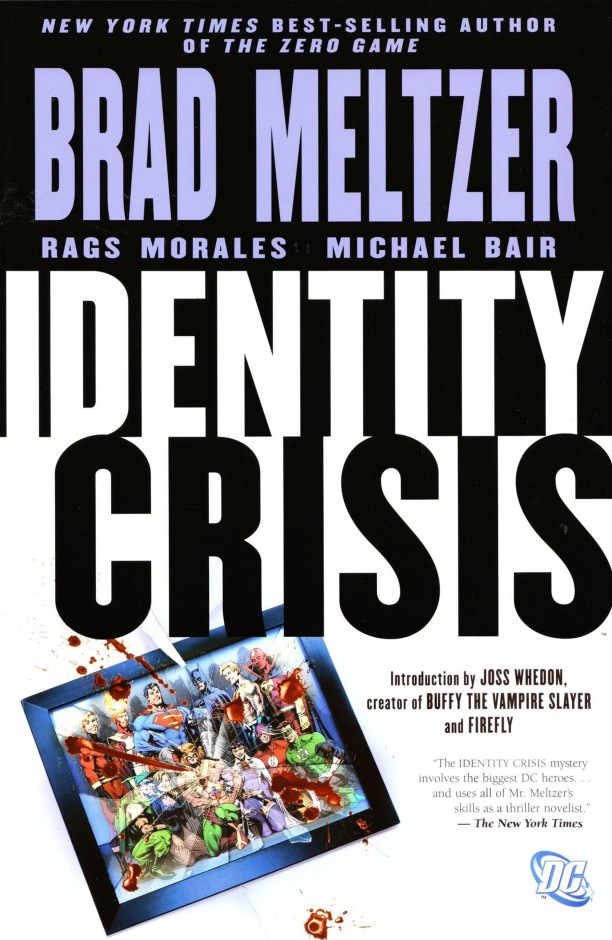
Throwback Thursday – Identity Crisis by Brad Meltzer, Rags Morales and Michael Bair.

Identity Crisis Cover

Publisher: DC Comics (Paperback – 1 October 2005)

Series: Identity Crisis Limited Series

Writer: Brad Meltzer

Penciller: Rags Morales

Inker: Michael Bair

Letterer: Ken Lopez

Colorist: Alex Sinclair

Length: 288 pages

My Rating: 5 out 5 stars

Amazon     Book Depository

Welcome back to my Throwback Thursday series, where I republish old reviews, review books I have read before or review older books I have only just had a chance to read.  For this week’s Throwback Thursday I take a look at one of my absolute favourite comic book limited series, the epic 2004 DC Comics event, Identity Crisis.  (Quick warning, there are spoilers ahead).
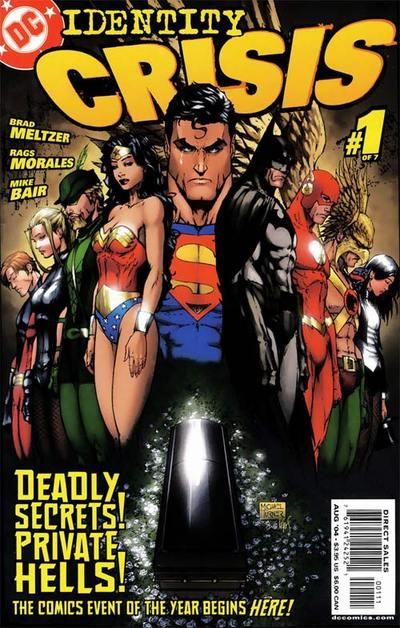
Identity Crisis #1

It is fair to say that the early to mid-2000s was one of my favourite periods of comic books, with some truly cool and epic ongoing and limited series being released.  This was particularly true for DC Comics, who produced some of their best work during this time, many of which rank amongst my all-time favourite comic series.  This easily includes the exceptional and brilliant crossover event, Identity Crisis, which to my mind is one of the best limited series ever written.

Made of seven issues, Identity Crisis combines the unique writing talent of thriller author Brad Meltzer with the artistic stylings of veteran DC Comics collaborators Rags Morales and Michael Bair.  This ended up being a near perfect combination of talents and skill, and I have a lot of love for the exceptional story, which absolutely hooks me every time, and its outstanding associated artwork.  I particularly impressed with the addition of Meltzer, who, despite his more literary background has written some of the absolute best and most human comics I have ever had the pleasure of reading, including Green Arrow: The Archer’s Quest and the two Justice League of America storylines, The Tornado’s Path and The Lightning Saga.  However, his story in Identity Crisis is particularly powerful and thought-provoking, and it ends up being a comic that completely changes everything you knew about your favourite heroes.

For years the members of the Justice League of America have protected the world from all manner of evil and destruction, always prevailing no matter the odds.  But who can protect them when someone goes after those closest to them?  And what if they actually deserve the punishment being visited upon them?

On an unremarkable night, a mysterious attacker breaks into the home of long-serving Justice League associate, Ralph Dibny, the Elongated Man, and commits a terrible crime, the murder of Ralph’s beloved wife, Sue Dibny.  With no evidence about who the killer is and no idea how they breached the Dibnys’ impressive security, the superhero community rallies behind their bereaved friend and seeks to find the killer by any means necessary.

As the rest of the heroes seek answers at any potential suspect within the supervillain community, the Elongated Man and a small group his closest friends hunt for a minor villain, Dr Light, whose secret connection to the League’s darkest moment may hold the answers they seek.  However, when a second attack occurs on another publicly known relative of a superhero, Jean Loring, the former wife of the Atom, it soon becomes clear that someone else is targeting the heroes and their loved ones.
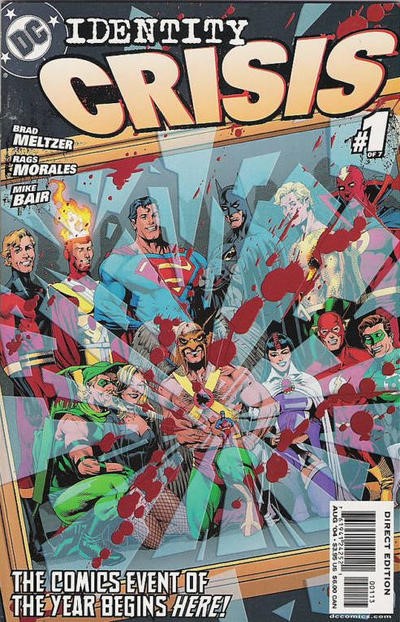
Identity Crisis #1b

As Batman, Superman, Green Arrow and others attempt to get to the bottom of the case, cryptic threats to one hero’s relative reveal that whoever is targeting them knows all of the League’s secrets, including their hidden identities.  As even more tragedies befall the superhero community, dark secrets from the League’s past are brought into the light and no-one will be prepared for the terrible truth behind these brutal murders.  Can the League weather this latest attack, or is this the beginning of the end for the world’s greatest heroes?

Damn, no matter how many times I read this comic, the tragic and powerful events of Identity Crisis still really get to me.  This exceptional comic contains one of the most impressive narratives I have ever seen in a limited series, taking the reader on a captivating and emotional dive into the world of your favourite heroes.  Perfectly combing a dark, mysterious narrative with incredible character work and some truly amazing artistic inclusions, this comic gets an extremely easy five-star rating from me.

For Identity Crisis, Brad Meltzer really went to the well, producing an insanely compelling and moving story that relentless drags you in and introduces you to a completely new side of your favourite heroes.  Utilising his experience as a crime thriller writer, he produces a powerful, character driven superhero narrative with detailed crime fiction elements to create an exceptional and unique story.  Identity Crisis has an amazing start to it, which not only carefully introduces several key figures but also installs some dark tragedy, as the wife of a superhero is killed off.  The subsequent investigation into her murder by the enraged superhero community is extremely compelling and intense, as the emotional heroes turn over every rock and stone, much to the horror of the villains.  However, it is soon revealed that several members of the Justice League are harbouring a devastating secret, one that could reveal the identity of the killer.  This secret becomes one of the most important parts of the first half of the series, and it leads to an epic, action-packed fight sequence against a particularly dangerous foe.
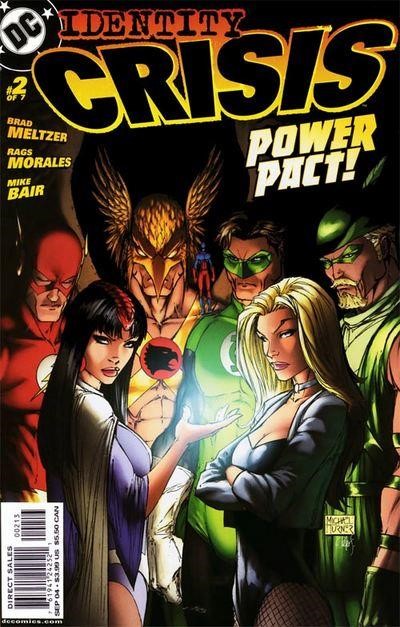
Identity Crisis #2

The story starts to go in a bit of a different direction at this point, with the above secret not really panning out regarding the investigation.  However, other superhero relatives, both public and secret, are targeted, resulting in pandemonium around the characters.  I loved the narrative’s move to a more classic investigation at this point, as the heroes start following every lead they can, while more character development and big moments are explored.  This all leads up to the defining moment when another superhero loses a loved one and the identity of the killer is seemingly revealed.  However, this turns out to be a bluff, as the real killer is still hidden.  The reveal of who did it and why are revealed pretty suddenly towards the end, with some curious and clever motivations exposed.  This leads to a tragic and heartbreaking conclusion, as more secrets are revealed, dangerous lies are uncovered, and several characters leave the story more broken and destroyed than ever before.  You will be thrown through the emotional wringer as you check this comic out.

I deeply enjoyed the way that Meltzer told Identity Crisis’s excellent story, especially as it quickly and effectively engrosses the reader and ensures their undivided attention.  The author utilises a mass-character narrative that follows a substantial collection of heroes and villains, many of whom have distinctive or semi-separate storylines.  This works to tell an intriguing, rich narrative that not only has some clever dramatic components but also allows for some intriguing and compelling retcons and expansions to the already elaborate DC universe.  It is very cool how the story developed into more of a murder mystery/thriller story as the comic progressed, and this really played to Meltzer’s strengths.  The investigation is handled very well, and I liked how the superhero elements altered and enhanced it in some clever ways.  The mystery itself is complex and clever, with Meltzer adding in some great twists, false leads and compelling surprises to keep the reader guessing.  The twist about the actual killer is pretty good, and Meltzer did a great job layering in hints and clues throughout the rest of the story while also introducing a few good alternative suspects.  While the motivations and complexities surrounding the killer’s actions are great, I did think that how the protagonists worked it out was a little abrupt, and it might have been a little better if they worked it out from some earlier clues.  The use of female characters wasn’t the best either, especially as most of them are there simply to be victims in one shape or another.  Having a long-established character getting both raped and murdered in a comic as a plot device is pretty unfortunate, and some stronger female figures might have helped balance this out.  Still, this ended up being an awesome read and I deeply enjoyed how it turned out.

One of the things that I really enjoy about Identity Crisis is the interesting examinations that were included as part of the plot.  Meltzer and the artistic team obviously had a lot of fun exploring or introducing some cool aspects of the DC Universe in this series, especially when it comes to the secret or hidden lives of superheroes and supervillains.  I particularly loved the in-depth examination about how both groups are officially or unofficially organised, and there are some very intriguing views of them socialising or working together.  The inclusion of a highly organised superhero death investigation squad, made up of a range of random heroes (the Ray, the Atom, Animal Man, Mister Miracle and two of the Metal Men) is particularly clever, as is the way the various heroes organise into a vengeful posse to question potential suspects.  The deep dive into the importance of a superhero secret identity also becomes an important part of the story, especially as the loss of the secret brings pandemonium thanks to the killer stalking them.  I also loved the counterbalance look at organised villainy, and there are some excellent scenes that see the villains gathering to socialise or talk shop.  Having an organising force like the Calculator, as well as a secret space station hangout, is pretty elaborate, and the deeper look at the villains of this universe, definitely gave Identity Crisis a compelling and intricate edge.
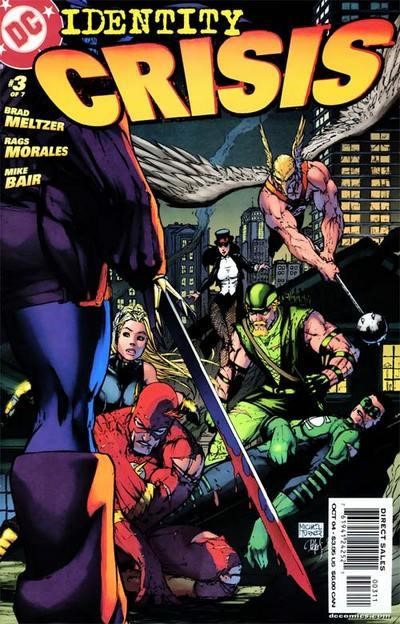
Identity Crisis #3

However, easily the most groundbreaking and compelling new inclusion to the universe is the reveal about the unofficial league within the Justice League who have some dark secrets.  Made up of heroes Green Arrow, Black Canary, Hawkman, Zatanna and Atom, as well as the Silver Age Green Lantern and Flash, this group of heroes apparently operated separately of the main Justice League during their classic Silver Age adventures, acting as their clean-up crew.  This retcon by Meltzer provides an interesting explanation for why villains never remember the secret identities of the heroes they switch minds with or whose dreams they invade, namely they have their mind erased by Zatanna’s magic after being captured by this inner-League.  While this is already a dark move by these established heroes, it gets even worse when they are forced to reveal that they intentionally destroyed Dr Light’s brain to make him less of a threat.  This and other revelations, acts to make many of your favourite heroes appear much more morally grey and fallible, and it was a particularly impressive and monumental inclusion, that will have grave consequences down the line for the entire universe.

Unsurprisingly for something written by Meltzer, Identity Crisis contains some insanely complex and impressive characters who form the heart of the tale.  Due to the way the story is told, Identity Crisis follows a massive cast of comic characters, including several obscure or underappreciated figures.  Meltzer does a brilliant job of utilising all these established characters throughout his story, with nearly every major cast member getting a moment to shine in some way or another, and multiple figures who were underutilised or unappreciated before this comic were given brilliant and defining second chances here.  While the use of multiple focus characters had the potential for a scattered narrative, Meltzer was able to direct the flow of the story around all these various protagonists and antagonists perfectly, and you still get a tight and concise story, which also takes the time to dive into each of these figures and showcase them to their greatest degree.  As I mentioned before, there is a real focus on highlighting the darker side of the superhero characters throughout Identity Crisis, and you end up really seeing these fantastic figures in a whole new scary light.

Let’s start with Ralph and Sue Dibny.  I must admit that the very first time I ever read Identity Crisis, many years ago, I honestly had no idea who Elongated Man and his wife were, as they were a little obscure.  However, Meltzer really goes out of his way to feature them in this story (even adding in a few retcons) and you are given a great introduction to them at the start.  In just a few panels, you understand who these characters are and what they mean to each other and the other superheroes, as well as some unique characteristics and relationship quirks.  This excellent introduction makes you start to care about them just as Meltzer brings the hammer down and kills Sue.  The subsequent grief, rage and despair from Elongated Man is just heartbreaking, and you go through the rest of the comic seeing him attempt to recover from these terrible events.  This amazing use of characters at the start of the comic has a great flow-on effect to the rest of the story, and you become exceedingly invested in finding the killer as a result.
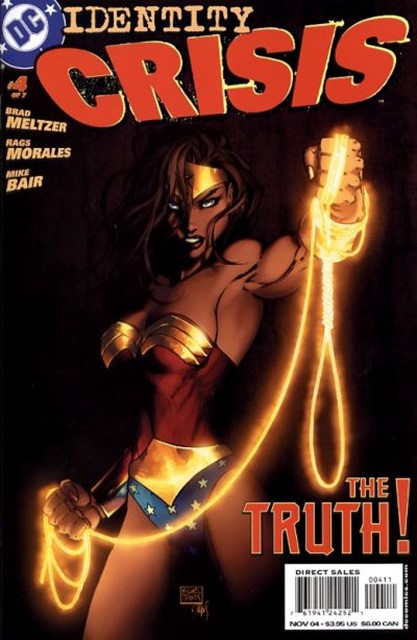
Identity Crisis #4

From there, a lot of the superhero focus goes to the surviving members of the Justice League who formed the league within the League I mentioned above.  There is some exceptional character work around some of these team members, especially as they come to terms with the decisions they made in the past and how they are impacting them now.  I loved seeing them attempt to justify their actions to the other heroes, even their darkest decisions, especially as you can understand why they did what they did, while also feeling disappointed in them.  You really get a sense of determination and shame from them as the story continues, and you see all of them go through a lot in both the past in the present story.  Despite multiple differences, this team are still friends and comrades, and watching them come together to brawl with some of the most dangerous characters is pretty heartwarming, even if darker elements lie just beneath the surface.

While there is a focus on these inner-Leaguers, some of them are utilised a lot more frequently than others, particularly the original Green Arrow, Oliver Queen.  Green Arrow is an excellent figure in this comic and is probably the closest thing to a heroic narrator/central protagonist the story has.  His unique perspective on the events acts as a good foil to many of the other characters, such as Batman and Superman, and he proves to be a calm, if potentially vengeful figure for much of the story, organising many of the League actions and forensic investigations.  He also proves to be the voice of reason for the inner League, calmly justifying many of their actions and serving as a bridge between this existing group and the newer Flash and Green Lantern.  Despite his belief that they are doing the right thing, you can see some real emotion and regret in his face, especially when the further revelations about Dr Light and Batman come out.  I also appreciated the deeper look into his antagonistic relationship with Hawkman, which partially originated in the past events mentioned here, and it is interesting to see how the events of this comic impact future Green Arrow storylines.

Aside from Green Arrow, other members of this secret League who get an intriguing focus include the Atom, Ray Palmer, and his ex-wife, Jean Loring.  Due to his status as another public hero, Atom and Jean are also targeted throughout the story, and you end up getting a rather intense and fascinating look at both.  Watching their failed relationship rekindle is a nicer part of most of the comic, although eventual reveals and tragedies naturally ruin it and smash everything around.  Still, their complicated emotions and issues surrounding their fractured relationship make for some of the best parts of the comic.  I liked the interesting look at Zatanna throughout the comic, especially as she is largely responsible for some of the worst moments of this group of heroes, as she clearly feels guilty about her magic messing with the villain’s minds.  I also need to highlight the younger Flash, Wally West, who finds out about the actions of the other characters during the current events of the comic.  It is absolutely heartbreaking to see Wally learn that his mentor and predecessor, Barry Allen, was not as perfect as he imagined, and actually participated in some of the team’s worst events.  The distress he exhibits with every subsequent reveal is showcased through the comic’s art extremely well, and his subsequent guilt as he is forced to keep it secret from other Leaguers like Batman is quite noticeable.
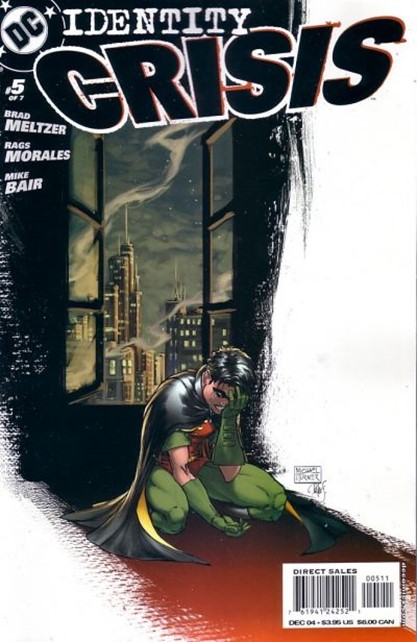
Identity Crisis #5

As you can expect from any major DC Comics crossover event, members of DC’s Big Three are strongly featured throughout Identity Crisis.  While Wonder Woman only has a few intriguing scenes, in which you get to see both her ferocity and her kindness, there is much more of a focus on Superman and Batman.  Superman gets some great sequences throughout Identity Crisis, especially as the creative team sinisterly focus on his family and friends, all of whom are potential targets.  Watching Superman slowly get frustrated with the investigation, especially when Lois is threatened, helps to enhance the seriousness of the story, and he has some powerful moments here.  I did appreciate the way in which Meltzer attempted to paint the big blue Boy Scout in a darker light, as it is revealed that even the supposedly righteous Superman is not as innocent as you’d believe.  It is subtly implied that Superman always knew what the inner League was up to (yay for super hearing), and chose to ignore it for convenience.  This brilliant and dark suggestion that even Superman isn’t infallible is a pretty weighty one that  helps to enhance the weight and power of Identity Crisis’s narrative.

Batman is a lot more involved in the story and leads his own investigation into who is behind the killing.  Even though he does not actually appear until halfway through the comic, he is a heavy presence throughout Identity Crisis, both because of his brusque, loner ways of trying to solve the crime, but because of the dark shadows of the past.  There are multiple moments that revisit his childhood and the death of his parents, which parallels some of the other losses in Identity Crisis, and you get to see the human side of grief impacting this usually stoic character.  Batman’s storyline gets even more intense when it is revealed that part of his memory was erased by his fellow Leaguers to cover up their actions surrounding Dr Light, which is a very haunting inclusion.  Meltzer makes this even more intriguing by having Green Arrow suggest, mostly out of guilt, that Batman likely has done something similar in the past, while also acknowledging that he has likely already deduced that his memories were erased.  This really makes you consider Batman’s relationship with the rest of his heroes, and it certainly has a big impact on future Batman storylines.

The Batman impact on this story is also felt through the great focus on the current Robin, Tim Drake, who plays a surprisingly big role in the events of Identity Crisis.  At the start of the comic, Tim is one of the few members of the Bat-family who still has a father, which puts him at odds with Batman and the Robin predecessors.  As his father has only just discovered his dual identity as Robin, he becomes one of the more interesting protagonists, as the comic explores the stress of the superhero lifestyle on family.  Tim’s storyline ends up being extremely tragic when his father is murdered.  Watching Robin talk to his father over the phone as he’s about to die is just damn horrific, and your heart can’t help but break during that epically drawn-out scene where he and Batman arrive too late.  The subsequent parallel between him, Bruce Wayne and previous Robin Dick Grayson during this moment is particularly poignant, and it results in a whole new chapter of this amazing incarnation of Robin.
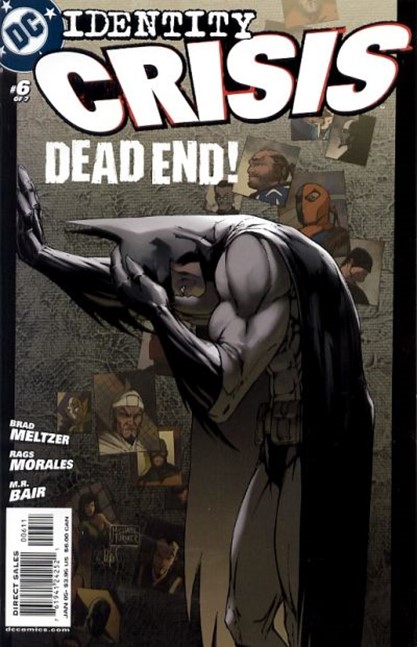
Identity Crisis #6

While there are a few other interestingly featured heroes in Identity Crisis, I’m going to start talking about the villains, as many of them have a brilliant role in this comic.  Thanks to Meltzer’s fantastic writing, Identity Crisis proves to be just as much about the villains as the heroes, as many of them are deeply impacted by the events disclosed here.  While I won’t reveal the identity of the killer here (I’m keeping some spoilers locked up), I will say that their motivations are pretty fascinating and provide a compelling insight into the super lifestyle.  The rest of the villains in Identity Crisis are fair game for discussion, though, and I deeply loved the creative team’s excellent examination of them.

Easily the villain I need to talk about the most is Dr Light, an old school Justice League villain who had not been really utilised in recent years.  Mostly known before this comic as the Teen Titans’ punching bag, Meltzer completely revitalised the character in Identity Crisis and, with a stroke, turned him onto one of the most deranged and dangerous figures in the entire universe.  It is revealed throughout the comic that Dr Light used to be an extremely powerful villain, but after invading an empty Watch Tower and raping Sue Dibny, the League brutally took him down, erased his memory of the event and then magically lobotomised him.  This resulted in him becoming the moronic and weakened villain who was routinely taken down by the teenage heroes and other embarrassing foes.  This entire reveal is pretty damn epic and horrifying at the same time.  Not only does Dr Light seem excessively evil and deranged in the flashback scenes, but the shocking revelations of his actions immediately make you hate him.  Meltzer’s explanation for why he turned into such as pathetic creature (aside from the real reason of capricious authors) really hits home hard, and even though Dr Light is a terrible person, you can’t believe that members of the Justice League went so far.  The subsequent scenes where Dr Light regains his memories and his powers feature some of the best artwork in the comic, and while he doesn’t do much here, the scenes with him brooding and plotting hit at his returned and future malevolence.  I deeply appreciated how much Meltzer was able to morph this villain, and while the reliance on rape for antagonist purposes is a bit low, he succeeded in making him a very hateful and despicable figure.

Aside from the killer and Dr Light, several other villains hold interesting and significant roles in Identity Crisis, and I deeply enjoyed how they were portrayed.  This includes Green Arrow villain Meryln, who serves as an interesting shadow to Oliver Queen throughout the comic (more so than usual).  While Green Arrow provides the superhero community’s viewpoint on events, Merlyn’s narration examines the supervillain community and their various reactions.  I loved his fun insights into his fellow villains, and he ends up being an interesting inclusion to the cast.  The same can be said for the Calculator, a formerly silly figure who has turned himself into a non-costumed villain who acts as an anti-Oracle, providing the villain community with tech support and intelligence by charging them $1,000 per question.  I loved this interesting revamp of this minor character, especially as this suave, behind-the-scenes information broker became his default look for years.  Calculator’s conversations and business dealings offer some compelling insights into the superhero community, and I loved the occasional jokes about his old costume.  Meltzer also makes exceptional use of one of my favourite villains, Deathstroke, who once again shows why he is the DC universe’s ultimate badass.  Hired by Dr Light to protect himself from the League, Deathstroke takes on an entire team of heroes single handily and essentially spanks them.  I love how the creative team not only showcase his insane physical abilities, but also his tactical knowhow, as he expertly takes down major heroes in brilliant ways (he takes down the Atom and Hawkman with a laser pointer, true story).  His scene in the centre of the comic is the best action sequence in Identity Crisis, and it perfectly showcased this awesome villain (seriously, give this man a movie), while also hinting at some future grudges.
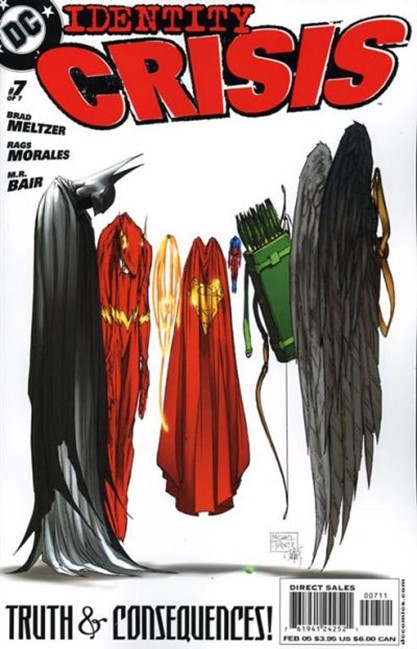
Identity Crisis #7

The final character I want to talk about is the lecherous and always entertaining Captain Boomerang, who has a major role in the plot.  I absolutely loved the exceptional story that Meltzer wrote around this infamous villain, and it is easily one of his most defining depictions.  Captain Boomerang has always been shown as a bit of a joke, but this comic shows him as a fat, washed up has-been, who leaches off his fellow villains and is generally looked down upon by them.  However, he gets a very intense and emotional story in this comic, as he meets his long-lost son and starts to develop a relationship with him.  The father/son moments add a rather interesting and nice edge to the main story and seem slightly disconnected from the rest of the plot.  That is until the final killing, when it is revealed that Captain Boomerang has arrived to kill Robin’s father.  The implied suggestion that Captain Boomerang of all people might be behind the killings is pretty iconic, and I loved the split panels that contrast his phone call to his son with the phone conversation between Robin and his father.  The subsequent results of the attack, as well as the reveals in the aftermath are pretty awesome, and I really appreciated the fun second chance that Meltzer and the artistic team gave to this iconic, old-school villain.

While I have gone a lot about story elements and characters, I also really need to highlight the incredible artwork featured in Identity Crisis.  The artistic team of Rags Morales and Michael Bair did an outstanding job in this limited series, producing some of the absolute best artwork from this era of DC Comics which perfectly enhances Meltzer’s epic storytelling.  There are so many impressive and memorable artistic moments and sequences throughout Identity Crisis, and I loved the various ways in which the artists convey movement, action, and emotion in their detailed and captivating panels.  There are so many brilliant action sequences in this comic, with my favourite being the Deathstroke vs Justice League fight I mentioned above, although a few others are also very cool to see.  I also loved the character designs featured throughout Identity Crisis, especially as the creative team took the opportunity to seriously reinvent several heroes and villains.  The streamlined look of the Calculator is particularly fun, and I also loved the balding and fat version of Captain Boomerang.  While I didn’t love how a couple of characters looked (what was with the hair on Connor Hawke?), most of it was pretty exceptional, and I love how it was later reutilised by other artists.

There are multiple truly brilliant and eye-catching artistic highlights of Identity Crisis that I must highlight, including the massive and powerful funeral sequence that takes place in the early part of the series.  There is an incredibly elaborate double-page public funeral spread that shows every single emotional superhero in attendance, with the various heroes organised by team or connection to the grieving family.  The use of the multiple heroes and associates is pretty awesome, especially as there are a range of character-appropriate reactions, and I loved seeing the whole costume crowd surrounded by members of the press and public as they mourn.  You also get also some excellent and heartfelt sequences in the subsequent scenes which show the eulogies, especially when Elongated Man starts to literally deteriorate due to his grief, which is just so powerful.  Other great examples of the artist’s work include the fun flashback scenes that allowed them to draw events in various classic comic styles, that offer a little bit of simplicity compared to the darker modern spread.

I particularly loved some of the brilliant sequences that are set around Dr Light, as not only do you see him at his most dangerous in the past but you also have some outstanding scenes when he regains his memories and powers.  The excellent parallels between the Justice League’s takedown of Dr Light and their attack on Deathstroke are incredible, and the subsequent massive panel of blinding light around Dr Light’s face is perfection.  However, the absolute best-drawn sequence in Identity Crisis must be the panels leading up to the death of Robin’s father.  Watching the insane amount of emotion on Batman and Robin as they realise that Robin’s father is about to die is so damn moving, especially the anguish on Robin.  The most moving of these panels is the one that focuses on Batman’s face after Robin begs his mentor to save his father.  The look of pure dread, fear and despair on Batman’s face takes my breath away every single time I look at it, and it perfectly conveys all of Batman’s repressed feelings as he realises that history is once again going to repeat itself.  While there are some other great scenes, the above are easily the cream of the artistic crop and definitely make this comic stand out.  I have so much love for the artistic work of Morales and Bair here, and it markedly enhances the already exceptional story, turning Identity Crisis into a true epic classic.

Well, that’s pretty much everything I have to say about Identity Crisis here.  As you can no doubt guess from the excessive way I have waffled on, I have a lot of love for this exceptional comic and I’m not afraid to show it.  The brilliant creative team behind Identity Crisis did an incredible job with this comic and they really turned out something special.  Perfectly bringing together a deep and clever story with impressive artwork, amazing characters, and so much damn emotion, this comic has something for everyone and is so very highly recommended.  I deeply enjoy everything about Identity Crisis, especially how it leads to some other epic comic books (the continuation of the mindwipe stuff in Justice League of America, Green Arrow, Teen Titans and more is particularly good).  One of the most distinctive and amazing comics ever and a must read for all DC Comics fans.

Amazon     Book Depository

Throwback Thursday: Usagi Yojimbo: Volume 14: Demon Mask by Stan Sakai

Usagi Yojimbo - Demon Mask Cover

Publisher: Dark Horse Comics (Paperback – March 2001)

Series: Usagi Yojimbo – Book 14

Length: 224 pages

My Rating: 5 out of 5 stars

Amazon

Welcome back to my Throwback Thursday series, where I republish old reviews, review books I have read before or review older books I have only just had a chance to read.  In this latest Throwback Thursday I once again dive into the awesome and elaborate world of Usagi Yojimbo as I check out the 14th epic volume, Demon Mask.

It feels good to be on a Usagi Yojimbo review streak here at The Unseen Library, and I have been having a lot of fun diving into some of the awesome middle volumes of one of my absolute favourite comic series.  My last two Throwback Thursday reviews of the 12th Usagi Yojimbo volume, Grasscutter, and the 13th volume, Grey Shadows, were really fun to pull together, and I really had no choice but to also have a look at the 14th volume this week with Demon Mask.

Usagi #31

Demon Mask is another excellent addition to the Usagi Yojimbo series that unsurprisingly gets a full five-star rating from me.  Exclusively written and drawn by Stan Sakai, this impressive entry once again follows the rabbit ronin Miyamoto Usagi as he continues his action-packed adventures through the anthropomorphic animal filled version of feudal Japan this series is set in.  Containing issues #31-38 of the Dark Horse Comics run on the series, as well as a few additional issues from associated magazines, Demon Mask continues the trend of featuring several shorter stories, while also leading back towards the next volume, Grasscutter II, which will contain a big crossover story.  I deeply enjoyed all the cool stories in this volume, and there are some real classics here.

The first story contained within Demon Mask is the entertaining and elaborate tale, The Inn on Moon Shadow Hill.  In this story, a travelling Usagi comes across a mysterious inn surrounded by strange sights and an unusual group of patrons.  The land surrounding the inn is apparently haunted, filled with all manner of monsters, demons and obakemono (haunts), which attracts many wealthy individuals to the safe inn to watch.  However, Usagi is soon drawn into a hefty wager with an arrogant merchant and must travel outside the inn to encounter the haunts and the forces behind them.

This is quite an amusing story that perfectly combines Sakai’s fantastic humour with his love of classic Japanese monsters and haunts.  The entire story comes together really well, first introducing the situation, and then forcing Usagi outside to face the ghosts after making a bet.  The subsequent reveal of the various monsters and creatures is pretty spectacular, and Sakai goes out of his way to include as many uniquely Japanese legendary creatures as possible, especially in one breathtaking and elaborate panel.  I really enjoyed the fun twist that occurred here, especially as it allowed Usagi to win his bet with the merchant, and his over-the-top explanation of what he experienced was pretty damn amusing with all the exaggerated facial expressions and reactions from Usagi and his audience.  This ends on a very satisfying and entertaining note, and The Inn on Moon Shadow Hill ended up being a fantastic and light-hearted start to the entire volume.

Usagi #32

Following on from the first fun story is the touching tale, A Life of Mush.  In this story Usagi encounters a brash peasant boy, Eizo, who wishes to become a warrior to avoid the farmer’s simple lifestyle (a life of eating mush).  However, Eizo soon grows tired of Usagi’s honourable warrior philosophy and attempts to befriend a group of bandits, only to discover that there is more to life and battle than brashness and toughness.  This was a great shorter story that presents an interesting outside perspective on the life of a warrior in this setting.  I liked the comparison between a child’s view of a warrior to Usagi’s intense dedication and spiritual thoughts, which in fairness, does seem a little more boring.  The subsequent events provide a fantastic lesson on perception and life choices, as Eizo and the bandits he encounters discover just how tough a true warrior like Usagi can be.  A compelling and thoughtful addition to the volume, A Life of Mush was a powerful and clever read.

The next story is a shorter entry, Deserters, which brings us back to the iconic Neko Ninja and their leader, Chizu.  Deserters examines a tragic tale of two Neko Ninja, Take and Saruko, who attempt to leave the Neko Ninja and start a new life together.  Captured by their fellows, they are taken before Chizu for trial, and must soon face the treachery and manipulation of Chizu’s ambitious second in command, Kagemaru.  This was another excellent shorter entry in Demon Mask, especially as it combines some quick, but efficient, character introductions, with some inherent tragedy and betrayal.  The result of the story, while a little predictable, ends up being very moving, and you can’t help but feel for the star-crossed lovers.  I also really like how this shorter entry turns out to be an interesting bridging story between several of the plot lines in the 11th volume, Seasons, and some of the big storylines in the next few volumes.  A surprisingly important and powerful story, Deserters is a great read that adds a lot to the overall volume.

Usagi #33

Up next, we have the rather entertaining and fun story, A Potter’s Tale, which makes great use of amusing coincidences to create a fantastic and hilarious story.  A Potter’s Tale sees the notorious thief, Samo, steal a precious jewel from a wealthy merchant and have to stash it.  Choosing an unfired pot in a small pottery shop, Samo makes the vessel distinctive before he is brought in for questioning.  Unfortunately, Usagi is staying with the same family of potters and chaos ensues when Usagi and his friends take a liking to Samo’s inadvertent innovation.

This is a great story that always gets a good laugh out of me when I read it.  While a rather quick story, Sakai manages to achieve a lot with it, setting up the base of the humour quickly and ensuring that the reader becomes invested with both the potters and the caddish thief.  The subsequent fantastic use of surprises, reveals and coincidences results in some amusing scenes, especially when the unlucky thief discovers that he must give up all his ill-gotten loot to fix his mistake.  The reveal that all his endeavours are for naught and his loot has returned to its original owner, in a roundabout way, is pretty entertaining, as is the ironic comeuppance he gets for his actions.  Sakai makes sure to enhance this story by featuring a compelling look at traditional Japanese pottery making (I love it when he examines authentic Japanese industries or art forms), and there are some beautiful sequences drawn as a result.  Easily one of the most entertaining stories in this volume, I deeply enjoyed A Potter’s Tale, and it is always guaranteed to crack me up.

Usagi #34

Sakai follows this funny story with another shorter entry, The Missive, which sees Nakamura Koji’s request for a duel reach Usagi’s master, Katsuichi.  Reflecting on the matter of honour brought before him, Katsuichi remembers a moment from Usagi’s childhood and the lessons it contains.  This was another quick but excellent entry from Sakai, which once again highlights how much he can do with only a few short pages.  Not only do we get an excellent bridging storyline between a good entry in the 11th volume, Seasons, and another future volume, but you also get an interesting reveal about a major supporting character.  Throw in an amusing childhood tale about a young Usagi, and you have an entertaining and unique entry that helps to break up the flow of the overall volume.

Now we get to the main event of the volume, with the three-issue story, The Mystery of the Demon Mask.  After receiving a dire warning about his future, Usagi ventures into a new town, only to witness a deadly duel between a fellow ronin and a mysterious opponent wearing a demon mask.  Encountering the police, including the venerable Inspector Kojo, Usagi soon learns that the killer, known as Demon Mask, has been targeting and killing ronin around town.  Helping with the investigation, Usagi encounters all manner of potential suspects as he also finds himself firmly in Demon Mask’s sites.

Usagi #35

The Mystery of the Demon Mask is probably the best story in the entire volume, and Sakai has put a lot of effort into developing a powerful and elaborate murder mystery storyline in this unique Japanese setting.  The entire story has a great flow to it, quickly introducing the villain, the murderous Demon Mask, and then introducing Usagi to the various players involved in the investigation.  From there Usagi is thrust into several dangerous situations as Demon Mask stalks him and other masterless samurai around the town.  There are several complex and intriguing characters introduced during this story, each of whom is a potential suspect.  This story ends on a big finale, with Demon Mask exposed as he faces off against Usagi in a deadly duel.  Sakai does a brilliant job of revealing who the killer is, and I really appreciated the various subtle clues scattered throughout the story to set this up.  This ended up being quite a fantastic murder mystery story that works extremely well despite the limitations of the shorter comic form.  The motivations behind the killer are pretty heartbreaking, and I really appreciated Sakai’s portrayal of their madness and grief.  There is an excellent focus on fighting and duels throughout this story, especially as Demon Mask engages several skilled samurai in personal combat, and I loved seeing all these fights unfold.  An excellent entry that has a brilliant balance of mystery, complex characters, classic Japanese elements and comic book action.

Following on from this awesome murder mystery story, we have another intriguing dive into Japanese mythology and monsters with the spooky story, Kumo.  In this story, Usagi, who is eager to reach his friends, takes a shortcut across the mountains and finds himself in an isolated village, surrounded by an unusual number of spiders and an insane amount of webbing.  When the innkeeper’s daughter is kidnapped in an improbable attack, it becomes apparent that something more is haunting the village, and that Usagi’s only hope might be another traveller in town, Sasuke.

Usagi #36

This was another particularly good entry in Demon Mask; I always love Sakai’s more supernatural narratives.  The story premise is somewhat typical, with Usagi arriving in a troubled town that needs his help, this time in defeating the monsters haunting them.  The subsequent conflict with this threat gets pretty wild, not just because of the cool monster (in this case a Spider Goblin and her giant spider minions), but also because it introduces the intriguing side character of Sasuke.  Sasuke, also known as The Demon Queller, is a mystical monster hunter who travels around Japan taking down supernatural threats (no doubt with Kansas blaring in the background).  Sasuke goes on to become a major recurring character within this series, having most recently appeared in the 34th volume, Bunraku and Other Stories (where he does some cool Demon Slayer-esque sword fighting).  However, he gets a very awesome introduction here in Kumo, with Sakai perfectly setting up the character’s mystique, as well as his powerful magical abilities.  This story literally sees Sasuke summon up a giant frog to fight a Spider Goblin, which has so many levels of awesome to it, and I loved seeing the magic on monster fight that ensures.  Another fantastic story that makes excellent use of Japan’s rich spiritual and mythological past, I always have an outstanding time reading Kumo.

The final major story in this volume is the intriguing tale, Reunion.  Usagi returns to the monastery of his friend, priest Sanshobo, only to discover it under attack by brigands, apparently after a rich merchant sheltering inside.  Working with Sanshobo and a recovered Gen, Usagi must find a way to overcome the brigand horde and save the monastery from attack.  However, the real threat may already be inside the walls, and soon Usagi, Sanshobo and Gen must overcome a dangerous enemy determined to take the most precious treasure, the legendary sword Grasscutter.

Usagi #37

Reunion was another fun entry which ended the main Demon Mask stories on a compelling and interesting note.  While a distinctive story itself, Reunion is primarily focused on setting up the events of the following major volume, Grasscutter II.  This presents a fun scenario where Sanshobo’s temple is attacked (again, it honesty gets attacked a lot), while the real danger remains inside the wall.  There are several fun parts to this story, from Usagi’s attempted infiltration of the gang, the many fight scenes against to the bandits, to the dangerous confrontation against the disguised adversaries within the temple.  This proved to be an excellent story, and it was great to see Sanshobo and Gen again, especially as they prepare for their next epic adventure.

While Reunion concludes the main stories, this volume also has a couple of shorter stories that were contained in other publications, such as Dark Horse Presents (vol. 1) #140, Dark Horse Presents Annual #3, Wizard Magazine #3, Oni Double Feature #11, and Dark Horse Extra #20-23.  These short stories provide a couple of quick, highly amusing tales which leave the reader smiling as they close the volume.  Sakai achieves a lot in these shorter stories, and each has an entertaining or moving story, even if they only last for only a page.  The most detailed of these was the entertaining Death and Taxes, which sees Usagi fighting bandits for a conniving and amusingly clever peasant.  There is also the sweet little story, A Funny Thing Happened on the Way to the Tournament, which shows a young Usagi meeting his future friend (and love interest) Tomoe Ame when they were children.  The short but powerful Netsuke sees Usagi reflect on a former comrade, while The Leaping Ninja has a hilarious one-page tale about an acrobatic infiltrator who leaps before he looks.  The final story was the intense Tsuru, which sees Usagi encounter a member of the Koroshi assassins with a love for paper cranes, who has a contract out on Usagi, resulting in a fantastic duel.  Despite their length, each of these stories features all of Sakai’s usual attention to detail and excellent story writing, and it was great to see these excellent examples of the creators shorter writing style.

Usagi #38

I must once again highlight all the incredible artwork featured in this impressive volume, as Sakai continues to showcase all his amazing artistic talent.  Pretty much every panel in this volume is filled with some excellent and powerful art, as Sakai tells his complex tales.  There is the usual brilliant focus on Japanese landscapes and towns, and Sakai has such a talent for capturing all the elaborate cultural elements of the period, as well as the beautiful locations that dotted Japan.  While all the art is really well drawn in this volume, I definitely have to highlight a few panels in particular.  The first story, The Inn on Moon Shadow Hill, has so many great drawings of creatures and haunts from Japanese folklore, and there is one brilliant panel were all of them are they facing Usagi at once.  The spider goblin and her minions in Kumo are also very cool and spooky, and the various scenes where they fight a samurai like Usagi and the magical Sasuke are pretty extraordinary.  I also loved the awesome character design on the antagonist Demon Mask from the main story.  Not only does it bear an interesting similarity to Usagi’s main foe, Jai (who himself is based on a character with distinctive mask), but it looks so dangerous and intimidating, especially when they silently engage in battle.  I deeply enjoyed the exceptional artwork in Demon Mask, and Sakai has once again shown how much feeling and emotion he can portray with his brush and ink.

Another week, another epic and incredible Usagi Yojimbo volume reviewed on my blog.  The 14th volume of this outstanding series, Demon Mask, was another awesome comic as Stan Sakai provides his usual blend of impressive writing, stunning artwork, and powerful characters.  Featuring several memorable and exciting short stories, Demon Mask serves as an excellent and wonderful entry in this wider series, and it is one that I always look forward to reading.  A highly recommended read, Sakai really can do no wrong with this exceptional series.

Amazon

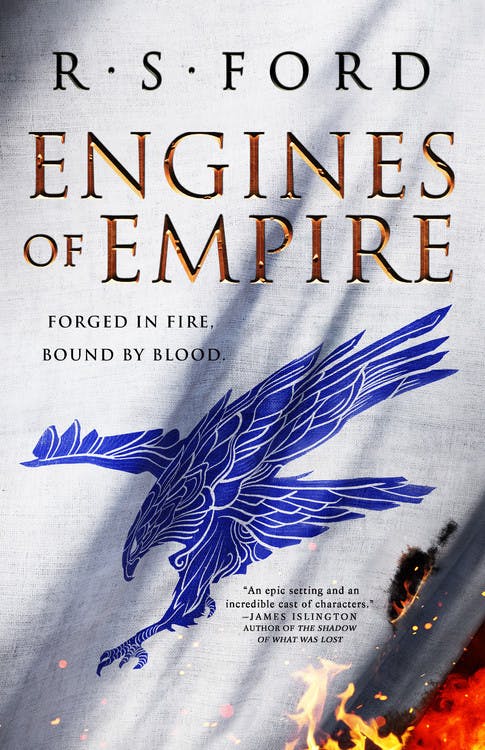
Engines of Empire by R. S. Ford

Engines of Empire Cover

Publisher: Hachette Audio (Audiobook – 18 January 2022)

Series: The Age of Uprising – Book One

Length: 22 hours and 3 minutes

My Rating: 4.25 out of 5 stars

Amazon

Bestselling fantasy author R. S. Ford starts off an intriguing and compelling new epic fantasy series with the powerful Engines of Empire, a great read that I had a wonderful time reading.

Ford is an author who has been writing some interesting books in the last few years.  His big works include the Steelhaven and War of the Archons series, both of which have some very intriguing plots.  While I have not had the pleasure of reading any of his previous work, I have heard some great things about his War of the Archons books, and I might have to go back and check it out at some point.  After reading some early positive reviews of Ford’s latest novel, Engines of Empire, I decided to check it out, grabbing an audiobook version, which proved to be extremely good.  This cool book serves as the first entry in Ford’s new The Age of Uprising series and sets the scene for a captivating and exciting new trilogy.

For generations, the nation of Torwyn has been ruled by the Guilds, industrial powerhouses who provide the nation its food, weapons, transportation and invaluable devices that fuse magic with technology.  One of the most prominent Guilds is the Hawkspurs, an ancient and powerful family who have long held the empire together and ensured its position in the world.  However, the current generation of Hawkspurs are about to find that everything they thought they knew is about to change.

As the matriarch of the family, Rosomon Hawkspur, attempts to maintain her family’s status and standing in Torwyn’s capital, the Anvil, her children each head off to find their own destinies.  The oldest son, Conall, departs to the empire’s distant frontier to prove his worth as a military commander.  The rebellious and magical Hawkspur daughter, Tyreta, is sent to an important imperial holding to facilitate her training as the future head of the family business.  The youngest son, Fulren, a talented artificer, finds himself involved in foreign politics when he is tasked with guiding an emissary from a powerful rival nation.

However, forces of chaos, fanaticism and destruction are all around them, and soon all the Hawkspurs are placed in mortal danger.  At the frontier, Conall attempts to prove himself, but only finds rejection and hints at a rising evil.  Tyreta’s reckless actions place her in mortal danger, and her only path to salvation lies in understanding the people her nation has hurt the most.  Back in the Anvil, Fulren is framed for murder and is soon banished to a hostile foreign nation ruled by dark gods.  Rosomon, desperate to save her fractured family, finds herself thrust into the middle treachery and dark revolution, as unseen hands plot against the guilds.  As the entirety of the world changes all around them and dangerous forces reveal themselves, can the Hawkspurs endure, or will they, and the entirety of Torwyn, come to utter ruin?

Engines of Empire was a captivating and entertaining fantasy epic that transports the reader to intricate new world, filled with interesting characters, political intrigue, and intense action, and makes for an excellent and exciting read.

At the centre of Engines of Empire is a massive and complex narrative that fully explores the various main characters while also plunging the intriguing new setting into chaos and anarchy.  Ford utilises a great multiple perspective storytelling device that splits the overall book into some compelling, separate chunks.  The story initially has four distinctive storylines that follow the Hawkspur family members as they go off on their own separate adventures.  This results in an interesting blend of plotlines as you have a more military story with Conall, a survival/adventure storyline with Tyreta, Rosomon’s political intrigue narrative, and Fulren’s life-or-death struggle in a foreign land.  These storylines are mostly unconnected to each other and not only allow the point of view protagonists to grow and develop independently with their own group of supporting characters, but it also ensures that the reader gets to explore various aspects of the new fantasy realm and see the range of different problems affecting it.  These four storylines develop at a reasonable and compelling pace, and the reader soon is drawn into their individual storylines, as well as some of the overlapping conspiracies that are featured throughout.  A fifth point-of-view character is introduced about halfway through the novel, which mainly acts to bolster one of the existing storylines and proves to be an excellent feature filled with action and espionage.  This leads to the final stretch of the novel, where several big events and twists occur that shake the foundation of the novel and take it in an excellent new direction.  Several of the separate plot lines start to come together more closely towards the end, and there are some excellent moments as the characters reunite to face a common foe.  This leads to an exciting and intense conclusion that takes several of the character storylines in interesting direction and sets up the rest of the trilogy extremely well.

I really liked how Engines of Empire came together as Ford wrote an excellent fantasy tale that made sure to cover a vast range of people and places.  The entirety of Engines of Empire has a great combination of story elements that ensures there is something for all sorts of readers here, including massive world building, great action, clever political intrigue, dangerous adventures or interesting characters.  I particularly enjoyed the great use of five character driven storylines centred on different point-of-view protagonists.  Not only did they come together well to produce a great overall narrative but they also provided the reader with several unique adventures with their own appeal.  I particularly enjoyed Fulren’s story, as it featured an excellent blend of interesting world building in a rival nation ruled by dark magic and impressive character moments.  Tyreta’s jungle-based survival mission was also really cool, especially with the intriguing side characters and brutal combat, while the fifth storyline introduced halfway through the book was filled with some amazing sequences and intriguing international espionage.  Unfortunately, the remaining two storylines surrounding Rosomon and Conall were a little slower and I didn’t have as much fun reading them, even with their respective political intrigue and desert action elements.  I struggled a little to get through these specific storylines at times, especially towards the centre of the novel, and it slowed down my overall reading of Engines of Empire.  Still, both storylines end on interesting notes, and I think they might have more potential in the sequel.

Due to the narrative being focused on five specific central characters, Ford spends a lot of time in Engines of Empire exploring and building up some of the characters.  The main protagonists are the four members of the Hawkspur family, Rosomon, Conall, Tyreta and Fulren, each of whom have their own skill.  Due to certain tragedies in their past, the family is a bit dysfunctional, and there is a noticeable distance between them.  I liked seeing each of them go on their own distinctive journey throughout the book, and each of them does develop to a degree, especially Fulren and Tyreta.  However, I did find myself getting rather frustrated with some of the protagonists as the book continued, especially as there is a lot of narrative stupidity and inconsistent character work.  This is particularly true for Conall, who comes across as a whiney idiot for most of the novel, while Rosomon, who is supposed to be a brilliant leader and tactician, is soundly outsmarted at every turn and can’t even see the most obvious of traps.  I felt these negative character traits deeply impacted their individual storylines, and it made them harder to care for.  On the other hand, I felt the fifth point-of-view character, Lancelin Jagdor, rounded out the main cast extremely well.  Lancelin is a master swordsman who has a very complicated relationship with the Hawkspurs.  He finds himself getting dragged into their issues about halfway through the book, and I think his interesting outlook and unique experiences help to balance out the less enjoyable protagonists and produce a better story.

Aside from these five main protagonists, Ford has also included a great collection of supporting characters.  These supporting characters are usually unique to one of the main protagonists’ storylines and are primarily shown through their eyes.  Many of these characters prove to be allies or friends of the protagonist, although there are a few good antagonists thrown in there as well.  Some of my favourites include Sted, Conall’s hard-drinking second in command, whose fun, no nonsense personality helps to enhance Conall’s storyline to a degree.  I also had fun with Kosma Khonos, a ruthless Torwyn spy in the kingdom of Nyrakkis, Saranor the Bleeder, an over-the-top barbarian war chief, and Wenis, a foreign witch who becomes both a jailor and love interest to Fulren, which ends up being one of the more interesting relationships in the entire novel.  This huge web of supporting characters really helps to enhance the overall story and I look forward to seeing some of these elaborate and distinctive figures again in the future.

I was deeply impressed with the amazing new fantasy world featured in Engines of Empire, and it appears that Ford spent a significant amount of time developing it.  The main setting for the novel is the fascinating nation of Torwyn, a former religious nation that has been taken over by the Guilds, industrial powerhouses who now hold sway over the various industries.  Torwyn is built up beautifully by Ford, and you soon get the full sense of it, including its intriguing industrial aspects, magic-powered technology, dragon-based religion, and ruthless politics.  The arrangement of Torwyn leads to an intense civil war that looks set to shape the future of much of the novel and serves as a brutal and fantastic central setting for several storylines.  While Torwyn proves to be an exceptional area to explore, Ford goes above and beyond and takes the reader to several other intriguing locations within and without it.  Thanks to the adventurous characters, you see some of the more desolate and dangerous locations in the lands, such as the jungle-covered Sundered Isles, the war riven frontier, the snow-covered, barbarian-infested Huntan Reach, and the magical controlled nation of Nyrakkis.  While all these locations were pretty cool, I particularly loved the dive into Nyrakkis, which proved to be a very intricate location filled with intrigue and demonic magic.  The jungles of the Sundered Isles were also extremely awesome, and Ford provides an interesting examination of the tribes who were displaced by the Torwyn settlers, especially as Tyreta spends time amongst them and getting to know their culture.  Throw in an interesting blend of different magical practices and technologies, as well as a few fun creatures (giant war eagles and beast men for the win), and you have an extremely awesome world that I can’t wait to return to in the future books.

I ended up grabbing the audiobook version of Engines of Empire, which ended up being a very enjoyable experience.  With a run time of just over 22 hours, this is a pretty substantial audiobook (it would have come in at number 18 on my Top Ten Longest Audiobooks list), and it did take a fair bit of effort to get through, especially in some of the slower parts of the story.  Despite its length, I think that it is worth the time to get through this audiobook, especially as it proves to be an excellent way to absorb Engines of Empire’s story.  I always find myself really connecting more to new fantasy settings and characters in this format, and this happened again with Engines of Empire, as I really found myself absorbing all the interesting details about this world.  I also loved how the Engines of Empire audiobook had several different narrators including Alison Campbell, Ciaran Saward, Phoebe McIntosh, Ewan Goddard, Andrew Kingston, Martin Reeve and Stephen Perry.  These narrators provide a rich and powerful audible tapestry, with one narrator assigned to voice all the chapters told from the perspective of a specific point-of-view character.  Not only do the narrators do a good job capturing the personalities of the main characters they are portraying but they also provide some fun voices for the various supporting figures and antagonists.  While it is occasionally odd to hear a narrator start voicing a character who had appeared in other chapters, this ended being a great collection of voices and I loved how well they all brought the characters to life.  An overall excellent audiobook, I would strongly recommend this format to anyone who wants to check out Engines of Empire and I had a brilliant time listening to it.

I have to say that I was quite impressed with my first book from R. S. Ford.  Engines of Empire was an excellent read that takes the reader on an epic fantasy adventure.  Making awesome use of a big cast of characters, Ford transports his audience to a brilliant and elaborate fantasy realm filled with adventure, intrigue and betrayal.  I had an amazing time getting throughout Ford’s captivating narrative, and I loved the exception world building that he did.  While I didn’t enjoy all of the characters, Engines of Empire ended up being an outstanding read that does a wonderful job setting up his next The Age of Uprising novel.  A great fantasy novel that is really worth checking out, especially in its audiobook format.

Amazon

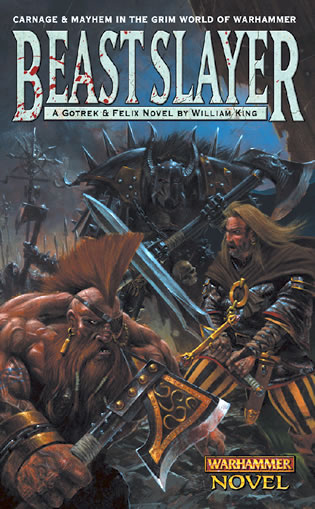
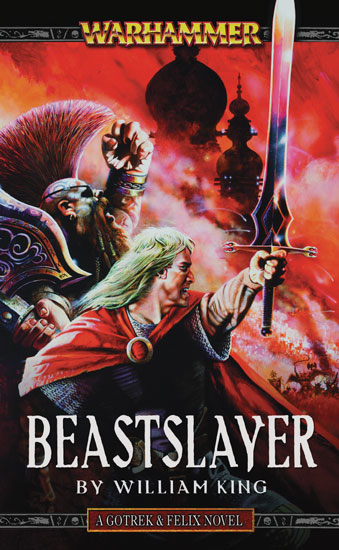
Throwback Thursday – Beastslayer by William King

Beastslayer Cover

Publisher: Black Library (Paperback – February 2001)

Series: Gotrek and Felix – Book 5

Length: 275 pages

My Rating: 4.5 out of 5 stars

Amazon     Book Depository

Welcome back to my Throwback Thursday series, where I republish old reviews, review books I have read before or review older books I have only just had a chance to read.  For my latest Throwback Thursday I continue to examine the awesome and exciting Gotrek and Felix series from the Warhammer Fantasy range with the fifth book, Beastslayer by William King.

Readers of my blog will have no doubt noticed my increased consumption of Warhammer novels in the last year as I have really started to get hooked on this cool franchise again.  One of my absolute favourite series has been the epic Gotrek and Felix books, the earlier entries of which are written by talented William King.  This excellent series is set in the Warhammer Fantasy world and follows two compelling protagonists, doomed dwarf Slayer Gotrek Gurnisson and his human companion Felix Jaeger, as they face the monsters, daemons and evil forces of the world in an attempt to find Gotrek a mighty death.  I have had a lot of fun with this series in 2021 and ended up reading the first four Gotrek and Felix books, Trollslayer, Skavenslayer, Daemonslayer and Dragonslayer.  This fifth book was another great entry in the franchise and pits this legendary team against an entire army of evil.

After their harrowing journey to the Chaos Wastes and their epic quest to slay a monstrous dragon, Slayer Gotrek Gurnisson and his chronicler Felix Jaeger continue their adventures throughout the Old Realm.  Once again determined to journey to the most dangerous place possible, Gotrek and Felix find themselves within the Kislev city of Prague, the great fortress city that serves as a bulwark between the Chaos Wastes and the civilised realms of man.  However, this mighty city is in mortal danger as a massive horde of Chaos descends upon it, led by the fearsome Arek Daemonclaw.

Arek, a ferocious and cunning war leader and sorcerer is determined to destroy Prague and lead his forces throughout Kislev and down into the Empire.  To carry out his goals, Arek has amassed one of the greatest armies of Chaos ever seen, filled with Northern marauders, elite warriors blessed by the dark gods of Chaos, beastmen, mutants, monsters, daemons and two sorcerers of unimaginable power.  Their victory over the people of Kislev seems certain, but Gotrek and Felix are used to fighting such impossible odds.

Accompanied by several powerful friends and allies, Gotrek and Felix are resolute in their determination to save Prague and kill as many followers of Chaos as possible.  However, their opponents are well aware of the threat these two companions represent and are doing everything in their power to destroy them.  Forced to confront both the massive army outside the walls and treacherous cultists from within who are led by a powerful member of the Prague court, can even Gotrek and Felix survive this latest attack from hell?

This was another thrilling and fun entry in the Gotrek and Felix series that I had a fantastic time reading.  Beastslayer has another great, action-packed story, and it was awesome to see the series’ two protagonists embark on another epic adventure.  This fifth novel takes place shortly after the events of Dragonslayer and sees the heroes arriving in the city of Prague just before the invading Chaos army arrives.  The story quickly devolves into a bloody siege novel, with the entire city under threat from the massive army outside.  I have a lot of love for siege stories, and this proved to a pretty good one, especially as some of the battles get quite brutal and over-the-top.  While the focus is naturally on the siege itself, King also mixes things up by installing a cool arc about a traitor within the city who is given the task of eliminating Gotrek and Felix.  This amps up the stakes for the heroes and ensures that they are facing threats from all sides.  While I did think that the identity of the mysterious traitor was a bit obvious (I had them pegged before I even knew there was a traitor), this intriguing arc worked out really well and I had a lot of fun with it.  The real highlight however is the final battle between the protagonists and the invading army.  King produces a truly amazing final battle sequence that sees Gotrek, Felix and their friends in one massive extended battle that really stretches them to their limit.  Although the eventual arrival of various allies seemed a tad predictable, it still ended up being an intense final third of the novel and I could not put the book down the entire time the battle was raging.  Throw in some interesting character development and an entertaining, if slightly disconnected, storyline around recurring antagonist Grey Seer Thanquol, and you have a great Gotrek and Felix novel that is really worth checking out.

I really liked the way that King wrote Beastslayer and I honestly think that it was one of the more consistent and compelling entries in the series so far.  King has moved away from having novels with partially separated storylines (such as the first parts of Daemonslayer and Dragonslayer), and instead presented a strong and very self-contained narrative.  Like most of the entries in this series, readers can easily dive into Beastslayer without having any prior knowledge of the series.  King makes sure to revisit and examine most of the key storylines and character moments from the previous novels, ensuring that new readers can easily follow what is happening here without too many problems.  From a series standpoint this is a key entry, wrapping up storylines from the previous novel in a fun and exciting way.  I loved seeing where some of the long-term story elements went, and by concluding a few of them, King sets up the next novel as a bit of a clean slate for new things.  This ended up being a pretty solid action-adventure novel, and I loved all the brilliant fight sequences that King loaded into the story.  These various action sequences are pretty gritty and brutal, and you get a real sense of the destruction and death being dealt around.  I had an outstanding time reading this novel and I think it was one of King’s stronger books.

One of the things that I liked about the Gotrek and Felix series is the slightly limited degree to which the plot relies on the overarching universe.  While this is clearly set within the Warhammer Fantasy world and features several iconic factions, locations and foes, enjoyment of this book is not dependent on known anything about them.  Any fantasy fan can easily dive into Beastslayer without being familiar with Warhammer lore and still have fun, and indeed this is a great introductory series for people interested in checking out the franchise.  There is of course a lot that will appeal to people more familiar with Warhammer and it was great to see some of the iconic locations, such as Prague and Hell Pit, especially as King does a wonderful job fleshing them out (especially Hell Pit, which is filled with some crazy Clan Moulder mutations).  There are also some great references to key parts of Warhammer history, such as the previous siege of Prague, and I enjoyed the continued focus on the lands of Kislev, which are often overlooked in Warhammer Fantasy fiction.  This ended up being a fantastic tie-in to the wider universe, especially as King went all out bringing in various monsters and Chaos foes, and I cannot wait to see where this series goes next.

At this point in the series, the central characters have been well established, and not only are the readers very familiar with the two main protagonists, Gotrek and Felix, but also with some of the main supporting characters, such as Max Schreiber, Ulrika Magdova and Snorri Nosebiter.  As such, there isn’t a great deal of character development in Beastslayer as King was mostly concerned with keeping the status quo.  As such, Gotrek and Felix are pretty much portrayed in the same entertaining way they have been throughout the entire series, with Gotrek being a grim, taciturn badass and Felix being a more sensible but dangerous ally.  There are a few interesting developments surrounding them, such as some fascinating peeks into Gotrek’s past which partially reveal the reason he became a Slayer, and Felix’s continued transformation into a hardened warrior and leader.  Max and Ulrika end up with a bit more development than Gotrek or Felix, with Max becoming more a sympathetic figure whose knowledge of magic becomes an important part of the novel.  Ulrika also goes through a few changes in this book, and it was great to see that annoying relationship with Felix mostly come to an end.  King still struggles a bit when it comes to writing female characters, especially since Ulrika is the only female character of note in the entire novel.  Several other fun recurring characters pop up throughout Beastslayer, although readers shouldn’t get too attached to some of them, especially during some of the climatic and deadly war scenes.

Aside from this great group of protagonists King has also included some interesting antagonists in this novel.  The most prominent of these is Arek Daemonclaw, the leader of the Chaos army attacking Prague and a follower of the dark god Tzeentch.  King does a lot with Arek in a very short amount of time, and he is soon built up to be a dangerous enemy and a real threat to Gotrek and Felix.  Aside from Arek there are a couple of other interesting villains, including some sorcerer twins who have their own agenda, and a mysterious cultist hidden within the city with some complex motivations.  King also makes sure to include the entertaining skaven character Grey Seer Thanquol, who has his own storyline throughout Beastslayer.  Thanquol once again serves as an excellent comic relief for most of the book, and it was entertaining to see all the fun intrigue and betrayal of the skaven.  I did think that Thanquol’s storylines were bit disconnected from the rest of the plot, especially as this is one of the last time we see Thanquol before he gets his own novel, but I still had a fantastic time following him.

Overall, William King’s fifth entry in the epic Gotrek and Felix series of Warhammer Fantasy books, Beastslayer, was a fun and exciting fantasy tie-in novel that I deeply enjoyed.  Featuring a ton of intense violence, a compelling siege-based storyline and some amazing Warhammer Fantasy elements, Beastslayer continued the cool storylines and character arcs established in the previous novels and made sure the reader was constantly entertained throughout.  I had an excellent time reading this awesome novel and I plan to grab the next few books in this series as soon as possible.

Beastslayer 2

Amazon     Book Depository

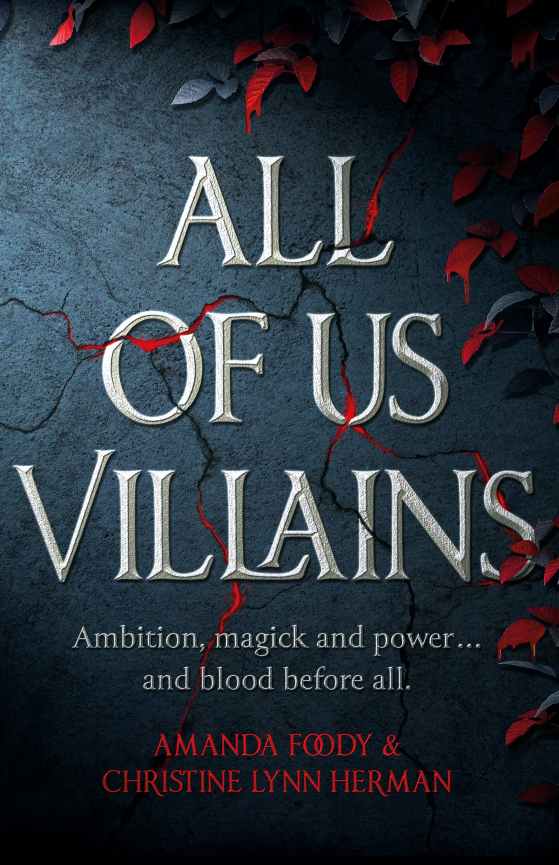
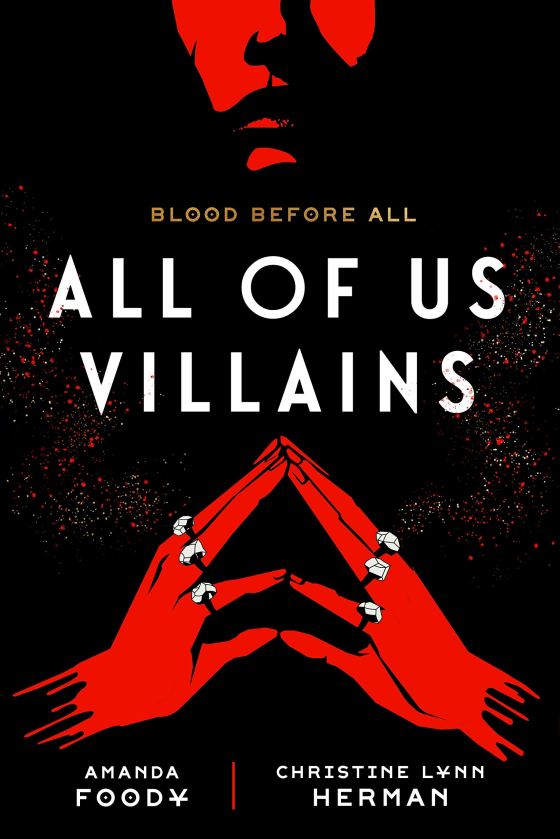
All of Us Villains by Amanda Foody and Christine Lynn Herman

All of us Villains Cover

Publisher: Gollancz (Trade Paperback – 9 November 2021)

Series: All of Us Villains – Book One

Length: 388 pages

My Rating: 4.5 out of 5 stars

Amazon     Book Depository

The writing team of Amanda Foody and Christine Lynn Herman presents their first awesome joint novel, with the impressive and dark young adult fantasy book, All of Us Villains.

Foody and Herman are both established authors, having previously released cool-sounding novels and series, such as Foody’s bestselling The Shadow Game series and Herman’s The Devouring Gray novels.  While I have not had the opportunity to check out either of these authors’ previous books, I was very interested by All of Us Villains when I first heard about it a few months ago.  I loved the unique and compelling plot synopsis, and I was also intrigued by all the buzz from other reviewers.  I instantly jumped on it once I received my own copy and I was very impressed with its clever and compelling story.

In a world still powered by spells and curses, nothing is more precious than high magick, which can super-charge any spell and provide its wielder with insane amounts of power.  The only reliable source of high magick left in the world can be found in the remote city of Ilvernath, a dour and depressing settlement whose prosperity and fame can be traced to seven ancient families.  The ability to see and manipulate this high magick can only belong to one family at a time, and control ensures their prosperity for an entire generation.  However, to gain this right, each family must make an unbelievable sacrifice.

Every generation, when the Blood Moon starts to rise, a magical tournament is enacted that pits the very best of the families against each other.  However, this is no gentle tournament of magick; it is a brutal, curse-created fight to the death, with each family forced to nominate a young champion to represent them.  Only one champion can survive the tournament, and no-one ever emerges unscathed.

Twenty years after the last competition, a new Blood Moon starts to rise, and the families make ready for the latest battle for supremacy.  However, this tournament will be very different than any before.  Someone from the seven families has published a tell-all book, detailing every aspect of the tournament and informing the world of the hidden atrocities that have been committed in the name of power.  With the world now obsessed with every aspect of the tournament, all attention is now focussed on Ilvernath and the seven champions.

Thrust into the public spotlight, all seven champions must now deal with the intense infamy the tournament produces as they prepare to fight.  Forced to balance their own feelings on death and survival with the intense pressure placed upon them by their families and tradition, none are truly ready for the horrors they will be forced to endure.  However, this tournament also offers its competitors a chance to survive and end the curse that has blighted their families for centuries.  But not all the competitors are willing to give up the chance of ultimate power and are prepared to pay any price to win.  Let the games begin!

Damn, now this was a really great novel.  The brilliant new writing team of Foody and Herman produced an outstanding book in All of Us Villains, and I really got stuck into its story incredibly quickly.  The authors did a wonderful job of utilising a new version of the always popular teenage death tournament to fit into a brilliant and moving narrative.  Filled with complex characters and intense personal moments, All of Us Villains is an awesome and powerful book that I deeply enjoyed.

All of Us Villains has an excellent narrative that is a lot of fun to get into.  Focused on four of the seven participants of the latest death tournament, this is an amazing character driven story that really dives into the protagonists’ psyches as they prepare for the ultimate challenge.  The authors do an awesome job setting the scene for this fantastic story, and the readers are quickly hooked by the four complex main characters and the interesting scenario.  Roughly the first half of the book is dedicated to the setup before the tournament begins, which I think ensured the perfect balance between development and bloodshed.  You come away from the first half appreciating each of the characters and deeply caring about the outcome of the upcoming battle.  I was particularly impressed with one great early twist that surrounded one main character’s family preparations, and it added some major impact to his storyline.  Once the tournament begins, readers are in for a whirlwind of emotions and excitement as all the characters enact their strategy to win while all bearing a heavy emotional weight or magical handicap.  There are some intense and captivating sequences here and the readers are constantly on the edge of their seat, especially with some unique interactions, alliances and motivations, including one character who attempts to destroy the entire tournament from the inside.  This all leads up to a devastating and powerful conclusion, filled with death, despair, betrayal and complete emotional devastation, as all the characters make their choices and everything crumbles around them.

I really loved this cool narrative and I found myself getting really caught up in the constant heartbreak and bloodshed.  I am a massive fan of the teenage death tournament premise, and the authors do a great job of working this established story elements into their setting extremely well.  While there isn’t as much intense violence in the actual tournament as some readers would probably hope, I think that the authors’ choice to focus on the characters and their intense emotions about being forced into this fight by their families turned All of Us Villains into a better book. The authors’ use of multiple character perspectives works extremely well here, especially as it forces you to choose between your favourite characters as you try and work out who you want to survive, while also ensuring a really in-depth look at the setting and the tournament.  While I did find the final twist of this novel slightly predictable, the rest of the reveals and unpredictable actions were really cool, and I was shocked and surprised multiple times while reading.  This was also a great first entry, with the story ending on a compelling final note that will ensure that I will be coming back for the next book.  This was a deeply accessible and enjoyable read that has a lot of appeal to a vast array of varied readers, especially its intended young adult audience who will really love the complex story, clever setting and fantastic characters.

I had a lot of fun with the captivating and inventive setting and scenario that the authors have come up with for All of Us Villains.  While the world itself is a bit of a familiar alternate world with magic, the town of Ilvernath and the tournament it hosts more than makes up for it.  The authors spend a substantial amount of time establishing the setting, showcasing how the participants live, the vile history surrounding their families, as well as the tournament which plays a major role in their existence.  The people of Ilvernath, especially the seven families, are explored in detail, and it was fascinating to see the various opinions and expectations surrounding them.  This becomes even more apparent as a clever media saturation element is worked into the narrative as the tournament has been exposed to the public and has gained substantial attention, changing the entire nature of the tournament.  Excerpts from the tell-all-book that caused this attention are featured at the start of each chapter, which I deeply enjoyed.  Not only is it fascinating to see an inside perspective on the events, the families, and the tournament history, but it helps to expand the lore of this world in a fun way.  I also quite enjoyed the cool magical system of this novel, which is channelled through spell-laden rings powered.  The authors spend a lot of time exploring this magical system, especially as they show off various aspects of it, including spell/curse crafting and the subsequent casting.  You get a real sense of how this system works in a very short amount of time, and there are some unique and intense spells that get chucked into the mix, resulting in some big story moments.

The highlight of All of Us Villains is the death tournament, which gets a lot of attention and development.  The authors perfectly explain the lore, rules, and quirks of the tournament, and it is fascinating to see it unfold once the characters are thrown into it.  Cut off from the rest of the world by a magical barrier, the participants need to kill each other within a set period or else everyone left alive will die.  There are some fantastic rules and inclusions set into this tournament, including seven artefacts with their own unique benefits and seven strongholds that the champions can hold up in.  These items and strongholds have their own significance and connections to the seven families, and it was interesting to see their impact on the events of the tournament.  The authors’ clever use of excerpts from the tell-all book works extremely well to highlight elements of the tournament, and I loved all this crucial part of the book.  There are also some new elements introduced for this specific tournament, as parts of the curse start to break apart due to the unpredictable actions of the participants.  This opens new opportunities and possibilities that were quite fascinating to see.  I look forward to seeing what happens around this tournament in rest of this series, especially as more bloodshed and destruction is inevitable.

As I mentioned multiple times above, the best thing about this cool book is the fantastically complex and compelling central characters.  The focus of All of Us Villains is on the seven participants of the tournament, with a particular emphasis on the four main characters.  The authors really dive into these four characters, highlighting their personalities, emotions, and their thoughts on the tournament they are about to embark on.  Each character is very well established, and there are some extremely complex and powerful storylines and character arcs set up around them.  It is a testament to the authors’ writing that I tended to enjoy each separate perspective about equally, and there were none that I disliked more than any of the others, which is a real peril in novels with a lot of narrators.  I will say that this intense focus on only four of the main characters does detract a lot of attention and interest away from the rest of the supporting cast, especially the three other family champions, but I think it is worth it for the impressive development put into the central protagonists.

The first of these characters is Alistair Lowe, the powerful scion of the Lowe family.  The Lowes win most of the tournaments and are generally considered the villains of Ilvernath and its history due to their monstrous personalities.  Alistair has been raised his entire life to win the tournament by any means necessary and has fully accepted his role as the monster of the story, even if he isn’t as evil as everyone assumes or wants him to be.  However, an interesting and unexpected romance soon starts to change his mind and he is convinced that changing his ways and saving the others might be a good idea.  However, a particularly vicious twist towards the end of the novel completely alters the entire trajectory of his character arc and will leave you reeling in shock while it loads up the epic feels.  I felt that out of all the characters, Alistair had the most moving and complex storyline as well as the most substantial development, and he swiftly becomes the character you bond with the most.  I am deeply intrigued to see what happens to him in the next book and I have a feeling that there is both great tragedy and great evil in his future.

The next central champion is Isobel Macaslan, a bright and powerful magick user from a highly resented family.  I loved the great work that the authors put into developing her.  At first Isobel appears to be one of the most confident and enthusiastic figures in this book, especially as she is the one leaning into the publicity surrounding the tournament the most.  However, it soon becomes apparent that she was forced to be champion thanks to the machinations of her uncaring family and her former best friend, who threw her to the press.  Isobel has a lot of issues going into the tournament, with the mass attention and the unfair expectations placed upon her forcing her to take some big risks which severely disadvantage her as she enters the tournament.  Isobel ends up developing some unique connections throughout All of Us Villains, and the friendships and relationships she develops form the emotional heart of much of the narrative.  The reader sees Isobel go to some dark places in this book and it is hard to see all the heartbreak and despair she experiences.

I was also a major fan of the underdog Gavin Grieve, who has an amazingly complex and relatable story arc.  Gavin is the champion from the Grieve family, who have never won the tournament and are generally looked down upon by everyone in town.  Gavin is a sad and angry character since everyone underestimates him and his chances, while also showering him with scorn as it was apparently a Grieve who wrote the tell-all expose about the tournament.  This anger leads to him making a dangerous deal that provides him with impressive power at a great price.  This was an amazing story inclusion, especially as it turns Gavin into a bit of a beast due to finally having power and an advantage over the other families.  This leads him to do some reckless and cruel things, and it was fascinating to see the events of the tournament and its bloody legacy slowly corrupt this character before your eyes.

The final point-of-view character was Briony Thorburn, the confident wildcard.  Unlike all the other major characters, Briony wants to compete in the tournament and has spent her entire life getting ready for it, going as far as to dump her boyfriend, one of the other competitors, so she would feel less guilty about killing him.  However, events outside of her control impact her participation and she is forced to take some drastic actions.  This leads to her significantly reconsidering her position and gives her a fantastic arc about trying to save all her fellow participants and try to break the tournament once and for all.  Watching her attempt to make up for all her past mistakes while also convincing the other champions to change hundreds of years of tradition is pretty brilliant, and I found it to be a compelling arc that fleshed out the story perfectly.

In their first collaboration, the brilliant team of Amanda Foody and Christine Lynn Herman have produced one of the best young adult fantasy novels of 2021 with All of Us Villains.  This amazing novel contains an excellent story set around an intense magical teenage death tournament that takes the reader into some incredible directions.  Filled with tragedy, impressive character development, and a ton of impressive twists, All of Us Villains is an exceptional read that comes highly recommended novel.

All of us Villains Cover 2

Amazon     Book Depository

Throwback Thursday – Warhammer: Dragonslayer by William King

Dragonslayer Cover Combined

Publisher: Black Library (Paperback – November 2020)

Series: Gotrek and Felix – Book Four

Length: 271 pages

My Rating: 4.5 out of 5 stars

Amazon     Book Depository

For this week’s Throwback Thursday I check out another volume in the incredibly entertaining Gotrek and Felix Warhammer Fantasy series, Dragonslayer, by William King.

I have been having fun over the last year checking out several cool Warhammer 40,000 and Warhammer Fantasy tie-in novels, especially as all of them place great stories inside their respective elaborate extended universes.  Some of the most exciting and compelling of these Warhammer books have been part of the Gotrek and Felix series, which follows a doomed dwarven Slayer and his human companion as they face all manner of monsters and evils across the Warhammer Fantasy landscape.  I have so far had a lot of fun reading the first three books in this series, Trollslayer, Skavenslayer and Daemonslayer, all of which were some of the best pre-2021 releases I read this year.  I recently grabbed a couple more Gotrek and Felix novels second-hand, and I had a great time quickly reading the next entry in the series over the Christmas break, Dragonslayer, another fun and enjoyable read that has an action-packed narrative to it.

After their daring exploits in the Chaos Wastes, dwarf Slayer Gotrek Gurnisson and his rememberer, Felix Jaeger, return to the lands of Kislev in triumph, having rescued the survivors of a lost dwarven stronghold.  However, their victory is short lived, as danger begins to assail them the moment they return in the form of the skaven forces of their arch-enemy Grey Seer Thanquol.  Worse, their voyage has revealed a giant horde of Chaos warriors advancing towards the lands of Kislev, determined to bring destruction and death to all before them.

To warn the people of Kislev, Gotrek, Felix, and their companions travel by dwarf airship towards the capital.  However, their voyage is disrupted by an unnatural storm and an attack from a legendary dragon determined to rip them asunder.  Barely escaping with their lives, the adventurers find themselves stuck in the World’s Edge Mountains and forced to pull into the Slayer Keep of Karak Kadrin.  There they discover that the dragon that attacked them, Skjalandir, has been terrifying the mountains for months.  Determined to finally meet his mighty doom, Gotrek and his fellow Slayers head out to destroy the beast, accompanied by a reluctant Felix and their Kislev allies.  Beset on all sides by ravening orcs, desperate bandits, and a massive dragon of immense destructive potential, can even the legendary team of Gotrek and Felix survive, or will Gotrek finally find his longed-for death at the hands of the mightiest beast in the realm?

This was another very fun and intense novel from King, who once again provides the reader with an exciting and compelling dive into the Warhammer Fantasy universe.  Dragonslayer was a very good entry in the long-running Gotrek and Felix series, and I deeply enjoyed its cool and fast-paced narrative that sees the protagonists fight all manner of foes and dangers.  Filled with impressive monsters, a hilarious sense of humour and all manner of action, Dragonslayer was a fantastic read that I powered through in a few short days.

Just like all previous Gotrek and Felix novels, Dragonslayer starts off fast and never really slows down, as the various characters are thrust into one dangerous situation after another all the way up to the last page.  The first quarter of the book is firmly focussed on continuing the antagonist-centric storyline from Daemonslayer, with Grey Seer Thanquol’s planned attack from the last book finally coming to fruition.  This opening scene is pretty fun, even if it does feel a little disconnected from the following narrative, and I loved seeing more of enjoyable antagonist Thanquol.  Following this enjoyable first encounter, the protagonists head off on a new quest which is quickly detoured by an encounter with a dragon.  The dragon’s first big appearance is pretty devastating, and I loved how much of a threat this monster is made out to be, especially as the protagonists don’t come out unscathed.  The next section of the book is mostly devoted to character development and world building, as the protagonists prepare for their next adventure and gain some interesting new companions.  At the same time, Thanquol engages in another mostly unconnected storyline that sees him encounter and set up the dangerous Chaos horde that will be the major threat of the next novel.  The final third of the novel is primarily dedicated to the protagonist’s quest towards the dragon’s lair, where they encounter not only the beast but various other foes as well.  This leads up to some amazing battle sequences, the highlights of which include the deadly confrontation with the wounded and mutated dragon, and a fun full-on war scene between two forces determined to kill each other and the protagonists.  The book had an entertaining and exciting conclusion with a fun lead-in to the next novel, and I had a fantastic time getting through this brilliant and excellent read.

King has a great easy-to-read style that I really connect with in the Gotrek and Felix novels, which ensures that all fantasy fans can easily enjoy it, especially with the fast-paced narrative and crazy action scenes.  I like the author’s use of multiple character perspectives to tell a rich and impressive adventure story, and you get some fun alternate viewpoints and storylines as a result.  This is particularly apparent in the action sequences, as you see the various participants of the battle as they encounter the same foes or other narrators, and results in a much fuller and bloodier picture.  The action scenes themselves are great, filled with compelling fights that really get the blood pumping as the protagonists face off against a variety of foes.  While a couple of fights were a little shorter than I would have liked, King more than makes up for it with some of the big encounters, especially against the dragon.  I loved the two major dragon scenes, and King crafts some excellent and hard-hitting fight sequences against it, loaded with character deaths and intense brutality.  I also loved one fun final battle sequence that read like a pitched battle from the Warhammer Fantasy universe, Goblin Fanatics and Doom Diver catapults included.

Like most of the previous Gotrek and Felix books, Dragonslayer is pretty accessible to new readers, and there is no major requirement to check out any of the previous novels first, especially as King’s books tend to repeat certain elements from the preceding entries.  As such, unfamiliar readers can easily jump in here, although the Thanquol attack at the start of the books does come a little out of nowhere if you haven’t read Daemonslayer.  I would say that Dragonslayer did feel like a bit of a bridging novel in places, especially as it continued several plot points from Daemonslayer while also taking the time to set up a potentially bigger evil in the next book, but I still had a lot of fun with it.  I still really believe that the Gotrek and Felix novels are an excellent place for new Warhammer fans to start out, especially as they mostly read like classic fantasy novels rather than intense tie-in reads.  The readers get some great details about the extended Warhammer Fantasy universe here, and King expertly introduces several key locations while also featuring some of the more recognisable factions.  I really appreciate how King makes sure to reintroduce all these races in each of his novels, and it ensures that new readers can appreciate what is going on and why certain factions are acting the way they do.  This ended up being a particularly strong Gotrek and Felix entry, and I cannot wait to see what happens in this universe next.

Dragonslayer has a rather interesting cast headlined by the two central characters, Gotrek and Felix, who have another great adventure here.  Gotrek is his usual gruff self in this novel, and you don’t get a lot of development surrounding him in Dragonslayer, especially as King never shows his perspective, no doubt to highlight his secret past and the aura of unbreakable strength and confidence he gives off.  Felix, on the other hand, gets most of the plot’s attention, and it was fun to see him continue to grow as a character.  While he still has certain understandable apprehensions about the quests he follows Gotrek on, Felix has grown into quite a capable adventurer over the last few books, and it was fun to see him accompany his friend into near-certain death once again.  I enjoyed the intriguing storyline around his magical sword which was quietly introduced in the first book and which reaches its full potential here as a dragon-slaying item.  I also enjoyed the compelling examinations of Felix’s personality and resolve, especially when it comes to the oath he swore to Gotrex, as he is forced to make some big decisions here when faced with an alternate future.

Dragonslayer also features a fun supporting cast, including several intriguing characters from Daemonslayer who get an extended role here.  This includes Felix’s love interest (and the only significant female character), the Kislev noblewoman Ulrika, who ends up accompanying the main protagonists on their latest adventure.  Ulrika is an interesting character who I have mixed feelings about during the book.  While I did like how King featured a strong and complex female character (something lacking from some of his previous novels), I honestly could not stand the terrible romance that she has with Felix.  The two of them continuously bounce from being madly in love to hating each other over petty things, and it ends up getting annoyingly repetitive.  This terrible relationship made me hate Ulrika a little as the book progressed, and I kind of wanted her to get eaten by the dragon (in my defence, it would have made for a good dramatic moment).

Another character who got an expanded role in this book was the human wizard Max Schreiber, who becomes quite an intriguing addition to the plot.  Max becomes a key part of the team in this book, and his insight into magic and the wider events of the Warhammer Fantasy universe are great additions to the plot, helping to expand the reader’s knowledge.  At the same time, Max also comes across as a bit of a creeper due to his unrequited love of Ulrika, which causes him to do some stupid things.  You honestly start to worry that Max is going to do something sinister as the story continues, and I have no doubt that will become a major plot point in the future.

I also must quickly mention the mad dwarf engineer Malakai, who goes on a fun mission of vengeance here in this book to fight the dragon who crashed his beloved airship.  Malakai, who speaks with a Scottish brogue just to make him seem even wilder, is a deeply entertaining figure in this book, combining a Slayer’s death wish with a love of advanced weaponry.  It was so much fun to see this insane character advancing on his foes with explosives and giant guns, and I am still laughing about his cart-loaded gatling gun.

While there is a great focus on recurring characters, King also spend some time introducing several interesting new characters.  The best of these are the four new dwarf Slayer characters, Steg, Bjorni Bjornisson, Ulli Ullisson and Grimme, who accompany the protagonists on their quest to slay the dragon.  All four Slayers have diverse personalities, backgrounds and fun quirks that make them interesting in their own way.  King ends up doing a lot with these four characters in the 100 or so pages that they end up being featured, and there are some great story arcs drawn around them.  I quite enjoyed the compelling narrative around Ulli, a young dwarf forced to become a Slayer for his cowardice, especially as it had a good resolution.  I also must highlight Bjorni’s constant lewd stories and declarations, which add so many laughs to the book, especially as he makes some outrageous claims about his romantic conquests.  I did think he could have done a little more with the intriguing and incredibly taciturn Grimme, but overall these four characters were great additions to the plot and I look forward to seeing some of them again in the future.

The final characters I need to point out are the extremely amusing antagonist team of Grey Seer Thanquol and his minion Lurk Snitchtongue, two skaven characters who serve as secondary antagonists for Dragonslayer.  Thanquol and Lurk are really amusing characters who perfectly encapsulate the snivelling and duplicitous skaven race, with their constant talk of betrayal, self-gain and incompetence.  It is always so much fun seeing the two of them at it, and every one of their scenes is chock full of hilarious statements and continuous thoughts of treachery.  King adds in a very fun change to the dynamic between these two characters in Dragonslayer, with the previously small and deferential Lurk having been mutated into a massive beast, which gives him increased confidence.  This makes him strongly consider killing Thanquol several times throughout the book, and the two are constantly eyeing each other off.  This proves to be a hilarious addition to the plot, and I loved seeing Thanquol on the back foot with his minion after two books of pushing him around.  While they are not the most dangerous of villains at this point, they do make for an intriguing alternate viewpoint, especially as their storylines are mostly separate from that of the protagonists.  While they are a tad detached from the main narrative, their encounters and experiences add to the general tapestry of the series and help to set up the villains of the next Gotrek and Felix book.

With Dragonslayer by William King, the Gotrek and Felix books continue to impress me as one of the all-time best and most enjoyable Warhammer tie-in series.  I had an amazing time getting through this cool book, especially as it features all the best aspects of the series, including tons of fun action, great characters, and major Warhammer Fantasy settings.  Readers are guaranteed to have a blast with this book, and I loved every single second of danger, combat and dragon fighting Dragonslayer contained.  A fun and fantastic read, I look forward to checking out the rest of the books in this series, especially the fifth entry, Beastslayer.

Amazon     Book Depository

It Ends in Fire by Andrew Shvarts

It Ends in Fire Cover 2

Publisher: Jimmy Patterson Books (Hardcover – 9 November 2021)

Series: Standalone/Book One

Length: 369 pages

My Rating: 4.5 out of 5 stars

Amazon     Book Depository

After wowing the world with his debut trilogy, impressive young adult fantasy author Andrew Shvarts return with a fantastic and entertaining read that cleverly parodies the classic magical school fantasy setting with It Ends in Fire.

Shvarts is a great author whose work I have been rather enjoying over the last couple of years.  Shvarts debuted back in 2017 with his Royal Bastards trilogy, which followed a group of illegitimate children as they found themselves caught up in the conspiracies and plots of their dangerous parents.  Made up of Royal Bastards, City of Bastards (which has an extremely explosive ending), and War of the Bastards (one of my favourite books of 2019), this was an awesome trilogy, and it has made me very keen to read more of Shvarts’s books.  As a result, when I heard that Shvarts had a new novel coming out, one set in one of my favourite settings, a magical school, I knew I had to grab it.  I have been waiting for It Ends in Fire for a while, and I was quite excited when I received a copy the other day.

Prepare to visit the Republic, a land of magic, deceit and corrupted power, where the Wizards rule and the non-magical people, the Humbles, are brutally oppressed.  At the heart of the Republic is Blackwater Academy, the most prestigious school of magic in the land, where the elite Wizards are trained and forged into scheming, power-hungry sadists.  Blackwell Academy has survived for centuries and remains a great power in the Republic, but nobody is prepared for the arrival of its latest student.

As a child, Alka Chelrazi watched as her parents were brutally murdered by a powerful Wizard, and she has since sworn vengeance.  Taken in by a rebel group, Alka has grown into their most lethal weapon thanks to her own magical abilities and has spent her life training to do the impossible: infiltrate Blackwell.  Taking the identity of a dead Wizard unknown to anyone, Alka is tasked with entering the school, learning all its secrets, and burning it to the ground from the inside.

Determined to carry out her duty to the very end, Alka attempts to find her bearings and learn everything she can.  However, Blackwell is unlike any other school in the Republic, its lessons are lethal, the rivalries are fierce, and some students will do anything to succeed, even kill their classmates.  To complete her mission, Alka will need to use every skill and trick at her disposal to recruit allies, take out her rivals and help a motley crew of outcasts to win the Academy’s Great Game.  However, with dangerous politics, power-hungry rivals, suspicious professors, and an evil headmaster all arrayed against it, can Alka succeed in bringing down the Academy, or will the fires of her revolution be snuffed out before it can begin?

This was an awesome and compelling new book from Shvarts, who has produced another deeply entertaining and intense read.  It Ends in Fire has a powerful and captivating narrative that not only contains a great story about revenge and finding oneself, but which also parodies certain magical school stories.  I had a great time reading this novel, and I became quite addicted to it as it went along.

It Ends in Fire has a brilliant and exciting narrative that moves at a fast pace and ensures that the reader is never bored.  Shvarts starts the story off with a bang, introducing the protagonists and point-of-view narrator, Alka, and showing her initial steps in infiltrating the academy.  The start quickly showcases some of the lead characters, the stakes of her mission, and the new and somewhat familiar setting of Blackwell Academy, as well as the surrounding Republic.  At the same time, Shvarts includes a series of framing chapters that are set in the protagonist’s past, showcasing her motivations, her many personal tragedies and the training she undertook for her infiltration.  From there the story quickly progresses into a compelling arc around the character’s darker magical school experience, while also building up her personal history.  There are some fun magical lessons, budding rivalries and caste systems woven into the narrative, and it was intriguing to see this ultimate outsider attempt to get into the flow of this elite school.  The crux of the narrative revolves around three magical contents that the various school houses compete in for glory and reputation (as well access to the Republic Senate, which interests Alka).  These competitions are pretty awesome, and serve as the major story highlights, much in the same way as the Quidditch matches and the Triwizard Tournament in the Harry Potter novels.  I particularly enjoyed the first and third one, and it was pretty fun to see the protagonist engage in some heavy cheating to pull it off.

This all leads up to a big and brutal finale, where the protagonist finally gets to unleash her true personality on her foes, and which potentially sets up some interesting directions for any resultant series in the future.  There is a great blend of character development, world building, magical adventure, intrigue and personal betrayal throughout this story, and I ended up getting really stuck into this brilliant narrative.  I pretty much read the last 200 pages in a single day, especially as it contained two of the competitions and a fantastic duel, and I really loved how everything came together.  It Ends in Fire turned out to be fairly self-contained and feels a lot like a standalone read.  That being said, it has some potential to be a larger series, and I would be interested to see where it goes, especially as there are some outstanding storylines to explore.  Like Shvarts’s previous novels, It Ends in Fire is aimed towards a young adult audience with its teenage protagonist and supporting characters.  Due to some more mature elements, this novel is probably best suited towards an older teenage audience, who will no doubt appreciate the author’s realistic take on teenage education.  This novel will also hold a lot of appeal to adult fantasy fans, especially those who grew up on Harry Potter, as this novel acts in many ways like a clever and fun parody of these classic novels.  An overall excellent story with some fun twists and major memorable moments.

I must say that I was also incredibly impressed with the new fantasy setting that Shvarts came up with for It Ends in Fire.  This new fantasy world is a brilliant and complex collection of nations brought together by an oppressive magical regime ruled by powerful Wizards who control the non-magical people, the Humbles.  The author does a great job setting up this cool new world, and I loved the examination of a magical regime and the unique cultural and social circumstances that would evolve in such a regime.  I particularly enjoyed the fun examination of the Republic’s politics, especially when it came to the impacts of the protagonist’s actions within Blackwater Academy.  It was also very compelling to see the clever hierarchies that see even some Wizards oppressed or disenfranchised, ensuring that the situation is even more complex than the protagonist, who was raised by rebellious Humbles who hate all Wizards, initially believed.  This proves fertile ground for the main narrative that follows Alka attempting to take the system down from the inside, and it was a solid background to the narrative.  I also really appreciated the cool new magical system that Shvarts came up with for his new novel.  In It Ends in Fire, Wizards cast spells by entering a time-dilated field known as the Null, where they carve glyphs into the air with Loci (magical wands) to unleash elemental spells.  This is an awesome magical system, which allows for some amazing and complex duals and battles.  The slow-motion aspect of the Null ensures that there is some clever strategy involved, as well as some intense explanation from the protagonist, and I deeply enjoyed some of the fun an epic clashes that occurred.

In addition to the cool magic and fun overarching setting, I also must highlight Blackwater Academy, which serves as a dark mirror to other magical schools that have been featured in fantasy novels and media.  In many ways, Blackwater Academy is a twisted version of Hogwarts; an elite magic school, with houses, elaborate classes and competitions.  Shvarts does an amazing job of working altered versions of these classic magic school elements into his own setting, and pretty much every scene has something reminiscent of these established school settings.  However, all these elements are twisted and converted into something far darker and more adult.  The teachers are crueller, the rich rival kills with impunity, the lessons are more deadly, and the headmaster is essentially Dumbledore (a highly respected wizard who turned down political leadership to be a teacher), except evil and self-serving.  I really liked how Shvarts included these elements in his novels, and it was a lot of fun to not only spot the similarities but also see how the author had twisted them into something different (for example, the protagonist is chucked into the universe’s version of Hufflepuff, and then turns them into a strong team).  This resulted in a fantastic and compelling setting that is both familiar and rather distinct at the same time.

While there are a lot of similarities to Hogwarts and other classic magical schools, Blackwater Academy also has some truly unique features, which also enhance how awesome it is as a primary setting.  The near murderous rivalries between the houses added some excellent conflict to the narrative, and I found the Humble village located next to the school to be a great inclusion, especially as all the inhabitants are absolutely terrified of their Wizard clientele.  I also really loved the unique challenges that the students had to compete in throughout the year into order to win the Great Game.  While the inclusion of a three-event competition is somewhat familiar, the challenges themselves are special, and Shvarts obviously had a lot of fun coming up with something new for the young Wizards to compete in.  This entire clever setting and compelling magical system help to transform It Ends in Fire into an incredible read, and I hope that Shvarts will explore it more in the future.

I also need to quickly highlight the great characters within this novel.  It Ends in Fire features a fantastic and entertaining cast whose unique stories add a lot of depth and drama to this brilliant tale.  The most prominent of these is protagonist and narrator Alka, a rebel and wizard who infiltrates the Blackwater Academy with dreams of destroying it and everyone in it.  Alka is a complex and intriguing figure who must overcome a lot of emotional turmoil in this novel while also encountering conflicts, revelations and disturbing truths about the nature of evil.  Shvarts did an awesome job setting Alka up throughout this novel, and I appreciated the way in which elements of her past life are blended into the primary story.  Alka’s unique history and experience with Wizard culture ensures that she is the perfect narrator, ensuring that the reader learns about many parts of the world’s unique aspects through her constant questioning and research.  I also appreciated the complex romantic relationships that form between her and two other characters, especially as both are sweet and moving in their own ways, while also naturalising Alka’s bisexuality.  The rest of the characters in It Ends in Fire are also set up pretty well, and I liked the cool blend of arrogant rich wizards, bitter Humbles and lower-tiered Wizards who struggle in life nearly as much as the Humbles.  Shvarts utilised a wonderfully eclectic group of supporting characters throughout this novel, and I enjoyed some of the friendships and rivalries that formed, as well as the similarities that some characters have to notable Harry Potter characters.  The author introduces some interesting storylines and character development arcs around them, and you end up getting attached to their survival alongside Alka.  It will be interesting to see if Shvarts will continue to explore them in the future, and I hope he does, as I would love to see what happens to them next.

With his latest novel, It Ends in Fire, Andrew Shvarts continues to dominate the young adult fantasy genre with a complex and powerful read.  It Ends in Fire has a brilliant and entertaining narrative that takes a rebellious soul into the heart of enemy territory, an evil and twisted magical school.  I loved how Shvarts cleverly subverted a classic fantasy setting with his fantastic narrative and world building, and the resulting story is loaded with magical action, amazing character develop, and multiple fun, high-concept sequences.  It Ends in Fire is a highly recommended young adult fantasy novel and you will have a wonderful and amazing time reading it.

Amazon     Book Depository

Among Thieves by M. J. Kuhn

Among Thieves Cover

Publisher: Gollancz (Trade Paperback – 14 September 2021)

Series: Standalone/Book One

Length: 343 pages

My Rating: 4.5 out of 5 stars

Amazon

Magic, betrayal and the ultimate fantasy heist await in Among Thieves by M. J. Kuhn, one of the most exciting and compelling debuts of 2021.

Welcome to the city of Carrowwick, where life is cheap and three powerful gangs fight for supremacy and control of its notorious underground.  Out of all the thieves, rogues and assassins found within Carrowwick, no one is more feared than Ryia Cautella.  Better known as ‘the Butcher’, thanks to her uncanny skill with her twin hatchets, Ryia is sworn to notorious gang-leader Callum Clem, and is the chief enforcer and hidden blade of his Saints gang.  But while she seems content to spend her time fighting, drinking, and womanizing, deep down Ryia harbours a dark secret and a hidden past.

Thanks to an incredibly rough childhood, Ryia is in hiding from the most dangerous person in the entire realm, the Guildmaster, the powerful magic user who serves as the de facto ruler of the continent of Thamorr.  The Guildmaster runs a continent-spanning organisation whose operatives locate, capture and bind every child with magical potential in order to sell them to the highest bidder.  Forced to flee from city to city, constantly changing her identity, Ryia has no chance at a future while the Guildmaster is after her, and there is only so long that she can avoid her fate.  However, a chance encounter soon reveals a potential way out of her desperate situation, although it will mean journeying to the most dangerous place in the world, the Guildmaster’s Island, to steal a powerful magical artefact.

Determined to gain her freedom, Ryia prepares to attempt the impossible and infiltrate the Guildmaster’s Island during the annual auction where the bound and brainwashed magic users are sold.  However, not even the mighty Butcher can break into this impenetrable fortress alone.  Reluctantly forced to work with a team, Ryia sets out with a motley crew of rogues and miscreants, including a forger, a conman, a fallen soldier, and a smuggler.  But can this disparate crew pull off their impossible job, or are they all marching towards their deaths?  Worse, who among the crew can really be trusted, as every member has their own reason for being there, and none of them would hesitate to stab the others in the back to achieve their goals.  Let the heist begin!

This was a brilliant and outstandingly entertaining debut from M. J. Kuhn, who has done a remarkable job with her first book.  Among Thieves has a fun and clever story that takes its fantastically motley group of protagonists on an intense and thrilling adventure.  I loved the great blend of enthralling characters, an interesting new fantasy setting and an outstanding narrative, and this ended up being one of the best debut novels I have read in 2021.

Among Thieves has a really awesome narrative that I had an absolute blast getting through.  Frankly, I was very keen to read this novel the moment I saw it was a fantasy heist novel, as I love it when dark magical settings combine with classic crime fiction heist storylines.  Kuhn really did not disappoint as Among Thieves’ narrative is extremely well set out and does a great job bringing together its disparate genre threads.  The world, the various characters, and the dark tone of the book are set out quickly in an entertaining and easy-to-follow manner in the first 100 pages.  The reader gets a great sense of all the key players of this book, especially as the author makes excellent use of a multiple-perspective storytelling device, with all five members of the heist crew narrating several chapters within the book.

Once the scenario and the characters are established, Kuhn quickly moves into the exciting centre of the novel, which sees the protagonists infiltrating the Guildmaster’s island to find the treasure they seek and steal it.  The characters face some major adversity here, from betrayals within and without, as well as the unfortunate attention of rivals, law enforcement and the forces of their target.  This leads to several intense and entertaining scenes as the protagonists attempt to overcome these obstacles while their own personal demons and ambitions come to the surface.  There is a major twist about two-thirds through Among Thieves that is not only fun and a little unexpected but which also sets up the final arc of the novel extremely well.  This final third of the book sees the various characters make their final plays for the prize (if they still want it), while several revelations and twists are brought to the surface.  I deeply enjoyed the way that the story turned out, especially the reveal of the book’s real winner, and Kuhn chucks in some great surprises towards the end.  The entire story is an amazing blend of intrigue, action, thievery and relatable character interactions, which helps to produce a fast-paced and captivating narrative that I had a really hard time setting down.  Kuhn also makes sure to leave a few storylines wide open, which would translate into a sequel extremely well.  I really hope that the author continues this storyline in the future as I cannot wait to see how this awesome narrative finishes up.

Easily one of the best things about this amazing novel was the great mixture of unique and entertaining characters.  As I mentioned above, Among Thieves’ story features five central protagonists, the members of the heist crew, each of whom has their perspective shown at various points of the book.  This includes:

  • Ryia, a hardnosed and incredibly powerful killer who parties hard, flirts mercilessly with every female character and kicks ass in some incredibly violent ways. While Ryia appears to be a fun and entertaining character most of the time, she has a very dark past, filled with regret, betrayal, and the shocking actions of her father.  Thanks to her tendency to use humour and crassness as a distraction to hide deeper pain, Ryia proves to be both an entertaining and tragic figure, and it was deeply compelling to see her storyline unfold.  I loved the focus on her twisted loyalties, especially as she initially plans to betray her crew for her own ends.  However, she goes through some major development as the book continues, and slowly establishes some emotional connections she has been missing throughout most of her life.  A brilliant and fun central character, you will fall in love with this axe-wielding maniac.
  • Tristan, the youngest member of the group and their resident sleight of hand expert, specialising in gambling, cheating and pickpocketing. Tristan is bit of a dandy who was forced into the Saints after incurring a substantial debt, later sticking around due to his unrequited love with Ryia.  Like Ryia, Tristan has a lot of secrets from his past and is also a bit of a fugitive.  Tristan ends up being forced into some very unfortunate positions as the book continues due to various betrayals (his and other peoples), and he ends up being quite a major figure in the story.  I deeply enjoyed some of the great twists surrounding him, and it looks like Kuhn has some intriguing plans for him in the future.
  • Nash, the smuggler, a ship captain of great skill and cunning who transports the gang to the Guildmaster’s Island and helps them pull off their heist. Nash is a fun character who has some interesting storylines surrounding her inconvenient relationship with gang leader Callum Clem.  While I quite liked her as a protagonist, she was one of the least developed characters in the novel, mainly because she is the only one who didn’t have a plan to betray the gang.  Kuhn does add some interesting details to her arc towards the end of Among Thieves, as she is forced to deal with her growing attraction to Ivan, her conflicted loyalty to the insane Callum, and her own ambitions and survival instincts.
  • Ivan, the forger who serves as another entertaining character with a compelling storyline around him. Ivan is ultra-talented master of all sorts of forgery, including documents, tattoos, disguises, and everything in between.  A natural charmer and brilliant actor, Ivan manages to win the hearts of many, including Nash and the reader.  However, he also has a secret past as a freedom fighter, and he sees this job as an opportunity to free his imprisoned brother and re-start his revolution.  I found Ivan to be a funny and charming figure, and like I did with Ryia and Tristan, I deeply appreciated the inclusion of a hidden past which motivates his potential betrayal.  Ivan ends up in an interesting place at the end of the novel, and it will be fascinating to see how his gamble will play out.
  • Evelyn, the former city guard of Carrowwick and Among Thieves’ final point-of-view character. Evelyn is a complex and intense figure, a former honourable officer who is dishonoured and disinherited partially thanks to Ryia’s actions.  After a massive bender, she is convinced to join the heist crew by Callum Clem in exchange for being allowed to capture Ryia, whose imprisonment would restore her honour and position.  Evelyn has one of the best character arcs in the entire novel, especially as she plays a fish-out-of-water character, as the former cop trapped among a group of thieves.  This allows her to serve as an excellent foil to Ryia, and the two have a very adversarial relationship, which naturally develops some romantic overtones as the book progresses.  I liked how Evelyn slowly became more devious and criminally minded as the book progresses, and she was an excellent addition to the story, bring some great humour, drama and integrity (briefly) to the narrative.

Overall, I felt that Kuhn did an amazing job establishing all these main characters, and each of them brings something unique and fun to the story.  There was a pretty good balance between each of these characters, and it was very enjoyable getting to know all five of them.  That being said, having five separate motivations/planned betrayals was a bit much on top of the heist storyline, and it muddied the main plot just a little.  Still, I think that Kuhn made it work and it wasn’t too overwhelming.  All five characters have great chemistry with each other, and their distinctive perspectives helped to highlight the various mad plans and ideas in a very entertaining light.  I had an amazing time following these five rogues, and I look forward to seeing what happens to them in any future novels Kuhn writes.  I am also very curious about the side character who was cleverly given a point-of-view chapter at the end of the book, and I am sure it will result in a brilliant and villainous performance in the next book.

In addition to the awesome story and complex characters, I also was quite taken by the intriguing new fantasy world that Kuhn came up with.  Among Thieves is set in the continent of Thamorr, which is made up of five kingdoms who all pay homage to the Guildmaster, who controls the supply and demand of the magically powered supersoldiers each nation relies on.  Kuhn does a great job of introducing and setting up this new fantasy world, and the reader is soon dragged into the great crime-riddled city of Carrowwick, with its warring gangs, and the eventual travel to the Guidmaster’s island, a grim and hopeless magical fortress.  The interplay of the rival gangs, the political upheaval of several kingdoms, and the creation of obedient magical beings are all fantastic and add some great depth and background to the story.  I also loved the cool magical system Kuhn works into the narrative really well, ensuring that the control of people with magical potential becomes a major plot point.  This amazing setting serves as the perfect backdrop to the fast-paced and clever narrative, and it was quite fascinating to see the characters explore every compelling aspect of it.  It looks like this fantasy world will be massively expanded in the future novels, and I cannot wait to what cool new elements Kuhn introduces next.

With her debut novel, Among Thieves, new author M. J. Kuhn has shown herself to be an outstanding and impressive new talent on the fantasy fiction stage.  Among Thieves has an awesome and captivating heist-centric storyline, and I loved the cool combination of intense fantasy and thrilling crime fiction elements.  This all results in a powerful and intense narrative based on five brilliant and complex characters, which proves to be exceedingly addictive and thrilling.  I had an excellent time reading Among Thieves and this was easily one of the best debut novels of 2021.

Amazon

The Bone Ship’s Wake by R. J. Barker

The Bone Ship's Wake Cover

Publisher: Orbit/Hachette Audio (Audiobook – 28 September 2021)

Series: The Tide Child Trilogy – Book Three

Length: 20 hours and 49 minutes

My Rating: 5 out of 5 stars

Amazon     Book Depository

One of the fastest rising fantasy authors in the world today, the brilliant and exceedingly talented R. J. Barker, brings The Tide Child trilogy to an end in epic fashion with the exceptional and powerful The Bone Ship’s Wake, one of the best fantasy reads of 2021.

There have been some really impressive fantasy authors producing great reads over the last few years, but in my opinion none have been as consistently amazing and addictive as R. J. Barker.  Barker burst onto the scene in 2017 with Age of Assassins, the first book in The Wounded Kingdom trilogy, and soon followed it up with two additional outstanding reads, Blood of Assassins and King of Assassins.  While I have a lot of love for this brilliant trilogy, especially the final novel King of Assassins, Barker has since eclipsed it with his second series, The Tide Child trilogy.

The Tide Child trilogy is a grim and powerful series that follows a unique set of characters in an exceptional, character driven, adventure tale.  The Tide Child books are set in a dark fantasy world, primarily made up of deadly oceans and seas which have produced a harsh breed of warring humans.  The inhabitants of this world traverse these oceans in ships made of the harvested bones of sea dragons, known as the keyshans, the creation of which led to the mass extinction of these dragons.  The first novel in this series, The Bone Ships, set the scene for this great series and introduced the primary characters as they set out on an epic quest to hunt the last sea dragon aboard the boneship, Tide Child.  This was an exceptional read that ended up being one of the best books and audiobooks of 2019.  Barker followed this up in 2020 with Call of the Bone Ships, a great sequel that saw the crew of Tide Child engage in a rebellion against the established order.  Call of the Bone Ships ended on a pretty massive cliffhanger that set the scene for an exceptional and stunning conclusion.  As such, the final entry in this trilogy, The Bone Ship’s Wake, was one of my most anticipated reads of 2021, and Barker did not disappoint here, as he produced an epic and captivating read.

It has been a year since the climactic battle that saw the boneship Tide Child and the rebel fleet barely escape the wrath of the Hundred Isles after being forced to abandon shipwife Meas Gilbryn.  In that time, loyal deck keeper Joron Twiner has taken on the mantle of leadership for the rebel black ships and turned them into a fleet of marauding pirates.  Now known by all as the feared Black Pirate, Joron constantly raids the Hundred Isles, determined to weaken its fleet and devastate its defences for an invasion from the rival Gaunt Islands, Joron’s only true priority is to discover the location of his lost commander and rescue her.

After a particularly vicious raid nearly sees the destruction of Tide Child, Joron is only more determined to find the shipwife before the entire fleet is lost.  With time running out for Joron thanks to the insidious keyshan’s rot that is slowly eating away at his body, Joron embarks on an ambitious plan to find and rescue Meas by returning to the most dangerous place in the world, the capital city of the Hundred Isles.

Accompanied by a small crew, Joron hopes to infiltrate the city and force Meas’s location from the ruthless rule of the Hundred Isles, Meas’ estranged mother.  However, all Joron will discover is blood and betrayal, as dangerous forces seek to take control of the oceans for their own nefarious ends.  Worse, Joron must continue to struggle with the dangerous legacy of the magical gullaimes, who believe that he is the Caller, the man who can sing up the keyshans and use them to destroy the world.  Will Joron and his crew succeed against impossible odds, or will the final voyage of the Tide Child result only in the death of everyone and everything Joron loves and cares about?

Well damn, now that was an incredibly awesome book.  I have said time and time again that Barker seems to get better with every book he writes, and I honestly believe that The Bone Ship’s Wake is the very best so far.  The Bone Ship’s Wake has an exceptional narrative filled with emotion, tragedy and powerful action on the high seas, which perfectly wraps up this epic series and provides the reader with an emotional and captivating goodbye.  Easily one of the best books of the year, The Bone Ship’s Wake gets a full five-star rating from me.

This final entry in The Tide Child trilogy has an extremely powerful, character-driven narrative to it, which perfectly continues the epic tales told in the preceding novels while also providing an extremely satisfying and moving conclusion to the entire series.  Told nearly exclusively from the perspective of central protagonist Joron Twiner, The Bone Ship’s Wake starts one year after Call of the Bone Ships, with some major changes occurring to the world and the characters during this period.  Told in three parts, this book has a bit of a slower introduction, which Barker uses to full effect to highlight the situation the characters find themselves in, while also reintroducing all the key elements of the fantasy world.  The first part of the novel is primarily used to show how far Joron has come, placing him in command of a ship as he faces off against his enemies.  This outstanding introduction sets up several key storylines while also featuring a tense and detailed chase out on the seas, with deadly and monstrous consequences.  The second part of the novel follows a desperate Joron, after leaving his ship and most of his crew behind, as he embarks on a dangerous all-or-nothing quest to save his shipwife and bring her back to the fleet.  This second part is loaded with some major dramatic moments, intrigue, treachery, and politics, which does an outstanding job expanding the already captivating storylines, while also serving as a great buffer from the nautical heavy start and end of the novel.  The story goes in some amazing directions here, and Barker throws in some captivating and surprising twists that alter everything you thought about how the story would end.

All this leads up to the conclusion of the novel, which sees the surviving primary characters caught in a desperate situation on the high seas.  After some daring actions and clever plans which have some unfortunate costs, all the characters are perfectly set up for their final places the series’ brilliant storyline.  This last part of the novel is deeply thrilling and powerful, and it honestly proves impossible to put it down as you wait to see how everything comes to an end.  Barker really amps up the desperation and hopelessness during this part of The Bone Ship’s Wake, as the crew of Tide Child and its allies are pressed in some destructive naval actions.  It all leads up to one final gambit, with the lives and the hopes of the survivors held in the balance.  This epic conclusion is extremely dramatic and powerful, with some big sacrifices and major character moments that will leave you breathless and deeply moved.  I thought that this amazing conclusion perfectly wrapped up the entire series, with all the key storylines and character arcs coming to a very satisfying and emotional end.  I loved every single second I spent getting through this exceptional story, and every brilliant turn, clever revelation and powerful character moment is still firmly engrained in my mind.

I really need to highlight Barker’s fantastic writing style, which brings this brilliant story to life.  It has been an absolute pleasure to see Barker grow as an author throughout the last few years, especially as he utilises more and more complex techniques with each passing novel.  The Bone Ship’s Wake is a particularly good example of this, as an amazingly well paced novel that slowly builds momentum as the story requires, with the intensity of the book turning on a dime, from the deep slowness of sailing to the fast pace of an epic nautical battle.  This is often accentuated by the author’s great use of repetition, with key sentences throughout the novel repeated multiple times to build up tension or to highlight the rapidity of duty aboard a ship.  This pacing and repetition almost gives The Bone Ship’s Wake a pulse, and you can feel the rhythmic build towards the high points of a novel.

I was once again deeply impressed by Barker’s incredible ability to produce a nautically focused novel.  Nautical novels require an insane amount of detail and dedication to work, and Barker has done that in spades throughout The Tide Child trilogy.  Thanks to Barker’s ultra-detailed writing style, life aboard the boneships is brought to life for the reader, showcasing every single action of the crew or movement of the ship.  The reader gets an amazing sense of what is happening aboard Tide Child, and you feel that you are aboard the ship itself, watching the crew in action.  This works particularly well during some of the intense, high-concept naval battles, where the actions of multiple ships are followed, ensuring that the reader gets a great idea about what is going on.  Barker also works in a lot of ship details that are unique to the series’ fantasy universe, allowing for a much more distinctive and compelling time at sea.  The combination of traditional nautical elements and fantasy features, such as ships crafted from dragon bone, ultra-powerful bolt throwers, wind calling bird men and the various monsters stalking the deeps is particularly striking and really helps this cool trilogy stand out.  This is honestly one of the best series set on a ship you are ever likely to read, and I am still so impressed with how well Barker was able to feature it in his novels.

I also must highlight the cool, dark fantasy world that Barker has created for this series.  Throughout this trilogy Barker has put an amazing amount of work into crafting this complex and deadly fantasy world, containing hostile oceans with only a few small islands, where the inhabitants are forced to fight on ships made from dragon bone.  I have had an outstanding time exploring this complex and compelling landscape, and I have a lot of love for some of the more unique details, including the enslaved gullaime (bird-like windtalkers), crazy monsters, the gender reversed human society which includes subtle changes like ships being consider male by their crews, and the constant naval warring and raiding such a landscape has created.  Barker does some very interesting expansions in this final entry, resulting in some substantial changes and journeys to new locations within the world.  There are some cool new creatures, including a mist-spewing kraken, as well as some fascinating and intense developments amongst the established creatures, including the gullaimes and the keyshans.  I similarly appreciated the way Barker examined the troubles with his female dominated society, especially as the motivations for some of the antagonists are closely tied into it.  Overall, I had a wonderful time with my last exploration of this unique and dangerous setting, and I cannot wait to see what sort of distinctive setting Barker comes up with next, although I already know it will be pretty incredible.

You cannot talk about any novel in The Tide Child series without praising the outstanding character work that Barker has done.  Each of these novels has done an exceptional job of building up all the major characters, from the central point-of-view perspective, to the various supporting characters found upon the central ship setting.  I have deeply enjoyed seeing each of these characters develop into better and well-rounded figures as this series has progressed, and Barker makes sure to give them an impressive send-off in this final entry.  Pretty much all the key surviving characters get some great moments throughout The Bone Ship’s Wake, and most of their associated storylines come to an end, one way or another.  This naturally results in some intense emotional moments throughout the novel, especially as readers of this series will have become deeply attached to a lot of these characters, and you will not be prepared for how some of these characters go out!

Just like in the previous two novels, the central focus of The Bone Ship’s Wake was on Joron Twiner, the deck keeper (first mate) of Tide Child, who has grown from scared drunkard to experienced officer within the course of the series.  Twiner has gone through an incredible amount during the last two books, and when we first see him again in The Bone Ship’s Wake, he is a very different person.  Joron has since lost a leg and is now infected by the keyshan’s rot, an incurable disease that is slowly eating him alive.  Despite this, he has finally taken on command of his vessel and an extended fleet and fashioning himself a new persona, that of the Black Pirate, a notorious killer of ill-repute.  This is a fascinating change for Joron, and it is absolutely amazing to see how the differences between this character and the one we first saw in The Bone Ships.  While this change is substantial, it has been well built up in the last few books, and it was great to finally see Joron take on the command he was always meant to have.  Despite this, Joron still has some uncertainty dogging his steps that proves great to explore, especially as he is hesitant to risk the lives of those under his command on his missions.  Joron is also forced to deal with the insane prophecy and power hanging over his head, as he is forced to contemplate his ability to summon the sea dragons and potentially end the world.  Throw in his unwillingness to take on the role of his mentor, and the extreme guilt he feels for all the lives he has taken in her name since the conclusion of the last book, and you have a quite a conflicted figure, desperate to do anything to redeem himself.  This makes for some amazing character moments, and I really appreciated the sheer amount of development that went into Twiner in this novel.  A lot of Twiner’s storylines come full circle in this novel, and there are some extremely satisfying moments  between him and the other characters in the novel.  I deeply enjoyed this flawed and uncertain protagonist throughout this series, and Baker ensures that he is given a fitting and powerful ending.

The novel also spends a lot of time examining Tide Child’s shipwife, Meas Gilbryn, also known as Lucky Meas.  When we last saw Meas, she was surrendering herself to the Hundred Isles to give her fleet a chance to escape.  In the year that follows, she has been brutally tortured by her captors, who are attempting to gain all her secrets, especially regarding the sea dragons.  Due to her capture, and the primary focus on Joron, we don’t see that much of Meas for the first half of The Bone Ship’s Wake, and when we finally do, she is very different.  Rather than the always confident captain we are used to, we have a broken and brooding figure, unsure of the correct actions to take and unprepared for how much her legend has spread in the year she has been gone.  This makes for a very interesting counterpoint to the growth in Joron, and it is fascinating to see the slight role reversal that occurs between them.  I loved this exceptional character change that occurred around Meas, and Barker uses it to full effect to create some dramatic and emotionally charged moments.  The author also ensures that several lingering questions about Meas are answered, especially as she finally gets some closure with members of her family, such as her mother.  It was also amazing to see the unique relationship she forged with Joron come full circle, as the man she chose to be her second surpasses her.  The outstanding character work surrounding Meas, especially when it comes to her connection to Joron, added so much to the overall quality of this novel, and it was great to see how Barker altered and explored this character in The Bone Ship’s Wake.

I have to highlight the outstanding storylines surrounding the Gullaime, the ship’s windtalker of legendary power, who is destined to destroy the world alongside Joron.  This humanoid bird creature is always an entertaining figure in the novel, due to their unique appearance and outrageous behaviour and Barker does an exceptional job giving unique avian features to it.  However, like the other characters, the Gullaime goes through some big events in this final novel, especially once certain species detail is revealed, as well as the full scope of its powers and prophesised responsibilities.  Out of the all the characters in this series, the Gullaime is probably the easiest to like, and the end of its story cuts deep to the heart.

I also really appreciated Cwell’s storyline in this novel, especially after all the changes that occurred around her in this series.  Cwell initially started as a secondary antagonist who led a mutiny against Joron in the previous novel.  Despite this, Joron spared her life and kept her as his shadow, a silent bodyguard always watching his back.  This final book really explores the extent of this bond forged between them, as Cwell’s loyalty is tested multiple times throughout the course of the novel.  Barker is such a canny writer when it comes to Cwell, and it was fascinating to see some of her final depths in this book, especially as you honestly have no idea what she is going to do and whether she will end up betraying Joron.  It was also great to see more of Farys, the young woman Joron mentored through the series, and who now finds herself as his second.  Farys has a complex and compelling storyline in this novel, and I really appreciated how much time Barker put into enhancing her role in this final novel.  I also want to give callouts to recurring characters Mevans, Solemn Muffaz and Aelerin the courser, who all have some great moments in this novel, and whose roles each had their own emotional weight.  There is also a certain interesting reveal about one side character, right at the end of the novel that was a little surprising to me, but which I really appreciated, especially as Barker set up some great hints about them as the novel progressed.  Overall, all the side characters in this book are extremely awesome, and I am so deeply impressed with the work that Barker put into them, and the outstanding impacts that had on this already epic and captivating tale.

While I did receive a physical copy of The Bone Ship’s Wake, I ended up enjoying this novel in its audiobook format, not only for scheduling reasons but because I knew that I would have an amazing experience with it.  The Bone Ship’s Wake’s audiobook format has a substantial runtime of just under 21 hours, which does require a substantial time investment to enjoy.  I can guarantee that the time spent is well worth it, as the audiobook format perfectly gets the reader into the flow of the story and the detailed fantasy world of the series, and I found myself really absorbing all the many details Barker places into his writing.  I was also deeply impressed with the narration of Jude Owusu, who really threw himself into voicing the various books in The Tide Child trilogy.  Owusu has a brilliant voice that perfectly fit the epic, marine based tale, and which perfectly translated every single action and move to the listener.  Owusu has an excellent range of voices for the various characters featured throughout the novel, and each character ended up with a distinctive voice that perfectly fit their personality and demeanour.  I particularly enjoyed the weird and hyper-excited voices he utilised for the various gullaime characters, fully highlighting their birdlike characteristics in his voicing.  I felt that the narrator did an amazing job of injecting all the relevant emotion into the tale, and you have no doubt what the characters are feeling as they speak.  This brilliant and powerful voice work really helped to bring this epic tale to life, and I loved every single second of this fantastic audiobook.  This format comes very highly recommend, and it was easily one of the best audiobooks I have had the pleasure of listening to in 2021.

With The Bone Ship’s Wake, the final incredible and epic entry in The Tide Child trilogy, the unstoppable R. J. Barker has once again shown the world he is the future of the fantasy genre.  This outstanding and captivating nautical fantasy novel masterfully wrapped up one of the best trilogies I have ever read, ensuring that the reader will be emotionally blasted by this brilliant and clever tale.  The entire story came together perfectly, and fans of this series will be amazed and moved by the fates of so many well-established characters.  Not only was this Barker’s best book to date, but The Bone Ship’s Wake is also one of the most impressive novels I have enjoyed all year.  An exceptional five-star read that comes very highly recommended, especially in its audiobook format.  Anyone who loves fantasy needs to read this series!

Amazon     Book Depository

The Last Graduate by Naomi Novik

Last Graduate Cover

Publisher: Del Rey (Trade Paperback – 28 September 2021)

Series: Lesson Two of the Scholomance

Length: 388 pages

My Rating: 5 out of 5 stars

Amazon

Prepare to return to the deadliest magical school of all time in The Last Graduate, the epic second lesson of the Scholomance series by bestselling fantasy author Naomi Novik.

Novik is a fantastic author who has produced some excellent fantasy novels throughout her career, including her bestselling Temeraire series (set during a re-imagined Napoleonic War fought with dragons), as well as her standalone reads Uprooted and Spinning Silver.  However, I personally know Novik best from her awesome 2020 book, A Deadly Education, which was one of my favourite books from last yearA Deadly Education had an awesome story that followed Galadriel “El” Higgins, a student in the Scholomance, a lethal magical school filled with all manner of magical monsters known as maleficaria (mals).  This was an outstanding read with a really clever and intense narrative, and I have been really looking forward to seeing how the story continued for a while now.  As a result, I was excited when I found out that the sequel, The Last Graduate, was coming out, and it swiftly became one of my most anticipated reads for 2021.

Following her daring mission to reactivate the school’s defences and kill as many maleficaria as possible, El finally thinks she has a chance to relax and prepare for her gruelling final year at the Scholomance.  Not only must she continue her exhaustive magical studies, but the entire year leads up to a lethal graduation ceremony, where the students must run a gauntlet of mals at the school’s entry hall to escape back into the real world.  Now with allies, friends and even an extremely odd love interest in moody warrior mage Orion Lake, El has a chance of escaping the Scholomance without being forced to rely on her immense affinity for the most destructive spells in existence, which could result in the entire student body being vaporised.

However, the sentient Scholomance appears to have different ideas for El and resolves to make her life as difficult as possible, assigning her impossible classes and isolated study periods.  Worse, it appears that the school is deliberately funnelling as many mals towards El as possible to kill her and steal her magical energy.  Determined to defeat the school and escape, El is forced to make some new alliances to survive the year and make it to graduation.  At the same time, she needs to navigate her unusual relationship with Orion, especially after receiving a mysterious warning from her mother to stay away from him.

The closer El gets to graduation, the harder life becomes, especially after the scope of her magical abilities is revealed to the entire school.  Now targeted by rival factions within the Scholomance and unsure who she can trust, El will need to pull together every terrible power at her command to survive.  However, not everything is what it seems in the Scholomance, and the school has one final lesson to teach El: sometimes there are things far more important than surviving.

Wow, just wow, now that was a damn impressive sequel.  The Last Graduate is an epic and incredible read that proved to be utterly addictive in all the right ways.  I had an absolute blast reading this exceptional fantasy novel and I ended up powering through the last half of the novel in a couple of hours, only to be utterly traumatised by its cliffhanger ending.  It was so much fun getting back into this detailed and compelling setting, and it was great to see the main characters continue to evolve throughout, even if they lead to tragedy and heartbreak.   This was an outstanding read that gets a full five-star rating from me.

This latest book from Novik contains a pretty epic narrative which covers El’s entire final year within the Scholomance.  The story continues immediately after the end of A Deadly Education, and I would strongly recommend reading the first book before attempting The Last Graduate, as the initial Scholomance book contained a lot of interesting detail and character development that is useful to understand.  This second book starts off at a good, restrained pace, mostly settling things down after the fast-paced conclusion of A Deadly Education and allowing the protagonist and point-of-view character, El, to settle back into the rhythms of the school.  The author utilises a very detail-rich brand of storytelling, which helps to produce quite a rich a vibrant novel, even if it did slow down my initial reading speed.  However, the pace picks up significantly once it becomes apparent that things in the school have changed, as El finds herself the only person in the school being attacked by mals.  This troubling situation forces her to turn to her friends and new allies to survive, especially as she is convinced that the school itself is out to get her.  This eventually leads to the reveal that El is an all-powerful force of destruction, which greatly alters the balance of power in the school, as El is caught between the various enclaves who view her as a major weapon both inside the Scholomance and in the national rivalries outside of it.  This results in an immense amount of drama and conflict, as El fights to remain neutral and survive, while also coming to terms with who she is and the terrible magical system she finds herself a part for.

All this drama, fighting and conflict leads up to the big event of the book, the graduation gauntlet, something that the author has been building up since the start of the series.  However, nothing goes as expected with graduation, as everything about it, including the lead-in and the training is very different than in previous years.  The reasons why are finally revealed as part of a very interesting twist which changes everything about how you thought the novel was going to end.  This alteration leads to an excellent conclusion which perfectly works in all the story elements that have set up throughout the course of the two novels.  The final scenes are extremely dramatic, with some big moments and epic displays of magic that will keep you on your toes.  I honestly could not put the book down during this part of the novel as I was desperate to see how everything ended, and then we got to the very last sentence.  Ooh, that last sentence, how much I hate and love you at the same time.  Novik sets up a really massive cliffhanger that was both perfect and enraging at the very same time.  I was literally yelling my shock and frustration at the book (and Novik by extension) as I read and re-read that sentence, as I could not believe that she left it like that.  I mean, mad respect for setting it up and making me care so much for the characters so that I was deeply impacted by it, but at the same time, how dare you make me feel like that.  Naturally, the third and final book in the Scholomance series is now one of my most anticipated reads for 2022 (which is what Novik intended, evil genius that she is), and I am extremely eager to see what happens next.

I deeply appreciate the awesome setting that is the Scholomance.  This sentient magical school is such a dark and wonderful setting, and Novik has built it up perfectly throughout the course of the series.  I absolutely love this brilliantly perverse version of the classical magical school setting, especially as Novik has spent an amazing amount of time establishing it, providing the reader with a ton of detail and anecdotes about the education, living arrangements and many, many, hazards involved with living there.  This detail continues in The Last Graduate, as Novik expands on the school, showing more fantastic elements to it, and even throwing in a few intriguing changes that impact the status-quo of everybody there.  There is so much fun detail here, and I loved the examination of how living in such a dangerous and enclosed building would impact the people living there.  There is one amazing scene where El channels a lot of magic into the school, accidentally restarting a simulation of the outdoors.  The subsequent wave of grief from all the students at seeing the sun again was pretty terrible, and it showed just how damaging this situation is, even though it is saving their lives.  I also really appreciated the interesting new changes that Novik introduced to school, especially as it significantly alters what you think you knew about it.  I also liked how Novik also provided some additional detail of the wider world outside the Scholomance, expanding on some of the details that were already set up in A Deadly Education.  There are several hints about big events occurring outside of the school which will probably come into play in the third novel, and there is also an interesting examination about the rivalries between the various enclaves, magical societies with selective membership and strong political power.  I cannot wait to see what awesome new details and settings that Novik will add into her next book, and I have no doubt it will be really cool to learn about.

Aside from that outstanding story, the epic finale, and the wildly inventive setting, I also must highlight the great characters featured within the novel.  There is an interesting and memorable array of characters featured throughout the Scholomance series, although most of the book focused on protagonist El.  El is a fantastic and intense character, mainly because she holds a mythical level of destructive power, an incredible affinity for combat and death spells, and is also some form of prophesised destroyer, which caused her father’s side of her family to try and kill her (a bold move for pacifists).  This, as well as the fact that her power makes everyone she encounters subconsciously uneasy, turned El into quite a guarded person, and much of the first book focused on her coming out of her shell and finally making friends.  This development continues in The Last Graduate, as El is forced to make even more friends and alliances.  This has a pretty positive impact on her personality, especially as she learns to trust people, and while she still has a mostly prickly disposition, she does mellow out a little more.  There is also a rather interesting major plot point when the full range of her powers becomes apparent to the entire school.  This makes her a target for everyone in the school, with the various enclave students either trying to recruit her or kill her.  This forces El once again into a defensive mode, although she is eventually able to overcome for the greater good of herself and the school.  I deeply appreciated El’s growth as a character in this novel, and it was great to see this wildly unstable and sassy protagonist once again.

The other major character of the book is El’s love interest, Orion Lake.  Orion is another interesting protagonist, as he is a powerful mage with a hero complex who gains his powers from killing mals.  A member of the exclusive and powerful New York enclave, Orion is considered more of an asset than a person by his family, which has resulted in everyone seeing him as either a god or a weapon.  This, combined with his love for fighting monsters, has left Orion a little messed up, and he ends up imprinting on El as she is the first character to treat him like a normal person and call him out for his stupid heroic mindset.  Orion is a very complex and nuanced character, and it has been interesting to see him develop, especially as you only really get to see him through El’s cynical eyes.  While he is a little less utilised in this novel, he still has several interesting challenges, including having substantially less magical energy and power due to him encountering very few mals in his final year.  There is also the rather awkward but sweet romance he has with El.  Both these characters are messed up in their own unique ways, but together they nearly make one emotionally function human.  Their romance is a major part of the book’s plot, and Novik works in some compelling and moving storylines around it.  I felt that all of Orion’s character arc was really well written, and I deeply appreciated the way that Novik cleverly set up some key moments surrounding him.

Aside from El and Orion, The Last Graduate contains a fantastic array of supporting characters in the form of the other Scholomance students.  While Novik did introduce most of these characters up in A Deadly Education, I felt that they got a lot more attention in The Last Graduate, with the author taking the time to explore them a little further.  I quite liked the increased focus on these supporting characters, as there are an interesting array of personalities, powers and allegiances, which helped make the plot more exciting and filled with intrigue.  I particularly enjoyed the various members of El’s alliance, each of whom get a few key moments throughout the book and prove to be quite fun to follow.  I also must highlight El’s new familiar, a mouse called Precious, who gains a sort of sentience throughout the book, and immediately starts trying to sabotage El and Orion’s relationship.  Each of these characters added something fun to the overall tapestry of The Last Graduate’s story, and I look forward to seeing what happens to all of them in the final book.

With The Last Graduate, the amazing Naomi Novik has substantially jumped up my list of favourite authors, even if I am severely annoyed with her about that brilliant, if cruel, cliffhanger.  This excellent second novel in the Scholomance series is one of the best books I have read all year, and it is a highly recommended read.  I had an outstanding time once again exploring this messed-up magical school, and the complex characters and unique storylines helped to create an intense and powerful read.  I honestly cannot wait to read the third and final book in this series, even though I fully expect Novik to do everything in her power to break my heart.  If you have not started reading the Scholomance series, you are missing out big time!

Amazon