The Law by Jim Butcher

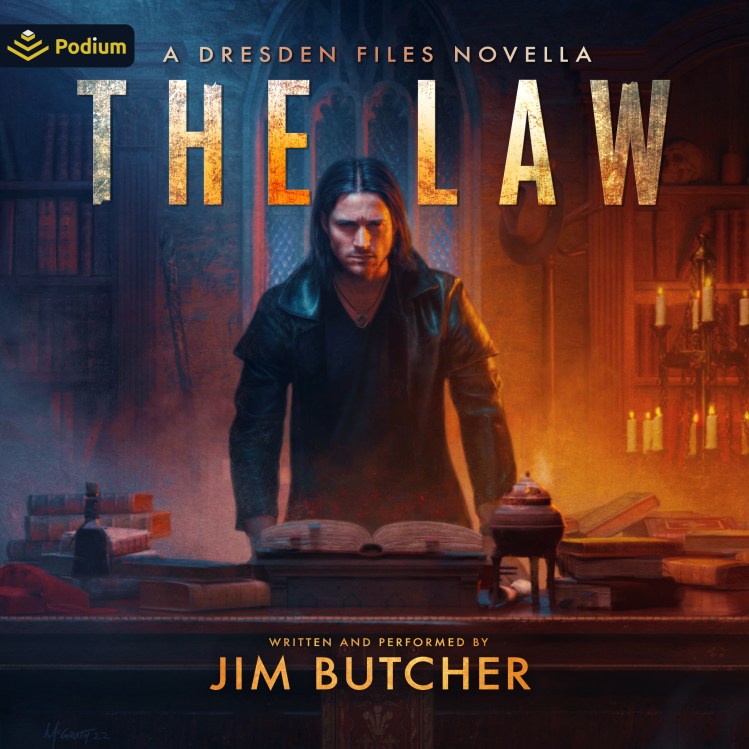
The Law Cover

Publisher: Podium Audio (Audiobook – 5 July 2022)

Series: The Dresden Files – Book 17.5

Length: 3 hours and 22 minutes

My Rating: 5 out of 5 stars

Amazon

Prepare to dive back into the wild world of Jim Butcher’s iconic Dresden Files series with the latest impressive novella, The Law.

Readers of this blog might have noticed that I usually don’t go out of my way to read too many novellas or short stories and instead usually focus on full-length novels and comics.  This isn’t so much a deliberate choice as I just prefer whole books I can really sink my teeth into.  However, I had to make an exception for the latest Dresden Files novella that Jim Butcher just dropped, as I have been deeply enjoying this epic series.

The Dresden Files are a long running series of urban fantasy novels that follow protagonist Harry Dresden, a wizard who protects the people of Chicago from the magic beings and creatures they don’t even know exist.  People may remember that I first got into the Dresden Files back in 2020 when I checked out the 17th entry in the series, Battle Ground.  While I did enter this series late in the game, I still had an outstanding time with Battle Ground and it ended up being one of my top books and audiobooks of 2020.  In fact, I enjoyed it so much that I went back and started reading the series from the beginning.  So far, I have been able to read the first four Dresden Files novels, Storm Front, Fool Moon, Grave Peril and Summer Knight, all of which have been pretty impressive and captivating reads.  This dive into the older novels, plus my lingering enjoyment of Battle Ground, ensured that I was ready and eager for any new Dresden Files content that came my way, and Butcher just delivered with his latest novella, The Law.

Set a month after the events of Battle Ground, The Law sees Harry Dresden and the city of Chicago still recovering from the invasion of the Titan Ethniu and her forces, which resulted in significant destruction.  However, Dresden is primarily mourning the tragic death of his love, Karrin Murphy, and even his new responsibilities as lord of a castle and protector of Chicago isn’t enough to keep his mind off his loss.  Determined to snap Dresden out of his funk, his friends decide to get him back to basics and introduce him to someone in need of a good investigator.

Enter Maya, a former prostitute turned tutor whose grassroots education company helps to supplement the education of Chicago’s working-class children.  Working hard, Maya has managed to turn her tutoring business into a viable, if low-profit, franchise that prioritises helping as many children as possible.  However, Maya’s past life is about to come back to haunt her in the form of her former pimp, Tripp Gregory, who initiates a bogus lawsuit against Maya’s company for a ridiculous sum.  Unable to afford a lawyer and desperate for help, Maya has no choice but to turn to Chicago’s resident miracle worker, Harry Dresden.

Deciding to the take on the case and hoping to quietly warn Tripp away from Maya, Dresden soon discovers that sometimes the most dangerous opponent is a greedy idiot concerned only for themselves.  Worse, Tripp and the case have unexpected connections to the magical world, with dangerous players taking an interest in its outcome.  Forced to deal with old and new foes of considerable power, Dresden will need all his wit and will if he is to save Maya’s business and ensure that justice is found.

Well, that has gone a long way to convincing me to check out more novellas in the future.  The Law was an epic read that took Butcher’s always outstanding Dresden File’s protagonist on a short, but extremely sweet, adventure.  Bringing Butcher’s usual flair and style, while also expanding on events from the last book, The Law was a great read that gets a full five-star rating from me.

Butcher pretty much teaches a master class on how to do a short, concise and captivating story here in The Law as, despite its length, this novella had an impressive and fun narrative that I found to be utterly addictive.  Not only does it serve as a great follow up to Battle Ground but it showcases some amazing character work while presenting the protagonist with an intriguing new adventure.  The story is so much fun, and I loved how it started as seemingly non-magical job and then morphed into something more dangerous and problematic as Dresden finds that it has connections with the magical world that forces him to deal with some of Chicago’s key players, including some old enemies.  Bringing a small but enjoyable amount of legal thriller aspect to the series’ usual urban fantasy crime fiction style, The Law goes in some fantastic directions, as Dresden attempts to placate all the players while also serving his client.  There is a great bit of action, a ton of humour, some intriguing revelations, and even some pretty dark moments, which combine extremely well to create quite the impressive narrative.  I loved how Butcher wrapped the entire novella up, especially with that one conference scene near the end, and the reader comes away very satisfied and entertained with the entire affair.  I cannot emphasise how great this story was, and I was so damn enthralled by it that I nearly finished it in an entire sitting.

One of the things that I particularly liked about The Law is the way that it serves as a bridging novella between Battle Ground and any future entries in the series.  Butcher spends a lot of time in this story looking at the aftermath of the previous novel, especially as Battle Ground featured that epic battle that saw Chicago nearly levelled.  As such, Butcher packs The Law with a ton of callbacks to the events of the last book, and there is a huge focus on how the various characters are dealing with the aftermath, especially Dresden.  There is also a very fascinating look at the rebuilding that is occurring during this time, as well as the current state of the citizenry, many of whom are traumatised or damaged because of a battle most of them couldn’t even fully comprehend.  I really appreciated seeing the various figures featured in The Law remembering or trying to understand the events of Battle Ground, whether they are a magical person who lost someone, a normal person who went through hell, or even one of Dresden’s Knights of the Bean, who now bear a dark connection with the protagonist.  Some of the details that came out as a result are deeply fascinating, and there are even a few hints about where some potential future storylines might go, such as increased Government awareness of magic (you see evidence of them covering up the events of Battle Ground here), or the increased fear that might lead to humans attacking magic kind in the future.  All of these are featured heavily in The Law, and I liked how it was well utilised for the current story, while also showing fans of the series how different the landscape of Chicago will be in the future.  I would say that this focus on the aftermath of Battle Ground did make The Law a little less accessible to those readers who haven’t read the latest Dresden Files novel, however, I think that if you are interested in reading this, then you should definitely read Battle Ground first.

I also must talk about the great character work featured in The Law.  Despite its shorter length, Butcher manages to fit a decent number of characters in The Law, and there are some impressive character arcs and development that occurs as a result.  Naturally, most of this is focused on series protagonist and central point-of-view character, Harry Dresden, who puts on his usual brave face for most of this novella, bringing his usual insights and wicked humour to the new case.  However, it soon becomes very apparent that Dresden is still heavily traumatised by the events of Battle Ground, where he lost so much because of the war.  Despite his best efforts to hide it, Dresden is a wreck for much of the story, and it was quite confronting and moving to see him experience blackouts and emotional strains due to the tragedies he has experienced.  I think that Butcher covered his protagonist’s trauma and grief in a pretty realistic way, and I liked how he tried to use an old-fashioned investigatory case as a coping method for Dresden.  It was great to see Dresden going back to his roots as a private investigator after the chaotic and world-altering events of the last few books, and it was interesting to see how much the character’s powers, methods, insights and choices have changed as a result of everything he’s seen.  The Law ended up being quite an intense and fantastic look in the recovering Dresden and readers will like seeing his emotional damage, his recovery, and even some of his darker moments that are contained within this excellent novella.

Aside from Dresden, The Law features an excellent array of supporting characters, who bring a lot to the narrative.  Butcher made sure to include a combination of new faces and existing characters to fill out the cast, and I had a blast with how they were utilised throughout.  Several of the funniest and most interesting recurring figures from the series had substantial roles here, including Bob, Gentleman John Marcone, and even Mab, and each of their appearances and interactions with Dresden were entertaining and fitting with their previous appearances.  I enjoyed many of the great new characters that Butcher introduced here.  Some of them, including a devilish lawyer with a shrouded identity, may come back in the future, and it will be interesting to see how they are utilised.  I also enjoyed main antagonist, Tripp Gregory, mainly because he was so different that Dresden’s usual antagonists.  Rather than being a magical creature or a major threat, Tripp is a normal and rather idiotic criminal, who has a surprising power: he’s too stupid to believe in magic and too self-centred to avoid all the trouble Dresden is bringing his way.  Dresden’s reactions to having to deal with such a selfish and unusual opponent makes Tripp’s inclusion totally worth it, and I had fun seeing his arc unfold.  These characters, and more, were awesome inclusions to The Law, and their unique inputs added a lot the quality and entertainment value of the entire novella.

Finally, a quick note on the audiobook format, which was how I enjoyed The LawThe Law audiobook has a very short run time of just over three hours and is a relatively easy audiobook to get through.  I always find myself really getting into Butcher’s excellent stories in this audio format, and this continued here with The Law, and it really helped me enjoy all the novella’s fun and entertaining details.  Probably the biggest thing about The Law audiobook was the choice of narrator.  I was deeply, deeply shocked when I discovered that long-time Dresden Files voice actor, the legendary James Marsters, wasn’t narrating The Law, and instead Butcher himself took over and voiced the entire thing.  Surprisingly, this ended up working out rather well and Butcher turned out to be a pretty competent and enjoyable audiobook narrator.  Don’t get me wrong, he’s no James Marsters (a point Butcher makes up-front, after promising Marsters would come back for future novels), but he does a really good job considering his lack of experience.  All the characters are given good, distinctive voices that fit their personalities and showcase their emotions and reactions perfectly.  His voice for Dresden was particularly good, and Butcher captured his creation’s cocky nature and damaged inner self perfectly.  While some of the accents he did were a little iffy, this was an overall fantastic performance from Butcher, and it was fun to see him contribute to his work in this way.  The Law audiobook ended up being an excellent and impressive way to enjoy this fantastic story, and it is easy the format I would most strongly recommend.

Jim Butcher continues to expand his epic Dresden Files series in some fantastic ways with the new novella, The Law.  Containing a compact, but highly impressive story loaded with some of Butcher’s best characters, The Law proved to be extremely entertaining and a lot of fun to get through.  Serving as a perfect follow-up to the major events of the last novel, The Law was an excellent and powerful entry in this long-running series that is a must read for all Dresden Files fans.

Amazon

Throwback Thursday – Warhammer: Van Horstmann by Ben Counter

Van Horstmann Cover

Publisher: Black Library (Paperback – 1 February 2013)

Series: Warhammer Fantasy

Length: 415 pages

My Rating: 4.75 out of 5 stars

Amazon

Welcome back to my Throwback Thursday series, where I republish old reviews, review books I have read before or review older books I have only just had a chance to read.  For my latest Throwback Thursday I review another awesome Warhammer Fantasy novel, the compelling and unique Van Horstmann by Ben Counter.

Another week, another Warhammer tie-in novel that I must review.  I have been really diving into this franchise over the last year; to be fair, there are some incredible books there, including the two 2022 Warhammer 40,000 releases that got a full five-star rating from me, Ghazghkull Thraka: Prophet of the Waaagh! by Nate Crowley and Assassinorum: Kingmaker by Robert Rath.  Some of the best of these books are tie-ins to the now destroyed Warhammer Fantasy universe, including the novel from last week’s Throwback Thursday, Runefang by C. L. Werner.  Well, my current obsession with all things Warhammer continued again as I recently read the awesome Van Horstmann by Ben Counter.  Counter is a well-established author of Warhammer fiction, having made a ton of impressive contributions to the franchise, including his Grey Knights and Soul Drinkers series, as well as his entries in the massive Horus Heresy series.  I was really drawn to Van Horstmann when I picked it up, not only because it has a great cover (love a cover with a dragon on it), but because of its intriguing plot, which sounded extremely awesome.

In the human realm known as the Empire, magic has been feared and mistrusted through most of its history, with practitioners hunted down and burned at the stake.  However, following the Great War against Chaos, the elven mage Teclis was allowed to train various talented humans in the use of magic, establishing the eight Colleges of Magic that train scholars and battle mages to help the armies of the Empire.  Out of all the colleges that were formed, the most revered are the College of Light, whose powerful light magic can be used to push back the darkness of Chaos.

Years after its formation, a young wizard manages to find the College of Light, hidden behind a magical barrier in the Imperial capital, Altdorf.  This wandering wizard, Egrimm van Horstmann, is a talented young mage whose desire for knowledge and skill at manipulating the Wind of Hysh immediately impress his new teachers, and many believe that he will rise high in the order.  However, van Horstmann has a dark secret that burns deep within him, and knowledge, power and ambition aren’t the only reasons for his joining the Light Order.

As van Horstmann rises in the ranks of his order, it soon becomes apparent that he has a diabolical plan.  Working with dangerous forces, including daemons, cursed items and even the Chaos god Tzeentch, van Horstmann begins to manipulate his order, the other colleges, and even the emperor to get what he wants.  But the closer he gets to achieving the goal, the more enemies he makes, and soon factions within the Light Order and the greater Empire begin to move against him.  Can van Horstmann succeed in his mission before his dark purpose is discovered, or will his dastardly designs unleash the great and uncontrollable power hidden at the very heart of the College of Light?

This was an impressive and deeply captivating Warhammer Fantasy novel, and I absolutely loved the elaborate and clever narrative that Counter came up with.  Focusing on an intriguing villainous figure and crafting an addictive story around him that also explores key aspects of the franchise’s lore, Van Horstmann was an outstanding novel, and it was probably the best Warhammer fantasy novel I have read so far.

Counter has come up with an excellent and impressive narrative for Van Horstmann, which, as the name suggests, is completely focused on the character of Egrimm van Horstmann.  For those who don’t know, van Horstmann was a minor special character for the Chaos army in some of the earlier editions of the games, but he didn’t have that much background or lore surrounding him.  I personally knew him due to his name being associated with one of my favourite magical items available to Empire armies in the later editions, Van Horstmann’s Speculum, which is a very fun surprise for an unwary foe (I have fond memories of using Van Horstmann’s Speculum in a game to switch stats between my Master Engineer and my brother’s Manfred von Carstein in a duel.  The look on his face as his ultimate general was suddenly weaker than my minor hero was just hilarious).  However, Counter manages to take the short background summary of the character and uses it as the basis for this novel, expanding on the tale of van Horstmann and showing how and why he infiltrated the Light Order and ended up betraying them, which results in an epic story.

Van Horstmann has a bit of a slow start to it, as Counter takes the time to set up key parts of the story, including an intriguing prelude that examines the first wizards of the Empire and their darkest secret.  From there, the story introduces the main character, van Horstmann, and shows his entry into the Light Order and his start as a student.  The story gets quite interesting after this, especially as you see van Horstmann involved in a demonic exorcism, which quickly highlights just how ruthless and cunning he can be.  The story picks up pace from there as you begin to witness van Horstmann’s inevitable rise to power as the full scope of his desire and despicable nature become fully apparent.  Most of the middle of the book showcases the characters careful and evil manipulations, as he manages to fool everyone and become more and more powerful through deals with daemons and the Chaos gods.  There are some brilliant scenes here as you witness the full scope of his plans, from a great battle scene against the skaven, to organising several duels between the various magical factions, all in the name of gaining power.  Counter really does a good job of showcasing this viewpoint through multiple perspectives, and while much of the focus is on the gloating van Horstmann, you also see how his actions impact several supporting characters, many of whom start to get suspicious.  The entire narrative has a great dark fantasy edge to it, that occasionally borders on horror (especially when the character interacts with some of the daemons and their dark gods), and I found myself really getting drawn into this story once everything had been set up.

This leads up to the epic conclusion that sees van Horstmann’s master plan enter its final phase while his enemies begin to realise his evil nature.  This ended up being an extremely impressive conclusion, and it really becomes apparent just how much stuff Counter had set up in the first two-thirds of the book.  Everything comes together here, as compelling story elements such as van Horstmann’s long-term plans, his troubled past, all his terrible actions while part of the order, the revelations about the foundation of the Light Order, several great secondary character arcs, and the attempted investigation by van Horstmann’s enemies, all pay off.  I really appreciated the brilliant and dark way that these storylines worked out, and there are some great revelations, especially around van Horstmann’s motivations and the full scope of his careful actions.  I loved the deep and very personal reasons behind the events, especially as van Horstmann has some extremely fantastic revenge planned, which was pretty epic to behold.  The entire novel ends on a brilliant note that sets up the character for his future appearances as a special character in the tabletop game, while also stabbing home that van Horstmann isn’t the absolute master manipulator that he thought it was.  This clever conclusion was the perfect ending to this gripping plot about a conniving and dangerously intelligent villain, and it was so much fun to see how everything ended.  These final pages and the outstanding conclusion they contained, definitely increased the overall awesomeness of the entire narrative, and seeing just how well every great twist and turn was set up is incredibly awesome.

This ended up being an excellent addition to the overall Warhammer Fantasy canon, and Counter did a wonderful job of working this elaborate and impressive story into the wider universe.  As I mentioned above, Van Horstmann adapted basic character notes from an older game book, and I felt that Counter expanded on all these details extremely well, working them into the wider history of the Empire.  There are some great explorations of several key factions throughout this novel, particularly the Empire and some of the forces of Chaos, and the reader really gets an impressive view of the iconic setting of Altdorf, where much of the narrative takes place.  However, the most detailed and fascinating part of Counter’s dive into the Warhammer Fantasy world revolves around the exploration of the Colleges of Magic in the Empire.  Without a doubt, Van Horstmann contains some of the best explanations of how human wizards perceive magic that you are every likely to see in a Warhammer novel and Counter spends a ton of time examining this.  While some of the explorations surrounding magic do get a bit overly metaphysical for their own good, they are always pretty compelling to see, and I loved how there is a fun focus on the various different orders of magic, especially Light and Gold magic, as there are some awesome fights between these groups.  However, it is the Light Order that gets the most attention in this novel, as the main character is nominally a member of this group.  There is so much detail put into showcasing the Light Order’s elaborate, hidden headquarters, as well as how their particular brand of magic works, and you come away with a pretty intense understanding of this, which I deeply enjoyed.

Now, due to the sheer level of intriguing detail and Warhammer Fantasy lore contained within this novel, Van Horstmann is a book best enjoyed by those already a fan of the franchise.  Counter dives into some fantastic and occasionally obscure parts of the lore, and established Warhammer fans will really appreciate the clever touches and revelations featured within.  That being said, Counter also spends time ensuring that new readers will be able to follow the narrative rather easily, and a lot of the book’s exposition is spent establishing the history, magical elements, and some of the key factions for new readers.  As such, pretty much anyone who loves a good dark fantasy story can easily enjoy Van Horstmann as a novel, and I am sure that most people will have an excellent time with its very clever and intense narrative.  However, Warhammer fans are going to get the most out of it, and this probably isn’t the best first book for those readers interested in exploring the Warhammer Fantasy universe (the Gotrek and Felix novels, such as Trollslayer, would be my recommendation).  Nevertheless, this is an exceptional Warhammer Fantasy read that will appeal to a wide cadre of readers.

There is some great character work featured in Van Horstmann, which naturally focuses primarily on the titular character.  Counter really gets into the mind of van Horstmann in this book, and while most of the time you only see the supremely confident wizard who delights in manipulating men, wizards and daemons, there is a lot more under the surface.  This includes a tragic backstory that serves as the motivation that drives him to do all the terrible things he wants to do here.  While it would be rather easy to hate this character, especially with his inherent arrogance, I found myself getting drawn into his multiple plots and machinations, and you end up rooting for him just to see how all his plans unfold.  Despite that, it is also quite fun to see misfortune strike him, especially the fun twist at the very end of the book where his overconfidence comes back to bite him in a big way.  I had an outstanding time following van Horstmann in this fantastic novel and he proved to be a very fun central figure in this book.

Due to the massive focus on van Horstmann, Counter doesn’t spend a lot of time building up a lot of the side characters.  Despite that, there are a few interesting supporting characters and storylines that add a fair bit to the narrative and which have some compelling connections to the main plot.  Various members of the Light Order are featured throughout, and I liked the way that Counter portrayed them as mostly being quite full of themselves and unable to consider treachery from within their order.  Watching them get taken down a massive peg by van Horstmann is a little satisfying at times, especially when their fates are well deserved, although there are a few tragedies thrown in at the same time.  Other great characters include the manipulative Skull of Katam, a sentient magical skull who guides van Horstmann for its own reasons, and who served as an untrustworthy accomplice for a good part of the book.  Finally, there is also the interesting character of Witch Hunter Argenos, a rabid religious zealot who hunts agents of dark magic and the Chaos gods.  Argenos serves as a good counterpoint to many of the more magical characters, and his deep drive and desire for religious justice, helps to turn him into an excellent threat to van Horstmann.  These side characters, and more, have some interesting moments in the book, and I liked their excellent contributions that combined with Van Horstmann’s main tale in some fantastic ways.

Containing an addictive, powerful and brilliant story, Van Horstmann by Ben Counter is an incredible and awesome Warhammer Fantasy novel that follows a fantastic villain as he dives deep into the world of magic.  I loved the elaborate and captivating tale of revenge and dark power that Counter came up with here, and readers will swiftly get drawn into this amazing novel.  An excellent in the Warhammer Fantasy canon, Van Horstmann is an exceptional read that comes very highly recommended.

Amazon

Throwback Thursday – Warhammer: Runefang by C. L. Werner

Runefang Cover

Publisher: Black Library (Paperback – 24 June 2008)

Series: Warhammer Fantasy

Length: 413 pages

My Rating: 4.5 out of 5 stars

Amazon

Welcome back to my Throwback Thursday series, where I republish old reviews, review books I have read before or review older books I have only just had a chance to read.  For this week’s Throwback Thursday I have a look at a classic Warhammer Fantasy adventure novel with the entertaining fantasy thrill ride, Runefang.

I have been reading an awful lot of Warhammer 40,000 novels lately, but deep down my heart will always belong to the Warhammer Fantasy franchise, as that was the game that I played back in the day.  Even though the Warhammer Fantasy game has ended (replaced by The Age of Sigmar), while it was going the Black Library invested a lot of time into creating some excellent novels in this setting, which I have also been enjoy recently.  This includes the awesome Broken Honour and some of the earlier entries in the iconic Gotrek and Felix series (including Trollslayer, Skavenslayer, Daemonslayer, Dragonslayer and Beastslayer).  Even after reading these, I am still in the mood for more fun Warhammer Fantasy adventures and so I just read Runefang by established Warhammer fiction author C. L. Werner.  Werner, whose other writing credits include the Witch Hunter, Thanquol & Boneripper and The Black Plague series, came up with a compelling idea for this novel which I had a lot of fun getting through.

As civil war, discord and political instability rock the human realms of the Empire, a far greater threat marches upon it from the south.  A massive horde of undead creatures has been raised from the grave and is  cutting its way through the heavily populated province of Wissenland.  As the forces of Wissenland gather to fight, they are disheartened to find that these are not the typical shambling herd of undead horrors, but a well-organised, highly disciplined force of relentless fighters with dangerous magic backing them up.  Worse, the leader of this force is a true monster, the wight lord Zahaak, an ancient general of the legendary dark necromancer, Nagash, who has risen from his last defeat to finally achieve the victory he promised centuries before.

After several devastating slaughters, it becomes apparent that the undead force before them is unstoppable and the only way to defeat it is to kill the unkillable undead general.  In desperate need of anything that will save his realm, the Count of Wissenland and his advisors come up with an unlikely plan: recovering the Solland Runefang.  Lost years before when an orc raid destroyed the former province of Solland, the stolen Runefang, one of the legendary 12 swords signifying rulership of the Empire’s provinces, is rumoured to be the only weapon capable of killing Zahaak.

The task of finding the Runefang falls to Baron von Rabwald, who pulls together a small expedition of soldiers, knights and adventurers and leads them to the Runefang’s purported hiding place in the Worlds Edge Mountains.  However, this is no easy quest, and the chances of success are low, especially as the Worlds Edge Mountains are a notorious haunt for monsters, orcs and innumerable other dangers.  Worse, they are not the only group seeking the lost Runefang, and the fell magic of Zahaak is never far behind.  Can the expedition recover the Runefang before it is too late, or will Wissenland fall at the hands of its greatest foe from the past?

This was an outstanding and extremely exciting Warhammer Fantasy novel that I had a wonderful time reading.  C. L. Werner did an excellent job providing readers with an amazing fantasy adventure, and Runefang has a lot of great elements that will appeal to a wide range of readers.

At the heart of Runefang lies a captivating and highly enjoyable fantasy narrative that quickly drags the reader in with its impressive action, enjoyable characters, intriguing examination of the Warhammer world, and exciting adventure narrative.   Starting off with a fantastic introduction that sees the Wissenland army’s first disastrous attack against the undead horde, you are swiftly brought into the middle of the conflict as you witness the aftermath of the defeat, which also introduces several of the main characters.  Following some compelling exposition about the enemy they are facing, the story splits into two parts, with Baron von Rabwald leading most of the supporting cast off to find the lost Runefang, while the rest of the story focuses on the Count of Wissenland’s attempts to delay the undead army to give the adventurers time.  This split works really well, and seeing the disasters unfolding in Wissenland heightens the stakes of the expedition’s adventures and ensures that the reader is even more invested in its outcome.  The expedition storyline encounters multiple obstacles throughout their adventure, including monsters, traps, and orcs and goblins.  They are also forced to deal with a rival force of humans who are also hoping to claim the Runefang, untrustworthy mercenaries, as well as a traitor within their ranks who is helping the enemy.

This all translates into a very good and action-packed adventure, and I loved seeing all the epic events unfold through the eyes of the varied characters.  The story chugs along at a quick and exciting pace, with a good combination of action, dark moments and some fun, if grim, humour that I quite enjoyed.  Werner also ensures readers are in for a wild ride by not being sentimental when it comes to character survivability.  This became really apparent around halfway through Runefang when several key characters, many of whom had been built up in a big way for most of the narrative, were very suddenly killed off, and one of the supporting cast took the reigns as lead protagonist.  While this was a little surprising, I think it worked rather well, and it added to the suspense and drama of the tale, as the new protagonist is forced to make some big choices and deals to keep the quest alive.  Following this, the story keeps advancing at a great pace, with new foes and dangers appearing the closer the protagonists got to their goal.  This leads up to the epic final sequences of the expedition narrative, and it was fantastic to see the surviving protagonists go up against all the villains that had been chasing them in a big, extended confrontation, and Werner kept continuously hitting the reader with twists, surprises and dangers.  The reveal about the traitor in the ranks was pretty good, especially as Werner threw in an excellent red herring character (although by the time it is revealed, there were limited potential characters who it could be).  Everything comes together extremely well, with all the storylines and character arcs reaching their natural end, and I felt that it was an excellent, if rather bittersweet, conclusion.

I have to say that this was a particularly good and accessible entry in the wider Warhammer Fantasy canon, which is very well suited to this sort of immense and powerful story.  While Werner could have just phoned in Runefang with a generic adventure story set in the universe, he does a great dive into the lore.  This novel is set well before the events of most Warhammer Fantasy novels and takes place during the Age of the Three Emperors, where the Empire was split by a raging civil war.  As such, the province of Wissenland is on its own throughout the novel and must also deal with the substantial machinations of its neighbours as it fights to survive, which gives it a great additional edge of intrigue.  The author also spends a great deal of time focusing on the ruined province of Solland and the importance of its lost Runefang.  It was fascinating to see the ruins of Solland in Runefang, as it was still badly scarred by the orc invasion that destroyed it, and the impact of Wissenland’s absorption of it was quite interesting.  I also really appreciated the fantastic portrayal of the notorious Worlds Edge Mountains, the former realm of the dwarfs that is now controlled by orcs, bandits, and monsters.  The author did a really good job showing this to be a desolate and dangerous place, and he really did not disappoint when it came to featuring the variety of cool creatures and threats it contains, forcing the protagonists up against dangerous odds again and again.

Finally, I must highlight the author’s excellent use of the undead army in this book.  Rather than using the armies of the Vampire Counts or the Tomb Kings (which were the two undead factions at the time of Runefang’s release), Werner features a historic army of undead creatures who have risen after their defeat during the early days of the Empire to have their vengeance.  As such, they are a unique force of undead creatures, and I loved seeing them in action, particularly as you get some awesome reactions of terror from the human characters observing them.  Overall, I really loved the cool use of Warhammer Fantasy elements, history and settings in Runefang, and I felt that this was the sort of Warhammer novel that any fantasy fan could pick up and enjoy.

I also need to highlight all the impressive action featured throughout Runefang, and Werner has a clear talent for making fight scenes come to life in a big way.  There are so many battles throughout this book, and each of them is showcased to the reader in exquisite detail.  Whether it be a small skirmish, a one-on-one fight, a brawl against a giant monster, or a large pitched battle between armies, the author ensures that the reader gets the full sense of everything that his happening.  It was extremely cool to see all these fights unfold, and I was able to mentally see every sword swing, desperate charge and epic moment.  I liked how some of these fights emulated the battles from the table-top Warhammer Fantasy game, and you could really envision how they would have looked being played out on the board.  These action scenes combined well with the awesome and exciting story, and I think that they strongly enhanced my enjoyment of Runefang.

The final thing I want to talk about is characters, as Runefang features an excellent and massive cast of distinctive protagonists and villains.  Now, I am not going to go into too much detail about character arcs or development here, as to do so might ruin which key characters are killed off early.  However, I have to say that I was really impressed with the awesome way that Werner introduced each of the major figures in the book.  As such, you quickly grow to like many of the figures in Runefang, especially as Werner goes out of his way to feature a unique and often damaged group of protagonists to fit the story around.  I will say that I deeply enjoyed the Baron’s notorious and scarred champion, Kessler, who has some great moments; the dwarf Skanir, who serves as cantankerous guide; and the fantastic duo of the halfling Theodo Hobshollow and his ogre sidekick, Ghrum, who were an excellent and entertaining comic relief team.  There are also some really good villains in this novel, including the bandits who are also after the Runefang (featuring a brilliantly despicable leader and an entertaining pair of cowards), and an extremely dangerous orc warlord, Uhrghul Skullcracker.  Uhrghul was a particularly fun character, and I liked both his philosophical insights about being an orc leader as well as his effective way of questioning human prisoners (eating my legs in front of me probably would get me to talk).  I did think that the main villain of Runefang Zahaak was a tad underdeveloped, even if he was shown to be an epic badass with major historical cred to his name.  However, this might have been a deliberate choice by Werner to highlight the uncomplicated nature and motivations of the undead compared to the more insidious, evil, or animalistic plots of the humans and orc villains.  I had an amazing time following these characters, just try not to get too attached to any of them.

Filled with fantastic action, a compelling adventure storyline, fun characters and great use of the Warhammer Fantasy setting, Runefang was an outstanding novel from C. L. Werner that I had an amazing time reading.  Werner really went out of his way to create the most impressive and exhilarating fantasy adventure he could, and the result is really worth checking out.  A highly recommended Warhammer fantasy novel that you are guaranteed to have fun with.

Amazon

Against All Gods by Miles Cameron

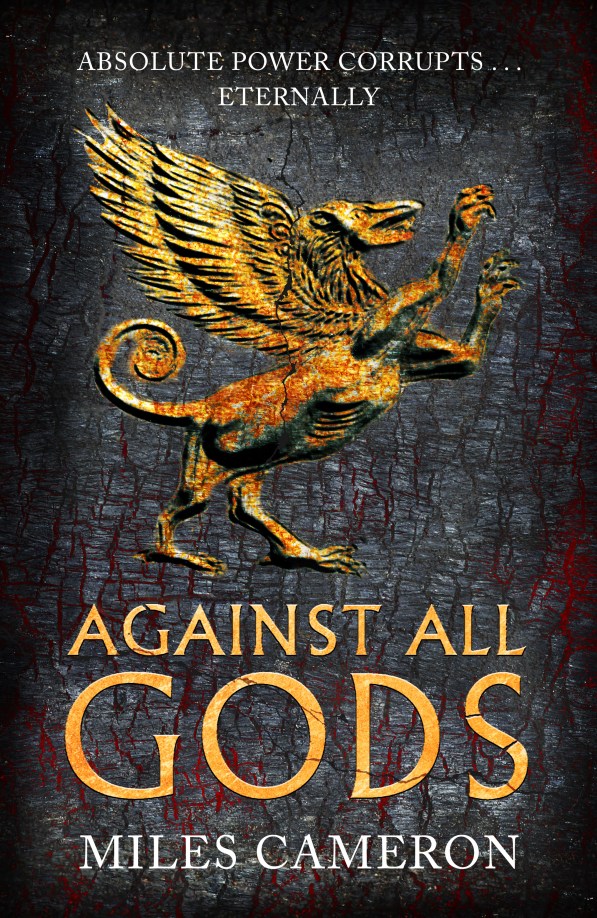
Against all Gods Cover

Publisher: Gollancz (E-book – 23 June 2022)

Series: The Age of Bronze – Book One

Length: 465 pages

My Rating: 5 out of 5 stars

Amazon     Book Depository

The always impressive and inventive Miles Cameron returns with another awesome novel, Against All Gods, a compelling epic with a truly divine story.

There are few authors with more of a diverse catalogue of books than the talented Miles Cameron.  The pseudonym of historical fiction author Christian Cameron (who has also released novels with his father, Kenneth Cameron, under the joint pseudonym Gordon Kent), Cameron has been on a real roll with his fantasy and science fiction novels lately.  Not only did he have great success with his incredible Master and Mages series, which included Cold Iron and Dark Forge (one of my favourite novels and audiobooks of 2019), but he also successful released his first foray into science fiction last year with Artifact Space (one of my favourite books of 2021).  As such, I have been keenly anticipating Cameron’s latest read and I was extremely excited to receive an early copy of his latest fantasy novel, Against All GodsAgainst All Gods is the awesome first entry in his new The Age of Bronze series, which follows a group of desperate mortals as they attempt to overthrow an entire deadly pantheon of gods.

In a damaged world filled with death, despair and injustice, the gods rule with an iron fist.  Secure in their power and glory after destroying or banishing the previous pantheon, the current gods make games of the lives of mortals, controlling them for their own gain and punishing them on a whim.  However, the gods are not as secure as they would hope, and all it will take is one spark to ignite a deadly rebellion against them.

When the daughter of powerful magos and aristocrat, Gamash of Weshwesh, is killed by a malicious god, it sets off a chain of events that will change everything.  Determined to get revenge, Gamash finds himself a willing tool of an older god who exists to stir up chaos and challenge her new masters.  Following the signs laid out before him, Gamash receives weapons that can hurt the corrupt divine beings and embarks on a quest to challenge the gods once and for all.

As Gamash’s quest continues, he is soon joined by an eclectic mixture of mortals, all of whom have their own issues with the current deities and who have been manipulated to fight against them.  Faced with dangers at every turn and soon caught up amid multiple divine conspiracies, these reluctant rebels soon begin to understand the full extent of the danger they find themselves in.  Determined not to be mere pawns in a cosmic game of immortal gods, the rebels will decide to do the impossible: go up against all the gods and win!

Wow, Cameron continues to impress me with his unique and incredible story writing.  Against All Gods is a distinctive and powerful read that takes multiple fantastic characters on an epic adventure through a great new fantasy landscape.  I loved the powerful narrative that Against All Gods contained, and it really did not take me long to become incredible addicted to its twisty and compelling tale.  Complex, utterly enthralling and very fun, Against All Gods was an excellent read and I honestly have no choice but to give it a full five-star rating.

Against All Gods has an outstanding story that I had a wonderfully entertaining time reading.  Essentially a Bronze Age inspired fantasy that sees multiple mortal characters caught up in the multiple machinations of the gods, this is a particularly fun and over-the-top narrative that you cannot help but fall in love with.  Against All Gods’ narrative has an excellent flow to it that individually introduces the substantial main cast and showcases their various pasts and issues they have with the ruling pantheon.  These initially separate storylines come together towards the centre of the book, once all the protagonists are thrust together by their unseen benefactor, and it swiftly evolves into a powerful plot, with the same events beautifully showcased from multiple different narrators.  At the same time, much of the story follows the machinations of the gods as they plot and backstab against each other, while also attempting to counter the actions of the mortal characters.  These scenes set in Heaven are often the most entertaining parts of the book, especially as Cameron produces a ton of twists and facilitates the multiple scheming deities, each of whom has their own plans.  These multiple storylines combine for a massive and awesome conclusion, as the protagonists come face-to-face against the gods in their opening salvo.  There are some truly epic scenes in this final part of the novel, and Cameron ends the book with some fun surprises and reveals that indicate how awesome the rest of The Age of Bronze series is going to be.

I really liked the style of Against All Gods, which is a slight departure from some of Cameron’s previous novels.  Despite the Bronze Age setting, the characters, attitudes and personalities are a bit more modern than some of Cameron’s existing fantasy books, and I think this really fit Against All Gods’ over-the-top narrative extremely well.  This is easily one of Cameron’s more elaborate narratives, and I loved how he started utilising a large range of character perspectives, rather than focusing on a single central protagonist.  Again, this works extremely well for this novel’s plot, and it helps to introduce the various outrageous characters and highlight the completely insane pantheon of gods who are fighting behind the scenes of the main story.  Cameron’s proven ability to craft a complex and highly detailed story is once again on display here, and every scene comes across in a powerful and expansive way, painting a powerful picture.  This works particularly well during the many impressive action sequences, and the reader is really drawn into the intense battles and fights that occur.  The narrative itself has an excellent blend of world building, character development and classic adventure, all of which is bound together by a healthy and entertaining dose of intrigue and deceit.  I was very quickly drawn into the unique story that Cameron was telling here, and I found it very hard to put this book down in places, as I really wanted to see what happened next.

You can’t discuss Against All Gods without mentioning the impressive and highly complex new world that Cameron has come up with.  Cameron has clearly combined two of his literary loves here, producing an intense and dangerous Bronze Age fantasy world clearly inspired by ancient Greece, especially its mythology.  As such, you get some glorious scenes of bronze covered soldiers facing off against each other, elaborate Mediterranean inspired cities, and a ton of awesome depictions of ancient seafaring ships.  However, there are some noticeable differences as this version of the world is ruled over by a corrupt and dangerous pantheon of new gods.  Centuries ago, this pantheon arrived in this world, mostly destroying the previous pantheon, and completely taking over the lands.  Their rule has become an insanely despotic one, where only they and their minions profit, while the people are now forced to worship them and ignore their old gods while powering the petty choices of their new masters.  The subsequent world is a dark and brutal place which serves as an excellent background to the powerful and exciting narrative Cameron has come up with for Against All Gods.  The idea of a Bronze Age society totally dominated by an evil pantheon of invading gods is exceedingly inventive, and Cameron really makes it work, showcasing all the ways that the gods screw over humanity and control them.  There are so many fun details here, with the new hierarchy, the multiple magical eyes that turn the lands into a divine surveillance state, and even the enforced reliance on bronze, as the gods have removed all iron from the world.  Throw in several awesome cultures, some unique creatures (the Dry Ones are pretty awesome), and even a marauding army of murderous savages, and you have a brilliant backdrop to this story that I found to be extremely cool.  I look forward to seeing how this setting evolves in the future and I am sure that Cameron has some more bonkers ideas for it.

One of the other great things about Against All Gods was the impressive and compelling collection of characters that Cameron focuses the story on.  There is a great group of point-of-view figures throughout this novel, and the author generally breaks these up into mortal and divine characters.  Most of the novel focuses on a small band of mortals who are framed as the protagonists of the series, each of whom has their own grudges and reasons to dislike the gods.  I felt that Cameron did an awesome job of presenting all these main characters at the start of Against All Gods, and their extended introductory chapters really allow the reader to get to know them and understand their unique stories and histories.  These characters include Gamash, a powerful magos seeking revenge against the gods after they kill his daughter, and who serves as a tragic figurehead for most of the plot.  He is joined by other impressive characters, like Era, a singer and dancer, whose extreme confidence, impressive sarcasm and tough exterior are at great odds with her warm interior.  Era, who is also an excellently represented lesbian character, serves as a great foil to the rest of the cast.  She really plays off Zos, a Godborn warrior, whose martial prowess and cynical worldview brings him into conflict with the gods, especially after he incurs their wrath.  The major protagonists are well rounded out by Pollon, a former highborn scribe and intellectual, whose cushy life is crushed in a matter of days, which convinces him to go up against the gods.

These four protagonists are backed up by an intriguing and eclectic mixture of supporting characters, each of whom bring something special and fun to the mix.  This includes the crew of the Hakran ship, Untroubled Swan, led by Aanat, another substantial point-of-view figure.  The Hakran are a curious group of characters, serving as one big polygamist family, which makes for some very interesting dynamics in the book.  They are also major pacifists who are manipulated into helping the heroes and who constantly find their wishes and way of life threatened by the actions of their new comrades.  I also had a lot of fun with Daos, a mysterious child adopted by Era, who bears an odd gift that allows him to see the world in different ways, and who helps to guide the protagonists to some interesting directions.  These characters and more (there is a fantastic stuffed bear and donkey combination that works surprisingly well) are a lot of fun to watch, and the constant interactions and intriguing developments help to enhance the plot.  While the plot was a bit bogged down in places with too many characters at once, this was an overall good collection of supporting figures who had some fun storylines between them.

I also really must highlight the fantastic god characters in Against All Gods.  Cameron has gone out of his way to create a truly vicious, conceited and manipulative troop of deities, each of whom is in it for their own benefit or power.  This pantheon is led by the bull-headed thunder god, Enkul-Anu (essentially Zeus), a powerful and stubborn being who conquered the previous gods and installed his kin as the new rulers of this world.  Forced to control a group of idiotic, rebellious or half-insane gods, as well as the always troublesome mortals, Enkul-Anu is an angry and exasperated figure in this novel, constantly at his wits ends with the stupidity and self-serving nature of the other gods.  Even though he’s the brutal main villain, you can’t help but feel a little for Enkul-Anu at times as he must deal with all the issues his followers have created.  He is well matched by an excellent group of other gods, including a fantastically depraved and eternally underestimated god of drunkenness and orgies, Druku; his beauty-obsessed consort, Sypa; his ambitious son and herald, Nisroch; and two troublesome sisters, the Huntress and the Blue Goddess, who constantly seek to destroy him.  All these excellent characters, plus several insane greater gods and their ultra-keen offspring, serve as a brilliant pantheon of villains, and I had so much fun with their manipulative and selfish actions.  The intriguing interactions between these characters are extremely entertaining, and you won’t believe who comes out on top at times.  I can’t wait to see how these gods continue their battles in the future, especially after the results of this book’s crazy conclusion.

With Against All Gods, the first book in his brilliant new fantasy series, Miles Cameron continues to shine as one of the most inventive authors out there.  Featuring an extremely compelling narrative that pits likeable mortal characters against selfish, all-powerful gods in a Bronze Age setting, Against All Gods is a layered and deeply entertaining book that comes highly recommended.  This was a truly awesome read and I look forward to seeing how Cameron continues The Age of Bronze series in the future.  The next book in this series, currently titled Storming Heaven, is set for release in a year’s time, and I personally can’t wait to get my hands on it.

Amazon     Book Depository

Master of Furies by Raymond E. Feist

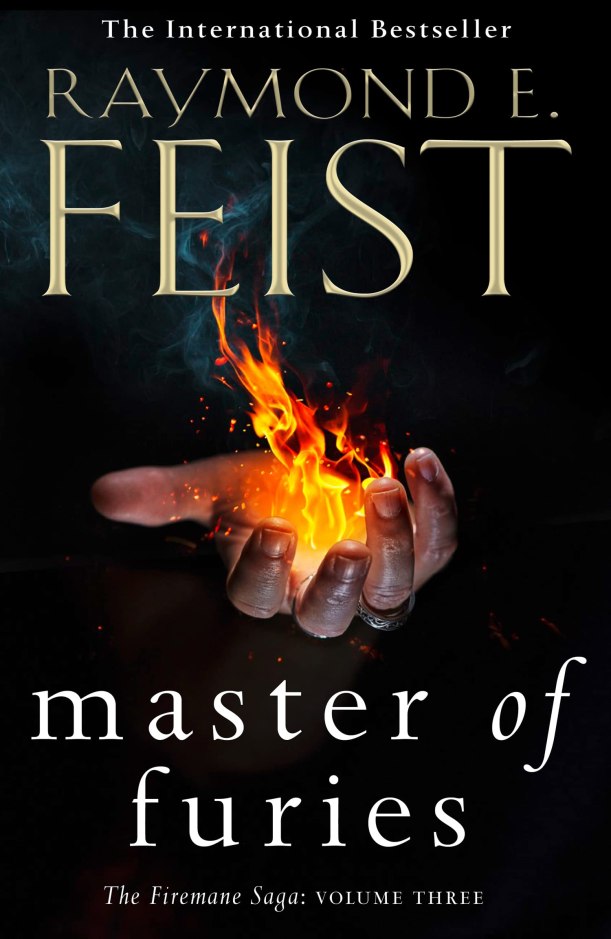
Master of Furies Cover

Publisher: Harper Voyager (Hardcover – 5 July 2022)

Series: The Firemane Saga – Book Three

Length: 515 pages

My Rating: 4.5 out of 5 stars

Amazon

One of the leading authors of fantasy fiction, Raymond E. Feist, brings his Firemane Saga to an end in a big way with the impressive and deeply entertaining Master of Furies.

I was recently in the mood for some classic high fantasy awesomeness, and few people do high fantasy better than one of my all-time favourite authors, Raymond E. Feist.  I have been a massive Feist fan for years, ever since I stumbled upon his epic Riftwar Cycle in my youth.  Made up of around 30 connected novels in a massive, multi-world universe, including his epic debut, Magician, and the fantastic Empire trilogy (co-written with Janny Wurts), the Riftwar Cycle contains so many fantastic stories and it remains one of the seminal pieces of fantasy fiction out there.  Feist appeared to finish the Riftwar Cycle off in 2013 and after a break he started working on a different fantasy series, the Firemane Saga.

Set in a new fantasy world, the Firemane Saga followed several great protagonists as they found themselves dragged into a series of conflicts that threaten to tear their continent apart.  This series started in 2018 with King of Ashes, an excellent book that served as a brilliant introduction to the setting, story and characters.  This series was continued in 2020 with Queen of Storms, which continued the various character-based storylines, expanding on some existing elements while also throwing in a ton of new enemies and some surprising changes.  This second novel included a pretty fantastic twist halfway through, as one of the major settings of the series was completely destroyed and various supporting characters were killed off.  I have been eager to see how this series would continue and I was pretty excited when I saw that the third and final book in the series, Master of Furies, was set for release this year (it was one of my most anticipated releases for the first half of the year).  I ended up grabbing this book the day it came out and I swiftly got drawn into its fun and action-packed story.

War and death have come to the Barony of Marquensas after unknown raiders from across the seas arrived and laid waste to everything before them.  Their most savage action saw them destroy the town of Beran’s Hill, which resulted in the death of Gwen, Declan Smith’s beloved wife.  Now determined to get revenge, Declan has become a soldier and allied with Baron Daylon Dumarch, whose family was also killed in the raid.  As the Baron gathers a new army around him, Declan travels to the desolate far south of Tembria to recover rare materials that will allow him to forge the best weapons and armour for them.

At the same time, Hava, former spy for the shadow nation of Coaltachin, has drawn first blood against the mysterious forces attacking her friends.  After capturing the enemy ship, Queen of Storms, Hava has become a notorious pirate captain, raiding ships from across the waves to find out who or what is threatening Marquensas.  Her investigations will eventually lead her to the hidden continent of Nytanny, where a powerful group holds sway of a vast population of warring nations.

As Hava, Declan and Baron Daylon prepare their forces to fight whatever lies within Nytanny, the fate of the world may rest in someone else’s hands.  Hava’s husband, Hatushaly, the last living member of the Ithrace royal family, has finally discovered his legacy as a legendary Firemane.  Under tutelage on the hidden island Sanctuary, Hatushaly works to hone his destructive magical abilities.  But as his powers grow, Hatushaly will find himself thrust into events beyond his control.  A new darkness is rising within his world and Hatushaly will need all the help he can find to stop it.

This was another awesome book from Feist that I felt was a great end to the excellent Firemane Saga.  This third and final book takes the character-driven story in some fantastic directions, and I think that Master of Furies was one of Feist’s better recent novels.

I had an outstanding time getting through Master of Furies’ clever and compelling narrative and I really enjoyed the elaborate and exciting third part of the series.  Now, I must admit that I initially had a bit of a hard time getting back into this book, mainly because it had been two years since Queen of Storms’ release and I had forgotten some of the story details from the preceding novels.  I probably should have done a bit of a reread of the series before starting Master of Furies, and this is one of those cases where interested readers should really check out the first two novels first. Master of Furies immediately dives back into the plot lines from the last book, and while a lot of elements are recapped, it does help to remember how the series has unfolded.

Master of Furies is told from multiple character perspectives as all the protagonists from the first two novels are featured here.  There is a good mixture of different storylines throughout the novel, including the mystical training of Hatushaly, the adventures of Declan in a hostile desert, political intrigues occurring with Marquensas, and Hava’s nautical and espionage activities as she sails from location to location, attempting to find out who they are actually fighting.  All of those storylines are spread out evenly through the book and they played off each other well, coming together into an exciting and expansive narrative.  I particularly liked Declan’s storyline, not only because it was a very good example of a classic fantasy adventure but it also expertly showcased the character’s grief and anger after the events of Queen of Storms.  I liked the balance between action, world-building and character development contained in each chapter, and this book had an amazing flow to it.  The action scenes are particularly well written, and Feist features multiple epic battles and fights that really get the reader’s adrenalin pumping.  The resulting story is very well paced out and there are no slow spots in the story at all.  Each of the separate stories start coming together a lot more towards the centre of Master of Furies as Feist starts to prepare for the big conclusion.

While I was initially worried that Feist was going to rush the conclusion too much (I had some doubts with 150 pages to go, as there seemed to be too much that needed to get wrapped up), this ended up coming together really well.  The established character arcs ended on an awesome (if slightly predictable) note and most of the open storylines are resolved in a satisfying manner.  It was great to see some of the fun characters you have grown to like over the course of the trilogy finally get what they deserve, while others start new adventures that will lead to some interesting storylines in the future.  Feist also works to set up some interesting storylines for the future and it is pretty clear that he has intentions to produce some form of sequel trilogy or series in the future.  An overall strong and exciting story, I absolutely powered through this book and I was extremely entertained and happy the entire way through.

There was some interesting world-building in Master of Furies that I quite enjoyed as Feist sought to expand on his already established new fantasy realm.  Not only did Feist take one of his main characters to the previously unseen harsh deserts at the lower part of the main continent of Tembria, but we also got our first real look at the rival continent of Nytanny, where most of the antagonists originate.  I found both areas to be fascinating and detailed as Feist does a great job of building up both settings in this novel, ensuring that the reader gets an idea of geography, culture and history.  I had a great time exploring both, and the fantastic landscapes of south Tembria were particularly cool, especially as one of the main protagonists spends half the book facing off against every enemy and threat he can find there.  I did think that the focus on Nytanny came too late in the trilogy, as Feist has deliberately kept this continent and its people obscured from the reader and the main characters.  While this did enhance the mystery surrounding their actions, it did mean that their sudden reveal in this book felt a tad forced and you did not care as much about who they were or savoured the eventual counterattack against them by the protagonists.  Likewise, some of the political situations in the rest of Tembria that were featured in the earlier books, such as the impacts of the corrupt Church of the One and the politics of the other kingdoms of Tembria, are somewhat ignored here in favour of focusing on the characters in Marquensas.  While I do not think this took away from the narrative too much, it might have made for a more elaborate and complete universe if more of these missing elements had been explored in more detail (I reckon Feist could have turned this into a four-book series to properly set up this world).  Still, I really enjoyed the rest of the world-building and the change in the settings in this book, particularly surrounding the impacts of the massive raids from Queen of Storms which have devastated not only the Barony of Marquensas but also the various other kingdoms and lands featured in the book.  I really hope that we get to see a lot more of this world in Feist’s future novels as I really want to see how it progresses and changes as it faces more dangers.

For the final thing I wish to discuss about this novel, I think I’m going to have to put a Spoiler Warning into effect as some of the details I’m about to discuss are significant and one of the more surprising things about Master of Furies.

This feature was the intriguing connection that Master of Furies, and by extension the entire Firemane Saga, has with Feist’s established Riftwar Cycle.  I was pleasantly surprised when, seemingly out of nowhere, one of the most entertaining characters from the Riftwar Cycle suddenly appeared in the narrative and started helping Hatushaly learn how to control his magic, revealing that this new world is set in the same joint universe as Feist’s previous series.  While I really should not have been too surprised, (multiple alternate fantasy worlds are a staple of Feist’s writing), I honestly did not see this coming.  In hindsight there were some subtle hints in some of the previous books, but I did not realise to what extent the author intended to bring everything together.  Feist really goes to town on the connections in this third book, and soon several additional Riftwar Cycle characters appear, referring all the existing books.  It soon became very clear at the end of Master of Furies that the author was intending to substantially combine the Firemane Saga with the Riftwar Cycle, especially when an established malevolent presence was discovered on this new world.  The book ends on a very interesting note, with the main characters of this series meeting with two of the biggest characters from the Riftwar Cycle, and it looks like Feist’s next trilogy is going to combine these two universes together in even more substantial ways.

Now, bringing the Firemane Saga into the larger Riftwar Cycle is a bit of a double-edged sword for Feist, although it is one that I personally enjoyed.  I loved the surprise at seeing some of these favourite characters come across each other, and every single new connection or reference brought a thrill for me, Feist nerd that I am.  However, I know that some readers are going to be disappointed, especially as people who were hoping for something new from Feist suddenly got thrown back into the author’s established universe and characters.  This connection also means that those readers unfamiliar with the entire Riftwar Cycle might get a little lost here, especially if they do not fully realise the significance of events or characters.  While Feist does a good job of highlighting who these characters are and why readers should care, I can see some people getting confused about what is going on.  As such, I can understand if some readers are frustrated, but I think it was a great choice by Feist and I loved seeing the author bringing everything together.  If nothing else, this is probably going to inspire me to do a big Feist re-read at some point in the future, especially if all his previous novels are going to come into play in his next series (can I read all the Riftwar Cycle novels before Feist’s next book? I don’t know, but I’m willing to try).

Spoiler Warning End

Raymond E. Feist continues to shine as one of my absolute favourite fantasy authors with the outstanding third and final entry in his awesome Firemane Saga, Master of Furies.  Containing an epic and deeply entertaining narrative that cleverly concludes this fun trilogy, Master of Furies has an excellent blend of story, setting and characters, as well as some cool connections to some of Feist’s more iconic works.  While there were a few issues with how this book came together, I honestly had a fantastic time reading Master of Furies as I was so wrapped up in its outstanding story.  Overall, this book comes highly recommended, especially for those established fans of Feist’s work.

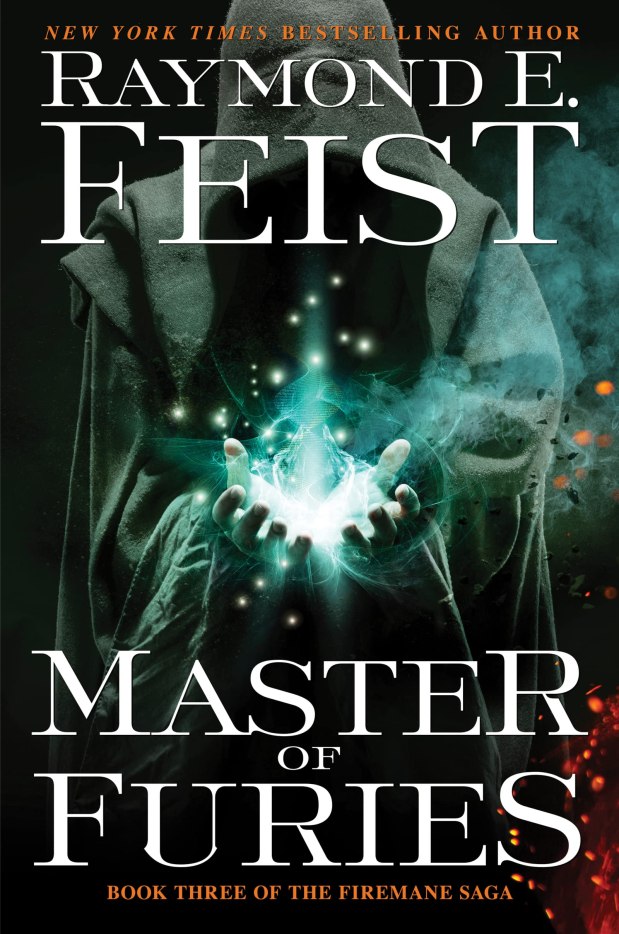
Master of Furies Cover 2

Amazon

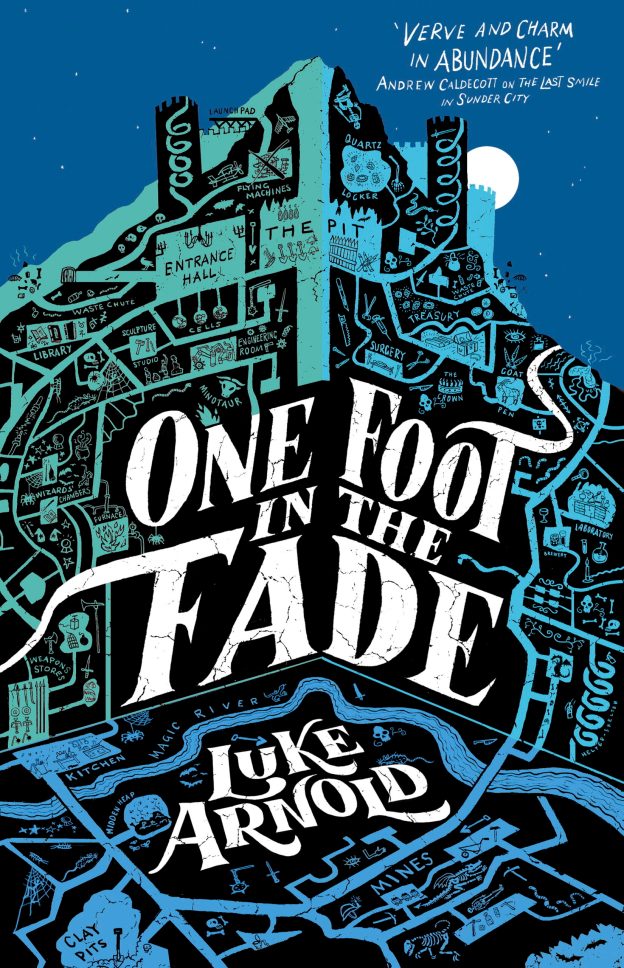
One Foot in the Fade by Luke Arnold

One Foot in the Fade Cover

Publisher: Orbit (Trade Paperback – 26 April 2022)

Series: Fetch Phillips – Book Three

Length: 439 pages

My Rating: 4.75 out of 5 stars

Amazon     Book Depository

One of Australia’s fastest rising fantasy authors, Luke Arnold, returns with the third novel in his Fetch Phillips series, the fantastic and impressive One Foot in the Fade.

Back in 2020, Australian actor turned author Luke Arnold made his fantasy debut with his first Fetch Phillips novel, The Last Smile in Sunder City.  This very clever and intense read, which ended up being one of my favourite debuts of 2020, was set in the unique landscape of Sunder City, a formerly majestic fantasy city facing hard times in a world that has just lost all its magic, causing all the fantasy creatures and beings who lived there to become deformed and dying beings.  The story focused on the character of Fetch Phillips, a human private investigator responsible for the disaster, who tries to redeem himself by helping the disenfranchised former magical beings.  Arnold followed it up later that year with a sequel, Dead Man in a Ditch, which was just as impressive and exciting as the first book.  Both these novels were extremely good, and they perfectly set up Arnold’s intriguing and magic-less universe.  I have been rather keen to see how the story continues so I was quite excited when I received a copy of the third book, One Foot in the Fade, a few weeks ago.

A new dawn has risen in the formerly magical Sunder City.  Under the leadership of human business mogul Thurston Niles, the city is entering a technological age, leaving behind its mystical roots and providing everyone, both human and former magical being, with cars, guns and electricity to service their needs.  Most are content with the new way of life, all except man-for-hire Fetch Phillips.  Still ridden with guilt for the role he played in destroying the world, Fetch spends his days taking on odd jobs for former magical beings while also desperately searching for any way to bring back the magic.

After his latest assignment, recovering stolen artefacts still containing traces of their power, ends badly, Fetch’s hopes for bringing back magic are at an all-time low, until a new clue literally and fatally lands at his feet.  An Angel has fallen from the sky at a great height, his formerly decayed wings once again feathered and whole, clearly the result of magic.  But who or what is responsible for reinvigorating the unfortunate Angel’s magic?

Desperate to uncover the roots of this new mystery, Fetch discovers a former Genie, Khay, whose body is slowly losing its hold on reality.  Still apparently capable of granting wishes, including returning a person’s magic to them, Khay may be the best chance for Fetch to redeem himself.  However, in order to make her powerful enough to bring magic back, Khay requires a legendary crown located at the deadly and isolated Wizard city of Incava.  Pulling together a small team, Fetch embarks for Incava to reclaim the crown.  But the further Fetch goes on his quest, the more he begins to realise that not everything is as it seems.  Blinded by his obsession with magic and redemption, Fetch walks a dangerous path that may end up damning him once again.

This was another extremely awesome read from Arnold who continues to showcase his impressive talent as a fantasy author.  One Foot in the Fade did a brilliant job continuing from the previous Fetch Philips novels, and I loved revisiting the deformed and depressed world of Sunder City.  Loaded with complex characters and powerful settings, this latest story was particularly captivating, and I think that One Foot in the Fade is probably Arnold’s best novel yet.

I really appreciated the powerful and intriguing narrative contained with One Foot in the Fade as Arnold has come up with some deeply fascinating and intense storylines that make this novel very hard to put down.  Taking place shortly after Dead Man in a Ditch, One Foot in the Fade’s story places Fetch Phillips right into the action as he attempts to recover some magical artefacts.  Thrown off by his villainous corporate antagonist, Fetch falls into despair, only to immediately find a dead angel whose magic has been returned to them.  This leads him into a hunt for the being responsible for the miracle, quickly finding Khay, who reunites his faith and hope in magic.  Bringing together a new team of comrades, Fetch travels outside of Sunder City on an epic quest to retrieve a legendary magical crown in order to empower Khay’s abilities.  This works as a particularly fun and exciting centre to the entire narrative, and Arnold really pumps up the action and danger in this part of the book, seeing the protagonists deal with all manner of dangers, deadly creatures, former allies with their own agendas, a mysterious secret society, a giant Minotaur, and even some surprising and very dark magic.

I had an absolute blast with the first two-thirds of the novel, especially with all its action, intriguing new characters and world building; however, it is the final third that really turns One Foot in the Fade into something truly special as Arnold adds in some intense and intriguing twists.  Despite Fetch’s best efforts, everything turns pear-shaped on him as some of the supporting characters are revealed to be far darker and more damaged than he ever believed.  Thanks to some big and dramatic tragedies, Fetch is forced to make some hard decisions that will deeply impact him and change the entire course of the story.  These later twists and revelations are pretty well set up throughout the first two-thirds and the novel, and I really appreciated the way in which Arnold brought the entire story together in such a clever and enjoyable way.  While there are a few excessive plot points that slightly distract the main story, One Foot in the Fade’s narrative was pretty tight and never really slows down.  I love the cool blend of dark fantasy, detective noir and urban fantasy elements contained within this impressive read, and Arnold has come up with a pretty bleak, character-driven narrative that really gets to the heart of the protagonist while also exploring the possibilities of redemption.  The reader will find themselves getting quite drawn into this epic story, and I myself powered through most of it in a single night.  Despite the author’s best efforts to recap the necessary background, One Foot in the Fade is a little hard to read by itself and I feel that most readers should read the first two books in this series first, although this is hardly a chore.  I really enjoyed the hopeful end note of this third novel, and I cannot wait to see where the rest of the series goes from here.

While the Fetch Phillips novels all have great narratives to them, their best qualities are the unique and striking settings.  Primarily set in the once majestic and glorious Sunder City on the fantasy continent of Archetellos, the stories generally explore how the city has changed since magic left the world.  The first two books in this series saw Sunder City as a decaying metropolis, filled with depressed and dying magical beings who were trying to adapt to the new world.  However, in the second book, an industrious human company is starting to provide technological alternatives to everything formerly powered by magic.  Since then, the entire feel and tone of the city has changed, with Sunder City transforming into an industrious and factory orientated city, with 1920’s-esque technology like cars, firearms (that everyone carries) and neon signs.  I really appreciated the brilliant and logical way that Arnold keeps changing the feel and look of his great setting every novel, especially as every change seems to match the series’s overarching noir feel.  I had a lot of fun seeing the comparisons between the setting’s current technology and the former magical glory, and watching the protagonist compete against the march of progress.  Arnold doubles down with the world building in One Foot in the Fade, with some interesting new additions that I found really fascinating.  Not only are we introduced to multiple new magical races, all of whom have been impacted by the death of magic in their own unique ways, but a large portion of the novel takes place outside of Sunder City, as the characters head to another former major settlement, the Wizard city of Incava.  The journey to and into Incava showcases multiple new interesting features about the larger continent of Archetellos, and I appreciated how much time Arnold put into expanding it.  Incava itself proves to be a particularly haunting and deadly setting for a good part of the book, and the various dangers within really amp up the action-packed story.  Overall, Arnold remains well on top of the cool settings in this novel, and readers will once again be entranced by the fantastic and distinctive setting of this series.

One Foot in the Fade also boasts a great array of complex and damaged characters whose personal journeys and intense pain really enhance the impressive narrative.  This is particularly apparent in series protagonist and first-person narrator Fetch Phillips, a man with a particularly intense backstory.  Due to bad choices in his past, Fetch is moderately responsible for the death of magic in the world and all the bad things that went with it.  This led him into an extremely dark spiral and he has spent the rest of the books trying to redeem himself.  However, this has not been easy, especially as he was forced to go up against his magical mentor and best friend in the second novel and his guilt is at an all-time high at the start of One Foot in the Fade.  As such he is particularly obsessed with bringing back magic in this novel and embarks on the quest to repower his new Genie friend and redeem himself no matter the cost.  This obsession blinds him (and by extension the reader) to the risks of what he is doing, and he ends up endangering his friends, while also ignoring some troubling signs from other characters that hinted at the books tragic ending.  This is easily the most obsessed we have seen Fetch throughout the entire series, and it really fits into his brilliantly written character arc which sits at the core of the moving narrative.  Watching him continue to try and fail is always very heartbreaking, and you really feel for Fetch throughout this novel, even with all the mistakes he’s made.  As such, he serves as an excellent centre for the story, and I have a great time following his personal tale, especially as Arnold has also imbued him with a good sense of humour.  The author also sets up a few intriguing character developments and changes throughout One Foot in the Fade that I think will lead to some very compelling storylines in the future, so I look forward to seeing where Fetch goes in the future.

Aside from Fetch, Arnold has filled this novel with a substantial collection of excellent supporting characters, each of whom adds their own distinctive flair to the narrative as well as a complex and often damaging relationship with the protagonist.  One Foot in the Fade features a combination of new and existing supporting characters, and it was interesting to see who returned after the events of the last book.  It was great to see more of former Witch and academic Eileen, one of Fetch’s main compatriots, who helps him throughout most of the book.  Eileen serves as Fetch’s sense of reason, and her more measured approach to the tasks at hand balance well with the protagonist’s more impulsive nature.  I also enjoyed seeing more of futurist company leader Thurston Niles, who is serving as something of an overarching series antagonist.  Thurston, who was introduced in the second book, is the human businessman whose company is responsible for the industrialisation of Sunder City and all its new technology.  While his appearances are a little brief in this novel, he serves as an excellent alternative human character to Fetch and I am really enjoying their rivalry.  Despite appearing as the villain due to his desire to replace magic completely with technology, Thurston has more layers and he actually appears to enjoy Fetch’s efforts to bring back magic.  Their various interactions in this novel are pretty entertaining, and I look forward to seeing their conflict continue in the rest of the series.

The author also introduces several great new characters in One Foot in the Fade, and their interesting and often self-contained storylines are pretty impressive.  My favourite was Theodor, a Werewolf adventurer who Fetch and his friends hire to help get to Incava.  Despite being disfigured and partially disabled (Werewolves and other shape-changers were also partially transformed into dark human-animal hybrids without their magic), Theodor is a badass hunter and tracker who quickly becomes one of the more likeable figures in the novel.  Theodor serves as a mentor to many of the characters, especially Fetch, and it was fun to watch him teach the city slickers how to survive out in the wilds.  Due to the way that Theodor’s storyline in One Foot in the Fade ends I am very curious to see if or how he returns in the future, and I am sure that Arnold will come up with some plot points elements for him.  The other impressive new character was Khay, the Genie who serves as the book’s sentient McGuffin.  Arnold paints a tragic picture around Khay as a Genie literally fading away due to the death of magic.  Only able to survive through certain magical objects and granting wishes to people, namely returning their magic, Kay is just as obsessed as Fetch to achieve their objective.  However, there is a powerful and captivating alternate side to Khay, and the consequences of her actions will have some lasting impacts in the entire series.  These outstanding characters, and more, are an impressive and very important part of One Foot in the Fade, and I really appreciate how much effort Arnold put into making them so relatable and memorable.

With One Foot in the Fade, Australian author Luke Arnold continues to showcase his amazing literary talent, bringing together an epic new story with his already distinctive characters and settings.  Thanks to the powerful and intense new narrative, this third Fetch Phillips novel is probably Arnold’s best novel so far and it is really worth checking out.  I cannot wait to see how Arnold impresses me with the next book.

Amazon     Book Depository

The Sandman – Act 1 (Audiobook) by Neil Gaiman and performed by a full cast

Sandman Act 1 Cover

Publisher: Audible Original (Audio Drama – 15 July 2020)

Series: The Sandman

Script: Neil Gaiman and Dirk Maggs (script adapter)

Director: Dirk Maggs

Cast: Neil Gaiman, James McAvoy, Kat Dennings, Taron Egerton, Riz Ahmed, Samantha Morton, Bebe Neuwirth, Andy Serkis, Michael Sheen, Justin Vivian Bond, Arthur Darvill, William Hope, Mathew Horne, Reginald D. Hunter, Sue Johnston, Paterson Joseph, Josie Lawrence, Anton Lesser, Joanna Lumley, Miriam Margolyes, Tom Alexander, Stephen Critchlow, Blake Ritson, Oris Herhuero, Karen Batke, Ray Porter, Michael Roberts, Kerry Shale, Andrew James, Simon Vance, Sandra Dickinson, Ellen Thomas, Cathy Tyson, Sandra-Mae Luyx, Amaka Okafor, Shey Greyson, Laurel Lefkow, Harry Myers, Mack Keith Roach, Laurence Bouvard, Toby Longworth, Daniel Weyman, Samantha Beart, Cliff Chapman, Felicity Duncan, Julia Winwood, Nicholas Boulton, John MacMillan, Tracy Wiles and Adam Thomas Wright.

Length: 11 hours and 2 minutes

My Rating: 5 out of 5 stars

Amazon

Thanks to a lengthy and productive road trip, I have finally breached the realm of dreams and explored the iconic and powerful creation that is Neil Gaiman’s The Sandman.  In this review I check out the first act of its impressive full-cast audiobook adaptation.

Back in 1989, mind-bending author Neil Gaiman unleashed his most iconic comic creation when he introduced the complex and dark The Sandman.  Centred on the mysterious character of Dream, the anthropomorphic personification of dreams, The Sandman was a clever and intense hybrid of horror, fantasy and superhero storylines released as part of the Vertigo comic imprint, which was associated with the DC Comics universe.  This series was considered a revolutionary success and its unique and colourful story cemented Gaiman’s legacy in comic circles, as The Sandman and its spinoffs are still very highly regarded.

Now I must make a bit of a confession: I have never actually read The Sandman and it is a bit of a gap in my comic book knowledge.  I just never seemed to be in a position to read these comics despite hearing how good they were.  However, with the upcoming television adaptation of The Sandman set for release later this year, I thought that it was about time that I tried to check it out.  Luckily, the good folks at Audible decided to make this rather easy for me as they recently released a full-cast audiobook adaptation of The Sandman.  Not only was this a great opportunity for me to check out this cool comic in my favourite format, but this adaptation featured a truly remarkable cast of actors, with the production pulled together by the highly acclaimed Dirk Maggs.

There are many strange, unusual and powerful creatures inhabiting the universe, but only seven siblings, known as the Endless, are truly immortal.  The Endless, each a personification of a human concept, have their own realms and powers, with the most mysterious and unique belonging to Dream.  Known by many names, including Morpheus, he is the manifestation of all dreams and stories, and governs the Dreaming, the vast realm made up of creation’s collected dreams.  Unchanging since the dawn of time, Morpheus’s eternal life is about to get more complicated than he ever believed.

Summoned by a mystical cult seeking to capture his sister, Death, Morpheus finds himself trapped and powerless on Earth.  Stripped of his tools of office and placed within a magical cage, Morpheus is kept as a prisoner for over 70 years.  When he eventually escapes from his captors, Morpheus returns to his realm only to find it in tatters, with several of his servants missing and his own powers greatly weakened.  To ensure the continued stability of the Dreaming, Morpheus must endeavour to regain his full strength by recovering his lost tools of power.

However, this is no easy task as all three items have been scattered across the world and are now in the hands of several dangerous foes.  To obtain them, he will have to contend with human magician John Constantine, face down Lucifer and battle the malicious Justice League foe known as Doctor Destiny.  From dangerous demons to rogue dreams and even his own siblings, Morpheus will face great challenges and unique creations on his road back from capture.  But even if Morpheus does succeed, is he prepared for the full chaos his absence has wrought on the world?

I’ve been exceedingly foolish by neglecting The Sandman for so long.  This is such a unique and epic tale that contains powerful looks at revenge, change, human perception and the power of dreams and stories, and so much more, as Gaiman cleverly examines elements of the human psyche through the eyes of an elusive immortal.  The impressive and exceedingly memorable story contained within these early entries of The Sandman, are deeply captivating and I found myself really getting drawn into the amazing narrative and distinctive characters.  Throw in an exceptional voice cast and a brilliant audiobook production, and I honestly have no choice but to give this a full five-star review.

When I first heard about The Sandman audiobook I did wonder if it would provide a more abridged version of the narrative.  However, it appears that this production was a pretty faithful and full adaptation of issues #1-20 of The Sandman comic.  As such you get an intense and fully developed story that is guaranteed to grasp your attention and send your imagination into overdrive, especially by the two major storylines contained within these first 20 issues.  The first of these, the “More than Rubies” storyline, examines Morpheus’s capture by human occultists in the early 20th century, his decades-long imprisonment, his eventual escape, and his subsequent attempts to recover his tools of office to regain his lost power.  This storyline serves as a pretty awesome and captivating start to the entire production and it contains several distinctive and addictive chapters.  The initial chapters that deal with Morpheus’s imprisonment set up a lot of major storylines for the rest of the series, give you some fantastic early impressions of this world, introduce some key concepts and provide readers with their first compelling look at the main character.  From there, the story gets even more exciting as you follow Morpheus as he attempts to recover his items of power from some dangerous individuals.  This sets up some brilliant chapters as he deals with everyone’s favourite magician, John Constantine, in a horrific tale that provides readers with their first glimpse at the true danger of dreams.  From there, Morpheus goes straight to hell as he attempts to retain his helm from an army of demons while also dealing with the nefarious Lucifer in what is possibly one of the most entertaining parts of the entire production.  That is then followed by a particularly dark storyline that sees Morpheus forced to contend with damaged DC comics supervillain Doctor Destiny, who is using Morpheus’s own powers to destroy the world.  This initial main storyline is particularly good, with an amazing and captivating flow to it that is guaranteed to make you a fan of The Sandman.

The other major storyline of this first act of The Sandman sees Morpheus attempt to contend with a new dangerous threat impacting the Dreaming.  This threat turns out to be young woman, Rose Walker, who is a powerful Dream Vortex.  To fully understand her, Morpheus finds himself getting involved in her hunt for her missing brother, and soon finds himself in conflict with several of his missing creations, each of whom has their own agenda in the real world.  At the same time, Morpheus must contend with the machinations of his powerful siblings as they attempt to manipulate him for his own ends.  This second major storyline, The Doll’s House, is an extremely good follow-up to the introductory issues and continues several plot points, with several characters returning in interesting ways.  Indeed, as you traverse through this storyline, it becomes apparent how much the author set up in the initial major storyline, and this helps to make The Doll’s House flow extremely well.  This major storyline itself is pretty damn fun, and I liked how it split between Morpheus and several of the other major players, particularly Rose Walker and The Corinthian.  The entire thing goes in some rather interesting directions, from the traumatised dreaming mind of a young boy also containing several lost superheroes, to a serial killer convention where some of Morpheus’s most dangerous creations have arrived.  This entire storyline is pretty damn twisty and trippy in places, but it comes together extremely well and has some amazing high points to it.  I particularly enjoyed the sequences depicting the serial killer convention, which was both entertaining and disturbing in equal measures but which also has an outstanding payoff to it.  The Doll’s House ends the major storylines on an extremely high note and it will ensure that you will come back for the second act desperately wanting more.

Aside from the two main storylines, The Sandman also contains several filler arcs that take place around the main storylines, including all the stories contained in the collected volume Dream Country.  While I would usually be a little disappointed to have a gap occur between some of the main storylines like this, it worked really well.  Not only do these filler chapters serve as a bit of a palate cleanser, breaking up the major storylines, but they also provide a lot of additional context for the wider The Sandman universe by expanding on many of the supporting characters, such as Morpheus’s relatives or some of the strange people he encounters through his travels.  Each of these storylines lasts for a single chapter (an issue from the comic), and are fairly self-contained, coming together and concluding in short order.  Each of these filler stories is quite intriguing in their own right, especially as these stories are a little more metaphysical and often contain a dark, thought-provoking cautionary tale.  There is also an interesting range of settings and time periods for many of these stories, as some occur many years before the events of the major storylines, due to the immortal nature of Morpheus and his siblings.  I honestly enjoyed each of these separate storylines, not only because of the fantastic ways that they expanded The Sandman universe but because of the way that each story hit a different emotional note.  My favourite was probably Men of Good Fortune (issue #13 of the comic), a brilliant story that sees Morpheus and Death encounter a man, Hob Gadling, who is certain of his desire never to die.  Intrigued, Morpheus ensures his immortality and arranges to meet him once every 100 years in the same tavern.  So begins a fantastic story that skips across centuries as you see Hob continue to exist and change through the centuries.  Watching him achieve the highs and lows of an immortal is deeply fascinating, as is his compelling and deeply personal interactions with Morpheus as they discuss his experiences and his desires to stay alive.  The conclusion of this story proves to be particularly moving, and it helps to humanise Morpheus after several issues of him being emotionally distant.  Other interesting filler arcs include Morpheus meeting with Death and following her around in her complex and sad duties, another sees William Shakespeare, who years earlier made a Faustian bargain with Morpheus, debut A Midsummer’s Night Dream to a host of elven nobility in a touching performance.  All these filler arcs, and more, add a certain gravitas to the overall book, and I think that they really helped to enhance the major storylines they were set around.

I was really impressed with all these major and minor storylines, especially as the writing behind them was particularly powerful and brilliant.  Everything flows together extremely well and you can see that Gaiman is setting up a ton of fascinating storylines for the future, while also ensuring that the current plot points stand on their own and are extremely fun.  Everything about this story is interesting, and while the author does occasionally go in some zany, grotesque and unique directions, it generally proves to be entertaining and eventually fits back into the major storylines in a great way.  Gaiman seeks to create a massive and powerful epic that not is not only filled with action and excitement but which causes the reader to stop and think about certain states of being or metaphysical aspects such as dreaming.  This is often achieved, especially in the audiobook format, with distinctive and powerful dialogues that showcase the unique attributes of the characters and the dramatic and dangerous situations they find themselves in.

I personally loved how there were a range of different styles and elements featured throughout the plot as The Sandman didn’t conform to one particular genre.  The story could at any time jump from unique fantasy adventure to a deep character driven narrative or end up being a bleak and deeply disturbing horror tale.  For example, one of the best chapters in this act of The Sandman was a dark, disturbing and somewhat detached horror narrative they fit in right after a chapter involving the Justice League and certain Batman villains.  In this story the deadly Doctor Dee, having stolen Morpheus’s dream stone, holds several people hostage in a diner over the course of a day.  Throughout this day (which is counted down hour by hour for some impressive dramatic impact), Doctor Dee toys with his pets, diving deep into their personal lives and using disturbing elements from their past to manipulate their emotions and their reactions.  This results in several extremely disturbing hours as the bad doctor makes them experience lust, despair, hatred, animalist urges, religious zeal and more to entertain him as he waits, and it turns this chapter into a horrific experience in between some more action packed or fantasy issues.  This frequent change in genre really helps to make this first act stand out, and all the different storylines and elements work well with the overall dark gothic theme of The Sandman.  It also helps to make The Sandman a bit more accessible to different readers as there is something here for all fans of horror, fantasy and comics, although some basic knowledge of DC and Vertigo comics may be somewhat helpful.

This story is greatly helped by the complex and exceedingly memorable characters featured throughout.  The most notable of these characters is the titular Sandman himself, central character Dream/Morpheus, an immortal anthropomorphic personification who lives in creation’s dreams and serves as their lord and master.  I loved how Morpheus is portrayed in this first act as the reader really gets to sink their teeth into the character and find out what makes him tick.  Gaiman ensures you get the most out of Morpheus by immediately showing him at his worst, imprisoned for decades by humans with his powers stolen from him.  While you don’t get a lot of insight into who or what he is at the beginning, once he escapes you find out everything you need about his motivations, responsibilities and personalities.  Gaiman initially paints Morpheus as a callous and detached being, removed from humanity and more concerned with his own needs and realm than the people he interacts with.  While it does make it a little harder to root for him in some of the earlier storylines, I think this coldness helped to stoke some real mystery around the character and you wanted to find out more about him and his past.  Once the first major story arc ends and you get into some of the filler stories, especially the one involving the interaction with his sister Death, you start to understand him a lot better and soon see that his a basically good person, just with some major personality flaws brought on by his immortal existence and purpose.  Don’t get me wrong, at times he is still a pretty hard character to like, especially when details about his love life are revealed, but he is generally a lot more likeable than most of the other immortal or non-human characters you encounter, and you get really invested in his continual struggles.  By the end of his first act you will become extremely addicted to his story arc, and I cannot wait to see how Morpheus’s narrative continues in the future.

Gaiman has come up with an eclectic and distinctive group of characters to support the story, with a fantastic combination of original characters, mythological figures and even a few established DC and Vertigo comic characters.  These great characters are featured to various degrees throughout the story, with some being continuously used, while others only get brief flashes.  All of them are pretty fantastic, and I loved seeing how Gaiman worked them into his brilliant narrative.  There are so many notable characters throughout this first act to talk about, especially as they were portrayed by some outstanding actors (more on that later), and I could honestly spend pages talking about all of them, however, in the interests of saving time I might just limit it to my absolute favourites.  I must highlight Dream’s sister Death; rather than a traditional mournful or skeletal figure, Death is shown as a cheerful young woman who bears great compassion and kindness to those she reaps.  This is a really interesting change to the usual personification of Death you see in fiction, and it works really well, especially as Death here serves as a great positive foil to her dour brother Dream and the other Endless.  As such, she swiftly becomes a favourite character to follow, especially with her many different appearances.  I also must mention Gaiman’s great use of John Constantine, everyone’s favourite drunk English wizard, who has a notable chapter towards the start of the story.   Lucifer himself is also brilliant as a brief secondary antagonist, and Gaiman lays some interesting story seeds here for him.  The comedic duo of Cain and Abel brings some fun to several stories, as does Morpheus’s servant, Matthew the Raven.  Rose Walker serves as an excellent protagonist of the second major storyline, and I enjoyed her very English protector, Gilbert, who has some intriguing scenes.  Finally, I was rather impressed with the great early antagonist Doctor John Dee, better known as the Justice League villain Doctor Destiny.  Gaiman went out of his way to make Doctor Dee as creepy and deranged as possible in this comic and he has some outstanding, if shockingly horrifying, scenes throughout the More than Rubies storyline.  He, and other great villains like The Corinthian, add some intriguing danger and a ton of depravity to the story, and I had an absolute blast getting to know all these great characters.

As I mentioned before, I chose to check out the full-cast audio adaptation of The Sandman rather than reading the original comics, and this greatly impacted my experiences of how I absorbed this unique story.  However, while I probably missed out on some brilliant artwork, I think that this audio adaptation was the perfect way to enjoy this elaborate and massive story.  As far as I can tell, the audio production faithfully adapts all the comic storylines throughout its run, with the movement and action of the comic page replaced with narration, sound effects and probably altered dialogue where necessary for the benefit of the listener.  While this is probably a little different than the comic, I think that it captured the tone, characters, and intent of The Sandman exceedingly well, and the resulting production is pretty damn impressive.  Not only does it feature some brilliant acting, but the production team makes outstanding use of a ton of cool sound effects and some moving music to create something extremely special.

While this audio production has many great features, without a shadow of a doubt its most defining aspect is the incredibly stacked voice cast who bring the various characters to life.  Someone clearly sold their soul to get the eventual cast for The Sandman, as some exceedingly talented actors are featured here giving some intense and powerful performances.  These great performances deeply enhance the entirety of The Sandman and turn this already outstanding story into something that you will listen to again and again.  This voice cast is led by the insanely talented James McAvoy, who voices main character Morpheus.  McAvoy is extremely good in this production, showcasing all his acting range to bring this complex character to life in all his dark, gothic and detached glory.  Thanks to the way he voices the character, listeners really get a sense of how ethereal and distant Morpheus can be, as well as the intense weight of the events of this story and the relationships he has formed.  You really get the full gambit of Morpheus’s emotions during this first act and McAvoy covers them all perfectly, embodying the character’s rage, sorrow, impatience and intense regret extremely well.  This performance really serves to enhance the character of Morpheus in this production of The Sandman, and McAvoy was the perfect actor to helm this entire series.

The rest of the voice cast is just as impressive, with several major celebrities featured here.  Taron Egerton has a notable time voicing the iconic John Constantine and his pretty damn good here, bringing the distinctive magician to life extremely well.  Edgerton brilliantly brings forth Constantine’s full emotional range throughout The Sandman, and you get a great sense of his cheeky demeanour which overlays his insane amount of guilt and despair.  This was a very good version of Constantine, and indeed after listening to this production, Edgerton would be my choice for Constantine if they chose to do another major movie with him.  In addition, Kat Dennings has a major role in this audiobook as Death.  Dennings is pretty amazing here, and she brings some real life (pun intended) to this major role, showcasing this character’s intense warmth and friendliness, as well as her exasperations when it comes to her brother.  Dennings really made this unique character her own, and I deeply enjoyed her performance.  I also had a lot of fun with Andy Serkis who voices Matthew the Raven, Dream’s messenger and servant.  Matthew is a fairly comedic role which Serkis fills perfectly, giving the raven a sarcastic and everyman feel that fit the lines really well and helped to make him a very distinctive and fun figure.

Other big-name actors include Bebe Neuwirth, who perfectly voices a prophetic cat with aspirations to change the world through dreaming.  Riz Ahmed is pretty terrifying as The Corinthian and you get some major serial killer vibes from his performance.  Arthur Davill has a great couple of appearances as William Shakespeare, while the legendary Joanna Lumley has an unfortunately short appearance as Lady Johanna Constantine, although she gets her time to shine in future productions.  Likewise, Michael Sheen has only a short appearance as Lucifer Morningstar, although he brings some incredible flair to the character, dripping style, venom and power.  Like Joanna Lumley, Sheen will get his time to shine in future instalments of this audio series, so don’t be too disappointed with his limited appearances here.  I loved William Hope as Doctor Dee, as he gives the villain some deep malevolence and insanity.  Michael Roberts and Kerry Shale are fun as Cain and Able respectfully, while Paterson Joseph has a great sequence as The Demon Choronzon.  I was also very happy to see that one of my favourite audiobook narrators, Ray Porter, was featured here, voicing multiple supporting characters.  All of Porter’s portrayals were very fun, although I think he was best as Gilbert, providing some fun British pomp to the character.  Finally, Neil Gaiman himself has a massive role in this production as the Narrator, which is pretty damn appropriate.  Gaiman is great as the narrator, with his distinctive voice perfectly moving the story along, as he describes events, actions and settings, as well as providing a massive dose of exposition.  I was really impressed with Gaiman’s continued performance here, and I honestly don’t know if anyone else could have done such an impactful and meaningful job of it.  I am honestly only just scratching the surface of this cast, as there are a ton of other actors featured throughout The Sandman in some way.  However, all of them are extremely good and their work on this show is just superb.

As you can no doubt tell from the elaborate and long-winded review above, I had an outstanding time with this audio production of The Sandman, and I am so very happy that I got to finally experience Neil Gaiman’s amazing series.  Everything about this audiobook was impressive, with an elaborate and dark narrative, gritty characters, fantastic performances and some incredible world building.  There is truly something for everybody here, as readers unfamiliar with The Sandman can easily jump in and learn everything they want to know about the series (I’m now ready for that upcoming Netflix series), while established fans will no doubt enjoy it performed by such a talented team of actors.  I had such a good time listening to this first act that once I finished, I immediately jumped into listening to the second act, which has an even better and expanded voice cast.  I will hopefully review that in a few weeks, but in the meantime do yourself a favour and listen to this incredible audio production of The Sandman, as you will not regret it.

Amazon

Amongst Our Weapons by Ben Aaronovitch

Amongst our Weapons Cover

Publisher: Orion (Trade Paperback – 12 April 2022)

Series: Rivers of London – Book Nine

Length: 406 pages

My Rating: 5 out of 5 stars

Amazon     Book Depository

One of the leading lights in the urban fantasy genre, the exceedingly talented Ben Aaronovitch, returns with the latest epic book in his brilliant Rivers of London series, Amongst our Weapons.

For the last 10 years, the fantasy world has been exceedingly impressed by the fantastic writings of Ben Aaronovitch, who came up with a real winner with his Rivers of London series (also known as the Peter Grant series).  Aaronovitch, who already had some major nerd cred as a writer of two Doctor Who serials, debuted the first book in this series, Rivers of London, back in 2011.  This book told the story of Peter Grant, a young Metropolitan Police officer who is assigned to a specialised branch of the Met that deals with magic and supernatural incidents.  This intriguing debut combined magical elements with a classic police procedural format to create an epic and captivating read.  The author has since expanded this series out to several novels, as well as a range of novellas, short stories, and even a graphic novel series, all of which continue the story of Peter Grant and Aaronovitch’s unique magical world.  I have had a lot of fun over the last few years with this series, and I have greatly enjoyed Aaronovitch’s last two entries, Lies Sleeping and False Value.  Aaronovitch is back with another exceptional read in his ninth Rivers of London novel, Amongst our Weapons, which continues the excellent format and presents the reader with an awesome new mystery.

The London Silver Vaults are a renowned underground market for silverware in the heart of London.  They are highly secured and constantly monitored, so getting away with any sort of crime in the vaults is impossible.  So when a crazed would-be robber is brutally killed in the middle of the vaults with no witnesses or cameras catching the act, the Met are forced to call in their secret weapon, Peter Grant and his fellow detectives from the Special Assessment Unit, better known as the Folly.

Specialising in investigating magical incidents, Peter and his team are quickly able to determine that the death and the murder’s subsequent escape were a result of powerful magic.  Taking the lead on the case, Peter hopes to catch the killer quickly, but are quick to discover that their investigation is about to get far too complicated.  Ancient magics and unknown powers are loose around London, and after discovering a second body, the Folly team begin to investigate the members of a mysterious college cult from Manchester that has been inactive for years.  As more attacks occur, it becomes apparent that members of the cult are being hunted down and that their killer appears to be a vengeful, spear-wielding angel.

Determined to get to the bottom of the killings, Peter dives into the history of the cult and the mysterious artefacts they uncovered.  His investigation will lead him all over England, from the colleges of Manchester all the way to the dismal North.  But even as he begins to uncover the truth behind the killings and the being responsible, does even the full might of the Folly have the power to stop an angel and the deadly magic gifted to her?  Worse, another party has involved themselves in the case, someone that Peter knows far too well.  Can Peter solve this case before it is too late, and how will he deal with the greatest challenge of his life, becoming a father to his two magical twins?

Wow, Aaronovitch continues to massively impress me, bringing together another brilliant and unique urban fantasy read.  Once again bringing together an outstanding story that features distinctive fantasy elements with a clever mystery, Amongst our Weapons was a fantastic read that I had an incredible time reading.  This book was pretty damn awesome and gets a full five-star rating from me.

I had an absolute blast with the story contained within Amongst our Weapons as Aaronovitch has once again cleverly combined complex fantasy elements with a compelling murder mystery investigation, resulting in a deeply entertaining and addictive story.  Aaronovitch starts this latest novel off strong, with the protagonist and his team immediately thrust into an investigation of a man with a mysterious magical hole blown into his chest and no witnesses who saw what happened.  This intriguing start quickly becomes even more enticing, as a second murder is soon discovered, as well as other unusual signs and discoveries at the various crime scenes.  However, the excitement does not end there, as Aaronovitch also fits in an early encounter with the powerful murder, who appears to be an exceedingly deadly angel of vengeance, as well as the sudden reappearance of recurring antagonist Lesley May, Peter’s former partner who now acts as a magical mercenary.  Throw in some great character driven storylines about the protagonist’s family, as his river goddess wife is about to give birth, and you have quite an exceptional start to the novel.  Indeed, once all these elements were set up, I was hopelessly hooked on the story, and it proved extremely hard to put this book down at all.

The rest of the narrative flows on from here extremely strongly, as the characters launch an exhaustive and intense investigation not only into the murders but into the origins of certain magical items and the history of the college cult who appear to be targeted.  This takes the protagonist on a bit of a fieldtrip outside London, exploring Manchester and the North, and introducing the characters to some intriguing new magical elements.  While parts of the story here did get a bit bogged down when it came to exploring some of the more complex new fantasy inclusions, I flew through the second part of the book, especially as it is laced with several brilliant and imaginative confrontations between the protagonist and the book’s various antagonists.  Everything comes together extremely well in the lead-up to the conclusion, which results in a fantastic battle that helps resolve everything perfectly.  I did think that it got a little too metaphysical in places, but I still deeply enjoyed this great conclusion, which should really satisfy every reader, while also setting up some interesting storylines for the future.

Aaronovitch has such a distinctive writing style for the Rivers of London series, which is put to great use throughout Amongst our Weapons.  Like most of the Rivers of London novels, Amongst our Weapons can be read as a standalone read, with Aaronovitch doing a great job of rehashing some of the relevant continued storylines when they become relevant to the ongoing story.  This book features the usual awesome blend of magic, crime fiction and character-led storylines, wrapped up with a great sense of fun and humour, which helps to produce quite an entertaining and captivating read.  I particularly loved how the author makes his novels feel like a police procedural with magic, and this is perfectly on display in Amongst our Weapons, as the protagonists engage in elaborate investigation into several unique deaths.  It is so much fun to watch these magic-wielding protagonists do research, official police investigations, paperwork, evidence collecting and various theorising as they examine both the magical and human sides of the case, and I always love how well these elements can be fit into a seemingly typical murder mystery storyline.  Everything flows extremely well through this novel, and while I think there are some minor pacing issues towards the middle, readers will power through this entire book once they get caught up in the mystery and the magic.

I have always been really impressed with the distinctive and captivating fantasy elements contained within the Rivers of London novels, which prove to be intrinsic and outstanding parts of the book.  Rather than use classic fantasy elements, the magic and unique creatures featured within this series are a lot more abstract with a focus on energy manipulation, creatures from alternate universes and godlike beings who get their powers by being embodiments of important locations.  This really gives the novels a great, unique feel that is brilliantly enhanced by the way that the various characters treat magic in an almost scientific way, especially from a policing perspective, as the protagonists are effectively investigating and monitoring it in London.  This fantastic way of examining magic proves to be quite effective in Amongst our Weapons, as you get to see all manner of theorising, analyses and scientific conclusions drawn up as the protagonists attempt to identify and quantify the new forms of magic they are dealing with, especially when they come face to face with an unknown being of immense power.  This cool magic is also quite stunningly described throughout the novel, and I loved seeing its unique and clever use throughout the various magical confrontation sequences, and there is nothing more awesome than reading about a couple of wizards face off against an apparent angel.  I find all the cool magical elements quite fascinating to explore, and I loved seeing some of the world building that occurred throughout Amongst our Weapons, with some new groups of magical users introduced or referenced throughout.  Aaronovitch actually sets up some intriguing new world-building elements throughout Amongst our Weapons, and I look forward to seeing how this expands in some of the future novels.

Finally, I really must highlight the outstanding characters featured within Amongst our Weapons, who really help to turn this awesome story into something truly special.  This cast is headlined by the book’s main protagonist and point-of-view character, Peter Grant, who I really have a lot of fun with.  Grant is a funny and bold protagonist, who has been really growing since the first novel, not only in personality and responsibility but also in magical talent.  He serves as a brilliant protagonist for Amongst our Weapons, and his dogged and clever investigation of the unusual events moved the story along at a swift and enjoyable pace.  While his police work is a major part of the character, this latest novel also focuses again on his personal life, showing his unique marriage to a river (well, the living embodiment of a river), and the upcoming birth of his likely magical children.  This puts some major responsibility on Peter’s head, which he struggles to deal with, still taking risks with his work.  Watching him obsessively chase after the culprit while also trying to balance the upcoming birth of his children was a great part of the novel, and it really helped to make the reader feel attached to him.  However, I personally loved his outstanding sense of humour throughout this novel, as much of the book’s comedic elements are thanks to this protagonist’s funny statements and clever observations about the outrageous events he is witnessing.

Aside from this excellent and relatable protagonist, Amongst our Weapons features a large and diverse cast of figures, including a combination of new people associated with the case and a huge batch of recurring characters who have been perfectly set up before.  Most of the recurring characters are re-introduced extremely well, and even new readers should be able to follow who is who amongst this unique cast of magic users and professional police officers who work together to solve crimes.  My favourite supporting character is Detective Chief Inspector Thomas Nightingale, head of the Folly and the last official wizard.  A gentlemanly figure who fought in World War II, Nightingale serves as a great mentor as well as a badass magician able to throw down with the worst creatures or dark magic users.  While not featured as heavily here as in previous novels, Nightingale has some great moments throughout Amongst our Weapons, and it was awesome to see him squaring off against the winged antagonist.  Aaronovitch also sets up some interesting storylines for him in this book, and it sounds like he will have a much more altered role in the future.  The other major character I should highlight is Lesley May, who serves as a secondary antagonist throughout this book.  Lesley, who spends most of the book as a mercenary character attempting to undermine the police’s investigation, is a great addition to the plot and I am extremely glad that Aaronovitch brought her back for this novel.  Not only do you get more of the regret-filled interactions with Peter but she serves as a great foil for the protagonists, and it was really fun to see her get involved and attempt to manipulate the situation to her advantage.  All these characters, and many more, are great additions to the fantastic and complex plot of the book, and I deeply enjoyed seeing the fantastic and powerful interactions between them.

The Rivers of London series continues to shine as one of the best and impressive urban fantasy series with Amongst our Weapons.  Ben Aaronovitch is such a talented author, and I deeply enjoyed distinctive and captivating stories he crafts, especially with its outstanding blend of unique fantasy and memorable murder mystery elements.  Amongst our Weapons is one of my favourite books from Aaronovitch I have read so far and it is a highly recommended for all fantasy fans.  If you aren’t exploring the Rivers of London, then you are really missing out!

Amazon     Book Depository

The Hunger of the Gods by John Gwynne

The Hunger of the Gods Cover

Publisher: Orbit (Audiobook – 14 April 2022)

Series: The Bloodsworn Saga – Book Two

Length: 22 hours and 57 minutes

My Rating: 5 out of 5 stars

Amazon     Book Depository

Extremely talented dark fantasy John Gwynne returns with one of my most anticipated fantasy novels of 2022, The Hunger of the Gods, the epic second entry in The Bloodsworn Saga.

Last year, the fantasy world was aflame with discussion about a certain novel from acclaimed author John Gwynne, best known for his The Faithful and the Fallen series and its sequel Of Blood and Bone trilogy.  While I wasn’t initially intending to check this book out, the sheer amount of positive feedback and reviews convinced me that I was clearly missing out, so I grabbed a copy and ended up being deeply impressed by the elaborate fantasy saga it contained.  That novel was The Shadow of the Gods, a Norse inspired dark fantasy tale that saw three intriguing protagonists explore a deadly new fantasy world wrecked by the last battle of the dead gods, and filled with monsters, warbands and powered humans tainted by the divine ancestors.  I had an exceptional time with this great book, which really met all my expectations and ended up being one of my favourite books and audiobooks of 2021 (it also topped my favourite new-to-me authors list and best covers of 2021 list, it was just that damn awesome).  I deeply enjoyed the fantastic and elaborate tale this novel contained, and I could not wait to see how it would be continued.  As such, when I received a copy of the sequel, The Hunger of the Gods, which featured another awesome fantasy cover and plot synopsis, I immediately started reading it and was once again thrust into world of gods and heroes.

The dread dragon god, Lik-Rifa the soul-stealer, has been released from her ancient tomb and now all of Vigrid lies in peril.  Determined to unleash a new era of blood, death and conquest upon the lands, Lik-Rifa immediately begins to gather around her horde of Tainted warriors, including her own descendants, the dragon-born, terrible monsters and a cult of followers, all slaved to her will.  Hope looks bleak, especially as the warring human kingdoms remain unaware that Lik-Rifa is free and about to unleash fresh horrors upon them.

Amongst this chaos, the deadly Orka continues her hunt for her stolen son, taken by Lik-Rifa’s followers.  Now revealed as the legendary and infamous warrior, the Skullsplitter, Orka will not rest until she has her son and her vengeance, no matter the obstacles.  While Orka continues her quest, her former warband of secretly Tainted warriors, the Bloodsworn, head south, determined to rescue one of their members, while their newest initiate, Varg, continues his attempts to find vengeance for his sister.  Meanwhile, Elvar is forced to fulfil the blood oath she took to rescue another child from the dragonborn, and needs to convince her now leaderless warband, the Battle-Grim, to follow her.

As these brave warriors each take their own steps to destiny, they will all face dangerous challenges and horrendous odds.  Orka will need to come to grips with the wolf lying deep in her heart as she attempts the impossible: defying a god.  Varg and the Bloodsworn will travel to a distant land to achieve their goals, only to meet tragedy and loss.  Elvar finally attempts to claim the responsibility of leadership that she has always desired.  However, despite all their bravery and skill in arms, none of these heroes are going to be capable of fighting Lik-Rifa directly.  Instead, Elvar and her company will attempt a desperate plan, using forbidden magic to bring a dead god to life and bind it to their will.

Wow oh wow, what an incredible and awesome read.  Gwynne continues to showcase why he is one of the best current authors of fantasy fiction with The Hunger of the Gods, which perfectly continues the impressive Bloodsworn Saga in a big way.  Featuring tons of bloody action, impressive new fantasy elements, complex characters, and a powerful and elaborate narrative that is the very definition of epic, The Hunger of the Gods was another five-star read from Gwynne that is easily one of the better books I have read so far this year.

The Hunger of the Gods has an outstanding and impressive story that instantly grabs the reader’s attention and ensures that they are unable to put the book down until the very last page.  This sequel kicks off right after the epic conclusion of The Shadow of the Gods and quickly follows up on all the big revelations and events that occurred there, especially the release of the giant dragon god, Lik-Rifa, who serves as a suitably sinister and epic main antagonist for the series.  Just like the first book, The Hunger of the Gods’ narrative is told from a series of split storylines, each one focused on a specific point-of-view character.  All three character-specific storylines from The Shadow of the Gods are continued here, following Orka, Varg and Elva.  These existing storylines go in some exciting and interesting directions in The Hunger of the Gods, and I loved how the author expanded on the character’s growth and individual journeys from the first novel, while also keeping some of the existing dynamics and elements.  Gwynne also adds in two new point-of-view characters, as antagonists Gudvarr and Biorr, who were good secondary characters from The Shadow of the Gods, get their own intriguing storylines here.  These new character arcs are impressively entertaining, providing great alternate perspectives to deepen the story, while also working into the existing storylines extremely well.  All five storylines go in some great directions throughout the course of the novel, and there are some absolutely brilliant moments, twists and revelations that occur throughout, especially as many of these storylines started to come together more.  I had an excellent time seeing where everything went, and Gwynne really did a great job taking all these character stories in some appropriate directions.  Every single storyline end on an amazing note and the conclusions are guaranteed to drag readers back for the third Bloodsworn novel.

This second book in The Bloodsworn Saga is written pretty damn perfectly as Gwynne continues his magic to produce an addictive and distinctive read.  The Hunger of the Gods retains the excellent tone introduced in the first novel, ensuring that everything comes across as a Norse adventure story set within a unique, dark fantasy realm.  Everything about this book is handled extremely well, from the exceptional pacing, which ensures that you fly through this massive novel, to the intense and brutal action that is installed in every section of the book, guaranteeing that readers get that much needed adrenalin rush.  Gwynne utilises an interesting writing style here that really emphasises repetition and unique dialogue to help to make the story feel more and more like an epic Norse saga.  Just like the preceding novel in The Bloodsworn Saga, I think that The Hunger of the Gods had just the right blend of action, humour, character growth, world building and darker elements to create an excellent and enticing read.  I also have to say that I was quite impressed with how Gwynne was able to avoid middle book syndrome here, as in many ways The Hunger of the Gods was even better than The Shadow of the Gods.  While the story does slow down in places to help build up certain settings or plot elements, there is always something interesting or compelling going on, and I can honestly say that I was not bored at any point in the book.  You could almost read The Hunger of the Gods by itself with no knowledge of the preceding book and still have a brilliant time with it, especially with the detailed synopsis of the prior novel at the start.

The best thing about how this story is written is the exceptional use of multiple character perspectives.  The story perfectly flits between the five separate characters arcs throughout the novel, with a different character being focused on with each new chapter.  Thanks to the inclusions of two new characters, readers of this sequel get to enjoy a much deeper story here, especially as the new characters are associated with some of the series’ antagonists, providing some fantastic new elements.  I think the additional characters worked really well, as while the existing three protagonists are great, their storylines needed to be spaced out more in this sequel.  All five separate character storylines play off each other perfectly as the novel continues, telling an immense narrative that, while connected, still contains a fair bit of individuality as you follow their specific adventure.

I liked finally being able to see some interactions between the various protagonists and I loved seeing these outstanding and well-written characters finally come together in some intense scenes, allowing the reader to see these distinctive characters viewed through the eyes of the other protagonists.  The author had a great sense of which perspectives needed to featured at certain times, and there were some amazing contrasts as certain exciting storylines were played off each other, especially when you were able to see two sides to certain major battles or events.  In addition, this is one of those rare multi-narrative fantasy novels where it is near impossible to choose a favourite storyline or character to follow.  Each of the five storylines offers the reader something different, from a bloody revenge story, to an intriguing look at the book’s main antagonists, and all of them work extremely well in the context of the wider story.  I will say that Orka’s brilliant quest for her son has some amazing action scenes and powerful character moments, while the camaraderie and excellent larger-scale battles of Varg’s storyline ensured that I was excited to hear from this character.  In addition, Gudvarr provides some great political intrigue from the perspective of a true weasel, which was so very fun to watch.  However, I honestly had a great time with every single character, and there was not a moment that their individual stories did not enhance the overall quality of The Hunger of the Gods.

I really must highlight the incredible dark fantasy setting of The Bloodsworn Saga that is expertly used again in The Hunger of the Gods after Gwynne took the time to set it up in the first novel.  The harsh land of Vigrid, with its warring Jarls, terrifying monsters, long-dead gods, glory-seeking warbands and the feared and exploited Tainted, works so well as a background to this epic story and it really helps to expand the bloody adventures featured within.  I loved how Gwynne uses classic Norse elements like shield walls, longboats, weaponry and mindsets, and I still really love seeing this in a fantasy context, especially when combined or used against the monsters and Tainted characters.  This is further enhanced with the continued use of Norse inspired terms and dialogue throughout the novel, and it helps to give this entire series such a distinctive feel (although I kind of wish that he would stop trying to continually make “thought cage” an alternative to a person’s skull).  While the author spends a bit of time continuing these elements from the first book, The Shadow of the Gods also features some brilliant world building as Gwynne provides intriguing enhancements to the existing gods, land and people, which were already extremely intriguing.  There are also some examinations of the neighbouring nation of Iskidan, which was mentioned a few times in the first book.  Iskidan, which has elements of historical China, the Middle East and the Byzantine Empire in its construction, serves as an intriguing counterpoint to Vigrid, and it was fascinating to learn more about it.  I also loved a couple of cool, if freaky new monsters, that were featured in this book, although the flesh burrowing insect monster and the nightmare inducing tongue eaters, are a bit on the gruesome side (readers who don’t like body modifying monsters are warned to stay away).  All these awesome elements are fitted in the book perfectly, and I loved this continued dive into the dark and gruesome world Gwynne has lovingly created.

While the awesome narrative, clever storytelling and dark fantasy setting are amazing parts of the book, I would be extremely remiss if I didn’t highlight the incredible character work that Gwynne did within The Hunger of the Gods.  Just like the first book in The Bloodsworn Saga, The Hunger of the Gods features an impressive and captivating cast of characters, each of whom are expertly featured and who add some fantastic elements to the overall story.  This is particularly true for the wonderful and memorable characters from whose perspective this epic tale unfolds.  Gwynne did an incredible job introducing these excellent characters in the first book, and it was great to see two previous supporting characters promoted up to the central cast.  All five main characters are exceptional and their unique personalities and goals ensure that every chapter is different from the last which helps to produce an awesome and expansive read.

The first of these characters is Orka, an incredibly dangerous warrior who is hunting for her lost son and vengeance for her murdered husband.  Orka is a brilliant and complex figure who is easily one of the most exciting and enjoyable characters in the entire series.  Due to her single-minded determination and bloodlust, pretty much all Orka’s chapters read like a bloody revenge trip that is essentially a dark fantasy version of Taken.  Gwynne continues this excellent trend with Orka in this second novel and it was great to see this implacable warrior travel across this land, killing everyone who gets in her way as she takes big risks.  However, Gwynne adds in some extra elements to Orka’s tale in The Hunger of the Gods, especially following the revelations made at the end of The Shadow of the Gods that Orka is both Tainted and the former leader of the Bloodsworn, the legendary killer known as the Skullsplitter.  Orka actually comes across as a lot more bestial in this second book, especially after the big massacre she created at the end of The Shadow of the Gods that unleashed her inner monster.  As such, there are more scenes of Orka trying to contain her rage and anger, and there were some fantastic and clever portrayals of her inner beast throughout the book.  We also see some of Orka’s guilt and regret as the novel explores how she left the Bloodsworn and the relationships she sacrificed for the sake of her unborn son.  I also quite enjoyed seeing her as a reluctant leader in this novel as she finds herself in charge of a small team of warriors and monsters.  This enhances her sense of guilt and remembrances of her previous time with the Bloodsworn, and it adds some fun drama and even a mentoring arc as continues her work with her young student, Lif.  Orka’s storyline goes in some great directions throughout The Hunger of the Gods, and you will be enthralled with her tale right up until the last line of this book.

I also had a lot of fun with Varg in this book.  Varg, or as his warband knows him, Varg No-Sense, was probably my favourite character in The Shadow of the Gods and he continues to be an excellent part of this sequel.  While he doesn’t develop as much as some of the other characters in The Hunger of the Gods, Varg still remains an enjoyable figure.  Most of the appeal revolves around his friendship and growing sense of acceptance with his fellow Bloodsworn, and I liked seeing him continue to develop as a warrior and a free person, especially as starts to create some meaningful relationships.  Like Orka, a lot of Varg’s personal storyline deals with his desire for vengeance, as well as his issues controlling his Tainted rage, and I liked seeing how this complemented and contrasted with Orka’s experiences.  This is particularly noticeable when it comes to how he deals with loss, something he is not good at, especially when some good friends fall throughout the story.  As a result, there are some great moments for Varg in this novel, and his chapters are filled with some of the funniest supporting characters and best battle sequences.  I did find it interesting that Varg didn’t have the biggest impact on the overall storyline in this novel, even during his own chapters, but Gwynne is clearly planning some big things for him in the future, which I am really looking forward to.

Elvar, also has a great storyline in The Hunger of the Gods, and I honestly think that out of all the characters, she has the most development in this book.  Due to where her story from The Shadow of the Gods ended up (dragon gods rising and all), I was extremely excited to see more from Elvar in this novel, and it really did not disappoint as she immediately gets into action, resurrecting gods and bending them to her will.  Quite a lot of major plot elements occur through Elvar’s eyes, and she proves to be an excellent focus for all these key storylines.  I liked how Elvar grew up quite a lot in this sequel, especially after the traumatic betrayals of the previous book, and she ends up with a very different mindset throughout this sequel, especially when it comes to leadership and her need for fame.  Watching her grow and take control of the Battle-Grim is a compelling part of this novel, and it was awesome to see her come to terms with her new responsibilities.  It was also great to see how a lot of Elvar’s story comes full circle in this novel, especially when it comes to her personal history and family, and her final chapters in this novel are some of the best in the book.  I am once again extremely keen to see how Elvar’s story continues in the rest of the series, and Gwynne has left her in an incredible spot for the future.

Like I mentioned above, I was really impressed with Gwynne’s decision to start utilising two additional point-of-view characters in The Hunger of the Gods, and it really helped to turn this sequel into a much more detailed and compelling read.  Part of the reason this works so well is that these two additional characters are both complex and excellent characters, and their chapters act as a great continuation of some of the minor storylines from the first book.  The first of these characters is Biorr, former member of the Battle-Grim who was revealed to be a spy planted by Lik-Rifa’s followers and who ended up betraying and killing the Battle-Grim’s leader.  While it would be easy to hate Biorr for his actions, he becomes quite a sympathetic character.  Not only does he spend most of the book feeling intense guilt for his actions, but he also paints a pretty grim picture of his previous life as a slave, showcasing the hardships he and his fellow Tainted have suffered.  As such, you can understand many of his reasons for why he is helping Lik-Rifa, especially as she is promising a new world order for people like him.  Despite this he is still quite conflicted, and he acts as a more moderate antagonist.  This changes towards the end of the book, especially after he meets a certain divine being, and he starts to become a bit colder and more determined to support Lik-Rifa.  Despite being one of the least action-packed storylines in the novel, Biorr’s chapters were an excellent and entertaining part of the novel.  I particularly enjoyed the intriguing alternate views they gave of the main group of antagonists, making them seem more reasonable and complex, and the inclusion of Biorr greatly enhanced the entire narrative for the best.

The other new point-of-view character is Gudvarr, the conceited lordling who hunted Orka in the last book and was a particularly annoying antagonist.  I must admit that I was initially surprised that out of all the great supporting characters, Gudvarr was the one who was upgraded to main cast.  However, it soon became apparent why he was used, as Gwynne had some real fun turning him into one of the entertainingly despicable characters in the entire novel.  Gudvarr is the absolute epitome of arrogance, petty cruelty and cowardice throughout this book, and it is near impossible to have any respect for him, as he lies, brownnoses and attempt anything to gain power and reputation, often with disastrous results.  Gwynne goes out of his way to make him seem as conceited and cowardly as possible throughout the novel, mainly through his inner monologue, where he constantly hides all his insults and most cowardly thoughts to avoid getting into trouble with actual warrior.  He is such a little arseling in this novel, and you can’t help but hate him, especially as he has the devil’s luck and frustratingly manages to wiggle out of every single disaster he finds himself in.  Despite this, or perhaps because of it, I grew to really enjoy Gudvarr’s chapters as everything he did was hilarious in a sneaky and spiteful way, and it is just so damn entertaining to see him get pushed around then overcome more powerful and confident characters.  The Gudvarr chapters also provide some fantastic insight into another group of antagonists, loaded with political intrigue and deceit from one of the main courts of Vigrid.  I had an absolute blast following Gudvarr throughout the novel, and the way that his storyline in this novel comes to an end is just so perfect and really showcases what an absolute cowardly snake he is.  I cannot wait to see him get his eventual just deserts (or maybe he’ll be the only survivor), and he ended up being on of my surprisingly favourites in The Hunger of the Gods.

Aside from these main five characters, The Hunger of the Gods is filled with a massive raft of supporting characters, with a distinctive cast associated with each of the point-of-view storylines.  Gwynne handles these supporting characters beautifully; despite the cast list going on for six pages, you get to know all of them and fully appreciate everything they bring to the story.  Most of these characters support their respective storylines incredibly well and many of the characters either stand on their own as distinctive figures or have some brilliant interactions with the main characters.  Many of my favourites were members of the Bloodsworn band, with the hilarious and witty Svik being the best example of this with his tall tales, love of cheese, and calming attitude towards Varg, while an additional storyline about his connection to Orka adding some intriguing depth to his character.  You really get to enjoy many of the key Bloodsworn members, although this does mean you become way too emotionally strained when they get hurt or killed.  I also really grew to enjoy returning character Lif in this book as he continues to grow as a warrior through Orka’s tutelage.  Watching him develop is a great part of the Orka chapters, and he proves to be an excellent foil to the brutal main character.  I loved the deeper look at many of the series’ main antagonists throughout The Hunger of Gods, especially with the two new character perspectives, and it was great to see a different side to their plans and motivations.  The multiple resurrected or freed god characters proved to be an excellent addition to this second novel, with the main characters brought into their renewed war one way or another.  These gods really changed the entire story, and it was fascinating to see their interactions with the main characters, as well impact they have on everyone’s psyches.  These great characters, and many more, all added a ton to the story, and I loved how their various arcs and storylines came together.  It will be fascinating to see if anybody else becomes a point-of-view protagonists in the future (my money is on Lif), and I can’t wait to see what happens to these brilliant characters in the future.

While I was lucky enough to receive a physical copy of The Hunger of the Gods, I ended up listening to the audiobook version of it instead, which was an extremely awesome experience.  With a runtime of just under 23 hours, this is a pretty lengthy audiobook (the 19th longest audiobook I’ve ever listened to) and requires a substantial investment of time.  However, this is more than worth it as hearing this epic tale read out to you is a brilliant experience.  Not only does it ensure that you become deeply trapped in the elaborate story and are able to absorb all the great detail, but it also fits with the book’s inherit theme of an oral saga.  One of the best features of this audiobook is impressive narrator Colin Mace, a man with a ton experience narrating elaborate fantasy and science fiction audiobooks (such as The Black Hawks by David Wragg).  Mace has a commanding and powerful voice that really fits the theme of this universe and perfectly conveys all the violence, grim settings and powerful elements of the dark fantasy world.  He does a particularly good job with the character voices as well, as every character has a distinctive tone that fits their personality and actions extremely well.  I loved some of the great voices that he comes up with, including deep-voiced warriors, snivelling cowards, strange creatures, ethereal gods and more, and it helped to turn The Hunger of the Gods audiobook into quite an experience.  As such, I would strongly recommend this audiobook format as the way to enjoy The Hunger of the Gods, and I fully intend to check out the rest of this series on audiobook when it comes out.

John Gwynne continues to dominate the fantasy genre with his incredible Bloodsworn Saga.  The amazing second entry, The Hunger of the Gods, is another exceptional read that takes you on a wild and deadly adventure through Gwynne’s impressively put together dark fantasy world.  Containing an epic and powerful story, chock full of action, Norse fantasy elements and impressive characters, The Hunger of the Gods was one of the best reads of 2022 so far and I had an outstanding time reading it.  In some ways The Hunger of the Gods ended up being a better novel than the first entry in the series and is an absolute must read for all fantasy fans.

Amazon     Book Depository

Throwback Thursday – Identity Crisis by Brad Meltzer, Rags Morales and Michael Bair.

Identity Crisis Cover

Publisher: DC Comics (Paperback – 1 October 2005)

Series: Identity Crisis Limited Series

Writer: Brad Meltzer

Penciller: Rags Morales

Inker: Michael Bair

Letterer: Ken Lopez

Colorist: Alex Sinclair

Length: 288 pages

My Rating: 5 out 5 stars

Amazon     Book Depository

Welcome back to my Throwback Thursday series, where I republish old reviews, review books I have read before or review older books I have only just had a chance to read.  For this week’s Throwback Thursday I take a look at one of my absolute favourite comic book limited series, the epic 2004 DC Comics event, Identity Crisis.  (Quick warning, there are spoilers ahead).
Identity Crisis #1

It is fair to say that the early to mid-2000s was one of my favourite periods of comic books, with some truly cool and epic ongoing and limited series being released.  This was particularly true for DC Comics, who produced some of their best work during this time, many of which rank amongst my all-time favourite comic series.  This easily includes the exceptional and brilliant crossover event, Identity Crisis, which to my mind is one of the best limited series ever written.

Made of seven issues, Identity Crisis combines the unique writing talent of thriller author Brad Meltzer with the artistic stylings of veteran DC Comics collaborators Rags Morales and Michael Bair.  This ended up being a near perfect combination of talents and skill, and I have a lot of love for the exceptional story, which absolutely hooks me every time, and its outstanding associated artwork.  I particularly impressed with the addition of Meltzer, who, despite his more literary background has written some of the absolute best and most human comics I have ever had the pleasure of reading, including Green Arrow: The Archer’s Quest and the two Justice League of America storylines, The Tornado’s Path and The Lightning Saga.  However, his story in Identity Crisis is particularly powerful and thought-provoking, and it ends up being a comic that completely changes everything you knew about your favourite heroes.

For years the members of the Justice League of America have protected the world from all manner of evil and destruction, always prevailing no matter the odds.  But who can protect them when someone goes after those closest to them?  And what if they actually deserve the punishment being visited upon them?

On an unremarkable night, a mysterious attacker breaks into the home of long-serving Justice League associate, Ralph Dibny, the Elongated Man, and commits a terrible crime, the murder of Ralph’s beloved wife, Sue Dibny.  With no evidence about who the killer is and no idea how they breached the Dibnys’ impressive security, the superhero community rallies behind their bereaved friend and seeks to find the killer by any means necessary.

As the rest of the heroes seek answers at any potential suspect within the supervillain community, the Elongated Man and a small group his closest friends hunt for a minor villain, Dr Light, whose secret connection to the League’s darkest moment may hold the answers they seek.  However, when a second attack occurs on another publicly known relative of a superhero, Jean Loring, the former wife of the Atom, it soon becomes clear that someone else is targeting the heroes and their loved ones.
Identity Crisis #1b

As Batman, Superman, Green Arrow and others attempt to get to the bottom of the case, cryptic threats to one hero’s relative reveal that whoever is targeting them knows all of the League’s secrets, including their hidden identities.  As even more tragedies befall the superhero community, dark secrets from the League’s past are brought into the light and no-one will be prepared for the terrible truth behind these brutal murders.  Can the League weather this latest attack, or is this the beginning of the end for the world’s greatest heroes?

Damn, no matter how many times I read this comic, the tragic and powerful events of Identity Crisis still really get to me.  This exceptional comic contains one of the most impressive narratives I have ever seen in a limited series, taking the reader on a captivating and emotional dive into the world of your favourite heroes.  Perfectly combing a dark, mysterious narrative with incredible character work and some truly amazing artistic inclusions, this comic gets an extremely easy five-star rating from me.

For Identity Crisis, Brad Meltzer really went to the well, producing an insanely compelling and moving story that relentless drags you in and introduces you to a completely new side of your favourite heroes.  Utilising his experience as a crime thriller writer, he produces a powerful, character driven superhero narrative with detailed crime fiction elements to create an exceptional and unique story.  Identity Crisis has an amazing start to it, which not only carefully introduces several key figures but also installs some dark tragedy, as the wife of a superhero is killed off.  The subsequent investigation into her murder by the enraged superhero community is extremely compelling and intense, as the emotional heroes turn over every rock and stone, much to the horror of the villains.  However, it is soon revealed that several members of the Justice League are harbouring a devastating secret, one that could reveal the identity of the killer.  This secret becomes one of the most important parts of the first half of the series, and it leads to an epic, action-packed fight sequence against a particularly dangerous foe.
Identity Crisis #2

The story starts to go in a bit of a different direction at this point, with the above secret not really panning out regarding the investigation.  However, other superhero relatives, both public and secret, are targeted, resulting in pandemonium around the characters.  I loved the narrative’s move to a more classic investigation at this point, as the heroes start following every lead they can, while more character development and big moments are explored.  This all leads up to the defining moment when another superhero loses a loved one and the identity of the killer is seemingly revealed.  However, this turns out to be a bluff, as the real killer is still hidden.  The reveal of who did it and why are revealed pretty suddenly towards the end, with some curious and clever motivations exposed.  This leads to a tragic and heartbreaking conclusion, as more secrets are revealed, dangerous lies are uncovered, and several characters leave the story more broken and destroyed than ever before.  You will be thrown through the emotional wringer as you check this comic out.

I deeply enjoyed the way that Meltzer told Identity Crisis’s excellent story, especially as it quickly and effectively engrosses the reader and ensures their undivided attention.  The author utilises a mass-character narrative that follows a substantial collection of heroes and villains, many of whom have distinctive or semi-separate storylines.  This works to tell an intriguing, rich narrative that not only has some clever dramatic components but also allows for some intriguing and compelling retcons and expansions to the already elaborate DC universe.  It is very cool how the story developed into more of a murder mystery/thriller story as the comic progressed, and this really played to Meltzer’s strengths.  The investigation is handled very well, and I liked how the superhero elements altered and enhanced it in some clever ways.  The mystery itself is complex and clever, with Meltzer adding in some great twists, false leads and compelling surprises to keep the reader guessing.  The twist about the actual killer is pretty good, and Meltzer did a great job layering in hints and clues throughout the rest of the story while also introducing a few good alternative suspects.  While the motivations and complexities surrounding the killer’s actions are great, I did think that how the protagonists worked it out was a little abrupt, and it might have been a little better if they worked it out from some earlier clues.  The use of female characters wasn’t the best either, especially as most of them are there simply to be victims in one shape or another.  Having a long-established character getting both raped and murdered in a comic as a plot device is pretty unfortunate, and some stronger female figures might have helped balance this out.  Still, this ended up being an awesome read and I deeply enjoyed how it turned out.

One of the things that I really enjoy about Identity Crisis is the interesting examinations that were included as part of the plot.  Meltzer and the artistic team obviously had a lot of fun exploring or introducing some cool aspects of the DC Universe in this series, especially when it comes to the secret or hidden lives of superheroes and supervillains.  I particularly loved the in-depth examination about how both groups are officially or unofficially organised, and there are some very intriguing views of them socialising or working together.  The inclusion of a highly organised superhero death investigation squad, made up of a range of random heroes (the Ray, the Atom, Animal Man, Mister Miracle and two of the Metal Men) is particularly clever, as is the way the various heroes organise into a vengeful posse to question potential suspects.  The deep dive into the importance of a superhero secret identity also becomes an important part of the story, especially as the loss of the secret brings pandemonium thanks to the killer stalking them.  I also loved the counterbalance look at organised villainy, and there are some excellent scenes that see the villains gathering to socialise or talk shop.  Having an organising force like the Calculator, as well as a secret space station hangout, is pretty elaborate, and the deeper look at the villains of this universe, definitely gave Identity Crisis a compelling and intricate edge.
Identity Crisis #3

However, easily the most groundbreaking and compelling new inclusion to the universe is the reveal about the unofficial league within the Justice League who have some dark secrets.  Made up of heroes Green Arrow, Black Canary, Hawkman, Zatanna and Atom, as well as the Silver Age Green Lantern and Flash, this group of heroes apparently operated separately of the main Justice League during their classic Silver Age adventures, acting as their clean-up crew.  This retcon by Meltzer provides an interesting explanation for why villains never remember the secret identities of the heroes they switch minds with or whose dreams they invade, namely they have their mind erased by Zatanna’s magic after being captured by this inner-League.  While this is already a dark move by these established heroes, it gets even worse when they are forced to reveal that they intentionally destroyed Dr Light’s brain to make him less of a threat.  This and other revelations, acts to make many of your favourite heroes appear much more morally grey and fallible, and it was a particularly impressive and monumental inclusion, that will have grave consequences down the line for the entire universe.

Unsurprisingly for something written by Meltzer, Identity Crisis contains some insanely complex and impressive characters who form the heart of the tale.  Due to the way the story is told, Identity Crisis follows a massive cast of comic characters, including several obscure or underappreciated figures.  Meltzer does a brilliant job of utilising all these established characters throughout his story, with nearly every major cast member getting a moment to shine in some way or another, and multiple figures who were underutilised or unappreciated before this comic were given brilliant and defining second chances here.  While the use of multiple focus characters had the potential for a scattered narrative, Meltzer was able to direct the flow of the story around all these various protagonists and antagonists perfectly, and you still get a tight and concise story, which also takes the time to dive into each of these figures and showcase them to their greatest degree.  As I mentioned before, there is a real focus on highlighting the darker side of the superhero characters throughout Identity Crisis, and you end up really seeing these fantastic figures in a whole new scary light.

Let’s start with Ralph and Sue Dibny.  I must admit that the very first time I ever read Identity Crisis, many years ago, I honestly had no idea who Elongated Man and his wife were, as they were a little obscure.  However, Meltzer really goes out of his way to feature them in this story (even adding in a few retcons) and you are given a great introduction to them at the start.  In just a few panels, you understand who these characters are and what they mean to each other and the other superheroes, as well as some unique characteristics and relationship quirks.  This excellent introduction makes you start to care about them just as Meltzer brings the hammer down and kills Sue.  The subsequent grief, rage and despair from Elongated Man is just heartbreaking, and you go through the rest of the comic seeing him attempt to recover from these terrible events.  This amazing use of characters at the start of the comic has a great flow-on effect to the rest of the story, and you become exceedingly invested in finding the killer as a result.
Identity Crisis #4

From there, a lot of the superhero focus goes to the surviving members of the Justice League who formed the league within the League I mentioned above.  There is some exceptional character work around some of these team members, especially as they come to terms with the decisions they made in the past and how they are impacting them now.  I loved seeing them attempt to justify their actions to the other heroes, even their darkest decisions, especially as you can understand why they did what they did, while also feeling disappointed in them.  You really get a sense of determination and shame from them as the story continues, and you see all of them go through a lot in both the past in the present story.  Despite multiple differences, this team are still friends and comrades, and watching them come together to brawl with some of the most dangerous characters is pretty heartwarming, even if darker elements lie just beneath the surface.

While there is a focus on these inner-Leaguers, some of them are utilised a lot more frequently than others, particularly the original Green Arrow, Oliver Queen.  Green Arrow is an excellent figure in this comic and is probably the closest thing to a heroic narrator/central protagonist the story has.  His unique perspective on the events acts as a good foil to many of the other characters, such as Batman and Superman, and he proves to be a calm, if potentially vengeful figure for much of the story, organising many of the League actions and forensic investigations.  He also proves to be the voice of reason for the inner League, calmly justifying many of their actions and serving as a bridge between this existing group and the newer Flash and Green Lantern.  Despite his belief that they are doing the right thing, you can see some real emotion and regret in his face, especially when the further revelations about Dr Light and Batman come out.  I also appreciated the deeper look into his antagonistic relationship with Hawkman, which partially originated in the past events mentioned here, and it is interesting to see how the events of this comic impact future Green Arrow storylines.

Aside from Green Arrow, other members of this secret League who get an intriguing focus include the Atom, Ray Palmer, and his ex-wife, Jean Loring.  Due to his status as another public hero, Atom and Jean are also targeted throughout the story, and you end up getting a rather intense and fascinating look at both.  Watching their failed relationship rekindle is a nicer part of most of the comic, although eventual reveals and tragedies naturally ruin it and smash everything around.  Still, their complicated emotions and issues surrounding their fractured relationship make for some of the best parts of the comic.  I liked the interesting look at Zatanna throughout the comic, especially as she is largely responsible for some of the worst moments of this group of heroes, as she clearly feels guilty about her magic messing with the villain’s minds.  I also need to highlight the younger Flash, Wally West, who finds out about the actions of the other characters during the current events of the comic.  It is absolutely heartbreaking to see Wally learn that his mentor and predecessor, Barry Allen, was not as perfect as he imagined, and actually participated in some of the team’s worst events.  The distress he exhibits with every subsequent reveal is showcased through the comic’s art extremely well, and his subsequent guilt as he is forced to keep it secret from other Leaguers like Batman is quite noticeable.
Identity Crisis #5

As you can expect from any major DC Comics crossover event, members of DC’s Big Three are strongly featured throughout Identity Crisis.  While Wonder Woman only has a few intriguing scenes, in which you get to see both her ferocity and her kindness, there is much more of a focus on Superman and Batman.  Superman gets some great sequences throughout Identity Crisis, especially as the creative team sinisterly focus on his family and friends, all of whom are potential targets.  Watching Superman slowly get frustrated with the investigation, especially when Lois is threatened, helps to enhance the seriousness of the story, and he has some powerful moments here.  I did appreciate the way in which Meltzer attempted to paint the big blue Boy Scout in a darker light, as it is revealed that even the supposedly righteous Superman is not as innocent as you’d believe.  It is subtly implied that Superman always knew what the inner League was up to (yay for super hearing), and chose to ignore it for convenience.  This brilliant and dark suggestion that even Superman isn’t infallible is a pretty weighty one that  helps to enhance the weight and power of Identity Crisis’s narrative.

Batman is a lot more involved in the story and leads his own investigation into who is behind the killing.  Even though he does not actually appear until halfway through the comic, he is a heavy presence throughout Identity Crisis, both because of his brusque, loner ways of trying to solve the crime, but because of the dark shadows of the past.  There are multiple moments that revisit his childhood and the death of his parents, which parallels some of the other losses in Identity Crisis, and you get to see the human side of grief impacting this usually stoic character.  Batman’s storyline gets even more intense when it is revealed that part of his memory was erased by his fellow Leaguers to cover up their actions surrounding Dr Light, which is a very haunting inclusion.  Meltzer makes this even more intriguing by having Green Arrow suggest, mostly out of guilt, that Batman likely has done something similar in the past, while also acknowledging that he has likely already deduced that his memories were erased.  This really makes you consider Batman’s relationship with the rest of his heroes, and it certainly has a big impact on future Batman storylines.

The Batman impact on this story is also felt through the great focus on the current Robin, Tim Drake, who plays a surprisingly big role in the events of Identity Crisis.  At the start of the comic, Tim is one of the few members of the Bat-family who still has a father, which puts him at odds with Batman and the Robin predecessors.  As his father has only just discovered his dual identity as Robin, he becomes one of the more interesting protagonists, as the comic explores the stress of the superhero lifestyle on family.  Tim’s storyline ends up being extremely tragic when his father is murdered.  Watching Robin talk to his father over the phone as he’s about to die is just damn horrific, and your heart can’t help but break during that epically drawn-out scene where he and Batman arrive too late.  The subsequent parallel between him, Bruce Wayne and previous Robin Dick Grayson during this moment is particularly poignant, and it results in a whole new chapter of this amazing incarnation of Robin.
Identity Crisis #6

While there are a few other interestingly featured heroes in Identity Crisis, I’m going to start talking about the villains, as many of them have a brilliant role in this comic.  Thanks to Meltzer’s fantastic writing, Identity Crisis proves to be just as much about the villains as the heroes, as many of them are deeply impacted by the events disclosed here.  While I won’t reveal the identity of the killer here (I’m keeping some spoilers locked up), I will say that their motivations are pretty fascinating and provide a compelling insight into the super lifestyle.  The rest of the villains in Identity Crisis are fair game for discussion, though, and I deeply loved the creative team’s excellent examination of them.

Easily the villain I need to talk about the most is Dr Light, an old school Justice League villain who had not been really utilised in recent years.  Mostly known before this comic as the Teen Titans’ punching bag, Meltzer completely revitalised the character in Identity Crisis and, with a stroke, turned him onto one of the most deranged and dangerous figures in the entire universe.  It is revealed throughout the comic that Dr Light used to be an extremely powerful villain, but after invading an empty Watch Tower and raping Sue Dibny, the League brutally took him down, erased his memory of the event and then magically lobotomised him.  This resulted in him becoming the moronic and weakened villain who was routinely taken down by the teenage heroes and other embarrassing foes.  This entire reveal is pretty damn epic and horrifying at the same time.  Not only does Dr Light seem excessively evil and deranged in the flashback scenes, but the shocking revelations of his actions immediately make you hate him.  Meltzer’s explanation for why he turned into such as pathetic creature (aside from the real reason of capricious authors) really hits home hard, and even though Dr Light is a terrible person, you can’t believe that members of the Justice League went so far.  The subsequent scenes where Dr Light regains his memories and his powers feature some of the best artwork in the comic, and while he doesn’t do much here, the scenes with him brooding and plotting hit at his returned and future malevolence.  I deeply appreciated how much Meltzer was able to morph this villain, and while the reliance on rape for antagonist purposes is a bit low, he succeeded in making him a very hateful and despicable figure.

Aside from the killer and Dr Light, several other villains hold interesting and significant roles in Identity Crisis, and I deeply enjoyed how they were portrayed.  This includes Green Arrow villain Meryln, who serves as an interesting shadow to Oliver Queen throughout the comic (more so than usual).  While Green Arrow provides the superhero community’s viewpoint on events, Merlyn’s narration examines the supervillain community and their various reactions.  I loved his fun insights into his fellow villains, and he ends up being an interesting inclusion to the cast.  The same can be said for the Calculator, a formerly silly figure who has turned himself into a non-costumed villain who acts as an anti-Oracle, providing the villain community with tech support and intelligence by charging them $1,000 per question.  I loved this interesting revamp of this minor character, especially as this suave, behind-the-scenes information broker became his default look for years.  Calculator’s conversations and business dealings offer some compelling insights into the superhero community, and I loved the occasional jokes about his old costume.  Meltzer also makes exceptional use of one of my favourite villains, Deathstroke, who once again shows why he is the DC universe’s ultimate badass.  Hired by Dr Light to protect himself from the League, Deathstroke takes on an entire team of heroes single handily and essentially spanks them.  I love how the creative team not only showcase his insane physical abilities, but also his tactical knowhow, as he expertly takes down major heroes in brilliant ways (he takes down the Atom and Hawkman with a laser pointer, true story).  His scene in the centre of the comic is the best action sequence in Identity Crisis, and it perfectly showcased this awesome villain (seriously, give this man a movie), while also hinting at some future grudges.
Identity Crisis #7

The final character I want to talk about is the lecherous and always entertaining Captain Boomerang, who has a major role in the plot.  I absolutely loved the exceptional story that Meltzer wrote around this infamous villain, and it is easily one of his most defining depictions.  Captain Boomerang has always been shown as a bit of a joke, but this comic shows him as a fat, washed up has-been, who leaches off his fellow villains and is generally looked down upon by them.  However, he gets a very intense and emotional story in this comic, as he meets his long-lost son and starts to develop a relationship with him.  The father/son moments add a rather interesting and nice edge to the main story and seem slightly disconnected from the rest of the plot.  That is until the final killing, when it is revealed that Captain Boomerang has arrived to kill Robin’s father.  The implied suggestion that Captain Boomerang of all people might be behind the killings is pretty iconic, and I loved the split panels that contrast his phone call to his son with the phone conversation between Robin and his father.  The subsequent results of the attack, as well as the reveals in the aftermath are pretty awesome, and I really appreciated the fun second chance that Meltzer and the artistic team gave to this iconic, old-school villain.

While I have gone a lot about story elements and characters, I also really need to highlight the incredible artwork featured in Identity Crisis.  The artistic team of Rags Morales and Michael Bair did an outstanding job in this limited series, producing some of the absolute best artwork from this era of DC Comics which perfectly enhances Meltzer’s epic storytelling.  There are so many impressive and memorable artistic moments and sequences throughout Identity Crisis, and I loved the various ways in which the artists convey movement, action, and emotion in their detailed and captivating panels.  There are so many brilliant action sequences in this comic, with my favourite being the Deathstroke vs Justice League fight I mentioned above, although a few others are also very cool to see.  I also loved the character designs featured throughout Identity Crisis, especially as the creative team took the opportunity to seriously reinvent several heroes and villains.  The streamlined look of the Calculator is particularly fun, and I also loved the balding and fat version of Captain Boomerang.  While I didn’t love how a couple of characters looked (what was with the hair on Connor Hawke?), most of it was pretty exceptional, and I love how it was later reutilised by other artists.

There are multiple truly brilliant and eye-catching artistic highlights of Identity Crisis that I must highlight, including the massive and powerful funeral sequence that takes place in the early part of the series.  There is an incredibly elaborate double-page public funeral spread that shows every single emotional superhero in attendance, with the various heroes organised by team or connection to the grieving family.  The use of the multiple heroes and associates is pretty awesome, especially as there are a range of character-appropriate reactions, and I loved seeing the whole costume crowd surrounded by members of the press and public as they mourn.  You also get also some excellent and heartfelt sequences in the subsequent scenes which show the eulogies, especially when Elongated Man starts to literally deteriorate due to his grief, which is just so powerful.  Other great examples of the artist’s work include the fun flashback scenes that allowed them to draw events in various classic comic styles, that offer a little bit of simplicity compared to the darker modern spread.

I particularly loved some of the brilliant sequences that are set around Dr Light, as not only do you see him at his most dangerous in the past but you also have some outstanding scenes when he regains his memories and powers.  The excellent parallels between the Justice League’s takedown of Dr Light and their attack on Deathstroke are incredible, and the subsequent massive panel of blinding light around Dr Light’s face is perfection.  However, the absolute best-drawn sequence in Identity Crisis must be the panels leading up to the death of Robin’s father.  Watching the insane amount of emotion on Batman and Robin as they realise that Robin’s father is about to die is so damn moving, especially the anguish on Robin.  The most moving of these panels is the one that focuses on Batman’s face after Robin begs his mentor to save his father.  The look of pure dread, fear and despair on Batman’s face takes my breath away every single time I look at it, and it perfectly conveys all of Batman’s repressed feelings as he realises that history is once again going to repeat itself.  While there are some other great scenes, the above are easily the cream of the artistic crop and definitely make this comic stand out.  I have so much love for the artistic work of Morales and Bair here, and it markedly enhances the already exceptional story, turning Identity Crisis into a true epic classic.

Well, that’s pretty much everything I have to say about Identity Crisis here.  As you can no doubt guess from the excessive way I have waffled on, I have a lot of love for this exceptional comic and I’m not afraid to show it.  The brilliant creative team behind Identity Crisis did an incredible job with this comic and they really turned out something special.  Perfectly bringing together a deep and clever story with impressive artwork, amazing characters, and so much damn emotion, this comic has something for everyone and is so very highly recommended.  I deeply enjoy everything about Identity Crisis, especially how it leads to some other epic comic books (the continuation of the mindwipe stuff in Justice League of America, Green Arrow, Teen Titans and more is particularly good).  One of the most distinctive and amazing comics ever and a must read for all DC Comics fans.

Amazon     Book Depository