
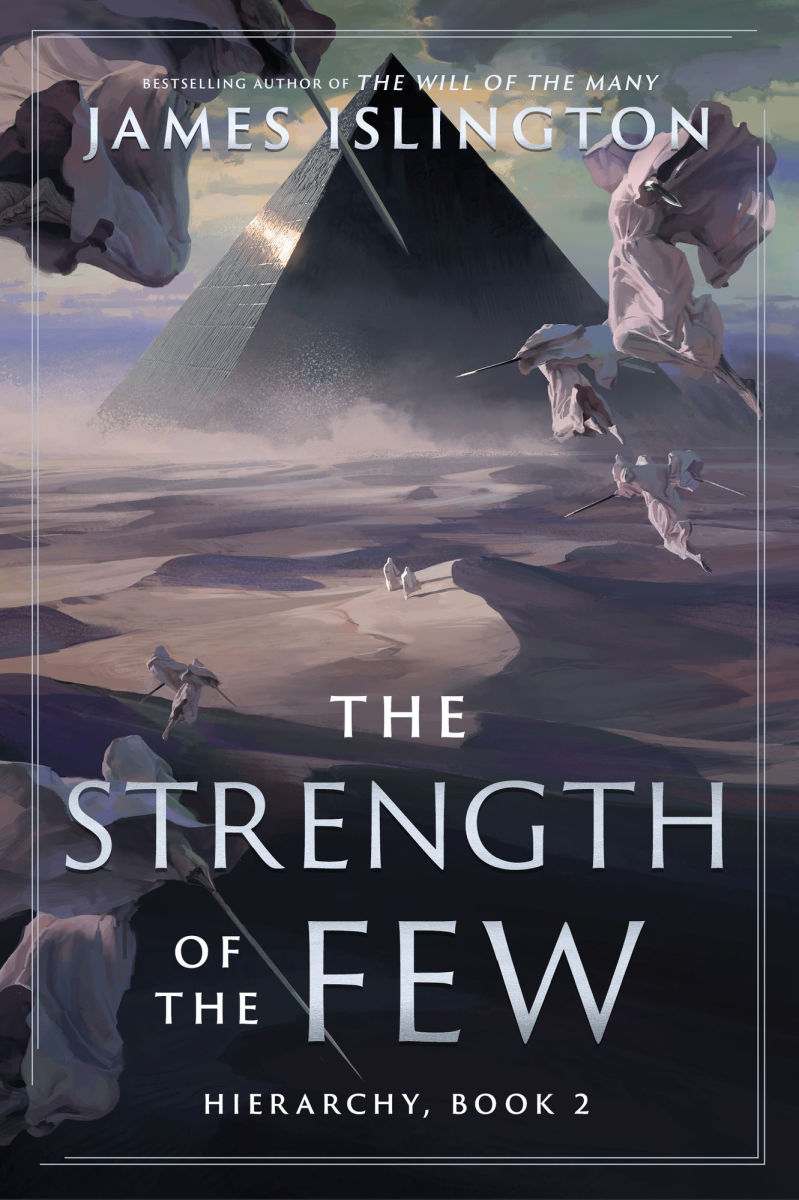
Publisher: Text Publishing/Audible Studios (Audiobook – 11 November 2025)
Series: Hierarchy – Book Two
Length: 31 hours 8 minutes
My Rating: 5 out of 5 stars
Australian author James Islington continues his Hierarchy series in epic form with the incredible and complex novel, The Strength of the Few, an outstanding and highly addictive fantasy novel that I had an incredible time getting through.
Back in 2023, I had the pleasure of reading the outstanding novel, The Will of the Many from James Islington, which I very quickly fell in love with. Following a fugitive prince who finds himself enrolled in an academy for the children of the elite members of the nation that conquered his homeland, The Will of the Many had an intricate plot that forced the protagonist to deal with elaborate ancient puzzles, the unique magic of his world, unlikely friendships, deadly rebels, and all his hidden secrets potentially becoming uncovered. I had such an amazing time reading The Will of the Many that it got a very easy five-star rating from me, and it ended up topping several of my end-of-year lists for 2023, including my favourite book, audiobook, new-to-me author and Australian fiction lists. Unsurprisingly, I have been keen to see how the series would continue ever since I finished the final page of The Will of the Many, and the long-awaited sequel, The Strength of the Few, was one of my most anticipated novels of 2025. I started reading The Strength of the Few the second I could, and it turned out to be another captivating read, with a plot that goes in some captivating and intense directions.
After infiltrating the Academy and running the mysterious Labyrinth, the man known to the Catenan Republic as Vis Telimus thought that he would finally understand some of the secrets of the nation that destroyed his people. However, his encounters within the Labyrinth have instead resulted in the impossible and placed him in the firing line of an ancient evil determined to destroy his world.
While the original Vis continues to live in the Catenan Republic, attempting to avenge the massacre of his Academy classmates and friends at the Iudicium, he is unaware that the ancient devices within the Labyrinth replicated him across three separate words. Mirrors of each other influenced and altered by different history, the worlds of Obiteum, Luceum and the world Vis already knows as Res, are divergent places, each with their own troubles, rulers and chaos.
Now one of the few beings existing across all three concurrent realities, Vis stands as the only person who can stop the upcoming Cataclysm that will burn away all he loves. But first he needs to face the different challenges each world has for him, especially as he truly belongs in none of them. Forced to fight, to learn how to control the unique powers his situation has granted him, and to understand the different worlds they find themselves in, all three versions of Vis will be pushed to their limits as they try to prove themselves and understand the secrets behind their unlikely journey. If any version of Vis fails, then all their chance to stop the Cataclysm are finished. But can Vis really survive in three separate realities, each of which is filled with beings who desperately want him dead?
Well damn, now that’s how you do a sequel. The Strength of the Few was an incredible novel as James Islington expertly continued the elaborate and ambitious narrative of his epic Hierarchy books. Featuring a layered story loaded with complex world-building, intricate story details and compelling characters, The Strength of the Few was an exceptional novel that gets a very easy five-star rating from me.
Islington came up with an especially complex and powerful story for The Strength of the Few, which served as a very worthy follow-up to the compelling events of the previous Hierarchy book. Right out the gate readers are treated to an intricate plot, with the protagonist from The Will of the Many split into three different versions of himself in three separate mirror worlds. Each version has its own very distinct narrative that revolves around that specific Vis trying to overcome the challenges of that specific world. For example, the version of Vis on Res, the world that The Will of the Many was completely set in, continues to endure the politics of the Hierarchy, while also attempting to uncover those responsible for the massacre of his classmates at the end of the previous book. The storyline set on Obiteum is a bit of a post-apocalyptic narrative, as Vis is forced to survive a broken world ruled by the enemy responsible for several previous Cataclysms, and must try to find a way into a forbidden city, half staffed by the living dead. The final storyline set in Luceum offers a much more adventurous narrative, as a version of Vis that is completely unaware that he is in an alternate world, is forced to explore a new culture and attempt to survive amongst people who have no idea of his past or his destiny.
These three separate and very distinctive storylines each go in some interesting directions as the book continues, and the result is a very impressive and compelling overall narrative, especially as Islington expertly sets up necessary details in the early stages of the book and cleverly builds from there. For most part, each of these storylines stay isolated, although some key details from each bleed into the wider narrative, and you can appreciate the significance of certain events or revelations in one storyline better thanks to the events in one of the other worlds. Each plot line goes in some very interesting directions, with the dark politics of Res forcing Vis to engage in some complex schemes and deceptions, the struggles of Obiteum slowly getting to an isolated version of the protagonist, while positive character interactions in Luceum turn that Vis into a completely different person. Islington starts to enhance the tension of all three storylines in the second part of the book, and there are some very amazing scenes that completely change the tone of each of the main storylines. I felt the political instability of Res allowed for some particularly powerful moments, especially after a shocking scene about two-thirds of the way through book. A growing war in Luceum also provides some compelling drama for that storyline, as Vis must decide what he wants in life, while the continued threat of discovery in Obiteum proves to be particularly draining.
The final third of the book contains some of the best scenes of The Strength of the Few, as Islington builds on all the novel’s great storytelling and complex worldbuilding to bring forth an epic conclusion. Thrusting all three versions of Vis into mortal danger, the tension is particularly thick, as the protagonist and much of the supporting cast are in constant risk. This includes a final desperate attempt to achieve his goal of killing a god in Obiteum, which hits a range of snags amongst the ancient city Vis has spent most of the book infiltrating. At the same time, the Vis in Leceum finds himself in the middle of a deadly war, where his unique abilities and the unlikely rewards of a deadly ceremony weigh him down. However, the most intense is the narrative set on Res, where Vis finds himself attempting to save who he can from the chaotic events brought on by those manipulating him. Islington probably throws the book’s most shocking moments into the Res storyline, which nicely builds on a lot of the drama and intrigue from the first novel, and forces the protagonist to make some dark decisions, out of both vengeance and necessity. One scene where the title of the book is quoted by an antagonist really sticks in the mind, and I’m not sure I’ll be able to forgive Islington with the dark bait-and-switch there. All three of these storylines end on an interesting note that hint of destructive events for the future, and it is going to be fascinating to see how Islington continues the Hierarchy series going forward.
Thanks to the elaborate ideas that Islington had for this epic sequel, The Strength of the Few turned out to be an exceptionally written read, which provides an intense and compelling fantasy narrative, filled with some great emotional depth. The inventive way that the author splits the book to follow three separate versions of the same protagonist worked surprisingly well, and it allowed for quite a unique character-driven story, which really showcases Islington’s writing ability. I felt that the split between the three distinctive storylines was very well done, and these separate narrative threads each stood on their own merits, provide a distinctive experience in each. I loved how there was something special in each of the storylines, and you got some interesting interactions, world building and different focuses with each of them. All three were very well written, and there were honestly no weak links with any of the storylines, which is always a risk when you split the narrative like this. I will say that the intrigue-laden narrative on Res was a particular favourite of mine, but both other storylines were also quite exceptional, and they balanced each other nicely with their alternating themes and varied character growth. Throw in some creative expansion of the universe the narrative is set in, with its cool Will-based magic system, and three worlds each inspired by different ancient cultures (Roman, Egyptian and Celtic), and this was a very well written book, and I really appreciate how effectively Islington builds up his different worlds and showcases them to the reader.
The Strength of the Few proved to be an impressive continuation of the Hierarchy series, and I felt that Islington did an outstanding job building on the impressive fantasy elements and storylines of the first book. However, the complex narrative split and the way that Islington dives immediately into the story does mean that The Strength of the Few is probably best enjoyed by those readers who have already gotten through The Will of the Many. While Islington does re-examine key elements of the plot from the first book as The Strength of the Few continues, it is a very gradual process, and new readers trying to read the sequel first are likely to get confused if they don’t know some necessary details from the first book. The Strength of the Few might have benefited from a good summary or recap at the front of the book to remind readers of some key details, especially if they haven’t had a chance to read re-read The Will of the Many since its 2023 release. Still, for the most part, all readers should be able to follow and appreciate The Strength of the Few, especially once you get drawn into the three compelling storylines, and people who love extremely elaborate fantasy narratives with a lot of intricate detail are going to have an outstanding time.
I was once again impressed with Islington’s great characters in The Strength of the Few, as this book has a massive cast, made up of an interesting combination of figures from The Will of the Many, and new characters from the three separate worlds of the setting. However, most of this book naturally follows the young protagonist from the first book, who is primarily known as Vis Telimus. A studious and damaged figure who had already gone through a lot before the events of this novel, Vis has rather a unique experience in this sequel, as unbeknown to him, there are now three separate versions of him concurrently existing in the mirror worlds of this setting.
Islington perfectly sets up and utilises this three-way split of his protagonist, and readers are soon treated to three distinct variations of the protagonist, each of whom are altered by their experiences and losses, especially the two versions of Vis who lose their left arm. It was fascinating to see how each of the Vises are influenced and changed by their respective traumas, and how their adventures are altered by the different information or people that they meet. For example, the Vis in Res, who is essentially the same protagonist from The Will of the Many, finds himself longing for vengeance after the events of the Iudicium, and spends much of the book angry and forced to endure politics and lies. The version of Vis on Luceum, while feeling lessened by the loss of his arm, soon finds peace in his new setting, and his eventual motivations for fighting and living are very different from his other incarnations, especially as he finds friends he can trust completely. Finally, the Vis on Obiteum is one of the more confident incarnations of the protagonist, having full knowledge of the upcoming Cataclysm and his place in the three worlds explain early in the book. As such, he soon becomes the most competent at utilising his Will talents and appears the most undamaged of the three due to not losing his arm. However, in many ways the Obiteum Vis is the worst off out of all versions of the protagonist due to his isolation, the desolate surroundings, and the early expectations of murder and potential death that are thrust upon him. I really cannot emphasise just how clever the split between these different variations of the protagonist is, especially with the subtle differences and alternate reactions to similar events or situations. It really makes for quite a distinctive and moving read, especially as all three versions of Vis experiences even greater trauma and damage as this sequel continues.
While Vis is the obvious focus of The Strength of the Few, there is a huge supporting cast utilised throughout this book, including various characters only found on each distinctive world. Indeed, each version of Vis picks up its own supporting cast, which allows for some very different interactions in each of the major storylines. Highlights include many of the recurring characters from the first book who serve as Vis’ friends and mentors in Res. There is a particular focus on Eidhin and Aequa, who have an expanded role as Vis’s main confidants in this novel, and I liked some of the powerful storylines that formed around them. Other major supporting characters from the first novel are showcased to a lesser extent in this sequel, primarily due to the book being split into three separate parts, although many of these characters still got a notable role in this sequel.
The cast supporting Vis on the desolate world of Obiteum is a lot more limited, mainly to emphasise the protagonist’s loneliness, although he does find a compelling mentor in Caeror, his adoptive uncle, who the protagonist was hunting for in the first book. A couple of other native characters from Obiteum gain prominence later in this storyline as Vis attempts to complete his mission, and it is fascinating to see how their experiences living on a dead-world, impact their interactions with the protagonist. Finally, the cast of the Luceum plotline represent a compelling counterpart to the supporting characters of the rest of the book. While Vis has enemies in Luceum, he also finds several true friends who he can trust with all his secrets. It was interesting to finally see Vis truly open up to other people, and it allowed for some very different interactions to the secrets and lies that define the protagonist in the other two storylines. Throw in a compelling array of antagonists, as well as an entertaining manipulator who keeps chucking Vis into the deep end on Res, and this was an impressive cast for this great sequel. It honestly was an extremely intriguing experience to have three separate casts of characters set around different versions of the protagonist. While this narrative split did result in some restrictions when it came to character depth or a full exploration of relationships, I think the overall extended length of the book overcame this and allowed the reader to grow close to the supporting characters. I will warn readers not to get too attached to the extended cast though, as Islington does get a little murderous as the book continues, however, all these characters are impressive while they last.
While I was lucky enough to receive a physical copy of The Strength of the Few, I ended up holding out for a little bit to listen to the audiobook version of this book instead. I’m a big fan of audiobooks when it comes to ultra-elaborate fantasy narratives, as I tend to absorb and retain more of the details that way, and this worked out well with The Strength of the Few. I felt that Islington’s complex story came across very effectively when read out, and all the elements, including the elaborate worldbuilding and the great character work, were well translated to the reader. I also appreciated how the switches between the three different versions of the perspective protagonist, was easily discernible, and this was a very easy story to follow on audiobook. The Strength of the Few audiobook saw the return of Euan Morton for narrator, who previously read out The Will of the Many, and who I quite enjoyed as a narrator of the Star Wars audiobook, Tarkin. Morton has a very interesting cadence to his voice as a narrator, which provided a very unique edge to this audiobook. While Morton’s narration style might not appeal to everyone, I felt that he did a good job voicing this compelling story, especially through the eyes of the complex protagonist, and his unique narration on this elaborate story worked extremely well. I also felt that Morton excelled at pronouncing all the different names and titles that Islington featured in his plot, no matter their Roman, Celtic or Egyptian inspiration, and the characters of all three different worlds had a subtly different cadence and accent that helped to distinguish the separate storylines from each other. As such, I really got stuck into this audiobook, powering through it quickly, even with its 31-hour runtime. This was probably one of the more intense and moving fantasy audiobooks I had the pleasure of listening to in 2025, and I cannot recommend this format enough.
James Islington does it again with his incredible second Hierarchy novel, The Strength of the Few. Brilliantly continuing his elaborate narrative from the first novel in a unique manner, The Strength of the Few was an ultra-addictive read, that really showcased Islington’s writing ability and imagination. Clever, powerful and easy to get addicted to, The Strength of the Few was one of my favourite books of the year, and I cannot wait to see how Islington continues the series going forward.
 The Unseen Library