
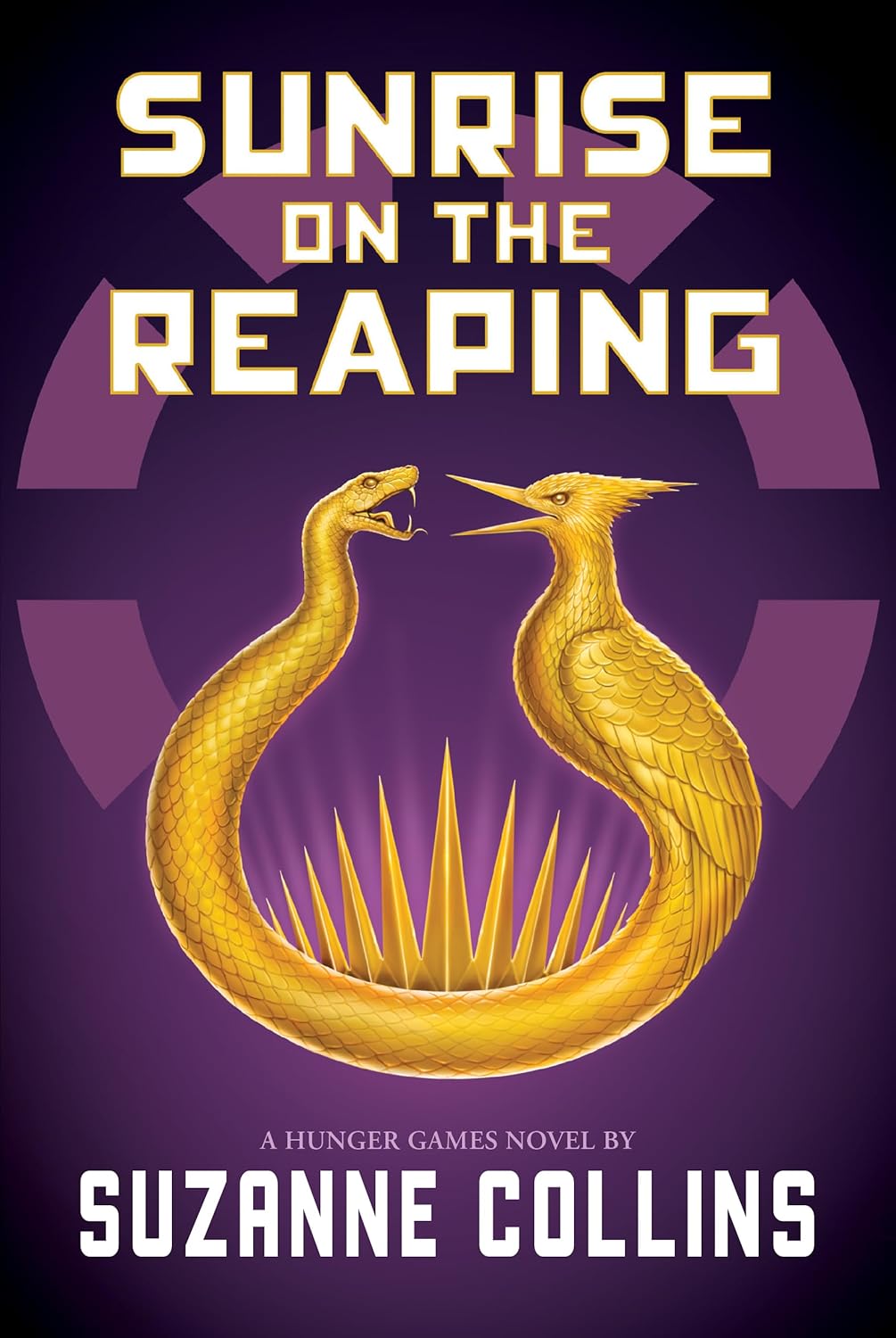
Publisher: Scholastic Audio (Audiobook – 18 March 2025)
Series: The Hunger Games – Book 0.5
Length: 12 hours and 48 minutes
My Rating: 5 out of 5 stars
Acclaimed author Suzanne Collins presents the next epic and heartbreaking entry to her iconic Hunger Games series with the brilliant prequel, Sunrise on the Reaping.
Unless you’ve been living under a rock for the last few years, then you’ll probably be more than familiar with the Hunger Games series by Suzanne Collins, as well as the major film franchise that it spawned. Set in a dystopian future where 24 teenagers are forced to fight to the death each year, the Hunger Games franchise is a very cool and inventive young adult series that expertly blends great characters, an overarching anti-authoritarian narrative and a ton of complex action with its excellent central concept. I have been a massive fan of the Hunger Games since watching the first movie, which I went into blind and ended up deeply enjoying. I have since read all the books, including Collins’s previous prequel, A Ballad of Songbirds and Serpents, all of which are extremely awesome and contain exceptional stories that cleverly add to the larger setting.
While I have enjoyed all the awesome Hunger Games books that Collins has so far written, there has always been one intriguing story from the universe that I always felt needed to be expanded on, that of the rascally old drunk mentor Haymitch Abernathy (played perfectly by Woody Harrelson in the films). I especially have always wanted more detail about Haymitch’s own Hunger Games, which were briefly summarised in the second novel, Catching Fire. Well, Collins has just granted one of my fondest literary wishes as her latest book captures just that with Sunrise on the Reaping. Sunrise on the Reaping has been very high on my to-read list since it was first announced, and it was one of my most anticipated novels of 2025, as well as a much-anticipated film in late 2026. I had a real blast listening to it, and boy did Collins take her story to all the dark places I wanted, and further beyond.
May the odds be ever in your favour!
As the dawn breaks on the 50th annual Hunger Games, few people have cause to celebrate, even young District 12 bootlegger Haymitch Abernathy, whose birthday unfortunately falls on Reaping Day each year. Despite growing up in a totalitarian dictatorship, Haymitch believes that he has a good life, with friends, family and the love of his life. However, he is unprepared for just how badly a single moment can change everything.
Selected as one of his district’s Hunger Games tributes, Haymitch suddenly finds himself torn away from everything he loves and must contemplate fighting for his life to survive in the Capitol’s arena. However, this is no ordinary Hunger Games, it is the second Quarter Quell, and twice as many tributes have been taken from each of the districts, ensuring that his games will be the largest and most brutal battle ever seen.
Forced to compete alongside three other District 12 tributes, including one of his best friends, an oddsmaker whose family prospers by betting on the games, and the most stuck-up-girl in town, Haymitch knows that his chances of survival are slim. However, something within Haymitch wants to fight back against both the Capitol and the controlling President Snow. Finding unlikely allies, Haymitch seeks a way to make his impending death mean something and to strike a blow that the Capitol can’t ignore. But can Haymitch survive long enough to make his stand, while still keeping true to his own loyalties and friendships? The fires of rebellion start to burn here, but Haymitch will soon find out that when flames start, people get burnt.
Well hot damn, that is how you do a prequel. Suzanne Collins once again shows why she is the leading lady of dystopian young adult fiction, with the brilliant and powerful Sunrise on the Reaping. A devastating prequel to her original Hunger Games trilogy that perfectly tells the haunting tale of Haymitch Abernathy, Sunrise on the Reaping was an exceptional novel that I can’t help but give a full five-star rating to. This is a must-read for all fans of the Hunger Games series, but be warned: you won’t be prepared for how tragic the book gets.
I honestly have so much to say about the epic new story that Collins came up with for Sunrise on the Reaping, although I really don’t want to ruin anything for those who have yet to read it. I will say that if you think you know the story from the summary in Catching Fire, then you are very, very wrong, as Collins twists everything you thought you knew about the 50th Hunger Games and Haymitch Abernathy, while breaking your heart in so many ways.
This dive into tragedy is very well established, and Collins does a brilliant job of initially setting the scene around young Haymitch and showing his early life, family and the other connections he has around District 12. It doesn’t take long for Collins to turn the expected narrative on its head, thanks to a very clever bait-and-switch, and from that moment on, you really don’t know what to expect. While much of Sunrise on the Reaping does follow the story beats you would expect from reading the previous books and from Catching Fire’s summary, Collins keeps cleverly turning or twisting them around, so that events like the Tributes parade, the pre-game training and the interviews go in some surprising and often even more traumatic directions. At the same time, Haymitch has interesting interactions with an array of great supporting characters, many of whom will be very familiar to those who have read the previous Hunger Games books. All this works to provide much more depth to a story that could have simply been about a massive teenage deathmatch, and which helps to drag you even more into the story, especially as it gives you some intriguing context about Haymitch’s upcoming actions.
Things get pretty crazy once the characters get into the games proper at around the halfway point, and Collins keeps this part of the story fast paced, as you watch Haymitch navigate the arena, surviving the fights and trying to enact his own plans. This is the part of the book that really deviates from the previously shown version of these games, and I loved how much more detail and complexity Collins gives this latest batch of carnage as Haymitch tries to enact his own hidden goals alongside the previously known narrative. This works to form quite a compelling plot, which I won’t talk about too much to avoid spoilers. I will say that there are some truly devastating moments, and you cannot help but feel despair as you witness what really happened to Haymitch and his fellow tributes. There are so many heartbreaking scenes scattered throughout this part of the book, as well as some great moments of rebellion and humanity, all of which keeps you hooked as you wait to see the brutal final moments of these games. Collins does an amazing job wrapping everything up in a powerful way, although the conclusion is guaranteed to gut you. While you know something bad is coming, the full enormity and devastation of the ending really does break you and ensures that will come away from Sunrise on the Reaping haunted and with a deeper appreciation of the rest of the series.
I deeply enjoyed how this epic novel came about, as Collins delivered a complex, powerful and distinctive character-driven read that has the right balance of moving character arcs, desperate survival, brutal tragedy and clever word building, all brought together by a series of shocking twists and heart-breaking reveals. Once again told exclusively from the protagonist’s perspective, you witness events through the eyes of the young and rebellious Haymitch, which narrows the reader’s vision of the plot. While I do hope that the film makers show some alternative perspectives like they did in the original Hunger Games films (i.e. what was happening in the control room), I think that this single-character perspective worked extremely well for the book, allowing the reader to get closer to the protagonist, appreciate his emotional reactions to the dark events unfurling around him, while also provide a great outsider perspective to the craziness of the Capitol and the arena. Collins utilises this to tell a dark and haunting tale, and you are soon inundated with the many injustices Haymitch experiences that Haymitch experiences as he makes his may towards the inevitable Hunger Games. I really appreciated how well Collins set out the various pivotal events of Sunrise on the Reaping, especially as there are some subtle hints about some of the big events cleverly scattered throughout both the early part of the book, as well as the brief synopsis of the games featured in Catching Fire. I felt the author did an excellent job pacing everything out, and the reader is constantly on their toes as unexpected events hit the protagonist, and you never quite know what is going to happen next.
As with most of the books in this series, I found Sunrise on the Reaping to be a novel that will appeal to a wide range of readers, including both its intended young adult audience and older fans. Thanks to the protagonist covering his adventure from start to finish, new readers can easily jump into the series here if they wanted to and not lose any of the book’s intensive impact. Unsurprisingly, though, Sunrise on the Reaping is going to be best enjoyed by those readers who have enjoyed the rest of the Hunger Games books or movie adaptations. Collins layers in a ton of references, cameos and hints at events to come, throughout the course of Sunrise on the Reaping’s plot, and eagle-eyed readers will have a lot of satisfaction picking up on them. I personally loved some of the clever references to the previous prequel, A Ballad of Songbirds and Serpents, including one scene where President Snow utilises some of his knowledge gained from his sojourn to District 12 to rattle Haymitch. I also quite liked the author’s depictions of the games 24 years before the events of the first novel, and it was interesting to see the similarities and differences between the events, especially after the more basic version that was showcased in A Ballad of Songbirds and Serpents.
One of the things that fans of the series will no doubt be interested in seeing is how the events of Sunrise on the Reaping are widely different to the summary included in Catching Fire. While certain broad strokes of the event are the same as what Katniss and Peeta saw in the recording, most of what happened in the actual games and its lead-up is vastly different, with Collins showing some very surprising motivations and hidden events throughout the course of the book. I found this to be extremely fascinating, mainly because it so cleverly invokes the overlapping theme of Sunrise on the Reaping: control of information as a powerful tool of authoritarian governments. There are some very clever scenes where the Capitol edits and rewrites key events of the plot to suit their own propaganda, and it was fascinating to see tragedies, injustices and occasional flashes of kindness hidden away or completely erased to make Snow look good and Haymitch and the other tributes look like animals or noble patriots. This allowed Collins to hide a very compelling early rebellion storyline amongst the events of the book, which puts the events of the main trilogy in a whole new light and makes you full reevaluate some of the supporting cast members. Collins did this in a very clever manner which doesn’t devalue or contradict the events of the other Hunger Games novels but which allowed Sunrise on the Reaping to stand out as a major entry in the larger canon, with events that would resonate down the years. I really cannot emphasise enough what an impressive act of long-term series writing this is, and you can tell that Collins put an exceptional amount of thought and planning into bringing this unique story to life.
This compelling read features an excellent and varied array of major and supporting characters, including a whole collection of major existing characters from the franchise, as well as several great new figures. Collins wrapped some amazing storylines around these outstanding figures, and I was really impressed by how attached I grew to several of them, even though I knew what their eventual fate was likely to be.
Due to his role as the book’s main narrator and point-of-view character, most of Sunrise on the Reaping’s focus was around the young Haymitch Abernathy, and it was particularly fascinating to see a younger version of this iconic figure. Initially shown to be a hopeful and confident teenager with ambitions of love and a future, you soon become quite attached to the young Haymitch due to his selflessness and his willingness to protect his friends and loved ones leading up to the games, as well as the inherent rebellious nature that makes him a target of the Capitol and Snow. However, as the book continues and Haymitch experiences multiple tragedies, including a series of dark deaths, you witness his spirit start to break piece by piece. While you had to know that Haymitch was going to have a hard time in this novel, especially after seeing the drunk and damaged figure from the original trilogy, it was still very heartbreaking to see every dark event that befalls him, especially while witnessing all his thoughts and emotions. I really loved this deeper dive into Haymitch’s life, especially as you get to see why he had so little hope or resolve when you first met him in The Hunger Games, and this makes his entire story from the main trilogy even more impactful. A truly amazing origin story for one of the best characters in the Hunger Games series.
Aside from Haymitch, Sunrise on the Reaping contains an outstanding array of supporting characters, many of whom Collins makes shine in the time that they appear. This includes several great new figures, primarily those fellow tributes of Haymitch, whose story alongside the protagonist is highly impactful. I’m not going to go into too much detail to avoid spoilers, but I felt that several of these new characters were extremely cool, and will no doubt become even larger than life on the big screen. Highlights for me include Wyatt Callow, a young oddsmaker whose family business makes the other tributes distrust him; Louella McCoy, the youngest tribute from District 12, whose story is especially tragic; and Ampert Latier, a tribute with connections to a major character from the original trilogy. Lenore Dove Baird, Haymitch’s love interest back home, is a very enthralling figure who has some potential connections to a major figure from A Ballad of Songbirds and Serpents, which allows for some very compelling and moving scenes. Other interesting new figures included the cruel Capitol escort, Drusilla Sickle, and the reptile-obsessed stylist Magno Stift, while several other great characters step up in their own way. However, it was the final District 12 tribute, Maysilee Donner, who really stole the show for me, and her fantastic wit and brutal barbs helped turn her into a major favourite of mine, especially when you realise that she isn’t as stuck up as people believe she is.
Collins wraps up this cast with several characters introduced in the original trilogy who have some memorable appearances here. However, they aren’t just there to please the fans; Collins used them strategically to give a lot more depth to some of these recurring characters as you witness early key events in their personal history. Many of these appearances helped to underscore why they are so willing to rebel or help Katniss, and I loved how well they were featured in the plot. Special mention must go to a returning President Snow (the only character to appear in all five books), who was a spectacular antagonist in this latest Hunger Games book. The author made sure to showcase Snow at his most cruel and vindictive during his scenes, and Collin’s use of him here was a pure masterclass of evil that you had to love. I also need to highlight the fantastic deeper dive into Plutarch Heavensbee, whose motivations during the Catching Fire, are a little clearer after reading Sunrise on the Reaping, and it was awesome, if initially a little surprising, to see him so well utilised in this novel.
Overall, I think that the character work in Sunrise on the Reaping was quite exceptional, and I loved how well all these characters were featured in this book. While the particularly large cast of supporting characters did mean that some tributes weren’t as well featured or explored as they could have been (this is also a side effect of there being twice as many tributes), the figures who were highlighted more than made up for this, and I loved the various complex and tragic story arcs that surrounded them. I cannot wait to see how many of these characters come across in the upcoming Sunrise on the Reaping film, although based on the recent casting announcements, they are going to shine so brightly when they appear.
As with the rest of the books in the Hunger Games series, I chose to listen to Sunrise on the Reaping on audiobook, which is an exceptional way to absorb Collins’s dark and brutal tale. Featuring a runtime of just under 13 hours, Sunrise on the Reaping has a decent length that I managed to move through quickly. Thanks to some great narration and an excellent pace, the audiobook format did an outstanding job of enhancing many of the best elements of Sunrise on the Reaping, especially the central characters and the emotional depth of the protagonist. The narrator of this audiobook, actor Jefferson White, was particularly effective, and I loved how he brought the story to life with his voice. His take on many of the characters was pretty damn perfect, with his voice for the young Haymitch being particularly effective. His young Haymitch, which was the default tone for much of the audiobook, was a great take on a younger Woody Harrelson, and I really felt that he captured the characters many nuances and emotions. I also liked how White tried to sing out the various melodies that were so intrinsic to the plot of Sunrise on the Reaping, which ensured that they were a little more impactful. This outstanding narration really helped to enhance my enjoyment of the books’ epic plot, and I honestly felt that this was the best way to enjoy this exceptional addition to the Hunger Games franchise.
I think the above five pages are more than enough to showcase just how much I loved Sunrise on the Reaping, which was such a brilliant addition to the Hunger Games series. Suzanne Collins honestly outdid herself with this incredible prequel, and you will not be prepared for how complex and emotionally traumatising this outstanding novel is. I honestly cannot not stop thinking about how Sunrise on the Reaping turned out and this is easily one of the better books (and audiobooks) I have so far enjoyed in 2025.
 The Unseen Library