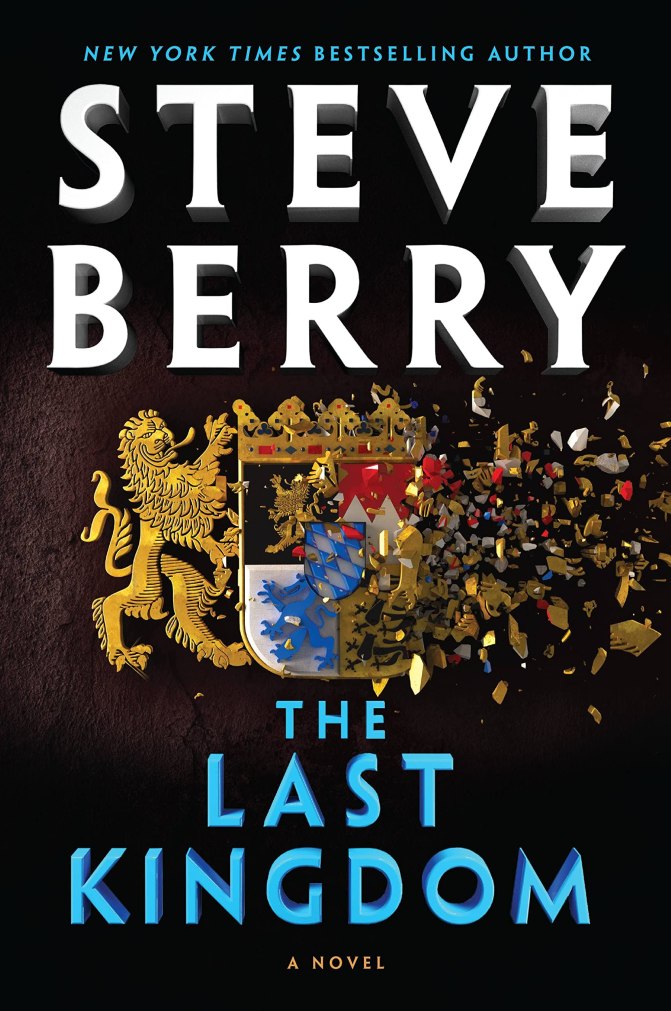
The Last Kingdom by Steve Berry

The Last Kingdom (Steve Berry) Cover

Publisher: Hachette Audio (Audiobook – 21 February 2023)

Series: Cotton Malone – Book 17

Length: 14 hours and 20 minutes

My Rating: 4.75 out of 5 stars

Amazon

Prepare for a remarkable and captivating mystery from out of history as acclaimed thriller writer Steve Berry presents another outstanding and riveting novel in The Last Kingdom.

Ever since I started reading thrillers a few years ago, one of my favourite authors in the genre, as well the most consistently entertaining, is the fantastic Steve Berry.  A veteran author who has been producing compelling reads since the early 2000s, Berry has over 25 books to his name that blend intense modern thriller narratives with intriguing history elements.  His most iconic body of work is his long-running Cotton Malone series, which follows a US Justice Department agent as he investigates unique historical conspiracies or secrets whose revelation will have major implications in the modern world.  I first fell in love with Berry’s writing back in 2019 when I read The Malta Exchange.  Since then I have gone on to read several more Cotton Malone novels including The Warsaw Protocol and The Kaiser’s Web, as well as the standalone novel The Omega Factor, each of which have contained some addictive stories that I’ve deeply enjoyed.  As such, I made sure to read his 2023 release, The Last Kingdom, as a soon as I could.  The 17th Cotton Malone novel, The Last Kingdom presented the reader with another brilliant conspiracy from history that was pretty awesome to behold.

There are many strange tales scattered throughout the history of Europe, but few are more unusual than that of King Ludwig II of Bavaria.  An unstable and fanciful figure who loved stories, solitude, and magnificent castles, King Ludwig dreamed of a magical kingdom, one far different from the lands he ruled.  Determined to find such a kingdom, he despatched agents throughout the world before his murder in 1886.  History suggests that he never found what he was looking for, but what if he did?

Now, in modern day Bavaria, freelance intelligence agent Cotton Malone has been hired by his old friend and protégé Luke Daniels to help him infiltrate a small group of radical separatists with dreams of securing Bavaria’s independence from Germany.  The focus of Luke’s investigation is the prince of Bavaria who seeks to usurp his older brother, the duke, and restore the ousted Wittelsbach monarchy with himself as king.  But to achieve his dreams, the prince needs the ultimate leverage, the Last Kingdom of King Ludwig II.

Following clues throughout several significant sites in Bavaria, Cotton and the Prince’s men are soon caught in a race to find a mysterious deed, one that Germany, China and the United States would kill for and which could greatly shift the balance of power in the world.  With the White House, Chinese intelligence, a mysterious Bavarian secret society and a rogue group of former CIA agents all vying for the prize, Cotton desperately attempts to solve the puzzle of the Last Kingdom and the terrible legacy it holds.  But can Cotton once again defeat the odds and keep the word safe from another historical mystery, or will the world be irrevocably altered by a secret form another century?

Well damn, now that was a pretty awesome read.  I have so much damn love for Steve Berry’s work, and The Last Kingdom is probably one of my favourites so far.  Perfectly combining an excellent thriller storyline with an elaborate and deeply captivating tale of history, The Last Kingdom was an exceptional read and one that I honestly could not stop listening to.

Berry has produced an amazing and addictive masterpiece of a thriller in The Last Kingdom with a particularly strong story behind it.  Like most of Berry’s books, The Last Kingdom is primarily a modern day thriller that introduces an original conspiracy that took place in history and has remained hidden until Cotton Malone wanders along (that man finds ancient mysteries wherever he goes).  As such, what starts as a simple infiltration at a famous Bavarian palace soon devolves into an elaborate treasure hunt for unique piece of history.  This latest historical mystery revolves around the eccentric and tragic final kings of Bavaria, and their desires to either retain power or find their own place in the world.  Berry expands on this historical detail throughout the entire course of the book, providing a good combination of real facts and some exaggerated fictional elements, which works into the main plot extremely well.  This modern day storyline gets some legs really early on as the protagonist and his companions are dragged into a major shadow war with several different factions attempting to take advantage of the situation and the hunt for the historical mystery.  Cotton soon finds himself working for several old colleagues, including a reckless CIA agent, while other groups, including the Bavarian prince and a rogue group of former CIA agents, start to use deadly force to solve the clues and find the hidden deed.

Berry keeps the pace of The Last Kingdom quick and compelling by raising the various stakes of the book while still showing off the entirety of Bavaria and its historic beauty.  There is a good reveal of why everyone is after the deed about halfway through which sets everyone on the road to a big confrontation.  While the full details of the conspiracy are a little over-the-top, Berry fits it into the story well, and the examination of modern and historical concerns surrounding is quite clever and intriguing.  The final half of the book is an intense thrill ride in several great ways, as Berry loads up the story with fun reveals, clever twists and so many betrayals.  I loved how the mystery of the King’s deed unfolded, and Berry really mixed the various original puzzle pieces of his conspiracy with the overlying historical detail to create a fantastic scavenger hunt.  The modern day thriller elements flitted around this extremely well, and watching the various participants in the hunt betray or outwit each other to try and get the prize was deeply exciting and led to some big moments.  The conclusion to the story is very good, and readers will come away extremely satisfied, both with how the story came together, and with all the extra knowledge Berry leaves you with.

I have a very deep appreciation for how Berry writes his outstanding novels and I think that The Last Kingdom was a particularly impressive example of this.  The blend of a high-intensity modern thriller storyline wrapped around a mystery loaded in historical detail is always entertaining, and I felt it turned out well again in The Last Kingdom.  The way that Berry splits the story out using alternate perspective chapters is particularly useful, as you get to see each of the characters interpreting the historical elements from different perspectives.  At the same time, several of the chapters are set in the 19th century and provide some deeper historical context to the story, which I felt was particularly useful and fun.  Berry really excels in simultaneously showing the different aspects of his story, and readers come away from The Last Kingdom having had fun with the thriller elements, while also learning so much more about some fascinating topics.  I really think that The Last Kingdom had one of the better thriller storylines associated with it thanks to inclusion of spies, disaffected royals, and several warring governments, and the way that story element unfolded had me pretty damn hooked the entire way through.  Like most of the Cotton Malone novels, The Last Kingdom can be read as a mostly standalone book, and readers don’t need to have any real knowledge of the previous entries in the series to enjoy this great novel.  While there are references to previous adventures and mysteries, the relevant details of these are well explained and new readers won’t be thrown by them.  However, long-term fans of the series will appreciate the continuation of several recent storylines, especially around Cotton’s feud with the US President, and I liked how that unfolded.

As I have mentioned a few times already, one of the best things about The Last Kingdom, and indeed all of the Cotton Malone novels, is the way that Berry dives into unique and intriguing parts of history to really give his stories a captivating kick.  In The Last Kingdom, this takes the form of a focus on the unique history of the kingdom of Bavaria, specifically the last 19th and early 20th century and the last three monarchs of the Wittelsbach line.  I have to admit, this was an area of history that I was not familiar with, but that changed after reading The Last Kingdom.  Berry conveys an immense amount of detail about this period and the relevant kings to the reader throughout the course of the book, so by the time you are done, you know so much about them.  However, Berry does it in such a way that ensures that the reader don’t get bored with it, as he showcases the more compelling elements of their reigns and the nation’s history around it, while also hinting at how it ties into the big conspiracy/mystery of the story.  I particularly enjoyed the detailed and fascinating examination of eccentric King Ludwig II.  Berry covers so many parts of his compelling life in this story, including his complex reign, his unusual outlook on the monarch, and his infamous end that saw him deposed and murdered.  The mysteries of Ludwig II and his search for a new kingdom proved to be a deeply compelling centre for the entire plot and I am really glad I got to learn more about them.  Another nation’s history, which I mention for spoiler reasons, is also concisely featured here, and I liked how Berry tied it together with Bavaria, resulting in a cool mixture that perfectly fed into the modern-day thriller.  The author clearly has so much fun researching and utilising all this historical detail in his books, especially if the extensive author’s notes section at the back is anything to go by.  Featuring all this historical detail works to create a great story, and I cannot emphasise how awesome it can be, especially in Berry’s capable hands.

In addition to all the historical elements of the book, I also really need to highlight how well Berry showcased Bavaria as a whole throughout the course of The Last Kingdom.  Many of the Cotton Malone novels act like a tourist brochure as the protagonists travel from one picturesque area of the country to the next, visiting all manner of historical sites.  This is very much the case for The Last Kingdom as the characters are forced to travel to several impressive locations throughout Bavaria, including iconic cityscapes, famous cathedrals, and beautiful landscapes.  Berry really spares no detail when it comes to describing these locations, and you can easily visualise them in all their stunning glory.  Some of the best descriptions are the iconic three castles that King Ludwig II built, which were strongly connected to his life story.  These castles form the basis for much of the plot’s historical scavenger hunt, and Berry really goes into the history and layout of them, even describing the furniture and the decorations.  You really grow to appreciate these locations around Bavaria, and I know that if I ever get the chance to visit, several of them are going to be on the top of my list of places to check out.  However, it is not just these iconic locations that are explored.  Berry also spends substantial time trying to show off the intangible nature of Bavaria, including its politics, its current attitudes, the state of its old monarchy, its place within larger Germany, and various other elements of its culture, including a real secret society dedicated to King Ludwig II.  All these elements are masterfully researched, examined, and showcased throughout The Last Kingdom, and all of them add to the authenticity of the story in immeasurable ways.

Aside from the excellent story and complex historical details, I also need to mention the great characters featured throughout The Last Kingdom.  Berry always writes fantastic figures, and it was awesome to see more of his central protagonist, Cotton Malone, as well as recurring supporting character Luke Daniels.  Both are well utilised throughout The Last Kingdom, and it was always great to see them working, especially as they have some major veteran presence at this point and work well against the various forces coming for them.  I did think that there was not a lot of development between the two, as both are essentially the same people they were in their last appearances, but they still make solid and likeable central focuses for the story.  However, there was some fantastic character development occurring outside of these main characters, especially as Berry introduces an amazing supporting cast of aging spies, angry deposed royalty, intriguing members of Bavarian society and deadly foreign agents.  Several of these characters have key roles in the book and Berry utilises them perfectly as great alternate perspectives for large swathes of the plot, producing a complex and powerful extended plot.  I loved the utilisation of Derrick Koger, a veteran CIA agent who has history with Cotton and has worked with him/against him in the past.  The funny and morally ambiguous Koger plays off the honourable Cotton perfectly as they work together in this book, and it was interesting to see them teaming up.  I liked how several of the antagonists, as well as Koger, shared a compelling character theme of people who believe they were overlooked or betrayed by their peers or people, and it serves as a great driving force for them to do bad things.  This group of characters and their conflicting priorities are an excellent part of The Last Kingdom and I had an outstanding time following them along this powerful quest.

I once again chose to check out this latest Steve Berry novel on audiobook, which is always a pretty epic experience.  Coming in at nearly 14 and a half hours, The Last Kingdom is medium length audiobook, although once you get caught up in the compelling story it flies by extremely quickly.  I personally love the Cotton Malone audiobooks as the narration really enhances all the elaborate detail of the story, especially the historical background, and ensures that they stick in the mind.  Hearing the key historical facts again and again really drives them home and I find that this helped me get even more fixated on the narrative as I was extremely eager to see how everything came together.  It helps that The Last Kingdom once again features narration from Scott Brick, one of the premiere thriller audiobook narrators out there who has lent his voice to all the previous Cotton Malone audiobooks.  Brick has a great voice for thrillers and I find his narration really fits Berry’s cool stories, especially as he gives some gravitas and complexity to both the modern day events and the historical elements.  Brick also has a great array of accents that he employs to full effect throughout The Last Kingdom, which I deeply appreciated.  His various American accents, which includes one from the wilds of Tennessee, are very well done, and I was once again extremely impressed by his dazzling array of German and European tones.  Even his Australian accent, something I am particularly sensitive about, was passable, if slightly stereotypical, and this fantastic choice of voices enhanced the audiobook experience.  Due to this outstanding voice work, as well as the great impact this format has on some of the key parts of the book, I would strongly recommend The Last Kingdom audiobook, and it is always one of my favourite ways to enjoy a good Steve Berry novel.

Steve Berry continues to impress with his latest outstanding Cotton Malone novel, The Last Kingdom.  Featuring his typical blend of exciting and intense thriller storylines and fascinating historical detail, The Last Kingdom is a brilliant read that powerfully showcases Bavaria in all its glory.  Examining key elements of the state’s past, as well as its current beauty, and perfectly working them into an excellent story, this was an exceptional outing from Berry and one that I had such an amazing time reading. Highly recommended!
Amazon

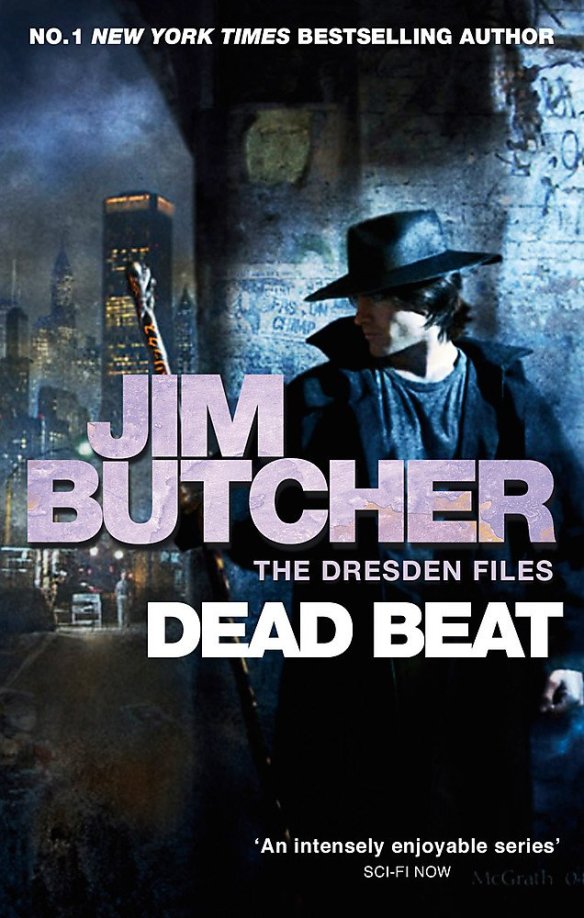
Throwback Thursday – Dead Beat by Jim Butcher

Dead Beat Cover

Publisher: Penguin Audio (Audiobook – 3 May 2005)

Series: Dresden Files – Book Seven

Length: 15 hours and 7 minutes

My Rating: 5 out of 5 stars

Amazon

Welcome back to my Throwback Thursday series, where I republish old reviews, review books I have read before or review older books I have only just had a chance to read.  For this latest review I dive back into the epic Dresden Files series by Jim Butcher with the seventh entry, Dead Beat.

Over the last couple of years, I’ve had a ton of fun finally getting into the iconic Dresden Files books by legendary author Jim Butcher.  Generally considered one of the very best urban fantasy series, the Dresden Files are a deeply captivating series that follows Chicago’s resident wizard, Harry Dresden, as he investigates a series of mystical cases throughout the city, often resulting in epic moments loaded with magic.  I started this series with the latest book, Battle Ground (one of my favourite books and audiobooks of 2020), and then went back to the start to experience the series from the beginning.  So far, I have managed to read Storm Front, Fool Moon, Grave Peril, Summer Knight, Death Masks and Blood Rites, as well as last year’s novella, The Law.  All these books have been extremely good in their own way, and I have loved the elaborate stories each of them contained.  As such, when I was in the mood for something I was guaranteed to love this week, listening to the next Dresden Files book on my to-read list was an easy choice for me, with the seventh book, Dead Beat.

Harry Dresden, private wizard detective and magical protector of Chicago is always willing to help a person in need no matter the cost.  But even he is unprepared for how far he’ll have to go when an old and merciless enemy imperils one of the people closest to him.  The ancient vampire Mavra has evidence that could destroy his best friend, Karrin Murphy, and threatens to unleash it unless Dresden recovers a powerful book of magic written by the legendary, long-dead necromancer Kemmler.

With no choice but to find the book, Dresden begins his search around Chicago, attempting to discover any trace of its location.  However, his search soon leads him into conflict with a new dark power arriving in the city.  Three of Kemmler’s students have their eyes on the book and the rituals it contains, and they are willing to destroy everyone and anyone to get it, including each other, especially when the prize at stake is godhood.

Caught between the three warring necromancers and their minions, Dresden needs to find the book first to stop their dark ultimate ritual before it can decimate Chicago.  However, each of Kemmler’s students far outclasses him in terms of magical ability and ruthlessness, and with only limited allies to call upon, it looks like even Dresden will have trouble saving the day again.  To survive, he might have to a make a dark deal with an even more malevolent evil, one that that has the potential to damn him forever.

I don’t know how he does it, but every single one of Jim Butcher’s novels that I read is so damn addictive and epic that I always struggle to put it down.  Dead Beat was another outstanding entry in the Dresden Files series, and honestly it might be one of the best I have read so far.  I absolutely powered through its clever and elaborate story as I tried to get to the end, and everything about it was highly enjoyable and fun.  Dead Beat gets another easy five-star rating and I have so much love for how amazing this seventh entry in the series turned out.

Dead Beat has an amazing story to it that effortlessly drew me in with the cool combination of magic, character moments and investigative angles.  Starting off quickly with Dresden drafted into the search for a powerful magic book, the protagonist begins his new investigation, only to discover the dangerous necromancers waiting for them.  Dresden soon has deadly encounters with all three necromancers in Chicago searching for the book, as well as their various minions and associates, which results in some brilliant scenes.  Dead Beat continues by setting Dresden and his allies on a dark course as they simultaneously attempt to find the book and the full extent of the warring necromancer’s plans, while also fending off their attacks.  Dresden keeps getting confronted again and again by his foes, barely escaping each time while also learning more about what is to come.  At the same time, he is forced to deal with certain personal issues, including trauma, complicated relationships, and a literal demon in his head, tempting him with power and knowledge.  There are some great twists, dark moments and emotionally powerful scenes set up around the middle of the novel, and I loved how well Butcher laid out the storylines and hinted at some big moments to come. Everything leads up to an epic concluding final third of the book as Dresden makes some hard decisions and compromises to save the day.  The final confrontation with the bad guys is pretty damn awesome, especially as the protagonist, utilising his usual restraint and good judgment, unleashes a very monstrous response to the antagonist’s minions.  This entire narrative was enthralling from start to finish, and I cannot emphasise just how addictive and entertaining the entire story was.

Dead Beat featured Butcher’s usual excellent writing style which once again lent itself extremely well to the elaborate narrative he came up with.  The pacing of this book was constantly fast and exciting, which guarantees that the reader is always paying attention, especially as every page has either action, some intriguing bit of lore or history, or some intense and compelling character development.  Butcher also ensures that this latest novel has the right blend of great story elements to it, and I deeply enjoyed how the fantasy and mystery elements are well featured as the protagonist is forced to do detective work to get the answers.  All this is overlayed by a great smattering of humour, mostly from the funny protagonist, who approaches the dark events and villains with his usual cockiness and disrespect.  The use of a first-person perspective from Dresden is also quite effective, and I loved seeing events through his eyes, as it allows readers to fully grasp the mystery, while also showcasing the great character developments.  While Dead Beat can be read as a standalone read, especially as Butcher is good at quickly recapping events, at this point in the series readers will benefit from going back and reading the earlier Dresden Files books first.  Dead Beat proves to be a key entry in the larger series, with multiple major events occurring here, and there are a ton of references to the preceding books, including the return of several fantastic characters.  I really got a lot more out of Dead Beat’s story for having read the previous novels, especially as you get to see how much Dresden has been through in the lead up to this book.  Overall, this was a very well-written and impressive novel, and Butcher really ensured that his cool story came through perfectly.

As with the rest of the Dresden Files books, I was really impressed with the blend of fantasy and urban fiction elements in Dead Beat, especially as Butcher has come up with such an elaborate world to set his stories in.  The author adds some cool new elements into his complex world throughout Dead Beat, as Dresden is forced to deal with a whole new branch of dark magic, necromancy.  Necromancy, or the control over the dead, is always a great villainous power in fantasy fiction, and Butcher makes excellent use of it in this book, with three rival necromancers vying for power.  Each uses a different form of necromantic magic in battle, and this results in some outstanding scenes where Dresden is forced to confront them.  The resulting magical mayhem is pretty epic, and Butcher’s unique depiction of zombies was both fun and a little scary.  This intriguing new form of magic ensured that Dead Beat really stood out, and I appreciated how Butcher turned it on its head towards the end when Dresden gets creative.  These excellent portrayals of magic fit within the fantastic setting of modern-day Chicago and it is always fun to see the elaborate balance of magical and mundane features that Butcher has set up within the city.  These great fantasy inclusions blend well with the character work and mystery elements of Dead Beat, and I look forward to seeing how Butcher further expands it in future books.

One thing that I felt Butcher did particularly well in Dead Beat was how he portrayed his brilliant cast of characters.  The Dresden Files always contain great protagonists and villains, but this novel had some of the best portrayals of them to date.  This is especially true for series protagonist and point-of-view character Harry Dresden, who had a great outing here.  Dresden has always been a damaged and conflicted figure in the series, but recent traumas are really weighing him down in Dead Beat as he struggles with a terrible hand injury, as well as the malign influence of the fallen angel bound to him, Lasciel.  The protagonist spends most of the book trying to deal with the influence of Lasciel who subtly manipulates him in many ways, tempting him with power or a solution to his many problems.  Each damaging and desperate encounter that Dresden survives in Dead Beat forces him to reconsider the wisdom of refusing her help, and the subsequent internal battles produce some of the most intense and compelling scenes in the novel.  This continued temptation and manipulation alters Dresden’s personality at times, and it was interesting to see how his allies and friends treat him, especially as Dresden begins to understand the different ways that members of the magical community view him.  Of course, Dresden hides most of his internal pain with his usual hilarious wit and humour, and his irreverent opinions, funny observations, and sheer ability to annoy anyone he encounters, results in most of the book’s humour and over-the-top moments.  Throw in other concerns, including complex relationships, unrequited love, and the character’s desire to prove himself and do the right thing, and this was some of the best character work that Butcher has ever done around his main protagonist.

On top of Dresden, Butcher also features a brilliant cast of support characters and villains that really help to enliven the book.  Dead Beat features a mixture of established supporting characters, as well as several great new ones, each of whom get some excellent moments to show off throughout the book.  I particularly enjoyed how well Butcher utilised the character of Waldo Butters in Dead Beat.  Butters, a kooky and big-hearted mortal medical examiner who had minor roles in a previous novel, is thrust into the limelight during this book, becoming a major ally to Dresden.  Butcher weaves some great storylines around him as he simultaneously finds his courage and begins to understand the magical world that keeps trying to kill him.  Butters proves to be a great supporting figure to Dresden in this book, and I loved their amusing team-up and developing friendship.  There is also a couple of great hints at some of the future storylines involving Butters, and I look forward to seeing more of him.

Aside from Butters, I also enjoyed the appearance of Dresden’s half-brother, the vampire Thomas Raith, who has been crashing at Dresden’s place.  Butcher paints a fun brotherly relationship between the two in this novel, which was quite entertaining at times.  However, the more humorous elements of their relationship are often overshadowed by the deep pain within Raith as he tries to overcome the emotional damage done to him in the previous novel.  I also loved learning more about Dresden’s skull spirit companion, Bob, in Dead Beat, and his dark history proves to be quite fascinating, especially as his former nature contrasts substantially with his usually entertaining persona.  The three necromantic villains, Grevane, the Corpsetaker and Cowl, each bring a certain level of sinisterness to the table, and they prove to be exceptional antagonists in their own way.  Finally, I must highlight the inclusion of Dresden’s new dog, Mouse, who has an awesome outing in Dead Beat.  A young and growing gentle giant, Mouse is a fun animal companion to Dresden and his allies, and I look forward to seeing more of his hijinks in the future.  Honestly, the entire cast of Dead Beat was pretty damn exceptional, and their powerful interactions and internal issues, added so much to the impact and power of this awesome novel.

As with all the Dresden Files novels, I chose to listen to Dead Beat on audiobook, which was an exceptional experience as the audio format helps to enhance the great characters and magical action.  Coming in at just over 15 hours, this is a substantial audiobook, however, I manage to knock it out in a few days, especially once I got caught up in fantastic story.  Naturally, the best thing about the Dead Beat audiobook is the return of actor James Marsters as the narrator.  Marsters, who is one of my favourite audiobook narrators thanks to his work on this series, did another brilliant job in Dead Beat and I have so much love for his outstanding performance.  After lending his voice to all the previous Dresden Files novels, Marsters has all the characters down, and each figure is given a fitting and powerful voice that carries through from book to book.  I particularly appreciated his portrayal of main character Harry Dresden, and Marsters perfectly captures the protagonist’s deep emotions and cocky demeaner, ensuring that you are both drawn to his pain and entertained by his antics.  In addition to the excellent voices, Marsters also has some noticeable and contagious enthusiasm in his narration, especially when it comes to the magical battles, and you can really feel his passion and excitement in parts of the story, especially when he loudly shouts out Dresden’s magical spells.  This narration from Marsters is so damn good, and it ensures that I had an exceptional time with Dead Beat’s audiobook, while is the absolute best way to enjoy a Dresden File novel.

In the seventh entry in his iconic Dresden Files series, Dead Beat, Jim Butcher has produced another exceptional read and one that I cannot recommended enough.  Featuring a particularly impressive and captivating narration, cool magical inclusions, and some of the best character work Butcher has ever done, Dead Beat is one the best Dresden Files novels I have read so far, and I loved everything about it.  This was such an amazing book, and I am very much intending to read several more entries in this outstanding series later this year.

Amazon

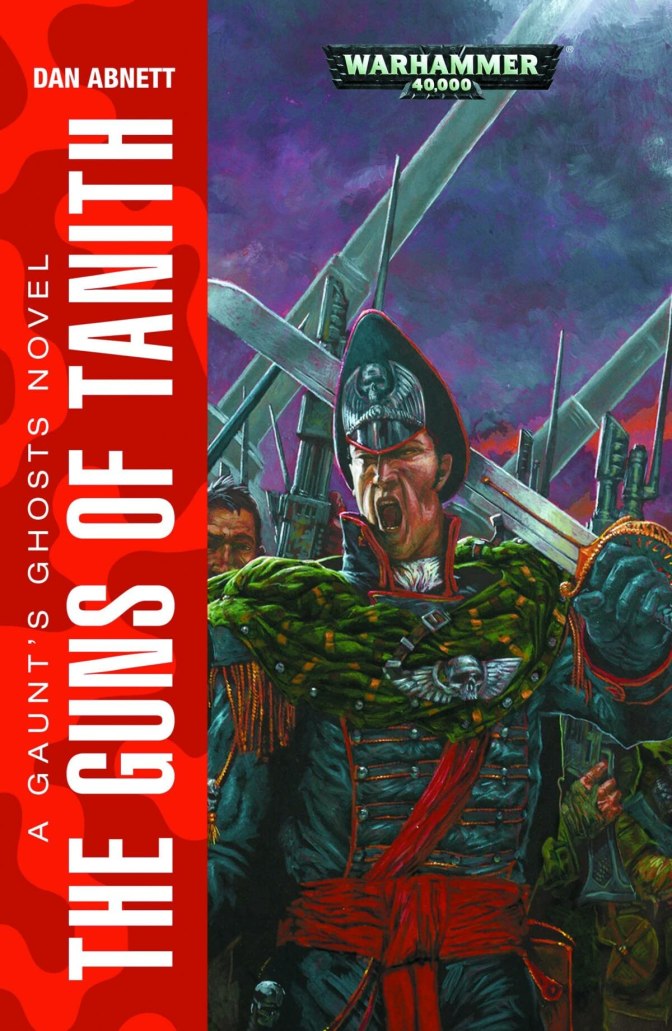
Throwback Thursday – Warhammer 40,000: The Guns of Tanith by Dan Abnett

The Guns of Tanith Cover

Publisher: Black Library (Audiobook – 25 April 2002)

Series: Gaunt’s Ghosts – Book Five

Length: 10 hours and 10 minutes

My Rating: 4.5 out of 5 stars

Amazon

Welcome back to my Throwback Thursday series, where I republish old reviews, review books I have read before or review older books I have only just had a chance to read.  After having such a great time reviewing the previous Gaunt’s Ghosts novel, Honour Guard, in my last Throwback Thursday, I immediately read the fifth fantastic entry in the series, The Guns of Tanith, which proved to be just as awesome and exciting.

As I mentioned last week, I have been really getting into the works of Dan Abnett over the last year, and I now consider several of his books to be amongst the best Warhammer 40,000 novels I have had the pleasure of reading.  Not only did I deeply enjoy his epic Eisenhorn trilogy (made up of Xenos, Malleus and Hereticus) but I have also been powering through his Gaunt’s Ghosts books.  The Gaunt’s Ghosts books are some of the more iconic novels in the Warhammer 40,000 franchise and are often considered essential reading by fans of the franchise due to the captivating way they capture the gruelling experiences of ordinary human soldiers in this grim, futuristic setting.  The first four novels in the series, First and Only, Ghostmaker, Necropolis and Honour Guard, as well as the prequel novel The Vincula Insurgency, are all excellent and exciting in their own way, and I have had a ton of fun seeing the impressive war narratives set around the men of the Tanith First-and-Only, informally known as Gaunt’s Ghosts.  As I was still in the mood for some awesome action at the end of last week, I just had to keep going with these books and I quickly picked up the fifth entry, The Guns of Tanith.

As the massive Sabbat Worlds Crusade continues to pit the forces of the Imperium of Man against the foul forces of Chaos, the battlelines extend across multiple planets and systems, drawing in millions of soldiers.  The latest phase of the crusade has severely stretched the supply lines of the Imperial assault and the Chaos foes are quick to take advantage, threatening to cut off and surround the main Imperial force.  To stave off disaster, Warmaster Macaroth, needs the Tanith First-and-Only to recapture the vital promethium producing planet of Phantine so the crusade can be resupplied and continue.

Led by the heroic Colonel-Commissar Ibram Gaunt, the Tanith First-and-Only engage in a deadly airborne assault on several of the planet’s domed cities.  Relying on their unique skills of navigation and infiltration, the Ghosts prove to be vital to the operation and soon take the key city of Cirenholm.  However, holding the city proves to be harder than expected.  While preparing for the next assault, the vile murder of a freed Cirenholm civilian places a Ghost on trial and opens up the festering cultural divides within the regiment.

As Gaunt attempts to get to the bottom of the crime and ensure that the innocent are left alive, the Ghosts are given a vital mission to undertake.  A dangerous Chaos warlord has taken command of the final occupied city, Ouranberg, and his lethal command threatens to devastate an attack by the Imperials.  To ensure a successful invasion of this Chaos stronghold, a specialised team of Ghosts is tasked with infiltrating the city and assassinating the enemy leader in advance of the main assault force.  Featuring some of the best the Ghosts have to offer, the assassination squad will be forced to walk through hell to achieve their objective and not everyone will be coming back.

In this fifth entry in this amazing series, Abnett continues to impress with another powerful and captivating character-driven read that takes the Ghosts through a gruelling round of battles, tragedy and growth that proves near impossible to put down.  The Guns of Tanith was a pretty strong entry in the series, expanding on some of the interesting storylines from the first novel while also introducing a new dark scenario for the characters to deal with.

The Guns of Tanith features a fantastic narrative from Abnett that contains his usual blend of high-intensity action, character growth, and intriguing examinations of the Warhammer 40,000 universe, that make all the Gaunt’s Ghosts novels such a treat to read.  Following on from the events of the previous books in the series The Guns of Tanith is told in Abnett’s typical style, with a ton of unique character perspectives, mostly those of the Ghosts, which presents the reader with a rich and vibrant view of the events, as well as the unique, character-driven storylines that emerge.  While this fifth Gaunt’s Ghosts novel can be read as a standalone book, The Guns of Tanith does see several ongoing, character focused storylines come to a head or get even more complicated. As such, readers should really consider checking out the previous novels first so they can get the full emotional weight of the revelations and twists that emerge.

The main narrative of The Guns of Tanith is bookended by major extended battle sequences that see the Ghosts and their allies engage in elaborate fights across two separate cities.  The first of these battles, in Cirenhom, sees all the Ghosts forced to engage in a particularly bloody battle with limited ammunition against a dangerous and determined foe that has set up some elaborate traps.  This extended sequence is both epic and useful as it provides the reader with a ton of intense action to draw them into the novel while Abnett introduces the characters and storylines that this latest novel is focused on.  You also get a good overview to the new setting of Phantine, a polluted planet with a toxic atmosphere that requires multiple forms of airship to traverse.  This unique location adds some great spice to the overall story, especially as it requires the characters to learn some unique aerial skills, while also allowing Abnett to have fun featuring several impressive dogfights.  There are some great moments during this first extended battle sequence, and it sets the rest of the book up nicely.

The middle of the book is where the reader gets into the real meat of the story, especially as it lowers the intensity levels down from the action-packed introduction and allows the reader to breathe and absorb all the intriguing story elements to come.  At first, I wasn’t too keen on a quieter middle section to this novel, especially as I thought it would make The Guns of Tanith more of a bridging novel in the series, rather than a book that could stand on its own.  However, Abnett soon proved me wrong as this intriguing central storyline contained a lot of major character moments and intriguing plot lines, while also expertly setting up the final third of the book.  The main storyline explored in the centre involves a murder investigation when one of the Ghosts is accused of killing an innocent civilian.  Abnett does a great job with this murder storyline, especially as it brings in compelling mystery and legal thriller elements to it, while also driving the characters in some excellent directions.  However, the real joy of this part of the book is the focus on the camaraderie and factions within the Ghosts, and the fracturing coherence in places leads to some memorable moments later on.

The final section of the book focuses on the assault of the Phantine city, Ouranberg, and the special Ghosts mission to assassinate the Chaos warlord.  Following several supporting members of the cast, this final third of The Guns of Tanith takes these characters on a particularly dark mission through a Chaos stronghold, and Abnett throttles up the tension and brutality to the maximum, ensuring that the readers are strongly hooked on everything unfolding.  Watching the separated teams attempt to navigate through enemy territory leads to some dark and bloody sequences, and everything comes together in a brutal confrontation where all the characters get a moment to shine.  The invasion in the aftermath of this assault brings the entirety of The Guns of Tanith together in an outstanding way, as several major storylines are expertly and impressively resolved, often in ways that leave the characters even more damaged than when they started.  This is also a particularly shocking death of a major character that is guaranteed to move long-term readers of the series.  Abnett does a masterful job of setting this death up, including by showcasing several misleading near-misses, so you really don’t know who is going to live or die right up to the end.  His eventual choice is one designed to wound his readers, and you will have to come back to see how it impacts the rest of this series.  Overall, this was an extremely solid and impressive Gaunt’s Ghosts narrative, and I deeply enjoyed how Abnett continued and finalised some of the great character storylines from the previous books, while also providing the reader with more action and intrigue than they can handle.

As with most of the Gaunt’s Ghosts books, The Guns of Tanith is an open read to all those unfamiliar with the wider Warhammer 40,000 canon.  Abnett goes out of his way to make his books accessible for new readers, and he always provides enough detail and background so that anyone can catch up and enjoy the subsequent story.  However, for those fans more familiar with the Warhammer universe, there are always a ton of great elements or unique world building details that they will find particularly fascinating.  The new locations in The Guns of Tanith are pretty damn spiffing, and I had a lot of fun with the polluted planet, especially as it requires multiple arial sequences.  This is turn leads to the introduction of the Phantine XX Fighter Corps, who Abnett will go on to feature in his spin-off novel, Double Eagle, and it was fun to see how they get their start here.  For me, though, the best part of the universe expansion was Abnett’s in-depth look at the day-to-day life of the common soldier in the Imperial Guard.  While Abnett has always done a masterful job of capturing the footslogger experience in his novels, I felt that The Guns of Tanith was one of his best attempts to dive into the core of his beloved regiment.  Not only is there are lot of story focus on the various members and factions of the regiment, but Abnett also spent some time trying to explore the downtime and personal lives of the characters, and it was pretty intriguing to see the accompanying civilian baggage train of the regiment, which includes their families and other vital services.  I also personally loved the scenes that examined the problems associated with the Imperial bureaucracy as the Ghosts come up against their greatest enemy: bad paperwork.  Certain mistakes ensure that the Ghosts are left with minimal ammunition as the Departmento Munitorum orders the wrong power packs for their lasguns.  The following extended sequence which saw the regiment unable to fight effectively because their ammunition couldn’t fit their guns was an impressive part of the book and it definitely raised the stakes during the book’s introduction.

As usual, one of the major highlights of The Guns of Tanith is the amazing characters that the story focuses on, as Abnett once again fits a huge number of character-driven storylines into the book.  At this point in the series, Abnett has introduced a pretty substantial cast of characters, many of whom have ongoing storylines, and it is intriguing to see them unfold even further in The Guns of Tanith, especially as Abnett does a great job featuring most of them equally and then combining them into the larger narrative.  Many of the more intriguing character arcs in this book carry over from the previous novels and there are some great conclusions and expansions to them here that helps to improve the already great narrative of The Guns of Tanith.  At the same time, several new characters are introduced here or finally given prominence, and it was interesting to see how they fit into the already established character dynamics that Abnett has been building up.  The cohesiveness of the Ghosts as a regiment ends up becoming a huge fixture of this book as the Tanith-Verghastite divide is explored in greater detail by many of the characters.  It was fascinating to see how Abnett handled these character storylines in The Guns of Tanith, and several of them ended up being some of the best parts of the book.

As with most of the novels in the series, quite a lot of character focus goes towards the main protagonist, Colonel-Commissar Ibram Gaunt, whose experiences as the commander of this unique regiment continue to trouble him in various ways.  In The Guns of Tanith, this takes the form of his apparent unconscious bias towards the Tanith elements of his regiment over the Verghastite recruits, which is showcased by his differing reactions during two court cases.  This results in several intense interactions between Gaunt and members of his team, which helped to showcase the protagonist’s idealism and a certain degree of naiveté when it comes to Imperial politics, both of which will cause him trouble in the future.  This is also an intriguing look at the issues caused by Gaunt holding the dual rank of Colonel and Commissar, which make him simultaneously a command officer and a political officer in charge of discipline.  This is the first time the duality of his roles has caused some major problems for him, and it was interesting to see several characters question him about it.  Watching Gaunt try to balance his various hats while also maintaining the respect of his men and his superiors makes this a rather compelling novel for Gaunt and I will be intrigued to see how this affects the character in the future.

While there is always a lot of focus on Gaunt, many of the other characters have big moments here, and it is always interesting to see which characters Abnett will focus on in each particular novel.  Firstly, this is one of the Gaunt’s Ghosts books where the major characters of Colm Corbec and Elim Rawne do not get a lot of focus, as Abnett sets them aside to make room for others.  Corbec is once again wounded early on in the plot to keeps him out of the action, while Rawne, after getting a good needling into Gaunt, is showcased as the senior commander, but that’s about it.  Instead, a lot of the focus goes towards some of the newer members of the cast, such as Gol Kolea, whose attempts to balance his complex family concerns leads only to tragedy and despair for him and the reader.  Cuu continues to be a menace, while surgeon Ana Curth acts as several character’s consciences throughout the book.  The previously overlooked but surprisingly lucky Bonin finally got some prominence in this novel, and I loved finding out how he survived Necropolis.  The newer characters of Commissar Hark and Captain Ban Daur also proved to be essential parts of the plot, and I am really glad that Abnett continued to utilise them, as they helped Gaunt see the errors of several decisions while simultaneously taking on some of Gaunt’s more unorthodox methods.  Members of the original Ghosts, such as Brin Milo, Larkin, Bragg and Mkoll all had good roles in The Guns of Tanith as well, and their balanced scenes showcased different triumphs and tragedies.  Finally, I was glad that Abnett decided to keep featuring the mysterious preacher, Ayatani Zweil, after his fun introduction in Honour Guard.  Zweil is an always entertaining yet serious figure, and it was great to see him knock some sense into several characters when they needed it.  I’m honestly only scratching the surface here, as a ton of other characters were well featured throughout The Guns of Tanith as Abnett continues to build and bring together his final cast of major characters.  Each of these amazing protagonists had some superb impacts on narrative of this novel, and I cannot wait to see how Abnett continues to develop them in the later books of the series.  I am assuming it is only a matter of time until more of the characters start to die, and I am sure that will break my heart just as much as the big death in The Guns of Tanith did.

Due to my love of the format, I of course listened to The Guns of Tanith on audiobook, which is easily the best way to enjoy any Warhammer book.  I have gone on a lot about the fantastic Gaunt’s Ghosts audiobooks in recent reviews, and The Guns of Tanith has all the same advantages, as one of my favourite audiobook narrators, Toby Longworth, brings the reader right into the heart of the action with his great voice work.  Every scene is masterfully showcased by his narration, and all the characters are brought to life thanks to the great voices he utilises for them.  Longworth really stretched himself when it came to accents in this latest novel, and he features a ton of great new voices, as well as the existing tones from the previous audiobooks, to bring this entire audiobook together.  With the standard runtime of just over 10 hours, The Guns of Tanith audiobook is a real snap to power through, and I honestly finished it off in only a few days.

Unsurprisingly, I absolutely loved the fifth entry in Dan Abnett’s exceptional Gaunt’s Ghosts books, The Guns of Tanith, which proved to be another powerful and enjoyable Warhammer 40,000 novel.  Filled with Abnett’s usual impressive battles, The Guns of Tanith also had a brilliant focus on characters-driven storylines that dominated most of the plot and kept the readers hooked the entire time.  An intense, addictive, and deeply personal Gaunt’s Ghosts books, The Guns of Tanith was pretty damn outstanding and I loved every second of it.

Amazon

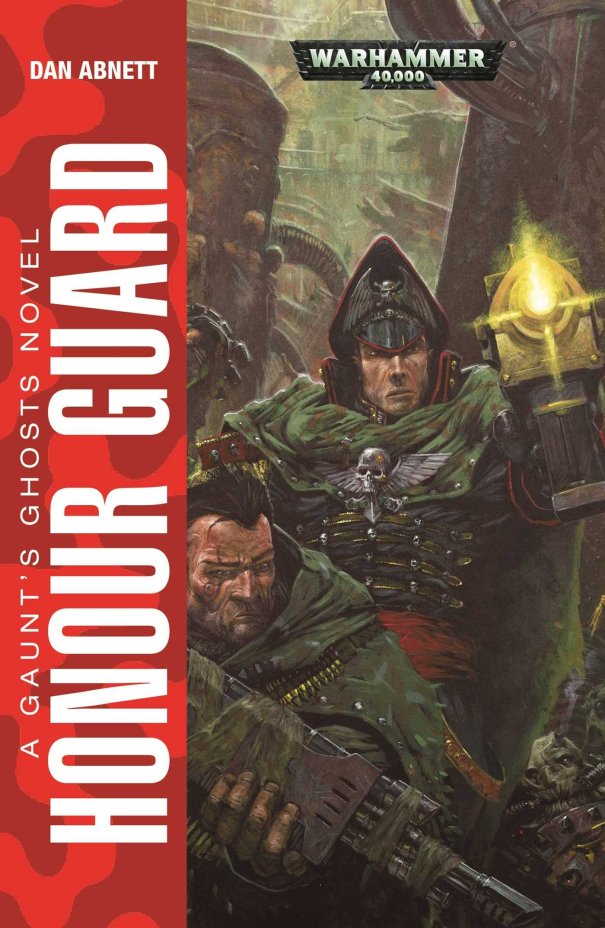
Throwback Thursday – Warhammer 40,000: Honour Guard by Dan Abnett

Warhammer 40,000 - Honour Guard Cover

Publisher: Black Library (Audiobook – July 2001)

Series: Gaunt’s Ghosts – Book Four

Length: 10 hours and 12 minutes

My Rating: 4.5 out of 5 stars

Amazon

Welcome back to my Throwback Thursday series, where I republish old reviews, review books I have read before or review older books I have only just had a chance to read.  For this week’s Throwback Thursday I’m still in a Warhammer 40,000 mood, so I decided to dive even further into Dan Abnett’s classic Gaunt’s Ghosts series with the fourth book, Honour Guard.

Readers of this blog will no doubt have noticed a fair increase in the number of Warhammer 40,000 novels I’ve highlighted this year, as this entire grim expanded universe has quite an addictive quality to it.  Foremost amongst these books have been the compelling works of veteran author Dan Abnett, who has written so many impressive and key parts of the Warhammer canon over the years.  I deeply enjoyed his Eisenhorn trilogy (Xenos, Malleus and Hereticus), all three of which were given pride of place in my recent post listing my favourite Warhammer 40,000 novels.  However, his best-known works are his Gaunt’s Ghosts series of books, which catalogue the adventures of the Tanith First and Only regiment of Imperial Guard, better known as Gaunt’s Ghosts.  I have had a wonderful time with the first three novels, First and Only, Ghostmaker and Necropolis, as well as the prequel novel The Vincula Insurgency, which showcased the bloody lives of the common soldier in this war-torn universe.  I have really gotten attached to this series and when I wanted a quick read, there was nothing I would rather turn to then the next Gaunt’s Ghosts book, Honour Guard.

Throughout the extended, system-spanning Sabbat World crusades, the men of the Tanith First and Only have fought against the dark forces of Chaos in every way imaginable.  Led by their heroic commander, Colonel-Commissar Ibram Gaunt, the Tanith soldiers, known colloquially as Gaunt’s Ghosts, have had many victories, but few failures.  So, when fighting on the holy Shrine World of Hagia, the Ghosts are devastated when they trigger a disastrous enemy trap that destroys a holy city and creates a psyker beacon that will draw a massive Chaos fleet down on their position.

Troubled by his failures to protect one of the most important planets in the Sabbat Worlds and made a scapegoat by his commander, Gaunt is left a broken man.  His one chance to save his career and his regiment is to lead the Tanith and an armoured company as an honour guard to a sacred shrine to recover the holy relics of Saint Sabbat.  If he can recover the relics and evacuate them from the planet before the Chaos fleet arrives, he may be able to keep the Ghosts under his command.

Beginning the arduous pilgrimage, Gaunt and his men soon discover that the road to the shrine isn’t as clear as their intelligence indicated.  A vast enemy army lies in wait for them, and the Ghosts will have to fight every step of the way to secure their objective and make their escape.  However, there are far more mysterious forces at work behind the scenes as Gaunt and some of his men soon find themselves being driven on by religious visions of Saint Sabbat herself.  Is the holy saint talking to them, or is something more sinister manipulating them?

Honour Guard was another epic science fiction military adventure that I powered through in no time at all.  Skilfully continuing the intriguing Gaunt’s Ghost story, Abnett has produced a thoughtful and intense read that throws the protagonists into a captivating action-packed scenario that really showcases the gritty nature of the Warhammer 40,000 universe.

Honour Guard has a somewhat typical Gaunt’s Ghosts story to it, and if you’ve read the series before then you know that means great characters, intense fights with big set-piece battles, and a compelling look at the common soldier in the Warhammer 40,000 universe.  This fourth book follows on from the events of Necropolis, and Abnett quickly and ably shows the changes to the regiment that the previous adventures have wrought, especially with all the new Verghastite recruits.  Abnett starts things off with an epic series of battles as the Ghosts attempt to take a Chaos controlled city.  This opening sprawl of fights is not only intense but it expertly introduces the new setting, sets up several key story points, and lets the reader know who the main characters of Honour Guard are going to be.  From there, the characters, especially the main protagonist, Gaunt, face a major setback as the city is destroyed, their allies are killed, and a massive Chaos fleet has been summoned to destroy the holy planet they are on.  There are some great moments in this early bit of the book, especially as Abnett really dives into the impacts of the failure on Gaunt.  It also sets up the intriguing story element that Gaunt is likely to lose his command and the Ghosts will be broken up as a result.

With that set up, Abnett then drives into the meat of the story, with Gaunt leading the Ghosts and an armoured regiment as an honour guard to retrieve the sacred relics of one of the Imperium’s most important saints before the enemy fleet arrives.  Framed as an easy mission to give Gaunt an honourable send off, the mission naturally goes to hell when the Ghosts discover a vast enemy army between them and their goal.  This results in several major battles on the road, and Abnett has a lot of fun combining infantry fighting with tank warfare to make the conflicts even more impressive.  Each battle is extremely fun in its own regard, and fans of action and military combat really won’t be disappointed by Honour Guard as a result.  At the same time, there is a real focus on the characters, as several of the protagonists are going through different personal struggles, especially Gaunt.  Abnett also introduces an intriguing and moving side storyline that sees several long-running Gaunt’s Ghosts characters, who were wounded and left behind, attempt to make their own way to the conflict, guided by religious visions.  Everything leads up to a final battle sequence at the objective as the honour guard are trapped with a massive enemy force coming towards them.  Abnett naturally spends pages detailing all the bloody fighting, which serves as a great backdrop to the main story elements.  While I did think that the big finale of the book was too sudden and coincidental, it did fit into the general theme of faith and miracles that were covered in a lot of the plot.  Overall, this was another great, action-heavy narrative that I was able to sit back and enjoy.

As with all Abnett’s work, Honour Guard is extremely well written, and readers who have enjoyed any of the author’s previous books will be aware of what they are in for with this fantastic novel.  The author features a great blend of action, universe building and character development throughout his novel, and readers are ensured of constant excitement or intense, character-driven moments.  The entire story is told from multiple character perspectives, as the entire cast is well represented.  Not only does this allow the reader to get interesting updates from all the intriguing characters, many of whom have been built up in previous books, but it also ensures that you get a wide view of events featured throughout the novel, including several different perspectives of each battle.  I do think that the book was lacking a good antagonist perspective (or honestly a real antagonist character), and if Abnett would have included that, the entire story would have felt a bit more complete.  Still, the sheer number of perspectives and supporting characters ensures that the reader sees every angle of the action.  That is really great, as the battle scenes are some of the best parts of the book.  Abnett never holds back when it comes to the carnage, and every massive fight, armoured vehicle engagement and or infantry push is covered in high detail.  The author really tries to highlight the brutality and trauma of war, as well as the hell each of the soldier characters goes through, and you ended up riveted to the plot as a result, especially as no side character is safe.  I am glad that Abnett keeps up his outstanding writing throughout the Gaunt’s Ghosts series and I ended up getting really caught up in Honour Guard as a result.

This proved to be another interesting addition to both the Gaunt’s Ghosts series and the wider Warhammer 40,000 universe, and fans of both are going to have a pretty great time with this new novel.  As with most of the books in the series, Honour Guard can be read as a standalone novel, although starting with the earlier books does give the reader more insight into the characters.  Abnett really tries to make each of his novels as accessible as possible, and readers new to the series or Warhammer fiction in general can easily dive in here and have a fun time with all the military action.  However, Abnett also has a lot of fun expanding out the canon in Honour Guard, especially as you get to see more regiments of the Imperial Guard in action against the forces of Chaos.  One of the most intriguing lore aspects of Honour Guard is the examination of key elements of the Sabbat Worlds, which have been the overarching focus of this series.  In particular, there is a focus on the legendary figure of Saint Sabbat, who is a personal hero of many of the characters.  This sends the story down an interesting spiral of faith and devotion in the Imperial Cult, as many have their religious beliefs tested due to the earlier events of the story.  As such, there are some great examinations of the Imperial religion, and it is fascinating to see the potential spiritual ramifications of several events throughout the novel.  I also quite enjoyed the main setting of the planet of Hagia, which is only really featured in this novel.  Abnett sets the entire world up very quickly and you soon find yourself caught up in the fight for this religious planet which is completely dedicated to worship of the Emperor and his saints.  Abnett works several religious elements of the planet into the story extremely well, and it proves to be quite fascinating backdrop for this awesome novel.

One of the best things about Abnett’s writing is his ability to construct multiple complex and intriguing characters who all go through some great development.  This is particularly true in the Gaunt’s Ghosts books, as he has constructed a pretty massive cast of characters throughout the first three books in the series who all come into play in Honour Guard.  I really enjoyed all the amazing characters in this fourth novel, especially as there is a very interesting change of dynamics due to the Verghastite recruits joining at the end of the previous novel, Necropolis.  Not only does that mean that some of the best new characters from the previous book are once again featured here, but it builds some fantastic rivalries between the soldiers as the new Ghosts attempt to gain acceptance from the men of Tanith.  Honour Guard ended up being a fantastic litmus test for Abnett’s expanded cast, especially as it introduces some compelling cultural and gender divides to the regiment, while also ensuring that all the fantastic characters the author utilised in Necropolis don’t go to waste.

Many of these great characters really stood out to me in Honour Guard, but of course most of the focus was once again on the central protagonist of Colonel-Commissar Ibram Gaunt.  This was a pretty significant novel for Gaunt, as readers get to see him at his very lowest point after he suffers a devastating defeat.  This pushes him into a depressive spiral, which is very surprising after how controlled and confident he has been in the previous novels.  Abnett really does a great job of showcasing Gaunt’s lost confidence and internal anger, and watching him overcome it becomes an intense part of the book.  The author really dives down deep into Gaunt’s motivations throughout Honour Guard, and you come away feeling a lot closer to the character as a result.  It isn’t always easy for an author to show their main protagonist dealing with defeat and loss, but Abnett did a wonderful job of it in Honour Guard, and I think it makes Gaunt a much stronger figure as a result.

Aside from Gaunt, a lot of the other characters are really well utilised throughout Honour Guard, with some great side storylines and adventures.  Colonel Corbec’s adventure with long-running Gaunt’s Ghosts characters Dorden, Brin Milo and Bragg, had some excellent moments to it, especially as many of them are still dealing with the loss of loved ones or their planet.  Abnett also makes great use of several notable characters introduced in Necropolis like Gol Kolea, Captain Ban Daur and Ana Curth in Honour Guard.  It was great to see the author spending time developing storylines around them which will continue to build throughout the series, and I enjoyed seeing them attempting to integrate into the Tanith regiment.  Even new characters like Viktor Hark, the regiments new Commissar, the slippery and entertaining killer Cuu, and troubled Trooper Vamberfeld, all added some awesome elements to the overall story.  I liked how Hark proved to be a compelling reflection of Gaunt, while Vamberfeld showcased the traumas war can have on a soldier’s mind, while also placing him right in the middle of key events.  However, some of the best character work in Honour Guard occurred around the always entertaining Major Rawne.  Rawne, who has sworn multiple times to kill Gaunt, bears witness to his commander’s fall from grace after his defeat.  However, rather than revelling in it, Rawne ends up having a big confrontation with Gaunt towards the end of the book to snap some sense in him.  Watching this cynical character be the voice of reason to Gaunt was just brilliant, and the resulting exchange added some fantastic layers to Rawne that I deeply enjoyed.  While I really would have loved some more named antagonists, the characters overall in Honour Guard were pretty exceptional, and I really loved how Abnett worked their unique personal narratives into the wider plot.

I doubt anyone is going to be too surprised that I checked out Honour Guard on audiobook, as that has been my preferred format for all Abnett’s books.  This is mainly because the action, characters, and grim setting are always translated across so effortlessly on the audiobook, and you can really appreciate all the cool detail that Abnett includes as a result.  Coming in a just over 10 hours, the Honour Guard audiobook has a pretty typical length for a Warhammer book, and I was able to quickly power through it.  As usual, I need to highlight the amazing narration of Toby Longworth, who has lent his voice to all of Abnett’s previous books.  Longworth has an outstanding voice that really captures the tone of the story and ensures that the reader can envision every single battle taking place.  His real talent is his ability to dive into every single character Abnett comes up with and give them a fitting voice that captures their personality and emotions.  There is some impressive continuation from the previous Gaunt’s Ghosts audiobooks as Longworth brings back all the voices he previously featured there, which I deeply appreciated.  He also employs an intriguing range of accents, which help to emphasise the different planets of origin for the various characters and regiments featured in the book.  This attention to detail and impressive voice work helps to make Honour Guard, and indeed all the Gaunt’s Ghosts audiobooks really stand out, and I had a wonderful time listening to the book in this format.  Easily the best way to enjoy this fantastic novel.

Honestly, there was no question about me enjoying Honour Guard, considering how much fun I have been having with the previous Gaunt’s Ghosts books.  This fourth entry has a great story and some brilliant writing by Abnett, and readers are in for an exceptional experience of bullets, blood and explosions in some the best military fiction in the Warhammer 40,000 universe.  This was an outstanding read, and I can give no higher compliment than to say that the moment I finished off Honour Guard, I started listening to the next novel in the series, The Guns of Tanith.  I honestly cannot get enough of this incredible Warhammer 40,000 series and it will be very interesting to see what unique storylines Abnett cooks up next.

Amazon

Unnatural History by Jonathan Kellerman

Unnatural History Cover 2

Publisher: Century (Trade Paperback – 28 February 2023)

Series: Alex Delaware – Book 38

Length: 303 pages

My Rating: 4.5 out of 5 stars

Amazon     Book Depository

A shocking murder, a mysterious motive, and two intriguing investigators on the case, it sounds like it’s time for another Alex Delaware novel from bestselling author Jonathan Kellerman with Unnatural History.

For the last few years one of my favourite long-running crime fiction series has to be the Alex Delaware books from the always impressive Jonathan Kellerman.  Set in Los Angeles, this excellent series follows the exploits of psychologist Alex Delaware and his best friend, Lieutenant Milo Sturgis, as they investigate strange murders throughout the city.  This is a very solid and captivating series, and I personally love all the clever and distinctive mysteries that Kellerman keeps coming up with.  All the Alex Delaware novels I have so far read, including The Wedding Guest, The Museum of Desire, Serpentine and City of Dead, have been just outstanding, and the complex and fascinating murder investigations have all been very strongly written and particularly compelling to follow.  As such, the Alex Delaware books are one series that I will always make sure to grab as soon as it is out, and this includes the latest entry, Unnatural History.  The 38th book in this long-running series, Unnatural History was another exceptional read with a fantastic case behind it.

When the body of a photographer is found murdered in his studio, brutally shot to death, Lieutenant Milo Sturgis is quick to bring in his friend and consultant, psychologist Alex Delaware, to help with the investigation.  The victim, Donny Klement, was a controversial photographer whose latest project saw him photographing members of the local homeless population as they pretend to achieve their greatest dreams.  To complicate matters even further, Donny was the son a mysterious and elusive billionaire whose family members have a habit of dying young.

Diving into the case, Alex and Milo soon discover that their victim was a curious figure.  Damaged by a neglectful father, a scattered family, and a dead mother, Donny’s life was anything but easy, even with his vast family fortune.  His latest photographic vision looked set to make him a major star in the arts scene, but was his death related to his seemingly disrespectful photos or to his family and their wealth?

As Alex and Milo attempt to find a motive for Donny’s killing, a second body is found that appears connected to their first case, suggesting that their killer is taking out all the potential witnesses.  It soon becomes apparent that Alex and Milo are dealing with a deranged serial killer whose anger lies somewhere in Donny’s life.  To solve the case, Alex and Milo need to uncover all the victim’s secrets and use them to catch the killer before he strikes again.

This was another excellent and captivating novel from Kellerman, who presents the reader with an impressive and well-set-out mystery that really draws you in and keeps you hooked.  Like most of the Alex Delaware novels, Unnatural History quickly works to set the scene for the case, with the reader immediately introduced to the murder victim, Donny Klement, and his unfortunate circumstances.  The story moves into the investigative stage with Alex and Milo beginning the task of identifying the relevant people associated with Donny’s life, including his family, his girlfriend, and the people he interacted through with through his photography.  This raises quite a few interesting avenues of inquiry as the victim was both the scion of a mysterious billionaire whose family has already suffered multiple deaths, and an idealistic artist who showed great naivety in dealing with the city’s homeless population.  This leads to quite a deep dive into the victim’s life, and you soon build up a quite an intensive view at who Donny was and the many problems he faced in life.

Kellerman keeps the investigation going strong the entire way through Unnatural History, and the reader is directed along many interesting plot threads as the author lays down false trails and red herrings.  There are some great alternative theories and potential motives spread out for much of the book, and the case gets even more complicated when additional bodies are found throughout the city, all of them connected to Donny in some way.  This really throttles up the pacing of the book, and the reader is gifted with some intriguing revelations as Kellerman revisits details that previously seemed unimportant and cleverly fits them even further into his case.  The eventual reveal about the killer is pretty brilliant, and I liked how Kellerman was able to tie the motivation into several existing different story threads, which allowed for a complex and intense picture of who they are and what evils they committed.  This ended up being a very strong mystery, and I honestly did not see the full extent of the motivations coming.  Everything leads up to a big confrontation which doesn’t go how you’d expect, and which results in some very dark moments.  I did like how this confrontation revisited events from several books ago and it helped some of the characters gain a measure of closure.  I ended up being really impressed with how the author managed to bring everything together in his story, and I was firmly hooked the entire way through.

As always, I really enjoy Kellerman’s unique style when it comes to his compelling murder mysteries, and this helped me power through Unnatural History.  I love the sharp pacing and focus on the characters, both the protagonists, and the victim, that occurred throughout Unnatural History and you are swiftly drawn into their unique lives and the process of their investigation.  The blend of solid investigative focus, character moments, and major twists is pretty spot on, and there honestly aren’t any slow moments at any point of this book, as the reader is constantly learning more interesting bits of information about the case.  All his characters have a very distinctive way of talking/interacting with each other, and it is something that always drags me in, especially with the fun banter.  I did find a few of these conversations, especially with deliberately annoying witnesses, to be a little odd, but they all added to the general theme and feel of the book.  Like all the Alex Delaware novels, Unnatural History is fairly accessible to new readers, and anyone interested in this book who hasn’t read anything from Kellerman can easily dive in here without any issues.  While there are references to prior events scattered throughout Unnatural History, none of them are too relevant to the plot, and Kellerman always does a good job of making his novels almost feel standalone in nature, as he recaptures the series’ unique feel each time.  That being said, fans of some of his last few books will no doubt enjoy some of the story elements between Alex and one of the supporting characters that come full circle after several books, and it was something I was very happy to see.

One of the things that I always particularly enjoyed about the Alex Delaware novels is the way that Kellerman presents a more grounded style when it comes to how his detectives solve the crime.  Unlike in some of the flashier crime fiction novels out there, Kellerman’s characters are more realistic in their investigative approach, and each Alex Delaware novel has a major focus on talking to witnesses, doing research, hammering out theories and doing the legwork to find out everything you can about the victim and the various suspects.  The protagonists are constantly following up leads and talking to multiple people associated with the case, even if they only tangentially knew the victim, to find out every fact or theory that they can.  This leads to a much more comprehensive examination of the murder, which allows the reader to build up a captivating picture of everything that led up to the killing.  This more methodical and realistic method of investigation always really works for me, and I love seeing the protagonists earning their solve and battling through all manner of obstacles.  I felt that the investigation in Unnatural History was particularly good, especially when they combine multiple cases from across the city to get the full picture, and the way that they efficiently weed out the unlikely scenarios and find the truth was deeply addictive and really worth checking out.

I also need to highlight the impressive characters who are the focus of Unnatural History, especially when it comes to the two protagonists, Alex Delaware and Milo Sturgis.  These two protagonists, the calm psychologist and the veteran detective, complement each other perfectly when it comes to their skill set, and you can see why they are such an effective team.  At the same time, Kellerman has really built up their relationship over the series, so the two are good friends, which results in some fantastic dynamics and interactions between the two.  The banter and discussions fly thick and fast between them, and you really appreciate just how close they are as they solve the crimes together.  There is a pretty major moment that occurs between these friends at the end of Unnatural History that I felt was handled extremely well and which is likely to impact their dynamic going forward.  I am very intrigued to see how Kellerman handles that, and I am sure it will make his next novel even more interesting.

The other character that gets quite a lot of focus in Unnatural History is the main murder victim, Donny Klement.  As with most of Alex Delaware novels, Kellerman’s ensures that the story spends substantial time diving into the victim’s life, as the police try to find out why he is murdered.  This allows the reader to get a fascinating, outsiders perspective of who Donny was, which proves to be quite fascinating and compelling.  Kellerman’s portrayal of Donny as a lonely man trying to escape his father’s shadow while also dealing with other family trauma allows the reader to get very attached to the victim and you become even more invested in solving the case.  This post-mortem portrayal of Donny was excellent, and I loved how effectively Kellerman showed his complex and unusual life.  Throw in a very fascinating and complex murderer, a good collection of unique witnesses, and the usual supporting detectives in Milo’s squad, and Unnatural History has a great collection of characters who add a lot to the overall story.

Jonathan Kellerman once again delivers an amazing and compelling murder mystery with his latest Alex Delaware novel, Unnatural History.  This fantastic novel features another brilliant mystery that dives deep into the life of a complex victim and paints a powerful picture around him.  This was a deeply entertaining and captivating read, and I loved every second I spent getting through Unnatural History.  I cannot wait to see what happens next in the Alex Delaware series, one of the strongest, long-running crime fiction series currently out there.

Unnatural History Cover

Amazon     Book Depository

Waiting on Wednesday – Code Red by Kyle Mills (based on the books by Vince Flynn)

Welcome to my weekly segment, Waiting on Wednesday, where I look at upcoming books that I am planning to order and review in the next few months and which I think I will really enjoy.  I run this segment in conjunction with the Can’t-Wait Wednesday meme that is currently running at Wishful Endings.  Stay tuned to see reviews of these books when I get a copy of them.  In this latest Waiting on Wednesday, I check out the next entry in the always exciting Mitch Rapp series with Code Red by Kyle Mills.

Code Red Cover

Amazon

Every year there are several great series that I just have to continue due to their excellent storytelling and writing styles.  Of these, one of the ones I have a particularly fun time is the amazing Mitch Rapp thriller books which are always worth a read.  Initially written by Vince Flynn, the series follows deadly spy Mitch Rapp as he faces off against all of America’s enemies in his typical brutal and efficient way.  Since Flynn’s death, the Mitch Rapp books have been continued by the very talented Kyle Mills who has produced some very clever and unique novels that show an older Rapp getting into more and more dangerous situations in a continually deteriorating world.  All the Mitch Rapp books I have had the pleasure of reading so far, such as Red War, Lethal Agent, Total Power, Enemy at the Gates and Oath of Loyalty, have been pretty epic, and I love the cool range of stories, from terrorists destroying the power grid in Total Power to Mitch Rapp facing off against a corrupt president in Oath of Loyalty.  As such, I am always extremely excited to read the new Mitch Rapp book each year and it looks like I won’t have too much longer to wait.

That is because the next Mitch Rapp novel is coming out in September with Code Red.  The 22nd Mitch Rapp novel, Code Red sees Rapp thrust into another deadly and dangerous mission with global ramifications.

Plot synopsis:

Mitch Rapp returns to make a mortal enemy of Russia in this high-octane and up-to-the-minute installment in the #1 New York Times bestselling series from “one of the best thriller writers on the planet” (The Real Book Spy).

Mitch Rapp hates owing anyone a favor—especially when it’s the world’s most powerful crime lord. But when Damian Losa calls, Mitch is honor-bound to answer.

The Syrian government appears to have created a highly addictive new narcotic that it plans to distribute throughout Europe. It’s a major threat to Losa’s business and he’s determined to send someone to keep him on top by any means necessary.

Rapp is the perfect choice for the mission. Not only does he have extensive experience operating in the Middle East, but he’s also entirely expendable.

As he crosses into war-torn Syria, Rapp quickly discovers a shocking truth. The new drug isn’t being produced by Damascus to prop up the government’s collapsing finances. Instead, it was created by Russia’s asymmetrical warfare unit, not for profit but as a weapon against the West.

With far more than Damian Losa’s interests at stake, Rapp devises a desperate plan that forces him and his team onto a battlefield where the United States is virtually powerless and allegiances shift almost hourly. Further, if Russia uncovers their plot, it will set off a confrontation between the two countries that could change the course of human history.

Ooh, now this is a very interesting sounding new novel from Mills.  After dealing with several domestic threats in the last few books it will be fun to see Rapp going after his old foes the Russians again, this time in Syria.  Code Red sounds like a much more classic spy thriller read with Rapp going up against enemy agents to try and stop an impending disaster, and the plot idea about Rapp accidently stumbling on this trying to clear a debt is very interesting.  I have a feeling this is going to turn out to be a pretty awesome read and I am curious to see Rapp’s take on certain world events when we get to it.

Based on how impressive and captivating the Mitch Rapp series by Kyle Mills has been in the past, I have very little doubt that I am going to have a wonderful time getting through Code Red.  No doubt containing the usual great blend of spy craft, over-the-top action, and intriguing commentary, Code Red is a book I will dive into the moment I get a copy and I know I will an outstanding time with it.

Burner by Mark Greaney

Burner Cover

Publisher: Sphere/Audible (Audiobook – 21 February 2023)

Series: Gray Man – Book 12

Length: 16 hours and 37 minutes

My Rating: 5 out of 5 stars

Amazon

The epic and captivating Gray Man series by legendary thriller author Mark Greaney returns with another exciting spy thriller entry, Burner, which thrusts the protagonists into the middle of some major real-world events.

Nothing starts off the thriller field of 2023 quite like the latest Gray Man novel from leading author Mark Greaney.  Greaney is a very impressive author who has been killing it throughout the genre for years.  Not only has he produced some cool standalone books, such as last year’s exciting action romp Armored, or the cool military thriller he co-wrote with Hunter Rawlings IV, Red Metal (one of my favourite books and audiobooks of 2019), but he has also written the exceptional Gray Man spy thriller books.  Following legendary assassin Court Gentry, better known as the Gray Man, as he gets involved in several deadly situations, the Gray Man books are one of the leading spy thriller series and I have deeply enjoyed the epic and powerful adventures that Greaney has so far released.  I personally have had an exceptional time with several of the Gray Man books, including Greaney’s debut novel, The Gray Man (which got a film adaptation last year), as well as the later entries such as Mission Critical, One Minute Out (one of my favourite books and audiobooks of 2020), Relentless (one of my favourite books and audiobooks of 2021) and Sierra Six (one of my favourite books and audiobooks of 2022).  His latest release is the outstanding Burner, which was one of my most anticipated novels of 2023.  The 12th book in the Gray Man series, Burner was a particularly intense read with a fantastic story behind it.

Alex Velesky is a Ukrainian expat living in Switzerland, whose comfy life as a notorious mover of immoral money has been hollow ever since the death of his family back in Ukraine at the start of the invasion.  Going through the motions, Velesky is suddenly given an opportunity to strike back at Russia when a disenfranchised Russian intelligence agent provides him with a trove of secret financial data.  This data, when combined with information from his own bank, reveals all the Russian bribes paid out to the West, and could damage not only Russia’s foreign intelligence apparatus but also the delicate negotiations to re-open the Russian economy to the wider world.

Immediately targeted by Russians determined to kill him and reclaim the data before it can leak out, Velesky finds himself hunted throughout Switzerland.  His only chance of survival seems to lie in rogue intelligence officer Zoya Zakharova, a woman hunted by her former employers in both Russia and the CIA, who is determined to get him and his information to New York, where it can be deciphered and released.  But Velesky and Zoya soon find themselves being stalked by an elite unit of Russian military operators who have no qualms about killing anyone in their way.

However, the Russians aren’t the only people interested in the data, as the CIA wants to claim it for themselves.  Determined to keep their interest in it quiet, the CIA reach out to Court Gentry, the Gray Man, to capture Velesky before the Russians do.  However, Court is unaware of the full significance of the data he is reclaiming, and that he will have to compete against the love of his life, Zoya.  Soon caught between the competing interests of the CIA and Russian intelligence, Court and Zoya decide to work together to keep Velesky alive.  But with the dangerous data revealing dark dealings in the highest levels of government, can even these two legendary spies survive?

Wow, Greaney really can’t miss when it comes to the Gray Man books.  Burner was another exceptional novel that had me hooked from the very beginning all the way to the final, devastating encounter.  The blend of exceptionally written action scenes, spy thriller elements, complex characters and the utilisation of contemporary issues makes Burner really stand out, even alongside the other epic Gray Man books.  This was another easy five-star rating from me as Greaney once again shows why he is currently leading the spy thriller genre.

Burner’s story is a pretty impressive and intense thrill ride that takes the reader across multiple continents in a blaze of glory and excitement.  The book starts whilst the Russian invasion of Ukraine is ongoing and introduces the reader to interesting new character, Alex Velesky, who receives information about all of Russia’s illegal financial transactions from a disaffected Russian operative.  If he can take this information, as well as data stolen from his bank, to a certain forensic accountant in New York, he will be able to disrupt Russia’s international intelligence efforts while also weakening their position against Ukraine.  However, he soon finds a deadly Russian kill team on his tail, and is only saved by reluctant operative Zoya Zakharova, who eventually believes his story and attempts to get him to New York.  However, the Russians and the CIA both want the data, and this drags in Court Gentry.  On the run from the CIA and unsatisfied with his current job sinking Russian mega-yachts, Court is given a chance to get back into the agency’s good books by helping them recover the data.  This sees him engage in a massive fight in Caribbean, before flying to Europe to find and capture Velesky and begin searching for him and the Russians.  This results in a brilliant collection of scenes as the various sides engage in elaborate tradecraft to try and outsmart the others, resulting in a particularly epic extended sequence on a train.  The resulting carnage and revelations make for some exceedingly gripping content and sets the final third of the book up extremely well.  I protagonists are forced into a series of deadly battles on a tight timeline to achieve their goals.  There are surprises, shocking deaths, elaborate fights and the resolution of several character arcs, all of which wraps up with a particularly epic, split-scene sequence that ends everything on a high note.  I was engrossed in this exceptional narrative the entire way through, and it will be very interesting to see where Greaney takes this series next.

Greaney brings all his impressive writing skills to the table with Burner, and his ability to set a dramatic and powerful scene honestly turns the already outstanding narrative into something truly special.  While I did find a few pieces of dialogue to be a bit weak and robotic, and Greaney did decide to fit in the annoying trope that two women working together must be bitchy to each other, this was mostly a very strongly written spy thriller book.  Like all the previous Gray Man books, Burner has an outstanding pacing to it that quickly draws the readers in and ensures that they stick around for the entire ride.  The action scenes are brutal and have a great veneer of realism that ensures that you can easily imagine every punch, shot or stab.  The focus on tradecraft is a particularly fascinating element to the entire story, and you must love the multiple scenes that show the characters utilising their training to outmanoeuvre their opponents.  Greaney also brings in the perfect blend of intense action focused scenes and story building, real-world issues, and character moments throughout the course of Burner and there honestly wasn’t a single moment that I wasn’t hooked on everything that was going on.  Burner also proves to be a rather interesting and significant entry in the wider Gray Man series, which long-running fans are going to appreciate.  While Burner can easily be read as a standalone novel thanks to the author’s concise and effective description of prior events, this book does continue several interesting storylines from the previous books, including Court’s fugitive status, his relationship with Zoya, and the examination of both main characters’ places in the world.  Several recurring characters from the series also make their return here, including some entertaining antagonists, and I loved how Greaney worked them into the plot.  I had a lot of fun seeing some of these call-backs to previous stories and plotlines, and Greaney leaves this book in an interesting place for the future.

I really need to mention Greaney’s exceptional use of multiple character perspectives throughout Burner.  Greaney casts a very wide net when it comes to the perspectives being followed and while primary characters, such as Court Gentry and Zoya Zakharova, do get a lot more focus, you also see a lot of events occurring through the eyes of other characters, including several antagonists.  This gives the reader a much more expansive narrative that not only lets you understand the motivations of every significant character but also allows you to see how the antagonists are responding to the actions of the protagonists, which adds intensity to the plot.  However, the best advantage is the way that Greaney utilises these perspectives to make some of his biggest sequences really pop.  In these key sequences, the point of view constantly moves around the various characters as the story unfolds and this helps to produce a particularly intricate and powerful viewpoint of how events are going down.  This is particularly evident in the book’s best extended sequence where multiple point-of-view characters, including Court, Zoya, Alex, the antagonistic Russian hit team, a lone CIA agent and more find themselves converging on a train to Switzerland.  As the scene continues, Greaney keeps quickly moving the point-of-view around from one of the characters to the next, including a couple of minor characters who are mostly there as witnesses.  Watching every character’s reactions, moves and countermoves really enhances the power of the scene as Greaney first uses it to build up tension before the inevitable firefight begins, and then switches it up to ensure that the resulting battle is even more epic as you see every shot both sides make.  Greaney uses this excellent balance of perspectives through several of Burner’s key scenes, including the big finale, and each sequence comes off much better as a result.  I cannot emphasise how effectively Greaney utilised this throughout Burner, and it was a major highlight for me.

One of the most distinctive things about Burner was the excellent and memorable use of contemporary events to enhance the already enjoyable spy thriller narrative.  Greaney has never shied away from referring to current conflicts, politics and events, and in Burner he goes for the most infamous current conflict in a big way by strongly featuring the Russian invasion of Ukraine.  Greaney pulls no punches when describing the conflict and he artfully and powerfully paints the entire invasion as the act of barbarism and greed that it is.  While no political leaders are names, multiple Ukrainian and Russian characters are featured throughout the plot and through them Greaney examines multiple sides of the conflict, ensuring that readers are fully aware of what is happening, who is responsible, and just how bad things are.  The Russian government are shown to be extremely corrupt, starting the war and then poorly preparing their own troops, all in the name of obtaining more money for the Russian elites to exploit.  This focus on corrupt money is a major part of the plot as the characters spend the entire book trying to identify funds being syphoned out of Russia to the West, either to escape sanctions or to be used for bribes or operation money by Russian intelligence.  The discussion about bribes to influential westerners is pretty interesting, especially as it seems to be a dig at certain politicians and news reporters, and it ended up being a very fascinating plot focus.  While it might seem a little insensitive to use a current conflict in a thriller novel, I personally felt that this was a master touch by Greaney.  Having the book focused on something that is such a big part of current world events ensured that I was even more invested in the story while rooting for the protagonists to succeed.  I really must compliment Greaney for using his book to shine a light on this conflict, and I feel that his warnings about how the war could end are very important.

I also need to highlight the great characters contained within Burner as Greaney brings back several of his best recurring protagonists, while also introducing some cool new figures.  This includes series protagonist Court Gentry, who has another outstanding adventure in Burner.  Court is his usual fun and effective self in this latest book, and it was great to see him utilise his skills and over-the-top abilities to achieve the mission.  Despite this, there isn’t an awful lot of character development around Court in this one, except for updating his status with the CIA.  Instead, most of the character development in this book was reserved for major recurring character and Court’s love interest, Zoya Zakharova.  Zoya last appeared in the 10th book, Relentless, which saw Court abandon her to keep her alive after he became wanted by the CIA again.  This had a major impact on Zoya’s psyche due to her previous abandonment issues and this, combined with the guilt she feels for being a former Russian spy, sends her into a massive spiral, and at the start of Burner she is an alcoholic, cocaine addicted mess.  A lot of her storyline deals with her attempts to move forward from her guilt, and she takes the mission with Alex Velesky to redeem herself.  Greaney does an outstanding job of showcasing Zoya as a woman in crisis, and I felt that this was an interesting and realistic jump in her character arc, especially after everything she’s been through in the series.  Naturally her life gets even more complicated once she is reunited with Court, which forces her to deal with some major feelings.  Greaney smartly keeps these two characters apart for a substantial part of the book and they are unaware of each other’s presence even while working the same case.  This means that when they finally do meet, the emotional pay-off is even more rewarding, and there are some great sequences with them as the story continues.  This ended up being a very substantial story for both characters and it was great to finally get some closure on the open relationship threads.

Aside from Court and Zoya, most of the other major characters are new additions to the Gray Man series, and Greaney does an outstanding job of building these characters up quickly during their initial appearances in Burner.  The most prominent of these is Alex Velesky, a Ukrainian banker working in Switzerland who ends up with the incriminating Russian data and is motivated to expose it after the death of his family.  Greaney frames an exceptionally good redemption arc around Alex in Burner as the character, who is feeling guilty for the years he’s spent illegally moving Russian money, attempts to finally reveal all the crimes he’s been apart of.  Alex’s entire arc is masterfully written by Greaney, and he proves to be an outstanding part of this book.  The other major new character was Angela Lacey, a rookie CIA operative who is sent to work with Court.  Shown to be a bit naïve, yet highly capable, Angela proves to be an interesting inclusion to Court’s mission, and he ends up become a bit of a mentor to her.  Angela is forced to grow up a lot in this book, especially when manipulated by her superiors, and it looks like Greaney has some interesting plans for her in the future.  Other great characters include a deadly new Russian assassin Luka Rudenko, slippery recurring antagonist Sebastian Drexler, and even Court’s old CIA handler Suzanne Brewer, who is up to her old diabolical tricks.  All these impressive characters add a lot to the plot of Burner, especially as Greaney takes the time to explore all their motivations and deeper secrets, and their inclusion results in some amazing sequences and confrontations.

While I did receive a paperback copy of Burner, I ended up listening to this awesome book on audiobook, mainly because I have had some great experiences with the Gray Man audiobooks in the past.  The Burner audiobook ended up being another excellent production that I managed to knock off quickly, even with a run time of over 16 and a half hours.  In my opinion, this audiobook format greatly enhanced the already epic story contained within Burner in several notable ways.  Not only does the action sequences really pop as you have them read out to you, by the format also works well to enhance the tension of some of the extended sequences involving multiple characters.  Just listening to all the players making their moves at the same time really drags you into the intense and explosive scenes and I was riveted through the scene on the train, or the final massive battle.  It also helped that Burner once again featured the exceptional vocal talents of Jay Snyder, who has lent his voice to all the previous Gray Man audiobooks.  Snyder, who was already one of my favourite audiobook narrators, has an outstanding voice that really fits the spy thriller genre.  His performances always capture the intensity, chaos, and destruction of any scene he narrates, while at the same time he manages to move the book along at a quick pace that really keeps the audience drawn in.  Snyder also has an excellent and fitting range of voices that he deploys throughout the audiobook, and I loved hearing the voices he assigns to some of the returning favourites.  His tone for Court Gentry fits perfectly, and all the other major player get some great voices with well performed accents.  All this ensures that the audiobook is an incredible way to enjoy the latest Gray Man novel and I cannot recommend the Burner audiobook enough.

I could go on more about Burner (trust me, I really could), but I think it is fair to say that I deeply enjoyed this latest Gray Man novel from Mark Greaney.  Greaney has been on a roll with his last few Gray Man books, and I honestly think that Burner is one of the better novels he has released recently.  The impactful story, great characters, compelling content and impressive writing ensured that I was enthralled throughout the entirety of Burner, and I honestly couldn’t put it down at times, especially during some of the big action sequences.  This was such an epic book, and I can already guarantee Burner is going to end up as one of my top books and audiobooks of 2023.  Highly recommended!

Amazon

Throwback Thursday – Warhammer: Giantslayer by William King

Giantslayer Cover

Publisher: Black Library (Audiobook – 3 April 2003)

Series: Gotrek and Felix – Book Seven

Length: 10 hours and 23 minutes

My Rating: 4.5 out of 5 stars

Amazon

Welcome back to my Throwback Thursday series, where I republish old reviews, review books I have read before or review older books I have only just had a chance to read.  After having a ton of fun listing my favourite Warhammer 40,000 novels last week, I dive back into Warhammer Fantasy in a big way with the seventh epic entry in William King’s Gotrek and Felix series, Giantslayer.

While the Warhammer franchise has many great series, few are as iconic or long-lasting as the epic Gotrek and Felix books.  Following a doomed dwarf Slayer Gotrek Gurnisson and his human chronicler Felix Jaeger as they travel across the Warhammer Fantasy landscape, trying to find a worthy death for Gotrek, these books are amazing and fun action-packed reads guaranteed to keep you entertained with their excellent stories.  Each of these books is an outstanding read in their own way, and I have had a wonderful time getting through the previous Gotrek and Felix books by King, including Trollslayer, Skavenslayer, Daemonslayer, Dragonslayer, Beastslayer and VampireslayerGiantslayer actually marks the end of William King’s run on the Gotrek and Felix series, and he brings his tenure of the series to a powerful and impressive end.

Following their arduous and costly battle against the vampires of Sylvania, Gotrek, Felix and their companions attempt to deal with the losses they all have suffered.  However, the evils of the Old World are never considerate of grief, and soon the heroes find themselves attacked by a horde of beastmen.  Following them to their lair, they discover a mysterious cavern full of tunnels pulsing with unnatural power.

Separated from their friends and dragged through an unnatural gateway, Gotrek and Felix find themselves transported to the legendary island of Albion, home of ancient tribes, dark forces, and massive giants.  Fate brings the two companions into contact with the legendary High Elven mage Teclis, who has journeyed to Albion to uncover the source of dangerous magical energy that threatens to sink the High Elves’ home island of Ulthuan and devastate the rest of the world.

Reluctantly agreeing to work with the elf mage, Gotrek and Felix travel across Albion, attempting to uncover the cause of the latest magical threat facing the world.  They soon discover that the island is far from tranquil; instead it is a dark land corrupted by magical power and the dangerous legacy of the Old Ones, the mysterious beings who created the world.  Worse, the island has been invaded by the dark forces of Chaos who are determined to harness Albion’s unique magic for themselves.  Caught between dark sorcerers, corrupted giants, an army of greenskins and the long-lasting enmity that exists between elves and dwarves, can Gotrek and Felix work with Teclis to save the world, or will the Slayer finally find his doom on Albion?

Giantslayer was another great and highly entertaining Gotrek and Felix novel that successfully showcased the outrageous protagonists while further exploring the elaborate Warhammer Fantasy universe.  This was another amazing book from William King, and I felt that he ended his run on this series on a great note, especially as Giantslayer contained a fantastic and fast-paced story.  Taking place in the immediate aftermath of Vampireslayer, Giantslayer quickly thrusts the protagonists into the midst of the action while simultaneously introducing the reader to the character of Teclis, who serves as a great additional central character.  The first few chapters of the book are pretty trippy in places, especially as all the characters find themselves trapped in a mystical realm, and the subsequent escape results in some fantastic sequences.  The characters are then transported to Albion and must explore this intriguing new landscape while trying to overcome their many personal issues, namely the animosity between Gotrek and Teclis, which adds a fun edge to the entire narrative.

King expands the story as the book continues, introducing the reader to several fantastic supporting characters from amongst the people of Albion, and soon shapes the major threat facing the world, namely the forces of Chaos overwhelming the magical energy of the island for their nefarious purposes.  King utilises an excellent series of villains at this point of the novel, including the recurring sorcerous twins who have been dogging the protagonists since Dragonslayer.  Everything eventually leads up to the massive final confrontation as the protagonists and their allies find themselves in the middle of a massive three-sided battle as they attempt to achieve their goal.  There is a ton of action, sacrifice, magical duels, and of course a giant, in this last part of the book, and King really built up an explosive and powerful conclusion to the entire novel.  I really enjoyed how this entire book came together, and it was great to see the characters embark on a final adventure under King’s reign.  While the story itself can be read as a standalone, the author does fit in a ton of references to the previous entries in the series and long-time readers will enjoy the cool callbacks.

I think that King did an interesting job of wrapping up his run on this series with this final fantastic action story, and fans of his writing style will not be disappointed with Giantslayer.  This is very much another epic hack and slash Warhammer novel, and King always manages to make that style of novel stand out, especially with his excellent attention to detail and ability to make all the fun action really pop.  The use of multiple perspectives, including through Felix, Teclis and several antagonists’ eyes, gives the reader a very wide narrative to explore, and I loved the fantastic and fun moments that emerged through their adventures.  King utilises very quick pacing for this book, so it is quite easy to power through it, especially as there is really never a dull moment as the characters jump from one deadly scenario to another.  I do have to be a little critical and point out that King is a somewhat repetitive writer; if he finds a phrase, description, or sentence that he likes, he tends to overuse it slightly throughout the plot.  This is particularly noticeable after seven Gotrek and Felix books and readers of this series will no doubt know what phrases I am talking about (wool cloaks and beads of blood).  However, while this repetition is occasionally distracting, it honestly didn’t mess up my enjoyment of the story too much and I had a ton of fun getting through Giantslayer.

Giantslayer also serves as a particularly interesting and lore-heavy addition to the Gotrek and Felix books as King spends a lot of time diving into the history of the Warhammer Fantasy world and the original creators, the Old Ones.  The book is primarily set on the island of Albion, the setting for the 2001 Warhammer Fantasy campaign series, Dark Shadows, and the author really leans heavily into the setting, showing the rain drizzled island in all its swampy and deadly glory.  King sets it a little before the events of Dark Shadows, and much like the campaign’s descriptions the island of Albion is shown as a very Celtic landscape, very much inspired by Scotland.  This serves as a brilliant background to the main story, and I loved seeing the characters traverse and fight across the various settings to achieve their goal.  As one of the few Warhammer Fantasy books set on Albion, fans of the Dark Shadows campaign can have a bit of fun with Giantslayer, and it was great to learn a little more about the local societies and the history of the island.  History really is a major part of the book, and the protagonists end up finding a lot of about Albion and the Old Ones as the story continues.  This includes a dive into the Path of the Old Ones, a series of magical gateways existing outside of the main reality which can be traversed.  The sequences set within this gateway are very trippy and dark, especially as they have been invaded by daemons, and King really knows how to make all these unique locations stand out with his excellent writing.  As a long-time Warhammer Fantasy fan who can remember the Dark Shadows campaign, I really liked the heavy lore inclusions in this book and I felt that King utilised them perfectly throughout Giantslayer to tell a powerful narrative with some really heavy stakes for the protagonists.

I need to highlight the great characters contained within Giantslayer, especially as you get to see more of the titular protagonists, Gotrek Gurnisson and Felix Jaeger.  This odd-couple pair of suicidal Slayer and pragmatic human is always a ton of fun, and King keeps this up all the way to the end, as the two characters play off each other perfectly.  Gotrek’s glee at each encounter is usually only matched by Felix’s understandable reluctance to travel into the dangerous places their quests take them, and you can always count on a sarcastic and fatalistic statement from Felix, and it makes for some amazing, if slightly predictable scenes.  King has never done a lot of character development when it comes to these protagonists and this continues again in Giantslayer.  Gotrek remains the same old unstoppable and unflappable Slayer that he always has been, constantly diving into danger, with the author never showing his perspective or providing too many hints at this past.  While King does however provide some intriguing insights in Gotrek’s seemingly unkillable nature, this was pretty much a status-quo book for Gotrek, which still has its fun moments.  Felix also had some minimal growth in this book, although King does dive into the emotional impacts that the previous adventures have had on the character, which does provide some insights into his cynical and reluctant personality.  I did like the more scholarly bent that was shown around Felix in this novel as he learns more about the history of the world and it was fun to see him finally get the idea to start writing the books that have introduced all the prior Gotrek and Felix adventures.

While the character work around Gotrek and Felix was minimal in Giantslayer, King more than makes up for this with the inclusion of the master mage Teclis, one of the more significant High Elf characters in the game.  Teclis is a very fascinating character in the lore, and I deeply enjoyed how King portrayed him throughout Giantslayer.  King amped up the arrogant, ethereal and ancient qualities of Teclis in his storytelling, and you can really feel how apart from the various human characters he is, especially in the many scenes that he narrates.  Teclis is also, by his nature, a rather darker cynical figure, even compared to other elves, and it was great to see this featured throughout the book, especially when it comes to his dealings with the other characters.  Despite this, he is still a good person whose sole concern is the preservation of his homeland and the rest of the world.  I think that King utilised him perfectly throughout Giantslayer and he served as a great alternative narrator to Felix.  I loved seeing this iconic mage in action, and it was especially fun to see him interact with Gotrek considering how antagonist dwarfs and elves are with each other.  The two engage in a petty war of words for most of the book, which proves to be highly amusing, as these usually collected characters end up bickering like children.  This makes for an extremely unique dynamic throughout the novel that I found to be highly entertaining.  King backs up Teclis with a series of great supporting characters and intriguing villains, all of whom add a certain amount of flair and strength to the story.  While King once again fails to include any substantial or distinctive female characters, except for a few minor figures, I enjoyed the excellent character inclusions to the series and you get really invested in some new personal stories in this book.

While I did manage to get a physical copy of Giantslayer (as part of the Gotrek and Felix omnibus), I ended up listening to it on audiobook out of convenience, and due to my love of the format.  Coming in at just under 10 and a half hours, this is rather easy audiobook to get through quickly, and I manage to knock it out in a couple of days.  Like most of the Gotrek and Felix books, the audiobook format for Giantslayer was very fun and I loved how it managed to enhance the epic nature of the book.  Not only does it really showcase King’s elaborate descriptions of the Warhammer world, but it also ensured that all the many action scenes really popped as you were drawn right into the heart of the battle through the cool narration.

It helped that the listener was once again treated to the awesome narration of Jonathan Keeble, a veteran voice actor and audiobook narrator who has lend his voice to a huge number of Warhammer audiobooks, including all the Gotrek and Felix books.  Keeble is a particularly skilled narrator, not only because he produces a huge number of distinctive voices but because he brings a high level of excitement to his performances that really drags the listener in.  I love how Keeble’s voice speeds up to match the carnage and the enthusiasm and energy that permeate his voice as he describes every blow or crazy moment makes you feel like you are sitting there watching it.  I also love the very fitting voices that he brings to all the characters, all of which are pretty damn perfect and a lot of fun.  The gruff and brutal voice of Gotrek and the sarcastic, scared, yet determined tones of Felix are still just as good here as they were in Trollslayer, and all the new voices introduced by Keeble in the Giantslayer audiobook work just as well.  I loved the more ethereal and arrogant voice that Keeble used for Teclis, which really fit King’s portrayal of the character in the novel, and the cool Scottish accents that the natives of Albion spoke with were very distinctive and helped to really characterise these awesome supporting figures.  Keeble also brings a great range of monster voices to the book to fit the various Chaos creatures, orcs and giants that are such a prominent feature of the plot, and I loved how dedicated he got to bringing these creatures to life with his narration.  Keeble is a very talented narrator, and his performance adds so much to this audiobook while also helping to enhance the already exciting narrative of Giantslayer.  As such, I would highly recommend the audiobook version of this book, and you are guaranteed to have a ton of fun listening to it.

Overall, I felt that William King brought his run on the iconic Gotrek and Felix to an end in a fantastic way with Giantslayer which was another awesome and electrifying entry in the series.  Featuring an epic, lore-rich story, a ton of action, and the complex and enjoyable characters that King has spent seven books developing, Giantslayer is King at his best and all Warhammer fans will have a blast with this outstanding novel.  This entire impressive series has been so much fun to get through and King’s work on these books really stand the test of time as the Gotrek and Felix series are still the premier Warhammer Fantasy books.  I will hopefully dive into the next book in the series, Orcslayer, later this year, and while it will be odd not to have it written by King, I am very intrigued to see what Nathan Long brings to the franchise.

Amazon

Throwback Thursday – Warhammer 40,000: Ghostmaker by Dan Abnett

Warhammer Ghostmaker Cover

Publisher: Black Library (Audiobook – January 2000)

Series: Gaunt’s Ghosts – Book Two

Length: 10 hours and 15 minutes

My Rating: 4.75 out of 5 stars

Amazon

Welcome back to my Throwback Thursday series, where I republish old reviews, review books I have read before or review older books I have only just had a chance to read.  For my latest Throwback Thursday, I check out another Warhammer 40,000 novel with an epic entry from Dan Abnett’s classic Gaunt’s Ghosts series, Ghostmaker.

I have been in a real Warhammer 40,000 mood lately so I thought I would continue to explore some outstanding books from legendary Warhammer author Dan Abnett.  Abnett is one of the most prolific and highly regarded contributors to the extended Warhammer universe, having created a huge range of compelling series and unique standalone books, most of which are considered the gold standard of Warhammer tie-in novels.  One of his most significant contributions to the Warhammer 40,000 universe is the Gaunt’s Ghosts series, which follows a ragtag group of human soldiers as they are dragged from deadly battleground to deadly battleground.  Made up of 15 novels, a ton of short stories and some other intriguing inclusions, the Gaunt’s Ghosts is a very iconic series in Warhammer 40,000 lore, which has spawned some awesome spinoffs and stories.  I had an outstanding time reading the first entry in the series, First and Only, and I also recently read the prequel novel, The Vincula InsurgencyGhostmaker was another impressive early entry in this series, and I had a wonderful time listening to it last week.

Colonel-Commissar Ibram Gaunt and the men of the Tanith First-and-Only, also known as Gaunt’s Ghosts, are some of the toughest soldiers serving the Imperium of Man.  The only survivors of the now dead world of Tanith, the Ghosts bear a substantial grudge against the forces of Chaos, as well as a complex relationship with their commander who saved their lives by abandoning their planet.  Now deployed to the jungle world of Monthax, the Ghosts prepare for their next inevitable battle against the Chaos host.

As the Ghosts await their next confrontation, Gaunt walks the lines, reliving the events that made his regiment what it is, while also growing close to the unique individuals he commands.  Each member of the Ghosts has their own story, and all have been forged in the crucible of war alongside their fearless commander.  But when battle is joined again the Ghosts find themselves in a unique confrontation that pulls on their tragic history and forces them to relive the worst day of their lives.  Is this the event that will forge the Ghosts into a legendary regiment, or will the survivors of Tanith break when they are needed most?

Abnett once again showcases why he is one of the very best Warhammer authors out there with this brilliant second entry in the Gaunt’s Ghosts series.  Bringing together several fantastic narratives into one character-driven plot, Ghostmaker is a key and compelling entry in this wider series that I absolutely powered through in a couple of days.

Ghostmaker is a compelling and powerful Warhammer 40,000 novel that continues to explore the intriguing members of the Tanith First-and-Only regiment.  Abnett spins a unique narrative in Ghostmaker, as this book reads more like a short-story collection than a typical novel.  Broken up by several brief sequences in the present on Monthax, most of the book revolves around a series of self-contained, character-driven background stories that showcase the history of the regiment and its members.  This includes a dive into the tragic formation of the regiment and the death of the planet Tanith, and you also get a view of some of the earliest battles the Ghosts fought in.  As Ghostmaker continues, the next series of stories each contain a more focussed narrative that dive into specific members of the regiment.  These shorter stories usually showcase one of these focus characters’ key battles or moments as a Ghost, while also diving into their personality and personal histories.  This deep dive into the key characters really helps you bond with the cast of this series in a whole new way, and I liked seeing more of these unique figures.  Everything comes to a head in the final quarter of the novel, when the story is dragged back to the conflict on Monthax as the Ghosts advance into battle.  Several key plot threads and recurring characters from the previous short stories make a reappearance here, and I loved how Abnett was able to connect this storylines together to make a cohesive and captivating overarching plot.  The final sequences are loaded with some of the deadliest fights in the entire novel, while also resolving a ton of character arcs and personal storylines raised in the previous entries.  The end result is a powerful and compelling overall story that really drags you in while giving you additional insights into some of Abnett’s best characters.

I really appreciated how Ghostmaker came together, and Abnett really showed off his writing skill by combining these shorter stories together the way he did.  I especially enjoyed how the multiple short stories gave Ghostmaker various tones as the reader continued through it.  For example, while most of the stories featured battles and war, there were also some more subtle stories of politics and investigations.  Abnett also featured some dark psychological stories as well as some deeply personal and brutal survival tales.  This variation in narratives and settings gave the book an eclectic feel, but I think that was very appropriate considering the regiment that Abnett was writing about.  All the shorter stories contained within Ghostmaker were entertaining in their own way, although a few definitely stood out over the rest.  Each story was extremely well written, concise, and fast-paced, and any leftover narrative threads are clipped off in the final entry, so the reader isn’t left wondering about anything.  The book also features a ton of awesome battle sequences in nearly every chapter and Abnett has a great skill at showing the horrors the men face during their dangerous battles, especially when they go up against supernatural or horrific foes.  Abnett also presents this book as a gritty war novel, with many of the stories focusing on the damaged and traumatised common troops who have been dragged into a series of terrible situations.  I have often said that some of the very best Warhammer novels focus on the common human soldiers (for example Steel Tread or Krieg), and Ghostmaker was one of the better examples of this I have seen in Warhammer fiction.  You really can sense the characters pain through the various chapters, especially when reminded of their home, and this makes for quite an emotionally rich read at times.

As I have mentioned a few times above, one of the major strengths of this book, and indeed the entire Gaunt’s Ghosts series, are the outstanding characters that Abnett focuses his stories around.  Throughout the course of the series, Abnett has introduced a great core of complex central protagonists who you really grow attached to.  However, Ghostmaker perhaps gives the best look at these characters, as it showcases their histories while also chucking them into deadly and deeply personal situations.  You really grow attached to these protagonists as the book proceeds and Abnett crafts some outstanding and wildly entertaining narratives around many of the cast, which are really fun to read.

As with most books in the series, a lot of Ghostmaker’s plot is focussed on the central character of Colonel-Commissar Ibram Gaunt, the Ghost’s commander.  Abnett continues to paint Gaunt as a caring and charismatic leader who recognises the sacrifice his men have made and is determined to keep as many of them alive as possible.  Most of Gaunt’s personal history before the events of Tanith was covered in the last book, and Abnett doesn’t rehash that in Ghostmaker.  Instead, you get to see Gaunt’s actions during and after the fall of Tanith, and I loved the examination of the guilt and responsibility he feels for abandoning the planet.  While the first chapter of this book primarily focuses on Gaunt, he also appears as a major figure in all the other protagonist’s stories, and it was fascinating to see the other Ghost’s opinions of him, especially as many have both resentment and respect for him.

Ghostmaker also spends a ton of time exploring several other key Ghosts, and Abnett does an excellent job of perfectly utilising all these great characters.  There are some brilliant tales surrounding these figures, and many also appear as supporting characters in other chapters, with some storylines crossing over.  Naturally, some of the characters stand out a little more than others, due to having personal plots that were particularly fun or intense.  Colm Corbec, the regiment’s second-in-command, is a major figure throughout most of the book, and I liked how Abnett expanded on him and focused on his different leadership style to Gaunt.  The story surrounding the seemingly stupid Trooper Bragg was extremely funny, especially with the slow-burn reveal of the character’s deep cunning, and you must love how funny and likeable Bragg is.  The story around the Ghosts’ medical officer, Tolin Dorden, was also very good, as it not only highlighted his position as the oldest Ghost, but also his refusal to sacrifice a life.  Other highlights include the trippy story of ace sniper Hlaine Larkin, who loses his mind during a mission, or the intense and compelling tale of elite scout Sergeant Mkoll, whose keen senses serve him well in the most hostile of environments.

However, I felt that the best two stories in Ghostmaker revolved around the characters of Major Rawne and Brin Milo.  Rawne is a murderous and slippery character who bears a great deal of hate and disdain towards Gaunt following the destruction of Tanith.  His story sees himself and Gaunt trapped together on an ice planet, which forces the two to work together.  Seeing the hateful Rawne trying to work out whether to kill Gaunt in cold blood or resolve their differences another time, makes for some compelling reading, and Rawne is probably one of the most complex and intense figures in the series.  Milo on the other hand is Gaunt’s young adjutant and the only civilian who survived the destruction of Tanith.  Milo serves a unique position in the Ghosts, and I really appreciated how Abnett explored how the rest of the regiment views him.  Milo’s story was particularly good, as politics sees him getting investigated by an Imperial Inquisitor for potentially having psychic abilities.  The scene where Milo manages to outplay the Inquisitor during his interrogation is one of the best scenes in the entire book and it really shows you just how clever he is, while also hinting at a potentially deeper secret.  All these characters, and more, help to turn Ghostmaker into a particularly enjoyable and fun read and I was very glad that Abnett gave us a closer look at the main supporting cast in this novel.

I felt that Ghostmaker was a great addition to the wider Warhammer 40,000 canon, as well as a great entry in the Gaunt’s Ghosts series.  While it is the second novel in the series, readers can easily get into Ghostmaker without any knowledge of the prior books, especially as Abnett spends so much time exploring the characters and the unit’s history.  While some of the narrative is set after the events of First and Only, Abnett does a great job reintroducing any relevant elements again in Ghostmaker and you don’t need too much pre-knowledge to enjoy the plot.  Ghostmaker would also serve as an interesting entry point for those who aren’t familiar with the Warhammer 40,000 franchise.  Abnett makes his novel very accessible to new readers, and I liked how he carefully and subtly introduced key elements of the wider universe, mainly those that concern the common soldiers.  The continued expansion of the Sabbat Worlds Crusade made for an interesting background to the book, and Abnett introduces or references several factions or regiments here that will go on to have a bigger role in later novels.  For example, Ghostmaker introduces readers to the Royal Volpone regiment (better known as the Bluebloods), who serve as rivals to the Ghosts and who recently got their own novel.  I had an incredible time diving back into the Warhammer 40,000 universe in Ghostmaker, and Abnett did a great job of expanding this already elaborate universe.

As with most Warhammer novels I enjoy, I chose to listen to Ghostmaker’s audiobook version, which was an excellent way to dive into this compelling read.  The audiobook format really allows the reader to get transported into the middle of the epic fights that are the hallmark of this fantastic series, while also ensuring that the reader absorbs all the key information about the surrounding universe.  Coming in at just over 10 hours in length, this is an easy audiobook to get through quickly, and I tore through the Ghostmaker audiobook in short order.  It helped that Ghostmaker was narrated by the very talented Toby Longworth, who voices most of Abnett’s Warhammer audiobooks.  Longworth has an excellent voice that fits the intense, character-rich tone of Ghostmaker extremely well, and he can move the plot along at a fast and compelling pace.  In addition, he has a brilliant take on all the key characters featured within the series and he provides everyone with a unique and fitting voice.  He also has the fantastic ability to capture the emotions and personality traits of the various characters with his tones, and you really get inside their heads when he talks.  This was an outstanding audiobook and I would strongly recommend it as the best way to enjoy this amazing novel.

Overall, Ghostmaker was a fantastic and impressive read by Dan Abnett and I am really glad I took the time to read another Gaunt’s Ghosts novel.  Featuring a distinctive format and some amazing character-driven stories, Ghostmaker beautifully expanded on the groundwork Abnett laid down in First and Only and this serves as an excellent and powerful addition to the series.  I deeply enjoyed this book, and I can think of no better way to illustrate this than to mention the fact that the moment I finished Ghostmaker I immediately started listening to the other Dan Abnett audiobook I had loaded on my phone, Xenos.  I really cannot recommend this series enough, and if you are interested in trying out some Warhammer 40,000 fiction, then the Gaunt’s Ghost series is the perfect place to start.

Amazon

Red Winter by Marc Cameron (based on the series by Tom Clancy)

Red Winter Cover

Publisher: Sphere (Trade Paperback – 13 December 2022)

Series: Jack Ryan series

Length: 419 pages

My Rating: 4 out of 5 stars

Amazon     Book Depository

Prepare for another adventure from classic spy thriller character Jack Ryan as Marc Cameron once again visits Tom Clancy’s iconic universe for an amazing read with Red Winter.

Now, I am the first to admit that I have more than a few gaps in my reading knowledge, especially when it comes to some of the classic, long-running crime fiction or thriller series.  Perhaps one of the most significant of these are the works of Tom Clancy, whose books, particularly those featuring protagonist Jack Ryan, are very highly regarded and have resulted in many films and other adaptations.  The Jack Ryan novels have continued for years, even after Clancy’s death, with several authors contributing great new stories to the wider series.  Well, I am about to dip my toe into Clancy’s universe for the first time by checking out the new Jack Ryan novel, Red Winter.  Written by established thriller author Marc Cameron, who has already contributed several recent entries to the series, Red Winter was an intriguing and enjoyable read with some great spy thriller elements to it.

Berlin, 1985.  The crushing stalemate of the Cold War continues as the East and the West engage in their usual espionage games.  The most valuable piece on the board is an apparent Stasi source embedded deep within the CIA, providing invaluable information to the East Germany intelligence agency.  However, the espionage balance is about to tip once again, when a young American embassy worker is handed a note in mysterious circumstances, apparently from a high-ranking member of the Stasi who wishes to defect to the West with a trove of information.

Unwilling to trust the CIA team in West Berlin, the traitor requests that a new face journey to East Berlin to discuss his upcoming defection.  Forced to look outside the box of their usual operatives, the CIA decide to send Jack Ryan to make contact.  Accompanied by a talented agent and shadowed by a deadly CIA killer, Ryan begins the dangerous journey to East Berlin to determine the legitimacy of their new source.  However, there are few places more dangerous for a CIA agent like Ryan than East Berlin, and he soon finds himself surrounded by tricky foreign agents, deadly assassins and desperate informers, all of whom pose a dire risk to Ryan and his mission.

However, the plan gets even more complicated when an experimental US military aircraft crashes down in the Nevada desert, right in front of an undercover Stasi agent.  Securing a vital piece of military hardware, the Stasi agent flees across America, aiming for an extraction by his masters while the FBI, Air Force and local police hunt for him.  Desperately needing information on the Stasi agent in America before it is too late, Ryan must work hard to bring the defector to their side and find out where the fugitive is going.  But with the KGB, Stasi, and the CIA traitor moving in for the kill, can Ryan escape East Berlin with the information he needs, or will the stolen technology allow the East to once again heat up the Cold War?

Red Winter was an excellent and highly exciting spy thriller novel that takes readers back to the classic Tom Clancy setting of Cold War Europe.  Marc Cameron has produced a very entertaining and compelling read here, and I was swiftly sucked into the awesome story.  The narrative itself has a lot of moving parts to it as Cameron focuses on several closely related storylines or character arcs at the same time.  While much of the focus is on Ryan and his comrades as they attempt to infiltrate East Berlin and make contact with the defector, you also get familiar with several other great characters in the vicinity.  This included the CIA mole, an East German singer who is being abused by a Stasi agent, members of the various spy agencies working on both sides of the Wall, and a deadly American operative who is shadowing Ryan to keep him alive.  The book also shows the hunt for the fugitive Stasi agent in America, who is attempting to flee with the stolen military equipment.  This American part of the book is further split between different perspectives, with the reader seeing events from the eyes of both the Stasi operative and the FBI agent hunting them.

These diverse storylines come together extremely well, and I really liked the interplay of different characters and plot lines in the second half of the book.  There are some great storylines going on throughout the plot, with my personal favourite being the compelling fugitive scenes in America.  The sequences set in Germany are also very intriguing, especially as Cameron provides some excellent descriptions of tradecraft and the various counterplays by the spies, as both sides battle it out for espionage supremacy.  I really appreciated the dark dive into life within East Germany during this period, and the compelling looks at several East German characters who are attempting to survive added some intensity to the book.  There is also an excellent look at the traitor with the CIA and their complex position and their reasons for betraying their country are an excellent part of the plot.  While the first half of the book is pretty intense, everything kicks up a notch once Ryan and his colleagues arrive in East Germany.  There are a ton of destructive and high-impact action sequences here which really get the blood pumping and keep the story going at a very fast pace.  I deeply enjoyed the cool action sequences, especially as Cameron does a great job of writing them realistically, showcasing the talent of the professionals and Ryan’s lack of fighting ability.  There are a few good twists towards the end and Cameron keeps the conclusion hopeful, but dark, highlighting that there are very few heroes in the Cold War.  Red Winter was an amazing and very fun spy thriller, and I loved how this compelling narrative came together.

I also had a lot of fun coming into to this series as a Tom Clancy newbie.  My only experience with Tom Clancy and the Jack Ryan books comes from some of the film adaptations, such as The Hunt for Red October, Clear and Present Danger and Patriot Games.  However, I found that this was more than enough to enjoy Red Winter, and my lack of any real knowledge of Tom Clancy’s original books didn’t really hamper me at all.  While I am sure that I missed out on a bunch of clever throwbacks, Cameron did a great job of reintroducing all the key characters so that new readers can follow their storylines.  There are multiple references to some of the previous events that occurred canonically before the events of Red Winter, but none of them have any major impacts on the story, and I felt that any thriller fan could dive in here with a minimal amount of knowledge and still enjoy the fantastic story within.  Red Winter also apparently serves as a bridging novel between The Hunt for Red October and The Cardinal of the Kremlin, with Ryan meeting several of the supporting characters from The Cardinal of the Kremlin in advance here.  I felt that this was a very clever inclusion by Cameron, and fans of Clancy’s original work are going to love seeing some of the intriguing hints of the events that are to come.  This also ends up being the first canonical time that recurring character John Clark sees Jack Ryan, having travelled to Berlin to help him, although Cameron uses circumstance and training to make sure they don’t actually talk.  Personally, I thought this was a great introduction to the wider world of Clancy’s writings, and I will have to try and read some of his earlier works when I get a chance.

Overall, I had a wonderful time reading Red Winter and I really enjoyed Marc Cameron’s latest addition to Tom Clancy’s spy universe.  Cleverly adding to the well-established Jack Ryan series, Red Winter features some awesome spy action while perfectly showing off the dangers of Berlin during the Cold War for all spies and government agents.  Fast-paced, action-packed, and loaded with some classic Tom Clancy moments, Red Winter was an intriguing and captivating novel that will appeal to a wide range of readers.

Amazon     Book Depository