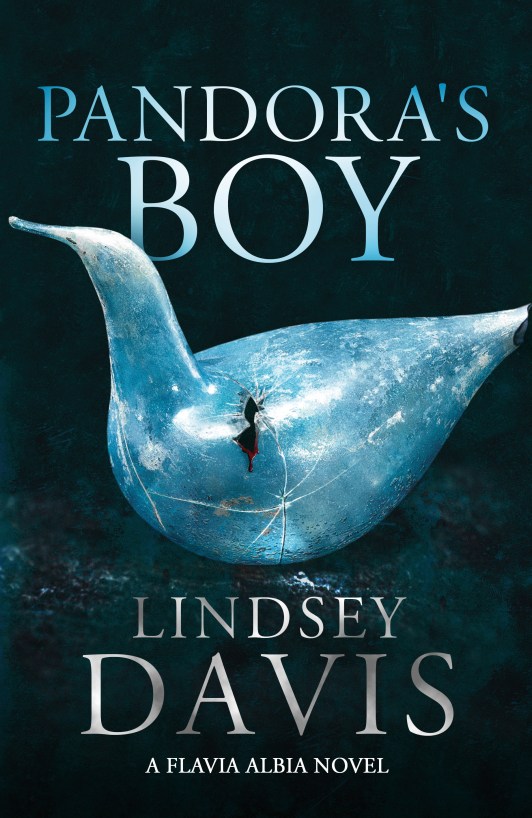
Pandora’s Boy by Lindsey Davis

Pandora's Boy Cover.jpg

Publisher: Hodder & Stoughton

Publication Date – 5 April 2018

Amazon

Ancient Rome’s premier female detective returns in the latest Flavia Albia mystery from veteran historical crime author Lindsey Davis.

Rome, 89 AD.  Flavia Albia, the daughter of the legendary investigator Falco, is now a proficient private investigator and informant in her own right.  When the ex-wife of her husband, Tiberius, brings a case of family drama to her, Flavia is tempted to refuse, but when Tiberius disappears she needs a distraction.

The case revolves around a teenaged girl found dead in the prosperous Quirinal Hill district of Rome.  The girl, Clodia, was the apparent victim of a poisoned love potion, and her parents and grandparents are blaming each other for her death.  What begins as a simple investigation quickly becomes complicated when the witch accused of supplying the potion turns out to be the sister of the city’s biggest crime boss.  No-one is talking, and everyone in the Quirinal Hill has a secret.

Flavia is forced to seek the truth from a variety of people, including warring grannies, concerned parents, criminal lawyers, secretive slaves, a lettuce salesman with an interesting religious statue and, worst of all, the overprivileged offspring of Rome’s elite.  However, as Flavia’s investigation continues and a friend of hers dies, it soon becomes apparent that a vicious gang war is imminent.  Can Flavia solve the crime without getting caught in the crossfire, especially when she has a terrible history with one of the gangs?

Pandora’s Boy is the sixth book in the Flavia Albia series, which acts as a direct sequel series to Davis’ Marcus Didius Falco series.  Davis is one of the most prolific authors of historical whodunits and has a particular focus on novels set in ancient Rome.  For example, her Marcus Didius Falco series contains 20 books, and she has produced some stand-alone books set in the same period.

Like the previous books in the Flavia Albia series, Pandora’s Boy takes a contemporary look at Roman culture and lifestyles.  The inhabitants of Davis’ books act in a very modern way despite their ancient surroundings, and this results in a very humorous interpretation of the ancient Roman characters.  Davis also uses this book to parody a specific group in modern society: the millennials.  Throughout the story, Flavia is forced to follow, interview and generally endure the victim’s friends, who are the offspring of the city’s rich and powerful.  These friends are exceedingly selfish, have sordid love lives and get into all sorts of mischief.  In other words, they act in a very similar way to how modern day millennials are often perceived and portrayed.  Their appearance is quite jarring in the ancient Roman setting and leads to a lot of the books humour.  In all, it is a fun, quirky addition, and an amusing examination of modern society through very ancient eyes.

The core of the book is the death of a young woman and its investigation by the main character.  This is a well-done mystery that takes many twists and turns to keep the attention of the reader.  Flavia’s investigation is done through interviews, trickery, observations and undercover work, and, like many other parts of the book, is infused with Davis’ trademark humour.  The investigation is wrapped up in a final scene that is a throwback to classic murder mystery dénouements.  All the interested parties are gathered together in one place and the investigator reveals their conclusions, eventually leading to their solution to the crime.  Davis provides a perfect parody of this, infused with her own unique touch.  As a result, there are several jokes about this well-used literary device, including discussions around the necessary prep work and tricks to keep the gathered parties’ concentration of the speaker that will greatly amuse many murder mystery buffs.

One of the more diverting and memorable aspects of the Flavia Albia series is Davis’ tendency to include big action sequences that devolve into near absurdity and provide some of the best laughs in the entire book.  For example, in Davis’ previous book, The Third Nero, the climactic scene was a battle in the heart of Rome that featured, among other things, a war elephant, Parthian cataphracts and one of the most improbable chase sequences in all of fiction.  While nothing will quite top this, Davis has striven to include one such scene in Pandora’s Boy, featuring an interrupted séance, an all-out brawl between legionnaires and Vigiles at a collapsing temple, all of which serves as a backdrop to a fight between two warring grannies.  This is an extremely entertaining scene and definitely a highlight to watch out for.

Another notable feature of the books in the Falco universe is the deeper examination of the Roman criminal justice system.  The investigators in these books often deal with the Vigiles and the Aediles, the ancient Roman equivalent of the police and magistrates, many of whom turn into key characters.  This is a unique feature, as most Roman historical fiction books neglect to focus on these institutions, only mentioning them if in the context of political gain.  Pandora’s Boy includes a detailed look at the Vigiles who patrol the Quirinal Hill district and their investigation into the death and other serious crimes.  Loaded up with a suitable modern twist, the inclusion of these characters is an intriguing addition that highlights an often-neglected side of ancient Roman life.

Pandora’s Boy is a wonderful addition to one of the best ancient crime series currently on the market.  Davis once again creates a fantastic murder mystery and infuses it with outrageous humour and a modernistic take on ancient Roman life.  This is an exceedingly fun and deeply absorbing novel that will appeal to a very wide audience of readers.

My Rating:

Five Stars

Amazon

The Throne of Caesar by Steven Saylor

The Throne of Caesars Cover

Publisher: Constable

Australian Publication Date – 6 March 2018

World Publication Date – 20 February 2018

Amazon

Steven Saylor’s long-running ancient Roman detective series returns as Gordianus the Finder deals with the most infamous murder in Roman history: the assassination of Julius Caesar.

For decades, Gordianus the Finder has been the most respected investigator in all of ancient Rome.  After a lifetime of solving crimes and murders for the city’s rich and powerful, Gordianus is determined to retire from the investigative game and enjoy a life of luxury.  However, one last surprise has been thrust upon him: Gordianus’ adopted son Meto has spent years in the service of Caesar as his trusted aid and ghost-writer, and Caesar now seeks to reward Meto by making his father a senator.  Reluctantly accepting this rise in station, Gordianus’ ascension will take place in five days’ time, on the Ides of March.

Caesar has an ulterior motive for meeting with Gordianus.  Warned by visions and prophets, Caesar believes that his life may be in danger, and that disaster may strike before the conclusion of the Ides.  He requests that Gordianus keep his ears to the ground and quietly question leading members of the Roman nobility to see if there is any basis to his concerns.  While initially sceptical of any attempts on the dictator’s life, Gordianus’ suspicions are aroused when one of Caesar’s old rivals, Senator Cicero, also asks him to watch out for potential conspiracies.  As Gordianus begins his investigation, he finds himself in the middle of dangerous historical events, and even the legendary Finder may be unable to stop what is to come.  The Ides of March are approaching, and Caesar’s life isn’t the only one at risk.

The Throne of Caesar is the 16th book in the Roma Sub Rosa series, a series that also includes three prequel novels and two collections of short stories.  Saylor began in 1991 with Roman Blood, set in 80 B.C. some 36 years before the events of this book, and he has slowly been working towards the assassination of Julius Caesar.  Indeed, the last three instalments of the series were prequels produced while Saylor perfected his account of this famous murder.  It was definitely worth the wait, as Saylor has produced an extremely detailed and well-researched account of the infamous killing.

Gordianus’ investigation and social interactions are used to introduce the reader to many of the key people involved with the plot, as well as to discuss the political atmosphere that lead up to the assassination.  The Ides of March is the centrepiece of the novel.  It is clear that Saylor has consulted the key historical records of the killings, as he has made sure to include several of the lesser-known events that happened on the day.  For example, Saylor includes descriptions of the supposed visions Caesar’s wife, Calpurnia, had the night before, and Decimus Brutus’ intervention at Caesar’s residence the morning of the Ides.  Saylor also dedicates a good part of the book to examining the aftermath of Caesar’s death, including the political manoeuvrings that immediately followed, as well as the violent funeral.  As a result, the description of the killings and the surrounding circumstances are first rate, and this aspect of the book will appeal to Roman history buffs.

As Saylor discusses in the author’s notes, writing a murder mystery around the assassination of Julius Caesar is particularly hard, as his death is one of the most well-known events in Roman history, with all the conspirators condemned to historical infamy.  Saylor, however uses this to his advantage and manages to create a large amount of suspense by counting down the days until the 15th of March and hinting at the events that are to come.  All the reader can do is keep going through the novel, knowing that Gordianus will be unable to stop the murder, even as he gets closer and closer to the truth.

Saylor also compensates for the lack of mystery around the death of Caesar by including a second murder subplot.  Elements of this additional murder mystery are hidden in the background of most of the book, as the reader’s attention is directed towards the upcoming assassination, and the investigation into the second murder comes to the fore after Caesar’s death.  The actual events of the second murder are unique and will be of particular interest to fans of a certain Shakespearean play.

One of the best features of The Throne of Caesar is the significant incorporation of Greek mythology throughout the book.  Several Greek myths are discussed, and parts of the plot mirror elements of these myths.  Many of these myths are also included as centrepieces of two Roman epic poems written by Gaius Helvius Cinna, a famous historical poet, which are a major part of the plot.  While one of the plays featured is completely fictional and with no historical basis, the other play is Zmyrna, considered by Cinna to be his greatest achievement, the text of which is unfortunately lost to history.  Saylor provides an interesting possible narrative for the lost play, which flows into the plot of his mystery with great effect.  The overall effect of Saylor including these myths and legends is very striking, and it provides the reader another viewpoint into the lives of the ancient Roman characters who put great stock in these old and religious stories.

The latest addition to the Roma Sub Rosa series is a meticulously detailed and well-crafted book that acts as a unique and powerful chronicle of an important historical crime.  A suspenseful and compelling read, The Throne of Caesar serves as a great continuation of the story of Gordianus the Finder, and it will be interesting to see where Saylor takes the series next.

My Rating:

Four and a half stars

Amazon

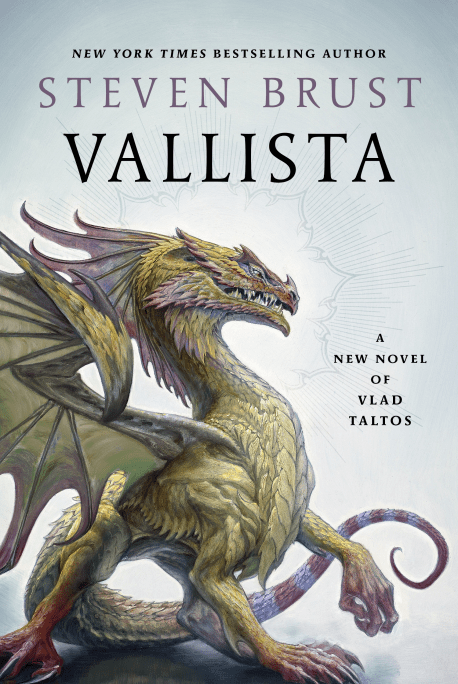
Vallista by Steven Brust

Vallista Cover

Publisher: Tor

Australian Publication Date – 28 November 2017

World Publication Date – 17 October 2017

Amazon     Book Depository

One of fantasy’s most iconic heroes returns in Vallista, the latest book from acclaimed fantasy writer Steven Brust.

In the world of Dragaera powerful and long-lived humanoids known as the Dragaerans are the planet’s dominant species, while humans, called Easterners, are second-class citizens.

Vlad Taltos is a rare anomaly, being an Easterner with a title, money and influence.  Having made his name as an enforcer and assassin, Vlad was a respected member of House Jhereg, the Dragaeran clan in charge of the Empire’s organised crime.  However, Vlad’s relationship with the Jhereg has deteriorated.  Having betrayed his clan, Vlad has spent the last few years on the run, hunted day and night by ruthless assassins.  Luckily, Vlad has friends in very high places, including the Empress, some powerful sorcerers, a necromancer and even a Dragaeran god.

Throughout his travels, Vlad has had several meetings with Devera, a small Dragaeran girl who is the daughter of one of his many powerful friends.  Devera is a mysterious creature of considerable power, an overabundance of enigma and a casual relationship with the rules of time.  Devera has once again appeared to Vlad, requesting his help and leading him to a mysterious manor that has suddenly materialised by the sea.

Despite the fact that the manor should not even exist, Vlad enters, only to find himself trapped with the manor’s mysterious inhabitants.  The inside of the manor is a weird collection of rooms and corridors altered by magic and no longer obeying the rules of reality.  Mirrors teleport people from room to room, mysterious portals lead to the ancient past, and a certain door leads to the Halls of Judgement, the Dragaeran afterlife.

The more Vlad explores, the more he understands that the manor is home to many lies and death.  The overly helpful servants are determined to keep the manor’s past a secret.  No one will explain how an unused and empty kitchen keeps providing Vlad with warm meals.  On top of this, Vlad encounters a ghost unaware of how she died, a mutant deformed by magic, and a powerful demon determined to kill him.

In order to escape, Vlad must uncover the manor’s bloody history and reveal all of its inhabitants’ dark secrets.  With his sarcastic familiars and a sentient sword to aid him, Vlad must use every trick at his disposal to survive while trying to interpret some beguiling visions of his own past lives.  If only Devera, his only guide, would stop disappearing in the middle of every conversation.

Vallista is the 15th book in Brust’s iconic Vlad Taltos series, and is set before the 14th book in the series, Hawk.

One of the most appealing features of Brust’s books has always been their trademark combination of fantasy world-building, action, adventure and fun comedic undertone.  Brust continues this trend in Vallista, creating a fast-paced book that delivers several exhilarating action scenes and a good amount of comedy without compromising the fantasy elements of the plot.  Fans of the Vlad Taltos series will be excited to see an in-depth look at Devera, a minor character who has long mystified readers, as well as visions into several of the titular character’s past lives.

Brust also has an enjoyable habit of combining elements of other genres into his stories.  This ensures that many of the books in the Vlad Taltos series are transformed into different genres, such as murder mysteries, political thrillers or heists contained within the fantasy setting.  Vallista continues this trend with its interesting and unique fantasy mystery.  The main character is forced to uncover the secrets of the mysterious manor in which he is trapped in order to escape.  As a result, Vallista reads a lot like a typical mystery, which is enhanced by the book’s various fantasy elements.

Vallista also borrows several elements from classic haunted house tales.  The main character is trapped and imperilled, the house is filled with servants reluctant to reveal their secrets, and ghosts, monsters and strange events are around every corner.  However, as this is a fantasy book, our hero has far more experience in dealing with such things, and quite a lot of the book’s humour revolves around Vlad responding to the manor’s various challenges.

Unsurprisingly, this book will appeal greatly to those readers who enjoyed the previous instalments of the Vlad Taltos series.  At the same time, this is one of the most inclusive fantasy series that I have ever read.  Burst is very good at succinctly explaining the universe’s lore so that new readers will easily be able to enjoy Vallista every bit as much as any seasoned veteran of the Vlad Taltos series.

Overall, Vallista is fun fantasy adventure that will appeal both to Brust’s established fans and to casual fantasy readers.

My Rating:

Four stars