White Night by Jim Butcher

White Night Cover

Publisher: Penguin Audio (Audiobook – 3 April 2007)

Series: Dresden Files – Book Nine

Length: 14 hours and 12 minutes

My Rating: 5 out of 5 stars

Amazon

Welcome back to my Throwback Thursday series, where I republish old reviews, review books I have read before or review older books I have only just had a chance to read.  In my latest Throwback Thursday post, I continue to explore the epic Dresden Files series by Jim Butcher, with the exceptional White Night.

Readers of this blog will have noticed that my last few Throwback Thursday posts have been all about the amazing Dresden Files by Jim Butcher.  One of the most impressive and recognisable urban fantasy series in the world today, the Dresden Files are brilliant novels that follow Harry Dresden, a wizard and magical protector of humanity, as he faces off against all manner of unique supernatural foes and mysteries in modern day Chicago.  This series features so many incredible books, such as Storm Front, Fool Moon, Grave Peril, Summer Knight, Death Masks, Blood Rites and Battle Ground, as well as the novella The Law, all of which are five-star reads.  I have been reading this series on and off since 2020, and I recently got back into it, managing to finish off two more books, Dead Beat and Proven Guilty in recent weeks.  These outstanding novels were also pretty exceptional, and I was in such a Dresden Files mood I ended up also listening to ninth book in the series, White Night, which turned out to be a pretty awesome decision.

Harry Dresden, wizard, private investigator, and now Warden for the White Council, is Chicago’s only defence against a range of supernatural threats lurking around its exterior.  However, due to his growing power, the extended war between the White Council and the Red Court vampires, and his new position as a Warden, a lethal magical law enforcer, the ordinary magical users of Chicago have grown to fear him and no longer consider him one of their own.  As such, Dresden is shocked to discover that several lesser practitioners in the city have either died in apparent suicides or simply disappeared.

Investigating the crimes, he discovers several mysterious messages that hint at a serial killer stalking female magic users in the city, one who seems to be taunting Dresden directly.  Diving into the city’s hidden magical underbelly, Dresden soon finds a group of minor witches living in fear, all of whom are convinced that Dresden has something to do with their comrade’s deaths.  Attempting to gain their trust, Dresden tries to find the truth, only to discover that all the evidence points towards his secret half-brother, the vampire Thomas Raith.

Unwilling to believe that his brother has become a murdering monster, Dresden dives deeper, only to discover a far more sinister plot lying beneath the surface.  The vampires of the White Court are on the hunt, and their malevolent schemes are expanding to capture all of Chicago, including Dresden and his friends, in their web.  Working with a range of allies, including wizards, gangsters and an old flame, can Dresden untangle the web and stop the White Court before every human magic user on the planet becomes the ultimate prey?

Damn, it really is proving impossible for me to have a bad time with one of the Dresden Files books.  The ninth novel in this series by Butcher, White Night, was another incredible addition and one that I absolutely inhaled in only a few short days.  Featuring a brilliant and well-written story loaded with the series’ great characters, White Night is an amazing and captivating read that gets another easy five-star rating from me.

Butcher has come up with a pretty epic story for White Night, and it was one that had me hooked the entire way through.  The narrative starts off in familiar ground for a Dresden Files novel, with Dresden helping the Chicago police with a suspicious death that might have magical implications.  Butcher draws the reader in at first by presenting them with a juicy and compelling case, that of a serial killer stalking minor magical practitioners in Chicago and leaving taunting messages or Dresden to find.  This story gets even more intriguing when it turns out that many witnesses or the victims’ friends consider Dresden to be the main suspect, not only because of circumstantial evidence, but because his damaged reputation.  Despite this, Dresden keeps trying to investigate, only to come across evidence that suggests his half-brother, Thomas, a White Court vampire, might be behind some of the crimes.  He also encounters his first love, Elaine, who has been hired by a local group of witches for protection, and who Dresden teams up with again to solve the case.

I really appreciated the investigative focus for the first third of the book, and it really reminded me of some of the more classic Dresden Files adventures that started the series off.  This initial investigation soon leads the protagonists into a pretty massive confrontation, and I loved how deadly and destructive things got around halfway through.  Butcher also works in a rather good flashback sequence at this point, which lends itself well to explaining the protagonist’s mental state and providing some excellent context to his recent actions.  As the story continues, Butcher starts to layer out and fully explore the major mystery of White Night in some fantastic ways.  Not only is one of the killers exposed after some fun revelations, but a massive, elaborate conspiracy is also revealed that places Dresden and his allies in a major predicament.  This leads up to an extended confrontation sequence in the last third of the book where Butcher really cuts loose and provides the reader with all the action and intense scenes that they can handle.  Not only is their a beautifully written duel sequence that was pretty cool to see, but Butcher than provides a massive battle sequence that had so much going for it.  There are explosions, betrayals, carnage and sacrifices here, and it is an impressive extended sequences that was near impossible to put down, especially as Butcher loads in epic surprise after epic surprise.  The entire sequence comes together perfectly, and I had so much fun with it, especially as it opens up some cool storylines for the future.  It also serves as a great conclusion to the narrative, and I was really impressed at the ongoing storylines that were either wrapped up or strengthen.  Everything comes together really well and it honestly left me wanting even more Dresden Files.

Butcher once again backs up his amazing story with some outstanding writing that always works to drag the reader write into the middle of the plot.  Featuring a great first-person perspective from Dresden that showcases his unique view of events, as well as his own deep personal concerns, Butcher moves White Night along at a swift pace, ensuring that every scene has something deeply interesting or exciting to keep the reader’s attention.  I really appreciated the great blend of elements within White Night, as Butcher cleverly balances action, adventure, humour, character growth and dark moments, which, along with the investigation elements, ensures that there is a little something for everyone in this book.  I particularly enjoyed some of the elaborate and intense major action sequences in White Night, especially that epic one at the end, and it was cool how massive and deadly some of them got.  Just like most of the previous Dresden Files novels, White Night can be read as a standalone urban fantasy adventure, as Butcher makes sure to recap and reference and relevant prior event, character or storyline so new readers can easily follow along and still have fun.  However, as this is a key novel in the series which concludes or continues several long-running storylines and character arcs, White Night is best enjoyed by those who have checked out the earlier Dresden Files books, especially as the emotional elements of some revelations or actions are greatly enhanced by continuous reading.  I always have so much fun with Butcher’s style in this series, and I felt that White Night was particularly well served by the author’s ability to tell an amazing story.

I have a lot of love for the cool fantasy setting that the Dresden Files utilises as the combination of modern-day Chicago and classic fantasy monsters and magic is always makes for an excellent story.  There are so many excellent elements to this fantasy society that Butcher has dreamed up over the years, and at this point in the series the lore and history of magic and its various factions is very well established.  Despite this, Butcher always finds intriguing new elements to dive into each book, which is something I really appreciate.  In White Night, he takes the time to look at the less powerful magic users in this society, the ones that don’t have enough magic to bother the White Council or interact with Dresden.  These somewhat marginalised magic users have created their own societies and communities as a result, and it was really interesting to see Dresden interact with them, especially as, due to his position as a Warden, they all fear what he represents, which is a fun reversal of how Dresden was persecuted at the start of the series.  I really loved seeing magic through the eyes of the little guy, and Butcher works them into the story in a very intriguing way.

The book also features quite a few White Court vampires, who feed on emotion and mental energy rather than blood.  The White Court are always a rather distinctive inclusion in any Dresden Files novel, and of course there is the requisite extremely beautiful women and focus on lust that are a key part of the White Court vampires.  However, several of the other factions of vampires are finally introduced here, those that induce and feed off fear and despair.  This adds a rather darker angle to parts of the book, especially when these abilities are unleashed at full blast, and it was interesting to see how badly it can be weaponised.  The accompanying vampiric schemes and backstabbing plans are also very fun, and Butcher manages to weave several elaborate ruses and plots into the narrative with some effective results.  These fantasy elements, and more, really help to create a distinctive and captivating read, and I cannot get enough of Butcher’s ability to come up with and utilise the inventive elements.

As always, the characters contained within White Night were pretty damn amazing, and I felt that their complex and powerful character arcs added so much value and intensity to the plot.  The focus is once again on protagonist and point-of-view character, Harry Dresden, who finds himself under all manner of immense pressure in White Night, which blows up around him in some big ways.  Not only is he dealing with the dual responsibilities of having an apprentice and being the magical law in Chicago, but he also has some major family issues and a tone of intense mental trauma that has been building up over the last few books.  A lot of this comes to a head in White Night, and Dresden actually comes across as a lot more angry and frustrated than he has in previous novels, especially after experiencing more losses and seeing some dreadful things.  Butcher writes some compelling and complex storylines around Dresden’s many emotional concerns in White Night, and it proves very intriguing and powerful to see him try to work through them, especially as he is in denial about several of the more prominent concerns.  The author does an amazing job exploring Dresden’s inner psyche here, and you come away feeling closer to him as a result.  White Night is actually a pretty significant book for Dresden’s character growth, especially as several long-running storylines about his mental state finish up here, and this ends up being a pretty satisfying read as a result, especially if you like how he was portrayed in the previous few novels.  Despite, or perhaps because of, his many issues, Dresden still brings his typical humour and complete disregard for decorum or his opponents to the table in White Night, and his fun comments and witty observations are responsible for most of the book’s comedy and entertainment.  As such, Dresden remains a pretty impressive and likeable central character, and I cannot wait to see what future adventures and pain he has coming to him in the future.

White Night also features a great supporting cast of friends and antagonists to liven up the plot in some awesome ways.  While most of the focus of the story is on Dresden, you see a lot of these characters and there are some fantastic and complex storylines written around them.  The most prominent of these characters in White Night is probably Dresden’s half-brother Thomas Raith, who has been a major figure for the last few books.  Due to his banishment from his vampire family, Thomas has been somewhat adrift in recent books, and it was clear that he had been keeping secrets from Dresden for various reasons.  Most of his secrets are finally revealed here in White Night and it was interesting to see what resulted.  Some of them are quite intriguing, some are pretty funny, and it was nice to finally get some answers, especially as it helped to strengthen the relationship between the two brothers.  Other great characters in White Night include Dresden’s former lover, Elaine, who has managed to bounce back since her last appearance and is trying to become more like Dresden by helping people; Dresden’s dog, Mouse, who is such a fun supernatural canine character; and the fallen angel in Dresden’s head Lasciel, who has some of the most emotionally powerful scenes in the book.  However, my favourite supporting character in White Night is probably Chicago gangster John Marcone, a mortal crime lord who dips his toes in supernatural affairs and often serves as an antagonist/uneasy ally of Dresden.  Marcone is always very fun in these books, especially as he and Dresden play off each other perfectly, and he is the perfect foil to the hot-headed protagonist.  His appearance in White Night is particularly good, as you get a deeper look at his true character, and realise he isn’t as evil as he appears.  Despite that, he still proves to be rather ruthless and Butcher writes some amazing and compelling scenes around him.  These characters and more add so much to the power and impact of White Night’s story, and I love how captivating and complex Butcher makes them.

I can’t talk about a Dresden Files novel without once again raving about its audiobook format.  I love, love, love the Dresden Files audiobooks, and there is honestly no substitute to listening to these amazing stories, especially when all the audiobooks feature the incredible vocal talents of actor James Marsters.  Marsters, who is one of my favourite audiobook narrators thanks to this series, is so damn talented, and his take on the Dresden Files books is very special.  This proves to be the case again in White Night, as Marsters utilises all his intensity and passion to bring this epic story to life.  His grip on all the major characters in White Night is pretty damn amazing, and I love how he manages to expertly portray all the characters, ensuring that the reader fully understands their personalities, emotions and inner thoughts when Marsters speaks in their voice.  This is particularly true for protagonist Harry Dresden, a character that Marsters has always done an incredible job voicing, and I deeply appreciated how the narrator was able to capture his full emotional turmoil in this fantastic audiobook.  This brilliant narration, as well as the great story it follows, ensures that White Night was another exceptional listen, and I had an outstanding time getting through this audiobook.  Coming in at just over 14 hours, White Night was slightly shorter than some of the other Dresden Files audiobooks out there, but it still takes a little bit to get through it.  However, it is well worth the time investment, and I cannot recommend White Night on audiobook enough.

Just like every Dresden Files novel I have read, White Night is an exceptional and captivating read that I had an absolute blast getting through.  Jim Butcher’s novels always drag me in with their brilliant storytelling, complex scenarios and fantastic characters, and White Night is one of his more intense and exciting inclusions in the series.  A highly recommended read and an outstanding addition to the series.  I will be reading more Dresden Files novels as soon as I can.

Amazon

The Accomplice by Steve Cavanagh

The Accomplice Cover

Publisher: Orion (Trade Paperback – 26 July 2022)

Series: Eddie Flynn – Book Seven

Length: 323 pages

My Rating: 4.75 out of 5 stars

Amazon

The murder trial of the year is in session as brilliant legal thriller author Steve Cavanagh returns with his latest Eddie Flynn novel, The Accomplice.

Last year I had the great pleasure of reading a very fun and compelling thriller novel with The Devil’s Advocate, which was the sixth book in the Eddie Flynn series by talented author Steve Cavanagh.  I had heard of Cavanagh before last year, and indeed I already had a couple of his other books currently sitting on my to-read shelf, but this was the first real chance I had to read one of his novels.  I ended up being really impressed with The Devil’s Advocate, which pitted the series’ conman turned lawyer protagonist against a murderous southern prosecutor in a story that was wildly entertaining, extremely clever, and highly addictive.  As such, I have been rather eager to see what Cavanagh would write next, and his next book, The Accomplice, had been high on my upcoming books list for a while.  Well, I just received an advance copy of The Accomplice a couple of days ago and I immediately picked it up and started reading because it had such an awesome story idea behind it.

Carrie Miller is the most hated woman in America!  A seemingly normal and unassuming housewife, the world was shocked to discover that Carrie’s husband, Daniel Miller, was the notorious and brutal serial killer known as the Sandman.  After terrorising New York for months and killing 14 people, the Sandman suddenly vanished just as the police arrived to arrest him.  While the Sandman may have been gone, Carrie was still there, and everyone, including the police, FBI, media, and the entirety of America, believes that she knew about her husband’s crimes and helped to cover them up.

As the start of her trial begins, a desperate Carrie turns to the one defence attorney that could save her, former conman and legal genius Eddie Flynn.  Convinced of her innocence and determined to help, Flynn reluctantly takes on her case.  However, this will be the most difficult case of his life, as he must convince a jaded jury and the rest of the world that Carrie had no knowledge of her husband’s crimes and took no part in the murders.  But with Carrie already convicted by the media, and no evidence or witnesses that can back up her story, Eddie will have a real fight on his hands.

As Eddie prepares for the case, a dangerous new problem enters the picture.  After a lengthy absence, the Sandman has returned to New York, and he’s determined to save his wife from a life sentence.  Even with the police, FBI and rogue serial killer specialist Gabriel Lake on his tail, the Sandman begins a new reign of terror, targeting the prosecution’s witnesses and members of the FBI.  With the stakes higher than ever, can Eddie prove Carrie’s innocence before the killer strikes again or will he and everyone he cares about face the wrath of the Sandman?

Cavanagh hits it out of the park again, providing readers with a brilliant and intense thriller that is dark and fun at the same time.  Combining fantastic legal elements with a gripping psychological narrative about a dangerous killer, The Accomplice was another impressive read from Cavanagh that was well worth the wait.

This seventh Eddie Flynn novel has a really awesome and intense story to it that takes the reader on an impressive ride that is near impossible to stop.  Starting off with a great introduction to the case, the story quickly loops in Eddie Flynn and his team, while also bringing back the great villain in the Sandman.  Following some subsequent exposition and background to the case, Eddie gets into planning the defence, only to have a substantial shock hit him as the Sandman strikes in several different directions.  As the various characters attempt to deal with the issues surrounding the Sandman’s new attacks, Eddie is forced to defend his client in impossible circumstances as the trial starts.

Thanks to his great use of multiple character perspectives, which follows everyone including Eddie, his team, and even the Sandman himself, you get a great view of the events occurring throughout the book.  The middle of this impressive novel is filled with some excellent sequences depicting the killers’ current brutal actions, the desperate search for him that envelopes several main characters, and Flynn’s always impressive legal scenes.  I loved the awesome changes in tone and focus that occurred between these various chapters, and there is an intriguing and powerful contrast between the intensive cat-and-mouse games surrounding the killer and the more legal focused scenes.  All the perspectives come together in a big way towards the end of the book, and The Accomplice has a fantastic and wildly entertaining finale.  There are some pretty cool twists loaded up here and Cavanagh does a great job setting them up throughout the narrative.  I was kind of able to predict how one of the main ones would turn out, but I was pleasantly surprised by the other, and looking back it was cleverly set up and then hidden by the other secrets.  The author ends The Accomplice on a great note, and readers will come away wildly entertained and very impressed with how everything was so neatly wrapped up.

Cavanagh was in the zone when he was writing The Accomplice, and I deeply enjoyed how the entire story came together.  Like most of Cavanagh’s novels, the pacing in The Accomplice was spot on and the reader is never really given a chance to relax or put the novel down, which ensures that they try really hard to get through everything in one go (it worked on me).  There was an excellent blend of styles throughout The Accomplice, and Cavanagh once again did a great job of combining the darker subject matter of a disturbed killer, with the lighter scenes that focused on Eddie Flynn’s outrageous behaviour.  The scenes focused on the Sandman were particularly dark and gripping, especially as you get to see directly into his diseased mind, and the use of them throughout the novel really helped to amp up the drama and threat, while also moving the narrative along in some impressive directions.  Likewise, you get some intriguing and powerful character driven scenes from some of the other major characters, such as Flynn’s investigator Bloch and newcomer Gabriel Lake, as they get obsessed with finding the Sandman and bringing him to justice.

However, my personal favourite scenes in the book are those that deal more with the legal thriller aspects of the book.  I am always a sucker for a good legal battle in fiction, and Cavanagh, a man who knows a thing or two about the law, does a brilliant job of showcasing trials, legal prep work, and the formation of a defence case throughout his novels.  The court sequences scattered throughout the novel are very well written, and it was fascinating to see the author’s take on certain prosecution and defence strategies (some of the names for the strategies were quite amusing) as the protagonists do their darndest to blow a hole in the seemingly airtight case against their client.  I really loved how Cavanagh once again let Eddie go wild during the court case, and he uses all his knowledge and flair for the dramatic to manipulate the court in some inventive and often hilarious ways.  Most of Eddie’s appearances in the court are wildly entertaining, and his over-the-top shenanigans so much fun to behold, especially when he takes down every smug opponent and obstacle in a big way.  The author has a lot of fun setting up some of these events throughout the book, and it is really entertaining to see the protagonists coming up with their eccentric plans, as the hints about what they are going to do are left purposely vague to capture the reader’s attention.  I have so much love for Cavanagh’s ability to bring some wacky ideas into the court setting, and I can’t wait to see what convoluted and hilarious strategies the protagonist employs in any future books.

On top of the great story and distinctive sequences, Cavanagh also excels at character creation and development, which adds an extra impressive layer to the narrative.  The Accomplice features an interesting complement of characters, from the established cast of the previous books to some exceptional new figures whom the current case revolves around.  Naturally, most of the focus falls on the protagonist of Eddie Flynn, who is once again brought into an impossible case.  Flynn has another strong turn in The Accomplice and gets up to all his old tricks to win.  This results in quite a few entertaining and hilarious moments, and most of the book’s strong humour is because of Flynn’s more outrageous behaviours.  However, parts of this case do really get to Flynn and show that deep down he’s a good and flawed figure who lets his work dig into him.  Watching certain stresses and griefs take their hold on him really adds to the drama and intensity of the book, and I really appreciated how Cavanagh portrayed him throughout this latest novel.

On top of Eddie, the author brings back the central legal team, who are very strongly featured throughout this seventh book.  This includes Eddie’s mentor and advisor, Harry Ford, who continues to be a solid and calming presence for much of the book.  Harry serves as an excellent foil to the more outgoing Flynn, and they work well together as a team, especially during some scenes that see Harry have a bigger impact on the story than usual.  The other two key members of the staff are the firm’s other associate, young lawyer Kate Brooks and investigator Blotch, who are well utilised throughout The Accomplice.  Both bring something very different to the story, whether it be Kate’s relative innocence and determination to help wronged women, such as their client in this book, or Blotch’s investigative knowhow, capacity for violence, and general determination.  Both prove a good match for Flynn throughout this book, and I really liked the major impacts they have on the story, as it resulted in a much more varied and fun narrative.  There is also a great look at their strong friendship, which has lasted since childhood, and it was fun to see more examples of Blotch’s overprotective nature, especially when it comes to a thieving neighbour.

Finally, there are also some excellent new characters utilised in The Accomplice, who each bring something very different to the table.  Due to their stronger involvement with this particular case, be it suspect, perpetrator or hunter, Cavanagh does spend a bit more time introducing and developing these new characters than the existing cast, and you end up getting to know them extremely well.  This includes Flynn’s new client, Carrie Miller, the wife of the infamous Sandman, who finds herself under attack from pretty much the entire country in this book.  Carrie cuts a fascinating figure as a result, and while you are constantly wondering just how innocent she is, you get to see her at her most vulnerable as everyone she knows has turned against her.  I particularly enjoyed some of her insights (her choice of favourite film is excellent), and the journal entries that the author scatters throughout the novel really enhances her tale and gives greater context to her present actions.

In addition, Cavanagh also introduces the character of Gabriel Lake, a former FBI agent turned private investigator who specialises in catching serial killers.  A brilliant man with interesting ideas about the way to hunt killers which goes against the established theories of the FBI, Lake is an integral part of the plot, as he helps Flynn with his case in the hope of catching the Sandman.  However, there is also a deep well of anger within Lake, due to both his past and his personal connection to the Sandman case, and this becomes a major problem for the protagonists as the book goes on.  You never quite know what Lake’s motivations or intentions are, and he ends up adding an entire extra layer of complexity to an already twisty plot.

The final character I need to mention is the killer known as the Sandman.  While I won’t go into too much detail here about them to preserve some plot details, they serve as a sinister and threatening figure throughout the story, and their presence really impacts the events of the narrative.  Cavanagh goes out of his way to make the Sandman appear as deadly and deranged as possible, and it was fascinating to get a glimpse into his mind, especially as he truly believes that the Sandman is his true persona.  Watching him work his deadly skills in several disconcerting point of view chapters really adds to the intensity of the narrative, and he ended up being a particularly impressive literary villain.  I really had a great time with all these amazing and complex characters, be they old and new, and Cavanagh has once again really showcased his excellent skill when it comes to writing damaged people.

Unsurprisingly, I had a wonderful time with The Accomplice and Steve Cavanagh continues to impress me as one of the more entertaining thriller authors out there today.  This latest Eddie Flynn novel has all the series trademark flair as Cavanagh presents the reader with another unique and captivating case.  I loved how The Accomplice featured a great combination of a dark killer, hilarious legal scenes, a twisty thriller plot, and some well-established characters, which result in an incredible and addictive narrative.  A deeply enjoyable read, I really must go back and check out some of the earlier Eddie Flynn novels when I get a chance.  Highly recommended!

Amazon

Death of the Black Widow by James Patterson & J. D. Barker

Death of the Black Widow Cover

Publisher: Century (Trade Paperback – 12 April 2022)

Series: Standalone

Length: 520 pages

My Rating: 5 out of 5 stars

Amazon     Book Depository

Prepare for one of the trippiest and darkest thrillers of 2022 with Death of the Black Widow, the latest brilliant standalone novel from the all-star team of James Patterson and J. D. Barker.

Few thriller writers out there at the moment are as well-known or prolific as superstar author James Patterson.  Patterson has been absolutely dominating the thriller and crime fiction genre for nearly 30 years and has an incredible catalogue of works to his name, including his best-selling Alex Cross books.  In recent years, Patterson has released a torrent of works, including some solo books and several novels done in collaboration with other talented writers and even a few celebrities.  I personally have loved several of his previous collaborated books, including Lost (co-written with James O. Born) and 2 Sisters Detective Agency (co-written with Candice Fox).  However, one of the more intriguing authors he has teamed up with is acclaimed thriller and horror author J. D. Barker.  Barker, whose work I previously enjoyed on Dracul (co-written with Dacre Stoker), has already produced two intriguing novels with Patterson, The Coast-to-Coast Murders and The Noise.  I have been keen to check out this awesome writing team for a while (The Noise is currently sitting on my shelf waiting for my attention), and when I received a copy of their latest book, Death of the Black Widow, I made sure to read it as soon as possible.

It is a typical night in Detroit until former police officer Walter O’Brien and his comrades call in a bomb threat on a busy night club and use concentrated sniper fire to keep its patrons trapped inside.  When the police arrive on scene, Walter surrenders to them and offers them a simple choice: allow them to kill a single woman hidden within the club, or watch as the entire building is destroyed.  But who is this mysterious woman and what has driven Walter and his friends to such extremes?

The origins of these desperate actions date back decades to when a young Walter O’Brien is called to a murder scene on his very first night for the Detroit PD.  What he uncovers is a terrible and bloody crime scene: a scared and surprisingly alluring young woman has apparently escaped from captivity and skillfully bludgeoned her ruthless captor to death with a lamp.  Attempting to take her to hospital, Walter is shocked when she escapes from his custody, leaving an impression on him that will last a lifetime.

Years later, as a new homicide detective, Walter has a chance encounter with someone he believes to be same women from that fateful night.  Still obsessed with his previous encounter, Walter attempts to track her down, only to find a disturbing pattern between this mysterious and woman and several disturbing and unexplainable murders he is investigating.  But when his case takes an even more unusual twist, Walter finds himself thrust into something far bigger than himself.  A secret government agency is attempting to find this mysterious woman, and soon they and Walter begin to uncover a disturbing trend of murders going back years.  As Walter begins to lose himself more and more to obsession, he becomes determined to be the one to stop any more killings.  But what is he willing to do to stop the deaths once and for all?

Wow, now that was a fun and intense book.  Patterson and Barker have produced something very special with Death of the Black Widow, which was an utterly insane and awesome read.  I was actually a little surprised with how much I enjoyed this clever book, and I think I have very little choice but to give it a full five-star rating.

Now, I must admit that when I started reading Death of the Black Widow, I honestly did not know too much about the book, apart from what was in the synopsis.  From that and the name, I assumed that this was going to be a psychological thriller or a spy thriller.  However, while Death of the Black Widow does have thriller and murder mystery elements to it, and indeed it appears to be a purely crime fiction novel for the first few chapters, it actually turned out to be something entirely more complex.  Within the first 100 pages or so, you begin to realise that the authors are subtly including elements from other genres, and Death of the Black Widow soon starts to take on a distinctive horror vibe, with some incredible brutal killings done under extremely unusual circumstances.  While I was surprised by this, I cannot say that I was disappointed.  Instead, I felt that it was a brilliant move from the authors and one that played particularly well to Barker’s strengths.  This new genre combines well with the books existing thriller/crime fiction framework to create an intense and exhilarating read that is extremely easy to get into and very, very hard to put down.  I personally found myself powering through the last 350+ pages in less than a day, especially once I begun to fully understand just how clever and weird things were about to get.

I was really impressed with how Death of the Black Widow unfolded as a story, especially as Patterson and Barker went out of their way to make this standalone read as enticing and epic as possible.  The book starts in the present day and shows the older protagonist and his compatriots entering the end game of their confrontation with a mysterious woman.  This serves as a great setup to the rest of the story, which jumps back multiple decades to 1986, when Walter and the mysterious woman, known here as Amy Archer, first meet, and the strange and deadly circumstances behind their encounter.  The story then jumps forward several years to 1992, where Walter is investigating several strange murders when he has a chance encounter with someone he believes is Amy.  This results in an intriguing series of chapters where Walter deals with both the investigation and his growing obsession with this girl, before everything blows up terribly and the mystery becomes more convoluted and unusual with each new revelation.  This pattern continues throughout the book, with the story jumping ahead years at a time to show the multiple encounters between Walter and his obsession.  Each time period reveals some intriguing new angles and elements, and you find out new revelations about the woman the protagonist is hunting, resulting in the full truth about her finally being revealed.  The novel also keeps slipping back to the siege occurring in the present, with some new characters trying to uncover what Walter and his team are up to as the protagonists provide them with hints about who they are and what they are after.

I deeply enjoyed that the authors chose to utilise a split timeline for Death of the Black Widow, especially as it works extremely well to tell this outstanding narrative.  The switch between time periods and chronological length of the story really enhances just how mysterious the events of the book are and the powerful, life-altering impact they have on the protagonist.  There are many clever elements to the switches between the periods, and I loved the subtle inclusions in the present timeline that hint at the events in the past that the protagonist was yet to experience, and the full impacts of them.  There are also some fun summaries loaded at the front of each change between the past and the present that represent the protagonist’s notes on the case.  Not only can these be useful to remind the reader where they are, but it helps to highlight just how massive the case gets, especially towards the end of the book, as well as tracking Walter’s growing obsession (especially the last one).  This entire story is loaded up with brilliant reveals and shocking twists, and I was honestly surprised and very thrilled in some of the excellent directions that the authors took the story.  You will honestly have a hard time putting this novel down once you get past the halfway point, especially once the 1992 storyline comes to its shocking end, and the intense revelations and horrific scenes of the next few time periods ensures you will become unerringly trapped as you attempt to find out more about the antagonist and their past.  This entire story of obsession, murder and mystery concludes perfectly in the present, with some truly big moments, as everything comes full circle and twists that have been hidden in plain sight since the start come into the light.  This was such a great story, and I frankly loved every single second I spent reading it.

I cannot finish talking about this book without mentioning the excellent characters it contained.  Death of the Black Widow features an intriguing and unique cast, each of whom brings something fun and compelling to the story.  The most prominent of these is Walter O’Brien, who serves as the central point-of-view character for most of the story.  Thanks to how the book progresses, you get to see the entirety of Walter’s life unfold, from his young days as a rookie cop, all the way up to his present, when an older, dying Walter attempts to bring his great obsession to an end by finally catching the woman who has haunted him for decades.  This ensures you get a brilliant look at this character and it proves absolutely fascinating to see the various stages of his life and the continued impacts of his interactions with the woman he knows as Amy Archer.  One of the best parts of this is that you get to see the growing obsession that Walter builds towards this woman, as meeting her proves to be a defining experience for him.  Despite the fact that his interaction with her are relatively short, each time he meets Amy she changes his life in a different way and he soon becomes quite obsessed with her.  This obsession continues to bloom, even after certain revelations about her and her actions become known, and he is forced to fight his own feelings and observations throughout the entire book, especially once it becomes clear that this obsession is mutual and that Amy is drawn to Walter as well in a twisted romance that is so damn dark.  Watching this usually confident and capable person being haunted by this obsession proves to be powerful and captivating centre to this story, and you really feel for this protagonist as he struggles.  Walter ends up serving a great role as the central protagonist of this story, and I found his entire character arc to be extremely well written and cleverly exposed.

On the other side of the coin is the mysterious woman who serves as the titular Black Widow of the story.  Known to Walter as Amy, this woman serves as a shadowy and enigmatic figure in the book, especially as you have no idea who she truly is for most of it.  To avoid spoilers, I will not go into too much detail about her here, but I will say she was an exquisite and amazing character, and the authors did a remarkable job bringing her to life and fitting her into this remarkable story.  She is easily one of the most distinctive and memorable literary villains I have read for a while, and if they ever make a movie of this book (which they really should), I think a great actor could turn her into something very special.  These two characters, as well as some other great supporting characters (the members of Walter’s team in the present day, as well as some distinctive cops from the past timelines for example), prove to be the beating heart of this incredible story, and it was absolutely fascinating to see how their intriguing lives worked in to the plot of this book.

No doubt it, I was really, really impressed with Death of the Black Widow, which ended up being one of the most exciting and compelling reads of 2022 so far.  The outstanding team of James Patterson and J. D. Barker were absolutely amazing here, producing a clever and intricate thriller, loaded with unique characters, a deep obsession laden storyline and some excellent horror elements.  This was easily one of the most unique and memorable novels I have read in a while, and I loved every single second I was going through it.  A highly recommended read that will appeal to anyone interested in a dark and deadly read, you will not be disappointed with Death of the Black Widow.

Death of the Black Widow Cover 2

Amazon     Book Depository

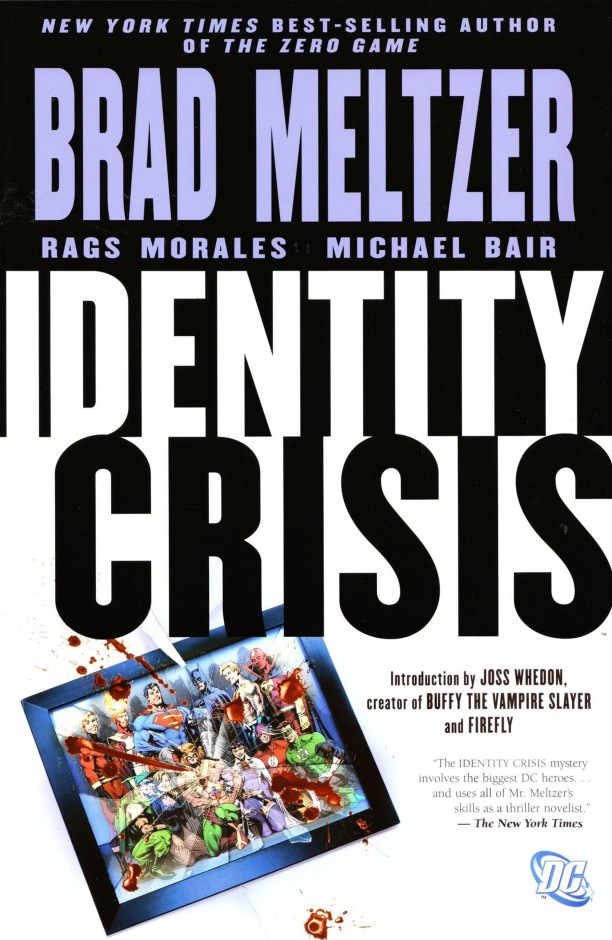
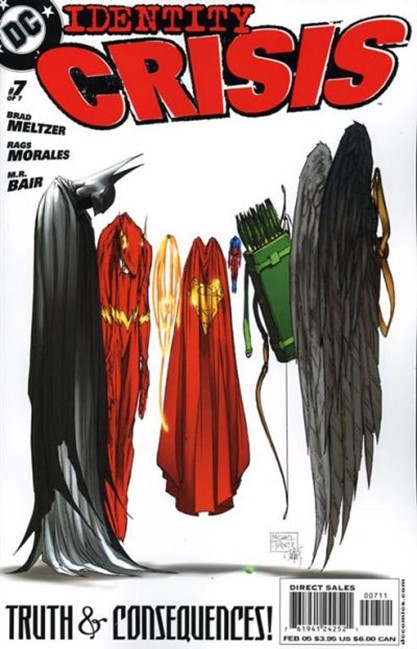
Throwback Thursday – Identity Crisis by Brad Meltzer, Rags Morales and Michael Bair.

Identity Crisis Cover

Publisher: DC Comics (Paperback – 1 October 2005)

Series: Identity Crisis Limited Series

Writer: Brad Meltzer

Penciller: Rags Morales

Inker: Michael Bair

Letterer: Ken Lopez

Colorist: Alex Sinclair

Length: 288 pages

My Rating: 5 out 5 stars

Amazon     Book Depository

Welcome back to my Throwback Thursday series, where I republish old reviews, review books I have read before or review older books I have only just had a chance to read.  For this week’s Throwback Thursday I take a look at one of my absolute favourite comic book limited series, the epic 2004 DC Comics event, Identity Crisis.  (Quick warning, there are spoilers ahead).

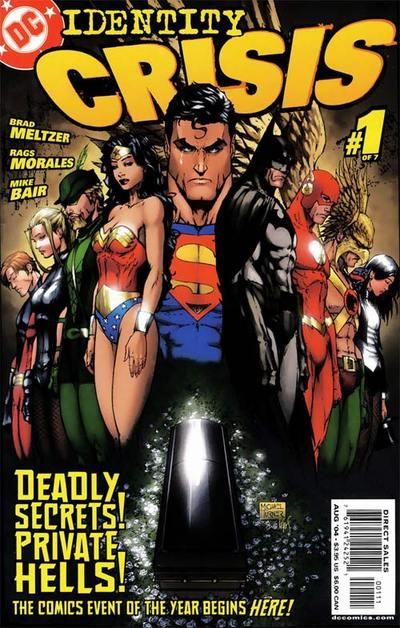
Identity Crisis #1

It is fair to say that the early to mid-2000s was one of my favourite periods of comic books, with some truly cool and epic ongoing and limited series being released.  This was particularly true for DC Comics, who produced some of their best work during this time, many of which rank amongst my all-time favourite comic series.  This easily includes the exceptional and brilliant crossover event, Identity Crisis, which to my mind is one of the best limited series ever written.

Made of seven issues, Identity Crisis combines the unique writing talent of thriller author Brad Meltzer with the artistic stylings of veteran DC Comics collaborators Rags Morales and Michael Bair.  This ended up being a near perfect combination of talents and skill, and I have a lot of love for the exceptional story, which absolutely hooks me every time, and its outstanding associated artwork.  I particularly impressed with the addition of Meltzer, who, despite his more literary background has written some of the absolute best and most human comics I have ever had the pleasure of reading, including Green Arrow: The Archer’s Quest and the two Justice League of America storylines, The Tornado’s Path and The Lightning Saga.  However, his story in Identity Crisis is particularly powerful and thought-provoking, and it ends up being a comic that completely changes everything you knew about your favourite heroes.

For years the members of the Justice League of America have protected the world from all manner of evil and destruction, always prevailing no matter the odds.  But who can protect them when someone goes after those closest to them?  And what if they actually deserve the punishment being visited upon them?

On an unremarkable night, a mysterious attacker breaks into the home of long-serving Justice League associate, Ralph Dibny, the Elongated Man, and commits a terrible crime, the murder of Ralph’s beloved wife, Sue Dibny.  With no evidence about who the killer is and no idea how they breached the Dibnys’ impressive security, the superhero community rallies behind their bereaved friend and seeks to find the killer by any means necessary.

As the rest of the heroes seek answers at any potential suspect within the supervillain community, the Elongated Man and a small group his closest friends hunt for a minor villain, Dr Light, whose secret connection to the League’s darkest moment may hold the answers they seek.  However, when a second attack occurs on another publicly known relative of a superhero, Jean Loring, the former wife of the Atom, it soon becomes clear that someone else is targeting the heroes and their loved ones.

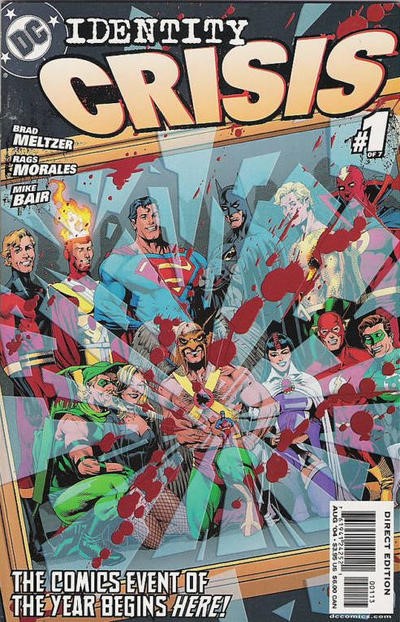
Identity Crisis #1b

As Batman, Superman, Green Arrow and others attempt to get to the bottom of the case, cryptic threats to one hero’s relative reveal that whoever is targeting them knows all of the League’s secrets, including their hidden identities.  As even more tragedies befall the superhero community, dark secrets from the League’s past are brought into the light and no-one will be prepared for the terrible truth behind these brutal murders.  Can the League weather this latest attack, or is this the beginning of the end for the world’s greatest heroes?

Damn, no matter how many times I read this comic, the tragic and powerful events of Identity Crisis still really get to me.  This exceptional comic contains one of the most impressive narratives I have ever seen in a limited series, taking the reader on a captivating and emotional dive into the world of your favourite heroes.  Perfectly combing a dark, mysterious narrative with incredible character work and some truly amazing artistic inclusions, this comic gets an extremely easy five-star rating from me.

For Identity Crisis, Brad Meltzer really went to the well, producing an insanely compelling and moving story that relentless drags you in and introduces you to a completely new side of your favourite heroes.  Utilising his experience as a crime thriller writer, he produces a powerful, character driven superhero narrative with detailed crime fiction elements to create an exceptional and unique story.  Identity Crisis has an amazing start to it, which not only carefully introduces several key figures but also installs some dark tragedy, as the wife of a superhero is killed off.  The subsequent investigation into her murder by the enraged superhero community is extremely compelling and intense, as the emotional heroes turn over every rock and stone, much to the horror of the villains.  However, it is soon revealed that several members of the Justice League are harbouring a devastating secret, one that could reveal the identity of the killer.  This secret becomes one of the most important parts of the first half of the series, and it leads to an epic, action-packed fight sequence against a particularly dangerous foe.

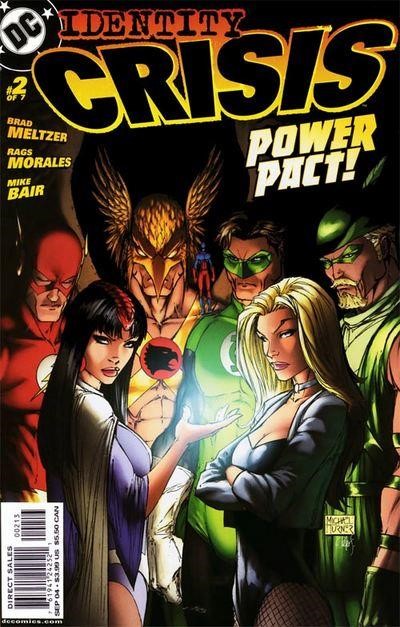
Identity Crisis #2

The story starts to go in a bit of a different direction at this point, with the above secret not really panning out regarding the investigation.  However, other superhero relatives, both public and secret, are targeted, resulting in pandemonium around the characters.  I loved the narrative’s move to a more classic investigation at this point, as the heroes start following every lead they can, while more character development and big moments are explored.  This all leads up to the defining moment when another superhero loses a loved one and the identity of the killer is seemingly revealed.  However, this turns out to be a bluff, as the real killer is still hidden.  The reveal of who did it and why are revealed pretty suddenly towards the end, with some curious and clever motivations exposed.  This leads to a tragic and heartbreaking conclusion, as more secrets are revealed, dangerous lies are uncovered, and several characters leave the story more broken and destroyed than ever before.  You will be thrown through the emotional wringer as you check this comic out.

I deeply enjoyed the way that Meltzer told Identity Crisis’s excellent story, especially as it quickly and effectively engrosses the reader and ensures their undivided attention.  The author utilises a mass-character narrative that follows a substantial collection of heroes and villains, many of whom have distinctive or semi-separate storylines.  This works to tell an intriguing, rich narrative that not only has some clever dramatic components but also allows for some intriguing and compelling retcons and expansions to the already elaborate DC universe.  It is very cool how the story developed into more of a murder mystery/thriller story as the comic progressed, and this really played to Meltzer’s strengths.  The investigation is handled very well, and I liked how the superhero elements altered and enhanced it in some clever ways.  The mystery itself is complex and clever, with Meltzer adding in some great twists, false leads and compelling surprises to keep the reader guessing.  The twist about the actual killer is pretty good, and Meltzer did a great job layering in hints and clues throughout the rest of the story while also introducing a few good alternative suspects.  While the motivations and complexities surrounding the killer’s actions are great, I did think that how the protagonists worked it out was a little abrupt, and it might have been a little better if they worked it out from some earlier clues.  The use of female characters wasn’t the best either, especially as most of them are there simply to be victims in one shape or another.  Having a long-established character getting both raped and murdered in a comic as a plot device is pretty unfortunate, and some stronger female figures might have helped balance this out.  Still, this ended up being an awesome read and I deeply enjoyed how it turned out.

One of the things that I really enjoy about Identity Crisis is the interesting examinations that were included as part of the plot.  Meltzer and the artistic team obviously had a lot of fun exploring or introducing some cool aspects of the DC Universe in this series, especially when it comes to the secret or hidden lives of superheroes and supervillains.  I particularly loved the in-depth examination about how both groups are officially or unofficially organised, and there are some very intriguing views of them socialising or working together.  The inclusion of a highly organised superhero death investigation squad, made up of a range of random heroes (the Ray, the Atom, Animal Man, Mister Miracle and two of the Metal Men) is particularly clever, as is the way the various heroes organise into a vengeful posse to question potential suspects.  The deep dive into the importance of a superhero secret identity also becomes an important part of the story, especially as the loss of the secret brings pandemonium thanks to the killer stalking them.  I also loved the counterbalance look at organised villainy, and there are some excellent scenes that see the villains gathering to socialise or talk shop.  Having an organising force like the Calculator, as well as a secret space station hangout, is pretty elaborate, and the deeper look at the villains of this universe, definitely gave Identity Crisis a compelling and intricate edge.

Identity Crisis #3

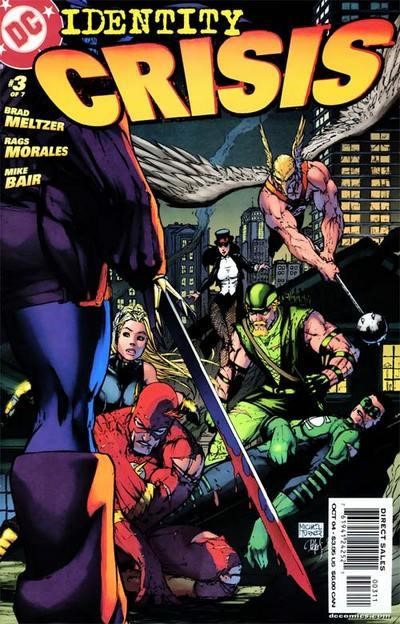
However, easily the most groundbreaking and compelling new inclusion to the universe is the reveal about the unofficial league within the Justice League who have some dark secrets.  Made up of heroes Green Arrow, Black Canary, Hawkman, Zatanna and Atom, as well as the Silver Age Green Lantern and Flash, this group of heroes apparently operated separately of the main Justice League during their classic Silver Age adventures, acting as their clean-up crew.  This retcon by Meltzer provides an interesting explanation for why villains never remember the secret identities of the heroes they switch minds with or whose dreams they invade, namely they have their mind erased by Zatanna’s magic after being captured by this inner-League.  While this is already a dark move by these established heroes, it gets even worse when they are forced to reveal that they intentionally destroyed Dr Light’s brain to make him less of a threat.  This and other revelations, acts to make many of your favourite heroes appear much more morally grey and fallible, and it was a particularly impressive and monumental inclusion, that will have grave consequences down the line for the entire universe.

Unsurprisingly for something written by Meltzer, Identity Crisis contains some insanely complex and impressive characters who form the heart of the tale.  Due to the way the story is told, Identity Crisis follows a massive cast of comic characters, including several obscure or underappreciated figures.  Meltzer does a brilliant job of utilising all these established characters throughout his story, with nearly every major cast member getting a moment to shine in some way or another, and multiple figures who were underutilised or unappreciated before this comic were given brilliant and defining second chances here.  While the use of multiple focus characters had the potential for a scattered narrative, Meltzer was able to direct the flow of the story around all these various protagonists and antagonists perfectly, and you still get a tight and concise story, which also takes the time to dive into each of these figures and showcase them to their greatest degree.  As I mentioned before, there is a real focus on highlighting the darker side of the superhero characters throughout Identity Crisis, and you end up really seeing these fantastic figures in a whole new scary light.

Let’s start with Ralph and Sue Dibny.  I must admit that the very first time I ever read Identity Crisis, many years ago, I honestly had no idea who Elongated Man and his wife were, as they were a little obscure.  However, Meltzer really goes out of his way to feature them in this story (even adding in a few retcons) and you are given a great introduction to them at the start.  In just a few panels, you understand who these characters are and what they mean to each other and the other superheroes, as well as some unique characteristics and relationship quirks.  This excellent introduction makes you start to care about them just as Meltzer brings the hammer down and kills Sue.  The subsequent grief, rage and despair from Elongated Man is just heartbreaking, and you go through the rest of the comic seeing him attempt to recover from these terrible events.  This amazing use of characters at the start of the comic has a great flow-on effect to the rest of the story, and you become exceedingly invested in finding the killer as a result.

Identity Crisis #4

From there, a lot of the superhero focus goes to the surviving members of the Justice League who formed the league within the League I mentioned above.  There is some exceptional character work around some of these team members, especially as they come to terms with the decisions they made in the past and how they are impacting them now.  I loved seeing them attempt to justify their actions to the other heroes, even their darkest decisions, especially as you can understand why they did what they did, while also feeling disappointed in them.  You really get a sense of determination and shame from them as the story continues, and you see all of them go through a lot in both the past in the present story.  Despite multiple differences, this team are still friends and comrades, and watching them come together to brawl with some of the most dangerous characters is pretty heartwarming, even if darker elements lie just beneath the surface.

While there is a focus on these inner-Leaguers, some of them are utilised a lot more frequently than others, particularly the original Green Arrow, Oliver Queen.  Green Arrow is an excellent figure in this comic and is probably the closest thing to a heroic narrator/central protagonist the story has.  His unique perspective on the events acts as a good foil to many of the other characters, such as Batman and Superman, and he proves to be a calm, if potentially vengeful figure for much of the story, organising many of the League actions and forensic investigations.  He also proves to be the voice of reason for the inner League, calmly justifying many of their actions and serving as a bridge between this existing group and the newer Flash and Green Lantern.  Despite his belief that they are doing the right thing, you can see some real emotion and regret in his face, especially when the further revelations about Dr Light and Batman come out.  I also appreciated the deeper look into his antagonistic relationship with Hawkman, which partially originated in the past events mentioned here, and it is interesting to see how the events of this comic impact future Green Arrow storylines.

Aside from Green Arrow, other members of this secret League who get an intriguing focus include the Atom, Ray Palmer, and his ex-wife, Jean Loring.  Due to his status as another public hero, Atom and Jean are also targeted throughout the story, and you end up getting a rather intense and fascinating look at both.  Watching their failed relationship rekindle is a nicer part of most of the comic, although eventual reveals and tragedies naturally ruin it and smash everything around.  Still, their complicated emotions and issues surrounding their fractured relationship make for some of the best parts of the comic.  I liked the interesting look at Zatanna throughout the comic, especially as she is largely responsible for some of the worst moments of this group of heroes, as she clearly feels guilty about her magic messing with the villain’s minds.  I also need to highlight the younger Flash, Wally West, who finds out about the actions of the other characters during the current events of the comic.  It is absolutely heartbreaking to see Wally learn that his mentor and predecessor, Barry Allen, was not as perfect as he imagined, and actually participated in some of the team’s worst events.  The distress he exhibits with every subsequent reveal is showcased through the comic’s art extremely well, and his subsequent guilt as he is forced to keep it secret from other Leaguers like Batman is quite noticeable.

Identity Crisis #5

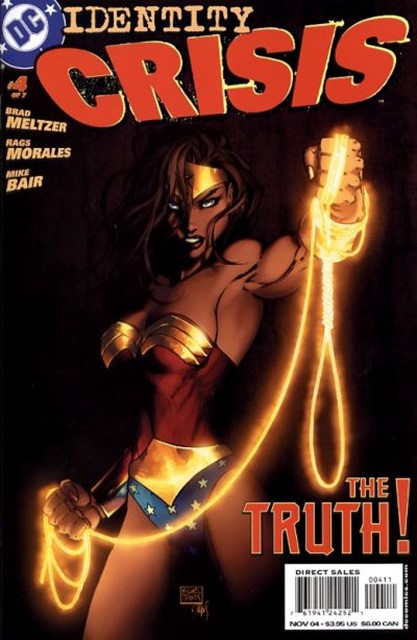
As you can expect from any major DC Comics crossover event, members of DC’s Big Three are strongly featured throughout Identity Crisis.  While Wonder Woman only has a few intriguing scenes, in which you get to see both her ferocity and her kindness, there is much more of a focus on Superman and Batman.  Superman gets some great sequences throughout Identity Crisis, especially as the creative team sinisterly focus on his family and friends, all of whom are potential targets.  Watching Superman slowly get frustrated with the investigation, especially when Lois is threatened, helps to enhance the seriousness of the story, and he has some powerful moments here.  I did appreciate the way in which Meltzer attempted to paint the big blue Boy Scout in a darker light, as it is revealed that even the supposedly righteous Superman is not as innocent as you’d believe.  It is subtly implied that Superman always knew what the inner League was up to (yay for super hearing), and chose to ignore it for convenience.  This brilliant and dark suggestion that even Superman isn’t infallible is a pretty weighty one that  helps to enhance the weight and power of Identity Crisis’s narrative.

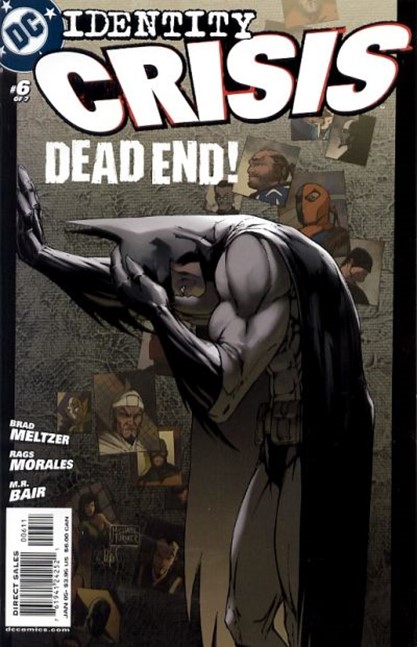
Batman is a lot more involved in the story and leads his own investigation into who is behind the killing.  Even though he does not actually appear until halfway through the comic, he is a heavy presence throughout Identity Crisis, both because of his brusque, loner ways of trying to solve the crime, but because of the dark shadows of the past.  There are multiple moments that revisit his childhood and the death of his parents, which parallels some of the other losses in Identity Crisis, and you get to see the human side of grief impacting this usually stoic character.  Batman’s storyline gets even more intense when it is revealed that part of his memory was erased by his fellow Leaguers to cover up their actions surrounding Dr Light, which is a very haunting inclusion.  Meltzer makes this even more intriguing by having Green Arrow suggest, mostly out of guilt, that Batman likely has done something similar in the past, while also acknowledging that he has likely already deduced that his memories were erased.  This really makes you consider Batman’s relationship with the rest of his heroes, and it certainly has a big impact on future Batman storylines.

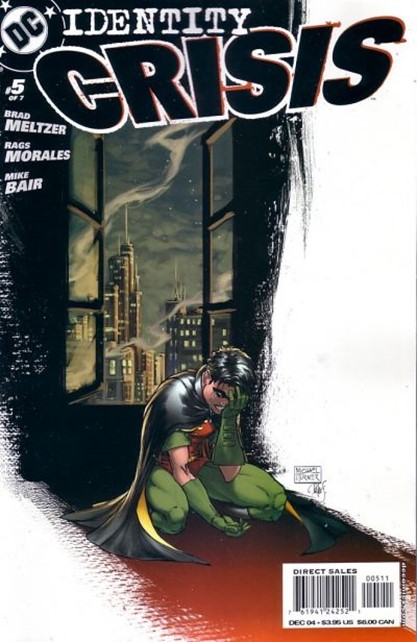
The Batman impact on this story is also felt through the great focus on the current Robin, Tim Drake, who plays a surprisingly big role in the events of Identity Crisis.  At the start of the comic, Tim is one of the few members of the Bat-family who still has a father, which puts him at odds with Batman and the Robin predecessors.  As his father has only just discovered his dual identity as Robin, he becomes one of the more interesting protagonists, as the comic explores the stress of the superhero lifestyle on family.  Tim’s storyline ends up being extremely tragic when his father is murdered.  Watching Robin talk to his father over the phone as he’s about to die is just damn horrific, and your heart can’t help but break during that epically drawn-out scene where he and Batman arrive too late.  The subsequent parallel between him, Bruce Wayne and previous Robin Dick Grayson during this moment is particularly poignant, and it results in a whole new chapter of this amazing incarnation of Robin.

Identity Crisis #6

While there are a few other interestingly featured heroes in Identity Crisis, I’m going to start talking about the villains, as many of them have a brilliant role in this comic.  Thanks to Meltzer’s fantastic writing, Identity Crisis proves to be just as much about the villains as the heroes, as many of them are deeply impacted by the events disclosed here.  While I won’t reveal the identity of the killer here (I’m keeping some spoilers locked up), I will say that their motivations are pretty fascinating and provide a compelling insight into the super lifestyle.  The rest of the villains in Identity Crisis are fair game for discussion, though, and I deeply loved the creative team’s excellent examination of them.

Easily the villain I need to talk about the most is Dr Light, an old school Justice League villain who had not been really utilised in recent years.  Mostly known before this comic as the Teen Titans’ punching bag, Meltzer completely revitalised the character in Identity Crisis and, with a stroke, turned him onto one of the most deranged and dangerous figures in the entire universe.  It is revealed throughout the comic that Dr Light used to be an extremely powerful villain, but after invading an empty Watch Tower and raping Sue Dibny, the League brutally took him down, erased his memory of the event and then magically lobotomised him.  This resulted in him becoming the moronic and weakened villain who was routinely taken down by the teenage heroes and other embarrassing foes.  This entire reveal is pretty damn epic and horrifying at the same time.  Not only does Dr Light seem excessively evil and deranged in the flashback scenes, but the shocking revelations of his actions immediately make you hate him.  Meltzer’s explanation for why he turned into such as pathetic creature (aside from the real reason of capricious authors) really hits home hard, and even though Dr Light is a terrible person, you can’t believe that members of the Justice League went so far.  The subsequent scenes where Dr Light regains his memories and his powers feature some of the best artwork in the comic, and while he doesn’t do much here, the scenes with him brooding and plotting hit at his returned and future malevolence.  I deeply appreciated how much Meltzer was able to morph this villain, and while the reliance on rape for antagonist purposes is a bit low, he succeeded in making him a very hateful and despicable figure.

Aside from the killer and Dr Light, several other villains hold interesting and significant roles in Identity Crisis, and I deeply enjoyed how they were portrayed.  This includes Green Arrow villain Meryln, who serves as an interesting shadow to Oliver Queen throughout the comic (more so than usual).  While Green Arrow provides the superhero community’s viewpoint on events, Merlyn’s narration examines the supervillain community and their various reactions.  I loved his fun insights into his fellow villains, and he ends up being an interesting inclusion to the cast.  The same can be said for the Calculator, a formerly silly figure who has turned himself into a non-costumed villain who acts as an anti-Oracle, providing the villain community with tech support and intelligence by charging them $1,000 per question.  I loved this interesting revamp of this minor character, especially as this suave, behind-the-scenes information broker became his default look for years.  Calculator’s conversations and business dealings offer some compelling insights into the superhero community, and I loved the occasional jokes about his old costume.  Meltzer also makes exceptional use of one of my favourite villains, Deathstroke, who once again shows why he is the DC universe’s ultimate badass.  Hired by Dr Light to protect himself from the League, Deathstroke takes on an entire team of heroes single handily and essentially spanks them.  I love how the creative team not only showcase his insane physical abilities, but also his tactical knowhow, as he expertly takes down major heroes in brilliant ways (he takes down the Atom and Hawkman with a laser pointer, true story).  His scene in the centre of the comic is the best action sequence in Identity Crisis, and it perfectly showcased this awesome villain (seriously, give this man a movie), while also hinting at some future grudges.

Identity Crisis #7

The final character I want to talk about is the lecherous and always entertaining Captain Boomerang, who has a major role in the plot.  I absolutely loved the exceptional story that Meltzer wrote around this infamous villain, and it is easily one of his most defining depictions.  Captain Boomerang has always been shown as a bit of a joke, but this comic shows him as a fat, washed up has-been, who leaches off his fellow villains and is generally looked down upon by them.  However, he gets a very intense and emotional story in this comic, as he meets his long-lost son and starts to develop a relationship with him.  The father/son moments add a rather interesting and nice edge to the main story and seem slightly disconnected from the rest of the plot.  That is until the final killing, when it is revealed that Captain Boomerang has arrived to kill Robin’s father.  The implied suggestion that Captain Boomerang of all people might be behind the killings is pretty iconic, and I loved the split panels that contrast his phone call to his son with the phone conversation between Robin and his father.  The subsequent results of the attack, as well as the reveals in the aftermath are pretty awesome, and I really appreciated the fun second chance that Meltzer and the artistic team gave to this iconic, old-school villain.

While I have gone a lot about story elements and characters, I also really need to highlight the incredible artwork featured in Identity Crisis.  The artistic team of Rags Morales and Michael Bair did an outstanding job in this limited series, producing some of the absolute best artwork from this era of DC Comics which perfectly enhances Meltzer’s epic storytelling.  There are so many impressive and memorable artistic moments and sequences throughout Identity Crisis, and I loved the various ways in which the artists convey movement, action, and emotion in their detailed and captivating panels.  There are so many brilliant action sequences in this comic, with my favourite being the Deathstroke vs Justice League fight I mentioned above, although a few others are also very cool to see.  I also loved the character designs featured throughout Identity Crisis, especially as the creative team took the opportunity to seriously reinvent several heroes and villains.  The streamlined look of the Calculator is particularly fun, and I also loved the balding and fat version of Captain Boomerang.  While I didn’t love how a couple of characters looked (what was with the hair on Connor Hawke?), most of it was pretty exceptional, and I love how it was later reutilised by other artists.

There are multiple truly brilliant and eye-catching artistic highlights of Identity Crisis that I must highlight, including the massive and powerful funeral sequence that takes place in the early part of the series.  There is an incredibly elaborate double-page public funeral spread that shows every single emotional superhero in attendance, with the various heroes organised by team or connection to the grieving family.  The use of the multiple heroes and associates is pretty awesome, especially as there are a range of character-appropriate reactions, and I loved seeing the whole costume crowd surrounded by members of the press and public as they mourn.  You also get also some excellent and heartfelt sequences in the subsequent scenes which show the eulogies, especially when Elongated Man starts to literally deteriorate due to his grief, which is just so powerful.  Other great examples of the artist’s work include the fun flashback scenes that allowed them to draw events in various classic comic styles, that offer a little bit of simplicity compared to the darker modern spread.

I particularly loved some of the brilliant sequences that are set around Dr Light, as not only do you see him at his most dangerous in the past but you also have some outstanding scenes when he regains his memories and powers.  The excellent parallels between the Justice League’s takedown of Dr Light and their attack on Deathstroke are incredible, and the subsequent massive panel of blinding light around Dr Light’s face is perfection.  However, the absolute best-drawn sequence in Identity Crisis must be the panels leading up to the death of Robin’s father.  Watching the insane amount of emotion on Batman and Robin as they realise that Robin’s father is about to die is so damn moving, especially the anguish on Robin.  The most moving of these panels is the one that focuses on Batman’s face after Robin begs his mentor to save his father.  The look of pure dread, fear and despair on Batman’s face takes my breath away every single time I look at it, and it perfectly conveys all of Batman’s repressed feelings as he realises that history is once again going to repeat itself.  While there are some other great scenes, the above are easily the cream of the artistic crop and definitely make this comic stand out.  I have so much love for the artistic work of Morales and Bair here, and it markedly enhances the already exceptional story, turning Identity Crisis into a true epic classic.

Well, that’s pretty much everything I have to say about Identity Crisis here.  As you can no doubt guess from the excessive way I have waffled on, I have a lot of love for this exceptional comic and I’m not afraid to show it.  The brilliant creative team behind Identity Crisis did an incredible job with this comic and they really turned out something special.  Perfectly bringing together a deep and clever story with impressive artwork, amazing characters, and so much damn emotion, this comic has something for everyone and is so very highly recommended.  I deeply enjoy everything about Identity Crisis, especially how it leads to some other epic comic books (the continuation of the mindwipe stuff in Justice League of America, Green Arrow, Teen Titans and more is particularly good).  One of the most distinctive and amazing comics ever and a must read for all DC Comics fans.

Amazon     Book Depository

Throwback Thursday: Usagi Yojimbo: Volume 14: Demon Mask by Stan Sakai

Usagi Yojimbo - Demon Mask Cover

Publisher: Dark Horse Comics (Paperback – March 2001)

Series: Usagi Yojimbo – Book 14

Length: 224 pages

My Rating: 5 out of 5 stars

Amazon

Welcome back to my Throwback Thursday series, where I republish old reviews, review books I have read before or review older books I have only just had a chance to read.  In this latest Throwback Thursday I once again dive into the awesome and elaborate world of Usagi Yojimbo as I check out the 14th epic volume, Demon Mask.

It feels good to be on a Usagi Yojimbo review streak here at The Unseen Library, and I have been having a lot of fun diving into some of the awesome middle volumes of one of my absolute favourite comic series.  My last two Throwback Thursday reviews of the 12th Usagi Yojimbo volume, Grasscutter, and the 13th volume, Grey Shadows, were really fun to pull together, and I really had no choice but to also have a look at the 14th volume this week with Demon Mask.

Usagi #31

Demon Mask is another excellent addition to the Usagi Yojimbo series that unsurprisingly gets a full five-star rating from me.  Exclusively written and drawn by Stan Sakai, this impressive entry once again follows the rabbit ronin Miyamoto Usagi as he continues his action-packed adventures through the anthropomorphic animal filled version of feudal Japan this series is set in.  Containing issues #31-38 of the Dark Horse Comics run on the series, as well as a few additional issues from associated magazines, Demon Mask continues the trend of featuring several shorter stories, while also leading back towards the next volume, Grasscutter II, which will contain a big crossover story.  I deeply enjoyed all the cool stories in this volume, and there are some real classics here.

The first story contained within Demon Mask is the entertaining and elaborate tale, The Inn on Moon Shadow Hill.  In this story, a travelling Usagi comes across a mysterious inn surrounded by strange sights and an unusual group of patrons.  The land surrounding the inn is apparently haunted, filled with all manner of monsters, demons and obakemono (haunts), which attracts many wealthy individuals to the safe inn to watch.  However, Usagi is soon drawn into a hefty wager with an arrogant merchant and must travel outside the inn to encounter the haunts and the forces behind them.

This is quite an amusing story that perfectly combines Sakai’s fantastic humour with his love of classic Japanese monsters and haunts.  The entire story comes together really well, first introducing the situation, and then forcing Usagi outside to face the ghosts after making a bet.  The subsequent reveal of the various monsters and creatures is pretty spectacular, and Sakai goes out of his way to include as many uniquely Japanese legendary creatures as possible, especially in one breathtaking and elaborate panel.  I really enjoyed the fun twist that occurred here, especially as it allowed Usagi to win his bet with the merchant, and his over-the-top explanation of what he experienced was pretty damn amusing with all the exaggerated facial expressions and reactions from Usagi and his audience.  This ends on a very satisfying and entertaining note, and The Inn on Moon Shadow Hill ended up being a fantastic and light-hearted start to the entire volume.

Usagi #32

Following on from the first fun story is the touching tale, A Life of Mush.  In this story Usagi encounters a brash peasant boy, Eizo, who wishes to become a warrior to avoid the farmer’s simple lifestyle (a life of eating mush).  However, Eizo soon grows tired of Usagi’s honourable warrior philosophy and attempts to befriend a group of bandits, only to discover that there is more to life and battle than brashness and toughness.  This was a great shorter story that presents an interesting outside perspective on the life of a warrior in this setting.  I liked the comparison between a child’s view of a warrior to Usagi’s intense dedication and spiritual thoughts, which in fairness, does seem a little more boring.  The subsequent events provide a fantastic lesson on perception and life choices, as Eizo and the bandits he encounters discover just how tough a true warrior like Usagi can be.  A compelling and thoughtful addition to the volume, A Life of Mush was a powerful and clever read.

The next story is a shorter entry, Deserters, which brings us back to the iconic Neko Ninja and their leader, Chizu.  Deserters examines a tragic tale of two Neko Ninja, Take and Saruko, who attempt to leave the Neko Ninja and start a new life together.  Captured by their fellows, they are taken before Chizu for trial, and must soon face the treachery and manipulation of Chizu’s ambitious second in command, Kagemaru.  This was another excellent shorter entry in Demon Mask, especially as it combines some quick, but efficient, character introductions, with some inherent tragedy and betrayal.  The result of the story, while a little predictable, ends up being very moving, and you can’t help but feel for the star-crossed lovers.  I also really like how this shorter entry turns out to be an interesting bridging story between several of the plot lines in the 11th volume, Seasons, and some of the big storylines in the next few volumes.  A surprisingly important and powerful story, Deserters is a great read that adds a lot to the overall volume.

Usagi #33

Up next, we have the rather entertaining and fun story, A Potter’s Tale, which makes great use of amusing coincidences to create a fantastic and hilarious story.  A Potter’s Tale sees the notorious thief, Samo, steal a precious jewel from a wealthy merchant and have to stash it.  Choosing an unfired pot in a small pottery shop, Samo makes the vessel distinctive before he is brought in for questioning.  Unfortunately, Usagi is staying with the same family of potters and chaos ensues when Usagi and his friends take a liking to Samo’s inadvertent innovation.

This is a great story that always gets a good laugh out of me when I read it.  While a rather quick story, Sakai manages to achieve a lot with it, setting up the base of the humour quickly and ensuring that the reader becomes invested with both the potters and the caddish thief.  The subsequent fantastic use of surprises, reveals and coincidences results in some amusing scenes, especially when the unlucky thief discovers that he must give up all his ill-gotten loot to fix his mistake.  The reveal that all his endeavours are for naught and his loot has returned to its original owner, in a roundabout way, is pretty entertaining, as is the ironic comeuppance he gets for his actions.  Sakai makes sure to enhance this story by featuring a compelling look at traditional Japanese pottery making (I love it when he examines authentic Japanese industries or art forms), and there are some beautiful sequences drawn as a result.  Easily one of the most entertaining stories in this volume, I deeply enjoyed A Potter’s Tale, and it is always guaranteed to crack me up.

Usagi #34

Sakai follows this funny story with another shorter entry, The Missive, which sees Nakamura Koji’s request for a duel reach Usagi’s master, Katsuichi.  Reflecting on the matter of honour brought before him, Katsuichi remembers a moment from Usagi’s childhood and the lessons it contains.  This was another quick but excellent entry from Sakai, which once again highlights how much he can do with only a few short pages.  Not only do we get an excellent bridging storyline between a good entry in the 11th volume, Seasons, and another future volume, but you also get an interesting reveal about a major supporting character.  Throw in an amusing childhood tale about a young Usagi, and you have an entertaining and unique entry that helps to break up the flow of the overall volume.

Now we get to the main event of the volume, with the three-issue story, The Mystery of the Demon Mask.  After receiving a dire warning about his future, Usagi ventures into a new town, only to witness a deadly duel between a fellow ronin and a mysterious opponent wearing a demon mask.  Encountering the police, including the venerable Inspector Kojo, Usagi soon learns that the killer, known as Demon Mask, has been targeting and killing ronin around town.  Helping with the investigation, Usagi encounters all manner of potential suspects as he also finds himself firmly in Demon Mask’s sites.

Usagi #35

The Mystery of the Demon Mask is probably the best story in the entire volume, and Sakai has put a lot of effort into developing a powerful and elaborate murder mystery storyline in this unique Japanese setting.  The entire story has a great flow to it, quickly introducing the villain, the murderous Demon Mask, and then introducing Usagi to the various players involved in the investigation.  From there Usagi is thrust into several dangerous situations as Demon Mask stalks him and other masterless samurai around the town.  There are several complex and intriguing characters introduced during this story, each of whom is a potential suspect.  This story ends on a big finale, with Demon Mask exposed as he faces off against Usagi in a deadly duel.  Sakai does a brilliant job of revealing who the killer is, and I really appreciated the various subtle clues scattered throughout the story to set this up.  This ended up being quite a fantastic murder mystery story that works extremely well despite the limitations of the shorter comic form.  The motivations behind the killer are pretty heartbreaking, and I really appreciated Sakai’s portrayal of their madness and grief.  There is an excellent focus on fighting and duels throughout this story, especially as Demon Mask engages several skilled samurai in personal combat, and I loved seeing all these fights unfold.  An excellent entry that has a brilliant balance of mystery, complex characters, classic Japanese elements and comic book action.

Following on from this awesome murder mystery story, we have another intriguing dive into Japanese mythology and monsters with the spooky story, Kumo.  In this story, Usagi, who is eager to reach his friends, takes a shortcut across the mountains and finds himself in an isolated village, surrounded by an unusual number of spiders and an insane amount of webbing.  When the innkeeper’s daughter is kidnapped in an improbable attack, it becomes apparent that something more is haunting the village, and that Usagi’s only hope might be another traveller in town, Sasuke.

Usagi #36

This was another particularly good entry in Demon Mask; I always love Sakai’s more supernatural narratives.  The story premise is somewhat typical, with Usagi arriving in a troubled town that needs his help, this time in defeating the monsters haunting them.  The subsequent conflict with this threat gets pretty wild, not just because of the cool monster (in this case a Spider Goblin and her giant spider minions), but also because it introduces the intriguing side character of Sasuke.  Sasuke, also known as The Demon Queller, is a mystical monster hunter who travels around Japan taking down supernatural threats (no doubt with Kansas blaring in the background).  Sasuke goes on to become a major recurring character within this series, having most recently appeared in the 34th volume, Bunraku and Other Stories (where he does some cool Demon Slayer-esque sword fighting).  However, he gets a very awesome introduction here in Kumo, with Sakai perfectly setting up the character’s mystique, as well as his powerful magical abilities.  This story literally sees Sasuke summon up a giant frog to fight a Spider Goblin, which has so many levels of awesome to it, and I loved seeing the magic on monster fight that ensures.  Another fantastic story that makes excellent use of Japan’s rich spiritual and mythological past, I always have an outstanding time reading Kumo.

The final major story in this volume is the intriguing tale, Reunion.  Usagi returns to the monastery of his friend, priest Sanshobo, only to discover it under attack by brigands, apparently after a rich merchant sheltering inside.  Working with Sanshobo and a recovered Gen, Usagi must find a way to overcome the brigand horde and save the monastery from attack.  However, the real threat may already be inside the walls, and soon Usagi, Sanshobo and Gen must overcome a dangerous enemy determined to take the most precious treasure, the legendary sword Grasscutter.

Usagi #37

Reunion was another fun entry which ended the main Demon Mask stories on a compelling and interesting note.  While a distinctive story itself, Reunion is primarily focused on setting up the events of the following major volume, Grasscutter II.  This presents a fun scenario where Sanshobo’s temple is attacked (again, it honesty gets attacked a lot), while the real danger remains inside the wall.  There are several fun parts to this story, from Usagi’s attempted infiltration of the gang, the many fight scenes against to the bandits, to the dangerous confrontation against the disguised adversaries within the temple.  This proved to be an excellent story, and it was great to see Sanshobo and Gen again, especially as they prepare for their next epic adventure.

While Reunion concludes the main stories, this volume also has a couple of shorter stories that were contained in other publications, such as Dark Horse Presents (vol. 1) #140, Dark Horse Presents Annual #3, Wizard Magazine #3, Oni Double Feature #11, and Dark Horse Extra #20-23.  These short stories provide a couple of quick, highly amusing tales which leave the reader smiling as they close the volume.  Sakai achieves a lot in these shorter stories, and each has an entertaining or moving story, even if they only last for only a page.  The most detailed of these was the entertaining Death and Taxes, which sees Usagi fighting bandits for a conniving and amusingly clever peasant.  There is also the sweet little story, A Funny Thing Happened on the Way to the Tournament, which shows a young Usagi meeting his future friend (and love interest) Tomoe Ame when they were children.  The short but powerful Netsuke sees Usagi reflect on a former comrade, while The Leaping Ninja has a hilarious one-page tale about an acrobatic infiltrator who leaps before he looks.  The final story was the intense Tsuru, which sees Usagi encounter a member of the Koroshi assassins with a love for paper cranes, who has a contract out on Usagi, resulting in a fantastic duel.  Despite their length, each of these stories features all of Sakai’s usual attention to detail and excellent story writing, and it was great to see these excellent examples of the creators shorter writing style.

Usagi #38

I must once again highlight all the incredible artwork featured in this impressive volume, as Sakai continues to showcase all his amazing artistic talent.  Pretty much every panel in this volume is filled with some excellent and powerful art, as Sakai tells his complex tales.  There is the usual brilliant focus on Japanese landscapes and towns, and Sakai has such a talent for capturing all the elaborate cultural elements of the period, as well as the beautiful locations that dotted Japan.  While all the art is really well drawn in this volume, I definitely have to highlight a few panels in particular.  The first story, The Inn on Moon Shadow Hill, has so many great drawings of creatures and haunts from Japanese folklore, and there is one brilliant panel were all of them are they facing Usagi at once.  The spider goblin and her minions in Kumo are also very cool and spooky, and the various scenes where they fight a samurai like Usagi and the magical Sasuke are pretty extraordinary.  I also loved the awesome character design on the antagonist Demon Mask from the main story.  Not only does it bear an interesting similarity to Usagi’s main foe, Jai (who himself is based on a character with distinctive mask), but it looks so dangerous and intimidating, especially when they silently engage in battle.  I deeply enjoyed the exceptional artwork in Demon Mask, and Sakai has once again shown how much feeling and emotion he can portray with his brush and ink.

Another week, another epic and incredible Usagi Yojimbo volume reviewed on my blog.  The 14th volume of this outstanding series, Demon Mask, was another awesome comic as Stan Sakai provides his usual blend of impressive writing, stunning artwork, and powerful characters.  Featuring several memorable and exciting short stories, Demon Mask serves as an excellent and wonderful entry in this wider series, and it is one that I always look forward to reading.  A highly recommended read, Sakai really can do no wrong with this exceptional series.

Amazon

Unforgiven by Sarah Barrie

Unforgiven Cover

Publisher: HQ (Trade Paperback – 1 December 2021)

Series: Standalone/Book One

Length: 480 pages

My Rating: 5 out of 5 stars

Amazon

Talented Australian author Sarah Barrie presents one of the darkest and best Australian thriller novels of 2021 with Unforgiven, a powerful and captivating read that sets determined protagonists against the very worst of human monsters.

Years ago, the city of Sydney was haunted by a terrible paedophile and murderer known as the Spider, who kidnapped, molested and killed young girls, all on camera.  His reign of terror was ended suddenly one violent night thanks to two women, a determined rookie police officer, Rachael Langley, and one of the Spider’s young victims, Lexi Winter, who disappeared never to be seen again.

Now, after years of living on the street, Lexi has grown up tough and hard, determined to escape the tortures of her childhood through alcohol while trying to reconnect with the sister she was forced to leave behind.  However, Lexi is still obsessed with taking down monsters, and with her impressive hacking skills she spends her days tracking paedophiles, entrapping them, and ensuring they are captured by the police.  However, when her latest target proves to be particularly illusive online, she makes a fateful decision to break into his house, only to witness him being murdered.

At the same time, Rachael Langley is now a successful detective inspector, solving some of the toughest crimes in Sydney.  Still lauded for her role in stopping the Spider, Rachael lives in regret for being unable to save Lexi all those years before.  However, everything changes when a man calls her, claiming to be the real Spider and providing proof by horrifically murdering another child on camera.  Quickly establishing a police taskforce, Rachael and her team must determine if the killer is a copycat or whether Rachael captured the wrong man all those years ago.  To solve this case Rachael is going to need help from the last person who wants to see her, Lexi, but can these women work together after everything they have been through?  And what happens when their killer learns that Lexi is still alive and hunting for him?

This was an intense, grim and deeply compelling Australian crime fiction read from Barrie, who has written an amazing and powerful story that proves very hard to put down.  Unforgiven was the first of Barrie’s books that I have read, although several of her other Australian crime fiction novels are quite intriguing and I might try and read them at some point after being so captivated by this epic and moving read.  This was such an addictive novel that it gets a full five-star rating from me.

Barrie has come up with a very impressive and intense narrative for Unforgiven that sees several damaged characters dragged into the web of a dangerous and clever criminal.  The story has a great start that showcases the lives of the main protagonists, Lexi, Rachael and Rachael’s nephew and fellow police officer Finn, as well as giving some hints at the events of the original Spider case that so deeply impacted the female main characters.  After this quick set-up, the story advances in all its dark and powerful glory, as two fascinating plot lines develop.  Lexi, who has become an online vigilante hunting paedophiles on the dark web, finds herself caught up in a brutal murder when one of her targets is murdered by a mysterious figure while she is sneaking into his house.  Most of her early story involves her continued attempt to hunt paedophiles while also trying to find a way to hide the body of the murdered man, for which she gains some help from an interesting source.  At the same time, Rachael and Finn become involved in a brutal case when the man claiming to be the real Spider calls Rachael and leads them to murdered young girl, forcing them to once again dive into the unsettling world of paedophiles.

Both storylines advance at a quick and compelling pace, with each of the main protagonists facing massive challenges as they attempt to achieve their objectives.  I liked this initial separation of the storyline, and the two plotlines work well together in tandem, with the reader getting pretty caught up in both narrative threads.  At the same time, the author drip-feeds in bits and pieces of Lexi and Rachael’s pasts, especially the events that led up to the arrest of the Spider and the disappearance of Lexi.  This deepens the audiences’ connections to the two protagonists so that when their storylines inevitably connect it really enhances the impact of the scene.  Unforgiven shifts into high gear once these plotlines are joined, with all three protagonists working towards the same goals, although Lexi maintains her secrets.  Barrie starts throwing in some real curveballs here, providing a complex and intriguing case that throws the protagonists through the emotional wringer as they get closer to the big and powerful conclusion of the novel.  There are some great twists in the last half of the book and while I saw a couple of things coming, there were some fantastic surprises that really threw me.  This ends up being an outstanding and complex story, and the readers will be left wanting more, especially as Barrie leaves it open for a sequel, which I really hope she does.

While I deeply enjoyed the captivating and intense story contained within Unforgiven, this was a bit of a hard novel to read at times due to its very, very dark content.  Unforgiven focuses on the hunt for a murderous paedophile and his child exploiting friends, which inevitably leads to some depictions of the terrible acts they commit, not only to children in the current storyline, but to the protagonist Lexi back in her childhood.  Barrie really does not pull any punches here, and the book contains some very dark and grim moments that really stick in the mind.  These powerful and shocking scenes really raised the stakes of the book and ensured that the reader becomes extremely invested in seeing the protagonists achieve justice through their actions.  While I really appreciated that Barrie was trying to raise awareness and showcase just how evil some people can be, I will admit that some of these scenes did get to be a bit much at times, forcing me to stop and put the book down.  Readers are warned that Unforgiven has very strong themes of violence and abuse against children and young people.  However, if you can get past that, it is worth it, as Barrie does an excellent job telling this rough story about true human evil.

Unforgiven’s already brilliant and powerful narrative is enhanced by the impressively written and complex central characters contained within.  Barrie has gone out of her way to introduce several very damaged and compelling protagonists, each of whom add so much to the overall plot thanks to their excellent backstories and substantial development.  The most prominent and interesting of these characters are the two female leads of the book, Lexi Winter and Detective Inspector Rachael Langley, whose lives became irreparably entangled all those years ago.  These two characters serve as two of the three main point-of-view characters, with most of the story told from their perspectives.

Lexi was a great character, and I was deeply impressed with the amount of work that Barrie put into her complex and damaging past, as well as her distinctive current personality.  There were so many interesting aspects to Lexi, who immediately stands out as a protagonist thanks to her damaged personality, strong sense of deduction and observation, her badass ability with a computer and the fact that she is the only character whose chapters are told in the first person.  I loved the intriguing contradictions in her life as Lexi makes a living as an escort while devoting most of her personal life to being an online vigilante/hacker extraordinaire who specialises in taking paedophiles down.  This makes for such a distinctive character, especially once you figure in all the major impacts of her childhood that has left her such an emotional mess.  Barrie does a good job of slowly revealing all the horrors of her early life, and while some of the scenes are pretty brutal, it is amazing to see everything that the character has risen above to still be such a strong figure.  The reader swiftly gets attached to Lexi as a protagonist and it will be fascinating to see what happens to her next if Barrie decides to turn this into a series.

The other central character that I must talk about is Rachael, the veteran detective inspector whose career was built off the success of the Spider case.  Rachael is a great police protagonist, a confident, intelligent and strong figure who is able to keep most of her people in line and pursue a vigorous investigation.  However, Barrie builds in several great aspects to her character that really impact this protagonist throughout the course of Unforgiven.  Firstly, there is the guilt that Rachael still feels over her past with Lexi, especially as Rachael failed her in a way which is slowly revealed over the course of the book, especially once the two reunite and have an awkward relationship.  The other aspect is the doubt that slowly creeps into Rachael as the case proceeds, especially as the possibility that the original person convicted in the Spider case might be innocent.  This doubt, coupled with the guilt over the fact that she could be responsible for the latest deaths by not actually catching the real Spider, starts to impact her throughout the book and proves to be an intriguing motivator for some of her decisions.  These complex aspects really helped enhance the emotional power of Unforgiven and I really appreciated the intense storyline that Barrie wrote about people living in the past and accepting one’s mistakes.  I really enjoyed seeing both Lexi and Rachael in this novel, and they had some great storylines in this book.

Aside from Lexi and Rachael, there are several other great characters in Unforgiven I should mention.  The most prominent of these must be Detective Senior Sergeant Finn Carson, Rachael’s nephew and second-in-command of the investigation, who ends up being the third major point-of-view character.  Finn was an excellent male police character who serves as an interesting counterpoint to the two female protagonists.  While not as damaged as the other two, Finn has his own issues, and his viewpoint really added to the overall quality of the book.  I was also a big fan of Lexi’s neighbour Dawny, an eccentric older woman who assists Lexi in several matters, including disposing of a body (what are good neighbours for?).  Dawny was one of the funniest characters in the book and it was great to see the protagonists be completely baffled by her knowledge and ability to come up with effective solutions to problems while maintaining the batty old lady routine.  I quite liked the eventual reveal of who Dawny really was, as it fit in well with the other characters in the book, and it will be fun to see if Barrie brings her back at some point in the future.  Finally, I definitely need to highlight the villain of the book, the Spider, who is one of the most despicable fictional antagonists I have seen: a sordid child abuser and murderer who films their grisly crimes.  You quickly feel a lot of hate towards this character, even if you don’t know who they are for most of the story.  The eventual reveal and the various twists around them were quite clever and I had an amazing, if disturbing, time finding out who this monster was.  An overall exceptional character driven novel, you will quickly find yourself getting stuck following all these fascinating and compelling figures.

Unforgiven by Sarah Barrie is an outstanding and impressive read that takes the reader of a gritty and vicious ride.  Filled with a disturbing narrative and some brilliantly damaged central characters, Unforgiven is an utterly captivating read that is near impossible to put down or forget about.  Easily one of the best Australian thrillers of 2021, Unforgiven comes highly recommended and I am extremely excited to see what other incredible novels Barrie comes up with in the future.

Amazon

Billy Summers by Stephen King

Billy Summer Cover

Publisher: Hodder & Stoughton (Trade Paperback – 3 August 2021)

Series: Standalone

Length: 433 pages

My Rating: 5 out of 5 stars

Amazon

Stephen King returns with another exceptional read, Billy Summers, an awesome and memorable character driven thriller that has proved to be one of the best books of the year so far.

2021 has been quite an amazing year for Stephen King, who has released two outstanding and impressive novels in a short period of time.  His first book of 2021 was the interesting horror novel, Later, which followed a child who can see and talk to the recently deceased.  While I have not had a lot of experience reading Stephen King novels in the past, I really got into Later due to its likeable characters and thrilling narrative, and it ended up being one of the best audiobooks I listened to in the first part of 2021.  Due to how much I liked Later, I made sure to keep an eye out for any additional Stephen King releases, and I was extremely intrigued to see that he had a second book coming out with a great-sounding plot.  As a result, this second novel, Billy Summers, was one of my most anticipated reads for the second half of the year, and I was excited when I received my copy, especially as it contained a really cool story.

Billy Summers is an assassin and gun for hire.  A maestro with a sniper rifle and a master of elaborate escapes, there are few killers better than him.  However, for all his skills, Billy has one unusual quirk: he has a conscience and a moral code which limits him to only taking out contracts on targets he considers to be bad guys.  After a lifetime of killing, as both an assassin and a soldier, Billy wants out, and he is willing to take one final job to retire.  Luckily, his employer has a job that fits all his criteria.

Taken to the small city of Red Bluff on the East Coast of America, Billy is hired to kill a notorious gangster and killer who is currently locked up in Los Angeles but due to be extradited back to Red Bluff.  Billy’s boss wants the target dead the moment he arrives to stop him making a deal with the authorities ahead of his murder trial.  With a massive pay cheque on the line, Billy accepts the job, despite some odd stipulations.  As part of their plan to take out their target, Billy will need to take on the identity of an author working in the office complex overlooking the courthouse and maintain his cover for as long as it takes the extradition process to go through.

Despite misgivings about the job, Billy dives into the role as required and soon establishes himself as a regular figure in the office block.  As he waits for his target to arrive, Billy begins to get to know the people around him and takes the opportunity to write a memoir about his life and the decisions that led to him becoming a killer.  However, the closer he gets to the conclusion of the job, the more he suspects that nothing involved with this assassination is on the level, and that his bosses intend from him to die as well.  Making his own plans in case things go sideways, Billy prepares to end his career as an assassin on his own terms.  But then he meets Alice, and everything changes.

Well damn, how the hell does King do it?  After nearly 45 years of writing, you’d think the man would run out of unique and compelling ideas, but that apparently is not the case, as his latest book, Billy Summers, turned out to be quite an exceptional read.  King has produced an impressive and powerful story that follows a complex and well-established protagonist as he experiences life for the first time.  With some outstanding characters, a deeply thrilling storyline and some intriguing insights into the human condition, this was an outstanding read that was easily one of the best books I read in 2021 and which got a full five-star review from me.

Billy Summers contains a pretty addictive and powerful story that I found to be really cool.  The book is primarily told through the eyes of the titular Billy and shows him as he prepares to take on his final job.  King does a great job of introducing the character and the scenario, and you are soon placed into the midst of a very cool storyline as Billy moves into suburbia under an assumed identity to build his cover.  This results in some compelling character interactions, as Billy simultaneously prepares for his assassination mission with his employers while also getting close to some of the people he encounters and starts to see what a normal life feels like.  At the same time, he also builds up a third identity to use after the job is completed, which requires him to assume a different disguise and create some additional personal connections.  He also starts writing a personal memoir which tells a slightly altered version of his life story, including his rough childhood, his military career, and his early contract work.  This mixture of intriguing and fascinating story threads come together extremely well in the first half of the novel, and you get quite a unique and compelling narrative which perfectly blends thriller excitement with personal character growth.

After a big moment halfway through the novel, the entire storyline dramatically changes, especially as Billy is introduced to a key character, Alice.  While there is still a large amount of focus on the job from the first half of the novel and its consequences, the story noticeably morphs at this point, really diving into the relationship that develops between these two characters.  The storyline also moves away from some of the prior relationships that were introduced, and moves into a road trip, with Billy now accompanied by Alice.  There are some really good sequences in this second half of the novel, as well as a continued exploration of Billy’s past.  King does a fantastic job morphing the various story threads and plot ideas into a cohesive and captivating narrative, and I really enjoyed the powerful combinations.  The set pieces are a series of awesome action sequences, which help tie up several of the main story threads and lead up to the book’s epic conclusion.  While King is often criticised for his endings, I felt that Billy Summers had an exceptional and incredible conclusion that I deeply enjoyed.  This great conclusion is both tragic and memorable, and it ties together the entire novel extremely well, helping to turn Billy Summers into one of the best stories I have read all year.

I really enjoyed King’s writing style in this novel, especially as it focused a lot on character development and interactions between unique people.  The entire novel has a very philosophical bent to it, as King and his characters take time to explore the human experience, especially those aspects of life that people on the outside, such as BIlly, miss out on.  While you wouldn’t think that this would pair well with a thriller story about an assassin, it actually works extremely well, especially when combined with Billy’s journaling scenes, and readers are guaranteed to fall in love with this distinctive form of storytelling.  I also liked the author’s great use of various settings which help to show off the uniqueness of America’s landscapes.  King features several different locations, including suburbia, the inner city, the wide open road, the isolated Colorado mountains, and even some more famous locations, like fabulous Las Vegas.  Each location offers the reader and the characters something new to enjoy or appreciate, and King makes sure to capture both the beauty and the ugliness of these various settings.  While King does move away from some of his more extreme murder sprees in this novel, there are some dark moments in this book.  Not only are there some very graphic action sequences, but readers should also be warned about the sexual violence content, especially one scene where Billy enacts some justice.  I’m also slightly concerned that King might end up getting sued by Rupert Murdoch for a certain facsimile character who does some bad things.  Overall, though, I really enjoyed the way King told his latest unique story, and there is something for everyone in it.

As I mentioned above, I don’t have the most experience reading Stephen King novels, with only a few of his more recent reads under my belt.  Despite this, I was easily able to enjoy Billy Summers, especially as it is a standalone thriller with one-shot characters.  As a result, this is a book that any reader can easily pick up and get into, and I really liked how open the author made Billy Summers.  However, fans of King, as well as those people generally aware of his work, will probably have fun seeing the references to some of King’s previous books.  One of his more iconic works is referenced several times, especially as the protagonists end up spending time near a pivotal location.  While this is not particularly essential to the plot, it was a nice callback, and I think that most people will appreciate the fun self-homage.  I also found it interesting that both of King’s novels of 2021 had a compelling focus on writing, which becomes a key part of the plot.  While Later focused more on the publishing side of things, Billy Summers contains a fantastic examination of the difficulties of putting your ideas to paper as a writer, with the protagonist attempting to write his life story in his downtime.  While there are several fantastic advantages to the writing subplot, such as it being a great way to introduce the protagonist’s backstory in a compelling and episodic manner, I also quite enjoyed seeing the depiction of the writing process, and the various difficulties of telling a story.  It very much felt that King was pouring some of his own experiences with writing into these sections of the novel, and it was incredibly fun and insightful to see one of the world’s greatest authors depict the difficulties of writing in one of his novels.

Another area that Billy Summers excelled in is the fantastic central and supporting characters.  King does a remarkable job of introducing a diverse cast of characters, each of whom affect the character in various ways, either by showing him what his missing, or showing him what he is better than.  The most focused character is naturally the titular protagonist, Billy Summers, a brilliant contract killer who only kills bad people.  Billy is a remarkably complex figure, who builds several different personalities and personas around himself for professional reasons and protection.  I really enjoyed the intriguing portrayal of this character, mainly because you got to see at least four different versions of him in the first half of the book.  While the narrator is the calm and collected lover of classic novels who is basically a good guy, despite being an elite professional killer able to see every angle and work out the best way to kill someone and escape, that is a viewpoint that only the readers sees, at least at the start of the novel.  Billy hides this real side of himself from the rest of the world, effecting a less intellectual personality to his criminal associates, which he calls his “dumb self”, to fool them and think he’s less of a threat.

While his dumb self is usually enough to get by, his new assignment requires him to take up the identity of a struggling author who moves into a suburban neighbourhood and a local office block to focus on his upcoming bestseller.  Billy is forced to integrate into these social systems to keep his cover, and he soon makes friends amongst the people he meets, many of whom have an impact on him due to their honesty, innocence, and normality, all of which Billy has long given up.  He also builds up yet another identity to rent an additional house, which he plans to use as a safe house if the job goes wrong, which forces him to deal with additional normal people.  On top of that, he also takes the opportunity to write a memoir of his life, not only to maintain his cover but to satisfy his own curiosity about the writing process.  This proves to be a delicate balancing act, as he attempts to give an honest account of his past while also trying to keep up the charade of being dumb in case his employers read the story he writes.  This results in a unique, multifaceted character, and you get hints at the true nature of Billy, not just from the narration, but from seeing the similarities and differences between the various versions he presents to the world.

Billy’s life changes even further when he meets Alice, a woman who he meets at the very worst time of her life.  Saving her initially to maintain his cover, Billy soon finds himself drawn to protecting Alice, who has no-one and is having trouble getting over her trauma.  Billy soon works in a fantastic and touching relationship with Alice, as the two become close and help each other see the world in other ways.  Not only is Alice a great character in her own right, especially as King presents a very real and moving portrayal of a damaged and lost woman, but she also brings out the best in Billy.  While Alice does imprint on Billy due to her trauma, she also encourages him and gets him to continue writing his book.  This powerful bond they form soon becomes a central part of the book’s plot, and it is extremely fascinating and compelling to see what happens to them.  These exceptional characters and deep personalities really turn Billy Summers into an exceptional read, and I become severely invested in their story, even though I knew it was likely to end badly.

Stephen King has once again shows why he is the premier fiction author in the world today with another intense and exquisite read in Billy Summers.  Featuring a deep and captivating narrative about a complex character, Billy Summers was an absolute treat to read, and comes highly recommended.  Readers will swiftly fall in love with the unique narrative and compelling leading figures, and I guarantee that you will have trouble putting this excellent novel down.  Easily one of the best books of 2021, I cannot praise Billy Summers enough.

Billy Summers Cover 2

Amazon

The 22 Murders of Madison May by Max Barry

The 22 Murders of Madison May Cover

Publisher: Hachette Australia (Trade Paperback – 30 June 2021)

Series: Standalone

Length: 322 pages

My Rating: 4.5 out of 5 stars

Amazon     Book Depository

From the unique mind of leading Australian science fiction author Max Barry comes the fantastic and very clever alternate universe thriller, The 22 Murders of Madison May.

Madison May has been murdered and she has no idea why!

Madison, a young real-estate agent suddenly finds herself on the wrong side of a knife wielding client with zero regard for keeping his identity hidden from the police.  His final act before killing her is to profess his undying love to her.  However, Madison has never seen her murderer before in her life, at least, not in this life.

When word of Madison’s death reaches the desk of the Daily News, it falls to rising reporter Felicity Staples to follow up.  Despite a dislike for murder cases, Felicity soon finds herself wrapped up in investigating the brutal killing of the beautiful Madison May, especially as some unusual designs have been carved into the walls.  However, things take a turn for the strange when Felicity sees the suspected murderer at the subway in a dangerous confrontation with another fugitive from justice.  Moments after seeing them, Felicity can only watch in surprise as they vanish before her eyes and her universe is turned upside down.

Returning to her apartment, Felicity notices several minor changes to her life.  Her boyfriend suddenly knows how to cook, one of her cats is missing, and no-one at work remembers anything about her story or Madison May.  As strange events keep occurring, Felicity is soon forced to face the fact that she has been transported to an alternate dimension.  Reeling from the revelation, Felicity is even more stunned when a slightly different Madison May turns up murdered, the victim of the same killer.  Chasing after the mysterious people hovering around the case, Felicity discovers that a dangerous stalker is moving from dimension to dimension, determined to find the perfect Madison May to fall in love with, and killing any version he doesn’t like.  Can Felicity stop the killer before he takes out another version of Madison May, or will her forays into interdimensional travel have consequences she could never imagine?

Wow, this was a very fun and captivating read that I really enjoyed.  The 22 Murders of Madison May is the latest novel from Australian Max Barry, an author of several intriguing science fiction novels, including Providence, Jennifer Government, and Machine Man.  This was the first novel of Barry’s that I have had the opportunity to read, and I am very glad that I did, as Barry has created an outstanding and fun science fiction thriller that makes great use of some cool alternate dimension travel to produce an exquisite and awesome story.

Barry has come up with an extremely exciting and compelling narrative for this fantastic novel, which makes excellent use of its unique science fiction hook.  The novel starts off with the brutal murder of the first Madison May, which leads to the involvement of protagonist Felicity.  It does not take long for Felicity to get dragged into an alternate universe after encountering the killer and a fugitive engaged in a fight.  Forced to deal with the unusual differences in her life and the revelations of what has happened to her, Felicity attempts to save the lives of several different Madison Mays, while also avoiding the attentions of a group of interdimensional travellers who jealously guard their secrets.  What follows is a series of thrilling scenes where Felicity and her ally, Hugo, jump from alternate universe to alternate universe trying to stop the killer, with varying degrees of success.  This all eventually leads up to a fantastic and impressive conclusion where Felicity is forced to make some major, life-altering decisions, while also facing off against the monster she’s been chasing.  This proved to be an extremely captivating and fascinating novel, which honestly takes no time at all to get hooked on.  I loved the brilliant blend of psychological thriller and compelling science fiction elements, which seamlessly work together to produce an outstanding and memorable standalone story.  I powered through this book in a couple of days, and I deeply enjoyed every second I spent reading this intense and cleverly written story.

I have to say that I deeply appreciated the fascinating concept of alternate dimensions and interdimensional travel that Barry features.  Not only does the author do a good job explaining the science and philosophy behind this science fiction feature, but he also ensures that it works to full effect within the narrative.  In this book, dimensional travellers move from one reality to the next, taking over the lives of the version of themselves living in that dimension.  This results in the travelling characters awakening in a world with slight deviations from the last one they visited.  Barry features several separate dimensions within The 22 Murders of Madison May, and it was always quite fascinating to see the slight differences that occur, good and bad.  This is most prominently shown through the eyes of protagonist Felicity, who ends up visiting several alternate realities, some of which severely shake her.  However, you likewise get to see several different versions of the titular murder victim, Madison May, which results in a fascinating examination of how decisions and missed opportunities can impact your life.  It was also cool to see the various ways in which the alternate dimension travel could be manipulated, most noticeably by the book’s antagonist.  This vicious killer was constantly manipulating events to find a version of Madison May that would love him the same way that he loved her, and it was both creepy and intriguing the way in which Barry combined an alternate reality story with a tale of a fanatic serial killer.  It was very interesting to see the way the villain was able to change the course of his dimensional travels to suit his needs, such as by framing one of his pursuers for murder, and then ensuring that they only travelled to dimensions where they were locked up in prison.  I felt that Barry did a great job introducing and utilising this cool concept, and it really worked to create an epic and powerful narrative.

The author has also come up with some fun and complex characters in The 22 Murders of Madison May, who are enhanced by the fact that you get a very detailed and compelling snapshot into various versions of their lives.  The main character is Felicity Staples, a bold and clever reporter who finds her entire life upside down.  Felicity initially lives an ordinary life, with a boyfriend and two cats, while hunting for political corruption.  However, the events of this story really mess her around, as she is bounced around slightly different versions of her life.  These various involuntary jumps really have an impact on her, especially as she experiences both positive and negative changes which make her question her choices and relationships.  At the same time, she becomes obsessed with saving Madison May and stopping the killer, so much so that she constantly throws her life in danger.  The combination of these choices and the changing realities proves to be quite wearing on her, especially as she is forced to make some major sacrifices in her own life to try and save Madison’s.  This makes for quite a strong and likeable protagonist, and I deeply enjoyed seeing her intense and tragic narrative unfold completely.

I also really enjoyed supporting character Madison May.  The Madison Mays are essentially nobodies who have the very classic backstory of being a struggling actress who moved the big city and is dealing with a terrible boyfriend.  However, in one reality she was given her big break and appeared in a film in a small role.  However, this big break was a double-edged sword, as it gained the attention of a stalker, who, upon failing to meet her in his world, travelled between dimensions and started hunting her down.  Throughout the course of the book, you see multiple versions of Madison May, each of whom has a slightly different life, whether she is still struggling as an actress, on the cusp of a big break, or has given up acting altogether.  The author does a really good job of quickly and concisely setting up each of these new versions of Madison May, and you quickly get a feel for who the character is and the choices that change her.  Because she is not travelling through alternate dimensions, it is always fascinating to see the different interactions she has with her killer, as well as the reactions to the strange events occurring around her.  As a result, you get a fairly detailed examination of this character’s life, and it proves very hard not to like her and hope that she is able to overcome the latest attempts on her life.

The final character I want to focus on is the novel’s main antagonist and the killer of Madison May, Clayton Hors.  Clayton is a compelling and intense villain who starts his journey as an obsessed fan who falls in love with Madison May after seeing her in a movie in his reality and starts stalking her, eventually getting caught.  While this would usually be the end of the story, Clayton was able to obtain an item that allowed him to travel through dimensions, so he started stalking Madison in every reality he can find, assessing each version to find the perfect match to the one he fell in love with, and then attempting to make them love him in return.  This is some deeply disturbing antagonist creation here, and I really appreciate the way in which Barry amps up a dangerous and obsessed sociopath by giving them the ability to stalk their victims across the dimensions.  There are so many elements to this character which turn them into quite a memorable villain, from his unwavering determination to get what he wants, his short and violent temper, an inability to be satisfied with the girls he finds, and an obsession that can withstand constant dimensional travel.  I particularly found the descriptions of his arms, which are scarred and cracked by the various bite marks of Madison May from across the dimensions, to be a horrific masterstroke from Barry, and it was very disturbing to see versions of Madison May who attempt to bite down on his arm in self-defence to find that their teeth already match the indentations there.  Clayton was an outstanding and disturbing villain, and he really helped turn this excellent science fiction thriller into something very special and dark.

The 22 Murders of Madison May is a brilliant and distinctive science fiction thriller that I had an amazing time reading.  Australian author Max Barry has written an exceptionally clever story that perfectly combines a disturbing tale of murder and obsession, with an adventure in interdimensional travel.  I loved this awesome story, and I will have to make sure I check out some more of Max Barry’s novels in the future because I had a fantastic time getting through The 22 Murders of Madison May.  A highly recommended read.

Amazon     Book Depository

Blackout by Simon Scarrow

Blackout Cover

Publisher: Headline (Trade Paperback – 30 March 2021)

Series: Standalone/Book One

Length: 424 pages

My Rating: 4.5 out of 5 stars

Amazon     Book Depository

One of the leading authors of historical fiction, Simon Scarrow, breaks new ground in a thrilling and captivating historical murder mystery, Blackout.

Berlin, December 1939.  As the citizens of Berlin worry about a potential upcoming conflict with Britain and France, the Nazi party continues to sink their claws into every aspect of German society.  But as a bleak winter sets in and enforced blackouts plunge the city into darkness, a far more sinister threat begins to stalk the streets of Berlin.

A young woman has been found brutally murdered near a busy set of train tracks.  The victim is a former famous actress with a powerful husband.  Due to her marital connections, as well as a scandalous past with various high-ranking Nazi figures, including Goebbels, her case has dangerous political implications.  To that end, her case is assigned to Criminal Inspector Horst Schenke of the Kriminalpolizei, the Kripo, one of the few police officers not to join the party.  Due to his apparent disregard for the party and the importance of the victim, Horst is under intense pressure from the head of the Gestapo to solve this case.  However, what begins as an easy murder case swiftly devolves into something far more dangerous when a second body is found, and Horst is forced to face the reality that he is chasing a serial killer.

As the bodies of more young women are discovered, Horst rushes to find a killer before the government attempts to hush up the fact that a killer is loose within their perfect Nazi society.  But with the Gestapo interfering at every step and key suspects protected by the Abwehr, German Military Intelligence, this case proves difficult to solve.  When a survivor is found, Horst thinks this may be the opportunity to find the killer.  However, when the witness is revealed to be Jewish, Horst is forced to find a way to protect her from both the killer and the Gestapo.  Can Horst find the killer before it is too late, or will he discover that disloyalty to the Nazi government is considered a far worse crime?

This was another amazing novel from one of my absolute favourite authors.  Scarrow is best known as a Roman historical fiction author due to his long-running and impressive The Eagles of the Empire series, which I am a particular fan of (see my reviews for The Blood of Rome, Traitors of Rome, and The Emperor’s Exile).  However, Scarrow has also branched out into other historical periods with his Revolution quartet, the standalone novels The Sword and the Scimitar and Hearts of Stone, and a modern crime novel he wrote with his colleague Lee Francis, Playing with Death (which I really need to check out).  His latest book, Blackout, is an interesting change of pace from some of the previous Scarrow novels I have enjoyed, presenting a compelling murder mystery story with the dark historical setting of Nazi Germany.  Blackout, which was unfortunately delayed from last year, proved to be an excellent read, and I loved the complex and powerful story that Scarrow came up with.

Scarrow’s latest book has an outstanding narrative that starts with a Nazi social party scene quickly leading to the brutal murder.  This shocking opening in the dark of a blacked-out Berlin sets the scene for the rest of Blackout perfectly, and lets the reader know that they are in for an intense and dark tale.  The narrative then advances to the next day, with a great introduction to central protagonist Inspector Horst Schenke, who gets to showcase his deductive ability while also covering his personality and feelings about the Nazi government.  Once the case proper begins, Horst and his team are thrust into a lethal hunt for a serial killer, while also having to contend with the vicious politics and intrigue of the Nazi party.  Horst finds himself caught between the Gestapo, German Military Intelligence, and other influential Nazis, each of whom are attempting to manipulate the situation for their own ends.  This blend of mystery and dangerous political intrigue makes for a fantastic read, and I enjoyed the compelling balance that Scarrow produced.  The mystery itself is well crafted, with the author ensuring there is a complex and tangled web to unravel, with several promising suspects.  There are some very cool twists added into the plot, and I quite enjoyed the exciting conclusion and eventual reveal of the killer.  This is also a very effective standalone mystery, which would serve as a great introductory novel if Scarrow ever wanted to revisit this setting and characters in the future.  A series set around this book could go in some interesting directions, and I for one would be quite keen for that.

Easily the most captivating and fascinating part of this novel is the amazing historical setting that Scarrow used as the backdrop to his amazing mystery.  While several great mystery series have used World War II Germany as a setting before (the Bernie Gunther series by the late, great Philip Kerr comes to mind), I think that Blackout was a particularly good example of how it could be done, with Scarrow making sure that it really enhanced this already incredible story.  Scarrow skilfully works several fantastic and intriguing elements of this iconic setting into his narrative.  This includes the blacked-out winter streets and train lines of 1939 Berlin, which serve to hide the killer’s actions and ensures an easy hunting ground.  I also appreciated the air of worry and uncertainty that inhabited many of the characters as they are constantly left wondering if their country is heading towards a bigger war with Britain and France, not knowing of their government’s master plan.  There is also a certain amount of nationalism, patriotism and casual racism/anti-Semitism on the streets, which is a confronting and concerning aspect that the protagonist has to deal with.  There is also a fascinating focus on the way in which the Nazis infested all aspects of the German government and administration, particularly the police.  Inspector Horst is constantly butting heads with other members of the police force who were only promoted due to their party allegiances, rather than any skill or ability, which impacts the protagonists to successfully investigate his crime.  Add in the compelling depictions of German politics and Nazi interference that I mentioned before, and you have a very impactful and distinctive setting, which really helped to turn this crime novel into something very special.

Scarrow has a knack for creating some interesting and likeable characters, and this is certainly true for Blackout.  Inspector Horst is a fantastic protagonist, a former famous race car driver who experienced a traumatic crash several years ago.  He has since reworked himself as a talented police investigator and a rare man of honour in troubled times.  There is a lot to like about Horst, including his brilliant investigative skills, his courage in the face of danger, and his complete disregard for the Nazi leadership.  As one of the few senior police officers who has not joined the Nazi party, Horst is a bit of a black sheep amongst the ranks of his organisation, especially as he barely contains his disdain for the Nazis and what they are doing to his country.  This invariably leads him into a whole mess of trouble, which sees him in the crosshairs of the Gestapo and other Nazi figures, who seek to use his neutrality and skill for their own advantages.  I had a lot of fun following Horst throughout this novel, and it was great to see how a non-Nazi supporter would survive amongst the authoritarian ranks of German police in this period.  There are several great storylines surrounding this character, including about the trauma he is experiencing from his crash, as well as guilt at his failure to save the people closest to him.  I really enjoyed this character in Blackout, and it seems likely that Scarrow would have some very compelling storylines in place for this character if he ever revisited this series.

Aside from Horst, there are several other compelling side characters in this novel, which include a mixture of fictional characters and real historical figures.  One of the better characters is Ruth, the only apparent survivor of one of the serial killer’s attacks.  Ruth is a feisty and combative character, made so by her position as one of the few Jewish people still remaining in Berlin.  Despite being threatened by the entire German apparatus as well as a serial killer, Ruth remains strong throughout the book and is a very inspirational character to follow.  I also quite enjoyed the character of Liebwitz, a Gestapo agent assigned to Horst’s unit to spy on him and report back to the Gestapo commander.  However, Liebwitz proves to be a rather unusual Gestapo agent, more concerned with facts and analysis, rather than Nazi internal politics, and it was fascinating to see an honest and non-sociopathic member of the Gestapo.  While there is a lot of mistrust for Liebwitz in the beginning, he soon becomes a major part of the investigation, and Scarrow sets up some very interesting storylines for him.  Finally, I also quite enjoyed the killer of the story.  Several sequences in Blackout are shown from his point of view, although his identity is kept hidden towards the end of the book.  Scarrow paints an interesting picture of this killer’s mental state, and it was interesting to see his motivations run parallel to the goals of the Nazi party, which he uses to justify some of his actions, and indeed his actions are something that the Nazi leadership might approve of.  I felt that the author did a good job setting this antagonist up throughout the novel, and I rather liked the twist surrounding their eventual reveal.

Simon Scarrow continues to show why he is one of the leading authors of historical fiction with the outstanding and captivating historical murder mystery, Blackout.  Breaking into a whole new historical period and setting, Scarrow produces a fantastic and powerful murder investigation which makes amazing use of its complex characters and detailed historical setting.  Featuring all manner of twists, political intrigue and devious Nazi characters, Blackout was a compelling and intriguing read that comes highly recommended.  I cannot wait to get my next hit of Scarrow, and luckily I don’t have to be patient for long as the next Eagles of the Empire book, The Honour of Rome, is out in a few months time.

Amazon     Book Depository

Quick Review – The Chase by Candice Fox

The Chase Cover

Publisher: Bantam Press (Trade Paperback – 30 March 2021)

Series: Standalone

Length: 449 pages

My Rating: 4 out of 5 stars

Amazon     Book Depository

Australian thriller author Candice Fox returns with another fast-paced and intriguing thriller novel, this time utilising an extremely fun prison break premise to create The Chase, a compelling and addictive read.

Candice Fox is a bestselling Australian author who debuted in 2014 with Hades, the first novel in her Archer & Bennett trilogy, a fantastic Australian crime series that followed two very damaged detectives.  She then followed that up with her Crimson Lake trilogy, as well as collaborating on the Detective Harriet Blue series with James Patterson.  Since then Fox, has written a couple of standalone crime fiction novels set in America, including the 2020 release Gathering Dark, which is the only previous novel of Fox’s that I have read and which proved to be a fun and fantastic book.  As a result, I was interested in reading more of Fox’s work, especially after I saw what kind of story her new novel would feature. 

Synopsis:

When more than 600 of the world’s most violent human beings pour out from Pronghorn Correctional Facility into the Nevada Desert, the biggest manhunt in US history begins.

But for John Kradle, this is his one chance to prove his innocence, five years after the murder of his wife and child.

He just needs to stay one step ahead of the teams of law enforcement officers he knows will be chasing the escapees down.

Death Row Supervisor turned fugitive-hunter Celine Osbourne is single-minded in her mission to catch Kradle. She has very personal reasons for hating him – and she knows exactly where he’s heading . . .

I am sure that I was not the only person drawn in by The Chase’s cool plot synopsis, I mean, 600 convicts escaping from prison at the same time, who can resist that?  I really enjoyed this book’s awesome story and I ended up finishing the entirety of The Chase in just over a day.  This was mainly because The Chase had such a strong and captivating start to it, with someone using deadly blackmail to instigate a mass breakout as cover to free one unknown prisoner.  This was one of the more awesome starts to a novel that I have seen, and I really loved the initial moments of this story, with the prisoners all heading off in various directions, including protagonist John Kradle, while other protagonist Celine Osbourne is left in shambles with all her Death Row charges escaping.

Fox soon breaks this narrative up into several smaller stories; you follow Kradle as he makes his escape, you also see Osbourne dealing with the fallout of the escape, and there are short descriptions of some of the other escapees and the people that encounter them.  The main two storylines surrounding Kradle and Osbourne continue in an awesome way towards the middle of the book.  I had a great time seeing Kradle attempt to evade the police and overcome an insane killer who is tagging along with him, while also heading home to solve the murder of his wife and child.  Osbourne’s story was also very compelling, as it details some of the initial hunts for the escaped fugitives, the investigation into who was responsible for the breakout, and the start of Osbourne’s obsessive hunt for Kradle.  The various smaller stories of the other escapees prove to be fun interludes to the main narratives, and Fox also includes key flashbacks to enrich the backstory of her central protagonists and showcase the reasons for emotional and combative history with each other.

Unfortunately, I found the last half of The Chase to be somewhat of a letdown after its outstanding beginning.  Kradle’s hunt for his family’s killer soon becomes one of the least interesting parts of the entire book, especially as it has no connection with the wider breakout.  His investigation is also loaded with way too many coincidences, unusually helpful witnesses, and strange motivations.  The eventual reveal of the killer was honestly pretty weak, and Kradle’s entire storyline only concludes satisfactorily due to a serendipitous appearance from a supporting character.  I was also not amazingly impressed with the identity of the person behind the prison escape, and I think that Fox missed a few opportunities, such as maybe tying Kradle’s personal investigation into a larger conspiracy.  Still, there were some fantastic highlights in this second half of the book, including Osbourne’s gradually changing relationship with Kradle, the action-packed conclusion to Osbourne’s hunt for the organisers of the prison break, as well as the extended and entertaining storyline of one escapee who managed to make the most of their situation.  While I would have loved a couple more extended storylines about some other outrageous inmates, I think that this was an overall good narrative, and I did have a lot of fun getting to the end.

I did really enjoy several of the characters featured in this fantastic novel.  The most prominent of these is John Kradle, the Death Row inmate accused of killing his wife and son.  Kradle is a likeable character, and you are quickly drawn into his desperate hunt for the person who framed him.  Fox makes great use of several flashback sequences to explore Kradle’s past, which paints an intriguing picture of a former recluse who eventually finds love and ends up raising a son by himself.  The reader does a feel a lot of sympathy for this unusual character, and he proves to be a fun protagonist to follow.  The other major character in The Chase is the supervising prison guard of Pronghom Correctional Facility’s Death Row, Celine Osbourne.  Osbourne is a strong and independent character who becomes obsessed with hunting Kradle and dragging him back to Death Row.  I really enjoyed Osbourne as a character, especially as Fox comes up with a very traumatic and clever backstory for her that perfectly explains her obsession.  Both lead characters serve as perfect focuses for The Chase’s narrative, and I had a great time seeing how their arcs unfolded, even if one was a little weaker than the other.

Fox also made use of several great side characters throughout The Chase.  My favourite is probably street hustler Walter Keeper, better known as Keeps, the one inmate at Pronghom who did not escape, as he was due to be released.  Keeps is dragged into Osbourne’s hunt for Kradle somewhat against his will due to his knowledge and intelligence.  Keeps serves as a good supporting act to Osbourne for much of the book, although his character arc goes in some very entertaining and ironic directions as the narrative progresses.  I also quite enjoyed tough-as-nails, no-nonsense, US Marshal Trinity Parker, who leads the manhunt.  Parker is a very entertaining character who serves as a perfect foil to Osbourne’s obsessions, mainly due to her absolute refusal to take any BS from her.  While I do think that Parker was a little over-the-top at times, she was still a fun addition to the cast.  The final character I want to talk about is one of the escapees, Old Axe.  Axe is a geriatric inmate who escapes from Pronghom on a whim and slowly makes his way to freedom.  I quite enjoyed the various sequences that highlighted Axe’s escape efforts, even if they were tinged with a sinister edge, but his arc was one of the more distinctive parts of the book.  All these characters were great, and I was really impressed that Fox was able to introduce them, build up their backstory and also provide satisfying conclusions for all of them in just one novel.

Overall, I really enjoyed The Chase and I felt that Candice Fox wrote a very entertaining and compelling narrative.  While this book did have its flaws, I had a fantastic time getting through it and readers will find it very hard to put this exciting novel down.  This was an awesome and addictive thriller, and I cannot wait to see what this amazing Australian author comes up with next.