Warhammer 40,000: The Traitor’s Hand by Sandy Mitchell

The Traitor's Hand Cover

Publisher: Black Library (Audiobook – 1 January 2005)

Series: Ciaphas Cain – Book Three

Length: 9 hours and 6 minutes

My Rating: 4.75 out of 5 stars

Amazon

After updating my list about my favourite Warhammer 40,000 novels last week, I was keen for more action from this awesome franchise, so I decided to quickly listen to the entertaining and fun novel, The Traitor’s Hand by Sandy Mitchell.

One of the things that I like most about the Warhammer 40,000 franchise is the sheer range of different stories and genres that can be found within it.  For example, one of the most popular series is a particularly funny and amusing series that focuses on a Blackadder-esque Imperial Commissar as he finds himself involved in all manner of over-the-top heroics.  This series is the Ciaphas Cain books, which follows the titular protagonist who has accidently become regarded as a great hero of the Imperium of Man, despite most of his actions being more for self-preservation.  The first two books in this series, For the Emperor and Caves of Ice, were extremely fun reads, and I have been meaning to check out the next book in the series for a while.  As such, when I had my recent Warhammer 40,000 craving, the third Ciaphas Cain book, The Traitor’s Hand, was an easy choice.

Commissar Ciaphas Cain, hero of the Imperium or unrepentant coward?  Constantly forced into the direst of circumstances despite doing everything in his power to avoid them, Cain has built up a reputation he considers entirely undeserved, especially as being known as a hero always seems to get him into trouble.  His latest assignment will test him like none other, especially when he is forced to go up against the great archenemy of the Imperium, the forces of Chaos.

With a Chaos fleet approaching the tidally locked planet of Adumbria, Cain and the soldiers of the Valhallan 597th are rapidly redeployed towards the planet to aid in its defence.  Despite wishing to stay off the frontlines, Cain’s experience and uncanny ability to find trouble forces him to join in the hunt for a Chaos cult hidden throughout the planet that has awakened in advance of the coming fleet.  However, the more he digs, the more he discovers that there is something far more sinister going on within the planet than anyone realises.

As the invading enemy arrives on the planet, it soon becomes apparent that two rival bands of Chaos worshippers are attacking Adumbria with very different goals in mind.  Leading the fight against the enemy, Cain needs to work out just what their objectives are before the world is destroyed in the Chaos crossfire.  However, with deadly enemy forces all around and a rival commissar determined to undermine him, can even the terminally lucky Cain stop them, especially when an old nightmare returns seeking revenge against him.

The Traitor’s Hand was an extremely awesome book from Mitchell that I had so much fun getting through.  Containing the outstanding blend of action, humour and intriguing characters that the Ciaphas Cain series is known for, The Traitor’s Hand was pretty damn epic, and I managed to power through it in about a day of intense listening.

This third Ciaphas Cain novel had a great story behind it that I had a wonderful time listening to.  While it does follow some similar story conventions to the previous books in the series, in that Cain and the Valhallan 597th arrive on a planet to face one foe, only for Cain to inadvertently discover another threat hidden under the surface, I think Mitchell did a good job distinguishing this book from the previous entries.  The introduction of a rival Commissar and alternating bands of Chaos worshippers makes for a great central storyline, and you get really involved in the battle for the planet and the attempts to discover a hidden Slaaneshi cult who are performing dark rituals.  The entire story evolves in a familiar manner, with Cain’s attempts to avoid a fight leading him into darker situations each time, while his keen insights allow him to determine where the true threat to the planet is located.  The big final sequence for The Traitor’s Hand was pretty damn awesome, as Cain leads a small force into a massive battle royale between warring Chaos warbands while also facing a dangerous foe from his past.  While the big bad’s identity was overly foreshadowed, their inclusion was very intense and lead to a gripping conclusion.  I do wonder if this repetitive story structure is going to be sustainable for the series in the future, but I really got stuck into this entertaining and exciting narrative and powered through it so damn quickly.

I absolutely loved the fun style of the Ciaphas Cain books which Mitchell once again uses to tell a fantastic story.  Primarily told from the first-person chronicle perspective as Cain recounts his many adventures, you get to see his insights into events that occur.  While on the surface this appears to be a typical Imperial Guard focused Warhammer 40,000 story, it is a much lighter read, as the book revolves around Cain’s continued attempts to get out of danger only to encounter worst problems.  It is really entertaining to see his excuses and manipulations, especially as nearly every action he does is calculated to avoid danger, which he shamelessly admits to.  The continued increase of stakes, desperate response from Cain and the inevitable lucky escape makes for some fun reading, and Mitchell does an excellent job of layering a strong amount of comedy into a usually dark universe.  This humour is expertly enhanced by the overarching narration of the book, provided by Inquisitor Vail’s editorial notes as she collates Cain’s memoirs.  Vail’s various notes, quotes and included histories of the story provides some much-needed context to the plot, while the entertaining and often sarcastic way they are delivered works extremely well.  I think that Mitchell got the right blend of humour, action, and dark moments throughout the course of The Traitor’s Hand, and I really got engrossed in the hilarious and action-packed story that emerged.  I did feel at times that Mitchell did get a bit repetitive with some of his phrases and lines, which you really notice with an extended read, but this is honestly a pretty minor complaint, and The Traitor’s Hand proved to be an amazing read.

I liked how well Mitchell featured the Warhammer 40,000 universe in The Traitor’s Hand, especially as he once again seeks to showcase the horrors of the franchise from the eyes of a human solider, even one as lucky as Ciaphas Cain.  The various Chaos factions prove to be great villains in this story, and I loved the cool comparisons between the Slaaneshi cult and the Khorne-worshipping warband.  You also get a great insight into the life of the common soldier or civilian, and it was fun to see the various responses many of them have to the reveals about Chaos and their dark designs.

Like most of the Ciaphas Cain novels The Traitor’s Hand can easily be read as a standalone book, and no real pre-knowledge of the Warhammer 40,000 universe is really needed.  Indeed, I really appreciated how efficiently Mitchell is able to ease new readers into the wider Warhammer 40,000 universe.  In addition, readers don’t really need to have checked out the prior Ciaphas Cain novels either, as Mitchell does a good job of summarising the necessary key points from these books when needed.  There were some strong references to the Ciaphas Cain short story, The Beguiling, which if you had read would have increased the impact of The Traitor’ Hand to a degree, however, it is also not necessary to have read it first, as Mitchell recaps it very well.  Overall, I felt this was a great piece of Warhammer 40,000 fiction that many people can get into.

A key highlight of any Ciaphas Cain novel is the excellent character work that Mitchell installs into the story.  This is certainly the case in The Traitor’s Hand, with most of the character work revolving around the protagonist and main point-of-view character, Commissar Ciaphas Cain.  While Mitchell has done a great job setting up this figure in the previous two books, it is always so much fun to see a story through Cain’s eyes, especially as the protagonist bears the duality of being a hero and a coward at the same time.  Fitted with a well-honed sense of survival, Cain is constantly trying to find ways to get out of danger and has proven quite adept at manipulating people to get what he wants.  However, due to bad luck or because he finds himself trapped by his own legend, Cain is constantly dragged into the most dangerous situations possible.  While it would be easy to dislike a character like this, readers quickly become aware that Cain isn’t as big a coward as he believes, and instead he is quite a skilled, brave and caring leader whose “cowardly” actions are often borne by shrewd assessment and tactical awareness.  Throw in his excellent sense of humour, his entertaining insights into the universe, and his vast experiences with the many different things trying to kill humans in the Warhammer universe, and Cain is such a great protagonist to follow.

Aside from Cain, The Traitor’s Hand features a raft of other great characters, each of whom bring a lot to the story.  For example, Inquisitor Vail, despite not appearing in person, serves a big role in the book, editing Cain’s unreliable manuscripts.  I loved her witty over-arching narration and notes throughout the book, and it was fun to have someone constantly calling out Cain for his wilder statements.  I also loved the continued inclusion of Cain’s aid, Jurgen, the man capable of killing anything in the galaxy with his trusted meltagun.  I love how Mitchell sets Jurgen up as the Baldrick to Cain’s Blackadder in this series, especially with his attitude, hygiene and loyalty, although he proves to be a vital ally.  It was also interesting to see Mitchell continue to explore just how vital Jurgen is to Cain’s success, especially due to his status as a Blank, and I love the entertaining team the two characters combine into.  New character Commissar Tomas Beije, an old school rival of Cain’s, serves as a great secondary antagonist for much of the story, and it was entertaining to finally see a character suspicious of Cain’s status as hero, especially as he looks deranged spouting out accusations we know to actually be true.  Finally, the various members of the Valhallan 597th, many of whom were introduced to us at the same time as Cain, continue to grow as characters and serve great supporting roles in the story, and it was touching to see how their relationship to the protagonist has grown over the years.

I have often said throughout my many reviews on the subject that the best way to enjoy a Warhammer 40,000 novel is its audiobook format.  Nowhere is that truer than the Ciaphas Cain audiobooks, which really capture the zany feel of the series through its excellent narration and style.  Most of this is due to the excellent use of multiple narrators, whose mixture of voices creates a particularly epic read (indeed this one of my favourite audiobook series with multiple narrators).  The Traitor’s Hand features four separate narrators, each of whom add so much to my enjoyment of this audiobook.  Each of these narrators has a distinctive role, with the amazing Stephen Perring providing the bulk of the narration in this series, as he narrates the chapters told from the protagonist’s perspective.  Perring serves as an epic centre for this audiobook, especially as he does such a good job capturing the larger-than-life Ciaphas Cain with his acting.  Perring’s take on Cain’s cocky dialogue, as well as his more honest chronicling of events, is impressive, and I love how he captured the various aspects of Cain’s character.  There are some other great voices featured throughout these chapters as well, as Perring assigns fitting and entertaining voices to each of the major characters.  My favourite of these is probably Jurgen, especially as Perring really tries to make him sound as much like Tony Robinson as possible.

While Perring does most of the narration in The Traitor’s Hand, the additional voice actors also add a lot to the story, especially Penelope Rawlins.  Rawlins voices the character of Inquisitor Vail, the Imperial Inquisitor and acquaintance of Cain who is compiling the memoirs for publication.  As such, Rawlins voices the prelude, chapter introductions and footnotes contained in this book to showcase the editorial notes that this character is adding in to make Cain’s ramblings easier to read.  Rawlins serves as a good contrast to Perring, especially as her character’s more serious tones are the direct opposite of Perring’s flippant take on Cain.  I love how seamlessly the production works Rawlins’ voice into the various points of the audiobook where her character cuts into the main story, and you really get into the groove of her explaining key details about the universe and the characters.  Throw in the additional voice work of Emma Gregory and new narrator Andrew Spooner, who give their voices to various in-universe texts that provide additional information for the reader, and you have a strong team who masterfully enhance Mitchell’s brilliant story.  These great actors really help to make this entire audiobook production so much fun to listen to, and with a runtime of just over nine hours, you can very easily sit back and listen to The Traitor’s Hand in one fantastic sitting.

With The Traitor’s Hand, Sandy Mitchell continues to showcase why he is one of the strongest, and funniest, authors of Warhammer 40,000 fiction.  Filled with the series’ trademark humour, intriguing characters and intense action, The Traitor’s Hand was an entertaining audiobook from start to finish that I could not turn off.  An outstanding and highly recommend novel, The Traitor’s Hand was so damn good, and I cannot wait to see how Mitchell continues this amazing series.
Amazon

Throwback Thursday – Warhammer 40,000: Storm of Iron by Graham McNeill

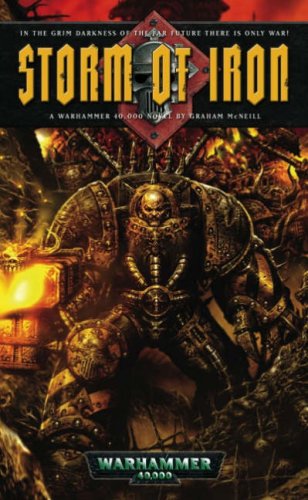
Storm of Iron Cover 2

Publisher: Black Library (Audiobook – July 2002)

Series: Warhammer 40,000

Length: 11 hours and 3 minutes

My Rating: 4.5 out of 5 stars

Amazon

Welcome back to my Throwback Thursday series, where I republish old reviews, review books I have read before or review older books I have only just had a chance to read.  For this latest Throwback Thursday, I dive into some old-school Warhammer 40,000 fiction with the exceptional Storm of Iron by one of the most prolific Warhammer authors, Graham McNeill.

Readers of this blog will know that I have been really getting back into Warhammer fiction in the last few years, and I have had an outstanding time reading all the exciting and captivating reads the franchise’s extended universe contains.  I have been particularly impressed by the sheer number of talented authors who contribute to this extended universe, and I already have a few favourites due to how epic and complex their novels have turned out to be.  However, one of the main contributors to the current Warhammer canon I had not really explored yet is the superbly talented Graham McNeill.  McNeill has been writing Warhammer fiction for 20 years now, and he has produced multiple books for both the Warhammer 40,000 and Warhammer Fantasy sub-franchises.  Best known for The Ambassador Chronicles, Legend of Sigma, Ultramarines and Forges of Mars series, as well as his entries in the massive Horus Heresy series, McNeill has produced some outstanding sounding books throughout his career (including several books I really want to read) and had an incalculable impact on Warhammer fiction universe.  I however, have not had too much experience with his works, although I do have several of his novels sitting on my shelf.  I am hoping to read more of his stuff in the future, but I ended up starting with one of his earlier books, the standalone Warhammer 40,000 novel, Storm of Iron.

The Adeptus Mechanicus Forge World of Hydra Cordatus is a barren and desolate place, garrisoned by Imperial Guard of the 383rd Jouran Dragoons and members of Adeptus Mechanicus, who rule from one of the mightiest and seemingly impregnable fortresses in the galaxy.  No-one ever expected that the many wars that plague the universe would ever come to a planet as seemingly inhospitable as Hydra Cordatus, but hell has descended upon the planet in the form of Chaos Space Marines from the feared Iron Warriors legion.

Under the leadership of the dread Warsmith Barban Falk, the Iron Warriors have arrived on Hydra Cordatus in substantial numbers, determined to destroy all the Imperial defenders and take the planet’s main citadel.  After a blistering landing upon the surface of the planet that cuts off all hope of relief, the Iron Warriors deploy their full force of warriors, slaves, labourers and even several corrupt Titans to assault the enemy.  But they have not chosen an easy target, as the citadel of Hydra Cordatus is no ordinary fortress.  It is an ancient and mysterious stronghold, whose walls are designed to stymy any attack, and few foes would have a chance of defeating its defences.

However, the Iron Warriors have long been considered the greatest siege warfare specialists in all the universe.  Having honed their bloody craft for millennia since their betrayal of the Emperor, the corrupt Iron Warriors soon embark on an ambitious and fast campaign that soon threatens to completely destroy the Imperial forces.  Only the arrival of members of the Iron Warrior’s greatest enemies, the Space Marines of the Imperial Fists, gives any hope to the defenders.  But can even the legendary Imperial Fists stand against the ancient fury of the Iron Warriors?  And what secrets truly lay hidden in the depths of Hydra Cordatus’s citadel?

Well, this was a pretty damn awesome Warhammer book.  McNeill did a remarkable job with Storm of Iron, producing an intense and action-packed novel that might be one of the best siege novels I have ever had the pleasure of reading.  Loaded with impressive battle-sequence after impressive battle-sequence, as well as a ton of intriguing and fun characters, Storm of Iron was an outstanding read, and I had so much fun getting through it.

I will admit that one of the things that really drew me to Storm of Iron is that it showcases a massive siege in the gothic future of the Warhammer 40,000 universe.  I have always deeply enjoyed books with sieges in them, and the Warhammer universe is naturally filled with some good examples of this, although these mostly occurred in the fantasy focussed books.  As such, I was quite intrigued to see how a science fiction siege would occur, and McNeill really did not disappoint, painting a powerful and captivating picture and using the Iron Warriors and Imperial Fists, both of whom are known for their siege craft, as central figures in the narrative.

McNeill starts Storm of Iron off with a bang, showing the Iron Warrior’s initial move as they launch a lightning-fast raid and landing upon Hydra Cordatus in the opening chapters.  From there, the siege of the citadel starts in earnest as the Iron Warriors deploy their entire army towards it.  Told from multiple character perspectives of both the attackers and defenders, you swiftly get to know all the key players of the book and see their various personal and military struggles as the siege unfolds.  The author sets everything up perfectly, and you are soon engrossed in the novel-spanning siege, which McNeill explores in intricate detail, examining the various moves and countermoves that the two sides are doing.  You get some awesome scenes throughout Storm of Iron, and it really has everything you could want from a siege book, including artillery barrages, trench warfare, sapping, sallies, reinforcements, counterattacks and desperate fighting in breaches.  The entire story moves pretty quickly, and there are barely any pauses in between battle scenes.  Any delays that do occur serve an essential part of the plot, showing the various personal issues impacting the participants, introducing new characters, or exploring some of the hidden intrigue going on within the besieged citadel.

The story picks up even further around the middle, with the arrival of the Imperial Fists Space Marines who give the defenders more of a fighting chance.  As such, you are never quite certain how the book is going to unfold, and the battle really could go any way.  I liked how McNeill balanced the book between the Chaos and Imperial characters (or the attackers and defenders), and I deeply enjoyed seeing how each side conducted their war, especially as both had to deal with internal dissension and setbacks.  I think that the narrative had a great blend of cool story elements, and the combination of action, intrigue and character work fit the story very well.  Naturally, the best part of the book is the exceptional battle scenes, and thanks to author’s detailed depictions, it is extremely easy to envision all the intense fight sequences that unfold.  There are some outstanding scenes here, and there is a little bit of everything, included destructive ranged warfare, brutal close combat fights, desperate last stands and even some over-the-top battles between the massive Titans (essentially intense mecha warfare).  This entire story comes together pretty well, and I really liked the fantastic and dark notes that McNeill left it on.  While I wasn’t too shocked by one of the book’s main twists, there honestly wasn’t a moment where I wasn’t entertained by Storm of Iron’s story, and I had such a fantastic time seeing this entire epic siege unfold.  I managed to power through this book extremely quickly, and I had so much fun seeing how this protracted battle unfolded.  As such, this is a must-read for all those who love a good siege book, and I really appreciate the awesome story that McNeill featured here.

I love all the cool Warhammer 40,000 elements that McNeill was able to fit into this awesome book, and fans of the franchise will appreciate his attention to detail and fun depictions of the various factions and their iconic regiments/toys.  While the Imperial Guard, Adeptus Mechanicus and Imperial Fists are all featured here, this book is mainly about the Iron Warriors, and it was fascinating to see them in action.  These traitorous and corrupt siege specialists have a rich history of hatred, and while the author doesn’t go completely into their fall from grace, you get a good idea of why they turned and some of the terrors they have inflicted.  Indeed, all the depictions of the Chaos side are extremely powerful, and you get an impressive view of just how twisted and dangerous they and their dark gods are.  That being said, you get a much more nuanced viewpoint of the Chaos side here than most Warhammer books have, and it was utterly fascinating to see their views on the conflict.  That, combined with some of the secrets that the Adeptus Mechanicus are hiding, continues to reinforce one of the key concepts of the Warhammer 40,000 universe: that there really are no good guys here, just winners and dead people.  Thanks to author’s ability to highlight key universe and faction details, this is one of those Warhammer 40,000 books that could serve as a great introduction to Warhammer fiction, and if a massive and bloody siege doesn’t get your attention and make you interested in this franchise, nothing will.  As such, you don’t need to come into Storm of Iron with too much pre-knowledge of the Warhammer 40,000 universe to enjoy this book, although established fans will naturally get a lot more out of it.  I am personally glad that, of all of McNeill’s books, I chose to start with Storm of Iron, especially as it apparently sets up some of his future Warhammer entries.  In particular, it introduces one of the key antagonists of his Ultramarines series, which has long been on my to-read list, and I look forward to enjoying more of McNeill’s epic Warhammer books in the future.

I also deeply appreciated some of the excellent character work that was featured within Storm of Iron.  Due to how McNeill writes the story, the book features a huge range of different point-of-view characters, broken up between the Iron Warriors and the members of the 383rd Jouran Dragoons who are defending the citadel.  While the quick-paced story and multiple character perspectives cuts down on development a little, you do get to know all the key characters very quickly, and McNeill fits in some absolutely fascinating character arcs that I deeply enjoyed.  Three of the most interesting characters are the Iron Warriors captains who are leading the assault on Hydra Cordatus, Honsou, Forrix and Kroeger.  All three are pretty interesting in their own right, with Honsou the true believer ostracised by his comrades due to his heritage, Forrix the disillusioned veteran, and Kroeger the mad berserker who is slowly going insane serving the Blood God Khorne.  Their personal storylines are all amazing, but the real fun is seeing their interactions, especially as they all hate each other and are vying for their master’s favour.  McNeill spends a lot of time with these three villains, and you really get a sense of whole Iron Warrior’s legion through their disparate viewpoints.  I will say that I didn’t think any of the Imperial characters quite measured up to these Chaos characters, especially as McNeill really worked to make them as compelling as possible.  I did deeply enjoy the character of Guardsman Julius Hawke, a slacker who finds himself alone in the wilds and serves an interesting role in the battle.  I was also quite intrigued by Lieutenant Larana Ultorian, a defiant soldier who is captured by the Chaos forces and slowly driven insane by her forced service to them.  These characters, and more, all help to turn Storm of Iron into a much more complex and powerful read, and I had a great time explore all their unique stories and histories here.

I doubt anyone is going to be too surprised that I made sure to grab the recently released audiobook version, which in my opinion is one of the best ways to enjoy a cool Warhammer book.  The Storm of Iron audiobook was a pretty good example of this, as I quickly got drawn into it, especially as the awesome action sequences became even more epic when they are read out.  With a run time of just over 11 hours, this was a decent length Warhammer audiobook, although I managed to power through it in less than a week, mainly because of how much I got caught up in the story.  I was also pretty impressed by the narration from Michael Geary, who really dove into the various roles contained within Storm of Iron’s story.  Geary clearly had a lot of fun telling this dark tale, and I felt his fast-paced narration really added the intensity and excitement of the story.  I also felt that he did a great job bringing the various characters of Storm of Iron to life, and each of the main figures is given a unique voice or accent to help set them apart.  While I liked all the cool voices he did, Geary’s take on the various Chaos Space Marines was very memorable, especially as he really captures the cruelty, hatred and dark demonic influences that affect them.  An overall excellent Warhammer audiobook, I had such an exceptional time listening to this version of Storm of Iron, and this format comes highly recommended.

Overall, I am extremely happy that I chose to read this fantastic Warhammer 40,000 novel, and it was one of the more interesting older entries in the franchise I have so far read.  The extremely talented Graham McNeill did a wonderful job on Storm of Iron, and I had such an amazing time getting through its elaborate and action-packed narrative.  This book featured such an impressive depiction of a siege in the gothic far future, and readers are in for an intense and captivating time as they see this complex battle between besiegers and defenders unfold.  Clever, compelling, and filled with pulse-pounding fun, Siege of Iron was an excellent book and I look forward to reading more of McNeill’s Warhammer books in the future.

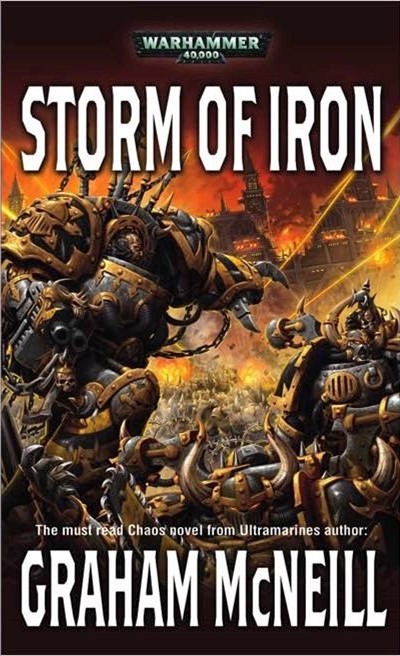
Storm of Iron Cover

Amazon

Throwback Thursday – Daemonslayer by William King

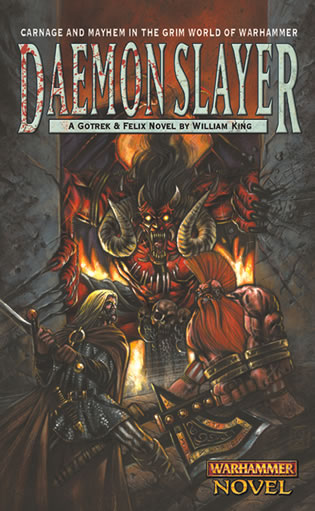
Daemonslayer Cover

Publisher: Black Library (Audiobook – October 2000)

Series: Gotrek and Felix – Book Three

Length: 9 hours and 38 minutes

My rating: 4.75 out of 5 stars

Amazon     Book Depository

Welcome back to my Throwback Thursday series, where I republish old reviews, review books I have read before or review older books I have only just had a chance to read.  For this Throwback Thursday, I am doing a bit of a double feature by reviewing two of the outstanding entries from the iconic Warhammer Fantasy franchise’s Gotrek and Felix series by the brilliant William King.  I have just published a review for the second book in the series, Skavenslayer, and, after some rapid audiobook listening, I have also pulled together a review for the third book, Daemonslayer.

After the epic conclusion of the battle of Nuln in Skavenslayer, Dwarf Slayer Gotrek Gurnisson receives a mysterious message and immediately sets out on the road, convinced that this missive may be the key to finding his much desired glorious death.  Accompanied as always by his companion, the former poet turned reluctant adventurer Felix Jaeger, Gotrek marches to the northern parts of the Empire to meet his destiny.

Arriving at their destination, Gotrek and Felix learn that a group of dwarfs are planning an expedition to find the lost dwarf stronghold of Karag Dum, and they want Gotrek to accompany them.  Destroyed in ages past, Karag Dum now lies in the middle of the Chaos Wastes, the most dangerous place in the entire world.  Wracked by the shifting winds of magic, marauding war bands, mutating warpstone and the foul essence of Chaos, no one can cross the Chaos Wastes and survive, and only death, madness or mutation awaits those who try.  However, expedition leader Borek Forkbeard has come up with an ambitious plan to fly over the Chaos Wastes in a giant, experimental airship, designed by an unstable engineer turned Slayer.

Determined to make up for previous failed attempt to reach Karag Dum, Gotrek agrees to accompany the expedition, with an inspired Felix accompanying him.  However, even with all the advantages that the airship provides, this will still be a perilous journey.  Many dangerous things lurk in the Chaos Wastes that will not hesitate to destroy the dwarven company for their dark gods.  At the same time, Gotrek and Felix’s old foe, Grey Seer Thanquol, plots from the shadows, determined to claim the airship for the Skaven cause.  But the very worst dangers will be found at Karag Dum.  A terrible foe lies within, waiting for revenge and determined to destroy all before him.  Can even the legendary Gotrek and Felix stand up to the wrath of a deadly Bloodthirster of Khorne, especially one who appears destined to kill Gotrek and destroy all who stand with him?

I am having so much fun getting through this cool series and I really wish I had checked it out many years ago.  Daemonslayer is another incredible read that continues the fantastic Gotrek and Felix adventures that started in Trollslayer and were continued in Skavenslayer.  William King has come up with a pretty intense story for this third entry in the series, and I loved the change in writing style featured within it.  An exciting and character-driven tale, this was easily the best entry in the series so far, and I deeply enjoyed the time I spent getting through it.

Daemonslayer contains an impressive and intense narrative that proves to be extremely addictive and a lot of fun to read.  Unlike the previous novels in the series, which featured a collection of short stories, Daemonslayer is actually a complete story with one continuous narrative.  This is an interesting change of pace, and one that I think works extremely well, especially as it cut down on some of the repetition that was an issue in Trollslayer and to a lesser extent in Skavenslayer.  King writes a fantastic story that quickly gets into the action and adventure as the protagonists embark on an epic and potentially lethal quest.  While not a collection of short stories, King does break the book up into several distinctive sections, each filled some unique plot points and antagonists.  These sections are pretty linear and flow into each other extremely well, resulting in a very cohesive and entertaining narrative.  Like the rest of the novels in the Gotrek and Felix series, readers do not need a lot of background knowledge about the Warhammer Fantasy world to enjoy this book.  While I would probably suggest reading Skavenslayer first, Daemonslayer can be read as a standalone book, and all readers are generally in for a good time with this novel.

The action and adventure flies pretty fast and thick throughout Daemonslayer, with highlights including a lengthy battle against an army of Skaven towards the start of the novel, exploration in the dark tunnels of Karag Dum and the final epic fight sequence against the hordes of Chaos.  King is particularly skilled at writing exciting and powerful battle sequences, and I loved how he managed to bring the uniqueness of a large-scale Warhammer battle to life.  Part of this is because the author makes great use of multiple character perspectives throughout Daemonslayer, which allows for a richer narrative as you get to see many different angles of the same story.  This works particularly well in the first battle against the Skaven, as you get to see Grey Seer Thanquol controlling his forces, as he desperately tries to kill Gotrek and Felix.  I did think that some of the Thanquol scenes in the second half of the novel were a bit weak, especially as they were more concerned with setting up his appearance in the next novel, Dragonslayer, than influencing the plot of Daemonslayer.  Still, these scenes were great, and you are always guaranteed a laugh when dealing with this ruthless Skaven.  While there is a noticeable focus on action and death, King also works in some fantastic comedy and humour, which makes this book an absolute treat to read.  I also appreciated how dark and emotional several scenes became, especially when the protagonists are faced with the grim realities of certain terrible situation.  All of this is worked into quite an impressive adventure story, which ends up being extremely addictive and enthralling to get through.

I loved the great use of setting throughout Daemonslayer, especially as King features some of the darkest and most dangerous locations in the entire Warhammer Fantasy canon.  The most notable of these is the notorious Chaos Wastes, a dark and dangerous wasteland, completely corrupted by the Chaos gods and filled with all manner of mutants, monsters, beastmen, worshipers of Chaos and Daemons, who gather and fight throughout the wastes.  While the Chaos Wastes are primarily shown from above, King makes sure to produce some gruesome and disturbing depictions of the landscape and its inhabitants, and it proves to be a pretty horrific backdrop for a good part of the story.  I do wish that a little more of the story had been spent on the ground within the Wastes, but it was probably a wise choice to avoid, as the story could easily become bogged down there.  I also really enjoyed the lost dwarf hold of Karag Dum, where the last third of the book takes place.  King was clearly drawing some inspirations from Tolkein’s Mines of Moria when he came up with this location (Moria is also known as Khazad-dûm), with hidden doors, ancient treasures, despoiling opponent, and a giant fiery demon boss.  The scenes set within this hold are pretty claustrophobic, and King makes sure to use the dark location to its full advantage during fight scenes.  You really get a sense of the decay and destruction that has occurred within this setting over the years, and it is pretty easy to feel the despair of the various dwarf characters.  Both these major settings are really impressive, and they prove to be an excellent and fitting backdrop to a very fun and intense story.

A major strength of this book is its characters, as King continues to produce a range of complex and distinctive figures to populate his tales.  This includes protagonists Gotrek and Felix, who find themselves on their most dangerous mission yet.  Felix continues to be used as the novel’s primary point-of-view character, and it is fascinating to see his continued evolution from cowardly fop to dangerous warrior.  Despite his continued caution and reluctance to engage in fights, Felix is now regarded by everyone as a heroic figure, and he accompanies Gotrek on this latest quest with only a minimum of forbearance, despite being given an out by his friend.  King has really hit his groove when it comes to portraying Felix, and the character reigns supreme as a sarcastic, but loyal friend.  I have really grown to like Felix, and readers will become pretty invested in his tale.

After being overlooked a bit in Skavenslayer, Gotrek has a lot more focus on him in Daemonslayer, as he re-visits one of his old failures and reunites with some of his dwarf kin.  For most of the novel, Gotrek is his usual gruff and battle-hardened self, still searching for his doom while managing to kill anything that he comes across.  While this is always a lot of fun, King makes sure to feature some deeper character elements in this novel, by highlighting some of his inner feelings and giving hints at his past.  There are several compelling mentions of Gotrek’s pre-Slayer life in this book, as well as some early hints at the character’s true destiny and the dark fate surrounding him.  King also shows a surprising amount of emotion in the character for this book, and Gotrek has some moving scenes with Felix as he contemplates the mistakes of his past and his many regrets.  I really enjoyed seeing how the character’s friendship with Felix has developed over the course of the last few books, and there is even a scene where Gotrek admits he is apprehensive about journeying to the Chaos Wastes and even lets Felix know he does not have to follow him.  While all this character development is great, King also makes sure to continue to portray Gotrek as an absolute badass in Daemonslayer, as he goes up against a ton of different enemies and opponents.  The various fight scenes with Gotrek are so much fun, although I do worry that King is perhaps making Gotrek a little too overpowered, especially as he manages to defeat a Bloodthirster, literally the most dangerous creature in the entire Warhammer canon (admittedly Felix helps a lot).  I still really love this great character and I cannot wait to see what other crazy adventures he goes on in the future.

Just like his previous books, King loads Daemonslayer up with a great range of supporting characters, and several of the characters introduced in this novel end up becoming major recurring figures in the Gotrek and Felix series.  Probably my favourite was Snorri Nosebiter, a fellow dwarf Slayer, who has had way too many blows to the head.  Snorri proves to be a fun companion to Gotrek and it was interesting to see a character who makes the titular protagonist seem sane in comparison.  There was also a fun character in Varek Varigsson, who is essentially the dwarf version of Felix, except with a range of explosive devices.  In addition, you cannot overlook the dwarf engineer turned Slayer, Malakai Makaisson, and I had a good chuckle when the characters discuss the fates of his previous, unfortunately named ships.  I also really liked that King reused two of his most entertaining characters from the previous novel, the Skavens Grey Seer Thanquol and Lurk Snitchtongue.  Both serve as secondary antagonists in the story, and prove to be excellent comic reliefs, especially as their schemes constantly go against them.  It looks like King has some fun plans for Snitchtonuge in the future, and I liked the fun changes he went through.

As I did for Skavenslayer, I really need to point out the extreme lack of female characters in this book.  Daemonslayer literally had only one named female character, Ulrika Magdova, who naturally falls in love with Felix the first time they lay eyes on each other.  While this is pretty lazy writing on King’s part, at least Ulrika is a much better written character than the females featured in Skavenslayer.  Ulrika is a badass Kislev fighter, who proves to be a dangerous fighter (of course, Felix has to be just a little bit better).  Still, I have a feeling she is going to be a bit of a damsel in distress in some of the future novels, and I hope that King balances it out with some additional female characters in the future.  Overall, there are some great characters featured throughout Daemonslayer and I look forward to seeing the ones who survive in some of the other Gotrek and Felix novels.

I ended up grabbing the audiobook format of Daemonslayer, narrated by Jonathan Keeble.  With a relatively short runtime of 9 hours and 38 minutes, the Daemonslayer audiobook is an easy audiobook to get through, and I managed to finish it off quickly.  The audiobook format proves to be a great way to enjoy this excellent book, especially as it allows the fantastic and chaotic landscape and characters to come to life in all their ghastly glory.  Keeble continues to impress as the narrator of this series, and I love the amazing array of voices he brings to the table.  Daemonslayer really highlights just how varied his voice can be as Keeble produces a substantial number of different accents and vocal tones to capture the rich and unique cast.  This includes Scottish-sounding dwarfs, Russian-esque Kislev lancers, humans with cultured British accents and the mad, loud voice of Snorri Nosebiter.  Keeble also has to voice the various inhuman monsters that the protagonists encounter, from the great Skaven characters, to the monstrous daemons and warriors of Chaos, all of which prove very fitting and amusing.  He also brings an immense amount of passion to his narration that deeply enhances the experience of anyone listening to the book.  The way in which he gets into the various fight sequences is amazing, and you can hear the sheer excitement in his voice as he reads.  This is especially true in the final epic fight scene, and the listener soon finds themselves on the edge of their seat as Keeble works his way up to the conclusion.  This is really an impressive and amazing format to enjoy Daemonslayer in, and I cannot recommend this audiobook enough.

Daemonslayer by William King is an exceptional and amazing entry in the fantastic Gotrek and Felix tie-in series.  This awesome novel contains an epic and intense story, as its two iconic protagonists continue to explore the dark and deadly Warhammer Fantasy world.  Filled with action, adventure, comedy and some dramatic character moments, Daemonslayer is an outstanding novel that comes highly recommended for all Warhammer fans.  I look forward to seeing how the rest of the series turns out and I am really enjoying my current jaunt into the world of Warhammer tie-in fiction.

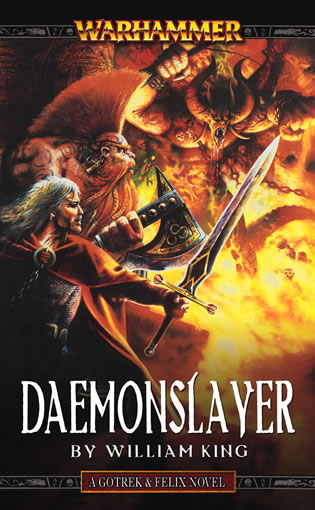
Daemonslayer 2 Cover

Amazon     Book Depository