Throwback Thursday – Batman: Under the Red Hood

Under the Red Hood Cover

Studio: Warner Bros. Animation and DC Entertainment

Series: DC Universe Animated Original Movies – Film Eight

Director: Brandon Vietti

Writer: Judd Winick

Producers: Bruce Timm and Bobbie Page

My Rating: 5 out of 5 stars

Welcome back to my Throwback Thursday series, where I republish old reviews, review content I have enjoyed before or review older books I have only just had a chance to read.  For this latest Throwback Thursday, I am going to keep following a recent trend of looking at animated movies and review Batman: Under the Red Hood.

Ever since I reviewed Justice League Dark: Apokolips War last year, I have been focusing a little more on one of my favourite forms of entertainment, animated films based on comic books.  Not only did I have a great time listing my favourite comic book based animated films and television shows, but I have also done some cool reviews for Batman: Soul of the Dragon and Batman: Assault on Arkham.  After I got some positive responses to my review for Assault on Arkham last week, I thought I would use this Throwback Thursday to highlight the incredibly awesome Batman: Under the Red Hood, which is probably my absolute favourite DC Comics inspired animated film.

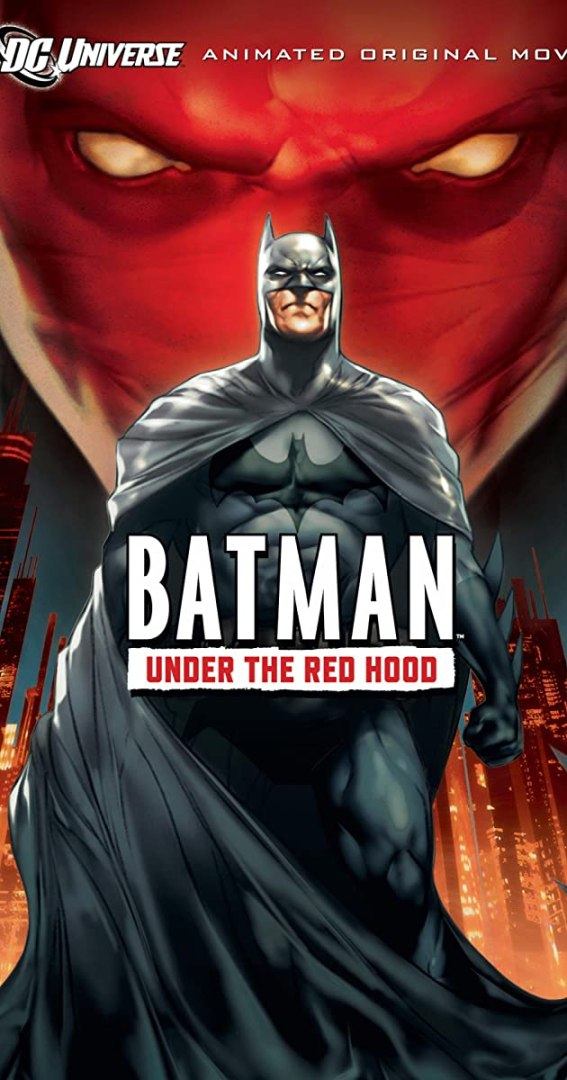
Released in 2010, Under the Red Hood was an early entry in the DC Animated Originals Movies range, and it remains one of the best that they have ever done.  Directed by Brandon Vietti and written by Judd Winick, this film is an adaptation of the iconic Batman comics storyline Under the Hood, which was also written by Winick.  Not only does this film contain an excellent story that does an amazing job capturing the original comic but it also features an all-star voice cast and some excellent animation, resulting in a dark and exciting film that is also rich in emotion and tragedy.

Years ago, Batman suffered the greatest defeat in his entire crime-fighting career when the Joker did the unthinkable by brutally killing his sidekick, Jason Todd, the second Robin.  Despite this terrible loss, Batman left the Joker alive and continued his non-lethal mission for justice, fighting from the shadows to save Gotham City from its criminal element.

In the present, Gotham is controlled by the ruthless crime boss, Black Mask, who has managed to take over the entire criminal underworld.  But a new player in town, the mysterious Red Hood, is making moves to disrupt Black Mask’s interests and take control of the city.  With some incredible skills, brilliant manoeuvring and intense violence, Red Hood soon becomes a major thorn in Black Mask’s side, taking parts of the city from him.  At the same time, Red Hood has placed himself right in the path of Batman and his former sidekick, Nightwing, determined to test his abilities against those of the Dark Knight.

As Batman attempts to stop the latest wave of violence sweeping the city, he notices something disturbingly familiar about the Red Hood.  His skills and training are too familiar, and even more shocking, he knows that Batman is Bruce Wayne.  With Black Mask on the warpath, the mysterious Ra’s al Ghul watching from the shadows, and the Joker always a menacing presence in Arkham, Batman gets closer to finding out the terrible truth about who Red Hood truly is.  But is he prepared for the darkness and tragedy he will find under the hood, or will the ghosts of his past finally push Batman over the edge?

Under the Red Hood is a dramatic, exciting, and overall tragic animated feature, which is brought together beautifully to produce an epic and powerful film, anchored by an exceptional narrative.  The film starts in a very dark place, with a malicious and hilarious Joker brutally killing Robin just before Batman can save him.  This perfectly sets the tone for the entire film, as the story advances to modern times and shows a new brutal crime war between the Black Mask and newcomer the Red Hood.  At the same time, Batman becomes embroiled in their war, when he interrupts a ploy by the Red Hood to steal an Amazo superweapon.  This leads to an action-packed middle section of the film, as Batman and Nightwing attempt to capture Red Hood, who is also dealing with assassins sent by Black Mask.  After several impressive fight sequences, Batman learns the shocking truth about Red Hood’s identity (which is as a tad obvious, even for those unfamiliar with the comics), resulting in some extreme drama, as Batman is forced to confront the dangerous ghosts of his past.  As Batman attempts to come to terms with his discovery, Red Hood forces his opponents to make some dramatic moves, which work into his plans.  What follows is a fantastically powerful and intense final act, as Batman confronts Red Hood and finds out the tragic and touching reasons behind his motivations.  What follows is emotional blow after emotional blow, as Batman, Red Hood and the Joker have their final confrontation.  The aftermath of this is absolutely heartbreaking and will leave you breathless and utterly moved: “This doesn’t change anything; this doesn’t change anything at all!”  This is an epic and exceptional narrative that I have so much love for.

Under the Red Hood serves as an exceptional adaptation of the Under the Hood Batman comic storyline, although as the film and the comic share the same writer, that’s pretty understandable.  This film does a great job fitting all the key points of the comic into its 75-minute runtime, and you get the full enjoyable story, as well as some useful backstory, especially around Jason Todd’s death.  This is mostly a pretty straight adaption, although there are a few noticeable changes designed to make the movie flow a little better.  I think these changes work extremely well, and Winick adds several great new scenes into this film that make for a different and, in some ways, better experience than the comic source material.  This is mainly because the Under the Hood comic was set amid several other ongoing Batman storylines, as well as the major crossover event, Infinite Crisis, which impacted Under the Hood’s overall narrative.  As it would have been too confusing to include some of these elements in the film, their removal resulted in a few notable changes.  While this did result in a few fun parts from the comics being removed, such as having the opponents in the Batman/Red Hood team-up fight change from members of the Secret Society of Supervillains, such as Captain Nazi and Count Vertigo, to a group of mechanised martial artists (it’s still a great fight though), some of the other changes worked really well.  I loved the alterations to the Joker’s story, as it was clever to have the Red Hood orchestrate Joker’s release to kidnap him.  It also results in some amazing scenes, including that great cell scene with Black Mask, and the fantastic scene with the truck on the bridge.

One disadvantage that I felt the film version had was that the big reveal over Red Hood’s identity is a lot less impactful.  When the Under the Hood comic first came out, it was a major revelation and there were some great surprise elements to it.  However, by the time the film came out, every comic fan knew who Red Hood really was, so that really cut down on the surprise factor of the reveal.  In addition, even if you were unfamiliar with the Under the Hood comic, the Jason Todd death scene at the start of the film ensured that most viewers would be easily able to figure out this twist as soon as the mysterious Red Hood appeared.  This was kind of unavoidable though, as the rest of the film wouldn’t have made sense without the establishing scene.  I did think that the reason behind Robin’s resurrection was handled a lot better in the film.  The original story, in which he is brought back to life due to Superboy-Prime punching a dimensional barrier, never really worked for me, so having it purely be the result of a Lazarus Pit resurrection was a lot neater and simpler (well, as simple as a magical resurrection pit can be).  Overall, I think that Under the Red Hood proved to be a really good adaption of the original comic, and in many ways I felt that in enhanced the source material while also compensating for the changed canons.

I am always deeply impressed by the fantastic and well-crafted animation of Under the Red Hood.  This entire film features a constant stream of beautiful and amazing sequences that are an absolute joy to behold.  The action is seamless throughout, and the creative team make sure to feature several sequences that show off the various skills of the main characters, while also bringing some iconic scenes from the comics to life.  I really must call out the two excellent extended chase sequences, as Red Hood flees from Batman and Nightwing.  These scenes are full of excitement and major moments, and the fantastic running sequences, equipped with all the players using their various gadgets and tricks, are so cool, and they are just animated perfectly.  However, these chase scenes pale in comparison to some of the epic fight sequences featured throughout the film.  While I do deeply enjoy the Amazo fight sequences at the start of the film, which expertly highlights the way Batman and Nightwing work together as a team, the best ones are the two fights involving Batman and Red Hood.  The first of these, which sees the two former partners team up against the anime-inspired team of assassins, the Fearsome Hand of Four, is so deeply cool, especially as the amazingly drawn martial arts techniques are beautifully paired with the over-the-top gadgets (one guy gets thrown through the air with explosives several times).  The animators save the best for last, with a brutal brawl between Batman and Red Hood near the end of the film.  This impressive and dramatic fight sequence is teased throughout the entire film, and when it goes down it does not disappoint.  The two heroes go to war with each other, each of them bringing lethal fighting abilities and an entire arsenal of toys and gadgets against each other for some incredible action.  The fight goes from the alley where the two first met, to the rooftops, all the way to a dilapidated apartment bathroom, where bodies are brutally thrown through fixtures and walls.  There is so much intensity in this sequence, and the animators outdid themselves bringing this major and spectacular fight to the screen.  You will be so impressed by this terrific animation.

You cannot talk about Under the Red Hood without out mentioning the incredible collection of characters and the outstanding voice cast that perfectly portrayed each of them.  Unsurprisingly for a Batman film, the cast is anchored by the Dark Knight himself, who is voiced by the talented Bruce Greenwood.  This is a great portrayal of Batman and the writer really captured the complexities of the veteran version of this superhero.  This Batman has been fighting crime for a very long time, and has been struck by tragedy after tragedy, especially the death of Jason Todd.  This comes into play throughout the film, and there are some major emotional moments, especially in the final climatic scene with the Red Hood.  Watching this film, it is impossible not to see Batman as a tragic figure, always destined to experience heartbreak and trauma as the result of his relentless crusade.  I did love the amazing animation featured around Batman’s various fight scenes, and it contrasts nicely with some of the other characters, such as Red Hood, with more of a focus on his experience and placing the right move at the right time.  I also really enjoyed Bruce Greenwood’s portrayal of Batman, who brings a gruff and determined depiction of the character which really works.  Greenwood delivers several great dialogue sequences which show the depth and complexity of this iconic character, and I had a fantastic time following him in this film.

Another major character is the character of Jason Todd/Red Hood (I would add a spoiler alert, but after all these years it’s kind of redundant), voiced by Jensen Ackles.  The Red Hood featured in this film is an amazing and outstanding version of the character, and you run the entire emotional gambit with him.  I loved the fantastic and clever introduction of the character, where he manages to take over a large criminal organisation with just a bag and a machine gun.  This evolves into a very fun game of cat and mouse between Red Hood and Batman, while he also works to take over from Black Mask.  The eventual reveal about Red Hood works extremely well: “You haven’t lost your touch, Bruce,” and I loved the various chase scenes between the two, as well as their joint fight sequence against the Fearsome Hand of Four.  All this perfectly leads up to the great final confrontation with Batman, with a big elaborate fight scene and that extremely dramatic sequence opposite Batman.  Ackles adds some real cockiness to the character, and his various interactions with the supporting characters are pretty funny and really fun.  However, it is his sequences with Batman that are the best, as Ackles adds all the appropriate drama of a murdered child when encountering his former mentor.  The revelation of Red Hood’s motive is deeply captivating, and the entire scene where he, Batman and the Joker are reunited is so very tense and powerful.  You also have to love how the final scene in the film features the younger version of Robin on his first night of crime-fighting, as his innocence and childlike joy at being a hero stands in such contrast to his eventual fate: “This is the best day of my life.”  This is an outstanding portrayal of one of the most complex characters in the DC canon.

I also really must highlight the incredible version of the Joker that is featured in this film, who is voiced by the always entertaining John DiMaggio.  This is a great interpretation of the Joker, and you get to see just how vicious and ruthless he can be.  I love how the writers and actor did a great job capturing his insane mentality when it comes to the Batman, especially as his greatest ambition is to drive Batman insane enough to kill him.  I was honestly surprised at how awesome John DiMaggio was in this role, especially as the purely evil Joker is very different from the comedic characters he is best known for portraying.  However, he brings some very excellent menace to this character, and while there are a lot of humorous undertones to his actions, the sheer insanity and joy he has at other people’s suffering is more than evident.  Joker has some incredible scenes throughout this movie, which DiMaggio really enhances with his unique take on the character.  The opening sequence in which he beats Jason Todd half to death with a crowbar is pretty dark, despite the constant jokes, and his later confrontation with Batman in Arkham really captures his overall insanity.  However, his best sequences occur later in the film.  The first of these is the cell scene with Black Mask, where he accepts a job offer in the most boss way possible (never hand the Joker a cup of any variety).  The follow sequence on the bridge, where he attempts to draw the Red Hood out with a truck, some guys and some gasoline is really great, especially when it is revealed that the Black Mask is also amongst his hostages.  However, DiMaggio shines best in the final sequence where Batman and Red Hood finally have their dramatic showdown with the Joker in the middle.  The Joker revels in all the drama and emotion in the room, especially when Red Hood attempts to force Batman to kill Joker: “This is turning out even better than I hoped!”  The final bit of the confrontation where Joker, realising that Red Hood’s bomb will kill them all, joyfully attempts stop Batman, “This is perfect…. I’m the only one who’s going to get what they want tonight,” really captures the character’s chaotic mentality and is a great conclusion to his story arc.

The other major character in the film is Nightwing, former Robin Dick Grayson, who is portrayed by the legendary Neil Patrick Harris.  Mostly featured in the first half of the film, Nightwing serves as the traditional sidekick role, bringing a lighter comedic role to the dynamic duo and playing off the ultra-serious Batman perfectly.  I loved the fantastic coordination in the action sequences between these two, and the animators do an outstanding job showing how their fighting styles complement each other and they instantly know what the other one is doing.  Harris’s voice work is great, hyping up the characters comedic, banter-laden fight style, and while it didn’t fit as well as some other versions of Nightwing I have seen, this was still a pretty epic bit of casting.

Aside from these above four main characters, I deeply appreciated Jason Issacs and Wade Williams as Ra’s al Ghul and Black Mask respectfully.  Issacs does an outstanding job bringing the enigmatic and ruthless al Ghul to life, and it was great to see the respect and personal code this version of the character has, especially once his actions result in Jason Todd’s death.  Williams’s unhinged version of Black Mask is also incredibly good, and I loved the ultra-anger he brings to the role, especially as he slowly becomes more and more targeted by Red Hood and Batman.  His reactions to the crazy antics of the other characters is pretty fun, and you’ve got to love the look on his face when he sees Red Hood targeting him with a giant rocket launcher.  I also want to call out Kelly Hu as Black Mask’s assistant, Ms Li, a gender-swapped version of the assistant character in the comic.  Ms Li serves a pretty cool counterpart to Black Mask and is a constant calm presence in his chaotic administration, barely batting an eye at any of his angry or violent outbursts.  These great supporting characters compliment the main cast perfectly, and I felt the film’s entire collection of characters and actors helped to turn Under the Red Hood into something incredibly special.

While there have been some incredible DC animated movies out there, none have eclipsed the exceptional and awesome Batman: Under the Red Hood.  Featuring an impressive adaption of an iconic and cool comic story arc, this amazing film contains a fantastic narrative loaded with action, excitement, and intensity, as the characters engage in a dramatic and tragic battle.  With a perfect voice cast and some outstanding animation, Under the Red Hood is a must-watch animated film that I have seen and deeply enjoyed so many times.  An easy five-star watch that is highly recommended; if you love Batman, you need to see this film.

Throwback Thursday: Batman: Assault on Arkham

Assault on Arkham Poster

Studio: Warner Bros. Animation and DC Entertainment

Series: DC Universe Animated Original Movies – Film 20

Director: Jay Oliva and Ethan Spaulding

Writer: Heath Corson

Producer: James Tucker

My Rating: 5 out of 5 stars

Welcome back to my Throwback Thursday series, where I republish old reviews, review content I have enjoyed before or review older books I have only just had a chance to read.  For this week’s Throwback Thursday I go back and check out one of the more intriguing DC animated movies, with Batman: Assault on Arkham.

As I mentioned in a recent Top Ten Tuesday, I have been in a DC mood ever since I saw The Suicide Squad on the weekend, which was easily the best film focusing on the titular Suicide Squad.  While people only familiar with the live-action films might think that this is a low bar, those who know about the awesome catalogue of DC Comics animated films will know that there are several awesome and outstanding films that perfectly capture the feel and tone of the supervillain team and are pretty fun to watch.  Therefore, this week I will look at one of these great animated films, with Batman: Assault on Arkham.

Assault on Arkham is an amazing and fantastic film that came out in 2014 and is set in the same universe as the Arkham video game franchise (set between Arkham Origins and Arkham Asylum).  Directed by Jay Oliva and Ethan Spaulding, written by Heath Corson and produced by James Tucker, this was a memorable and fun DC Universe Animated Original Movie, which contains some of the best comic book based animated films out there.  Despite the name, Assault on Arkham is really a Suicide Squad movie, with Batman strongly featured but acting more as a side character.  This was an excellent and impressive film, which makes use of a darker tone and more adult animation to create a fitting Suicide Squad experience.  Heck, this was a much better Suicide Squad movie than the 2016 live-action film as it embraced the team’s darker side and their propensity for violence, while also featuring an impressive and clever story.

Two years before the Joker took over Arkham Asylum, the Clown Prince of Crime terrorises Gotham City, this time by threatening it with a dirty bomb.  With the Joker locked up in Arkham Asylum and refusing to talk, Batman stalks the streets of Gotham, searching for those who helped him.  His mission leads him to save the Riddler from a black-ops team of soldiers, sent by shadowy government agent Amanda Waller.  With Riddler now locked up in Arkham Asylum, Waller assembles the one force capable of breaching Arkham’s walls to find him and the information she desires, Task Force X.

Task Force X, also known as the Suicide Squad, is made up of some of the most deadly and skilled villains in the world, each of whom have been forcibly drafted onto the team and offered reduced sentences if they complete their mission.  Recruiting a team made up of Floyd Lawton (Deadshot), Harleen Quinzel (Harley Quinn), George Harkness (Captain Boomerang), Eric Needham (Black Spider), Nanaue (King Shark) and Louise Lincoln (Killer Frost), Waller sends them into Arkham with bombs implanted in their necks.

Forced to work together despite their innate distrust and dislike of each other, the Suicide Squad arrive in Gotham and make their plans to infiltrate the asylum.  However, it doesn’t take long for petty rivalries, massive manipulations, and dangerous outside influences to put all their schemes in disarray.  Working their way through the most dangerous place on the planet, the Squad soon learns a deadly secret that will change everything and set them on a bold new path.  But with Batman wise to their presence, can the Squad achieve their goals and make their escape, or will they find themselves locked up in Arkham instead.  Worse, someone far more dangerous is stalking the halls of the asylum, someone with an insane sense of humour and a desire to claim back what is his.  The Joker is loose, and he wants to play!

This is an awesome film that really does the chaotic and dangerous Suicide Squad justice.  Featuring an excellent story and serving as a clever adaption of the Suicide Squad comics and other pieces of media, this is an extremely fun movie.  Throw in an exceptional voice cast, some great interpretations of iconic characters, and some powerful animated sequences, and you have a great and impressive movie that I have long been a fan of.

At the heart of this great movie is a very compelling and exciting narrative that takes its various characters on a wild and dangerous ride to hell in back.  Assault on Arkham starts off with an excellent scene, which sees Riddler being attacked by Waller’s goons, only to be rescued by Batman in an intense and brutal fight sequence.  This then leads into an entertaining introductory sequence for the various members of the squad, with a fun reel of shots with no dialogue showing each member of the Squad showing off some of their skills before getting captured by various law enforcement groups.  These dark and sometimes gruesome introductory scenes really set the tone for the entire movie, while also providing great summaries of each of the main characters.  What follows is a fun and captivating character-driven tale as the members of the Squad arrive in Gotham and make their play to break into Arkham.  There are some fantastic clashes of personality and deep personal moments in this early part of the film, as the team initially comes together, despite their crazy differences.  This leads to an intriguing central part of the film, where the characters begin their assault on the asylum, performing a reverse prison break.  After some great scenes, the team are at large in the asylum, which leads to even more chaos, destruction, and big fight moments.  All of this leads to an explosive and dangerous final act, as the characters need to escape while being pursued by Batman and the Joker.  Caught between these extremely dangerous forces, the fractured Squad attempts to escape, facing some major defining obstacles which really bring the entire film together.  I loved the fantastic and darker story that this film featured, and the writing team did an excellent job combining brutality, humour, character development and pure craziness into one enthralling tale.  There are so many fun and thrilling moments to this outstanding film, and viewers will found themselves really getting drawn into the cool story.

The animation in Assault on Arkham is very impressive, and the creative team behind it did a great job bringing the various characters to life and placing them in some outstanding action sequences.  The movement and action in this film is pretty damn seamless, and you are in for some very fast-paced scenes that look pretty superb, especially as they feature a great mixture of lighting and multiple unique characters.  Highlights include the opening shadowy encounter between Batman and the special forces soldiers, the massive fight between Batman and the entire Suicide Squad, and the final two confrontations that occur after a big helicopter crash.  I loved the cool character designs of the various characters, especially as they mix some new looks with classic drawings.  I also felt that the creative team combined this cool animation with the excellent musical score well, and the various tunes really helped to set the scene.  There is something very dark, bloody, and adult about the designs in the film, and the end result is definitely not a kid’s cartoon.

Part of the design that I really enjoyed was the way in which the creative team attempted to emulate the style from the fantastic Batman: Arkham video games.  This film serves as a canon entry between Arkham Origins and Arkham Asylum, and the team did a great job capturing the cool style and themes that the games are famous for.  This is particularly seen in the various scenes featuring Batman, the playable character of the games, and you get to see him whip out the various gadgets and viewscreens that appeared in the games.  I particularly enjoyed the opening scene where Batman takes out a squad of soldiers in much the same way that a player would in the games, from the flips to the use of a batline.  There are also several references to the games throughout the film, from a character trying to hide in a vent, to the layout of Arkham Asylum, where you spend significant time in the first film.  Despite all these references, this film can easily be enjoyed by comic fans who have not played the video games.  Assault on Arkham is very much framed as a standalone film, and no matter your familiarity with Batman or the Arkham games, you will have a fun time watching this movie.

As I have mentioned above, this awesome film contained a really impressive and memorable take on the Suicide Squad, producing a truly great movie.  Part of this is the choice of team, as it features a compelling blend of characters that are inspired by the team first introduced in the New 52 range.  Anchored by team leader Deadshot and wildcard Harley Quinn, it also features long-time Suicide Squad member Captain Boomerang, as well as a fantastic combination of Black Spider, King Shark and Killer Frost.  While the team structure is similar to the team in the first live-action film, Assault on Arkham actually predates this film by a couple of years, and also utilises them a lot better, really showing off some more complex aspects of their personality, mainly thanks to the excellent voice cast.  This animated film also takes itself a lot less seriously than the first live-action film did, and is less afraid to show blood, sex and death.  While some of this is a tad over the top (some of the female characters are way too sexualised), I really wish that the subsequent live-action film had taken some cues from how successful this animated feature was, as that would have resulted in a much better experience.

Easily the best part of this film is the amazing characters and sensational voice cast, which really help to make it stand out.  While it does feature a lot of Batman and Joker, the main characters of this film are the Suicide Squad.  The most prominent is team leader an assassin extraordinaire, Deadshot.  Voiced by the talented Neal McDonough, a man who has voiced quite a few villains in his day, this version of Deadshot is near perfect, and contains a lot of elements from the comics that the live-action version was lacking.  While the overriding love for his daughter is still there, this version of Deadshot is a lot colder and a lot quicker on the trigger, happily massacring everyone who gets in his way.  McDonough really captures the character’s menace, killer instinct, and determination, and this Deadshot serves as the tough and often exasperated leader of the Squad.  I loved that they captured Deadshot’s crazier side (he has a massive death wish in the comics), especially as this leads to one of the best scenes in the entire film: “Mate, you just out-crazied the Joker”.  It was also cool that Deadshot had one of the most satisfying character arcs in the entire film, ending Assault on Arkham on a very entertaining and memorable note, that showed that the character was a man of his word: “Bang!”

This film also features an amazing version of iconic character Harley Quinn.  Before Margot Robbie and Kaley Cuoco put their spins on the character, veteran voice actor Hynden Walch provided her impressive voice to Harley, resulting in a fantastic and crazed female-lead.  Walch, who is probably best known for voicing Starfire in Teen Titans or Princess Bubblegum in Adventure Time, does an excellent job going a little darker with this character, producing some excellent scenes of madness and humour as Harley manages to annoy the other characters while cracking up the audience.  I loved the introduction that this character had, biting off an ear in a halfway house with Looney Tunes music playing (it’s weird, but it works).  Harley proves to be quite conflicted in this film as she finds herself stuck between her abusive ex, the Joker, and her new love interest, Deadshot (all I am going to say about the later relationship is “Yahtzee!”).  While this starts off with a very concerted attempt to kill the Joker, Harley is eventually drawn back to him, which is kind of heartbreaking.  There is some of the typical abusive relationship stuff that comes out with Harley, as she blames everyone but Joker for her problems.  This was a great portrayal of this fantastic and complex character, and I was very happy that Walch came back to portray Harley in other films such as Justice League Dark: Apokolips War.

Other great members of the Squad include Captain Boomerang, voiced by Greg Ellis.  Boomerang acts as the Squad’s comic relief, and I liked the uncaring and selfish attitude that is such a feature of the character in the original Suicide Squad comics.  Ellis really brings out the character’s smarmy and arrogant side, and I loved the amusing rivalry he formed with Deadshot, which results in a brilliant game of darts.  This movie also features the outstanding Gincarlo Esposito in the role of Black Spider, a murderous vigilante who is less than pleased at being lumped in with a group of supervillains.  Esposito brings some real gravitas to the character, and he proves to be a skilled and fun member of the team, and his inclusion results in a pretty major fake-out.  The hilarious John DiMaggio does a great King Shark in this film, and I loved the somewhat more human design of the monster and his funny dim-witted mentality.  Despite being a source of some humour, King Shark is a brutal killer, which is very much shown in his introduction where he emerges from a bathtub full of blood.  Finally, the brilliant Jennifer Hale portrays a fantastic Killer Frost (not surprising, considering she’s voiced the character in nearly every film or animated television appearance).  This version of Frost is pretty cold-blooded and proves to be a murderous addition to the team.  I liked the fun friendship that she forms with King Shark, and they prove to be a great duo.

While the Suicide Squad takes most of the film’s focus, Batman is featured pretty extensively in this film, which is really cool.  I personally was overjoyed that they got the iconic voice of Kevin Conroy for the character, and this amazing actor reprises his role from the various animated series and the Arkham games.  Batman is mostly on the outside of the story for the first half of the film, only becoming involved when the Squad enters the asylum, but once he gets involved, the results are pretty damn awesome.  This version of the character perfectly highlights the various aspects of Batman, as he kicks ass, intimates everyone he meets, outsmarts his foes, and utilises his amazing detective skills to make some big assumptions.  Featuring Batman as a side-character in his own film was an interesting choice, but it is one that really works, and it was great to see him attempt to work out the various ploys of the Squad, Waller, and the Joker.  Conroy’s voice work is of course, perfect, which isn’t surprisingly considering all the times he’s portrayed the character.  Another excellent inclusion of the legendary hero.

While most of the cast of Assault on Arkham are villains, the one that sticks out the most is the master of anarchy, the Joker.  Voiced by Troy Baker, who reprises his role from Arkham Origins, Joker really stands out as a character, which honestly isn’t that surprising.  Joker escapes his cell and starts causing chaos all over the asylum, coming into conflict with both the Squad and Batman.  This version of the Joker is the usual awesome mix of scary insanity and corny humour, and the character has several hilarious scenes throughout the film, including one of the best lines: “Denzel, what have they done to you?”  I also enjoyed the new rivalry he forms with Deadshot, as he shows some uncharacteristic jealousy over the fact that Harley has moved on.  This leads to a brutal brawl in the film’s conclusion, which is a major highlight.  Baker, who would go on to voice the Joker in several other animated features, does a pretty good job in Assault on Arkham, and does well at replicating Mark Hamill’s take on the character.  This results in an excellent villain, and I loved seeing the insane Arkham version of the character once more.

The final character I really want to highlight controls Task Force X, Amanda “the Wall” Waller.  Voiced by the incredible CCH Pounder, the definitive voice actor for the character (she is so good in Justice League Unlimited), this manipulative bureaucrat is in many ways the true villain of Assault on Arkham, turning everyone against each other to get what she wants.   She has an excellent introduction, where she manages to outsmart the Riddler, while also giving a fantastic line about riddles: “I have Google, like the rest of the world!”  From there, she proves to be a consistent badass, dragging the ruthless killers together into her Suicide Squad, bending them to her will, and then unleashing them upon the world.  Despite her plans not going as well as she hoped, Waller still manages to have a great run in Assault on Arkham, and Pounder really dives into the character’s manipulative nature and inner anger: “No one screws the Wall!”  She also has a pretty badass stare-down with Batman, actually managing to win their confrontation.  This character has a pretty amazing final moment in the film, especially as it wraps up her entire arc with Deadshot in one fantastic word.  Overall, Pounder rounds out the awesome central voice cast perfectly, and it was an absolute treat to see their performance come together.

Batman: Assault on Arkham is a fantastic and memorable animated film that is so much fun to watch.  Serving as the definitive and best film about the Suicide Squad for years, Assault on Arkham makes full use of its intense and exciting story, its brilliant design and exceptional cast and characters.  I deeply enjoy this amazing film and I have watched it multiple times ever since it was released.  A highly recommended watch, especially if, like me, you loved the latest Suicide Squad movie and want some more crazy, villain-led chaos and destruction.

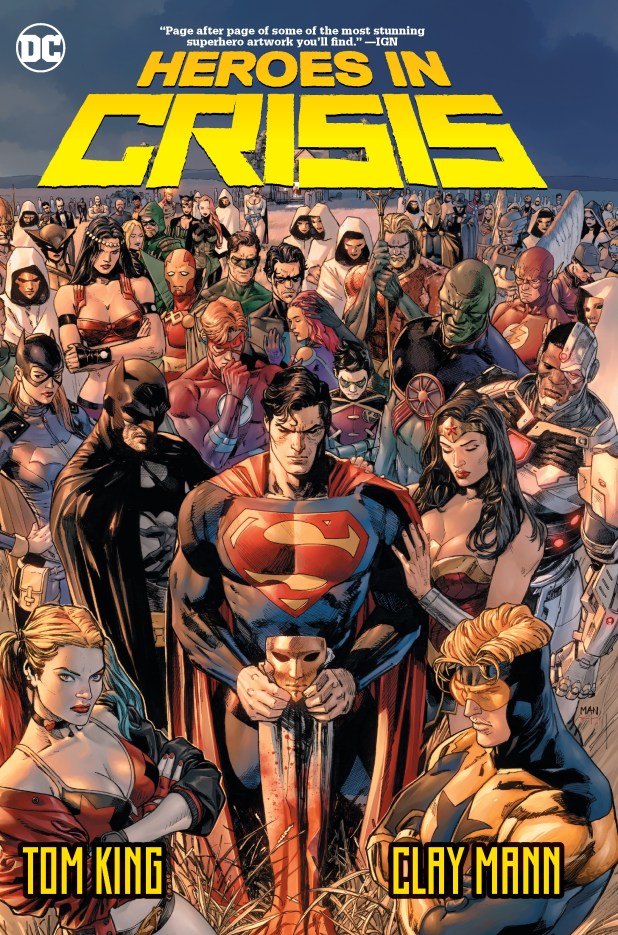
Throwback Thursday – Heroes in Crisis by Tom King and Clay Mann

Heroes in Crisis Cover

Publisher: DC Comics (Paperback – 1 October 2019)

Writer: Tom King

Artists: Clay Mann, Travis Moore, Lee Weeks, Mitch Gerads, Jorge Fornes

Colourists: Tomeu Morey, Arif Prianto, Mitch Gerads

Letterer: Clayton Cowles

Length: 234 pages

My Rating: 4 out of 5 stars

Amazon     Book Depository

Welcome back to my Throwback Thursday series, where I republish old reviews, review books I have read before or review older books I have only just had a chance to read.  For this latest Throwback Thursday article, I look at an interesting DC Comics crossover event from a couple of years ago, the deep and compelling Heroes in Crisis.

Heroes_in_Crisis_1 (V1)

Now I have to admit that I have been somewhat avoiding a lot of the recent DC crossover events, mainly because I think the universe is getting a bit too complicated, what with the multiple versions of characters and timelines.  However, I recently grabbed the Heroes in Crisis collected edition (containing all nine issues of the limited series), mostly because I had heard some conflicting reports about whether it was any good, and I thought that it would be worth seeing just what sort of comic it really was.  I was also drawn to this comic as I am major fan of Tom King and Clay Mann after the work they recently did on Batman, which featured some really cool and compelling storylines.  Heroes in Crisis turned out to be a rather fun and intriguing comic, especially as King came up with another fascinating narrative.

Heroes_in_Crisis_1 (V2)

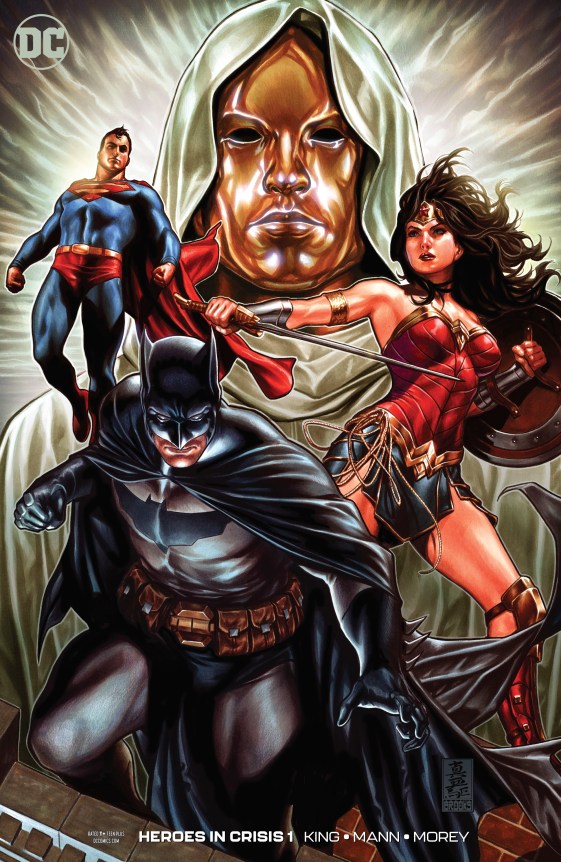
After years of fighting and surviving against the very worst evils in the universe, even the greatest heroes will start to crack under the unreal pressures of their chosen lives.  Realising this and determined to help their fellow superheroes, the trinity of Superman, Batman and Wonder Woman designed Sanctuary.  Sanctuary is a hidden facility containing a cutting-edge artificial intelligence programmed to provide advanced therapy, support and counselling to any hero that needs it after harsh battles and traumatic events.  However, no sanctuary lasts forever, and after losing contact with the facility, Superman, Batman and Wonder Woman arrive to find Sanctuary in shambles and several patients brutally killed.  As the world’s superheroes reel from the deaths of friends and colleagues such as Roy Harper, Red Devil, Commander Steel, Poison Ivy and Wally West, their thoughts swiftly turn to justice.  But who is responsible for the killings, and could the culprit be one of their own?

Heroes_in_Crisis_1 (V3)

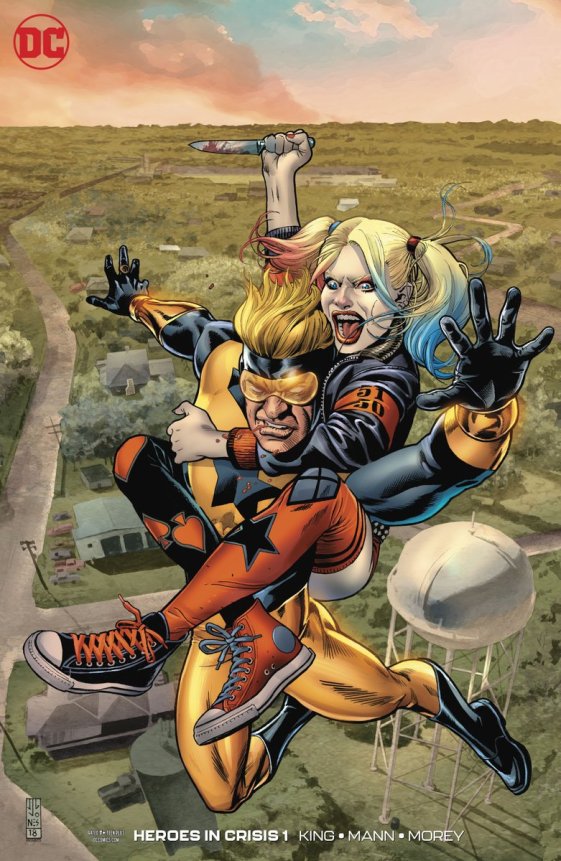
The answer may lie with the only two survivors of the Sanctuary massacre, the greatest hero you have never heard of, Booster Gold, and the mad clown princess, Harley Quinn.  However, Booster and Harley are both convinced that they saw the other commit the crime, and are now out to stop the other survivor by any means necessary.  As the heroes attempt to uncover the killer lurking amongst them, their world will be further turned upside down when the confessions and therapy sessions recorded at Sanctuary are leaked to the media, casting a new light on them.  Can the killer be caught before they strike again, or will this case irreparably damage the world’s greatest superheroes?  Whatever happens, the DC universe will never be the same again.

This was a very unique and fascinating crossover comic which contains some notable flaws, but is something that I quite enjoyed.  King, Mann, and their artistic team produced a clever comic that really dives into the minds of the collected heroes of the DC universe.  Featuring a great story, some powerful character moments and some impressive artwork, Heroes in Crisis turned out to be a fun and heartfelt comic that I had a wonderful time reading and which has really stuck in my mind.

Heroes_in_Crisis_2

Heroes in Crisis has an intense and powerful character driven narrative that presents the reader with an interesting mystery, while also attempting to dive into the minds of some of the most iconic comic book characters out there.  I very much enjoyed the excellent premise that King came up with for this comic, especially as he starts the narrative off by showing several iconic heroes brutally killed around the Sanctuary within the first several pages.  At the same time, two of DC’s most unique and complex characters, Booster Gold and Harley Quinn, are fighting to the death, with both claiming that the other is responsible for the crimes.  This proves to be an excellent start to the comic which really drew me into the book, and which quickly leads into a compelling investigation angle with Booster, Harley and the DC Big Three (Superman, Batman and Wonder Woman) all working towards the same goal while also fighting amongst themselves.  At the same time, a mysterious opponent is manipulating events from the shadows, ensuring that the protagonists are distracted by the public revelations about their mental fragility.  All of this leads up to an interesting and heartfelt conclusion where the killer is finally revealed in an emotional confrontation.

Heroes_in_Crisis_3

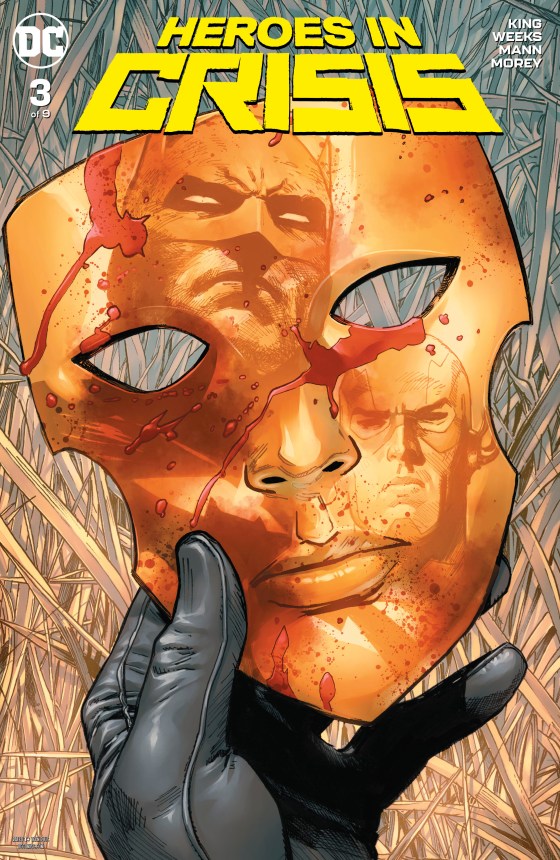
This was a rather intense and fast-paced narrative and it was clear that King was drawing a lot of inspiration from the iconic Identity Crisis crossover comic (another controversial comic that split the fan base, although I personally consider it a masterpiece).  However, unlike Identity Crisis, I think that Heroes in Crisis fell a little flat and I can see where a lot of the criticism surrounding it came from.  While this comic has a great start and the author sets up the whole mystery and characters perfectly, I felt that the ending had some major flaws to it.  The reveal of the killer, despite some hints throughout the story, is a bit of a letdown (admittedly, due to internet spoilers, I did know who it was in advance of reading this comic, but this didn’t massively impact my overall reaction).  While I could appreciate some of the motives surrounding the killer’s choices, especially as it ties into the psyche aspects of the comic, it was a bit of a weak choice that undermined an amazing and well-established character.  In addition, many aspects of the conclusion, such as the reveal, the killer’s motivations, and the eventual solution to some established problems, were unnecessarily complicated and required some major logic leaps.  I also did not quite get why King included a certain “bros before heroes” scene, as it proved to be a very odd inclusion for such a serious story.  While I did greatly enjoy the set-up, as well the impressive inclusion of flashbacks and character centric panels throughout the entire comic, this ending was a bit of a letdown that substantially affected how much I enjoyed Heroes in Crisis.

Heroes_in_Crisis_4

While the flaws in the story were a little disappointing, I think that King’s excellent character work more than makes up for it.  As he has previously done with his recent run on Batman, King attempts to really dive into the heart of the characters featured within Heroes in Crisis, highlighting their complex psyches and personalities to help to draw the reader in.  I also quite liked how this comic focuses on a very unique selection of characters, including several of my personal favourites.  While much of the story follows the Big Three, with some additional inclusions from the Barry Allen Flash, the major focus of the comic is on the fun duo of Booster Gold and Harley Quinn.

Booster Gold, unconventional time traveller and the greatest hero you have never heard of, is a character I have a lot of love for, especially as he is usually shown to be a bungling hero trying to do the right thing.  Booster ends up being an excellent character in Heroes in Crisis as he desperately tries to understand who is responsible for the deaths at Sanctuary, especially as he is a suspect himself.  While much of Booster’s appearance is comical, there is a deeper sadness to him, both before the killings and after them.  King does a masterful job showing off Booster’s inner thoughts in some of his therapy sessions while also presenting him as a damaged person potentially capable of committing the murders.  I loved seeing Booster used so prominently in the comic and I hope we see more of him in the future.  The appearance of Booster also ensures that we get to see some of his robot companion, Skeets, who has a fun relationship with Booster, often pointing out the stupidity of several of his plans, such as telling the Flash that he may be responsible for Wally West’s death and not realising it would get him punched in the face.

Heroes_in_Crisis_5

Heroes in Crisis also strongly features Harley Quinn, who DC have been heavily promoting recently.  Harley is her usual fun, chaotic self throughout Heroes in Crisis, although like Booster, deep down she is hurting.  King makes sure to explore the various damages that she still bears from her abusive relationship with the Joker, while also focusing on her current, relatively healthier relationship with Poison Ivy (who has a very lethal idea about therapy).  However, when Ivy is killed, Harley snaps a little and is determined to hunt down the person she thinks is responsible.  King does a great job showing off Harley’s unpredictability, humour and inner turmoil, and I liked how he presents her as a real threat, even to the likes of Superman and Batman.  Harley has a number of great moments throughout this comic, including a dangerous standoff, some great character development and some fantastic lines.  Harley also serves as a great foil to Booster, and when they are not trying to kill each other their conversations highlight their similarities, as both consider themselves failures in one way or another.  I deeply appreciated the use of Booster and Harley as key characters, and they were an outstanding focus of this comic.

Heroes_in_Crisis_6

Heroes in Crisis also features a fantastic array of supporting characters, and the creative team takes full advantage of their story to bring back some great underutilised heroes.  I loved how King spent time exploring all the various characters who were massacred at the start of the novel, especially as he examines why they were there seeking help.  While there is an obvious focus on the more prominent heroes like Wally West and Poison Ivy, I had a lot of fun seeing characters like Lagoon Boy, Commander Steel and Gnarrk the Last Cro-Magnon.  King did a lot with these very minor DC characters, using a few short sequences to build them up as sympathetic and likeable characters, ensuring that the impact of their death was a little more significant to the reader.  The inclusion of Wally West was also mostly well done and I appreciated the exploration of all the trauma and pain he has gone through in the last few years (being written out of existence for a few years is a painful experience).  Batgirl and Blue Beetle (Ted Kord) also show up as supporting characters for Harley and Booster respectfully, and I quite enjoyed the examination of the unique relationships between these friends.  All of these characters really add a lot to the story and I very glad that King took the opportunity to explore and highlight how complex some of these DC heroes can be.

Heroes_in_Crisis_7

While Heroes in Crisis has many good and bad qualities, without a doubt the best thing about it is the examination of traumatised heroes.  A large part of this comic’s narrative revolves around the fact that all the superheros in the DC universe are deeply traumatised or emotionally damaged because of their heroic careers, requiring them to seek treatment at Sanctuary.  While I know that some readers really disliked this portrayal of superheroes being emotionally and psychologically damaged, I personally felt that it was a clever inclusion from King that added a lot of realism to the DC universe.  Of course these heroes are going to be traumatised!  Most of them have been fighting crime or dealing with crazy people for most of their lives, experiencing innumerable tragedies and losses along the way, including dying and coming back to life multiple times.  It is honestly rather refreshing to see this acknowledged within the comics, and I deeply appreciated that King decided to feature it so prominently in Heroes in Crisis.

Heroes_in_Crisis_8

One of the reasons that this psychological plotline works so well is because Heroes in Crisis features a ton of panels and scenes highlighting the heroes as they discuss their trauma.  Not only do you get glimpses at several AI assisted therapy sessions, some of which are quite intense (Lagoon Boy’s one hurts to read at times), but there are a ton of “confession” panels, which show the various heroes sitting in a special room discussing their pain to a camera.  These confession scenes are cleverly scattered throughout the comic and are worked into the story extremely well, showing the raw psyche of some of the comic’s major characters or murder suspects and providing possible motivations for their actions.  At the same time, they work to show the reader just how damaged some of your favourite heroes can be.  While there is a focus on characters who were part of the Sanctuary massacre, nearly every DC superhero makes an appearance at some point in Heroes in Crisis, talking about their pain and their sorrow.  King ensures that each of these confessions, even the single-panel ones, are really emotionally rich and moving, and you get some amazing feelings out of all of them.  Highlights for me include a great sequence with Batman lamenting the death of his sidekicks, and another one with Commander Steel, who is pretty damn traumatised by his experiences of dying, being reborn as a zombie, having his corpse mutilated, and then coming back again.  Booster, Harley and Wally West also have some very intense, story driven confessions which both moved the story along and helped to get to the roots of their issues.  I found these scenes of trauma, healing and emotions to be particularly well written and very powerful, and they are one of the main reasons I enjoyed this comic as much as I did.

Heroes_in_Crisis_9

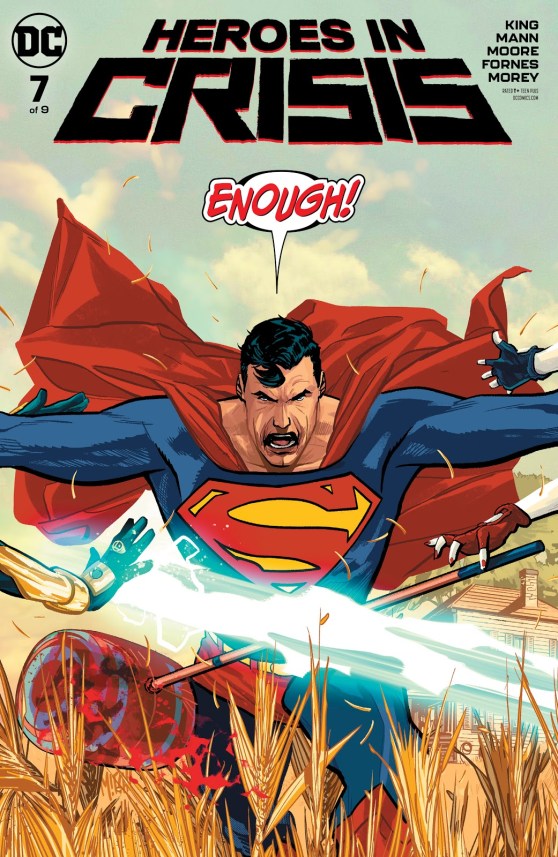
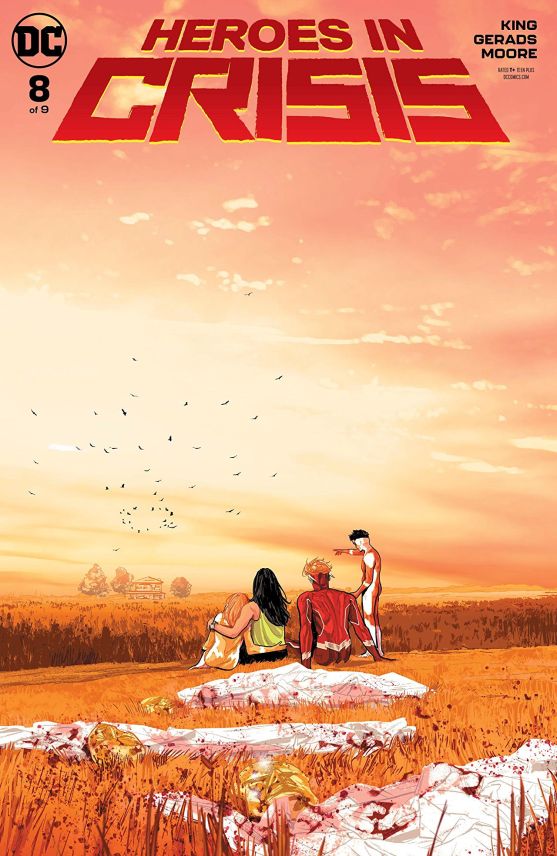
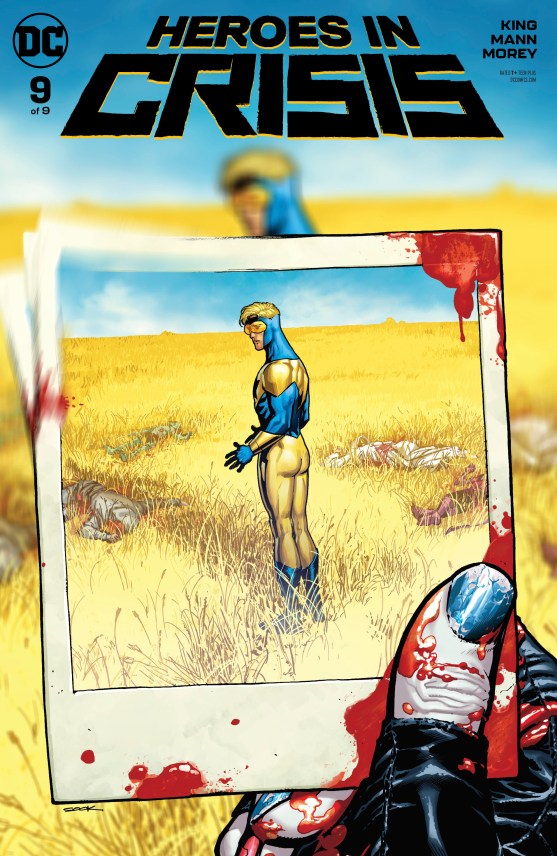
Another major highlight of Heroes in Crisis is the exceptional artwork by a massive collection of artists who banded together to produce some iconic and powerful pieces of art.  All of the scenes within this comic are very well drawn, and there is a real sense of movement, purpose and intensity in every panel.  I loved all the cool action sequences, and the artists really did not pull any punches when it came to highlighting the tragic deaths of so many different heroes.  Some of the best artwork, however, lies around the amazing and wonderful background and landscape shots throughout the comic.  There are so many fantastic shots that superimpose the characters in front of some beautiful settings, whether they be fields, sunsets or other pieces of nature.  These shots are not only visually impressive but they really add to the dramatic feel of the entire comic, especially as they remind you of the hope that so many of the damaged characters want to feel, but cannot, either because of the events of this comic or some pre-existing trauma.  The artistic team also has a lot of fun bringing to life a host of heroes from various periods of DC’s history, including some obscure characters we have not seen for a very long time.  While some of them were brought back only to die a painful death, it was great to see them again and the artwork surrounding them turned out to be superb.  I also deeply appreciated the artists’ ability to portray emotion and sorrow on the faces of each of the characters featured within Heroes in Crisis.  You get a real sense of the darkness and pain lying behind some of the characters’ eyes, especially in some unguarded moments, and it helps to enhance the emotion of the pages.  Overall, this was some impressive and memorable artwork that did a great job enhancing King’s intriguing tale.

Heroes_in_Crisis_9 (V1)

Heroes in Crisis was a very interesting and memorable comic which I had a great time reading.  While it does have some flaws, I think that the creative team behind it managed to create a very touching character driven narrative that succeeded in highlighting the vulnerabilities of several iconic DC superheroes.  I had an amazing time reading this comic and it is definitely worth checking out, especially if you are interested in exploring the damaged minds of some of your favourite heroes.

Amazon     Book Depository

Catwoman: Soulstealer by Sarah J. Maas

Catwoman Soulstealer Cover.jpg

Publishers: Penguin Random House

                        Penguin Random House Audio

Publication Date – 7 August 2018

Amazon

One of DC Comics’ most iconic and badass female antiheroes is re-imagined in this bold new novel from young adult fiction bestseller Sarah J. Maas.

Selina Kyle is a rough street kid growing up in the slums of Gotham City.  She looks after her sister while scraping a living as a gang member and pit fighter.  When her luck finally runs out, her potential is seen by the mysterious Talia al Ghul who saves her and recruited into the League of Assassins.

Two years later, Selina has returned to Gotham City with a plan to turn the city on its head as Catwoman, the master thief and criminal mastermind.  Using the alias of the spoiled socialite Holly Vanderhees, Selina has returned at an ideal time; Batman is not in the city, away on a vital mission, and he has left his protégé Batwing behind to safeguard the city.  Initiating a series of high-profile thefts, Selina soon has the attention of Batwing and GCPD, especially when she starts teaming up with her new BFFs Poison Ivy and Harley Quinn to wreak havoc around the city.

While Batwing searches the city for this mysterious new villain, his alter ego, Luke Fox, encounters his mysterious new neighbour, Holly, and the two find themselves drawn to each other as their alter-egos battle in the night.  While Selina is able to outfox Batwing, a far more destructive force is about to be unleased upon Gotham.  Catwoman stole something from the League of Assassins and now a cadre of their most lethal assassins are descending on the city.  Will Selina be able to survive their deadly attentions, what is Catwoman’s plan, and who will be left standing in the aftermath?

This is the third book in the DC Icons series, a series of young adult books that provide re-imagined origin stories for younger versions of DC’s most iconic characters outside of the other established DC universes.  Featuring a range of different authors, the first book in the series, Wonder Woman: Warbringer, focused on Wonder Woman before she left Themyscira to become a hero, while the second book, Batman: Nightwalker, followed a teenage Bruce Wayne as he attempts to stop a series of murders in Gotham City.  A fourth book in the DC Icons series, Superman: Dawnbreaker, is currently set to be released in March 2019 and will follow a young Clark Kent as he investigates strange happenings in Smallville.

Soulstealer is the first of these DC Icons books that I have read, and I was quite impressed with the new and unique Catwoman story that it contained, as well as the cool new versions of several DC characters, including Poison Ivy, Harley Quinn and Batwing.  I listened to this book in its audiobook format, read by Julia Whelan.  I quite enjoyed having the story narrated to me, especially as it only took around 10 hours to get through.  While I initially had misgivings about whether I would like this series, after reading and loving Soulstealer I will definitely be getting a copy of Dawnbreaker when it is released next year, and Warbringer and Nightwalker will both be appearing future versions of my Throwback Thursdays reviews.

The author of Soulstealer, Sarah J. Maas, is one of the biggest names in modern young adult fiction, having written two best-selling young adult series in the last six years.  Her long-running Throne of Glass series finished earlier this year, and she has also created the A Court of Thorns and Roses series.  Soulstealer is the first Sarah J. Maas book that I have had the pleasure of reading, but after really enjoying the intricate story and fantastic characters within the novel I am keen to see what her fantasy books are like.  As a result, her Throne of Glass series is high on my list of books to check out in the future, especially after seeing just how awesome the artwork is on some of those covers and collected box sets.

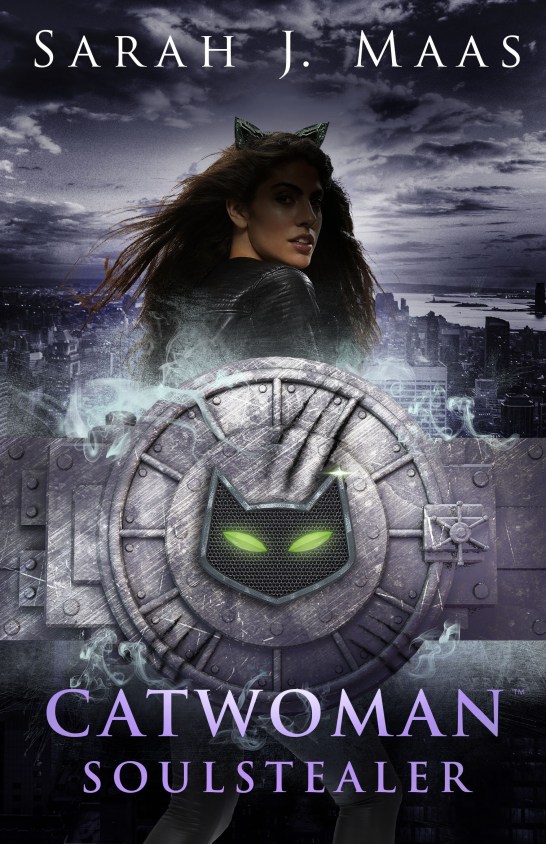
Maas has installed a fantastic and clever story into her debut DC novel, and I really enjoyed how she re-imagined the origins of prominent comic book character.  Soulstealer contains a younger version of Catwoman, introducing her as a teenager gang member and focusing on her initial life of crime.  After the introductory paragraph, the story jumps ahead two years to Selina’s return to Gotham and her initial adventures as Catwoman, while also featuring several flashbacks to her training with the League of Assassins.  This main story is then told from two separate point-of-view characters, Selena and Batwing, and shows the characters in both their costumed adventures and as the people behind the masks in their civilian identities.  Soulstealer has a tight and intricate storyline that contains the perfect balance of comic book action, relationships, backstory, references and variations to comic lore, as well as a number of heists and intricate plots.  I loved Catwoman’s overall plan, as she engages in a play to take over Gotham while really nursing an ulterior motive that pits her against the League of Assassins.  I loved the slow reveal of this complex and insane plan, as well as the lengths she goes to bring her plan to pass, including making some dangerous partnerships.

One of the most interesting and significant changes that Maas makes to Catwoman’s origin story in this novel is the fact that she never meets or associates with Batman.  In nearly every previous iteration of Catwoman, her story has always been intertwined with Batman’s, as the two were usually each other’s main love interest, either as Batman and Catwoman or Bruce Wayne and Selina Kyle.  However, in Soulstealer, Catwoman is substantially younger than Batman, who starts his crusade years before she is trained by the League of Assassins.  In addition, Batman is not present in Gotham when she returns to the city and throughout the book the two characters have no interactions at all.  Instead, Catwoman’s main love interest is the Luke Fox version of Batwing, who has been defending Gotham in Batman’s absence.  This results in a similar romance plot to some of the classic Batman and Catwoman storylines, where the two characters meet and start to fall in love with each other in both of their personas, despite their apparently different personalities.  This is a fun little romance that does get serious at times, as the two characters are mirrored by their personal traumas and backstories, such as a Selina’s life on the streets and with the League, versus Luke’s PTSD as a result of his time as a marine.  There are also some great moments when the two characters face off against each other, and some of the book’s best laugh-out-loud moments came when Catwoman messes with either Batwing or Luke, sometimes at the same time.  To my mind, the funniest scene in the book had to be when Batwing, after getting injured and rescued by Catwoman, awakens half-naked in a darkened room, only to find out that he is actually in Commissioner Gordon’s spare bedroom.  The moment Luke walks out to find Gordon and his family staring at them was pretty darn funny, especially when Batwing attempted to play it off nonchalantly while silently cursing Catwoman.

One of the elements of Soulstealer that I really appreciated was the references and re-imagined versions of several DC comics characters that appeared throughout the novel.  A huge range of DC characters, many tied into the Batman comics, appear throughout the book in a number of different capacities.  The characters that appear range from the iconic to the obscure and are enough to delight both hardcore comic fans and those with a more casual knowledge of these comics.  Several major Batman characters appear throughout the story; I will refrain from mentioning the full roster of characters to cut down on spoilers, although there is one appearance that was particularly awesome.  While a number of these characters have key or interesting differences between their mainstream comic book counterparts, it is clear that Maas has a real understanding and appreciation for the lore behind these characters.  It is also incredibly fascinating to see how Maas changes these characters for the purposes of her story, and the subtle tweaks that are made to accommodate this different universe.

Of all these additional characters, two of the best and significant inclusions are fellow supervillains Poison Ivy and Harley Quinn, who team up with Catwoman to bring a little chaos to Gotham.  In the comic universe, these three supervillains occasionally form a team known as the Gotham City Sirens, and it was great to see them together in this book.  Like Catwoman, both Poison Ivy and Harley Quinn are quite young and have slightly altered origin stories which somewhat mirror the new origin story of Catwoman.  However, some of the key elements that made these characters so great in their comic book origins remain alive in these book adaptations of the characters and which work extremely well with Maas’s fantastic Soulstealer storyline.  For example, in this story, Harley is still obsessed with the Joker, no matter how much it impacts her relationship with the others, and there are a lot of discussions between Catwoman and Ivy about the roots of her obsession and insanity.  There is also a very clear and acknowledged romantic connection between Ivy and Harley that adds a really interesting element to the story, especially as Harley’s insanity stands in the way of the more serious relationship Ivy desires.  The inclusion of these characters adds in a defining friendship for a main character who has never had the option of friends before, and it’s also a lot of fun seeing these three characters work together, especially as they have such diverse skill sets and range of attitudes.  Overall, I really loved the fact that Maas included Poison Ivy and Harley Quinn as key characters in her novel, and it was a lot of fun to see her version of these young villains banding together for the first time and forming an outstanding partnership.

Rather than read a physical copy of this book, I grabbed the audiobook copy of Soulstealer and listened to that instead.  The audiobook is narrated by Julia Whelan, who does an amazing job capturing the essence of the book’s main character, Catwoman/Selina Kyle.  When focused on Catwoman’s point of view, the listener gets a real sense of the character’s emotions and attitude, and the voices that Whelan assigns to the other main female characters, Ivy, Harley and Talia, are fairly distinctive and fit well with the character.  I thought that the voice that the narrator used for the book’s other point-of-view character, Batwing/Luke Fox, was very serviceable and conveyed the character well enough.  However, I was a tad disappointed that the narrator did not do too much with several of the other iconic Batman characters in the story, such as Alfred, Batman or Commissioner Gordon, especially as these major characters have all been portrayed by amazing actors or voice actors in the past.  Still, the audiobook version is a great way to enjoy this story and it certainly helped me power through this novel quickly without forcing me to skip over any of its important elements.

Catwoman: Soulstealer is an excellent young adult superhero novel from acclaimed author Sarah J. Maas.  This book is a fantastic standalone novel that re-imagines an iconic DC comic book character.  No great previous insight into Catwoman or the DC universe is required, and those with even a glancing knowledge of the comic book characters will be able to enjoy this novel to its full potential.  This serves as a very good young adult novel that will hopefully draw in a younger generation of readers into this established universe, and I appreciated Maas’s casual inclusions of a number of LGBT+ elements.  Soulstealer comes highly recommended and it has certainly sparked my interest in checking out all the other books in the DC Icons range.

My Rating:

Four and a half stars

Amazon