
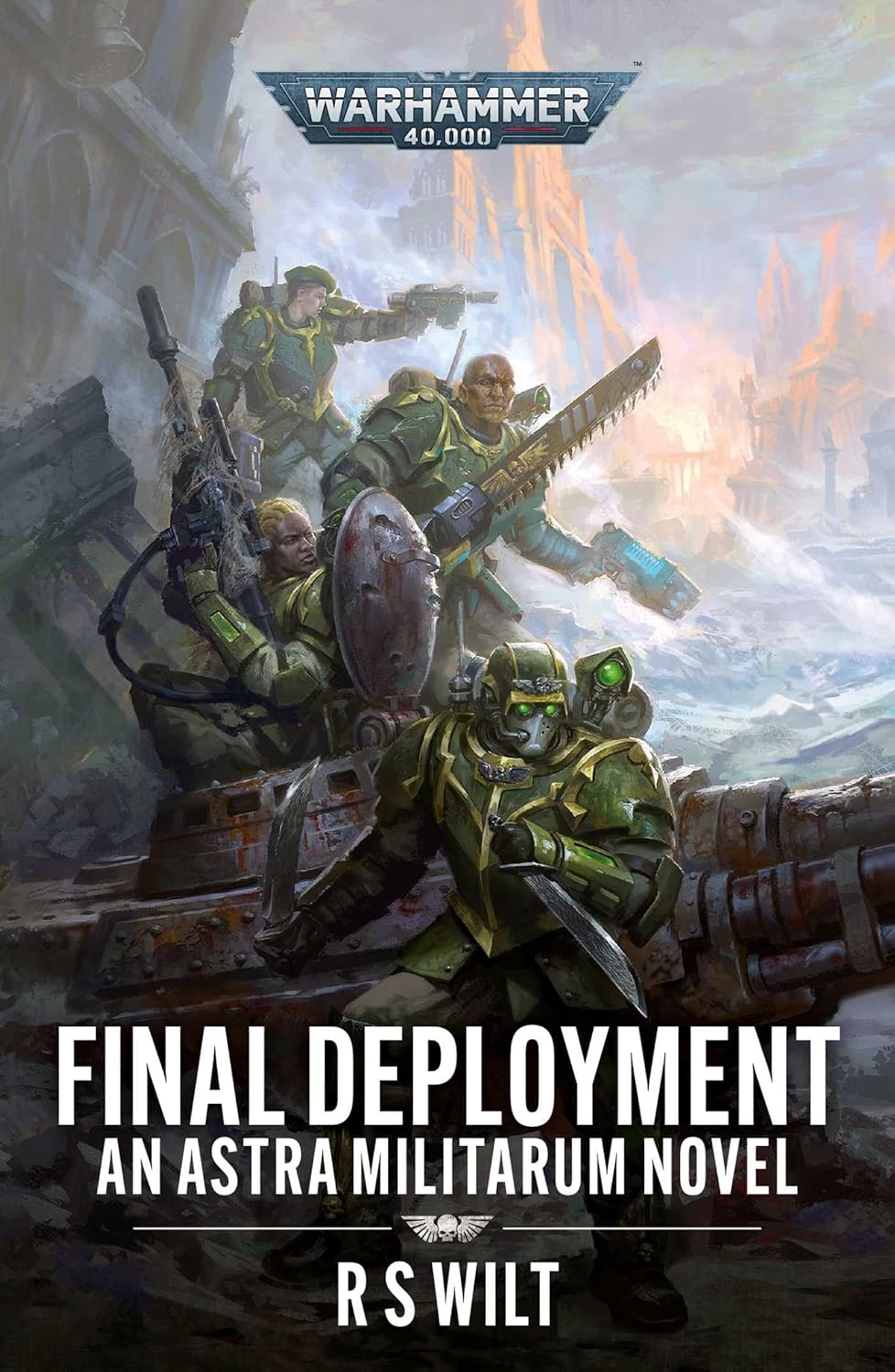
Publisher: Black Library (Audiobook – 30 August 2025)
Series: Warhammer 40,000
Length: 11 hours and 23 minutes
My Rating: 4.5 out of 5 stars
Prepare for battle as R. S. Wilt presents his debut novel, Final Deployment, a captivating read that perfectly highlights bloody war in the grimdark future of the Warhammer 40,000 universe.
There are few franchises that bring me as much joy as the Warhammer 40,000 series, which follows the numerous factions of the infamously grimdark 41st millennium. The sheer amount of imaginative stories and tales that are featured in this universe, as well as the talented authors who contribute to it, is quite impressive, and includes some major established writers. I particularly like how the Warhammer 40,000 publishers also give some interesting opportunities to new authors looking to break into the fantasy or science fiction space. Many aspiring authors have had their very first novel published in the Warhammer canon recently, and I deeply enjoy reading debuts from these new writers. Examples of this include Fire Made Flesh by Denny Flowers, The King of the Spoil by Jonathan D. Beer, Ashes of Cadia by Jude Reid, Longshot by Rob Young, Deathworlder by Victoria Hayward and Lord of Excess by Rich McCormick, to name a few. Many of these debuts are first class reads, and I’ve featured a few on my favourite Warhammer 40,000 novels lists over the years.
Due to my previous awesome experiences with debuts in this franchise, I am always very excited to check out first Warhammer 40,000 novels from new authors, especially those with epic plots. The latest example of this is Final Deployment by R. S. Wilt, which was the author’s very first novel. Spinning off from his previously published short story Eradicant, Final Deployment had a very exciting plot behind it that follows the most lethal human soldiers in the grimdark future, the Tempestus Scions.
In the far future, the Imperium of Man battles for survival on thousands of planet-spanning battlefields, with untold numbers of human soldiers fighting and dying every day against monsters, xenos and heretics. Of these soldiers, none are more deadly or skilled than the Tempestus Scions. Moulded into unquestionable killing machines from a young age with relentless training and mental manipulation, the Tempestus Scions serve as an elite force with the soldiers of mankind, taking on the missions that no other soldier could complete.
Amongst these Tempestus Scions are the fighters of First Eradicant squad of the Xian Tigers. Led by Tempestor Traxel and “inspired” by Commissar Fennech, First Eradicant are an unusual regiment made up of several misfit Scions damaged by the battles they have seen. Deployed to the planet of Rilis, a formerly loyal world now fighting a brutal civil war, First Eradicant is tasked with destroying the rebelling regiments and bringing order to the planet. Utilising their superior training and equipment, First Eradicant quickly turn the tide against the enemy and being to lead the loyalist forces on Rilis to victory. However, their success leads them discover the full strength of the traitors, as well as their dark allegiances.
After a disastrous battle that sees their loyalist allies massacred, First Eradicant find themselves facing monstrous opponents even more lethal than they are; three Chaos Space Marines from the Iron Warriors legion. Determined to slay the ancient, genetically enhanced traitors, First Eradicant take the fight to the Iron Warriors across the planet. However, with their leader traumatised by past battles and Commissar Fennech playing his own sinister games, can even the best human soldiers in the galaxy defeat the evolved might of the Chaos Space Marines?
R. S. Wilt starts his professional writing career off in explosive fashion with this amazing and compelling debut. Final Deployment was a deeply exciting character-driven Warhammer 40,000 story that followed several highly damaged characters as they attempted to survive the horrors of war. Intense, action-packed and deeply addictive, Final Deployment was an outstanding read that I had an incredible time getting through.
I really enjoyed the epic and deeply exciting narrative that Wilt pulled together for Final Deployment, which perfectly showcases futuristic special forces soldiers going after a deadlier opponent. Set after the events of the author’s previous short story Eradicant, Final Deployment has a quick and effective start to it, as Wilt first sets the scene for the war on Rilis, before introducing the members of First Eradicant as they literally drop onto the scene. Each of the protagonists, especially lethal and reckless recon trooper Norroll, gets their moment to shine in these opening scenes, which also work well to highlight Wilt’s intense writing style. You are soon dragged into the story, and while the initial parts of the book are a tad slow, that changes with the pivotal battle around a third of the way through that sees the Chaos Space Marines arrive in bloody fashion.
Wilt did an outstanding job of changing the tone of Final Deployment after this big moment, as the protagonists find themselves heavily on the backfoot, and there are some notable PTSD elements hitting Tempestor Traxel. The rest of the novel revolves around the protagonists attempting to hunt down and stop the Chaos Space Marines, no matter how the rest of the war is going. The story from that point is essentially broken down into three distinctive parts, each of which showcase the very different, but equally brutal, fights against the separate deadly antagonists. Wilt does an excellent job setting up the scenarios around these battles, which include infiltrating a deadly facility, a brutal ambush by a daemonic possessed foe, and an air drop into enemy territory, and you soon get enthralled in the protagonist’s desperate mission. These events work extremely well as a sequential and cohesive narrative, and you get really absorbed in the mission of the slowly dwindling group of Tempestus Scions. Everything leads up to the desperate final confrontation between the protagonists and their deadliest foe, which hits hard and keeps you guessing about who is going to survive. I felt this entire story came together perfectly, and the ending does an excellent job wrapping up Final Deployment as a standalone Warhammer 40,000 story, with the potential left open for a sequel. An overall excellent narrative that was quite impossible to put down at times.
While the story is very cool, I also felt that Final Deployment was extremely well written, as Wilt produces a powerful, character-driven narrative that focused on the horrors of war in the grimdark future. Expertly utilising the iconic Warhammer 40,000 universe in this clever and brutal war story, I loved how the intense personal narratives blended with the more outrageous elements of franchise. Wilt puts his evident skill at writing brilliant and bloody action sequences to good use in Final Deployment, and the resulting firefights and close combat sequences were some of the more intense and striking you are likely to see in Warhammer fiction. The author maintains an excellent, fast pace throughout the entire novel, and there wasn’t a single slow moment or inclusion that didn’t play into the story in some interesting or compelling way. I also appreciated the great use of alternate perspectives, as the story cleverly jumps between several key characters. This is primarily utilised to showcase multiple angles to the book’s awesome action sequences, which was a ton of fun. However, I also enjoyed how Wilt took the opportunity to examine the plot from the perspective of several interesting supporting character, including a couple of antagonists. This helps Wilt to present an even more layered narrative, and it is always really entertaining to see the villain’s reactions to the protagonist’s actions.
Final Deployment is also an excellent and entertaining addition to the Warhammer 40,000 franchise, which works well as an exciting standalone novel. Despite diving straight into the universe, Final Deployment is accessible to readers no matter their experience with Warhammer fiction, as the author provides a lot of intriguing universe details. This includes the Tempestus Scions, who serve as the human faction’s ultimate special forces unit outside of the genetically enhanced Space Marines. The author does an incredible job showcasing the skill and tactics of the Scions throughout Final Deployment, and you really appreciate that they are a highly trained and better equipped regiment. While Wilt somewhat exaggerates the effectiveness of the Scions and their equipment for narrative purposes (especially carapace armour), you get a realistic sense of these figures in combat, and I appreciated how the characters were slowly debilitated by injuries and losses. There is also a fascinating look at the harsh training and religious brainwashing these figures undergo, which fits the grimdark Warhammer 40,000 universe perfectly. Other elements of Warhammer fiction are cleverly utilised here, and I loved the author’s depiction of just how dangerous Space Marines and their chaotic counterparts are compared to normal humans, even the Tempestus Scions. The damage three Iron Warriors were able to do to the loyalist army, and the lengths the protagonists went to beat them, was so beautifully excessive, and I felt it was an appropriate amount of power scaling. Thanks to these cool features from the Warhammer 40,000 universe, this book will primarily appeal to established fans of the franchise, although thanks to Wilt’s great writing, new readers will also have a lot of fun with it, even if they didn’t read the author’s previous short story.
While much of the appeal of Final Deployment was its epic story, great writing, and impressive action, I also felt the complex characters helped to make it even more special. Primarily set around a group of Tempestus Scions, Final Deployment featured an intriguing look at these figures, their damaged pasts, and the struggles they experience on and off the battlefield. Wilt does an excellent job of splitting the focus of Final Deployment over much of the extended cast, and indeed its nominal main characters, Tempestor Traxel and Commissar Fennech, don’t have that much of the book shown from their perspective. Instead, most of the story is told through the eyes of other key members of the squad, including Norroll and the squad’s medic, Daviland. This allows these secondary figures in the squad much more room to shine, and I felt the book was stronger as a result. Norroll in particularly was quite a fun character. An overly reckless Scion, Norroll finds himself caught between loyalty to Traxel and his squad, and his own death wish, and it was often really intriguing to see him in the middle of the bloodiest scenes in the book. Daviland served as an excellent counter to Norroll’s more outrageous perspectives, especially as she is one of the saner members of the squad. A transplant from another regiment, Daviland provides an interesting outsider’s perspective to the book, especially as she has a lot less mental damage the rest of First Eradicant. Despite her loyalty primarily being to Fennech, Wilt writes an excellent storyline around Daviland becoming closer to her squad, and I felt that her perspective scenes were some of the more thoughtful and provided some great insights in the minds of the rest of the characters.
Of the rest of the cast, Tempestor Traxel and Commissar Fennech, had the most presence. Despite not serving as perspective characters, both were major parts of the book’s plot, and Wilt did an excellent job showcasing their personalities and issues through the eyes of the other protagonists. This includes Traxel’s mental trauma at once again facing Chaos Space Marines after a previous deadly mission, and his impacted leadership adds an extra layer of difficulty to the protagonists’ mission. Fennech, on the other hand, was a great portrayal of a classic, cold-blooded Imperial commissar, shooting allies first and never asking questions. Fennech served an interesting role as both an ally/gun-bearing motivator, and a potential secondary antagonist to First Eradicant, especially as he questions their effectiveness and resolve. While Fennech’s storyline doesn’t go as far as it could have, and I would have liked seeing some of the book through his steely eyes, I felt that he was an outstanding inclusion to Final Deployment’s cast that added some excellent alternative menace.
In addition to these characters, I enjoyed how the rest of First Eradicant also got their time to shine in this novel. Featuring a mixture of existing members and later transfers from another squad, each of these characters had their own unique charm, and their compelling interactions added a lot to the novel’s enjoyment. While there isn’t an excessive amount of development with some of these characters, which is mainly down to the mental indoctrination they’ve gone through, they were still fun to follow. Just make sure not to get too attached to them, as the death toll in this novel is quite high. Wilt matches these excellent perspective characters with several additional outsider characters, including several gloriously over-the-top antagonists, and the clash of styles and mentalities increased the overall fun and excitement I had with Final Deployment.
Unsurprisingly, I ended up listening to Final Deployment on audiobook, rather than seeking out a physical copy of the book. I always find that the audiobook format brings out the very best of the grimdark Warhammer 40,000 universe and the unique characters that inhabit it, and the Final Deployment audiobook was a great example of this. Perfectly narrated by Andrew Wincott, who previously impressed me with his voice work in Deathwatch: Shadowbreaker by Steve Parker and Huron Blackheart: Master of the Maelstrom by Mike Brooks, the intense action and harsh nature of war featured in Final Deployment really comes through in this audiobook, and I loved hearing all the intense firefight sequences come to life. Wincott did an excellent job moving this intense story along at a quick clip, while also providing all the characters with distinctive voices that really fit their unique and gritty personalities. The fun mixture of voices between the battle-weary human soldiers and the more unnatural forces of Chaos was extremely enjoyable, and you really get drawn into the compelling narrative as a result. I honestly flew through the over 11-hour long audiobook in no time at all, and I loved every second I spent listening to it, especially some of the more brutal and deadly fight sequences.
Loaded with awesome action, damaged characters and an epic narrative, Final Deployment by R. S. Wilt was an incredible read and an amazing piece of Warhammer 40,000 fiction. A fast-paced novel that follows some intense protagonists through hell and back, Final Deployment was an outstanding debut from Wilt, and comes very highly recommended, especially on audiobook. I look forward to seeing how Wilt’s writing career continues in the future, and I am sure I will enjoy any additional contributions to the Warhammer franchise.
 The Unseen Library