Warhammer 40,000: The Traitor’s Hand by Sandy Mitchell

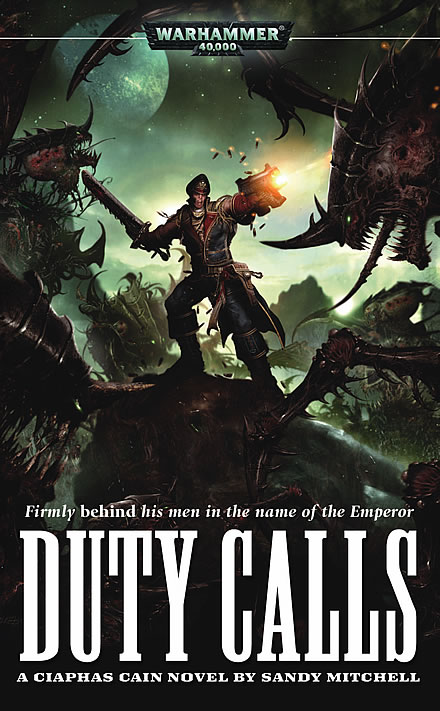
The Traitor's Hand Cover

Publisher: Black Library (Audiobook – 1 January 2005)

Series: Ciaphas Cain – Book Three

Length: 9 hours and 6 minutes

My Rating: 4.75 out of 5 stars

Amazon

After updating my list about my favourite Warhammer 40,000 novels last week, I was keen for more action from this awesome franchise, so I decided to quickly listen to the entertaining and fun novel, The Traitor’s Hand by Sandy Mitchell.

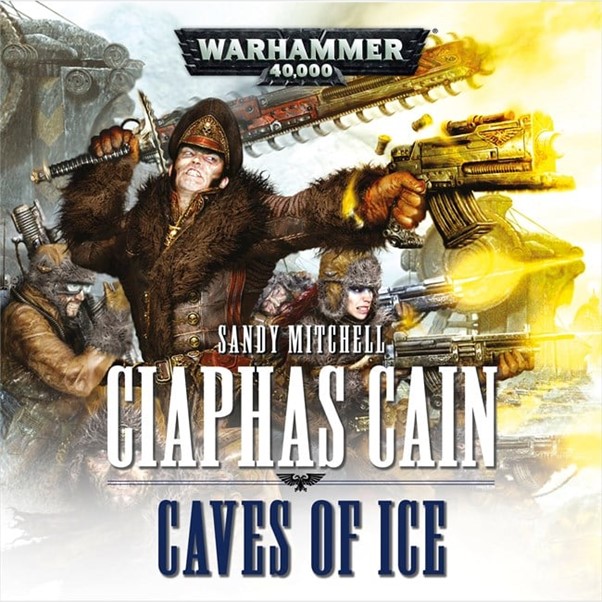
One of the things that I like most about the Warhammer 40,000 franchise is the sheer range of different stories and genres that can be found within it.  For example, one of the most popular series is a particularly funny and amusing series that focuses on a Blackadder-esque Imperial Commissar as he finds himself involved in all manner of over-the-top heroics.  This series is the Ciaphas Cain books, which follows the titular protagonist who has accidently become regarded as a great hero of the Imperium of Man, despite most of his actions being more for self-preservation.  The first two books in this series, For the Emperor and Caves of Ice, were extremely fun reads, and I have been meaning to check out the next book in the series for a while.  As such, when I had my recent Warhammer 40,000 craving, the third Ciaphas Cain book, The Traitor’s Hand, was an easy choice.

Commissar Ciaphas Cain, hero of the Imperium or unrepentant coward?  Constantly forced into the direst of circumstances despite doing everything in his power to avoid them, Cain has built up a reputation he considers entirely undeserved, especially as being known as a hero always seems to get him into trouble.  His latest assignment will test him like none other, especially when he is forced to go up against the great archenemy of the Imperium, the forces of Chaos.

With a Chaos fleet approaching the tidally locked planet of Adumbria, Cain and the soldiers of the Valhallan 597th are rapidly redeployed towards the planet to aid in its defence.  Despite wishing to stay off the frontlines, Cain’s experience and uncanny ability to find trouble forces him to join in the hunt for a Chaos cult hidden throughout the planet that has awakened in advance of the coming fleet.  However, the more he digs, the more he discovers that there is something far more sinister going on within the planet than anyone realises.

As the invading enemy arrives on the planet, it soon becomes apparent that two rival bands of Chaos worshippers are attacking Adumbria with very different goals in mind.  Leading the fight against the enemy, Cain needs to work out just what their objectives are before the world is destroyed in the Chaos crossfire.  However, with deadly enemy forces all around and a rival commissar determined to undermine him, can even the terminally lucky Cain stop them, especially when an old nightmare returns seeking revenge against him.

The Traitor’s Hand was an extremely awesome book from Mitchell that I had so much fun getting through.  Containing the outstanding blend of action, humour and intriguing characters that the Ciaphas Cain series is known for, The Traitor’s Hand was pretty damn epic, and I managed to power through it in about a day of intense listening.

This third Ciaphas Cain novel had a great story behind it that I had a wonderful time listening to.  While it does follow some similar story conventions to the previous books in the series, in that Cain and the Valhallan 597th arrive on a planet to face one foe, only for Cain to inadvertently discover another threat hidden under the surface, I think Mitchell did a good job distinguishing this book from the previous entries.  The introduction of a rival Commissar and alternating bands of Chaos worshippers makes for a great central storyline, and you get really involved in the battle for the planet and the attempts to discover a hidden Slaaneshi cult who are performing dark rituals.  The entire story evolves in a familiar manner, with Cain’s attempts to avoid a fight leading him into darker situations each time, while his keen insights allow him to determine where the true threat to the planet is located.  The big final sequence for The Traitor’s Hand was pretty damn awesome, as Cain leads a small force into a massive battle royale between warring Chaos warbands while also facing a dangerous foe from his past.  While the big bad’s identity was overly foreshadowed, their inclusion was very intense and lead to a gripping conclusion.  I do wonder if this repetitive story structure is going to be sustainable for the series in the future, but I really got stuck into this entertaining and exciting narrative and powered through it so damn quickly.

I absolutely loved the fun style of the Ciaphas Cain books which Mitchell once again uses to tell a fantastic story.  Primarily told from the first-person chronicle perspective as Cain recounts his many adventures, you get to see his insights into events that occur.  While on the surface this appears to be a typical Imperial Guard focused Warhammer 40,000 story, it is a much lighter read, as the book revolves around Cain’s continued attempts to get out of danger only to encounter worst problems.  It is really entertaining to see his excuses and manipulations, especially as nearly every action he does is calculated to avoid danger, which he shamelessly admits to.  The continued increase of stakes, desperate response from Cain and the inevitable lucky escape makes for some fun reading, and Mitchell does an excellent job of layering a strong amount of comedy into a usually dark universe.  This humour is expertly enhanced by the overarching narration of the book, provided by Inquisitor Vail’s editorial notes as she collates Cain’s memoirs.  Vail’s various notes, quotes and included histories of the story provides some much-needed context to the plot, while the entertaining and often sarcastic way they are delivered works extremely well.  I think that Mitchell got the right blend of humour, action, and dark moments throughout the course of The Traitor’s Hand, and I really got engrossed in the hilarious and action-packed story that emerged.  I did feel at times that Mitchell did get a bit repetitive with some of his phrases and lines, which you really notice with an extended read, but this is honestly a pretty minor complaint, and The Traitor’s Hand proved to be an amazing read.

I liked how well Mitchell featured the Warhammer 40,000 universe in The Traitor’s Hand, especially as he once again seeks to showcase the horrors of the franchise from the eyes of a human solider, even one as lucky as Ciaphas Cain.  The various Chaos factions prove to be great villains in this story, and I loved the cool comparisons between the Slaaneshi cult and the Khorne-worshipping warband.  You also get a great insight into the life of the common soldier or civilian, and it was fun to see the various responses many of them have to the reveals about Chaos and their dark designs.

Like most of the Ciaphas Cain novels The Traitor’s Hand can easily be read as a standalone book, and no real pre-knowledge of the Warhammer 40,000 universe is really needed.  Indeed, I really appreciated how efficiently Mitchell is able to ease new readers into the wider Warhammer 40,000 universe.  In addition, readers don’t really need to have checked out the prior Ciaphas Cain novels either, as Mitchell does a good job of summarising the necessary key points from these books when needed.  There were some strong references to the Ciaphas Cain short story, The Beguiling, which if you had read would have increased the impact of The Traitor’ Hand to a degree, however, it is also not necessary to have read it first, as Mitchell recaps it very well.  Overall, I felt this was a great piece of Warhammer 40,000 fiction that many people can get into.

A key highlight of any Ciaphas Cain novel is the excellent character work that Mitchell installs into the story.  This is certainly the case in The Traitor’s Hand, with most of the character work revolving around the protagonist and main point-of-view character, Commissar Ciaphas Cain.  While Mitchell has done a great job setting up this figure in the previous two books, it is always so much fun to see a story through Cain’s eyes, especially as the protagonist bears the duality of being a hero and a coward at the same time.  Fitted with a well-honed sense of survival, Cain is constantly trying to find ways to get out of danger and has proven quite adept at manipulating people to get what he wants.  However, due to bad luck or because he finds himself trapped by his own legend, Cain is constantly dragged into the most dangerous situations possible.  While it would be easy to dislike a character like this, readers quickly become aware that Cain isn’t as big a coward as he believes, and instead he is quite a skilled, brave and caring leader whose “cowardly” actions are often borne by shrewd assessment and tactical awareness.  Throw in his excellent sense of humour, his entertaining insights into the universe, and his vast experiences with the many different things trying to kill humans in the Warhammer universe, and Cain is such a great protagonist to follow.

Aside from Cain, The Traitor’s Hand features a raft of other great characters, each of whom bring a lot to the story.  For example, Inquisitor Vail, despite not appearing in person, serves a big role in the book, editing Cain’s unreliable manuscripts.  I loved her witty over-arching narration and notes throughout the book, and it was fun to have someone constantly calling out Cain for his wilder statements.  I also loved the continued inclusion of Cain’s aid, Jurgen, the man capable of killing anything in the galaxy with his trusted meltagun.  I love how Mitchell sets Jurgen up as the Baldrick to Cain’s Blackadder in this series, especially with his attitude, hygiene and loyalty, although he proves to be a vital ally.  It was also interesting to see Mitchell continue to explore just how vital Jurgen is to Cain’s success, especially due to his status as a Blank, and I love the entertaining team the two characters combine into.  New character Commissar Tomas Beije, an old school rival of Cain’s, serves as a great secondary antagonist for much of the story, and it was entertaining to finally see a character suspicious of Cain’s status as hero, especially as he looks deranged spouting out accusations we know to actually be true.  Finally, the various members of the Valhallan 597th, many of whom were introduced to us at the same time as Cain, continue to grow as characters and serve great supporting roles in the story, and it was touching to see how their relationship to the protagonist has grown over the years.

I have often said throughout my many reviews on the subject that the best way to enjoy a Warhammer 40,000 novel is its audiobook format.  Nowhere is that truer than the Ciaphas Cain audiobooks, which really capture the zany feel of the series through its excellent narration and style.  Most of this is due to the excellent use of multiple narrators, whose mixture of voices creates a particularly epic read (indeed this one of my favourite audiobook series with multiple narrators).  The Traitor’s Hand features four separate narrators, each of whom add so much to my enjoyment of this audiobook.  Each of these narrators has a distinctive role, with the amazing Stephen Perring providing the bulk of the narration in this series, as he narrates the chapters told from the protagonist’s perspective.  Perring serves as an epic centre for this audiobook, especially as he does such a good job capturing the larger-than-life Ciaphas Cain with his acting.  Perring’s take on Cain’s cocky dialogue, as well as his more honest chronicling of events, is impressive, and I love how he captured the various aspects of Cain’s character.  There are some other great voices featured throughout these chapters as well, as Perring assigns fitting and entertaining voices to each of the major characters.  My favourite of these is probably Jurgen, especially as Perring really tries to make him sound as much like Tony Robinson as possible.

While Perring does most of the narration in The Traitor’s Hand, the additional voice actors also add a lot to the story, especially Penelope Rawlins.  Rawlins voices the character of Inquisitor Vail, the Imperial Inquisitor and acquaintance of Cain who is compiling the memoirs for publication.  As such, Rawlins voices the prelude, chapter introductions and footnotes contained in this book to showcase the editorial notes that this character is adding in to make Cain’s ramblings easier to read.  Rawlins serves as a good contrast to Perring, especially as her character’s more serious tones are the direct opposite of Perring’s flippant take on Cain.  I love how seamlessly the production works Rawlins’ voice into the various points of the audiobook where her character cuts into the main story, and you really get into the groove of her explaining key details about the universe and the characters.  Throw in the additional voice work of Emma Gregory and new narrator Andrew Spooner, who give their voices to various in-universe texts that provide additional information for the reader, and you have a strong team who masterfully enhance Mitchell’s brilliant story.  These great actors really help to make this entire audiobook production so much fun to listen to, and with a runtime of just over nine hours, you can very easily sit back and listen to The Traitor’s Hand in one fantastic sitting.

With The Traitor’s Hand, Sandy Mitchell continues to showcase why he is one of the strongest, and funniest, authors of Warhammer 40,000 fiction.  Filled with the series’ trademark humour, intriguing characters and intense action, The Traitor’s Hand was an entertaining audiobook from start to finish that I could not turn off.  An outstanding and highly recommend novel, The Traitor’s Hand was so damn good, and I cannot wait to see how Mitchell continues this amazing series.

Amazon

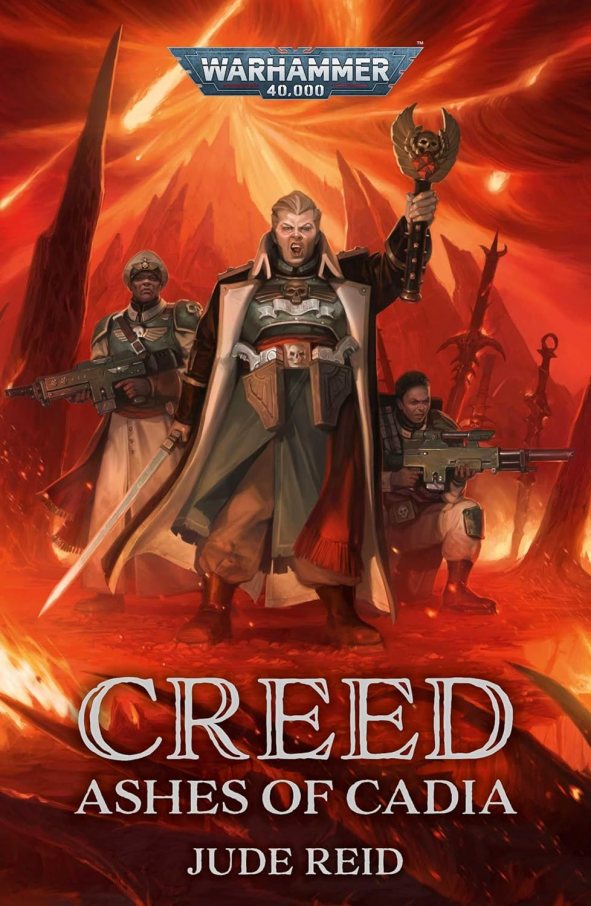
Warhammer 40,000: Creed: Ashes of Cadia by Jude Reid

Creed - Ashes of Cadia Cover 2

Publisher: Black Library (Audiobook – 9 September 2023)

Series: Warhammer 40,000

Length: 14 hours and 36 minutes

My Rating: 4.5 out of 5 stars

Amazon

Exciting new Warhammer 40,000 author Jude Reid presents an action-packed and captivating novel that takes the reader to one of the most desolate places in the franchise’s universe, the ruins of Cadia, with the exciting novel Creed: Ashes of Cadia.

Last year proved to be an outstanding year for new authors producing their first Warhammer 40,000 novel, with several highly talented authors, such as Rob Young (Longshot) and Jonathan D. Beer (The King of the Spoil), producing amazing and intense reads in this fantastic universe.  One of the most interesting of these 2023 Warhammer 40,000 debuts was the impressive and captivating Creed: Ashes of Cadia by new author Jude Reid.  Reid’s first full novel after writing multiple Warhammer 40,000 short stories, Ashes of Cadia takes the reader on an epic journey with a new major protagonist.

Years after the fall of Cadia to the dread forces of Chaos, the Imperium of Man is still reeling from the carnage wrought in its aftermath which saw a massive warp rift cleave their besieged intergalactic realm in two.  Led by the returned Primarch Roboute Guilliman, humanity fights back as best it can in a great crusade, but its victories are never enough.  When word reaches Guilliman of a potential weapon on the most unlikely of locations, desperation requires him to investigate, and there is only one person he can call on for this dangerous mission.

After continually proving herself on the field of battle, Ursula Creed has succeeded her father, Ursarkar E. Creed, in becoming the new lord castellan of Cadia.  Leading the remaining Cadian forces in the Imperium, Ursula hopes to erase the stain of her legendary father’s great defeat, however, she can never seem to leave behind his complicated legacy.  When summoned by Guilliman for a secret mission, Creed is shocked to discover that she is being sent back to one place she never thought to return to, the shattered remains of Cadia.

Accompanied by a select team of Cadians with an unusual mixture of skills and experience, Ursula is sent to the surface to recover her father’s final battle plans and the secret weapons they supposedly lead to.  However, the surface of Cadia is a blasted wasteland, filled with foul energies and unnatural magic that causes even the dead to attack the invaders.  Left without support and hopelessly outnumbered, Ursula must lead her unprepared followers onwards in the hope of securing the prize.  But terrible evils lay claim to the remnants of Cadia, and Ursula will be forced to confront both the forces of Chaos and her own inescapable legacy as the daughter of Creed if she wants to survive.  Can Ursula succeed where her father failed and redeem Cadia, or is she already lost?

Reid had a very ambitious story idea for Ashes of Cadia, in that she needed to provide a human solider focused, character-driven adventure narrative that simultaneously examined the complex legacy of the Cadians in a new way, while also providing the reader with an intense and action-packed read.  Reid more than succeeded, as Ashes of Cadia takes the reader back to Cadia, one of the most significant landscapes in the Warhammer 40,000 universe and puts several intriguing and damaged protagonists through absolute hell.

Starting off a little slow to establish the main cast, remind people about the Cadian legacy, and set up the mission, Ashes of Cadia doesn’t really speed up until the protagonists land on shattered Cadia, and naturally all hell breaks loose.  The protagonists essentially find themselves thrust into a zombie apocalypse scenario, as a sorcerer attacks with a horde of living dead and decimates the protagonist’s team, leaving them trapped on the planet.  The disparate band of damaged and disillusioned survivors are forced to journey across the ravished planet to find either an escape or the rumoured secret weapon, encountering all manner of horrors, tragedy and continuous losses of supporting characters, all the while being hunted.  At the same time, the cast become more and more disheartened and internal conflicts seek to fracture them in a range of emotionally charged scenes.  This harsh adventure takes them to several key places on the ruins of the planet, as they get closer to their various personal goals.  There are some interesting false starts and twists, as well as some heartbreaking scenes, and you are constantly on edge, especially as a new danger of betrayal might emerge just around the corner.  I liked the reveal of Creed’s treasure in the novel, especially as it has some interesting potential consequences for the future of the Cadians, and the use of Creed’s daughter as a protagonist was a smart choice.  While I did see the big twist of the book regarding a certain traitor coming, it was still really well written, and I loved how Reid tried to misdirect with multiple bloody red herrings.  Everything leads up to a big, brutal, and over-the-top final confrontation, the sees the survivors redeemed in various ways, and it ended up being a fantastic and powerful piece of Warhammer 40,000 fiction.

Reid wrote a very intense and personal novel here with Ashes of Cadia, and I really enjoyed her captivating writing style.  Expertly splitting the focus of the book between several complex and unconventional soldiers with their own individual baggage, Ashes of Cadia becomes a much more emotionally charged novel than I was expecting, but the result was an impressive read, especially as you quickly get invested in the various character arcs.  However, Reid is no slouch when it comes to the action, as the many combat sequences are sharp and brutal, keeping you on your toes as any of your favourite figures can quickly fall.  While the pace of Ashes of Cadia does slow a bit at the beginning and in the middle, for the most part Reid keeps her novel moving along, and I had a hard time putting it down as a result.  I especially loved how well Reid portrayed the fallen planet of Cadia throughout this novel, especially as she really laid out the horrors and dangers associated with this planet.  Fans of Warhammer 40,000 fiction who know this planet well will be shocked by how disturbing and different it turns out, and I loved that we finally got an adventure in the ruins.  A brilliant and exceptionally written novel, you will have a lot of fun with this book.

As I have mentioned a few times in this review, Ashes of Cadia is a significant piece of Warhammer 40,000 fiction, mainly because it provides a continuation to a lot of the major story elements that have been a big part of the franchises fiction since the lore changes surrounding the fall of Cadia.  Quite a bit of in-universe time has taken place since that event, and most of the recently released Warhammer fiction focuses on how the loss of the planet effected the Imperium and the many Cadian soldiers fighting throughout it.  If followed through, the events of Ashes of Cadia are going to give these Cadian characters and stories new purpose, and I loved that we also have new Creed character to follow in Ursula.  Reid does an excellent job of building up to these reveals, and there was another interesting look at how traumatised and demoralised the Cadians are, which really fit into the plot of this book.  There are also a lot of references to other novels and events from the lore that fans of the franchise will appreciate, and I personally liked how it had some connections to another Warhammer 40,000 novel from last year, The Fall of Cadia by Robert Rath (one of my favourite books and audiobooks of 2023).  As such, Ashes of Cadia is probably best enjoyed by those established fans of the Warhammer 40,000 universe, especially those who have enjoyed the recent influx in Cadian fiction.  However, there is still a lot for newer readers to the franchise to enjoy, especially as Reid does a wonderful job of explaining the key lore elements that lead up to this story.  General fans of adventure, science fiction and even horror, can have a lot of fun with Ashes of Cadia, and this turned into quite an intense and bloody war narrative.

Easily the most distinctive part of Ashes of Cadia is the complex and damaged cast of characters that make up the main cast.  Reid produced some unique figures for this impressive narrative, and their individual stories, as well as the general despair of the Cadian trooper following the loss of their planet, proves to be a major driving point in the plot, and I really enjoyed seeing the various character arcs unfold.

Ashes of Cadia’s story had three primary point of characters, and Reid did a pretty good job of jumping the story around them, showcasing each of their unique and well-written storylines.  The most prominent of these is the titular Ursula creed, the current lord castellan of the lost planet of Cadia.  The daughter of the beloved Cadian leader who lost the planet before disappearing, Ursula has big boots to fill, especially as she is resentful for her father’s legacy and the fact she barely knew him.  The resulting insecurities, responsibilities and bitterness play a huge part in her character arc, and watching her walk in the steps of her father and attempt to become the leader he was proved to be a great part of the plot.

The next major character, Shael Laskari, adds a more general viewpoint to the story as a recently graduated cadet who is chosen to accompany Creed to the surface for propaganda reasons.  Inexperienced and fearful, Laskari is the everywoman of Ashes of Cadia, and it proved interesting to see her deal with the unknown horrors of the planet while also trying to find her courage in her squad.  Reid also does an exceptional job with the unique character of Mac Ossian.  A former medic and member of a Cadian regiment, Ossian was assigned to a penal legion after killing his former commander, and now finds himself back on Cadia as part an expendable distraction.  Managing to meet up with Creed’s unit, Ossian spends much of the book trying to prove his loyalty and worth, while also wondering if Creed and Cadia still deserves his surface.

These central characters are accompanied by several fantastic supporting cast members, several of which have their own exceptional character arcs.  I personally really enjoyed Colonel Hadrian Aurelius Van Haast, who serves as a guide with local knowledge of the area.  Van Haast is a stupendously arrogant figure, who you can’t help but dislike, and he added a fantastic dynamic to the cast.  However, this arrogance is a cover for a much darker secret, which Reid slowly and expertly reveals as the book continues.  I also must highlight Ossian’s fellow penal legionnaire Liga Yager, another prisoner who tries to survive after being dropped on Cadia to die.  Due to her much more cynical perception of Creed and the Cadians, as well as her compelling backstory, Yager goes on a very different path than Ossian, and proved to be a devil on his shoulder that speaks some much-needed truth.  Finally, I loved the villain of the story, the Death Guard sorcerer, Livor Opilionis, who is mostly called The Huntsman throughout the book.  The Huntsman is a gloriously sinister and dangerous foe, who relentlessly hunts them throughout the ruins of Cadia, heralded by his hunting horn and packs of plague zombies, and the confrontations the protagonists have with him always leads to carnage.  This outstanding cast of characters, and more, really turned Ashes of Cadia into an amazing novel, and I loved the brilliant character arcs that Reid developed around them.

As with most Warhammer 40,000 books I check out, I made sure to grab Ashes of Cadia on audiobook.  The Warhammer 40,000 audiobooks are always pretty damn awesome, and I love how much the action, horror and unique setting came through in this format.  Coming in with a decent runtime of just over 14 and a half hours, Ashes of Cadia was a very easy book to listen to, and I managed to knock it off quickly.  It helped that Ashes of Cadia was narrated by the superbly talented Colleen Prendergast, who is swiftly becoming the go-to narrator of Warhammer 40,000 audiobooks with female Cadian protagonists.  Prendergast has a great and intense voice for Warhammer 40,000 fiction, and I love how well she was able to move the plot along.  She also provides a series of great and fitting voices for the cast of this book, especially the female characters.  I loved how dignified and complex she made some of these characters, as well as how monstrous and threatening the main antagonist sounded in his terrifying scenes.  As such, Ashes of Cadia was an absolute joy to listen to and I would strongly recommend this audiobook version to anyone interested in this fantastic piece of Warhammer 40,000 fiction.

Creed: Ashes of Cadia was a fantastic, dark and captivating novel from Jude Reid, who produce an impressive debut with some intriguing potential for the wider Warhammer 40,000 universe.  Loaded with action, intrigue and several complex characters, Creed: Ashes of Cadia was an excellent read that cleverly ties into the history and existing lore of this complex and highly fun franchise.  Intense, moving, and oh so brutal, Ashes of Cadia comes highly recommended, especially for fans of Warhammer 40,000 fiction.

Amazon

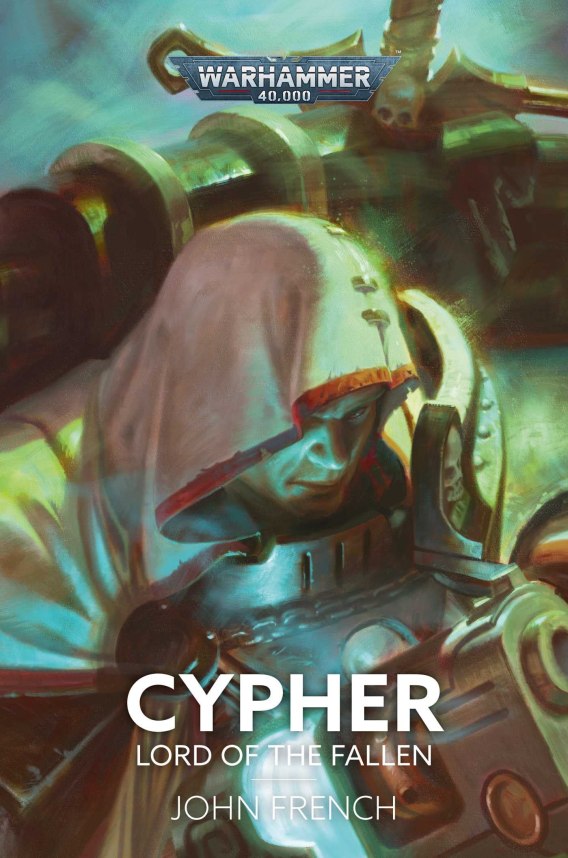
Warhammer 40,000: Cypher: Lord of the Fallen by John French

Cypher - Lord of the Fallen Cover

Publisher: Black Library (Audiobook – 18 July 2023)

Series: Warhammer 40,000

Length: 5 hours and 8 minutes

My Rating: 4.75 out of 5 stars

Amazon

One of Warhammer 40,000’s most mysterious and elusive characters finally gets the spotlight in the awesome new book from John French with Cypher: Lord of the Fallen.

Gosh, 2023 is turning out to be a brilliant year for Warhammer 40,000 fiction.  I have already had a ton of fun with such great books as The Lion: Son of the Forest, Warboss, Shadowsun: The Patient Hunter, Leviathan, The King of the Spoil and Longshot, but the best is honestly yet to come.  There are still several great Warhammer 40,000 novels coming out before the end of the year, and one of the most intriguing was Cypher: Lord of the Fallen.  Written by well-established Warhammer fiction author John French, Cypher: Lord of the Fallen follows one of the most iconic and mysterious figures in the Warhammer 40,000 canon and places them in a sinister new adventure.

Thousands of years ago, at the end of the Horus Heresy, the Space Marines of the Dark Angels Legion suffered a devastating schism, as betrayal and deceit tore them apart from within.  The resulting civil war destroyed their home planet, killed their Primarch, and scattered the Dark Angels who rebelled across space and time.  Since then, the remaining loyal Dark Angels and their successor Chapters have hunted these traitors, known as the Fallen, throughout the galaxy, determined to bring them all to justice and hide the truth about their Legion’s fall.

Out of all the Fallen still at large in the galaxy, none is more hated or more dangerous the mysterious warrior known only as Cypher.  A Space Marine with strange motivations and deadly martial ability, Cypher has haunted the Dark Angels for centuries, manipulating them for unknown reasons and threatening everything they hold dear.  His latest mysterious scheme saw him and a small band of Fallen save the reborn Ultramarines Primarch, Roboute Guilliman, from the forces of Chaos and then accompany him to the Imperial Palace on Terra for his own purposes.  But rather than being welcomed as honoured guests, the suspicions around Cypher have seen him and his Fallen comrades locked up in the Dark Cells of the Adeptus Custodes, the most secure prison in all the Imperium, designed to never be breached or release their occupants.

But Cypher is no ordinary prisoner, and as the Great Rift unfolds across the skies of Terra, strange and seemingly unpredictable events will allow him to escape from the Dark Cells into the Imperial Palace proper.  Now loose in the most sacred and heavily guarded location in the entire Imperium of Man, Cypher leads his Fallen brothers from captivity and deeper into the palace complex.

However, their presence has not gone unnoticed, and Cypher and his comrades find themselves contending with the relentless defenders of Terra, including the Emperor’s personal bodyguards, the Adeptus Custodes, lethal Imperial Assassins and powerful predictive seers.  Worse, the Dark Angels are aware of Cypher’s presence on Terra, and a desperate strike force soon arrives, determined to capture or kill Cypher no matter the cost.  But as all these forces start to close around the members of the Fallen, it becomes clear that Cypher has a far greater agenda than anyone realised: to stand before the Emperor on the Golden Throne.  But are Cypher’s intentions noble, or does he intend to destroy the Emperor and sacrifice all of humanity to Chaos gods?

Cypher: Lord of the Fallen was a very fun and tricky Warhammer 40,000 entry that fans of the franchise are going to absolutely love.  French does a wonderful job of bringing the enigmatic and chaotic Cypher to life in all the best ways, pressing him and several other unique figures into a fast-paced and intense series of manipulations and conflicts.  The book is slick, addictive and loaded with clever references and allusions to the wider Warhammer 40,000 canon.  I managed to power through the audiobook version of this book in no time at all and had a wonderful time doing so.

Cypher: Lord of the Fallen has a short but exceedingly sweet story to it that wastes no time dragging the reader in.  This is primarily because of the unique narration that French features in this book, with the entire story told through Cypher’s enigmatic perspective.  Cypher describes all the events that are occurring, even when the chapter’s focus is on other characters far away from him, and his depiction of events is quite unique, as you are never certain how he is seeing events, or whether he is making everything up.  French, through the mechanism of Cypher, quickly dives into the events of Lord of the Fallen, efficiently setting the scene of the Imperial Palace in chaos and the defenders stretched thin.  Thanks to the arrival of the Dark Angels and other machinations, Cypher and his cohort are soon unleashed into the larger palace.

The narrative splits off into several threads, some following Cypher, some following the Dark Angels infiltrators, and some following the Palace defenders trying to restore order.  However, all of these scenes are still shown through Cypher’s mind’s eye, and his confident and possibly unreliable narration gives each sequence a compelling and ethereal edge that I quite enjoyed.  There are some great sequences spread throughout this part of the story as everyone dances to Cypher’s tune one way or another and you quickly grow attached to the great cast and their unique motivations.  Each character meets an intriguing end or conclusion to their tale, which is quite fitting in its own way, as French layers in the action, the compelling world building, and the constant allusions and stories from Cypher.  The overall conclusion of the main story is interesting, if a tad anticlimactic and overly mysterious, but the reader can make some substantial inferences from what happened.  I honestly was hooked the entire way through, and French did such a great job of creating as unique a read as possible that was perfectly fitting for the titular character.

While I usually find most Warhammer 40,000 novels are quite accessible to readers somewhat unfamiliar to the franchise, this is one piece of Warhammer 40,000 fiction that is best enjoyed by those people exceedingly familiar with the franchise’s lore.  French does do a good job of explaining certain aspects of what is going on, however this story quickly dives into some of the more complex pieces of lore surrounding the game, such as the hidden history of the Dark Angels and the mysteries surrounding the character of Cypher.  As someone highly familiar with the background lore, I personally found this to be extremely fascinating, although I could see new readers getting fairly frustrated.  However, even those fans of the game might get a little frustrated here, mainly because they are not going to find as many solid lore revelations here as they might hope for.  The narrator flat out states at the beginning of the book that this tale is not about him, and Cypher’s history remains mostly hidden as a result.  There are certain hints and anecdotes that could lead knowledgeable fans to make guesses, but the narrator fully admits that these could be lies or falsehoods designed to hide the truth even from the reader.  Those Warhammer 40,000 fans familiar with who or what Cypher might potentially be and how he operates will absolutely love this, and I personally enjoyed how French kept us guessing.

For those readers who are hoping for more, French does paint a fantastic and elaborate picture of the Emperor’s Palace on Terra, which is one of the more fascinating settings in Warhammer 40,000 fiction.  The dark and elaborate depiction of the palace, with its excessive bureaucracy, forgotten corners, vast religious underpinnings, and millions of workers, is endlessly fascinating, and I loved all the cool details French provided.  I particularly enjoyed seeing the Custodes in action, and the elaborate depictions of the Dark Cells, a truly unique location, was very damn fun.  This compelling dive into one of this universe’s best locations more than makes up for any disappointments a reader may have regarding the lack of revelations around Cypher, and French does such a great job bringing this entire setting to life.  A fantastic read for those already in love with all things Warhammer!

As I mentioned above, I ended up listening to the audiobook version of Cypher: Lord of the Fallen, which is honestly the best way to enjoy a Warhammer 40,000 novel.  This was once again the case in this tricky and fun book as Cypher: Lord of the Fallen’s impressive story really comes to life when it is read out to you.  All the secrets, twists and fantastic depictions of Terra are so much more epic in this format, and I really had a blast listening to it.  It helped that the audiobook was narrated by the very talented Jon Rand, who has previously impressed me in Ghazhkull Thraka: Prophet of the Waaagh! and Dredge Runners.  Rand has a great voice for dark Warhammer 40,000 fiction, and he puts that to full use in Cypher: Lord of the Fallen, especially when he brings the very cryptic narrator to life.  The near whispering and often gloating tones Rand ascribes to Cypher are pretty perfect, and I felt he captured this mythical and notorious trickster perfectly.  His portrayal adds a lot of depth to Cypher’s appearance in this audiobook, especially as he also covers the evident regret and occasional sad despondency that Cypher experiences as he manipulates events, which makes you grow attached to the figure, even though he could be faking it.  At the same time, the rest of the cool cast, including the proud Custodes, the vengeful Dark Angels and the lost members of the Fallen, are also portrayed extremely well.  Rand gives each of them very fitting voices and you cannot help but feel their relative emotions of duty, resolve and occasional despair that follow.  This was a masterful bit of voice work by Rand, and he really helps to turn this format into the ultimate way to enjoy the exceptional Cypher: Lord of the Fallen.

Overall, Cypher: Lord of the Fallen is an outstanding and epic piece of Warhammer 40,000 fiction that I cannot recommend enough.  John French did a remarkable job bringing together a novel that perfectly portrays and encapsulates one of the most mysterious and beloved figures in the canon, and shows him at his manipulating best.  Featuring a unique and enjoyable writing style, as well as a ton of hints for established Warhammer 40,000 fans, Cypher: Lord of the Fallen was one of my favourite Warhammer books of the year and is really worth checking out, especially in its audiobook format.

Amazon

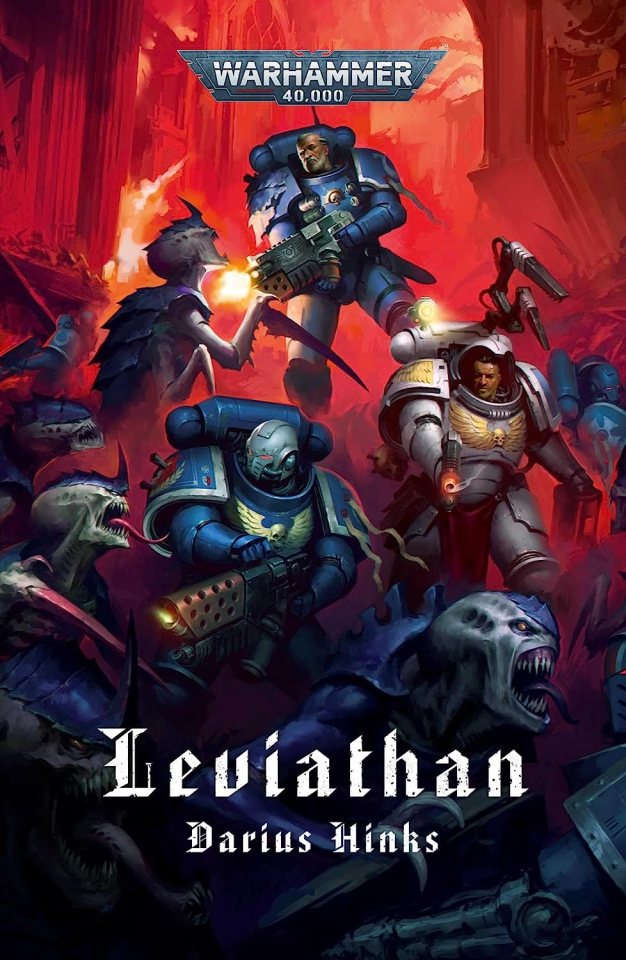
Warhammer 40,000: Leviathan by Darius Hinks

Warhammer 40,000 - Leviathan Cover

Publisher: Black Library (Audiobook – 24 June 2023)

Series: Warhammer 40,000

Length: 12 hours and 13 minutes

My Rating: 4.5 out of 5 stars

Amazon

Prepare for all-out war as the righteous Ultramarines battle the insidious Tyranids in this epic new Warhammer 40,000 novel from Darius Hinks, Leviathan.

It has been a pretty good year for Warhammer 40,000 fiction already, with several fantastic novels coming out in 2023, including Warboss and The Lion: Son of the Forest by Mike Brooks (the latter being one of my favourite books from the first half of 2023), and Shadowsun: The Patient Hunter by Phil Kelly.  However, the hits are far from over, especially as there are several fantastic new Warhammer 40,000 novels set to come out later this year.  But before we get to those, I managed to jump onto another recent release with the outstanding novel Leviathan, written by established Warhammer author Darius Hinks.  Hinks was a new author to me, but I soon grew to appreciate his latest book, especially as it showcased a dark and intense alien invasion that made for a great story.

In the far future of the 41st millennium, the besieged Imperium of Man faces many threats, but few are more deadly, unstoppable, or insidious as the unrelenting and seemingly endless hordes of the Tyranids, an alien race determined to devour everything it encounters.  While several of the larger invading Tyranid fleets have been destroyed, a splinter tendril is making its way towards the galactic centre, threatening the very heart of the Imperium.

Standing in the way of this fleet is the fortress world of Regium, an ancient planet recently taken over by Imperial forces, it now serves as a bulwark against invasions heading towards the inner-Imperium.  Many believe that Regium is secure from all threats, but when the people of the planet are haunted by parasites, strange cults, and mysterious dreams of terrifying monsters, it soon becomes clear that a Tyranid swarm is about to descend upon them.

It falls to the decorated hero, Lieutenant Castamon of the Ultramarines, to hold Regium against the foes and keep the rest of the Imperium safe.  A veteran of many battles, Castamon believes that this new Tyranid fleet will be swiftly destroyed.  However, these Tyranids are led by something far more sinister than the Ultramarines have encountered before, something cunning and ruthless that is able to disrupt minds and outthink even the cleverest of humans.  With his forces split, Regium’s defences compromised, and his allies panicking, even the vaunted Lieutenant Castamon may be unable to save Regium from the Tyranid invasion.  However, Castamon has one last trick up his sleeve, the brilliant Ultramarine Apothecary Biologis, Vultis, whose research into the Tyranid biology might be the only thing that can stop them.  Unfortunately, the enemy knows all about the Ultramarines and their plans, and the deadly creature known as the Harbinger is coming for them.

Leviathan was a pretty awesome and intense Warhammer 40,000 novel that shines a real spotlight on one of the more insidious alien races in the canon.  Featuring a strong and at times terrifying narrative, Leviathan was a great read, and I really got caught up in Hinks’s fantastic book.

Hinks pulls together an excellent story for Leviathan, and it is one that will appeal to a range of different readers, especially those fans of Warhammer 40,000 fiction.  Set around the already troubled planet of Regium, Leviathan follows an intriguing range of different human/space marine characters as they attempt to make sense and prepare for a Tyranid invasion of their world.  The early parts of the book are dedicated to introducing the key characters and the overall setting of the story, while also attempting to cast a more psychological edge to the main story as visions, doubts and other insanities haunt the populace.  There are some great early action sequences, including a disastrous shipboard incursion, and a dark hunt in some interesting terrain, and Hinks works well to set up for the second half of the book, especially as several unique, character driven stories were introduced and given some early weight.  While I enjoyed a lot of this set up, I did find the first half of the story to be a bit slow with its pacing and I was initially having trouble getting too invested in any of the characters or story elements.  However, this changed when I got to the second half of the book.

This second half masterfully builds on all the setup and character development that occurred at the start of Leviathan and readers are in for a particularly intense and gruesome narrative from this point on.  This entire second half is dedicated to the full-on invasion of Regium, as swarms of aliens, including some new creatures, emerge to decimate the populace and challenge the protagonists.  Each of the character focused plot lines set up in the first part of the book, as well as a few additional story inclusions, are perfectly thrust into this overlying chaos, and you get to see them try to survive the oncoming horrors and monstrosities.  Hinks really pulls no punches when it comes to this Tyranid invasion, and you get to witness all the devastation, the deadly transformation of the planet, and the subsequent epic battles, as the Tyranids fight against the human and Ultramarine defenders in some epic and well-crafted set pieces.  Each storyline was really good in its own way, and together they formed a fantastic and at times over-the-top overarching narrative that successfully showcased just how overwhelming the Tyranids can be.  I loved how dark Hinks made Leviathan at times, especially as he had no qualms about killing off key characters in some particularly brutal ways, which really raised the stakes for the reader.  While I did think that a lot of the plot did rely a little on the narrative stupidity of certain characters (the Ultramarines kept forgetting everything they knew about the Tyranids), the second half of the book was extremely epic, and I had real trouble putting it down.  All the separate storylines were concluded in entertaining and fitting ways, and I particularly appreciated the final plan that Hinks introduced for the main protagonists, which really fitted the outrageous feel of a lot of the plot.  This brutal and continuously exciting second half really turned Leviathan into such a great read, and I really loved how the entire thing turned out.

Leviathan proved to be an interesting and compelling addition to the wider Warhammer canon, especially as Hinks took the opportunity to really dive into some of the factions and showcase how crazy they can be.  However, I know that Leviathan has been copping a little flack in this department, mainly because some people see it as merely a promotional novel tied-in with some of the recently announced Ultramarines and Tyranid models.  While I can definitely see that, especially as Hinks spends a lot of time highlighting some of the newer Tyranid creatures in his narrative, I still enjoyed Leviathan a lot.  His depictions of the Tyranids were one of the major highlights of the book, and I loved how much he upped the horror aspect of them, showing them to be ravenous monsters who alter and devour everything they encounter.  This might be one of the better portrayals of Tyranids that I have so far seen in Warhammer fiction, and they were certainly a lot less one-dimensional here than they are in other books.  Part of this was because of the inclusion of several newer Tyranid creatures, such as the Neurotyrant and the Norn Emissary, with both being shown as unstoppable monsters with interesting abilities.  This allowed the Tyranids to attack their prey in all new ways, and it was very fun to see the various intricate tactics they were able to come up with.  Hinks tempers some of the more commercial aspects of these creatures’ inclusion by not actually using the names of the models in Leviathan, instead all you have is the protagonist’s descriptions of them when they encounter them in person.  These personal and often deeply terrified accounts of the various Tyranid bioforms really help to showcase just how terrifying and alien they are, especially to the ordinary human, and it really added a great edge to the narrative.  This darker edge is further exacerbated by the author’s powerful examination of how the planet of Regium is altered once the Tyranids arrive.  The spores constantly raining down on the planet slowly poison the various humans as they breathe in, and the depictions of the protagonists dying from within as they inhale alien matter, while their skin starts to slowly melt is pretty damn memorable and terrifying, especially as this is the first step in turning all biological matter in the planet into edible goo.  Frankly, I don’t think I’ve ever experienced the horror that is the Tyranid better than in Leviathan, and Hinks’ brilliant use of this faction enhanced the entire book.

On top of the Tyranids, Leviathan also features another intriguing major faction, the all-time classic Ultramarines chapter of Space Marines.  I mostly liked how the various Ultramarine characters were featured in Leviathan, although I did think that Hinks could have perhaps done a little more to distinguish them from other general Space Marines.  Still, Hinks goes out of his way to make the Ultramarines as badass as possible, and you really get a sense of their courage and battle prowess, especially as the severally outnumbered Ultramarines (I won’t go into the logistics of Regium’s defence here, but it did seem a tad low for such a vital planet), managed to put up quite a showing against the Tyranid swarm.  Some of the fight sequences featuring the Ultramarines in combat were pretty damn epic, and while some Space Marines did die easily for plot effect (especially when going up against a Tyranid with a new model), I felt that Hinks did a good job highlighting just how dangerous a Space Marine can be.  Hinks really tries to cover various aspects of the Space Marines throughout Leviathan, including the reverence and respect that most normal people have for them, and while this might not be the absolute best portrayal of an Ultramarine detachment ever, it was still pretty damn good, especially in those fantastic fight sequences.

I also must highlight some of the great characters featured within Leviathan as Hinks comes up with a diverse and compelling cast to tell the story with.  Thanks to the way the story is set out, each of the key plotlines revolves around some excellent characters, each with their own motivations, missions, and big moments, as they try to weather or escape the oncoming Tyranid doom.  Hinks crafts some great storylines for each of these major characters, and it proves easy to get invested in them, such as the tale of two ordinary farm workers who try to escape the monsters around them, the hapless Governor who finds himself out of his depth, or the proud Cadian leader who is drawn into war by the machinations of a delusional priest.  However, some of the best characters in Leviathan are members of the Ultramarines, and much of the story focuses on the elites of this chapter on Regium.  I really enjoyed these major Ultramarine characters, including the bold Lieutenant Castamon, the heroic leader who lives up to all the hype, the Apothecary Biologis, Vultis, whose analytical mind and desire for knowledge might hold the key to victory, and even the arrogant Sergeant Tanaro has his moments, especially in that powerful last scene.  However, my favourite character in the book is probably the scarred Ultramarine Baraca.  Baraca is a seemingly unkillable figure who has survived an insane amount of damage, but who has grown detached from even the rest of his battle brothers.  Despite appearing to be a mindless brute, Baraca is a deep and complex figure whose friendship with Vultis provides some emotional power to their scenes together.  Baraca honestly steals every scene he is in, especially his last, and Hinks writes a great storyline around him as he courts death, while trying to find his place in life.  All these characters, and more are very well written, and the impact they have on the plot is pretty impressive.

Like most Warhammer 40,000 content that I absorb, I chose to listen to Leviathan’s audiobook format, which is such a fantastic way to enjoy these intense stories.  I think that I made the right choice when it came to Leviathan, as this amazing audiobook really helped to throw me into the midst of the action.  Narrator Theo Solomon did an excellent job of setting a fast pace with his narration, and his descriptions of the massive battles, compelling heroics, and gruesome aliens was very fun to listen to.  While I wasn’t always the biggest fan of some of the character voices that he came up with, Solomon did produce some excellent tones for some of the main characters, particularly that of Lieutenant Castamon, who is made to sound very heroic and bold, which worked to showcase this intriguing protagonist.  As such, I felt that this was an excellent way to enjoy Leviathan, and with a run time of just over 12 hours, this isn’t a massive audiobook to get through, especially once you get caught up in the impressive second half.  I had an awesome time with Leviathan on audiobook, and I recently featured it on my favourite audiobooks from the first half of 2023 list.

Overall, I think that Leviathan was a pretty good Warhammer 40,000 novel and I was pretty impressed with my first book from Darius Hinks.  While I did have some issues with the story, especially in the early goings, this ended up being a very memorable and captivating read, especially thanks to the use of the cool Tyranid faction.  Loaded with carnage, brutal fights to the death, and complex characters dealing with an oncoming horde of clever aliens, Leviathan was an outstanding novel that deeply enjoyed.

Amazon

Warhammer 40,000: The Lion: Son of the Forest by Mike Brooks

The Lion - Son of the Forest Cover

Publisher: Black Library (Audiobook – 22 April 2023)

Series: Warhammer 40,000

Length: 12 hours and 15 minutes

My Rating: 4.75 out of 5 stars

Amazon

One of the fastest rising authors of Warhammer 40,000 fiction, Mike Brooks, returns with another exceptional read, this time covering one of the most significant events in recent Warhammer fiction, the return of Lion El’Johnson with The Lion: Son of the Forest.

At this point I think that my love for all things Warhammer is pretty well established, especially after my lengthy post earlier this year detailing my favourite Warhammer 40,000 novels.  I have been having a ton of fun in 2023 with this cool franchise, and I have just managed to finish off the newest Warhammer novel with The Lion: Son of the Forest.  This is the latest book from the very impressive Mike Brooks, who has been making a real name for himself in Warhammer 40,000 fiction and who seems to get better with every one of his books that I read.  His previous novel, Huron Blackheart: Master of the Maelstrom was a great read about an excellent established villain, and I had a lot of fun with his most recent book, Warboss, a highly entertaining novel about the always crazy orks.  However, I think that The Lion is probably his most ambitious and captivating novel yet as he covers the return of the Primarch of the Dark Angels, Lion El’Johnson.  This is a pretty big deal in Warhammer circles, and I was very impressed with how Brooks puts his own spin on the return to create an epic and powerful read.

At the dawn of the Imperium of Man, there was no force more deadly nor more loyal to the Emperor than the Dark Angels, the first Legion of Space Marines.  Led by their implacable and unstoppable Primarch and genefather, Lion El’Johnson, better known as the Lion, nothing was able to stop the Dark Angels as they crusaded from planet to planet dispensing the Emperor’s will.  However, following the events of the Horus Heresy and the Lion’s inability to save the Emperor, the Dark Angels imploded from within.  Treachery and years of resentment saw the Legion engage in a brutal and sudden civil war, which resulted in the destruction of the Dark Angel’s home world of Caliban, the scattering of the traitor Dark Angels throughout time and space as the Fallen, and the disappearance and apparent death of the Lion right when the galaxy needed him most.

Now in the 41st millennium, humanity is facing the greatest threat since the Horus Heresy.  The fall of Cadia spawned the Great Rift, a sprawling gap of daemon infested space that split the already crumbling Imperium in two, distributing travel, communications and coordination between humanity’s armies.  Into this darkness, the dread forces of Chaos emerge, destroying all before them, while other malign threats begin to eat away the remains of the Imperium.  The doom of all mankind seems certain, but hope is about to emerge in the most unlikely of places.

After a 10,000-year absence, the Lion awakens on the far-flung and devastated planet of Camarth, with no memory of how he got there.  Discovering one of his former sons, the Fallen Zabriel, the Lion soon discovers what has happened to the Imperium in his absence, as well as the terrible threats of the Great Rift and the forces of Chaos.  Unsure of his purpose or what has happened to him, the Lion sets out to preserve humanity from the forces trying to destroy it.  Rallying members of the Fallen from their long exile, the Lion begins a new campaign throughout the besieged systems of man, while trying to reconcile himself to everything he has lost.  But a dangerous and well-organised Chaos warband, the Ten Thousand Eyes, led by two of the Lion’s Fallen sons, are determined to destroy the returned Primarch and enact an ambitious plan with galaxy shattering consequences.  Can an isolated Lion survive the insanity of the 41st millennium, or has he returned only to face his doom?

Wow, now this was a pretty damn awesome Warhammer 40,000 novel.  Mike Brooks continues to really impress me with this cool new book, and I loved the elaborate and captivating tale contained within The Lion: Son of the Forest.  Featuring an intriguing and emotionally charged narrative that perfectly revives a key Warhammer 40,000 character, The Lion is an outstanding read and I think this is probably Brooks’ best Warhammer novel yet.

The Lion had a particularly interesting narrative that was firmly set around the return of Lion El’Johnson, and I loved the unique tale that Brooks came up.  The initial scenes of the book are quite fascinating as Brooks presents a symbol laden couple of chapters to show the Lion’s initial return, which I felt was a great way to start the story as it set up a lot of intriguing moments and gave the book quite a distinctive theme.  The introduction of two new alternate perspective characters a few chapters in helps to morph the story into a more typical Warhammer 40,000 narrative as it sees the Lion and other former members of the Dark Angels awaken in the current timeline.  The story soon sees the Lion reunite with one of his former sons and begin to reclaim a conquered Imperial planet from a notorious Chaos warband while trying to understand the new universe he’s in.  Getting back to his roots as a protector, the Lion soon is soon drawn into larger affairs, thanks a mysterious new ability he has obtained, and he sets out to do the right thing and right the wrongs of his past.  His actions not only lead him to more of his sons, ensuring that this book has a deep emotional heart to it, but it also leads him into conflict with a dangerous enemy, one that has big plans for him.

The Lion’s narrative is pretty epic in its scope and power as Brooks tells an exciting and compelling story about both the past and the present, and how one hero can make a difference.  The story features some great moments, including cool battles, emotional reunions, and dives into ancient history, as the characters come to grips with what the Lion’s return means to the greater universe.  Everything leads up to an ultra-intense finale as the Lion encounters a truly fallen son and is forced to reckon with the sins of his Legion and family.  I really enjoyed this epic narrative and Brooks sets out all the events extremely well, ensuring that readers will follow one excellent scene to the next.  While not every mystery is explained, the author does lay out some intriguing events that will grab a lot of Warhammer fans attention, and it leaves it open for more awesome books in the future.  I had an incredible time with The Lion and I managed to finish it off in a short amount of time.

This outstanding story is beautifully brought to life in Brooks’s capable hands as he deploys an excellent and captivating writing style throughout The Lion.  Brooks really had a tall order here in bringing back a key character from the Warhammer mythos and I think that he handled in an outstanding way by focusing on the emotional aspects of the character, rather than a pure action novel.  While The Lion does have some outstanding battle sequences designed to showcase just how epic a Space Marine can be, the focus is really on character development as Brooks examines three outstanding point of view figures while also telling an excellent narrative about characters trying to find their place in a strange new galaxy.

I loved how the author split the story across the three different perspectives, and I enjoyed how he made them so distinctive by using different styles and tenses for each of them.  For example, Baelor’s chapters use a third-person narration to show his struggles without going too deep into his head, the scenes shown from Zabriel’s eyes are written in a first person chronicle style as he recounts his story as if writing a journal, while the chapters focusing on the Lion are also in the third person, but feature a different, more epic style, which at times put me in mind of an older story or saga.  These different styles really fit the characters and their specific stories, and I appreciated how Brooks utilised these changes of styles to really tell a complex by subtly layering a classic Warhammer tale with pain, emotional damage, and uncertainty.

I felt that the author got the right balance of action and adventure with character growth, and you really get attached to the protagonists and their unique experiences in the Warhammer 40,000 universe.  I also loved how Brooks layered the story with a ton of Arthurian symbolism, as the Lion is meant to mirror King Arthur in this book, returning during his people’s darkest hour after dying during a war with his sons.  This included an excellent take on the Green Knight tale, with a dark Warhammer 40,000 twist to it, which also leads to one of the book’s funniest moments with a Monty Python homage.  I really got drawn into this outstanding story thanks to the way that Brooks told it, and this was an excellent and captivating read.

Now, this one of those Warhammer 40,000 novels that I probably wouldn’t recommend to new Warhammer readers as the story dives into some deep canon elements of the franchise.  Due to its focus on the return of Lion El’Johnson, a particularly important character that was only recently brought back in the game as a major event, The Lion is a key book in the Warhammer 40,000 expanded universe, and I felt readers needed a good understanding of the lore to fully appreciate its story.  This is because is strongly related to the history of the Dark Angels, and indeed all the Space Marines, and while Brooks does revisit and explain these events, having a more in-depth knowledge really does make that story that much clearer and more intriguing.  For those established fans of Warhammer 40,000 fiction, you are in for a real treat as Brooks expertly expands the lore while also providing some intriguing insights into established canon.  Seeing the Lion return and interact with his Fallen brethren was so damn cool, and it really tied into some of the best bits of Dark Angel lore that has been building for years and years.

I loved how the story examined both the current state of the Warhammer 40,000 universe, as well as the Horus Heresy, and it was fantastic to see characters who survived the Heresy arrive in the current universe and see what has been unleashed by the arrival of the Great Rift.  There are also a ton of jokes, references, and in-universe discussions that I had a lot of fun with, including intriguing new descriptions of events of the Horus Heresy, as well as more intriguing Dark Angels history.  I personally deeply enjoyed seeing the various ancient characters discuss the events that happened after they disappeared, and their reactions at the state of the Imperium, the deification of the Emperor to godhood, and what happened to the Dark Angels in the Lion’s absence, and this lead to some outstanding scenes.  The Lion proved to be a pretty epic piece of Warhammer 40,000 fiction and I was really impressed with how Brooks told such a unique and important story.

As I mentioned before, The Lion is a very powerful character driven novel as Brooks focuses on a cast of damaged and dispossessed figures thrust into an uncompromising future.  This is mostly clearly seen in the main character of Lion El’Johnson, the legendary Primarch of the Dark Angels and son of the Emperor, who returns after 10,000 years of mysterious disappearance.  Brooks paints quite the intriguing and complex picture around the Lion, showing him as a being out of time who, after experiencing some of the greatest losses and betrayals imaginable, awakens 10,000 years in the future with no idea of what happened to him.  The Lion is shocked at what the Imperium has become and how badly the universe has changed without him there.  Forced to reconcile with both this new future and his many failures, the older and wiser Lion heads back to the basics of his youth, protecting humans from monsters while also trying to reconnect with his lost sons, the Fallen, who he has mixed feelings about.  Brooks’s characterisation of the Lion is very different to what we’ve seen in previous novels, which I think a smart move, as the character is tired and lonely in this reality, and very much aware of the mistakes he has throughout his life.  Watching him relive some of the worst decisions he made during the Horus Heresy is very moving, and I loved how his insights into the past allowed him to move forward with his rediscovered sons and attempt to forgive them.  While there are a still a lot of questions around how the Lion returned (something I hope Brooks addresses in the future), I think that this was a pretty impressive return of such a key character, and I look forward to seeing more books focused on him.

The other major characters featured within The Lion are former Dark Angels who rebelled against their father thousands of years ago and were scattered throughout time and space following the destruction of Caliban.  Known collectively as the Fallen, these Space Marine characters have very complex feelings about Lion El’Johnson, especially as many believe he betrayed them and the Imperium, and they have all spent the intervening years being relentlessly hunted by the modern Dark Angels and their successor chapters.  This intriguing background was fertile ground for rich character development and backgrounds, and a large portion of the novel’s emotional depth relied heavily on the Lion meeting and reconciling with his lost sons.  Brooks produces several brilliant scenes that showcase the turbulent relationship between the Lion and the returning Fallen, and it was fascinating to see the Lion, a usually stubborn and proud character, admit that he was wrong and try to make amend to his sons.  I loved the intriguing group of characters that emerged in a supporting role as a result, especially as Brooks set them up as counterpoints to the Knights of the Round Table to match the Arthurian vibes around the Lion.

The most prominent of these supporting characters is Zabriel, the first Fallen that the returned Lion encounters, who serves as his guide to the new universe.  Zabriel has some amazing scenes in this book, especially as he provides the Lion with the first taste of the trauma the Fallen have experienced thanks to their father, and he makes sure the Lion knows that.  His well written chapters really capture his deep emotional conflict throughout The Lion, as he tries to reconcile the betrayals of the past with the hope that surrounds the revelation that Lion El’Johnson has returned.  His interactions with other members of the Fallen are really impressive as well, and I think he had some of the best chapters in the book.  Zabriel’s intriguing perspective is well matched by the other major point of view character, Baelor, a fellow Fallen who has chosen to continue following his former commander Seraphax, who he believes has a great plan to save the Imperium.  To achieve this goal, Seraphax has taken to wielding dark magic and is working with the followers of Chaos, forming the deadly warband, The Ten Thousand Eyes.  This forces Baelor to make a lot of compromises as he works to maintain his loyalty to Seraphax, even though they are doing terrible things.  The return of the Lion really throws Baelor for a loop, and there is a great undercurrent of denial to him as he tries to process all the implications that this has for him.  Brooks paints a brilliantly narrative of conflicted loyalty and duty around Baelor which worked wonderfully with all his chapters depicting the horrors of Chaos.  The rest of the Fallen characters in The Lion are very well written, and while some of them didn’t get a lot of focus, I loved some of the distinctive personalities that emerged.  It will be interesting to see how many of them are featured in the future, especially as there are still some secrets I wouldn’t mind knowing (who is The Red Whisper?), and I deeply appreciated how well Brooks featured them here.

To nobody’s great surprise, I checked out The Lion on audiobook, which is easily the best way to enjoy any good Warhammer novel.  Naturally, The Lion was pretty damn epic in this form, and everything about the book is greatly enhanced by the narration, as the epic story, amazing characters, and intriguing additions to the Warhammer universe, all come to life when read out.  I particularly enjoyed the voice work of Timothy Watson, who previously impressed me in last year’s Warhammer 40,000 audiobook, Krieg.  Watson has a wonderfully booming and commanding voice that worked well with all the powerful Space Marine characters in The Lion.  The narrators take on the confident and radiant tones of Lion El’Johnson was particularly awesome, and I really felt that he captured both the majesty of the character, as well as his deeper uncertainty and regret.  The other Space Marine characters are also extremely well captured, and I liked the fun range of voices that emerged, especially as they all seemed to fit that respective character and convey the key parts of their identity to the listener.  The villains are also cleverly narrated, and Watson goes out of his way to make them sound as inhuman as possible in places.  Coming in with a run time of over 12 hours, The Lion has a decent length for a Warhammer audiobook, although Watson’s fantastic narration moves the story along at a swift pace, ensuring that the listener is constantly hooked on the plot.  This entire production was just amazing, and I had an exceptional time listening to The Lion on audiobook, which is such an epic way to enjoy a Warhammer 40,000 novel.

Mike Brooks continues to rise through the ranks of Warhammer 40,000 authors with his outstanding new novel, The Lion: Son of the Forest.  The impressive and captivating read brilliantly brings back one of the most significant characters in the Warhammer canon and places him in an intense and deeply powerful tale of betrayal, forgiveness and displacement.  I had such an epic time with The Lion: Son of the Forest and this probably the best Warhammer book of 2023 so far.  I cannot wait to see what happens to this iconic character in the future, nor can wait to get my next Mike Brooks novel.  Highly recommended and required reading for all fans of Warhammer fiction.

Amazon

Throwback Thursday – Warhammer 40,000: Necropolis by Dan Abnett

Warhammer 40,000 - Necropolis Cover

Publisher: Black Library (Audiobook – January 2001)

Series; Gaunt’s Ghosts – Book Three

Length: 10 hours and 23 minutes

My Rating: 4.75 out of 5 stars

Amazon

Welcome back to my Throwback Thursday series, where I republish old reviews, review books I have read before or review older books I have only just had a chance to read.  For my latest Throwback Thursday, I continue to dive into the mud and blood of the 41st century with the awesome Warhammer 40,000 novel, Necropolis by Dan Abnett.

A few weeks ago I published a Top Ten Tuesday that listed my favourite Warhammer 40,000 novels, where I featured several great and impressive authors.  However, out all these authors, the one I seemed to mention the most was the extremely talented Dan Abnett.  Abnett, a veteran contributor to Warhammer lore, is one of the major pillars of the Warhammer 40,000 canon, having written several exceedingly iconic series or novels.  I have really enjoyed some of Abnett’s books including his legendary Eisenhorn trilogy (made up of Xenos, Malleus and Hereticus) which I eagerly absorbed earlier this year.

However, one of Abnett’s most compelling series is his long-running Gaunt’s Ghosts series of books.  This great series follows the tragic and deadly members of the Tanith First and Only, an Imperial Guard regiment let by legendary Colonel-Commissar Ibram Gaunt.  Known informally as Gaunt’s Ghosts, due to their position of the being the only survivors of the destroyed planet of Tanith, the Ghosts fight for vengeance and the hope of winning a new planet.  The Gaunt’s Ghost series follows their adventures during the Sabbat World Crusades, a series of deadly campaigns in a Chaos controlled sector.  I have deeply enjoyed this cool series, mainly because it shows a particularly accurate view of the life of the common soldier in the Warhammer 40,000 universe.  The first two books, First and Only and Ghostmaker, as well as the prequel novel, The Vincula Insurgency, have served as excellent introductions to the characters and their mission, and I have been keen to continue this series.  The third book in the series, Necropolis, features a brilliant new story that throws the Ghosts deep into the absolute hell of war.

On the planet of Verghast, deep in the Sabbat Worlds, the Hive City of Verunhive has long stood as a beacon of productivity and economic success, producing vast quantities of materials for the crusading Imperial armies.  Their dominion on Verghast seems absolute, until a shocking and deadly surprise attack from the neighbouring rival city of Ferrozoica, leaves everyone in shock.  Amassing an army of millions, Ferrozoica launches a continued and brutal attack on Verunhive and its holdings, determined to bring it to its knees, and not even the hastily assembled forces of Verunhive or the fortified walls of the hive seem capable of stopping them.

To maintain the manufacturing capabilities of Verunhive, Warmaster Macaroth dispatches several regiments of Imperial Guard to Verghast to unite the people of Verunhive and help put an end to the invasion Ferrozoica.  Amongst the Imperial reinforcements are the Tanith First and Only, better known as Gaunt’s Ghosts, who are now hardened veterans after years of fighting under Colonel-Commissar Gaunt.  Arriving in Verunhive, the Ghosts discover a desperate hive, fortified by inexperienced soldiers and untested leadership, who are ill-prepared for the horrors of war that are about to be unleashed upon them.

As the Ghosts and their new allies begin a desperate fight for survival, Gaunt soon discovers that the Hive is divided, with political intrigue, ambitious officers, and old rivals, all vying to control the war.  As this division hampers the war effort, an even more dangerous discovery is made: the forces of Ferrozoica aren’t just rebelling, they are under the fell control of Chaos.  Faced with a relentless horde of enemies that won’t stop their attack for anything, can the Tanith and the defenders of Verunhive rally to hold off the enemy are will the Ghosts finally meet their match in the ruins of the corrupt Hive City?

Abnett continues to show why he is one of the very best Warhammer 40,000 authors out there with this exceptional third entry in his Gaunt’s Ghosts series.  Necropolis is a brutal and intense read that features a brilliant group of characters caught up in a desperate and deadly siege.  Action-packed and exceedingly powerful, Necropolis was an incredible addition to the series that I powered through in no time at all.

Necropolis has an outstanding and exceptional story that places the Tanith regiment in the middle of a no-win scenario.  I had heard that Necropolis had one of the best stories out of all the Gaunt’s Ghosts books, and it lives up to all the hype.  One of the reasons for this is that, in contrast to the episodic nature of the first two books, Necropolis has one consistent and continuous story that is completely focused on the battle for Verunhive.  The other major reason for me is that this book is a siege novel, which is something I particularly enjoy, and the subsequent extended war to control Verunhive was pretty damn epic as a result.

The book starts without the Ghosts even present, and instead Abnett takes the time to completely explore the start of the siege, showcasing the setting and introducing many of the new supporting characters and their unique storylines.  This works to set the scene beautifully and you really go into the book fully understanding just how chaotic the ensuing war is going to be.  Gaunt and the Ghosts are introduced a few chapters into Necropolis, and they are swiftly and expertly inserted into the story.  Most of the returning characters are split up around the city and given their own distinctive storylines which often merge with those of the Verunhive citizens introduced in the opening scenes.  At the same time, Gaunt finds himself involved in the political intrigue that is dominating the commanders of the city, which forces him to work with and against rival commanders, commissars and politicians.

The story moves at a pretty swift pace, and soon the reader is gifted with a series of brutal and powerful battles that drag in every major character in the book.  All these battle scenes are pretty intense and deadly, with the protagonists significantly outnumbered by the forces of Chaos.  Abnett really communicates the resulting desperation and fear that many of the characters feel, especially as the enemy starts to make further progress and the losses mount.  These impressive war scenes mesh well with the instances of political intrigue and personal conflicts that several of the characters, particularly Gaunt, are experiencing during the war, and it becomes apparent that ambition, greed and corruption are going to cause just as many problems as the war outside.  I loved the brilliant combination of character driven storylines that emerged, and all of them come together to present a comprehensive and compelling picture of the wider siege before them.

Naturally, things start going to absolute hell in the lead-up to the final act, and Gaunt and his soldiers face a huge variety of threats from both inside and outside of Verunhive.  There are some great scenes of carnage, valour and bitter personal fights during this part of the book as each of the characters attempt to survive in their own way.  Abnett really doesn’t hold back when it comes to the brutal war and readers should really not get attached to any of the characters, as the death toll is pretty significant.  Everything leads up to a final, desperate battle, and I felt that the author handled it extremely well, pitting all the key characters into some outstanding fight sequences.  I did think that the conclusion of one major fight was slightly cliched (as well as significantly underpowering the strength of a bolt pistol), but it was an overall excellent way to end the book.  All the storylines that Abnett opens in Necropolis are closed in a satisfactory way, and many of the characters leave both hopeful and a little forlorn at what they have experienced.  Abnett also leaves behind some hints of future storylines, especially around the personal lives of the Ghosts, and it looks like there is going to be a lot of changes in the next novel of the series.

Featuring a massive multi-perspective cast, Abnett tells a complex and expansive siege narrative that is guaranteed to draw the reader.  As I mentioned before, I love a good siege book, and this probably one of the better ones that I have had the pleasure of reading (I will be adding it to the next version of my Top Ten Tuesday list on the subject).  Abnett really captures the intensity and complexity of the siege of this massive Hive City, and this shines through in every major battle scene he produces.  The reader is effortlessly drawn into every gritty and lethal fight that occurs, and I love how he shows all the perils associated with war, from morale, logistics and even the insanity of the Chaos invaders.  The grim scale of the war and the massive city this book is set in are on full display as well, and you must love seeing the mechanics behind attacking this city, as well as the inherent tragedy such an invasion is having on millions.  Accompanied by an amazing amount of complex, personal stories, and some outstanding, futuristic political intrigue, and you end up with a particularly gripping and well-written tale, and its one I could listen to again and again.

One of the things that I love about Abnett’s books is the way that he so easily and cleverly works the wider Warhammer 40,000 setting into his story.  He does such a good job of including and subtly explaining every bit of relevant lore, technology or faction throughout the book and in such a way that even readers unfamiliar with the franchise can dive in here with Necropolis without any major issues.  This accessibility to new readers is further helped by the way that most of the story focuses on the battles of the common Imperial soldier, and seeing their gritty perspectives and opinions of the book’s events really makes it easier to read.  Necropolis also serves as quite a key entry in the Gaunt’s Ghosts series, and fans who enjoyed the first two books will love to see the Ghosts return to another brutal war.  While Abnett does ensure that Necropolis is accessible to people unfamiliar with the series, readers are better served going back and reading First and Only and Ghostmaker first.  This is mainly because these two books were so heavily focused on character development and introductions, and seeing this characterisation continue in Necropolis makes for a more enjoyable experience.  However, readers can still jump into Necropolis without too many issues, and anyone is guaranteed an epic time if they do.

Abnett is always particularly skilled when it comes to characters, and Necropolis is no different as it features an amazing and large cast.  This not only includes the recurring characters from the previous Gaunt’s Ghosts books, but also a series of new characters originating in Verunhive.  Abnett does a wonderful job of introducing all these new characters while also simultaneously re-establishing all the previous protagonists and their particular character arcs.  The reader ends up following a huge range of character storylines in Necropolis as a result, and it was fascinating to see all the different protagonists, both Ghost and Verunhive local, and their experiences in the war.  However, I do think that Abnett might have gone a little overboard when it came to characters in Necropolis, as it became hard to follow so many distinctive personalities at times.  I also found that some of the best characters from the first two books, such as Colm Corbec and Major Rawne, were a bit underutilised as a result.  However, you still get a lot of Gaunt, and his excellent chapters perfectly capture the insanity behind the war as Abnett once again showcases him as the noble hero, although even he is not prepared for some of the complex figures waiting for him.  I loved the contrast between Gaunt and his rival, Commissar Kowle, who is a lot more self-serving, and it was great to see more hostile interactions between Gaunt and the Royal Volpone commander General Sturm.  This ended up being a great book for characters, and I look forward to seeing how some of the supporting cast introduced in Necropolis will go in future books, especially after so many join the Ghosts at the end of the book.

As with pretty much everything else from Abnett that I have enjoyed, I chose to grab Necropolis on audiobook, which was exceptional.  Generally, all the Warhammer 40,000 novels are pretty amazing in their own way, but I have had a great time with the ones written by Abnett.  I find the format fits his epic and powerful narratives extremely well, and the intense action, world building and characters, are all highlighted perfectly in the audiobooks.  One of the main reasons for this is due to the impressive work of narrator Toby Longworth, who lends his voice to all of Abnett’s main works.  Longworth is such a great narrator and I love how he brings the intense story to life, revelling in every action, shot and bit of carnage that Abnett imagines.  His main skill is his ability to come up with a huge range of fitting and memorable voices for every major cast member, and his take on each of Abnett’s characters is always spot on.  All the characters who appeared in the previous Gaunt’s Ghosts books return with the same voices that Longworth utilised then, and I loved both the consistency with the prior audiobooks and the unique way he gets into each of the recurring characters.  The accent that he gifts all the native members of the Tanith First and Only is amazing, and it is really cool how he uses it to acknowledge their rugged history.  Longworth’s talent for accents is pushed to the limit in Necropolis, as the plot features characters from several different planets.  However, he succeeds in giving unique accents for all the different off-worlders, which included a pretty accurate Australian-esque accent, which gets my approval.  This voice work, as well as the way the format generally enhances the cool story, ensures that the Necropolis audiobook is a fantastic way to enjoy this awesome book.  With a run time of just under 10 and a half hours, listeners can easily power through this book in a few days, especially once they get caught up in the addictive narrative.

My love of the classic Gaunt’s Ghosts series keeps getting stronger and stronger as the third book, Necropolis was a particularly epic Warhammer 40,000 read.  The legendary Dan Abnett provides readers with a powerful and captivating siege story that makes full use of its dark setting and comprehensive cast of characters.  An exceptional read from start to finish, Necropolis comes highly recommended, and I cannot wait to see what happens in the next Gaunt’s Ghosts book.

Amazon

Throwback Thursday – Warhammer 40,000: Kill Team by Gav Thorpe

Kill Team Cover

Publisher: Black Library (Paperback – 1 November 2001)

Series: Last Chancers – Book Two

Length: 277 pages

My Rating: 4.5 out of 5 stars

Amazon

Welcome back to my Throwback Thursday series, where I republish old reviews, review books I have read before or review older books I have only just had a chance to read.  In my latest Throwback Thursday, I review the second epic entry in Gav Thorpe’s ultra-fun Last Chancers series with Kill Team.

I have been going through a real Warhammer phase in the last few months, especially as I have been lucky enough to find some awesome older paperbacks in second hand shops.  I was particularly happy to find a copy of was the first two books in Gav Thorpe’s Last Chancers series.  Following a rotating team of convict Imperial Guardsmen as they engage in suicide missions for their freedom, the Last Chancers books are essentially The Dirty Dozen in space, and I love the awesome and brutal stories that emerge.  The first book, 13th Legion, was one of the very best Warhammer 40,000 novels I have had the pleasure of reading, and I have been trying to fit the sequel, Kill Team, into my reading schedule for a while.  I finally got a chance last weekend, and boy was it worth making the time for as the second Last Chancers novel had another outstanding and action-packed story to it.

In the far future, the armies of the Imperium contain multitudes of scum and villains, all of whom are considered useful in the service of the Emperor.  However, after blowing his last chance at redemption after completing an impossible suicide mission, Lieutenant Kage has been cast aside, locked inside an Imperial detention centre away from the one thing he is good at, fighting the Emperor’s enemies.  When his former commander, the mysterious and ruthless Colonel Schaeffer, returns with another deadly assignment, Kage is swift to accept and become useful again, even if he no longer has a chance at freedom.

The Colonel has been tasked with leading a small, disposable team to assassinate a prominent Tau commander and he needs a new version of the 13th Penal Legion, the infamous Last Chancers, to pull the mission off.  Placed in command, Kage must recruit a ragtag group of the worst killers, deserters, and malcontents that the Imperial Guard have cast out.  Forcing them into a harsh training regime to bring them together into an effective squad, Kage soon finds himself leading a new squad of Last Chancers, many of whom are as desperate for freedom and the fight as he is.

However, their mission is another lethal suicide mission.  Working with an immoral Imperial Inquisitor, the team is covertly inserted into Tau space and must infiltrate the political and military circles surrounding their target.  But not everything is as it seems and soon the squad must content with treachery, personal enmity, and the superior technology of the Tau.  Can these new Last Chancers succeed when so many before them have perished, or will the only redemption they find be in death?

Thorpe continues to give me all the Warhammer 40,000 fun I can ever need with this amazing and intense read.  Serving as an outstanding sequel to 13th Legion, Kill Team proved to be a fun and compelling novel, loaded with action, adventure and some intriguing characters.

Readers are in for another intense and brutal story with Kill Team, as Thorpe once again utilises The Dirty Dozen format to successfully set the scene.  However, rather than having a massive regiment get whittled down until the toughest survivors are left, this time the protagonist and main narrator, Lieutenant Kage, is forced to choose his own team of criminals to lead on the Colonel’s new suicide mission.  I really enjoyed the starting scenes of Kill Team, especially as you see Kage go from cell to cell choosing the best individuals for his team, before engaging in an extended and deadly training montage, which mirrored the hell he went through in the first book.  As Kage is dealing with that, and his own substantial personal issues, the main mission of the book is set up as the Last Chancers are sent into Tau space to assassinate an ambitious, warmongering commander.  Initially infiltrating in as diplomats and mercenaries, the team travel to several Tau planets before beginning their attack.  The final third of the book is primarily focused on this deadly mission as the team find themselves in the middle of a bloody battle against the very worst the Tau can throw at them.  The subsequent fight is pretty intense and brutal, and the readers are treated to some great scenes of warfare in various unique scenarios.  The ending is well set up, with betrayals, fun reveals and some brilliant character focused moments as the team finally come together to succeed.  I do think that Thorpe might have gone one twist too many at the end, but the overall story was extremely satisfying, and I deeply enjoyed how the entire thing came together.

I had a lot of fun with this second Last Chancer’s novel, and I am really glad that The Dirty Dozen plot basis didn’t wear thin in the second entry.  Thorpe did a great job of following on from the story elements he introduced in 13th Legion, especially when it comes to the two main characters, who have a fantastic new dynamic in Kill Team.  Like the first book, Kill Team is very fast-paced, and I had a ton of fun at the start when the new characters are recruited, as well as all the awesomeness of the extended battle sequence at the end.  However, unlike the episodic storytelling Thorpe utilised in 13th Legion, Kill Team has a more straightforward plot line, which worked well to set it apart from the previous entry.  You really get dragged into the struggles of the new Last Chancers, as well as the eternally battered Kage, who serves as the book’s primary narrator.  While there are a lot of references to the first book, Kill Team can easily be read as a standalone read and it isn’t necessary to get through 13th Legion first.  However, I deeply enjoyed seeing the continued development of the protagonist and fans of the first book will probably get a lot more out of Kill Team as a result.  Unsurprisingly, a lot of the book’s focus is on the action and combat, and Thorpe really doesn’t disappoint when it comes to that.  The author does a wonderful job capturing every single firefight, brawl, and pitched battle that occurs within Kill Team, and you can see and feel every single shot, punch and stab that is thrown as a result.  The presence of a few too many characters guaranteed to survive did occasionally lessen the impact of some dramatic fight scenes, however, you still get caught up in the violence and I deeply enjoyed how well Thorpe supported his narrative with his great writing.

Kill Team also serves as an intriguing entry in the wider Warhammer 40,000 canon, especially as it is one of the stories that follows a common soldier as he experiences the alien perils of the wider galaxy.  Just like with 13th Legion, readers don’t need a lot of background knowledge of the wider Warhammer 40,000 universe to enjoy Kill Team, and the Last Chancers books are actually a pretty good introductory series for those unfamiliar with the franchise.  I loved some of the fun references and factions contained within Kill Team, not only because you get to see more of the dark side of the Imperial Guard, but you also get quite an in-depth look at the Tau.  The Tau are one of the more interesting factions in the Warhammer canon, and frankly there aren’t enough books focusing on them.  I had a lot of fun seeing them in Kill Team, mainly because you got to see the inexperienced human characters encountering them for the first time.  Their reactions at the Tau culture, politics, and weaponry, makes for a great part of the book’s middle plot, and it was really fun to see them comparing their own lives in the Imperium to what the Tau have (that scene when they’re exploring the Tau ship’s bathroom was just great).  While Thorpe did nerf the Tau when it comes to their battle prowess, as the Last Chancers mow down waves of Fire Warriors, you get a great idea of their military capability throughout Kill Team and I loved seeing the Battlesuits in action.  There are a lot of great elements that Warhammer fans will get a kick out of in Kill Team and I really enjoyed some of the stuff Thorpe added in.

For me, the real highlight of Kill Team was the exceptional character work, especially when it came to Lieutenant Kage.  Kage is a natural survivor who has gone through a lot in his life, especially since joining the Last Chancers.  The Kage we met in 13th Legion was a gritty survivor, just looking for his freedom at any cost.  However, after the success and trauma of his mission and his subsequent failure to stay out of trouble, Kage has come back a little broken and a little bit more unhinged, especially as he is now racked with guilt over the fate of his original Last Chancers.  After a lengthy, violent prison sentence, Kage is once again under the heel of Colonel Schaeffer in Kill Team.  Kage actually ends up becoming more like Schaeffer in this book, especially when he chooses, trains and controls his own team of rogues, and the realisation that he will be responsible for their deaths weighs very heavily on him.  This guilt, and his own mental trauma, plays a big part in how Kage interacts with many people in Kill Team, and there is something very wrong with Kage throughout this book.  Despite this, he is still the ruthless survivor that he was in 13th Legion, and, if anything, Thorpe possibly made him a little too unkillable and deadly for this sequel (he’s not really a common soldier anymore).  The best scenes involving Kage are still the ones when he faces off against Schaeffer, and the have some great interactions throughout the book, especially as Kage blames Schaeffer for everything that happened to him.  Kage honestly hates and fears the Colonel more than anyone else, and yet he still follows him, even though his own chance of freedom has already been spent.  This results in some brilliant encounters between the unhinged Kage and the taciturn Schaeffer, and I cannot wait to see how their relationship evolves in the other Last Chancers books.

Aside from Kage and Schaeffer, there is a good collection of supporting characters featured throughout Kill Team.  Most of the prominent ones are the new members of the Last Chancers who Kage recruits for the mission.  Thorpe features a great introduction for all these new characters at the start of Kill Team and you soon get drawn into their unique storylines.  Each brings something new to the book, even if it is only briefly, as you know well in advance that most, if not all, of these character are going to die.  I liked the more specialist focused characters featured in Kill Team, as it was an intriguing departure from the more generalised grunts in 13th Legion, although this did slightly pigeonhole these characters in certain ways.  Still, all the new Last Chancers characters formed an excellent base for the story, and it was fascinating to see how they interacted with Kage, who see him in the same way that Kage viewed Schaeffer in the first book.  Other awesome characters featured within Kill Team includes a wily Inquisitor, some alien diplomats and a mysterious passenger waiting in the wings.  All these, and more, add so much to the plot, and I had a great job seeing how they, and their seemingly inevitable deaths, played into this awesome book.

Overall, Kill Team was exactly the sort of fun read that I thought it would be, as Gav Thorpe did a wonderful job in this second Last Chancers book.  Loaded with action and highly damaged characters, Kill Team was another fantastic and electrifying romp through the chaotic and deadly Warhammer 40,000 universe with a crew of convicted soldiers.  Sharp, brutal, and highly addictive, I powered through Kill Team very quickly and had an awesome time doing so.  Hopefully I will be able to lay my hands on the next Last Chancers novels at some point in the future and I cannot wait to see what carnage they get up to next.

Amazon

Throwback Thursday – Warhammer 40,000: Caves of Ice by Sandy Mitchell

Caves of Ice Cover

Publisher: Black Library (Audiobook – 1 February 2004)

Series: Ciaphas Cain – Book Two

Length: 6 hours and 46 minutes

My Rating: 4.5 out of 5 stars

Amazon

Welcome back to my Throwback Thursday series, where I republish old reviews, review books I have read before or review older books I have only just had a chance to read.  For this latest Throwback Thursday I look at another highly entertaining entry in the hilarious Ciaphas Cain Warhammer 40,000 series with the second book, Caves of Ice.

Even after my many recent reviews of Warhammer 40,000 fiction, my obsession with this franchise is far from over, so when I had a spare second, I quickly listened to Caves of IceCaves of Ice is the second novel in Sandy Mitchell’s (a pseudonym for author Alex Stewart) iconic Ciaphas Cain series, which follows the outrageous life of Commissar Ciaphas Cain, legendary hero of the Imperium of Man, who in reality is a pragmatic survivor whose heroic reputation is the result of chance and coincidence.  I had a wonderful time reading the first book earlier in the year, For the Emperor, and not only was it an extremely funny book but it also ended up being one of the absolute best Warhammer 40,000 novels I have had the pleasure of reading.  As such, I have been looking for an opportunity to continue this series and I worked hard to slip it into my reading cycle.  This was well worth the effort as Caves of Ice is another fun and awesome read that takes the protagonist to a whole new dangerous battlefield in deadly circumstances.

After unravelling a diabolical conspiracy on Gravalax, the legendary Commissar Ciaphas Cain and the troops of the Valhallan 597th have been redeployed to a new battlefront, the ice planet of Simia Orichalcae.  Empty except for a vital promethium refinery, Simia Orichalcae has recently received a group of unwelcome guests, a warband of orks who crash landed on the planet and are making their destructive way towards the refinery with ill intent.

Happy to be facing a more conventional enemy on their preferred icy terrain, the Valhallan men and women eagerly prepare for battle.  However, Cain, in his usual pragmatic approach to life and war, is less enthusiastic about the violent battle to come and searches for any way to avoid the fighting.  Several mysterious disappearances in the tunnels beneath the refinery offer a potential escape for Cain as he leads a small squad underground to map the tunnels and discover the reasons behind the missing miners.

Cain, with his typical bad luck, finds far more than he bargained for beneath the ice.  Not only are several ferocious monsters lurking in the vast underground labyrinth, but a far more sinister foe lies there undisturbed, one that Cain has good reason to fear.  When the war and Cain’s explorations awaken this enemy, the entire planet is put at risk as this new, unrelenting danger attempts to destroy both the orks and the humans.  It once again falls to the reluctant Cain to face impossible odds and try to find a way to save his men.  But can even this legendary hero of the Imperium stop the flood of evil that is to come?

Sandy Mitchell continues his fantastic Ciaphas Cain series in a very fun way with Caves of Ice, which features another excellent story that strongly focuses on Mitchell’s reluctant hero.  Caves of Ice was a wild ride from start to finish, with a fantastic and captivating mixture of action, adventure, humour and intriguing character moments.  Taking place after the events of For the Emperor, Caves of Ice is another self-contained novel that any new reader can easily jump into.  This was a much shorter novel than the previous Ciaphas Cain book, and Mitchell provides a more direct narrative as a result.  Initially focusing on the ork invasion of Simia Orichalcae, the story is soon primarily set in the labyrinth of mines and tunnels laying underneath the refinery, where several miners have gone missing.  Attempting to avoid the fighting on the surface, Cain leads his aide Jurgen and squads of soldiers on several missions into he depths to explore the tunnels and find whatever is behind the disappearances.  What follows is an Aliens-esque series of adventures, as Cain discovers a variety of different and steadily more terrifying dangers down in the tunnels.  Each discovery forces Cain to go even deeper into danger, thanks to his heroic reputation and hidden skills, and the resultant action is pretty epic, especially when combined with Cain’s cynical and self-serving narration of events.  Everything leads up to a very explosive conclusion as the protagonist and his comrades are faced with the absolute worst their enemy has to offer them, and the resulting mess really brings everything together.  This ended up being a pretty strong sequel to For the Emperor, and I had an incredible time seeing Cain dragged into another deadly adventure.

I love the way that Mitchell portrays the various adventures of Cain in these novels, especially as it allows him to express a great range of different writing styles.  Just like with For the Emperor, Caves of Ice is primarily told from Cain’s perspective as entries from his personal memoirs.  However, this chronicle is cut through with notes and inclusions from his unintended editor, Inquisitor Vail, who provides some added context to the story through her own introductions, footnotes, inclusions of in-universe texts, and quotes from other notable characters.  These inclusions from Vail not only allow for a much wider story than the one Cain is telling (especially when it comes to the battle on the surface), but it also increases the humour of the novel by implying Cain is an unreliable narrator.  This, combined with the cynical and less-than-heroic observations and actions of the protagonist, gives the entire Ciaphas Cain series a much more comedic edge than many other Warhammer 40,000 books out there, and indeed there were several times I was cracking up laughing throughout this book.  However, Mitchell perfectly balances this lighter tone with some dark and bloody moments as the protagonist encounters all manner of deadly foes.  The action and lethal battles are recorded in exquisite detail, and you can feel the terror and fear that the protagonist feels as he constantly fights for his life.  This great blend of styles and tones really helps to make Caves of Ice stick in the mind, and I find the entire setup extremely compelling and very easy to fall in love with.

In addition to being a great Ciaphas Cain novel, I felt that Caves of Ice was a great entry in the wider Warhammer 40,000 canon.  The clever, humorous writing, and the fact the book could easily stand on its own, makes Caves of Ice an ideal place for someone to start their Warhammer 40,000 adventure, even if they are very new to the franchise.  The book provides some interesting insights into life in the Warhammer 40,000 universe, both through Cain’s insights and through the humorous or satirical texts that Inquisitor Vail adds to the book.  I really enjoy the solider-focused observations of the primary narrator and some of the supporting characters, and it is always quite compelling to see the common soldier’s reactions to the aliens and monsters they encounter.  Cain’s observations are always very sharp and funny, and his own range of experiences adds some amazing colour to the events unfolding in Caves of Ice.  Mitchell also takes the time to explore several iconic Warhammer 40,000 factions and races throughout the book and its quite interesting to see Cain’s opinions and insights into them, especially as he has a much more realistic views towards them than some of his cohorts.  Combine that with some fun insights into the day-to-day lives of soldiers in the Imperial Guard and their Commissar, and Caves of Ices proves to be quite an interesting Warhammer 40,000 novel.  I love seeing the range of different experiences that the protagonist has in this universe, and it will be fascinating to see what deadly danger he encounters in the next book.

Without a doubt, the major highlight of this series and Caves of Ice is the fantastic and compelling characters, particularly Commissar Ciaphas Cain.  Cain is one of the more entertaining figures in Warhammer 40,000 lore as he is a somewhat cowardly man who, in his mind, has accidently gained a reputation as a great hero and legendary fighter.  Just like in his previous adventure, Cain is still obsessed with staying alive and avoiding battle, often manipulating events to ensure he’s far away from the action.  Nearly all his thoughts revolve around how he can stay alive or in control, and it is often very entertaining to see his very selfish thought process in action.  At the same time, he is conscious of his image as a hero, which he also tries to maintain as dearly as his life, and this forces him into so many situations and fights he would honestly rather avoid.  His honest observations and hilarious internal reactions when events don’t go his way (which happens often), are some of the main drivers behind the book’s outrageous humour, and it is hard not to fall in love with this cheeky rogue.  While a lot of this book does focus on Cain’s attempts at survival and avoiding combat, Mitchell does take the time to focus on Cain’s good qualities.  Despite his own narration constantly trying to talk down his own abilities out of modesty (or self-loathing), Cain is shown to be a very competent fighter, explorer and commander, effectively leading his troops into battle and facing down a series of outrageous threats.  His keen insights, vast history fighting the enemies of the Imperium, and his own uncanny survival skills, actually make him an ideal champion who often succeeds against all the odds.  Indeed, with each adventure it is becoming more and more apparent that Cain is in denial about his own abilities and is suffering some form of imposter syndrome.  Whatever the case is, Cain remains a particularly entertaining and surprisingly likeable figure, and I cannot wait to see what crazy adventures he has in his next book.

Aside from Cain, Caves of Ice contains an intriguing range of characters who add to the story in several different and unique ways.  This second novel contains a fascinating range of supporting figures, including several who previously appeared in For the Emperor, as well as a few new characters as well.  The always entertaining Inquisitor Vail, despite not appearing in person, continues to have a major impact on Caves of Ice as she is the one presenting Cain’s manuscripts to the reader, often editing it to make it more reliable and cohesive.  Her insights into Cain’s adventures, mindset and unreliable narrations are very amusing, while also simultaneously impacting the reader’s perception of the protagonist and his various actions.  As such, she is a vital part of Caves of Ice, and I am glad Mitchell continues to utilise her as a narrator.  Another major character in the book is Jurgen, Cain’s aide and bodyguard who accompanies him on most of his adventures.  Portrayed as a slightly dim, relentlessly straightforward, and somewhat smelly, Jurgen is essentially the Baldrick to Cain’s Blackadder, and at times he serves as a good additional comic relief, especially in some of the more serious scenes where Cain is scared.  Despite his portrayal as a simple man, Jurgen is a very effective fighter and companion to Cain, and his love of the meltagun heavy weapon gets them out a jam plenty of times.  I liked how Mitchell also strongly hints that Jurgen is a lot smarter than anyone realises, especially when it comes to Cain’s nature, and it will be interesting to see how their friendship develops in the future.  Other great characters include Lieutenant Sulla, an exceedingly keen and annoying solider who offers some entertaining insights into the wider events of the story.  This is primarily due to the fact that Vail quotes Sulla’s memoirs throughout the book, although Mitchell writes them as pompously and badly as possible to really highlight Sulla’s character deficits.  Throw in some additional soldiers, arrogant bureaucrats, and a fanatical Adeptus Mechanicus priest who brings nothing but trouble for Cain, and you have an outstanding cast that I had a great time following.

Unsurprisingly, I chose to listen to the Caves of Ice audiobook rather than grab a physical copy, and I once again had an epic time with the fantastic audio format.  Coming in at just under seven hours, this was a relatively short Warhammer audiobook entry, and I was able to power through extremely quickly.  The audiobook format really made Caves of Ice a joy to listen to, and the entire story was beautifully portrayed throughout, especially the action scenes in the tunnels.  I was particularly happy that this production once again featured the three narrators who were utilised in For the Emperor, with the excellent team of Stephen Perring, Penelope Rawlins and Emma Gregory once again making a major impact.  All three give excellent performances in Caves of Ice, and I had a good chuckle listening to their fun and clever takes on the characters.

Perring is once again the central narrator as he voices everything in Caves of Ice shown from Cain’s perspective.  Perring has an outstanding voice, and he really brings all the characters to life in a colourful way, especially when it comes to showcasing the slippery and jaded Cain.  I also love his take on most of the supporting characters, especially Cain’s aid Jurgen, who Perring gives a very Baldrick-esque voice to.  In addition to Perring, Penelope Rawlins serves a very vital role as Inquisitor Vail in the outside narration, who is compiling Cain’s memoirs for the reader.  Rawlins voices all the extra notes that Vail adds to the proceedings, including the footnotes, several chapter introductions, and the descriptions of several in-universe texts, all of which Vail adds to give extra context to the story.  Rawlins gives Vail an awesome voice steeped in knowledge, command and a light sense of humour, and it is always very fun to see her add some honesty and truth to Cain’s version of events, especially when the footnote appears in the immediate aftermath of Cain’s false information or ignorance.  The final voice actor, Emma Gregory, is primarily used to narrate one of the major in-universe texts that is quoted throughout, the chronicles of supporting character Lieutenant Sulla (Like a Phoenix From the Flames), written many years after the events of Cave of Ice.  Gregory voices all the excerpts of Like a Phoenix From the Flames in a particularly pompous manner to match the tone of these poorly written memoirs, and you really get a sense of the self-importance Sulla must feel in the future.  This brilliant combination of narrators ensures that Caves of Ice, and indeed all the Ciaphas Cain audiobooks, really stands out, while also effectively increasing the humour of the entire production.  For that, and more, audiobooks are easily the best way to enjoy the Ciaphas Cain series and I cannot recommend it enough.

The second entry in the outstanding Ciaphas Cain series, Caves of Ice, was another exceptional novel from Sandy Mitchell that I had an awesome time reading.  Featuring an outstanding and hilarious protagonist, Caves of Ice is a great addition to one of the funniest series in the Warhammer 40,000 franchise.  I cannot recommend this book enough, and any fans of fun adventure are going to have a great time with Caves of Ice.

Amazon

Throwback Thursday – Warhammer 40,000: 13th Legion by Gav Thorpe

13th Legion Cover 2

Publisher: Black Library (Paperback – 1 January 2001)

Series: Last Chancers – Book One

Length: 275 pages

My Rating: 4.5 out of 5 stars

Amazon

Welcome back to my Throwback Thursday series, where I republish old reviews, review books I have read before or review older books I have only just had a chance to read.  For this latest Throwback Thursday, I check out a classic Warhammer 40,000 novel that has been on my to-read list for a while with 13th Legion by Gav Thorpe.

I have been in a very noticeable Warhammer 40,000 reading mood lately which has allowed me to check out a huge and varied range of books from one of my favourite franchises.  This current obsession allowed me to finally get a copy of the outstanding older Warhammer 40,000 novel, 13th Legion, which I have been hoping to get for a while.  The first book in the iconic Last Chancers series, 13th Legion is essentially billed as The Dirty Dozen in the Warhammer 40,000 universe, which is a pretty awesome concept.  It has also been written by Gav Thorpe, one of the most significant authors of Warhammer fiction that I haven’t had a chance to read too much from yet.  Thorpe has contributed a ton of novels to various parts of the larger Warhammer franchise, including Warhammer Fantasy and Warhammer 40,000, but the Last Chancer novels are the series that I have most wanted to read.  13th Legion was one of Thorpe’s first Warhammer novels and I had an awesome time getting through this epic military thriller.

In the far future of the 40th millennium, the Imperium of Man boasts innumerable regiments of loyal and brave Imperial Guard.  However, no Imperial Guard regiment is as despised, desperate and doomed as the infamous 13th Penal Legion, also known as the Last Chancers.  Made up of former Imperial Guard who have committed terrible crimes against their fellow soldiers or the Imperium and under the command of the steely and mysterious Colonel Schaeffer, each member of the 13th Legion is given one last chance to achieve redemption in the eyes of the Emperor by dying in battle.

But, after fighting on some of the harshest battlefields in the Imperium, the 13th Legion is starting to run out of men.  Out of the thousands of convicts originally drafted into the fray, only a few hundred remain, and that number is whittled down with every single conflict.  Worse, Schaeffer continues to lead them into some of the worst scenarios imaginable, and with no reinforcements in sight, it looks like his bloodlust will see every single Last Chancer killed.

However, Schaeffer is playing a far more deadly game than anyone, including convict officer Lieutenant Kage, is aware of.  Soon the remaining Last Chancers are given an opportunity that none of them expected, a full pardon and a return to service in the Imperial Guard.  But to get their pardon they need to complete one last mission: infiltrate an impregnable stronghold in the middle of a deadly battlefield and end a rebellion.  However, with deadly enemies all around, including their own commander, the Last Chancers are about to find out just how expendable they truly are.

13th Legion is a brilliant and extremely fun novel that does an amazing job of not only introducing the series, but also taking the reader of an exciting and action-packed adventure through several interesting parts of the Warhammer 40,000 universe.  Told from the perspective of Lieutenant Kage, 13th Legion  introduces you to the motley collection of characters as they are dragged into dark adventure after dark adventure in search for redemption.  Their journey in 13th Legion takes them to several unique worlds and each of the long chapters feels a bit like its own independent short story, albeit still connected through the overarching characters and the story.  Each adventure is pretty fun in its own way, with dangerous crash landings, ork invasions, Dark Eldar incursions and more, with the Last Chancers losing more and more members in stunningly ways.  All these semi-independent adventures are pretty exciting and well-written in their own way; however, they are also cleverly well-connected, making up an excellent and intense overall adventure.  Kage proves to be an excellent narrator for this, as not only does he show the plight of the common criminal solider, but he is the only person Schaeffer will confide in, which gives him slightly more insight to where the characters are going.

These intriguing, mostly self-contained storylines are also complemented by several very short inclusions and interludes that provide some intriguing context to the larger story.  Everything leads up to the big finale of the book, as the remaining Last Chancers arrive at the planet of Typhos Prime and are offered their pardon with about of the third of the novel left to go.  I must admit that I was a little surprised at how long it took to get to the final battlefield, although the set-up for this last major sequence, as well as the multiple proceeding fights and adventures did make it worth waiting for.  The final sequence is exceedingly intense and captivating as the protagonists slowly make their way into the enemy fortress using stealth, guile and an intense amount of firepower.  You are on the edge of your seat the entire way through this part of the book, and I honestly couldn’t stop reading as I wanted to see how everything unfolded.  There is so much going on in the last 100 pages of 13th Legion, including some big, brutal battles, a bunch of significant deaths, and some major revelations, including a particularly powerful one from the Colonel that makes you rethink every previous event of the book.  Everything comes together in one glorious and intense collaboration of war, betrayal and surprising heroism, and I was very satisfied with how it all unfolded.  I especially need to praise the overall conclusion of the novel, which provided a dark and ironic final twist of the knife for the protagonist Kage, while also hinting at some additional fun in the future.

I enjoyed Thorpe’s excellent writing style, which helped to really bring 13th Legion’s outstanding narrative to life in an exciting and fun way.  The central character focus and the use of larger chapters, each containing one specific adventure, gave this book a pretty epic feel at times and you really appreciate the harsh events that the protagonists go through.  Likewise, the incredible focus on the plight of the common solider, as well as the harshness of their punishment, ensures that you are really on the side of the Last Chancers, no matter how much bad stuff they are responsible for.  The great parallels to The Dirty Dozen and other similar films or series (The Suicide Squad comics, for example) are fun, and I was especially pleased when it looked like Thorpe was going to send in a dozen Last Chancers into battle.  The many, many action sequences are also a true highlight, and every intense and brutal battle really gets the blood pumping as you watch these doomed characters fight all manner of foes in bloody fashion.  My one concern about 13th Legion’s writing was the lack of a good introduction, as well as all the references to events not shown in the book.  Despite being the first Last Chancers novel, a lot of their unit history or key events from the past aren’t shown in 13th Legion.  Instead, I’m pretty sure many of the previous adventures mentioned in this book originally appeared in short story anthologies and other places such as the White Dwarf magazine.  While Thorpe did provide enough details about these events so the reader doesn’t get lost, the constant call-back to them did ruin the flow in places, and I think it might have been useful to include a few flashbacks or include some of these short stories again.  However, this was a minor issue, and I still had an epic time reading this addictive and thrilling read.

I also felt that this was an excellent entry in the wider Warhammer 40,000 canon and one that established fans will have a great time with.  Thorpe takes the reader to several unique locations throughout this wider universe throughout 13th Legion and you get a lot of experiences in the sort of dangers a soldier is likely to face out there.  I loved seeing the reaction from these mostly normal people at the various aliens and traitors they encounter, and it helped to make this novel a bit more grounded and relatable in places.  13th Legion would also make a pretty good entry place into Warhammer 40,000 fiction, especially for those who love some good military fiction/thrillers.  The Dirty Dozen inspired story of normal soldiers/criminals getting thrust into a dangerous mission is a classic plotline, and new readers can use that as a jumping point to appreciate some of the details of this universe.  It helps that Thorpe is a consistent and detailed author who makes sure to explain some of this universe more unique elements, and he is also a great author to continue following if you enjoy 13th Legion.  This book also serves as the start of a pretty interesting series and I know that I am going to keep going with the Last Chancers books in the future, especially as I have a copy of the second book, Kill Team, sitting on my shelf right now.

The final thing that I must highlight about 13th Legion was the amazing and complex characters that Thorpe introduced in this novel.  All the main characters are criminal Imperial Guardsmen who have been forced into the 13th Penal Legion, and this leaves Thorpe a great collection of chaotic and murderous characters to work with.  You get introduced to quite a few unique and fun characters throughout the course of the book, although due to the dangerous nature of the missions and the multiple violent battles, most characters don’t stick around for long.  I was a tad surprised (I really shouldn’t have been) at how brutal Thorpe was with his characters in this novel, and the resulting high death rate really enhanced the stakes of the book and ensured you were constantly on edge during a battle.

The main exception to this are the two main characters, the narrator Lieutenant Cage and Colonel Schaeffer, the mysterious commander of the regiment who handpicked each of its members.  Both are great characters in their own way.  Cage is the everyman, who has barely survived his experiences and is quite traumatised as a result, desperately seeking a way out of the situation while also trying to keep his men alive.  Cage goes through quite a lot in this book, and watching his friends die for a purpose he doesn’t understand really hits him hard and you grow pretty close to him as a result.  Schaeffer on the other hand is an aloof and distant figure who is clearly manipulating the Last Chancers for his own hidden purpose.  Thorpe really paints Schaeffer as a supremely dangerous and harsh figure who manages to keep the entire regiment of criminals inline through will and intimidation.  The reactions of the other characters when Schaeffer appears are pretty hilarious, as none of them, no matter how insane or murderous, is willing to stand up to him.  Thorpe really uses Schaeffer to his full potential throughout 13th Legion and I especially loved the brilliant revelation towards the end of the book that showed just how callous and manipulative Schaeffer was the entire time.  The intense relationship between Cage and Schaeffer is an outstanding part of the book, as Cage simultaneously fears, hates, and respects his Colonel, and each of their conversations reflects this.  Despite the enmity between the two, they do have some great interactions, especially after some of the team’s deadliest missions, and they do respect each other, especially as Cage proves to be the one Last Chancer Schaeffer relies on and would hesitate to execute.  Their final meeting in the closing pages of the book perfectly encapsulates their relationship, and I am very excited to see what happens to both in the next novel.

Overall, I had an amazing time reading 13th Legion and I felt that it was one of the most intense, exciting and fun Warhammer 40,000 novels I have had the great pleasure of reading.  Gav Thorpe made excellent use of his amazing story concept of The Dirty Dozen in the Warhammer 40,000 universe, and the resulting novel was littered with death, battles and awesome character moments.  This honestly lived up to all my expectations and I cannot wait to continue the Last Chancers series in the future.  A very highly recommended novel that any Warhammer fan will have an outstanding time with.

Amazon

Warhammer 40,000: Bloodlines by Chris Wraight

Warhammer 40,000 - Bloodlines Cover

Publisher: Black Library (Audiobook – 8 August 2020)

Series: Warhammer Crime

Length: 8 hours and 30 minutes

My Rating: 4.75 out of 5 stars

Amazon     Book Depository

After some of my recent awesome experiences with the Warhammer Crime series, I just had to check out the outstanding novel, Bloodlines by Chris Wraight, which has one of the best pure crime fiction stories in this entire epic franchise.

Regular readers may have noticed I have been having an absolutely amazing time getting through a ton of Warhammer 40,000 novels in recent weeks as everything about this extended franchise has been so damn fun.  One of the more intriguing sub-series of Warhammer fiction I have been tearing through has been the Warhammer Crime books which, as the name suggests, blends cool crime fiction narratives with a Warhammer 40,000 settings.  The entire series is set within the massive, corrupt city of Varangantua on the planet of Alecto, and several very talented writers have come up with some exceptional novels that perfectly showcase murder, mystery and death in the midst of this great setting.  I have so far deeply enjoyed the epic entries, Dredge Runners and The Wraithbone Phoenix by Alec Worley, Grim Repast by Marc Collins, and Flesh and Steel by Guy Haley, each of which have contained different, if equally exceptional stories.  However, few have had the excellent central mystery of the very first full-length Warhammer Crime novel, Bloodlines from new-to-me author Chris Wraight, which took a veteran cop on an intensive investigation with fantastic results.

After a lifetime working for the Varangantua Enforcers, Probator Agusto Zidarov is well aware that the only certainties in the continent-spanning city are wealth, corruption and criminality.  Tired of the games played between the warring gangs, trade combines, and nobles as they battle for control of the city’s resources, Zidarov is more concerned about his own life, family and secrets.  However, when a simple missing person investigation gets unexpectantly complicated, Zidarov will find a terrible case that he can’t turn away from.

Called to the estate of wealthy business magnate Udmil Terashova, Zidarov is ordered to find her son and heir, who has gone missing.  Forced to plumb the depths of Varangantua’s underbelly, Zidarov attempts to find any trace of the boy, who has likely just disappeared taking part in the rich’s hedonistic lifestyles.  However, when an uncovered lead places him conflict with one the city’s most ruthless gangs, Zidarov soon begins to believe that there is more to this case than he initially believed.

Discovering that the gang is involved in the notorious crime of cell draining, Zidarov’s attempts to shut them down.  However, his raid ends up being a bust, and the fallout results in a dead sanctioner, a wounded probator and a full-on war between the gang and the enforcers.  Attempting to mitigate the consequences of his actions, Zidarov soon discovers that there is far more going on behind the scenes than he ever imagined as corporate interests work to influence the investigation.  To find the truth about the city’s new crime ring and the missing noble, Zidarov is forced to probe both Varangantua’s lowest gangs and wealthiest citizens.  But can Zidarov survive the encounter with his secrets and life intact?

Bloodlines is an incredible and deeply impressive Warhammer Crime novel that I had an excellent time reading, especially as Wraight perfectly blended his crime fiction story with the cool Warhammer setting.  Featuring one of the more elaborate and intriguing cases in the Warhammer Crime books I have read so far, I absolutely powered through Bloodlines and this was truly an outstanding read.

At the heart of Bloodlines lies a pretty awesome and captivating narrative building on the basic crime fiction premise of a veteran cop attempting to solve a crime no one wants investigated.  Taking its cues from classic noir entries (I was reminded a bit of Chinatown), Bloodlines follows Probator Agusto Zidarov, a family man with a cynical view of his job and his place in the city, as he gets dragged into a missing persons case.  Initially starting off a little slow, the story quickly heats up as Zidarov attempts to find the missing heir to the wealthy Terashova family, a disappearance he assumes is a simple case of young rebellion.  However, his routine investigation into the missing lad leads him to discover a cell draining operation being run by one of the major gangs, and he shifts his investigation in an attempt to shut it down.  But when his plans go wrong and his colleagues end up injured or dead, Ziadarov finds himself on everyone’s firing line.

There are some interesting jumps in the case around halfway through as the protagonist soon realises there is far more going on than he initially believed and he is forced to simultaneously investigate both the gangs and some of the wealthiest families and businesses in the city.  I loved this gradual escalation of the stakes of the crime as the book continues, as the original missing persons case is revealed to be far more complex and intriguing than initially believed when the protagonist discovers that he is being used by everyone.  At the same time, Zidarov is forced to deal with some major personal issues, as his wife begins to resent his choices, his rebellious daughter has gone missing in a city full of predators, and certain dark secrets around Zidarov threaten to come into the light.  The eventual reveal about who is responsible for the various crimes is very clever, and I liked the subtle and effective hints and clues leading up to it as the unique motivations and plots utilised intriguing aspects of the Warhammer 40,000 universe.  Wraight ends Bloodlines on a great note as Zidarov gets justice through drastic means after a very intense and powerful confrontation with one of the book’s more intriguing and complex supporting characters.  As such, you come away from Bloodlines feeling very satisfied, although you instantly want to see more of this great character, especially as the sinister connotations about Zidarov’s dark secret indicate that some tragic events are going to befall this character in the future.

The entirety of Bloodlines was laid out extremely well by Wraight, who uses a great style to tell a complex and captivating story.  Told exclusively from Zidarov’s perspective, you are given a personal and close examination of the events of the book as Zidarov slowly and methodically investigates the various crimes.  You are quickly drawn into the elaborate narrative Wraight lays out as the author does a good job of combining an excellent crime fiction storyline with intriguing character development, all set with Varangantua and the wider Warhammer 40,000 universe.  The noir inspired elements of Varangantua really stand out in this book, especially as Zidarov is forced to simultaneously investigate both the criminal cartels and some of the city’s wealthiest residents.  Bloodlines really recalls some classic noir tales, as it focuses on the experienced and dogged investigator fighting the entire system to get answers and justice, and I loved exploring even more of this enormous city and its many colourful residents.  The whole concept of cell draining, which sees thousands of people literally drained of their essence to make life-extending products, was pretty damn horrifying, and I liked how the examination of this gave Bloodline’s crimes a distinctive feel.  Wraight’s great writing style really lends itself to producing a particularly impactful and compelling crime narrative, and I loved how the entire storyline unfolded, especially with the effective twists and the well thought out foreshadowing.  I ended up coming away from this book quite enthralled and happy and I am really excited to read more books from Wraight in the future.

One of the things that I have so far found with all the Warhammer Crime entries is that readers really need very little familiarity with the wider Warhammer 40,000 universe to appreciate these great books.  Anyone interested in a compelling and intense crime fiction story set in a cool and grim futuristic city can easy dive into one of these novels, and all these books are an awesome introduction to the Warhammer fandom.  Bloodlines is no exception to this, as Wraight writes a very accessible crime fiction thriller that anyone can enjoy while simultaneously enjoying the gothic setting.  That being said, Wraight does make excellent use of several intriguing elements from the Warhammer 40,000 lore to enhance his story and there are hints and discussions about elements outside of Varangantua, such as the Imperial Guard or the wider wars of the Imperium, which fans of the franchise will deeply appreciate.  Wraight does do an amazing job of explaining these elements so that newer readers will fully appreciate them, however, established readers will always get a little bit more out of it.  For example, the full significance of Zidarov’s secret isn’t going to be too apparent to new readers, while in-the-know fans are going to get a blast out of the potential implications.  I felt that Bloodlines has a lot to offer all readers, no matter their experiences with Warhammer, and you might find yourself falling for the franchise with this first book.

Another key aspect of the Warhammer Crime series that Wraight perfectly captured in Bloodlines was the excellent utilisation of a complex and likeable central character.  Wraight’s protagonist and main point of view character, Probator Agusto Zidarov, is a deeply intriguing figure who stands out from the other protagonists in the Warhammer Crime series for being much less of a damaged outsider.  Instead, he is a veteran probator who worked his way up to his position with a very realistic view of the world around him than most other characters, and I liked his no-nonsense approach to his job and his city which has been formed from years on the job staying alive.  Despite this veteran presence and cynicism, Zidarov is still willing to do what is right, even if it endangers him, and his dogged approach to solving the case is extremely addictive, especially as Wraight puts in some deeper motivations behind them.  I really enjoyed some of the scenes where Zidarov continuously ignores his friend’s advice and keeps going forward with the case, simply explaining to them and the reader that he is unable to let it go, and he just keeps moving forward despite the inherent weariness of the character.  This determined and tired cop persona is well balanced by the family man aspect of Zidarov, which is another intriguing element that you don’t see in a lot of Warhammer fiction, as most protagonists don’t have wives or children.  Watching him attempt to balance his family responsibilities with that of his job adds some intriguing drama to the story, and I enjoyed seeing this portrait a ‘normal’ Warhammer 40,000 family.  Wraight perfectly weaves together these dual aspects of Zidarov’s personality with a certain darker, secretive thread that really shows the character in a whole new light when revealed, and which is going to have some intriguing impacts down the line.  All of this, and more, helps to make Zidarov one of the more relatable and enjoyable protagonists I have ever enjoyed in Warhammer fiction, and I really hope that Wraight produces some additional Zidarov stories soon.

Once again, I chose to listen to this cool Warhammer novel in its audiobook format, which, as always, was an excellent and deeply fun experience.  The Bloodlines audiobook did an amazing job of bringing this intense and powerful story to life in some very fun ways.  In particular, the complex central setting of Varangantua is really shown in all its corrupt glory when you hear it being described, and I loved how the fast pacing of the audiobook kept the story rolling by.  This format of Bloodlines was also greatly helped by veteran narrator Charles Armstrong, who has so far only lent his talented voice to a few Warhammer audiobooks.  Armstrong provided an excellent performance in Bloodlines, really diving into the various complex characters and helping to showcase their unique personalities and emotions.  I loved the tired and resigned voice that Armstrong came up with for the main character, which really sells the audience on Zidarov’s veteran status which is the result of an exhaustive and draining career.  Other great voices include that fun Irish accent he gifted to supporting character Brecht, which added to his entertaining nature, as well as some excellent voices the various suspects in the main case had.  All this makes the Bloodlines audiobook the very best way to enjoy this exceptional novel and with a runtime of eight and a half hours, you can power through it in no time at all.

Overall, Bloodlines was a particularly epic entry in the Warhammer Crime series, and it is one that author Chris Wraight should be extremely proud off.  Wraight did a remarkable job of blending together an intense and clever crime fiction story with the dark and grim Warhammer 40,000 setting, and the result is a brilliantly twisted case that I couldn’t turn away from.  Combined with instantly likeable character, Bloodlines proved to be extremely fun and deeply captivating, and I loved how the entire book unfolded.  As such, Bloodlines comes extremely highly recommended and you are guaranteed to love every second of it.  I look forward to seeing how Wraight continues this character in the future, and any future books featuring Zidarov are going to be something truly amazing.

Amazon     Book Depository