Throwback Thursday – Warhammer 40,000: Blood Angels: Deus Encarmine by James Swallow

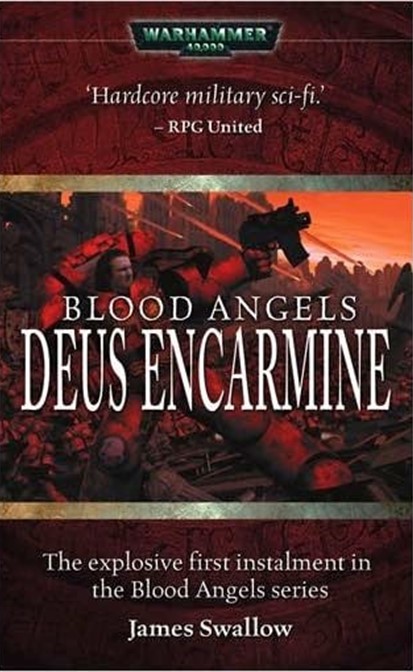
Deus Encarmine

Publisher: Black Library (Paperback – 1 December 2004)

Series: Blood Angels – Book One

Length: 252 pages

My Rating: 4.5 out of 5 stars

Amazon

Welcome back to my Throwback Thursday series, where I republish old reviews, review books I have read before or review older books I have only just had a chance to read.  This is actually my second Throwback Thursday post today as I also put up a review for the Warhammer 40,000 novel Xenos by Dan Abnett.  However, I have been in an extreme Warhammer mood lately so I figured I would do a double feature and review the other Warhammer 40,000 book I finished this week, the first entry in James Swallow’s Blood Angels series, Deus Encarmine.

One of the main things that really draws me into the Warhammer extended universe is that it contains works from a ton of awesome authors who have experience across the writing spectrum.  For example, James Swallow is a highly regarded thriller author who also contributed his talents to several extended universes, including the elaborate Warhammer universe.  While many readers may be familiar with his entries in the Horus Heresy sub-series, Swallow’s other major contribution to the Warhammer canon is the Blood Angels books, which provide dark adventures for one of the most iconic Space Marines chapters, the Blood Angels.  I managed to grab the first two books in this series from a second hand shop a few months ago and I just finished off the first entry, Deus Encarmine, this week.  It proved to be a fantastic and dark read that showcases the Blood Angels in a whole new light.

Out of all the Space Marines chapters who faithfully defend the Imperium of Man, few are as revered, respected or feared as the legendary Blood Angels.  The genetic descendants of the angelic primarch Sanguinius, the Blood Angels are proud warriors whose martial prowess and resolve are known across the galaxy.  However, their strength comes at a great cost, as the traumatic death of Sanguinius millennia before during the Horus Heresy still lingers in their shared genes and has the potential to drive even the best of them mad.

As the Imperium once again finds itself invaded by the forces of Chaos, one of the Blood Angels’ greatest tests is about to begin on the planet of Cybele.  A grave world dedicated to the memory of fallen Imperial warriors, Cybele is brutally invaded by Chaos Space Marines of the traitor Word Bearers legion, who overwhelm the Blood Angels honour guard stationed there and a relief force from the Blood Angels battle barge Bellus.  Only an ambitious plan by a young Battle-Brother, Arkio, turns the tide against the forces of Chaos, a victory that is considered by many to be a miracle.

As the Blood Angels follow the Word Bearers back to their base of operations, the conquered planet of Shenlong, more miracles seem to surround Arkio, leading his fellow Space Marines to believe that he is the blessed reincarnation of Sanguinius himself.  The only Blood Angel who doubts is Arkio’s older brother, Rafen, who notices strange changes in his sibling that his fellows are too blinded to see.  Only Rafen can discover whether Arkio’s gifts are a Chaos plot or the divine will of Sannguinius, but will he find out the truth before humanity’s greatest protectors are torn apart from within?

This was an excellent and captivating Warhammer novel from Swallow that tells a bleak and compelling story of faith, betrayal and family.  Making full use of the grim Warhammer 40,000 universe and the focus on the iconic Blood Angels, Deus Encarmine set up this first part of this series perfectly and you come away from this book extremely satisfied.

I really enjoyed the complex and dark story that Swallow featured in Deus Encarmine, especially as there are multiple layers to the narrative that drag you in with clever twists and turns.  Starting quickly and effectively with an extended and bloody war sequence, you really get a sense of the Blood Angels’ determination and resolve, as well as some of the deeper elements that impact them.  However, the real story doesn’t begin until after the massive battle at the start, as the characters are drawn into a deadly plot based around the Blood Angels’ history and beliefs.  Thanks to the efforts of a manipulative Inquisitor, as well as their own arrogance and faith, the Blood Angels are led to believe that the young Battle-Brother Arkio is the reincarnation of their founder, and they decide to follow him on a doomed quest to a Chaos controlled planet.  The build up to the invasion is amazing, especially as you get to see the various enemy moves to confuse the Blood Angels, as well as the failed attempts by the protagonists to discover what exactly is going on with Arkio.  Everything comes to a head when they reach their target, and the massive and brutal battle that follows reveals some dark truths about the despicable plans to destroy the Blood Angels.

I really got drawn into this awesome and compelling narrative and I loved the many impressive layers that Swallow added to it.  While many readers will be drawn in by the detailed and bloody war sequences, the real joy is in the intense manipulations and deceits that the villains unleash as the protagonists find themselves confronted by their own beliefs in dark times.  Swallow makes perfect use of the grim setting and the interesting history of the Blood Angels to turn this into an intense read, and you really get drawn in as you attempt to discover the truth behind Arkio and the enemy plan.  The author features various character perspectives to really showcase the differing views of the Blood Angels, as wells as the moves of the antagonists, and I loved how everything unfolded.  Readers come away from Deus Encarmine very satisfied, although the bleak cliff-hanger ending makes you instantly want to get out and grab the sequel.  I also felt that this was a pretty good entry novel for those readers looking to get into Warhammer fiction, as Swallow expertly introduces key elements of the wider universe and showcasing just home grim and deadly the war between Chaos and humanity can be.

Unsurprisingly, this first book in the Blood Angels series spends quite a bit of time focused on the titular chapter of Space Marines, the Blood Angels, who proved to be as awesome as always.  The Blood Angels are one of the most iconic and beloved factions in the entire Warhammer universe.  While all Space Marines are compelling and contain great potential for exciting stories (see my reviews for Deathwatch: Shadowbreaker by Steven Parker and Space Wolf by William King), the Blood Angels are particularly complex and striking figures.  Deadly and honourable warriors, the Blood Angels have a religious obsession with blood which borders on the vampiric, as well as major psychic daddy issues from their dead progenitor that can potentially drive them mad.  All this has tugged at the imagination of generations of Warhammer fans and Swallow uses that to full effect in Deus Encarmine.  Not only do you see these deadly warriors in multiple battle sequences, but Swallow dives into the history, culture and spirit of the chapter, including all the factors that helped turn them into such efficient and unstoppable killers.  All the key aspects of the Blood Angels experience are artfully captured and utilised throughout Deus Encarmine and fans of this chapter will be particularly excited, especially as Swallow adds in a ton of references and homages to various parts of the lore and previous fictional releases (I spotted a couple from Bloodquest).  I particularly loved that Swallow featured a Death Company in one of the battles, which was so damn cool as you got to see Blood Angels inflicted with the Black Rage tear apart their enemies one last time.  I also really appreciated how Swallow utilised the past and trauma of the Chapter as a key story point, and their faith and dedication to their primarch is used against them by their enemy.  All these elements, and more, make Deus Encarmine a must-read for all Space Marines fans, especially those who love to field/read about the Blood Angels, and Swallow had a wonderful time showcasing this faction.

I had a great time with the characters featured in Deus Encarmine and Swallow perfectly set them up and then inserted them into the complex tale.  Nearly all the major characters are members of the Blood Angels, and they share a joint history of suffering and bloodshed that binds them together.  While their training and history ensures some similarities, Swallow ensures that the central cast had some key differences and personalities.  The main character of Rafen was particularly compelling, and Swallow puts an interesting history around him.  His constant battle between the needs of his chapter and his loyalty to his brother is a major part of the book’s drama, and it is hard not to feel for him when he is the only one able to see that something is going terribly wrong.  The character of Arkio was also a fantastic addition to the cast, and I loved his gradual change throughout Deus Encarmine from a humble warrior to a dangerous religious figure.  Other characters, including the arrogant Sanguinary Priest Sachiel, the grizzled and suspicious veteran Koris, and even the entertaining Word Bearers characters who acted in counterpart to the protagonists, were all well written and I loved the elaborate narrative threads that Swallow wove around them.  However, my favourite character in Deus Encarmine was probably Inquisitor Stele.  Initially shown as an effective, if arrogant, ally, it is slowly revealed that Stele is a manipulative and callous being who is leading the Blood Angels towards a darker objective.  Watching him carefully and effectively divide and control the various Blood Angels characters was really awesome and I loved watching his dark scheme unfold.  I deeply enjoyed how Swallow utilised his characters in Deus Encarmine, and it will be intriguing to see who survives the deadly events of the next book.

Overall, I felt that Deus Encarmine was a pretty epic read and a powerful addition to the Warhammer canon.  James Swallow has written an excellent and captivating read here that perfectly blended intrigue, betrayal and an intense war story with the complex history and culture of the iconic Blood Angels Space Marines chapter.  An intense and addictive read, I absolutely loved this first Blood Angels and I plan to check out the sequel, Deus Sanguinius next, especially as I want to see how Swallow ends this fantastic duology.

Blood Angels Cover

Amazon

Throwback Thursday – Warhammer 40,000: Xenos by Dan Abnett

Warhammer 40,000 - Xenos Cover

Publisher: Black Library (Audiobook – 1 May 2001)

Series: Eisenhorn – Book One

Length: 9 hours and 55 minutes

My Rating: 5 out of 5 stars

Amazon

Welcome back to my Throwback Thursday series, where I republish old reviews, review books I have read before or review older books I have only just had a chance to read.  In my latest Throwback Thursday I continue to review the awesome Warhammer 40,000 works of Dan Abnett with his impressive and dark space thriller, Xenos.

For my Throwback Thursday last week, I talked about legendary Warhammer fiction author Dan Abnett and his Gaunt’s Ghosts series, which is one of the pillars of Warhammer 40,000 fiction.  I have already had a lot of fun reading several of the Gaunt’s Ghosts novels (including First and Only, Ghostmaker and The Vincula Insurgency), so I thought I would take the opportunity to check out one of Abnett’s other major Warhammer entries, the Eisenhorn series, which I have heard some extremely good things about.  Set in a different area of the Warhammer 40,000 universe than the Gaunt’s Ghosts books, the Eisenhorn books are a darker and more intense series that follows a troubled Imperial Inquisitor hunting down a deadly conspiracy at the heart of humanity.

In the dark future, the Imperium of Man is under constant attack from aliens, monsters and daemons who seek to destroy or corrupt all within.  However, the greatest threat to the Imperium comes from within as diabolical heretics, witches and cultists work from the shadows to weaken the Imperium, worship the forces of Chaos, and bring humanity crashing down around them.  The only protection humanity has against these nefarious and hidden threats are the members of the Inquisition, deadly agents who wield great power and authority to pursue their investigations by any means necessary.

Gregor Eisenhorn is a talented and experienced Inquisitor who has long fought against the shadows constantly threatening stability and order.  When he finally corners and kills an old adversary amid a dark ritual, Eisenhorn hopes that his actions have permanently ended an ongoing source of Chaos and despair in the Imperium.  However, evidence he recovers from the crime scene hints at a greater conspiracy that threatens several local systems.

Travelling to a prosperous system hub, Eisenhorn restarts his investigation, determined to get to the bottom of this new danger.  However, he is unprepared for the full scope of the hidden forces of Chaos that wait for him, as a massive and hidden cabal rises in opposition against him.  As multiple planets within the system burn due to the action of the Chaos cultists, Eisenhorn works with a series of unique allies to bring this cult to heel before they cause irreparable damage to the Imperium.  However, the more sinister danger may come from the prize that his enemies are seeking, an ancient and dark tome of knowledge, known as the Necroteuch, which has the potential to burn the universe and turn the entire Inquisition against Eisenhorn.

Xenos was another exceptional novel from Abnett, and one that really showcases his ability to tell a varied and complex tale.  This is a dark, powerful, and impressive character-driven read, and I loved the switch to dark intrigue and heretical investigations, which made for such an incredible story.  I was an instant fan of Xenos’s clever and highly addictive plot, and I must give it a full five-star rating for how awesome it was.

I was deeply impressed with the outstanding and compelling story that Abnett featured in Xenos, especially as it was very different in style and substance to his previous works I have enjoyed.  While the Gaunt’s Ghosts novels are gritty war stories that focus on the common soldier, Xenos was a powerful and twisty space thriller that saw a determined Inquisitor attempt to root out the manipulations of Chaos far away from the battlefields.  The story itself is extremely clever and well-paced, and it swiftly draws you in with its dark events, especially its intense and action-packed introduction.  Despite killing his nemesis early in the story, Eisenhorn is forced to keep digging even further as he uncovers more conspiracies and plots.  Utilising undercover methods, interrogations, obscure evidence and a series of bloody fights, Eisenhorn and his unique comrades follow the trail across the sub-sector, attempting to discover the true plot of their enemies.  This leads to several large and memorable set pieces, and I loved the constant change of locations, especially as it allowed you to get a whole new idea of the scope of their foes plans and the desperate battles being fought to stop them.  I also enjoyed the quieter scenes that were laid out between them as they not only added some great intrigue, but also highlighted the personal nature of the protagonist’s quests and the bonds he forged along the way.  The plot is eventually resolved after several major battles, including some very trippy sequences, and I came away from this book very satisfied and wanting more, especially as Abnett laid some intriguing hints about deeper conspiracies towards the end.  I was absolutely hooked the entire way through this narrative and I had such an amazing time reading this exciting and compelling story.

Xenos was an extremely well written Warhammer novel, and I really appreciated how Abnett was able to seamlessly change writing style and tone for this darker read.  The author makes excellent use of a first-person perspective for Xenos, as the story is in a chronicle format being written by the central character of Inquisitor Eisenhorn.  This allows for a much more personal and protagonist-centric narrative which really draws you into the hunt as you see the protagonist’s obsession with capturing the heretics and ending the threat to the Imperium.  Abnett keeps the pace pretty fast and intense throughout the entirety of Xenos, even during the sequences between the main action-packed scenes, and you are constantly engaged with the hunt or the intriguing relationships between the characters.  I was personally very impressed with how Abnett was able to blend a lot of distinctive story elements together throughout Xenos to produce an excellent story.  The way that the author combines Warhammer, thriller, mystery, science fiction and even horror (the Chaos creatures can get pretty bad at times) elements together is just amazing, and it opens up the appeal of the book to a wide range of readers.  I loved the continued and powerful hunt throughout the Imperium, especially as all the protagonist’s actions and attempts to end the threat result in major consequences for those around him.  This was a deeply captivating and intense read, and I cannot empathise how addictive and fun I found it.

One of the main reasons I chose to check out Xenos and the Eisenhorn series, aside from generally loving Abnett’s writing, is it is generally considered to be one of the best series to start a dive into Warhammer fiction.  After powering through Xenos, I can confirm this as Abnett uses the lore and the darker side of the Warhammer universe to its full advantage throughout this fantastic thriller tale.  While some slight knowledge of the large Warhammer 40,000 universe might be helpful to understand parts of Xenos, new readers unfamiliar with the franchise can easily dive into this book and follow the story with no problem, and any science fiction fan can have an amazing time reading it.  Abnett patiently and competently explores key details of the Warhammer universe as the story continues, although never in a way that interferes with the captivating flow of the book.  As such, you get a good view of the overall state of humanity and the Imperium during this novel, with a particular focus on the Inquisitors and their mission.  The Inquisitors have always been a fascinating and complex part of Warhammer 40,000 lore, and this series really highlights just how dangerous their tasks are, as well as the fine line they walk in their hunt for justice and purity.  Naturally, this dive into the Inquisition will also make this book very appealing to experienced Warhammer readers as well, and Abnett is considered to be one of the best franchise authors for a reason.  I have a deep appreciation for all the cool lore elements that were featured here, and I particularly enjoyed how Xenos offers a very different story to many of the other Warhammer 40,000 books out there, and really highlights just how complex the universe can be.

I was also very impressed by the exceptional character work that Abnett featured with Xenos, as this compelling read features some great characters.  The primary figure of this book is naturally Inquisitor Gregor Eisenhorn, who serves as the main protagonist and narrator of the story.  I felt that Xenos served as a particularly good introduction to this iconic Warhammer figure, and I found myself getting quite attached to his journey.  A no-nonsense and extremely practical Inquisitor, Eisenhorn is seen by many as a cold and calculating man, although deep down he is a caring individual who feels great attachment to his friends and comrades.  Abnett portrays Eisenhorn as a pretty reasonable figure, preferring subtle investigations, which makes him appear a bit radical to some of his fellow Inquisitors whose preferred methods are to kill anyone with any potential for evil.  It was very interesting to see him as a pretty strait-laced guy in Xenos, especially as I have heard of how radical he gets in the future, and I think it was very smart of Abnett to showcase him in this way first to enhance the impact of his future actions.  However, Eisenhorn does go through a lot in Xenos, including mental, psychical and spiritual tortures, and you can really see the damage done to him and how his desire for vengeance and getting the job done by any means grows.  I cannot wait to see how his story advances in the next few books, as I know that Abnett has damaging days in store for him.

In addition to Eisenhorn, Abnett loads Xenos with a ton of interesting supporting characters, all of whom are seen through Eisenhorn’s eyes.  This includes Eisenhorn’s eccentric entourage of follows and agents, including a data-obsessed scholar, a skilled pilot, a grim justice operative and his newest associate, Bequin, a psychic blank who is drafted into the war against Chaos against her will.  This unusual team prove to be great backup to the dour Eisenhorn, and I liked the genuine connection that Eisenhorn forms with them, especially as it shows that he really isn’t the monster many people think he is.  Other characters of note include the varied and distinctive fellow inquisitors that either assist or oppose Eisenhorn, and the various deadly enemies he goes up against.  Rather than have one specific antagonist in Xenos, Abnett featured a cabal of Chaos worshipping foes, each of whom despises Eisenhorn for what he represents.  While there isn’t a massive focus on any specific villain, each of the major players in the cabal are pretty distinctive, and I liked the overall effect that Eisenhorn is fighting a multi-faced beast in Chaos, rather than a specific evil.  These outstanding characters really enhanced this epic and captivating narrative and I look forward to seeing what other insane figures show up in this series as it progresses.

Unsurprisingly, I chose to enjoy Xenos in its audiobook format, which is frankly the best way to experience any Warhammer novel.  With a run time of just under 10 hours, I absolutely powered through this audiobook and I found that it perfectly conveyed all of Abnett’s elaborate and compelling story elements.  This was partially due to the brilliant narration of veteran voice actor Toby Longworth, who has lent his fantastic vocal talents to most of Abnett’s Warhammer books.  Longworth did another remarkable job here with Xenos, and I loved his take on this slighter darker narrative.  I deeply appreciated all the voices he provided to the characters in Xenos, especially as he is not just recycling the voices he uses in the Gaunt’s Ghosts books.  Each of the voices here are pretty fitting to their respective character and there is some fantastic variation based on plot details such as the speaker’s planet of origin, species, inclination, and personality.  This excellent voice work really enhanced my enjoyment of this captivating read and I would strongly recommend this format to anyone interested in reading Xenos.

The first entry in Dan Abnett’s Eisenhorn series, Xenos, lives up to all the hype surrounding it as it proved to be an exceptional and highly addictive read.  Perfectly combining an elaborate thriller story with the dark Warhammer 40,000 universe, Xenos was a joy to read from start to finish.  I cannot recommend this novel enough and my plan is to listen to yet another book from Abnett in the next couple of days.

Amazon

Throwback Thursday – Warhammer 40,000: Ghostmaker by Dan Abnett

Warhammer Ghostmaker Cover

Publisher: Black Library (Audiobook – January 2000)

Series: Gaunt’s Ghosts – Book Two

Length: 10 hours and 15 minutes

My Rating: 4.75 out of 5 stars

Amazon

Welcome back to my Throwback Thursday series, where I republish old reviews, review books I have read before or review older books I have only just had a chance to read.  For my latest Throwback Thursday, I check out another Warhammer 40,000 novel with an epic entry from Dan Abnett’s classic Gaunt’s Ghosts series, Ghostmaker.

I have been in a real Warhammer 40,000 mood lately so I thought I would continue to explore some outstanding books from legendary Warhammer author Dan Abnett.  Abnett is one of the most prolific and highly regarded contributors to the extended Warhammer universe, having created a huge range of compelling series and unique standalone books, most of which are considered the gold standard of Warhammer tie-in novels.  One of his most significant contributions to the Warhammer 40,000 universe is the Gaunt’s Ghosts series, which follows a ragtag group of human soldiers as they are dragged from deadly battleground to deadly battleground.  Made up of 15 novels, a ton of short stories and some other intriguing inclusions, the Gaunt’s Ghosts is a very iconic series in Warhammer 40,000 lore, which has spawned some awesome spinoffs and stories.  I had an outstanding time reading the first entry in the series, First and Only, and I also recently read the prequel novel, The Vincula InsurgencyGhostmaker was another impressive early entry in this series, and I had a wonderful time listening to it last week.

Colonel-Commissar Ibram Gaunt and the men of the Tanith First-and-Only, also known as Gaunt’s Ghosts, are some of the toughest soldiers serving the Imperium of Man.  The only survivors of the now dead world of Tanith, the Ghosts bear a substantial grudge against the forces of Chaos, as well as a complex relationship with their commander who saved their lives by abandoning their planet.  Now deployed to the jungle world of Monthax, the Ghosts prepare for their next inevitable battle against the Chaos host.

As the Ghosts await their next confrontation, Gaunt walks the lines, reliving the events that made his regiment what it is, while also growing close to the unique individuals he commands.  Each member of the Ghosts has their own story, and all have been forged in the crucible of war alongside their fearless commander.  But when battle is joined again the Ghosts find themselves in a unique confrontation that pulls on their tragic history and forces them to relive the worst day of their lives.  Is this the event that will forge the Ghosts into a legendary regiment, or will the survivors of Tanith break when they are needed most?

Abnett once again showcases why he is one of the very best Warhammer authors out there with this brilliant second entry in the Gaunt’s Ghosts series.  Bringing together several fantastic narratives into one character-driven plot, Ghostmaker is a key and compelling entry in this wider series that I absolutely powered through in a couple of days.

Ghostmaker is a compelling and powerful Warhammer 40,000 novel that continues to explore the intriguing members of the Tanith First-and-Only regiment.  Abnett spins a unique narrative in Ghostmaker, as this book reads more like a short-story collection than a typical novel.  Broken up by several brief sequences in the present on Monthax, most of the book revolves around a series of self-contained, character-driven background stories that showcase the history of the regiment and its members.  This includes a dive into the tragic formation of the regiment and the death of the planet Tanith, and you also get a view of some of the earliest battles the Ghosts fought in.  As Ghostmaker continues, the next series of stories each contain a more focussed narrative that dive into specific members of the regiment.  These shorter stories usually showcase one of these focus characters’ key battles or moments as a Ghost, while also diving into their personality and personal histories.  This deep dive into the key characters really helps you bond with the cast of this series in a whole new way, and I liked seeing more of these unique figures.  Everything comes to a head in the final quarter of the novel, when the story is dragged back to the conflict on Monthax as the Ghosts advance into battle.  Several key plot threads and recurring characters from the previous short stories make a reappearance here, and I loved how Abnett was able to connect this storylines together to make a cohesive and captivating overarching plot.  The final sequences are loaded with some of the deadliest fights in the entire novel, while also resolving a ton of character arcs and personal storylines raised in the previous entries.  The end result is a powerful and compelling overall story that really drags you in while giving you additional insights into some of Abnett’s best characters.

I really appreciated how Ghostmaker came together, and Abnett really showed off his writing skill by combining these shorter stories together the way he did.  I especially enjoyed how the multiple short stories gave Ghostmaker various tones as the reader continued through it.  For example, while most of the stories featured battles and war, there were also some more subtle stories of politics and investigations.  Abnett also featured some dark psychological stories as well as some deeply personal and brutal survival tales.  This variation in narratives and settings gave the book an eclectic feel, but I think that was very appropriate considering the regiment that Abnett was writing about.  All the shorter stories contained within Ghostmaker were entertaining in their own way, although a few definitely stood out over the rest.  Each story was extremely well written, concise, and fast-paced, and any leftover narrative threads are clipped off in the final entry, so the reader isn’t left wondering about anything.  The book also features a ton of awesome battle sequences in nearly every chapter and Abnett has a great skill at showing the horrors the men face during their dangerous battles, especially when they go up against supernatural or horrific foes.  Abnett also presents this book as a gritty war novel, with many of the stories focusing on the damaged and traumatised common troops who have been dragged into a series of terrible situations.  I have often said that some of the very best Warhammer novels focus on the common human soldiers (for example Steel Tread or Krieg), and Ghostmaker was one of the better examples of this I have seen in Warhammer fiction.  You really can sense the characters pain through the various chapters, especially when reminded of their home, and this makes for quite an emotionally rich read at times.

As I have mentioned a few times above, one of the major strengths of this book, and indeed the entire Gaunt’s Ghosts series, are the outstanding characters that Abnett focuses his stories around.  Throughout the course of the series, Abnett has introduced a great core of complex central protagonists who you really grow attached to.  However, Ghostmaker perhaps gives the best look at these characters, as it showcases their histories while also chucking them into deadly and deeply personal situations.  You really grow attached to these protagonists as the book proceeds and Abnett crafts some outstanding and wildly entertaining narratives around many of the cast, which are really fun to read.

As with most books in the series, a lot of Ghostmaker’s plot is focussed on the central character of Colonel-Commissar Ibram Gaunt, the Ghost’s commander.  Abnett continues to paint Gaunt as a caring and charismatic leader who recognises the sacrifice his men have made and is determined to keep as many of them alive as possible.  Most of Gaunt’s personal history before the events of Tanith was covered in the last book, and Abnett doesn’t rehash that in Ghostmaker.  Instead, you get to see Gaunt’s actions during and after the fall of Tanith, and I loved the examination of the guilt and responsibility he feels for abandoning the planet.  While the first chapter of this book primarily focuses on Gaunt, he also appears as a major figure in all the other protagonist’s stories, and it was fascinating to see the other Ghost’s opinions of him, especially as many have both resentment and respect for him.

Ghostmaker also spends a ton of time exploring several other key Ghosts, and Abnett does an excellent job of perfectly utilising all these great characters.  There are some brilliant tales surrounding these figures, and many also appear as supporting characters in other chapters, with some storylines crossing over.  Naturally, some of the characters stand out a little more than others, due to having personal plots that were particularly fun or intense.  Colm Corbec, the regiment’s second-in-command, is a major figure throughout most of the book, and I liked how Abnett expanded on him and focused on his different leadership style to Gaunt.  The story surrounding the seemingly stupid Trooper Bragg was extremely funny, especially with the slow-burn reveal of the character’s deep cunning, and you must love how funny and likeable Bragg is.  The story around the Ghosts’ medical officer, Tolin Dorden, was also very good, as it not only highlighted his position as the oldest Ghost, but also his refusal to sacrifice a life.  Other highlights include the trippy story of ace sniper Hlaine Larkin, who loses his mind during a mission, or the intense and compelling tale of elite scout Sergeant Mkoll, whose keen senses serve him well in the most hostile of environments.

However, I felt that the best two stories in Ghostmaker revolved around the characters of Major Rawne and Brin Milo.  Rawne is a murderous and slippery character who bears a great deal of hate and disdain towards Gaunt following the destruction of Tanith.  His story sees himself and Gaunt trapped together on an ice planet, which forces the two to work together.  Seeing the hateful Rawne trying to work out whether to kill Gaunt in cold blood or resolve their differences another time, makes for some compelling reading, and Rawne is probably one of the most complex and intense figures in the series.  Milo on the other hand is Gaunt’s young adjutant and the only civilian who survived the destruction of Tanith.  Milo serves a unique position in the Ghosts, and I really appreciated how Abnett explored how the rest of the regiment views him.  Milo’s story was particularly good, as politics sees him getting investigated by an Imperial Inquisitor for potentially having psychic abilities.  The scene where Milo manages to outplay the Inquisitor during his interrogation is one of the best scenes in the entire book and it really shows you just how clever he is, while also hinting at a potentially deeper secret.  All these characters, and more, help to turn Ghostmaker into a particularly enjoyable and fun read and I was very glad that Abnett gave us a closer look at the main supporting cast in this novel.

I felt that Ghostmaker was a great addition to the wider Warhammer 40,000 canon, as well as a great entry in the Gaunt’s Ghosts series.  While it is the second novel in the series, readers can easily get into Ghostmaker without any knowledge of the prior books, especially as Abnett spends so much time exploring the characters and the unit’s history.  While some of the narrative is set after the events of First and Only, Abnett does a great job reintroducing any relevant elements again in Ghostmaker and you don’t need too much pre-knowledge to enjoy the plot.  Ghostmaker would also serve as an interesting entry point for those who aren’t familiar with the Warhammer 40,000 franchise.  Abnett makes his novel very accessible to new readers, and I liked how he carefully and subtly introduced key elements of the wider universe, mainly those that concern the common soldiers.  The continued expansion of the Sabbat Worlds Crusade made for an interesting background to the book, and Abnett introduces or references several factions or regiments here that will go on to have a bigger role in later novels.  For example, Ghostmaker introduces readers to the Royal Volpone regiment (better known as the Bluebloods), who serve as rivals to the Ghosts and who recently got their own novel.  I had an incredible time diving back into the Warhammer 40,000 universe in Ghostmaker, and Abnett did a great job of expanding this already elaborate universe.

As with most Warhammer novels I enjoy, I chose to listen to Ghostmaker’s audiobook version, which was an excellent way to dive into this compelling read.  The audiobook format really allows the reader to get transported into the middle of the epic fights that are the hallmark of this fantastic series, while also ensuring that the reader absorbs all the key information about the surrounding universe.  Coming in at just over 10 hours in length, this is an easy audiobook to get through quickly, and I tore through the Ghostmaker audiobook in short order.  It helped that Ghostmaker was narrated by the very talented Toby Longworth, who voices most of Abnett’s Warhammer audiobooks.  Longworth has an excellent voice that fits the intense, character-rich tone of Ghostmaker extremely well, and he can move the plot along at a fast and compelling pace.  In addition, he has a brilliant take on all the key characters featured within the series and he provides everyone with a unique and fitting voice.  He also has the fantastic ability to capture the emotions and personality traits of the various characters with his tones, and you really get inside their heads when he talks.  This was an outstanding audiobook and I would strongly recommend it as the best way to enjoy this amazing novel.

Overall, Ghostmaker was a fantastic and impressive read by Dan Abnett and I am really glad I took the time to read another Gaunt’s Ghosts novel.  Featuring a distinctive format and some amazing character-driven stories, Ghostmaker beautifully expanded on the groundwork Abnett laid down in First and Only and this serves as an excellent and powerful addition to the series.  I deeply enjoyed this book, and I can think of no better way to illustrate this than to mention the fact that the moment I finished Ghostmaker I immediately started listening to the other Dan Abnett audiobook I had loaded on my phone, Xenos.  I really cannot recommend this series enough, and if you are interested in trying out some Warhammer 40,000 fiction, then the Gaunt’s Ghost series is the perfect place to start.

Amazon

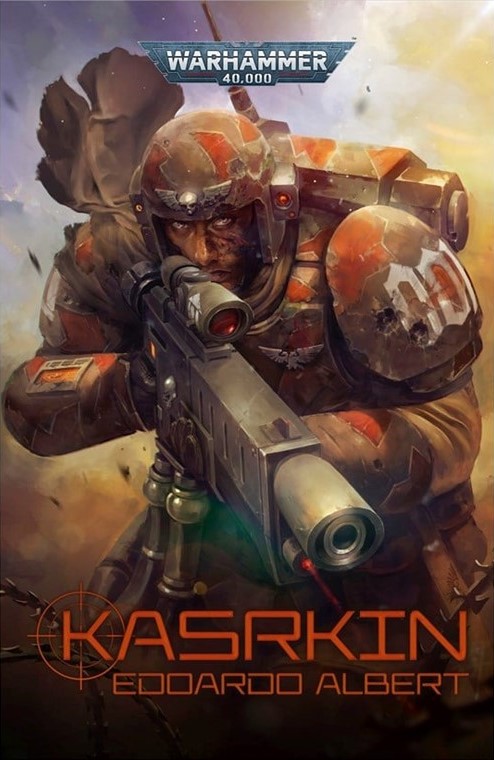
Warhammer 40,000: Kasrkin by Edoardo Albert

Warhammer 40,000 - Kasrkin Cover

Publisher: Black Library (Audiobook – 22 October 2022)

Series: Warhammer 40,000

Length: 11 hours and 3 minutes

My Rating: 4.5 out of 5 stars

Amazon

Get ready for some high-concept action in the latest awesome and exciting Warhammer 40,000 novel by Edoardo Albert, Kasrkin.

While I might be repeating myself a little, I must once again talk about the particularly amazing year I’m having when it comes to Warhammer 40,000 fiction.  There have been some outstanding Warhammer 40,00 books out in 2022, and I have done my best to listen to as many of them as possible.  Some of my personal highlights include The Wraithbone Phoenix, Outgunned, Assassinorum: Kingmaker, Ghazghkull Thraka: Prophet of the Waaagh! and Day of Ascension, just to name a few.  All these have been a ton of fun, and so when I had an open slot in my reading schedule, I naturally chose another recent Warhammer 40,000 book, Kasrkin.  Written by a new-to-me author, Edoardo Albert, who has previously created some interesting pieces of Warhammer fiction, Kasrkin is an action epic that pits a band of elite warriors on a deadly mission into the dark heart of a desert planet.

Welcome to the deadly desert world of Dasht i-Kevar, an Imperial planet currently under siege by the advanced xenos, the T’au, who have turned the usually baren planet into a bloody battlefield.  But the war is about to get even more interesting as the T’au have succeeded in shooting down an Imperial Valkyrie containing an important Astra Militarum general, whose knowledge of the Imperial Guard strategy and disposition could cause the planet to fall.

Only one group of Imperial soldiers have a chance of journeying into the harsh desert of the planet, an elite squad of Cadian Kasrkin.  Led by Captain Bharath Obeysekera, the Kasrkin are tasked to travel deep into the Great Sand Sea behind enemy lines to find the general and either recover him or kill him to keep him out of enemy hands.  The best of the best, the Kasrkin are trained to operate in any terrain and face off against any enemy.  But none of them have every encountered anything as endless, hot, or deadly as the deserts on Dasht i-Kevar.

Cut off by sandstorms and forced to journey over impossible obstacles, the Kasrkin are firmly on their own and can only rely on themselves.  But the deeper they journey in the wastes, the more they begin to realise that they are not as alone as they thought.  Other hunters are searching for the missing general, and the mysterious locals have their own games to play.  However, none of them are prepared for an ancient evil lurking far beneath the desert sands, determined to kill everything it encounters.

Another week, another exceptional Warhammer 40,000 novel that I had so much damn fun listening to.  Kasrkin was an excellent, fast-paced read that follows a compelling group of characters on an epic adventure tale.  Loaded with action, compelling characters, and a story that makes perfect use of its setting and the fantastic lore of the Warhammer 40,000 universe, Kasrkin in an epic read from Edoardo Albert that I absolutely powered through.

The story itself starts off pretty simply, with Albert introducing the reader to the Kasrkin squad and quickly setting them on their mission to find the missing general.  The early parts of the book are really focussed on allowing the reader to get their heads around the book’s premise, the characters, and the impressive desert setting, which honestly takes on a life of its own.  Initially a little slow going to build up tension and camaraderie amongst the Kasrkin, the book starts to get interesting about a third of the way in, when Albert introduces some unique world elements which show how cool and weird the Warhammer 40,000 universe can be.  From there, the story takes the protagonists closer to their objective, and I was initially a little surprised at how soon then managed to get where they were going.  However, this proves to be a bit of a ruse from Albert, as he chooses this moment to really shake everything up.

About halfway through, the entire structure of the book changes with the appearance of a new group of point of view characters, a kindred of Kroot aliens, determined to capture the general for the T’au.  This results in an awesome split in focus between the human and Kroot characters, and I loved the sudden introduction of an excellent rival group who appear equal to the Kasrkin in terms of combat ability.  However, this is not the only surprise that Albert has in store, as both the Kasrkin and the Kroot find themselves facing off against an even more deadly enemy in a fantastic new setting.  While I won’t go into too much detail about what happens next, it was a pretty epic move from Albert and one that I deeply appreciated.  The rest of the story is particularly intense and dark, and there some real horror vibes going for part of it, which fit in perfectly with the powerful narrative and darker setting.  Albert really layers on the action in the second half of the book, and I loved all the shocking and bloody places that he took his story, especially as there are several great twists and some truly engaging scenes featured throughout.  Everything comes to an excellent end, and this proves to be a particularly powerful and gripping Warhammer 40,000 read that really stands on its own.

I felt that Albert’s strong writing style helped to enhance the compelling narrative of Kasrkin and I really appreciated how the author’s style brought everything to life.  Like most Warhammer 40,000 novels, Kasrkin is a great standalone read that is very appealing for established fans of the franchise.  However, this book can also be easily enjoyed by most general science fiction or military fiction fans, especially as the author covers all the relevant lore details that you need to understand the world you are diving into.  Albert blends together some excellent storylines in this novel, and he keeps the pace steady, with a ton of brilliant action and dangerous occurrences.  I liked how the narrative kept morphing as the book progressed as what started as a compelling, if slower, desert adventure eventually turned into a high-octane war novel, before finally transforming into a desperate survival novel in a horror setting.  Albert manages these changes in style really well, and I think the constant alterations helped to keep the reader’s attention glued to all the craziness of the book. 

At the same time, the book remains a soldier’s story at heart, which is something that Warhammer fiction always excels at showing (good recent examples include Steel Tread, The Vincula Insurgency and Catachan Devil).  Watching these elite soldiers face impressive odds makes for an awesome read, especially as Albert also dives into their deeper concerns and features some deeper betrayals and intrigues.  I also cannot highlight enough how outstanding the combat sequences were in Kasrkin as Albert features some pretty hairy action scenarios.  I was particularly impressed with how well these combat scenes were enhanced by the book’s multiple character perspectives, especially once the Kroot were introduced.  Having the perspectives changed between the opponent groups as the firefights was ongoing was just brilliant, and it was amazing to see both sides of the battle, as well as the reactions from the rival teams.  All this, and more, really brought the best out of Kasrkin’s narrative and I deeply enjoyed how it was showcased.

Perhaps one of the most notable features of Kasrkin are the distinctive and memorable locations.  The reader is dragged to several great settings throughout the course of the plot, and the author takes particular pleasure in presenting them in exquisite detail.  The main location is the endless, featureless desert of Dasht i-Kevar, which the characters are forced to traverse for a good part of the book.  I got some great Dune vibes from this setting, and Albert makes this desert out to be a soulless, crushing place of shifting sands, massive unstable dunes, and intense heat, with the ability to strip the resolve and strength from the strongest of men.  Just listening to the characters traverse it made me thirsty, and you could really imagine the harsh journey they are going through.  At the same time, Albert also introduces some very unique aspects to the desert, including impossibly smooth patches of sand that move like water and mysterious water that lives deep under the surface which gives the planet some unusual life.  All these elements are very memorable, and you find yourself really feeling the intense desert surroundings as the characters push through it.  I think that Albert did a remarkable job of introducing and then utilising this harsh setting and it definitely stood out as a landmark part of the book.  A second, darker location becomes the key setting for much of the second half of Kasrkin and while I will again be brief to avoid spoilers, it was pretty damn epic.  Serving as the lair of a notable enemy, this location was a haunting and deadly setting, and one that the characters all struggled to survive in.  There are so many surprises and foes lurking in this location, and the strain of it really showed on the characters who find themselves with very little chance of survival.  I had such a great time with this location, and it, as well as the outside desert, helped to turn Kasrkin into a particularly noteworthy book.

On top of the new setting, I was also really impressed with the outstanding Warhammer 40,000 elements contained within this great book.  As I mentioned before, Kasrkin is a book a range of readers can enjoy, and part of the reason why is that Albert spends a lot of time exploring the unique lore elements of the Warhammer 40,000 universe that come into play during the plot.  Not only does this help to introduce the universe to new readers but established fans will appreciate how deep Albert dives into the subject.  As the name of this book suggests, quite a lot of the focus revolves around the Cadian Kasrkin, the most elite special forces group in the whole Imperial Guard.  Albert showcases them perfectly throughout the book, and it was so damn epic to see them in action, especially as they live up to all the hype and work together as a particularly effective unit.  The author dives into all their particularly quirks, training and operational preferences that sets them apart from the common Astra Militarum units, and you come away with a greater appreciation for who they are and what they can do.  In addition, there is a great underlying look at how the Kasrkin are doing following the destruction of their home world of Cadia, and I loved the deeper grief that they are all suffering after their failure and the hardships they have faced.

On top of the Kasrkin, Albert also spends a substantial amount of time examining and featuring other Warhammer 40,000 factions throughout the story.  The most prominent outside of the Kasrkin are the kindred of Kroot that become the protagonist’s opponents.  During their multiple scenes, Albert dives deep into the biology, beliefs and society of the Kroot, and the reader is soon given a crash course in who they are and what they can do.  There is a particular focus on their biological abilities, with Albert exploring their avian traits, their ability to communicate in different frequencies (giving off high-pitched whistles, which made several hunting scenes particularly cool) and more.  The real focus is on the Kroot’s ability to absorb the genetic traits of anything they consume, which is a big part of their society, as they live to hunt and consume prey that can give them a greater edge in battle.  Albert really examines this hunting and eating part of their culture, and it was fascinating to see how diverse the Kroot are after eating different creatures during their travels.  This ability plays a big role in the plot, with horrific consequences, and I loved having the Kroot featured so heavily in this book, especially as I haven’t seen them in too many other pieces of Warhammer 40,000 fiction.  I also loved how Albert did some fun contrasts between the Kroot and the Kasrkin and showed that they were very similar in their abilities and mentalities (and they both refer to their groups as kin).  Watching the two sides face off against each other is a thing of beauty and it results in some complex and exciting battle scenes.

On top of the Kasrkin and the Kroot, a third major faction from the Warhammer 40,000 universe are also featured, and they become an exceptional part of the books plot in the second half of the book.  Just like with the other groups featured within Kasrkin, Albert examines and features this group extremely well, and you get a good idea of who they are and what motivates them, even if they are a little more unusual then the general examples you see in Warhammer fiction.  I was particularly impressed with how Albert used one distinctive unit from this third faction throughout the course of Kasrkin, and they prove to be brutal and terrifying hunters that haunt the point of view characters in some epic and dark ways.  I cannot emphasise how well Albert featured all these different factions throughout Kasrkin, and fans of the franchise are going to have an outstanding time seeing them all in action and facing off against each other.

I had a lot of fun with the characters featured in Kasrkin as the author features some interesting interactions and character development in a short amount of time.  Most of the book focuses on the members of the Kasrkin team, including their leader, Captain Bharath Obeysekera, a veteran officer with a lot of regrets behind him.  Albert showcases this character a lot and Obeysekera proves to be a bit more of a radical thinker than your typical Imperial soldier, which I felt fit rather well in this unusual tale of survival, and it was heartbreaking to see him try and fail to keep his squad alive.  Other great characters include Sergeant Shaan Malick, the squad’s veteran NCO, who serves as a rock for most of the book, while also playing his own selfish game.  Watching him manipulate the other characters added a great edge to the plot, and I really appreciated his realistic and understandable motivations once they were revealed.  I was also very impressed with the character of Roshant, a newly minted Commissar with family connections who joins the mission and proves to be a bit of a pain for most of it.  Initially despised by the men and seen as a coward, Roshant goes through some real soul searching in this book, and it was fascinating to see this privileged character contrasted against the rough and tough Kasrkins, especially in some dangerous situations.  The rest of Kasrkin’s cast are also pretty impressive, and Albert does a good job of balancing the narrative around a large group of characters.  There is some excellent character work in this book, and I really appreciated seeing such a fun and damaged cast go to war against each other.

Like most Warhammer 40,000 books, I chose to enjoy Kasrkin in its audiobook format, which was an absolute ton of fun.  Coming in at just over 11 hours, the Kasrkin audiobook was an excellent and quick way to experience this fantastic narrative, especially as all the many cool action sequences really seemed to pop in this format.  The real highlight of this audiobook was narrator David Seddon, whose work I previously enjoyed in the short production Dredge Runners.  Seddon did a remarkable job with the narration in Kasrkin, and I loved how he swiftly moved the book along and perfectly controlled the pacing of the audiobook.  I was also deeply impressed with the huge range of voices that he brought to the production, and he effectively captured all the characters featured in this book and gave them all distinctive and fitting voices that showcased their personalities and emotions.  Not only does he capture the various gruff and thoughtful human characters, but he also provides some great alternate voices for some of the alien characters contained within.  The avian-inspired voices of the Kroot characters reminded me a little of the Skeksis from The Dark Crystal, which was really fitting considering the Kroot’s evolutionary origins.  I also loved the deeper and more ancient voice that was used for another character, revealed later in the book, especially when combined with the various voices used for this character’s computer servant.  This outstanding voice work really helped with my enjoyment of this book, and I had a wonderful time listening to the Kasrkin audiobook.  This was easily the best way to enjoy this fantastic book, and I would strongly recommend this format to anyone interested.

The Warhammer 40,000 universe continues to enchant and amaze me with this latest tie-in book Kasrkin.  Edoardo Albert wrote a powerful and deeply intense read that sees an iconic regiment from the game go up against all manner of trouble in some exceptional settings.  Extremely addictive, relentlessly exciting, and very clever, Kasrkin was an outstanding read that I am really glad I decided to check it out.  Highly recommended, especially for fans of Warhammer 40,000 fiction.  You are guaranteed to have a great time with this excellent tie-in book.

Amazon

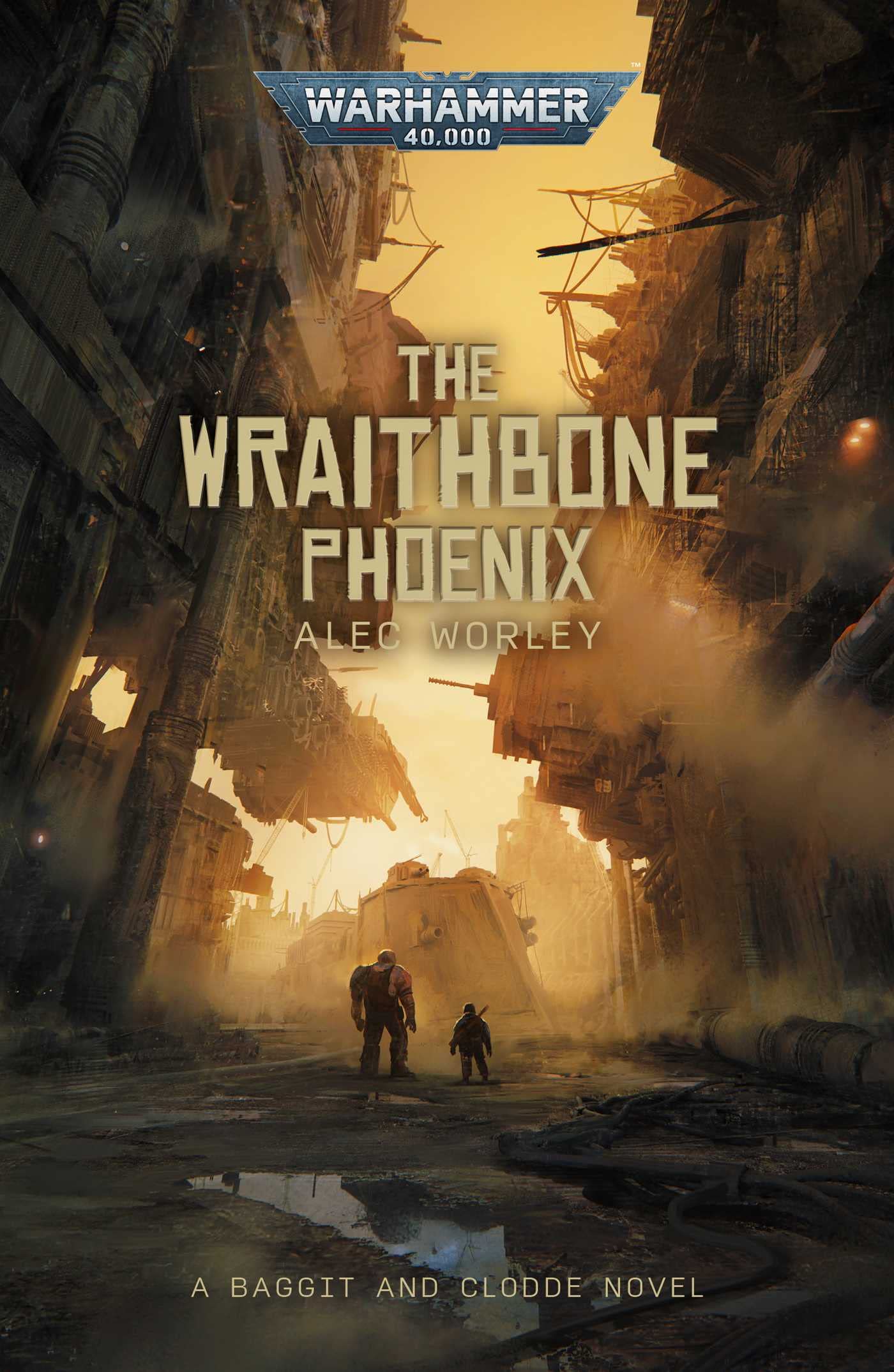
Warhammer 40,000: The Wraithbone Phoenix by Alec Worley

The Wraithbone Phoenix Cover

Publisher: Black Library (Audiobook – 30 August 2022)

Series: Warhammer Crime

Length: 11 hours and 6 minutes

My Rating: 4.75 out of 5 stars

Amazon     Book Depository

The entertaining team of Baggit and Clodde return for another Warhammer Crime adventure in the rip-roaring and deeply exciting science fiction thriller romp, The Wraithbone Phoenix by the impressive Alec Worley.

Last week I presented a review that talked about the intriguing Warhammer Crime series that combined crime fiction narratives with elements of the iconic Warhammer universe to create some amazing reads.  While some Warhammer novels already feature some intriguing crime fiction elements, such as in Necromunda novels like Kal Jericho: Sinner’s Bounty by Joshua Reynolds, the Warhammer Crime books are a much more complete melding, with cool thriller plots and complex mysteries.  I was rather intrigued by this concept, especially as I love it when authors combine wildly different genres together, and I mentioned how I planned to try out one of those books next.  Well, that book was The Wraithbone Phoenix by Alec Worley, an awesome and captivating read set in the Warhammer 40,000 universe.  A follow-up to Worley’s 2020 full-cast audiobook, Dredge Runners, The Wraithbone Phoenix is a full-length novel that brings back the protagonists of the original audiobook and puts them in another unique and deadly situation.

In the far future of the universe, there are few places more corrupt and chaotic than the crime-ridden city of Varangantua.  Life is cheap on the mean streets of Varangantua, and death waits around every corner, especially if you have a massive bounty on your head.  Unfortunately, the most wanted in the city currently are the abhuman deserters turned criminals, Baggit and Clodde.  Baggit, a tricky ratling always looking for the next score, and Clodde, his ogryn friend with a rare facility for thought, have made an enemy of one of the most dangerous men in the city, and now everyone is after their heads.  Hiding out within one of the city’s industrial salvatoriums, Baggit and Clodde have taken on new identities until the heat dies down.  However, the twos natural inclination for getting into trouble soon breaks their cover, and they are soon forced out into the open.

Desperate to find a way to pay off their debts, Baggit hears an interesting bit of news that could change all their fortunes.  One of the nearby salvatoriums is dismantling the decommissioned Imperial Navy ship, Sunstriker, the reputed home of a long-lost treasure, a xenos artifact known as the Wraithbone Phoenix.  Guided by the rumours he heard when previously served about the Sunstriker, Baggit believes that the Wraithbone Phoenix is still hidden aboard, and its value is more than enough to get rid of their bounty.

But no secrets every remain safe in Varangantua, and as Baggit and Clodde make their preparations to sneak into the Sunstriker, news of their location and their potential treasure leaks out.  Soon every criminal, bounty hunter, treasure hunter and mercenary is on their way towards the Sunstriker, desperate to claim either the bounty on Baggit and Clodde’s head, or the Wraithbone Phoenix.  Forced to face off against the very worst killers that Varangantua and its main criminal cesspool, the Dredge, has to offer, Baggit and Clodde attempt to do the impossible, recover the artefact from the ship and get out with their heads intact.  But can even the clever Baggit and the indomitable Clodde escape the deadly wave about to crash down upon them?

Wow, now this was one of the most entertaining and thrilling Warhammer 40,000 novels I have read all year.  Worley has produced an amazing novel in The Wraithbone Phoenix that did a wonderful job blending Warhammer elements with an impressive crime fiction narrative.  Filled with a ton of action, some amazing humour, and so many outrageous characters, The Wraithbone Phoenix is an outstanding read that proves to be extremely addictive.

I had such a brilliant time with The Wraithbone Phoenix, especially as Worley pulled together an extremely impressive and intense narrative that is very hard to put down.  Set in a particularly crime-ridden and corrupt city, the novel sees the chaotic duo of the ratling (halfling/hobbit) Baggit and the ogryn (ogre) Clodde, get into all manner of trouble.  Featuring a range of character perspectives, the first third of the book is pretty firmly focussed on the main duo, with some fun scenes from the contemptable villain Lemuel Scratchwick.  Forced into hiding due to past mistakes, Baggit comes up with an ambitious plan to recover the Wraithbone Phoenix, a legendary xenos treasure that is rumoured to be hidden in a nearby ship being scrapped (the theft and hiding having been cleverly set up in some early interludes).  However, after Lemuel overhears and spills the beans in a very public way, the entire city knowns what the two are planning, and a horde of killers and thieves head towards the ship.  The book starts spreading its focus to several other outrageous figures, all of whom are interested in either the Wraithbone Phoenix or killing Baggit and Clodde.  The author does a wonderful job introducing each of the characters, and you soon become invested in their hunt, as all of them are pretty amusing in their own way.  The action ends up in the decommissioned ship, were everyone starts their search for the missing treasure, and it doesn’t take long for everyone to start fighting each other in a series of bloody battles.  You honestly have no idea who is going to survive the various encounters, and it is very fun to see the distinctive characters dying in surprisingly and compelling ways.  At the same time, the characters also attempt to solve the mystery of the hidden Wraithbone Phoenix, and the various hints about its initial disappearance are cleverly woven into the modern tale, requiring the protagonists to solve it.  Eventually, only a few characters are left, and there is a great series of twists and turns that sees everyone get what they truly deserve.  While I did think that Worley perhaps went one twist too far (the final one was a bit too metaphysical for my taste), the reader comes away extremely satisfied, and highly entertained.

I had a wonderful time with this awesome book, and I think that Worley did a great job setting the entire narrative out.  The combination of crime fiction elements and the great and grim Warhammer 40,000 setting worked extremely well, and you ended up with a high-octane thriller that saw futuristic and half-crazed killers go against each other in a deadly contest for money and treasure.  The use of various perspectives allows you to get to know the various outrageous killers and participants in a very short amount of time, and you are soon invested in them and their various personal struggles as they duke it out.  I was getting a very cool and cinematic vibe from this story that put me in mind of films and books like Smoking Aces, Snatch or Bullet Train, with big casts all working against each other for the same goal.  While you are generally rooting for the main two characters, it is also very fun to see the other players in action, and the multiple unique interactions all these crazy figures have results in an impressive and frenetic read.  Worley backs this up with a ton of brilliantly written and highly detailed action sequences, and you really won’t believe the range of destruction and deliciously devious deaths that occurs.  There are so many impressive and cleverly set up moments throughout this narrative, and the deaths of several characters are usually the result of some well-placed bit of trickery that occurred chapters ago.  All this action, intrigue and character development is perfectly bound together by the book’s overarching humour, which helps to balance out the more intense elements of the novel, while also keeping everything darkly funny.  There are so many good jokes or hilariously over-the-top moments scattered throughout the novel, and I had a lot of great laughs as I powered through it.  Heck, even the title, The Wraithbone Phoenix, is a play on the classic noir book/film, The Maltese Falcon.  Everything comes together so perfectly throughout the book, especially as Worley also includes several outstanding interludes, some brilliant flashbacks, and even some hilarious in-universe text excerpts and announcements, all of which add perfectly the funny, but grim, tone of the book.  This was an incredibly well written and captivating read, and it proves quite impossible to put down at times.

While The Wraithbone Phoenix does have an outstanding crime fiction narrative, this book wouldn’t be anywhere near as good if it weren’t set in the grim future of Warhammer 40,000.  Worley did a remarkable job setting the book in this futuristic world, and it was great to see the various technologies and factions from the game being utilised in a crime story.  The author really works to explain many different elements from the Warhammer 40,000 lore here, and readers new to the franchise can easily dive into this book and start appreciating its clever story and settings.  I particularly loved the primary location of the corrupt city of Varangantua.  The author expands on this city a lot in this new book, giving more depth than it had in Dredge Runners, and you see more of the massive industries the planet supports, and the terrible conditions the people forced to work there endure.  Worley continues to hammer home just how much of a dark, dystopian society Varangantua, and the larger Imperium, really is for ordinary human citizens, and that their supposedly enlightened rulers are in many ways just as bad, if not worse, than the various monsters and the forces of Chaos they fight against (at least Chaos worshippers are honest about their intentions).  You can really sense the woe and control that Varangantua’s rulers have over the populace, and this is only enhanced by the various propaganda announcements that are played at various intervals throughout the book.  The propaganda posts are very obviously biased in their attempted manipulations and exhalations for service and order, that they are all extremely funny, even as they show just how bad things are by denying them.  However, Worley takes this even further by showing the darker, criminal side that surrounds the city, and it was really cool to see just how much worse things could get.

One of the most intriguing Warhammer 40,000 elements that Worley explores in The Wraithbone Phoenix is how the Imperial abhumans are treated.  Abhumans are genetically diverse humans who come in many shapes and sizes, like the small and sneaky ratlings and the gigantic, but dumb, ogryn.  Tolerated by the Imperium for their usefulness, these abhumans are treated as second-class citizens, looked down on by everyone just for the way they were born.  While this has been explored in other books, Worley really hammers it home in The Wraithbone Phoenix, especially as the two main characters are both abhumans.  You get a brilliant examination of how abhumans are regarded throughout the Imperium, both in the Astra Militarum and in general society, and the results are pretty damn grim.  Not only do all the humans treat them terribly and generally tell them they are worthless (there is an entire litany they need to learn about them being abhorred, unclean, but forgiven), but there are multiple examples of abhumans being killed or maimed, just for what they are.  Not only is this fascinating, while also enhancing the dark nature of the Imperium and the supposedly righteous humans, but it also becomes quite a key plot point throughout the book.  There are multiple scenes that focus on the protagonists struggling to deal with the prejudice they have suffered throughout their life, which defines them and drives them.  In addition, the plot around the hidden Wraithbone Phoenix is down to a mistreated ratling trying to get his revenge after being unfairly targeted and left filled with hate.  This proves to be quite a fascinating and well-written aspect of The Wraithbone Phoenix, and I loved being able to see everything from the abhumans perspective.

I also have a lot of love for the excellent characters that Worley set his story around.  There is such a great range of distinctive and captivating characters throughout The Wraithbone Phoenix, and you really get drawn into their individual tales and battles for survival and redemption.  Most of the focus ends up going around the main characters of the book, Baggit and Clodde, abhuman Astra Militarum deserters turned criminal entrepreneurs who were introduced in Dredge Runners.  Worley ensures that new readers can quickly pick up who Baggit and Clodde are, and it was so much fun to follow this ratling/ogryn combination, especially as they continued their chaotic lives of crime.  Both protagonists have their own brilliant characteristics, including Baggit’s (I assume the name is a fun homage to Bilbo/Frodo Baggins) enjoyment of plans and schemes that never work out, and the surprisingly smart and philosophical nature of Clodde (that’s what happens when you get shot in the head).  The two characters play off each other perfectly, with Baggit taking on the role of leader and carer for his big comrade, and Clodde letting him, while also not allowing him to get away with anything, thanks to the increased understanding he has.  We get a bit more history surround these two characters, including their time in the army, and while it is not fully explored yet, you get to see the fantastic bond they have.  Baggit ends up getting a bit more of a focus in this book than Clodde, mainly because the central plot point is so tightly tied to the fate of a mistreated ratling.  Baggit, who suffered his own abuse from humans while serving, becomes obsessed with the fate of this long dead ratling, and he is determined to find out what happened to him and whether he got his revenge.  Baggit really emphasises with him as the story continues, and his obsession for answers lead him to make some big mistakes, especially once he learns all the ancient ratling’s secrets.  Both Baggit and Clodde are extremely likeable, and you can’t help but fall in love with the scheming ratling and the sweet, if brilliantly weird, ogryn.

Aside from Baggit and Clodde, Worley also fills The Wraithbone Phoenix with an eclectic mix of characters, with some very diverse storylines and characteristics to them.  The most iconic and heavily featured are the various assassins, bounty hunters and other individuals who are flocking to the Sunstriker for various reasons, be it money, treasure, or a chance of redemption (sometimes all three at once).  This list of crazy characters includes a genetically enhanced killing machine, a cult of phoenix-worshiping wackjobs, a team of elite mercenaries, an ageing bounty hunter trying to regain his reputation, a sadistic archaeologist with a love of whips, another ratling with a past connection to Baggit and Clodde, a disgraced and drunk Imperial Navy officer with a dream of finally impressing his dead mother, and the mysterious hooded assassin known only as Death.  Worley did a really good job of introducing each of these unique figures, and you swiftly get drawn into their compelling personal stories and outrageous personalities, especially after witnessing several scenes from their perspective.  While I could go on for ages about all of these dangerous people, I’m mainly just going to give a shoutout to the character of Lemuel Scratchwick, a steward at the plant Baggit and Clodde were working at, who really grows to hate the pair.  Dragged down from his high perch by them, Lemuel spends the rest of the book trying to get even and comes across as the most arrogant and detestable villain.  It is so amusing to see Lemuel in action, especially as his pride often gets the better of him and nothing goes his way, much to my delight.  He forms quite an unhealthy rivalry with Baggit which draws them both into taking stupid risks.  All these over-the-top, but deeply likeable characters, really enhanced my enjoyment of this book and I can’t wait to see what impressively outrageous figures appear in Worley’s next novel.

Unsurprisingly, I chose to listen to The Wraithbone Phoenix on audiobook, which is really one of the best ways to enjoy a great Warhammer book.  This was a moderately long audiobook, coming in at just over 11 hours, and I found myself getting through it in a relatively short amount of time, including powering through the last several hours in a day trying to get to the conclusion.  This was a very fun and entertaining audiobook, and I had a great time listening to the awesome humour and intense violence unfold, especially as the narration by Harry Myers painted quite an impressive picture.  Myers, whose work I previously enjoyed in another recent Warhammer 40,000 novel, Day of Ascension by Adrian Tchaikovsky, does a pretty epic job in The Wraithbone Phoenix, and I loved his narrative take on the captivating story.  Every character in this audiobook is given their own distinctive and fitting voice, which I deeply enjoyed, especially as it helps the listener to connect more to them and the story.  Myers clearly had a lot of fun when it came to voicing all the outrageous figures and some of the voices he came up with were very amusing.  I really appreciated the squeakier voice he used for the rattling characters, as wells as the deeper boom of Clodde, and the rest of the voices he came up with were not only distinctive and fun, but they also helped to enhance the inherent traits of the character it was associated with.  For example, he really conveyed the deep arrogance and distain contained within the character of Lemuel Scrathwick, as well as he dramatic decline in sanity as the book unfolded, and I really appreciated the narrator’s attention to detail with that.  Myers really impressed me as a narrator in The Wraithbone Phoenix, and I liked how some of his scenes, namely those depicting the in-universe propaganda, were enhanced with some serious and inspiration music and sound effects, which made the absurd declarations even more hilarious.  This was such a good audiobook, and I cannot recommend it enough as a way to enjoy this epic Warhammer novel.

Overall, this was an outstanding first Warhammer Crime novel from me, and I had such an incredible time getting through this book.  The Wraithbone Phoenix is an impressive and highly addictive Warhammer 40,000 read, and I loved the elaborate story that Alec Worley came up with for it.  Containing some brilliant characters, a highly entertaining story, and a great combination of crime fiction and Warhammer elements, The Wraithbone Phoenix comes highly recommended, and you are guaranteed to have an exceptional time reading this witty and intense read.

Amazon     Book Depository

Throwback Thursday – Warhammer 40,000: Storm of Iron by Graham McNeill

Storm of Iron Cover 2

Publisher: Black Library (Audiobook – July 2002)

Series: Warhammer 40,000

Length: 11 hours and 3 minutes

My Rating: 4.5 out of 5 stars

Amazon

Welcome back to my Throwback Thursday series, where I republish old reviews, review books I have read before or review older books I have only just had a chance to read.  For this latest Throwback Thursday, I dive into some old-school Warhammer 40,000 fiction with the exceptional Storm of Iron by one of the most prolific Warhammer authors, Graham McNeill.

Readers of this blog will know that I have been really getting back into Warhammer fiction in the last few years, and I have had an outstanding time reading all the exciting and captivating reads the franchise’s extended universe contains.  I have been particularly impressed by the sheer number of talented authors who contribute to this extended universe, and I already have a few favourites due to how epic and complex their novels have turned out to be.  However, one of the main contributors to the current Warhammer canon I had not really explored yet is the superbly talented Graham McNeill.  McNeill has been writing Warhammer fiction for 20 years now, and he has produced multiple books for both the Warhammer 40,000 and Warhammer Fantasy sub-franchises.  Best known for The Ambassador Chronicles, Legend of Sigma, Ultramarines and Forges of Mars series, as well as his entries in the massive Horus Heresy series, McNeill has produced some outstanding sounding books throughout his career (including several books I really want to read) and had an incalculable impact on Warhammer fiction universe.  I however, have not had too much experience with his works, although I do have several of his novels sitting on my shelf.  I am hoping to read more of his stuff in the future, but I ended up starting with one of his earlier books, the standalone Warhammer 40,000 novel, Storm of Iron.

The Adeptus Mechanicus Forge World of Hydra Cordatus is a barren and desolate place, garrisoned by Imperial Guard of the 383rd Jouran Dragoons and members of Adeptus Mechanicus, who rule from one of the mightiest and seemingly impregnable fortresses in the galaxy.  No-one ever expected that the many wars that plague the universe would ever come to a planet as seemingly inhospitable as Hydra Cordatus, but hell has descended upon the planet in the form of Chaos Space Marines from the feared Iron Warriors legion.

Under the leadership of the dread Warsmith Barban Falk, the Iron Warriors have arrived on Hydra Cordatus in substantial numbers, determined to destroy all the Imperial defenders and take the planet’s main citadel.  After a blistering landing upon the surface of the planet that cuts off all hope of relief, the Iron Warriors deploy their full force of warriors, slaves, labourers and even several corrupt Titans to assault the enemy.  But they have not chosen an easy target, as the citadel of Hydra Cordatus is no ordinary fortress.  It is an ancient and mysterious stronghold, whose walls are designed to stymy any attack, and few foes would have a chance of defeating its defences.

However, the Iron Warriors have long been considered the greatest siege warfare specialists in all the universe.  Having honed their bloody craft for millennia since their betrayal of the Emperor, the corrupt Iron Warriors soon embark on an ambitious and fast campaign that soon threatens to completely destroy the Imperial forces.  Only the arrival of members of the Iron Warrior’s greatest enemies, the Space Marines of the Imperial Fists, gives any hope to the defenders.  But can even the legendary Imperial Fists stand against the ancient fury of the Iron Warriors?  And what secrets truly lay hidden in the depths of Hydra Cordatus’s citadel?

Well, this was a pretty damn awesome Warhammer book.  McNeill did a remarkable job with Storm of Iron, producing an intense and action-packed novel that might be one of the best siege novels I have ever had the pleasure of reading.  Loaded with impressive battle-sequence after impressive battle-sequence, as well as a ton of intriguing and fun characters, Storm of Iron was an outstanding read, and I had so much fun getting through it.

I will admit that one of the things that really drew me to Storm of Iron is that it showcases a massive siege in the gothic future of the Warhammer 40,000 universe.  I have always deeply enjoyed books with sieges in them, and the Warhammer universe is naturally filled with some good examples of this, although these mostly occurred in the fantasy focussed books.  As such, I was quite intrigued to see how a science fiction siege would occur, and McNeill really did not disappoint, painting a powerful and captivating picture and using the Iron Warriors and Imperial Fists, both of whom are known for their siege craft, as central figures in the narrative.

McNeill starts Storm of Iron off with a bang, showing the Iron Warrior’s initial move as they launch a lightning-fast raid and landing upon Hydra Cordatus in the opening chapters.  From there, the siege of the citadel starts in earnest as the Iron Warriors deploy their entire army towards it.  Told from multiple character perspectives of both the attackers and defenders, you swiftly get to know all the key players of the book and see their various personal and military struggles as the siege unfolds.  The author sets everything up perfectly, and you are soon engrossed in the novel-spanning siege, which McNeill explores in intricate detail, examining the various moves and countermoves that the two sides are doing.  You get some awesome scenes throughout Storm of Iron, and it really has everything you could want from a siege book, including artillery barrages, trench warfare, sapping, sallies, reinforcements, counterattacks and desperate fighting in breaches.  The entire story moves pretty quickly, and there are barely any pauses in between battle scenes.  Any delays that do occur serve an essential part of the plot, showing the various personal issues impacting the participants, introducing new characters, or exploring some of the hidden intrigue going on within the besieged citadel.

The story picks up even further around the middle, with the arrival of the Imperial Fists Space Marines who give the defenders more of a fighting chance.  As such, you are never quite certain how the book is going to unfold, and the battle really could go any way.  I liked how McNeill balanced the book between the Chaos and Imperial characters (or the attackers and defenders), and I deeply enjoyed seeing how each side conducted their war, especially as both had to deal with internal dissension and setbacks.  I think that the narrative had a great blend of cool story elements, and the combination of action, intrigue and character work fit the story very well.  Naturally, the best part of the book is the exceptional battle scenes, and thanks to author’s detailed depictions, it is extremely easy to envision all the intense fight sequences that unfold.  There are some outstanding scenes here, and there is a little bit of everything, included destructive ranged warfare, brutal close combat fights, desperate last stands and even some over-the-top battles between the massive Titans (essentially intense mecha warfare).  This entire story comes together pretty well, and I really liked the fantastic and dark notes that McNeill left it on.  While I wasn’t too shocked by one of the book’s main twists, there honestly wasn’t a moment where I wasn’t entertained by Storm of Iron’s story, and I had such a fantastic time seeing this entire epic siege unfold.  I managed to power through this book extremely quickly, and I had so much fun seeing how this protracted battle unfolded.  As such, this is a must-read for all those who love a good siege book, and I really appreciate the awesome story that McNeill featured here.

I love all the cool Warhammer 40,000 elements that McNeill was able to fit into this awesome book, and fans of the franchise will appreciate his attention to detail and fun depictions of the various factions and their iconic regiments/toys.  While the Imperial Guard, Adeptus Mechanicus and Imperial Fists are all featured here, this book is mainly about the Iron Warriors, and it was fascinating to see them in action.  These traitorous and corrupt siege specialists have a rich history of hatred, and while the author doesn’t go completely into their fall from grace, you get a good idea of why they turned and some of the terrors they have inflicted.  Indeed, all the depictions of the Chaos side are extremely powerful, and you get an impressive view of just how twisted and dangerous they and their dark gods are.  That being said, you get a much more nuanced viewpoint of the Chaos side here than most Warhammer books have, and it was utterly fascinating to see their views on the conflict.  That, combined with some of the secrets that the Adeptus Mechanicus are hiding, continues to reinforce one of the key concepts of the Warhammer 40,000 universe: that there really are no good guys here, just winners and dead people.  Thanks to author’s ability to highlight key universe and faction details, this is one of those Warhammer 40,000 books that could serve as a great introduction to Warhammer fiction, and if a massive and bloody siege doesn’t get your attention and make you interested in this franchise, nothing will.  As such, you don’t need to come into Storm of Iron with too much pre-knowledge of the Warhammer 40,000 universe to enjoy this book, although established fans will naturally get a lot more out of it.  I am personally glad that, of all of McNeill’s books, I chose to start with Storm of Iron, especially as it apparently sets up some of his future Warhammer entries.  In particular, it introduces one of the key antagonists of his Ultramarines series, which has long been on my to-read list, and I look forward to enjoying more of McNeill’s epic Warhammer books in the future.

I also deeply appreciated some of the excellent character work that was featured within Storm of Iron.  Due to how McNeill writes the story, the book features a huge range of different point-of-view characters, broken up between the Iron Warriors and the members of the 383rd Jouran Dragoons who are defending the citadel.  While the quick-paced story and multiple character perspectives cuts down on development a little, you do get to know all the key characters very quickly, and McNeill fits in some absolutely fascinating character arcs that I deeply enjoyed.  Three of the most interesting characters are the Iron Warriors captains who are leading the assault on Hydra Cordatus, Honsou, Forrix and Kroeger.  All three are pretty interesting in their own right, with Honsou the true believer ostracised by his comrades due to his heritage, Forrix the disillusioned veteran, and Kroeger the mad berserker who is slowly going insane serving the Blood God Khorne.  Their personal storylines are all amazing, but the real fun is seeing their interactions, especially as they all hate each other and are vying for their master’s favour.  McNeill spends a lot of time with these three villains, and you really get a sense of whole Iron Warrior’s legion through their disparate viewpoints.  I will say that I didn’t think any of the Imperial characters quite measured up to these Chaos characters, especially as McNeill really worked to make them as compelling as possible.  I did deeply enjoy the character of Guardsman Julius Hawke, a slacker who finds himself alone in the wilds and serves an interesting role in the battle.  I was also quite intrigued by Lieutenant Larana Ultorian, a defiant soldier who is captured by the Chaos forces and slowly driven insane by her forced service to them.  These characters, and more, all help to turn Storm of Iron into a much more complex and powerful read, and I had a great time explore all their unique stories and histories here.

I doubt anyone is going to be too surprised that I made sure to grab the recently released audiobook version, which in my opinion is one of the best ways to enjoy a cool Warhammer book.  The Storm of Iron audiobook was a pretty good example of this, as I quickly got drawn into it, especially as the awesome action sequences became even more epic when they are read out.  With a run time of just over 11 hours, this was a decent length Warhammer audiobook, although I managed to power through it in less than a week, mainly because of how much I got caught up in the story.  I was also pretty impressed by the narration from Michael Geary, who really dove into the various roles contained within Storm of Iron’s story.  Geary clearly had a lot of fun telling this dark tale, and I felt his fast-paced narration really added the intensity and excitement of the story.  I also felt that he did a great job bringing the various characters of Storm of Iron to life, and each of the main figures is given a unique voice or accent to help set them apart.  While I liked all the cool voices he did, Geary’s take on the various Chaos Space Marines was very memorable, especially as he really captures the cruelty, hatred and dark demonic influences that affect them.  An overall excellent Warhammer audiobook, I had such an exceptional time listening to this version of Storm of Iron, and this format comes highly recommended.

Overall, I am extremely happy that I chose to read this fantastic Warhammer 40,000 novel, and it was one of the more interesting older entries in the franchise I have so far read.  The extremely talented Graham McNeill did a wonderful job on Storm of Iron, and I had such an amazing time getting through its elaborate and action-packed narrative.  This book featured such an impressive depiction of a siege in the gothic far future, and readers are in for an intense and captivating time as they see this complex battle between besiegers and defenders unfold.  Clever, compelling, and filled with pulse-pounding fun, Siege of Iron was an excellent book and I look forward to reading more of McNeill’s Warhammer books in the future.

Storm of Iron Cover

Amazon

Warhammer 40,000: Outgunned by Denny Flowers

Warhammer 40,000 - Outgunned Cover

Publisher: Black Library (Audiobook – 20 August 2022)

Series: Warhammer 40,000

Length: 10 hours

My Rating: 4.75 out of 5 stars

Amazon

One of the fastest rising stars of Warhammer fiction, Denny Flowers, returns with his second novel in the Warhammer 40,000 canon, Outgunned, a deeply compelling and epic novel with a twisty and powerful story.

Last year I was lucky enough to read an interesting and memorable Warhammer 40,000 novel, Fire Made Flesh.  The debut novel of Denny Flowers, who had previously written some interesting Warhammer 40,000 short stories, Fire Made Flesh was part of the Necromunda subseries and told a fantastic story about warring factions in a spooky underworld town.  I had a lot of fun reading Fire Made Flesh, and it ended up being one of the better debuts I read in 2021.  As such, I have been eager to see how Flowers was going to follow up this debut, and I was deeply excited when I saw that he had a new novel coming out, the intriguing Outgunned.

In the far future, the soldiers of the Imperium of Man fight monsters and aliens on many battlefields and there is always a need for fresh bodies to fill the gaps in the ranks.  That is where Kile Simlex comes in.  A talented propagandist, Simlex excels at creating moving cinematic picts to inspire the people and increase recruitment to the Astra Militarum.  However, Simlex desires greater realism and seeks to travel to a battlefield to gain real footage for his greatest pict yet.

Travelling to the fetid swamp planet of Bacchus, Propagandist Simlex plans to chronicle the adventures of the Aeronautica Imperialis, the brave flying aces who traverse the skies, fighting in deadly aerial combat against the rampaging ork hordes.  In particular, he hopes to make a pict about legendary fighter ace, Lucille von Shard, considered to be the greatest pilot in the Imperium, to turn her into a renowned hero.  However, not everything is as it seems on Bacchus, and Simlex’s attempts to get footage may cost him everything.

Soon after arriving, Simlex begins to realise that the war on Bacchus is not going to plan.  The undermanned Aeronautica forces are being overwhelmed by the supposedly crude orks who have created an elaborate fleet of fighters and are slowly destroying Imperial forces from a hidden base.  At the same time, a mysterious sickness is destroying the planet itself, while its governor is determined to downplay the war no matter the cost.

However, his biggest threat may come from his chosen subject, as Lucille von Shard is an arrogant and disobedient pilot who has only avoided execution due to her peerless flying abilities.  Determined to make the situation work, Simlex attempts to chronicle the reluctant Shard’s skills, while also investigating the strange occurrences on Bacchus.  But is even the legendary Lucille von Shard capable of defeating the mysterious enemy waiting for them within the clouds?  The Green Storm hungers for combat, and the entire Imperium may shake as it approaches.

This was a superb and deeply impressive Warhammer 40,000 read that really highlights Flower’s growing skill as a science fiction writer.  Containing a unique and highly addictive narrative, Outgunned was an outstanding read that blended an exceptional story with some impressive glances at the wider Warhammer 40,000 universe.  I had an amazing time getting through this book and it was one of the more exciting and compelling Warhammer novels of 2022 so far.

I must admit that while I deeply enjoyed Outgunned’s brilliant narrative, it honestly wasn’t what I was expecting when I first started reading it.  Rather than a completely combat/military focused story about battles in the sky, Outgunned is a powerful and intense story that spends just as much time examining the darker aspects of the Imperium of Man as it does facing off against the ork threat.  This becomes clear very early on, especially as the opening introduction from Simlex hints at the deceit, cover-up and lies that are to come.  However, I was still unprepared for the full extent of the fantastic narrative that Flowers came up with, as he blends a lot of complex themes and components with some exceptional character work and clever universe expansions to create something truly special.

Outgunned’s narrative starts off hard and fast, quickly introducing Simlex and his propagandist ways, as well as his intentions on Bacchus, before throwing him briefly into the fray and introducing his fellow protagonist, Shard.  From there, Simlex attempts to film the flying aces in action, but he soon begins to realise that the supposedly stupid orks have developed a giant fleet of sophisticated airships and are slowly winning the battle against the Aeronautica Imperialis.  As he attempts to learn more about this, he finds himself drawn into a major conspiracy as Bacchus’s governor is determined to minimalize the impacts of the ork invasion and is actively working against it.  This forces Simlex to engage in multiple efforts, including diving into the past of his desired subject, the prickly and secretive Shard and flying on several missions against the orks, only to discover just how organised and deadly they are.  At the same time, he also attempts to understand what is truly going on with Bacchus and its people, as he finds many strange elements to them, including a spreading disease and a corrupt leader.  These well set up storylines are not only quite compelling and intriguing in their own right but they come together to tell a complex and impressive story that I was deeply addicted to.  I loved the mysteries and intrigues featured within this story, and they blended extremely well with the more combat orientated aspects of the plot and the unique character interactions that Flowers included.  Everything comes together extremely well at the end, and I loved some of the brilliant revelations and secrets that come out as the story concludes.  The entire narrative leads up to an excellent final fiery confrontation with the orks, which ties in nicely to many of the story elements featured throughout the book.  This is an overall excellent and powerful narrative that will really draw you in, especially with its unique look at the Warhammer 40,000 universe.

I deeply enjoyed the way that Flowers set out Outgunned’s narrative as there are so many great elements to it.  Told in a chronicle format from Propagandist Simlex’s perspective as he recalls the events in a more realistic and negative light.  This works to tell quite an intriguing tale, especially as you get some hints of the events of the future, and the negative tint that Simlex gives to the book’s narrative was a fantastic overall tone.  Despite this interesting narration choice, this novel has a brilliant, fast pace to it and the reader is never left in a dull spot, as there is always some cool action, fascinating intrigue or powerful dive into a character occurring throughout.  I loved the balance of story elements, and I must highlight the fantastic moments where Simlex works on his propaganda picts and dives through his recordings of the events around him.  I also had a lot of fun with the outstanding ariel combat scenes that are featured through the plot.  While they aren’t as heavily featured as you would expect from a book about the Aeronautica Imperialis, there are still some great sequences that were very fun to see.  Flowers really captures the magic and brutality of combat in in the air, and I loved some of the crazy scenes that resulted, especially against the ork stronghold.  There is also a particularly good fight sequence in the middle of a swamp that was pretty awesome, especially as it showed one character’s particular ingenuity and fighting spirit.

Outgunned served as an impressive standalone entry in the Warhammer 40,000 universe, and I deeply enjoyed how self-contained the narrative turned out to be.  Flowers also did a great job explaining most of the relevant Warhammer 40,000 elements featured within Outgunned, and I felt that this book can be easily enjoyed by most science fiction fans, although established Warhammer fans will probably get the most out of it.  I loved some of the very unique Warhammer 40,000 aspects that Flowers featured in Outgunned, as the author came up with some fantastic new elements that added so much more to the story.  I personally thought that Flowers did a really good job examining the Imperium through his character’s eyes, and you really get to see a fun new edge to it.  Not only do you get to see the Aeronautica Imperialis in action, which will appeal to many Imperial Guard fans, but you also get a cool viewpoint of the Imperium’s propaganda department.  Watching the protagonist dive into the techniques and motivations of the Imperial propagandists is quite fascinating, and it gives another great edge to the already dark and gothic Imperium that make you understand that deep down, they really aren’t the good guys they try to make out.  Throw in a fun blast of Imperial politics, as a corrupt planetary governor can manipulate the Astra Militarum for their own selfish ends, as well as some dark viewpoints of the brainwashing of young soldiers that occurred to certain characters, and you have a great, cynical view of the Imperium that I deeply enjoyed.

I was also quite impressed with the intriguing and cool viewpoint of the orks contained in Outgunned.  2022 has been a pretty good year for fascinating ork novels, such as Ghazghkull Thraka: Prophet of the Waagh! and Catachan Devil, and Outgunned offered another great look, even though you rarely get to see the creatures in person.  Instead, Flowers offers an interesting look at them through the human characters’ eyes as they try to work out just how these supposedly crude creatures are winning the war for the skies over the planet.  Watching the characters slowly realise just how ingenious and clever the orks really are is pretty fun, especially as the propagandist main character has spent most of his career showing them as stupid beasts.  As such, the book shows many fantastic examples of the complex ork culture through the eyes of characters who really don’t understand it, which I think worked to make it appear a lot more interesting and mysterious.  Established fans of the ork faction (and what Warhammer fiction reader doesn’t love the orks?), will have a blast watching the characters, especially the sheltered Simlex, try and understand their motivations and tactics, and I felt that it was a great way of showcasing the orks without having a major ork character present.  I deeply enjoyed all the awesome Warhammer 40,000 elements contained with Outgunned, and it really proved to be an amazing entry into the wider canon.

I also must quickly mention the outstanding setting of the planet Bacchus, where the entire narrative took place.  A swamp world with little agricultural value, Bacchus proves to be an unlikely battleground for the forces of the Imperium; however, with an influential governor and a corrupt ruling class enjoying the wine that it produces, it soon becomes a major warzone.  While I quite enjoyed this further example of how corrupt the Imperium is, its main benefit as a setting is the way that Flowers makes Bacchus appear as unpleasant and deadly as possible, and it provides a very distinctive and memorable background for many of the book’s fantastic scenes.  The sickly swamp setting comes across in vivid detail, and you can feel the terrible sucking feel of it, as well as the many dangers in contains.  If that wasn’t bad enough, Flowers also inserts in a mysterious rotting disease that is making Bacchus even more deadly and hostile.  This disease is worked into the larger story beautifully, and it helps to give Bacchus even more of a rotting, decaying feel that makes you wonder why anyone is still fighting the orks for it.  I deeply appreciated this unique and fantastic Warhammer 40,000 setting, and Flower’s masterful portrayal of it deeply enhanced Outgunned’s excellent story.

I also must talk about the outstanding characters contained within Outgunned as Flowers worked to create some impressive and complex central protagonists.  While there are some great supporting figures throughout Outgunned, I am going to limit myself to the main two characters who most of the story revolves around.  The first of these is Propagandist Kile Simlex, a renowned pict maker and artist who has dedicated his life to making inspirational films that inspire mankind and get them to fight the Imperium’s enemies.  Not only is this a very cool position in the Warhammer 40,000 canon, but Flowers writes Simlex in a very compelling way.  I loved how the character’s narration allows you to see the cynical hindsight of Simlex after he survived the events of the book and recounts his adventures, and it was fascinating to see the character slowly lose his faith in the Imperium and the system he has always served when confronted with the events of this book.  The constant danger, political selfishness, betrayal, misinformation and disdain of the soldiers he is trying to help really get to him as the novel progresses, and you really see him start to doubt himself.  Flowers writes some beautiful scenes around this, and the realisations that he has about the Imperium and his role in its continuing exploitation are great, even if they come back to bite him.

I also deeply enjoyed how Flowers paired Simlex with three servo-skulls who are linked to him mentally.  These skulls (literal skulls that have been turned into drones) are specifically altered to act as Simlex’s cameras, and he uses them to record the combat footage and gather information as he attempts to unravel the conspiracies of Bacchus.  The powerful link he has to these skulls ensures that his mind is often split between different perspectives, and he often views the world through these robotic eyes.  This unique method of viewing the world becomes a key part of Simlex’s character, and it was fascinating to see how connected he was to his floating skulls, who almost become characters in their own right.  Simlex proved to be an impressive centre for this entire narrative, and his dark and compelling view of the world really helped to shape this awesome book.

The other major character is Flight Commander Lucille von Shard, the greatest fighter ace in the Imperium, who Simlex is hoping to base his pict on.  Shard is the scion of a legendary Imperial family whose members are serving the Imperium in distinguished roles.  However, rather than being a dutiful solider, Shard is a brash, arrogant and rude figure who knows she’s the best, even when drunk, and is happy to tell everyone she knows.  Always depicted with a sneer on her face, Shard appears not to care about her position, and only truly loves flying, drinking and fighting.  Initially disrespectful of Simlex and everything he represents, the two eventually begin working as an antagonistic team against the orks, and Simlex soon sees Shard in a new light, especially once he discovers that much of her persona is an act.  Flowers does a truly fascinating dive into Shard throughout Outgunned, and she is easily the most interesting and complex characters in the entire novel.  There is so much hidden pain, unreasonable expectations and personality issues surrounding this character, and the hints about what drives her and the realities of her family and her past are just brilliant.  Shard honestly had a perfect character arc and Flowers did something special with this protagonist.  I honestly don’t think that Outgunned would have been as good as it was without Shard, and I had such an outstanding time getting to know her and seeing the complex backstory the author wove around her.

Like most of the Warhammer novels I enjoy, I chose to check out Outgunned in its audiobook format, which was pretty damn epic.  I loved how well the Outgunned audiobook turned out, and the format really enhanced the impressive, action-packed narrative.  The audiobook moves the already great story along at a brisk and fun pace, while also highlighting the excellent characters.  With a run time of 10 hours, this is a pretty quick audiobook to get through, and I managed to power through it in a few days.  I was particularly impressed with the voice work of narrator Phillip Sacramento, who does a wonderful job reading out this compelling book.  Sacramento has a brilliant voice for the dark gothic narrative of Outgunned, and I felt that this Irish accent gave the overall narration a little more gravitas.  I deeply enjoyed the great voices he attributed to the various characters of Outgunned, and every cast member was given a fitting voice that really worked for them.  I felt that Sacramento really captured each of these characters extremely well, and you get a real feel of their rough emotions as they attempt to navigate the terrible situations of the book.  I particularly liked the voice that was used for Lucille von Shard, as the sheer arrogance of the character practically drips into your ear, only to occasionally be replaced by a different emotion as her barriers break.  This outstanding narration added so much to my enjoyment of Outgunned, and this ended up being an exceptional way to enjoy this brilliant book.  As such, this format comes very highly recommended, and it is easily the best format to enjoy Outgunned.

With his second novel, Outgunned, Denny Flowers really showed the world what he is capable of as a Warhammer 40,000 author.  With its outstanding and captivating narrative, Outgunned rose above the author’s previous novel and was one of the better Warhammer 40,000 novels of 2022 so far.  The author wove some brilliant layers into this impressive read, and I loved the incredible characters, memorable setting and fascinating Warhammer elements that enhanced the clever story.  A must-read for all Warhammer 40,000 fans, Outgunned was an absolute pleasure to read and I can’t wait to find out what Flowers has planned next.

Amazon

Warhammer 40,000: Catachan Devil by Justin Woolley

Catachan Devil Cover

Publisher: Black Library (Audiobook – 29 March 2022)

Series: Warhammer 40,000/Astra Militarum – Book Two

Length: 9 hours and 14 minutes

My Rating: 4.5 out of 5 stars

Amazon     Book Depository

Another iconic regiment of the Astra Militarum is on full display in the new Warhammer 40,000 novel by talented author Justin Woolley, with the intense and action-packed read Catachan Devil.

2022 is shaping up to be a particularly epic year for Warhammer 40,000 fiction, with a ton of brilliant novels coming out that cover a range of factions and sides of the surprisingly massive and highly compelling extended universe surrounding the famous tabletop games.  Some of the best Warhammer books of the year include Ghazghkull Thraka: Prophet of the Waaagh! by Nate Crowley and Assassinorum: Kingmaker by Robert Rath, which both got five-star ratings from me.  However, I have also been really drawn to the impressive novels that examine the basic human troopers of the Imperium of Man.  These soldiers, members of the Astra Militarum, better known as the Imperial Guard, come from many different planets, and are forged into unique fighters by the harsh conditions of their worlds.  I have had a great time reading some of the recent books about them, such as Steel Tread, Krieg and The Vincula Insurgency, especially as the authors dive deep into the psyches of the regiments and their members to unearth their history, mentality, and their opinions of the deadly wars they are fighting.  As such, I was excited when I saw that there was a cool book coming out that followed the legendary Catachan Jungle Fighters, Catachan Devil by Justin Woolley.

Deep in the 41st century, where war and death surrounds the fragile Imperium of Man, many serve the Imperium as soldiers of the Astra Militarum.  However, not all Imperial Guard are created equal, as Trooper Torvin of the newly formed Skadi Second Infantry is about to find out.  Conscripted to fight in the Emperor’s wars, the poorly trained and terrified Torvin suddenly finds himself on the jungle world of Gondwa VI, expected to go up against the brutal and ever-growing greenskin threat.  However, fate is about to place him in the path of a far more dangerous group of fighters.

The lone survivor of his regiment after their vital outpost is overrun and captured by orks, Torvin is accused of cowardice and faces death by firing squad.  However, he is given a chance at redemption by joining up with the men chosen to retake his fallen outpost, the legendary and lethal men of the Catachan 57th Jungle Fighters.  Led by Colonel Haskell ‘Hell Fist’ Aldalon, the Catachans are masters of stealth and jungle fighting, and the 57th Jungle Fighters have a particular grudge to bear against the orks.

Accompanying a small detachment of Catachan Devils to the fallen fortress, Torvin is in awe of the Catachan’s skill and lethality, while they view him with nothing but disdain.  Forced into the fight, Torvin soon discovers that the Catachans are just as likely to turn on him for his incompetence as they are to kill the orks they are hunting.  If he wants to survive, Torvin will need to forget his standard training and fight his hardest to gain the respect of the Catachans.  However, not even the Catachans are fully prepared for the opponents waiting for them; these orks are aware of their strengths and have taken to emulating their tactics and style.  May the best commandos win!

Woolley’s first full Warhammer 40,000 novel was a real hit, and I loved how Catachan Devil provided the reader with a powerful and deeply exciting science fiction tale that also highlights one of the more distinctive factions from the tabletop game.  Catachan Devil has a brilliant and deeply compelling story to it that I found myself powering through in only a few days.  A standalone Warhammer 40,000 book, Catachan Devil takes the reader into heart of the action quickly by introducing two of the main protagonists in the early goings of the book and showing their arrival on Gondwa VI.  These initial chapters primarily focus on the character of Trooper Torvin and show his initial attempts at being an Imperial Guardsman and his unfortunate first encounter with the orks and their fun point-of-view character.  Following this, you are introduced to the Catachans and their leader, Colonel Aldalon, who are brought in to clean up the mess made by Torvin’s regiment.

While it was a tad surprising not to see any Catachan characters until a third of the way in, I think it worked, as all the previous events set up the main narrative extremely well, while also showcasing the dearth in skill of the human soldiers at that point.  The rest of the book follows at a brilliant pace, taking the various characters on an intense and ultra-exciting adventure.  The rest of the story has a great blend of combat, universe building and character development splattered throughout it, as the three central characters all evolve in different ways as they fight against their own issues and their various opponents.  Woolley takes Catachan Devil’s narrative in some interesting directions, and I enjoyed the examination of the Catachan mission and the work done to build up a worthy set of adversaries.  This all leads up to some brilliant and highly exciting final confrontations between the Catachans and their foes, and I loved the fantastic way that Woolley was able to wrap up the main narrative of this book, as well as the three central character storylines.  Everything comes together extremely well, and readers will come away very satisfied, although if they are anything like me, they will be wanting more, even if that is a tad unreasonable.  While Catachan Devil does work as a standalone narrative, Woolley does leave some options for a sequel open in the future, which I personally would be quite interested to see.  An awesome and highly addictive narrative that was really fun to get through.

I enjoyed the way that Catachan Devil was put together as Woolley wrote it in an enjoyable and captivating way.  While this book is primarily designed to highlight a specific regiment of Imperial Guard, something that Woolley does really well, it still contains a brilliant and extremely fun narrative that can be easily enjoyed by anyone familiar with Warhammer 40,000.  However, Catachan Devil would serve as a rather good introductory novel for new readers of the franchise.  Catachan Devil contains an excellent blend of damaged characters, impressive action sequences and entertaining humour that anyone can have an awesome time with this book, and I personally found myself laughing myself silly at times (there is a fun scene where some orks are trying to lure the Catachans out), while also getting drawn into some powerful character arcs.  The entire book is very well paced out, and I particularly enjoyed how Woolley perfectly utilised three central character perspectives to tell a layered and intriguing tale.  Seeing three very different perspectives of the events occurring in Catachan Devil adds to the humour and complexity of the tale, and the three unique main characters play off each other extremely well to create an outstanding book.  I had such a great time getting through Catachan Devil and it was an exceptional addition to the Warhammer 40,000 canon.

Without a doubt the highlight of this book is the focus on the iconic Imperial Guard regiment, the Catachan Jungle Fighters.  The Catachans are a fan-favourite regiment with a distinctive look strongly based on Green Berets in Vietnam (or more likely around Rambo).  Portrayed as tough, disrespectful, and extremely deadly warriors whose fighting ability is a result of their upbringing on a jungle Death World, the Catachans have long captured the imagination of the Warhammer fandom, and they have some of the coolest models in the game.  Due to their popularity, the Catachans have featured in multiple tie-in novels and comics before, but I felt that Woolley did a particularly good job of examining this iconic faction throughout this book.  Indeed, the author really goes out of his way to showcase just how cool and impressive the Catachans are, and the reader gets an intriguing deep dive into their history, mentality and deadly ability in combat.

I felt that the way Woolley set out Catachan Devils really helped to highlight just how skilled and different they are from typical Imperial Guards.  Woolley ensures that there is a very fun and compelling comparison between the Catachans and the other Imperial Guards by first showing a normal regiment of troopers getting slaughtered by the orks while relying on their standard training.  From there, the Catachans are shown from various perspectives: an insider one from their commander, and two outsider perspectives, including from a poorly trained guardsman, which really helps to highlight the differences between the typical soldiers and these badass Jungle Fighters.  Watching the Catachans’ various ambushes, sneak attacks and brutal close combat fights was pretty amazing, and I loved the way that Woolley worked to highlight the practical aspects of their skills and techniques.  You learn a lot about the Catachans throughout this book, as all the point-of-view characters learn or reminisce about the things that drive them and the full applications of their skills and training.  I definitely came away from Catachan Devil with a new appreciation for this faction, and I loved how well Woolley focused the book on them.

To tell Catachan Devil’s fantastic story, Woolley centred the narrative on three point-of-view characters who each have multiple chapters told from their perspective.  These three characters proved to be a winning narrative combination, and you get a powerful and intriguing story as a result.  While each of them has their own distinctive personal narrative, their stories come together throughout the book, and it proves very entertaining to see their different takes on the same events.  This use of three characters was very effective, especially as you get drawn into their personal stories in some powerful ways.

The first character is Trooper Torvin, a rookie Imperial Guard from the ill-fated and newly formed Skadi Second Infantry.  Torvin, who was drafted into the Imperial Guard against his will, is thrust into the deep end on this book and soon finds himself forced to work with the Catachans, even though his inexperience and lack of any jungle training make him a major liability.  Woolley makes good use of Torvin throughout Catachan Devil, and he is the primary example used to show the differences between the common solider and the Catachans.  There are a ton of great examples scattered throughout the book that showcases the difference between a draftee like Torvin and the Catachans, who are raised from babies to be tough soldiers, from the lack of training, the bad information about opponents, and the way he lugs around a ton of unnecessary gear.  I particularly enjoyed the way in which several exerts from The Imperial Infantryman’s Uplifting Primer, an in-universe propaganda document, are quoted throughout Torvin’s chapters, often with ridiculous and untrue information that leads the character astray.

While much of Torvin’s story arc is used to highlight the Catachans, Woolley also inserts a compelling and emotionally rich narrative around Torvin as you witness his experiences as a newly minted Imperial Guard.  I felt that Woolley did an amazing job capturing the fear and uncertainty that a draftee like Torvin would experience.  The hesitation and reluctance that Torvin goes through feels very realistic, and the subsequent reactions from his superiors, most of whom would kill him if they knew what he was feeling, really got me to care for Torvin early on, and it was a great portrayal of a common man in the insane Warhammer 40,000 universe.  Naturally, Torvin develops as the book continues, especially once he is with the Catachans, and there are several great scenes as he slowly works to emulate his new comrades and gain their respect.  While it is slow going, Torvin eventually finds his courage and comes to terms with the fact that he is going to be an Imperial Guardsman for the rest of his life, and he really develops in a realistic manner.  Woolley did some brilliant character work here in Torvin, and I really appreciated how his character arc turned out.

The second major character in Catachan Devil is Colonel Haskell Aldalon, the Catachan commander known as Hell Fist due to the Power Fist he wields.  Aldalon is a lifelong soldier who has spent his entire life surviving and fighting in jungle warfare.  Portrayed as a gruff and unforgiving figure who fits the mould of the tough, impossibly muscled Catachans extremely well, Aldalon is Torvin’s polar opposite and is an interesting character as a result.  While Aldalon doesn’t change much in the book, he is dealing with some deep emotional issues after a big loss in his unit’s last battle.  He spends most of Catachan Devil keeping his emotions in check, and he ends up making several mistakes and fighting in a very un-Catachan way, just so he can kill some orks.  Aldalon is the most damaged figure in the entire novel, and it proves to be quite moving to witness him come to terms with his grief and despair to regain his old mindset.  I really grew attached to this old soldier as the book progressed and his impressive viewpoint added a lot to the quality of the entire narrative.

It is a little ironic that in a book all about the Catachans, one of my favourite characters is an ork.  Readers will be blown away by the incredible figure of Nogrok Sneakyguts.  Nogrok serves as the book’s primary antagonist and third point of view character and is a rather interesting figure that offers a fantastic alternate perspective on events.  Rather than the ultra-violent orks you typically see in Warhammer fiction, Nogrok is something special as he is a Blood Axe Kommando, an ork who has grown enamoured with human ideas of tactics and battle strategy, and who attempts to emulate these ideas in battle.  In particular, Nogrok has spent time observing the Catachans in combat and starts to use their ideas of infiltration, camouflage and sneaky kills, rather than the standard ork strategy of running towards the enemy screaming “WAAAAAAGH!”  Unfortunately for Nogrok, he is currently under the control of a warboss from another clan who doesn’t believe in tactics and is constantly berating Nogrok for his human ideas and suggestions.  I loved how Nogrok spent the entire book idolising the Catachans, and it was impressive to see an antagonistic perspective on them, especially as Nogrok acted more like a demented fanboy than anything else.  The comparisons between Nogrok’s opinions about the Catachans and his fellow orks are very entertaining, and it was so much fun seeing the long-suffering character trying and failing to talk sense into his stronger boss.  Woolley writes some interesting character development into Nogrok throughout Catachan Devil, and he ends up serving as an outstanding foil to Aldalon, especially as there is some major history between them.  Between all of this, and all the hilarious scenes featuring ork society and the hilarious discussions he becomes involved with, Nogrok’s chapters quickly ended up being a favourite of mine, and I loved how Woolley was able to build up the Catachans from this enemy viewpoint in a very funny way.

Like I have with most of the Warhammer 40,000 novels, I listened to Catachan Devil on audiobook, and I felt that this was the superior format to experience it in.  Catachan Devil ended up being a pretty exciting and fun audiobook experience, and the format works really well to enhance the action sequences and ensure that listeners can quickly power through its enjoyable narrative.  With a run time of over nine hours, this is a relatively easy audiobook to get through, and I managed to polish it off in only a few days.  I was particularly impressed with the narration by Joe Shire, who did a remarkable job with Catachan Devil.  Not only does he bring all the action and excitement to life with his excellent tone, but he also provides some fantastic voices to the various characters featured within.  All the key characters are given distinctive and very fitting voices for their dialogue, and you can really feel the emotion, anguish and bloodlust that the various figures felt.  I especially loved the various ork voices that Shire came up with throughout the book, and he captured the hilarious and vicious nature of these extremely fun characters, ensuring that all their jokes are delivered to the listener perfectly.  I had so much fun listening to Catachan Devil on audiobook and this format comes highly recommended as the best way to enjoy this epic read.

Catachan Devil by Justin Woolley was an impressive and highly entertaining Warhammer 40,000 novel that I had an incredible time reading.  Featuring a fantastic central cast, some awesome humour, compelling action and three outstanding central characters, Catachan Devil really grabbed my attention, and I had a wonderful time getting through it.  A guaranteed fun read that will appeal to both established Warhammer fans and general science fiction readers alike.

Amazon     Book Depository

Warhammer 40,000: Assassinorum: Kingmaker by Robert Rath

Assassinorum Kingmaker Cover

Publisher: Black Library (Audiobook – 2 April 2022)

Series: Warhammer 40,000

Length: 11 hours and 12 minutes

My Rating: 5 out of 5 hours

Amazon     Book Depository

The most lethal assassins in the Warhammer 40,000 universe go face to face with a gigantic foe in the impressive and deeply thrilling Assassinorum: Kingmaker by amazing author Robert Rath.

I know I’ve said this before, but 2022 is turning out to be a fantastic year for Warhammer fiction.  Thanks to my recent obsession with this franchise, I have been deeply enjoying all the new tie-in novels associated with this table-top game, as a bevy of talented authors seek to expand on the already massive lore.  I have already had a lot of fun with books like Steel Tread, The Bookkeeper’s Skull, Day of Ascension, Kreig, Ghazghkull Thraka: Prophet of the Waagh!, Reign and The Vincula Insurgency, but I may have just finished one of the most purely entertaining and awesome new entries, Assassinorum: Kingmaker.  Written by Robert Rath, who previously wrote the intriguing Necron focused book, The Infinite and The Divine, Assassinorum: Kingmaker had a very appealing story that instantly grabbed my attention and which ended up being an outstanding read.

In the 41st millennium, a new generation of war has engulfed the Imperium of Man, as the forces of Chaos press mankind from all sides and the recently resurrected Roboute Guilliman leads his forces on a new crusade.  Enemies attack the Imperium from all corners, often hidden in the shadows, and all the Emperor’s agents must work to find and eliminate them.  The most deadly, effective and feared of these agents are the members of the Officio Assassinorum, elite modified assassins who kill all of the Emperor’s enemies without mercy or fear, and who many believe are merely myth.

When the mechanical warriors of the Knight World of Dominion fail in their duty, the Imperial overlords task Vindicare assassin, Absolom Raithe, to travel to the planet and kill Dominion’s High Monarch, Lucien Yavarius-Khau, and managed the succession of a suitable replacement.  However, this will be no easy kill as the High Monarch has long ago bonded himself to his massive war machine, remaining permanently within its heavily armoured cockpit.  To kill this near-invulnerable king, Raithe is forced to recruit a kill-team with variable talents, featuring the Callidus assassin Sycorax and the Vanus assassin Avaaris Koln.

Infiltrating the planet using returning Knight, Sir Linoleus Rakkan, who has been co-opted into their plans, the assassins arrive to find a world in turmoil.  The planet’s two rival ruling houses are in constant battle with each other, and in the ensuing chaos, anti-Imperial sentiment is high, and the already invincible High Monarch is under heavy guard.  Seeking to infiltrate the court of Dominion, the kill team begin to manoeuvre themselves into position, while manipulating the feuding knights around them.  However, the assassins soon begin to realise that not everything is as it seems, and a dark secret lies at the heart of this noble planet.  Can Raithe’s team achieve their goals, or are they destined to die at the hands of a dangerous foe with malicious plans for the entire Imperium?

Damn! Damn! Damn! What an over-the-top and extremely cool Warhammer 40,000 novel that I deeply, deeply loved.  Robert Rath really went out of his way to make Kingmaker as awesome as possible, and the result is an extremely thrilling, electrifying and epic read, loaded with so many cool elements.  This was honestly one of the best Warhammer novels I have had the pleasure of reading and I have very little choice but to give it a full-five star read.

I really, really loved the cool story in this book, which essentially boiled down to ultra-elite assassins attempting to kill the king of a planet of mecha, which is such an awesome idea.  Despite this being a heavy concept to achieve, Rath managed to achieve it in spades, providing readers a fantastic and clever narrative that instantly grabs your attention.  This book starts off extremely well, introducing the world of Dominion, the unique mission, and the four central characters of the three assassins, and their Knight patsy, and generally setting up all the key elements of Kingmaker to ensure some outstanding moments later.  From there, the story turns into a bit of an espionage thriller, as the three assassins begin their infiltration of the court, impersonating the knight Rakkan, and coming to grips with the unique world they have arrived at.  Rath provides an excellent balance of story elements in this first half of the novel, and the reader gets a fantastic mixture of character development, massive universe building, political intrigue, spy elements and some early mecha-action, all of which is a ton of fun and ensures that the reader is firmly addicted with this novel.

While I deeply enjoyed the excellent story elements contained with this first half of Kingmaker, it’s the second half that made me a major fan of this book, as Rath amps up the action, excitement and thrills in a massive way.  Following a major, action-packed moment around the halfway mark that sees all the characters in their element, the protagonists soon have a new objective.  This leads to several great sequences of entertaining mayhem and death as the protagonists attempt to manipulate local politics to their advantage.  However, the fun doesn’t last much longer, as the book enters its final phase and big conclusion.  While it initially appears that everything is going to plan, you just know it will end badly as there is still a lot of book left to go.  However, you do not appreciate just how bad things have gotten for the protagonists until they are suddenly hit from every direction and hell reigns down all around them.

The story essentially devolves into all-out war for its last quarter, as the protagonists find themselves facing enemies all around, and all four main characters are forced go in some amazing directions at this point as they attempt to stymie the damage before them, with varying degrees of success.  Rath really pulls out all the stops here, and the reader is dragged into non-stop action on every front, from a mass of deadly mecha fights, close combat against abominations in the bowels of an ancient castle, and an intense gun fight against overwhelming numbers.  At the same time, there are a ton of big revelations occurring here as a lot of the storylines Rath has been patiently setting up throughout the rest of Kingmaker finally come to fruition.  I honestly did not notice some of the clues that Rath set out in the earlier stages of the novel, but once you realise what he has done, it really becomes apparent how much detail and planning the author put into the story.  Everything comes together extremely well at the very end, and Rath wraps up most of the storylines perfectly, leaving the reader very, very satisfied, with all their action needs firmly quenched.  However, he also leaves a couple of storylines opened, which could potentially lead to some form of sequel in the future, which I would be very excited for.  An, epic story with so much going for it!

Rath has a great and exciting writing style which I deeply enjoyed and which I found to really enhance the cool story.  The author was able to successfully blend multiple key elements together into a very cohesive narrative which delivered the right combination of action, intrigue, character moments, world building, a little humour and more.  This was a very fast-paced and exciting story, especially during some of the key moments at the centre and towards the end, and there was honestly not a single slow moment that made me even considering turning this book off.  With the use of multiple character perspectives, particularly of the four main characters, the reader is gifted a massive overarching view of the key events occurring throughout the novel, and they are always right in the centre of the story.  I particularly need to highlight the very impressive action sequences, as Rath had a real talent when it came to displaying violence and death, whether it be by the hands of the assassins, or via the multiple Knights featured throughout the book.  There is a wonderful interchange between perspectives during some of the more impressive action sequences, with the reader is shown multiple angles of key events, which really helped to enhance how epic they were.  I was really drawn to one sequence where you see a group of characters “talking” before it flashes over to another character quickly and efficiently killing everyone nearby.  Elements like this really drew me into Kingmaker’s story and were a lot of fun to see in action.

Kingmaker proves to be a very impressive addition to the Warhammer 40,000 canon, especially as Rath ensures that the reader leaves with a healthy amount of knowledge about the universe, and several major factions within it.  Ostensibly a standalone read (although there is room to expand out into an extended series), this is a book that will appeal to a wide range of Warhammer fans, especially as it focuses on two particularly unique and brilliant Imperial sub-factions, the dual use of which clash together perfectly to create an awesome narrative.  As such, a little bit of pre-knowledge about the Warhammer 40,000 universe, its recent history and the various major groups are useful to help you enjoy this story fully.  However, Rath did a great job of explaining a lot of these key universe elements throughout his story, and general science fiction fans should be able to pick up on the context easily enough.  As such, Kingmaker has a pretty broad appeal, and I loved seeing the great ways he expanded and explored some crazy groups.

The first faction that Rath deeply explored in Kingmaker is the Officio Assassinorum, the Imperium’s elite, hidden network of ruthless trained killers, who most people believe are a myth.  Trained, conditioned and modified to become the deadliest killers in the galaxy, the Officio Assassinorum are a pretty badass part of the Warhammer 40,000 universe, and there are only a few novels currently about them.  However, Rath really goes to town exploring them, and as they come together as a Kill Team to take facilitate the plot’s main mission.  Kingmaker features three different types of Imperial assassins from Officio Assassinorum temples, each of whom has their own unique skills, methods and technology.  As such, you are given a great insight into three additional sub-factions, with the Vindicare, Callidus and Vanus temples all featured here.  Rath really does a great job showcasing these different assassins throughout Kingmaker, and you come away with some major insights into how these assassins operate, what their skills are, and how they work or don’t work together.  There is also a deep and intriguing examination of the inner minds of these assassins, and you get a good idea of their opinions on the events unfolding, as well as their general thoughts on being deadly killers in service to the Emperor.  I really enjoyed the unique and compelling team-up of assassins featured in Kingmaker, and their technologically focussed attacks and elaborate methods worked well in contrast to the other major faction in this book, the Imperial Knights.

Imperial Knights are another great human sub-faction from the Warhammer 40,000 game, and one that I really didn’t know too much about before this novel.  However, that changed really quickly as, despite Kingmaker being labelled as an Assassinorum novel, Rath spent just as much time, if not more, examining members of a Knight World.  Knight Worlds in the Warhammer 40,000 universe are unique planets that have evolved into a feudal system equivalent to Earth’s medieval period, with peasants and other servants serving the noble houses who field Knights for war.  I always love seeing the cool range of different societies, cultures and technology levels throughout the Warhammer universe, and the Knight Worlds are especially fun, as they have gone out of their way to stay as a feudal society, rather than become standard Imperial worlds.  The contrast between the spoiled nobility and the poorer peasants in this futuristic context is just great, and I loved seeing so many Medieval elements being altered to fit into a degree of advanced technology, while still retaining a lot of traditional elements (e.g. footmen with laser rifles).  However, rather than riding to battle on a horse, these knights are mounted in the Imperial Knight war machines, massive mecha that, while not as large as the god-sized Titans, are still impressive walking weapons.  Rath has a lot of fun showcasing these Knights throughout Kingmaker, and you end up getting a good look at the unique machines, which are bounded to their pilot, and which contain the spirts of all their previous riders.  The impressive Knight-on-Knight battles throughout the book are extremely good, no matter their context, and I particularly enjoyed the focused look at the war machines’ apparent sentience, as the riders are bombarded with the thoughts and voices of the previous riders.

Dominion also proves to be a great and complex setting for Kingmaker, and I loved all the unique politics and elaborate back stabbings it created.  Featuring two rival houses, Stryder and Rau, as they battle for supremacy, Rath explores its rather elaborate and distinctive rulership and court as the assassin characters search for a weak spot.  Dominion’s status as a somewhat independent planet in the Imperium was also pretty intriguing, and it was fascinating to see members of the planet arguing over whether they should serve themselves or help the Emperor.  An overall deeply impressive examination of the Imperial Knights and their worlds, I deeply enjoyed how well Rath was able to work this faction into his complex narrative and it really highlighted his attention to detail and his love for the lore.

I also need to highlight the great characters featured within Kingmaker as Rath has created an excellent collection of enticing figures whose unique personal stories deeply enhanced the overall tale.  This was a fantastic group of deep and complex characters, and their statuses within this universe ensured that they all had some unique experiences.  Most of Kingmaker’s narrative is spread amongst the three members of the Assassinorum who represent a different Assassinorum Temple, and as such have very different viewpoints on the universe and the best way to operate as killers.  This provides some compelling initial conflict amongst them as they try to work together, something none of them are really good at.  However, they soon start to come together as a team as the novel continues, and they ended up playing off each other’s strengths and personalities to create an excellent, core group of protagonists.

The Assassinorum characters in Kingmaker are headlined by Absolom Raithe, the Vindicare assassin who has been appointed team leader.  An infamous sniper, tactician, and resolute loner, Raithe struggles the most with working as a team, and his initial attempts at leadership aren’t that successful.  The author adds in some additional issues for Raithe as the story continues, especially as he is forced to deal with an injury and taking on roles that are outside his comfort zone, producing some dangerous risks for the team.  However, Raithe ends up growing a lot as a leader as the book continues, while his multiple sniper scenes contain some of the best action in the entire novels.

Apart from Raithe, there is also a lot of focus on Sycorax, a Callidus assassin who specialises in infiltration and whose enhanced abilities allow her to morph her shape.  Due to her role impersonating Rakkan for most of the novel, Sycorax is one of the most significant characters in the book, and she ends up with some thrilling and intrigue laden sequences.  Watching her take on multiple personalities throughout the novel is really cool, and it was captivating to watch her more elaborate methods strongly clash with Raithe’s more direct attempts throughout the book.  Sycorax also provides the reader with some of the best and most intense insights into being an Imperial Knight pilot, as she is required to bond with Rakkan’s Knight Jester for much of the book.  Seeing an outsider character interact with Jester’s mind, which contains the spirits of its previous riders, was extremely fascinating, and you get a good sense of the difficulties and insanities involved with piloting such a machine.  In addition, the experiences and memories she obtained from the link impacted on Sycorax’s psyche and ensure that she gets some fantastic interactions with Rakkan, while also gaining a better understanding of the people and machines she is trying to manipulate.

The final assassin character in Kingmaker is Koln, a Vanus assassin with a skill in technology, data manipulation and analysis.  Even though Koln tended to get the least focus of the assassin characters, I really grew to like this tech-focused assassin, especially after her awesome introduction at the start of the book.  Koln proved to be an excellent third member of the Assassinorum team, balancing out the impulsive Raith and manipulative Sycorax well.  Her ability to kill just by manipulating some data, providing an elaborate forgery, or by hacking into a device was really fun, and I really appreciated the examination of the lesser utilised Vanus assassins.  Koln had some interesting story moments in Kingmaker, particularly towards the end of the novel, and it sounds like the author has some intriguing plans for her in the future.

I also need to highlight the character of Sir Linoleus Rakkan, a noble of Dominion who is co-opted into the plans to kill the high monarch and becomes a member of the assassin team.  At the start of the book, he is introduced as an ambitious pilot attempting to raise his fortunes.  However, after nearly being killed, he becomes a mercenary Freeblade, fighting against the forces of Chaos, before being kidnapped by the assassins.  Initially a depressed prisoner who relies heavily on drink to mask his emotional pain and the issues surrounding his disabled legs, the assassins manage to convince him to help Sycorax impersonate him on Dominion and use his return to gain access to the court.  Due to being a son of both the rival Stryder and Rau houses, Rakkan provides some great insights into both houses and the royal court, as well providing instruction on how to pilot a Knight.  It was a lot of fun to see Rakkan’s reactions to many of the early events of the book, especially as he is forced to watch himself being impersonated, providing information to help them pull off the charade.  While Rath could have left Rakkan as a useful, one-note character, he instead spent a good portion of the novel evolving Rakkan and ensuring that he ended up being a key part of the plot.  Not only does he mature greatly after witnessing some of the key moments of the mission and Sycorax’s impersonation of him, but Rath also dives into his past and the connection he has to his father, a Dominion hero whose glorious death Rakkan continually witnesses due to his connection to Jester, which his father died in.  This obsession with his family and the past eventually leads him to some big revelations in the present, and he ends up having some major and exciting moments in the last half of the novel.  Rakkan ended up being one of the most complex and entertaining characters in Kingmaker, and I really appreciate the excellent way in which the author developed him.

Aside from these four main characters, Kingmaker is loaded with an excellent group of supporting characters, most of whom are members of the Dominion nobility.  As I mentioned above, I had an amazing time seeing the diverse and contentious Knights of Dominion, especially as most of them are engaged in a brutal blood feud between the two ruling families.  Several of these noble characters have some intriguing storylines throughout Kingmaker, with an interesting focus on the members of the Court, the king’s inner circle who are hiding some major and disturbing secrets.  Of the rest of the noble characters, the best is probably Rakkan’s mother, the leader of the Stryder family, Baroness Hawthorn Astair-Rakkan, a domineering and ambitious woman who spends most of the novel trying to manipulate Rakkan for her own gain.  Baroness Hawthorn had some excellent moments throughout the novel, and I especially loved her collection of hounds, each of whom are humorously named after famous Imperial commanders, just to show off her arrogance and disrespect to the Imperial Guards.  Hawthorn’s story arc really changes towards the end of the book, and it will be interesting to see if we get some extra appearances from her in the future.  The other major supporting character of Kingmaker is Gwynne, Rakkan’s loyal Sacristan (Jester’s mechanic, a low-level Tech Priest with some additional cultural restrictions).  Gwynne serves as another ally to the main characters, and her knowledge of the Knights and their inner workings proves invaluable, as does her inquiring mind.  The author weaves some subtle, but important, storylines around Gwynne in Kingmaker, and she ends up serving a key and impressive role.  Overall, this was an excellent collection of characters, and I deeply enjoyed how well Rath used them throughout Kingmaker’s narrative.

Like many of the newer Warhammer novels I have been lucky enough to enjoy, I chose to check out Kingmaker on audiobook, which I found to be an awesome way to enjoy this book.  Coming in with a run time of just over 11 hours, this was a decently long Warhammer novel, but I honestly flew through it in just a few days, especially once I got fully addicted to its impressive story.  The audiobook format really helped me dive into the highly detailed setting and narrative, and I deeply appreciated how much more epic it made the action sequences.  Having the intense and over-the-top fighting between the various mechanical Knights was an outstanding experience, and you got the full impact of every powerful strike.  I also really enjoyed the excellent narration of veteran audiobook voice actor Gareth Armstrong, who has done a ton of other narration for the Warhammer franchise.  Armstrong’s work in Kingmaker was very good, and I loved the great array of voices he features for the various characters, capturing the ethereal and strange nature of the assassin characters and the more robust, proud and arrogant nobles of Dominion.  There was a great contrast between these two groups, and I loved how Armstrong succeeded in making every single character stand out on their own.  An overall exceptional way to enjoy this wonderful Warhammer book, the Kingmaker audiobook is without a doubt the best way to enjoy this novel, and I deeply enjoyed every single second I spent listening to it.

I think it is fair to say that I deeply enjoyed Assassinorum: Kingmaker.  Robert Rath crafted together a brilliant and exceptionally entertaining Warhammer 40,000 novel that was loaded with action, fun and great characters.  Featuring lethal assassins facing down massive Imperial Knights, Kingmaker has a little bit of everything, including political intrigue, impressive use of Warhammer elements, and some fantastic war sequences towards the end.  Easily one of the most impressive and captivating Warhammer novels of 2022, Kingmaker is a must-read for all fans of the franchise, and you are guaranteed to have an incredible time with this epic book.

Amazon     Book Depository

Throwback Thursday: Warhammer 40,000: Space Wolf by William King

Space Wolf Original Cover

Publisher: Black Library (Paperback – 1999)

Series: Ragnar series – Book One

Length: 266 pages

My Rating: 4.5 out of 5 stars

Amazon

Welcome back to my Throwback Thursday series, where I republish old reviews, review books I have read before or review older books I have only just had a chance to read.  For this latest Throwback Thursday I dive into the world of the Space Wolves chapter of Space Marines with the classic Warhammer 40,000 novel, Space Wolf by William King.

The Warhammer 40,000 expanded universe is truly blessed with the sheer range of unique stories that it contains.  From pulse-pounding crime novels (Kal Jerico: Sinner’s Bounty), deeply fascinating novels about aliens (Ruin, Reign and Ghazghkull Thraka: Prophet of the Waaagh!), haunting horror tales (The Bookkeeper’s Skull), and even brutal war stories by common soldiers (Steel Tread and First and Only).  However, at the end of the day, most of the more intriguing stories focus on the iconic and awesome Space Marines.  These genetically enhanced and over-armoured warriors are often the true MVPs of the Warhammer canon, with some great series based on them (for example, the 50+ book Horus Heresy series).  There are a ton of great Warhammer 40,000 series around the Space Marines that I am exceedingly keen to get into, and I was recently lucky enough to find a copy of the first book of one of them which I immediately dived into.

That book was Space Wolf by William King, who I best know from his epic work in the Warhammer Fantasy franchise with his Gotrek and Felix series (check out my reviews for Trollslayer, Skavenslayer, Daemonslayer, Dragonslayer and Beastslayer).  Space Wolf is the first book in King’s six-part Ragnar series (also known as the Space Wolf and Wolfclaw series).  Focused on the character of Ragnar, a legendary member of the Space Wolves chapter, this series sounded really cool, especially as I have been really enjoying King’s writing lately.  I ended up having a great time with this novel which contains an awesome and very fun story.

In the far future, humanity is constantly at war with aliens, daemons, traitors, and heretics, all of whom wish to tear the massive and fragile Imperium of Man to shreds.  Humanities best and often last line of defence are the mighty Space Marines, the Emperor’s angels who fight the very worst xenos and spawns of the Chaos Gods.  Out of all the Space Marine chapters, one of the most respected, feared and honoured chapters are the Space Wolves.  Born from the genetic material of their legendary founder, Leman Russ, and bearing the touch of the wolf, the Space Wolves have stood tall time and time again.  But how does a mere man become a bestial and lethal Space Wolf?

On the planet of Fenris, Ragnar Thunderfist is a young warrior, content to work on his father’s ship and contend with the many dangers of his fierce and low-tech home world.  During a raid upon his village by a rival tribe, Ragnar is killed in a mightily duel after felling many enemies.  However, this is not the end of Ragnar’s journey; instead he finds himself waking up healed, resurrected by one of the mysterious Wolf Priests who watch over the planet.  Taken from the ruins of his village with other worthy aspirants, Ragnar learns that he has been chosen to become a member of the next generation of Space Wolves.

However, earning the right to join the Space Wolves is no easy task, and Ragnar soon embarks on a gruelling and lethal training regime that will test him to his very limit.  Working to hone himself into a living weapon, Ragnar will face trials, monsters and deadly rivalries as he attempts to prove himself.  But even if he is found worthy, the greatest trial involves the final transformation into a Space Marine.  The Canis Helix, which is implanted into all Space Wolves, bears a dangerous curse, which may turn even the strongest of wills into wild beasts.  Can Ragnar overcome the bestial rage that comes with this awesome gift, or will he lose his mind before he can serve the Emperor?  And what happens with the legions of Chaos arrive upon Fenris?

Space Wolf Cover 2

This was another exceptionally exciting and compelling read from William King, who perfectly starts another epic Warhammer series.  Space Wolf had a very different tone and structure to some of King’s other books that I have enjoyed, and I found myself getting really invested in this intriguing story of survival, self-discovery, and destiny.  Starting with an intriguing glance at the present, Space Wolf jumps back into the protagonist’s past, showing Ragnar’s formative years and the events that led to him being chosen by the Space Wolves.  Primarily told from the perspective of Ragnar, with a few sections told by an antagonistic alternate narrator, Space Wolf quickly turns into a fascinating examination of the intense training faced by potential Space Wolves recruits.  Most of the story follows the various stages of this intense military training and eventual genetic modification, and it was absolutely fascinating to see the changes the protagonist goes through.  While there is a lot of focus on expanding the lore and the character changes associated with it, King tells a concise and powerful story that really dives into the mind and personality of its protagonists.  This extended and brutal training sequence and initiations eventually leads up to the protagonist’s first mission as a Space Marine, which sees him and his team, many of whom you have also come to know, face off against an insidious foe on their own home world.  This last part of the book provides a ton of action, some intriguing horror aspects, and the introduction of a compelling antagonist who will likely show up in future entries in the series.  This final section really brings the entire narrative together extremely well, showcasing what the protagonist has been working towards, while also resolving some great character arcs.  I had a really fun time with this entire novel, and it has definitely made me keen to check out the rest of the series when I get a chance.

One of the most intriguing parts of Space Wolf was the way that it fits into the wider Warhammer 40,000 universe.  Specifically, this novel serves as a particularly good introduction to the legendary Space Wolves Space Marines chapter, who are one of the more popular factions in the extended universe.  King chooses to look at them from a rather unique direction, showing them purely from the perspective of the protagonist Ragnar, an inhabitant of a Norse-esque society with no concepts of space travel, advanced technology, or the wider universe outside of their lands, and whose understanding of the Emperor, the Chaos Gods, the Space Marines and more comes purely from myths and legends.  As such, for much of the novel Ragnar and his fellow initiates have no idea who the Space Wolves are, or what they have been chosen for.  The snippets they continue to get slowly inform them of the wider picture, and it was fascinating to see their blind faith that they were working towards something greater.  Their eventual initiation comes as a great shock to them, and seeing these previously simple warriors become elite Space Marines with knowledge of the wider universe results in some awesome and intriguing scenes.  I found it really fun to see the similarities and differences between the characters when they were normal and when they were Space Wolves, and it was fantastic to witness how their harsh roots results in Space Marines with some major Viking vibes to them (it’s one of the things that make them such a cool chapter).

However, King also ensures that the reader is given some intense insight into the dark side of the Space Wolves.  While their training is often harsh and lethal, and their treatment of the tribes of their home planet is very manipulative, there is something far more worrying lying beneath the surface.  The genetic manipulation that goes into creating them awakens a beast within them, with many losing their sanity or even their humanity entirely, reverting into beastlike creatures known as the Wulfen.  King does an awesome job highlighting the various ways in which the characters are changed, body and mind, throughout the course of Space Wolf, and there are some powerful scenes where they are forced to battle to control their new inner nature.  This really ends up being a particularly fascinating and well-balanced examination of the Space Wolves chapter, and I honestly could not think of a better introduction to this faction.  This cool lore, as well as the Norse-inspired aspects and Nordic-like wild settings, serve to beautifully enhance the entire narrative, and King’s choice to show all events from an uninitiated character’s perspective was just brilliant.  The use of Ragnar as a narrator also ensures that readers unfamiliar with the Warhammer franchise can also easily enjoy this novel, as they can learn about the wider universe at the same time as the protagonist.  Established fans, on the other hand, will get a lot of joy out of seeing the Space Wolves in this much detail, and they will no doubt have fun viewing the myths and unique interpretations that the various Fenris tribes place on the Space Marines and other elements of Warhammer lore.  As such, this is a novel that will really appeal to a lot of different readers, and anyone with interesting in fantasy, science fiction, or even historical fiction, will probably have a great time reading Space Wolf.

Finally, I must highlight how good Ragnar was as a point-of-view protagonist.  Not only do we get the great insights into Space Wolves initiatives that I mentioned above, but there are multiple intriguing personality and mental aspects to his character that come across extremely well in the narrative.  Ragnar starts the book as a young warrior whose life is changed in a single day as his tribe is destroyed by a rival clan, his family is killed, and he himself is killed and then resurrected by the Space Wolves.  Worse, he is resurrected alongside the man who killed him, Strybjorn Grimskull, and is forced to train and work with him, despite their hatred for each other.  This results in a great deal of inner struggle for Ragnar as he is constantly torn between his honour and new responsibilities to the Space Wolves and his desire for revenge against Strybjorn.  Watching these two constantly circle each other through the training parts of the novel is awesome, and their issues get even more intense once they undergo the genetic change and become Space Wolves with bestial urges.  These intense inner issues and rivalries proved to be an excellent central plotline for much of the novel, and I felt that they dramatically enhanced the entire narrative very well, adding in some much need drama, comradery, and character development.  I cannot wait to see more of Ragnar and his fellow Space Wolves in the future, especially after how his first mission turned out.

Overall, Space Wolf was just as impressive and awesome as I hoped it would be.  William King did an exceptional job writing a fantastic introductory Space Wolves tale, and he continues to remain one of my absolute favourite Warhammer authors, especially with the excellent range he showed here.  Readers will love this outstanding dive into the Space Wolves and the wider Warhammer 40,000 universe that this novel contains, and Space Wolf is a highly recommended novel to anyone looking for an action-packed and exciting read.

Space Wolf Cover

Amazon